Showing posts with label Len Wein. Show all posts

Thursday, October 9, 2014

October is Spookey Month: Batman #319 (January 1980)

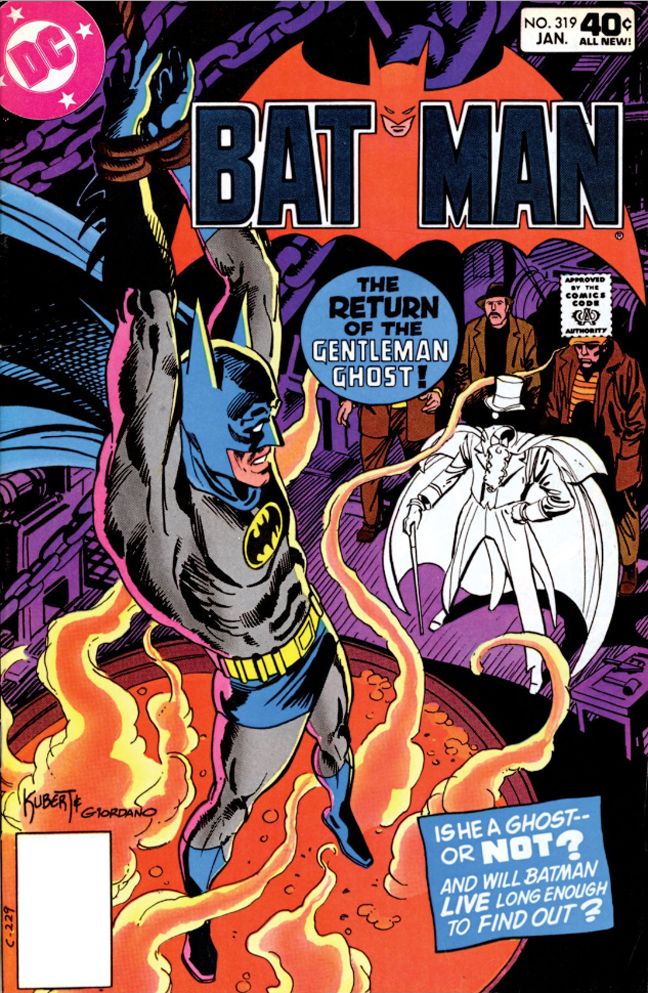
Batman #319 (January 1980) sees Batman and Gentleman Ghost battling once again.  This mean we get a Halloween treat in the form of a spectacular Joe Kubert cover with Batman in pulpy danger, suspended over a bubbling vat of wholesome Campbell's Tomato Soup with milk added.  Just like my dad loved to do!  Dick Giordano inks and the result is as rich and creamy as the soup Gentleman Ghost plans to dip Batman into.  Eerie underlighting and a line quality that's recognizably Kubert but somewhat cleaner and not as expressionistic.

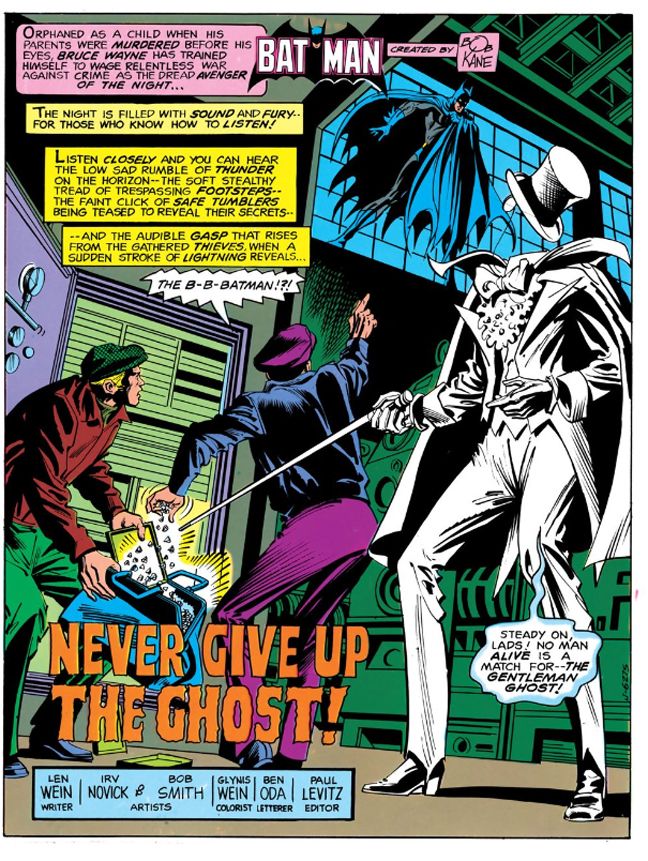
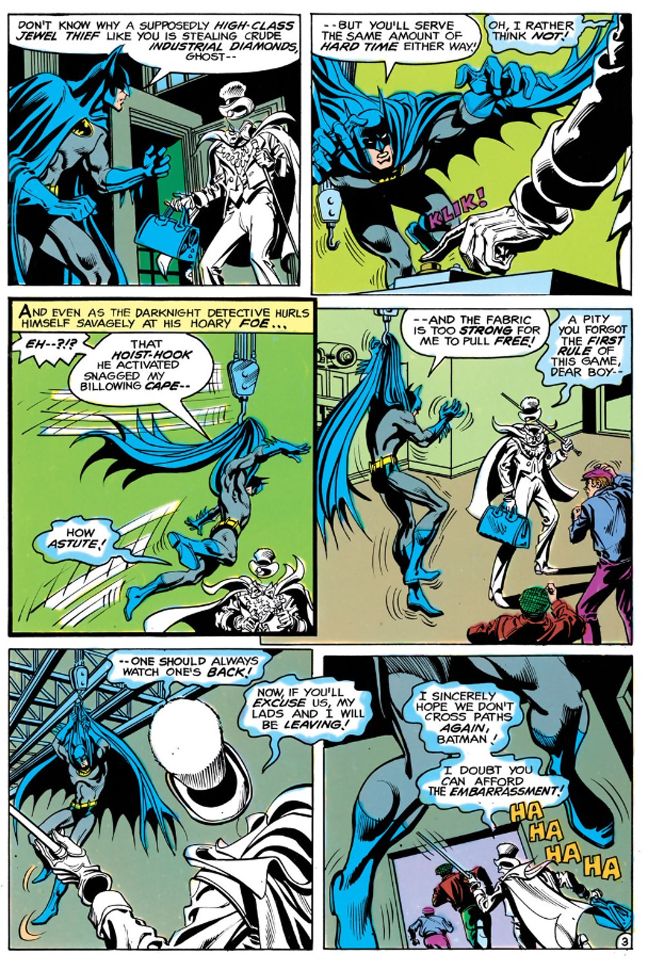
The story starts in mid-action, just like the previous Gentleman Ghost appearance.  Batman once again interrupts the Ghost and his henchpeople in mid-heist and ends up hoisted by his own cape.  While starting stories like this instantly ups the energy level and leads us to expect something rapid-fire and thrilling, there's a danger of this approach devolving into formula.  But Batman's dilemma-- which writer Len Wein points out is self-inflicted due to Batman's cape being rip-resistant, a helpful quality in most situations but not when you need it to tear so you can free yourself from a dangling hook-- proves startling and original in its details.  Wein also uses it to show that Batman, while fallibly human, is also resourceful and dangerous even when apparently helpless.  Never count out the Caped Crusader, as Gentleman Ghost finds before cleverly making his own escape.

Script: Len Wein/Pencils: Irv Novick/Inks: Bob Smith

From there we find Batman setting a trap for the Ghost, with a Halloween-appropriate setting.  He plans a costume ball at Wayne Manor with jewels on display as bait.  Gentleman Ghost finds this irresistible, and once again Batman ends up dangling from a hook.  This time over boiling soup.  I mean acid.  It's not tomato soup.  It's a vat of acid, a wicked comic book convention.  This time Wein shows us the mechanics of a Batman escape.  The story has the feel of someone working through all those classic Batman tropes.  The death traps, the fist fights, goofy henchpeople (somehow the very British Gentleman Ghost has found a couple of very British oafs to help him, one named, fittingly enough, Alfie) and another ambiguous ending.

Script: Len Wein/Pencils: Irv Novick/Inks: Bob Smith

We still never learn if Gentleman Ghost is a real ghost or not.  His lackies disguise themselves as the Ghost as a distraction and Wein suggests the headless quality is mere fakery when one of them is revealed to be merely hunching down.  That doesn't explain the floating top hats or monacles.  Later there's a bit with a convenient hologram projector which also seems to tell us the Ghost is more technological trick than supernatural treat, but Wein leaves the truth of the matter hanging, kind of like his Batman this issue.  You can have it either way.  He's a clever illusionist with a creepy gimmick or he's a creepy ghost with a penchant for high-tech chicanery.

Script: Len Wein/Pencils: Irv Novick/Inks: Bob Smith


It's up to you!

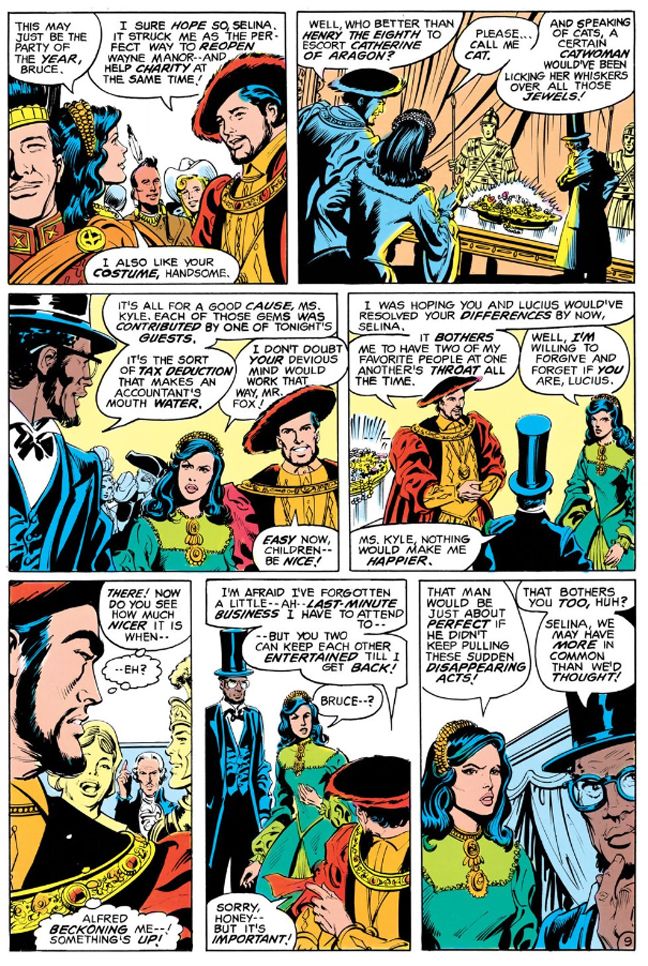
Irv Novick once again pencils, but this time Bob Smith inks.  Smith's line is thinner, sharper, more angular than Giordano's.  Well-defined figures and clarity of action make this issue very appealing throughout.  Batman is almost always on the left side of the panels, inciting things in the proper reading order so you get this forward thrust and momentum that carries through all the way to the end.  With Novick and Smith the crowded costume party has focus and detail, with one wide panel that's a treat to linger on.  Batman comes as Henry VIII, Selina Kyle as Catherine of Aragon ("Please... call me Cat," she quips) and Lucius Fox is Abraham Lincoln.  You can make out a plethora of other historical personages surrounding them and even when the Gentleman Ghost and friends gate-crash, Novick and Smith maintain a clear sense of where everyone is relative to each other.  Even when Selina Kyle and Lucius Fox abruptly switch sides so Fox can occupy the foreground with his thoughtful countenance you're not likely to freak out with the change and fall out of the story.  Good, solid stuff.

Script: Len Wein/Pencils: Irv Novick/Inks: Bob Smith

The issues I've read of this Wein run are sleekly enjoyable reads.  He drops exposition into dialogue and gives us meaty narrative captions to chew on while we enjoy the visual banquet Novick and Smith provide.  Very tasty stuff, the kind that satisfies.

Thursday, October 2, 2014

October is Spookey Month: Batman #310 (April 1979)

Batman #310 (April 1979) is a comic I bought solely for its cover.  Even back then I was a big Joe Kubert fan, and I believed the cover artist always did the interior art.  I was wrong.

Choosing Kubert as cover artist makes perfect sense because he and Robert Kanigher co-created Gentleman Ghost as a Hawkman/Hawkgirl adversary.  Gentleman Ghost debuted in Flash Comics #88 (August or October 1947, take your pick) but I’d never heard of him.  Why?  Because I never read any Hawkman comics.  Never had anything against Hawkman, just wasn’t my thing. 

Joe Kubert, on the other hand, certainly was and still is very much my thing.  Being 11 years old when this comic book came out I had no idea he’d ever done anything other than war comics and Tarzan.  A chance to see him draw a Batman story piqued my interest, but I can’t say the Irv Novick-Dick Giordano team that actually did the inside art disappoints.  They do a bang-up job.  Theirs is my ideal visual representation of Batman.  He has human proportions and he's not always gritting and grinding his teeth to the point where his molars must be just about gone.  He's a serious guy, but he has recognizably human emotions!
 
Here we are 35 years later and I’m still not particularly into Hawkman and my knowledge of Joe Kubert’s long comics career remains spotty at best.  I love his art and still adore this attractive, exciting cover, though.  I just find it odd I’d have an Irv Novick comic and never have it click with me despite coming to appreciate his solid Bat-work from all the reprints I’ve read over the years.  Maybe it’s not so odd.  I once had a Russ Heath Sgt. Rock and didn’t realize it until much later.  Same with a Rich Buckler-Bernie Wrightson Batman book.  I’m kind of an idiot.


Script: Len Wein/Pencils: Irv Novick/Inks: Dick Giordano

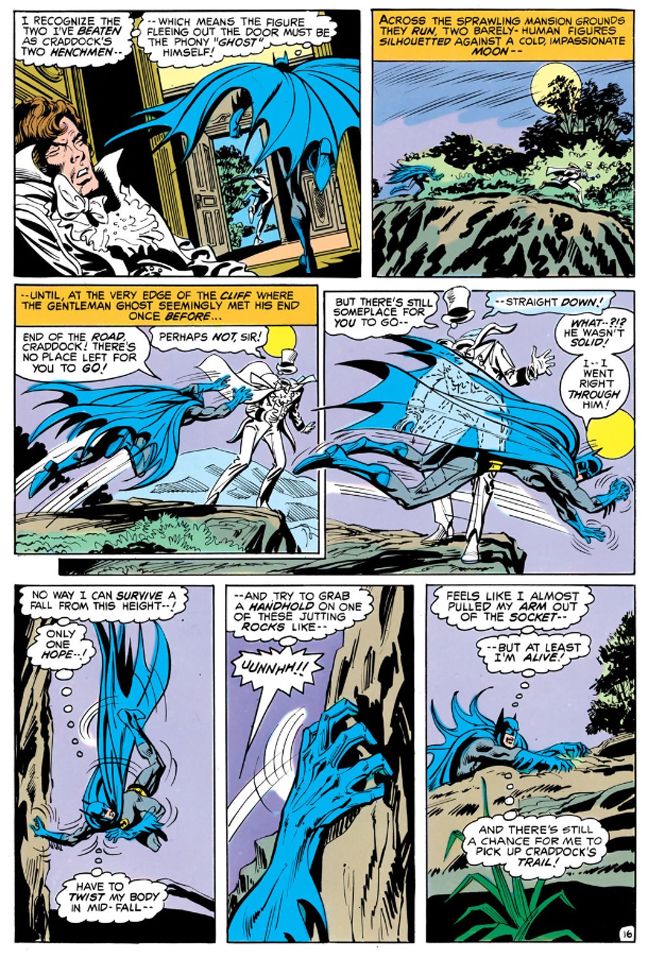
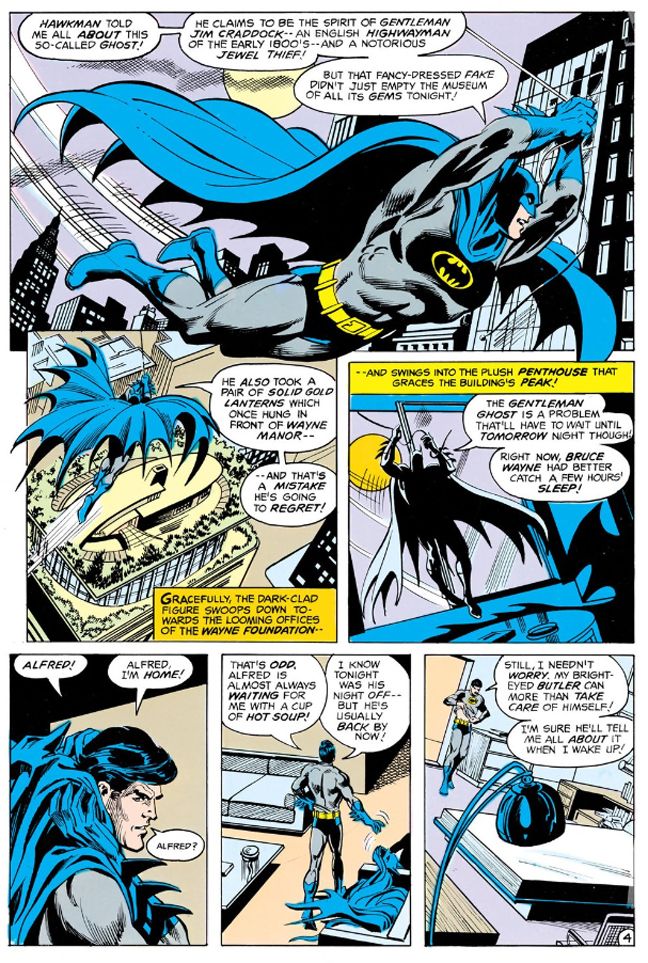
The story, titled "The Ghost Who Haunted Batman," is a jaunty, assured effort by all involved.  It would have made an excellent episode of the 1990s Batman: the Animated Adventures TV series.  Len Wein's script sets up a neat double mystery and wraps it all up in a single issue.  One one hand we want to know why is Gentleman Ghost, known for stealing jewels, suddenly after things like antique lanterns and furniture?  And on the other, where did Bruce Wayne's loyal butler Alfred Pennyworth disappear to?  Wein also plays the whole "is Gentleman Ghost a real ghost, or is he just some clever illustionist with a gimmick?" routine to great effect.  Batman remains pretty skeptical of the supernatural throughout, and when his bat-rope falls ineffectively between Gentleman Ghost's cuffs and gloves, he's disturbed.  But not enough to stop scoffing, as when he sneers, "Mister, you're about as supernatural as my shoe."

No doubt like Batman himself, I distinctly remember expecting some kind of prosaic explanation at story's end.  A special effects artist or magician revealed in an unmasking...

What I admire about this book is how every moment moves the story forward or reinforces the then-current Batman status quo.  There's no waste.  Even for a reader like me, who bought books based on whim and might go months between Batman purchases, could pick this issue up and learn all its players and how Batman relates to each of them.  There's a quick bit of Catwoman romance, a Lucius Fox appearance and even a return visit to Wayne Manor, and yet the central plot remains at the fore.  It's a quick read and certainly no gyp for being self-contained and short.

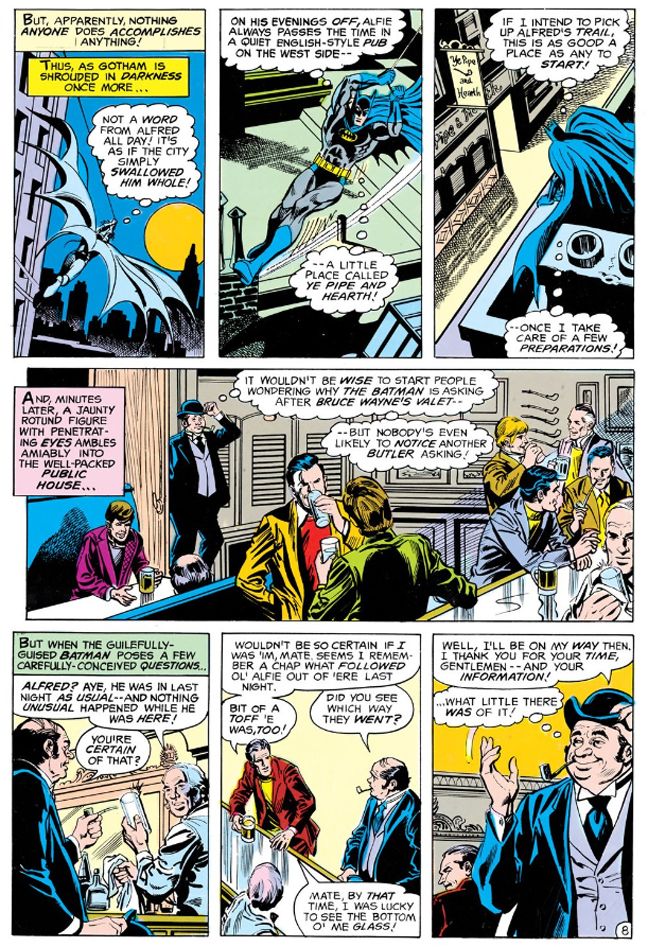
One of my favorite scenes in this book comes when Batman disguises himself as a portly fellow butler to infiltrate a UK-themed bar where Alfred likes to hang out on his nights off and brag to anyone who will listen and buy him a pint about his awesome job with the Waynes.  In the interest of blending in, Batman goes for the old school stereotype complete with bowler and crooked little pipe.  He kind of goes from one panel in his Batman jammies staring down at the pub to the next walking-- the caption tells us it's a mere few minutes later-- in all dressed up with a waistcoat and padded suit.  I'm not sure how Batman pulls this off so quickly when he doesn't even have his Batmobile around to carry things for him, but Wein doesn't let a little detail like this slow the story's pace.

Script: Len Wein/Pencils: Irv Novick/Inks: Dick Giordano

I like to imagine Batman spouting off with a Dick Van Dyke-quality accent and all the ex-pat Brits mocking him after he leaves.  For the story's purposes, Batman probably puts on an accent not only dead-perfect for some particular region of the UK, but also a specific neighborhood.  Came up with a complete biography for this one-off character and everything.  He is a master of disguise, after all.  He's right that it would be odd for Batman to go around asking about Bruce Wayne's butler-- but why doesn't he go in as Wayne?  Because subterfuge is fun!
 
Novick and Giordano lovingly create a creepy, fog-bound mood throughout, turning Gotham City into a vast haunted house.  The atmosphere compares favorably with that ultimate night-bound comic, Marvel's Tomb of Dracula.  And Gentleman Ghost makes an excellent Batman foil.  I’ve always enjoyed Batman stories where he comes up against the supernatural and he’s left a bit befuddled in the end.  Batman benefits from being depicted as vulnerable and not as hyper-competent.  Nowadays he’d anticipate Gentleman Ghost’s every move and have some kind of pre-built anti-ghost device.  In 1979, a hypnotized Alfred could sneak up behind him and knock him out with a heavy gold lamp and he could be deked by an empty suit, then try and fail to save Gentleman Ghost from a carriage crash.  The final scene certainly lives up to the story's title as Batman is left there with the Ghost’s mocking laughter ringing in his ears in one of those ambiguous “just what the heck was that guy?” endings. 
 
Batman and Gentleman Ghost would tangle again shortly and we'll talk about that one when I get the time to read it and react to it.

Friday, November 1, 2013

October is Spookey Month: Swamp Thing fights male and female werewolves!

To end our month-long celebration of Halloween, horror comics and all-girl Japanese pop punkers Spookey, here are a couple of stories where Swamp Thing fights that old school monster favorite, the werewolf.  Male and female varieties.

The first one, Swamp Thing #4 (May 1973) is by Len Wein and  Bernie Wrightson.  They lean on the familiar Universal Studios style, setting their tale in the Scottish moors and within a creepy old mansion.  Their werewolf is the tragically cursed son of some very worried parents.  They're in luck when Matt Cable and Abby Arcane crashland their plane close to their ancestral home, but definitely unlucky in that Swamp Thing is also on board.  This means their plans to use Cable's blood to cure their boy of his lycanthropy (and give it to Cable; but isn't this what any concerned parents would do for their child?) is doomed from the start.

While the werewolf on the cover looks more like a satyr to me, inside the comic itself Wrightson uses heavy black silhouetting for its first appearance, which gives his beastie a very Frazetta-ian touch, almost amorphous in the night fog.  It's very reminiscent in its first appearance of Frank Frazetta's aptly-titled "Werewolf!" from Creepy #1 (1964).  Kind of impressionistic.  Shoot, why am I telling you all this when I can just shut my fool mouth and show you?  Here:


There is nothing not to like about this comic and its classical approach. 

But what a difference a decade makes!   We hear a lot of talk about the "curse of the werewolf," and writer Alan Moore and his merry art crew of Steve Bissette and John Totleben set out to explore what this means both literally and metaphorically-- because there's also this other monthly thing sometimes referred to as a curse.

In Swamp Thing #40 (September 1985), Brit Moore unspools an episode in "American Gothic," an extended story arc where Swamp Thing battles traditional horror creatures suffused darker elements of the United States' national narrative-- the unintended consequences of progress, the preponderance of gun violence, the genocide of Native Americans and the lingering effects of slavery and the Civil War.  This time, perennial fan favorite character John Constantine pits Swamp Thing against something more personal-- the perpetual state of war between the genders, specifically the daily battles waged by a typically American suburban couple.

As with the Len Wein-Bernie Wrightson werewolf tale, "The Curse" is very concerned with blood.  It's just Moore is interested in a deeper exploration of this sanguine symbolism.  Our werewolf this time is a modern woman so empathetic to the anger and resentment felt by long-ago Pennamaquot tribeswomen sequestered in a special lodge (she and her husband live in a house built on the site) while they menstruate she turns into a massive wolf creature and goes on a rampage.  Male privilege has finally loosed a beast, and after a brief fight, Swamp Thing comes to as much of an understanding of the woman's plight as a male-gendered plant elemental can.

Tragically, our tragic werewolf is a stand-in for all of womankind, so she learns there's another aspect to this blood curse-- women are bound by it to men and vice versa.  As a result, she cannot bring herself to kill her husband (even though she contemptuously notes he's "soiled himself" from fear).  Giving in completely to her primal, savage anger, she crashes through the front window of a pornography shop where a customer has just asked the cashier to show him something he euphemistically refers to as more "unusual."  Perhaps as a matter of tastefulness, we aren't permitted to see the resulting carnage.  In the end, Swamp Thing cannot offer succor and the werewolf impales herself on the knives in a supermarket display, ironically labeled, "Here's good news for housewives!"  The supermarket setting itself represents the sterilizing effect consumerism has on our lives and its place in the continuing subjugation of female power, having been referenced satirically in the same vein by Ira Levin's 1972 novel The Stepford Wives and its 1975 film adaptation.


And with our tale of two lycanthropes, we bring this year's Spookey Month to a close!

Sunday, October 13, 2013

October is Spookey Month: Star Trek #19 in which a space criminal is frightened into incontinence...

The original Star Trek series sometimes combined science fiction with straight up horror, maybe softened a bit by a little dialogue about an "energy source" that creates whatever magic Kirk, Spock and the rest come up against.  But the idea was still using the old cliches to fill fifty minutes worth of story without being so obvious about it.  The very first episode to air, "The Man Trap" (September 8, 1966), featured a "salt vampire" that was pretty much just a version of a regular vampire story dressed up a little for a futuristic setting.  The crew met a witch in "Catspaw," written by Psycho author and H.P. Lovecraft protege Robert Bloch.  It ran just in time for Halloween (October 27, 1967, to be exact) and came complete with a black cat and a gothic castle.  And let's not forget "Wolf in the Fold" (December 22 the same year), also written by Bloch.  That's the one where we find out Jack the Ripper was possessed by some kind of immortal, incorporeal entity that feeds on fear.  When it gets into the ship's computer and starts screaming "RED JACK!  RED JACK!" over the intercom, Trek for the first time managed to scare me silly.  Even reading the James Blish short story adaptation of that particular episode frequently gave me the willies, the heebiejeebies, the whimwhams or small pox.


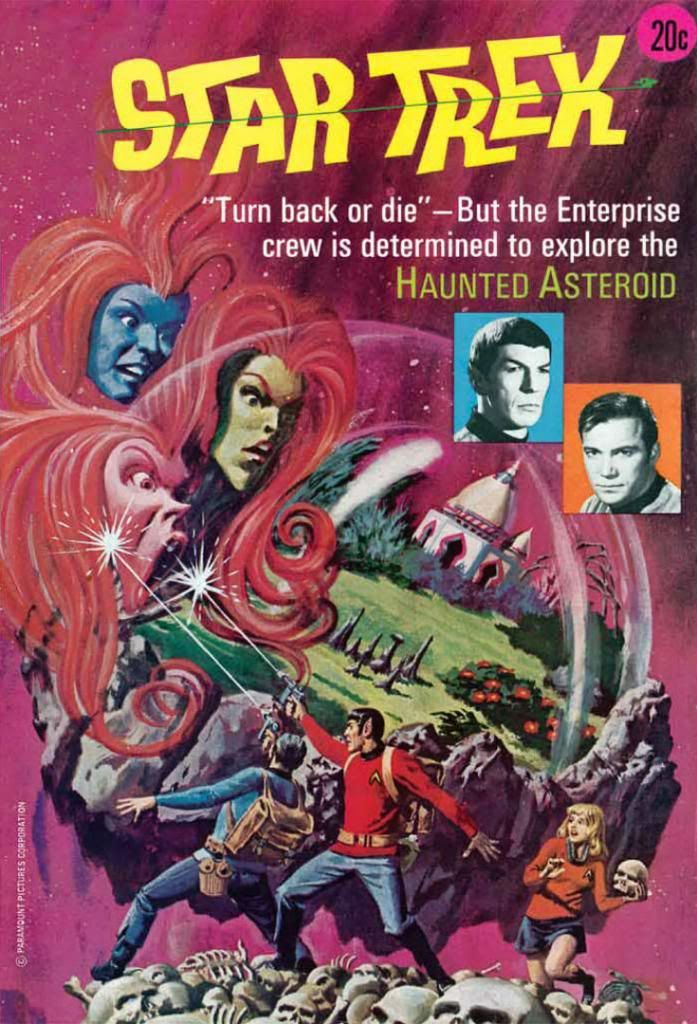
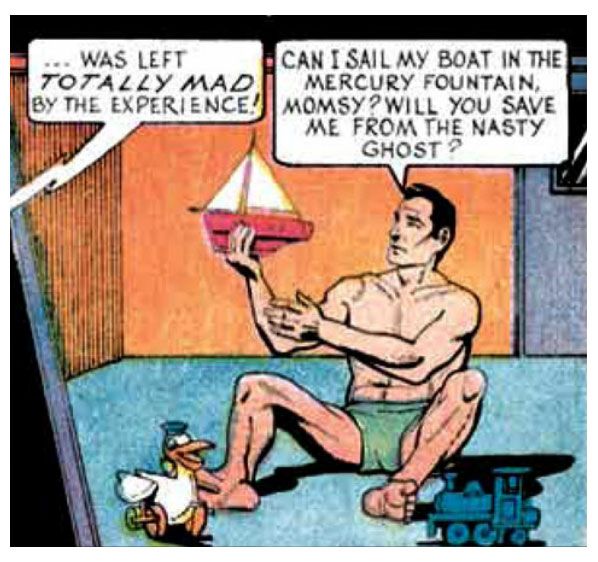
The Gold Key Star Trek comic adds ghosts to the mix in #19 (July 1973) , where (according to Comixology at least) writer Len Wein-- of all new, all different X-Men and Swamp Thing fame-- presents our daring space explorers with a supposedly haunted asteroid where something fearful dwells.  How fearful?  So fearful that after encountering it, this poor guy reverts to childhood and has to wear diapers for the rest of his life:


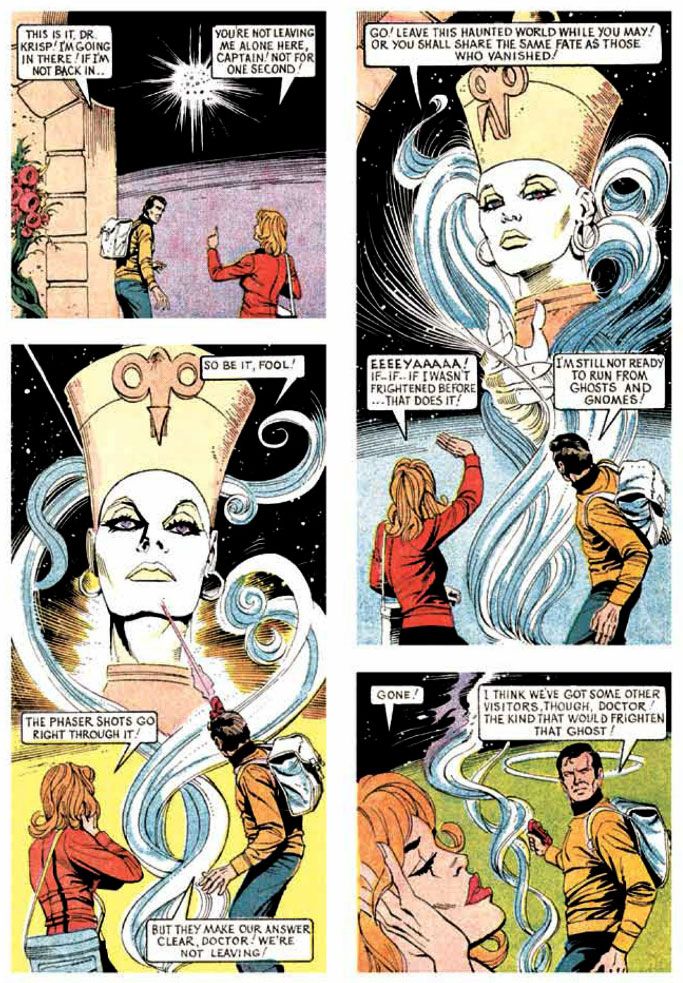
Because Starfleet favors the empirical over the metaphysical, the Enterprise warps to the asteroid for an investigation.  Kirk's old Academy pal Jay Nordyke goes down and comes back with selective amnesia.  Hypnotic regression reveals he's erased from his memory a horrifying encounter with a ghost.  At least he can still function as an adult.  Kirk, Spock, Sulu and some others beam down to check things out and gamble they're mentally tough enough to stay grown ups and in control of their bowels no matter what they face.


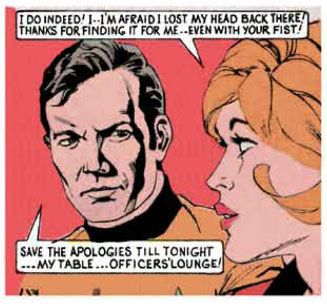
Aiding the ghostbusting is Dr. Krisp (first name Cookie) who, despite wearing a smart black skirt, proves a bit shaky in the field.  She and Kirk get down... to business (get your mind out of the gutter, please) and solve the mystery.  It turns out it's more science than supernatural, a variation on the old Scooby Doo, Where Are You? ploy of someone pretending to be a ghost to frighten people away when we all know that would only attract hordes of macho jackasses with night vision video cameras and heat signature detectors and a whole lot of pseudo-scientific bullshit to run around shouting at the walls for SyFy.


By borrowing heavily from the story of the Taj Mahal, Wein does a sweet job of setting up and then explaining the mystery.  There are some characteristically goofy moments because it's Gold Key, like hardened space travelers trained in scientific observation screaming "zombies" when what they're looking at is patently something else with which they should be very familiar given the Federation's technology.  And I love Alberto Giolitti's off-model artwork.  He sometimes all too obviously uses photo reference for some portrait-style panels, but most of the time it just seems like he had only the vaguest idea about the property he was working on.  As a result, a few things have been lost in translation, but a lot of charm has been gained.  Giolitti's art has its own Giolittian flavor, kind of fusion cuisine, some Trek, a side of Flash Gordon, a liberal dollop of European comics.  In the end, it proves a deliciously satisfying yet wild stew of different ingredients.  The exterior of the mausoleum looks Mughal, the interior gothic, the costumes strictly Ancient Egyptian.  At the same time, that's not too far from what the show itself used to do, where the set and costume designers seemed to lean on whatever was available in the prop and wardrobe departments at Desilu.

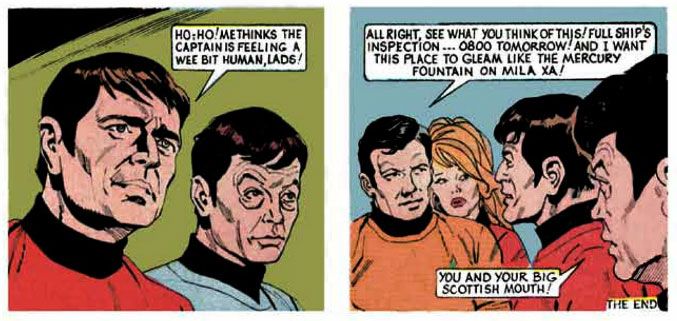
The ultimate solution is a surprise, but it fits the evidence and it's also made of stuff that's very familiar to Trek fans, so we'll accept it.  Or not.  That is to say, I'm fine with it but you'll have to make up your own mind.  This sets up a more traditional Star Trek dilemma where the crew now knows exactly what it's up against but still has to figure out how to escape an overwhelming power.  It helps that Sulu reveals himself to be a champion gymnast and Scotty a champion weightlifter.  I've always considered myself a solid Trekker, but I can't for the life of me remember either man possessing those skill sets.  I know Sulu is an expert fencer and botanist, and that Scotty can drink anyone under the table be it Klingon or godlike evolutionarily advanced super-being.  Neither of those apply here.

And what is it Kirk is good at, better than any other man?


Being a hard ass.

Tuesday, September 24, 2013

X-Men #94: Nefarious Nefaria and how he blew a fortune

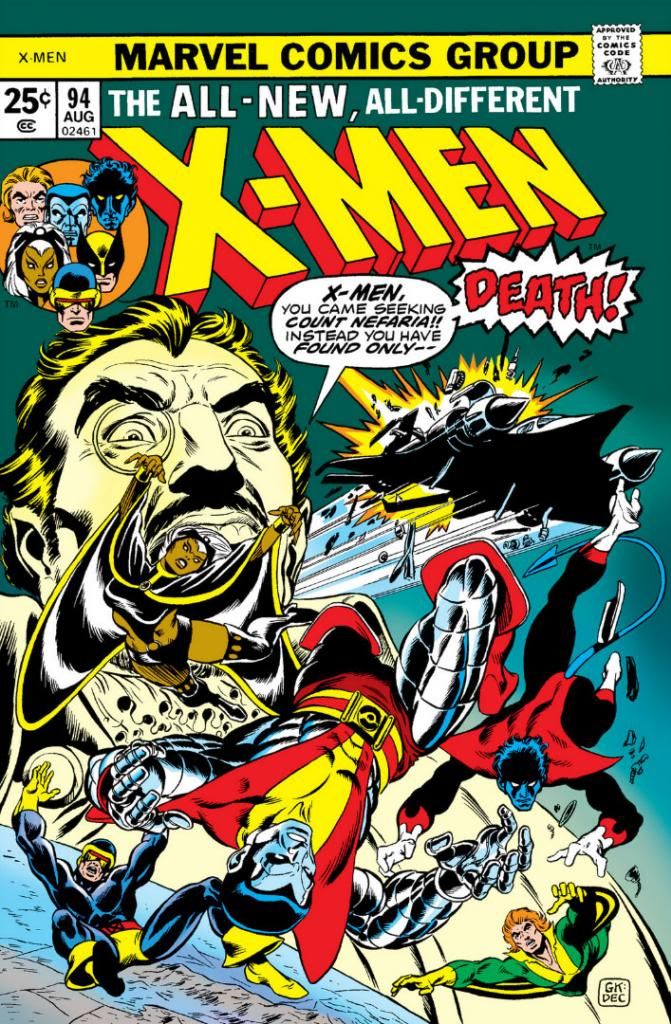
X-Men #94 (August 1975) was the first X-comic I owned.  A friend's mother worked for a regional magazine distributor and he got the leftovers.  This kid had piles of comics in his room, but he kept the X-Men issues in a cabinet in the living room for whatever reason.  Probably anti-mutant bigotry on his part.  After all these years I can't remember why he decided to sell some comics to me that day, nor can I remember why I wanted to buy them.  I liked comics, knew the difference between Jack Kirby and Alex Toth, loved Joe Kubert's art and had already discovered Al Williamson.  I just don't remember being comics crazy, but I was a junior high sequential art connoisseur of sorts because I loved drawing.

So years later, I'm going to claim it was the Gil Kane/Dave Cockrum cover that caught my fancy.  Even now, this cover impresses with its high (literally) drama and contorted heroes hurtling earthward to their deaths.  Well, except for Banshee, who seems to be flying to the rescue.  Poor Storm has completely forgotten she knows how to ride the winds-- and note Wolverine and Thunderbird don't even rate appearances!  Even without those two adding to the excitement, it looks kind of like Count Nefaria (the guy with the giant white head) is barfing mutants.  That characteristic Kane up-the-spout shot of Nefaria's face influenced the heck out of me for the next few years and I drew noses from that angle blacked in so I wouldn't have to work out the difficult low-angled perspective of the various nasal planes.  It seemed an elegantly simple solution to a drawing problem that had me stumped.  And you absolutely cannot beat the energy of Colossus in the foreground, boldly sporting primary colors of red and yellow.  Barfed or falling, that figure practically bursts from the picture plane and lands in your lap.  I probably bought the comics because I wanted to draw this particular cover.  I still do.  Good gravy, I love me some Gil Kane! 

My friend and I worked out a little deal where I paid him all the money I had in my pocket with a promise for more.  I think the original deal was supposed to be twenty bucks for a stack of books that, amazingly (or uncannily, if you will) included the first five or six issues of the "All-New, All-Different" X-Men.  In the end, I forked over a grand total of fourteen dollars and  the use of my left-handed baseball glove in P.E. a couple of weeks later.  By the time my pal and I completed the transaction on that long-ago spring day, I was in completely in goo-goo-ga-ga love with comic books in general and X-Men in particular.
 
Enough biography.  Let's read!

"The Doomsmith Scenario" introduces us to a man who has access to a matter transporter (maybe he invented it; the story never says where it comes from) and has also used some kind of genetic technology to mutate humans into anthropomorphic animal weirdos (which, admittedly, is a process that has fewer immediately-apparent practical applications).  Rather than launch a second Industrial Revolution by transforming the travel, transportation and medical industries and reaping billions, if not trillions, in ongoing profits, all he can think to do with this technology is invade a military base to hold the world hostage for a one-time payoff.  Granted, that involves each nation paying as much as it's capable, but it's still taking a huge risk versus a guarantee of unprecedented wealth if he just patents his tech and sells, sells, sells.


His name is Count Nefaria, and he is one of the most visually boring antagonists I’ve ever seen.  I believe these days he's some kind of immortal energy being, but when this book hit the spinner racks, Nefaria was just a goateed twerp in a suit with a ruffled shirt and evening cloak, a second-rate Bela Lugosi impersonator.  Off-the-rack, ready-to-wear, one-size-fits-all villainy.  His name essentially means Count Bad Guy, just to further illustrate how little effort went into his creation.  We can argue that dumb names are a hallmark of ol' Marvel.  I certainly will... Doctor Doom.  But to look at the magnificent Doom is to understand Nefaria's generic quality.  The Avengers dealt with the Count in #13 (February 1965) of their own book-- the synopsis of which makes the story seem completely interchangeable with just about any found in other Marvel team titles of the era-- and the unfortunate X-Men get stuck with him in the first regular issue of their revamped title. 

Our kid Nefaria and his Ani-Men invade Valhalla Mountain, home of NORAD’s super-sensitive defense center.  Despite looking like refugees from a line of He-Man knock-off toys, the Ani-Morphs or Ani-Men (one of whom is female, by the way) quickly subdue thousands of armed soldiers and military police who don’t simply shoot them on sight. 

The Ani-Men have the advantage of surprise for a few minutes, plus they're fast and strong.  That's more than enough to defeat the first bunch of uniformed slackers.   After that the entire base is on alert, yet the troops commit themselves piecemeal and not one soldier or airman gets off a shot despite being armed to the hilt.  They don't even try to shoot.  They must have been trained to use their rifles as clubs, and badly at that.  After this inexplicably incompetent response by our armed forces, Nefaria gasses everyone else to sleep.  It's just that easy for our tuxedo-wearing criminal genius.  I understand that in 1975, our armed forces were doing some serious soul-searching as the country emerged from the prolonged humiliation of the Vietnam War, but even the Mayaguez incident had a more satisfying military conclusion than this Nefaria deal. 

Of course, if we closed this plot hole we'd have a five page story where the X-Men watch a news report about a strange incident where Nefaria and the Ani-Men died in a hail of gunfire, and the rest of the comic would consist of pre-Thor Journey Into Mystery reprints.  That would never do, so the men and women guarding the United States' most important and secure military installation allow themselves to get their asses handed to them and, with the Avengers conveniently shelved, it’s up to our new X-Men to fly in and try to save the world.

Which they eventually do, but not before Cyclops spends an entire night roaming the halls of the mansion and bellowing his despair to the world, the original X-Men say a tear-filled farewell and a training montage where Thunderbird injures himself and Cyclops plays drill sergeant.  Since Chris Claremont takes a little time in his dialogue and thought-balloons to give both men clear motivations for what they do and how they act (Thunderbird is insecure, Cyclops is seasoned professional who has seen too many deaths and injuries in his time), the conflict between them works better than the seemingly random arguments that plagued Giant Size X-Men #1, where characters sniped at each other on practically every page and with no good reason.  It also pays major dividends in X-Men #95, but that’s a story for another day.

Penciller Dave Cockrum already had experience with group books, having worked on stories featuring the Legion of Superheroes in Superboy over at DC, and he co-created Nightcrawler, Storm and Colossus for this book.  Oh, and he drew the aforementioned Giant Size.  You'd imagine drawing a living island would tax a guy's creative faculties.  Not Cockrum's.  And here?  Wow, the man just absolutely cuts loose.  He must have wrecked his drawing hand filling panels with detailed backgrounds-- his Valhalla features a gargantuan situation room with elevated walkways between digital maps that must be hundreds of feet high to judge by the teensy-tiny antlike figures teeming all over. 

I remember being especially impressed by the training sequence and a collage-like one-page panel centered around Cyclops’s giant shouting head.  I copied that head line-for-line on notebook paper dozens of times over the next few years, always hoping to glean those Cockrum art secrets.  With the fine-lined inking of Bob McLeod giving the figures a bit of roundness and generally introducing a little bit of a Neal Adams-vibe, Cockrum's dynamic art dazzles.  It's pretty.  I mean, X-Men #94 has some of the prettiest art of its era.  I look at it and I feel joy.

Part of that joy comes from the absurdity of it all.  The first half of this book tends towards the talky, which leads to what I think of as a very fun kind of dissonance, like having a company of acrobats in spangled costumes perform Arthur Miller.  At one point, angry Japanese hero Sunfire scolds Professor X starting in the X-Mansion living room, but concludes his rant thousands of feet in the air above it.  All alone.  Well, the Professor is a telepath, so he probably read Sunfire's thoughts or something.  When Dave Cockrum provides the acrobats at least you’re getting a primo Cirque du Soleil version of Death of a Salesman.  Come to think of it, I’d pay good money to see that.

Since these are by far the best and most entertaining parts of the book, I kind of get the idea Chris Claremont would have been content to have his characters actually hang out around the mansion and watch Nefaria die a pathetic death on television while carrying on various conversations about their feelings and why they're sticking with Professor X.  Cyclops may look a little ridiculous expressing his essential dilemma, but at least Claremont gives him one.  All these years later, it's easy (and fun!) to parody Chris Claremont's more precious elements (many have, including this blogger) which would eventually overwhelm the book, but the man knew how to invest his audience in the characters and their dilemmas in a way that obsessed readers as never before.  When I was 14 years old, I was more emotionally involved in Kitty Pryde and Dani Moonstar than I was in the flesh-and-blood kids of the same age surrounding me at school, and Claremont made it good to feel that way.

But oh yeah-- superheroics!  Let's get back to Count Nekot Wafer.  After the tearful goodbyes and character-building, the X-Men finally get the call to action.  With almost all the pages already used up, the story ends on a cliffhanger, the X-Men falling to their apparent deaths as the result of a “sonic disrupter” Count Nefaria finds in Valhalla’s arsenal.  A sonic disrupter is a magical death ray that can disintegrate a supersonic aircraft but leave its passengers intact.  Pretty selective!  And yet we had to settle for a tie in Southeast Asia.

You can’t tell me any country that can produce a weapon like that and surround it with thousands of armed troops is going to tumble its nuclear warfare nerve center to a ragtag group even Dr. Moreau would discard as failures.  Then again, what is Marvel paying all its mutants for?  We’ve got the colorful suits, we’ve got Colossus and Storm and Wolverine.  Might as well use ‘em!

Friday, September 20, 2013

Let's take a fond look back at Soviet-style collective farming with our pal, Piotr Nikolaievitch Rasputin

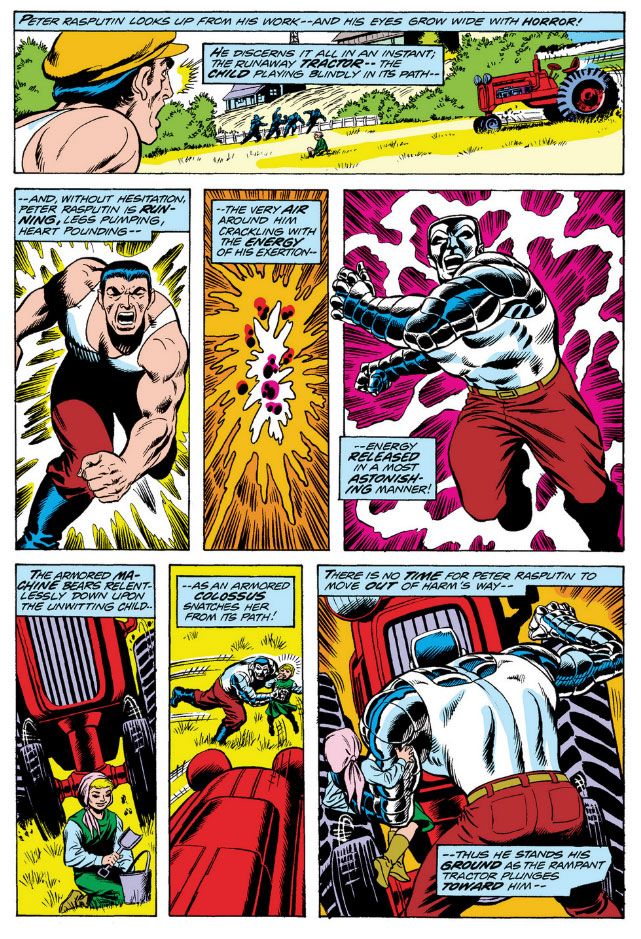
I'm sure many of you out there in Comic Book Land wax nostalgic for the glory years of the Union of Soviet Socialist Republics and its socialist paradise.  From 1920s to the Soviet Union's dissolution in 1991, agriculture there took place on kolkhoz, or farming collectives.  And it was on one of these collectives a true hero of labor was born and lived his early years.  His name is Piotr Nikolaievitch Rasputin, but he is better known under his revolutionary nom de guerre, Colossus.


Piotr Nikolaievitch was born on the Ust-Ordynski collective farm in Siberia.  At some point in his early teens he manifested an unusual power-- he could transmute his flesh to living metal, increasing his strength to that of one hundred Stakhanovites.  Soon the young man began producing several times his daily quota, which benefited his comrades and the state greatly.  And it was there in the beautiful wheat fields of his motherland Piotr Nikolaievitch attracted the attention of noted capitalist psychic Professor Charles Xavier, who, as leader of a team of superheroes and despite his counter-revolutionary upbringing, had become something of a champion of collectivism (albeit allowing his charges to sport outlandish, individualistic garb).  The Professor appealed to young Piotr's desire to learn to harness his powers in the interest of the workers of the world.  And so it was the strapping lad left the farm and dared the decadent West.

 
The state began collectivizing agriculture with the First Five-Year Plan, which called for the organization of 20 percent of arable land into collectives.  The Central Committee decided in 1930 to extend this to most of the country's grain-producing areas.  Stalin took a hand with his Urals-Siberian Method, which essentially forced the farming people of those regions to surrender their grain to the state.  Stalin's civil servants also seized farm equipment and livestock, their slogan being "Eliminate the kulaks as a class!"  The peasantry resisted.  A kind of civil war erupted, with peasants killing livestock rather than surrender it, but forty years later in Giant Size X-Men #1 (May 1975), written by Len Wein and illustrated by Dave Cockrum,  readers find the Rasputins living a Spartan yet idyllic existence.  By then Nikita Khruschev had denounced Stalin himself in his famous 1954 "Secret Speech" to the Communist Party's Twentieth Congress, the Cuban Missile Crisis had come and gone, also Czechoslovakia, the Vietnam War and the world relaxed a little bit during the thaw era under presidents Richard M. Nixon and Gerald Ford.  The time was right for a nice boy like Piotr to leave the collective and make his mark in American superhero funnybooks.
 
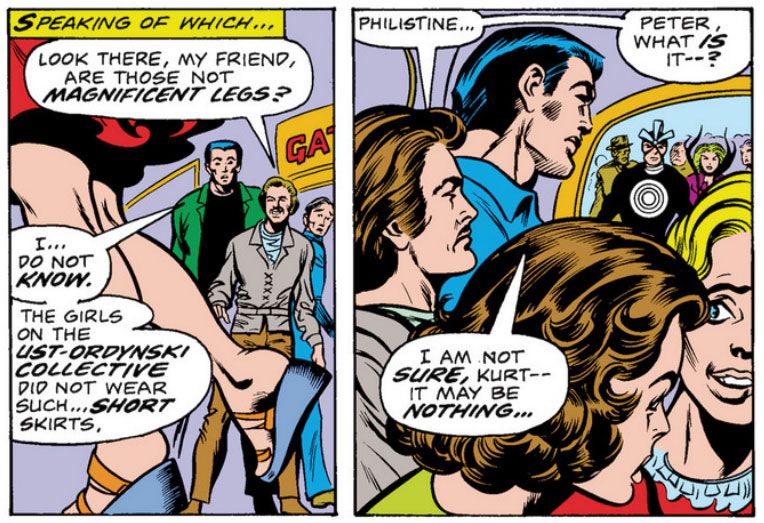
Compared to previous comic book portrayals of communist countries as Orwellian nightmare realms, this new view startles in its National Geographic picturesqueness.  Whether in the west or inside the communist sphere, farming remains a dangerous business, however, and Wein presents a convenient tractor accident by way of demonstrating Colossus' powers.  The raw, farmboy version of Colossus comes across as kind of a Soviet Li'l Abner in his first appearance and again in X-Men 97 (February 1976) where he and his pal Nightcrawler-- who at this point in his character history uses an "image inducer" to disguise his natural blue-furred appearance-- engage in a little girl-watching.  Chris Claremont provides a little fish-out-of-water humor, which artist Cockrum emphasizes with a perfectly chosen "camera" angle.
 
 
It's more a cultural moment rather than a political one.  Claremont doesn't have Colossus denounce western immorality.  Rather, Claremont has the lad make it more personal level, as a young man who has lived a very sheltered sort of existence-- not much different than some guy from a ranch in Montana, for example-- encountering a flash of skin for the first time.  Colossus isn't sure of it, but he's learning. 
 
Colossus' home country lasted just over a quarter century more before its economic and political systems could no longer sustain themselves.  At that point, the USSR collapsed and divided itself into independent nations.  The Cold War had ended, leaving the world with ever-more complex and confusing struggles, but these vintage X-Men comics capture a moment in geopolitical history when two vast powers with ostensibly opposite philosophies faced off through diplomacy and proxy wars across the globe, but the comic book creators from the English-speaking one were willing to humanize the foe and add nuance to their portrayals of our differences.
 
A few years before Piotr Nikolaievitch would more than likely have been a member of some commie bunch of X-Men counterparts the home team would fight to prevent some kind of moon shot sabotage or balance-of-power altering assassination.  Star Trek's Pavel Chekov prefigures Colossus' positive portrayal (even as the show's Klingons exploited the old commie/Cossack/Mongol horde tropes), but during the Seventies and before the Soviet invasion of Afghanistan and the "Evil Empire" rhetoric of the Ronald Reagan administration, Wein and Claremont present their metal-skinned hero as a decent kid.  Chris Claremont would later reveal Colossus as a talented painter in his own right, a nice contrast to the character's hulking appearance and job as team muscle, fully rounding-out Marvel's favorite Red.  His question to Professor X about whether or not his powers should belong to the state shows Colossus is very much a product of his system, but he's basically good-hearted and kind.  Sort of like the submarine crewmembers from Norman Jewison's 1966 comedy The Russians Are Coming, the Russians Are Coming!
 
Once the regular series starts, Colossus doesn't spend a lot of time trying vainly to re-educate his teammates with Leninist dialectics.  Or any at all, if I remember correctly.  The only time his politics really come to the forefront is in The Uncanny X-Men #123 and 124 (July and August 1979).  During a battle with Arcade a mind-controlled Colossus turns into exactly the kind of stereotype Wein and Claremont so carefully avoided-- the Proletarian.  It's a powerful switch, and with it Claremont gives us a satirical taste of the stuff Marvel printed in the 1950s, when Captain America wasn't frozen in ice but actively combating the International Communist Conspiracy and possibly flouridation of water, as well.
 
Since superhero comic book characters age very slowly (if at all), and because I've long since given up following current continuity, I'm not sure how Marvel handled the Soviet Union's dissolution.  The most recent X-Men story I've read-- the Joss Whedon run-- didn't address it at all.  Colossus was just there, as apolitical as he'd always been.  It seems unlikely a guy like Colossus, who was in his late teens when he first appeared and must only be in his twenties or early thirties now, could possibly have grown up under communist rule on a collective farm.  Maybe he's just a simple Siberian farm boy without the political ramifications.  Maybe he always was.

Friday, June 28, 2013

A look back with Swamp Thing: Careful! Scientists at work!

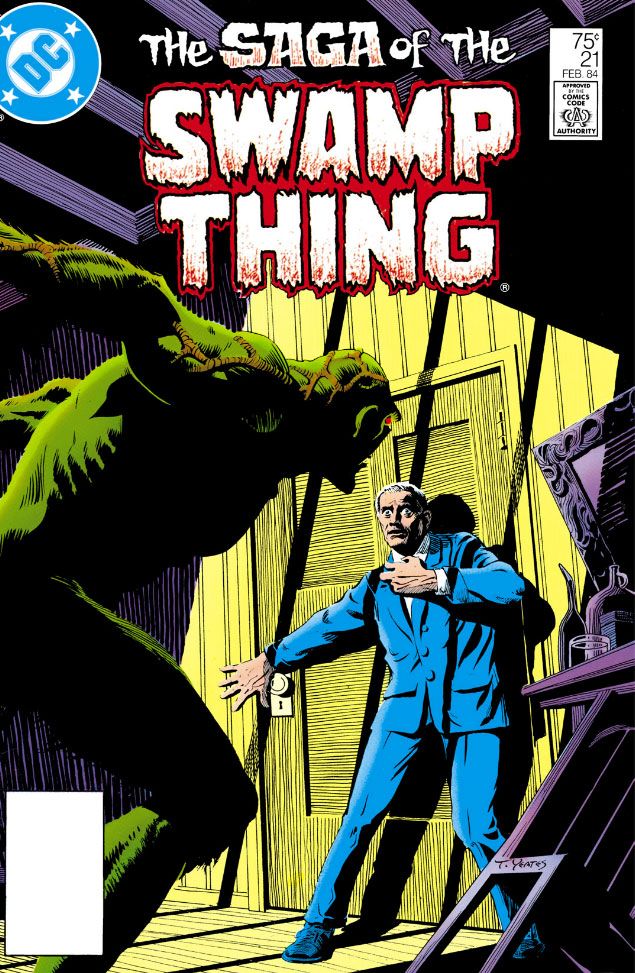
The Saga of the Swamp Thing #21 (February 1984), huh?  This is where our old pal Alan Moore made his American reputation by doing that Alan Moore thing of taking a previously existing character, picking it apart and figuring out what it's all about, then putting it back together in a startling new configuration.  Figuring out those implications previous writers either hadn't considered or considered and didn't know how to deal with.  Which character am I talking about?  General Avery Carlton Sunderland, CEO of the Sunderland Corporation.

Just joking.  Sunderland was a bastard before this issue and he continues being a bastard all through it.  But Moore had Sunderland make a little suggestion that got me to thinking about Alec and Linda Holland and just what kind of scientists they were.

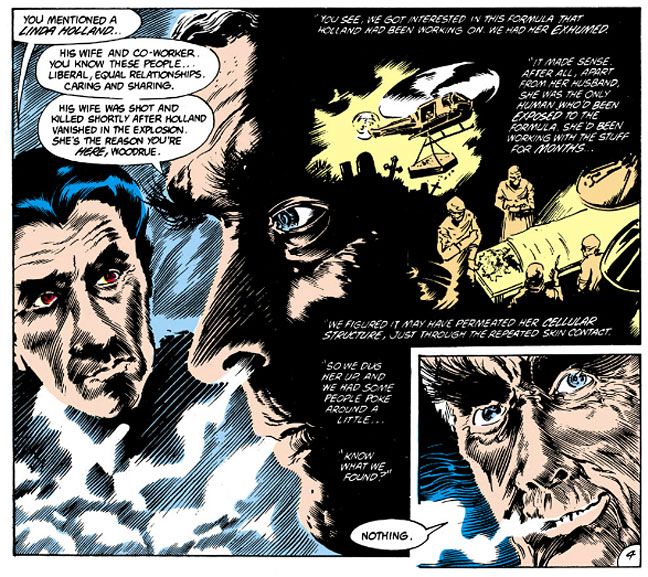
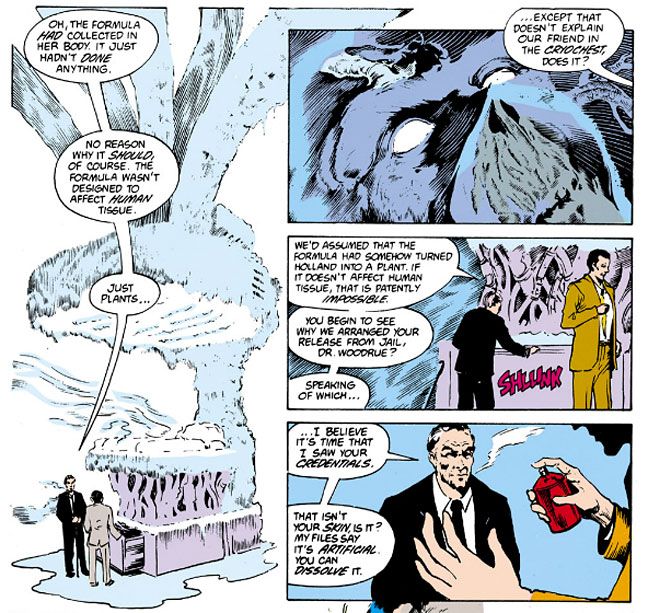
Introduced by Martin Pasko and Tom Yeates way back in The Saga of the Swamp Thing #6 (October 1982), Sunderland bedevils the hell out of Swamp Thing and his friends.  Somewhere along the way, Sunderland became interested in the biorestorative formula Alec and Linda Holland were working on-- the one that led to their deaths and the creation of Swamp Thing.  Conventional wisdom at the time said Alec Holland's cells were saturated with the formula by a lab explosion and this is what transformed him into a plant creature when his burned body fell into the biologically-rich environment of the swamp.  Since Swamp Thing is a little difficult to come by in order to gain a sample of the formula, Sunderland goes to another source and has Linda Holland's body exhumed and examined.  His researchers find the formula "had collected in her body as well."

People's bodies pick up chemicals all the time from their environment.  If you work around toxins (for example, at an asbestos manufacturer or for the Kardashians), you take precautions, but there's always a risk you're going to introduce into your system dangerous chemicals.  And even if you don't, you may be highly exposed to substances you've never imagined right now simply due to your lifestyle.

Both Hollands knew the hazards of working with chemicals-- you treat any chemical as potentially dangerous and attempt to limit your exposure; I've had to read OSHA forms just to work with photocopiers-- and would have taken at least basic precautions.  And even if they considered the chemicals completely safe, they would be concerned about contaminating their work.  At the very least they would have worn goggles, smocks and gloves.  If the chemicals were toxic enough, they would have worn respirators or air-tight suits.  And if the substances were even more dangerous than that, the Hollands would have worked from behind protective glass of some kind.  But apparently, all of this was just not enough.


And it lead to tragedy.  That aforementioned conventional wisdom-- what Sunderland and associates are operating under as this story begins-- states the formula transformed Holland.  Moore quickly disposes of this by having Sunderland remark there was no reason the formula would have affected Linda or, by extension, Alec.   It doesn't matter that Alec underwent a violent chemical reaction involving large amounts of the formula or that Linda had some in her cells as well when she was merely shot, embalmed and buried.  Their magic formula wasn't designed to work on human or animal tissue, only plant.  This sets up a major revelation partway through this issue, one that changes almost everything about Swamp Thing.  However Swamp Thing emerged, the central tragedy of this doomed couple always comes back to the biorestorative formula they worked so hard to create in hopes of feeding a hungry world.

And because Sunderland's piqued my curiosity, I'm wondering just how much of the biorestorative formula Linda's body contained.  Can we find out?  Of course.  Maybe not the exact amount, but we can at least make a rough estimate by engaging in a little time travel, a power unfortunately denied all the poop heads working for King Hell Poophead General Sunderland.

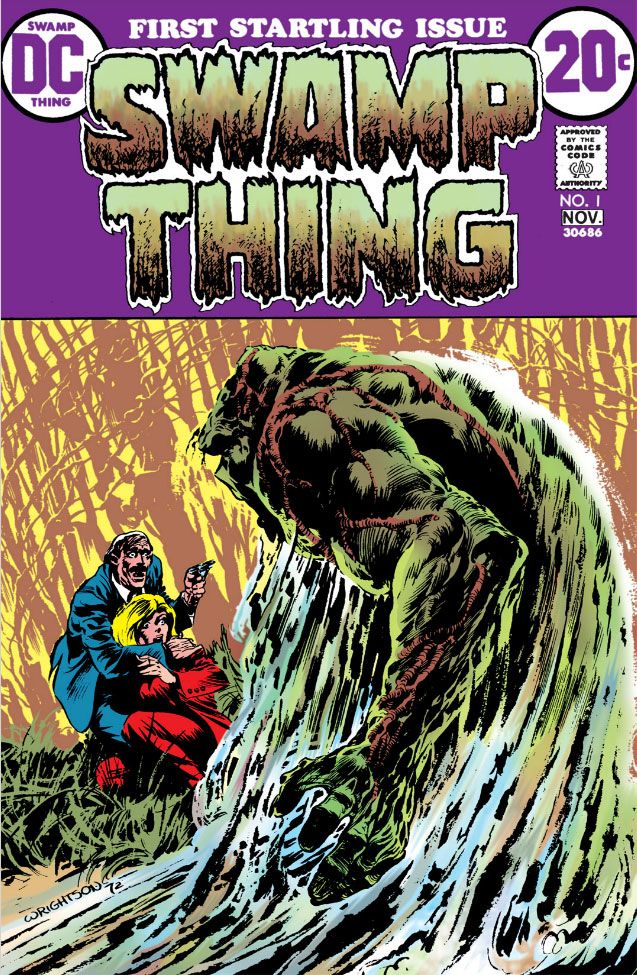
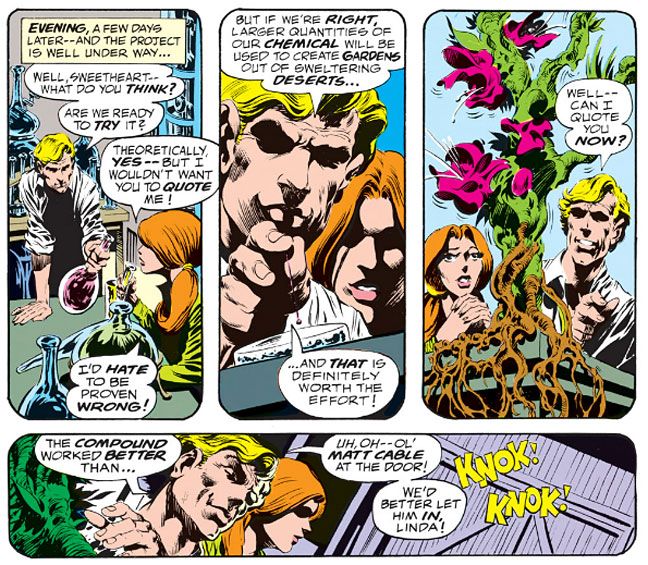
So let's journey back to November 1972 and look at Swamp Thing #1 by Len Wein and Bernie Wrightson.  Before we see what conditions the Hollands operated under, allow me to point out just how stupid it was of the government to put the two of them out in a swamp in the first place... for security purposes.  The government was so worried about the biorestorative formula falling into the wrong hands, they sent its creators to an easily-accessed farm house in a remote swamp and then protected them with a single police car.  In the DC universe, the Manhattan Project took place at a Mardi Gras party in New Orleans.


Okay, now lets see how these two genius smarty brain people carry out their research.  Wrightson probably drew a ton of cool-looking safet-- GOOD LORD!  Look at that!


They may have gotten results, but clearly the Hollands were an accident waiting to happen.  I'm surprised they didn't just eat or drink the stuff-- give it a grape flavor, add carbonation and throw themselves a Biorestorative Soda love-in on live television.  Now I'm thinking Linda Holland had LOTS of this junk in her system.  And when you think about all the fungi and microscopic plant life the human body contains--

It's probably just as well Alan Moore didn't put much thought into those gruesome possibilities!

Tuesday, October 30, 2012

October is Spookey Month: Anton Arcane's Un-Men enjoy the refreshing taste of 7 Up, the Uncola

And in the interest of complete disclosure, I must admit I do, as well.  And why not?  7 Up is crisply delicious.  When one tires of those everyday, commonplace colas, it's pleasing to do what the Un-Men do and indulge one's palate with 7 Up, the Uncola, which isn't made using cola nuts.  7 Up is made using un-cola nuts:  lemons and limes.  So in this, the Un-Men and I are completely in agreement.  In all other things, however...

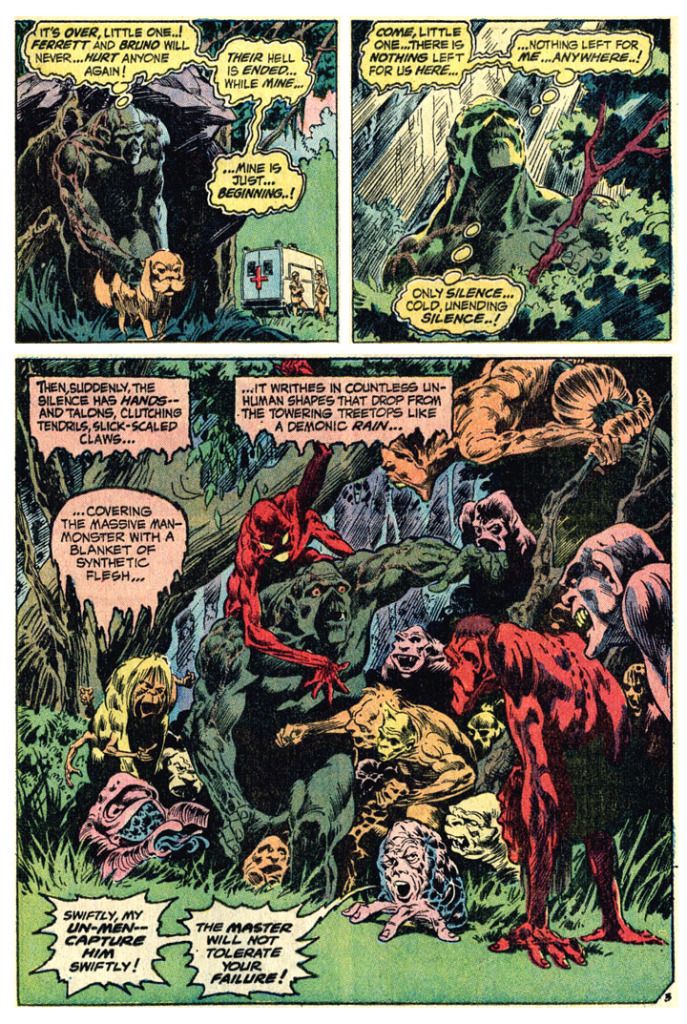
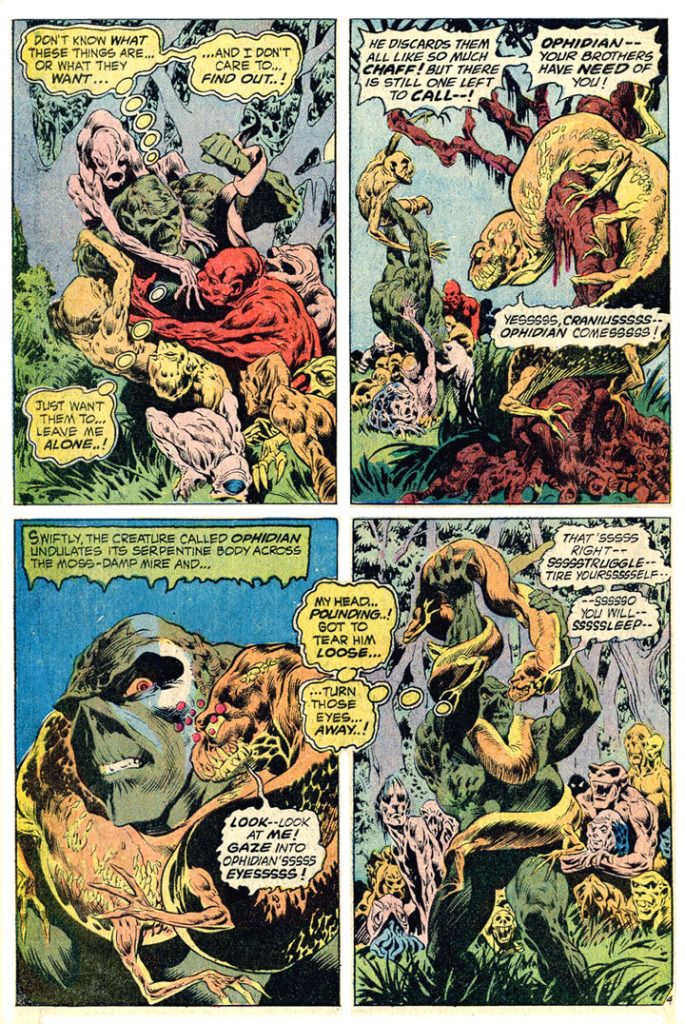
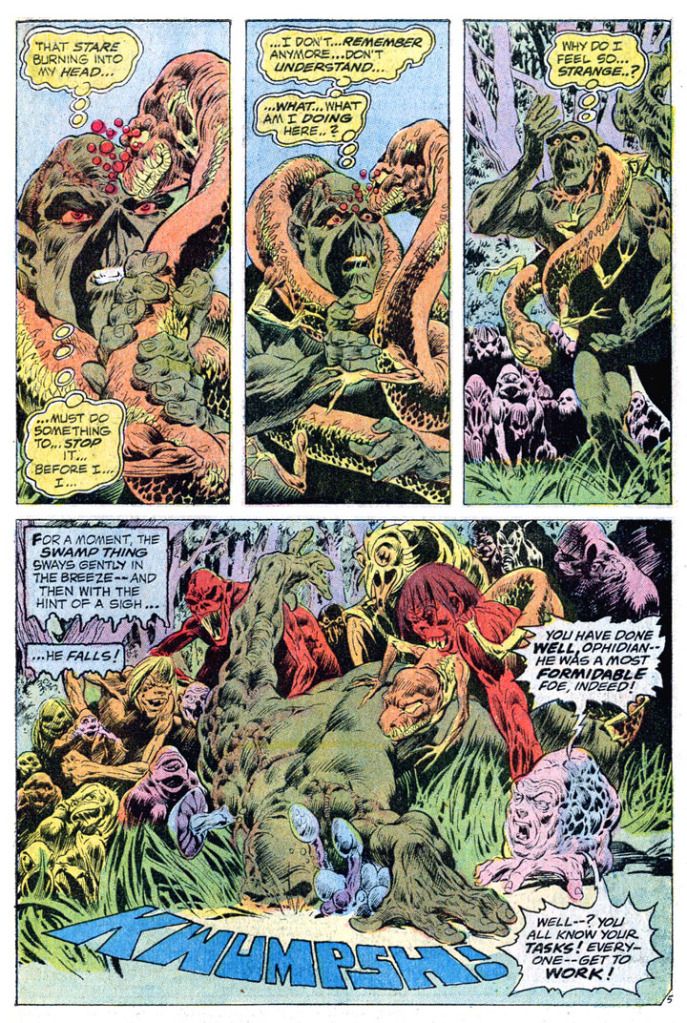
What kind of man deliberately creates monstrosities?  When Dr. Frankenstein attempted to glean the secrets of life, he meant to produce beauty but failed.  Anton Arcane, on the other hand, perversely sets out to make hideous things he then cruelly dubs the "Un-Men."  It's both a parody of the creation story-- God made perfection in 6 days, then rested-- and a misuse of science to tickle the fancy of an egotistical degenerate who wants to achieve immortality.  To this end, Arcane sends the Un-Men to the Louisiana bayou country to capture Alec Holland, who has recently become the Swamp Thing.


Marvelous!  Absolutely marvelous!  Just try making something like that out of a cola nut!  As we see in these exquisitely rendered Bernie Wrightson pages from "The Man Who Wanted Forever" in Swamp Thing #2 (January 1973), they succeed, at least temporarily.  But even this small achievement leaves the Un-Men lost in a world that never desired them.  In some ways, though, they are our children.  The unwanted, the living embodiment of our worst creative impulses, our vanity in thinking we might better nature itself, our ambivalent response to mortality.  In their nakedness, they are as newborns.  In their cruelty, they reflect their treatment at the hands of their twisted creator, as we do with our own petty crimes and misdemeanors.  Neither men nor women, they could only in the end become monsters.


Holland himself, his soul encased in plant matter and mud, provides a further tragic note.  This is before Alan Moore re-created Swamp Thing to suit his own needs-- the creature is not a transformed human, but rather a consciousness mistaken in its belief in that identity; it's a brilliant bit of revisionist storytelling that freed Swamp Thing from his ongoing quest to regain humanity and allowed Moore to take the tales along a more epic path.  But for our purposes-- and those of writer Len Wein-- this is definitely the soul of poor Holland trapped within a hulking, plant-based body, isolated not only from the humanity he desperately hopes to reclaim but also human society.  Lost in the night world of his new life, Holland now has more in common with the Un-Men than he does with Matt Cable, the human government agent searching for Swamp Thing just a few short miles away geographically, but a universe apart existentially.  Holland is also an un-man.

Now, let's all share the delicious taste of 7 Up.  The Uncola.  Why, it's even prettier than a cola.  Nuttier than a cola, actually!  HAHAHAHAHAHA!

Friday, June 8, 2012

Giant-Size X-Men #1: A retrospective look back in anger at a remembrance of things past!


Gil Kane and Dave Cockrum create
a classic image!

Giant-Size X-Men #1 (May 1975)
Publisher:  Marvel
Story/Script:  Len Wein
Art: Dave Cockrum

This is where it all began.  The X-Men legend.  This is where the title began its rise from obscure Fantastic Four knock-off to Marvel’s flagship franchise.  Hugely influential and source material for a lucrative film series that helped jump-start the idea of “superhero movies” as we now know the genre--  yet its characters remain fairly obscure outside the comic book world.  We insiders—damned as we are-- may know how Banshee lost his sonic scream and chuckle knowingly at the strange concept of Nightcrawler’s being able to turn invisible in shadow yet have a face that’s always shadowed, but our moms and dads probably couldn’t tell Wolverine from tangerine if you spotted them a tree, a juice squeezer and six Hand ninja.

But hoooo baby, they love that singin’, dancin’ man Hugh Jackman!

Anyway, here we are at the beginning at last.  Giant-Size X-Men #1.  Years ago I bought a run of early X-Men from a friend for the grand total of 20 dollars and the use of my left-handed outfielder’s glove one day in P.E.  In return I had X-Men numbers 94, 95, 96, 97, 98, 101, 107 and 112.  And I read them.  I took them to school, passed them around to my friends and we read them until they were wrinkled and puckered at the staples.  Take that, graded mint collectors!  But I didn’t have Giant-Size X-Men #1 and by the time I realized what I had that foolish friend of mine was on drugs and would rather trade his back issues for white powder and green leaf, neither of which I could easily obtain and transport back into the States despite possessing diplomatic clearance through customs thanks to a childhood spent overthrowing Communist-friendly regimes in Central and South America.  I was a precocious child and I will soon publish my memoirs detailing my cover story as a violin prodigy on a perpetual world tour that just happened to intersect certain geopolitical hotspots.  That is, if I’m not assassinated first!

I digress.  Eventually Marvel reprinted this story and I’ve since read it too many times.  And last night, I read it again.  The cover—by Gil Kane and Dave Cockrum—is a classic image, one copied and homage many times.  Led by—of all things—a filthy, atheistic Red made entirely of metal, including his filthy, atheistic genitalia, the new internationally stereotyped X-Men burst through the old homogenously white American X-Men.  The cover copy promises something it calls “Deadly Genesis!” but the title page introduces a story calling itself, “Second Genesis!”  What the hell?  Can’t you people get it together?  Plus, that title sounds a little like a new herbal shampoo, superior to the previous formulation.

Herbal shampoos—I mean, getting it together is what this story is all about.  I’m speaking of the super-team.  With the original X-Men missing after an ill-advised trip to a tropical island in search of an all-powerful mutant, Professor X travels the globe and recruits his new students.  There’s Nightcrawler, who finds himself pursued by angry Germans—the inverse of what my great-uncle did to the lousy Hun with one of Patton’s tanks during the Big One.  There’s Storm, who flies around topless with her startling white hair conveniently covering her breasts no matter how many howling thunderstorms of wind and rain she calls up with her magical mutant abilities.  There’s the aforementioned Red, a beefy simpleton from a collective farm.  He’s later called Colossus and wonders aloud if his powers are everything Professor X claims, shouldn’t they belong to the State?  Not on my watch, Pinko!  Professor X also recruits a trio of ringers, three characters who had already appeared in Marvel continuity.  I’m referring to the Impossible Man, Flash Thompson and Irving Forbush.

Okay, okay.  He signs Sunfire, Banshee and Wolverine.  We all know Banshee thanks to the many movies made about him in the last few years, but Wolverine remains an obscure piece of comic book trivia.  Sunfire is one of those arrogant, angry, ultra-traditional “I hate the West” Japanese guys beloved by American comic book writers.  Because you can never have too much racial animosity in your superhero group where teamwork is at a premium and cooperation can mean the difference between life or death in heavy combat, Professor X also brings in Thunderbird, an Apache who beats up buffalo with his bare hands, feels “ashamed of his people” and has to be persuaded with the old reverse psychology trick.

This is probably my favorite storytelling moment in the entire book, because artist Dave Cockrum has Thunderbird walking away in a huff, only to stop and rub the back of his neck with his hand.  It’s reminiscent of my beloved Billy Jack movies, one of those moments I used to anticipate with my little heart all a-flutter where Billy Jack finally has had enough redneck bullshit and prepares to lay aside his pacifism in favor of kung fu mayhem.  Wein’s dialogue—Thunderbird says, “Ho-kay… that does it!” and you can almost hear his slow, husky, exasperated voice—only makes the moment more Billy Jack-ish.  Billy Jack-ish? 

Anyway, the Professor’s mind game works on the proud, angry Thunderbird and soon the petty squabblers find themselves at the X-Mansion where Cyclops shows up and starts barking at them like an army officer and addressing them as “people” in a clipped voice. People, the X-Men are missing!  Only you can save them!  Cyclops is curt and snappish because he’s a professional and time is of the essence.  But despite sharing a flashback with the newcomers, he fails to explain why they should care about his problems, much less participate in them. 

Take Colossus, for example.  Two days ago, Colossus had never heard of X-Men or capitalism or honkytonk music or Peyton Place.  Suddenly, he’s expected to go off on some dangerous, possibly lethal mission with a group of strangers, all of whom appear to despise each other and aren’t exactly shy about expressing it, to risk his metal neck for another group of strangers who, to hear Cyclops explain it, are just as hateful as the ones he’s with.  If I were him, I’d be heading back to the land of vodka and women with five o’clock shadows.  If I were Storm, I’d take off my shirt and go flying back to Africa where people worship me as a goddess.  Sunfire has that sweet castle and kimono-clad wife to go home to, Banshee can score sweet seats to the Tom T. Hall concert at the Grand Ol’ Opry.  If I had their lives, I wouldn’t be mucking around with this junk, either.  As for Nightcrawler and Thunderbird…

Well, if I were either of those guys, I guess I’d be stuck because their lives seem to have the least purpose, unless being chased by angry mobs or manhandling buffalo while seething with contempt for your own tribe count as purposes.

Len Wein was and continues to be a fine writer and editor—I point you to his run on the original Swamp Thing, various stories in DC’s horror titles and hundreds of fantastic stories over the years plus his editorship of Watchmen, but reading Giant-Size X-Men #1, I’m struck by how shrill and unpleasant he makes his cast.  Character conflict is one thing—the Fantastic Four used to bicker a lot-- but having Professor X deliberately court this particular group of truly unpleasant people is quite another.  There’s no reason for their snappish behavior other than the transparent mandate they flaunt “individuality,” and because conflict adds interest.  With almost 40 years of comic book reading hindsight, I can’t think of a reason why Wein couldn’t have used a little subtlety or at least balanced out the nastiness with a little sympathy. 

In the classic days of Marvel, Human Torch would needle the Thing until they came to blows or at least fireballs and angry threats, but there was always sense of brotherly love beneath it all.  And they were likable.  You could go to the movies with them, if you could ever get them to agree on what picture to see.  Human Torch has always favored those Judd Apatow comedies, while the Thing prefers anything with Steve McQueen in it.  At this point in the X-Men narrative we barely know any of these jokers, but I can’t imagine spending more than a minute listening to their lame cracks and randomly vicious insults, if even that long.  It’d be like hanging out with the Let It Be Beatles without ever having experienced A Hard Day’s Night.

Because she only throws one fit—and off-panel at that-- Storm retains the most dignity, despite wearing a cape, a monokini and thigh-high go-go boots.  By the time they’re all fighting for their lives against the menace of a living island that calls itself Krakoa— Shocking twist!  The ISLAND is the mutant, thanks to that catch-all explanation for anything that doesn’t other make any sense, magi—er—radiation— I was just sick of them as individuals and collectively.  By the end, I was rooting for the island.

Dave Cockrum’s art on this job isn’t as slick as the guy he’s imitating, Neal Adams.  Cockrum’s characters pose dramatically but stiffly, lacking the Adams fluidity.  Adams’s superpeople might run around with every muscle in their bodies tensed, but they’re flexible and sinuous.  Cockrum’s figures here are dynamic but awkwardly constructed.  They also seem to be shouting a lot, even when they’re alone—as Cyclops does when he finds himself on the X-Jet minus his teammates and his powers, or Sunfire when he’s flying along outside the very same jet well beyond earshot of whoever it is he’s supposedly addressing.  That’s probably due to their being a bunch of jerks.  Cockrum confines himself to traditional panel shapes for the most part, and the result is a bit cramped.  He didn’t really hit his artistic stride until the regular series, especially #94 where he and Bob McLeod teamed up to produce one of the sweetest superhero art jobs I’ve ever seen, the one that made me want to draw superhero funny books for a living way back when before life sent me off on a more punk rock filled course that led me to Japan for some reason.

On the other hand, Cockrum shows the one thing that really matters—artistic charisma.  Appeal.  You want to look at these pages.  And you have to admire the man’s effort.  He even manages to draw the impossible.  There’s a very strange moment where Cockrum has to depict magnetic waves descending to the ocean floor as the team finally comes together with a typically silly comic book solution to the the Krakoa situation.  Who knew islands actually float, kind of like icebergs?  In Cockrum’s defense, it’s easy for a writer like Wein to describe this kind of thing.  I just did it, and I’m a complete idiot. 

But as an artist, I can’t think of another way to depict visually one of the prime forces of the universe which is difficult enough to account for in physics theories, much less as the work of a team of superpowered human beings.  It’s best to think of this panel as symbolic, like an editorial cartoon where the inner workings of various congressional committees are turned into a visual metaphor so the kind of idiots who still read newspapers, much less their editorial pages, can understand how they’re getting shafted this week.  Unless you disagree with the artist’s politics, of course, in which case you need to know enough to write an angry blog entry about it or at least comment on a political message board thread about it.

No one can see magnetic force itself, only its effects, and no one really knows what goes on in committee.  It’s all guesswork on the artist’s part.  I don’t know what Cockrum’s politics were at this time.  Perhaps a kind of pro-mutant, anti-sentient island stance that manifested itself in that remarkable panel. 

He certainly made the ridiculous look ridiculously cool.  I miss him.
Wednesday, February 8, 2012

Things I, as a comics blogger, must have an opinion about: DC's Watchmen prequel comics and a pro-Kirby boycott!

Watchmen Prequels

Is Watchmen a sacrosanct text?  Maybe, if your frame of reference consists entirely of comic books and graphic novels.  Or you just like to get pissed off about things.  This is the Internet; that's what we do here.  Watchmen is a great book, a fantastic achievement in fiction, but I don't think it's any more untouchable than Catch-22-- one of the most influential novels of the 20th century on impressionable undergrads.  Author Joseph Heller went one step beyond and produced a yawn-worthy and largely unnecessary sequel to it, Closing Time

I rank Watchmen ahead of Mario Puzo's The Godfather as a work of art, yet Francis Ford Coppola adapted that into a classic movie... with an equally-classic sequel.  All we got from Watchmen was that shitty Zack Snyder thing.  And go ask Michael Winegardner and the suits at Random House if Puzo left anything unsaid about his characters and their lives.  For that matter, consult Alexandra Ripley and Warner Books about Scarlett O'Hara and Rhett Butler.

So while I believe Watchmen makes a definitive statement then gracefully ends-- a rarity in American comics where characters are nothing more than trademarked entities to be endlessly recycled-- and even though the word "sequel" only makes me slightly less queasy than the word "prequel," DC's decision to expand the story is genius of a sort.  We're talking about it, people will probably buy it and I have to admit the idea of seeing some Adam Hughes sequential artwork has me drooling like a contented baby.  I'm not big on either Brian Azzarello or J. Michael Straczynski, but Len Wein has never wronged me and I'm starting to warm up to Lee Bermejo's artwork.

The best thing to do if you don't want more Watchmen is just to ignore the prequels.  Then there's no way they can sully the original for you.  Especially if your first name isn't Alan and your last name isn't Moore.  Moore does have a point about DC being "dependent on ideas [he] had 25 years ago."  Speaking of dependent on other people's ideas...

Jack Kirby Boycott

I was going to skip The Avengers anyway, because it takes more than sticking a red white and blue suit on some actor and calling him Captain America to interest me in a film even if you toss in Robert Downey, Jr., Mark Ruffalo (their first work together since Zodiac!) and Samuel L. Jackson.  Iron Man was a pleasant surprise and both The Dark Knight and Spider-Man 2 are genre classics. 

The rest have been mediocrities at best and most of them have been outright stinkers.  Fantastic Four movies, I'm looking at you and your bombastically fakey action sequences, over-abundance of lame humor and crass product placement.  DaredevilGhost RiderThorX-Men Origins:  WolverineKick-AssSuperman Returns?  I'm sure there are people who love these movies and make it a point to see every super-flick that comes out, but I'm not among their number.  You've got to wow me with things beyond CGI puppets flying around, a bit of latex and a familiar hero name.

 But beyond all that, according to a story on Slate, there's another reason to give The Avengers a miss and extend that to everything Marvel because Jack Kirby's family isn't getting a cut from all these characters he co-created.  A Marvel boycott.

I'm absolutely pro-Kirby, but that doesn't mean I'm anti-Stan Lee.  These kinds of false dichotomies reign in fandom and I'm not giving into them.  Having said that, I do firmly believe the Kirby family should be compensated for what Jack did for Marvel.  Without Jack, there would have been no Marvel.  That's also true of Stan, but "the Man" sued Marvel successfully, while the Kirbys lost.  The decision may have been according to the letter of the law, but it's still one of those painful things where the right thing and the contractual thing don't coincide even in the slightest.

Kirby got screwed.  He had to allow the screwing so he could provide for his family, but that doesn't mean the screwing was justified or deserved.  Face it, if any one of us had done even a fraction for a company what Kirby did for Marvel but received only his compensation compared to their profit margin past, present and future, we'd be ranting day and night until we get what we feel is equitable.  And even then, it would be such a small slice for them and a huge one for us.  You may claim to feel differently, but you're not going to convince me you're sincere.  Unless you want to sign a piece of paper for me where I own your imagination and can profit from it until the sun consumes the earth while paying you merely a living wage.

We, the fans, whether we're all that aware of Kirby or not, have benefited over the years from all the characters he illustrated and created.  Marvel has made an ungodly amount of money of this man's labors-- Disney paid 4 billion dollars for this company based on how much money they can make by exploiting its Kirby-created properties-- but his family gets nothing because he cashed his checks back in the 60s.

 I doubt any Marvel boycott will affect The Avengers.  The allure of Marvel heroes cavorting together on the big screen is going to prove too much of a lure to the casual fan who is probably only vaguely aware a man named Jack Kirby ever existed.  And the rest probably don't read comics at all and will come away only mildly confused as to why Superman and Batman weren't on the roster.  As for buying Marvel products-- that's already pretty difficult for me because I'm living in Japan.  I can order graphic novels from Amazon.jp or buy digital comics, but getting my hands on an actual monthly magazine is incredibly difficult.  I have an Amazon.com associates comic book store of my own, but to date I haven't made a single sale.  It's chockablock with Marvel trades.  So what would my role in such a boycott be?  Skipping a possibly craptacular summer action flick is the easiest step to tak.

What then?  Ditch the Marvels from my failure of a comic book shop?  Stop writing about Marvel books on my loser blog until the Kirby family gets its due?

Hmm.  I think I can do the former this weekend, but the allure of pop culture mockery is too strong for the latter.

Thursday, August 11, 2011

It's easy to tell you're not in heaven...

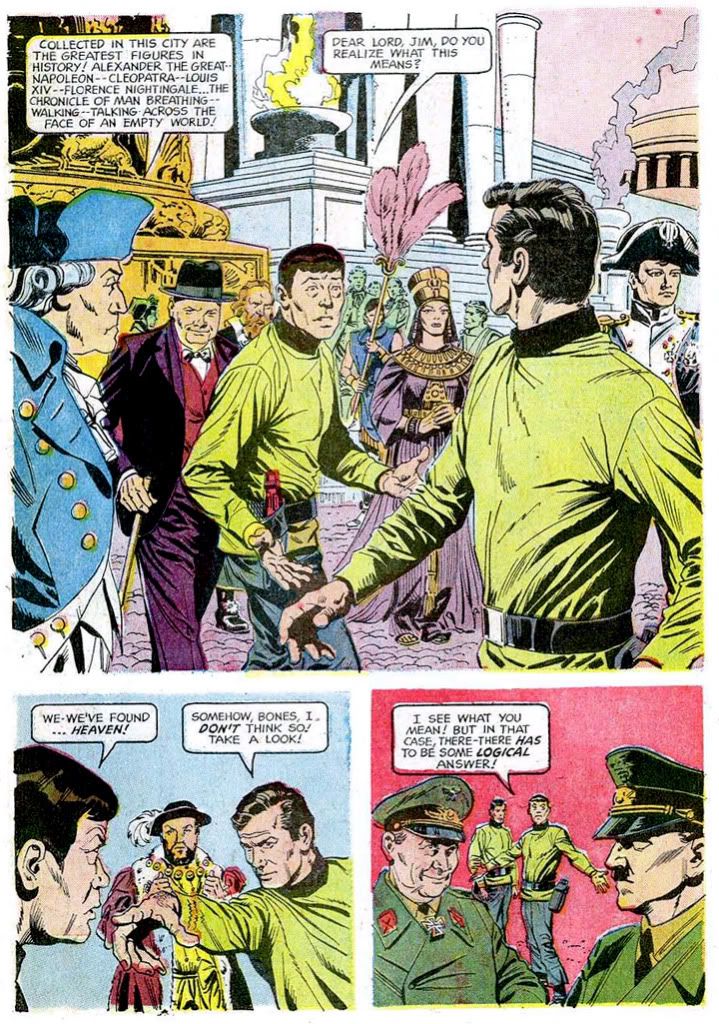
Yeah, I don't think so either, Capt. Kirk. This is a page from the Gold Key Star Trek series, namely issue #9, "The Legacy of Lazarus." This particular story may or may not have been written by Len Wein, but the art is definitely by Alberto Giolitti or someone in his employ doing a fantastic Giolitti impression. How's that for clarification? Well, someone's responsible, dammit, and I hope we can get to the bottom of this the way Kirk, Spock, McCoy and the rest of the Enterprise crew solve the mystery after they beam down to a planet where the entire population appears to be made up of Earth history's greatest-- and worst-- figures.

How do they handle social engagements? I mean, I can't imagine Winston Churchill inviting Adolf Hitler to his dinner parties no matter what planet they're stuck on-- it's bad enough when they meet out on the street, as they no doubt do just off-panel on this page. Those are probably tense moments. Somehow, I think Hitler and Herman Goering there probably spend most of their days skulking around together, ostracized by the likes of Henry VIII and Cleopatra's personal assistants.

I love these goofy old comics. As I've related here before, these were difficult to find when I was growing up. Coming across one was always a treat. I'm not sure why Kirk and McCoy are wearing lime green shirts with black turtleneck collars, but it makes me happy. Disgraced historian Alexander Lazarus and his museum-quality replica people all turn out to be complete jerks in the end, but in what other comic can you find a blood-crazed Abraham Lincoln attacking people with what appears to be part of a kite frame or canvas-stretcher?