Showing posts with label Terry Austin. Show all posts

Monday, February 3, 2014

Hell's Angel: The Strange and Terrible Saga of the Outlaw New Mutants and the Time They Adopted Bird Brain

From the vantage point of our current mass media, where its characters permeate the zeitgeist, it may seem ridiculous, even the stuff of lunacy, but there came a time in the late 1980s when America's comics-hungry masses turned away from New Mutants.  As interest in the comic fell and sales flagged and talking heads hit the airwaves to postulate almost hysterically on the reasons-- anxiety over the ending of the Reagan era? Pre-millennial jitters?-- series star Dani Moonstar phoned the home office and demanded someone at Marvel do something. The Marvel solution as scripted by Louise Simonson was to honor that most wonderful and time-tested of sitcom traditions with the addition of a cute tagalong to the familiar cast.

In the human world, this new character would most likely be a baby or even Ted McGinley (already having done sterling work on Happy Days, The Love Boat and at the time coming off a stint revitalizing Dynasty as Clay Fallmont on his way to achieving legendary status as Jefferson D'Arcy on Married With Children).  Or a bespectacled blond-headed moon-faced boy susceptible to both pies in the face and Bobby Brady's ridiculous detective schemes.  In the world of teen mutant super-beings, the ideal Cousin Oliver proved to be a hideous feathered freak, the very antithesis of the almost supernaturally handsome McGinley.

And while The Brady Bunch failed to escape the event horizon of its particular ratings black hole, adding Bird Brain to the cast gave New Mutants enough of a lift to carry on for a few more years.  Bird Brain, the lovable weirdo.  Bird Brain, who made Gonzo the Great look like Cary Grant and the Chicken Lady from Kids in the Hall resemble his To Catch a Thief co-star Grace Kelly.  Bird Brain, who ate fish and probably smelled something awful. 
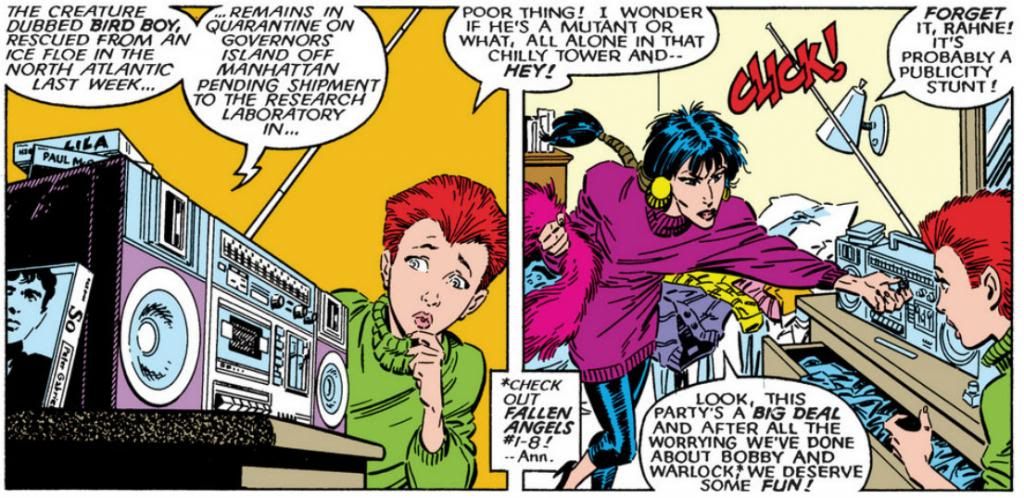
New Mutants #55 (September 1987), script: Louise Simonson, pencils: Bret Blevins, inks: Terry Austin

Online sources list New Mutants #55 (September 1987) as Bird Brain’s first appearance, and that's technically correct, although it's a mere cameo.  We do feel his presence throughout, starting early in the issue when the kids learn about Bird Brain from a radio news story.  Remember radio?  Artist Bret Blevins reminds of what this obsolete technology looks like with a highly detailed rendering that will no doubt become useful for future historians and archeologists as they try to recreate our late 20th century society. 

To you, highly advanced people of the future:  Yes, we primitives once used these devices to listen to music and learn about the world around us. 

Later, Rahne urges her friends to do something about Bird Brain's plight, and Bird Brain himself appears in an insert panel soon afterwards.  All we see is his beaked face.  Most of the story involves Sam Guthrie taking drugs at a party to impress his sometimes lover Lila Cheney, a space-thief who spends her down time rocking earth as a kind of Patti Smith/Pat Benatar/Joan Jett stand-in. 

For the record, I would fully support a Lila Cheney solo series.
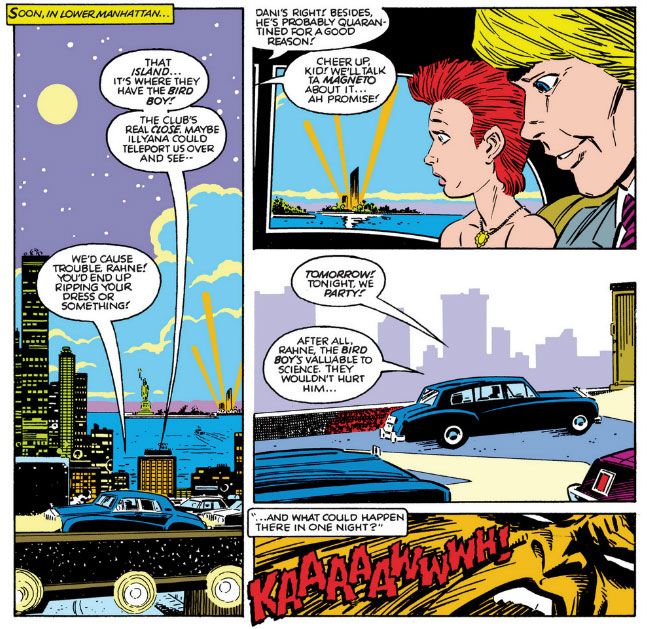
New Mutants #55 (September 1987), script: Simonson, pencils: Blevins, inks: Austin

Anyway, Bird Brain.  New Mutants #56 (October1987) is the first comic truly to be all about his birdness and his brain.  We learn Sam has somehow inadvertently freed Bird Brain from his imprisonment in a research lab—it must have happened while he was groggily flying around trying to avoid some aliens who have it in for Lila.  For unknown reasons, we don’t actually see this happen in the story.  Just take Dani's word for it.  Or Sam’s.  Or Rahne’s.  Whether or not he's truly responsible, Sam feels so and goes to find the fugitive freak while Dani involves the entire team.  She even makes them wear their hideous “graduation uniforms,” for disguise purposes.  See, if they wore their New Mutant garb, everyone would know them, but a group of teens with identical powers and similar appearance in different clothes constitute a mystery even Reed Richards couldn’t solve.  And that guy is a genius, but obviously not as much so as Dani Moonstar. 
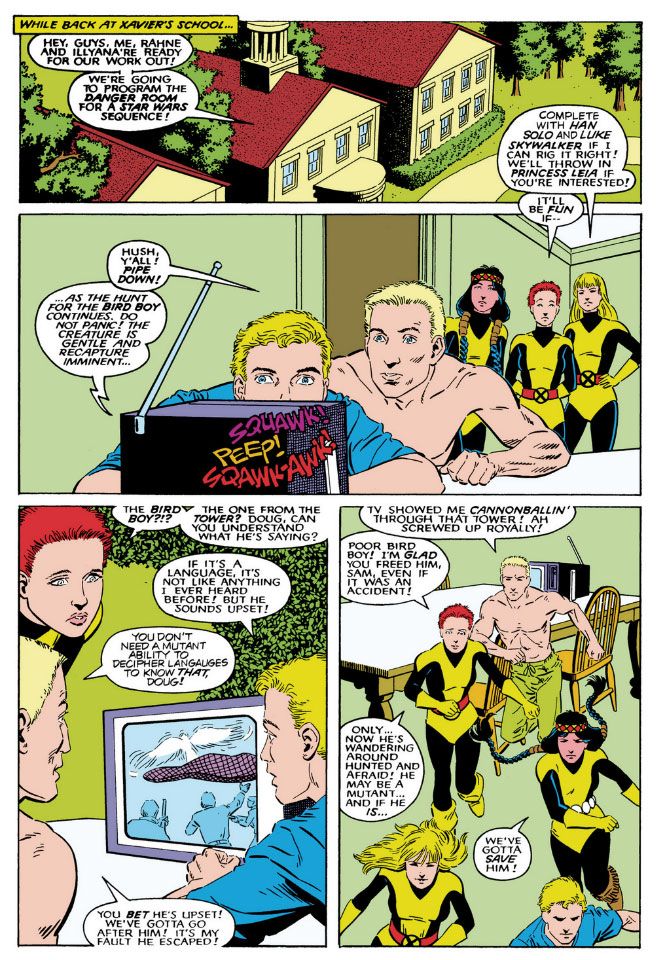
New Mutants #56 (October 1987), script: Simonson, pencils: June Brigman, inks: Austin
 
Let me just take a moment to express how much I wish June Brigman had penciled more New Mutants.  She did this issue and annual #4 (September 1988), but Marvel should have given her the monthly assignment.  She’s gold on this team, especially with Simonson's scripting.  Regular artist Blevins has an edgy, sketchy style with a lot of energy, but he makes Dani look about fifty years older than her supposed age (and kind of mean!), which is an unforgiveable lapse (although his Rahne Sinclair is cute as a button).  So while I admire Blevins' cartoony body language, with bent knock-kneed poses and dramatic gestures, I prefer Brigman's cleaner visuals and more controlled rendering.  Brigman, with the able assistance of inker Terry Austin, provides a sleek look that's a cool alternative to Blevins' more jittery work.  Her storytelling is fine, but it's the way she draws figures with lifelike proportions and impeccable facial “acting”  that grounds the book in some much-needed reality.  This gives outrĂ© characters like Bird Brain a bit more believability.  And this is without relying on the crutch of photorealism.
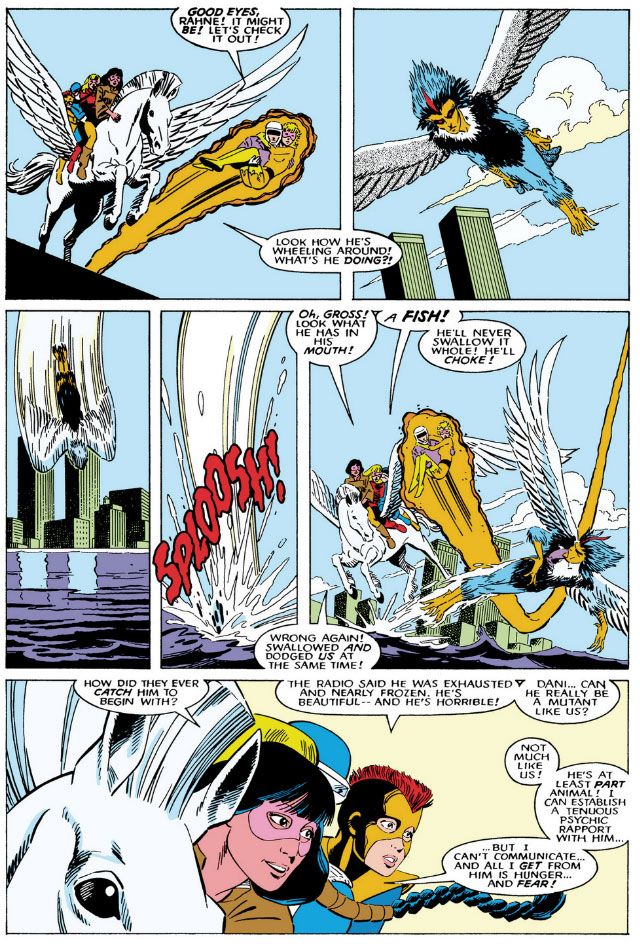
New Mutants #56 (October 1987), script: Simonson, pencils: Brigman, inks: Austin

Also, Louise Simonson has a way with naturalistic teen-speak that I find superior to Chris Claremont's more stilted dialogue.  Claremont crafted some dark classics during his run on the characters, particularly the "Demon Bear Saga," which received its own trade paperback collection (something that can't be said for the "Bird Brain Saga"), but Simonson's teens "sound" more like actual teens.  Especially when combined with Brigman's art, where they look like actual teens as well. 

Also, Simonson's Bird Brain certainly is a bird brain!  It doesn't take Dani and the rest long to teach him the importance of dressing well.
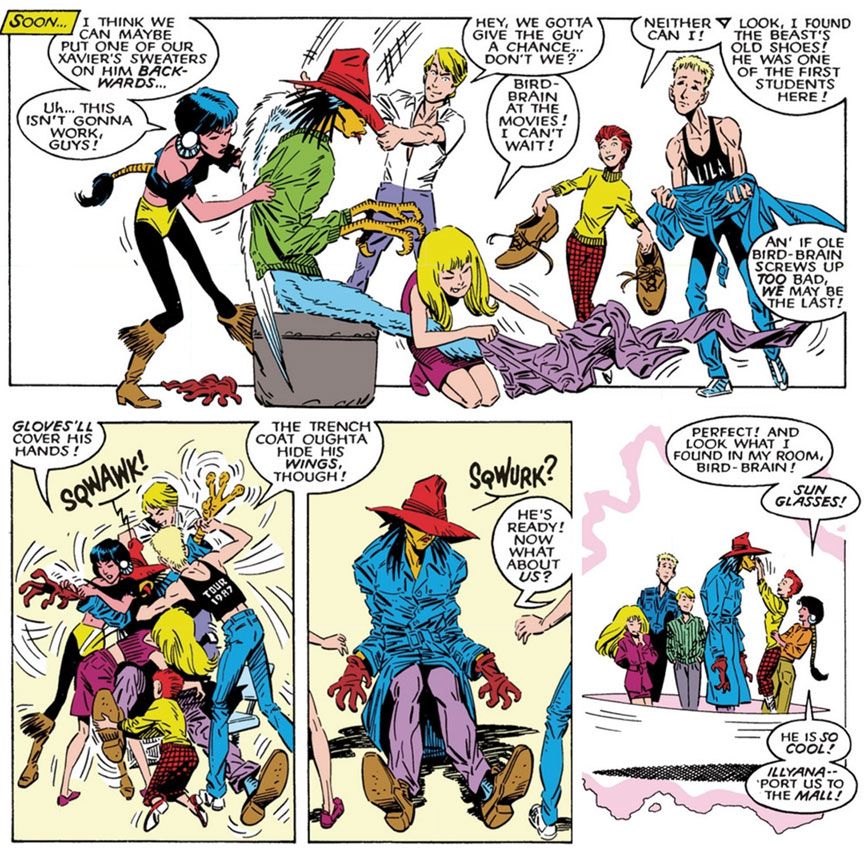
New Mutants #57 (November 1987), script: Simonson, pencils: Blevins, inks: Austin

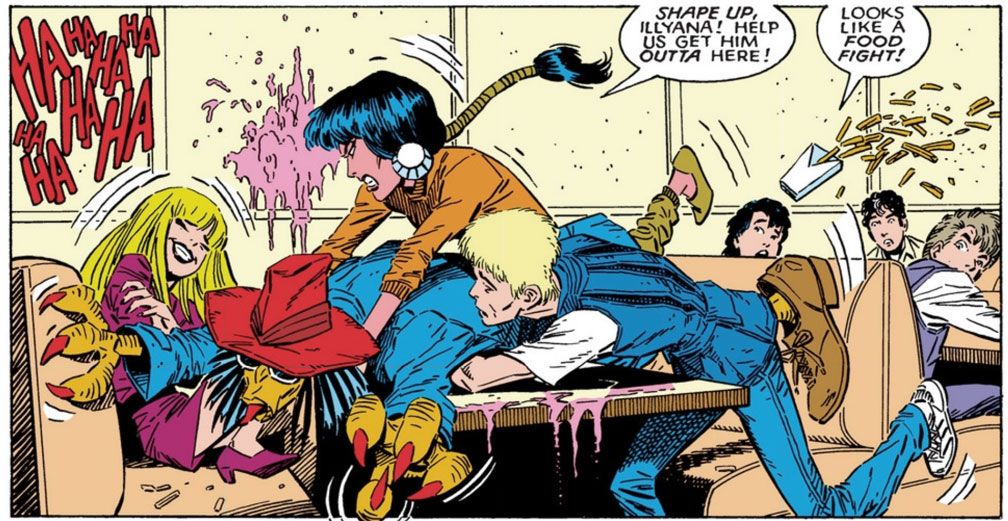
And the deliciousness of fast food.

New Mutants #57 (November 1987), script: Simonson, pencils: Blevins, inks: Austin

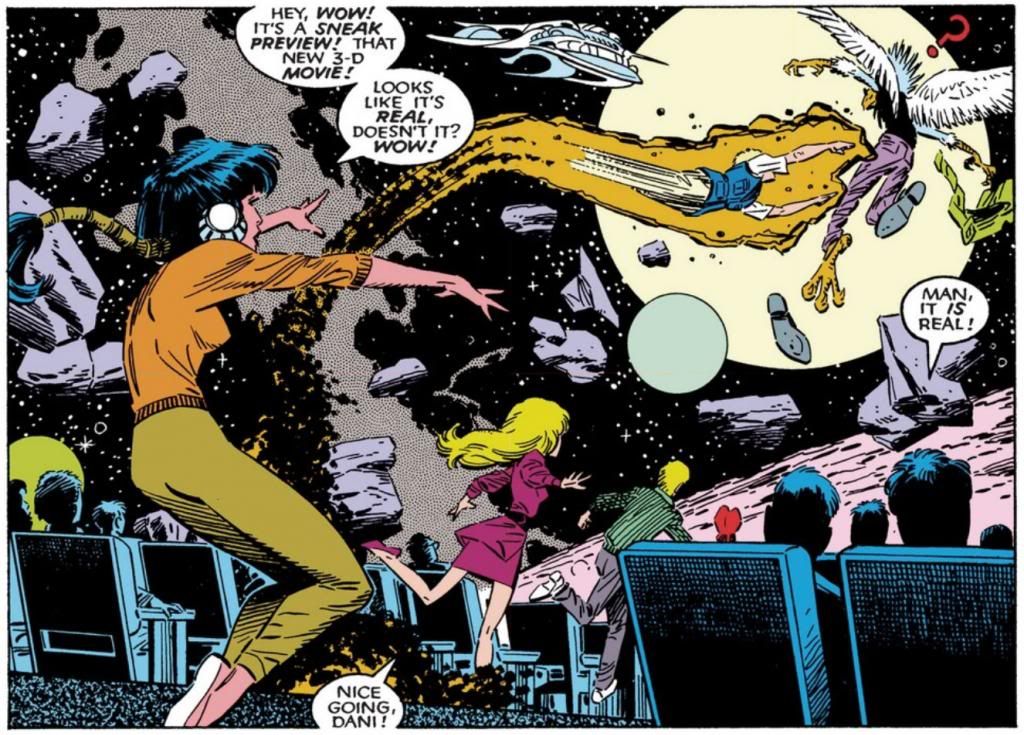
And the wonders of modern cinema.
 
New Mutants #57 (November 1987), script: Simonson, pencils: Blevins, inks: Austin

At this point, I will excuse you for asking,  "Just what in the name of Bill Sienkiewicz is going on here?"  In fact, ask me that.  Right now.

I don't know!  As a minor character Bird Brain would have been slightly annoying, but Simonson spotlights him over Dani Moonstar and other, more pressing plotlines like Sam's romance with Lila, Magneto's taking over the team and Amara's love-hate for one of the Hellions and her resulting arguments with Dani.  The kids' clumsy attempts at assimilating so alien a creature into teen society are amusing, but this is also a comic co-starring a girl who's literally from Hell and characters just one mistake away from death.  And the "Bird Brain Saga" isn't just a one or two issue romp.  It lasts approximately seven issues and for most of those seems little more than slapstick sit-com fodder, a bizarre digression for the series as a whole.

Okay, actually, I do know.  Because just when you've had about all the Bird Brain you can stand, Simonson ups the dramatic stakes by adroitly shifting tonally from comedy to sci-fi horror and the plot into a Moonstar-starring H.G. Wells' The Island of Dr. Moreau.  This happens in New Mutants #58 (December 1987) when the kids journey to a mysterious island to finally learn the true origin of Bird Brain.  After all, Bird Brain had to come from somewhere, so why not an island of animal-human hybrids presided over by a mad scientist with a skull for a hat?  By #59 (January 1988), the New Mutants are themselves captives and their humanity at risk.  

From there, the jeopardy growing from this development leavens the oddball comedy of the preceding issues.  The Moreau-style plotline is also particularly apt when dealing with characters on the cutting edge of human evolution.  Wells' themes--- including cruelty to animals (in Moreau, it's vivisection, in this story it's updated for the 80s to a more generalized laboratory research and then genetic splicing), which the Bird Brain story addresses obliquely from the beginning-- jibe quite well with Simonson's take on the team as concerned young people trying to make the world a better place.  By providing a classic literary explanation for this bizarre Bird Brain character, she finishes strongly, with a tragedy with lasting ramifications for the team in #60 (February 1988). 

Which I won't share with you because you owe it to yourself to read the entire Bird Brain saga in all its strangeness.   It's not exactly a "Demon Bear Saga," but on the other hand, it does feature Bird Brain.

Monday, September 3, 2012

The Uncanny X-Men and the New Teen Titans, or "When Dudes in Their Underwear Shake Hands"


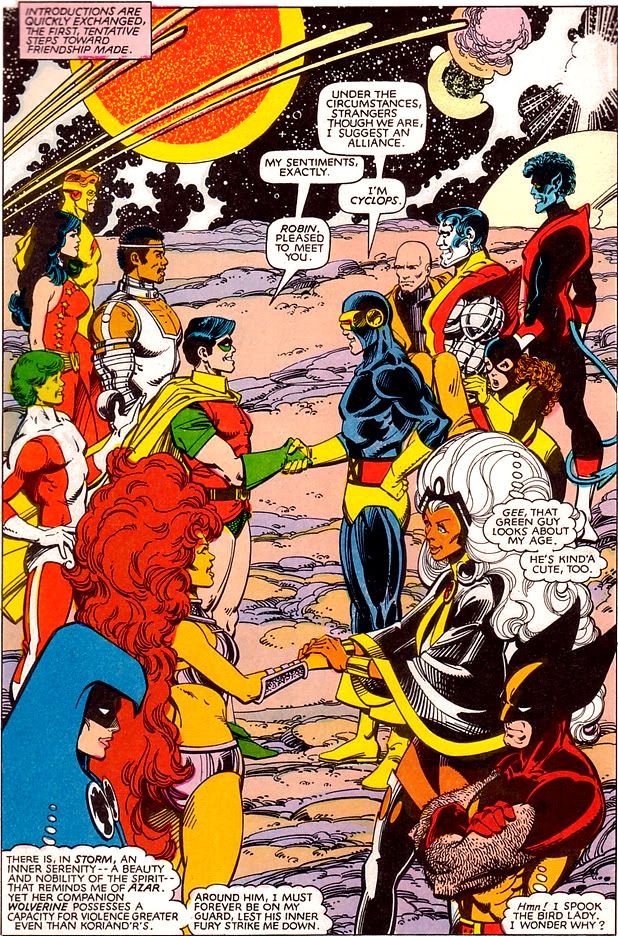
Fresh off the The X-Men and the Micronauts debacle, here's a team up more to my liking.  It's the Marvel and DC presentation of The Uncanny X-Men and the New Teen Titans (September, 1982), a fat, slick beauty of a book.  This is the pivotal moment where both teams gather with counterparts from each conveniently facing off, or grasping hands in greeting.  Well, the Raven/Wolverine moment isn't exactly a meeting of similar characters, but you get the idea.

Kitty's body is playing it smart even if her mind is unfortunately letting her down.  We need to trust our bodies more.  Sometimes the mind plays tricks on us, but the body is always honest.  In this case, Kitty is right to hide behind Colossus rather than approach Changeling.  That green freak would only make some clumsy sexual advance, and then keep it up non-stop, transforming into snakes and octopi while groping her.  And no one on either team would raise a hand to stop the little pervert.  Probably has his erect penis poking out of his waistband-- Changeling's idea of "playful flirtation"-- which is why artist Walt Simonson chose to hide the kid's crotch behind Starfire's hair.

I haven't read this in a while, but I remember it being an effective meshing of both teams' continuity, with Cyclops having to deal with the heartbreak of seeing his beloved Jean Grey resurrected in her evil Dark Phoenix form and Darkseid teaming up with Deathstroke the Terminator to kick the snot out of both teams.  As you can see from the dialogue and thought balloons in this image, it features Chris Claremont at the height of his powers doing a bang-up job capturing the essence of all the cross-company characters, throwing in little references to past events, showing his encyclopedic knowledge of then-current comic books.

You know, sort of how he was always name-dropping the good ones in Uncanny X-Men or having minor characters that parodied Cerebus the Aardvark or whatnot.  That stuff always made me feel I wasn't wasting my time reading comics, that they really were the intellectually stimulating yet action-filled pieces of sequential literature we always claimed them to be.

While I can't remember all the story details, I do know Claremont, Simonson and inker Terry Austin knocked me right out with this book when I was 14 and a fan of both teams.  It was perfection, just everything I wanted in a team-up of Teen Titans and Uncanny X-Men.  The epic climax with Dark Phoenix showing up and sacrificing herself for love (I believe) and then the denouement with all the players kind of hanging out in their civilian clothes left me feeling for Cyclops in a wistful sort of way for a couple of hours, but I read it ten to twenty times in two days and that kind of spoiled the mood.  I still have it, along with a run of the original "Dark Phoenix" issues of Uncanny.  I should re-read this comic and see if it holds up better than The X-Men and the Micronauts.

It should.  Although Changeling is probably twice the degenerate the Entity is any day of the week.

Monday, March 7, 2011

Superman vs. Muhammad Ali Deluxe Edition: A Comic Review

Superman vs. Muhammad Ali Deluxe Edition
Publisher: DC
Script: Denny O’Neil
Pencils: Neal Adams
Inks: Dick Giordano and Terry Austin

This is the big one we were all waiting for! I remember seeing the tabloid-sized original at our mall's Waldenbooks way back in 1978 and, as a major fan of both Muhammad Ali and Superman, wanting desperately to buy it. But $2.50 was beyond my price range at the time and there was a question of just where to keep the damned thing. It was monstrous and wouldn't fit easily on any of our bookshelves. In time, I came to think I'd dreamed it all. Superman versus Muhammad Ali? Why would those two ever fight?

Here we are decades later and thanks to our perceived hunger for overblown hardcover "archival" reprints of beloved childhood stories, Superman once more floats like a butterfly while Muhammad Ali stings like a bee. Two pop culture icons take on aliens with the stupidest name—the Scrubb. From the planet Bodace. I was kind of hoping it would be the planet Bonaduce and the erstwhile Danny Partridge might make a guest appearance as Jimmy Olsen, but no such luck.

That disappointment aside, where else can you see Superman punch his mighty fists together to stop a tsunami caused by plasma missiles from outer space? Or Muhammad Ali explain the sweet science from jabs and uppercuts to rope-a-dope tactics to the Man of Steel, then use his famous psych-out pre-fight patter on a bunch of star warriors? Or Superman disguise himself as Bundini Brown before battling an entire armada of enemy starships?

This is an outlandish and at times extremely silly epic-- witness Superman sheepishly explaining to Muhammad Ali why the Fortress of Solitude is full of so much junk and Jimmy Olsen's laughable ringside commentary to a crowd that includes anthropomorphized chickens-- that breathlessly spans light years and features crowd scenes that would have blown Cecil B. DeMille’s mind and bankrupted George Lucas. Neal Adams dazzles with double-page layouts full of space freaks and bizarre interplanetary vistas, and his Muhammad Ali caricature is spot-on.

Preserved in his beautiful prime-- the book apparently was so late in hitting the stores Ali was actually slightly past it in reality-- and transformed into a comic book hero by Adams and inker Dick Giordano, Ali may be the only real life person who could go mano-a-mano with Superman (convenient red sun pocket universes or not); he was and remains that much a legend, a towering figure of the 20th century sports/pop culture scene along with Babe Ruth. I wouldn't be surprised to find this story somehow entering mythological status a couple of thousand years from now (when I'm very old) and Ali's become some sort of demi-god figure whose factual existence academics debate at good ol' Mars University's Classics Department. Okay, I'm stretching things, but not by much.

For his part, Denny O’Neil provides fevered captions with appropriately purplish prose and nails Ali’s distinctive speech patterns. Confronted by an armored green alien, Ali is definitely not nonplussed-- not that you'd expect him to be:

ALIEN: We intend to prove ourselves you superior by showing our standard-bearer is the greatest!
ALI: WHOA... Right there, Dog-face! I AM-- the Greatest! Man... They rank me with Joe Louis... Sugar Ray Robinson.. Ezzard Charles... Archie Moore... Rocky Marciano... Gene Tunney... Jack Dempsey! I ain't agreein' to fight... but if I did, I'd whup your man. I'd stomp him--

If you grew up with Ali on TV and at the movies, you can "hear" this dialogue in your head in the man's distinct cadence; Ali's working himself up and preparing to do some real ass whuppin'.


It seems to take place outside of regular DC continuity. There's no Justice League satellite to warn Superman of the alien armada; he has to fly up into space to look for himself. And while some sort of Athena being makes an appearance at the fight itself to observe (over at Marvel, Stan the Man would've given us the Watcher with appropriately lofty nonsense dialogue, no doubt), there's no sign of Batman or the Green Lantern Corps. It's almost as if Ali's powerful charisma crowded them right out of the universe. So if you're a hardcore geek who has to fit every story into some sort of overarching narrative-- well, you probably should seek psychological help. Here it helps to lighten up and enjoy the weird.

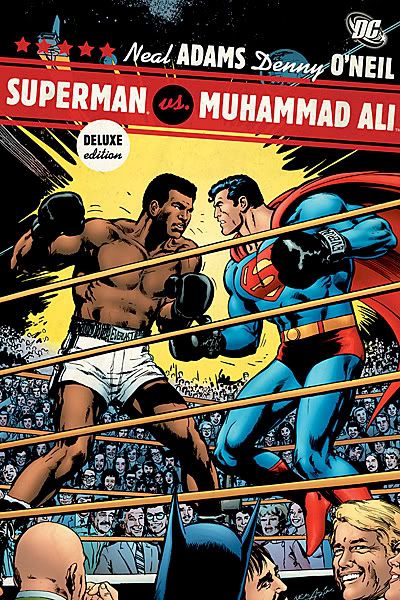
Why? Because there's a sense of the creative team just knocking themselves out (otherwise Ali might have done it for them) to produce something special, an event reminiscent of one of those “Battle of the Network Stars” specials or a Bob Hope holiday show with everyone in his Rolodex invited and then some. And because they manage to convey such a sense of fun, the book works both as a tribute to Ali and as a curious artifact of the 70s, the latter emphasized especially by the inclusion of Adams’s famous wraparound cover featuring such leisure suit era luminaries as Jimmy Carter, Pele, Sonny Bono, Johnny Carson, the entire Jackson 5 (man, they got some shitty seats!), a couple of Sweathogs from Welcome Back, Kotter and a young Ron Howard. If you look closely, you can make out a reunion of sorts for the Fab Four-- that's right; John, Paul, George and Ringo are there in the crowd. No sign of Linda or Yoko. You can also see a few famous faces with mustaches slapped on them because, as Jenette Kahn relates in her afterward, a few celebs balked at making a ringside appearance. And in what kind of world does George C. Scott turn down DC Comics only to be replaced by Kurt Vonnegut?

All this and a selection of Adams's surprisingly tight layout thumbnails. Just buy it and dig it, my babies.