Showing posts with label Kitty Pryde. Show all posts

Friday, September 5, 2014

"Forget it, Kitty! You're not good enough for us 'X-Babies!"


Ah, I remember New Mutants #13 (March 1984) when Kitty Pryde was like, "Oh, guys, can I hang out with you?" and Dani Moonstar was all, "Nuh uh!  You called us 'X-Babies,' so you can take your sorry butt right on out of these woods we're hanging out in and suck an egg!"  I was thinking about that the other day.  I've always loved the cover by Tom Mandrake.  Crying Kitty's in the foreground in her garish green circus costume, phasing sadly through a fallen tree, and the New Mutants are behind her looking fierce.  Especially Dani, who Mandrake places in this pose of haughty dismissal.
 
The story inside is heavy on Amara, Kitty and Doug Ramsey, none of whom I had the least interest in back in the day.  I briefly gave up reading the series right around this issue because the book seemed moribund.  No more Bob McLeod art, the team's central conflict-- Dani versus a Brood-controlled Professor X-- had long been resolved and the X-Men were back from space, where everyone had believed them dead.  There was really no need for a junior X-Team, unless it was to give Chris Claremont's complex narratives in Uncanny X-Men extra space to play out as a kind of main story footnote.  Hardly a compelling reason for another title, although it's standard operating practice at both Marvel and DC these days.
 
Rather than establish a distinct identity, New Mutants in its second year tended towards dull, generic super-kid stories. It hooked me again when Bill Sienkiewicz became the regular artist and Chris Claremont re-established his unique authorial voice by taking the kids and their narrative in a darker direction.  Demon bears, slumber parties, shape-shifting cyber-aliens from outer space.  All classic stuff.

But I loved this conflict between Kitty and Dani.  I took Dani's side, of course.  Who wouldn't?  Dani is only Marvel's greatest post-Jack Kirby creation.  Kitty's fine, but there's no competition there.  Mandrake's cover stuck with me for years after I'd forgotten Amara gets her codename in the story, long after I'd given up comic book reading for serious literature only to start in with them again, kind of the same way I did with New Mutants.

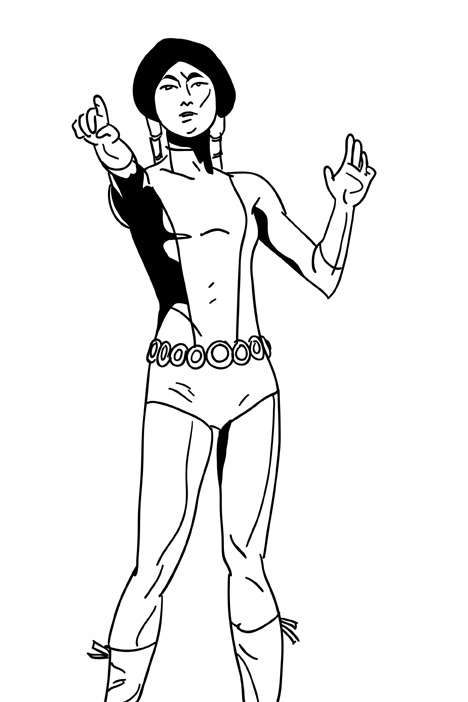
Every so often, I want to revisit that cover image, only my brain invariably turns it into something that only slightly resembles the Mandrake original.  Like with this drawing, which I knocked out the other day before work.  I felt like working on a foreshortened pointing pose, because I'd convinced myself Mandrake had drawn Dani that way.  Actually, if you take a look at New Mutants #13, she's just sort of waving her hand at Kitty.  And I really thought since Dani was establishing herself as team leader and spokesperson she was the one who let Kitty have it with the cover dialogue.  How wrong I was!  Well, my little sketch is poor Kitty Pryde to Mandrake's powerful Dani Moonstar.

Monday, January 13, 2014

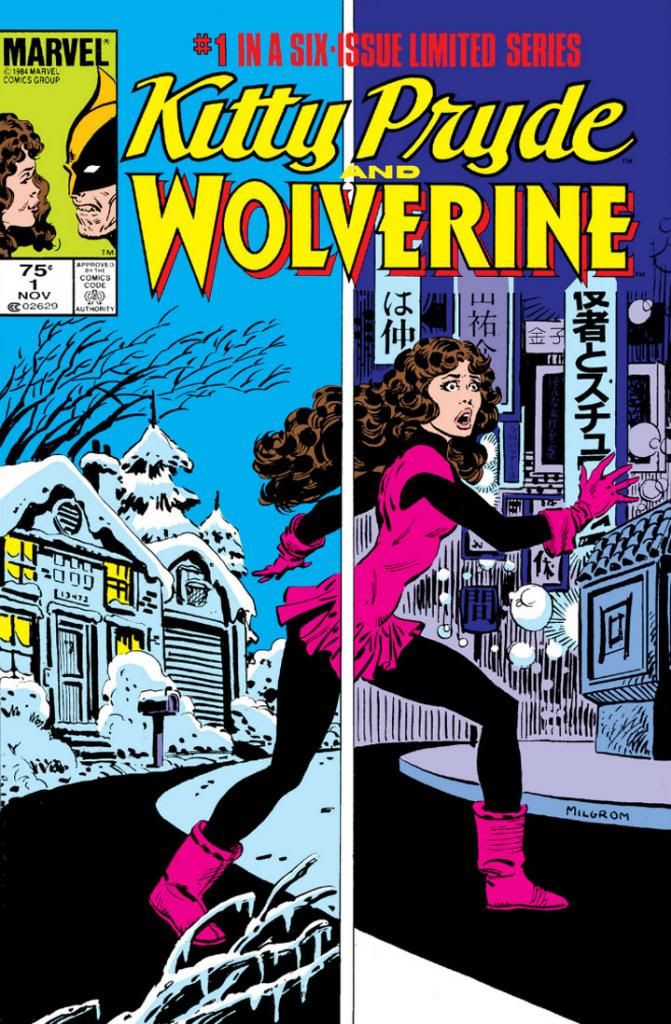
Kitty Pryde and Wolverine #1 (November 1984): Bad News Mutants Go (Back) to Japan!

When I was a much younger comic book fan Japan was mostly just that place Speed Racer and Pink Lady came from.  Then at some point, I must have gone insane because I moved there to start a new life and go to Melt-Banana shows whenever I damn well feel like it.  While it's not nearly as exciting a place as Pink Lady and Jeff would have you believe, Japan is still a pretty cool place to live.  I've had a lot of misconceptions corrected since I was a young comic book reader living in south Georgia, and I've probably formed more than a few new ones now that I'm an old comic book reader living in south Shizuoka.  This is why I love taking a look at American comics depicting my adopted home.

Marvel Japan!  I can't know for certain (since I wasn't working for them), but I get the feeling Japan was Marvel's go-to country for remaking characters back in the 1980s.  In their classic and influential 1982 Wolverine mini-series, Chris Claremont and Frank Miller sent Wolverine there, tore him apart, put him back together again and cemented his place as one of Marvel's top draws.  Along the way, they created a fabulous fantasy Japan (we've discussed this already), where the high-tech marvels of modern Tokyo form a backdrop for a lot of pseudo-mystical martial arts tough guy nonsense.  In the Marvel Japan Claremont and Miller invoked you could still encounter hordes of ninja and stoic old people still living the ways of bushido in their ancestral castles.  It's silly, but it's the best kind of silly.  I dug it, you dug it, lots of people dug it, so much so this story recently formed the basis for The Wolverine (in Japan it's called Wolverine: Samurai) starring Hugh Jackman.

In Kitty Pryde and Wolverine (November 1984-April 1985), it's Kitty Pryde's turn to visit Japan and experience life-changing events.  And you couldn't ask for a better protagonist, or one more in need of a fresh start than 1984 Kitty Pryde.  Lovingly written here by Claremont, our heartbroken yet smart'n'spunky (TM) Kitty is plenty interesting on her own to have headlined a two or three issue romp through 1980s-era Tokyo, capital of a country then enjoying a huge resurgence in economic prowess, self-confidence and cultural energy-- Shinjinrui!  Visual kei!  Para Para!  With New Wave artists already appropriating its looks and imagery, Japan's youth culture stood poised to conquer the pop culture world, and this could have provided plenty of material without anyone resorting to martial arts clichés.  Instead, in the second issue, Wolverine muscles his hairy way into the plot and the series becomes a deadly serious remake of his solo story, only with Kitty fighting ninja and yakuza for redemption.  Those aspects just don't provide the same kick or appeal the second time around. 

But rather than shoot my figurative BB gun at a comic for not doing what I want it to do, I'd rather focus a positive spotlight on the way-cool first issue, which has Kitty lost in translation all by herself, desperately in over her head.  So let's take a long, loving look at Kitty Pryde and Wolverine #1.  How do Claremont and artist Al Milgrom depict Japan?  Is it believable?  Does it make a reader feel as if he or she has been there?  That's what you're asking me right now, isn't it? 

No?  Well, okay!  I'll tell you anyway!

First, there's the trip journey itself.  To get to Tokyo, Kitty stows aboard a JAL flight from Chicago, and I can promise you there absolutely is such a flight, known as JAL Flight 9.  These days, the aircraft flying the route is a Boeing 777-300ER, but Kitty hops a 747-400 (I think).  That's the same plane I took, only I didn't phase onto it through the cargo bay.  I had a ticket, so my arrival at Narita Airport was a lot smoother (and drunker, thanks to JAL's liberal free drinks policy at the time) than Kitty's.  Not having my good luck, Kitty then spends a page or so escaping Narita.  Today's Narita doesn't look much like the one Milgrom draws, but I first visited it some twenty years after Kitty, so it probably underwent a renovation or two in the interim.  Oh, there's a funny bit where Kitty phases onto a bus and accidentally slaps a salaryman on the ass as she solidifies.  Today we're more likely to get to Tokyo proper by way of the Narita Express, because Narita is actually way out in the rice fields of rural Chiba prefecture, a fair distance from the urban neighborhoods the where the rest of the story takes place.

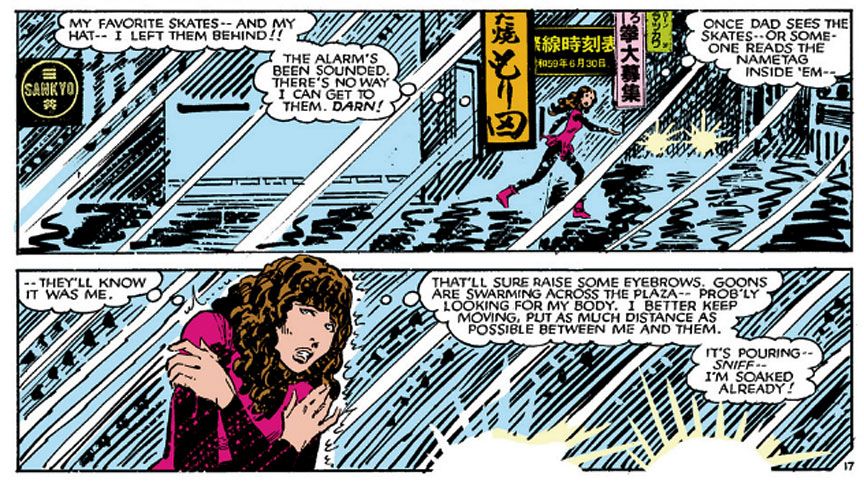
Now we come to the meat of this post:  Tokyo.  Godzilla's Stomping Ground.  Where the Bears played the Japanese Little League champs.  Kitty visits Tokyo in winter and let me tell you-- Japanese winters are cold!  Cold and windy!  Because her trip is on the spur of the moment with no time to pack or dress more appropriately, Kitty's skater costume is cute but hardly practical for running around outdoors here.  And to top it off, she gets soaked by the rain.

Script by Chris Claremont, art by Al Milgrom

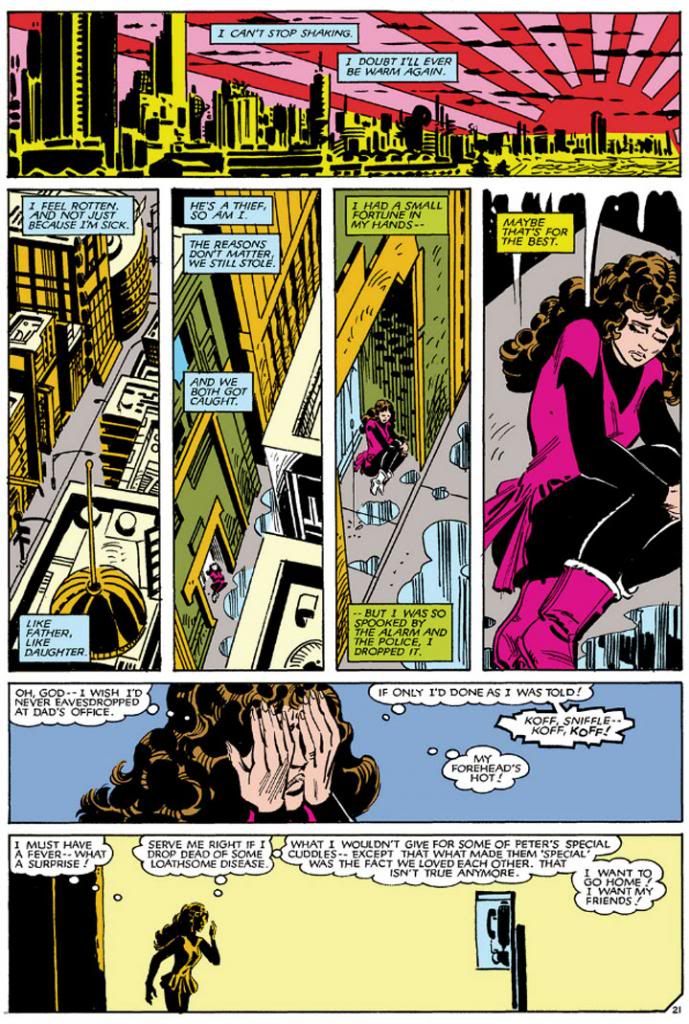
Claremont's Kitty may be impulsive at times due to her youth and naiveté, but she's also a thinker.  During this sequence, she's sizing up her situation after receiving a pretty heavy duty system shock and already figuring out not only has she made a sizable error in judgment trying to help her dad, she'll also be lucky just to stay out of jail herself.  Then the weather takes a dump on her, too.  It actually rains a lot in Japan (while Kitty can't because she lacks money, less desperate visitors should buy a cheap umbrella at a convenience store; the wind's just going to destroy an expensive one anyway), so this vaguely Blade Runner-esque cityscape looks pretty accurate.  Milgrom inks his pencils with a bold, energetic line and spends more time on the rain shower than the surroundings, but those squiggly blacks Kitty's running across are reasonable visual shorthand for the wet streets and reflective lighting of a rainy Tokyo evening.  The vertical signage creates a convincing Tokyo look as well.

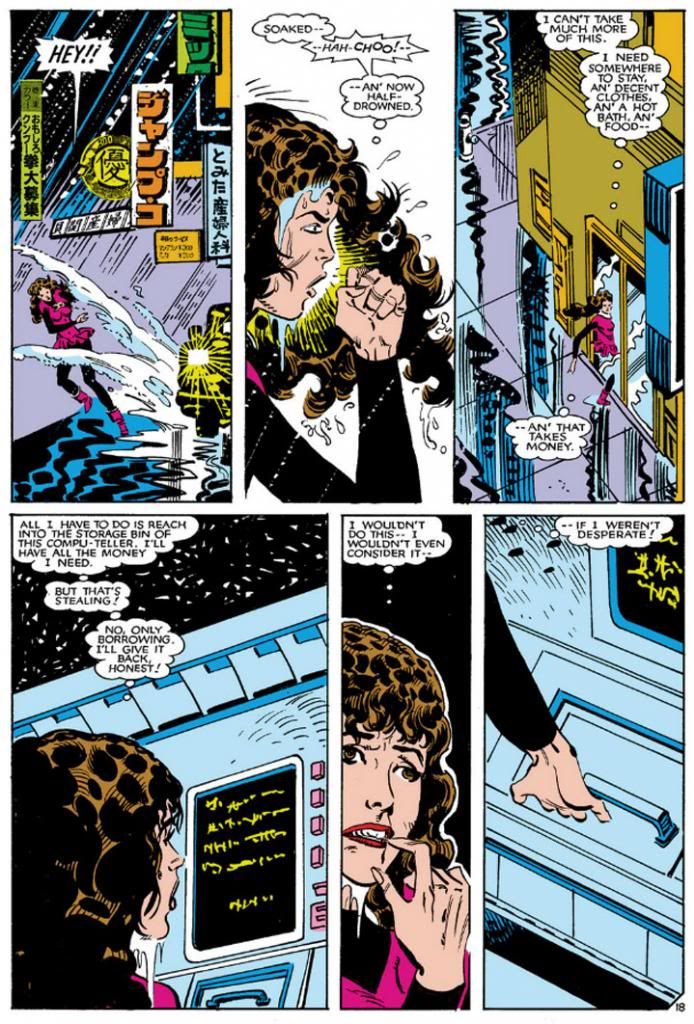
In the next sequence, the rain lets up a little so Milgrom shows us more of the city.

Claremont, Milgrom

It looks as though Milgrom uses some paste-up lettering here, possibly clipped from Japanese newspapers or magazines, or even actual photos of Tokyo.  That's a smart idea.  All that lettering would have been a pain for either him or the book's letterer to recreate, and they would have had to hire a translator to make sure they weren't just slapping down squiggles and squares or accidentally writing something rude.  Plus, Japanese comic book artists sometimes paste up entire pre-drawn backgrounds from special manga-tool artbooks, or use half-tone photographs.  Milgrom does the last, too, but I forgot to capture a screen image of it so you'll just have to take my word here.

Milgrom's version of a Japanese ATM is fun.  Since it's the 1980s, Kitty can't quite decide what to call it.  "Compu-teller," huh?  Now you find ATMs all over the place in Japan-- in banks, post offices, malls and convenience stores.  Inconveniently, some of them are not open 24 hours so sometimes you have to be prepared to wait until business hours the next day to withdraw money.  Imagine Kitty's dilemma here when she needs cash, it's after hours... and she doesn't have an ATM card or even a bank account.

Don't do it, Kitty!  Don't steal that money!  Not only is it illegal, but it's also not worth the guilty feelings and depression!

Milgrom waits until almost the end of the issue to give us a widescreen Tokyo cityscape.

Claremont, Milgrom

Ah!  The "Rising Sun" motif!  How Buckaroo Banzai, baby!  Now we really know we're in 1980s Japan.  Milgrom enjoyed this effect so much he used it again in the fourth issue, rising behind a Japanese castle.  After a spectacular overview of the big city, Milgrom zooms in on a neighborhood, finding a sick and miserable Kitty huddles in a doorway.  And she hasn't even hit bottom yet.  Kitty's back alley/sidestreet hideaway in the second panel tier looks reasonable to me.  Granted I spend most of my time in the hip, upscale districts hobnobbing with trendsetting fashionistas like Chiaki Kuriyama and Kyary Pamyu Pamyu, but I've occasionally glanced at just these kinds of lowly city spaces as we've swept by in our motorcycle-escorted limousine motorcades.  That pay phone looks pretty generic, but a phone is a phone, I guess.

"I can't stop shaking.  I doubt I'll ever be warm again."  I get the feeling Chris Claremont visited Japan himself some winter prior to writing this.  Anyway, welcome to a country where few buildings feature insulation or central heating even now.  Think how rare that must have been almost thirty years ago when Kitty came.  These days, I pile on the layers starting with Uniqlo Heat-Tech and ending with a quilted hanten, and my wife and I run an electric heater in the mornings when we get up.  I still shiver all winter.  And Kitty spent the night outdoors with only her wet skater dress and some tights to protect her.  She also swam through a sewer pipe a few hours before.  No wonder she's in no mood to enjoy the sunrise.

The rest of the mini-series stages fights inside office buildings or on rooftops (Tokyo Tower makes a background appearance as Wolverine's friend and sometimes lover Yukio dangles an unfortunate oaf over the distant street) and martial arts training sessions at secluded castles right out of Akira Kurosawa flicks.  Claremont and Milgrom score high marks on the Japan scene-setting throughout, and while I wish they had kept things Kitty-centric and lighthearted, at least she comes out of it with a spiffy new costume (a softer version of a leather outfit she wears as part of a disguise later in the story), some boss fighting skills and a grown-up codename:  Shadowcat.

She does get an ugly New Wave haircut, though.

Wednesday, October 9, 2013

October is Spookey Month: Uncanny X-Men #143 in which Kitty Pryde recreates the movie "Alien" just for kicks

Remember the N'Garai, the H.P. Lovecraft-inspired smoke demons led by that big, energy-draining jerk Kierrok?  One September afternoon and/or evening, they gave the X-Men a lot of trouble until Storm blew their stone cairn apart with a lightning bolt and sent them back to whatever hell-space they crawled out of.  Flash forward a few years and intro Kitty Pryde to the book. 

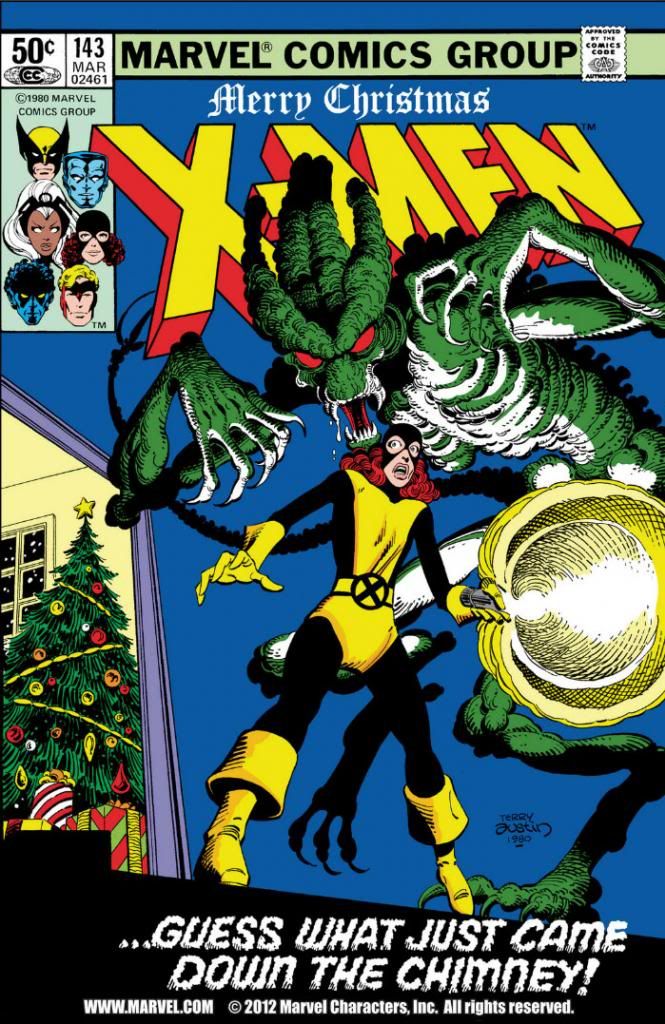
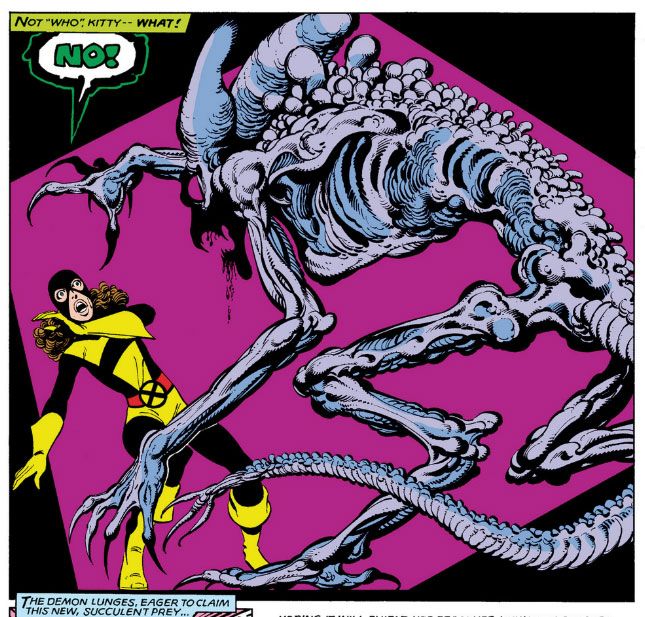
One Christmas Eve the rest of the gang leave her home alone, just like in that fun holiday movie about being left home alone.  The title escapes me.  Oh yeah-- It's a Wonderful Life.  Unknown to everyone but Chris Claremont and John Byrne (those scamps!), it turns the portal to the N'Garai dimension is still slightly ajar.  One of them, or a close relative, pops out, having visited Swiss surrealist H.R. Giger for a makeover sometime during the intervening years.  The first thing the new, Alien-style N'Garai does is shred an unfortunate couple out poaching a small Christmas tree for their apartment.  Then the poor, lost little demon, as lonely and in need of companionship as Kitty, goes looking for a friend.  After all, it's no fun to be by yourself during the holidays.  Kitty knows this, because this is the first Chanukah she's spent away from home herself.  Unfortunately, thanks to various cultural differences, things don't go the way the demon planned.  Kitty is less than appreciative of its presence, they don't get along, there's a misunderstanding, a fight and a blast from a white-hot jet engine.
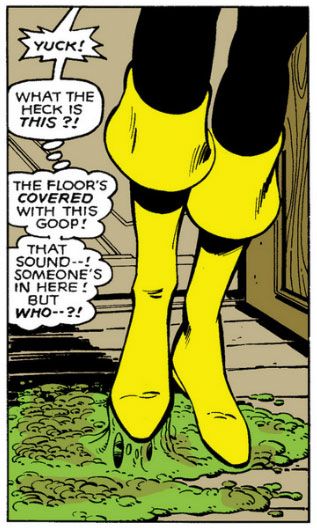
This story, called simply, "Demon," ran in Uncanny X-Men #143 (March 1981) a pretty minor work compared to the galaxy-spanning drama that made up the recently-concluded "Dark Phoenix Saga," and it lacks the influence of "Days of Future Past," which took up the previous two issues  It's kind of the Claremont-Byrne team's last little laugh before the team split, and from its title to its monster and most of its plot, it's openly cribbed from Ridley Scott's sci-fi/horror masterpiece.  You know, White Squall.  Claremont must have enjoyed using Scott as much as he did H.P. Lovecraft in the prequel to this issue; he'd later re-homage Alien with his Brood creatures,a kind of otherworldly insect species with a life-cycle that resembles a toned-down version of the Giger creature's.  I don't know if Byrne tried again.  He seemed to content himself with mining Marvel's own history for ideas when he moved over to Fantastic Four as writer and artist.  And tossing in a little Twilight Zone or Invasion of the Body Snatchers for good measure-- remember that issue with the town that drank the cow-Skrull milk and turned into evil shapeshifters?  That one was disquieting in a way this one can't quite match.

The monster itself tries its best, but falls a little short because neither Claremont nor Byrne seem particularly interested in it.  Their main concern is putting Kitty through her paces and making readers adore her.

Let's examine our N'Garai for a moment.  In X-Men #96, the story makes the point these smaller demons consist of smoke, and Dave Cockrum makes them more bug-eyed.  Storm is even able to wave one of them away with her hand.  They do, however, sometimes use long spears or lances with which they can stab someone and inflict pain and perhaps drain away life force like Kierrok does with his very presence.  Claremont is almost out of pages with no time to explain it fully, and Storm herself only says something about pain and possible death if she's stabbed again.  In this issue, the lone N'Garai is definitely made up of solid matter of some kind, albeit demonic, and it uses its claws and teeth on the young marrieds before eating their bodies and their souls.  It also leaves Alien slime wherever it goes and crashes through walls.  Essentially, it's an unauthorized guest appearance by the movie monster without any of the icky bio-mechanical sexual reproduction connotations.


Confined within the pages of a single issue and the limits of what the Comics Code would approve, the poor beastie doesn't really get to cut loose and terrify us.  The chase it inspires is chaotic but not as frightening as it needs to be.  Byrne smudges Kity's face and draws some sweat droplets on her brow and Claremont has her tell us through a thought balloon she's scared but "coping," but she comes across as a bit too unflappable throughout most of the comic.

Sigourney Weaver's redoubtable Lt. Ellen Ripley-- for whom Kitty acts as a stand-in and occasionally physically resembles here-- is self-possessed throughout the majority of the film, but frazzles during her frantic escape attempt.  Then she just about loses her shit when she discovers she's accidentally taken the alien with her in her little life pod before she pulls herself together.  Weaver's iconic performance helps, as she's able to convey both Ripley's palpable fear and her agency simultaneously.  This crucial element is missing in Uncanny X-Men #143, despite the tear in Kitty's eye in one close-up.  Also, we haven't really seen the demon do a whole lot beyond kill two people-- both taken by surprise and, as civilians, without even Kitty's ghostly phasing powers-- and a room full of plants.

The story comes close to its full  Alien-esque horror potential when the creature jumps out at Kitty and slashes through her, causing her pain and the temporary loss of feeling in one arm even though she's in her incorporeal "phase state," and in the hyper-kinetic Danger Room sequence as well, but  there's no real feeling Kitty's in serious jeopardy.  After all, this entire issue is more or less a love letter to her, so we seriously doubt from the get-go Claremont and Byrne plan to kill off this kid so soon after the start of her comic book career.

So what we're left with is more a puzzle situation, and the interest is in watching how courageous and clever Kitty solves it.  Which, I suppose, makes it kind of akin to one of those Quinn Martin detective shows.  Barnaby Jones or something.  We see the criminal commit the crime right at the outset and instead of a whodunnit, we get a how-solve-it.

Speaking of how Kitty solves things-- well, if you've seen Alien, you know how it all ends.  Byrne even borrows heavily from the film's visuals to show it, a kind of acknowledgement of just how baldly he and Claremont are riffing on Scott.  To set it up, there's a neat bit of foreshadowing right at the start when we see Professor X teaching Kitty how to start the Blackbird.  I find it really fun to see a young hero's education in process, and who would have thought the day's lesson would pay dividends so quickly?  This premise-- how superheroes learn to be superheroes within a school setting-- is a lot more interesting to me than the demon/Alien stuff.  It's a precursor to The New Mutants and it's almost as if we're watching Claremont inspire himself along those lines, with the genesis of that series appearing right here on these pages.

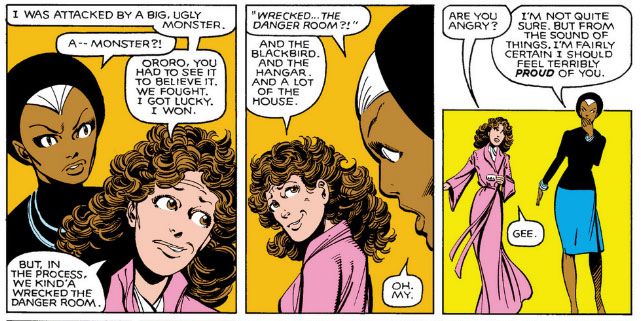
The weirdly saccharine denouement also foreshadows Claremonts of future past when the team returns to the mansion only to find a tired but otherwise unshaken Kitty sipping hot cocoa in front of the fireplace.  That's right-- she has barely escaped death or even worse at the demon's claws, has no way of knowing if this was a one-time event or the harbinger of a full-scale monster invasion, isn't expecting anyone home for hours... and Claremont has her drowsily lounging about in her robe, as if nothing at all out of the ordinary had happened.

Okay, so Kitty's much tougher than I'd ever imagined, and she's recently returned from the future where she watched everyone die, but don't you think almost being killed by a demon warrants some kind of emotional response beyond the slight embarrassment one gets from denting the family car?  And even if Kitty is too cool to worry, you'd think the older superheroes who almost died fighting Kierrok and supposedly have years of combat experience would do some kind of reconnaissance or go into a defensive posture on the chance there are more demons or enemies lurking around.  They don't even spend much time trying to debrief Kitty.  Storm just gives her the concerned mom act.  After all the mayhem, it turns out nothing more is at stake here than in any given episode of Facts of Life.


This comes dangerously close to making the whole "spunky teen girl joins the team" aspect insufferable.  I guess my tolerance for this stuff was a lot higher when I was Kitty's age.  The New Mutants, which came out a mere year or two later, would consist almost entirely of this kind of tonal dissonance, and I ate it up.  And still do, but then my outright hero worship-love for Dani Moonstar has always overshadowed my liking of Kitty Pryde.  As it is here, everyone's muted reaction further undermines any peril Kitty might have been in earlier in the story and reveals a Claremont a little too in love with his cast.  While it's nice to show Kitty as a teen character able to pull herself together and save herself (a trait she's going to need when the team rockets into space or faces down Dracula himself later on), if you're going to take your superhero story the sitcom route, a better, more appropriate gag for the ending would have been the team coming back to find a pumped up Kitty toting around a baseball bat or that M16 rifle Moira MacTaggert used on Kierrok when these demons first appeared.

And one more thing, gosh darn it-- it's really too bad this wasn't set at Halloween.
Monday, September 3, 2012

The Uncanny X-Men and the New Teen Titans, or "When Dudes in Their Underwear Shake Hands"


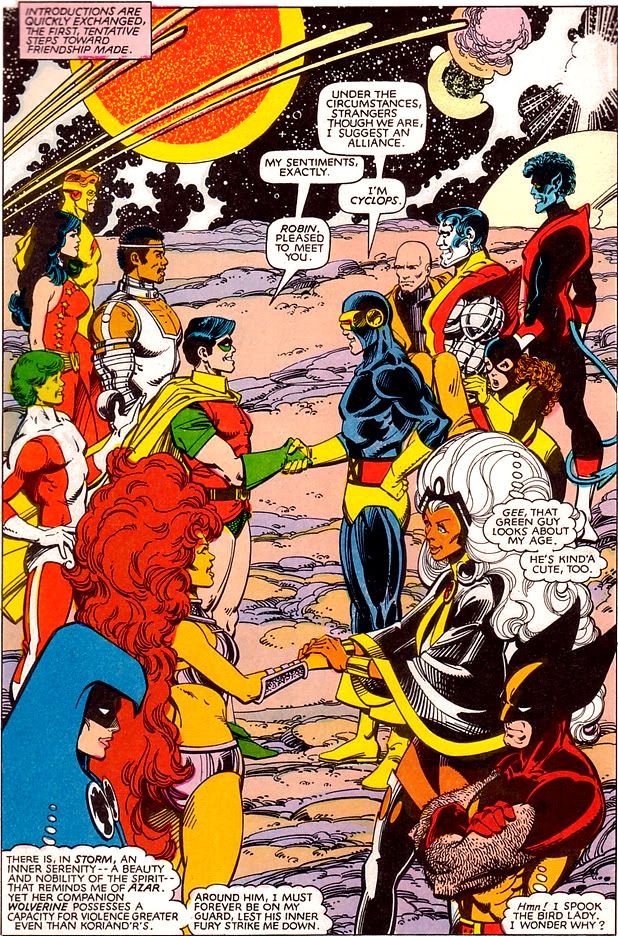
Fresh off the The X-Men and the Micronauts debacle, here's a team up more to my liking.  It's the Marvel and DC presentation of The Uncanny X-Men and the New Teen Titans (September, 1982), a fat, slick beauty of a book.  This is the pivotal moment where both teams gather with counterparts from each conveniently facing off, or grasping hands in greeting.  Well, the Raven/Wolverine moment isn't exactly a meeting of similar characters, but you get the idea.

Kitty's body is playing it smart even if her mind is unfortunately letting her down.  We need to trust our bodies more.  Sometimes the mind plays tricks on us, but the body is always honest.  In this case, Kitty is right to hide behind Colossus rather than approach Changeling.  That green freak would only make some clumsy sexual advance, and then keep it up non-stop, transforming into snakes and octopi while groping her.  And no one on either team would raise a hand to stop the little pervert.  Probably has his erect penis poking out of his waistband-- Changeling's idea of "playful flirtation"-- which is why artist Walt Simonson chose to hide the kid's crotch behind Starfire's hair.

I haven't read this in a while, but I remember it being an effective meshing of both teams' continuity, with Cyclops having to deal with the heartbreak of seeing his beloved Jean Grey resurrected in her evil Dark Phoenix form and Darkseid teaming up with Deathstroke the Terminator to kick the snot out of both teams.  As you can see from the dialogue and thought balloons in this image, it features Chris Claremont at the height of his powers doing a bang-up job capturing the essence of all the cross-company characters, throwing in little references to past events, showing his encyclopedic knowledge of then-current comic books.

You know, sort of how he was always name-dropping the good ones in Uncanny X-Men or having minor characters that parodied Cerebus the Aardvark or whatnot.  That stuff always made me feel I wasn't wasting my time reading comics, that they really were the intellectually stimulating yet action-filled pieces of sequential literature we always claimed them to be.

While I can't remember all the story details, I do know Claremont, Simonson and inker Terry Austin knocked me right out with this book when I was 14 and a fan of both teams.  It was perfection, just everything I wanted in a team-up of Teen Titans and Uncanny X-Men.  The epic climax with Dark Phoenix showing up and sacrificing herself for love (I believe) and then the denouement with all the players kind of hanging out in their civilian clothes left me feeling for Cyclops in a wistful sort of way for a couple of hours, but I read it ten to twenty times in two days and that kind of spoiled the mood.  I still have it, along with a run of the original "Dark Phoenix" issues of Uncanny.  I should re-read this comic and see if it holds up better than The X-Men and the Micronauts.

It should.  Although Changeling is probably twice the degenerate the Entity is any day of the week.