You'd have to be crazy to go on a Reed Richards-planned vacation. For one thing, there's no such thing as a leisurely Reed Richards-planned vacation because Reed's idea of leisure is to culture bacteria or tinker with a device to allow inter-dimensional travel. Those are his spare time activities. He does really heavy-duty stuff when he's working.
For another, if at the moment he's interested in traveling, he's not going to set up a Hawaiian itinerary or a couple of weeks in the Riviera, although he could easily afford either with all his patent money and licensing fees. No, he's going to take the whole party to Transylvania so he can do a little field research.
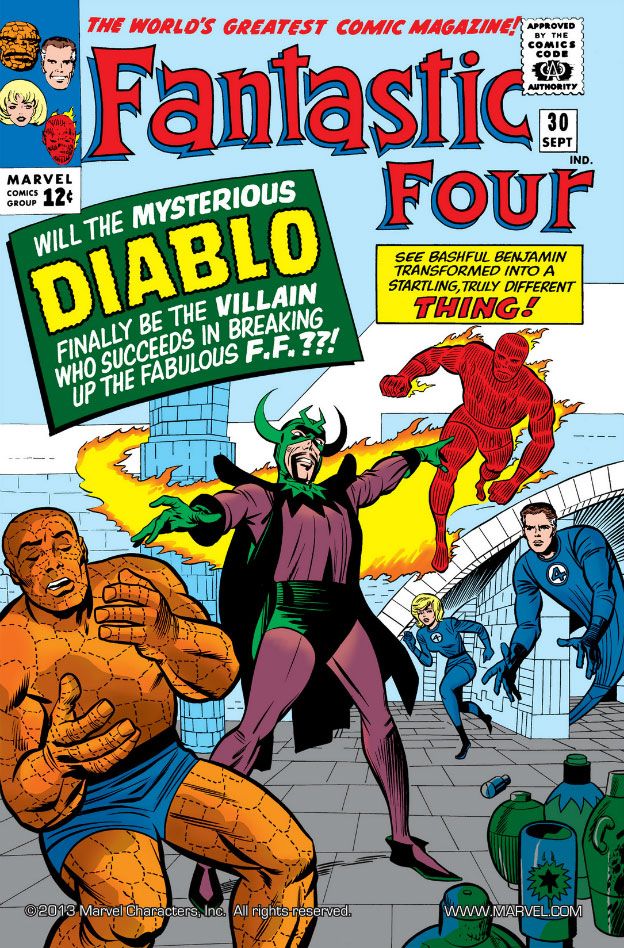
Check out what he does to his friends Sue, Ben and Johnny in Fantastic Four #30 (September 1964). Reed drags them all the way behind the Iron Curtain-- and I thought the guy absolutely despised communism-- for a visit to Dracula country. Stan Lee's narration calls Transylvania a "kingdom," but that was true
only in his active imagination, no doubt full of Bram Stoker-inspired
fantasies. In reality, during the time frame of the Fantastic Four's ill-fated visit, Transylvania, as part of Romania, had only recently emerged from under direct Soviet control and established a certain level of political and economic independence from the USSR, it labored under the rule of Georghe Gheorghiu-Dej, a hardline communist and former Stalinist who instituted one of the harshest regimes in Eastern Europe.
It also harbored anachronistic alchemists like Diablo, with his green horned cowl and jaunty purple tights.
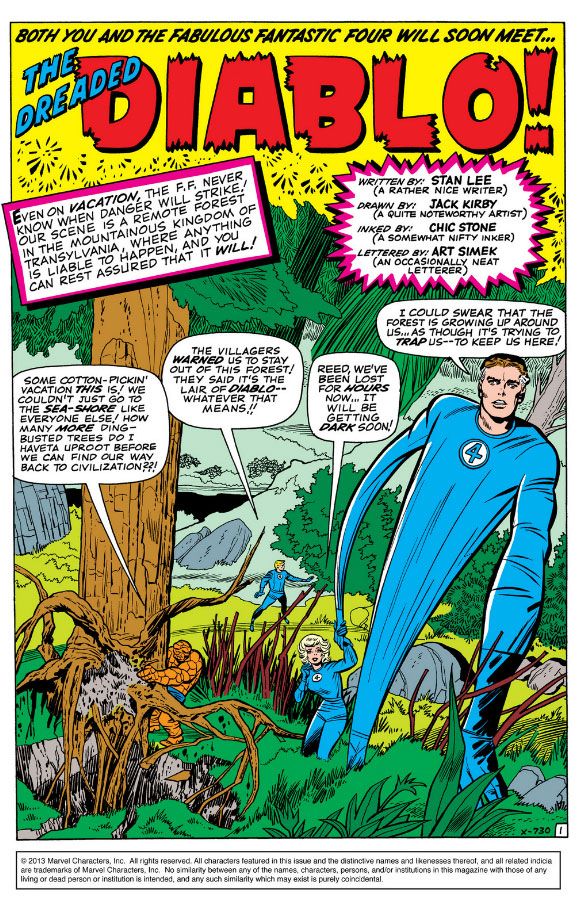
The first thing Reed does on this so-called vacation is to lose the team deep in the Transylvanian forests. He does this so quickly, Kirby and company don't even bother with set-up. There's no Baxter Building prelude where Ben and Johnny get into a fight and Reed intervenes only to have Sue step in and tell everyone they're only squabbling because they've got cabin fever and need some time off. Nope, right from the splash page they're lost and the only explanation for the how and why we get is in a caption. Anyway, Reed is probably faking it so he can surreptitiously search for a rare slime mold or fungus from which he can synthesize a chemical he needs. It is a scenic forest, though.
There are few inkers I enjoy on Jack Kirby so much as I do Chic Stone. Chic Stone makes Kirby's art look like a cartoon, and I mean that in the best sense of the word. Take that cover, for example. Check out how Kirby and Stone depict the transitional, less-rocky Thing-- thick contour line around the outside, dotted lines on the inside. And bald. Also, how cool is it on the splash page that Ben is plucking a tree right out of the ground while complaining about the very topic of this blog post? The tree's not even in his or anyone else's way; it's just there for the plucking. This is fun. Comic visuals that are pure fun.
But look at Reed stretching himself out there, pretending he doesn't know exactly where they are and what he's doing. A few moments later, he's all like, "Hey, look, gang! I found a ruined castle I totally never suspected was here all along! Why don't we... oh, I don't know... investigate it?" Obviously, Reed wasn't after just some botanical specimens...
Then this Baron Hugo character shows up and tells them to stop being lost before they hurt someone or disturb something best left undisturbed and that they can sleep over at his house. That night, Ben sneaks out into the forest and-- in a creepy sequence that anticipates Mike Mignola's Hellboy-- goes to an ancient castle where he pulls a giant stone stopper out of some kind of cylindrical stone architectural feature for which I don't know the name. The narration refers to it as a "crypt." Well, okay. This frees our old pal, Diablo. Diablo, the Transylvanian alchemist with the Spanish name that means "devil."
It doesn't take Diablo long to exploit festering personal divisions within the FF, using his chemicals to restore a limited humanity to the Thing, with a promise of more to come. That's all it takes for the disgruntled Ben to turn his back on tour guide failure Reed Richards and declare himself Diablo's buddy-for-life. Diablo goes on a chemical rampage, rejuvenating a geriatric millionaire named Featherstone (he wears a top hat!), transforming the Iranian desert blossom into a floral wonderland, raking in the money with government contracts and using Ben as overseer to exploit local labor.
Reed, smarter than your average alchemist, soon discovers Diablo's formulas are all phony-- suddenly, the blossoming deserts revert to their infertile state, the millionaire ends up hospitalized for an advanced case of being a moldy old bastard and the anti-missile shield (don't know how a chemical potion produces something like that and wisely no one bothers to even try to explain it). And poor Ben has his heart broken yet again.
With the tacit approval of the United Nations itself, the Fantastic Three spring into action, only end up trapped in glass vials. Ben redeems himself and Reed promptly gets them lost in the woods yet again. Because he still hasn't found the prized fungus, no doubt. And I have no doubt this is exactly the way things played out in Reed Richards's mind before they even left New York.
Some vacation! That's the kind of crappy vacation experience you're going to have if you let Reed Richards choose your destination. The man's a workaholic, I tell you. Doesn't know how to have fun. Or where. Now if you want me, it's summer vacation for me, too, and I'll be spending a fabulous fortnight in glamorous Pyongyang, cosmopolitan capital of the Democratic People's Republic of Korea. I hear it's a swingin' town and a real shopper's paradise!
Showing posts with label Ben Grimm. Show all posts
Thursday, August 1, 2013
Friday, February 15, 2013
Fantastic Four #1: Reed Richards, you maniac!
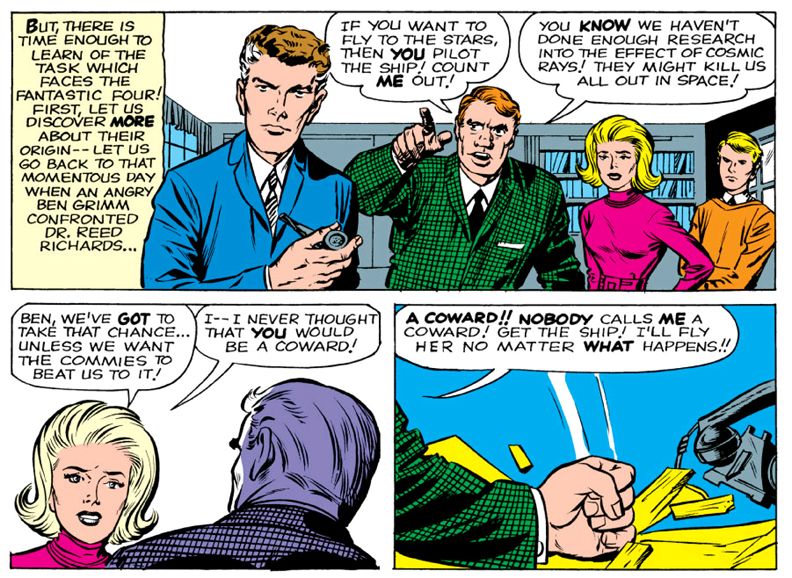
I'm guessing Reed Richards has at least one doctorate. Probably several. He's a genius, highly though of by the United States government. But for some reason this miracle mind, this all-American Einstein, this pipe-smoking prodigy, decided to take his girlfriend and her kid brother on a rocket joy-ride. That alone would be enough for the Fed to revoke all his security clearances and toss him in a metal box six by eight feet, surrounded by concrete and stone. While his real-life brainiac counterparts at NASA occasionally evinced "go-fever" and a kind of engineer-mind tunnel vision that led to disasters and deaths, it's hard to reconcile Richards's genius with the kind of recklessness involved in subjecting himself and his loved ones to cosmic rays and crashing America's most advanced spacecraft.
Think about it one more time. Reed Richards took his civilian girlfriend and a teenager with him on an unauthorized flight of an experimental rocket, even after the more cautious (but not cautious enough) test pilot Benjamin Grimm warned him the ship wasn't adequately shielded against radiation. And that was the least of the reasons why this was a terrible idea. This isn't "we've gotta beat those Reds into space" derring-do. This is "wearing diapers and driving across the country to shoot someone" multi-layered criminal insanity.
What was he thinking? Certainly, the lack of shielding represents a calculated risk for Richards and Grimm in their attempt to give the U.S. a Space Race victory. But to involve outsiders, one of whom Richards is involved in a romantic relationship with, gives one pause. J. Robert Oppenheimer (perhaps an inspiration for Richards) similarly allowed his personal life to intrude on his national security obligations. But while Oppenheimer married a former member of the Communist Party and carried on a secret affair with someone who wrote for the Western Worker, a Communist newspaper, he didn't strap either of them to the atomic bomb at Trinity. But his involvement with radical causes led the government to revoke his security clearances in the early 1950s. Richards's deed is arguably worse and he doesn't receive so much as a slap on the wrist.
Reckless endangerment. The failure of this flight could have set the United States back decades in the exploration of space. The 1967 Apollo 1 fire, for example, caused a twenty-month delay at a crucial time during our moon landing program. The loss of space shuttles Challenger and Columbia both halted American space flights. After the 1986 Challenger explosion, NASA grounded their shuttles for three years. After the 2003 Columbia re-entry disaster, crewed spaceflight via shuttle didn't resume for more than two. Imagine, then, the catastrophic results of Richards's rash, idiotic act.
The man should be under the jail. Well, actually, he shouldn't have even survived the crash. But the bulk of Fantastic Four #1 (November 1961) post-accident should have consisted of Reed Richards on trial as the traitor of the decade. Julius and Ethel Rosenberg? Bah! Pikers! The Cambridge Five? Rank amateurs by comparison. Richards's alma mater should have demanded he return his degrees, Grimm and Sue Storm should have been jailed as accomplices (the government could have granted them immunity or at least reduced sentences in return for testimony, however). A life sentence for ex-Dr. Richards.
Instead, Richards is one lucky devil. He gets rewarded with neat powers (unlike Grimm, who turns into an embittered monstrosity), Sue thinks nothing of the risks he put her and brother Johnny through and everything is just peachy.
Saturday, February 9, 2013
Fantastic Four #51: Someone left the Thing out in the rain
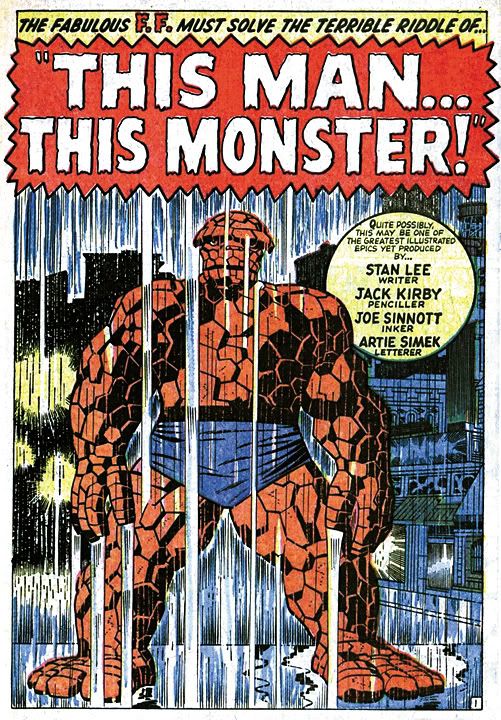
Feeling sorry for himself, he doesn't even bother to change out of his superhero swimsuit or stop for a sandwich before heading out into the rain to walk around, converse sullenly with well-meaning cops, then accept coffee from a weird bald guy with a prominent brow ridge.
The bald guy is pissed at Ben's buddy Reed Richards. Fortunately for him, the Thing exists. Because without the Thing and their convenient skeletal similarity, his transformation into the Thing's exact duplicate would prove impossible! Ironically, there's one man in the world who actually wants to be the Thing, while the real Thing would do anything- short of suicide- to escape that identity.
Anonymous Bald Freak goes to the Baxter Building where his enemy Richards is planning to invade the Negative Zone tethered to a simple nylon rope he bought at the Yancy Street Hardware Store, and wearing only a goldfish bowl for protection. Things end badly but not before Anonymous Bald Freak learns that all Things (even faux-Things) have an innate quality of heroism and self-sacrifice.
Interestingly, in a story about the Thing's wrestling with his own identity, we never learn the bald guy's name or exactly why he resents Reed Richards enough to want him dead. Even Richards himself hasn't a clue to who this guy is or what he might've done to piss him off. By the time the Thing is back his old rocky self, he's not really able to shed any light on the guy's story, either. Lessons learned? Ben Grimm's niceness rubs off even on jerks, and Reed Richards has a history of alienating people and making enemies.
Also, Stan Lee's dialogue perfectly balances the mundane and the sci-fi exotic. And Kirby's pencils follow suit. However, this is one of those issues-- despite what the credit blurb claims-- where Kirby did much more writing than Lee. It's full of Kirby-esque moments and moods that would become more familiar to the fans when he started garnering writing credits for himself.
Subscribe to:
Posts (Atom)