Showing posts with label Fantastic Four. Show all posts

Friday, January 24, 2014

Kirby's Kustoms! A selection of Jack Kirby's creative conveyances...

Jack Kirby created so many wonderful characters in his long career, but he also came up with all sorts of wild contraptions to get those characters to and from their adventures.  Your typical Kirby vehicle is somewhat outlandish, certainly futuristic, but also surprisingly plausible at a glance, as if he generated detailed plans before inserting them into his stories.  You're likely to find jet fans, air intakes and plexiglass cockpits along with all kinds of valves and pipes.  A Kirby vehicle is as instantly recognizable as one of his muscular, almost steel-like heroes.

Let's start with a one of his first from the fabled Fantastic Four comic.  Whatever happened to that?  Are they still publishing it?  Anyway, here we go--
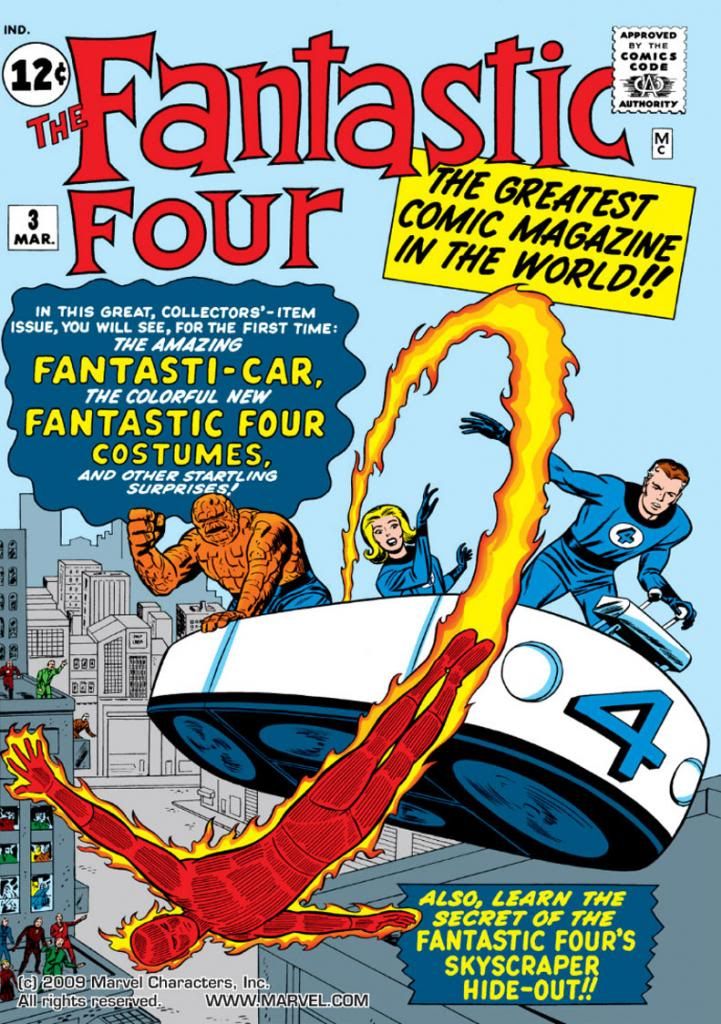
Fantastic Four #3 (March 1962), inks by Dick Ayers

The Fantasti-Car!  The Fantasti-Car debuts in Fantastic Four #3 (March 1962), which also saw the adventuresome quartet donning their blue costumes for the first time.  Like those plain but functional-appearing duds, the Fantasti-Car is a simple design, just a tub with headlights for safety and what appear to be four fans underneath for generating lift.  I'm not sure how Reed Richards controls pitch and yaw or generates forward thrust in this version of the Fantasti-Car, but I'm sure Kirby could have explained it if I'd been around in 1962 to ask him.  Unfortunately, this isn't the most visually impressive design, and I'm guessing Kirby must have been a little dissatisfied with it, because about a year later, the Fantastic Four upgrade to a hotter version.
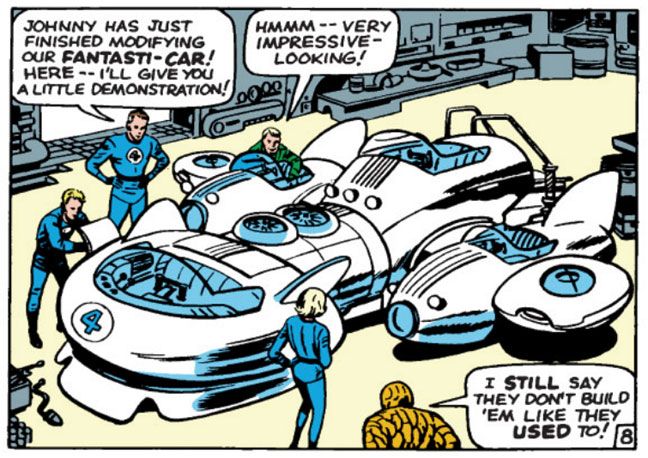
Fantastic Four #12 (March 1963), words by Stan Lee, inks by Dick Ayers

Yeah!  That's more like it!  The Fantasti-Car, Mark II made its debut in Fantastic Four #12 (March 1963).  This one has aerodynamic styling and possibly a much greater range.  Ignore Ben Grimm's little griping remark.  Some people just aren't pleased with anything.  The Fantastic Four use this Fantasti-Car to travel cross-country and take on the Hulk.  But what about ocean-hopping, when the team needs to cross hemispheres, date lines and other such geographic demarcations?

That's where this baby comes in--
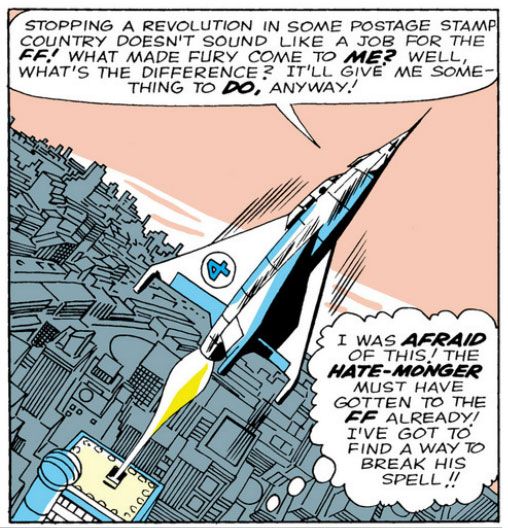
Fantastic Four #21 (December 1963),  words by Lee, inks by George Roussos

The Pogo Plane.  The Pogo Plane previously appeared in issue #3, but it really gets to strut its strato-stuff here as the FF prepare to face the Hate-Monger in Fantastic Four #21 (December 1963).  Kirby gives this aircraft a state-of-the-art appearance (at least for the 1960s), like something the USAF or NASA might have been toying around with in the early days of space exploration.  The X-51 or  the Lifting Body.  Man In Space Soonest.  The Flying Flapjack.  The Apollo Applications Program.  Somebody stop me or I'll go on forever.  I love aviation history!

This could be a wild, right-off-the-drawing-board design lifted from a Popular Mechanics article of the time.  It's got huge stabilizing fins and even flaps.  Plus it's a tail-landing VTOL aircraft.  That's "vertical take-off and landing," to you and me, Russ.  I'm no aeronautical engineer, but Reed Richards has that skill set among his many, and you can imagine he saw this one through from the initial design phase to wind-tunnel testing with a scale model to prototype production to flight test with none other than Ben Grimm at the controls.

Now that we're on the topic of his piloting skills, here's a little Ben Grimm-related aside-- Ben generally plays the fool with his gruff street-style patois, but he's actually vastly intelligent himself, the kind of guy who would have made the Mercury Seven if he'd actually existed.  Ben was a highly-regarded test pilot with a fighter background before he became a superheroic freak, which means he's got quite the expertise in engineering.  Tom Wolfe in his book The Right Stuff describes how Ben's closest real-world analog Chuck Yeager (no mean engineer himself) influenced not only aviation history but also how pilots of the era spoke-- I don't know if it's true or not, but Wolfe makes a hilarious and compelling case for airline pilots of the time doing their cockpit announcements in pseudo-West Virginia drawls in imitation of the man at flying's apex.  I can imagine in the Marvel world the same thing happening, only with pilots shouting, "It's clobberin' time!" when pushing the outside of that o' envelope, or making reference to their Aunt Petunias in put-on Brooklyn accents. 

If not for that fateful rocket flight...

Coming up next is a stripped-down sport model--
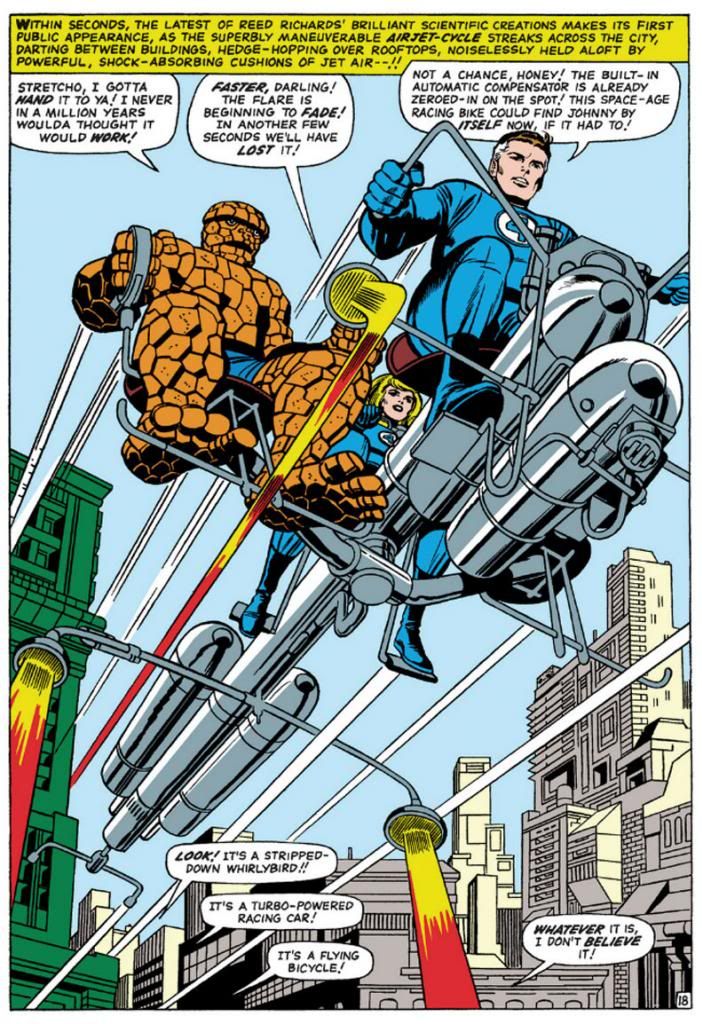
Fantastic Four #45 (December 1965),  words by Lee, inks by Joe Sinnott

The Airjet-Cycle.  This one has neat nozzles and tanks, but it's mostly just pipes and doesn't really look capable of lifting Reed alone, much less Ben and Sue as well.  Not the most practical of earthly designs, although it looks like something NASA might have considered for lunar mobility.  Leaves the passengers kind of exposed and vulnerable, too-- I love the look of sheer embarrassment on the Thing's ever-lovin', blue-eyed face as he holds on for his very life.   The Airjet-Cycle probably comes in handy for jetting to the supermarket, or getting little Franklin to school when he misses the bus.  Not as spectacular as either the Fantasti-Car or the Pogo Plane, the Airjet-Cycle nevertheless makes further appearances in Fantastic Four #46 (January 1966), #48 (March 1966) and #57 (December 1966), to name three.  The Avengers also use a version.  You can look it up.  I did!

And now--
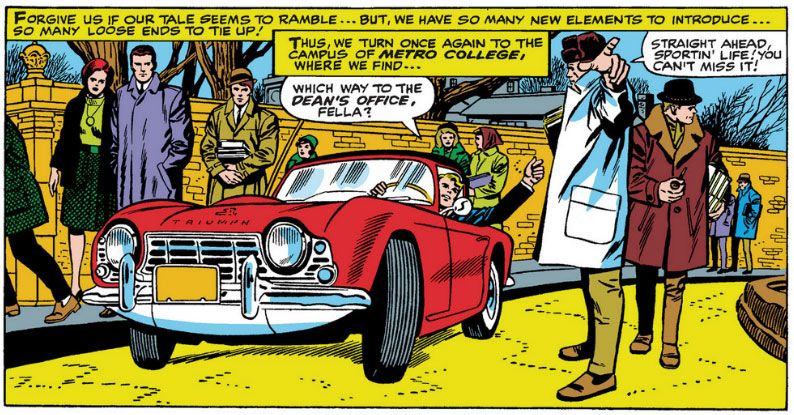
Fantastic Four #50 (May 1966), words by Lee, inks by Sinnott

Oops!  A ringer!  Don't ever think Jack Kirby couldn't bring things down to earth (relatively speaking-- Johnny's got one unearthly ride there) and draw realistic cars.  This one reminds me of the classic 1967 film The Graduate, directed by Mike Nichols.  Dustin Hoffman actually drives a 1966 Alfa Romeo Spider 1600 "Duetto" in that movie, but Johnny Storm here has a 1966 Triumph GT6.  Yeah, a Spitfire might have been more appropriate for the Human Torch, but Triumph introduced the GT6 the year Marvel published Fantastic Four #50 (May 1966), so leave it to Johnny to pick up the latest thing in sports cars.  Maybe he's auditioning for a part in The Undergraduate.

Let's leave behind the fast and the furious for the slow and reliable--
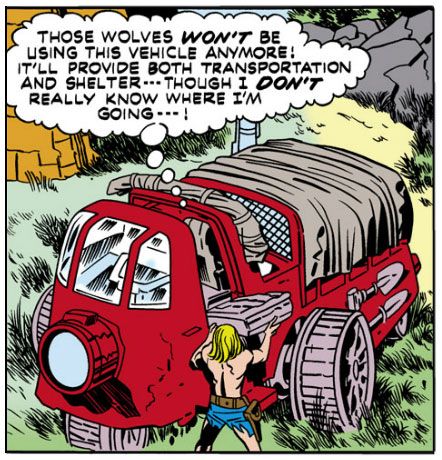
Kamandi #1 (November 1972), words by Jack Kirby, inks by Mike Royer

We're also ditching one comic company for another.  Just as Kirby and family left New York for California and Marvel for DC, in the first issue of his eponymous book (November 1972), Kamandi leaves his bunker home in this utilitarian military contraption with a very interesting outboard wheel arrangement.  They're heavy duty wheels, too.  Probably made of some kind of metal or composite alloy for years of wear.  Shovels clamped to the side, weatherproof tarp over the back.  This is a very appropriate get-about for Kamandi, and just the kind of thing you'd expect to find at a former military outpost.

Even after the Great Disaster, off-roading offers thrills and spectacle.  Witness--
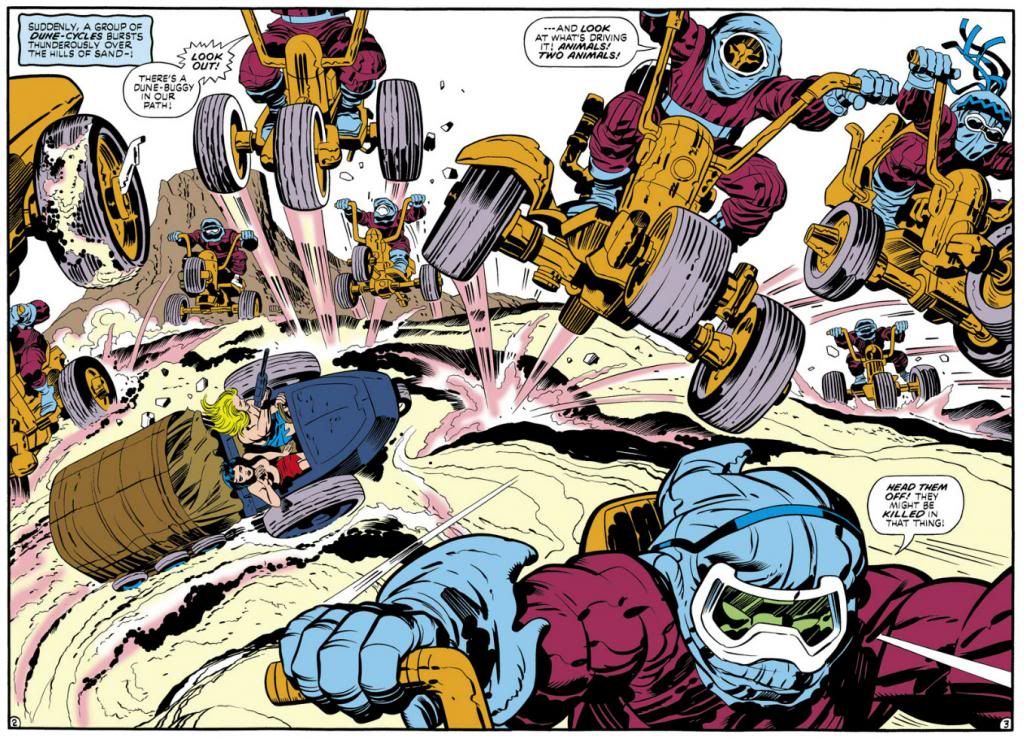
Kamandi #6 (June 1973), words by Kirby, inks by Royer

As you can see, Kirby anticipated the ATV craze.  For a while there in south Georgia, you couldn't take a drive without a three- or four-wheeler loaded with people in camouflage barreling out in front of your car from a side road or a trailer park entrance.  In fact, you still can't.  They're a menace, I tell you, and in this panel from Kamandi #6 (June 1973), you can see why.  Kamandi and his tragic girlfriend Flower have found yet another hard-working cargo carrier to explore the world, but suddenly they're capsized by a gang of three-wheeling lions!  They're huge, too.  Look how they dwarf Kamandi and Flower in their little cart.  These hot-doggin' felines think they own the dunes.  They're wrong.

Because there's one vehicle that's gonna shut 'em down, just like that little Cobra from a long ago Rip Chords song--
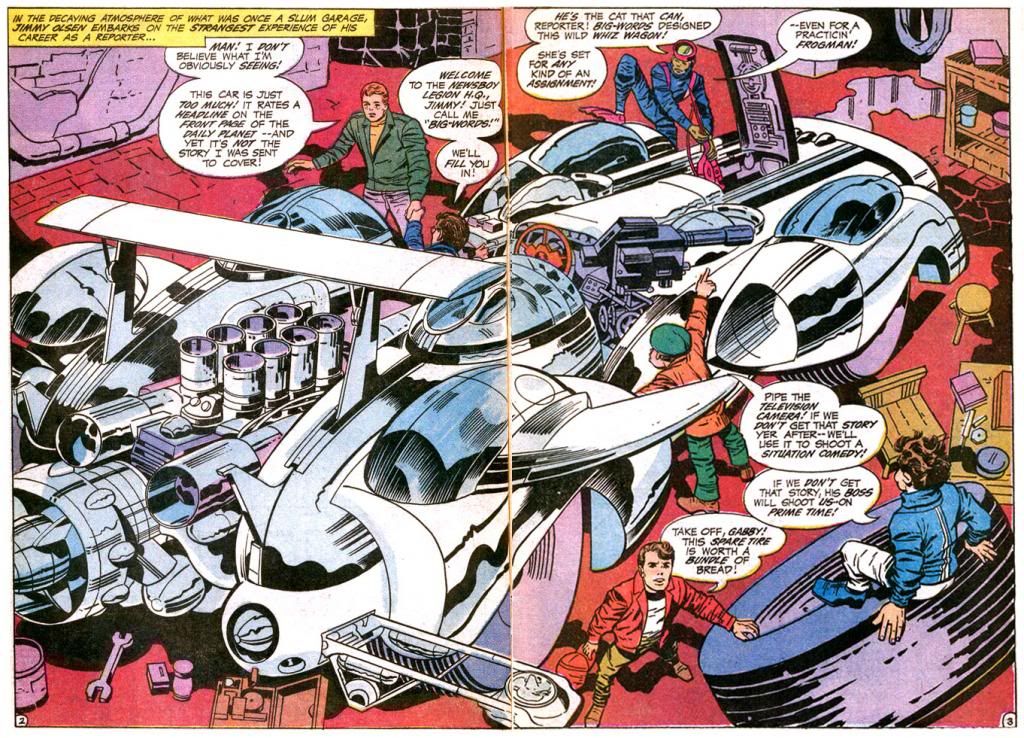
Jimmy Olsen #133 (October 1970), words by Kirby, inks by Vince Colletta

The best is last, but not for long!  In this spectacular image from Superman's Pal, Jimmy Olsen #133 (October 1970), we first greet the Whiz Wagon, custom-built by the Newsboy Legion just in time to explore the Wild Area with a certain cub reporter.  Or photographer.  Whatever the hell job it was Olsen did when he wasn't driving Perry White to distraction.  Look at the rear spoiler and those crazy intake pipes.  Is that a hint of a jet turbine beneath them?  Looking like the love child of the second Fantasti-Car and Speed Racer's fabulous Mach 5 by way of a maternity ward in the deepest, darkest, most top secret ward of Area 51, there's almost nothing the Whiz Wagon can't do.  The Newsboy Legion uses it to roar down the highway, chase after the Mountain of Judgment with the Hairies from the Habitat, fly, even travel underwater.  This is the ultimate in Kirby vehicle design. 

The Whiz Wagon by itself is an amazing visual, but Kirby doesn't simply fill two pages with a car and call it a day.  He loads this spread with details to help you believe in this phantasmagorical creation.  There's the spare tire with Newsboy Gabby perched on it (where do they buy those?), Flipper-Dipper and the forward cargo-hatch, plus tools galore and even some kind of liquid draining away in the background.  Hydraulic fluid?  Oil?  Tears from other artists who saw this and realized they'd never create anything even half so cool?

Saturday, November 9, 2013

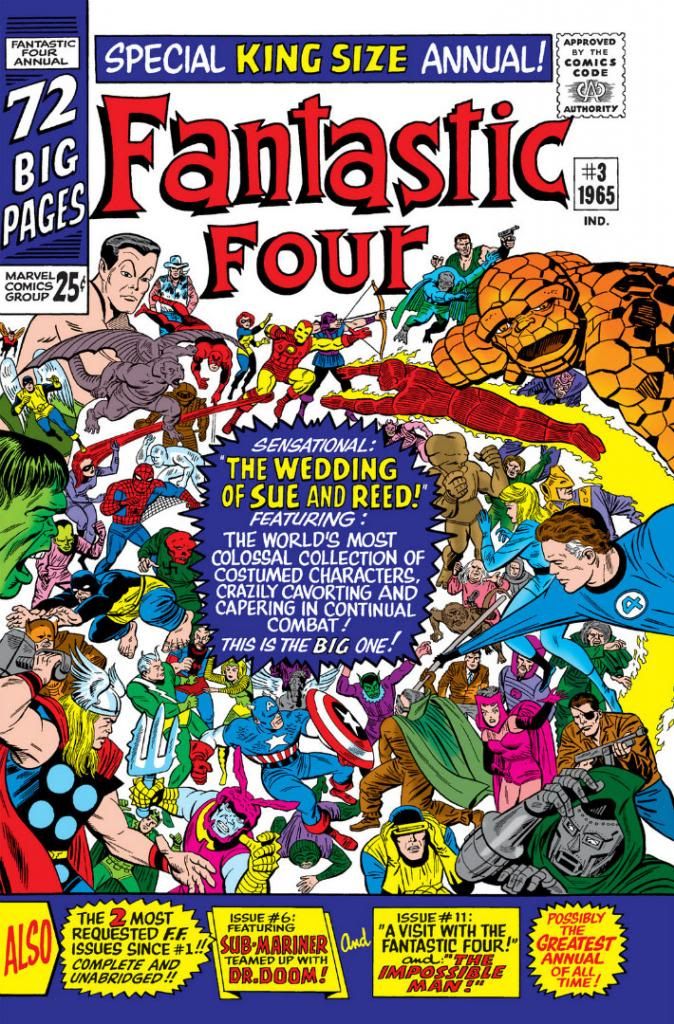
Fantastic Four Annual #3: Stan and Jack can't catch a break

I've always felt ambivalent about annuals.  The best are the ones where the regular creatives use the extra room to tell an epic story that's either too large an idea for an ordinary issue or else climaxes a storyline, or someone you've wanted to see handle the characters shows up to write or draw the book.  The worst are when some ill-suited guest team butts in with crap that's essentially filler or else it's simply part of a storyline from some other book.  Back in the 1960s, the gang at Marvel really knew how to put together an annual, although Fantastic Four Annual #3 (October 1965) consists of a regular-length story and some "most requested" reprints.  It's just the main story is nothing less than the long-awaited wedding of Reed Richards and Sue Storm.

And lemme tell ya, brothers and sisters, everyone who is everyone shows up and it is fun, fun, fun from panel one!  Captain America, Thor, Iron Man, Spider-Man, Daredevil, Dr. Strange and all the X-Men, plus Patsy and Hedy, (at least rumor has it) Millie the Model and possibly Irving Forbush headline a stellar guest list, with Nick Fury and SHIELD providing security.  The only problem is, with such a major event there are bound to be crashers.  The Puppet Master, the Red Ghost and his apes, Mole Man and the Super-Skrull all cause problems, because Dr. Doom himself has some kind of crazy emotion ray controlling their minds.

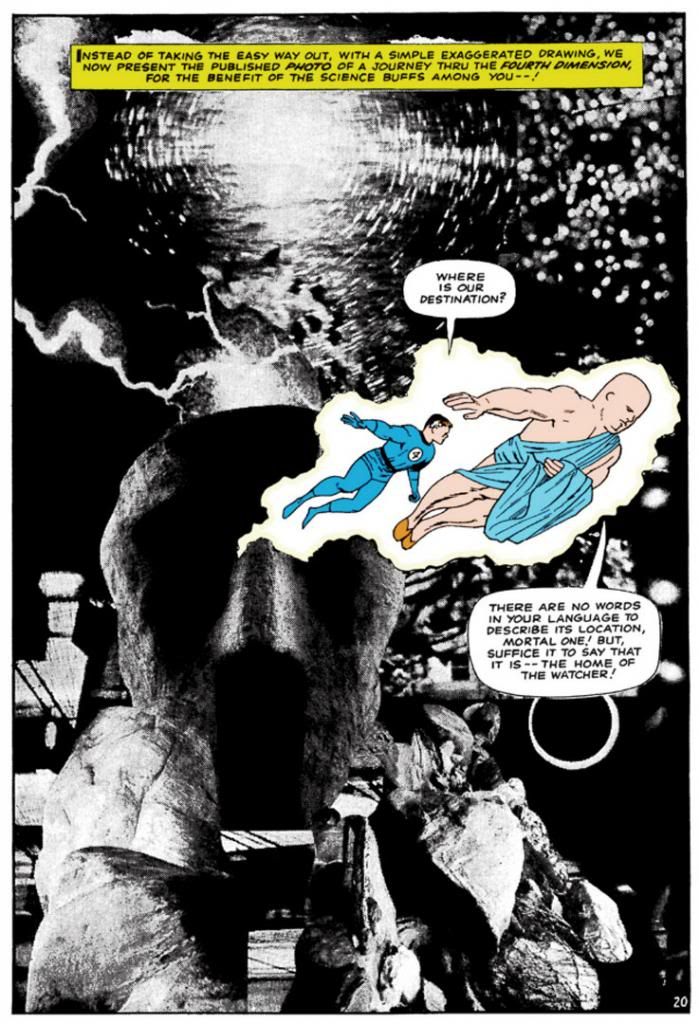
The heroes prove capable of handling the initial wave, but more and more villains attack so we get the like of the Mandarin and Hydra plus a lot of other clowns whose names escape me barging in and smashing up the place (kind of like Owen Wilson's mescaline-addled Eli Cash in The Royal Tenenbaums only without the death of a single Buckley), giving Fury a raging headache.  When Attuma and his Atlantean armies emerge from the harbor (Doom meant to call Namor, but the King himself was on some deeper quest according to Stan Lee's little editor's note; he also tells us why the Hulk isn't there) and Richards puzzles out what's behind it all, even the Watcher has to take a hand.  He takes Richards on a dazzling yet possibly superfluous trip through the "fourth dimension" (isn't that time?) to retrieve a device that beams all the baddies backwards in time to a moment where they would forget the whole thing happened.

Kirby uses one of his patented collages to depict the dimensional trip and we have to take a moment to gaze upon its wonders.


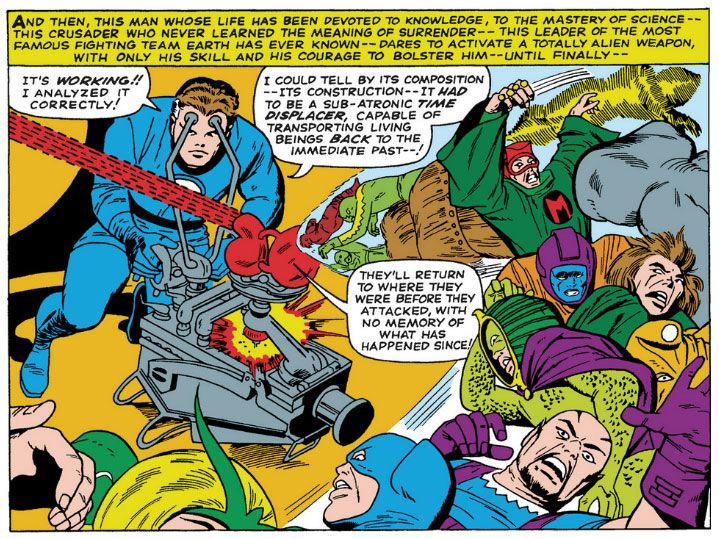
And here's that aforementioned device in action.


My god, Reed Richards is so smart, he could tell just by looking at it what it is and what it's used for!  I'm looking at it and all I can think is maybe I could use it to project transparencies onto some kind of fabric screen or perhaps even the wall itself as a visual aid for one of my classes.

This panel sums up the whole of the rather jangled plot, which is almost entirely given over to fight scenes, as you can imagine.  Kirby's on fire with some incredibly energetic poses as he presents practically an encyclopedia of Marvel's contemporaneous characters and we get a lot of villainous monologues and heroic wise-cracks from Lee.  Vince Colletta's inks are typically scratchy and rushed-looking, but I also recognize the herculean task faced by the art team here in working with this many characters on deadline.  They're serviceable finishes and a few odd figures and faces actually have a becoming elegance (others look kinda haphazardly slapped together), but certainly this book would have looked slicker with Chic Stone doing the honors, or Joe Sinnott.  Then again, Reed and Sue might have had to delay their ceremony another year or two waiting for this issue.

Another thing to consider is we're looking at restored art here.  I'm not sure what process Marvel puts their back catalog through to produce these color reprints, but I doubt they used the original inked pages or old separations (if any of that still exists).  I'm guessing they cleaned up some stats or decent-quality printed books as best they could,  retouched things here and there but said, "Eh, good enough" at the loss of finer lines after the digital coloring.  And these lines look like they were thin enough to begin with.

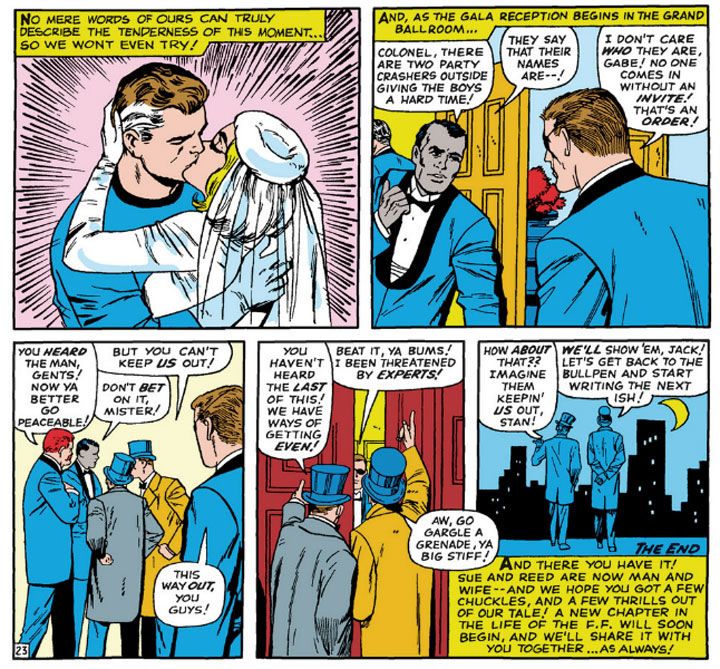
On with the wedding!  Here comes the--

Stop the music!  Stop the music!  Hold the sub-atronic time displacer!  What's this?  Two more wedding crashers?


In the immortal words of a certain bashful, blue-eyed boy, "Wotta revoltin' development!"

Friday, August 30, 2013

Fantastic Four #29: It's not just Yancy Street that needs help!

Yancy Street is in a bad way, with young hoodlums tossing garbage at our friends, the Fantastic Four.  The heroes have only come to help.  This is how it begins on Yancy Street, but before it's over the FF have wandered all the way to the moon where they fight cosmonaut apes produced by the dastardly Red Ghost, a dome-headed, long-haired mad scientist of the Commie persuasion.  More important than that to Marvel history, it's in Fantastic Four #29 (August 1964) our adventuresome quartet meets the Watcher, who has a dome head of his own.

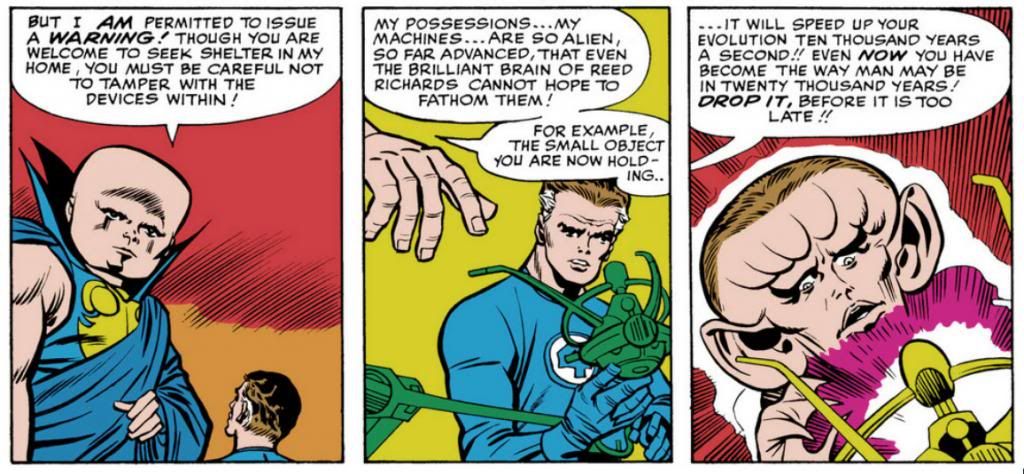
It doesn't take the ever-curious Reed Richards to run afoul of the Watcher's outlandishly futuristic devices, the likes of which no sane species would create outside of a Marvel comic.  Like this little baby:


Whoops!  Turn that off right now, Reed!  Is it just me, or does the Watcher look like Orson Welles with a shaved head in the first panel?

Sorry.  Forget that noise.  Look at how Jack Kirby views the future of human evolution in the third frame.  Since our brains are responsible for most of what we've accomplished, they will enlarge along with our skulls-- and our ears?  It's a little throwaway gag to establish how far above humanity the Watcher and his people are.  And it's just like Reed to pick something up out of scientific curiosity and activate it, damn the consequences.

But no, it's not Yancy Street that needs your help.  Comic creators do, too.  That's why I finally got off my butt and donated to the Heroes Initiative in the name of Kirby4Heroes, the fund-raising campaign run by Jack Kirby's granddaughter Jillian, who explains it in this video courtesy of Nerdist.


What I did-- and I still don't think it was nearly enough-- was donate a bit more than the amount I've spent this year on Fantastic Four comics at the Comixology site.  Comixology sells them for 1.99, and as far as I know, the Kirbys get nothing from this.  So while it's well and good to honor Jack Kirby's accomplishments and legacy by reading his works, I felt I really needed to do something for the campaign run by an actual Kirby to help Hero Initiative aid artists and writers whose stories I've also enjoyed.  People like John Ostrander, Bill Mantlo and one of my super-faves, Russ Heath.  This is going to be an annual thing for me from now on, every August 28th.

Wednesday, August 28, 2013

Fantastic Four #37: You want us to do what?!!

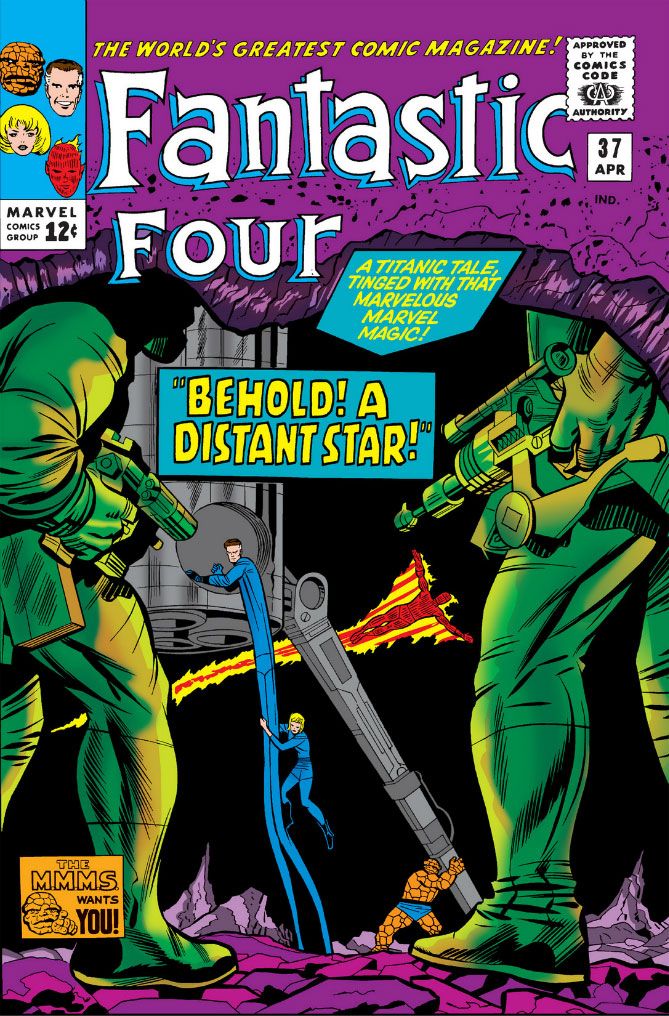
Here's a Jack Kirby gem from the Chic Stone era-- Fantastic Four #37 (April 1965), "Behold!  A Distant Star!"  It starts with Johnny Storm burning off his tuxedo.  Why is he wearing a tuxedo?  Because Reed Richards and Sue Storm are getting married, that's why.  The Fantastic Four are right in the middle of preparing for the single most important nuptial event in Marvel universe history, and the groom suddenly takes it in his head to fly them to the Skrull homeworld to fight the whole planet.

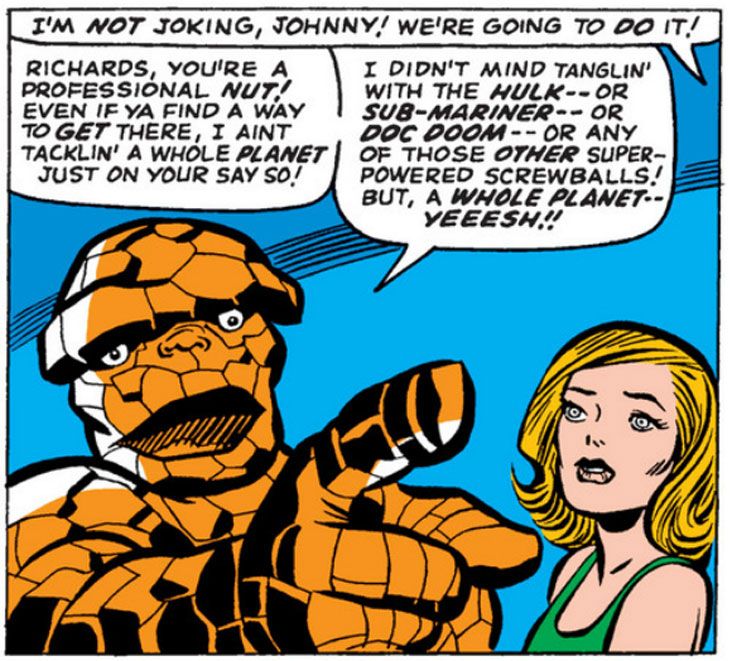
This is a book filled with wedding plans and power rays (Reed:  "To put it simply, it's a variation of a power amplifier!  It draws energy from an unknown source from somewhere beyond the confines of our solar system, and converts it into raw, usable power!"  To which the Thing replies: "Thanks a heap for puttin' it simply!  Now how about sayin' it in English?") and alien vistas full of creatures that would give Commander Hoek and Cadet Stimpy nightmares.  And it has a moment where the Thing aptly sums up just what's wrong about Reed's plan.

Take it away, Thing:

 
Despite the Thing's completely sane objections, off they go to the Skrull planet in another solar system. Faster than light travel is nothing for the Fantastic Four these days, or for us readers. We're starting to take Reed's inventive genius for granted at this point.

But let's never take Kirby's for granted.  I may not be giving Stan Lee his due here (the dialogue between the team members crackles with wit) but that's probably because of Kirby's art in this issue, which makes me feel drunk.  Drunk in a good way, right when the buzz is taking hold and you feel funny and energetic, ready to dance.  The visuals pretty much run the FF gamut, the family drama (it's not everyday two superheroes have a wedding rehearsal) and then the pan-galactic, realized in one of Kirby's collages.  There are elements of tongue-in-cheek and operatic drama and Kirby gets to draw both tuxedos and space finery, design interstellar starcraft for two species and then a lot of alien flora and fauna.  This is evidence of a man truly feeling the material.  The earliest issues are timid compared to the full-blown Kirby... well, Kirbyness we find in "Behold!"

It's not just that collage.  There's a scene where a Skrull monologues and Kirby cuts to an exterior view so he can draw freakish space critters running across a planetary landscape.  It's weird, man.  Weird and wonderful.  Stan the Man must have cackled with glee when he saw that page.  I know I did.

YEEESH!!

Thursday, August 1, 2013

Fantastic Four #30 demonstrates why you should never go on any vacation Reed Richards plans for you

You'd have to be crazy to go on a Reed Richards-planned vacation.  For one thing, there's no such thing as a leisurely Reed Richards-planned vacation because Reed's idea of leisure is to culture bacteria or tinker with a device to allow inter-dimensional travel.  Those are his spare time activities.  He does really heavy-duty stuff when he's working.

For another, if at the moment he's interested in traveling, he's not going to set up a Hawaiian itinerary or a couple of weeks in the Riviera, although he could easily afford either with all his patent money and licensing fees.  No, he's going to take the whole party to Transylvania so he can do a little field research.

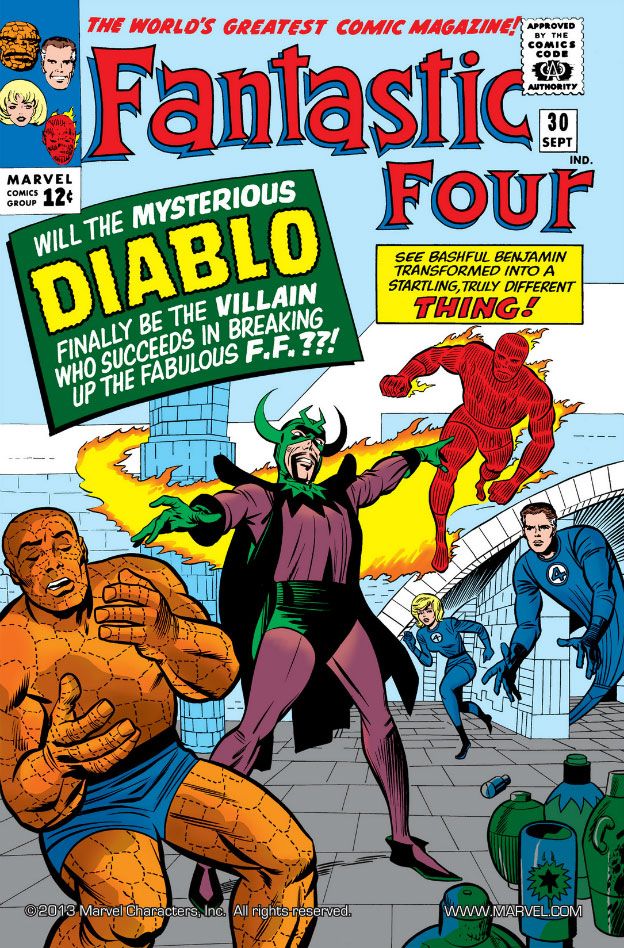
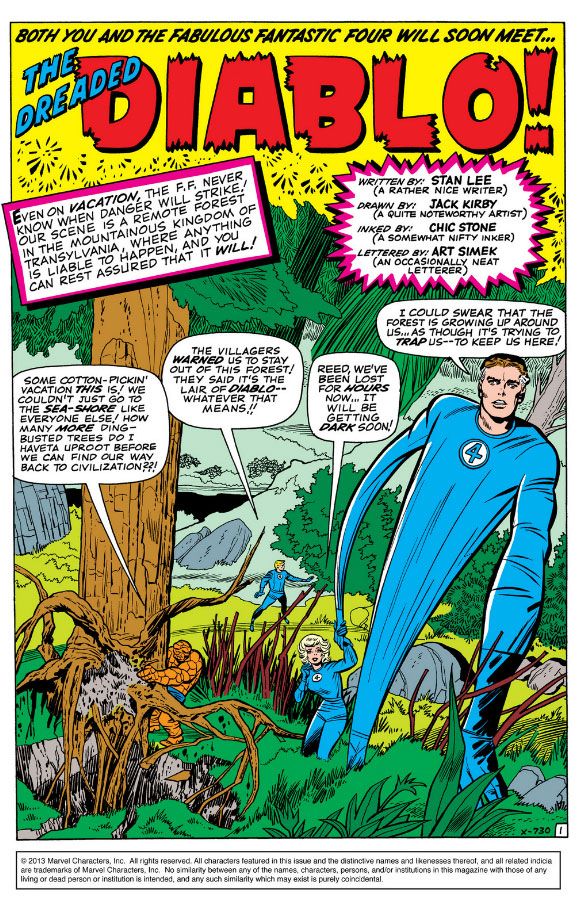
Check out what he does to his friends Sue, Ben and Johnny in Fantastic Four #30 (September 1964).  Reed drags them all the way behind the Iron Curtain-- and I thought the guy absolutely despised communism-- for a visit to Dracula country.  Stan Lee's narration calls Transylvania a "kingdom," but that was true only in his active imagination, no doubt full of Bram Stoker-inspired fantasies.  In reality, during the time frame of the Fantastic Four's ill-fated visit, Transylvania, as part of Romania, had only recently emerged from under direct Soviet control and established a certain level of political and economic independence from the USSR, it labored under the rule of Georghe Gheorghiu-Dej, a hardline communist and former Stalinist who instituted one of the harshest regimes in Eastern Europe.

It also harbored anachronistic alchemists like Diablo, with his green horned cowl and jaunty purple tights.


The first thing Reed does on this so-called vacation is to lose the team deep in the Transylvanian forests.  He does this so quickly, Kirby and company don't even bother with set-up.  There's no Baxter Building prelude where Ben and Johnny get into a fight and Reed intervenes only to have Sue step in and tell everyone they're only squabbling because they've got cabin fever and need some time off.  Nope, right from the splash page they're lost and the only explanation for the how and why we get is in a caption.  Anyway, Reed is probably faking it so he can surreptitiously search for a rare slime mold or fungus from which he can synthesize a chemical he needs.  It is a scenic forest, though.

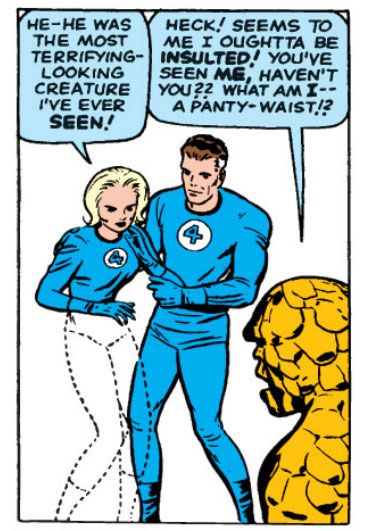
There are few inkers I enjoy on Jack Kirby so much as I do Chic Stone.  Chic Stone makes Kirby's art look like a cartoon, and I mean that in the best sense of the word.  Take that cover, for example.  Check out how Kirby and Stone depict the transitional, less-rocky Thing-- thick contour line around the outside, dotted lines on the inside.  And bald.  Also, how cool is it on the splash page that Ben is plucking a tree right out of the ground while complaining about the very topic of this blog post?  The tree's not even in his or anyone else's way; it's just there for the plucking.  This is fun.  Comic visuals that are pure fun.

But look at Reed stretching himself out there, pretending he doesn't know exactly where they are and what he's doing.  A few moments later, he's all like, "Hey, look, gang!  I found a ruined castle I totally never suspected was here all along!  Why don't we... oh, I don't know... investigate it?"  Obviously, Reed wasn't after just some botanical specimens...

Then this Baron Hugo character shows up and tells them to stop being lost before they hurt someone or disturb something best left undisturbed and that they can sleep over at his house.  That night, Ben sneaks out into the forest and-- in a creepy sequence that anticipates Mike Mignola's Hellboy-- goes to an ancient castle where he pulls a giant stone stopper out of some kind of cylindrical stone architectural feature for which I don't know the name.  The narration refers to it as a "crypt."  Well, okay.  This frees our old pal, Diablo.  Diablo, the Transylvanian alchemist with the Spanish name that means "devil."

It doesn't take Diablo long to exploit festering personal divisions within the FF, using his chemicals to restore a limited humanity to the Thing, with a promise of more to come.  That's all it takes for the disgruntled Ben to turn his back on tour guide failure Reed Richards and declare himself Diablo's buddy-for-life.  Diablo goes on a chemical rampage, rejuvenating a geriatric millionaire named Featherstone (he wears a top hat!), transforming the Iranian desert blossom into a floral wonderland, raking in the money with government contracts and using Ben as overseer to exploit local labor.

Reed, smarter than your average alchemist, soon discovers Diablo's formulas are all phony-- suddenly, the blossoming deserts revert to their infertile state, the millionaire ends up hospitalized for an advanced case of being a moldy old bastard and the anti-missile shield (don't know how a chemical potion produces something like that and wisely no one bothers to even try to explain it).  And poor Ben has his heart broken yet again.

With the tacit approval of the United Nations itself, the Fantastic Three spring into action, only end up trapped in glass vials.  Ben redeems himself and Reed promptly gets them lost in the woods yet again.  Because he still hasn't found the prized fungus, no doubt.  And I have no doubt this is exactly the way things played out in Reed Richards's mind before they even left New York.

Some vacation!  That's the kind of crappy vacation experience you're going to have if you let Reed Richards choose your destination.  The man's a workaholic, I tell you.  Doesn't know how to have fun.  Or where.  Now if you want me, it's summer vacation for me, too, and I'll be spending a fabulous fortnight in glamorous Pyongyang, cosmopolitan capital of the Democratic People's Republic of Korea.  I hear it's a swingin' town and a real shopper's paradise!

Monday, July 8, 2013

Hulk Cassidy and the Sundance Thing: The Early Days

Okay, actually it was just Butch and Sundance:  The Early Days without their surnames, but that didn't have enough of that pop culture fusion stupidity I enjoy so much (to the detriment of all my personal relationships).  And those two guys actually got along much better than the Hulk and the Thing.  The Hulk and the Thing are Marvel's two heavy hitters and their dust ups from the first few years of Fantastic Four are pure comic book fun.

First, you have the Thing.  A mouthy orange rock-man, the muscle and the ever-lovin' heart of the Fantastic Four.  The Thing was essentially nice.  Who the heck could hate the Thing?  Then, you have the Hulk.  In the 1960s, at least for a time, the Hulk had a command of language beyond simple statements in favor of smashing, or admonishments to puny humans to leave him alone.  He was an anti-hero hearkening back to Marvel's early years when they put out comics where Namor would show up pissed off for whatever reason and start tearing up the place.  Namor was the kind of dangerous character you rooted for only because he was fighting Nazis (only other Nazis root for Nazis), mad scientists or because he was like your own repressed child-id striking back at adult authority figures-- otherwise, Namor was angry specifically at you, the reader, for existing on land.  It's a similar story with the Hulk and Space Age-era Communists and outright villains.

With two opposing forces like these in a single comic book universe, it was only a matter of time before they clashed.  And clash they did in Fantastic Four #12 (March 1963) by Stan Lee, Jack Kirby and inks by Dick Ayers, from those fabled days when Kirby hadn't yet settled on the correct number of fingers and toes for the Hulk.  In this issue, the Jade Giant flaunts three of each, plus opposable thumbs for a grand total of fourteen digits.  Strangely enough, the same number sported by the Thing.  That's okay, because there's at least one instance of Mr. Fantastic showing six on one hand in a later issue.

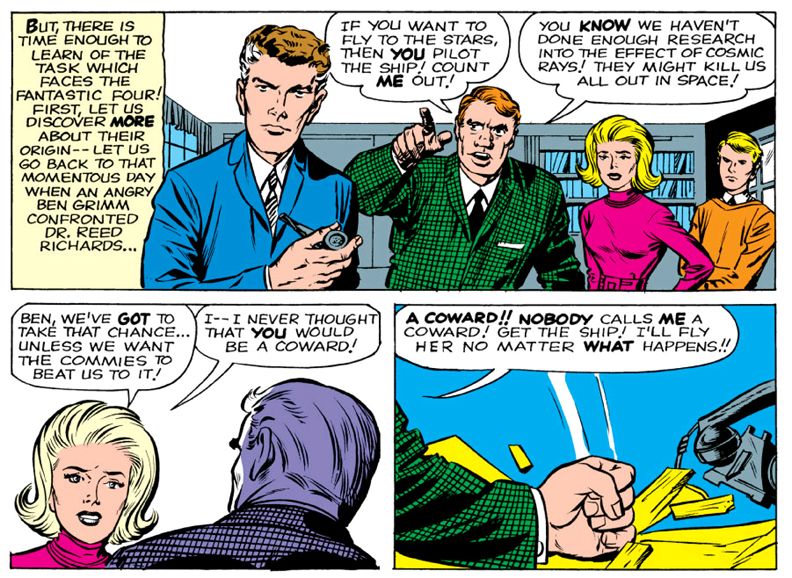
The story opens with the Thing looking natty in a tux, out on the town with his girlfriend Alicia Masters.  Within moments, things take a tragi-comic turn as they frequently do in this old Marvel stories-- soldiers on the alert for the Hulk cause a scene, an old man accidentally pokes the Thing, the Thing reacts angrily, attracts the attention of the soldiers, there's a fight as a result of mistaken identity and the Thing is publicly humiliated once again.  Why the soldiers are out looking for the Hulk is obvious-- he's a destructive menace. But why their officers sent them out without first briefing them on what the Hulk's actual appearance is something neither Stan Lee nor Jack Kirby care to explain.  And if being mistaken for a green monster in purple pants isn't pathetic enough for our orange monster in blue pants, the Thing also forgets his key to the Fantastic Four's special elevator and has to climb up the cables to get home.

None other than General "Thunderbolt" Ross (oddly appearing in an army uniform rather than one from the USAF) then comes to the Baxter Building to recruit the team to fight the Hulk for him.  To prove the Hulk's existence, Ross screens some top secret film footage of the Hulk in action, which causes the testosterone-laden male heroes-- including ostensibly mature older genius Reed Richards-- to act out their fantasies of single-handedly defeating the Hulk, while lone female Sue Storm frets about her uselessness.  At least until the men decide she's good "for morale."  Guess the Thing isn't the only one meeting with humiliation this fine evening.

The issue features the debut of a new whiz-wagon for the gang, the Fantasticar redesigned in-story by Johnny Storm, and featuring one of the many meta-moments Lee and Kirby inserted into the book in those days-- supposedly fans of the team wrote in complaining that the old Fantasticar looked too much like a flying bathtub.  The new one is a sleek Kirby creation that gives Ross a military-industrial complex boner.  The five rocket to the western desert and fight's on.

The Hulk is actually a big green herring as it turns out-- the real villain is someone called "the Wrecker" (a likely name) who sabotages our American way of life for his Commie overlords.  I don't want to spoil the story's big secret, but the Wrecker turns out to be the guy with the membership card in a communist subversive organization right there in his wallet.  Great detective work there, Rick Jones.  This leaves the Thing wondering out loud, "Just what the heck was I fighting the Hulk for?"  No reason, really, other then the very coolness of Thing versus Hulk, Thing!  Oh, and advertising for another hero even if his own title flopped.  In their first bout, our boys seem pretty evenly matched, and it's useless Sue Storm who manages to knock out the Wrecker and save the day for everyone.  Never underestimate Sue, fellas.  The Hulk, weakened by a laser beam, gives up and slinks away to fight another day.  So after all that, we don't even get a definitive answer to the question of which hero is muscle supreme in the Marvel universe.


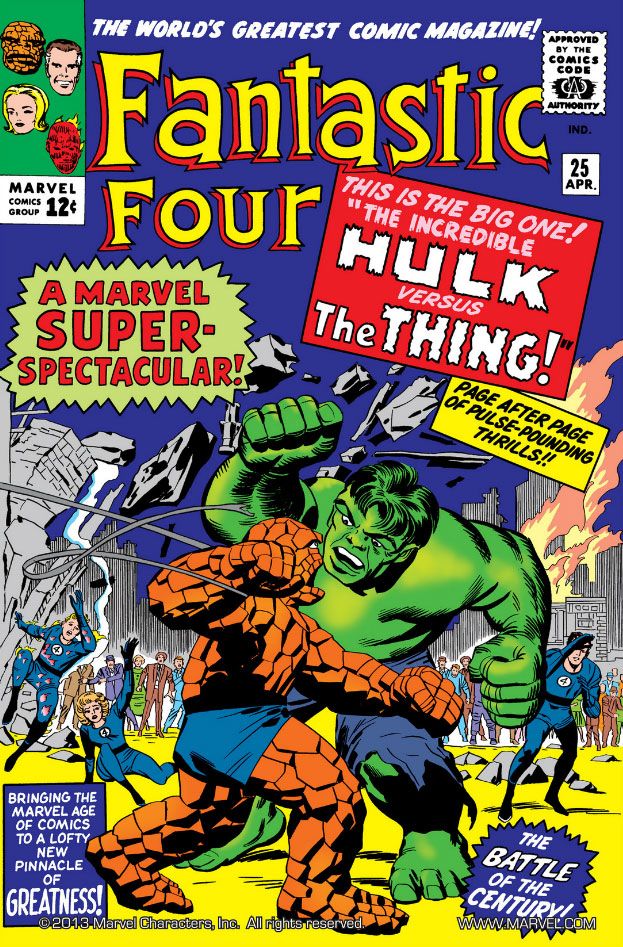
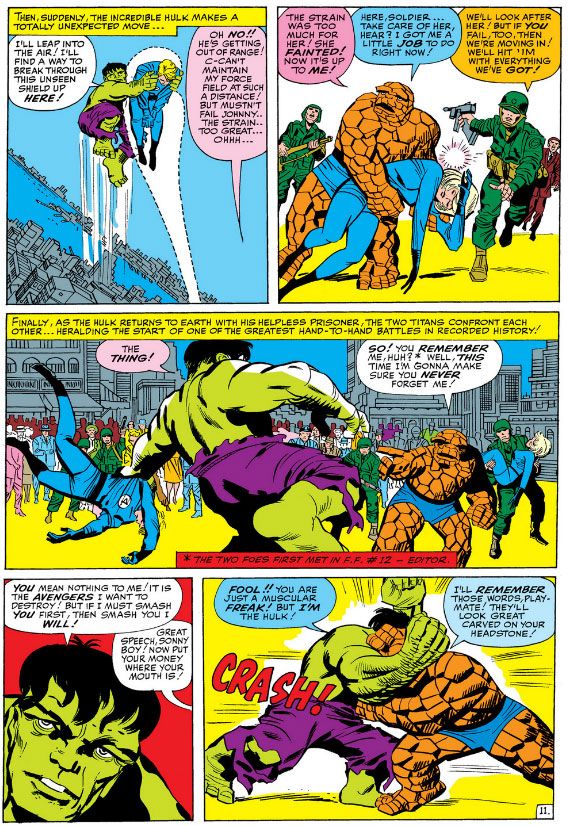
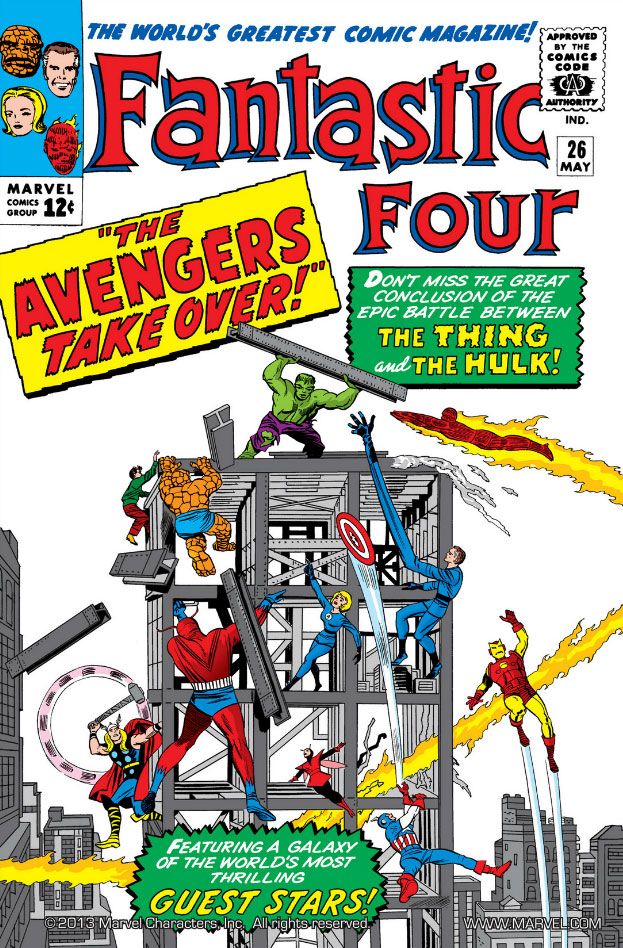
That is until a year later when Marvel published Fantastic Four #25 and 26 (April and May 1964 with George Roussos on inks this time, credited as George Bell), a story so big it sprawls over two complete issues and involves practically every other Marvel hero of the time.  I'm guessing it was Lee who crammed all the hyperbolic copy onto the cover of #25, the Man at his carnival barker's best.  This is the kind of stuff I've come to associate with the feeling of reading Marvel comics from the 60s and 70s-- a relentless barrage of overblown propaganda, indoctrinating the readers in the Mighty Marvel Mindset with phrases like "PULSE-POUNDING" and "SENSES-SHATTERING" (as if the latter was even remotely desirable).  This time the Fantastic Four don't have to go hunting the Hulk-- the big green galoot himself turns up in New York City because he's angry at the Avengers for booting him in favor of Captain America.


I can't blame the Avengers.  Who would you rather have on your team anyway-- a rational, intelligent strategist with acrobatic fighting skills and years of war-time experience, or an overly-sensitive rage-aholic with the strength to flatten entire cities?  No, you can't choose both.  Now imagine how well the Hulk takes your decision and you can see the problem this dilemma presents.  As if a vengeful Hulk weren't enough, the FF are fighting amongst themselves as well because the Thing refuses to drink Reed's newest cure for his condition-- which apparently was such a lab accident Reed doubts he can re-create it.  Shortly after that, Reed abruptly collapses into a coma and everyone is screwed.  The Hulk gives the remaining Fantastics a thorough thumping of the kind world champ Sonny Liston received from 22-year-old Muhammad Ali roughly a month before this issue hit the newsstands.  The Human Torch ends up in the hospital and Sue poops out when the Hulk's strength severely taxes her relatively-new invisible forcefield powers.  This leaves the Thing to fight alone, which he does for most of the issue until the Hulk finally grinds him down.

Never having been defeated outright before, the Thing spends a moment questioning his purpose in the world.  But he figures it out-- as a hero, his job is to take any beating necessary, even if he fails or dies as a result.  Once again, it's the Thing doing the world's dirty work, overmatched and underappreciated, a lone man against impossible odds and, unlike Liston, he decides to come out of his corner at the bell.

While poignantly scripted by Lee, this is Kirby storytelling, a moment where his contributions as a full-fledged writer-- not simply co-plotter and certainly not merely penciller-- breaks through most obviously.  You can't help but feel Kirby working autobiographically here, concerns of an intensely personal nature filtering through the fat line screens of the 1960s four-color printing process.  So characteristically Kirby is it, he'd return to it again and again-- most memorably in "The Death Wish of Terrible Turpin" from New Gods #8 (April 1972), but also as a running subtext to the entirety of his run on Kamandi the Last Boy on Earth.

Together, Lee and Kirby develop this theme over the course of #26, where we see Richards attempting to come off his sickbed to help the Thing and the Human Torch flying back into the fray despite being decked out in asbestos bandages from the beating he took in the previous issue.  Captain America shows a lot of the heroic stuff Kirby-style as he uses judo he learned in the Army against the Hulk, even though he knows he's involved in a massive weight-class mismatch.  So Captain America proves himself as an Avenger, but it's the Thing's example that inspires him and provides the story's beating heart.

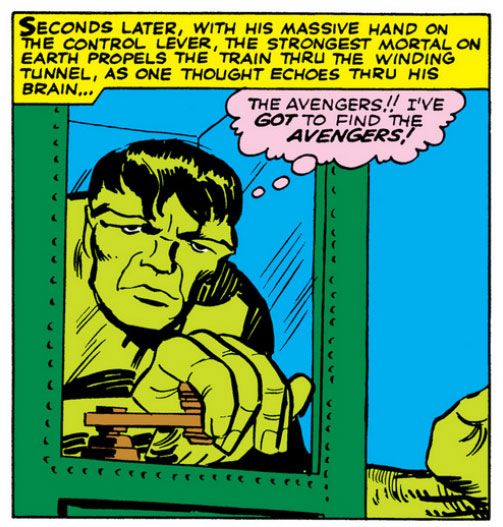
It's a fairly funny story as well, and I don't mean just inadvertently (for example, when the Hulk calls his weaker alter-ego "Bob" Banner for some reason-- we'll cut him some slack; he has a lot on his mind what with needing to file for unemployment and all that).  At one point the Thing threatens to use his powers of pathos against the Hulk.  My favorite sequence has the Hulk hijack a subway train and drive it to the Avengers' mansion.  Kirby treats us to a sweet shot of a mopey Hulk at the controls which  reminds me a lot of that Shaquille O'Neal commercial where he's too large for a sporty convertible.  I'm pretty sure Lee and Kirby got a huge kick out of tossing in this particular scene.

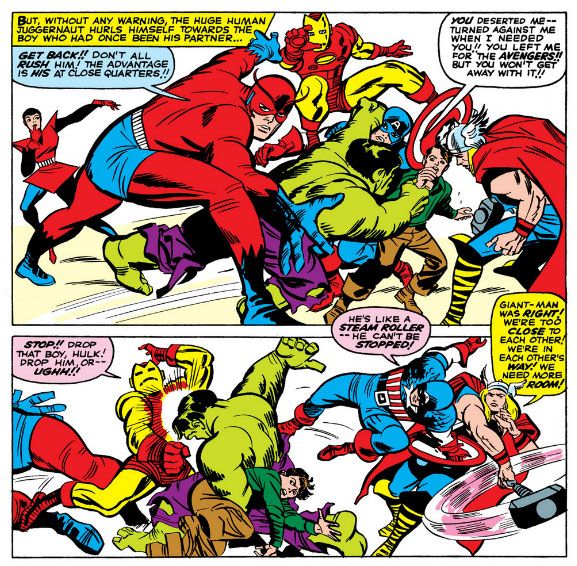
Speaking of the Avengers, they finally make the scene and flub their fight against the Hulk because there are just too many costumed clowns running around.  It gets worse when the fully recovered Fantastic Four pitch in, and then the two teams start a jurisdictional squabble.  Reed Richards suggest the Thing decide whether or not the two teams join forces since he's the one who's been doing most of the fighting and carrying the story on his rocky shoulders.

The Hulk and the Thing come together atop an under-construction building and trade blows.  Teenager Rick Jones pulls a Sue Storm and saves the day by tossing a gamma pill into the Hulk's mouth.  The Hulk falls into the river, but it's Bruce Banner its currents sweep away.

Two complete issues probably seemed overblown in 1964, but in our current era of drawn-out, marketing-driven storytelling I'm amazed how economically Lee and Kirby run through this plot.  Today's version would require an editor's meeting of a dozen or more thinkers to plan it (they'd spread it over an entire summer's or even a year's worth of titles priced at $2.99 or $3.99 each, interrupting whatever storylines the various writers have going), feature some supposedly-beloved secondary character like Rick Jones having his arms ripped off on-panel (the blog-o-sphere goes wild!) and climax in an over-sized special edition.  Entertainment Weekly would give it a B+ and declare it "the superhero epic of the season" while praising it for the repeated flashbacks to Bruce Banner's abusive childhood.  They'd also go nuts over the photo-realistic art, consisting mainly of pages of wide panels stacked broken by frequent full-body portraits of various involved characters, all of which would quickly show up in online auctions with hefty price-tags.


Lee and Kirby neatly pack it all into two standard-sized issues, minus any hint of gore but with plenty of action and characterization.  It also lacks today's trendy Joss Whedon-style dialogue where every character is a quip-making machine, but apologizes by having the Thing call Thor a "lantern-jawed, long-haired lummox."


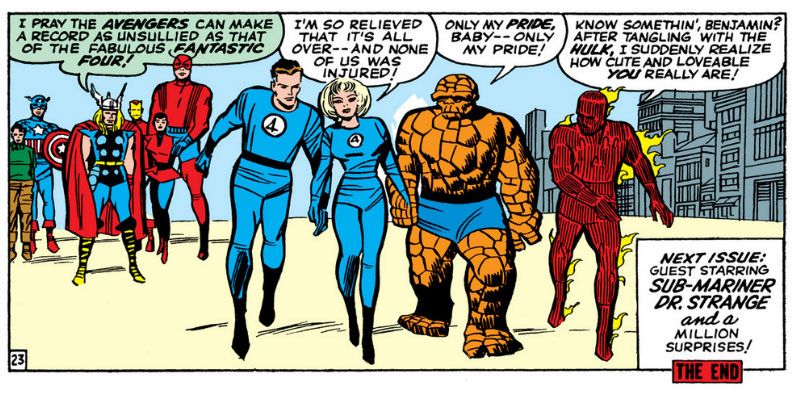
And yes, Sue, no one was injured.  Except the Thing and your brother, Johnny (twice!).  And probably Iron Man when the Hulk head-butted him right in the chest.

Wednesday, May 29, 2013

I own the first 30 issues of Fantastic Four...

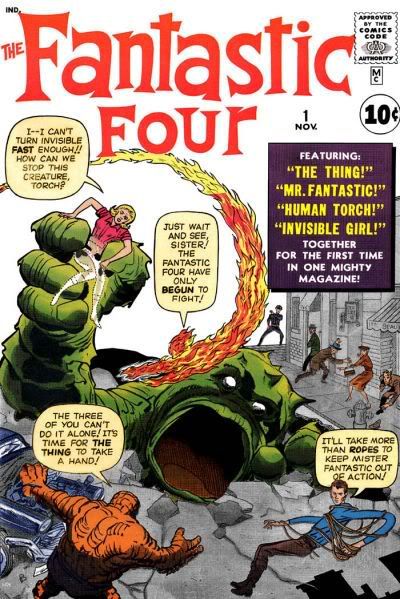
Plus Annual #1 where Namor goes off on the human race and invades New York City with an army of blue dudes wearing fishbowls on their heads.  Not the print originals, of course.  How much is Fantastic Four #1 (November 1961) going for these days?  There's a graded example (CGC FN+ 6.5, white pages) online at Heritage Auctions with a recent offer of $18,500.  An 8.5 went for $52,000.  That's a little out of my price range, I'm afraid.  No, I own reprints.  Reprints, reprints, reprints.

I've had the Fantastic Four Essential collections for a long time, and I used to have the fat Fantastic Four Omnibus that was so heavy I couldn't rest it on my stomach while reading in bed or it would squeeze my dinner out of me as if I were a Play-Doh Fun Factory.  I gave that one away before I moved back the US following my first stint in Japan as an English teacher, otherwise I would have had to purchase a second seat ticket from Air Canada to take it with me.

Comixology is my current source for vintage comics.  Publishers have been putting out re-colored versions of various classics so long they have a nice back catalog of stuff they're adding to Comixology a little at a time.  They usually run you about 1.99 each, although sometimes you can find 99-cent sales or even freebies.  With the files available, there's no reason not to put the books online.  The hard work has been done, so overhead is minimal at this point.  Easy money for Marvel and DC.

I frequently find myself pondering the appeal of early Fantastic Four.  I'm not denying it exists; I love the Stan Lee-Jack Kirby era Fantastic Four, after all.  What is that appeal's substance, however?  That's what I think about, in search of a magic formula, I suppose.

When we look at Fantastic Four #1, we're looking at something fairly raw and even clumsy.  The plot mechanics barely stand up to close scrutiny.  Why in the hell would a top scientist take his girlfriend and her kid brother on an illegal rocket jaunt?  Even by the lax standards of comic book logic, that's pretty stupid stuff.  Kirby's art seems relatively timid, not at all the bold, bombast we've come to associate with the King, and it's poorly served by gloopy inks.

Perhaps we have to put it into context, stack it up against DC's contemporaneous efforts.  I know the talent were doing their level best to put out good product, and a lot of these guys and gals rank pretty high in my pantheon of greats.  Plus there was this little thing called the Comics Code.  The last time someone tried to do something truly interesting with comics, the government got involved and not to say, "Nice job you're doing entertaining the little chaps, Mr. Gaines!"

But despite a few stand-out stories and some awesome-- if a little mechanical and stiff at times-- art, the formula wears thin pretty fast.  DC comics of that era don't really seem to be about anything in particular.  Especially if it's an "Imaginary Story!"  Which might be more interesting than any of the so-called "real" stories because it dares embrace weirdness.  So if you ask me what issue was it where we saw Superman turn into a fat version of himself or when did he grow a long beard or turn into a gorilla or gain a whole new set of powers or whatever, I'm likely to answer, "All of them."  What does it really matter?

Now imagine you're a kid who's starting to feel a bit jaded by all of this and you see the cover of Fantastic Four #1 glaring out at you from the newsstand like a pugnacious new kid to your neighborhood.  A little loud-mouth with a dirty face.  It's rude, it's coarse, it's even a little ugly.  But you can't take your eyes off this newcomer.  You open it and the inside is more of the same. And look at that squashed orange guy ripping that tree out of the ground to hit his friend with it.  Immediately, you sense it's got something those tight-assed DC comics don't have.

Charisma.  That's it.  It's got charisma.  The plot isn't just some one-off that's essentially the same as last month's with the details changed.  You probably don't even question Reed Richards's poor decision-making process.  That might be due to the frantic pacing, but I like to think it's because Stan and Jack are going somewhere and taking us along with them.  It's not just a plot; it's an actual story.  It matters.  Or at least it does by comparison to its competition.

And it just got better and better until DC was forced to react and turn to new talent, style experiments and the like (I'd argue Marvel inspired DC to put out a lot of their cooler books, even if they didn't sell all that well).  By the time Doctor Doom shows up in Fantastic Four #5 (July 1962), things are really starting to cook.  From that point, issue-by-issue, you get to witness Kirby come into his own again, giving his career that huge push that made him the super-legend he is today and Lee develop the inimitable voice of Marvel, bizarrely made up of WWII-era slang and hyperbolic carnival barker come-ons.  It's captured there for constant rediscovery on Comixology, the same way recordings capture the exponential aesthetic growth of the Beatles from "Love Me Do" to "Carry That Weight."

My favorites, though, are the Fantastic Fours inked by Chic Stone.  They have the energy and slightly unformed quality of the earliest issues and a little bit of the structure of the later Joe Sinnott-inked issues, which leave me a tiny bit cold.  I like Sinnott's slickness, but his issues just don't have the energy of Stone's.  To carry the Beatles analogy a bit further, it's kind of the way I admire the heady pop craftsmanship of Abbey Road, but I end up listening to the peppier Help! and back-to-back self-topping albums Rubber Soul and Revolver more often.

Anyway, the first 30 Fantastic Fours are now available on Comixology and I own them.  I plan to keep buying these until they get just past the Galactus caper.  After that, a lot of the energy and charisma seeps out.  You get the idea Stan and Jack were looking elsewhere after that point.

Friday, February 15, 2013

Fantastic Four #1: Reed Richards, you maniac!


I'm guessing Reed Richards has at least one doctorate.  Probably several.  He's a genius, highly though of by the United States government.  But for some reason this miracle mind, this all-American Einstein, this pipe-smoking prodigy, decided to take his girlfriend and her kid brother on a rocket joy-ride.  That alone would be enough for the Fed to revoke all his security clearances and toss him in a metal box six by eight feet, surrounded by concrete and stone.  While his real-life brainiac counterparts at NASA occasionally evinced "go-fever" and a kind of engineer-mind tunnel vision that led to disasters and deaths, it's hard to reconcile Richards's genius with the kind of recklessness involved in subjecting himself and his loved ones to cosmic rays and crashing America's most advanced spacecraft.

Think about it one more time.  Reed Richards took his civilian girlfriend and a teenager with him on an unauthorized flight of an experimental rocket, even after the more cautious (but not cautious enough) test pilot Benjamin Grimm warned him the ship wasn't adequately shielded against radiation.  And that was the least of the reasons why this was a terrible idea.  This isn't "we've gotta beat those Reds into space" derring-do.  This is "wearing diapers and driving across the country to shoot someone" multi-layered criminal insanity.

What was he thinking?  Certainly, the lack of shielding represents a calculated risk for Richards and Grimm in their attempt to give the U.S. a Space Race victory.  But to involve outsiders, one of whom Richards is involved in a romantic relationship with, gives one pause.  J. Robert Oppenheimer (perhaps an inspiration for Richards) similarly allowed his personal life to intrude on his national security obligations.  But while Oppenheimer married a former member of the Communist Party and carried on a secret affair with someone who wrote for the Western Worker, a Communist newspaper, he didn't strap either of them to the atomic bomb at Trinity.  But his involvement with radical causes led the government to revoke his security clearances in the early 1950s.  Richards's deed is arguably worse and he doesn't receive so much as a slap on the wrist.

Reckless endangerment.  The failure of this flight could have set the United States back decades in the exploration of space.  The 1967 Apollo 1 fire, for example, caused a twenty-month delay at a crucial time during our moon landing program.  The loss of space shuttles Challenger and Columbia both halted American space flights.  After the 1986 Challenger explosion, NASA grounded their shuttles for three years.  After the 2003 Columbia re-entry disaster, crewed spaceflight via shuttle didn't resume for more than two.  Imagine, then, the catastrophic results of Richards's rash, idiotic act.

The man should be under the jail.  Well, actually, he shouldn't have even survived the crash.  But the bulk of Fantastic Four #1 (November 1961) post-accident should have consisted of Reed Richards on trial as the traitor of the decade. Julius and Ethel Rosenberg?  Bah!  Pikers!  The Cambridge Five?  Rank amateurs by comparison.  Richards's alma mater should have demanded he return his degrees, Grimm and Sue Storm should have been jailed as accomplices (the government could have granted them immunity or at least reduced sentences in return for testimony, however).  A life sentence for ex-Dr. Richards.

Instead, Richards is one lucky devil.  He gets rewarded with neat powers (unlike Grimm, who turns into an embittered monstrosity), Sue thinks nothing of the risks he put her and brother Johnny through and everything is just peachy.

Thursday, February 14, 2013

Old comics on Comixology

Living in Japan, I don't have easy access to the latest American comics.  Japanese comics, yeah.  I can walk over to Lawson and buy tons of those.  But for American comics, I have to go all the way to Tokyo to visit Blister.  Fortunately, I don't buy a lot of new monthlies.  I do, however, buy lots of hardcovers of things like Nexus, Creepy, Eerie and softcovers of things like Swamp Thing, New Mutants, Uncanny X-Men and the like.  For those, I go through Amazon.jp.  Very fast and it's fun to get boxes even if I know what's in them.  The delivery guy and I have a great relationship, too.

In fact, the last time I ordered something from Amazon.jp, he recognized my name and brought it to the wrong apartment-- my old place, which is right across the street from my new place.  He thought he was doing me a snappy favor.  Poor guy was very apologetic once we got things straightened out.

Anyway, the point is, if you live in Japan, unless you happen to be in a location convenient to Blister, digital comics are your best bet for keeping up with the American sequential world.  Comixology carries almost everything.  I've been feeding my Walking Dead habit there, for example.  It's not perfect.  You don't actually own the comics even though you pay the same amount someone would if he or she went to a physical store and bought a physical copy there.  You're paying $1.99, $2.99, $3.99 or more for simply a license to read the comic on your computer (via Comixology's reader, which has its own positives and negatives), or on your iPhone (which is pretty cool if you're waiting for a doctor or a bus).  I won't kid you and say that concept doesn't suck.  If I pay for something, I want to own it outright, without limitations.

Well, I suppose I could order print copies online from other sources, but then I'd have to wait two weeks or more to read what you can read on the same day it hits the shelves.  Like I said, I live in Japan.  These are just little things I've weighed and my conclusion is Comixology is the way for me to go.  Or Dark Horse Digital, which is similar but exclusive to Dark Horse comics.  These are the ways I buy my comics.

Still, I love to read the old stuff more than the new stuff...  Well, Comixology can help you out there, too.  DC and Marvel are constantly adding their back catalog to Comixology.  It seems they focus a lot on back issues related to events in current titles so they can bundle them all together in special sales events meant to increase interest in their current product, but they're bulking up some of the ancient books I like to talk about here.

Let's see--  just recently I bought a bunch of the universe-spawning Stan Lee/Jack Kirby Fantastic Four, the complete first volume of Swamp Thing (twenty-four issues featuring Len Wein, Bernie Wrightson and Nestor Redondo, among others), the first two years or so of the Alan Moore version, the first seven issues of New Mutants plus the original Marvel Graphic Novel (a bargain at $3.99), some 1960s-vintage Teen Titans, two issues of the first volume of X-Men drawn by Jim Steranko, some Neal Adams Batman, John Byrne's Next Men, plus a lot of random stuff I can't remember right now because I'm at work and not at home where I can read my comics.  Many of these I own in collected editions and the like, but now I have a nice collection of really sweet old comics I can talk about here.

So expect a lot of Swamp Thing, New Mutants and Teen Titans coming your way.  And a lot of Jack Kirby.  Which I will analyze, deconstruct, poke affectionate fun at and generally mess around with.

You know, same crap as I always do here.  Only shinier.

Saturday, February 9, 2013

Fantastic Four #51: Someone left the Thing out in the rain

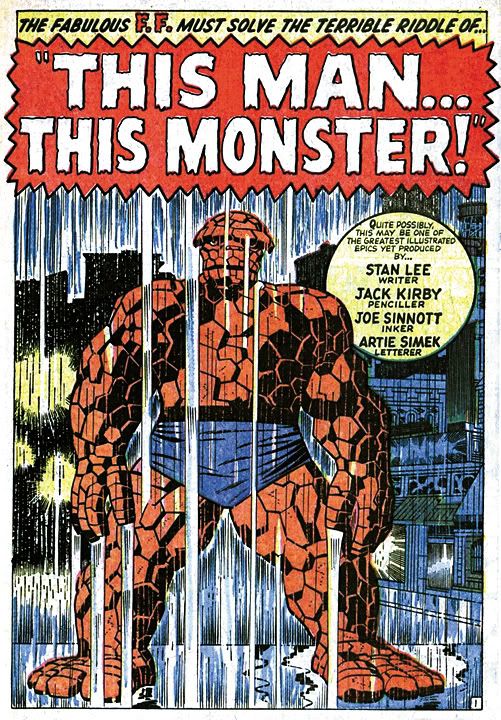
Splash page from Fantastic Four #51 (June 1966). One of Marvel's greatest single issues. The Fantastic Four had just faced off against the god-like Galactus and handed him his magenta-and-purple ass. While his teammates and the rest of the world celebrate, Ben "The Thing" Grimm turns his gaze inward.

Feeling sorry for himself, he doesn't even bother to change out of his superhero swimsuit or stop for a sandwich before heading out into the rain to walk around, converse sullenly with well-meaning cops, then accept coffee from a weird bald guy with a prominent brow ridge.

The bald guy is pissed at Ben's buddy Reed Richards. Fortunately for him, the Thing exists. Because without the Thing and their convenient skeletal similarity, his transformation into the Thing's exact duplicate would prove impossible! Ironically, there's one man in the world who actually wants to be the Thing, while the real Thing would do anything- short of suicide- to escape that identity.

Anonymous Bald Freak goes to the Baxter Building where his enemy Richards is planning to invade the Negative Zone tethered to a simple nylon rope he bought at the Yancy Street Hardware Store, and wearing only a goldfish bowl for protection. Things end badly but not before Anonymous Bald Freak learns that all Things (even faux-Things) have an innate quality of heroism and self-sacrifice.

Interestingly, in a story about the Thing's wrestling with his own identity, we never learn the bald guy's name or exactly why he resents Reed Richards enough to want him dead. Even Richards himself hasn't a clue to who this guy is or what he might've done to piss him off. By the time the Thing is back his old rocky self, he's not really able to shed any light on the guy's story, either.  Lessons learned? Ben Grimm's niceness rubs off even on jerks, and Reed Richards has a history of alienating people and making enemies.

Also, Stan Lee's dialogue perfectly balances the mundane and the sci-fi exotic. And Kirby's pencils follow suit. However, this is one of those issues-- despite what the credit blurb claims-- where Kirby did much more writing than Lee. It's full of Kirby-esque moments and moods that would become more familiar to the fans when he started garnering writing credits for himself.

Monday, August 6, 2012

Reed Richards, what the hell is wrong with you?


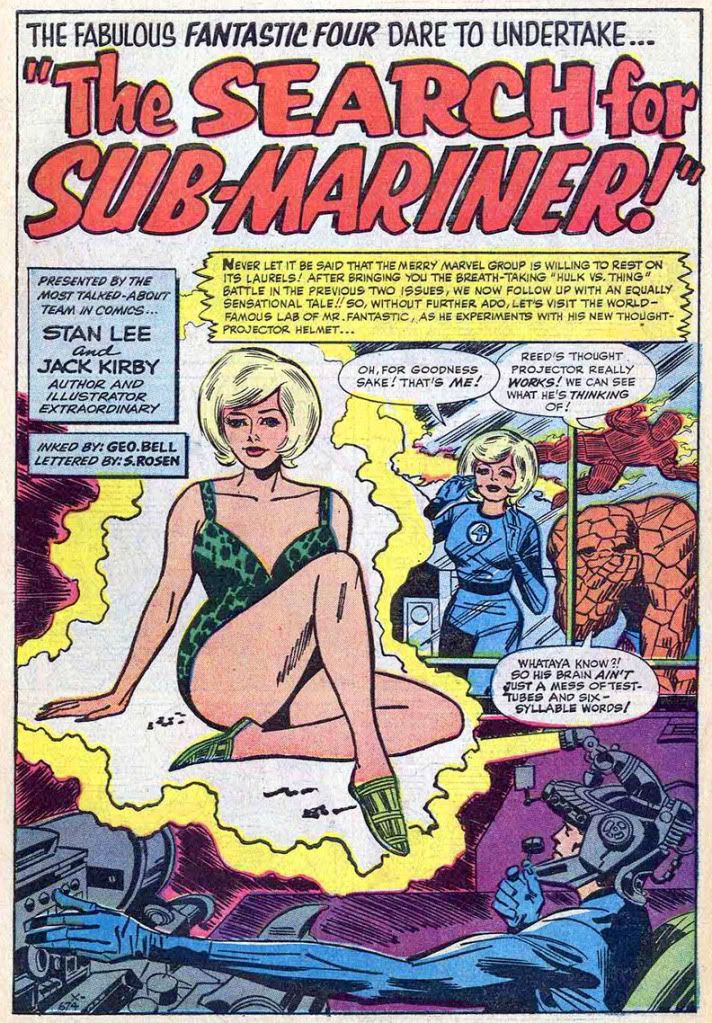
He's a red-blooded heterosexual male, that's what, you filthy degenerate atheistic Commie pinko red!  Just when you're convinced Reed Richards is nothing but an unfeeling computer on legs, thinking of nothing but the square root of the Einstein Theory and the co-efficient of the hypotenuse, it turns out at heart he's all man, right?  That's one interpretation, certainly valid.

However, look again, please.  What we're seeing is the comic book embodiment of that peculiarly American cognitive dissonance where we're obsessed with sex and tumescence-inducing imagery, yet puritanical and filled with shame and anxiety over it.  Indeed, proving himself quintessentially American in this regard, Richards uses this fabulous device to manifest his girlfriend Sue Storm as a sex object, but-- ambivalent due to his lifetime's conditioning in the laboratory of Protestantism-- cannot fully unleash his id and therefore timidly clothes her fantasy image in a very modest (also hideous) green one-piece swimsuit.  And what appear to be matching metal slippers.  What a contradictory imago his classically suppressed libido draws forth!  How fearful he is of the sexual woman, a woman's sexuality, even one he makes up in his mind!

Still, within the rigors of the Comic Code, what this splash page to Fantastic Four #27 (June, 1964) proves is Stan Lee and Jack Kirby were wise enough even in those pre-Internet days to understand there is virtually no new technology that can't be used for pornography, even by squares like Richards.  Prescient in a way.  Pure pop genius.  I'm reminded of this each time I check Google search terms that bring up When Comic Books Ruled the Earth and the leading one for the day is either of the phrases "Batgirl boobs" or "Cassandra Cain nude."

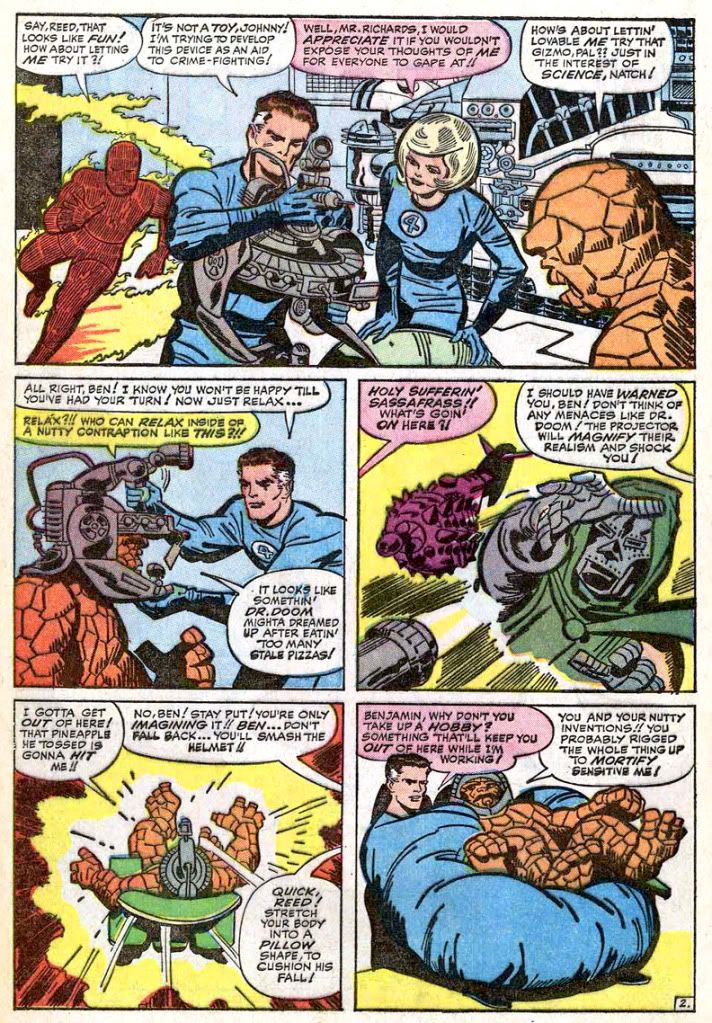
While Sue quite justifiably protests* even this fairly mild invasion of her privacy-- shades of the various "leaked" nude scandals that currently play out almost weekly online--  the boys aren't ready to put away their new toy.  Let's hook Ben Grimm up the machine and see what happens--


Oh, that poor guy!  

Note how Richards wisely refuses the hormonally-addled teen Johnny Storm (his powers incongruously activated despite the ostensibly safe domestic environment, heat amd burning both signifiers not only of arousal but of danger-- caution, don't touch, hot!) access to his incredible sex fantasy image-maker-- no doubt aware of the pimply carnal imagery that would result, and, once seen, never be un-seen-- and sticks the device on Ben's head only to have his friend conjure up a hallucinatory menace that threatens to destroy the new invention itself.  Ben, his powerful rocky form a monstrous mockery of American manhood-- as a former USAF test pilot, astronaut and college athlete perhaps a satirical comment on America's chest-thumpingly uber-masculine patriotism and over-weening pride in our Cold War martial prowess as a sublimation of our more prurient urges similarly suggested by Stanley Kubrick's dark comedy masterpiece Dr. Strangelove-- can't even summon as Richards did the mildly suggestive form of his own lover in a swimsuit.  Instead, his thoughts turn immediately to threat and violence.  Only by forming a symbolic bed for his friend to collapse onto can Richards prevent disaster, the loss of his prototype.

The type of bed symbolized depends on our reading of the Thing's pose.  Is it infantile, as if he's a baby waiting for his diapers to be changed?  In this case, Richards provides a comforting crib.  Or, continuing our linkage of this sequence to the underlying sexual repression/phobias/concerns of the American male psyche, is he spreading his legs for penetration, for intercourse, in which case Richards is providing him with a marital bed, in parody or gender inversion of a wedding night ritual?  Does this mean the imaginary "pineapple" Dr. Doom-- himself a stern father-figure which further suggests something deeply Oedipal-- throws at the Thing is phallic, or is it vaginal?

What is it the Thing truly fears, which only the embrace of his friend can relieve?  What is it the men of the United States feared most in 1964 (the year of the long-haired Beatles and the dawn of the Sexual Revolution) and possibly to this day, as evidenced by certain anti-feminist screeds so full of castration/feminization anxiety they tell more about their authors' psyches than they do the supposed goals of the movement they purport to criticize?  And doesn't he look silly with that damned thing on his head?

*Remember when Marvel used to pretend the FF were real and Stan and Jack were just transcribing their adventures?  As violated as Sue feels by Reed in this story, imagine how a real woman would feel knowing Marvel sometimes has her illustrated by an artist who literally traces pornography, frequently causing her not to look energetic or adventuresome but blatantly orgasmic.

Sunday, August 5, 2012

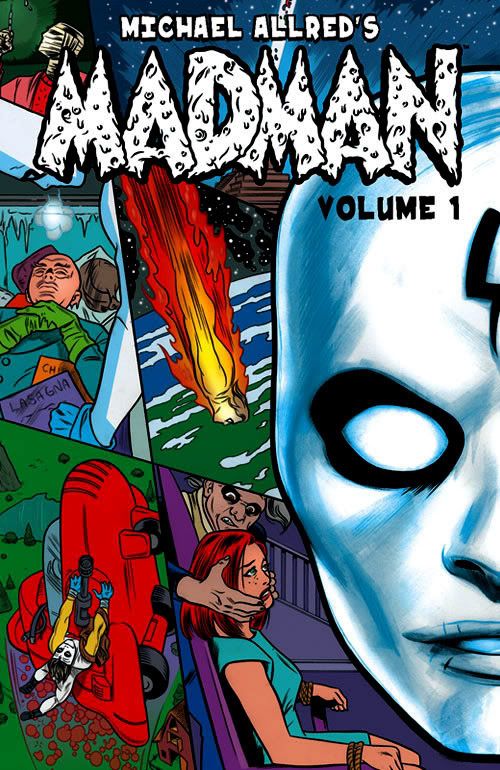
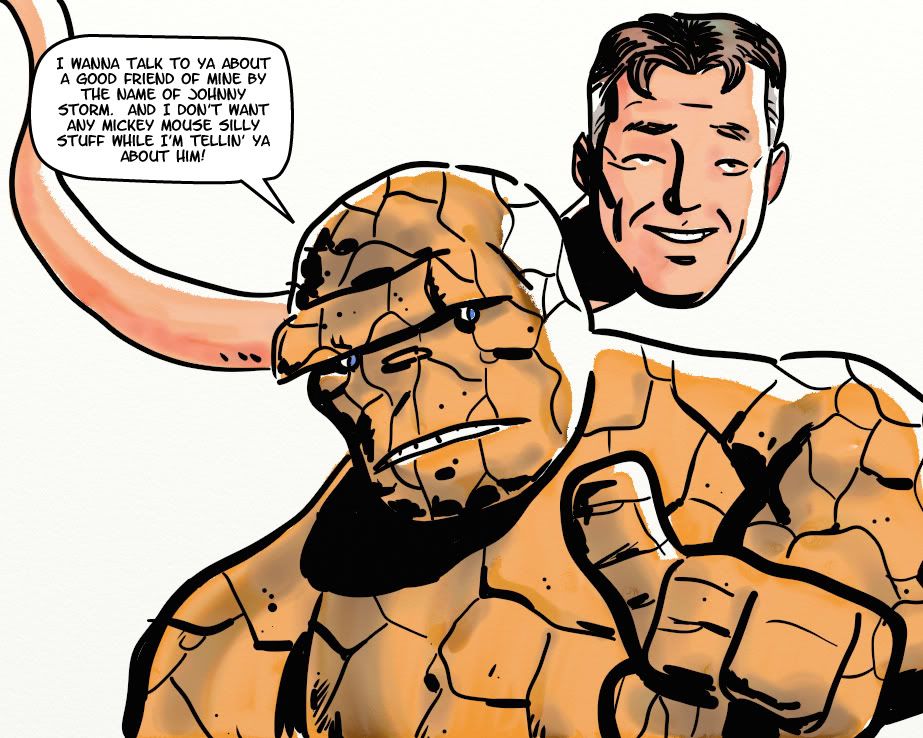
Mike Allred on the Fantastic Four?

Okay, it's not Marvel, but it's Allred!
Whereas DC's kind of like, "Nyahhh nyahhh, we don't need you!" it seems Marvel's going out of its way to solicit my hard-earned yen.  They've got Dani Moonstar practically headlining a book and now this exciting news.  Exciting to me, anyway!

I've loved Mike Allred's art for quite some time now-- and he's just such a positive, nice guy I can't help but like the man himself and his whole family, too-- and have especially fond memories of the last Marvel series other than the new New Mutants I bought with any regularity.  I'm talking the awesome X-Force/X-Statix book Allred did with Peter Milligan.  I really need to go back and re-read that.  It's been too long since I communed with the likes of Mr. Sensitive, U-Go Girl and Doop.  I can't even remember the other characters' names.  Spike?  Tike?  Man, it was gloriously weird and emotionally engaging in a way few mainstream comics ever are.

While I'd love it if Allred also happened to be writing Fantastic Four, just the presence of his artwork is a guarantee I'll be tracking this down over here, across the sea in Japan!

Excelsior!

Monday, August 8, 2011

Happy 50th Anniversary, Fantastic Four!

Hey Reed, Sue, Johnny and Ben! I love you guys! No matter what Marvel does to you, you'll always be the First Family of Comics.

The Fantastic Four was not my favorite comic when I was a kid. I liked the Saturday morning cartoon versions, but it wasn't until my then-favorite artist, John Byrne, took over the magazine's writing and drawing that I started reading it. From what I remember of the letter pages, other readers felt Byrne recaptured the aura or specialness or mood of the Stan Lee-Jack Kirby era, and I wanted to know what that meant. If it meant stories about a group of people who obviously loved each other-- despite their occasional spats-- and household drama growing to cosmic proportions, along with a lot of creepy sci-fi-type menace, then I knew I had to somehow read those old issues.

But who had $1,500 to spend on a comic book? That was the going price for The Fantastic Four #1 at the time. I think. I bought a few cheap issues from late in Kirby's run as artist-- they looked dynamic and kind of slick, thanks to the Joe Sinnott ink polish, but the stories themselves didn't do a whole lot for me. They just seemed like the same tired stuff I was reading in other comics. Fist fights and villains in garish costumes. The hoary Marvel bombast courtesy Stan Lee: "If This Be Flatulence!" "By Arthropods Denied!" "If Thine Eye Offend Thee, Doctor Doom!" "A World Dies Screaming as Black Bolt Orders Pizza Pies!"

Marvel eventually reprinted the series in their Marvel Masterworks hardcovers-- which were also ridiculously expensive-- and then various other more affordable formats, so I was finally able to read the series from the beginning. The first few issues were crude, with rushed-looking art and clumsy stories. The characters were mere ciphers, barely more than stock types. The scientist, the girlfriend, the kid and the...

The Thing. That's what The Fantastic Four had going for it, right from the start. The Thing. Looks like a monster, has the broken heart of a man. And the stories began to improve. By issue #5-- the first appearance of longtime Marvel mainstay baddie Dr. Doom-- Stan the Man and Jolly Jack had gelled and the Marvel Era as we came to know it was born. Reed, Sue and Johnny became more believable as flawed individuals, their enemies original. From there things just got better and better. The book developed a tone unique among comics at the time, at least the ones I've read. I'm trying to avoid historical generalizations here, because I wasn't born until The Fantastic Four was almost seven years old and I'm hardly a historian.

But you know what I mean. The marriage of the superheroic with the supermundane. One minute Reed Richards would be espousing some idiotic theory with Sue Storm petulantly demanding he spend more time snuggling with her, the next the Thing and Johnny Storm would be tearing up the place with their interminable sibling warfare. And then and only then would the issue's menace appear. Dr. Doom again. An alien child. The Skrulls. The Impossible Man. Irving Forbush. Danny Kaye. The New York Mets.

Despite his having been an established pro since the 1930s, it was during this time Kirby's art took on its characteristic visual power and he became the Kirby we know and love today. By the time Chic Stone took over on inks, Kirby had established himself as the King of Comics. Then came Joe Sinnott and his more polished finish and you had the Marvel House Style, a visual lexicon that matched Stan Lee's endless hyping and hucksterism-- the kind of comedic self-aggrandizing style that's so much fun to parody. 1940s army slang mixed with beatnik expressions and Madison Avenue ad-man copy, the occasional foray into Shakespearian syntax. 'Nuff said, True Believers!

The ideas began to flow at a feverish pace. I can't even keep them in order! The Inhumans, The Watcher, Silver Surfer, Galactus, the Blue Area on the Moon. The Yancy Street Gang. Wyatt Wingfoot. Alicia Masters, the gentle, blind sculptor whose love for Ben Grimm made the poor guy's life even more beautifully tragic. It seemed like every issue of The Fantastic Four was in danger of exploding from the pressure of too many concepts and characters against the thin skin of the gray newsprint they were printed on. How could one slender comic book contain so much? Look out! IT'S GONNA BLOW!

And finally, it did. Lee and Kirby began repeating themselves and soon Kirby was off at DC creating a new universe. But let me tell ya, the first 51 or so issues of The Fantastic Four are pop art masterworks. The encapsulate a lot of the vibrancy of the 60s. Watching Lee and Kirby grow into their creative powers issue by issue is a lot like listening to the Beatles' recorded catalog from beginning to end. The comics are very much of their time and in that, they're timeless.

Thursday, June 30, 2011

Friday, April 29, 2011

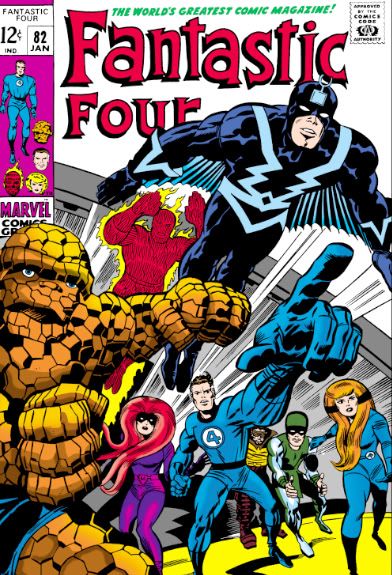
Hi, Crystal! My totally random appraisal of Fantastic Four #82

It's Fantastic Four #82 here to entertain us with jokes and repartee and perhaps some juggling and then some name-dropping anecdotes about meeting John and Yoko at a gallery opening, staying in a hotel suite next door to Mick and Bianca, guest-hosting The Tonight Show during the Carson Era before feuding with Johnny and being banned for life, growing a long beard and attempting to oil paint in the south of France...

Yes, Fantastic Four #82 has seen it and done it all. What a life it's lived! Oh, Fantastic Four #82! If only you'd finish those memoirs.

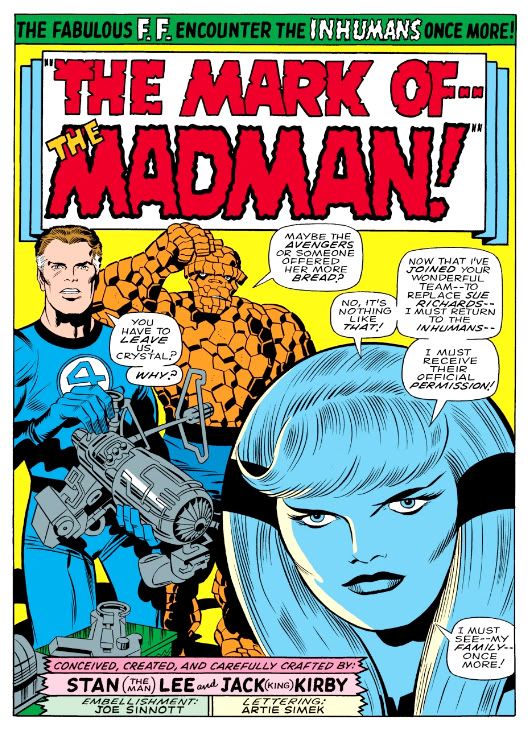
I've forgotten why I found these images from Fantastic Four #82. The story inside is titled "The Mark of-- The Madman!," which is pretty generic for something by Stan Lee. Little bombast, other than the exclamation point. Sue Richards has left the team and Crystal of the Inhumans has joined to replace her. We all know Sue as the Invisible Girl/Woman, with powers of invisibility. But what of Crystal? She can control the basic elements-- fire, air, earth and water. While invisibility has some obvious uses in terms of stealth and defense (especially Sue's famous invisible force fields), Crystal can move water and earth, combine elements to create weather. And she's stronger and more resilient than a normal human. Pretty useful as well. And yes, I know Sue later learned to use her invisible force field offensively as well. My point is, if you can't have one, the other will suffice.

I'm not sure I understand the whole "four elements" limitation. Why would her command of molecules stop merely with the ones that make up those particular things? Probably due to some literary reason haphazardly borrowed from Greek myth or something, but one wishes Stan Lee had thought through the implications of Crystal's powers. She might be more formidable than anyone-- including herself-- even suspects. Forgive me if some clever writer eventually worked this idea into Crystal's narrative. I haven't read a story with Crystal as a major player in it in years. But I do know Crystal also has a cool black headband.

Unfortunately, as a subject of Black Bolt, king of the Inhumans, Crystal isn't free to choose her own life. So despite the FF's kind membership offer, she has to run back to the Hidden Land to ask her monarch for permission. As for me, I prefer democracy. And since there's a madman promised in the story's title, of course the whole gang has to tangle with Maximus. This is a Fantastic Four issue from late in Stan's and Jack Kirby's run where they were recycling ideas that once seemed so fresh. Imagine how mindblowing the Inhumans were when they were introduced in Fantastic Four #45, "Among Us Hide... the Inhumans!"

Even the title is cooler, slightly ominous. Sinister, even! They're inhuman. They're among us. And they're hiding, no doubt for some nefarious purpose. Your neighbors might be one of them! Or a family member. This is why you must do as I do and call the Department of Homeland Security every day at 10pm and report any and all suspicious activity you might have observed in your workplace, your school, your church and even your very home.

Here we are, almost 40 issues later and the Inhumans are still having to deal with Maximus the Mad. This time he's got a gun that can hypnotize the entire earth and make slaves of everyone. In the next issue, it ends as lamely as you might imagine. Seems like Stan at the time was losing interest.

But Jack Kirby's art is still pretty sweet. Joe Sinnott is not my favorite Kirby inker, though.

Don't get me wrong. I like Sinnott's finishes a lot. They're super slick and they really pretty up Kirby's pencils. This is how comics tend to look in my mind when I'm making up my own (then when I try to draw them they look exactly like Alex Toth and Al Williamson got together and drew them holding pencils with their feet). It's just that I prefer the "purer" Kirby that resulted when Mike Royer inked him and followed his pencils more closely, without "fixing" things. I also love Chic Stone on Kirby. Stone-inked Kirby is a lot of visual fun, with thick contour lines around the characters and thinner interior lines for contrast-- not a lot of feathering or those zig-zag Kirby shadows Royer so ably brought out, but a funky, low-tech Kirby.

So it's more a matter of my own peculiar sense of what's appealing. If I had to rank Kirby inkers, I'd list Royer first, then Stone and then Sinnott. I believe Kirby once said he liked Wally Wood best among his inkers. I hate to disagree with the King, but I find too much Wood there and not enough Kirby. I'd rather see Wally Wood inks on Wally Wood pencils than an awkward melding of two different approaches to figure construction and lighting. Kirby's figures are more lit from within, they provide their own light. Not exactly conducive to Wood's "double lighting" feathered chiaroscuro work.