Showing posts with label Stan Lee. Show all posts

Saturday, June 7, 2014

Flash Thompson's swingin' send-off party!

Oh, wow. Sorry I haven't been chatting up the old comics lately. I'm making one of my own and it's taking all my free time. I take a break from it only to work my day job and sleep. I eat at the drawing table (so to speak; I draw on one of those razzly-dazzly Cintiq monitors these days) just like one of those old school guys who made comics back in the day and then died of alcoholism-related complications well before their natural times. Cheerful, ain't it?

Well, here's something that will certainly lighten the mood. Remember when Flash Thompson went off to fight the Vietnam War and everyone at his party looked incredibly mod and gorgeous and they all thought it was a wonderful, happy, pleasant thing he was doing, with no negatives about it whatsoever? It happened in Amazing Spider-Man #47 (April 1967).

Here’s a largely cheerful story about a bunch of friends putting on a going-away party for Flash Thompson, who is leaving for the service, possibly to fight in a war in a jungle that pointedly avoids even the suggestion such a thing might be in any way, shape or form at least the slightest bit controversial or even worrisome.  Of course, given the time, the implication is Flash has been drafted, but the closest we get to acknowledging that is a few issues back when Pete says something about Flash’s “induction notice,” a term less loaded than “draft notice.”  Not a soul even whispers Vietnam or Southeast Asia, and no one seems to think Flash is going to have anything other than a simply fine ol’ time.  Of course, criticizing at Stan Lee and Marvel Comics for not taking sides over Vietnam or making an issue of it is kind of like condemning The Beverly Hillbillies for not doing an episode where Jethro gets drafted, loses a foot and joins an anti-war rally in Washington while banker Milburn Drysdale talks the Clampett family into investing in a napalm factory.

On the other hand, despite what you might have read otherwise in the book Spider-Man Chronicle: Celebrating 50 Years of Web-Slinging, this issue isn’t even as topical as the April 8, 1965 episode of The Munsters where Herman tries out for the majors and Leo Durocher cracks, “I don’t know whether to sign him with the Dodgers or send him to Vietnam.”  Harry’s “Only don’t bother looking for the goalposts!” joke when another guest compares the jungle to a football field does seem eerily and cleverly prescient now that we have more than forty years of hindsight on the matter, though.  And Spidey does at last obliquely reference the potential dangers of war to callow young men when he wonders in the final panel why he keeps thinking of Flash in the past tense when the guy hasn’t even left yet and will probably come through all right.  “He'll make it-- somehow! good guys always win,” he muses, before adding a little ambiguity with the tag question, “Don’t they?”

I don’t think Lee was or is particularly interested in politics, and certainly not in wading into a political Big Muddy and more than likely drowning his company there.  He didn’t mind using the Commies as bloodthirsty villains and outright creeps whenever possible, but who at the time gave a rip what a communist thought about comic books?  If they even read comics when they weren’t murdering babies, knocking over Asian dominoes or stealing our space secrets, they probably stole them off the racks anyway, and that did nothing but harm to Marvel’s bottom line.
 
Plus, there probably wasn’t a lot of readership overlap between Marvel’s magazines and The New York Review ofBooks where in February of that year Noam Chomsky published “The Responsibilityof Intellectuals.” And Dr. Martin Luther King told 3,000 people at Riverside Church in New York City that the civil rights and anti-war movements were essentially the same struggle and condemned the war in Vietnam as US imperialism in the same month Marvel cover-dated Amazing Spider-Man #47.  Check out Time magazine's reaction, and the Washington Post's.  You know, those bastions of liberal thoughtNot so surprising when you consider a Gallup poll the same month showed 50% of respondents believed our escalation in Vietnam was not a mistake versus 37% who thought it was.  The believers were down from 59% the previous year, but still represented a significant majority over the skeptics.  This is a little different than outright support for the war, but risking controversy by directly addressing Vietnam and its complexities and uncertainties wasn’t going to sell Spider-Man to the middle Americans buying this stuff for their kids and still largely assured we were doing the right thing halfway across the world.

Lee had books to move, and Warren Publishing’s Blazing Combat had recently addressed the war directly with distinct disapproval and quickly folded.  In the course of entertaining the heck out of us—its primary purpose—this story acknowledges in the vaguest and safest of terms what couldn’t be ignored and takes no sides.  No more, no less. 

In fact-- YOWZAAA! Look at Gwen Stacy's knockout outfit!
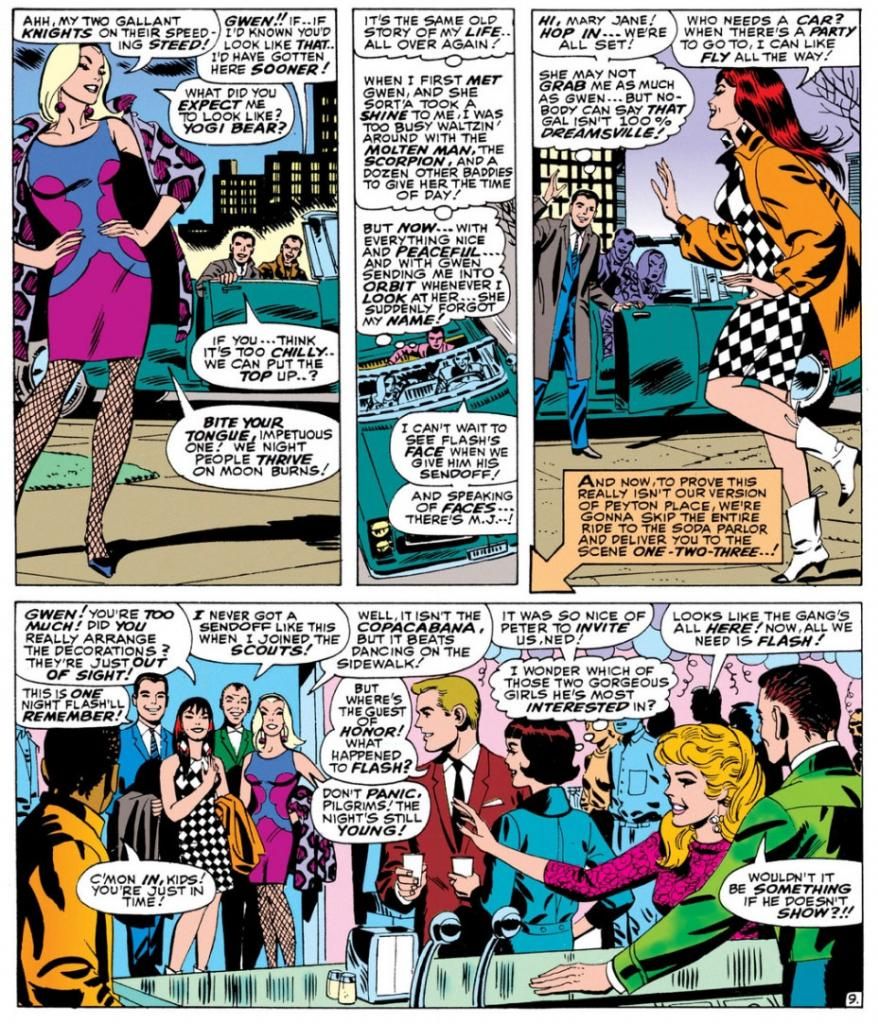

Script:  Stan Lee, Art: John Romita

I don't know who designed it.  Dormammu of Beverly Hills?  Purple and blue abstract design, with fishnets and a animal-print coat in decidedly unnatural hues of... purple again.  Jazzy John Romita was the perfect guy for this soapy stuff and he visualizes Gwen as the height of mid-60s cool.  It doesn't get any better, does it?

Yes it does!  Because here comes Mary Jane Watson in an op-art inspired checkerboard dress and some wild white boots with contrast black toes.  Shame about the orange coat, but she quickly dumps it once they hit the shindig.


Pretty much everyone there is a sharpie.  Smart jackets and ties for the gents, ultra-modern flips and bobs for the ladies.  The guest of honor, Flash Thompson himself, sports a brown coat with a black tee for an athletically casual take on dressing up.  That guy on the left of the top panel has a Beach Boys-looking striped shirt, possibly by Gant.  The only guy who looks anachronistic is poor Harry Osborn, with his green bowtie and jacket like something he borrowed from Barney Fife down in Mayberry, NC.  And he's supposed to be a rich boy.  He looks as if he popped in from a 1949 issue of Archie's Pep Comics.  He's even got Jughead's plate of hamburgers.
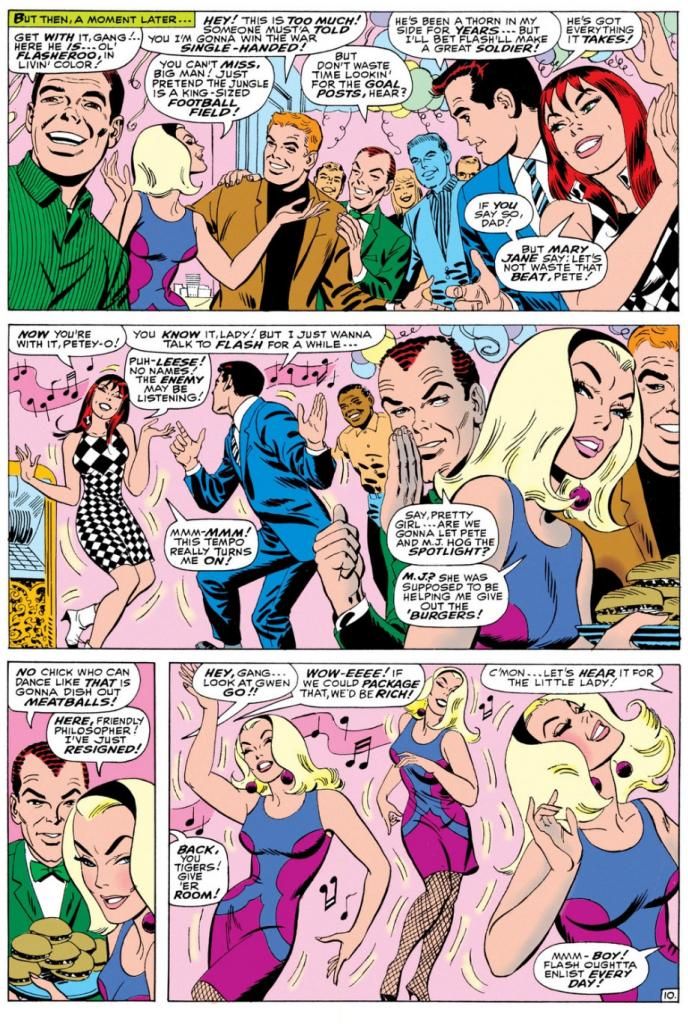
Script:  Stan Lee, Art: John Romita

Gwen steals the show-- much to Mary Jane's displeasure-- with a dance that rivals the one Audrey Horne would do a generation or so later on the premiere episode of Twin Peaks.  All eyes on Gwen.  Stan's blatantly sexist catcalls crack me up.  These are just a few, but they run all through this part of the comic, with Harry and Pete congratulating themselves on having such beauties for girlfriends and Pete secretly leering at Gwen every chance he gets.

Don't you wonder what music Gwen's dancing to?  This was right as pop was going psychedelic and becoming undanceable, and I doubt anyone wriggled and swayed to folk songs or protest tunes.  If this were a TV show of the time, it would be some outdated-sounding jazzy stuff the network squares thought of as "close enough to that rock junk no one will be able to tell the difference anyway." 

You know, like when Opie needs a little background noise while sweeping the courthouse floor for his dad and flips on a little white transistor radio and upbeat guitar noodling comes blaring out.  Then Ope starts doing some kind of frantic moves with his broom still in hand says, "Gee, Pa, isn't this the most?"  And Andy's like, "The most WHAT?"  But because he's pretty open-minded for a Southern sheriff of the day, he and Helen Crump end up championing the fresh-faced kids at the high school who want to add a couple of the exact same generic rock tunes to the annual play instead of doing the same old "founding of Mayberry" junk the older teachers favor.

Anyway, beautifully drawn, hilariously written bit of scene-setting before the issue's bad guy makes an appearance.  Kraven the Hunter.  You know what?  Who really gives a rip about that jackass when you've got these kinds of lovely John Romita pages to look at?  Interestingly, Romita is doing a Steve Ditko impression throughout, and even Kraven's face in a few panels looks more Ditko than Romita.  Artistic continuity, and at times Romita's line looks so impressively close to the guy's who he's imitating, it's almost as if Ditko himself inked this book.

Well, it's a fine book and I wish Lee and Romita had spent even more time just hanging out with the kids.  But I guess the readers came for the action, but I'm more in love with the soap opera/character-building sequences during this era.  I'd hang out with all of these characters even without the superheroic spider-bite antics.  We don't even have to talk politics.

Wednesday, March 12, 2014

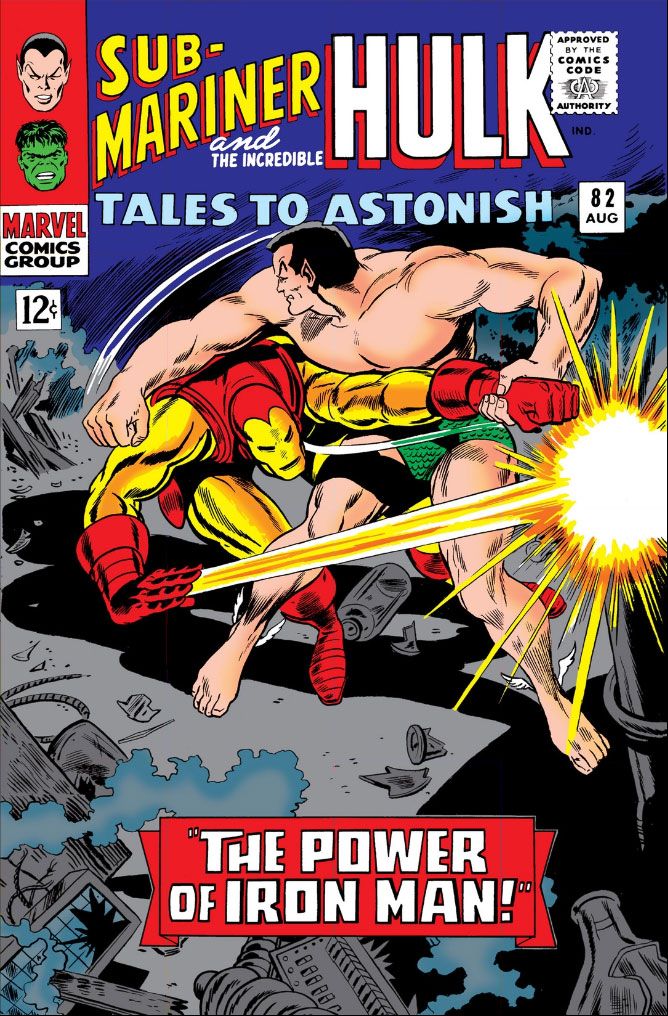
Tales to Astonish #82 (August 1966): I bought this for Gene the Dean, found Jack the King!

Tales to Astonish #82 (August 1966)  Pencils: Gene Colan,
Inks: Dick Ayers (according to Comic Vine) 
Well, that was a pleasant surprise!  I recently bought a digital handful of Marvel Comics superhero books by Gene Colan.  Some people were talking about him on Facebook the other day and I suddenly developed a hunger for his work.  And also for one of those old Marathon bars, but you can't buy those on Comixology. 

Anyway, my appetites aside, Gene Colan is one of my top five or six all-tme art heroes, a guy I've tried to imitate in my own art however futilely.  While I own a DC hardcover full of Batman stories by Colan, and I know he was responsible for a storied run on Daredevil, I tend to think of Colan as more of a horror artist because of his stellar art on Marvel's Tomb of Dracula and for Warren Publications.  After reading all that jazz from people way more knowledgeable than I about this stuff, I decided it was time to fill a gap in my education and study up on his superhero work.

Well, I already knew Colan for a horror master.  Love his moody, shadowy imagery and the extreme figure foreshortening because he chose very unusual "camera" angles.  He was incredibly cinematic, with a strong feel for intense drama and noir-ish lighting.  So I was really looking forward to reading this and seeing how he put that to use in one of those two-character long-underwear dust-ups printed before I was born.   I opened to the splash, scanned the credits to see who inked it (inking interests me lately) and got a surprise.  After the cover, there are only two pages of Colan in this book!  But we're not going to complain because after those two pages it's none other than Jack Kirby the rest of the way.
 
Tales to Astonish #82 (August 1966) has a Stan Lee plot and a Roy Thomas script, and it's a continuation of a fight started in another title, which is easy to confuse with this one, especially since their numbering runs so close together.  I'm talking about Tales of Suspense #80, which also has Lee's and Kirby's famous "He Who Holds the Cosmic Cube!"  I say it's famous because it's a Captain America story I read many years ago in the book Captain America: Sentinal of Liberty.  All the stories in that book are famous because Stan Lee says so.

Anyway, Captain America isn't in this.  It's just Iron-Man and Namor.  Their story starts over there, continues here in this one, then goes of into another comic.  I haven't had time to sit down and really give Tales to Astonish #82  a reading, but just from staring at the art, this story, called "The Power of Iron Man!," is a frenzy.  Just two characters duking it out.  I have no idea why, don't really care all that much.  I'm downloading it into the Comixology iPhone app as I type this, so I'll read it in those scant free moments I'm not shaking the earth and building a better future or whatever the hell it is I do.  I don't really wax nostalgic over things like two characters having a fight, or that this is "the first real inter-book crossover."  I'm more interested in the artwork by Colan and Kirby.

Despite Dick Ayers' inking, it would be obvious we've got two very different pencillers even if we haven't read the helpful credit boxes on the splash page which tell us Colan came down with the flu and Kirby had to take over.  I wonder if that's really the case, or if this is one of those cute jokey things Stan and Roy liked to use as an easy explanation for some other chain of events they didn't want us to know.  Seems likely enough, much more so than Kirby drawing the book then asking who the Sub-mariner is, but that's the claim here, too.

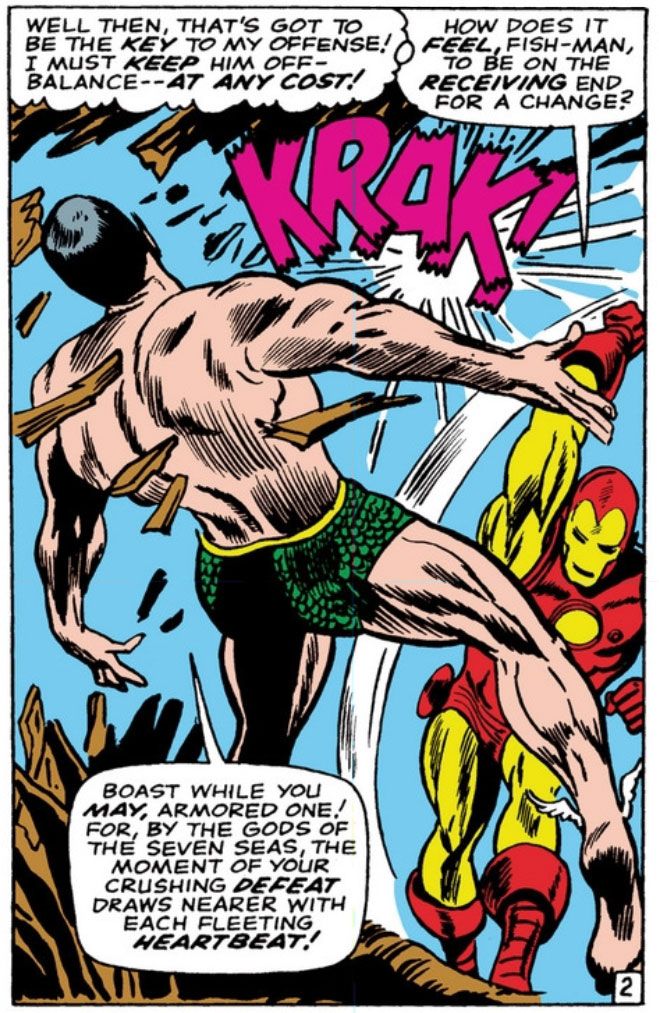
Here's where Iron Man hits Namor the Sub-Mariner so hard they both turn from Gene Colan figures...

Script:  Roy Thomas, Pencils:  Gene Colan, Inks: Dick Ayers
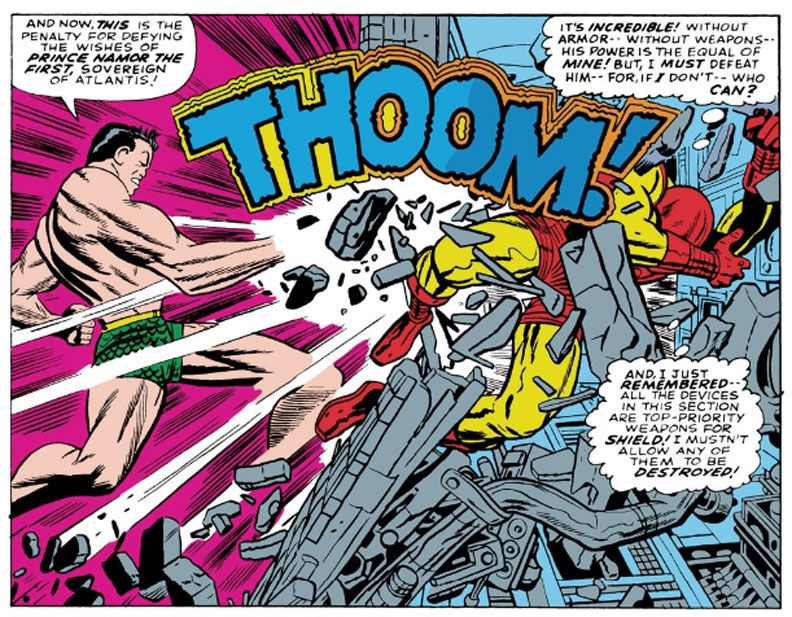
... into Jack Kirby figures:

Thomas, Pencils: Jack Kirby, Inks:  Ayers

Jagged purple "KRAK!" is the sound of metal-clad fist striking flesh and bone chin.  Earthquake-like yellow and blue "THOOM!" is what happens when fish-guy knocks armor-guy through a wall. 

In the Colan panel, notice how Iron-Man's weight is planted on that front foot.  Most of his body is moving towards Namor in the foreground because he's put everything into one massive hay-maker of a blow, which landed a split-second or so before Colan "photographed" this moment.  Even though he's still able to talk, Namor is flying upwards and backwards with his right foot dangling loosely.  This is follow-through, the impact completed, an interesting split-second between the moments of collision and release and much closer to the latter so the figures are opening up, becoming loose-limbed and extended, although I imagine Iron-Man's left thigh is clenched because he's planted that foot and is stopping his forward momentum with it.

Now look at Kirby's panel.  This isn't follow-through.  This is the exact moment of impact.  Namor has punched Iron-Man with a more compact body-blow.  Notice the rigidity of Kirby's figure drawing here.  Namor lowers and draws in his chin, which means his chest and abdominal muscles are clenched, tense.  He's still performing the action itself.  In Colan's, taking place nano-seconds after the action, we see Iron-Man's fist.  In Kirby's, at the moment of impact, Namor's fist has vanished in a white starburst.  And Kirby either gives us two time differentials here or else that punch is so powerful, the transfer of kinetic energy has already thrust Iron-Man through the wall in exact moment Namor landed it!  It seems impossible, two states at one time, but there you have it.  Also, like Namor before him, Iron-Man flies backwards from blow, but Kirby puts his upper body into a kind of defensive posture, arm raised to protect his face, while the other arm goes limp and he appears to be drawing his legs up so that he can land in a ball on the other side.  Or the fetal position.

Colan's is kind of athletic and even graceful, Kirby's is as hard and bone-shattering as two cars in a head-on collision.

These panels come a couple of pages apart.  I just wanted to show you one of Namor's answering blows because it wouldn't have been fair to give Iron Man two consecutive shots.  The art switch is just this abrupt, though.  You get that Iron Man punch at the end of one page-- and I find very entertaining Thomas's characterization of Namor as the kind of cool customer who can fall backwards after a sock to the jaw and still find it in himself to make a sneering speech about how Iron Man's "crushing defeat draws nearer with each fleeting heartbeat"-- then the very next page starts with a Kirby-drawn panel of Iron Man shooting his "repulsor rays" right at us, the readers! 

What gives?  Aim those things elsewhere, buddy!

Since I was born a generation later than the kids who bought these issues new off the stands, stories like these were hard to find unless they popped up as a back-up feature in an annual or else in one of those hardcover collections at the library.   The ones that were constantly checked-out and never available.  Or that Sentinel of Liberty book I was just telling you about, which I bought at Waldenbooks at our mall along with one about Dr. Strange. 

We didn't have all the archive reprints and essentials and, of course, digital comics had yet to be invented.  I didn't have the disposable income to buy swanky back issues, and I probably wouldn't have been inclined to even if I did.  There were always new comics to buy.  And living in a small southern town, I was largely isolated from fandom at large and things like fanzines and mailing lists.

This means I don't have an encyclopedic knowledge of storylines predating my interest in comics, nor do I know a whole lot about the inner workings of Marvel or DC or who drew or wrote what when or where.  It also means every time I go on a Gene Colan or Jack Kirby rampage, I'm liable to find stuff completely new to me.  I like that.  The joy of discovery!  The joy of turning a page drawn by Gene Colan and finding the next one drawn by Jack Kirby!

Oh, and there's a Bill Everett-pencilled Hulk story as the back-up feature, and that looks pretty cool, too.

Saturday, November 9, 2013

Fantastic Four Annual #3: Stan and Jack can't catch a break

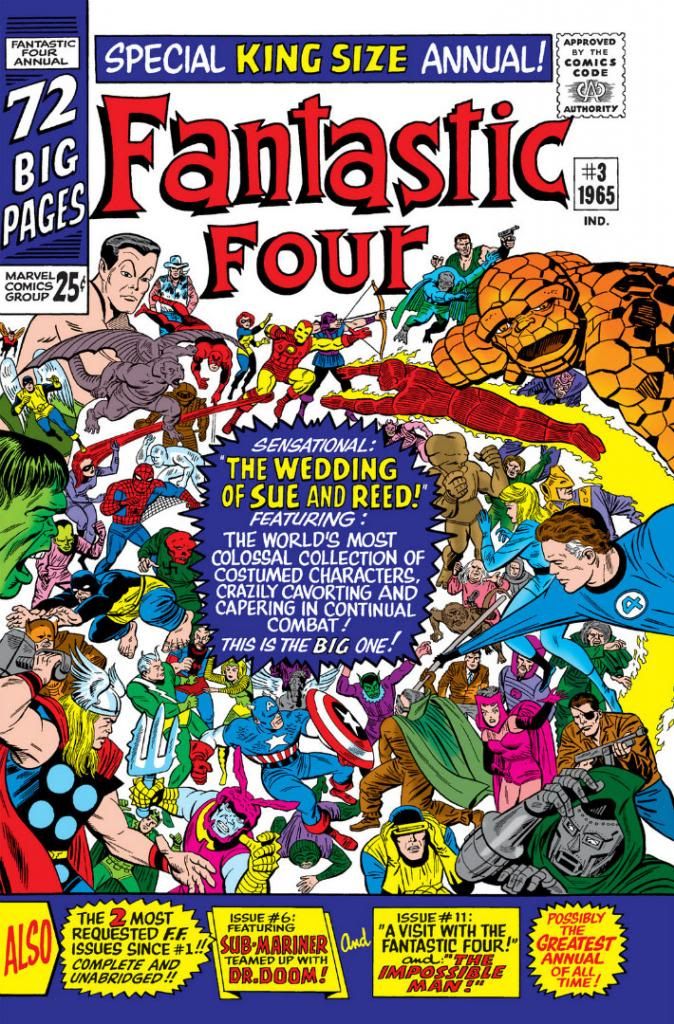
I've always felt ambivalent about annuals.  The best are the ones where the regular creatives use the extra room to tell an epic story that's either too large an idea for an ordinary issue or else climaxes a storyline, or someone you've wanted to see handle the characters shows up to write or draw the book.  The worst are when some ill-suited guest team butts in with crap that's essentially filler or else it's simply part of a storyline from some other book.  Back in the 1960s, the gang at Marvel really knew how to put together an annual, although Fantastic Four Annual #3 (October 1965) consists of a regular-length story and some "most requested" reprints.  It's just the main story is nothing less than the long-awaited wedding of Reed Richards and Sue Storm.

And lemme tell ya, brothers and sisters, everyone who is everyone shows up and it is fun, fun, fun from panel one!  Captain America, Thor, Iron Man, Spider-Man, Daredevil, Dr. Strange and all the X-Men, plus Patsy and Hedy, (at least rumor has it) Millie the Model and possibly Irving Forbush headline a stellar guest list, with Nick Fury and SHIELD providing security.  The only problem is, with such a major event there are bound to be crashers.  The Puppet Master, the Red Ghost and his apes, Mole Man and the Super-Skrull all cause problems, because Dr. Doom himself has some kind of crazy emotion ray controlling their minds.

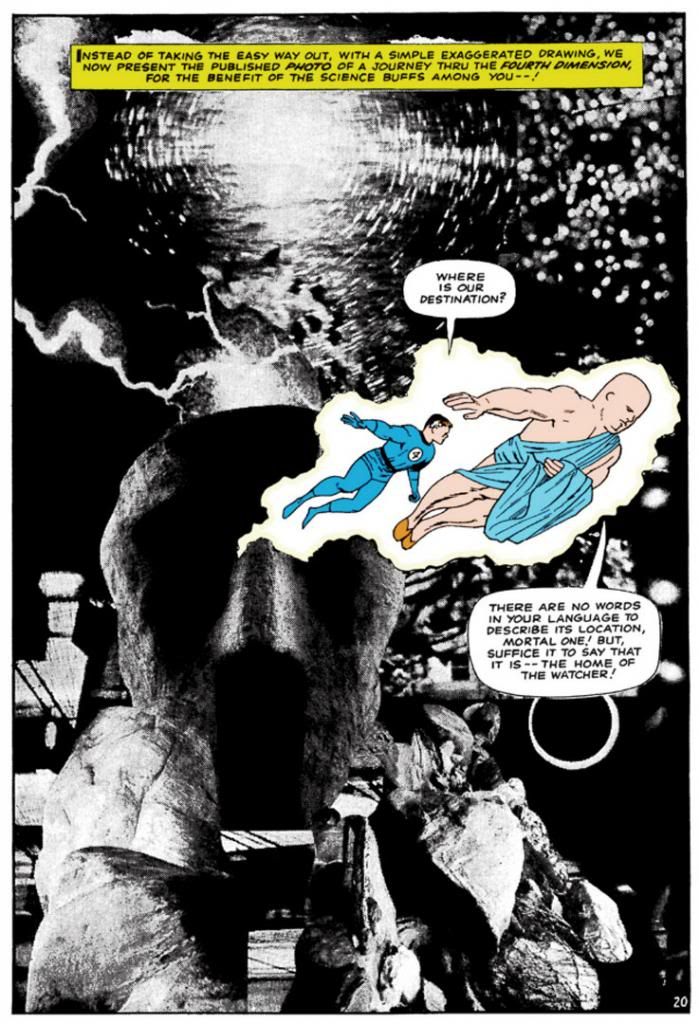
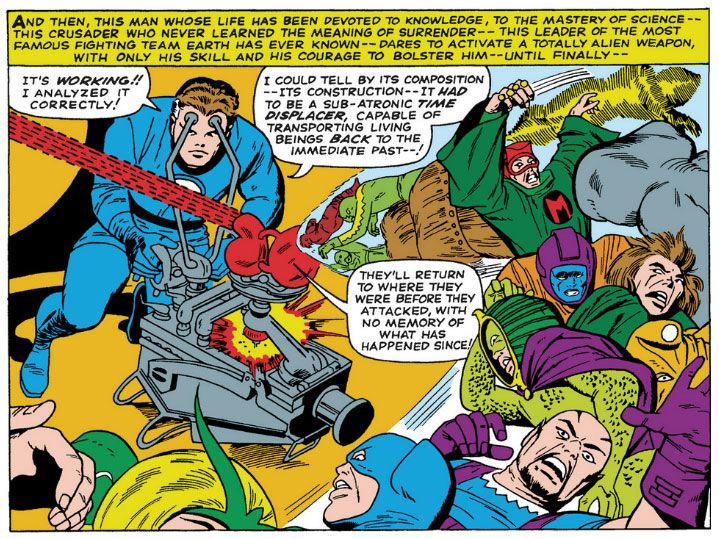
The heroes prove capable of handling the initial wave, but more and more villains attack so we get the like of the Mandarin and Hydra plus a lot of other clowns whose names escape me barging in and smashing up the place (kind of like Owen Wilson's mescaline-addled Eli Cash in The Royal Tenenbaums only without the death of a single Buckley), giving Fury a raging headache.  When Attuma and his Atlantean armies emerge from the harbor (Doom meant to call Namor, but the King himself was on some deeper quest according to Stan Lee's little editor's note; he also tells us why the Hulk isn't there) and Richards puzzles out what's behind it all, even the Watcher has to take a hand.  He takes Richards on a dazzling yet possibly superfluous trip through the "fourth dimension" (isn't that time?) to retrieve a device that beams all the baddies backwards in time to a moment where they would forget the whole thing happened.

Kirby uses one of his patented collages to depict the dimensional trip and we have to take a moment to gaze upon its wonders.


And here's that aforementioned device in action.


My god, Reed Richards is so smart, he could tell just by looking at it what it is and what it's used for!  I'm looking at it and all I can think is maybe I could use it to project transparencies onto some kind of fabric screen or perhaps even the wall itself as a visual aid for one of my classes.

This panel sums up the whole of the rather jangled plot, which is almost entirely given over to fight scenes, as you can imagine.  Kirby's on fire with some incredibly energetic poses as he presents practically an encyclopedia of Marvel's contemporaneous characters and we get a lot of villainous monologues and heroic wise-cracks from Lee.  Vince Colletta's inks are typically scratchy and rushed-looking, but I also recognize the herculean task faced by the art team here in working with this many characters on deadline.  They're serviceable finishes and a few odd figures and faces actually have a becoming elegance (others look kinda haphazardly slapped together), but certainly this book would have looked slicker with Chic Stone doing the honors, or Joe Sinnott.  Then again, Reed and Sue might have had to delay their ceremony another year or two waiting for this issue.

Another thing to consider is we're looking at restored art here.  I'm not sure what process Marvel puts their back catalog through to produce these color reprints, but I doubt they used the original inked pages or old separations (if any of that still exists).  I'm guessing they cleaned up some stats or decent-quality printed books as best they could,  retouched things here and there but said, "Eh, good enough" at the loss of finer lines after the digital coloring.  And these lines look like they were thin enough to begin with.

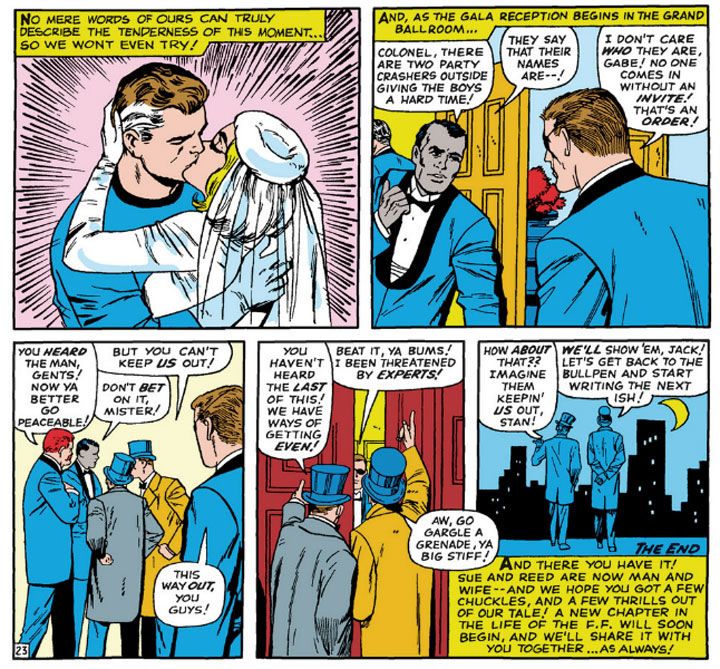
On with the wedding!  Here comes the--

Stop the music!  Stop the music!  Hold the sub-atronic time displacer!  What's this?  Two more wedding crashers?


In the immortal words of a certain bashful, blue-eyed boy, "Wotta revoltin' development!"

Wednesday, August 28, 2013

Fantastic Four #37: You want us to do what?!!

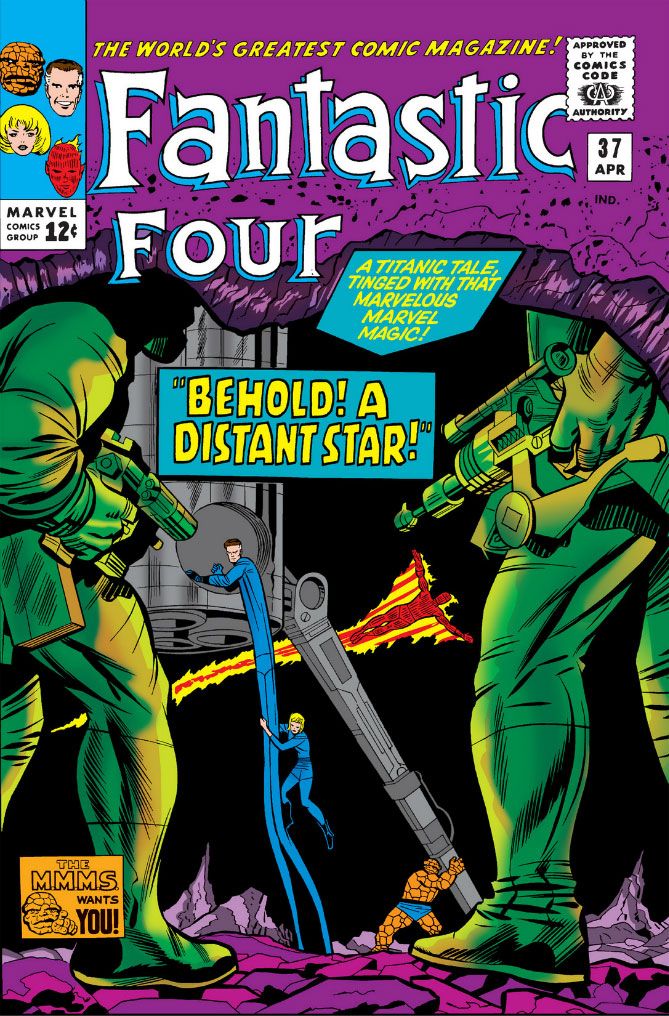
Here's a Jack Kirby gem from the Chic Stone era-- Fantastic Four #37 (April 1965), "Behold!  A Distant Star!"  It starts with Johnny Storm burning off his tuxedo.  Why is he wearing a tuxedo?  Because Reed Richards and Sue Storm are getting married, that's why.  The Fantastic Four are right in the middle of preparing for the single most important nuptial event in Marvel universe history, and the groom suddenly takes it in his head to fly them to the Skrull homeworld to fight the whole planet.

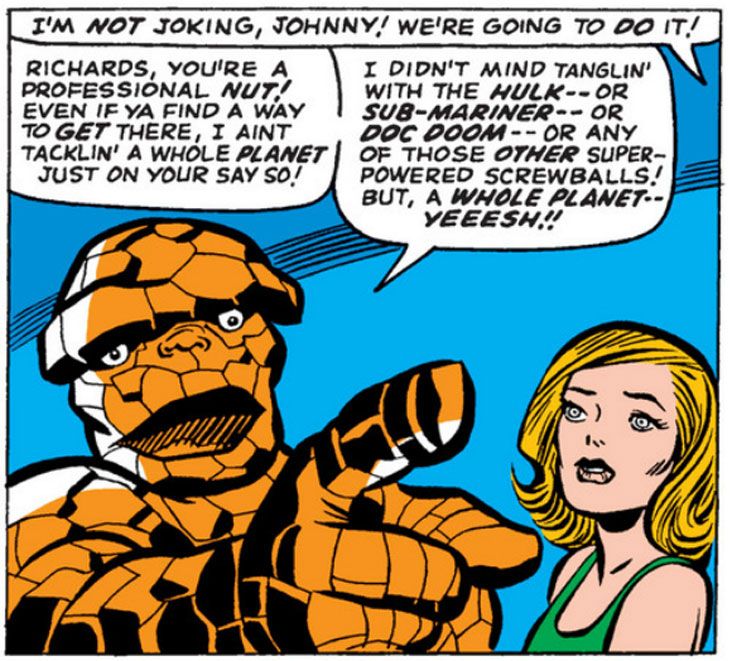
This is a book filled with wedding plans and power rays (Reed:  "To put it simply, it's a variation of a power amplifier!  It draws energy from an unknown source from somewhere beyond the confines of our solar system, and converts it into raw, usable power!"  To which the Thing replies: "Thanks a heap for puttin' it simply!  Now how about sayin' it in English?") and alien vistas full of creatures that would give Commander Hoek and Cadet Stimpy nightmares.  And it has a moment where the Thing aptly sums up just what's wrong about Reed's plan.

Take it away, Thing:

 
Despite the Thing's completely sane objections, off they go to the Skrull planet in another solar system. Faster than light travel is nothing for the Fantastic Four these days, or for us readers. We're starting to take Reed's inventive genius for granted at this point.

But let's never take Kirby's for granted.  I may not be giving Stan Lee his due here (the dialogue between the team members crackles with wit) but that's probably because of Kirby's art in this issue, which makes me feel drunk.  Drunk in a good way, right when the buzz is taking hold and you feel funny and energetic, ready to dance.  The visuals pretty much run the FF gamut, the family drama (it's not everyday two superheroes have a wedding rehearsal) and then the pan-galactic, realized in one of Kirby's collages.  There are elements of tongue-in-cheek and operatic drama and Kirby gets to draw both tuxedos and space finery, design interstellar starcraft for two species and then a lot of alien flora and fauna.  This is evidence of a man truly feeling the material.  The earliest issues are timid compared to the full-blown Kirby... well, Kirbyness we find in "Behold!"

It's not just that collage.  There's a scene where a Skrull monologues and Kirby cuts to an exterior view so he can draw freakish space critters running across a planetary landscape.  It's weird, man.  Weird and wonderful.  Stan the Man must have cackled with glee when he saw that page.  I know I did.

YEEESH!!

Happy Jack Kirby Day!

It's Jack Kirby's birthday (he would have been 96!), which, around here, is a major holiday.  For me, anyway.  And if I have my way, one day it will be a holiday for everyone.  I don't care if it becomes a national holiday with government offices and schools closed or anything like that.  I'd just love to buy a calendar and see August 28th labeled Jack Kirby Day.

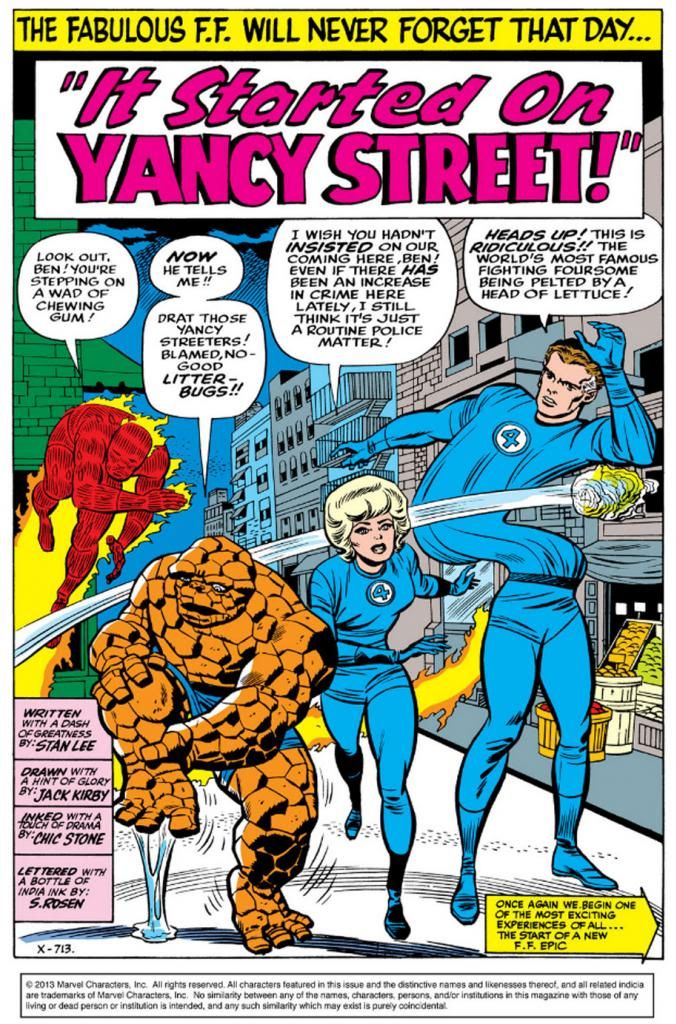
And maybe some parades in his honor or fireworks shows.  Here's a favorite splash page of mine, from the classic Fantastic Four #29 (August 1964).


I'd tell you the credits right here, but they're already in the artwork!

This color recreation is probably pretty close to the originals.  Some of it is a bit too intense, but I'm happy they didn't try to model a lot of shadows and light effects on the figures.  But what I like best about this isn't the Thing having stepped in gum (although that is a nice touch); it's the way Mr. Fantastic plants his feet on the concrete and then uses just his torso to dodge the tossed garbage.  There's a strong contrast between Reed's sturdy, pre-Vietnam-America-can-do legs and his swirling mid-section that draws my eyes.  I keep imagining Mr. Fantastic's texture as sometimes like taffy, and at others, like in this instance, almost a liquid.

And there's Sue Storm, the Invisible Girl, in the center, saying something completely sensible.  Call the police, not the superheroes.  It's not fear talking.  Sue isn't playing the dithery, do-nothing citizen trying to stay out of trouble at all costs.  Sue's objection has to do with prioritization.  She knows the team has more important things to worry about, like communism and Dr. Doom.  She probably also has practical concerns.  While I'm sure she'd agree the crime rate on Yancy Street is something of a concern, and it's admirable the FF want to pitch in, what can they realistically do about it?  Burn the Yancy Street Gang to death?  Bully them with the Thing's strength?  Build a community center with the wealth generated by Reed Richards' patents?  Psssh.  This isn't for the Fantastic Four to bother themselves over.  It's more a Spider-Man-level situation.

But I agree with Sue.  What's truly needed is police involvement.  Those lazy bums.

Thursday, August 1, 2013

Fantastic Four #30 demonstrates why you should never go on any vacation Reed Richards plans for you

You'd have to be crazy to go on a Reed Richards-planned vacation.  For one thing, there's no such thing as a leisurely Reed Richards-planned vacation because Reed's idea of leisure is to culture bacteria or tinker with a device to allow inter-dimensional travel.  Those are his spare time activities.  He does really heavy-duty stuff when he's working.

For another, if at the moment he's interested in traveling, he's not going to set up a Hawaiian itinerary or a couple of weeks in the Riviera, although he could easily afford either with all his patent money and licensing fees.  No, he's going to take the whole party to Transylvania so he can do a little field research.

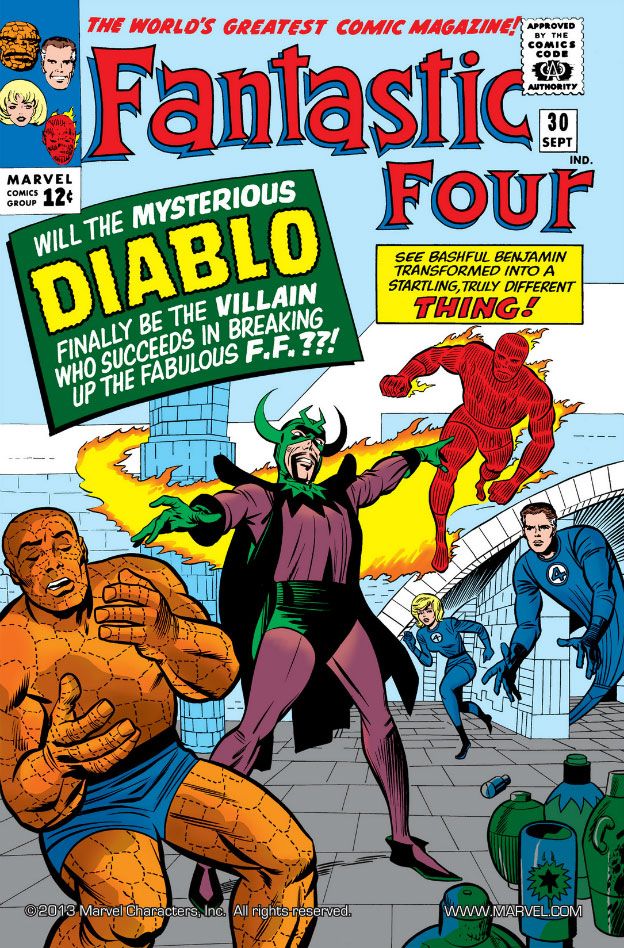
Check out what he does to his friends Sue, Ben and Johnny in Fantastic Four #30 (September 1964).  Reed drags them all the way behind the Iron Curtain-- and I thought the guy absolutely despised communism-- for a visit to Dracula country.  Stan Lee's narration calls Transylvania a "kingdom," but that was true only in his active imagination, no doubt full of Bram Stoker-inspired fantasies.  In reality, during the time frame of the Fantastic Four's ill-fated visit, Transylvania, as part of Romania, had only recently emerged from under direct Soviet control and established a certain level of political and economic independence from the USSR, it labored under the rule of Georghe Gheorghiu-Dej, a hardline communist and former Stalinist who instituted one of the harshest regimes in Eastern Europe.

It also harbored anachronistic alchemists like Diablo, with his green horned cowl and jaunty purple tights.


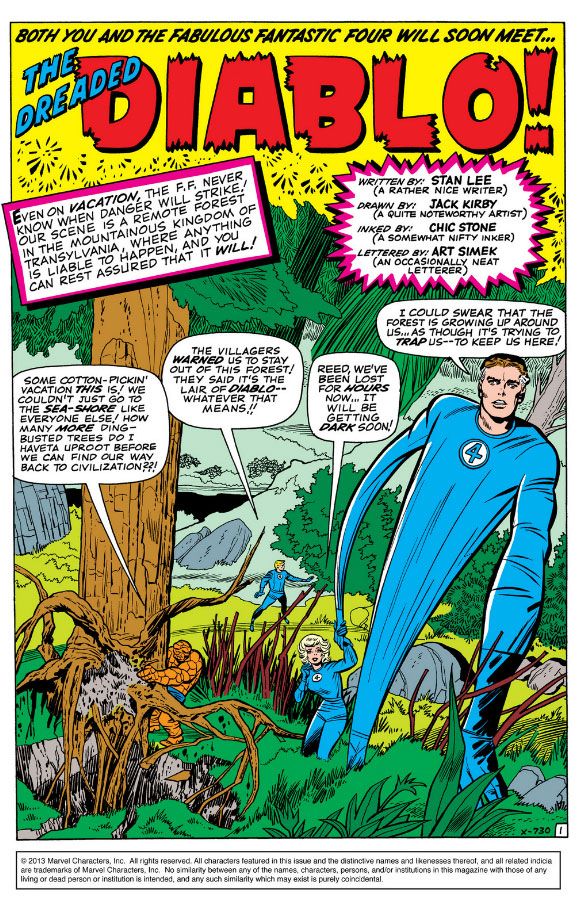
The first thing Reed does on this so-called vacation is to lose the team deep in the Transylvanian forests.  He does this so quickly, Kirby and company don't even bother with set-up.  There's no Baxter Building prelude where Ben and Johnny get into a fight and Reed intervenes only to have Sue step in and tell everyone they're only squabbling because they've got cabin fever and need some time off.  Nope, right from the splash page they're lost and the only explanation for the how and why we get is in a caption.  Anyway, Reed is probably faking it so he can surreptitiously search for a rare slime mold or fungus from which he can synthesize a chemical he needs.  It is a scenic forest, though.

There are few inkers I enjoy on Jack Kirby so much as I do Chic Stone.  Chic Stone makes Kirby's art look like a cartoon, and I mean that in the best sense of the word.  Take that cover, for example.  Check out how Kirby and Stone depict the transitional, less-rocky Thing-- thick contour line around the outside, dotted lines on the inside.  And bald.  Also, how cool is it on the splash page that Ben is plucking a tree right out of the ground while complaining about the very topic of this blog post?  The tree's not even in his or anyone else's way; it's just there for the plucking.  This is fun.  Comic visuals that are pure fun.

But look at Reed stretching himself out there, pretending he doesn't know exactly where they are and what he's doing.  A few moments later, he's all like, "Hey, look, gang!  I found a ruined castle I totally never suspected was here all along!  Why don't we... oh, I don't know... investigate it?"  Obviously, Reed wasn't after just some botanical specimens...

Then this Baron Hugo character shows up and tells them to stop being lost before they hurt someone or disturb something best left undisturbed and that they can sleep over at his house.  That night, Ben sneaks out into the forest and-- in a creepy sequence that anticipates Mike Mignola's Hellboy-- goes to an ancient castle where he pulls a giant stone stopper out of some kind of cylindrical stone architectural feature for which I don't know the name.  The narration refers to it as a "crypt."  Well, okay.  This frees our old pal, Diablo.  Diablo, the Transylvanian alchemist with the Spanish name that means "devil."

It doesn't take Diablo long to exploit festering personal divisions within the FF, using his chemicals to restore a limited humanity to the Thing, with a promise of more to come.  That's all it takes for the disgruntled Ben to turn his back on tour guide failure Reed Richards and declare himself Diablo's buddy-for-life.  Diablo goes on a chemical rampage, rejuvenating a geriatric millionaire named Featherstone (he wears a top hat!), transforming the Iranian desert blossom into a floral wonderland, raking in the money with government contracts and using Ben as overseer to exploit local labor.

Reed, smarter than your average alchemist, soon discovers Diablo's formulas are all phony-- suddenly, the blossoming deserts revert to their infertile state, the millionaire ends up hospitalized for an advanced case of being a moldy old bastard and the anti-missile shield (don't know how a chemical potion produces something like that and wisely no one bothers to even try to explain it).  And poor Ben has his heart broken yet again.

With the tacit approval of the United Nations itself, the Fantastic Three spring into action, only end up trapped in glass vials.  Ben redeems himself and Reed promptly gets them lost in the woods yet again.  Because he still hasn't found the prized fungus, no doubt.  And I have no doubt this is exactly the way things played out in Reed Richards's mind before they even left New York.

Some vacation!  That's the kind of crappy vacation experience you're going to have if you let Reed Richards choose your destination.  The man's a workaholic, I tell you.  Doesn't know how to have fun.  Or where.  Now if you want me, it's summer vacation for me, too, and I'll be spending a fabulous fortnight in glamorous Pyongyang, cosmopolitan capital of the Democratic People's Republic of Korea.  I hear it's a swingin' town and a real shopper's paradise!

Monday, July 8, 2013

Hulk Cassidy and the Sundance Thing: The Early Days

Okay, actually it was just Butch and Sundance:  The Early Days without their surnames, but that didn't have enough of that pop culture fusion stupidity I enjoy so much (to the detriment of all my personal relationships).  And those two guys actually got along much better than the Hulk and the Thing.  The Hulk and the Thing are Marvel's two heavy hitters and their dust ups from the first few years of Fantastic Four are pure comic book fun.

First, you have the Thing.  A mouthy orange rock-man, the muscle and the ever-lovin' heart of the Fantastic Four.  The Thing was essentially nice.  Who the heck could hate the Thing?  Then, you have the Hulk.  In the 1960s, at least for a time, the Hulk had a command of language beyond simple statements in favor of smashing, or admonishments to puny humans to leave him alone.  He was an anti-hero hearkening back to Marvel's early years when they put out comics where Namor would show up pissed off for whatever reason and start tearing up the place.  Namor was the kind of dangerous character you rooted for only because he was fighting Nazis (only other Nazis root for Nazis), mad scientists or because he was like your own repressed child-id striking back at adult authority figures-- otherwise, Namor was angry specifically at you, the reader, for existing on land.  It's a similar story with the Hulk and Space Age-era Communists and outright villains.

With two opposing forces like these in a single comic book universe, it was only a matter of time before they clashed.  And clash they did in Fantastic Four #12 (March 1963) by Stan Lee, Jack Kirby and inks by Dick Ayers, from those fabled days when Kirby hadn't yet settled on the correct number of fingers and toes for the Hulk.  In this issue, the Jade Giant flaunts three of each, plus opposable thumbs for a grand total of fourteen digits.  Strangely enough, the same number sported by the Thing.  That's okay, because there's at least one instance of Mr. Fantastic showing six on one hand in a later issue.

The story opens with the Thing looking natty in a tux, out on the town with his girlfriend Alicia Masters.  Within moments, things take a tragi-comic turn as they frequently do in this old Marvel stories-- soldiers on the alert for the Hulk cause a scene, an old man accidentally pokes the Thing, the Thing reacts angrily, attracts the attention of the soldiers, there's a fight as a result of mistaken identity and the Thing is publicly humiliated once again.  Why the soldiers are out looking for the Hulk is obvious-- he's a destructive menace. But why their officers sent them out without first briefing them on what the Hulk's actual appearance is something neither Stan Lee nor Jack Kirby care to explain.  And if being mistaken for a green monster in purple pants isn't pathetic enough for our orange monster in blue pants, the Thing also forgets his key to the Fantastic Four's special elevator and has to climb up the cables to get home.

None other than General "Thunderbolt" Ross (oddly appearing in an army uniform rather than one from the USAF) then comes to the Baxter Building to recruit the team to fight the Hulk for him.  To prove the Hulk's existence, Ross screens some top secret film footage of the Hulk in action, which causes the testosterone-laden male heroes-- including ostensibly mature older genius Reed Richards-- to act out their fantasies of single-handedly defeating the Hulk, while lone female Sue Storm frets about her uselessness.  At least until the men decide she's good "for morale."  Guess the Thing isn't the only one meeting with humiliation this fine evening.

The issue features the debut of a new whiz-wagon for the gang, the Fantasticar redesigned in-story by Johnny Storm, and featuring one of the many meta-moments Lee and Kirby inserted into the book in those days-- supposedly fans of the team wrote in complaining that the old Fantasticar looked too much like a flying bathtub.  The new one is a sleek Kirby creation that gives Ross a military-industrial complex boner.  The five rocket to the western desert and fight's on.

The Hulk is actually a big green herring as it turns out-- the real villain is someone called "the Wrecker" (a likely name) who sabotages our American way of life for his Commie overlords.  I don't want to spoil the story's big secret, but the Wrecker turns out to be the guy with the membership card in a communist subversive organization right there in his wallet.  Great detective work there, Rick Jones.  This leaves the Thing wondering out loud, "Just what the heck was I fighting the Hulk for?"  No reason, really, other then the very coolness of Thing versus Hulk, Thing!  Oh, and advertising for another hero even if his own title flopped.  In their first bout, our boys seem pretty evenly matched, and it's useless Sue Storm who manages to knock out the Wrecker and save the day for everyone.  Never underestimate Sue, fellas.  The Hulk, weakened by a laser beam, gives up and slinks away to fight another day.  So after all that, we don't even get a definitive answer to the question of which hero is muscle supreme in the Marvel universe.


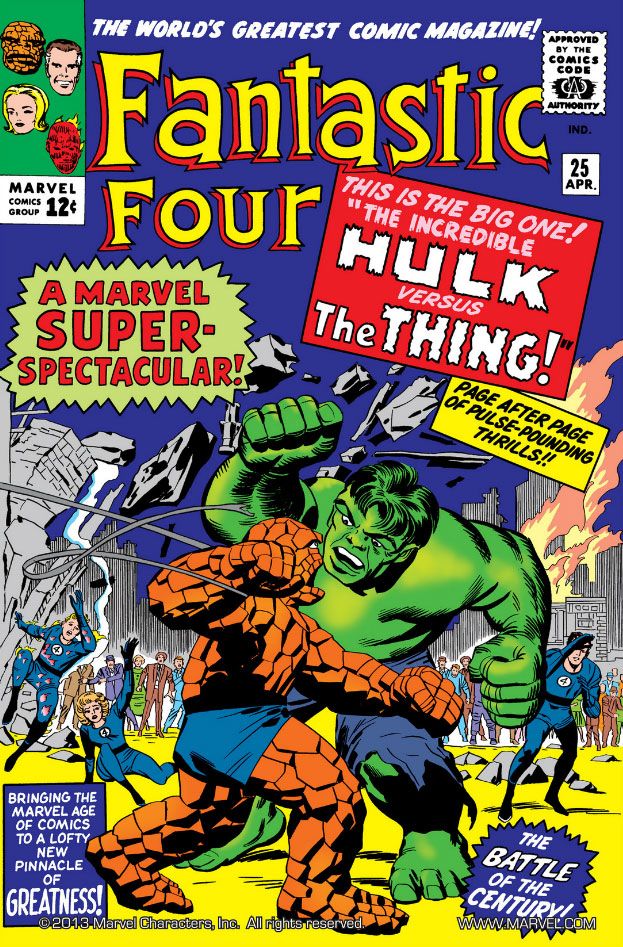
That is until a year later when Marvel published Fantastic Four #25 and 26 (April and May 1964 with George Roussos on inks this time, credited as George Bell), a story so big it sprawls over two complete issues and involves practically every other Marvel hero of the time.  I'm guessing it was Lee who crammed all the hyperbolic copy onto the cover of #25, the Man at his carnival barker's best.  This is the kind of stuff I've come to associate with the feeling of reading Marvel comics from the 60s and 70s-- a relentless barrage of overblown propaganda, indoctrinating the readers in the Mighty Marvel Mindset with phrases like "PULSE-POUNDING" and "SENSES-SHATTERING" (as if the latter was even remotely desirable).  This time the Fantastic Four don't have to go hunting the Hulk-- the big green galoot himself turns up in New York City because he's angry at the Avengers for booting him in favor of Captain America.


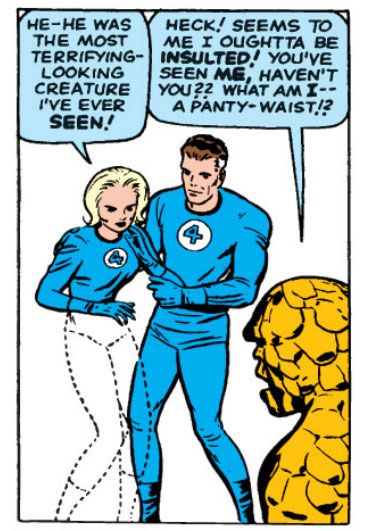
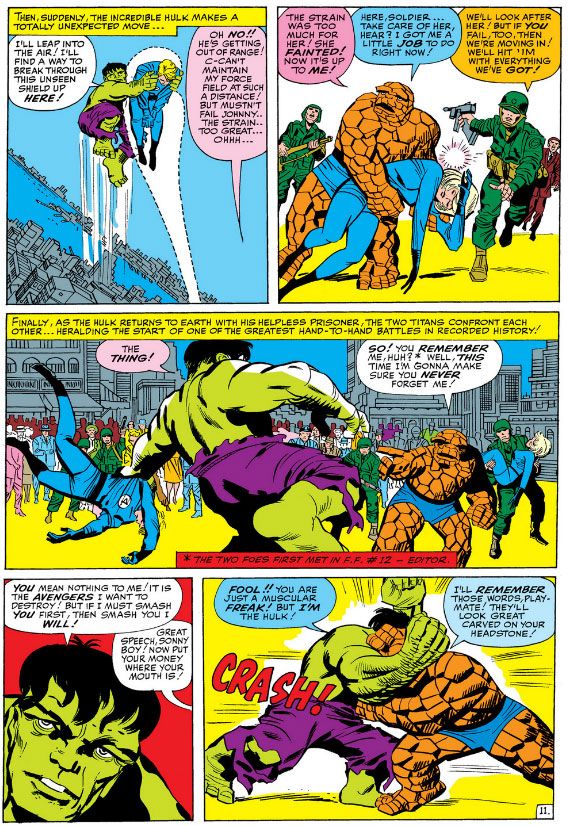
I can't blame the Avengers.  Who would you rather have on your team anyway-- a rational, intelligent strategist with acrobatic fighting skills and years of war-time experience, or an overly-sensitive rage-aholic with the strength to flatten entire cities?  No, you can't choose both.  Now imagine how well the Hulk takes your decision and you can see the problem this dilemma presents.  As if a vengeful Hulk weren't enough, the FF are fighting amongst themselves as well because the Thing refuses to drink Reed's newest cure for his condition-- which apparently was such a lab accident Reed doubts he can re-create it.  Shortly after that, Reed abruptly collapses into a coma and everyone is screwed.  The Hulk gives the remaining Fantastics a thorough thumping of the kind world champ Sonny Liston received from 22-year-old Muhammad Ali roughly a month before this issue hit the newsstands.  The Human Torch ends up in the hospital and Sue poops out when the Hulk's strength severely taxes her relatively-new invisible forcefield powers.  This leaves the Thing to fight alone, which he does for most of the issue until the Hulk finally grinds him down.

Never having been defeated outright before, the Thing spends a moment questioning his purpose in the world.  But he figures it out-- as a hero, his job is to take any beating necessary, even if he fails or dies as a result.  Once again, it's the Thing doing the world's dirty work, overmatched and underappreciated, a lone man against impossible odds and, unlike Liston, he decides to come out of his corner at the bell.

While poignantly scripted by Lee, this is Kirby storytelling, a moment where his contributions as a full-fledged writer-- not simply co-plotter and certainly not merely penciller-- breaks through most obviously.  You can't help but feel Kirby working autobiographically here, concerns of an intensely personal nature filtering through the fat line screens of the 1960s four-color printing process.  So characteristically Kirby is it, he'd return to it again and again-- most memorably in "The Death Wish of Terrible Turpin" from New Gods #8 (April 1972), but also as a running subtext to the entirety of his run on Kamandi the Last Boy on Earth.

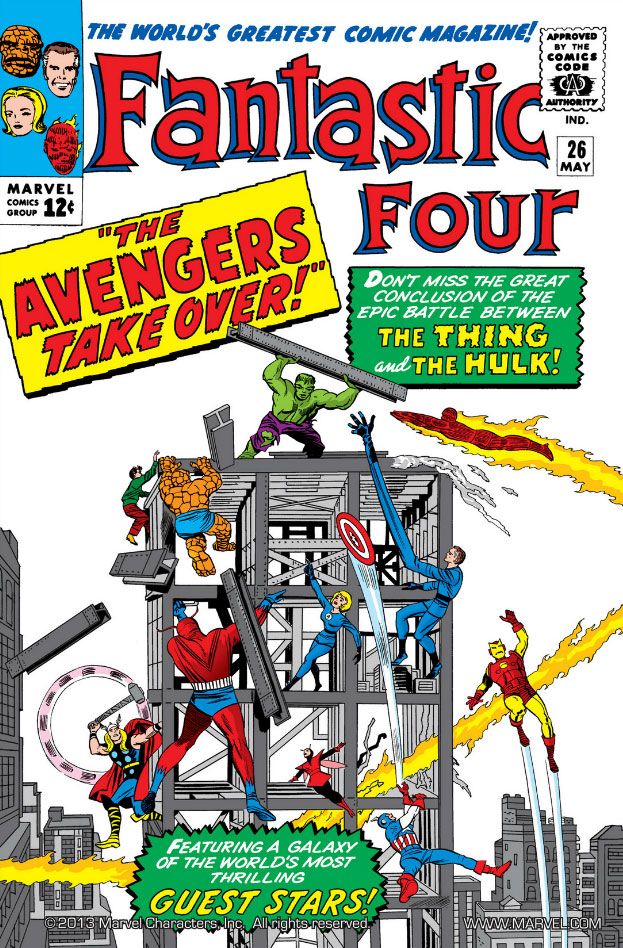
Together, Lee and Kirby develop this theme over the course of #26, where we see Richards attempting to come off his sickbed to help the Thing and the Human Torch flying back into the fray despite being decked out in asbestos bandages from the beating he took in the previous issue.  Captain America shows a lot of the heroic stuff Kirby-style as he uses judo he learned in the Army against the Hulk, even though he knows he's involved in a massive weight-class mismatch.  So Captain America proves himself as an Avenger, but it's the Thing's example that inspires him and provides the story's beating heart.

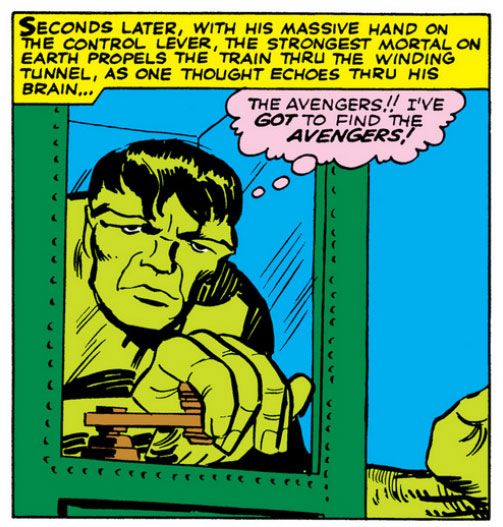
It's a fairly funny story as well, and I don't mean just inadvertently (for example, when the Hulk calls his weaker alter-ego "Bob" Banner for some reason-- we'll cut him some slack; he has a lot on his mind what with needing to file for unemployment and all that).  At one point the Thing threatens to use his powers of pathos against the Hulk.  My favorite sequence has the Hulk hijack a subway train and drive it to the Avengers' mansion.  Kirby treats us to a sweet shot of a mopey Hulk at the controls which  reminds me a lot of that Shaquille O'Neal commercial where he's too large for a sporty convertible.  I'm pretty sure Lee and Kirby got a huge kick out of tossing in this particular scene.

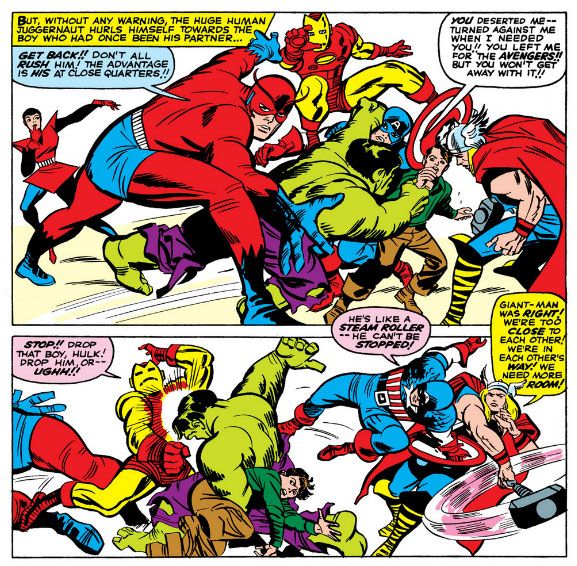
Speaking of the Avengers, they finally make the scene and flub their fight against the Hulk because there are just too many costumed clowns running around.  It gets worse when the fully recovered Fantastic Four pitch in, and then the two teams start a jurisdictional squabble.  Reed Richards suggest the Thing decide whether or not the two teams join forces since he's the one who's been doing most of the fighting and carrying the story on his rocky shoulders.

The Hulk and the Thing come together atop an under-construction building and trade blows.  Teenager Rick Jones pulls a Sue Storm and saves the day by tossing a gamma pill into the Hulk's mouth.  The Hulk falls into the river, but it's Bruce Banner its currents sweep away.

Two complete issues probably seemed overblown in 1964, but in our current era of drawn-out, marketing-driven storytelling I'm amazed how economically Lee and Kirby run through this plot.  Today's version would require an editor's meeting of a dozen or more thinkers to plan it (they'd spread it over an entire summer's or even a year's worth of titles priced at $2.99 or $3.99 each, interrupting whatever storylines the various writers have going), feature some supposedly-beloved secondary character like Rick Jones having his arms ripped off on-panel (the blog-o-sphere goes wild!) and climax in an over-sized special edition.  Entertainment Weekly would give it a B+ and declare it "the superhero epic of the season" while praising it for the repeated flashbacks to Bruce Banner's abusive childhood.  They'd also go nuts over the photo-realistic art, consisting mainly of pages of wide panels stacked broken by frequent full-body portraits of various involved characters, all of which would quickly show up in online auctions with hefty price-tags.


Lee and Kirby neatly pack it all into two standard-sized issues, minus any hint of gore but with plenty of action and characterization.  It also lacks today's trendy Joss Whedon-style dialogue where every character is a quip-making machine, but apologizes by having the Thing call Thor a "lantern-jawed, long-haired lummox."


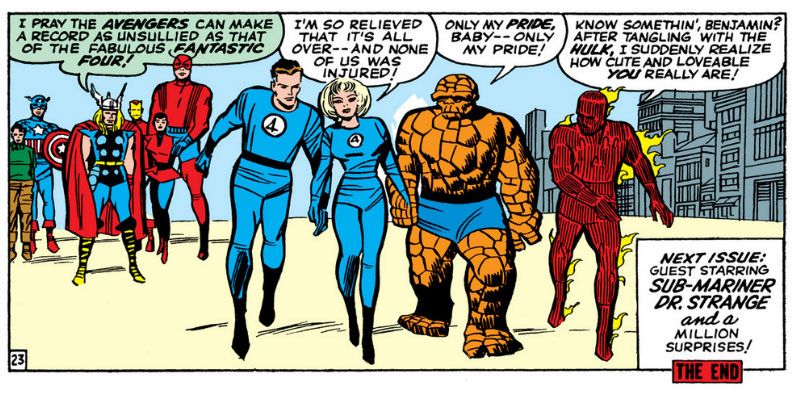
And yes, Sue, no one was injured.  Except the Thing and your brother, Johnny (twice!).  And probably Iron Man when the Hulk head-butted him right in the chest.

Wednesday, May 29, 2013

I own the first 30 issues of Fantastic Four...

Plus Annual #1 where Namor goes off on the human race and invades New York City with an army of blue dudes wearing fishbowls on their heads.  Not the print originals, of course.  How much is Fantastic Four #1 (November 1961) going for these days?  There's a graded example (CGC FN+ 6.5, white pages) online at Heritage Auctions with a recent offer of $18,500.  An 8.5 went for $52,000.  That's a little out of my price range, I'm afraid.  No, I own reprints.  Reprints, reprints, reprints.

I've had the Fantastic Four Essential collections for a long time, and I used to have the fat Fantastic Four Omnibus that was so heavy I couldn't rest it on my stomach while reading in bed or it would squeeze my dinner out of me as if I were a Play-Doh Fun Factory.  I gave that one away before I moved back the US following my first stint in Japan as an English teacher, otherwise I would have had to purchase a second seat ticket from Air Canada to take it with me.

Comixology is my current source for vintage comics.  Publishers have been putting out re-colored versions of various classics so long they have a nice back catalog of stuff they're adding to Comixology a little at a time.  They usually run you about 1.99 each, although sometimes you can find 99-cent sales or even freebies.  With the files available, there's no reason not to put the books online.  The hard work has been done, so overhead is minimal at this point.  Easy money for Marvel and DC.
I frequently find myself pondering the appeal of early Fantastic Four.  I'm not denying it exists; I love the Stan Lee-Jack Kirby era Fantastic Four, after all.  What is that appeal's substance, however?  That's what I think about, in search of a magic formula, I suppose.

When we look at Fantastic Four #1, we're looking at something fairly raw and even clumsy.  The plot mechanics barely stand up to close scrutiny.  Why in the hell would a top scientist take his girlfriend and her kid brother on an illegal rocket jaunt?  Even by the lax standards of comic book logic, that's pretty stupid stuff.  Kirby's art seems relatively timid, not at all the bold, bombast we've come to associate with the King, and it's poorly served by gloopy inks.

Perhaps we have to put it into context, stack it up against DC's contemporaneous efforts.  I know the talent were doing their level best to put out good product, and a lot of these guys and gals rank pretty high in my pantheon of greats.  Plus there was this little thing called the Comics Code.  The last time someone tried to do something truly interesting with comics, the government got involved and not to say, "Nice job you're doing entertaining the little chaps, Mr. Gaines!"

But despite a few stand-out stories and some awesome-- if a little mechanical and stiff at times-- art, the formula wears thin pretty fast.  DC comics of that era don't really seem to be about anything in particular.  Especially if it's an "Imaginary Story!"  Which might be more interesting than any of the so-called "real" stories because it dares embrace weirdness.  So if you ask me what issue was it where we saw Superman turn into a fat version of himself or when did he grow a long beard or turn into a gorilla or gain a whole new set of powers or whatever, I'm likely to answer, "All of them."  What does it really matter?

Now imagine you're a kid who's starting to feel a bit jaded by all of this and you see the cover of Fantastic Four #1 glaring out at you from the newsstand like a pugnacious new kid to your neighborhood.  A little loud-mouth with a dirty face.  It's rude, it's coarse, it's even a little ugly.  But you can't take your eyes off this newcomer.  You open it and the inside is more of the same. And look at that squashed orange guy ripping that tree out of the ground to hit his friend with it.  Immediately, you sense it's got something those tight-assed DC comics don't have.

Charisma.  That's it.  It's got charisma.  The plot isn't just some one-off that's essentially the same as last month's with the details changed.  You probably don't even question Reed Richards's poor decision-making process.  That might be due to the frantic pacing, but I like to think it's because Stan and Jack are going somewhere and taking us along with them.  It's not just a plot; it's an actual story.  It matters.  Or at least it does by comparison to its competition.

And it just got better and better until DC was forced to react and turn to new talent, style experiments and the like (I'd argue Marvel inspired DC to put out a lot of their cooler books, even if they didn't sell all that well).  By the time Doctor Doom shows up in Fantastic Four #5 (July 1962), things are really starting to cook.  From that point, issue-by-issue, you get to witness Kirby come into his own again, giving his career that huge push that made him the super-legend he is today and Lee develop the inimitable voice of Marvel, bizarrely made up of WWII-era slang and hyperbolic carnival barker come-ons.  It's captured there for constant rediscovery on Comixology, the same way recordings capture the exponential aesthetic growth of the Beatles from "Love Me Do" to "Carry That Weight."

My favorites, though, are the Fantastic Fours inked by Chic Stone.  They have the energy and slightly unformed quality of the earliest issues and a little bit of the structure of the later Joe Sinnott-inked issues, which leave me a tiny bit cold.  I like Sinnott's slickness, but his issues just don't have the energy of Stone's.  To carry the Beatles analogy a bit further, it's kind of the way I admire the heady pop craftsmanship of Abbey Road, but I end up listening to the peppier Help! and back-to-back self-topping albums Rubber Soul and Revolver more often.

Anyway, the first 30 Fantastic Fours are now available on Comixology and I own them.  I plan to keep buying these until they get just past the Galactus caper.  After that, a lot of the energy and charisma seeps out.  You get the idea Stan and Jack were looking elsewhere after that point.

Thursday, March 7, 2013

X-Men #12: Kirby and Toth, two great tastes that don't taste great together!


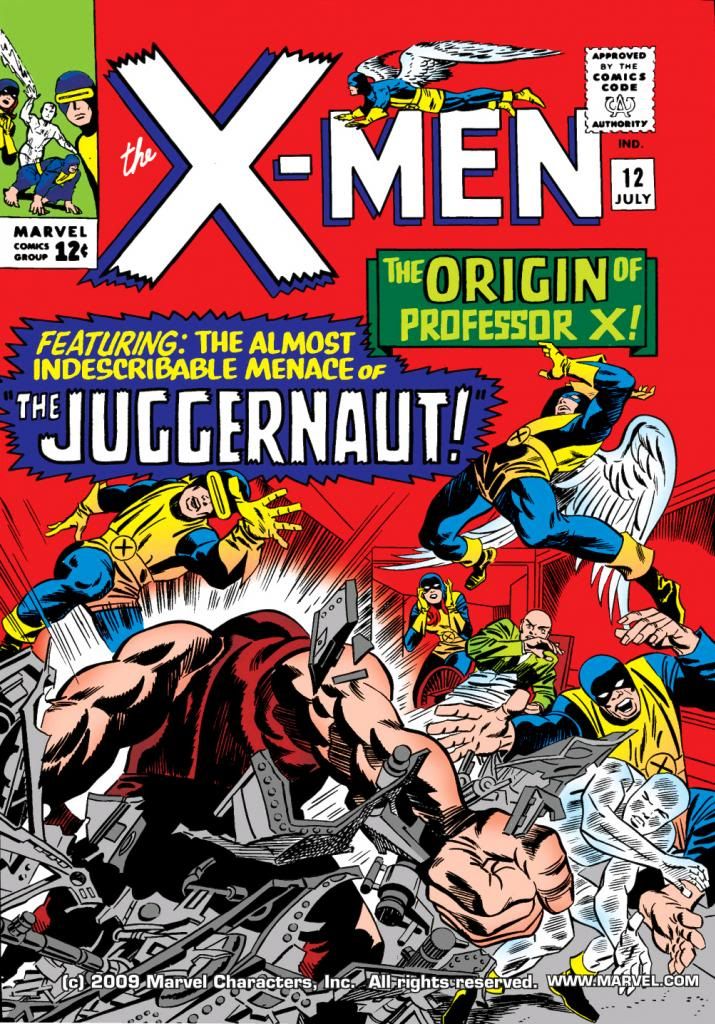
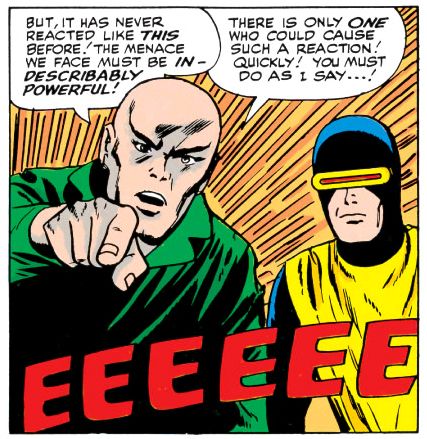
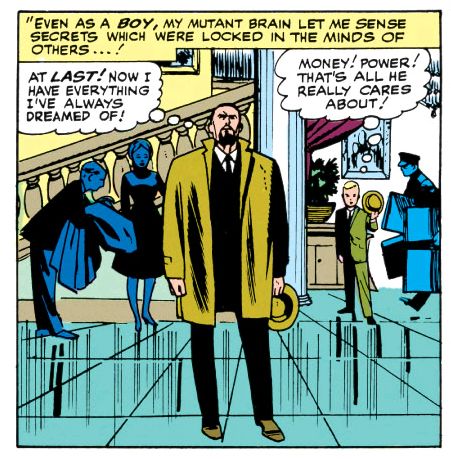
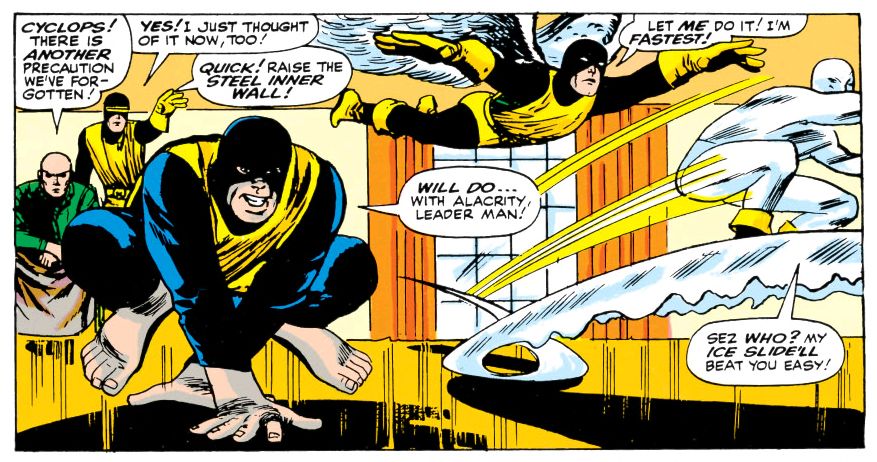
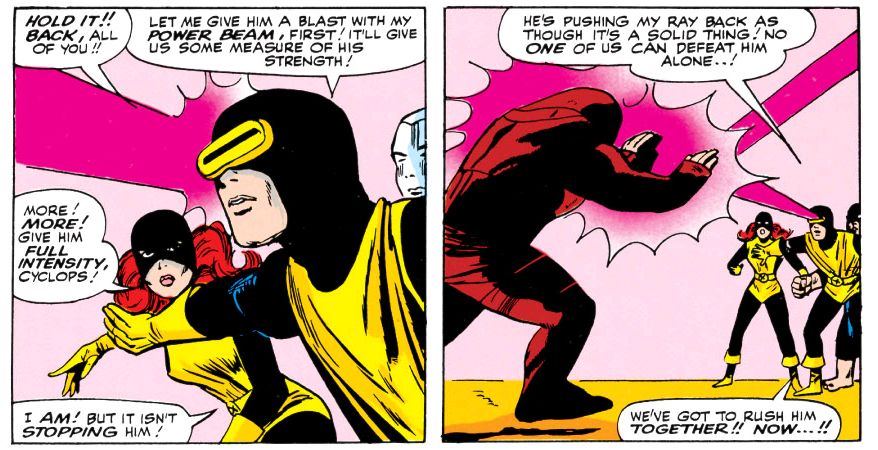
Jack Kirby and Alex Toth are tops of the pops as far as I’m concerned.  When I found out Alex Toth penciled X-Men #12 (July 1965), I had to track it down.  When I read he did this over Kirby layouts, I grew a little concerned.

You know, the two artists had almost diametrically opposed approaches to the page.  Toth practiced an elegant minimalism, with poses largely naturalistic.  Heavy black-spotting, cinematic.  Kirby drew in a more expressionistic way, his figures displaying emotions and actions at their most extreme.  Statue-like figures surrounded by crackling force fields and radiating forces, as if their struggles produce an energy that threatens to consume the paper they’re printed on.  

But then I thought, why not combine Toth and Kirby?  This kind of artistic dissonance can produce in collaboration an energy of its own, like unstable two radioactive molecules exchanging electrons and we get an artistic nuclear reaction producing a startling, never-before-thought-of beauty.  Or, in this case, X-Men #12, a comic book China syndrome.  A Three Mile Island in print.

Flash back to 1965.  Stan Lee, always on the hunt for artists (a number of DC regulars did Marvel jobs under assumed names back then), gave Alex Toth a call-- or mailed him a letter for all I know-- and offered him an issue of X-Men.  I'm no comic book historian, but I think Kirby was spread pretty thin at this point and dropping X-Men to concentrate on Marvel's better-selling titles.  But as to why Lee would offer this particular book to Toth in particular-- well, that's for people who know more about the inner workings at the House of Ideas.  Suffice it to say, Lee offered and Toth accepted.

So far, so good.  As so many other artists had to at Marvel, Toth went to work on pages previously laid out by Kirby, the creator of the Marvel house style.  Maybe this was meant to smooth the art transition for the readers.  Maybe Toth asked for this arrangement himself.  After all, he was used to working from full scripts, not from Stan Lee posing on his desk.  To make sure Toth's work became fully Marvel-ized, Lee then assigned inker Vince Colletta, a frequent Kirby collaborator, to...


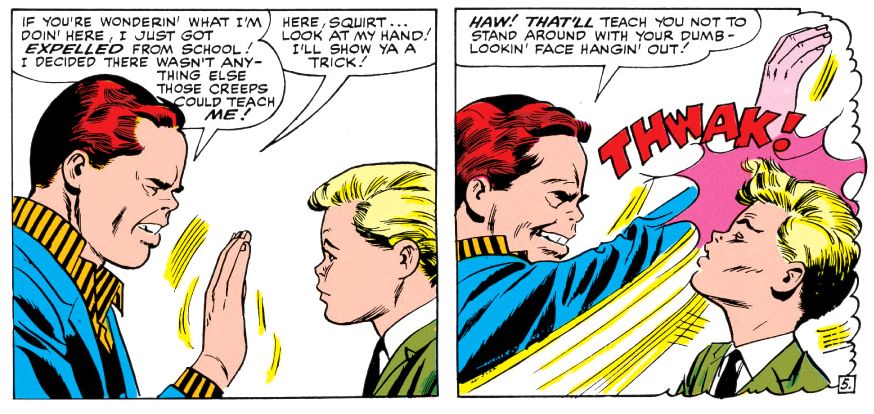
"Fix" isn't quite the word for what Colletta did.  While Colletta certainly has his shortcomings-- a cursory Google search will come up with ample listings of them, especially in conjunction with his inks on Kirby-- nowhere are they more on display than in this ham-fisted job on top of Toth pencils.  Gone are the smooth, graceful lines of Toth and instead, we find crinkly, crabby scrawlings, wonky faces and malformed hands galore, plus trange interpretations of light and shadow that show Colletta wasn't quite sure of what Toth was getting at.  Toth was known for drawing handsome men and beautiful women.  Kirby drew them as powerhouses seemingly carved from stone or molded from steel.  The mutants on display in this book are the kind you find preserved in alcohol in dark closets in abandoned madhouses.


Joe Sinnott might have salvaged this job with his slick line, confident black-spotting and willingness actually to draw with ink and fix proportions, but it's pretty obvious Colletta just isn't up to the task.  Check this out:


Lumpy Rutherford-- NOOOO!!!  This looks like the worst comic book adaptation of a secret Leave it to Beaver episode ever.  That red-haired jerk is Cain Marko, Charles Xavier's step-brother.  They don't get along, as you can see.  While Cain has a pert Toth-style nose, his hand looks like someone shoved sausages into a latex glove.  That's neither a Toth hand nor a Kirby hand-- it's a hand no one bothered to finish drawing.

In Colletta's defense, I really doubt Toth gave him all that much to work with.  They'd team together again at DC on Hot Wheels with much better results-- although Toth might dispute that if he were still around.  The difference there might have been Toth being more engaged with the material than he is here and unencumbered by another artist's layouts.

Anyway, a few panels in this book look very Tothian, as if he took his time to really shape the image, but for whatever reason, throughout most of this book Toth appears to have largely traced Kirby's figures without adapting them to his own naturalistic proportions and scale.  While he uses a lot of those parallel ray bursts that make the characters look as though they're exploding with strange energy-- but never seems to have reconciled the Kirby approach to these kind of abstracted effects with his own minimalism and Colletta spent about two seconds puzzling them out before slapping down the ink.  There's also a chance Toth might not have drawn any of these effects and Lee, dissatisfied with too much negative space in the panels, either added those lines himself or had someone in the art department do it.

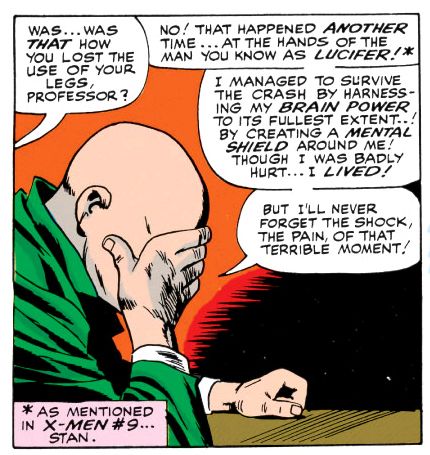
Here's another unfinished hand:


Another problem is the color reconstruction is lousy.  This comic was never meant to be printed on slick, glossy paper with modern line-screens.  Despite a growing serious fandom and popularity on college campuses and with the heads, comics in the mid-60s were still disposable rags printed on the cheapest paper.  Lee, Kirby, Toth and Colletta all knew this.  This didn't necessarily mean they hacked it out without a care, although X-Men #12 seems to stink of that.  It just means they were under no illusions of creating something of lasting impact.  They weren't dreaming history here or anticipating bloggers deconstructing every aspect of every panel on one page out of the hundreds they touched that month.  They were working to support families or pay alimony and they knew, as professionals, how to get the most out of the shoddy materials they had to work with in the time allotted-- they didn't have the luxury of blowing deadlines like superstar artists of today do-- so the end result, there on the newsstand, would be attractive enough to tempt readers into spending their twelve cents.

People didn't preserve the original artwork-- they had paste-up jobs done on them with glue that soon yellowed or browned, people used old pages to clean brushes or tossed them in files and later shredded them when the company needed more space.  I've seen some pages from this job for sale online, but I doubt Marvel spent the money necessary for full access to them in order to start from scratch.  What's more likely is they scanned decent printed copies, then used Photoshop to eliminate as much of the colors and old-timey fat line-screens-- a process which also takes away the edges of the black areas and a lot of the fine line work.  And, in the case of Colletta, serving to make an already sketchy line quality even sketchier.  Re-colored then printed slickly, or blown up on Comixology (which is where I read this), all the original flaws become glaring and a lot of new ones show up as well.

In this case, there are pages where Cain Marko's face appears a bizarre pink as if he's suffering from extreme embarrassment or some kind of disfiguring rash.  Poor guy. No wonder he went mad with power when he found the Cyttorak Ruby.


What I don't understand is why Toth took this job in the first place.  If Lee wasn't shy about expressing his artistic opinions, Toth was the original let 'em have it guy.  He must have looked at these layouts and thought, "Oh balls!"  Plus, Xavier's backstory is cliched and melodramatic (although these guys make a pretty good case for it even while pointing out Stan Lee's apparent difficulty with psychic terminology).  It's rather talky for a book so packed with characters, too.  And, as part one of two, it's all build-up and no climax.

Toth liked to draw airplanes and cars and he was aces on period pieces.  Portions of this story take place in flashback, but there's nothing setting it in any particular era visually, and just one sequence featuring a car that looks pretty contemporary to me, a mid-60s model in a scene that takes place sometime in the 1940s.  Toth preferred classic Errol Flynn-style swashbuckling heroism, but there's not a single sword-fight anywhere in this story.

My best guess is the Warren and DC jobs weren't coming frequently enough and publishers like Dell didn't pay high enough a page rate, so he gave Marvel a shot in hopes of picking up some much-needed money.   I don't know.  Who can fathom genius, especially one as mercurial as Alex Toth?

He must have had his reasons because here's Toth working over Kirby layouts.  It's not as if Toth never drew superheroes-- we have a classic Flash and Atom team-up from the year before which cuts X-Men #12 to shreds, a run on Black Canary and an often-reprinted Batman story, plus some other gems scattered throughout his bibiography.  This should have been one of those.


Anyway, if the lack of any other Toth Marvel work is any indication, Stan Lee wasn't too pleased with the outcome of his little science experiment.  Werner Roth would pencil part two, similarly working over Kirby lay-outs with happier results, as "Jay Gavin" before becoming the regular penciller under his own name.  Toth would go on to do sterling work in Warren's Blazing Combat, and for DC's horror and war titles in the 70s, but never again would he draw Marvel's heroes for comic books.  For TV, yeah.  A couple of years later, he did designs for Hanna-Barbera's Fantastic Four cartoon.  But we never got to see Toth's take on The Avengers or Doctor Strange.  I, for one, would have loved to have read a Toth Amazing Spider-Man or Daredevil.  I can't help but think if Lee had just trusted Toth to do his thing-- the way he seems to have let Gene Colan-- and come up with a plot playing to his strengths rather than trying to merge him with Kirby, we might have had a stand-out issue, an oddity nonetheless, but something really special.  Maybe it wouldn't have sold, though.  Whatever else you can say about Lee, the man knew how to move books.

Now if someone can explain to me why Cyclops's famous ruby-red eye beam is magenta.

Sunday, February 17, 2013

Jack Kirby satirizes Stan Lee!

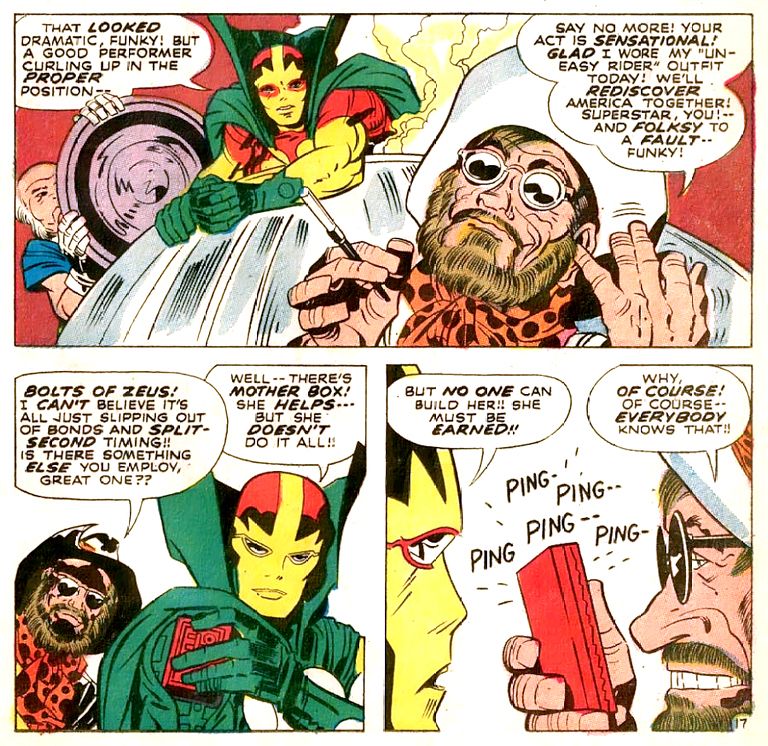
Words and pencils by Jack Kirby, inks by Mike Royer (Mister Miracle #6, Jan.-Feb. 1972)

I'm a little upset about this.  It's not even as if this is some obscure bit of comics history.  Way back in 1972, in Mister Miracle #6 (January of that year, to be exact), Jack Kirby vented some of his post-Marvel frustration by lampooning his former creative partner Stan Lee in the story "Funky Flashman."   "Funky Flashman" came out in a mainstream book from DC, not in some indie book or underground title and Jack's target was pretty obvious, hardly obscured by his funky pseudonym.  Plus I'm pretty sure The Jack Kirby Monthly from TwoMorrows covered the whole thing extensively in that hyper-geeky way that makes me love that magazine so (talk about your narrow focus!).  So when Brian Cronin at Comics Should Be Good on the Comic Book Resources website dragged out "Funky Flashman" one more time last week, why did it upset me?

Because I've been thinking about writing something about good ol' Funky for years and years and years.  Okay, years.  Months, maybe.  So while Funky isn't a hidden bit of lore-- his misadventures are readily available in the still-in-print Jack Kirby's Fourth World Omnibus Volume Two and you really should own a copy for yourself-- I wanted to spout off about him as if I'd uncovered him after some laborious detective work.  So I'm going to, even if my take is half-formed.

I've always loved the story "Funky Flashman."  It's vitriolic and even unfair-- I mean, taking a shot at poor Roy Thomas, depicted by Kirby as Houseroy, a diminutive lackey forever fawning over a Flashman who will feed him to his enemies before making good his own escape, seems a low blow no matter what your grievances against his boss-- but it's energetic and by some imp of the perverse, every bit as charismatic as his real-world inspiration.

Flashman is indomitable and in that way, if not admirable, he's at least a little likable.  Definitely a compelling figure.  A scene-stealer.  Flashman dominates every panel in which he appears, even alongside Big Barda as she plays with a revolver.  But maybe that's just me.  I have a strange attraction to these kinds of characters, shifty grifters with positive, can-do attitudes.  The Milo Minderbinders of the literary world.  They're quintessentially American types, aren't they?  These Jay Gatsbys, forever recreating themselves in whatever image will win them Daisy Buchanan or money or acclaim.  A Horatio Alger tale, but instead of some dopey kid who earns a reward for being so honest and stalwart, we get a complete bastard who pulls himself up while pulling others down.  And always with a smile on his face and a neat turn of phrase.

There's something to be said for someone who never gives up, who takes a beating-- even if they allow others to get it worse than themselves-- and dusts himself off before strutting on over to his next con-job.  Flashman is obviously a sociopath, but he's also never-say-die, endlessly up-beat, a bold figure we have to grudgingly admire for his knack for survival.  If nothing else, Flashman is fun to read about.  Guys like that can even be fun to know in real life, provide you don't go into business with them.

Flashman is a vicious caricature of Stan Lee.  He even looks like Lee.  Obviously, Stan the Man deeply hurt Jack Kirby at one point, whether deliberately or by accident.  Kirby's response may be passive-aggressive, but it's also entertaining.  The man was a storyteller.  And no one said caricatures have to be nice.  The best rarely are.  Yet Flashman is more than that, too.  Because Kirby-- at least in his prime and at his most involved, as he was with the Fourth World books at this point-- couldn't produce a one-dimensional character if he tried, Flashman's got his inspiration's wit as well.  Kirby wisely left it up to the readers to decide if Flashman is a villain or a hero.  He's probably a bit of both.  Always a survivor.

As Flashman tells himself in the final panel, "On to new conquests, Funky Flashman, you winner you!!!"

Friday, February 15, 2013

Fantastic Four #1: Reed Richards, you maniac!


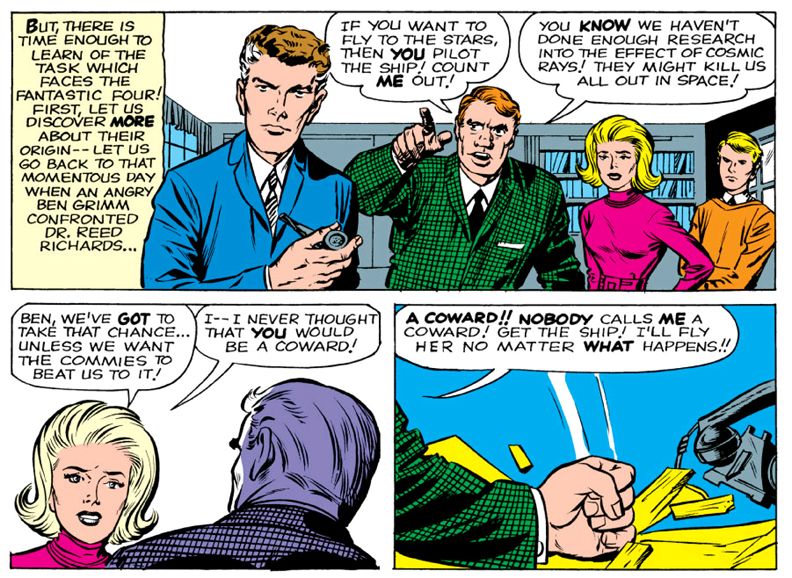
I'm guessing Reed Richards has at least one doctorate.  Probably several.  He's a genius, highly though of by the United States government.  But for some reason this miracle mind, this all-American Einstein, this pipe-smoking prodigy, decided to take his girlfriend and her kid brother on a rocket joy-ride.  That alone would be enough for the Fed to revoke all his security clearances and toss him in a metal box six by eight feet, surrounded by concrete and stone.  While his real-life brainiac counterparts at NASA occasionally evinced "go-fever" and a kind of engineer-mind tunnel vision that led to disasters and deaths, it's hard to reconcile Richards's genius with the kind of recklessness involved in subjecting himself and his loved ones to cosmic rays and crashing America's most advanced spacecraft.

Think about it one more time.  Reed Richards took his civilian girlfriend and a teenager with him on an unauthorized flight of an experimental rocket, even after the more cautious (but not cautious enough) test pilot Benjamin Grimm warned him the ship wasn't adequately shielded against radiation.  And that was the least of the reasons why this was a terrible idea.  This isn't "we've gotta beat those Reds into space" derring-do.  This is "wearing diapers and driving across the country to shoot someone" multi-layered criminal insanity.

What was he thinking?  Certainly, the lack of shielding represents a calculated risk for Richards and Grimm in their attempt to give the U.S. a Space Race victory.  But to involve outsiders, one of whom Richards is involved in a romantic relationship with, gives one pause.  J. Robert Oppenheimer (perhaps an inspiration for Richards) similarly allowed his personal life to intrude on his national security obligations.  But while Oppenheimer married a former member of the Communist Party and carried on a secret affair with someone who wrote for the Western Worker, a Communist newspaper, he didn't strap either of them to the atomic bomb at Trinity.  But his involvement with radical causes led the government to revoke his security clearances in the early 1950s.  Richards's deed is arguably worse and he doesn't receive so much as a slap on the wrist.

Reckless endangerment.  The failure of this flight could have set the United States back decades in the exploration of space.  The 1967 Apollo 1 fire, for example, caused a twenty-month delay at a crucial time during our moon landing program.  The loss of space shuttles Challenger and Columbia both halted American space flights.  After the 1986 Challenger explosion, NASA grounded their shuttles for three years.  After the 2003 Columbia re-entry disaster, crewed spaceflight via shuttle didn't resume for more than two.  Imagine, then, the catastrophic results of Richards's rash, idiotic act.

The man should be under the jail.  Well, actually, he shouldn't have even survived the crash.  But the bulk of Fantastic Four #1 (November 1961) post-accident should have consisted of Reed Richards on trial as the traitor of the decade. Julius and Ethel Rosenberg?  Bah!  Pikers!  The Cambridge Five?  Rank amateurs by comparison.  Richards's alma mater should have demanded he return his degrees, Grimm and Sue Storm should have been jailed as accomplices (the government could have granted them immunity or at least reduced sentences in return for testimony, however).  A life sentence for ex-Dr. Richards.

Instead, Richards is one lucky devil.  He gets rewarded with neat powers (unlike Grimm, who turns into an embittered monstrosity), Sue thinks nothing of the risks he put her and brother Johnny through and everything is just peachy.

Saturday, February 9, 2013

Fantastic Four #51: Someone left the Thing out in the rain

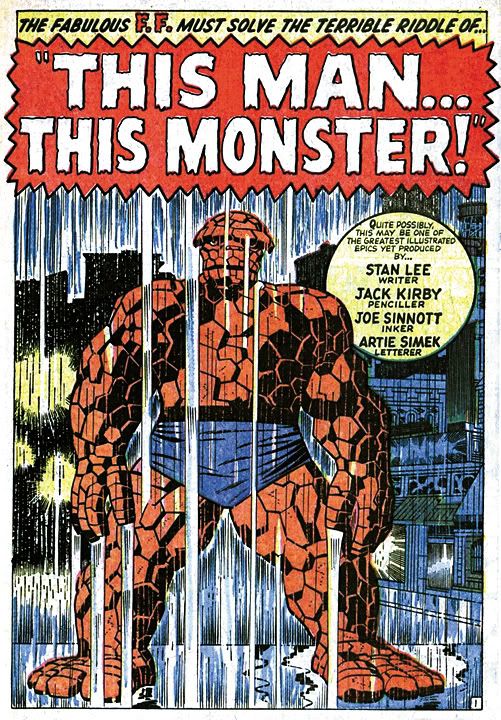
Splash page from Fantastic Four #51 (June 1966). One of Marvel's greatest single issues. The Fantastic Four had just faced off against the god-like Galactus and handed him his magenta-and-purple ass. While his teammates and the rest of the world celebrate, Ben "The Thing" Grimm turns his gaze inward.

Feeling sorry for himself, he doesn't even bother to change out of his superhero swimsuit or stop for a sandwich before heading out into the rain to walk around, converse sullenly with well-meaning cops, then accept coffee from a weird bald guy with a prominent brow ridge.

The bald guy is pissed at Ben's buddy Reed Richards. Fortunately for him, the Thing exists. Because without the Thing and their convenient skeletal similarity, his transformation into the Thing's exact duplicate would prove impossible! Ironically, there's one man in the world who actually wants to be the Thing, while the real Thing would do anything- short of suicide- to escape that identity.

Anonymous Bald Freak goes to the Baxter Building where his enemy Richards is planning to invade the Negative Zone tethered to a simple nylon rope he bought at the Yancy Street Hardware Store, and wearing only a goldfish bowl for protection. Things end badly but not before Anonymous Bald Freak learns that all Things (even faux-Things) have an innate quality of heroism and self-sacrifice.

Interestingly, in a story about the Thing's wrestling with his own identity, we never learn the bald guy's name or exactly why he resents Reed Richards enough to want him dead. Even Richards himself hasn't a clue to who this guy is or what he might've done to piss him off. By the time the Thing is back his old rocky self, he's not really able to shed any light on the guy's story, either.  Lessons learned? Ben Grimm's niceness rubs off even on jerks, and Reed Richards has a history of alienating people and making enemies.

Also, Stan Lee's dialogue perfectly balances the mundane and the sci-fi exotic. And Kirby's pencils follow suit. However, this is one of those issues-- despite what the credit blurb claims-- where Kirby did much more writing than Lee. It's full of Kirby-esque moments and moods that would become more familiar to the fans when he started garnering writing credits for himself.

Monday, August 6, 2012

Reed Richards, what the hell is wrong with you?


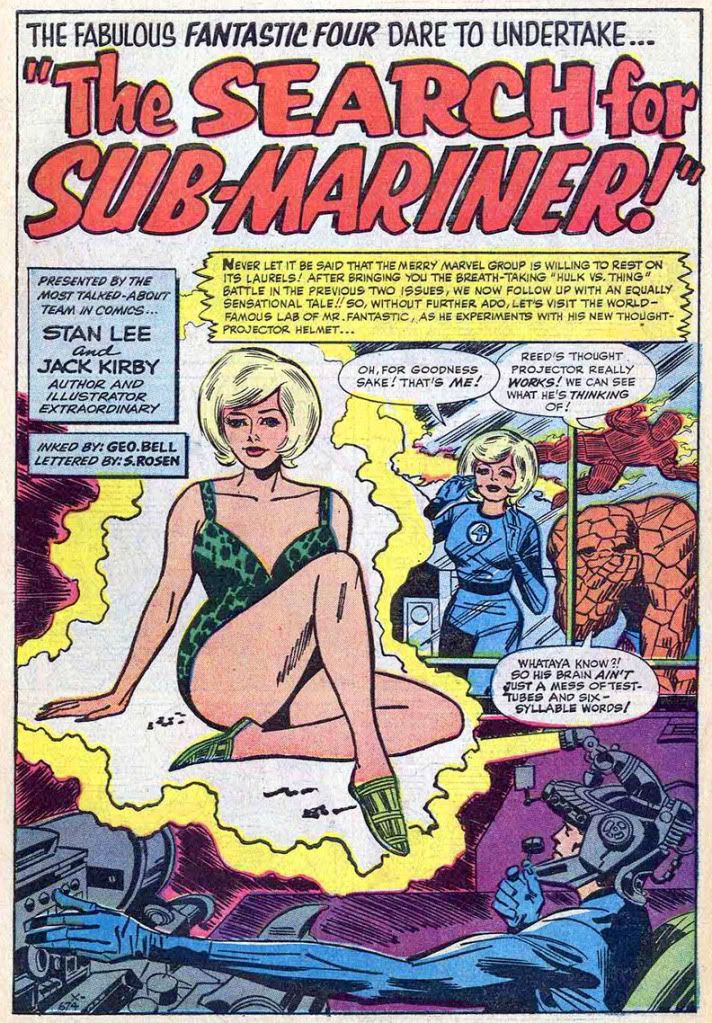
He's a red-blooded heterosexual male, that's what, you filthy degenerate atheistic Commie pinko red!  Just when you're convinced Reed Richards is nothing but an unfeeling computer on legs, thinking of nothing but the square root of the Einstein Theory and the co-efficient of the hypotenuse, it turns out at heart he's all man, right?  That's one interpretation, certainly valid.

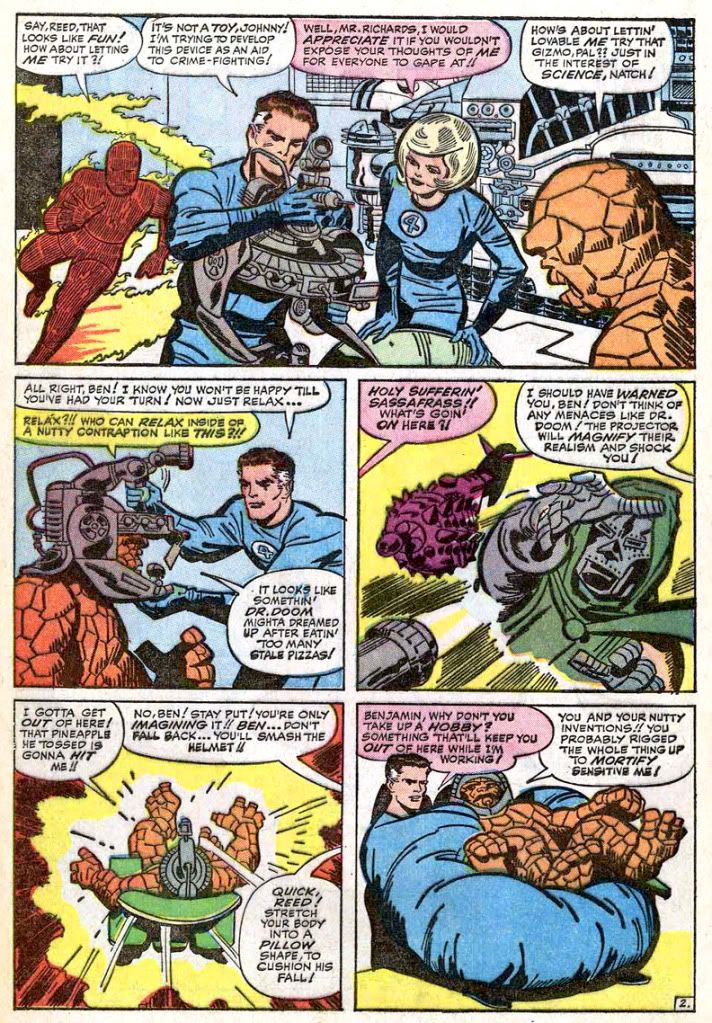
However, look again, please.  What we're seeing is the comic book embodiment of that peculiarly American cognitive dissonance where we're obsessed with sex and tumescence-inducing imagery, yet puritanical and filled with shame and anxiety over it.  Indeed, proving himself quintessentially American in this regard, Richards uses this fabulous device to manifest his girlfriend Sue Storm as a sex object, but-- ambivalent due to his lifetime's conditioning in the laboratory of Protestantism-- cannot fully unleash his id and therefore timidly clothes her fantasy image in a very modest (also hideous) green one-piece swimsuit.  And what appear to be matching metal slippers.  What a contradictory imago his classically suppressed libido draws forth!  How fearful he is of the sexual woman, a woman's sexuality, even one he makes up in his mind!

Still, within the rigors of the Comic Code, what this splash page to Fantastic Four #27 (June, 1964) proves is Stan Lee and Jack Kirby were wise enough even in those pre-Internet days to understand there is virtually no new technology that can't be used for pornography, even by squares like Richards.  Prescient in a way.  Pure pop genius.  I'm reminded of this each time I check Google search terms that bring up When Comic Books Ruled the Earth and the leading one for the day is either of the phrases "Batgirl boobs" or "Cassandra Cain nude."

While Sue quite justifiably protests* even this fairly mild invasion of her privacy-- shades of the various "leaked" nude scandals that currently play out almost weekly online--  the boys aren't ready to put away their new toy.  Let's hook Ben Grimm up the machine and see what happens--


Oh, that poor guy!  

Note how Richards wisely refuses the hormonally-addled teen Johnny Storm (his powers incongruously activated despite the ostensibly safe domestic environment, heat amd burning both signifiers not only of arousal but of danger-- caution, don't touch, hot!) access to his incredible sex fantasy image-maker-- no doubt aware of the pimply carnal imagery that would result, and, once seen, never be un-seen-- and sticks the device on Ben's head only to have his friend conjure up a hallucinatory menace that threatens to destroy the new invention itself.  Ben, his powerful rocky form a monstrous mockery of American manhood-- as a former USAF test pilot, astronaut and college athlete perhaps a satirical comment on America's chest-thumpingly uber-masculine patriotism and over-weening pride in our Cold War martial prowess as a sublimation of our more prurient urges similarly suggested by Stanley Kubrick's dark comedy masterpiece Dr. Strangelove-- can't even summon as Richards did the mildly suggestive form of his own lover in a swimsuit.  Instead, his thoughts turn immediately to threat and violence.  Only by forming a symbolic bed for his friend to collapse onto can Richards prevent disaster, the loss of his prototype.

The type of bed symbolized depends on our reading of the Thing's pose.  Is it infantile, as if he's a baby waiting for his diapers to be changed?  In this case, Richards provides a comforting crib.  Or, continuing our linkage of this sequence to the underlying sexual repression/phobias/concerns of the American male psyche, is he spreading his legs for penetration, for intercourse, in which case Richards is providing him with a marital bed, in parody or gender inversion of a wedding night ritual?  Does this mean the imaginary "pineapple" Dr. Doom-- himself a stern father-figure which further suggests something deeply Oedipal-- throws at the Thing is phallic, or is it vaginal?

What is it the Thing truly fears, which only the embrace of his friend can relieve?  What is it the men of the United States feared most in 1964 (the year of the long-haired Beatles and the dawn of the Sexual Revolution) and possibly to this day, as evidenced by certain anti-feminist screeds so full of castration/feminization anxiety they tell more about their authors' psyches than they do the supposed goals of the movement they purport to criticize?  And doesn't he look silly with that damned thing on his head?

*Remember when Marvel used to pretend the FF were real and Stan and Jack were just transcribing their adventures?  As violated as Sue feels by Reed in this story, imagine how a real woman would feel knowing Marvel sometimes has her illustrated by an artist who literally traces pornography, frequently causing her not to look energetic or adventuresome but blatantly orgasmic.