Showing posts with label Joe Sinnott. Show all posts

Friday, January 24, 2014

Kirby's Kustoms! A selection of Jack Kirby's creative conveyances...

Jack Kirby created so many wonderful characters in his long career, but he also came up with all sorts of wild contraptions to get those characters to and from their adventures.  Your typical Kirby vehicle is somewhat outlandish, certainly futuristic, but also surprisingly plausible at a glance, as if he generated detailed plans before inserting them into his stories.  You're likely to find jet fans, air intakes and plexiglass cockpits along with all kinds of valves and pipes.  A Kirby vehicle is as instantly recognizable as one of his muscular, almost steel-like heroes.

Let's start with a one of his first from the fabled Fantastic Four comic.  Whatever happened to that?  Are they still publishing it?  Anyway, here we go--
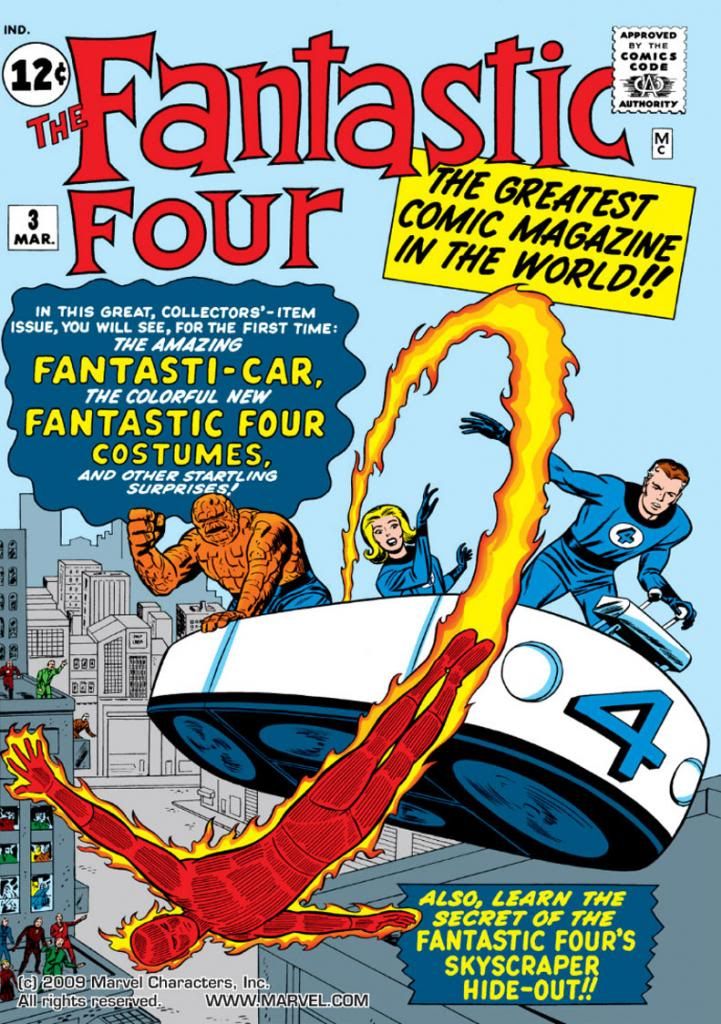
Fantastic Four #3 (March 1962), inks by Dick Ayers

The Fantasti-Car!  The Fantasti-Car debuts in Fantastic Four #3 (March 1962), which also saw the adventuresome quartet donning their blue costumes for the first time.  Like those plain but functional-appearing duds, the Fantasti-Car is a simple design, just a tub with headlights for safety and what appear to be four fans underneath for generating lift.  I'm not sure how Reed Richards controls pitch and yaw or generates forward thrust in this version of the Fantasti-Car, but I'm sure Kirby could have explained it if I'd been around in 1962 to ask him.  Unfortunately, this isn't the most visually impressive design, and I'm guessing Kirby must have been a little dissatisfied with it, because about a year later, the Fantastic Four upgrade to a hotter version.
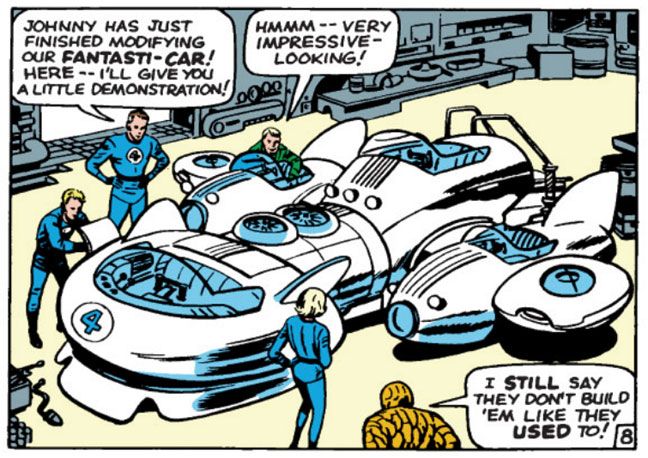
Fantastic Four #12 (March 1963), words by Stan Lee, inks by Dick Ayers

Yeah!  That's more like it!  The Fantasti-Car, Mark II made its debut in Fantastic Four #12 (March 1963).  This one has aerodynamic styling and possibly a much greater range.  Ignore Ben Grimm's little griping remark.  Some people just aren't pleased with anything.  The Fantastic Four use this Fantasti-Car to travel cross-country and take on the Hulk.  But what about ocean-hopping, when the team needs to cross hemispheres, date lines and other such geographic demarcations?

That's where this baby comes in--
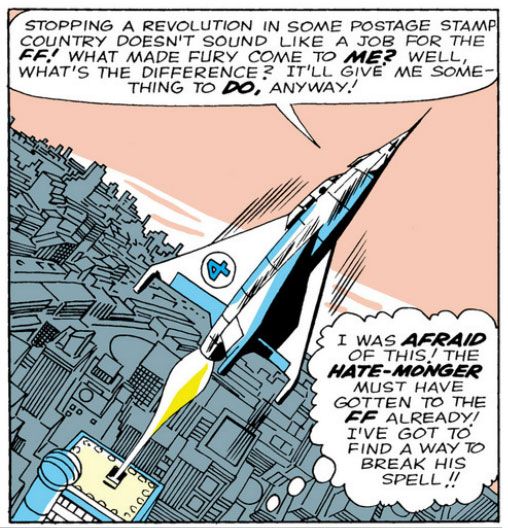
Fantastic Four #21 (December 1963),  words by Lee, inks by George Roussos

The Pogo Plane.  The Pogo Plane previously appeared in issue #3, but it really gets to strut its strato-stuff here as the FF prepare to face the Hate-Monger in Fantastic Four #21 (December 1963).  Kirby gives this aircraft a state-of-the-art appearance (at least for the 1960s), like something the USAF or NASA might have been toying around with in the early days of space exploration.  The X-51 or  the Lifting Body.  Man In Space Soonest.  The Flying Flapjack.  The Apollo Applications Program.  Somebody stop me or I'll go on forever.  I love aviation history!

This could be a wild, right-off-the-drawing-board design lifted from a Popular Mechanics article of the time.  It's got huge stabilizing fins and even flaps.  Plus it's a tail-landing VTOL aircraft.  That's "vertical take-off and landing," to you and me, Russ.  I'm no aeronautical engineer, but Reed Richards has that skill set among his many, and you can imagine he saw this one through from the initial design phase to wind-tunnel testing with a scale model to prototype production to flight test with none other than Ben Grimm at the controls.

Now that we're on the topic of his piloting skills, here's a little Ben Grimm-related aside-- Ben generally plays the fool with his gruff street-style patois, but he's actually vastly intelligent himself, the kind of guy who would have made the Mercury Seven if he'd actually existed.  Ben was a highly-regarded test pilot with a fighter background before he became a superheroic freak, which means he's got quite the expertise in engineering.  Tom Wolfe in his book The Right Stuff describes how Ben's closest real-world analog Chuck Yeager (no mean engineer himself) influenced not only aviation history but also how pilots of the era spoke-- I don't know if it's true or not, but Wolfe makes a hilarious and compelling case for airline pilots of the time doing their cockpit announcements in pseudo-West Virginia drawls in imitation of the man at flying's apex.  I can imagine in the Marvel world the same thing happening, only with pilots shouting, "It's clobberin' time!" when pushing the outside of that o' envelope, or making reference to their Aunt Petunias in put-on Brooklyn accents. 

If not for that fateful rocket flight...

Coming up next is a stripped-down sport model--
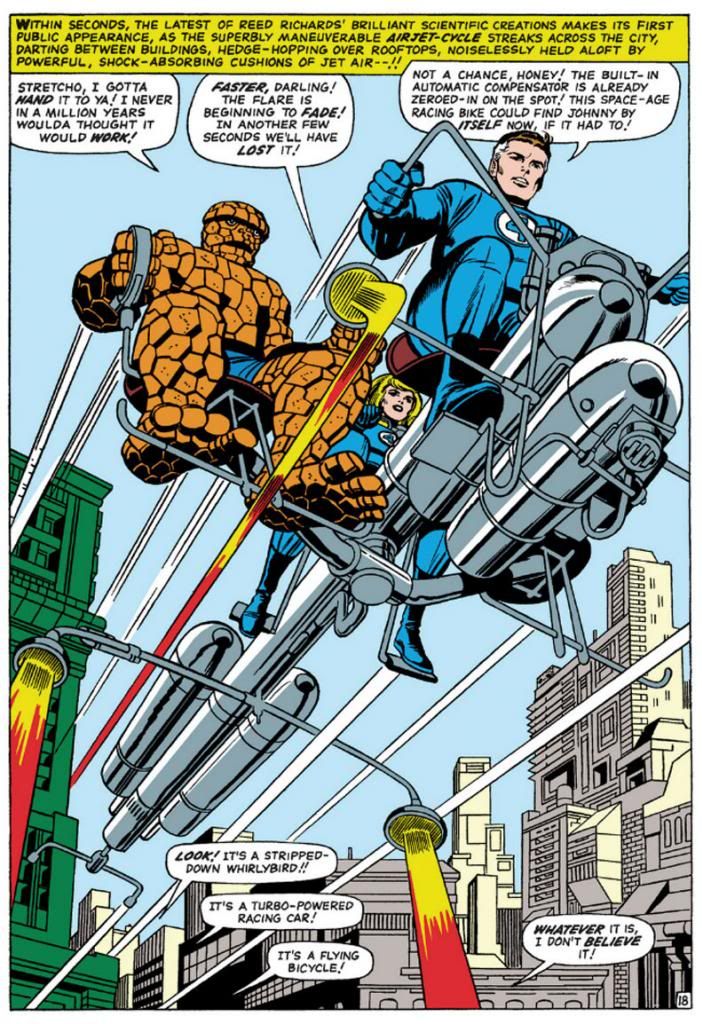
Fantastic Four #45 (December 1965),  words by Lee, inks by Joe Sinnott

The Airjet-Cycle.  This one has neat nozzles and tanks, but it's mostly just pipes and doesn't really look capable of lifting Reed alone, much less Ben and Sue as well.  Not the most practical of earthly designs, although it looks like something NASA might have considered for lunar mobility.  Leaves the passengers kind of exposed and vulnerable, too-- I love the look of sheer embarrassment on the Thing's ever-lovin', blue-eyed face as he holds on for his very life.   The Airjet-Cycle probably comes in handy for jetting to the supermarket, or getting little Franklin to school when he misses the bus.  Not as spectacular as either the Fantasti-Car or the Pogo Plane, the Airjet-Cycle nevertheless makes further appearances in Fantastic Four #46 (January 1966), #48 (March 1966) and #57 (December 1966), to name three.  The Avengers also use a version.  You can look it up.  I did!

And now--
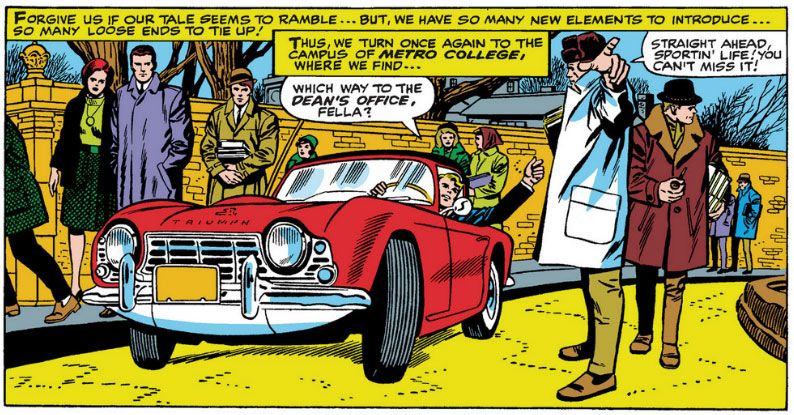
Fantastic Four #50 (May 1966), words by Lee, inks by Sinnott

Oops!  A ringer!  Don't ever think Jack Kirby couldn't bring things down to earth (relatively speaking-- Johnny's got one unearthly ride there) and draw realistic cars.  This one reminds me of the classic 1967 film The Graduate, directed by Mike Nichols.  Dustin Hoffman actually drives a 1966 Alfa Romeo Spider 1600 "Duetto" in that movie, but Johnny Storm here has a 1966 Triumph GT6.  Yeah, a Spitfire might have been more appropriate for the Human Torch, but Triumph introduced the GT6 the year Marvel published Fantastic Four #50 (May 1966), so leave it to Johnny to pick up the latest thing in sports cars.  Maybe he's auditioning for a part in The Undergraduate.

Let's leave behind the fast and the furious for the slow and reliable--
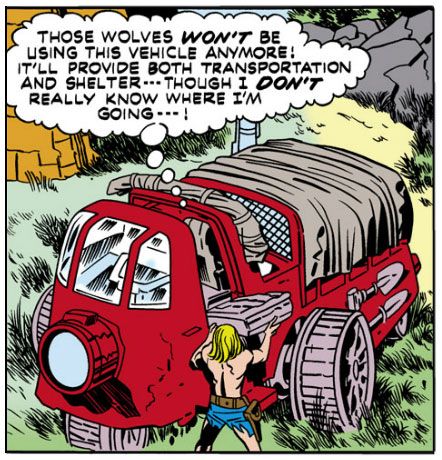
Kamandi #1 (November 1972), words by Jack Kirby, inks by Mike Royer

We're also ditching one comic company for another.  Just as Kirby and family left New York for California and Marvel for DC, in the first issue of his eponymous book (November 1972), Kamandi leaves his bunker home in this utilitarian military contraption with a very interesting outboard wheel arrangement.  They're heavy duty wheels, too.  Probably made of some kind of metal or composite alloy for years of wear.  Shovels clamped to the side, weatherproof tarp over the back.  This is a very appropriate get-about for Kamandi, and just the kind of thing you'd expect to find at a former military outpost.

Even after the Great Disaster, off-roading offers thrills and spectacle.  Witness--
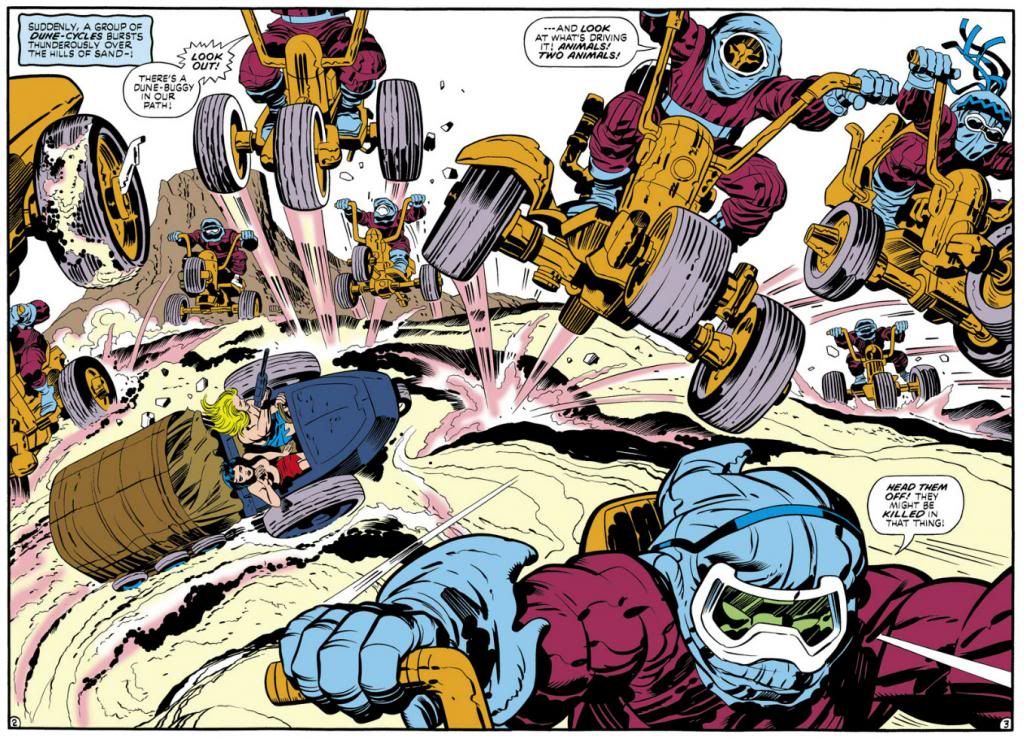
Kamandi #6 (June 1973), words by Kirby, inks by Royer

As you can see, Kirby anticipated the ATV craze.  For a while there in south Georgia, you couldn't take a drive without a three- or four-wheeler loaded with people in camouflage barreling out in front of your car from a side road or a trailer park entrance.  In fact, you still can't.  They're a menace, I tell you, and in this panel from Kamandi #6 (June 1973), you can see why.  Kamandi and his tragic girlfriend Flower have found yet another hard-working cargo carrier to explore the world, but suddenly they're capsized by a gang of three-wheeling lions!  They're huge, too.  Look how they dwarf Kamandi and Flower in their little cart.  These hot-doggin' felines think they own the dunes.  They're wrong.

Because there's one vehicle that's gonna shut 'em down, just like that little Cobra from a long ago Rip Chords song--
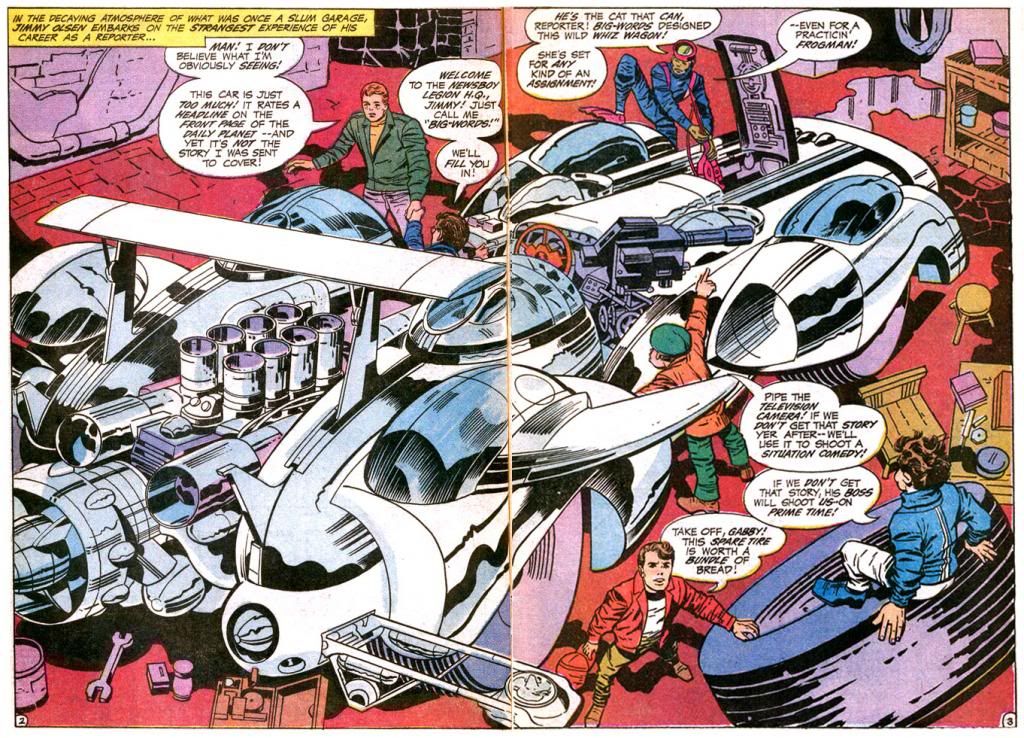
Jimmy Olsen #133 (October 1970), words by Kirby, inks by Vince Colletta

The best is last, but not for long!  In this spectacular image from Superman's Pal, Jimmy Olsen #133 (October 1970), we first greet the Whiz Wagon, custom-built by the Newsboy Legion just in time to explore the Wild Area with a certain cub reporter.  Or photographer.  Whatever the hell job it was Olsen did when he wasn't driving Perry White to distraction.  Look at the rear spoiler and those crazy intake pipes.  Is that a hint of a jet turbine beneath them?  Looking like the love child of the second Fantasti-Car and Speed Racer's fabulous Mach 5 by way of a maternity ward in the deepest, darkest, most top secret ward of Area 51, there's almost nothing the Whiz Wagon can't do.  The Newsboy Legion uses it to roar down the highway, chase after the Mountain of Judgment with the Hairies from the Habitat, fly, even travel underwater.  This is the ultimate in Kirby vehicle design. 

The Whiz Wagon by itself is an amazing visual, but Kirby doesn't simply fill two pages with a car and call it a day.  He loads this spread with details to help you believe in this phantasmagorical creation.  There's the spare tire with Newsboy Gabby perched on it (where do they buy those?), Flipper-Dipper and the forward cargo-hatch, plus tools galore and even some kind of liquid draining away in the background.  Hydraulic fluid?  Oil?  Tears from other artists who saw this and realized they'd never create anything even half so cool?

Wednesday, May 29, 2013

I own the first 30 issues of Fantastic Four...

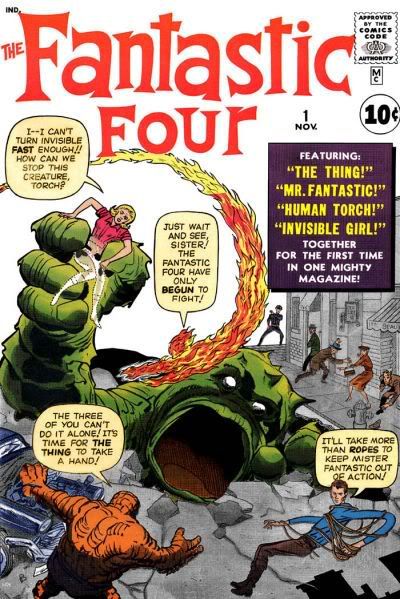
Plus Annual #1 where Namor goes off on the human race and invades New York City with an army of blue dudes wearing fishbowls on their heads.  Not the print originals, of course.  How much is Fantastic Four #1 (November 1961) going for these days?  There's a graded example (CGC FN+ 6.5, white pages) online at Heritage Auctions with a recent offer of $18,500.  An 8.5 went for $52,000.  That's a little out of my price range, I'm afraid.  No, I own reprints.  Reprints, reprints, reprints.

I've had the Fantastic Four Essential collections for a long time, and I used to have the fat Fantastic Four Omnibus that was so heavy I couldn't rest it on my stomach while reading in bed or it would squeeze my dinner out of me as if I were a Play-Doh Fun Factory.  I gave that one away before I moved back the US following my first stint in Japan as an English teacher, otherwise I would have had to purchase a second seat ticket from Air Canada to take it with me.

Comixology is my current source for vintage comics.  Publishers have been putting out re-colored versions of various classics so long they have a nice back catalog of stuff they're adding to Comixology a little at a time.  They usually run you about 1.99 each, although sometimes you can find 99-cent sales or even freebies.  With the files available, there's no reason not to put the books online.  The hard work has been done, so overhead is minimal at this point.  Easy money for Marvel and DC.

I frequently find myself pondering the appeal of early Fantastic Four.  I'm not denying it exists; I love the Stan Lee-Jack Kirby era Fantastic Four, after all.  What is that appeal's substance, however?  That's what I think about, in search of a magic formula, I suppose.

When we look at Fantastic Four #1, we're looking at something fairly raw and even clumsy.  The plot mechanics barely stand up to close scrutiny.  Why in the hell would a top scientist take his girlfriend and her kid brother on an illegal rocket jaunt?  Even by the lax standards of comic book logic, that's pretty stupid stuff.  Kirby's art seems relatively timid, not at all the bold, bombast we've come to associate with the King, and it's poorly served by gloopy inks.

Perhaps we have to put it into context, stack it up against DC's contemporaneous efforts.  I know the talent were doing their level best to put out good product, and a lot of these guys and gals rank pretty high in my pantheon of greats.  Plus there was this little thing called the Comics Code.  The last time someone tried to do something truly interesting with comics, the government got involved and not to say, "Nice job you're doing entertaining the little chaps, Mr. Gaines!"

But despite a few stand-out stories and some awesome-- if a little mechanical and stiff at times-- art, the formula wears thin pretty fast.  DC comics of that era don't really seem to be about anything in particular.  Especially if it's an "Imaginary Story!"  Which might be more interesting than any of the so-called "real" stories because it dares embrace weirdness.  So if you ask me what issue was it where we saw Superman turn into a fat version of himself or when did he grow a long beard or turn into a gorilla or gain a whole new set of powers or whatever, I'm likely to answer, "All of them."  What does it really matter?

Now imagine you're a kid who's starting to feel a bit jaded by all of this and you see the cover of Fantastic Four #1 glaring out at you from the newsstand like a pugnacious new kid to your neighborhood.  A little loud-mouth with a dirty face.  It's rude, it's coarse, it's even a little ugly.  But you can't take your eyes off this newcomer.  You open it and the inside is more of the same. And look at that squashed orange guy ripping that tree out of the ground to hit his friend with it.  Immediately, you sense it's got something those tight-assed DC comics don't have.

Charisma.  That's it.  It's got charisma.  The plot isn't just some one-off that's essentially the same as last month's with the details changed.  You probably don't even question Reed Richards's poor decision-making process.  That might be due to the frantic pacing, but I like to think it's because Stan and Jack are going somewhere and taking us along with them.  It's not just a plot; it's an actual story.  It matters.  Or at least it does by comparison to its competition.

And it just got better and better until DC was forced to react and turn to new talent, style experiments and the like (I'd argue Marvel inspired DC to put out a lot of their cooler books, even if they didn't sell all that well).  By the time Doctor Doom shows up in Fantastic Four #5 (July 1962), things are really starting to cook.  From that point, issue-by-issue, you get to witness Kirby come into his own again, giving his career that huge push that made him the super-legend he is today and Lee develop the inimitable voice of Marvel, bizarrely made up of WWII-era slang and hyperbolic carnival barker come-ons.  It's captured there for constant rediscovery on Comixology, the same way recordings capture the exponential aesthetic growth of the Beatles from "Love Me Do" to "Carry That Weight."

My favorites, though, are the Fantastic Fours inked by Chic Stone.  They have the energy and slightly unformed quality of the earliest issues and a little bit of the structure of the later Joe Sinnott-inked issues, which leave me a tiny bit cold.  I like Sinnott's slickness, but his issues just don't have the energy of Stone's.  To carry the Beatles analogy a bit further, it's kind of the way I admire the heady pop craftsmanship of Abbey Road, but I end up listening to the peppier Help! and back-to-back self-topping albums Rubber Soul and Revolver more often.

Anyway, the first 30 Fantastic Fours are now available on Comixology and I own them.  I plan to keep buying these until they get just past the Galactus caper.  After that, a lot of the energy and charisma seeps out.  You get the idea Stan and Jack were looking elsewhere after that point.

Saturday, February 9, 2013

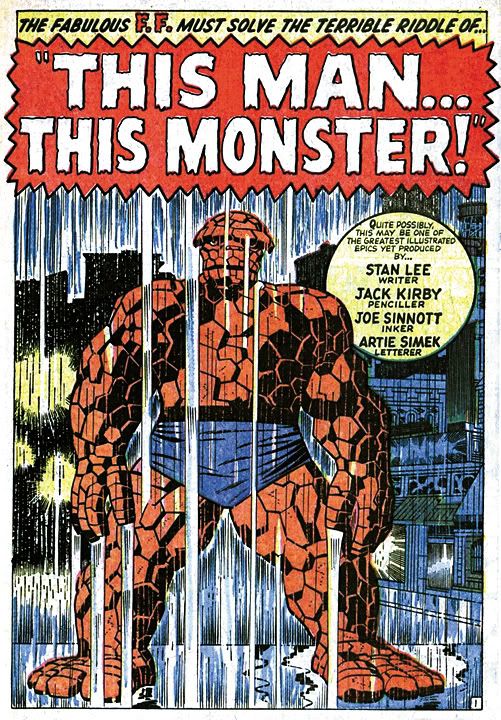
Fantastic Four #51: Someone left the Thing out in the rain

Splash page from Fantastic Four #51 (June 1966). One of Marvel's greatest single issues. The Fantastic Four had just faced off against the god-like Galactus and handed him his magenta-and-purple ass. While his teammates and the rest of the world celebrate, Ben "The Thing" Grimm turns his gaze inward.

Feeling sorry for himself, he doesn't even bother to change out of his superhero swimsuit or stop for a sandwich before heading out into the rain to walk around, converse sullenly with well-meaning cops, then accept coffee from a weird bald guy with a prominent brow ridge.

The bald guy is pissed at Ben's buddy Reed Richards. Fortunately for him, the Thing exists. Because without the Thing and their convenient skeletal similarity, his transformation into the Thing's exact duplicate would prove impossible! Ironically, there's one man in the world who actually wants to be the Thing, while the real Thing would do anything- short of suicide- to escape that identity.

Anonymous Bald Freak goes to the Baxter Building where his enemy Richards is planning to invade the Negative Zone tethered to a simple nylon rope he bought at the Yancy Street Hardware Store, and wearing only a goldfish bowl for protection. Things end badly but not before Anonymous Bald Freak learns that all Things (even faux-Things) have an innate quality of heroism and self-sacrifice.

Interestingly, in a story about the Thing's wrestling with his own identity, we never learn the bald guy's name or exactly why he resents Reed Richards enough to want him dead. Even Richards himself hasn't a clue to who this guy is or what he might've done to piss him off. By the time the Thing is back his old rocky self, he's not really able to shed any light on the guy's story, either.  Lessons learned? Ben Grimm's niceness rubs off even on jerks, and Reed Richards has a history of alienating people and making enemies.

Also, Stan Lee's dialogue perfectly balances the mundane and the sci-fi exotic. And Kirby's pencils follow suit. However, this is one of those issues-- despite what the credit blurb claims-- where Kirby did much more writing than Lee. It's full of Kirby-esque moments and moods that would become more familiar to the fans when he started garnering writing credits for himself.

Monday, August 8, 2011

Happy 50th Anniversary, Fantastic Four!

Hey Reed, Sue, Johnny and Ben! I love you guys! No matter what Marvel does to you, you'll always be the First Family of Comics.

The Fantastic Four was not my favorite comic when I was a kid. I liked the Saturday morning cartoon versions, but it wasn't until my then-favorite artist, John Byrne, took over the magazine's writing and drawing that I started reading it. From what I remember of the letter pages, other readers felt Byrne recaptured the aura or specialness or mood of the Stan Lee-Jack Kirby era, and I wanted to know what that meant. If it meant stories about a group of people who obviously loved each other-- despite their occasional spats-- and household drama growing to cosmic proportions, along with a lot of creepy sci-fi-type menace, then I knew I had to somehow read those old issues.

But who had $1,500 to spend on a comic book? That was the going price for The Fantastic Four #1 at the time. I think. I bought a few cheap issues from late in Kirby's run as artist-- they looked dynamic and kind of slick, thanks to the Joe Sinnott ink polish, but the stories themselves didn't do a whole lot for me. They just seemed like the same tired stuff I was reading in other comics. Fist fights and villains in garish costumes. The hoary Marvel bombast courtesy Stan Lee: "If This Be Flatulence!" "By Arthropods Denied!" "If Thine Eye Offend Thee, Doctor Doom!" "A World Dies Screaming as Black Bolt Orders Pizza Pies!"

Marvel eventually reprinted the series in their Marvel Masterworks hardcovers-- which were also ridiculously expensive-- and then various other more affordable formats, so I was finally able to read the series from the beginning. The first few issues were crude, with rushed-looking art and clumsy stories. The characters were mere ciphers, barely more than stock types. The scientist, the girlfriend, the kid and the...

The Thing. That's what The Fantastic Four had going for it, right from the start. The Thing. Looks like a monster, has the broken heart of a man. And the stories began to improve. By issue #5-- the first appearance of longtime Marvel mainstay baddie Dr. Doom-- Stan the Man and Jolly Jack had gelled and the Marvel Era as we came to know it was born. Reed, Sue and Johnny became more believable as flawed individuals, their enemies original. From there things just got better and better. The book developed a tone unique among comics at the time, at least the ones I've read. I'm trying to avoid historical generalizations here, because I wasn't born until The Fantastic Four was almost seven years old and I'm hardly a historian.

But you know what I mean. The marriage of the superheroic with the supermundane. One minute Reed Richards would be espousing some idiotic theory with Sue Storm petulantly demanding he spend more time snuggling with her, the next the Thing and Johnny Storm would be tearing up the place with their interminable sibling warfare. And then and only then would the issue's menace appear. Dr. Doom again. An alien child. The Skrulls. The Impossible Man. Irving Forbush. Danny Kaye. The New York Mets.

Despite his having been an established pro since the 1930s, it was during this time Kirby's art took on its characteristic visual power and he became the Kirby we know and love today. By the time Chic Stone took over on inks, Kirby had established himself as the King of Comics. Then came Joe Sinnott and his more polished finish and you had the Marvel House Style, a visual lexicon that matched Stan Lee's endless hyping and hucksterism-- the kind of comedic self-aggrandizing style that's so much fun to parody. 1940s army slang mixed with beatnik expressions and Madison Avenue ad-man copy, the occasional foray into Shakespearian syntax. 'Nuff said, True Believers!

The ideas began to flow at a feverish pace. I can't even keep them in order! The Inhumans, The Watcher, Silver Surfer, Galactus, the Blue Area on the Moon. The Yancy Street Gang. Wyatt Wingfoot. Alicia Masters, the gentle, blind sculptor whose love for Ben Grimm made the poor guy's life even more beautifully tragic. It seemed like every issue of The Fantastic Four was in danger of exploding from the pressure of too many concepts and characters against the thin skin of the gray newsprint they were printed on. How could one slender comic book contain so much? Look out! IT'S GONNA BLOW!

And finally, it did. Lee and Kirby began repeating themselves and soon Kirby was off at DC creating a new universe. But let me tell ya, the first 51 or so issues of The Fantastic Four are pop art masterworks. The encapsulate a lot of the vibrancy of the 60s. Watching Lee and Kirby grow into their creative powers issue by issue is a lot like listening to the Beatles' recorded catalog from beginning to end. The comics are very much of their time and in that, they're timeless.

Tuesday, May 24, 2011

For Kamandi -- With Love and Squalor

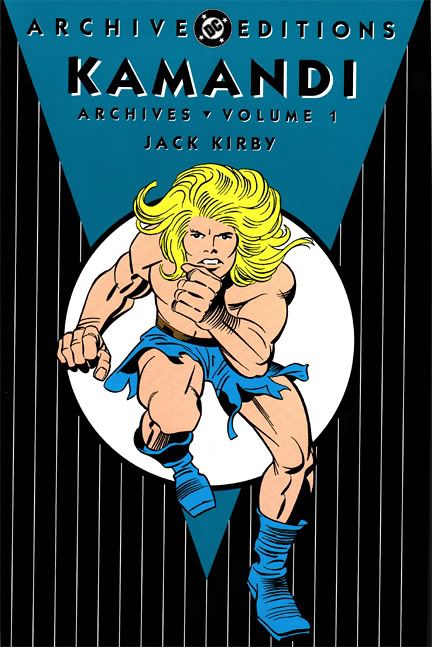
What do you get when you’re DC publisher Carmine Infantino and you float the idea that Jack Kirby should rip off Planet of the Apes? Not a Planet of the Apes rip-off, that’s for sure. If Infantino expected Kirby to content himself with mere talking simians, he was sorely mistaken. And yet that’s pretty much how it happened, and how approximately 65 million years later, we lucky fools ended up with this slick and weighty DC Archives edition of Kamandi.

Or, as I like to call it, Kamandi: The Last Boy on Earth, because that’s the series’ title and I’m clever that way.

Chapter One: The Last Boy on Earth!

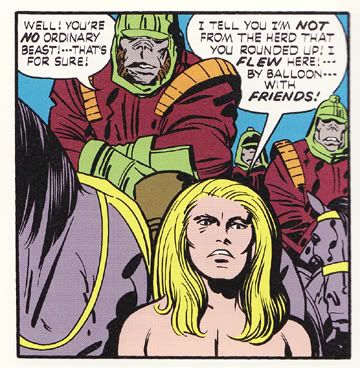
Kamandi is a futuristic, roughneck young hippie in a time where barbers have gone extinct, but cut-off denim and motorcycle boots are all the fashion rage. He’s the Charlton Heston surrogate for this madhouse world where not only do gorillas talk and ride horses, but lions and tigers tool around on three-wheelers and radioactive scientists float overhead in helium balloons.

Because it’s Kirby, Kamandi can scarcely contain itself. While he was always possessed of a febrile creativity, as soon as Kirby hit DC, his imagination went into some sort of turbocharged overdrive. His Fourth World stories are over stuffed with incident and new characters, and Kamandi features a similar breathlessly paced narrative. Reading a DC-era Kirby comic like reading ten stories in one.

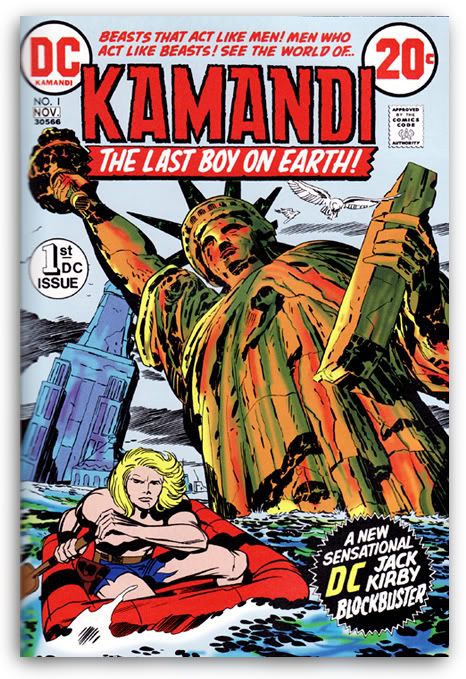
Kirby himself was busy then, too. I believe he was simultaneously producing Jimmy Olsen, Orion, Mr. Miracle and Forever People, spackling his living room wall in preparation for repainting it and mediating the Paris Peace Talks between the United States and the Democratic Republic of Vietnam (DRVN). And just as he saved our world in reality, Kirby destroys it in the pages of Kamandi. It's the post-apocalypse with a new status quo of underground bunker-dwelling and scavenging for food. Kirby destroys that almost as soon as he introduces it, too. When we first meet Kamandi, he's rafting through a flooded New York with a Statue of Liberty as majestically ruined as the one in the Apes film series, its obvious antecedent. Kirby leads with a splash page followed by a double-page spread no less!

DC... next time you destroy
the Statue of Liberty in a story,
do it the Kirby way.

Six pages in and Kamandi’s guardian/mentor is dead (he barely gets any dialogue), Kamandi’s battling a talking wolf who foolishly beckons, “Here! Give me that gun! --- Come on ---! I won’t hurt’cha!” and then Jolly Jack decides he needs to do something to pick up the pace before reader ennui sets in.

The second sees Kamandi’s new-found radioactive buddy Ben reminding him “Don’t forget Ben Boxer, boy! I’m not like the other humans you’ve seen!” As if Kamandi or the readers could forget- Ben Boxer is a man who has to wear an astronaut suit in order not to kill everyone around him with deadly radiation. Oh, and he turns into steel then deals out ass-whuppin’s. Just like the X-Men's Colossus, only not Russian. And a couple of years earlier.

Then we get yet another double page spread, this time of anthropomorphic rats looting the wreckage of the George Washington Bridge.

Kirby's gorillas are cooler than
the ones from 20th Century Fox.
Just keep Timothy Burton away
from them.

It’s not until #3 that the Planet of the Apes similarities fully emerge as roughneck gorillas (are there any other kind?) in green hunting caps and purple jumpsuits capture Kamandi. The cover blurbs come backing more hyperbolic bombast than a decade’s worth of today’s comics:

Welcome to a buried Las Vegas! Once a playground for men – now, a sinister hunting ground for gorillas!

So the apocalypse didn’t change much. And then this:

Complete in this issue! “The Thing That Grew on the Moon!”

A thing! And it grew… on the moon! As if the loincloth-sporting gorilla on the cover wasn’t enticement enough. Comics today could use more of this kind of cover copy-- at once hucksterish and tongue-in-cheek, and instantly appealing.

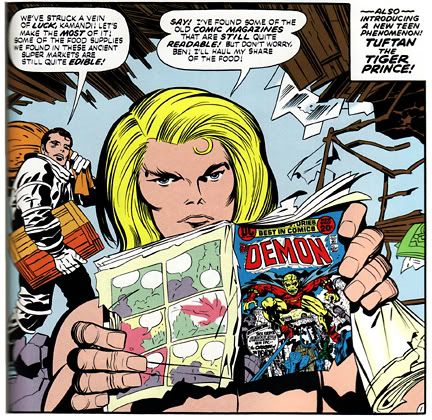
Who says this isn't the Age of
Kirby Self-Promotion? Kirby
works in a little plug for another
of his comics. "Quite readable,"
Kamandi? Quite readable indeed!

I think Kirby may have had bigger plans for Tuftan, the Tiger Prince. He comes on the scene in #4, heralded by a splash page text box labeling him a “new teen phenomenon.” I’m not sure if Kirby means Tuftan is a teenager (and more to the point, a tiger), or that he hopes Tuftan catches on with 70s teens the way David Cassidy and his half-brother Sean did, or Kristy McNichol, or skateboarding, or discotheques or feathered hair. After all, the kids loved Tiger Beat magazine; how could they not love Tiger Prince?

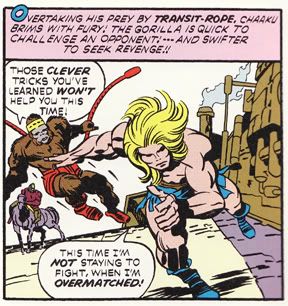
In the post-apocalyptic future,
half-naked neo-hippies will frolic
with headband and loincloth wearing
gorillas on transit ropes!

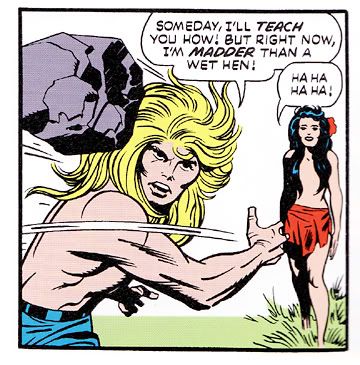
Kamandi and Tuftan get caught between the warring tiger and gorilla armies, and Kamandi gains a talking human girlfriend named Flower… who shamelessly goes around shirtless! Which is only fair, since Kamandi also flaunts bare-chestedness. Flower’s hair gives her some Lady Godiva-style modesty but Kirby’s notion of upper-body nudity is amazingly egalitarian.

In Kirby's future anyone may go
topless without shame! Viva la difference!

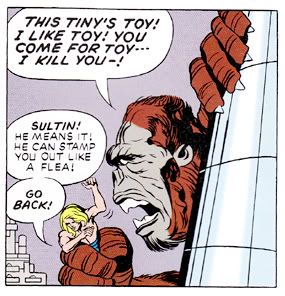
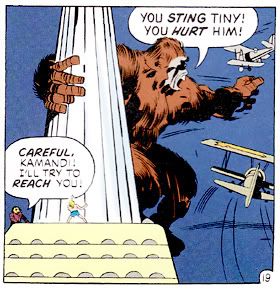
Almost as soon as Kirby establishes the romance between Kamandi and Flower and hints at the eventual reestablishment of some sort of humancentric society, tragedy strikes our young lovers. Kirby examines its aftermath in Kamandi #7, with a chapter intriguingly titled “The United States of Lions." Surprisingly, it has little if anything to do with unions, states and only tangentially features lions. Beginning with a funeral and ending with a skyscraper battle, it's actually Kirby’s parody of King Kong, substituting a massive gorilla; Kong’s equal in stature but superior in conversational skill.

And that’s just a quick overview of the first seven issues! I’m too exhausted to tell you all the details about the last three in this book, in which we visit “Tracking Site,” battle the savage flying bats and the freakish, sinister homunculus who dwells there, intent on unleashing a world-ending bacterium for some obscure reason Kirby can barely take time to explain to us in the breathless rush of his futuristic narrative.

Chapter Two: The Waiting Secret!!

If you haven't guessed by now, Kirby goes pretty far afield, given the series’ original mandate. And while Kirby wasn’t above rehashing classic movie plots he never failed to add twists the original wouldn’t dare. Imagine how insane Beneath the Planet of the Apes would’ve been if, instead of skinless mutants, the gorilla army had encountered talking lions on three-wheelers.

While suffering from an over-reliance on capture, escape and evasion plotting (it becomes repetitive), Kamandi is a sterling example of Kirby’s off-the-wall and unrestrained storytelling, honed over decades of professional work. While he may not have been as interested in the book as he was in his New Gods, the fact remains the man just could not half-ass things even if he tried.

Who else would engineer an entire future Earth, populate it with talking animals of nearly every species, continually hint at a central mystery that unravels intermittently throughout the adventures and introduce brand new characters practically on a page-by-page basis?

From reading these, I can’t help but see Kirby as a mostly intuitive storyteller. Certainly the man was a sponge, soaking in bits of science, legend and myth, and good old Hollywood movies; all of this he'd combine and alter to suit his story needs. Mike Evanier's recollections give me the impression Kirby would frequently come up with a particular direction for a story... then produce something almost totally counter to his original intent. Creating on the fly, always bubbling over with ideas. With that in mind, I don’t see an overall plan here, just incidents piled on incidents.

Groovy incidents. With the intent to entertain the bejeezus out of anyone who buys Kamandi.

And while Kirby may never have written the Great American Novel, it’s probably no accident Kamandi’s adventures take place in the western regions of the former United States. As soon as he departs his underground bunker near New York, Kamandi becomes the classic American pilgrim, sojourning in locales near Las Vegas, Yellowstone Park, even ranging as far as South America in a tip of the hat to Butch Cassidy and his partner in crime, the Sundance Kid.

From James Fenimore Cooper to Mark Twain and Brett Hart, to the relatively more recent Jack Kerouac and Thomas Berger plus many others, American novels frequently explore western migration as related to rugged individualism, which Kamandi certainly personifies. In fact, this is probably the most important defining traits of what we characterize as American literature, at least in the 19th century, and much of the 20th.

The west is the quintessential setting for American literature, with Kamandi the descendant of Huckleberry Finn by way of Col. George Taylor. And like Huck, and Berger’s Jack Crabb, Kamandi rebels against unjust societal expectations, cannot tolerate a life in either literal or figurative captivity. He must remain in motion, forever restless, the personification of our nation in its youth. Unable to relate to most surviving humans, Kamandi remains apart from each culture he encounters. Kirby reinforces this by repeatedly separating Kamandi from Ben Boxer's scientists and having Kamandi assert his human identity and equality to his animal overlords who insist on treating him condescendingly as either a pet, a mascot or an enemy.

As science fiction, technological themes abound in Kamandi, but these are traditionally conflated with western ones in more mainstream American literature as well. While Cooper might bog down the narrative of his 1823 novel The Pioneers to describe a stove in almost Luciferian terms, Kirby, the once and future king of his four-color milieu, creates bizarre flying vehicles and war machines with a gestural whim, yet never slackens the story's pace.

The series has a strange dichotomy-- for humans, advanced technology is of the past, and there’s a nostalgia for what humanity has lost, but along with it, an implied criticism of the queasy, mindless consumerism and complacency that led to this outcome in Kirby’s use of imagery featuring the detritus of a lost civilization: familiar shopping mall signage and weathered sculptures of American presidents (even significantly including one of Richard M. Nixon, never a Kirby favorite) whose identities have been lost to history.

Still, in order to reclaim mastery over the world, which Kamandi sees as a human birthright, he must solve these archaeological mysteries. To this end, Ben Boxer and his scientific comrades are forever seeking the lost “Apollo Project” in an effort to understand this disordered reality.

And while technology is used to destroy (being a Kirby action-fest, violence and weapons-based imagery predominate), there’s also a hopeful quality. If one can defeat the barbarian bat-creatures and the horrific human-created bacterium that can kill all life… one might at the very least, as in "The United States of Lions," find a peaceful place where one might belong.

If, that is, Kamandi can overcome his temper and tendency towards violence. Then again, to Kirby these were also human qualities. To create and destroy, our recurring pattern, even among animals with anthropomorphic qualities. Kamandi lives in a world ruled by violence, both casual and institutionalized- rowdy fistfights, warfare and gladitorial games coexist. Kirby might remind us these, too, are human inventions.

Kirby does Kong. Get Peter
Jackson on the phone! We need
an epic Kamandi movie!

Franklin Schaffner never thought
to put his apes in biplanes, but it
would've been cool if he did. These
are actually lions. Lions in biplanes,
attacking a giant, talking ape who
calls himself Tiny. God, we need
another Jack Kirby.

Chapter Three: The Monster Fetish!

We’re lucky enough of the art exists for DC to gather it all into this hefty and cleanly-designed hardcover. We can enjoy its prime Kirbyness, where his stylistic flourishes, unhindered by the slick ink work from Joe Sinnott at Marvel and the scratchy, unfinished line of Vince Colletta at DC, erupt. Kirby's use of splashes backed by innovative gutter-crossing double spreads on pages 2 and 3 gives the stories a wide-screen feel, opening up the scope and dazzling the reader with Cineramic imagery like a ruined Nevada town, preserved for animal archaeologists by the dry desert air, an Ozymandian image at once humorous and melancholy.

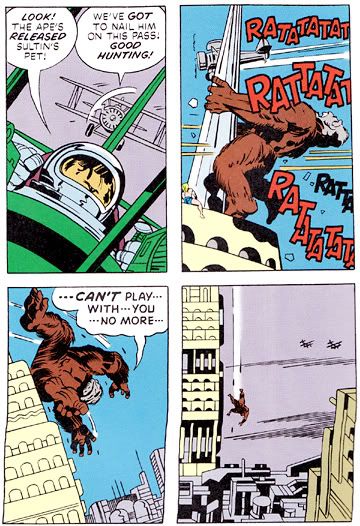
Sic semper Tiny! "Can't play---
with --- you --- no more." He's not
even angry at the lions who killed him.
Isn't that the saddest comic panel ever?

In the Kamandi Archives reprint, the blacks are crisp, the colors smooth. The reconstruction is akin to looking at a restored print of a Cecil B. DeMille epic. These stories were originally printed on grey-toned newsprint which almost immediately began to yellow. And they featured line screens that were practically planet-sized compared to today’s. Now we can see the art on glossy white, with screens so fine they allow the color fields to appear as smooth, flat areas. While this takes away some of the immediacy and ephemeral quality of the originals, it allows us to study the line work unobscured by cheap paper and indifferent printing.

This is especially educational because Mike Royer’s inks always bring out the Kirbyness of Jack Kirby’s pencils. From interviews I’ve read with Royer in the Jack Kirby Collector (a product of the wonderfully nice people at TwoMorrows), it seems his intent was always to preserve the pencils as much as possible. I love this approach, because the attraction of a Kirby comic is its uniqueness. He’s oft-imitated, but no one has ever fully captured the intangibles of the true Kirby.

The most others can do is provide the bombast and overkill, without the humane qualities. Kirby strikes me as having a genuine love for people, be they the shirtless, blonde hippie kid type or the kind hidden in an animal’s fur and sinew.

Friday, April 29, 2011

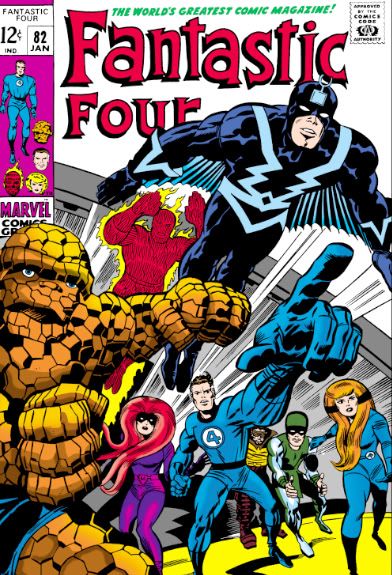
Hi, Crystal! My totally random appraisal of Fantastic Four #82

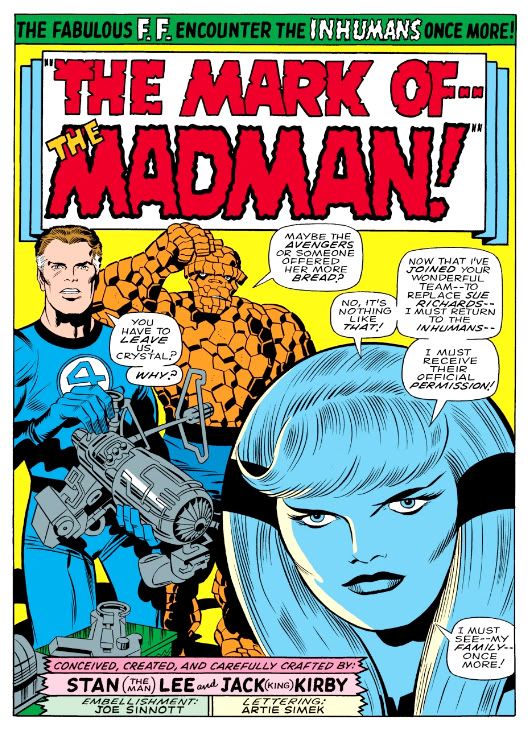
It's Fantastic Four #82 here to entertain us with jokes and repartee and perhaps some juggling and then some name-dropping anecdotes about meeting John and Yoko at a gallery opening, staying in a hotel suite next door to Mick and Bianca, guest-hosting The Tonight Show during the Carson Era before feuding with Johnny and being banned for life, growing a long beard and attempting to oil paint in the south of France...

Yes, Fantastic Four #82 has seen it and done it all. What a life it's lived! Oh, Fantastic Four #82! If only you'd finish those memoirs.

I've forgotten why I found these images from Fantastic Four #82. The story inside is titled "The Mark of-- The Madman!," which is pretty generic for something by Stan Lee. Little bombast, other than the exclamation point. Sue Richards has left the team and Crystal of the Inhumans has joined to replace her. We all know Sue as the Invisible Girl/Woman, with powers of invisibility. But what of Crystal? She can control the basic elements-- fire, air, earth and water. While invisibility has some obvious uses in terms of stealth and defense (especially Sue's famous invisible force fields), Crystal can move water and earth, combine elements to create weather. And she's stronger and more resilient than a normal human. Pretty useful as well. And yes, I know Sue later learned to use her invisible force field offensively as well. My point is, if you can't have one, the other will suffice.

I'm not sure I understand the whole "four elements" limitation. Why would her command of molecules stop merely with the ones that make up those particular things? Probably due to some literary reason haphazardly borrowed from Greek myth or something, but one wishes Stan Lee had thought through the implications of Crystal's powers. She might be more formidable than anyone-- including herself-- even suspects. Forgive me if some clever writer eventually worked this idea into Crystal's narrative. I haven't read a story with Crystal as a major player in it in years. But I do know Crystal also has a cool black headband.

Unfortunately, as a subject of Black Bolt, king of the Inhumans, Crystal isn't free to choose her own life. So despite the FF's kind membership offer, she has to run back to the Hidden Land to ask her monarch for permission. As for me, I prefer democracy. And since there's a madman promised in the story's title, of course the whole gang has to tangle with Maximus. This is a Fantastic Four issue from late in Stan's and Jack Kirby's run where they were recycling ideas that once seemed so fresh. Imagine how mindblowing the Inhumans were when they were introduced in Fantastic Four #45, "Among Us Hide... the Inhumans!"

Even the title is cooler, slightly ominous. Sinister, even! They're inhuman. They're among us. And they're hiding, no doubt for some nefarious purpose. Your neighbors might be one of them! Or a family member. This is why you must do as I do and call the Department of Homeland Security every day at 10pm and report any and all suspicious activity you might have observed in your workplace, your school, your church and even your very home.

Here we are, almost 40 issues later and the Inhumans are still having to deal with Maximus the Mad. This time he's got a gun that can hypnotize the entire earth and make slaves of everyone. In the next issue, it ends as lamely as you might imagine. Seems like Stan at the time was losing interest.

But Jack Kirby's art is still pretty sweet. Joe Sinnott is not my favorite Kirby inker, though.

Don't get me wrong. I like Sinnott's finishes a lot. They're super slick and they really pretty up Kirby's pencils. This is how comics tend to look in my mind when I'm making up my own (then when I try to draw them they look exactly like Alex Toth and Al Williamson got together and drew them holding pencils with their feet). It's just that I prefer the "purer" Kirby that resulted when Mike Royer inked him and followed his pencils more closely, without "fixing" things. I also love Chic Stone on Kirby. Stone-inked Kirby is a lot of visual fun, with thick contour lines around the characters and thinner interior lines for contrast-- not a lot of feathering or those zig-zag Kirby shadows Royer so ably brought out, but a funky, low-tech Kirby.

So it's more a matter of my own peculiar sense of what's appealing. If I had to rank Kirby inkers, I'd list Royer first, then Stone and then Sinnott. I believe Kirby once said he liked Wally Wood best among his inkers. I hate to disagree with the King, but I find too much Wood there and not enough Kirby. I'd rather see Wally Wood inks on Wally Wood pencils than an awkward melding of two different approaches to figure construction and lighting. Kirby's figures are more lit from within, they provide their own light. Not exactly conducive to Wood's "double lighting" feathered chiaroscuro work.