Showing posts with label Chic Stone. Show all posts

Thursday, March 6, 2014

Mike Royer and Chic Stone: My two favorite Jack Kirby inkers...

Someone asked Kirby fans their favorite inkers.  You know the usual suspects:  Joe Sinnott, Frank Giacoia, Mike Royer, Wally Wood.  I always enjoy reading those names.  They evoke the wonder and joy of discovery that comes when you're a youngster reading comics and the credits begin to mean something to you.  The writers and artists become characters in your imagination just like the superheroes whose stories they tell.  Many people gave very thoughtful, insightful responses, and there are few things more pleasing to me than people talking about art they love and giving reasons why they love it.  It puts me in a good mood.

I'm not going to complain about anyone here.  There aren't any inkers whose work on Kirby I absolutely reject.  I can think of good things to say about all of them, lots of positives.  But like anyone, I have my own favorites.  The ones that ring my bell more than others.  And I don't think my choices are particularly avant garde.  But since I have a blog and a big mouth, I'm going to share them with you right now.

Mike Royer is my top Kirby inker.  This isn't any big surprise.  He's a top pick of a lot of Kirby fans.  It's not enough simply to show fidelity to the pencil lines.  A lot of pros and amateurs can run ink over Kirby's pencils and come out with passable finishes.  But simple tracing in ink can flatten forms sometimes kills the energy and Kirby, if anything, is all about kinetics and energy.  While Royer is very true to Kirby's lines, I think he gets the intent right, and his own top-notch drawings skills means he understands the roundness of physical form and can fix little things where Kirby goes astray.
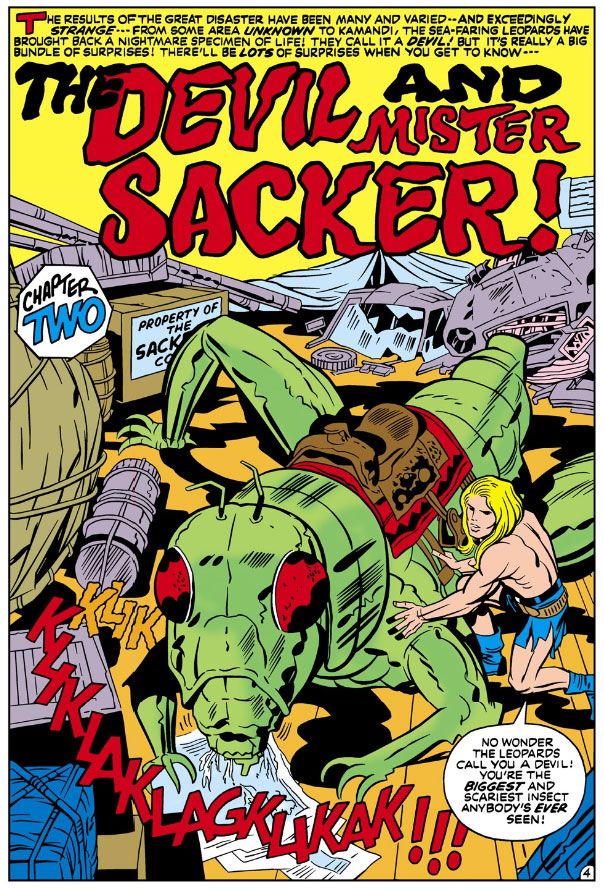

Kamandi #12 (December 1973) by Kirby and Royer
 
And face it, Kirby's take on anatomy is peculiar to Kirby.  It approaches the abstract at times, with flattened s-forms standing in for all kinds of muscle shapes and drapery folds.  Royer has the ability to make sense of it and give us something that's very Kirby on one hand, and very "readable" on the other.  I've seen some complaints about his lettering-- especially the bold, display "fonts"-- but I dig that stuff the most.  It all goes together into a complete package, very of its time but, as a result, timeless in that it's not faddish.

My second favorite is a little bit of an oddball choice, ever so slightly.  It's Chic Stone.  While Joe Sinnott slots in at #2 for a lot of people who also put Royer at #1 (and Giacoia is also a popular second choice), I find Chic Stone's cartoony interpretation of Kirby's pencils to have the most of that elusive concept we call "appeal" of any Kirby inker.  Stone's inks bring out the pop art fun inherent in Kirby's mid-60s Fantastic Four work.  He, like Royer (and Sinnott and Giacoia), could actually draw on his own, so he's not simply tracing the lines.
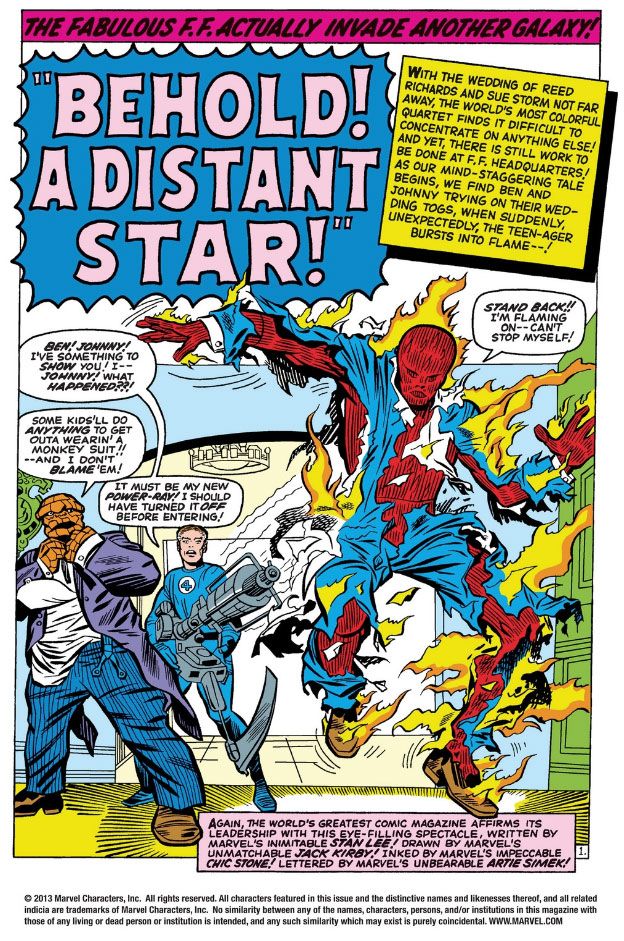

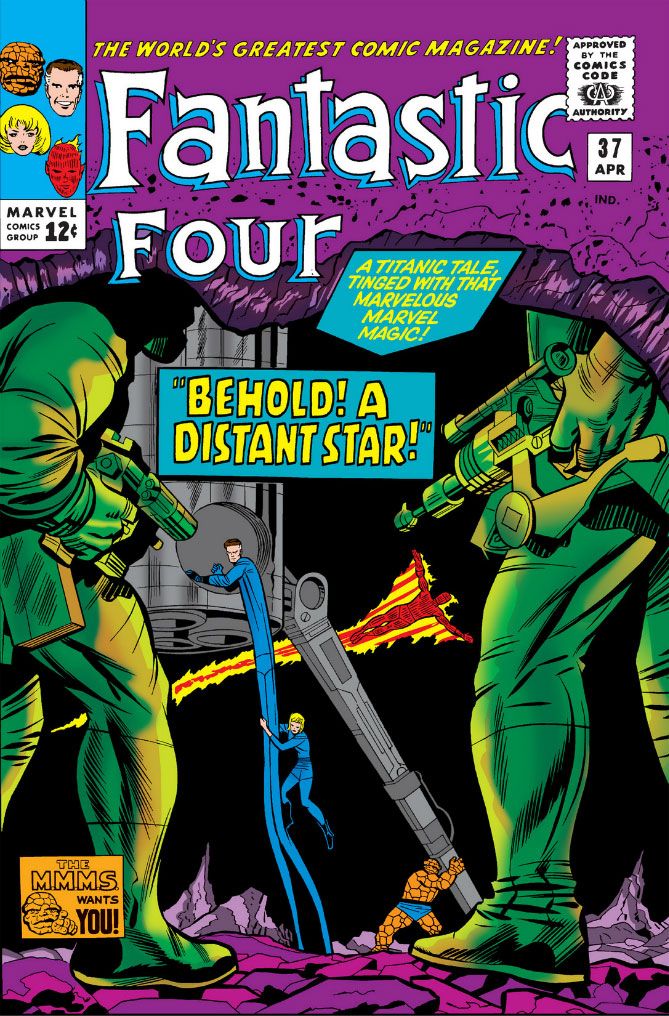
Fantastic Four #37 (April 1975) by Kirby and Stone

It's not that I find him "better" than Sinnott or Giacoia and I'm not trying to argue anyone out of those as their choices.  It's that my sense of aesthetics responds more joyously to Stone's interpreting Kirby through an almost animation-art lens.  So we get these thick contour lines and finer details within them, and large, open areas for color.  Stone is a master of creating depth of field this way.  It's not as slick or as pretty as Sinnott, but that only adds to its charm.  Sinnott inked my single favorite Fantastic Four issue, which is #51 with the classic "This Man, This Monster" story, but Stone inked my favorite extended run of issues.  Again, while the Stone look places the work very much in its mid-60s timeframe, it's successful both as a historical document and as something that exists outside of time. 

Like a Sean Connery Bond flick (which, along with this era's Marvel comics, are the epitome of 60s cool), or the Beatles or anything from Motown.  These are things to which artists return every generation or so for inspiration.  Each time they do, they energize their own works with the good feelings associated with these classics.  Jack Kirby is that guy for comics, especially with Stone finishes.

Friday, August 30, 2013

Fantastic Four #29: It's not just Yancy Street that needs help!

Yancy Street is in a bad way, with young hoodlums tossing garbage at our friends, the Fantastic Four.  The heroes have only come to help.  This is how it begins on Yancy Street, but before it's over the FF have wandered all the way to the moon where they fight cosmonaut apes produced by the dastardly Red Ghost, a dome-headed, long-haired mad scientist of the Commie persuasion.  More important than that to Marvel history, it's in Fantastic Four #29 (August 1964) our adventuresome quartet meets the Watcher, who has a dome head of his own.

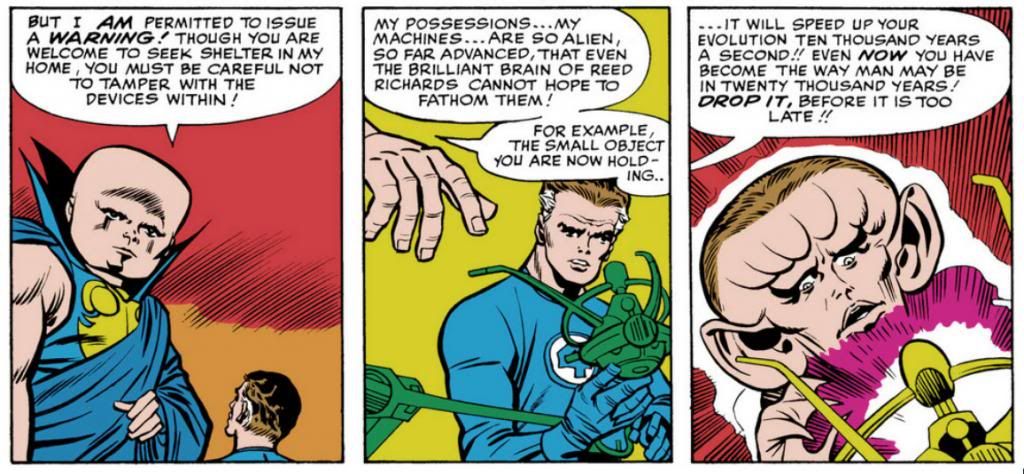
It doesn't take the ever-curious Reed Richards to run afoul of the Watcher's outlandishly futuristic devices, the likes of which no sane species would create outside of a Marvel comic.  Like this little baby:


Whoops!  Turn that off right now, Reed!  Is it just me, or does the Watcher look like Orson Welles with a shaved head in the first panel?

Sorry.  Forget that noise.  Look at how Jack Kirby views the future of human evolution in the third frame.  Since our brains are responsible for most of what we've accomplished, they will enlarge along with our skulls-- and our ears?  It's a little throwaway gag to establish how far above humanity the Watcher and his people are.  And it's just like Reed to pick something up out of scientific curiosity and activate it, damn the consequences.

But no, it's not Yancy Street that needs your help.  Comic creators do, too.  That's why I finally got off my butt and donated to the Heroes Initiative in the name of Kirby4Heroes, the fund-raising campaign run by Jack Kirby's granddaughter Jillian, who explains it in this video courtesy of Nerdist.


What I did-- and I still don't think it was nearly enough-- was donate a bit more than the amount I've spent this year on Fantastic Four comics at the Comixology site.  Comixology sells them for 1.99, and as far as I know, the Kirbys get nothing from this.  So while it's well and good to honor Jack Kirby's accomplishments and legacy by reading his works, I felt I really needed to do something for the campaign run by an actual Kirby to help Hero Initiative aid artists and writers whose stories I've also enjoyed.  People like John Ostrander, Bill Mantlo and one of my super-faves, Russ Heath.  This is going to be an annual thing for me from now on, every August 28th.

Wednesday, August 28, 2013

Fantastic Four #37: You want us to do what?!!

Here's a Jack Kirby gem from the Chic Stone era-- Fantastic Four #37 (April 1965), "Behold!  A Distant Star!"  It starts with Johnny Storm burning off his tuxedo.  Why is he wearing a tuxedo?  Because Reed Richards and Sue Storm are getting married, that's why.  The Fantastic Four are right in the middle of preparing for the single most important nuptial event in Marvel universe history, and the groom suddenly takes it in his head to fly them to the Skrull homeworld to fight the whole planet.

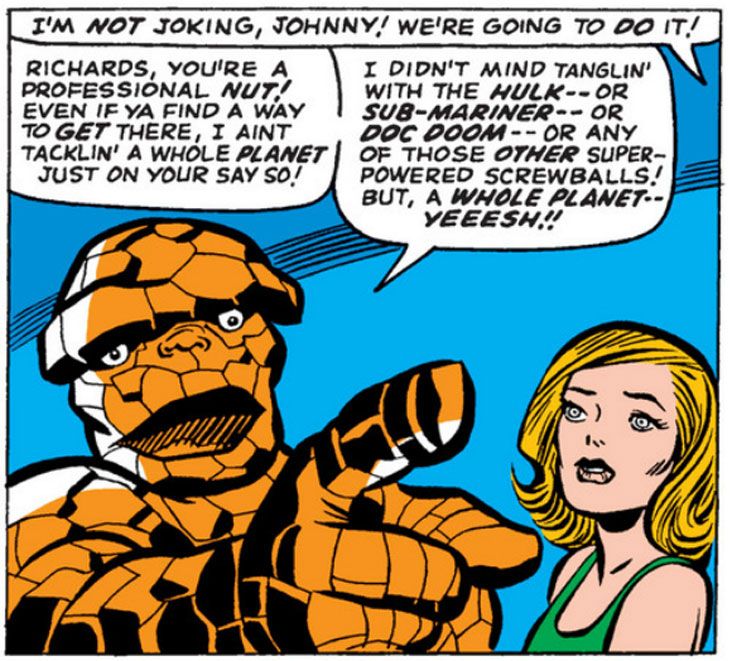
This is a book filled with wedding plans and power rays (Reed:  "To put it simply, it's a variation of a power amplifier!  It draws energy from an unknown source from somewhere beyond the confines of our solar system, and converts it into raw, usable power!"  To which the Thing replies: "Thanks a heap for puttin' it simply!  Now how about sayin' it in English?") and alien vistas full of creatures that would give Commander Hoek and Cadet Stimpy nightmares.  And it has a moment where the Thing aptly sums up just what's wrong about Reed's plan.

Take it away, Thing:

 
Despite the Thing's completely sane objections, off they go to the Skrull planet in another solar system. Faster than light travel is nothing for the Fantastic Four these days, or for us readers. We're starting to take Reed's inventive genius for granted at this point.

But let's never take Kirby's for granted.  I may not be giving Stan Lee his due here (the dialogue between the team members crackles with wit) but that's probably because of Kirby's art in this issue, which makes me feel drunk.  Drunk in a good way, right when the buzz is taking hold and you feel funny and energetic, ready to dance.  The visuals pretty much run the FF gamut, the family drama (it's not everyday two superheroes have a wedding rehearsal) and then the pan-galactic, realized in one of Kirby's collages.  There are elements of tongue-in-cheek and operatic drama and Kirby gets to draw both tuxedos and space finery, design interstellar starcraft for two species and then a lot of alien flora and fauna.  This is evidence of a man truly feeling the material.  The earliest issues are timid compared to the full-blown Kirby... well, Kirbyness we find in "Behold!"

It's not just that collage.  There's a scene where a Skrull monologues and Kirby cuts to an exterior view so he can draw freakish space critters running across a planetary landscape.  It's weird, man.  Weird and wonderful.  Stan the Man must have cackled with glee when he saw that page.  I know I did.

YEEESH!!

Happy Jack Kirby Day!

It's Jack Kirby's birthday (he would have been 96!), which, around here, is a major holiday.  For me, anyway.  And if I have my way, one day it will be a holiday for everyone.  I don't care if it becomes a national holiday with government offices and schools closed or anything like that.  I'd just love to buy a calendar and see August 28th labeled Jack Kirby Day.

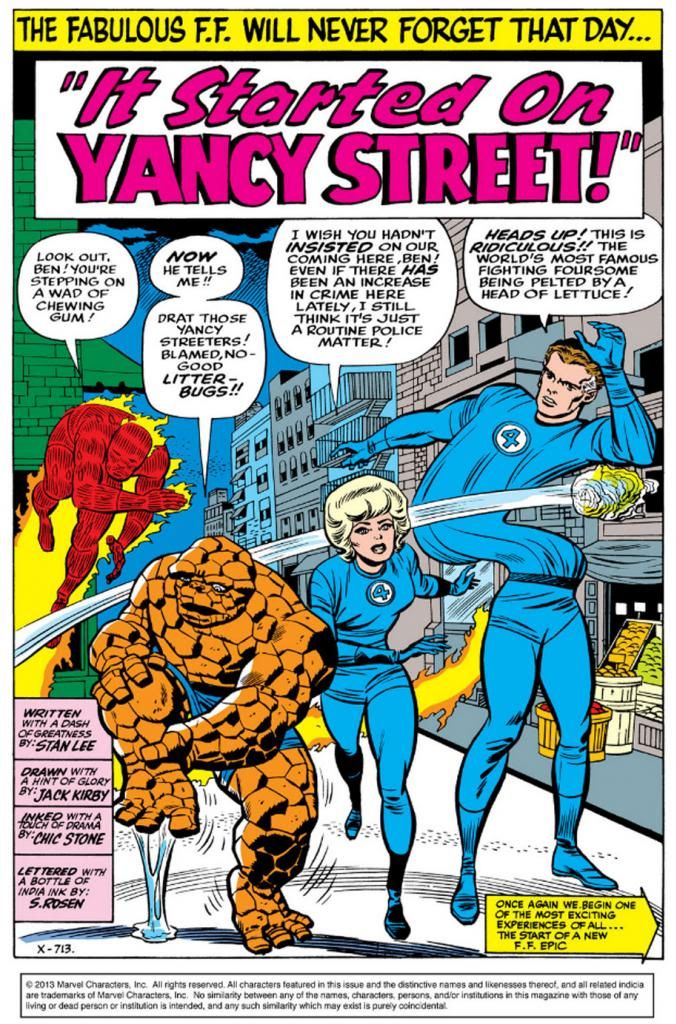
And maybe some parades in his honor or fireworks shows.  Here's a favorite splash page of mine, from the classic Fantastic Four #29 (August 1964).


I'd tell you the credits right here, but they're already in the artwork!

This color recreation is probably pretty close to the originals.  Some of it is a bit too intense, but I'm happy they didn't try to model a lot of shadows and light effects on the figures.  But what I like best about this isn't the Thing having stepped in gum (although that is a nice touch); it's the way Mr. Fantastic plants his feet on the concrete and then uses just his torso to dodge the tossed garbage.  There's a strong contrast between Reed's sturdy, pre-Vietnam-America-can-do legs and his swirling mid-section that draws my eyes.  I keep imagining Mr. Fantastic's texture as sometimes like taffy, and at others, like in this instance, almost a liquid.

And there's Sue Storm, the Invisible Girl, in the center, saying something completely sensible.  Call the police, not the superheroes.  It's not fear talking.  Sue isn't playing the dithery, do-nothing citizen trying to stay out of trouble at all costs.  Sue's objection has to do with prioritization.  She knows the team has more important things to worry about, like communism and Dr. Doom.  She probably also has practical concerns.  While I'm sure she'd agree the crime rate on Yancy Street is something of a concern, and it's admirable the FF want to pitch in, what can they realistically do about it?  Burn the Yancy Street Gang to death?  Bully them with the Thing's strength?  Build a community center with the wealth generated by Reed Richards' patents?  Psssh.  This isn't for the Fantastic Four to bother themselves over.  It's more a Spider-Man-level situation.

But I agree with Sue.  What's truly needed is police involvement.  Those lazy bums.

Thursday, August 1, 2013

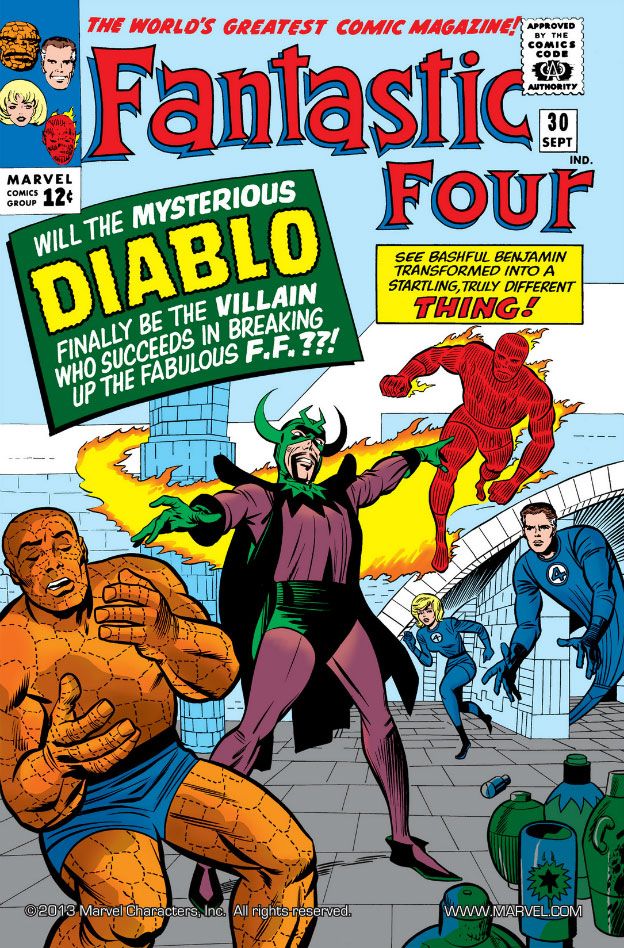
Fantastic Four #30 demonstrates why you should never go on any vacation Reed Richards plans for you

You'd have to be crazy to go on a Reed Richards-planned vacation.  For one thing, there's no such thing as a leisurely Reed Richards-planned vacation because Reed's idea of leisure is to culture bacteria or tinker with a device to allow inter-dimensional travel.  Those are his spare time activities.  He does really heavy-duty stuff when he's working.

For another, if at the moment he's interested in traveling, he's not going to set up a Hawaiian itinerary or a couple of weeks in the Riviera, although he could easily afford either with all his patent money and licensing fees.  No, he's going to take the whole party to Transylvania so he can do a little field research.

Check out what he does to his friends Sue, Ben and Johnny in Fantastic Four #30 (September 1964).  Reed drags them all the way behind the Iron Curtain-- and I thought the guy absolutely despised communism-- for a visit to Dracula country.  Stan Lee's narration calls Transylvania a "kingdom," but that was true only in his active imagination, no doubt full of Bram Stoker-inspired fantasies.  In reality, during the time frame of the Fantastic Four's ill-fated visit, Transylvania, as part of Romania, had only recently emerged from under direct Soviet control and established a certain level of political and economic independence from the USSR, it labored under the rule of Georghe Gheorghiu-Dej, a hardline communist and former Stalinist who instituted one of the harshest regimes in Eastern Europe.

It also harbored anachronistic alchemists like Diablo, with his green horned cowl and jaunty purple tights.


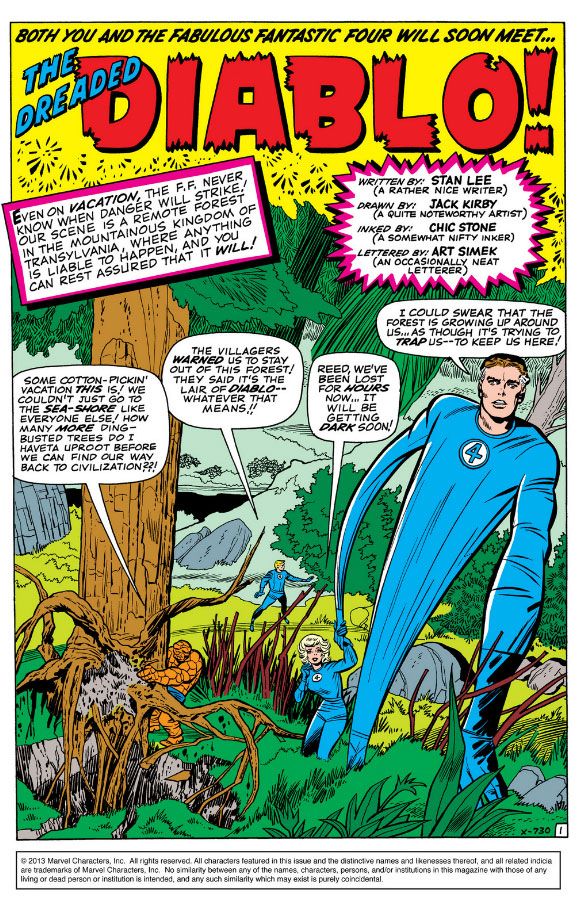
The first thing Reed does on this so-called vacation is to lose the team deep in the Transylvanian forests.  He does this so quickly, Kirby and company don't even bother with set-up.  There's no Baxter Building prelude where Ben and Johnny get into a fight and Reed intervenes only to have Sue step in and tell everyone they're only squabbling because they've got cabin fever and need some time off.  Nope, right from the splash page they're lost and the only explanation for the how and why we get is in a caption.  Anyway, Reed is probably faking it so he can surreptitiously search for a rare slime mold or fungus from which he can synthesize a chemical he needs.  It is a scenic forest, though.

There are few inkers I enjoy on Jack Kirby so much as I do Chic Stone.  Chic Stone makes Kirby's art look like a cartoon, and I mean that in the best sense of the word.  Take that cover, for example.  Check out how Kirby and Stone depict the transitional, less-rocky Thing-- thick contour line around the outside, dotted lines on the inside.  And bald.  Also, how cool is it on the splash page that Ben is plucking a tree right out of the ground while complaining about the very topic of this blog post?  The tree's not even in his or anyone else's way; it's just there for the plucking.  This is fun.  Comic visuals that are pure fun.

But look at Reed stretching himself out there, pretending he doesn't know exactly where they are and what he's doing.  A few moments later, he's all like, "Hey, look, gang!  I found a ruined castle I totally never suspected was here all along!  Why don't we... oh, I don't know... investigate it?"  Obviously, Reed wasn't after just some botanical specimens...

Then this Baron Hugo character shows up and tells them to stop being lost before they hurt someone or disturb something best left undisturbed and that they can sleep over at his house.  That night, Ben sneaks out into the forest and-- in a creepy sequence that anticipates Mike Mignola's Hellboy-- goes to an ancient castle where he pulls a giant stone stopper out of some kind of cylindrical stone architectural feature for which I don't know the name.  The narration refers to it as a "crypt."  Well, okay.  This frees our old pal, Diablo.  Diablo, the Transylvanian alchemist with the Spanish name that means "devil."

It doesn't take Diablo long to exploit festering personal divisions within the FF, using his chemicals to restore a limited humanity to the Thing, with a promise of more to come.  That's all it takes for the disgruntled Ben to turn his back on tour guide failure Reed Richards and declare himself Diablo's buddy-for-life.  Diablo goes on a chemical rampage, rejuvenating a geriatric millionaire named Featherstone (he wears a top hat!), transforming the Iranian desert blossom into a floral wonderland, raking in the money with government contracts and using Ben as overseer to exploit local labor.

Reed, smarter than your average alchemist, soon discovers Diablo's formulas are all phony-- suddenly, the blossoming deserts revert to their infertile state, the millionaire ends up hospitalized for an advanced case of being a moldy old bastard and the anti-missile shield (don't know how a chemical potion produces something like that and wisely no one bothers to even try to explain it).  And poor Ben has his heart broken yet again.

With the tacit approval of the United Nations itself, the Fantastic Three spring into action, only end up trapped in glass vials.  Ben redeems himself and Reed promptly gets them lost in the woods yet again.  Because he still hasn't found the prized fungus, no doubt.  And I have no doubt this is exactly the way things played out in Reed Richards's mind before they even left New York.

Some vacation!  That's the kind of crappy vacation experience you're going to have if you let Reed Richards choose your destination.  The man's a workaholic, I tell you.  Doesn't know how to have fun.  Or where.  Now if you want me, it's summer vacation for me, too, and I'll be spending a fabulous fortnight in glamorous Pyongyang, cosmopolitan capital of the Democratic People's Republic of Korea.  I hear it's a swingin' town and a real shopper's paradise!

Wednesday, May 29, 2013

I own the first 30 issues of Fantastic Four...

Plus Annual #1 where Namor goes off on the human race and invades New York City with an army of blue dudes wearing fishbowls on their heads.  Not the print originals, of course.  How much is Fantastic Four #1 (November 1961) going for these days?  There's a graded example (CGC FN+ 6.5, white pages) online at Heritage Auctions with a recent offer of $18,500.  An 8.5 went for $52,000.  That's a little out of my price range, I'm afraid.  No, I own reprints.  Reprints, reprints, reprints.

I've had the Fantastic Four Essential collections for a long time, and I used to have the fat Fantastic Four Omnibus that was so heavy I couldn't rest it on my stomach while reading in bed or it would squeeze my dinner out of me as if I were a Play-Doh Fun Factory.  I gave that one away before I moved back the US following my first stint in Japan as an English teacher, otherwise I would have had to purchase a second seat ticket from Air Canada to take it with me.

Comixology is my current source for vintage comics.  Publishers have been putting out re-colored versions of various classics so long they have a nice back catalog of stuff they're adding to Comixology a little at a time.  They usually run you about 1.99 each, although sometimes you can find 99-cent sales or even freebies.  With the files available, there's no reason not to put the books online.  The hard work has been done, so overhead is minimal at this point.  Easy money for Marvel and DC.

I frequently find myself pondering the appeal of early Fantastic Four.  I'm not denying it exists; I love the Stan Lee-Jack Kirby era Fantastic Four, after all.  What is that appeal's substance, however?  That's what I think about, in search of a magic formula, I suppose.

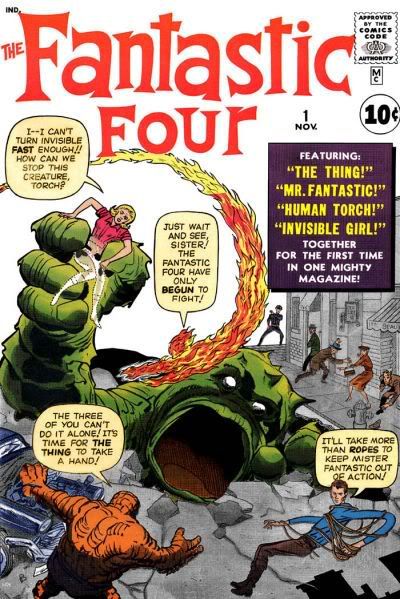
When we look at Fantastic Four #1, we're looking at something fairly raw and even clumsy.  The plot mechanics barely stand up to close scrutiny.  Why in the hell would a top scientist take his girlfriend and her kid brother on an illegal rocket jaunt?  Even by the lax standards of comic book logic, that's pretty stupid stuff.  Kirby's art seems relatively timid, not at all the bold, bombast we've come to associate with the King, and it's poorly served by gloopy inks.

Perhaps we have to put it into context, stack it up against DC's contemporaneous efforts.  I know the talent were doing their level best to put out good product, and a lot of these guys and gals rank pretty high in my pantheon of greats.  Plus there was this little thing called the Comics Code.  The last time someone tried to do something truly interesting with comics, the government got involved and not to say, "Nice job you're doing entertaining the little chaps, Mr. Gaines!"

But despite a few stand-out stories and some awesome-- if a little mechanical and stiff at times-- art, the formula wears thin pretty fast.  DC comics of that era don't really seem to be about anything in particular.  Especially if it's an "Imaginary Story!"  Which might be more interesting than any of the so-called "real" stories because it dares embrace weirdness.  So if you ask me what issue was it where we saw Superman turn into a fat version of himself or when did he grow a long beard or turn into a gorilla or gain a whole new set of powers or whatever, I'm likely to answer, "All of them."  What does it really matter?

Now imagine you're a kid who's starting to feel a bit jaded by all of this and you see the cover of Fantastic Four #1 glaring out at you from the newsstand like a pugnacious new kid to your neighborhood.  A little loud-mouth with a dirty face.  It's rude, it's coarse, it's even a little ugly.  But you can't take your eyes off this newcomer.  You open it and the inside is more of the same. And look at that squashed orange guy ripping that tree out of the ground to hit his friend with it.  Immediately, you sense it's got something those tight-assed DC comics don't have.

Charisma.  That's it.  It's got charisma.  The plot isn't just some one-off that's essentially the same as last month's with the details changed.  You probably don't even question Reed Richards's poor decision-making process.  That might be due to the frantic pacing, but I like to think it's because Stan and Jack are going somewhere and taking us along with them.  It's not just a plot; it's an actual story.  It matters.  Or at least it does by comparison to its competition.

And it just got better and better until DC was forced to react and turn to new talent, style experiments and the like (I'd argue Marvel inspired DC to put out a lot of their cooler books, even if they didn't sell all that well).  By the time Doctor Doom shows up in Fantastic Four #5 (July 1962), things are really starting to cook.  From that point, issue-by-issue, you get to witness Kirby come into his own again, giving his career that huge push that made him the super-legend he is today and Lee develop the inimitable voice of Marvel, bizarrely made up of WWII-era slang and hyperbolic carnival barker come-ons.  It's captured there for constant rediscovery on Comixology, the same way recordings capture the exponential aesthetic growth of the Beatles from "Love Me Do" to "Carry That Weight."

My favorites, though, are the Fantastic Fours inked by Chic Stone.  They have the energy and slightly unformed quality of the earliest issues and a little bit of the structure of the later Joe Sinnott-inked issues, which leave me a tiny bit cold.  I like Sinnott's slickness, but his issues just don't have the energy of Stone's.  To carry the Beatles analogy a bit further, it's kind of the way I admire the heady pop craftsmanship of Abbey Road, but I end up listening to the peppier Help! and back-to-back self-topping albums Rubber Soul and Revolver more often.

Anyway, the first 30 Fantastic Fours are now available on Comixology and I own them.  I plan to keep buying these until they get just past the Galactus caper.  After that, a lot of the energy and charisma seeps out.  You get the idea Stan and Jack were looking elsewhere after that point.

Monday, August 8, 2011

Happy 50th Anniversary, Fantastic Four!

Hey Reed, Sue, Johnny and Ben! I love you guys! No matter what Marvel does to you, you'll always be the First Family of Comics.

The Fantastic Four was not my favorite comic when I was a kid. I liked the Saturday morning cartoon versions, but it wasn't until my then-favorite artist, John Byrne, took over the magazine's writing and drawing that I started reading it. From what I remember of the letter pages, other readers felt Byrne recaptured the aura or specialness or mood of the Stan Lee-Jack Kirby era, and I wanted to know what that meant. If it meant stories about a group of people who obviously loved each other-- despite their occasional spats-- and household drama growing to cosmic proportions, along with a lot of creepy sci-fi-type menace, then I knew I had to somehow read those old issues.

But who had $1,500 to spend on a comic book? That was the going price for The Fantastic Four #1 at the time. I think. I bought a few cheap issues from late in Kirby's run as artist-- they looked dynamic and kind of slick, thanks to the Joe Sinnott ink polish, but the stories themselves didn't do a whole lot for me. They just seemed like the same tired stuff I was reading in other comics. Fist fights and villains in garish costumes. The hoary Marvel bombast courtesy Stan Lee: "If This Be Flatulence!" "By Arthropods Denied!" "If Thine Eye Offend Thee, Doctor Doom!" "A World Dies Screaming as Black Bolt Orders Pizza Pies!"

Marvel eventually reprinted the series in their Marvel Masterworks hardcovers-- which were also ridiculously expensive-- and then various other more affordable formats, so I was finally able to read the series from the beginning. The first few issues were crude, with rushed-looking art and clumsy stories. The characters were mere ciphers, barely more than stock types. The scientist, the girlfriend, the kid and the...

The Thing. That's what The Fantastic Four had going for it, right from the start. The Thing. Looks like a monster, has the broken heart of a man. And the stories began to improve. By issue #5-- the first appearance of longtime Marvel mainstay baddie Dr. Doom-- Stan the Man and Jolly Jack had gelled and the Marvel Era as we came to know it was born. Reed, Sue and Johnny became more believable as flawed individuals, their enemies original. From there things just got better and better. The book developed a tone unique among comics at the time, at least the ones I've read. I'm trying to avoid historical generalizations here, because I wasn't born until The Fantastic Four was almost seven years old and I'm hardly a historian.

But you know what I mean. The marriage of the superheroic with the supermundane. One minute Reed Richards would be espousing some idiotic theory with Sue Storm petulantly demanding he spend more time snuggling with her, the next the Thing and Johnny Storm would be tearing up the place with their interminable sibling warfare. And then and only then would the issue's menace appear. Dr. Doom again. An alien child. The Skrulls. The Impossible Man. Irving Forbush. Danny Kaye. The New York Mets.

Despite his having been an established pro since the 1930s, it was during this time Kirby's art took on its characteristic visual power and he became the Kirby we know and love today. By the time Chic Stone took over on inks, Kirby had established himself as the King of Comics. Then came Joe Sinnott and his more polished finish and you had the Marvel House Style, a visual lexicon that matched Stan Lee's endless hyping and hucksterism-- the kind of comedic self-aggrandizing style that's so much fun to parody. 1940s army slang mixed with beatnik expressions and Madison Avenue ad-man copy, the occasional foray into Shakespearian syntax. 'Nuff said, True Believers!

The ideas began to flow at a feverish pace. I can't even keep them in order! The Inhumans, The Watcher, Silver Surfer, Galactus, the Blue Area on the Moon. The Yancy Street Gang. Wyatt Wingfoot. Alicia Masters, the gentle, blind sculptor whose love for Ben Grimm made the poor guy's life even more beautifully tragic. It seemed like every issue of The Fantastic Four was in danger of exploding from the pressure of too many concepts and characters against the thin skin of the gray newsprint they were printed on. How could one slender comic book contain so much? Look out! IT'S GONNA BLOW!

And finally, it did. Lee and Kirby began repeating themselves and soon Kirby was off at DC creating a new universe. But let me tell ya, the first 51 or so issues of The Fantastic Four are pop art masterworks. The encapsulate a lot of the vibrancy of the 60s. Watching Lee and Kirby grow into their creative powers issue by issue is a lot like listening to the Beatles' recorded catalog from beginning to end. The comics are very much of their time and in that, they're timeless.

Friday, April 29, 2011

Hi, Crystal! My totally random appraisal of Fantastic Four #82

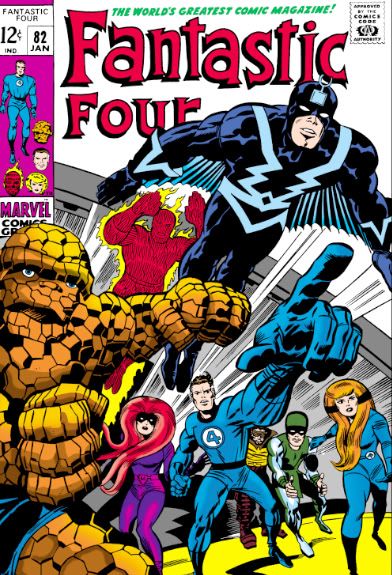
It's Fantastic Four #82 here to entertain us with jokes and repartee and perhaps some juggling and then some name-dropping anecdotes about meeting John and Yoko at a gallery opening, staying in a hotel suite next door to Mick and Bianca, guest-hosting The Tonight Show during the Carson Era before feuding with Johnny and being banned for life, growing a long beard and attempting to oil paint in the south of France...

Yes, Fantastic Four #82 has seen it and done it all. What a life it's lived! Oh, Fantastic Four #82! If only you'd finish those memoirs.

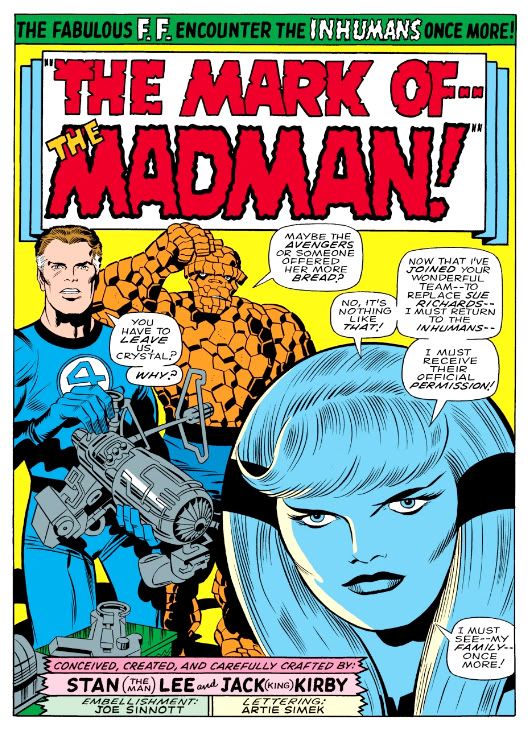
I've forgotten why I found these images from Fantastic Four #82. The story inside is titled "The Mark of-- The Madman!," which is pretty generic for something by Stan Lee. Little bombast, other than the exclamation point. Sue Richards has left the team and Crystal of the Inhumans has joined to replace her. We all know Sue as the Invisible Girl/Woman, with powers of invisibility. But what of Crystal? She can control the basic elements-- fire, air, earth and water. While invisibility has some obvious uses in terms of stealth and defense (especially Sue's famous invisible force fields), Crystal can move water and earth, combine elements to create weather. And she's stronger and more resilient than a normal human. Pretty useful as well. And yes, I know Sue later learned to use her invisible force field offensively as well. My point is, if you can't have one, the other will suffice.

I'm not sure I understand the whole "four elements" limitation. Why would her command of molecules stop merely with the ones that make up those particular things? Probably due to some literary reason haphazardly borrowed from Greek myth or something, but one wishes Stan Lee had thought through the implications of Crystal's powers. She might be more formidable than anyone-- including herself-- even suspects. Forgive me if some clever writer eventually worked this idea into Crystal's narrative. I haven't read a story with Crystal as a major player in it in years. But I do know Crystal also has a cool black headband.

Unfortunately, as a subject of Black Bolt, king of the Inhumans, Crystal isn't free to choose her own life. So despite the FF's kind membership offer, she has to run back to the Hidden Land to ask her monarch for permission. As for me, I prefer democracy. And since there's a madman promised in the story's title, of course the whole gang has to tangle with Maximus. This is a Fantastic Four issue from late in Stan's and Jack Kirby's run where they were recycling ideas that once seemed so fresh. Imagine how mindblowing the Inhumans were when they were introduced in Fantastic Four #45, "Among Us Hide... the Inhumans!"

Even the title is cooler, slightly ominous. Sinister, even! They're inhuman. They're among us. And they're hiding, no doubt for some nefarious purpose. Your neighbors might be one of them! Or a family member. This is why you must do as I do and call the Department of Homeland Security every day at 10pm and report any and all suspicious activity you might have observed in your workplace, your school, your church and even your very home.

Here we are, almost 40 issues later and the Inhumans are still having to deal with Maximus the Mad. This time he's got a gun that can hypnotize the entire earth and make slaves of everyone. In the next issue, it ends as lamely as you might imagine. Seems like Stan at the time was losing interest.

But Jack Kirby's art is still pretty sweet. Joe Sinnott is not my favorite Kirby inker, though.

Don't get me wrong. I like Sinnott's finishes a lot. They're super slick and they really pretty up Kirby's pencils. This is how comics tend to look in my mind when I'm making up my own (then when I try to draw them they look exactly like Alex Toth and Al Williamson got together and drew them holding pencils with their feet). It's just that I prefer the "purer" Kirby that resulted when Mike Royer inked him and followed his pencils more closely, without "fixing" things. I also love Chic Stone on Kirby. Stone-inked Kirby is a lot of visual fun, with thick contour lines around the characters and thinner interior lines for contrast-- not a lot of feathering or those zig-zag Kirby shadows Royer so ably brought out, but a funky, low-tech Kirby.

So it's more a matter of my own peculiar sense of what's appealing. If I had to rank Kirby inkers, I'd list Royer first, then Stone and then Sinnott. I believe Kirby once said he liked Wally Wood best among his inkers. I hate to disagree with the King, but I find too much Wood there and not enough Kirby. I'd rather see Wally Wood inks on Wally Wood pencils than an awkward melding of two different approaches to figure construction and lighting. Kirby's figures are more lit from within, they provide their own light. Not exactly conducive to Wood's "double lighting" feathered chiaroscuro work.