Showing posts with label Irv Novick. Show all posts

Thursday, October 9, 2014

October is Spookey Month: Batman #319 (January 1980)

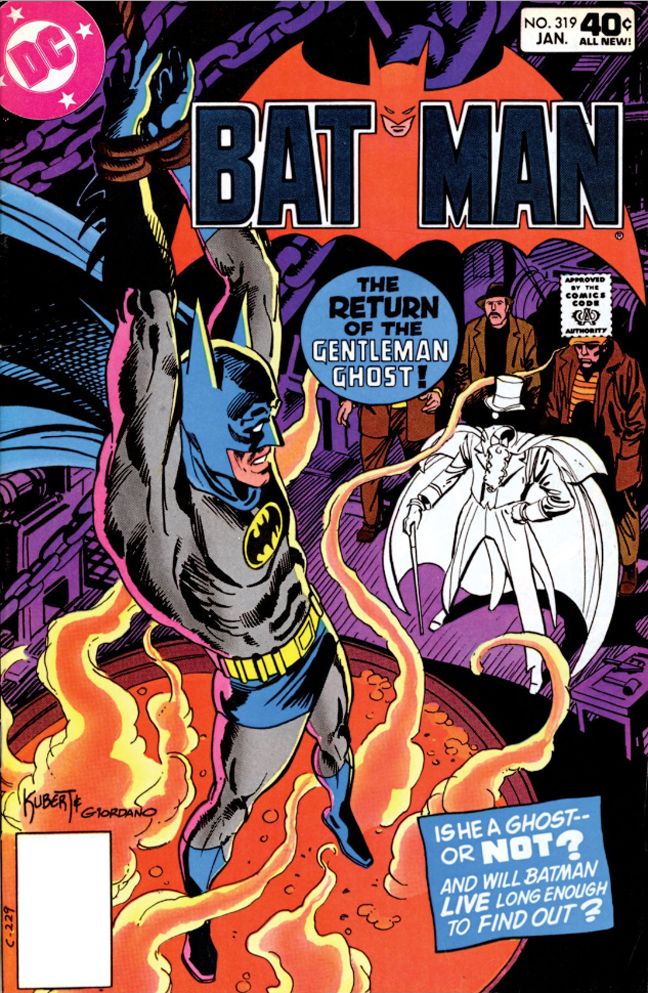
Batman #319 (January 1980) sees Batman and Gentleman Ghost battling once again.  This mean we get a Halloween treat in the form of a spectacular Joe Kubert cover with Batman in pulpy danger, suspended over a bubbling vat of wholesome Campbell's Tomato Soup with milk added.  Just like my dad loved to do!  Dick Giordano inks and the result is as rich and creamy as the soup Gentleman Ghost plans to dip Batman into.  Eerie underlighting and a line quality that's recognizably Kubert but somewhat cleaner and not as expressionistic.

The story starts in mid-action, just like the previous Gentleman Ghost appearance.  Batman once again interrupts the Ghost and his henchpeople in mid-heist and ends up hoisted by his own cape.  While starting stories like this instantly ups the energy level and leads us to expect something rapid-fire and thrilling, there's a danger of this approach devolving into formula.  But Batman's dilemma-- which writer Len Wein points out is self-inflicted due to Batman's cape being rip-resistant, a helpful quality in most situations but not when you need it to tear so you can free yourself from a dangling hook-- proves startling and original in its details.  Wein also uses it to show that Batman, while fallibly human, is also resourceful and dangerous even when apparently helpless.  Never count out the Caped Crusader, as Gentleman Ghost finds before cleverly making his own escape.
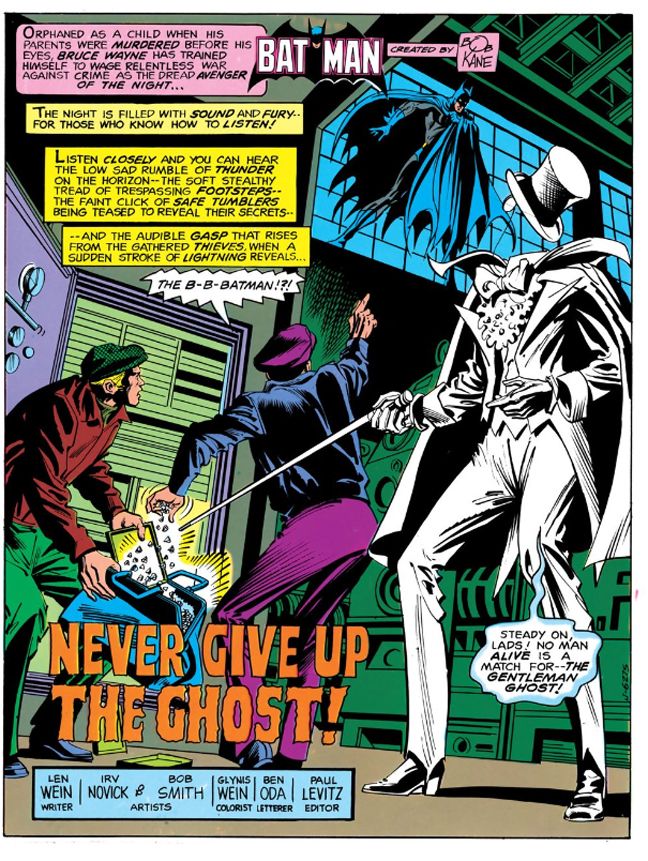
Script: Len Wein/Pencils: Irv Novick/Inks: Bob Smith

From there we find Batman setting a trap for the Ghost, with a Halloween-appropriate setting.  He plans a costume ball at Wayne Manor with jewels on display as bait.  Gentleman Ghost finds this irresistible, and once again Batman ends up dangling from a hook.  This time over boiling soup.  I mean acid.  It's not tomato soup.  It's a vat of acid, a wicked comic book convention.  This time Wein shows us the mechanics of a Batman escape.  The story has the feel of someone working through all those classic Batman tropes.  The death traps, the fist fights, goofy henchpeople (somehow the very British Gentleman Ghost has found a couple of very British oafs to help him, one named, fittingly enough, Alfie) and another ambiguous ending.
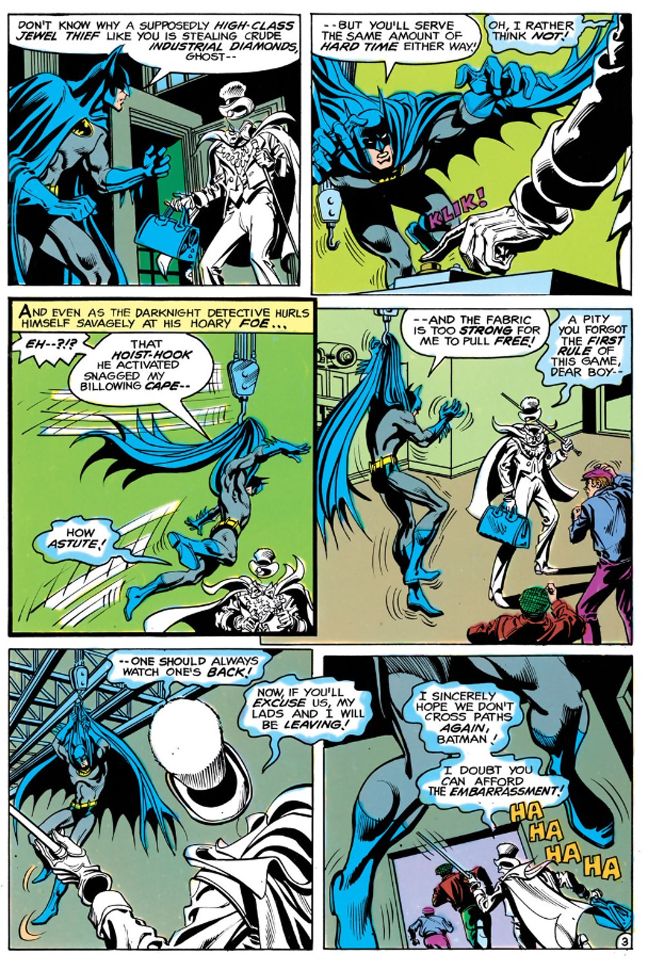
Script: Len Wein/Pencils: Irv Novick/Inks: Bob Smith

We still never learn if Gentleman Ghost is a real ghost or not.  His lackies disguise themselves as the Ghost as a distraction and Wein suggests the headless quality is mere fakery when one of them is revealed to be merely hunching down.  That doesn't explain the floating top hats or monacles.  Later there's a bit with a convenient hologram projector which also seems to tell us the Ghost is more technological trick than supernatural treat, but Wein leaves the truth of the matter hanging, kind of like his Batman this issue.  You can have it either way.  He's a clever illusionist with a creepy gimmick or he's a creepy ghost with a penchant for high-tech chicanery.
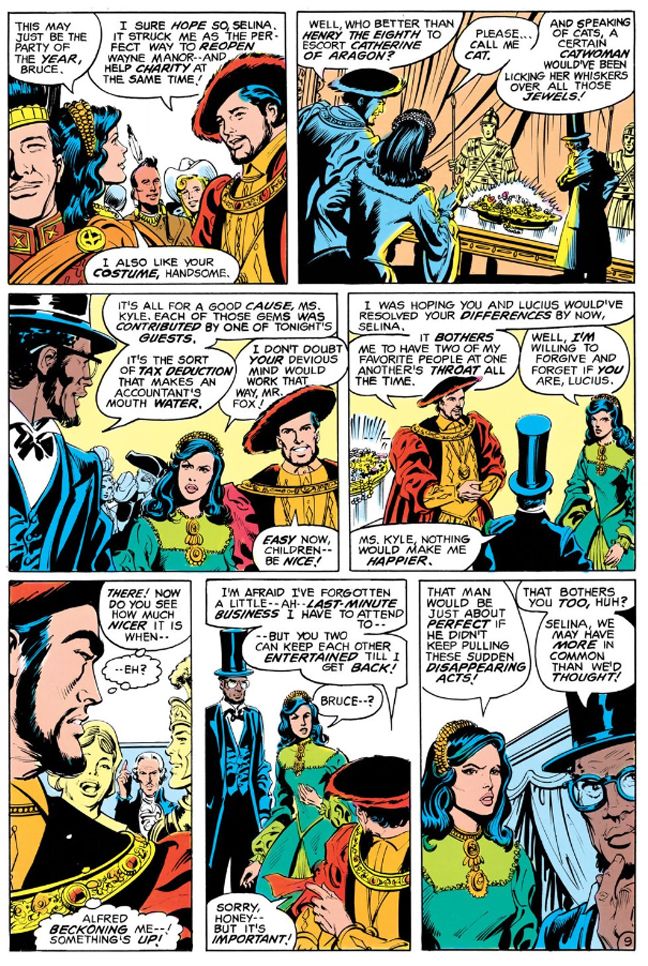
Script: Len Wein/Pencils: Irv Novick/Inks: Bob Smith


It's up to you!

Irv Novick once again pencils, but this time Bob Smith inks.  Smith's line is thinner, sharper, more angular than Giordano's.  Well-defined figures and clarity of action make this issue very appealing throughout.  Batman is almost always on the left side of the panels, inciting things in the proper reading order so you get this forward thrust and momentum that carries through all the way to the end.  With Novick and Smith the crowded costume party has focus and detail, with one wide panel that's a treat to linger on.  Batman comes as Henry VIII, Selina Kyle as Catherine of Aragon ("Please... call me Cat," she quips) and Lucius Fox is Abraham Lincoln.  You can make out a plethora of other historical personages surrounding them and even when the Gentleman Ghost and friends gate-crash, Novick and Smith maintain a clear sense of where everyone is relative to each other.  Even when Selina Kyle and Lucius Fox abruptly switch sides so Fox can occupy the foreground with his thoughtful countenance you're not likely to freak out with the change and fall out of the story.  Good, solid stuff.
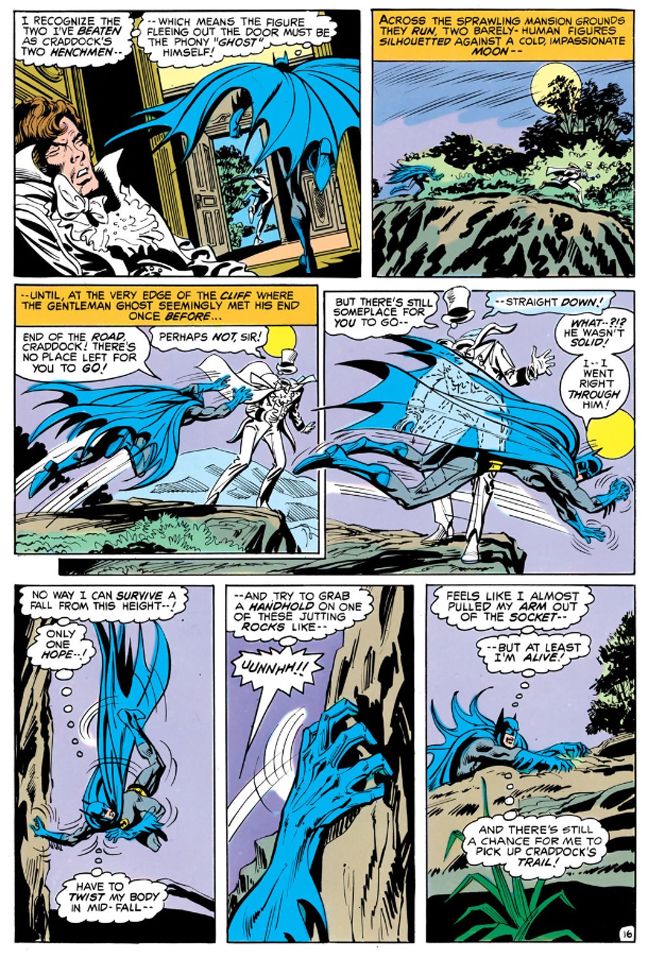
Script: Len Wein/Pencils: Irv Novick/Inks: Bob Smith

The issues I've read of this Wein run are sleekly enjoyable reads.  He drops exposition into dialogue and gives us meaty narrative captions to chew on while we enjoy the visual banquet Novick and Smith provide.  Very tasty stuff, the kind that satisfies.

Thursday, October 2, 2014

October is Spookey Month: Batman #310 (April 1979)

Batman #310 (April 1979) is a comic I bought solely for its cover.  Even back then I was a big Joe Kubert fan, and I believed the cover artist always did the interior art.  I was wrong.

Choosing Kubert as cover artist makes perfect sense because he and Robert Kanigher co-created Gentleman Ghost as a Hawkman/Hawkgirl adversary.  Gentleman Ghost debuted in Flash Comics #88 (August or October 1947, take your pick) but I’d never heard of him.  Why?  Because I never read any Hawkman comics.  Never had anything against Hawkman, just wasn’t my thing. 

Joe Kubert, on the other hand, certainly was and still is very much my thing.  Being 11 years old when this comic book came out I had no idea he’d ever done anything other than war comics and Tarzan.  A chance to see him draw a Batman story piqued my interest, but I can’t say the Irv Novick-Dick Giordano team that actually did the inside art disappoints.  They do a bang-up job.  Theirs is my ideal visual representation of Batman.  He has human proportions and he's not always gritting and grinding his teeth to the point where his molars must be just about gone.  He's a serious guy, but he has recognizably human emotions!
 
Here we are 35 years later and I’m still not particularly into Hawkman and my knowledge of Joe Kubert’s long comics career remains spotty at best.  I love his art and still adore this attractive, exciting cover, though.  I just find it odd I’d have an Irv Novick comic and never have it click with me despite coming to appreciate his solid Bat-work from all the reprints I’ve read over the years.  Maybe it’s not so odd.  I once had a Russ Heath Sgt. Rock and didn’t realize it until much later.  Same with a Rich Buckler-Bernie Wrightson Batman book.  I’m kind of an idiot.


Script: Len Wein/Pencils: Irv Novick/Inks: Dick Giordano

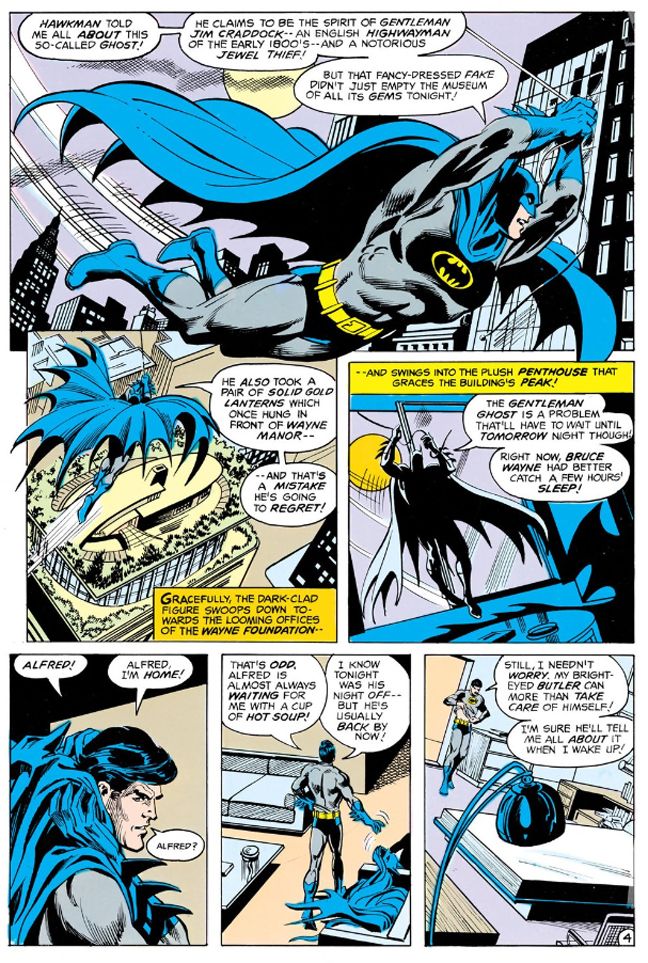
The story, titled "The Ghost Who Haunted Batman," is a jaunty, assured effort by all involved.  It would have made an excellent episode of the 1990s Batman: the Animated Adventures TV series.  Len Wein's script sets up a neat double mystery and wraps it all up in a single issue.  One one hand we want to know why is Gentleman Ghost, known for stealing jewels, suddenly after things like antique lanterns and furniture?  And on the other, where did Bruce Wayne's loyal butler Alfred Pennyworth disappear to?  Wein also plays the whole "is Gentleman Ghost a real ghost, or is he just some clever illustionist with a gimmick?" routine to great effect.  Batman remains pretty skeptical of the supernatural throughout, and when his bat-rope falls ineffectively between Gentleman Ghost's cuffs and gloves, he's disturbed.  But not enough to stop scoffing, as when he sneers, "Mister, you're about as supernatural as my shoe."

No doubt like Batman himself, I distinctly remember expecting some kind of prosaic explanation at story's end.  A special effects artist or magician revealed in an unmasking...

What I admire about this book is how every moment moves the story forward or reinforces the then-current Batman status quo.  There's no waste.  Even for a reader like me, who bought books based on whim and might go months between Batman purchases, could pick this issue up and learn all its players and how Batman relates to each of them.  There's a quick bit of Catwoman romance, a Lucius Fox appearance and even a return visit to Wayne Manor, and yet the central plot remains at the fore.  It's a quick read and certainly no gyp for being self-contained and short.

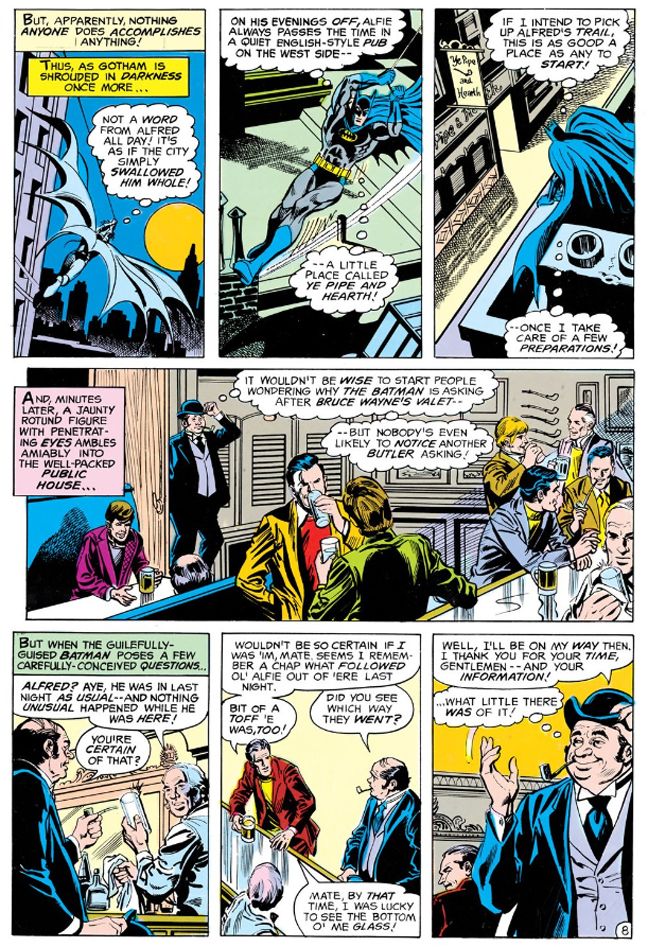
One of my favorite scenes in this book comes when Batman disguises himself as a portly fellow butler to infiltrate a UK-themed bar where Alfred likes to hang out on his nights off and brag to anyone who will listen and buy him a pint about his awesome job with the Waynes.  In the interest of blending in, Batman goes for the old school stereotype complete with bowler and crooked little pipe.  He kind of goes from one panel in his Batman jammies staring down at the pub to the next walking-- the caption tells us it's a mere few minutes later-- in all dressed up with a waistcoat and padded suit.  I'm not sure how Batman pulls this off so quickly when he doesn't even have his Batmobile around to carry things for him, but Wein doesn't let a little detail like this slow the story's pace.

Script: Len Wein/Pencils: Irv Novick/Inks: Dick Giordano

I like to imagine Batman spouting off with a Dick Van Dyke-quality accent and all the ex-pat Brits mocking him after he leaves.  For the story's purposes, Batman probably puts on an accent not only dead-perfect for some particular region of the UK, but also a specific neighborhood.  Came up with a complete biography for this one-off character and everything.  He is a master of disguise, after all.  He's right that it would be odd for Batman to go around asking about Bruce Wayne's butler-- but why doesn't he go in as Wayne?  Because subterfuge is fun!
 
Novick and Giordano lovingly create a creepy, fog-bound mood throughout, turning Gotham City into a vast haunted house.  The atmosphere compares favorably with that ultimate night-bound comic, Marvel's Tomb of Dracula.  And Gentleman Ghost makes an excellent Batman foil.  I’ve always enjoyed Batman stories where he comes up against the supernatural and he’s left a bit befuddled in the end.  Batman benefits from being depicted as vulnerable and not as hyper-competent.  Nowadays he’d anticipate Gentleman Ghost’s every move and have some kind of pre-built anti-ghost device.  In 1979, a hypnotized Alfred could sneak up behind him and knock him out with a heavy gold lamp and he could be deked by an empty suit, then try and fail to save Gentleman Ghost from a carriage crash.  The final scene certainly lives up to the story's title as Batman is left there with the Ghost’s mocking laughter ringing in his ears in one of those ambiguous “just what the heck was that guy?” endings. 
 
Batman and Gentleman Ghost would tangle again shortly and we'll talk about that one when I get the time to read it and react to it.

Wednesday, October 30, 2013

October is Spookey Month: The Joker versus the Scarecrow!

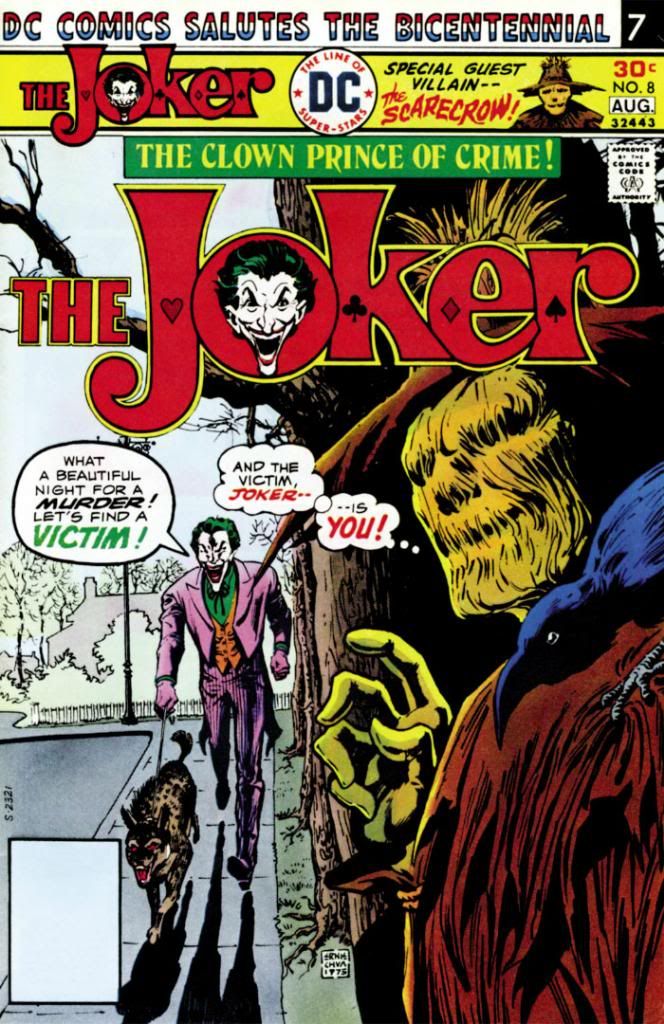
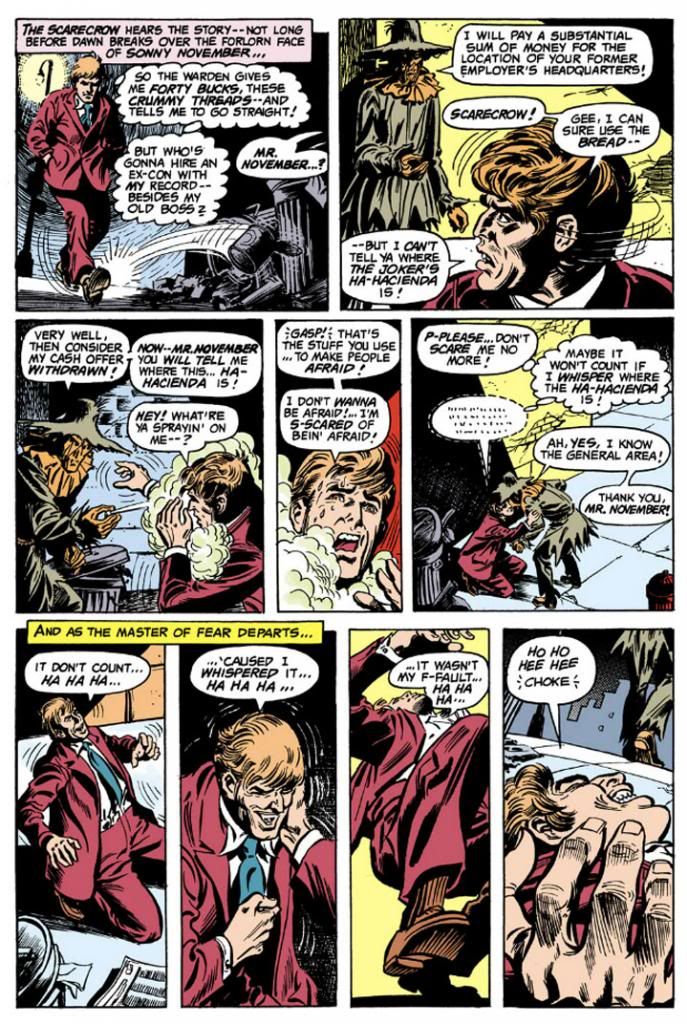
If there's a DC super-villain made for Halloween, it must be the Scarecrow.  He likes to scare people, people like to be scared on Halloween.  The Joker #8 (August 1976) pits him against our titular anti-hero over a batch of new-fangled fear gas developed by those happy-go-lucky chemical warfare specialists down at S.T.A.R. Laboratories.  What's startling about this book is despite its sunnily appealing Irv Novick-Tex Blaisdell art, there's a body count.  I'm simply fascinated by this dichotomy, which gives the book a mood of joyful nihilism.  Innocent people die, and so does a not-so-innocent.  The Joker himself says it best right there on the cover, "What a beautiful night for a murder.  Let's find a victim!"

While we're looking at it, that's a nice Ernie Chan cover.  Once again, Chan had to sign it "Chua," thanks to some kind of bureaucratic goof involving his work visa.  Whoever colored it didn't quite capture the essence of night, though.  No matter.  The lurking Scarecrow provides a lot of menace that's missing in the cheerful story itself.  I mean despite all the killing.

And now a special message to you, the reader!

Dear Reader,

How have you been?  Did you have a nice summer?

Okay, let's discuss something perhaps you can help me with.  This story brings up something that's troubled me for a long time.  I just can't imagine why your average, ordinary, work-a-day criminal would ever join the Joker's gang. 


Being a Joker henchperson has such a high fatality rate.  One touch you can almost count on in any Joker story is when the writer decides to present the Joker's bona fides as a dangerous lunatic by having him off a henchman.  This time writer Eliot S. Maggin floats the clever idea the Joker instills a post-hypnotic killing suggestion in all his employees.  If any of his gang rats him out, that person laughs himself or herself to death.  Good deal for the Joker, but a terrible burden for his lackeys.

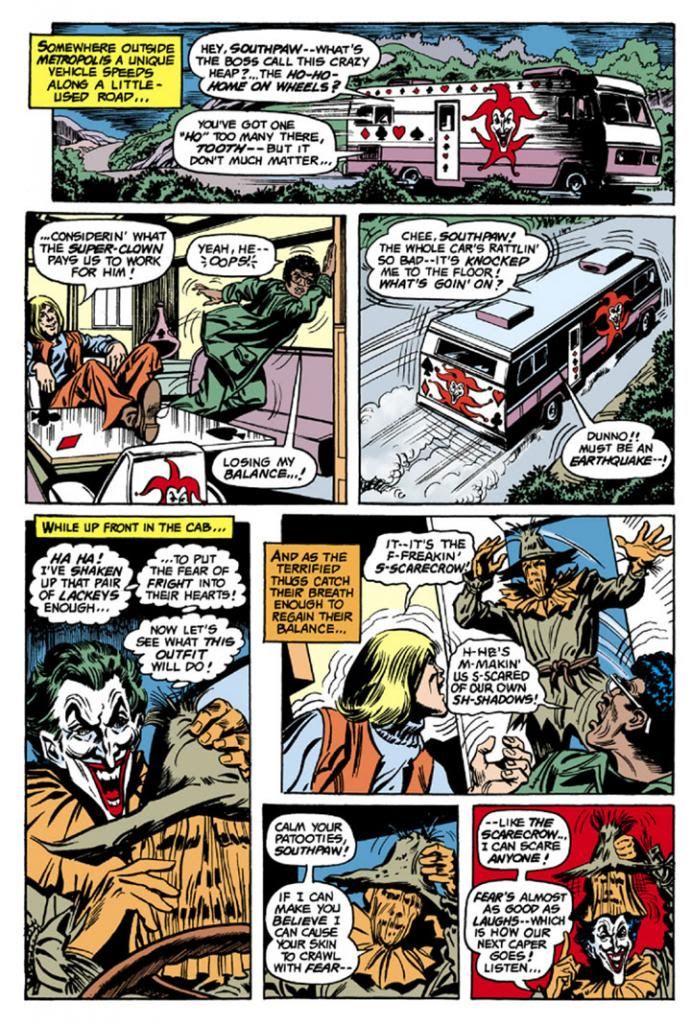
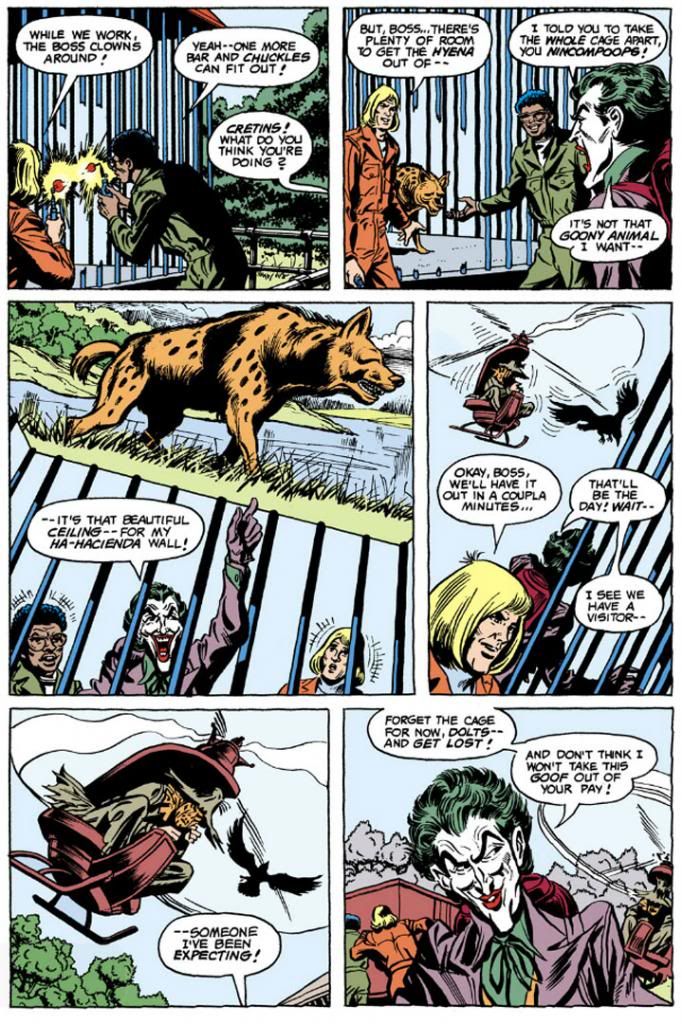
While there's no riskier occupation in the DC universe than Joker henchperson, there is virtually no reward in it.  Most of us grow up with the idea of risk versus reward.  The greater the risk, the greater the expected reward.  What's the reward for members of a Joker gang?  Even if the Joker decides to steal, say, a solid gold statue of famous clown Emmett Kelly, he's not doing it to melt the metal down and sell it off and split the profit equitably, or even to remove it from the market in hopes of increasing the value of his own stockpile (although a single statue would hardly do that) as when Auric Goldfinger colluded with communist China to irradiate the United States' gold reserves at Fort Knox.  The Joker operates whimsically.  He steals that statue because Emmett Kelly appeals to him in some personal way and he just wants to look at it.  In this story, the Joker takes the fear gas so he can use it to steal the ceiling out of a hyena cage because the painting on it would make a pretty decoration for his "Ha-Hacienda," a kind of Winnebago of crime he and his gang drive around in.  


Yet the Joker never seems to lack for lackeys, does he?  It's easy to understand why the Joker would appeal to anarchists, weirdos, cultists and anti-social types.  Even Charles Manson has fans.  But as far as I know, no writer has attempted to explain the attraction of working for the Joker to the Rockos and Leftys out there in Gotham City and Metropolis.  The blue-collar professionals-- safe-crackers, strong-arms, grifters, B&E boys (and girls) and car-thieves-- with families to feed. 

Here's where you come in, loyal reader.  Has any DC writer addressed this in a story?  I know Alan Moore had the Joker employ carnival freaks in Killing Joke-- which makes a lot of sense-- but never explained their motivation for taking part in his spree.  Every other Joker story I can think of features more conventional criminal types.  What's their attraction to the Joker?  I can only conclude lawbreakers in the DC universe must be even bigger idiots than real-world criminals.

Thanking you in advance!

Sincerely,
A Dope

Oh yeah!  I forgot all about the Scarecrow!


He flies into the comic in a teensy-tiny helicopter with his knees jutting skyward as if he's Disney's Ichabod Crane (a partial inspiration, I believe) on his horse at the end of the classic The Legend of Sleepy Hollow segment from their 1949 package film The Adventures of Ichabod and Mr. Toad.  He and the Joker engage in a duel right there in the zoo, and Scarecrow makes a complete ass of himself.  Oh well, to hell with him.  Here's Der Bingle singing about the Headless Horseman...


Here's Thurl Ravenscroft doing the same...


Happy Halloween, everyone!

Tuesday, May 17, 2011

Wonder Girl was right all along...

Back in the 1960s, one criticism of America's space program was that it leeched funds away from more urgent needs, i.e., education, feeding the poor, caring for the elderly and the war in Vietnam. Nonsense! What could be more necessary than NASA's greatest mission?


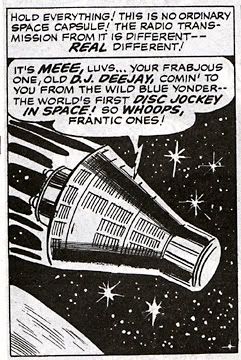
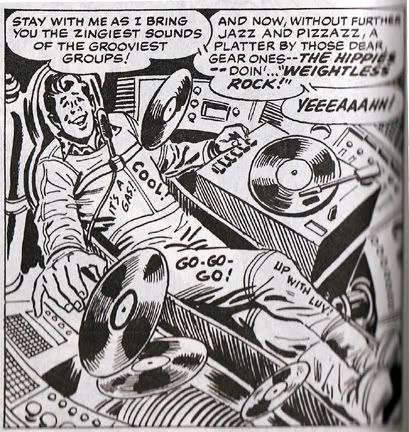
That's right... blasting off from the Kennedy Space Center at Cape Canaveral at the cost of millions of taxpayer dollars, we find D.J. Deejay, a man who proves the theory that our names control our destinies! And what's America's first space disk jockey up to?


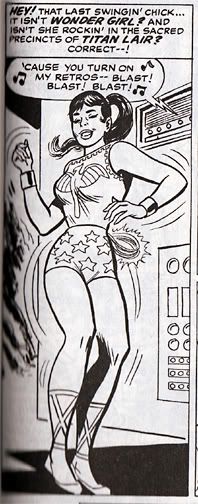
Covering his spacesuit with dated graffiti and trying to bridge the generation gap via some desperate-sounding hipster lingo! Faced with an adult world that resorts to madcap stunts like this in a desperate attempt to lull into complacency the hapless populace while waging war and mass-murder across the globe and using up every natural resource... what else can a teen from the Amazonion society of Paradise Island do but...


Dance! The Soviets have invaded Czechoslovakia! There are enough nuclear-tipped ICBMs to wipe out humanity one hundred times over! Southeast Asia is burning and the smell of napalm and human flesh fill the jungle air and hover over the Mekong delta rice paddies! MLK and RFK have been assassinated and people are rioting in the streets! Why not dance the apocalypse away?


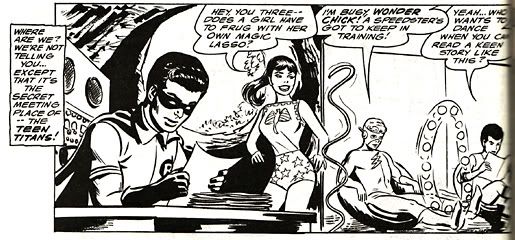
Why not dance in the face of clueless, apathetic boys?


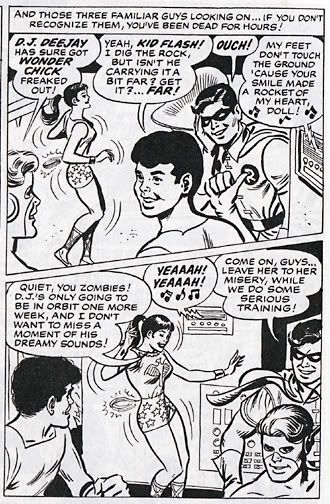
What's wrong with these idiot kids anyway? There's the third coolest chick in the whole DC Universe and all she wants to do is dance with them and they're walking away! Look! It's Wonder Girl dancing! Don't walk away... serious training? What the hell are you talking about, Robin? Wonder Girl... dancing!

Jesus... boys are stupid.

And Wonder Girl doesn't stop with dancing. She's a total hedonist! Fighting crime in the wilderness? Perfect time to take a barbecue break.


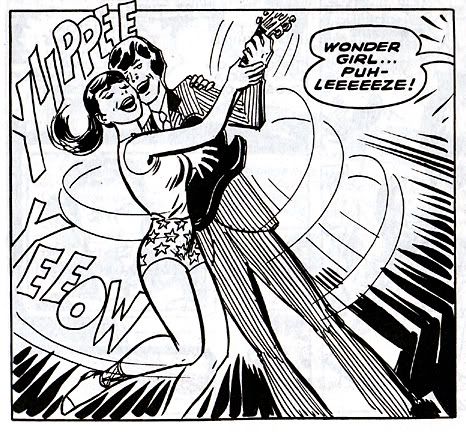
But I think this is my all-time favorite comic image:


Cardboard cutout of the latest teen pop sensation? Grab it and dance with it, in front of the world! Her joy is infectious. Wonder Girl is a girl in love with life. She's totally carefree, does exactly what the moment calls for without hesitation.

Wonder Girl puh-leeeeeeeze, indeed! Don't trammel this girl's spirit. Life is too short not to let her express her joie de vivre! We could all learn a little something from Wonder Girl. To that end...

Everyone! Dance with Wonder Girl! Enjoy life now before it's too late and D.J. Deejay comes crashing down to earth in the red-hot ball of death caused by the adult world's retro-rocket failure. No future for you, Wonder Girl. Here comes Watergate, the recession, the oil crisis, pollution, malaise, Three Mile Island, Reaganomics, Iran-Contra, the Gulf War, Monicagate, the War on Terrorism, peak oil, global warming, the inevitable consumption of the earth by our own sun, galactic entropy!

But before all that... let's dance!

What do I want? I want to write a series where THIS version of Wonder Girl... a superhero with no secret identity because she doesn't need one... not a care in the world because she comes from perfection... flies in from Paradise Island to spread mischievous cheer and fun times for all. Totally fearless, totally without inhibitions.

PS: Many of the things I referenced here actually happened a year after this comic came out, but what am I, your history professor?