I dropped some mega-bucks on DC's Silver Age Teen Titans Archives volumes 1 and 2, Showcase Presents Ghosts and Dark Horse's Star Wars Omnibus: A Long Time Ago... volume 4. These four massive books are on their way to me as I type this, through wind and rain. Yeah, it's a dark day here in Japan with changeable weather threatening to wash out any weekend activities people may have planned now that the temperatures are easing off from the sauna range they stayed in all summer long. Of course, with dengue fever closing Yoyogi Park in Tokyo, it's probably just as well. Yet within my heart is a bright, warm light and its source is anticipation of some classic comic book reading material.
The Silver Age Teen Titans Archives books particularly delight me, since this is one of those series I've fallen madly in love with. I just cannot seem to get enough of Bob Haney's socially aware writing or Nick Cardy's art. Most especially the latter. I've bought this material both in digital form and in Showcase format. The digitals, on Comixology, never seem to advance past the five or so comics available in Silver Age Titans Archives volume 1. The relatively inexpensive Showcase Titans books seem to be going out of print now. I have copies of both volumes stored back in the US, I only have one here in Japan. No luck getting the other one for a reasonable price. So my unreasonable solution was to complete my Haney-Cardy-Neal Adams-and-others Teen Titans collection by paying even more for hardcover full-color stories I already own in multiples.
Teen Titans is no mere comic book series. It is a way of life.
And since I was on a classic DC kick, what better choice to complement the superheroics than yet another Showcase Presents book featuring a horror anthology? The artist line-up in DC's old horror books reads like a list of my favorites: Cardy, Alfredo Alcala, Frank Redondo, Nestor Redondo, Sam Glanzman, Ramona Fradon, Jerry Grandenetti, Wally Wood, George Tuska, Gerry Talaoc and so many more. And with Halloween coming up, I need some fun and spooky reading material.
Finally, my addiction to Al Williamson inspired my purchase of the Dark Horse Star Wars Omnibus: A Long Time Ago... book. I have the first three, which means I have Williamson's The Empire Strikes Back adaptation. It also means I need his Return of the Jedi work. And I certainly am not going to complain about having to look at stories by Carmine Infantino, Walter Simonson and Ron Frenz with inks by Tom Palmer. This book also contains Star Wars #74, "The Iskalon Effect" (August 1983), with art by Frenz and Palmer. It's one of the few non-Al Williamson Star Wars comics I bought during Marvel's original run of books.

Showing posts with label Bob Haney. Show all posts
Showing posts with label Bob Haney. Show all posts
Thursday, September 4, 2014


Thursday, March 14, 2013
The Teen Titans versus the New Mutants-- reactions to authority in contrast
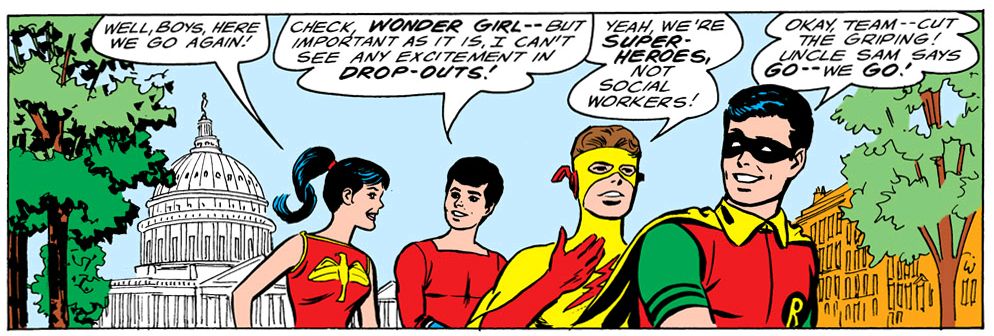 |
| Bob Haney-script/Nick Cardy-art, Teen Titans #3 (May/June 1966) |
Many years ago, before you and I were even born, the US government needed someone to help with school drop-outs. So they turned to DC's premiere group of costumed teens (most of whom were sidekicks, wards or protégés of similarly-themed adult characters). Calling Robin, Kid Flash, Aqualad and Wonder Girl to Washington, D.C., concerned officials charge them with journeying to the middle American heartland and confronting their age-peers. "Stay in school," the Teen Titans preach, "the United States government wishes it!"
People had youth on the brain back in the 1960s. While adults and kids have always had their differences, the post-WWII baby boom expanded what they used to call the "generation gap" to almost revolutionary levels. It started in the 1950s, but intensified the following decade due to the continued pressures of an unpopular war, struggles for racial and gender equality, new forms of musical, artistic and self-expression, the Sexual Revolution and even the cynical media exploitation of this huge, new-- and relatively affluent-- demographic. With even a cursory reading of history, we can, just as people did back in the 1960s, divide these opposing forces into the establishment and the anti-establishment.
When "The Revolt at Harrison High" in Teen Titans #3 -- with its heroes optimistically working for the establishment writer Bob Haney (himself a self-described socialist and pacifist) characterizes as largely benign-- hit the newsstands in the summer of 1966, the anti-war movement was already in full swing. Young people had already burned draft cards, various groups had successfully staged several
large scale anti-war rallies (Haney had participated in some by this time as well) and a number of veterans had attempted to return their medals to
the White House.
The next year, 1967, witnessed the Summer of Love and the Beatles' psychedelic masterpiece Sgt. Pepper's Lonely Hearts Club Band. Colorful Utopian dreams seemed within reach if the young simply turned their eyes to the sky in search of diamonds and tuned their sitars to the cosmic.
Then, in 1968, the world erupted, with the Tet Offensive rocking America's confidence in its military's ability to defeat a technologically-inferior foe, two major assassinations at home, racial violence, student violence, police violence in Chicago during the Democratic National Convention, a Soviet invasion of a liberalized Czechoslovakia, tyranny stamping its iron boot on the human face forever.
Things fractured further. That year, American International Pictures released Wild in the Streets, in which a 24-year-old rock star becomes president of the United States and throws people over 35 into concentration camps where they’re dosed with LSD. Coming years would see more war protests, the watershed music festival Woodstock giving way to legendary bummer Altamont, the Tate-LaBianca Murders (via the demonic influence of Charles Manson-- the perfect hippie bugbear to chill the spines of parents everywhere), the invasion of Cambodia and the 1970 Kent State shootings—an event preceded by the Ohio governor angrily denouncing anti-war protesters on campus as a “militant, revolutionary group.”
The next year, 1967, witnessed the Summer of Love and the Beatles' psychedelic masterpiece Sgt. Pepper's Lonely Hearts Club Band. Colorful Utopian dreams seemed within reach if the young simply turned their eyes to the sky in search of diamonds and tuned their sitars to the cosmic.
Then, in 1968, the world erupted, with the Tet Offensive rocking America's confidence in its military's ability to defeat a technologically-inferior foe, two major assassinations at home, racial violence, student violence, police violence in Chicago during the Democratic National Convention, a Soviet invasion of a liberalized Czechoslovakia, tyranny stamping its iron boot on the human face forever.
Things fractured further. That year, American International Pictures released Wild in the Streets, in which a 24-year-old rock star becomes president of the United States and throws people over 35 into concentration camps where they’re dosed with LSD. Coming years would see more war protests, the watershed music festival Woodstock giving way to legendary bummer Altamont, the Tate-LaBianca Murders (via the demonic influence of Charles Manson-- the perfect hippie bugbear to chill the spines of parents everywhere), the invasion of Cambodia and the 1970 Kent State shootings—an event preceded by the Ohio governor angrily denouncing anti-war protesters on campus as a “militant, revolutionary group.”
Then came further betrayals. The crushing loss of George McGovern in the 1972 election to Richard Nixon. Watergate. The energy crisis. Recession. Malaise. Cities like New York suffering from collapsing infrastructure. No wonder youth culture curdled into the nihilism and anarchy of punk rock on one hand and the mindless hedonism of disco on the other.
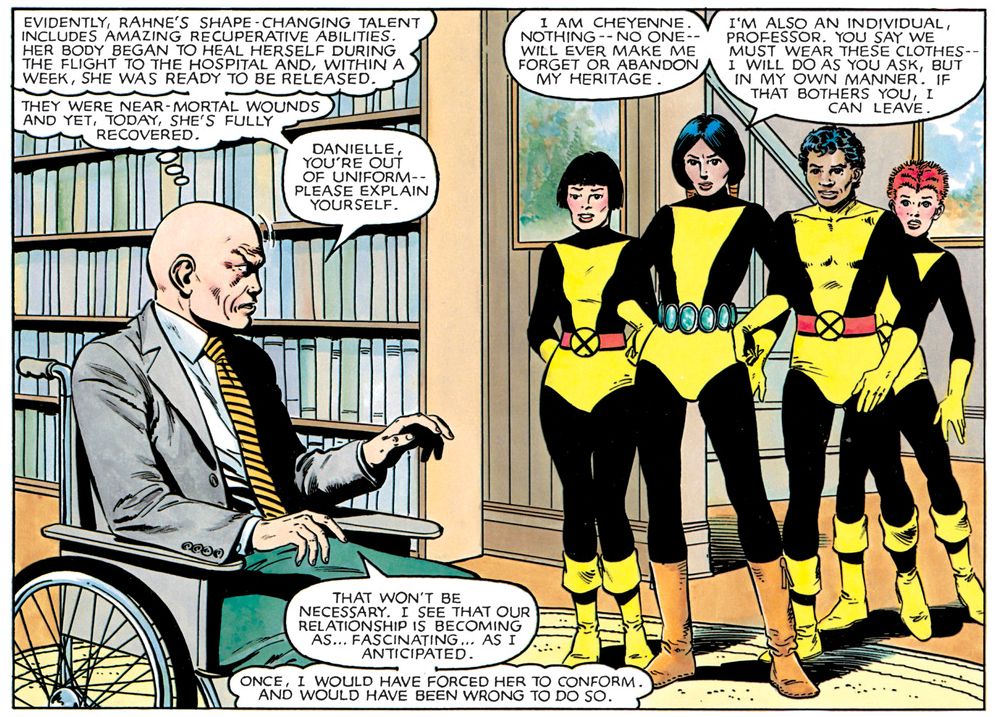 |
| Chris Claremont-script/Bob McLeod-art, Marvel Graphic Novel #4 (October 1982) |
Which might be why just a generation after the Titans marched proudly out of Washington filled with the evangelical furor and a hopeful message for high school drop-outs everywhere, Dani Moonstar of the New Mutants, Marvel’s premiere group for costumed
young people (none of whom were sidekicks, wards or protégés of
similarly-themed adult characters) responds with open rebelliousness to Professor
X’s demand for uniformity among his pupils.
And also why the Professor himself decides not to quash her
individualism.
 |
| Bob Haney-script/Nick Cardy-art, Teen Titans #3 (May/June 1966) |
The two teams take different tactics when interacting with their peers, too. In "Harrison High," the Titans act as
establishment mouthpieces, which renders their attempts at talking frankly with
their age-peers awkward and forced. They fail because few people enjoy being talked down to, especially by others their own
age. This approach pays no dividends, as
the Titans learn here. Later they take a
different tactic-- strangely enough, involving violence-- and find positive results.
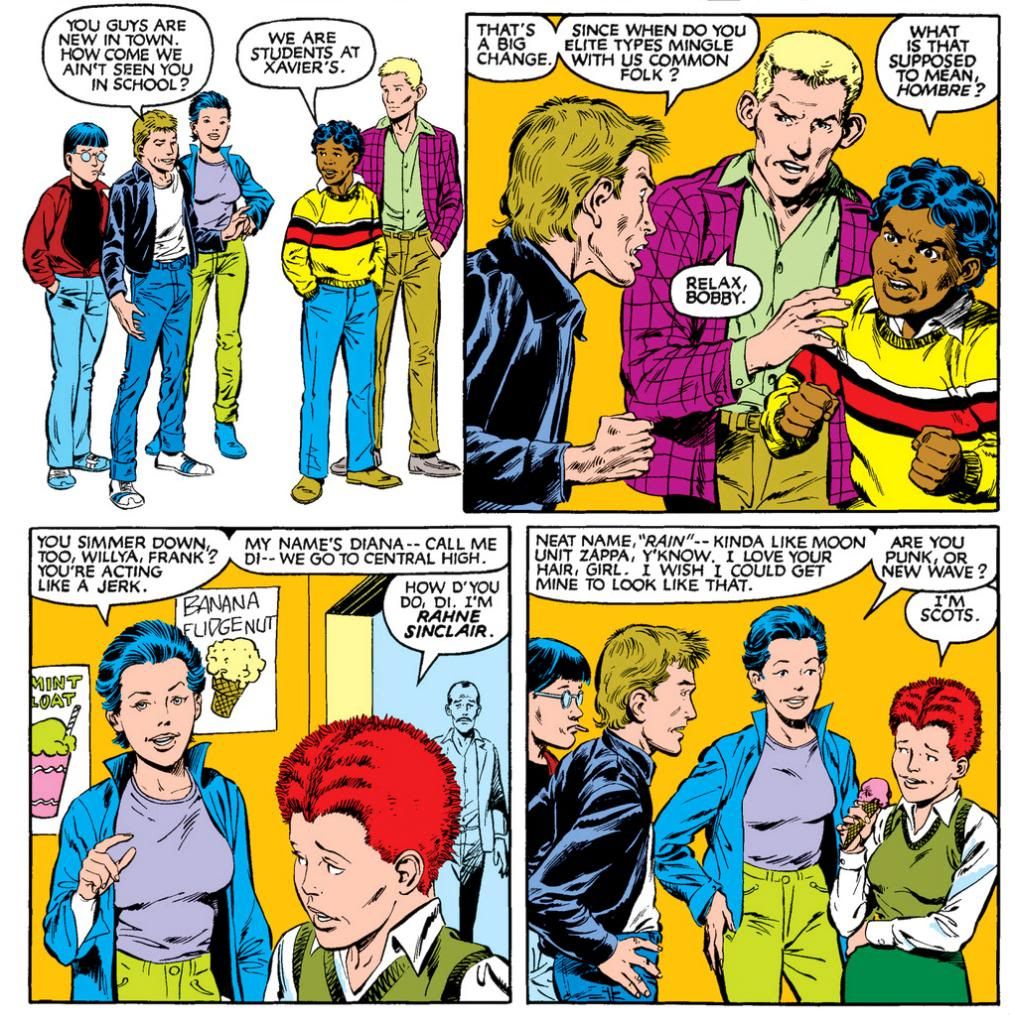 |
| Chris Claremont-script/Bob McLeod, Mike Gustovich-art, New Mutants #2 (April 1983) |
The New Mutants, on the other hand, have no ulterior motives-- certainly none that are government-directed-- and relate to people in their age demographic more or less as equals, so their interaction, while a bit contentious, is comfortingly naturalistic. Within moments, the mutant students and the townies have forged the bonds of friendship despite their socio-economic, cultural and genetic differences.
But don't let me give you the idea the Titans didn't learn to swing. It wasn't long before they got with their times and began questioning authority. They'd drop their self-righteous pro-establishment stance and come into conflict with their mentors and the adult world at large. That's an essay for another time. But just think about this-- today Robin is a grandfather and Dani is my age and they're both just as confused and troubled by today’s kids as the grown-ups of yesteryear.
Sunday, March 3, 2013
Teen Titans #3: And then they beat up "Big Daddy" Ed Roth on government orders
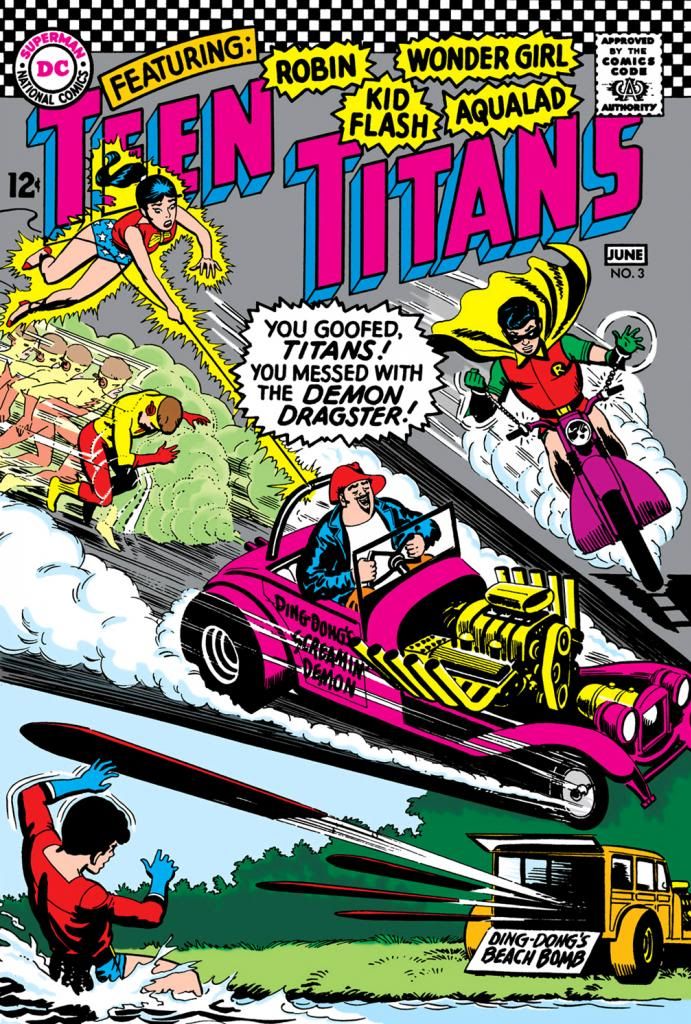
Anyway, "The Revolt at Harrison High," from Teen Titans #3 (June 1966), finds the Johnson administration trusting its anti-drop out initiative to a group of costumed kids who, if we measured IQ in houses, would have to climb up out of the basement to get to stupid. The Teen Titans in this issue are ultra-establishment types who believe when Uncle Sam says "Jump!" you jump, right across the Pacific into Southeast Asia where, if you're lucky, you come back minus just your innocence or part of your leg. Or in this case, to Harrison, USA, where statistically average teen David Robinson has dropped out of school and taken to spinning around town in a souped-up jalopy while working for Ding-Dong Daddy, who just happens to be a dead ringer for Ed Roth.
The Titans don't do much to prove me wrong about their intelligence in this issue. As soon as Robin hears about David's employer, he has the team check out Ding-Dong Daddy's Hot Rod Hive, which is a pretty obvious move. There Dowd-- a mountain of a man much like his real-world inspiration-- comes on way too strong with hip cat talk and his refusal to show anyone his secret room. Once again, the barely-sentient Robin senses something amiss-- I mean, secret room!-- and sends Kid Flash vibrating through the steel door to find a group of teen-aged boys doing what teen-aged boys do best.
No, not that. Are you kidding me? They'd go blind! Plus, that's more a hygiene issue and this is about societal ills. What these out of sight groovesters are doing is equipping an ice cream cart with a machine gun to kill cops. Robin knows this is all kinds of wrong, so he has the Titans beat a hasty yet nonchalant retreat so they can plan the next step. After tangling with a trio of Ding-Dong Daddy's hot rods and losing, the Titans disguise themselves as some less-than-convincing motorcycle toughs so they can help Danny and his no-good pals fight an even worse scourge of wholesome American highways-- an honest-to-goodness motorcycle gang called the Scorchers. The Scorchers wouldn't survive ten seconds in a rumble with the Hell's Angels. I doubt they'd last much longer against the Black Widows. Our favorite teens soon subdue the Scorchers and impress David and pals enough they help the heroes infiltrate the Hot Rod Hive where Wonder Girl-- her hair bleached blond-- entertains Ding-Dong Daddy by dancing away in his office and the boys fight some goons and a robotic gas pump.
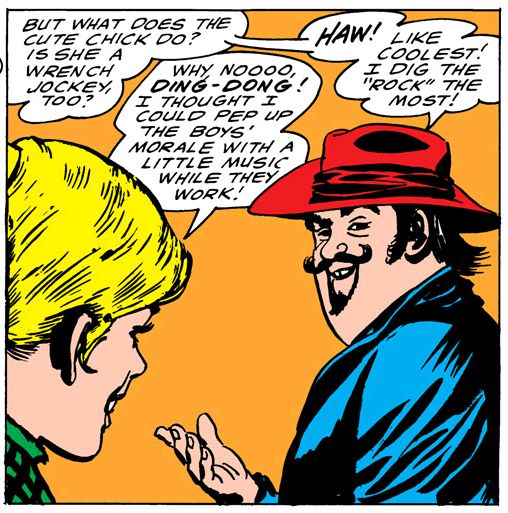 |
| You sleaze! You're more than twice her age! (Bob Haney, script/Nick Cardy, art, Teen Titans #3) |
There's even a nasty little double-entendre a few moments earlier when Ding-Dong Daddy asks, "But what does the cute chick do? Is she a wrench jockey, too?" This sets up a scene where Wonder Girl leads Ding-Dong Daddy by the arm to his office-- both figures largely silhouetted in a sinisterly suggestive way-- to "keep him occupied" (Robin's phrase, not mine). Once in the office, our bold young Amazon gyrates away while Ding-Dong Daddy, obviously middle-aged, leers at her and declares, "Haw! I like it, babe!" But the creep soon gets his as Wonder Girl takes him down herself and everyone agrees to return to school. Two years later, David Robinson gets his draft notice and it's off to Cu Chi with the 25th Infantry Division. But that's a Titans tale for another time!
Of course, there are few things less cool than middle-aged men trying desperately to capture the youth zeitgeist, but paradoxically, there are also few things cooler. Stan Lee somehow managed to do it with ease by using a lot of WW II-era GI slang ("Hang tough!" and "Face front!" come to mind), but DC never quite got with it despite their best efforts. Bob Haney lays on the teen-talk pretty thick throughout this issue, which dates it (along with its super square, pro-establishment naivete, which no doubt dated it even in 1966), but it's that very product-of-its-time quality that makes these early Teen Titans issues such fun. Like, baby, I dig Teen Titans the most! And that includes the pop-art checkerboard design on the cover.
That and the use of a Roth stand-in as the villain. Which, my friends, is inspired. The only thing that could have been better would have been a Bob Dylan-esque folk singer pushing pot to Robinson and pals. Okay, Haney never would have gotten that one past the Comics Code. Roth and his hot rod culture were pretty popular around this time-- DC comics frequently included ads for toys based on his designs-- and he was such a colorful figure in his own right. Plus, using a Roth avatar gives Nick Cardy the chance to go absolutely nuts with crazy custom car designs- one has bank-robbing mechanical tentacles, even-- and whacky motorcycle gang outfits.
Come to think of it, if Ding-Dong Daddy hadn't been a villain, he would have made the perfect protagonist for his own title. That is, if you took away his pervy "barely legal" predilections. Of course, it would have flopped like a lot of DC's youth-pandering efforts did later in the 60s and early 70s when they got ever more desperate to stem the Marvel tide and capture some of those Baby Boomer bucks, but then we'd have more Ding-Dong Daddy material to talk about and there's nothing wrong with that.
It's just too bad they couldn't have worked in some version of Rat Fink as Dowd's side-kick in place of some unfortunately generic thugs-- so dull I initially mistook one for David, who sports a white tee and jeans throughout. Yawn!-- who beat up Robin.
These early Titans issues are nothing if not socially conscious, as well. Which is fitting considering the book's young cast and the tumultuous times in which these books first appeared. Even though it's handled less subtly than in one of those classroom films we used to watch in PE on rainy days during junior high, Haney and Cardy don't let their preachy anti-drop out message get in the way of a lot of frantic action, with the dread Batman in his Batmobile getting his ass handed to him by Ding-Dong Daddy's technologically superior automotive stylings, Robin handcuffed to a "hot Honda" (a phrase which tickled Haney so much he uses it again later in the book), which nearly speeds him to his death, Kid Flash running in place to save a school bus full of teens and Aqualad falling prey to a car that shoots flying surfboards. They just awkwardly toss the message into the dialogue and let the story continue on its rambunctious way.
We're having fun, but I can't shake the feeling Haney really hoped he might reach a few at-risk kids with this comic and do some real-world good. That kind of kind heartedness counts a lot with me, especially looking back from a vantage point where so many of today's books seem simply negative for negativity's sake, crass, the results of lowest-common-denominator thought, or cynical attempts to exploit headlines for controversy. Haney probably wrote this with an eye on the headlines as well, but his mission wasn't simply to profit from them. Instead, I get the idea he hoped to find some constructive way for silly superheroes to have a positive impact on their readership, rather than just confirm them in their downbeat pessimism.
Realistically, this comic probably did little if anything to convince readers to stay in school or trust the Johnson administration. On the other hand, it must have sent more than a few of them in search of CARtoons magazine.
Thursday, February 28, 2013
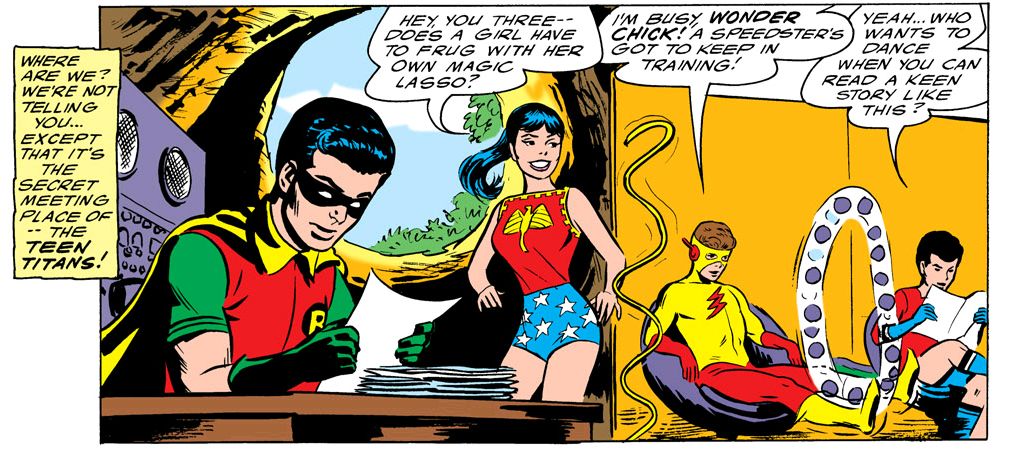
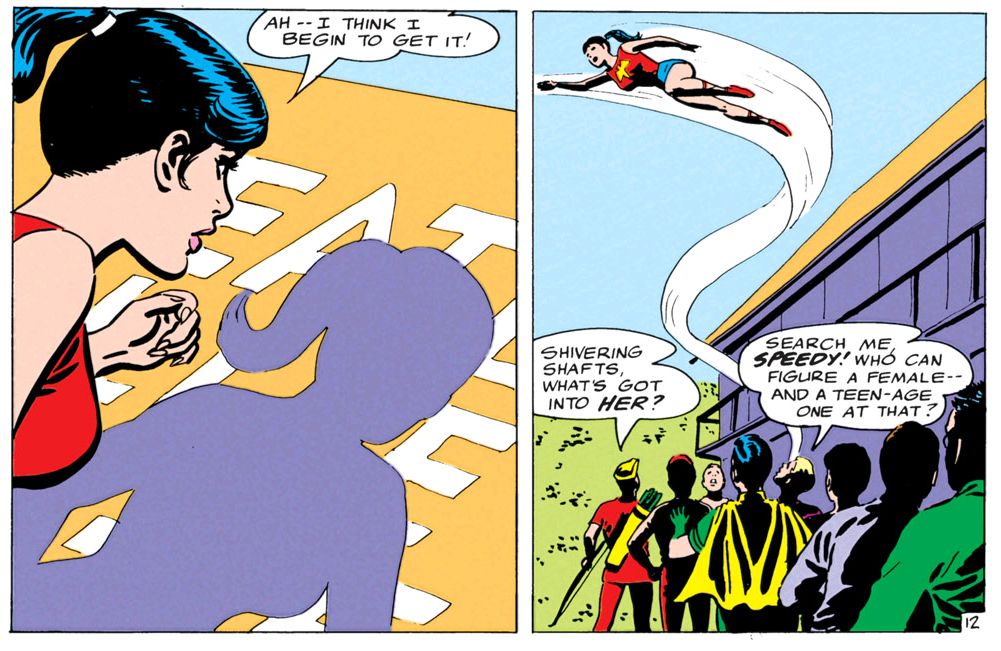
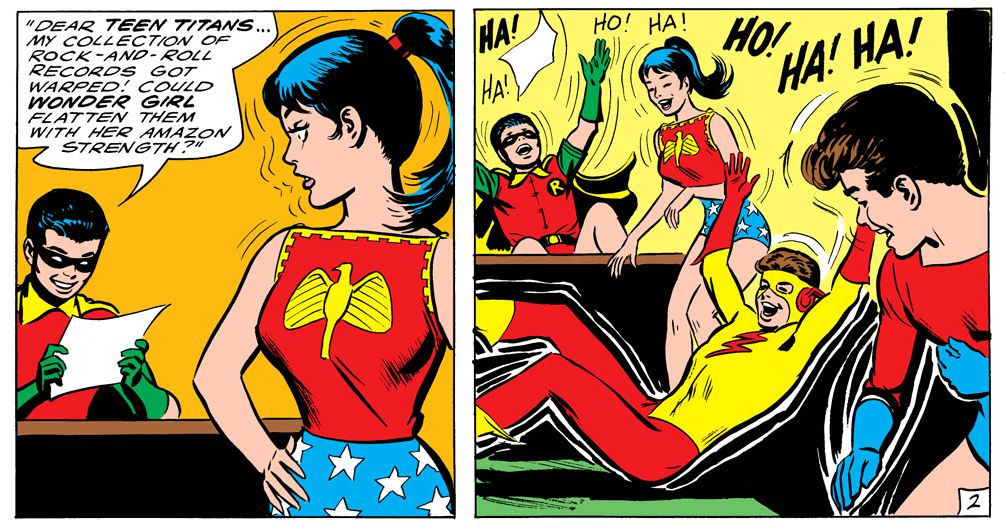
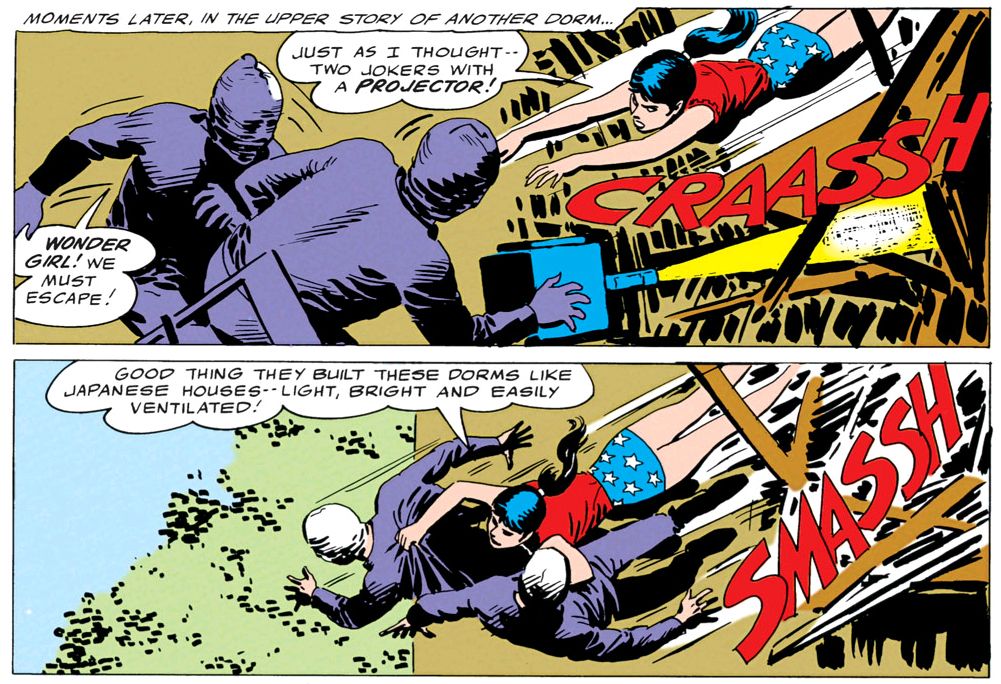
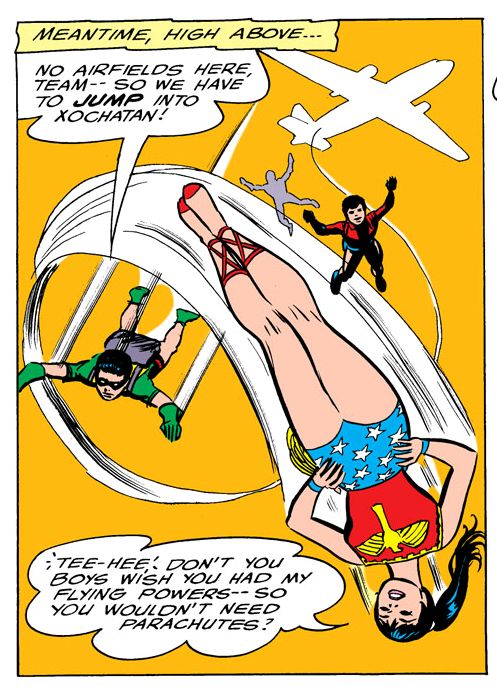
My Ten Favorite Wonder Girl Moments (old school version)!
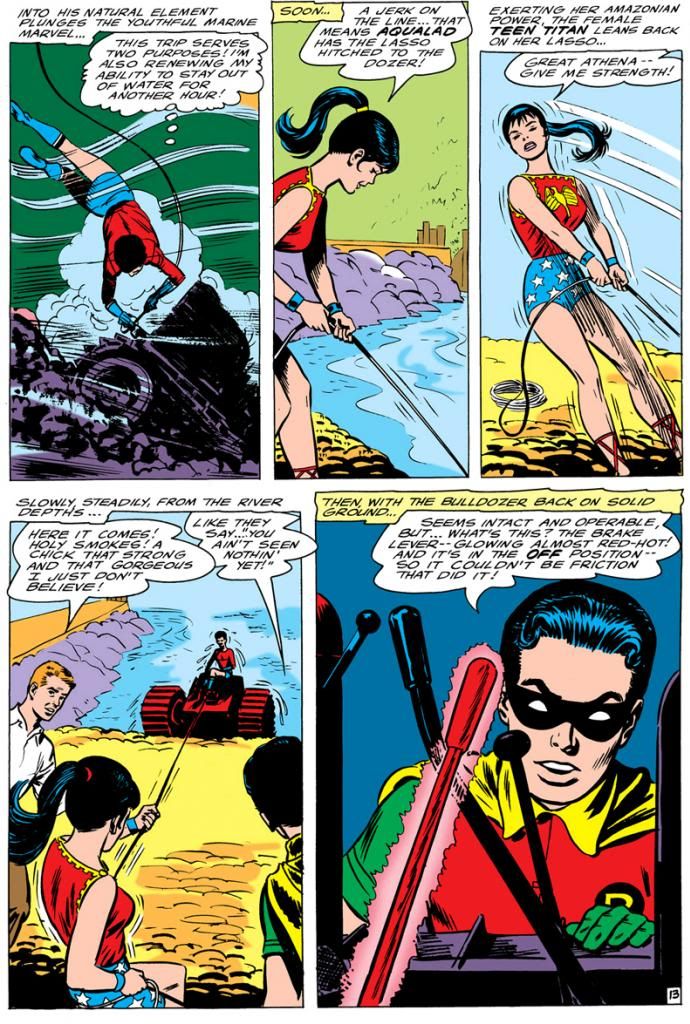 |
| Bob Haney, script/Nick Cardy, art |
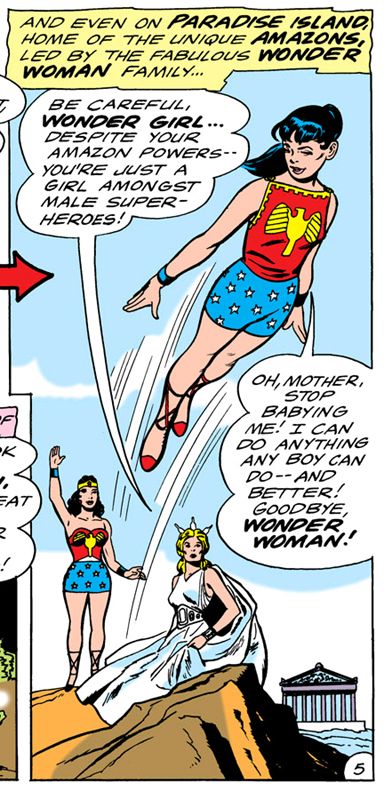 |
| Bob Haney, script/Bruno Premiani, art |
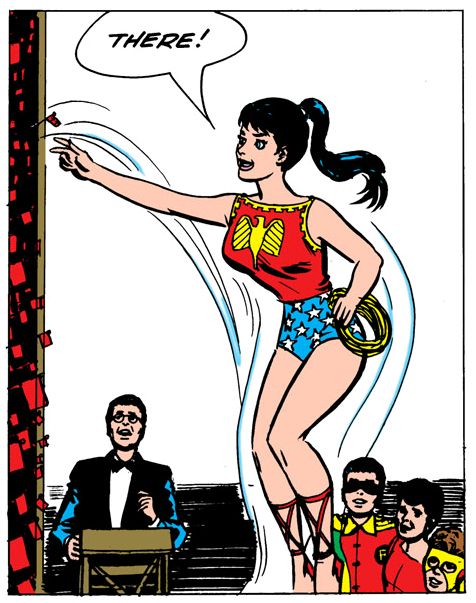 |
| Bob Haney, script/Nick Cardy, art |
 |
| Bob Haney, script/Nick Cardy, art |
 |
| Bob Haney, script/Nick Cardy, art |
 |
| Bob Haney, script/Nick Cardy, art |
 |
| Bob Haney, script/Nick Cardy, art |
 |
| Bob Haney, script/Nick Cardy, art |
 |
| Bob Haney, script/Nick Cardy, art |
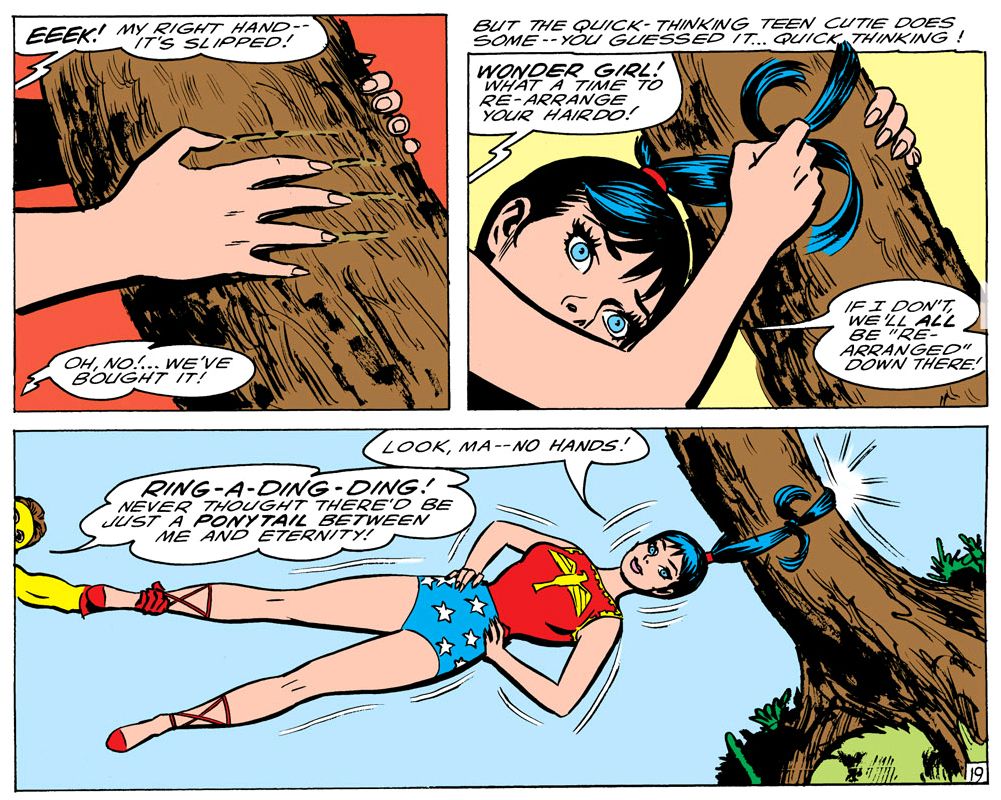
And now for the single greatest moment in Wonder Girl history-- or DC Comics history, for that matter--
 |
| Bob Haney, script/Nick Cardy, art |
Wednesday, February 20, 2013
Teen Titans #1 (February 1966): Nick Cardy makes a splash, Bob Haney makes a point
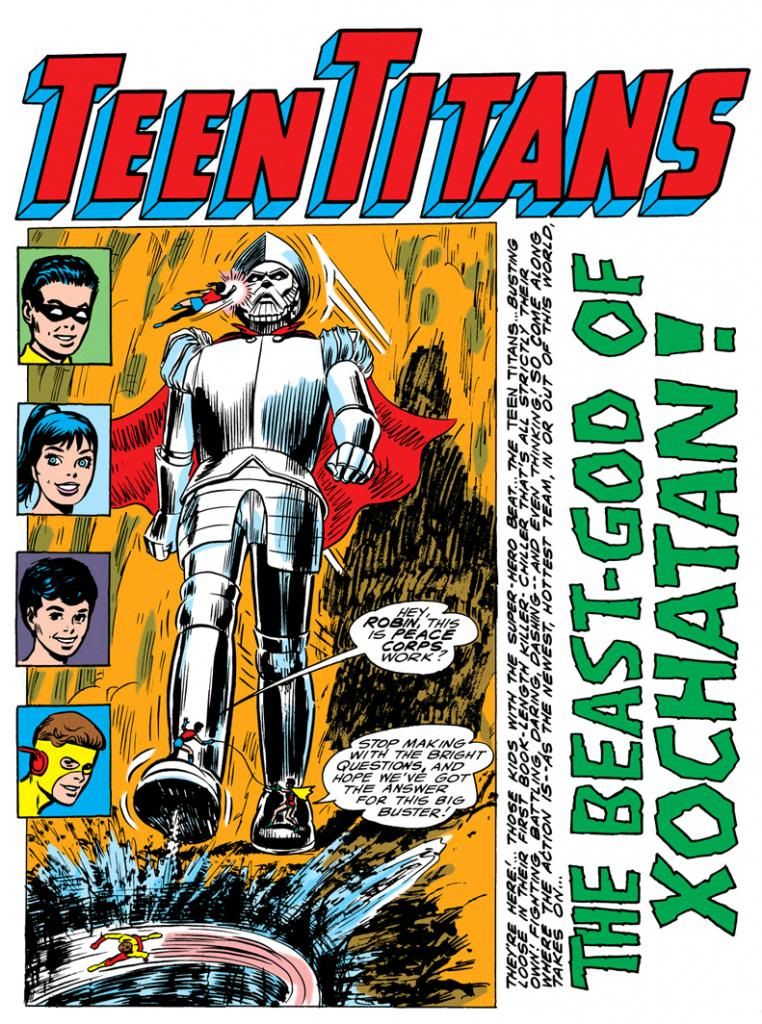
Officially established by John F. Kennedy with Executive Order 10924 in March 1961, the Peace Corps has been sending young Americans all over the globe to win hearts and minds by doing good works in developing nations ever since. Back when the Titans made their collective bid for membership, the United States was still basking in the afterglow of having helped defeat fascism in the 1940s and taking leadership in facing down communism ever since. World War II and the Cold War had frosted isolationism (except for a few backwards people living in mountain shacks and dank caves) in favor of internationalism, engagement on a global scale, and we Americans believed in solving humanity's problems and fostering democracy abroad by providing clean water and education.
In fact, we learn that almost every adult hero in the DC universe is some kind of Kennedy Democrat, a bunch of gaudily costumed but easily recognizable Eastern Establishment types of the kind hated and feared by Tricky Dick Nixon. Or at least Rockefeller Republicans. It's not enough that their young wards regularly risk their lives fighting crime. It's joining their the Peace Corps that makes Batman, Flash, Aquaman and Wonder Woman beam with pride. Not a single hero expresses anything but almost giddy enthusiasm for this Peace Corps thing.
We miss only Superman's reaction. Why? Because Superman is a god who needs no teen sidekick. He's the father figure to all the other adult heroes, not a bunch of shirt-tail kids. He's off trying to solve galactic entropy while they're fighting mutated fiddler crabs and giggling morons with chemical burns. Superman does have his famous cousin, but Supergirl is probably digging canals, inoculating babies against tuberculosis and smallpox and teaching birth control and crop rotation on her own time.
Incredibly, even though he lives with Robin in palatial Wayne Manor, Batman has to learn of his ward's decision from a newspaper headline while he's scaling a drainpipe on a building in downtown Gotham City. In the "dark of night." Great night-vision this guy has after years of nocturnal crime-busting, hug? The Caped Crusader may be on a case-- unless he practices urban mountaineering for fun-- but he still has time to turn, eyeball a handy newsstand through the gloom, make his discovery and loudly proclaim his joy to no one in particular. I'm guessing he doesn't bother to buy the paper because the fabulously wealthy Bruce Wayne very wisely refuses to carry loose change in his Batman costume in case he gets into combat, kind of like Colonel "Bat" Guano in Stanley Kubrick's Doctor Strangelove.
The teen heroes let Wonder Girl choose their destination by sticking a pin in a map, which she does with an athletic flourish and characteristic joie de vivre. So it's off to the Andes Mountains after a quick training montage to lend a helping hand to those in need.
And, as you can see from this splash page, the Teen Titans version of Peace Corps work doesn't differ all that much from the organization's directives; it's just a bit more aggressive. They aid the needy using their personal expertise in punching, hitting and kicking things. But that's not all they do. They right historical wrongs, as well. What else is toppling that giant conquistador but the defeat of the lingering effects of European imperialism and a refutation of criticism America is merely engaging in a modified, cleaned-up twentieth century version?
In case you miss the point that America isn't like all those other old, abusive world powers, the ultimate villain turns out to be a greedy landowner run out of the village before the story even begins by the hard-working campesinos-- all your rapacious developing-world pirate capitalists out to thwart progress, one ruffle-collared bastard representing the kind of repressive guys who made communist revolutions in places like Cuba and Nicaragua necessary because the U.S. sided with them instead of doing what the Titans and the Peace Corps do here. Of course, there's even one continuing in Peru to this day, but not for lack of Titans effort.
But this book isn't just politics. After all, it would be a dull-ass comic with just Sargent Shriver making speeches to the Titans. We readers demand some kind of giant menace for the kids to clamber all over (plus angry, attacking animals with human faces), and Haney knew how to deliver his patriotic, yet somewhat socialist, message in a colorful, action-packed way (like those sneaky vitamins in our chocolate-coated sugar-frosted rice puff cereals).
Looking back, it's obvious what this prescient story is telling us is the U.S. could have avoided a lot of grief in the coming decades if we'd only modeled ourselves after Wonder Girl, Robin, Kid Flash and Aqualad and taken on the real menace instead of merely replacing recalcitrant dictators with more compliant ones. But there's none of that cynicism in this story. Haney makes me wish I'd joined the Peace Corps back when I was a teen-aged superhero.
Monday, February 18, 2013
Wonder Girl: Best of all the Teen Titans!
 |
| Nick Cardy, Teen Titans #1 (February 1966) |
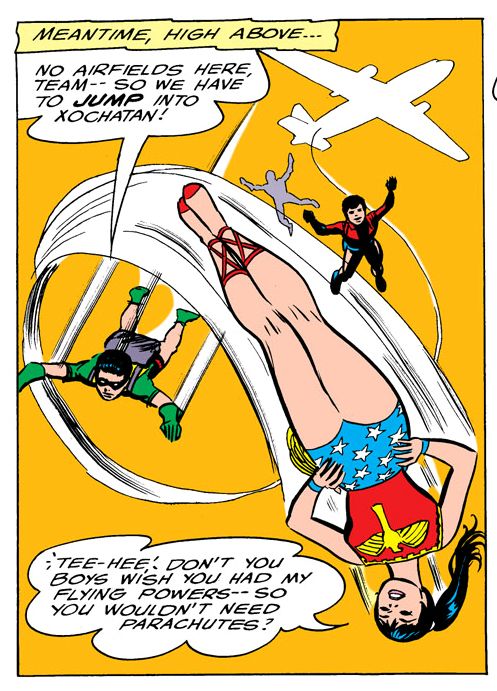
This gorgeous Nick Cardy panel of Wonder Girl showing up the rest of the Teen Titans appeared in Teen Titans #1, way back in February of 1966. Those were not simpler times. John F. Kennedy had been assassinated almost three years earlier, the Vietnam War raged in Southeast Asia (the same month this comic came out saw both the Tay Dinh and the Go Dai massacres), John Lennon made his infamous claim that the Beatles were "bigger than Jesus" and a gunshot felled James Meredith during the March Against Fear to encourage African Americans to register to vote. War, assassinations and riots lay ahead in the next few years as a nation threatened to tear itself apart. Above it all soared Wonder Girl, held aloft by the hopes of youth in post-war America, amid the fast-fading ghosts of Camelot, the dreams of the Civil Rights Movement, the high-tech hopes of the Space Race, and the attempt at making a Great Society.
How could you not love Wonder Girl? In fact,* will fist fight at high noon on the corner of 3rd Avenue and Pine Street any sucker who doesn’t like her. All right, I’m just kidding. I never get up that early. We’ll have to fight sometime later in the afternoon, or perhaps just before dinner time.
No, really, Wonder Girl really is a
wonder. Out of all the Teen Titans, she
gets the biggest kick out of having powers, being young, being a girl. The latter would be difficult for the others
as they’re all boys, but all gender considerations aside, the 1960s Wonder Girl
is pure joy. She’s a pleasure seeker who
finds pleasure almost everywhere, in the smallest things. Like simply being able to fly. That’s the kind of true happiness that doesn’t
require a lot of extraneous elements; the rest of us—those who aren’t vivacious
young Amazons capable of flight-- can get that a similar feeling from running
(if we’re runners) or drawing (if we’re artists). Or whatever it is we like to do with the
least fuss.
Her self-confidence is refreshing, as
well. Being a Titan means she’s probably
not the smartest person you’re likely to meet.
She’s more into dancing than reading, for example. She probably favors Frankie and Annette beach
musicals over French Nouvelle Vague cinema, the British invasion over minimalist
composers. There’s nothing wrong with
any of that. It all just goes to show
Wonder Girl is comfortable within herself.
And that makes her a positive role model in my book. A girl to learn from. Love who you are, love what you do, love life
itself.
In the vintage Teen Titans, which are
generally easy, breezy, carefree reads about teens who want to help the world
rather than tear it apart, Wonder Girl is by far my favorite character. If DC should ever bring her back, they need
to bring back this version or someone similar.
More light. That’s what’s
needed. More light, fewer shadows.
*Not in fact. But you can treat me to lunch.
Tuesday, September 6, 2011
The International Museum of Obscure Comic Book Characters, Exhibit 2: Johnny Carpetbag
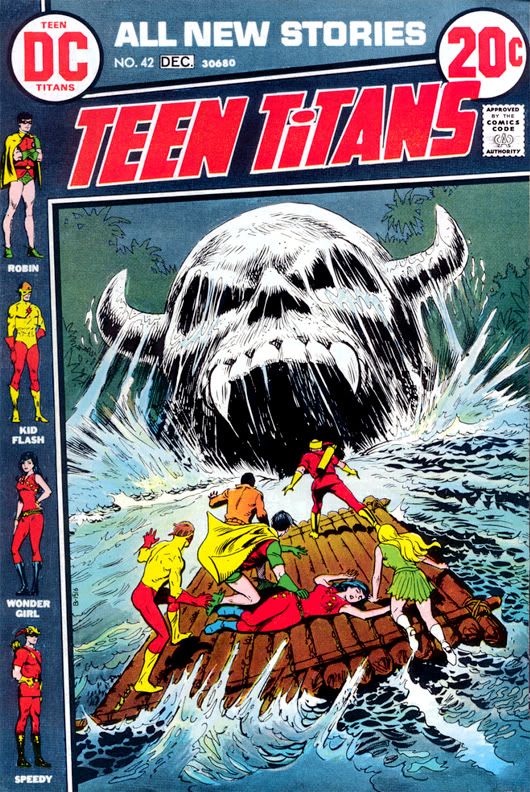 Johnny Carpetbag. Yes, that's his name. No one knows if his parents gave it to him, or if he came by it during his years of riding the rails during the Great Depression. Created by the amazing Bob Haney-- aided and abetted by Art Saaf and Nick Cardy-- Johnny Carpetbag first appeared in Teen Titans #42. If he's ever been in another DC comic in the years since, I'm not aware of it.
I'm surprised some hot-shot writer hasn't revived Johnny and turned into something horrifying. Johnny Carpetbag would make the perfect villain for some 12-issue mega-crossover where he powers up to appropriately bad-assian levels then stalks the grown-up Teen Titans, kills whichever one editorial deems unnecessary to Time-Warner's bottom line yet important enough to have impact on nostalgia hounds and hardcore geeks, then dies himself in some horrifically violent way at the hands of some character usually not known for doing such things, which somehow reboots the entire DC universe and launches a comic starring an "updated" version of said character. Lots of gore, too. A comic book is nothing without evisceration depicted in all its scarlet glory. If there's anything Teen Titans #42 lacks, it's evisceration.
Of course, this completely hypothetical yet oh-so-dreamy narrative would be accompanied by interviews with the creative team where they explain why Johnny Carpetbag was never used up to his full potential and then pat each other on the back for sullying what was once a pleasantly bizarre little comic and, by extension, every comic its characters ever appeared in before or after.
While we're waiting for the return of the new and improved Johnny Carpetbag, we can still enjoy the Teen Titans in "Slaves of the Emperor Bug." It's a simple story, with an insanely random plot.
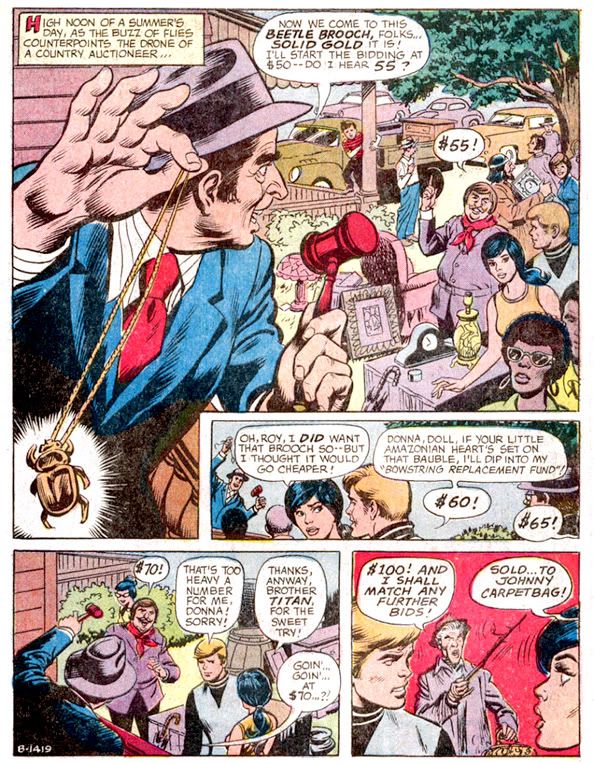
Ah. The opening sequence, tranquil and with just a hint of blossoming young romance. It lulls us into thinking the rest of the book will be sane. Wonder Girl and Speedy (pre-heroin addiction) bid on a beetle-shaped brooch. What's really cool is how Speedy refers to Wonder Girl's "little Amazonian heart." What a smooth operator. Her heart will play a major role in the story. Her metaphorical one. Don't you imagine it gets pretty old for Wonder Girl to always have the male Titans condescending to her like that? Especially when her "little Amazonian strength" could have Speedy shaped into a human pretzel if she so desired?
Notice how the auctioneer instantly recognizes Johnny Carpetbag. Not just because he's holding the object he took his name from, but apparently the guy's a sort of local character and held in fairly high regard by the citizens of whatever small town this is.
And why not? They think he's a righteous dude. For a dirty hobo. Who has an unlimited income. Maybe he's Howard Hughes in disguise, Wonder Girl! Give him a ride to Las Vegas and see if he puts you in his will!
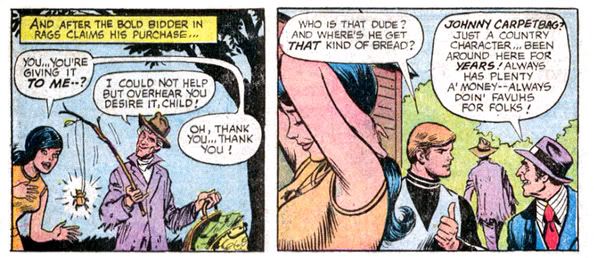
The golden beetle brooch soon shows its magical powers-- it tells Wonder Girl and her less gullible friend Lilith it once was a mighty warrior king and needs to return to the Yucatan so it can regain its former glory. This leads to the entire team heading down to Central America where they run into all sorts of trouble in the jungle. Here's where things get ever so slightly... um... far-fetched.
Kid Flash almost loses a leg to a hungry caiman, Wonder Girl fights a jaguar then sees a fish swallow her beloved brooch. When a hungry eagle snatches up the fish, Wonder Girl gives chase only to run afoul of a poisonous snake. The eagle flies directly overhead while the Titans are looking for Wonder Girl, and Speedy shoots the fish out of its talons. Non-powered but quick-thinking Titan Mal cuts open the fish and finds not Wonder Girl but the beetle brooch inside. What luck!
In Lilith's hands it leads the gang to the dying Wonder Girl and Robin injects her with all the anti-venom he can find in his little first aid kit. That first aid kit really comes in handy on this trip, so I recommend when you take a magical golden beetle brooch into some swamp or jungle you take one as well.
Reunited, the bold super-teens enter a skull-shaped island or temple or palace. And here our pal Johnny Carpetbag makes his second appearance.
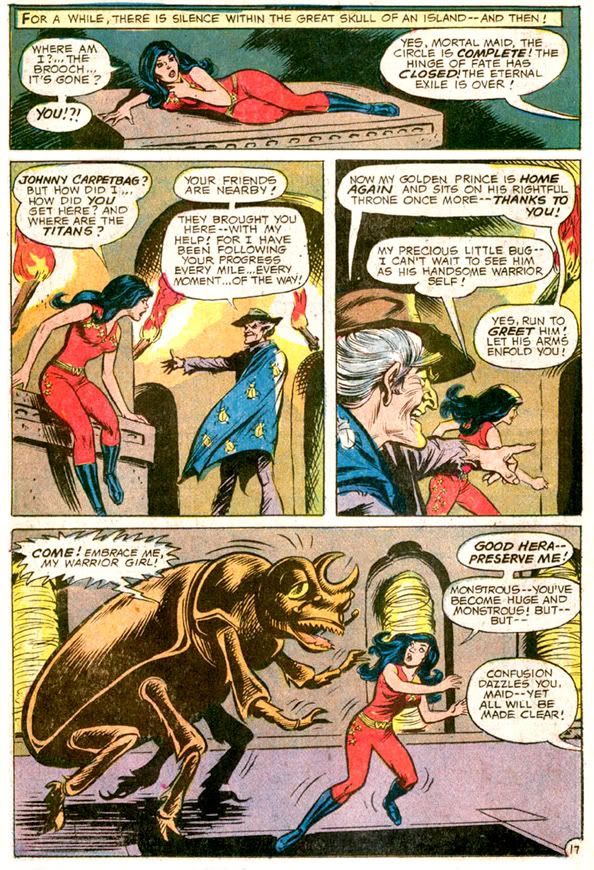
What's this? He's not the nice guy he first appeared to be? And Wonder Girl's golden warrior is actually a giant rhinoceros beetle? His name is Lord Beetle, and his love for her is still true, even if he plans to devour her friends. It's at this point Wonder Girl begins to suspect she just may have been had. Gesturing grandly, still smelling of what we can only assume is the accumulated sweat and urine from dozens of years sleeping on steaming sewer gratings and in abandoned automobiles, Johnny Carpetbag explains everything.
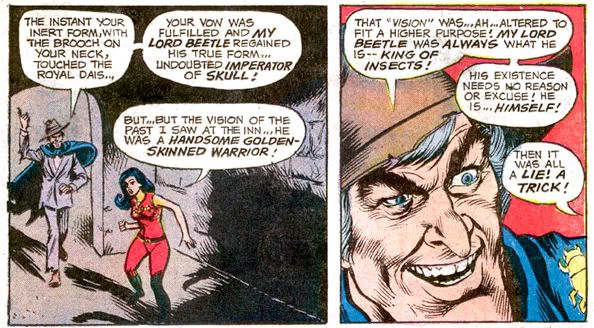
I really like Wonder Girl. She's endlessly vivacious and physically strong beyond reason, but not the smartest person in the room. In any room, including rooms filled with circus clowns or even the cadavers of circus clowns. Ever so slowly, she comes to the realization she may have screwed up. In fairness, none of the Teen Titans are exactly what you might call "geniuses." I'm not sure any of them exhibit even merely average intelligence. That's why it's so entertaining when Wonder Girl and Johnny Carpetbag start to debate the morality of a carnivorous diet.
As if he's spent many a late night contemplating this exact discussion with Wonder Girl, Carpetbag offers the what I consider the most compelling pro-meat argument-- we're all animals and most animals eat other animals. This includes as apex predator giant talking insects with magic powers eating intellectually-challenged teens with super powers. Or vice versa. One devours the other in the great circle of life. Wonder Girl, on the other hand, employs a kind of moral relativity and draws the line at the consumption of people, but thinks nothing of resorting to violence to drive home her point.
I'm sorry to say vegans and vegetarians are not represented in this debate, but I'm sure they could come up with plenty of reasons why both Wonder Girl and Johnny Carpetbag should embrace cruelty-free alternatives.
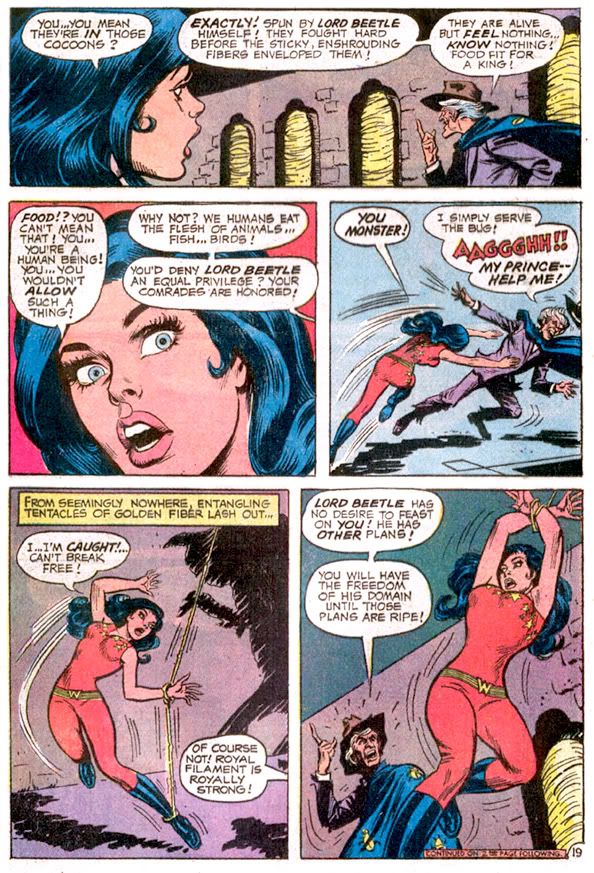
Bondage fetishists no doubt also enjoyed this issue, or at least two panels from it. And here's where the icky "other plans" line of dialogue falls. Care exercise your imaginations and come up with a few ideas of what these "other plans" might be? Unless they involve sending Wonder Girl back to the United States rather than long white gowns with veils of lace, I don't.
After tying up Wonder Girl with "royal filament" (from his royal butt spinneret... mercifully not shown), Lord Beetle lets her go to wander his temple alone. But soon enough Wonder Girl plays to her strengths-- not thinking or debating. No, she doesn't care for those. Dancing and general hedonism are more her bag. Okay, while in other stories, Wonder Girl often gives into her more fun-loving impulses, doing the frug, the mashed potato, the monkey, the Watusi or the Madison won't help her in this situation, so instead-- egged on by a talking skeletal salamander lying in pit-- she grabs a golden double-bladed sword and pulls with all her Amazonian might.
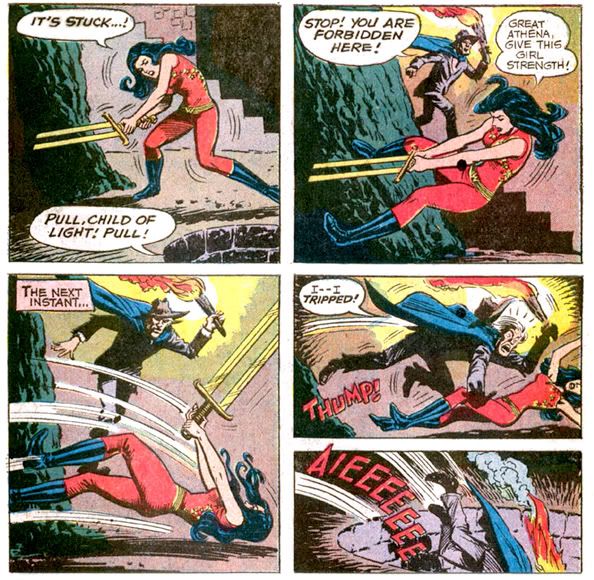
And so ends the life of Johnny Carpetbag. Not with a bang or a whimper, but an "I-- I tripped!" and an "AIEEEEEEE!" Because when push comes to shove, or trip, if you're dumb enough to work for a giant insect, you're probably dumb enough to destroy yourself accidentally. Even poor, dim-witted Wonder Girl knows better!
Tuesday, May 17, 2011
Wonder Girl was right all along...
Back in the 1960s, one criticism of America's space program was that it leeched funds away from more urgent needs, i.e., education, feeding the poor, caring for the elderly and the war in Vietnam. Nonsense! What could be more necessary than NASA's greatest mission?

That's right... blasting off from the Kennedy Space Center at Cape Canaveral at the cost of millions of taxpayer dollars, we find D.J. Deejay, a man who proves the theory that our names control our destinies! And what's America's first space disk jockey up to?

Covering his spacesuit with dated graffiti and trying to bridge the generation gap via some desperate-sounding hipster lingo! Faced with an adult world that resorts to madcap stunts like this in a desperate attempt to lull into complacency the hapless populace while waging war and mass-murder across the globe and using up every natural resource... what else can a teen from the Amazonion society of Paradise Island do but...

Dance! The Soviets have invaded Czechoslovakia! There are enough nuclear-tipped ICBMs to wipe out humanity one hundred times over! Southeast Asia is burning and the smell of napalm and human flesh fill the jungle air and hover over the Mekong delta rice paddies! MLK and RFK have been assassinated and people are rioting in the streets! Why not dance the apocalypse away?

Why not dance in the face of clueless, apathetic boys?

What's wrong with these idiot kids anyway? There's the third coolest chick in the whole DC Universe and all she wants to do is dance with them and they're walking away! Look! It's Wonder Girl dancing! Don't walk away... serious training? What the hell are you talking about, Robin? Wonder Girl... dancing!
Jesus... boys are stupid.
And Wonder Girl doesn't stop with dancing. She's a total hedonist! Fighting crime in the wilderness? Perfect time to take a barbecue break.

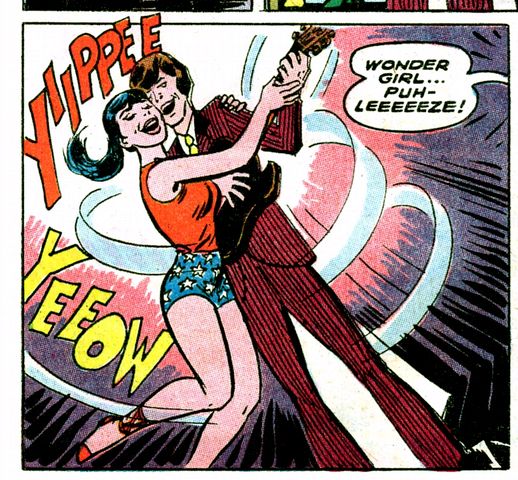
But I think this is my all-time favorite comic image:

Cardboard cutout of the latest teen pop sensation? Grab it and dance with it, in front of the world! Her joy is infectious. Wonder Girl is a girl in love with life. She's totally carefree, does exactly what the moment calls for without hesitation.
Wonder Girl puh-leeeeeeeze, indeed! Don't trammel this girl's spirit. Life is too short not to let her express her joie de vivre! We could all learn a little something from Wonder Girl. To that end...
Everyone! Dance with Wonder Girl! Enjoy life now before it's too late and D.J. Deejay comes crashing down to earth in the red-hot ball of death caused by the adult world's retro-rocket failure. No future for you, Wonder Girl. Here comes Watergate, the recession, the oil crisis, pollution, malaise, Three Mile Island, Reaganomics, Iran-Contra, the Gulf War, Monicagate, the War on Terrorism, peak oil, global warming, the inevitable consumption of the earth by our own sun, galactic entropy!
But before all that... let's dance!
What do I want? I want to write a series where THIS version of Wonder Girl... a superhero with no secret identity because she doesn't need one... not a care in the world because she comes from perfection... flies in from Paradise Island to spread mischievous cheer and fun times for all. Totally fearless, totally without inhibitions.
PS: Many of the things I referenced here actually happened a year after this comic came out, but what am I, your history professor?
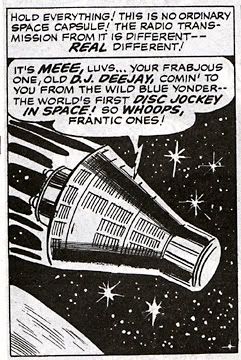
That's right... blasting off from the Kennedy Space Center at Cape Canaveral at the cost of millions of taxpayer dollars, we find D.J. Deejay, a man who proves the theory that our names control our destinies! And what's America's first space disk jockey up to?
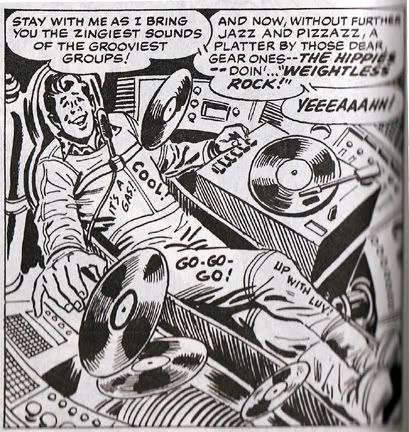
Covering his spacesuit with dated graffiti and trying to bridge the generation gap via some desperate-sounding hipster lingo! Faced with an adult world that resorts to madcap stunts like this in a desperate attempt to lull into complacency the hapless populace while waging war and mass-murder across the globe and using up every natural resource... what else can a teen from the Amazonion society of Paradise Island do but...
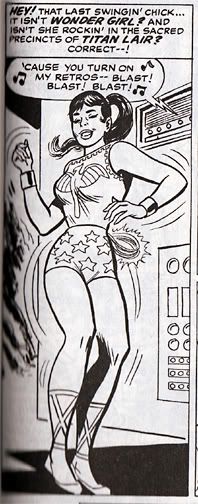
Dance! The Soviets have invaded Czechoslovakia! There are enough nuclear-tipped ICBMs to wipe out humanity one hundred times over! Southeast Asia is burning and the smell of napalm and human flesh fill the jungle air and hover over the Mekong delta rice paddies! MLK and RFK have been assassinated and people are rioting in the streets! Why not dance the apocalypse away?
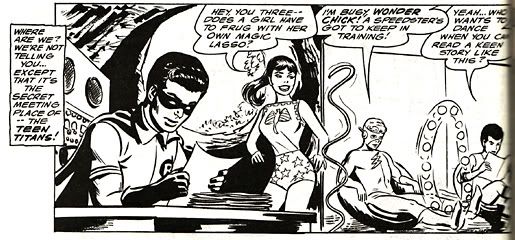
Why not dance in the face of clueless, apathetic boys?
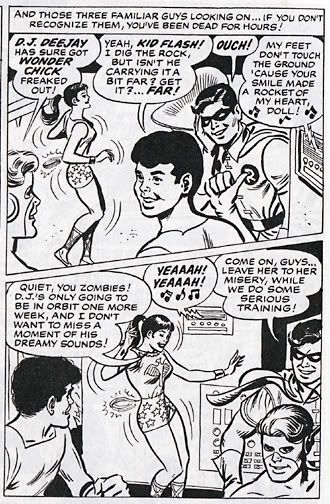
What's wrong with these idiot kids anyway? There's the third coolest chick in the whole DC Universe and all she wants to do is dance with them and they're walking away! Look! It's Wonder Girl dancing! Don't walk away... serious training? What the hell are you talking about, Robin? Wonder Girl... dancing!
Jesus... boys are stupid.
And Wonder Girl doesn't stop with dancing. She's a total hedonist! Fighting crime in the wilderness? Perfect time to take a barbecue break.

But I think this is my all-time favorite comic image:
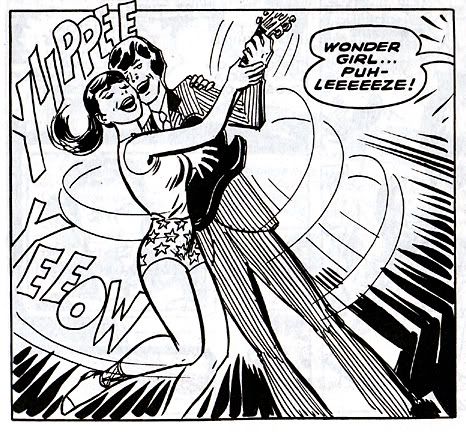
Cardboard cutout of the latest teen pop sensation? Grab it and dance with it, in front of the world! Her joy is infectious. Wonder Girl is a girl in love with life. She's totally carefree, does exactly what the moment calls for without hesitation.
Wonder Girl puh-leeeeeeeze, indeed! Don't trammel this girl's spirit. Life is too short not to let her express her joie de vivre! We could all learn a little something from Wonder Girl. To that end...
Everyone! Dance with Wonder Girl! Enjoy life now before it's too late and D.J. Deejay comes crashing down to earth in the red-hot ball of death caused by the adult world's retro-rocket failure. No future for you, Wonder Girl. Here comes Watergate, the recession, the oil crisis, pollution, malaise, Three Mile Island, Reaganomics, Iran-Contra, the Gulf War, Monicagate, the War on Terrorism, peak oil, global warming, the inevitable consumption of the earth by our own sun, galactic entropy!
But before all that... let's dance!
What do I want? I want to write a series where THIS version of Wonder Girl... a superhero with no secret identity because she doesn't need one... not a care in the world because she comes from perfection... flies in from Paradise Island to spread mischievous cheer and fun times for all. Totally fearless, totally without inhibitions.
PS: Many of the things I referenced here actually happened a year after this comic came out, but what am I, your history professor?
Subscribe to:
Posts (Atom)