Showing posts with label Joe Kubert. Show all posts

Thursday, October 9, 2014

October is Spookey Month: Batman #319 (January 1980)

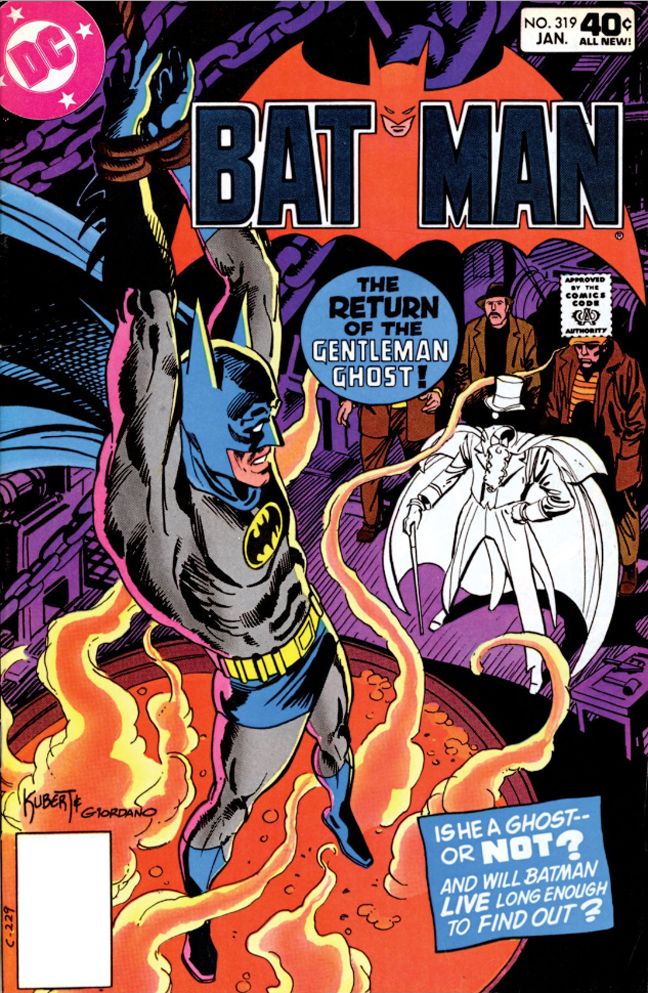
Batman #319 (January 1980) sees Batman and Gentleman Ghost battling once again.  This mean we get a Halloween treat in the form of a spectacular Joe Kubert cover with Batman in pulpy danger, suspended over a bubbling vat of wholesome Campbell's Tomato Soup with milk added.  Just like my dad loved to do!  Dick Giordano inks and the result is as rich and creamy as the soup Gentleman Ghost plans to dip Batman into.  Eerie underlighting and a line quality that's recognizably Kubert but somewhat cleaner and not as expressionistic.

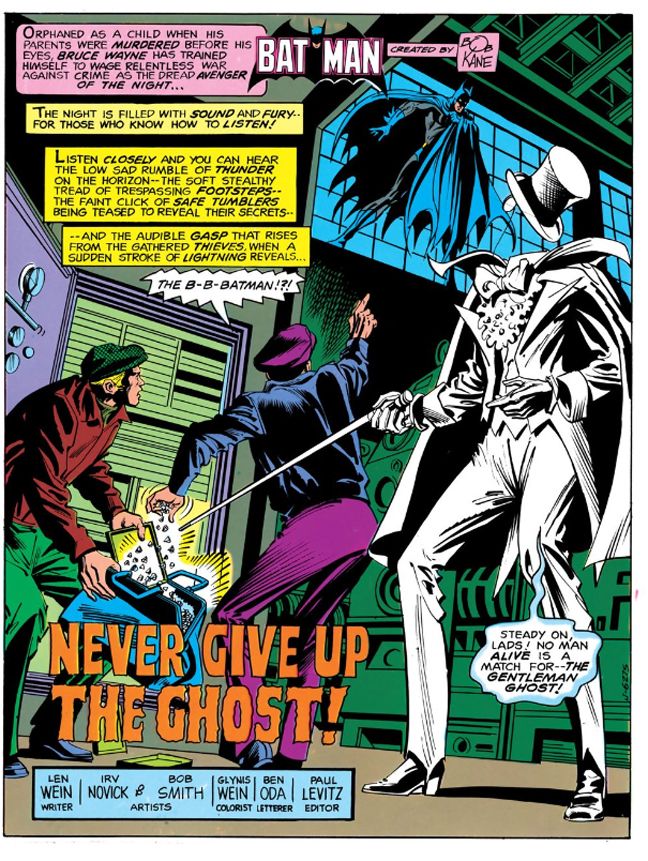
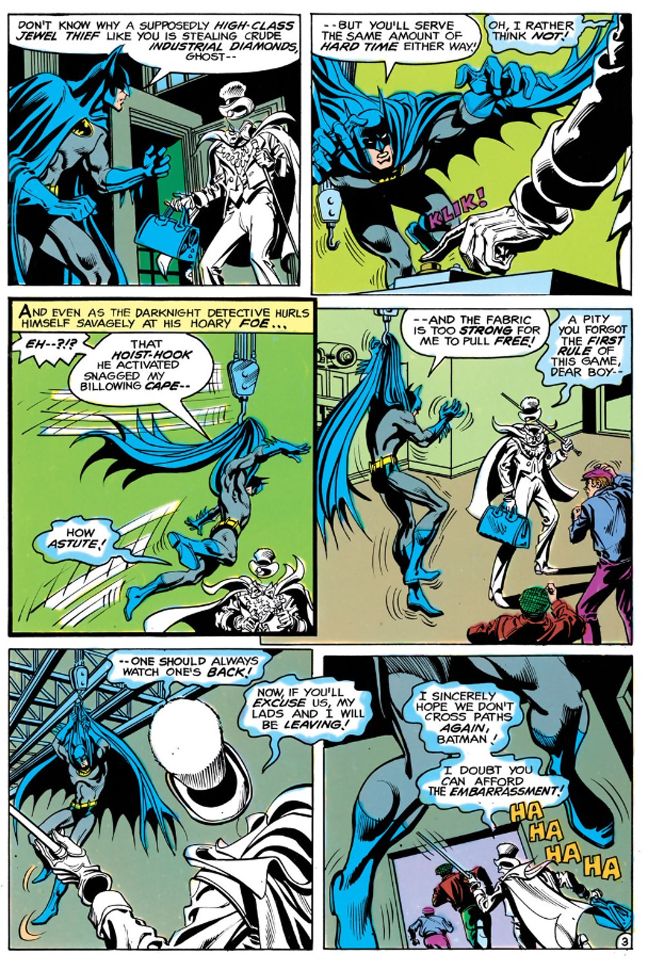
The story starts in mid-action, just like the previous Gentleman Ghost appearance.  Batman once again interrupts the Ghost and his henchpeople in mid-heist and ends up hoisted by his own cape.  While starting stories like this instantly ups the energy level and leads us to expect something rapid-fire and thrilling, there's a danger of this approach devolving into formula.  But Batman's dilemma-- which writer Len Wein points out is self-inflicted due to Batman's cape being rip-resistant, a helpful quality in most situations but not when you need it to tear so you can free yourself from a dangling hook-- proves startling and original in its details.  Wein also uses it to show that Batman, while fallibly human, is also resourceful and dangerous even when apparently helpless.  Never count out the Caped Crusader, as Gentleman Ghost finds before cleverly making his own escape.

Script: Len Wein/Pencils: Irv Novick/Inks: Bob Smith

From there we find Batman setting a trap for the Ghost, with a Halloween-appropriate setting.  He plans a costume ball at Wayne Manor with jewels on display as bait.  Gentleman Ghost finds this irresistible, and once again Batman ends up dangling from a hook.  This time over boiling soup.  I mean acid.  It's not tomato soup.  It's a vat of acid, a wicked comic book convention.  This time Wein shows us the mechanics of a Batman escape.  The story has the feel of someone working through all those classic Batman tropes.  The death traps, the fist fights, goofy henchpeople (somehow the very British Gentleman Ghost has found a couple of very British oafs to help him, one named, fittingly enough, Alfie) and another ambiguous ending.

Script: Len Wein/Pencils: Irv Novick/Inks: Bob Smith

We still never learn if Gentleman Ghost is a real ghost or not.  His lackies disguise themselves as the Ghost as a distraction and Wein suggests the headless quality is mere fakery when one of them is revealed to be merely hunching down.  That doesn't explain the floating top hats or monacles.  Later there's a bit with a convenient hologram projector which also seems to tell us the Ghost is more technological trick than supernatural treat, but Wein leaves the truth of the matter hanging, kind of like his Batman this issue.  You can have it either way.  He's a clever illusionist with a creepy gimmick or he's a creepy ghost with a penchant for high-tech chicanery.

Script: Len Wein/Pencils: Irv Novick/Inks: Bob Smith


It's up to you!

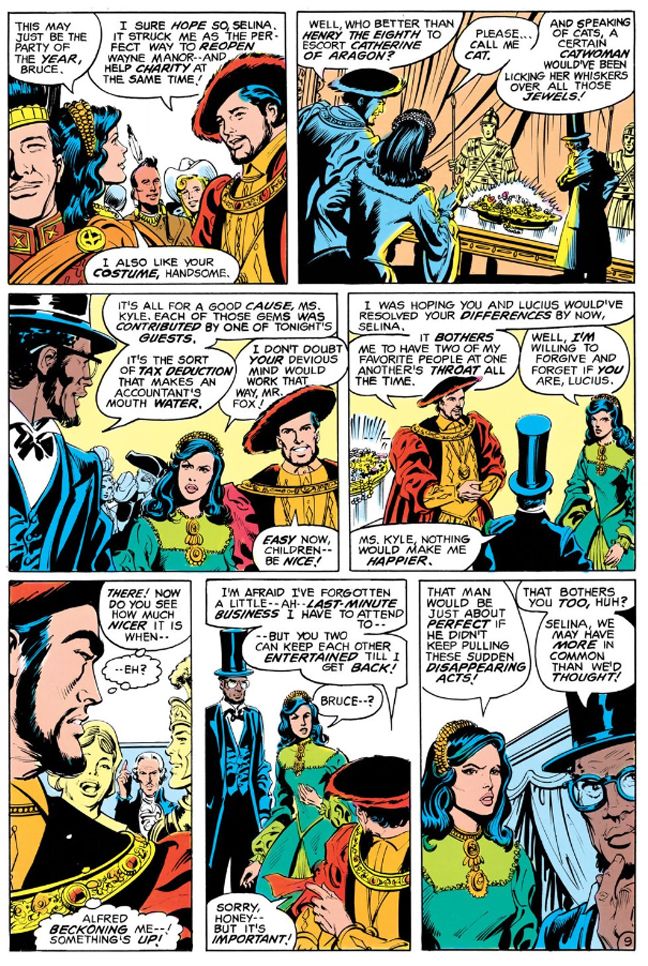
Irv Novick once again pencils, but this time Bob Smith inks.  Smith's line is thinner, sharper, more angular than Giordano's.  Well-defined figures and clarity of action make this issue very appealing throughout.  Batman is almost always on the left side of the panels, inciting things in the proper reading order so you get this forward thrust and momentum that carries through all the way to the end.  With Novick and Smith the crowded costume party has focus and detail, with one wide panel that's a treat to linger on.  Batman comes as Henry VIII, Selina Kyle as Catherine of Aragon ("Please... call me Cat," she quips) and Lucius Fox is Abraham Lincoln.  You can make out a plethora of other historical personages surrounding them and even when the Gentleman Ghost and friends gate-crash, Novick and Smith maintain a clear sense of where everyone is relative to each other.  Even when Selina Kyle and Lucius Fox abruptly switch sides so Fox can occupy the foreground with his thoughtful countenance you're not likely to freak out with the change and fall out of the story.  Good, solid stuff.

Script: Len Wein/Pencils: Irv Novick/Inks: Bob Smith

The issues I've read of this Wein run are sleekly enjoyable reads.  He drops exposition into dialogue and gives us meaty narrative captions to chew on while we enjoy the visual banquet Novick and Smith provide.  Very tasty stuff, the kind that satisfies.

Thursday, October 2, 2014

October is Spookey Month: Batman #310 (April 1979)

Batman #310 (April 1979) is a comic I bought solely for its cover.  Even back then I was a big Joe Kubert fan, and I believed the cover artist always did the interior art.  I was wrong.

Choosing Kubert as cover artist makes perfect sense because he and Robert Kanigher co-created Gentleman Ghost as a Hawkman/Hawkgirl adversary.  Gentleman Ghost debuted in Flash Comics #88 (August or October 1947, take your pick) but I’d never heard of him.  Why?  Because I never read any Hawkman comics.  Never had anything against Hawkman, just wasn’t my thing. 

Joe Kubert, on the other hand, certainly was and still is very much my thing.  Being 11 years old when this comic book came out I had no idea he’d ever done anything other than war comics and Tarzan.  A chance to see him draw a Batman story piqued my interest, but I can’t say the Irv Novick-Dick Giordano team that actually did the inside art disappoints.  They do a bang-up job.  Theirs is my ideal visual representation of Batman.  He has human proportions and he's not always gritting and grinding his teeth to the point where his molars must be just about gone.  He's a serious guy, but he has recognizably human emotions!
 
Here we are 35 years later and I’m still not particularly into Hawkman and my knowledge of Joe Kubert’s long comics career remains spotty at best.  I love his art and still adore this attractive, exciting cover, though.  I just find it odd I’d have an Irv Novick comic and never have it click with me despite coming to appreciate his solid Bat-work from all the reprints I’ve read over the years.  Maybe it’s not so odd.  I once had a Russ Heath Sgt. Rock and didn’t realize it until much later.  Same with a Rich Buckler-Bernie Wrightson Batman book.  I’m kind of an idiot.


Script: Len Wein/Pencils: Irv Novick/Inks: Dick Giordano

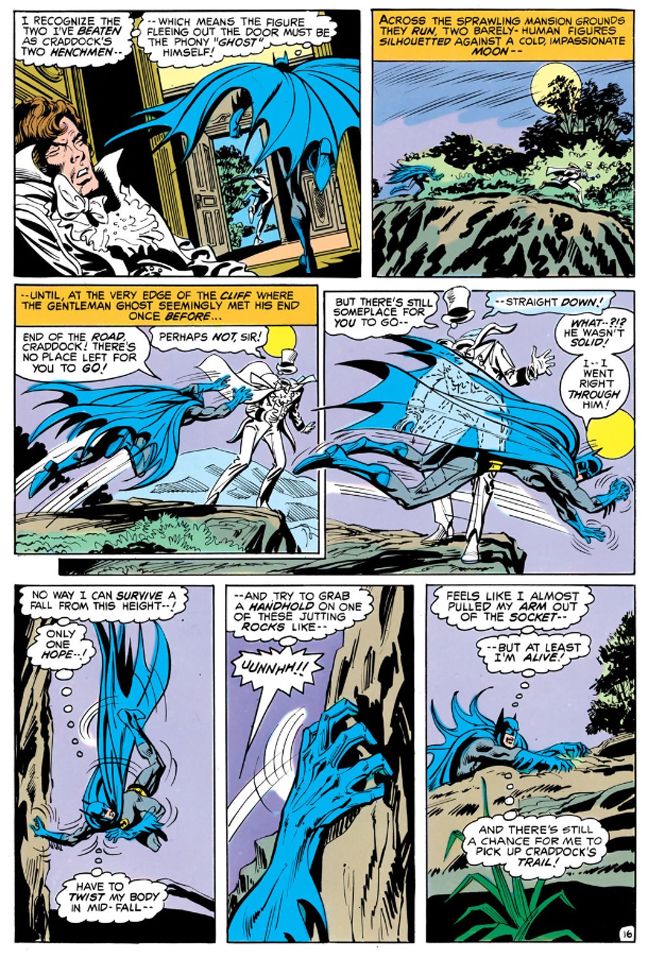
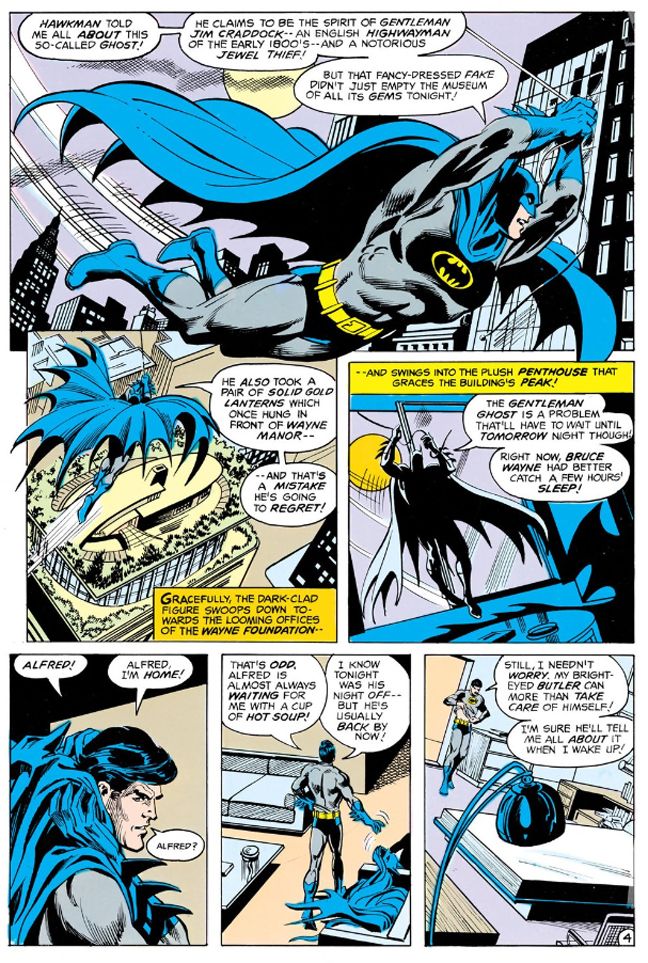
The story, titled "The Ghost Who Haunted Batman," is a jaunty, assured effort by all involved.  It would have made an excellent episode of the 1990s Batman: the Animated Adventures TV series.  Len Wein's script sets up a neat double mystery and wraps it all up in a single issue.  One one hand we want to know why is Gentleman Ghost, known for stealing jewels, suddenly after things like antique lanterns and furniture?  And on the other, where did Bruce Wayne's loyal butler Alfred Pennyworth disappear to?  Wein also plays the whole "is Gentleman Ghost a real ghost, or is he just some clever illustionist with a gimmick?" routine to great effect.  Batman remains pretty skeptical of the supernatural throughout, and when his bat-rope falls ineffectively between Gentleman Ghost's cuffs and gloves, he's disturbed.  But not enough to stop scoffing, as when he sneers, "Mister, you're about as supernatural as my shoe."

No doubt like Batman himself, I distinctly remember expecting some kind of prosaic explanation at story's end.  A special effects artist or magician revealed in an unmasking...

What I admire about this book is how every moment moves the story forward or reinforces the then-current Batman status quo.  There's no waste.  Even for a reader like me, who bought books based on whim and might go months between Batman purchases, could pick this issue up and learn all its players and how Batman relates to each of them.  There's a quick bit of Catwoman romance, a Lucius Fox appearance and even a return visit to Wayne Manor, and yet the central plot remains at the fore.  It's a quick read and certainly no gyp for being self-contained and short.

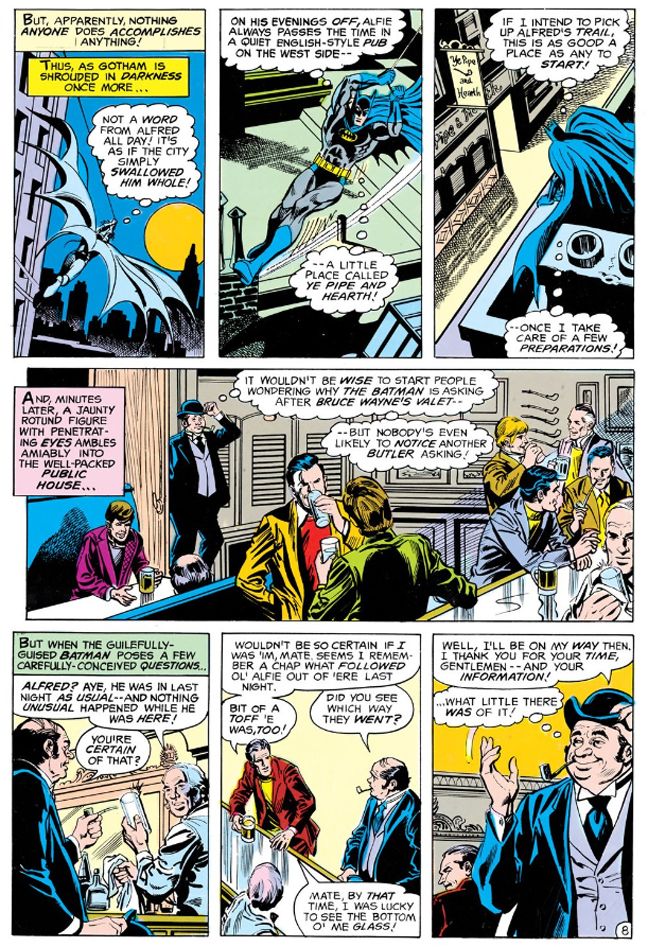
One of my favorite scenes in this book comes when Batman disguises himself as a portly fellow butler to infiltrate a UK-themed bar where Alfred likes to hang out on his nights off and brag to anyone who will listen and buy him a pint about his awesome job with the Waynes.  In the interest of blending in, Batman goes for the old school stereotype complete with bowler and crooked little pipe.  He kind of goes from one panel in his Batman jammies staring down at the pub to the next walking-- the caption tells us it's a mere few minutes later-- in all dressed up with a waistcoat and padded suit.  I'm not sure how Batman pulls this off so quickly when he doesn't even have his Batmobile around to carry things for him, but Wein doesn't let a little detail like this slow the story's pace.

Script: Len Wein/Pencils: Irv Novick/Inks: Dick Giordano

I like to imagine Batman spouting off with a Dick Van Dyke-quality accent and all the ex-pat Brits mocking him after he leaves.  For the story's purposes, Batman probably puts on an accent not only dead-perfect for some particular region of the UK, but also a specific neighborhood.  Came up with a complete biography for this one-off character and everything.  He is a master of disguise, after all.  He's right that it would be odd for Batman to go around asking about Bruce Wayne's butler-- but why doesn't he go in as Wayne?  Because subterfuge is fun!
 
Novick and Giordano lovingly create a creepy, fog-bound mood throughout, turning Gotham City into a vast haunted house.  The atmosphere compares favorably with that ultimate night-bound comic, Marvel's Tomb of Dracula.  And Gentleman Ghost makes an excellent Batman foil.  I’ve always enjoyed Batman stories where he comes up against the supernatural and he’s left a bit befuddled in the end.  Batman benefits from being depicted as vulnerable and not as hyper-competent.  Nowadays he’d anticipate Gentleman Ghost’s every move and have some kind of pre-built anti-ghost device.  In 1979, a hypnotized Alfred could sneak up behind him and knock him out with a heavy gold lamp and he could be deked by an empty suit, then try and fail to save Gentleman Ghost from a carriage crash.  The final scene certainly lives up to the story's title as Batman is left there with the Ghost’s mocking laughter ringing in his ears in one of those ambiguous “just what the heck was that guy?” endings. 
 
Batman and Gentleman Ghost would tangle again shortly and we'll talk about that one when I get the time to read it and react to it.

Tuesday, March 25, 2014

What's the earliest comic book you can remember owning?

Joe Kubert, August 1974
Memory.  Unless you have eidetic memory, don't trust yours, especially when it comes to tracing formative events from your early childhood.  This week I started thinking back to the first comic I could remember owning and once I started doing a little digging both in my brain and online, I came to a conclusion that's shaken my understanding of myself as a lifelong comic book fan.

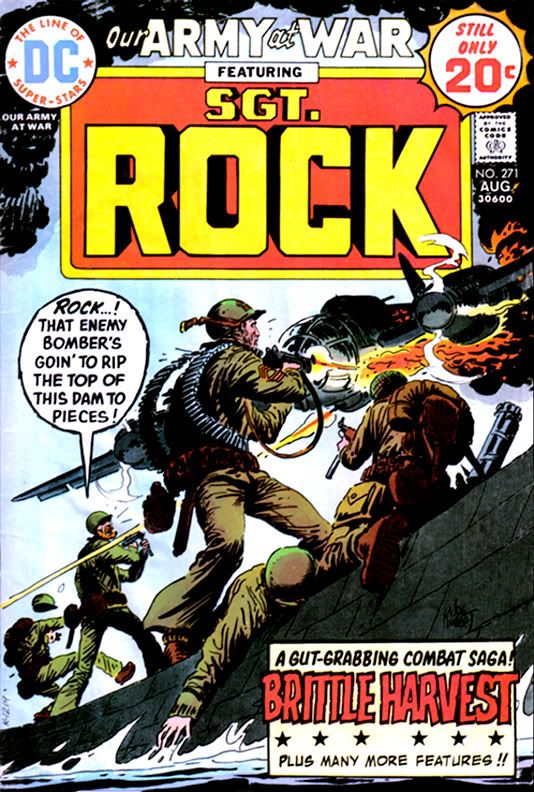
For years, I've had this persistent memory I learned to read from DC's Our Army at War #271, a book with art by the incomparable Russ Heath and a story by the inimitable Robert Kanigher. In the autobiographical film I constantly project in my mind, DC published it when I was three or four and there, on its pages, heretofore ignored ink marks inside the balloons coalesced into words, which formed into sentences and from there, the world of literacy opened to me.  Then I looked Our Army at War #271 up online and learned it has a cover date of August 1974, a mere month before I started first grade.  I was already six years old, and, according to family lore, I had already been reading for quite a while at that point.

So maybe Robert Kanigher didn't teach me mah letters, but I thought there was still a decent chance his story "Brittle Harvest," the book's Sgt. Rock-starring lead, truly was the first bit of fiction I read that didn't star a persistent weirdo with a fixation on oddly-colored breakfast foods.

But maybe it wasn't...


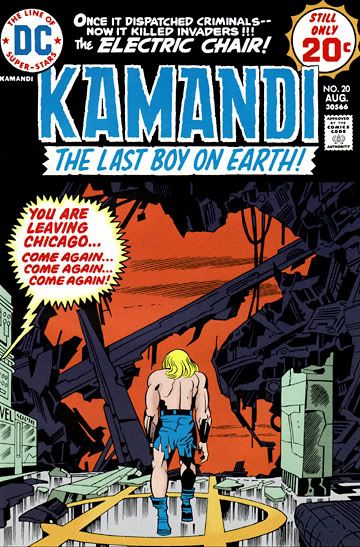
Jack Kirby/D. Bruce Berry, August 1974
Because I also owned Kamandi #20 and Strange Sports Stories #6.  I could have sworn both of those came out a year or two later.  This week, I discovered DC published them that very same August.  August 1974 was a good month for me as far as comics go.

How did I manage to obtain three comics when my income consisted entirely of spare change I found under the sofa cushions or dove for in the deep end of the local Elks' Club pool?  Gifts, maybe.  I can't imagine what fool would give me three comics at the same time.  One, yeah.  Two is stretching it.  Three invites rumors of decadence, of profligate spending on a scale unheard of in our little clan during the Ford administration days of energy crisis and Whip Inflation Now. 

Or else I somehow managed to collect enough pennies to buy them myself.  Yet, I have trouble imagining any scenario involving either of my parents allowing me such an extravagance.  Again, one comic, maybe two if I'd been especially well-behaved.  Three would be, in my mom's words when I bought a second aluminum baseball bat during my "athletic" period years later when I actually had a job and income of my own, "Ostentatious."  My parents, both products of hardscrabble Depression-era childhoods, instilled in me a financial caution I maintain even now that I'm as rich as the guy on the Monopoly game box.  Even with their permission, buying three comics at the same time back then would have given me the same guilty feelings I get now whenever I pick up a new Rolls or sports franchise.

Whether from false memories of learning to read or from inspiring a lifelong love of Jack Kirby's work, each of these comics has stuck with me in ways I've learned are as foggy and treacherous as some jagged coast in an old sea story.  I once again own both Our Army at War and Kamandi, so I've read them recently.  In this way I've corrected a number of misconceptions I carried for years about their stories.

A physical copy of Strange Sports Stories, on the other hand, remains elusive and, therefore, its contents a jumbled mishmash of mistaken impressions. 

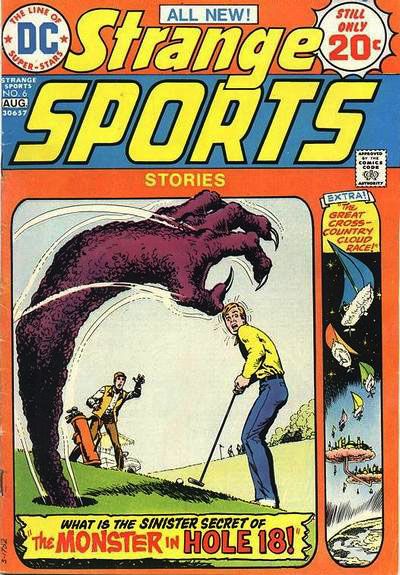
The cover is easy to find online, though.  Let's take a look and see what recollections it inspires.  Wow!  It's by Nick Cardy!  What a treat!  I've really underestimated myself all these years.  Kid me really had good taste in cover artists.


Nick Cardy, August 1974

Let's look at the cover copy.  Interesting story titles.  I thought so at the time, but I may have been alone there, since this was actually the final book in the series.  Another one of those failed DC experiments.

"The Monster in Hole 18!" inspires a vision of someone being pulled through the hole into an alternate dimension, his body grotesquely thinned and stretched in the process, leaving his midsection resembling a great noodle.  At least during the transition.  I'm pretty sure he came out the other side in whatever state for him passes as normal. 

I may be conflating this with the events of "The Great Cross-Country Cloud Race," which I believe is about a couple of young guys seriously into boating who travel into another universe where people race through the skies in little sailboats made from solidified clouds.  Perhaps these guys were the ones who went through a physically distorting transportation process of some kind. 

The cover suggests the book contains just two stories.  So why do I feel so strongly there was a third?  One about a young guy who injures his arm in such a way he can throw baseballs at ridiculous velocity, gets signed by a major league team and pitches in a game against a New York Yankees-type powerhouse club before crashing his expensive sports car and losing his magical pitching ability when the doctor re-sets his arm.  The same accident injures his hip, and there's a little matter of drop-kicking a football...

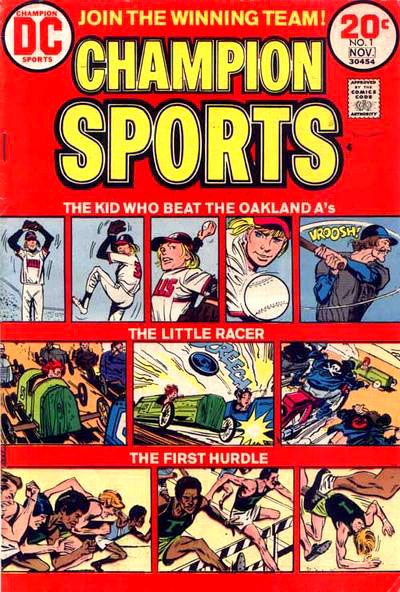
Jerry Grandenetti/Creig Flessel, July 1973
Let me see what I can find out about this.  Hey!  It turns out there is such a story, but it isn't in Strange Sports Stories #6.  We find it instead in Champion Sports #1. 

And it isn't the New York Yankees he pitches against and wins.  It's the Oakland A's.

That brings back a whole lot of memories!  The A's of the early 1970s featured a potent line-up centered around a hard-slugging clean-up hitter by the name of Reggie Jackson, and a pitching rotation starring Vida Blue, Ken Holtzman and Catfish Hunter (Rollie Fingers was on the team, too), each of whom won 20 or more games in 1973.  They beat the New York Mets in the World Series that year. 

My family hated those guys and their evil mustaches because we were National League fans and my oldest brother, a catcher himself, idolized Johnny Bench.  This meant we were Cincinnati Reds boosters, and they lost in the Series to the A's the previous year.  It didn't matter that my uncle had caught for the A's when they were the Kansas City Athletics and personally knew and greatly respected Hunter.

So, in fact, the story is called "The Kid Who Beat the Oakland A's," and I've just learned it's written by the great Joe Simon, drawn by the nifty Jerry Grandenetti, with inks by Creig Flessel.

And you can read it in all its glory on Diversions of the Groovy Kind, a super-cool website that's one of my favorites.  The Groovy Agent must be one of those people with eidetic memory.  He knows it all, baby.  He took the comic's tag line to heart and joined the winning team!

The "kid" is David Wexler, a would-be writer and sports nut.  He ends up enjoying a brief career in the Major Leagues, not as stellar as Catfish Hunter's or Vida Blue's, but still something to be proud of, especially the climactic event, which is spoiled by the title.  The most telling detail, though, is the caption towards the end, when the kid's swelled head leads to his comeuppance:  "You may have read about that game... What you didn't hear about was the dumb, wild things I did off the diamond."  It's a single sentence Simon uses to introduce the off-the-field aspect of big time sports, and gives the story a gritty background verisimilitude to help put across its rather improbable premise.  Shades of Jim Bouton's Ball Four (1970) and the stuff the newspapers didn't print about Mickey Mantle.

Which reminds me!  I could tell you a rather funny story involving my dad, my uncles, Mantle and Joe Pepitone down at spring training in Florida.  Maybe one day I will, but for now let me just tell you my dad swore me to secrecy and I've already told you too much.

What about the other stories?  Well, "The Little Racer" is about a soapbox derby kid who gets run over by a one-percenter motorcycle gang who then help him rebuild his racer with stolen parts.  He ends up with quite a hotrod, but his innate honesty causes him to revert back to his green wooden crate for the final race, which he loses but fairly and squarely.  Then the cycle dudes stomp him good, the same way the Hell's Angels did Hunter S. Thompson when they learned they weren't getting any of the money from the book he wrote about them.  Okay, I made that last one up.  The story thing, not the Hunter S. Thompson thing, which really happened.  The comic may or may not have a happier ending.  But even though our theme today is how crappy my memory is, I feel confident about its other details.

On the other hand, "The Last Hurdle" brings absolutely nothing to mind.  I'm guessing it has to do with at least one hurdle.  Perhaps a final one of some kind.  Literal?  Symbolic?  Shambolic?

No, that's this blog.

This has been a day for shocking revelations, hasn't it?  Let's conclude this mess with two more.

First, in December of 1997, the FBI investigated the possible theft of the artwork from this very comic, along with hundreds or even thousands of other pages.  The entire sequence of events found near the bottom of the document makes for some interesting (if difficult due to formatting and spelling errors) reading.  My oh my!  The things you uncover when you take a memory trip.  I'm completely flabbergasted.

And second, the answer to that nagging question that provides this post's title.  Champion Sports #1.  Look at this:  it has cover date of November 1973, same year the A's won their second World Series.  Diversions of the Groovy Kind puts its actual release date as July, which means, depending on their own street dates, it hit the stands more than a year earlier than Our Army at War #271, Kamandi #20 or Strange Sports Stories #6.

Champion Sports #1.  I was five years old when I read it.  It's now the earliest comic I can remember owning!

Sunday, August 12, 2012

Joe Kubert was something else!

I was all set to tell you about buying comics in Tokyo this week, but I just learned the saddest news.  Joe Kubert passed away at age 85.  It stings my heart.  His line was expressive and instantly recognizable.  Loose yet controlled.  Figures constructed like Renaissance giants.

Joe Kubert was a major force in my childhood and in my love for the best in comic book art.  The first book I ever read had a Joe Kubert cover, so he was there when words first started making sense to me.  Certain artists just own certain characters.  For me, it's Neal Adams Batman, Curt Swan Superman, Jack Kirby Fantastic Four, Al Williamson Star Wars, John Romita Spider-Man and Joe Kubert Sgt. Rock.  Somewhere along the way I began to love his art passionately, and used to spend hours copying his covers line for line.  I dreamed for years of attending his school.

He started his pro career as a child.  1938.  Which means he leaves us after a career spanning more than 70 years.  Are you impressed?  I'm flabbergasted.  That puts him in the company of Mickey Rooney in terms of professional longevity.  Almost unheard of!  Kubert appeared to be busy right up until the end, still doing vital work.  Two days ago I saw a brand new comic with his byline on the cover.  I wish I'd bought it.

Monday, June 18, 2012

I love me some Kuberts!

Amy Kuperinsky profiles legendary comic book artist Joe Kubert and his talented son Andy for the Star/Ledger-- an online news aggregator?-- with a name-check for Adam.  I'm shocked Andy and Adam are in their 50s.  I really thought they were younger for some reason.  But I should have known or guessed.  Both sons are seasoned pros with huge bodies of work.  I've just telescoped their careers because time really does fly.

My inability to understand chronology aside, there aren't any big revelations in the story.  Joe Kubert is one of the all-time greats, his sons adore him as a father and an artist, they have a school that's graduated a number of highly-thought of professionals in its almost 40 years of operation.  It's nice to read about a family that does comics together and it comes with a nice slide show, however.

Joe Kubert's garnered praise and awards throughout his long career, but even so as a comic book fan-- especially one who appreciates the old guard, the prime movers, the influences-- I feel any time of the day is the right time to think about him and the thousands of amazing pages he's drawn.  That he's in his mid-80s and still doing vital work is a wonder.  Most artists rise, peak and then decline, but Joe Kubert's charted his own curve that seems to have plateaued at a nose-bleed inducing level and just stayed there, decade in and decade out.  Not many artists get even a rocky little spike to that altitude of greatness and there sits Joe Kubert, a kind of mountain range unto himself.  Appreciate him and feel lucky we've been able to enjoy the view for so long.

The Kubert Mountains.  I thought to scale them when I was a kid copying his Sgt. Rock covers with a yellow #2 pencil into my school notebook.  I got about halfway up one of the foothills before pooping out.