Showing posts with label great stories. Show all posts

Tuesday, October 28, 2014

October is Spookey Month: Wally Wood brings you a new path to a life of peace and love in Creepy #38 (March 1971)

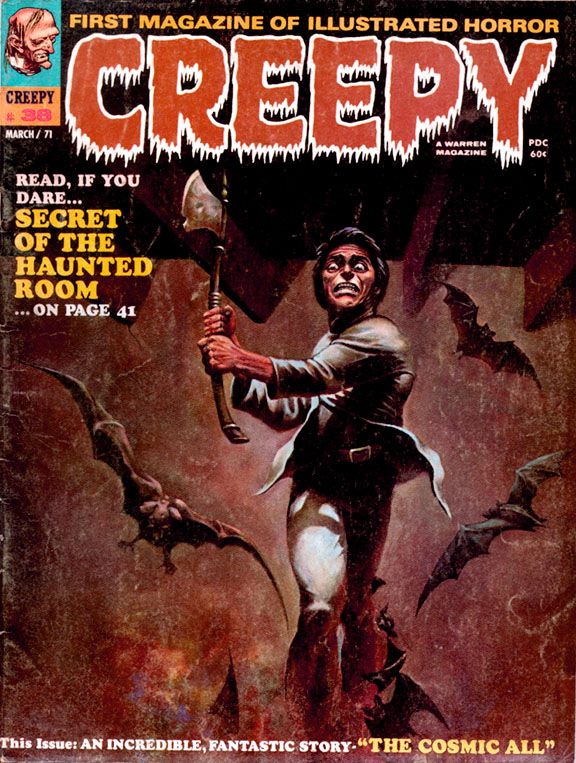
Behind a lurid and appealing Ken Kelly ax-maniac cover (Kelly's Creepy debut), you'll find a late career gem in the EC Comics mode written and illustrated by Wally Wood.  James Warren, who was not only publishing Creepy at this point but also editing it (along with associate editor Archie Goodwin), must have been particularly happy with Wood's "The Cosmic All," because he gives it a cover spotlight and the honor of closing out an issue that also includes work by Rich Buckler, Mike Royer and Ernie Colon.  Warren would also reprint the story just over a year later in Creepy #48, a special, all-reprint issue.

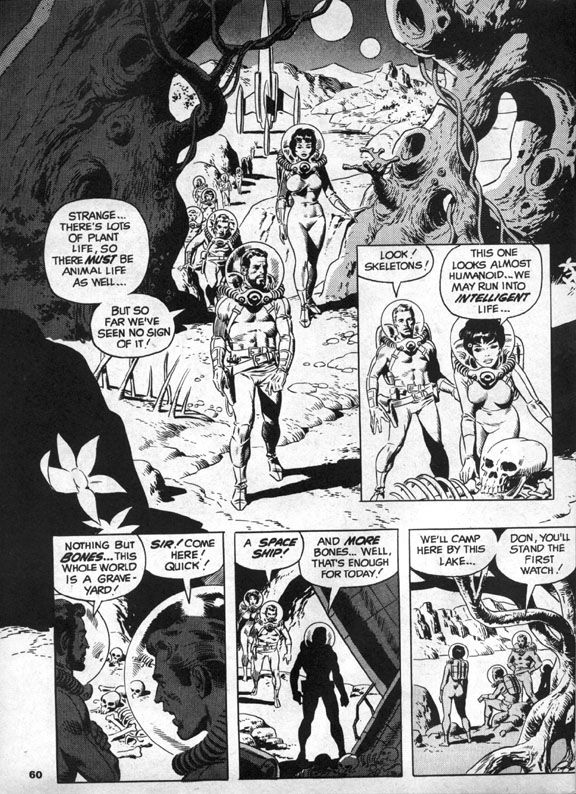
Sometime in earth's future, we've sent an intrepid mixed-gender exploratory mission led by a bearded captain (along with Don!  And Sue!) to Alpha Centauri, which is now, more than 40 years after this story's publication, a popular tourist destination.  In those days, it was the distant frontier of outer space.  After finding bones on their first planetary stop, the explorers anticipate a possible meeting with intelligent life.  Which is kind of ironic.  I mean, they do meet it.  It's just not the kind they were hoping for. 

You know how the hierarchy of space aliens goes—in order from least to most objectionable, it’s generally humanoids, reptilians, insectoids, cephalopods, non-tentacled mollusks, blobs and, finally, slimes.  The further its appearance gets from the human template, the more repulsive the alien.  And usually, the more likely to have philosophies contrary to the kinds we find comforting.  So Wood’s slime terrifies the space explorers by trying to absorb Sue.
 
Wally Wood

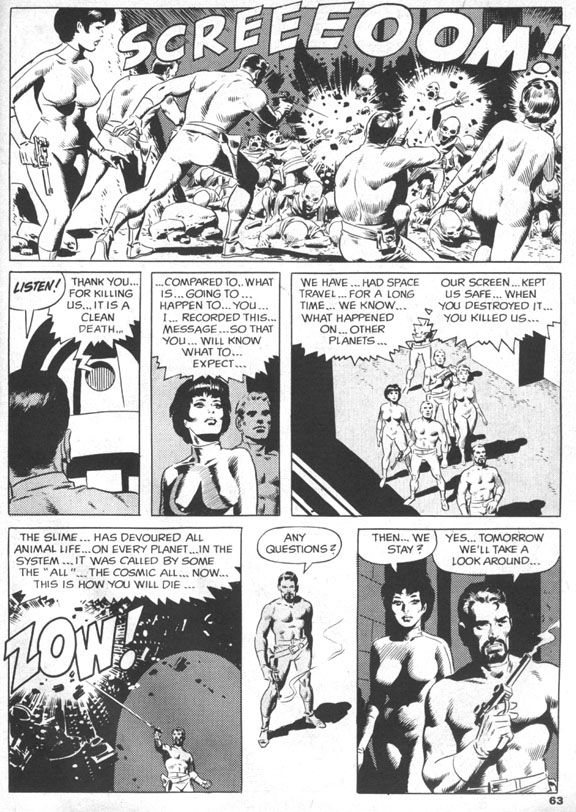
In familiar comic book sci-fi fashion, Don shoots the slime with his phallic laser zapper gun, then everyone flees in their retro-finned rocket ship, only to find the slime on yet another planet.  Having achieved what they believe is their due quota of slime-based encounters, they orbit a comfortably earth-like planet that gives them a very rude greeting in the form of more laser beams.  In response, the human explorers (And Don!  And Sue!) blast through planetary shields and receive a series of puzzling messages.  The civilization below no longer seem angry, but rather depressed and resigned to first contact.  They invite the astronauts to land, then ambush them in a suicidal rush. 
And, ironically enough, they're comfortably humanoid in appearance.  Bulbous, bald heads (like my own) and large black eyes notwithstanding.  A recording reveals this was their deliberate self-extinction and a cleaner death than the one that awaits the astronauts.  Who stand around puzzled, as anyone would be, but the next day all but two of them are skeletons as well.  And those two are Don and Sue!
 
Wally Wood

Which is probably just as well.  After all, even if it was a case of suicide-by-human-astronaut, these men and women did commit genocide.  Are they any less monstrous than the slime?  Perhaps they're precisely as monstrous, as we soon discover.  Don and Sue make for earth where they suddenly experience a strange elation and crash the rocket into the ocean.
 
Wally Wood

There Don and Sue slough off their skins and mutate into the now-familiar slime.  Everything becomes clear.  The humanoid aliens chose to die as a group with each individual’s self-awareness intact because the slime infects other beings and absorbs them into the titular cosmic all, a vast collective without individual thought.  The two space travelers become one with the intent of spreading their all-ness to every living thing on earth.  Starting with all sea life, I suppose.  Uncle Creepy appears at the end and tells us the ultimate twist—they’re glad to be this way, so it’s technically a happy ending.  I’m not going to argue with him.  It certainly made me happy!
 
Wally Wood

The ending is one reason.  The ambiguity of it lingers.  So many deaths, but no escape for Don and Sue, just the loss of humanity both physical and mental, a blending of their minds with the vastness of the alien slime, all-knowing and unstoppable.  Is their joy at the becoming genuine, or simply an effect the slime has on their minds?

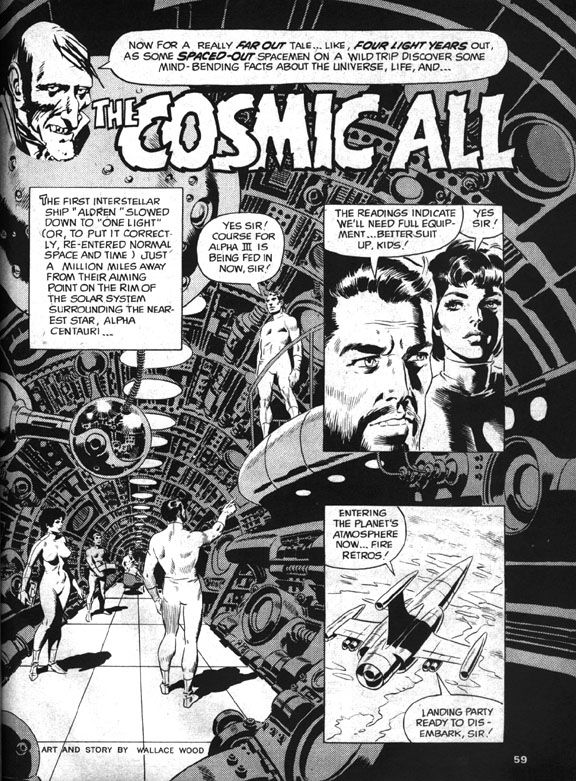
 The other is Wood’s artwork.  The splash page is a spectacular image, the kind of Woodian spaceship interior he drew regularly during EC’s heyday.  Round vents, layers of exposed pipes like the veins in a human arm.  Similarly exciting scenes follow, with the explorers trudging across a planetary landscape, the slime attacking like a huge ocean wave and then a space battle followed by an alien-wave attack and the intimate concluding sequence which is equal parts bleak and elating, an uneasy mix that elevates this story to legendary status.  It has the feel of a particularly memorable EC tale, but with an expansiveness the larger page size affords. 
 
And that ending!  That ending!

Friday, October 17, 2014

October is Spookey Month: How EC ruined America's pasttime in Haunt of Fear #19 (May-June 1953)

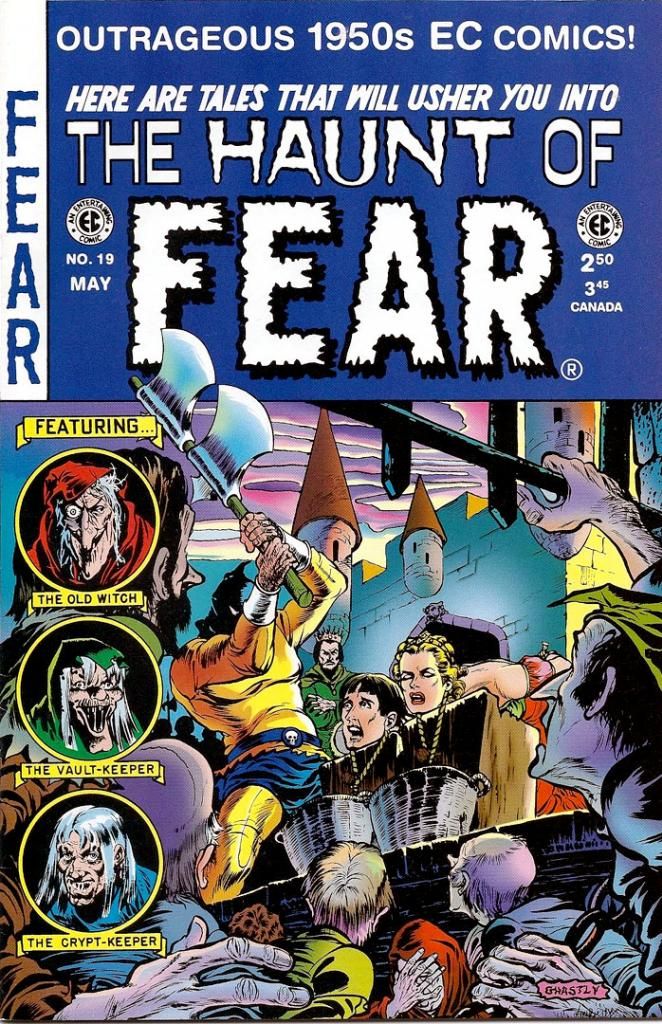
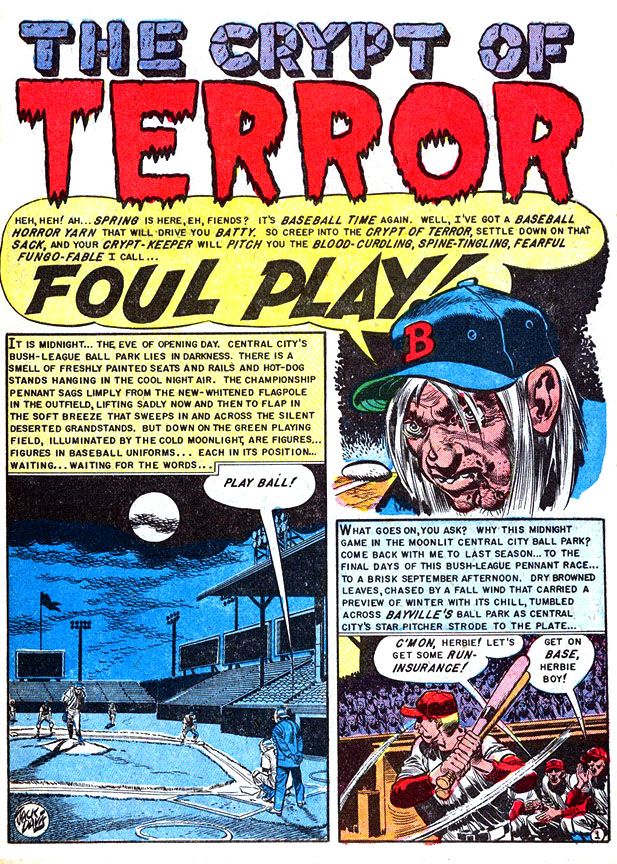
No, they didn't ruin baseball.  That's just me trying to have a little fun and shake things up a bit.  If anything, they made baseball better!  But EC did get itself into hot water with the government over "Foul Play," a story appearing in Haunt of Fear #19 (May-June 1953).  Dr. Frederic Wertham used it as an example of horror comic nastiness in his book Seduction of the Innocent and then did it again during his afternoon session testimony to the 1954 Senate Subcommittee Hearing on Juvenile Delinquency. 

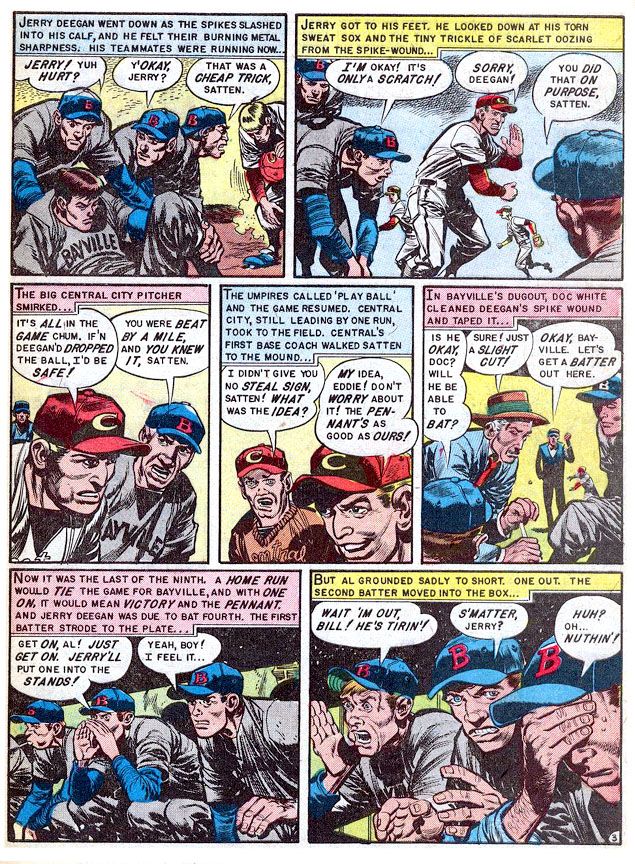
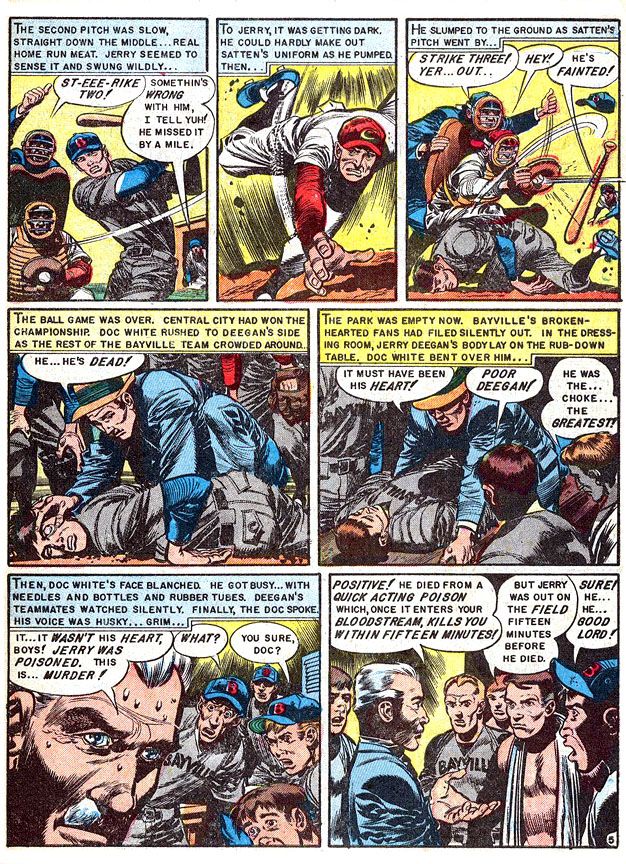
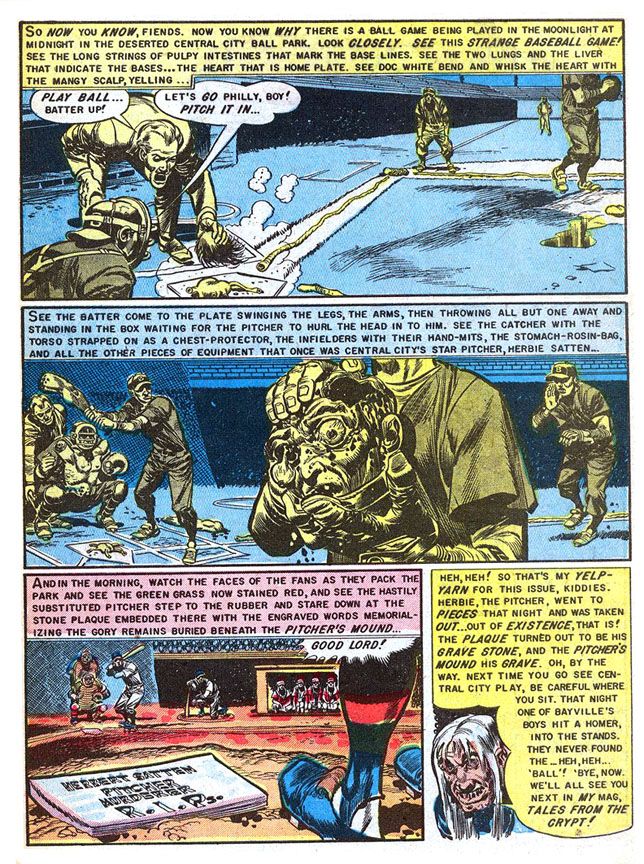
The story is about Central City's Herb Satten, an unscrupulous pitcher who wants to help his team win the pennant by murdering the Bayville's star second baseman, Jerry Deegan.  After all, this Deegan slugger led the league in home runs all season and he's up the next inning in a tight game.  It stretches credulity a bit.  Satten kills Deegan by poisoning his spikes, then allowing himself to get hit with an inside pitch so he can get on first, attempt a steal then slide spikes-high and slash his victim.  He's thrown out and it looks like a bonehead play, but it all works out. Satten kills his man and Central City wins.  This leads to the pitcher's grisly comeuppance the night before the next season's opening day.

And one of the all-time great gross-out scenes in horror comics history.  The murdered man's teammates literally rip Satten apart late one night and use his body parts to play a moonlit intrasquad game.  Complete with a complicit umpire.  That also stretches believability, but not so far as the poor pitcher's intestines, which serve as foul lines up the first and third base paths.  The grisliest detail is the catcher's using the Satten's chest as his own chest protector.  You wanna wear part of a human body even if he is a sorry murdering cheat?  What is this, the Ed Gein League?

They also incriminate themselves by burying him under the pitcher's mound and inscribing the rubber there with "Herbert Satten.  Pitcher.  Murderer.  R.I.P."

Rest in pieces, baby.  Rest in pieces.

Writer:  Al Feldstein/Artist: Jack Davis

Well, they were angry ballplayers and probably didn't think through the consequences.  The ironic thing about "Foul Play" is, it may have been notorious at the time but the guy who drew it is one of the nicest, most gentlemanly people you'll ever have the privilege of meeting.  If you're so lucky.  I had a chance to phone interview him way back in 1996 for a class project and I came away in such a good mood because he was so jolly and generous.  He answered even my stupidest questions with patience and good cheer.

Writer:  Al Feldstein/Artist: Jack Davis


I'm talking Jack Davis, the dean of American caricaturists.  This story is right in his wheelhouse, so to speak.  Davis is a master of sports cartooning, able to twist his loose-limbed figures into whatever pose necessary to show the physicality of sports.  Baseball, basketball, football, late night murder, these are things Davis visualizes so well.  Obviously made a huge impact on Dr. Wertham and the guys up on Capitol Hill, huh?

Writer:  Al Feldstein/Artist: Jack Davis

I loved Davis' work before I ever read this story (although I'd heard rumors of it for years and they always chilled me to the bone).  He drew magazine covers, movie posters.  His art came into our house on television in the form of character designs for the Jackson 5ive Saturday morning cartoon.  As a University of Georgia graduate, I've seen dozens, if not hundreds, of Davis-drawn Bulldog athletes in motion, with his characteristic lanky body language and large, articulated hands.  Gorgeously rendered in loose, appealing brushstrokes and then watercolored to pop from the page of whatever book, calendar or postcard they adorn.  His 1950s horror work benefits from the Davis approach, one that exaggerates reality for comic effect.  So when you see a Davis severed head, it's not grotesque no matter how decayed it might be.  It's sick... but in a tasteful way.

Writer:  Al Feldstein/Artist: Jack Davis

The Senate Subcommittee Hearing people must not have felt that way, although I believe William Gaines explained it quite well in his testimony.  This is gore in just the right amount.  There's nothing gratuitous about it, but it has to have impact.  If you'll notice, too, colorist Marie Severin gives those panels a blue-yellow complementary color scheme rather than one that emphasizes its fleshy or bloody qualities.  This makes it explicit without going over the top.  Not for the squeamish, certainly.  But it's right in my wheelhouse, too.  Jack Davis is an American treasure, baby.  And so is Marie Severin.  No doubt about that. 

Friday, June 20, 2014

Katana's first foray: Batman and the Outsiders #1 (August 1983)

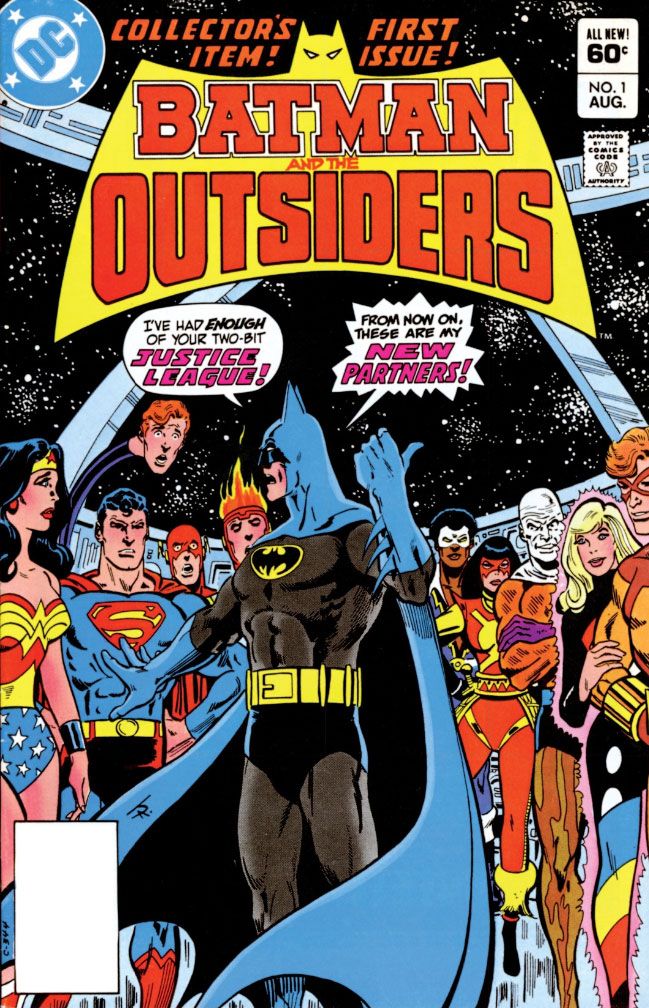
Katana’s first appearance is in the first DC Sampler giveaway comic, but for our purposes and because I no longer have that (I did all those years ago, though!), we’re going to say it was in Batman and the Outsiders #1 (August 1983).

As we've discussed before, I’ve always considered Katana a pretty cool character.  Well, except for her original ketchup and mustard color-schemed costume.  It’s really a shame what happened to her recent solo series.  Out of all the New 52 redesigns, hers is the most visually arresting and appropriate.  But we're old school hereabouts, so we're going to spend some time with the original Katana, from back in the day.  DC and Comixology just released for sale the first two issues of the 1980s Batman and the Outsiders series and, of course, I jumped at the chance to buy them again. 

The plot mechanics show through.  There's trouble brewing in made-up country Markovia, and that's where Bruce Wayne has sent trusted employee Lucius Fox (the guy played by Morgan Freeman in the Christopher Nolan Batman trilogy) there.  Rebel troops capture Fox and hold him hostage, but wouldn't you know it, Superman has told the United Nations the Justice League will sit this one out, and if you're a member of that team, his promise is legally binding.  When Batman finds out no one's going to help him rescue Fox, he flips out and quits, thus finding and exploiting the one small loophole in the United Nations charter as it relates to solemn promises made on everyone's behalf by a guy from another planet.  Even with Batman giving everyone yet another snarled recounting of his origin, this is still an all too convenient way to get Batman out of the Justice League and together with the Outsiders-- all of whom just happen to be in Markovia at the same time for their own purposes.

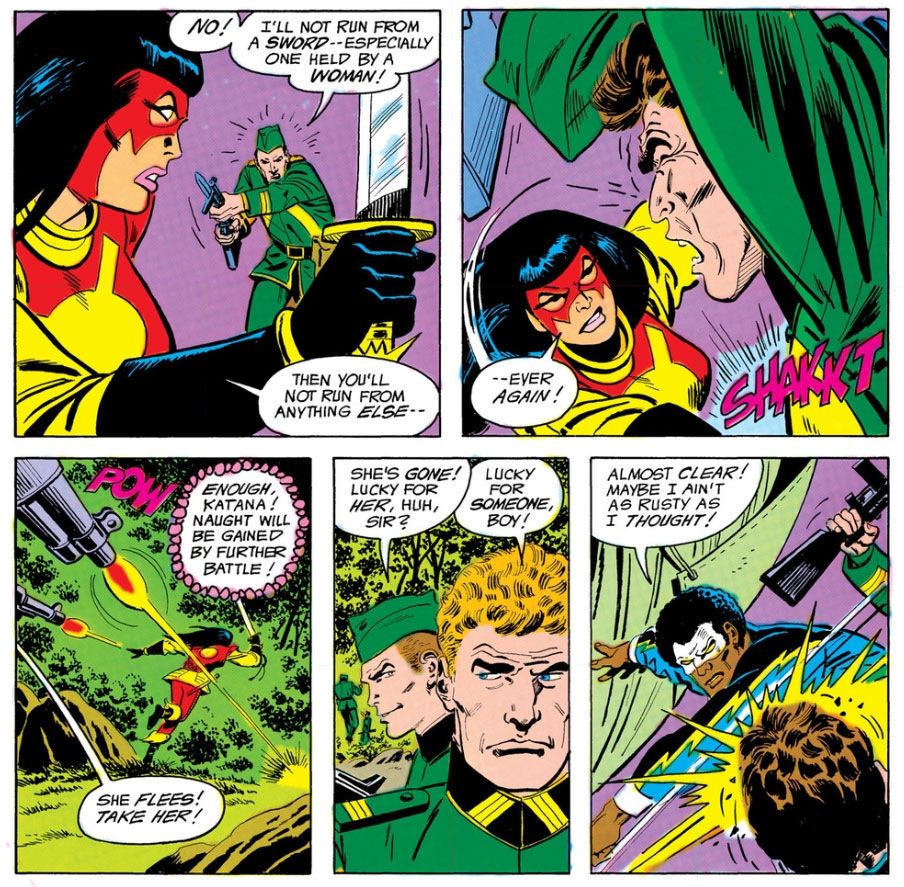
Well, to hell with that.  This was-- and remains-- a cool book.  You really can’t, or shouldn’t, argue with Jim Aparo’s artwork, and writer Mike W. Barr builds a strong team dynamic once he gets past the set-up.  The unique mother-daughter relationship he establishes between stone-cold killer Katana and naïve amnesiac Halo helps set this book apart from its ensemble-cast predecessors Uncanny X-Men and New Teen Titans and keeps Outsiders from becoming too generic—the DC equivalent of The Defenders.  Geo-Force is a real zero, though.  His brown costume is dull, as is his origin.  Fortunately, there’s Black Lightning and super-freak Metamorpho.  Black Lightning gives us someone badass to root for who isn’t a jerk like Batman, and Metamorpho adds visual interest.

What does Katana add besides maternal love?  Why, dead bodies by the truckload!

The all-murder-all-the-time team member element hearkens back to the early days of Uncanny X-Men and the Wolverine character arc, before he became overexposed and watered down by revealing his many origins and future demises.  I can’t get over Batman sort of standing back and letting Katana murder so many people, but it certainly makes her more interesting than blandly heroic dopes like Geo-Force.  She doesn’t have any powers to speak of, although because she’s Asian and in a comic book, she’s adept at all martial arts, and because she’s Japanese, of course she is a samurai.

Script:  Mike W. Barr/Art:  Jim Aparo


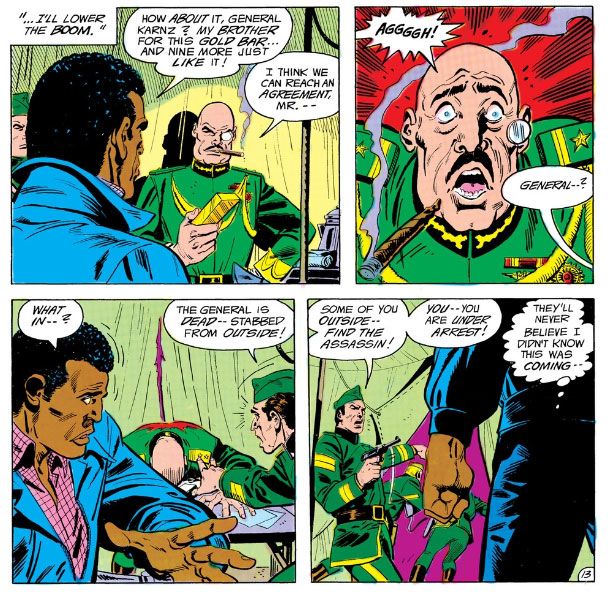
See?  The very first thing she does is kill that general, just as a disguised Black Lighting (he's not in the JLA, so he's legally allowed to help Batman all he wants) has successfully tricked him into believing he's Fox's brother and wants to trade lovely gold bars for his lovely fake brother.  Black Lightning's thought balloon and clinched fist both show he knows this ruins Batman's scheme.  He quickly strips off his civilian clothes to reveal his super-costume and starts fighting the enemy troops. 

Okay, let's take a break from all the killing to talk about the very thing from which Katana takes her codename.  What?  You thought Katana was her birth name?  No, her parents named her Tatsu Yamashiro, but only her close friends who know her in her civilian identity call her that.  And even they don't call her that.  They call her Yamashiro-san.  Or Ms. Yamashiro. 

And a katana is a type of samurai sword.  I'm far from an expert, but I do know samurai had more than one kind.  There were longer ones and shorter ones, and they all have names which I don't know.  We say "katana" when we mean the basic samurai sword.  Unless we say "samurai sword" sword instead.  This is Katana's main weapon, her version of Green Lantern's ring, Green Arrow's bow and arrows and Green Keyboard's magic computer.  Anyway, Katana uses a katana.  You know Katana talks to her katana, right?  That’s one of her “things.”

Why would anyone do that when there's a perfectly good Batman standing right there?  I'll tell you.

Like Katana herself, Katana's katana has its own special name:  The Soultaker.  It does that.  It takes souls.  If Katana kills you with it, your soul goes into the sword with all the other souls, but Michael Moorcock doesn’t sue you or anything, so don’t worry about it.  I think a cooler codename than Katana would have been the Japanese phrase for Soultaker, which is something like 魂を取る人, or “Tamashi o toru hito,” or 魂を盗み (“to steal the soul”) according to Google Translate.  Hm.  Maybe not.  Kind of clumsy, huh?  Looks as if Barr and Aparo had a good idea all along and I'm wrong, all right?  I'm Wrong Roy.  Toby!  You are close to death!  Come out here!

So her husband's soul is inside Soultaker.  They talk a lot.  In the new series, she sleeps with the sword as well, which is all kinds of kinky especially when you consider most of her pals don't believe her husband's soul (or anyone's) is inside the sword.  But trust me, in the original series, he's in there and she talks to him and he talks back and gives her advice.

 Anyway, she--


Script:  Mike W. Barr/Art:  Jim Aparo

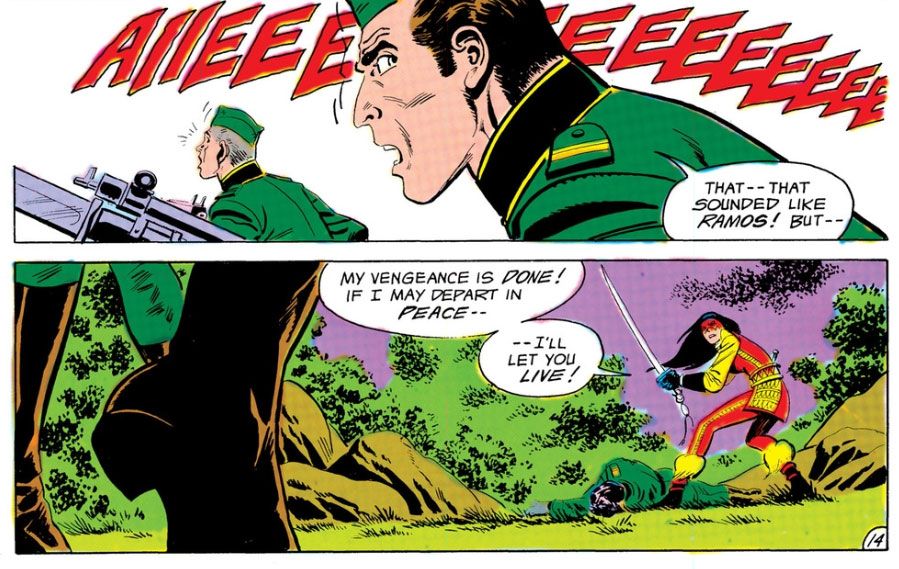
Oh, look!  Katana's second kill.

She's not really in the first issue of Batman and the Outsiders all that much, but with two kills in two pages, she's made quite an impression.  Batman hogs most of the story space, the same way he hogs the front part of the title, as if this were one of those noisy rock combos the kids like nowadays, where the lead person has their name up front and everyone else is kind of smashed into a collective to the rear.  And then the named artist quits and starts producing music that sounds just like the original group’s, only not as inspired or interesting.  As a result of Batman’s outrageous ego, Katana barely gets into the comic, but she has an impact much greater than you’d expect given the few panels in which she appears.

Another interesting aspect of the character is--

Script:  Mike W. Barr/Art:  Jim Aparo

That's our Katana!

Sunday, January 19, 2014

How did Josie and the Pussycats get on Saturday morning TV anyway?

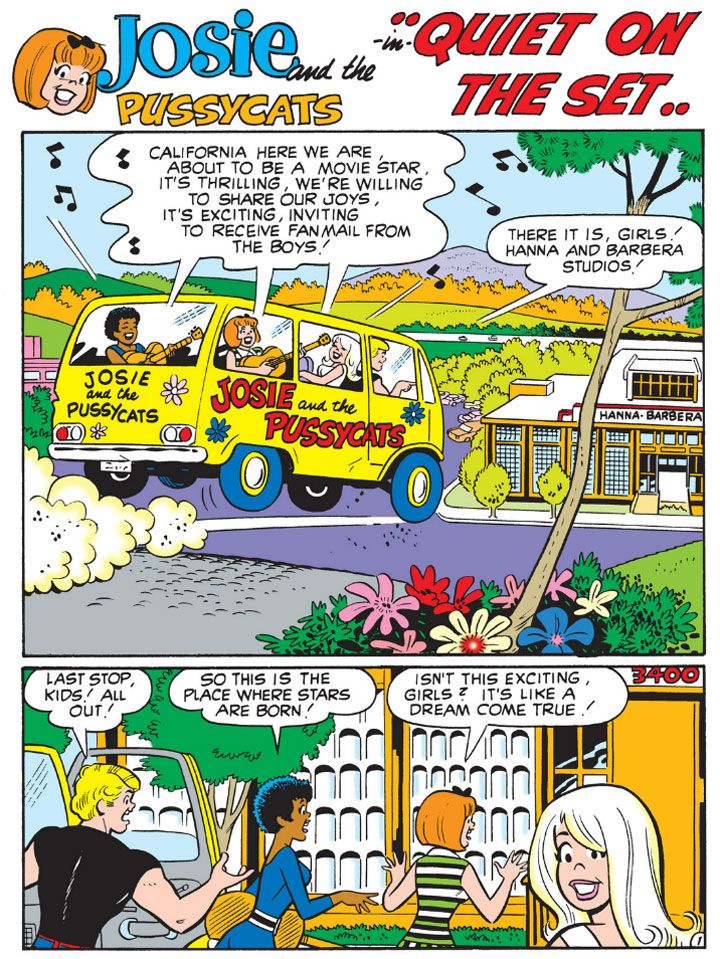
Philosophical minds have been asking this question for years.  As if to finally answer them, Archie Comics pulled some stories out of their archives for a Best of Josie and the Pussycats collection and thoughtfully included the story "Quiet on the Set" from Josie and the Pussycats #50 (September 1970), written by Dick Malmgren and illustrated by ace Josie artist-creator Dan DeCarlo and inker Rudy Lapick.  An example of cross-promotion, this story shows the band making a visit to Hanna and Barbera studios where they're caricatured and animated in time for their September 12, 1970 debut on CBS television.  Which I probably watched, despite being all of two years old.  Something hooked me on it, anyway.

Perhaps it was the basic idea of the Pussycats tooling around in their Chevy van improvising songs on whatever event they're currently involved in and accompanying themselves on acoustic guitars, so in tune with each other's creativity they can even do it in three-part harmony!


Josie and the Pussycats #50 (September 1970), script by Dick Malmgren, art by Dan DeCarlo and Rudy Lapick

Top that, Archies.  In fact, top that, Beatles!

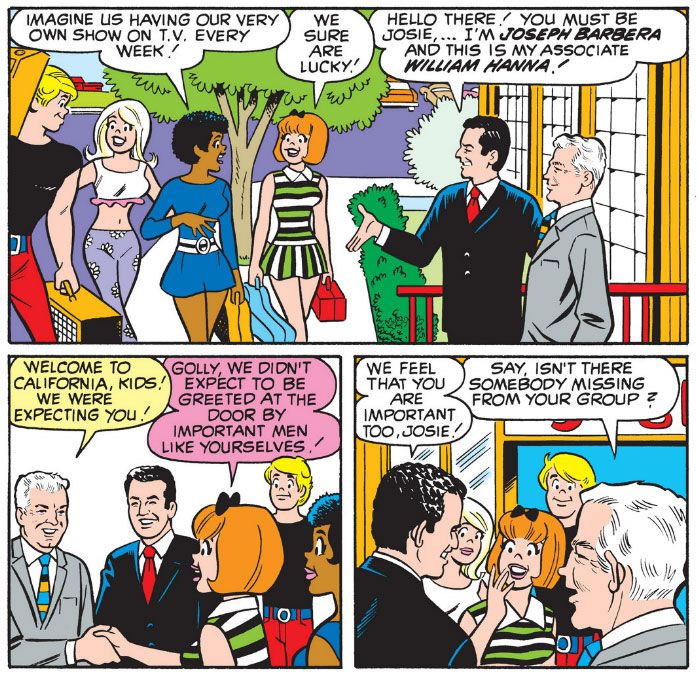
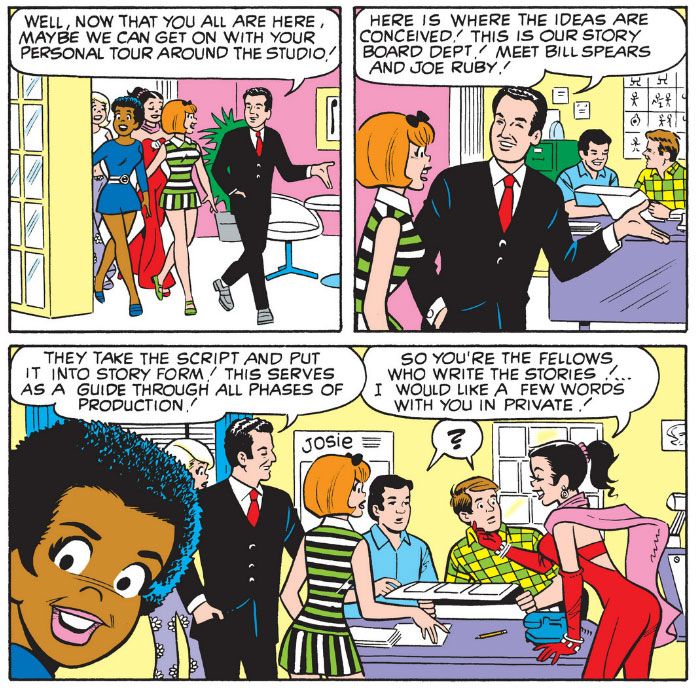
The band arrives at Hanna-Barbera and none other than Joseph Barbera and William Hanna (charmingly caricatured by DeCarlo and Lapick) turn out to greet them on the homey front step.  I'm not sure who these two guys are or what their relation to the animation studio might have been, but they look very friendly.  Dapper dressers, too.  They must have been fairly important if we're to judge by the Pussycats' impressed reactions.  Generation gap be damned-- the kids take to the two smiling older gentlemen right away.  In fact, it's a mutual admiration society.  But something's amiss, as William Hanna observes.

Script by Malmgren, art by DeCarlo and Lapick

No way!  Josie, Valerie, Melody, Alan.  That's everyone!  Who could they have left out?

She's Josie #1 (September 1970), script by Frank Doyle, art by Dan DeCarlo and Rudy Lapick

Actually, missing are those squabbling siblings, Alex and Alexandra Cabot.  They show up in a sweet limousine.  Alexandra proceeds to sweep into the studio as if she's Elizabeth Taylor and starts dropping advice to all the artists and animators on how she should be depicted in the series. 

Script by Malmgren, art by DeCarlo and Lapick

And Valerie's looking back at us as if to say, "Isn't this the most?" 

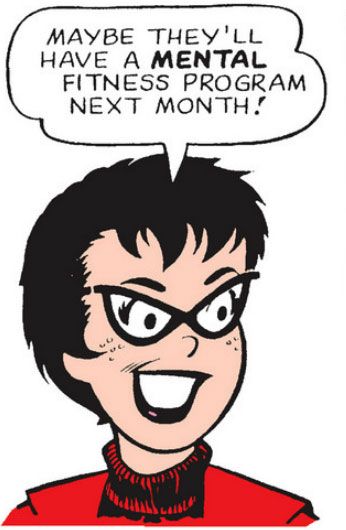
The two Hanna-Barbera employees here are Ken Spears (inexplicably referred to here as "Bill") and Joe Ruby.  From what I can gather, they were writers and story editors, but the comic shows them happily working together in the storyboard department.  Barbera's description of their duties is informative and vague at the same time.

Ruby and Spears, like Hanna and Barbera, are real people, as are many of the unnamed employees throughout this story, each of whom DeCarlo has obviously caricatured from life.  Ruby and Spears are the only two important enough for the story to name, and would later create Jabberjaw for the studio.  While it's a mistake to discount the magnetic qualities of its titular character, a talking shark gifted with Curly Howard's comedic persona, 70s kids with discerning Saturday morning cartoon tastes considered that show little more than a store-brand version of Josie and the Pussycats, delicious in its own way but suffering by comparison to its fantabulous inspiration, in much the same manner as Publix Super Markets' Magic Stars cereal versus General Mills' fresher-tasting Lucky Charms.

Simply appearing in a Josie and the Pussycats comic is enough for me to nominate the duo for immortality, but a few years after that, the Ruby-Spears team would found an animation studio of their own.  There they would co-produce The Mork & Mindy/Laverne & Shirley/Fonz Hour with former employers Hanna-Barbera, then famously team artists Alex Toth and Jack Kirby on Thundarr the Barbarian to the delight of Steve Gerber fans everywhere.  Along with their production of the revived Alvin and the Chipmunks series, It's Punky Brewster and a personal favorite of mine, Mister T (I conflated it with Marvel's The New Mutants comic), Ruby and Spears contributed the bulk of my childhood/early teen weekend entertainment that didn't involve reading about stars and wars, drawing stars and wars, or dropping quarters into video game machines and participating in stars and wars.

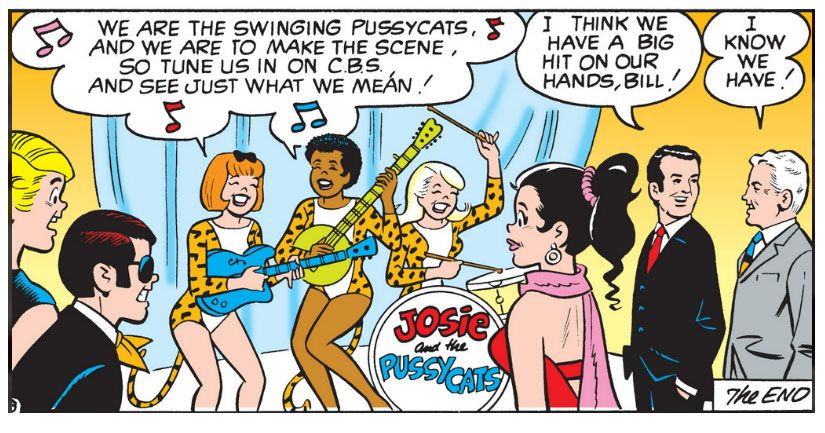
Back in our story, Alexandra's repeated self-aggrandizement leads only to humiliation for her animated counterpart as the Hanna-Barbera artists somehow manage to design, write, storyboard, animate, film, develop, loop, edit and print (or whatever order they do that in) for a short sequence in which she gets hit in the face with a pie during the band's visit.  Pretty fast turnaround, and it brings to mind the classic line, "Very few cartoons are broadcast live.  It's a terrible strain on the artists' wrists," from the classic eighth season The Simpsons episode, "The Itchy & Scratchy & Poochie Show" (February 9, 1997).  At first angry, but then acquiescing to the joke like the good sport she secretly is (possibly), Alexandra accompanies Hanna and Barbera to an impromptu concert put on by the Pussycats, who have changed into their famous feline-themed performance attire for the occasion.

Script by Malmgren, art by DeCarlo and Lapick

A happy ending.  The original Josie and the Pussycats TV cartoon ran for sixteen episodes during the 1970-71 TV season, then mutated into Josie and the Pussycats in Outer Space for another sixteen the following year.  They beat musical rivals the Partridge Family there by two hundred years.  And there you have it.