Showing posts with label Jim Aparo. Show all posts

Friday, June 20, 2014

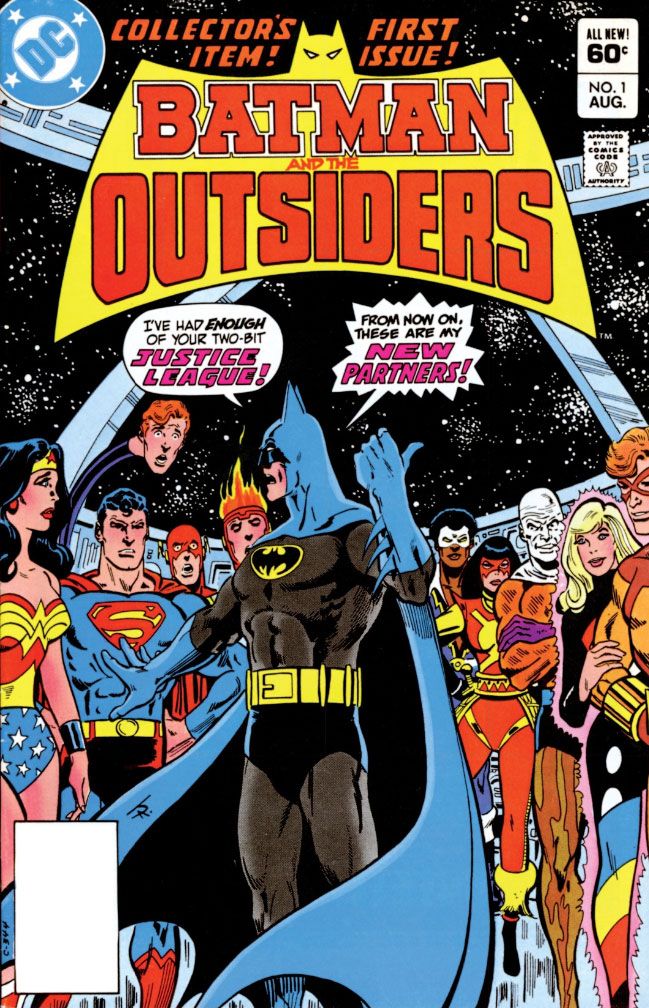
Katana's first foray: Batman and the Outsiders #1 (August 1983)

Katana’s first appearance is in the first DC Sampler giveaway comic, but for our purposes and because I no longer have that (I did all those years ago, though!), we’re going to say it was in Batman and the Outsiders #1 (August 1983).

As we've discussed before, I’ve always considered Katana a pretty cool character.  Well, except for her original ketchup and mustard color-schemed costume.  It’s really a shame what happened to her recent solo series.  Out of all the New 52 redesigns, hers is the most visually arresting and appropriate.  But we're old school hereabouts, so we're going to spend some time with the original Katana, from back in the day.  DC and Comixology just released for sale the first two issues of the 1980s Batman and the Outsiders series and, of course, I jumped at the chance to buy them again. 

The plot mechanics show through.  There's trouble brewing in made-up country Markovia, and that's where Bruce Wayne has sent trusted employee Lucius Fox (the guy played by Morgan Freeman in the Christopher Nolan Batman trilogy) there.  Rebel troops capture Fox and hold him hostage, but wouldn't you know it, Superman has told the United Nations the Justice League will sit this one out, and if you're a member of that team, his promise is legally binding.  When Batman finds out no one's going to help him rescue Fox, he flips out and quits, thus finding and exploiting the one small loophole in the United Nations charter as it relates to solemn promises made on everyone's behalf by a guy from another planet.  Even with Batman giving everyone yet another snarled recounting of his origin, this is still an all too convenient way to get Batman out of the Justice League and together with the Outsiders-- all of whom just happen to be in Markovia at the same time for their own purposes.

Well, to hell with that.  This was-- and remains-- a cool book.  You really can’t, or shouldn’t, argue with Jim Aparo’s artwork, and writer Mike W. Barr builds a strong team dynamic once he gets past the set-up.  The unique mother-daughter relationship he establishes between stone-cold killer Katana and naïve amnesiac Halo helps set this book apart from its ensemble-cast predecessors Uncanny X-Men and New Teen Titans and keeps Outsiders from becoming too generic—the DC equivalent of The Defenders.  Geo-Force is a real zero, though.  His brown costume is dull, as is his origin.  Fortunately, there’s Black Lightning and super-freak Metamorpho.  Black Lightning gives us someone badass to root for who isn’t a jerk like Batman, and Metamorpho adds visual interest.

What does Katana add besides maternal love?  Why, dead bodies by the truckload!

The all-murder-all-the-time team member element hearkens back to the early days of Uncanny X-Men and the Wolverine character arc, before he became overexposed and watered down by revealing his many origins and future demises.  I can’t get over Batman sort of standing back and letting Katana murder so many people, but it certainly makes her more interesting than blandly heroic dopes like Geo-Force.  She doesn’t have any powers to speak of, although because she’s Asian and in a comic book, she’s adept at all martial arts, and because she’s Japanese, of course she is a samurai.

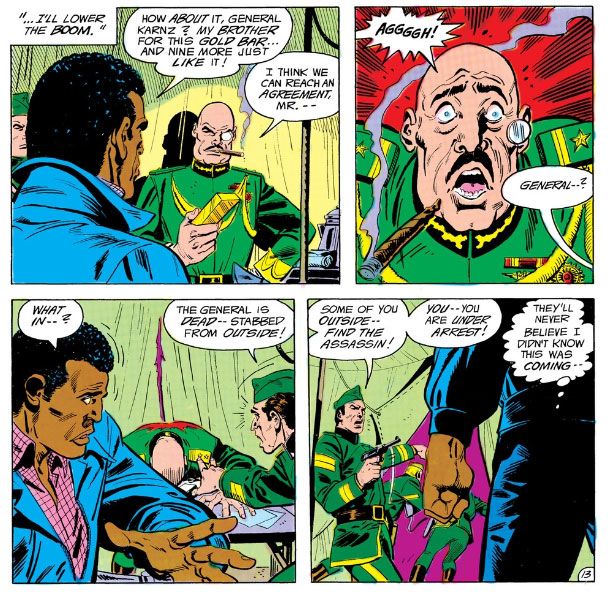
Script:  Mike W. Barr/Art:  Jim Aparo


See?  The very first thing she does is kill that general, just as a disguised Black Lighting (he's not in the JLA, so he's legally allowed to help Batman all he wants) has successfully tricked him into believing he's Fox's brother and wants to trade lovely gold bars for his lovely fake brother.  Black Lightning's thought balloon and clinched fist both show he knows this ruins Batman's scheme.  He quickly strips off his civilian clothes to reveal his super-costume and starts fighting the enemy troops. 

Okay, let's take a break from all the killing to talk about the very thing from which Katana takes her codename.  What?  You thought Katana was her birth name?  No, her parents named her Tatsu Yamashiro, but only her close friends who know her in her civilian identity call her that.  And even they don't call her that.  They call her Yamashiro-san.  Or Ms. Yamashiro. 

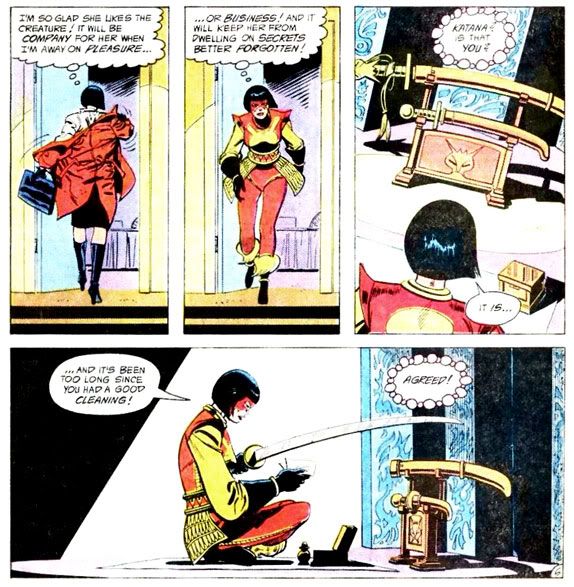
And a katana is a type of samurai sword.  I'm far from an expert, but I do know samurai had more than one kind.  There were longer ones and shorter ones, and they all have names which I don't know.  We say "katana" when we mean the basic samurai sword.  Unless we say "samurai sword" sword instead.  This is Katana's main weapon, her version of Green Lantern's ring, Green Arrow's bow and arrows and Green Keyboard's magic computer.  Anyway, Katana uses a katana.  You know Katana talks to her katana, right?  That’s one of her “things.”

Why would anyone do that when there's a perfectly good Batman standing right there?  I'll tell you.

Like Katana herself, Katana's katana has its own special name:  The Soultaker.  It does that.  It takes souls.  If Katana kills you with it, your soul goes into the sword with all the other souls, but Michael Moorcock doesn’t sue you or anything, so don’t worry about it.  I think a cooler codename than Katana would have been the Japanese phrase for Soultaker, which is something like 魂を取る人, or “Tamashi o toru hito,” or を盗 (“to steal the soul”) according to Google Translate.  Hm.  Maybe not.  Kind of clumsy, huh?  Looks as if Barr and Aparo had a good idea all along and I'm wrong, all right?  I'm Wrong Roy.  Toby!  You are close to death!  Come out here!

So her husband's soul is inside Soultaker.  They talk a lot.  In the new series, she sleeps with the sword as well, which is all kinds of kinky especially when you consider most of her pals don't believe her husband's soul (or anyone's) is inside the sword.  But trust me, in the original series, he's in there and she talks to him and he talks back and gives her advice.

 Anyway, she--


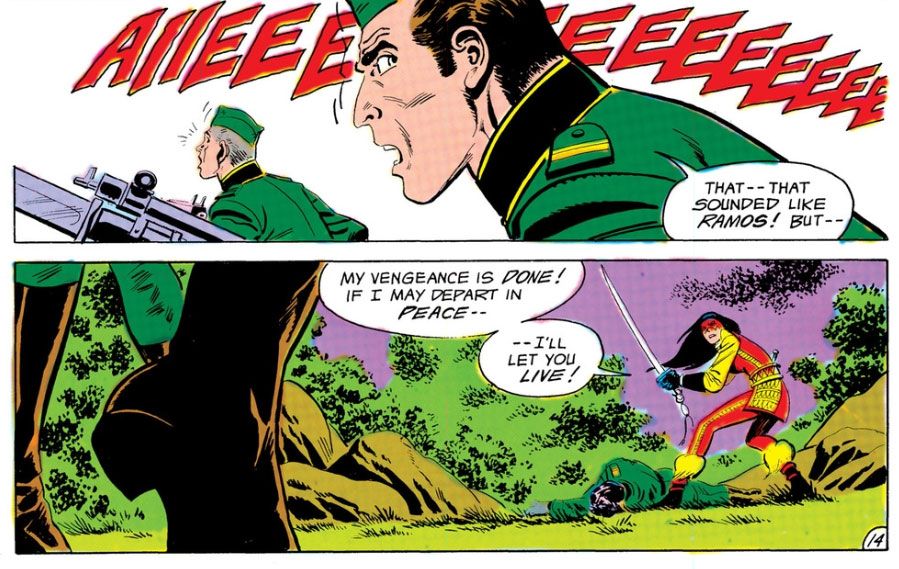
Script:  Mike W. Barr/Art:  Jim Aparo

Oh, look!  Katana's second kill.

She's not really in the first issue of Batman and the Outsiders all that much, but with two kills in two pages, she's made quite an impression.  Batman hogs most of the story space, the same way he hogs the front part of the title, as if this were one of those noisy rock combos the kids like nowadays, where the lead person has their name up front and everyone else is kind of smashed into a collective to the rear.  And then the named artist quits and starts producing music that sounds just like the original group’s, only not as inspired or interesting.  As a result of Batman’s outrageous ego, Katana barely gets into the comic, but she has an impact much greater than you’d expect given the few panels in which she appears.

Another interesting aspect of the character is--

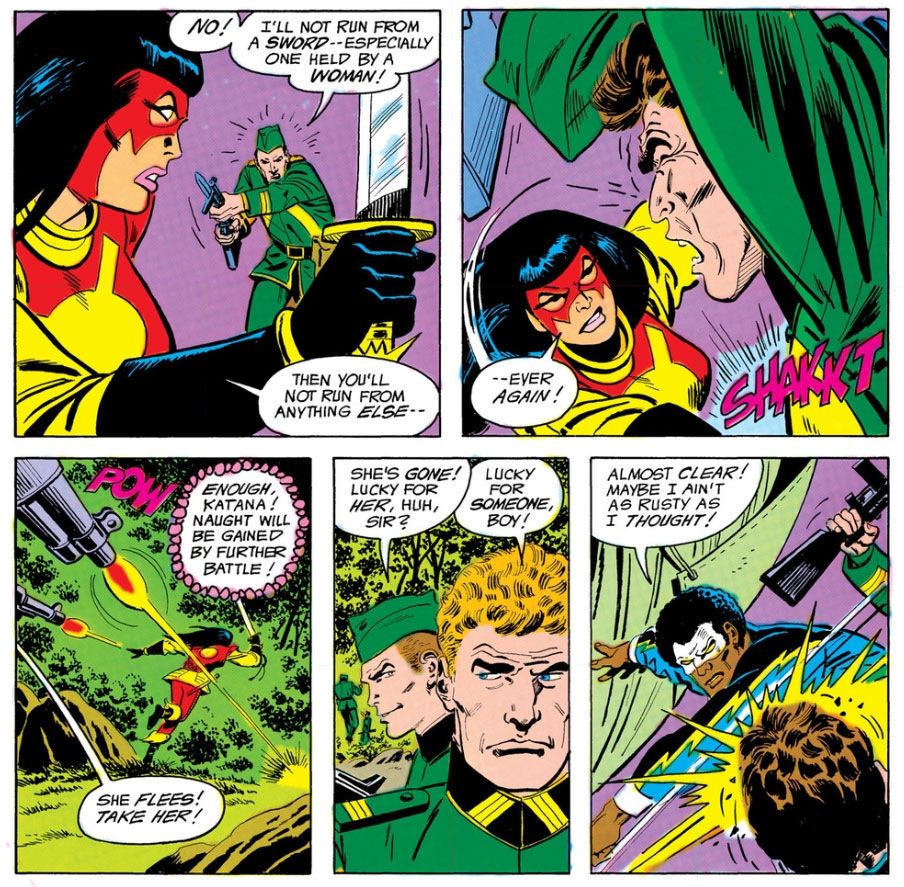
Script:  Mike W. Barr/Art:  Jim Aparo

That's our Katana!

Tuesday, June 17, 2014

Coming soon: a look at Marvel's movie adaptations!

Hola, amigos.  I know it's been a long time since I last rapped at ya, but things have been pretty crazy around here lately.  It's not as if I'm not reading comics.  I am.  I'm reading some fantastic old comics with art by cats like John Buscema and John Romita, Al Williamson, Jim Aparo and Alex Toth.  But, as I've told you, I'm also working on my own comic.  Plus I'm married and have a regular job that takes up about ten hours a day (if I'm lucky).  Man, I get home, all I want to do is read the comics, not write about them.  Or work on my own.

Anyway, what I'm here to tell you is I have a few posts coming up.  They're largely finished but I need to tweak a few things here and there, check a fact or two so they live up to the high standards for comic journalism you've come to expect from When Comic Books Ruled the Earth.  You deserve no less. 

Comixology and DC just released the first two issues of Batman and the Outsiders by Mike W. Barr and Jim Aparo.  That's one of my favorite series, and features Katana, a character I've dug for the longest time.  Well, ever since I bought Batman and the Outsiders #1 when it first came out way back in August 1983.  I've written about Katana here before, but it's time to do a closer reading of her first appearance.  DC and Comixology have made that possible, and for that, I'm happy and thankful.

I'm also very excited about one set of posts in particular.  I was writing a bit about Williamson's artwork for the Marvel Blade Runner comic when I realized Marvel has a lot of other cool movie adaptations we could pick apart and have some fun with.  Others have written beautifully about Gene Colan's killer work on Jaws 2, and I've already covered Close Encounters of the Third Kind and Dragonslayer.  You can even find a few funny articles here and there about things like Xanadu.  Well, now I'm going to take them all on, one by one, and in no particular order.  I won't be mocking them, although I'm sure there will be a few attempts at humorous deconstruction, because I'm stuck in post-modern mode and will probably never change.  Mostly I just want to appreciate some of the odder ones for attempting something different, for introducing new genres to comics even if those genres don't really translate into the format very well or comfortably.

You know, like musicals.

I'm not sure when the first post will appear, nor can I say for certain when we'll finally see the last of them.  All I can tell you is they are coming.  And maybe, down the road a ways, I'll make an official announcement of some kind about my own comic and let you know a little bit about it.  I just want to get enough done to make it more of a real thing rather than just a dream I'm chasing.  Consider that a promise.  Or a warning.  Or both.  I hope you enjoy the upcoming posts.  I think you will.

Wednesday, February 19, 2014

Uncanny X-Men #172 and #173: Bad News Mutants in Breaking Training So They Can Go To Japan... Yet Again!

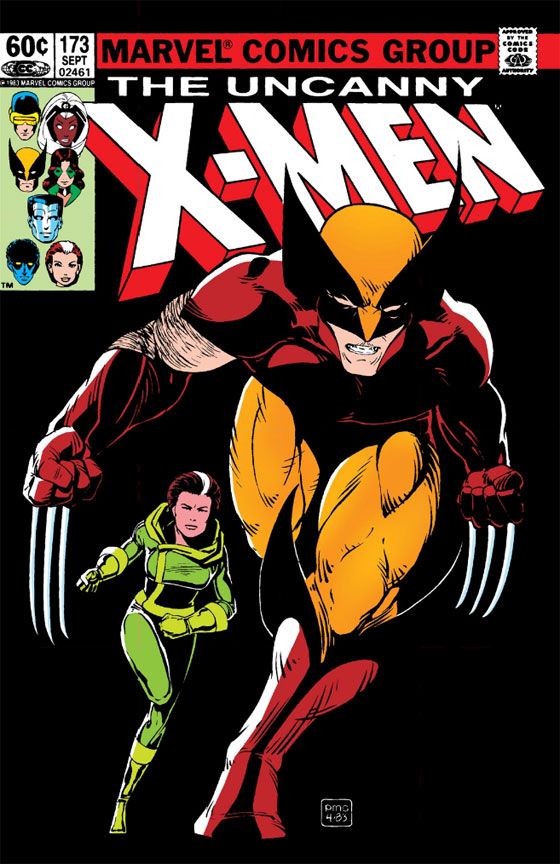
As anyone who's read this blog knows, I live in Japan and I love American comics with this country as their setting.  Imagine my delight when Comixology delivered up Uncanny X-Men #172 (August 1983) and #173 (September 1983), a couple of thrill-filled Nihon-centric issues originally delivered right to the mailbox of my childhood home and featuring a glimpse of my current home, Marvel-style.

Come to think of it, Uncanny X-Men writer Chris Claremont may be one of the reasons I moved here.  If so, I owe him a huge debt of thanks not just for the entertainment his writing provided me when I was kid about Dani Moonstar's age, but also because here in Japan, I live a life every bit as exciting as Wolverine's.  Okay, not really.  I'm boring.  I've only fought ninja or Yakuza thugs on rare occasions, and only once did I love and have my heart broken by someone as regal and unattainable as Lady Mariko.  I'd love to tell you all about it, but we have important things such as comics to discuss!

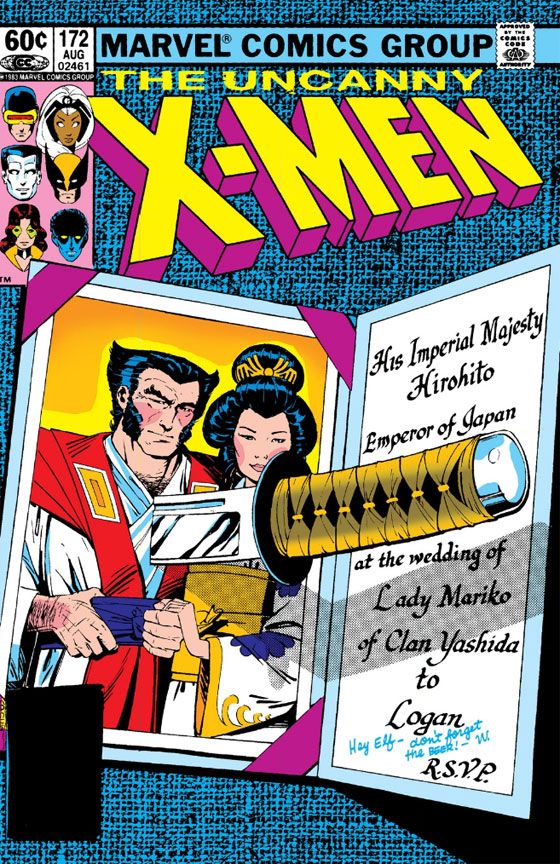
It's been years since I last read these two issues.  I plan to give them my full literary attention someday, but for now we're going to confine our discussion to Smith's images of Japan and bits of narration and dialogue in the pages I chose to illustrate this blog entry.  Just from looking at these very pretty pictures, I can tell this story is a direct sequel to 1982's four-issue Wolverine miniseries by Claremont and Frank Miller.  Wolverine Miller's influence runs all throughout their visuals, so much so the cover to #172 features the invitation Wolverine sent his friends at the end of Wolverine #4.  Paul Smith recreates Miller's original image, and even includes the cute handwritten little note from Wolverine to Nightcrawler about bringing beer.

"His Imperial Majesty Hirohito, Emperor of Japan."  He is now referred to as the Emperor Showa, and if you want to place this book within its era here in Japan it would be the Showa 58, the 58th year of the Showa Era.  Imagine receiving an invite from an emperor!  That is one heavy-duty invitation.  Lady Mariko, Wolverine's fiancée, is from a powerful family, apparently.  I love the fanciful Miller-designed attire the loving couple wear in the photo, too.

By the way, beer is readily available in Japan and has been for quite some time, so either Wolverine means bring any decent local brand Nightcrawler can pick up at a convenience store on the way to the ceremony or else pack in his suitcase some favored Canadian label he can't get there.

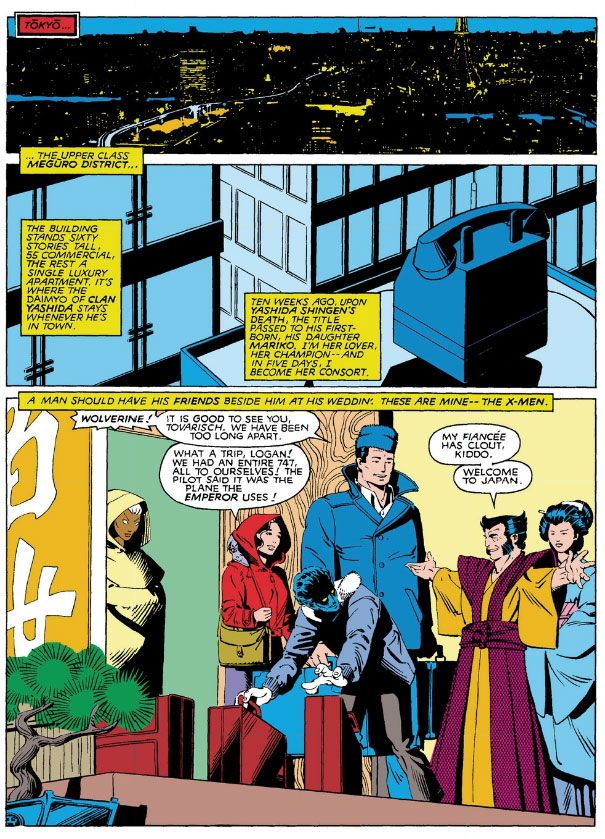
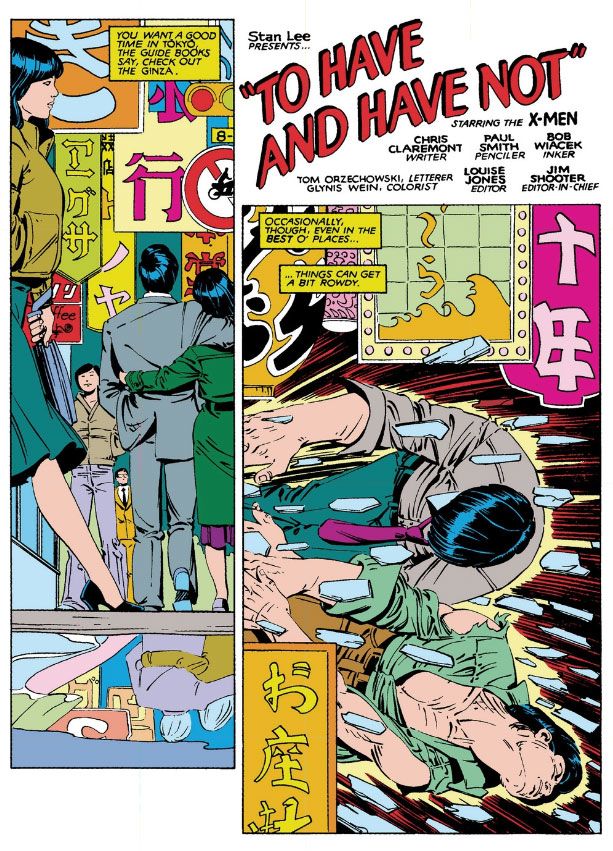
For this story, Claremont and Smith don't waste any time with flights or airports.  They immediately open with a "widescreen" cityscape and tell us it's Tokyo.  Certainly looks like Tokyo to this ex-pat.  Smith appears to have used a high-contrast photo paste-up to create this image, so what we have is a very convincing night view of the huge concrete and steel electrified wonderland we call Tokyo.

Then we zoom in for a closer view to establish exactly where in...

Uncanny X-Men #172 (August 1983), script: Chris Claremont, pencils: Paul Smith, inks: Bob Wiacek


And there it is!  That telephone-topped building again!  Frank Miller used it in Wolverine, Jim Aparo followed suit in Batman and the Outsiders.  Al Milgrom would also draw it in Kitty Pryde and Wolverine, yet another sequel to or continuation of this storyline.  In this issue, we get to see Smith's super-clean rendering of same. 

Was this telephone an actual Tokyo landmark?  I've been researching this online, but either it wasn't so special people have memorialized it or else it's a figment of Miller's imagination.  Even if this is the case, I think a Tokyo building with a big telephone on top is much more plausible than the existence of a Frank Miller movie that doesn't make Ed Wood weep the tears of artistic validation.  Tokyo is the place for all kinds of outdoor advertisement.  I don't know of any building currently topped with an old-fashioned telephone, but I do know of one topped with what the locals refer to as the "Golden Shit."  It's supposed to be a droplet of beer.  I have to agree with its more scatological nickname.

Anyway, you know you're in 1980s comic book Tokyo if you see the giant telephone.  You know you're in today's real Tokyo if you see a big, gilded turd.

Meguro, as Claremont informs us here, in the voice of his character Wolverine, is indeed an upper class district.  Celebrities and the like live there in expensive high-rise apartments.  It's just the place Mariko's family, the Yashidas, might maintain in Tokyo for their visits there.

Since this is an adventure comic, most of the outdoor scenes take place on the rooftops of those apartments, at night.  That's where the ninja sneak around so they can disrupt wedding plans when they take a notion to do so.  Wolverine and his pal Nightcrawler are pretty good at sneaking around up there, too.  As is Wolverine's erstwhile lover, the thrill-crazed Yukio.

Well, kind of...

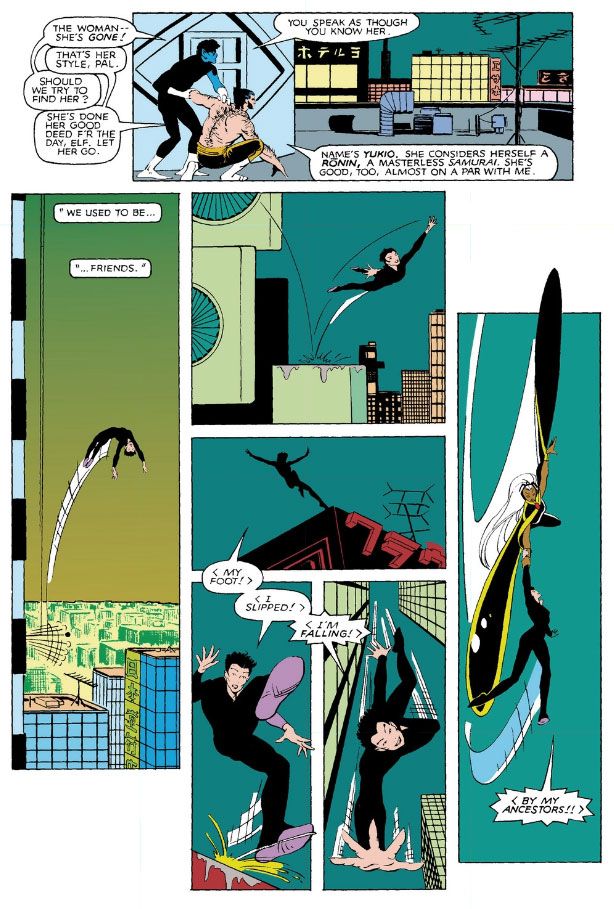
Uncanny X-Men #172, Claremont, Smith, Wiacek


"I slipped!"  That would have been a pretty stupid way for Yukio to die, huh?  Lucky for her, Storm was out flying around.

As you can see from this page, Smith constructs his buildings very simply.  Even so, he and inker Bob Wiacek toss enough katakana or hiragana up and down their sides to make things convincing.  His kimono-clad women are the real visual draw in this story.  There's something about the Smith-Wiacek clean-line look, with things pared down to sleek minimalism that goes well with traditional Japanese clothing.  It also helps that Smith and Wiacek draw amazingly beautiful women.  Unfortunately, they also tend to draw them so they resemble each other, except for Yukio and her punk-rock hair.  Smith and Wiacek give her a face with more sharply defined cheekbones and it individualizes her.

The fun extends to the next issue where Wolverine reluctantly teams up with new team member Rogue to fight the villains.  As I've said, I haven't re-read these in detail, so all I know about the plot is the Silver Samurai and Viper want to stop Lady Mariko from marrying Wolverine.  And Storm debuts her Mohawk after hanging out with Yukio.  No doubt spending any amount of time with someone as uninhibited as Yukio would inspire you to drastic style changes.  We'll get into all of this in the future, but for now you don't really need to know the specifics to enjoy our Claremont-Smith travelogue.

Uncanny X-Men #173, the story starts in "the Ginza."  Claremont has Wolverine tell us guide books recommend "the Ginza" for a "good time."  Wolverine's idea of a good time is getting drunk and into a bar fight.  So that's where we find him. 

I really think Wolverine has read the wrong guide books, because Ginza (minus the definite article) is more a shopping area.  And not just any shopping area.  Ginza is where the rich go to drop the big money on Rolex watches, Chanel and Louis Vuitton couture and bags and other luxury goods, many of which cost more each than I make in a month.  There may have been dive bars there in the 1980s.  There may be now.  But I doubt it.  I rather think Wolverine's destination of choice would be the wilder, woolier environs of Golden Gai in Shinjuku's Kabuki-cho neighborhood.

That's where I went when I wanted to pretend to be Wolverine and act all tough.  Whenever I told people I hung out in Kabuki-cho, they'd smile and shake their heads and tell me, "Don't go there!  It's dangerous!"  Dangerous to the tune of the thousands of yen you blow in the kinds of bars Wolverine would more than likely spend his nights. 

No one has ever said anything like that to me about Ginza.  They just told me to go to this famous chocolate shop, which I could never find the one time I tried, way back in 2008.  I did find a toney toy store selling Indiana Jones and the Kingdom of the Crystal Skull actions figures, the ones with amblyopia.  Some Wolverine, huh?

If you take a closer look at that first vertical panel, notice how Smith includes a puddle in the gutter.  Nice work on the reflections there.  It rains a lot in Japan, so that's a little detail that goes a long way to establishing the setting's bona fides as well.  That image has an impressive sense of place.  That's the Tokyo I've seen with my own eyes.

Uncanny X-Men #173 (September 1983), Claremont, Smith, Wiacek


I'm not too certain about those guys Wolverine's launched through the window.  He does a lot of stuff like that whenever he's in Japan.  Things like this may or may not happen here.  I have a feeling if a foreigner started tossing locals through bar windows, we'd hear about it on the NHK news.  Even more so in the early 80s when we were a rarer breed.  If I had to guess, I'd say this is a more likely to happen in Okinawa where the US military always seems to be stirring things up and causing trouble.  But then, as I've already proven, I'm not Wolverine. 

The worst incident I've ever been involved with was having a guy repeatedly scream, "Pearl Harbor say 'Fuck you!'" at our little drinking group until the bar-owner kicked us out for causing trouble.  I don't blame her.  He was a regular and we were just passing through.  I still wonder what set him off, though.  He approached us in what we thought was a friendly way.  We made small talk in Japanese and tried to use the little abdomen exercise wheel when he asked.  Maybe he felt patronized, or someone said something to offend him when I wasn't paying attention to the conversation.  Perhaps he just hated whitey.  I still don't know what was in his heart.  But I do know he was drunk.

You might read worse stories from other ex-pats here and there around Japan.  Some people attract negativity and bad scenes.  I suppose I've been very lucky in all my years here.  Despite the occasional run-in with Sunfire, mine has been a smooth, laid-back kind of life.  But once again, I don't have adamantium-coated bones or a mutant healing factor.

Marvel Japan is a pretty fun place to visit, isn't it?

Monday, January 9, 2012

Every Old Katana is New Again!

Created by writer Matt W. Barr and artist Jim Aparo, Tatsu "Katana" Yamashiro's been bouncing around the DC universe since 1983 when she debuted in the pages of The Brave and the Bold #200.  Despite his long held aversion to killing, Batman allowed Katana to join his Outsiders group, where her place was roughly the same as that of Wolverine in the first Chris Claremont-written issues of Uncanny X-Men.  Like their Marvel analogues, the Outsiders were originally an international team.  Katana as one of the few members from a real nation with a real culture to explore, even if in a somewhat superficial way.  Her code-name is the Japanese word for the main sword used by samurai, a similar situation to when I appeared as a character in a manga about dorks who blog about comics and called myself Computer Keyboard.


Strangely enough, her sword wasn't always a proper katana.  In some issues, Jim Aparo's version appears to be a no-dachi, a longer bladed weapon used for chopping down riders and horses so one might have a better chance at fileting the fallen enemy. And not just any no-dachi; it's a magical one named Soultaker because it contains the souls of all killed by it-- which gives it more of a Moorecockian lineage than anything having to do with samurai-- including Katana's dead husband. To whom she talks fairly often while... er... polishing him.  It.  I mean "it."


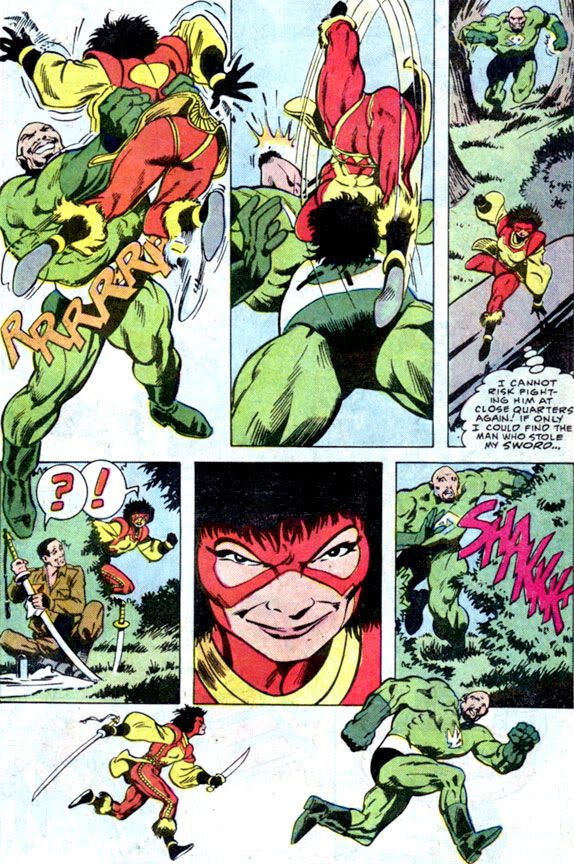
Alan Davis's sword is more the classic katana, although as you can see, its size sometimes varies from panel to panel.   "SHAKKKT" was Katana's version of Wolverine's famous "SNIKT."  But however an artist depicted the weapon, once it was in Katana's hands even the largest of enemies understood discretion as the better part of valor.  We can only imagine that quizzical guy... polishing... Katana's sword there lying in the bushes in two neatly bisected pieces, the grass covered in red slowly drying to a brown crust.  No word from Katana's dead husband on how much he enjoyed the poor fellow's loving hands, though.

Since Katana's a comic book Japanese person, writer Mike W. Barr characterizes her as secretive and largely emotionless, expert at martial arts and the ways of Bushido.  The other choice for comic book writers at the time was to write their Japanese characters as arrogant and frequently infuriated for no reason; i.e., the female Dr. Light and Sunfire over at Marvel.  And experts at martial arts and the ways of Bushido.  Katana's backstory also contains an ex-lover in the Yakuza for the customary family honor business.  Once again, this was during the era when The Uncanny X-Men and its break-out character Wolverine-- especially the version drawn by Frank Miller-- had made all things Japanese cool and hep in the superhero genre.


In Katana's case, think Wolverine's doomed fiancee Mariko Yashida, only this time she's the stone-cold killer instead of just giving someone else justification for his various murders.

Okay, so we've established Katana as an efficient martial arts-based hero with a fancy sword.  But what about her powerful maternal nature?  This is what makes her unique among comic book martial artists.  Sure Lady Shiva spends a lot of time trying to repair her relationship with biological daughter Cassandra Cain, but that's only because it's every parent's dream to fight her offspring to the death for the leadership of a secret cabal of international assassins.  Katana, however, truly embodies the classic nurturing archetype.  You know:  the extraordinarily deadly martial artist mother with a fancy soul-eating sword.

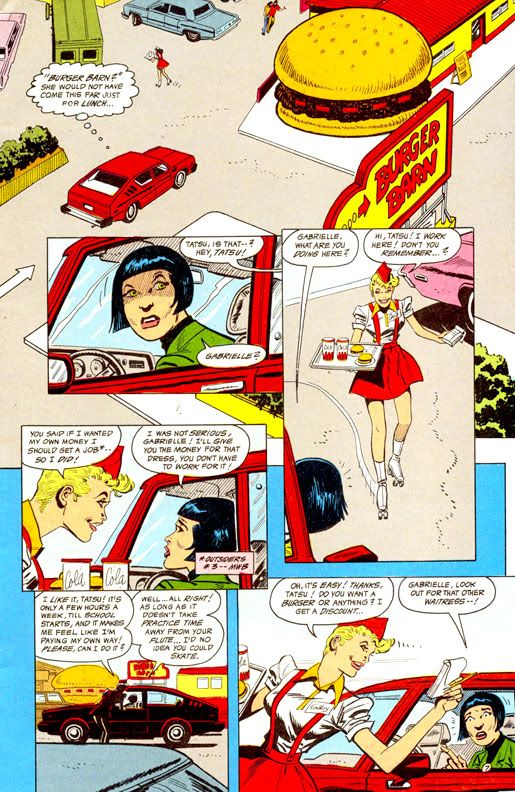
On the rare occasions when she does show emotions (I mean other than the joy that comes from bisecting an anonymous thug with with a perfect killing stroke), Katana largely directs them at her naifish teammate Halo.  During the first few issues, the two quickly form a sort of familial relationship, with Katana as the strict and occasionally insanely protective and possessive parental figure who seems obsessed with her young charge to the point of stalking her.  Finding Halo working as a roller-skating server at a fast food join in #43, Katana demands she quit and then rather desperately offers to buy the girl any clothes she wants.  Which is kind of wacky, considering Katana herself was the one initially trying to push Halo into the superhero equivalent of a "normal life."


You know, attending school, hiding your powers from your classmates, donning disguises, lying to everyone you meet, jetting off at odd hours to kill people all around the world.

Classic Katana may have been two parts stereotype to one part Faye Dunaway as Joan Crawford in the trash classic Mommie Dearest, but she was also a pretty cool and compelling character for those of us who are into Sonny Chiba movies and Koike Kazuo comics.

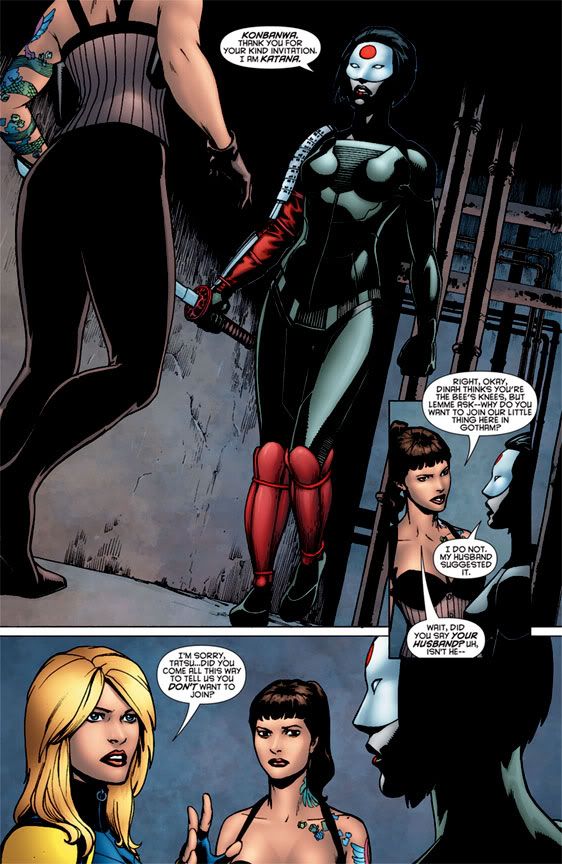
What about contemporary Katana, now that she's got a regular monthly gig again, but no longer with the Outsiders?  Some things about her are comfortingly familiar.  She's still a working part of a renegade team of heroes, this time the Birds of Prey alongside Black Canary, Starling and Poison Ivy.


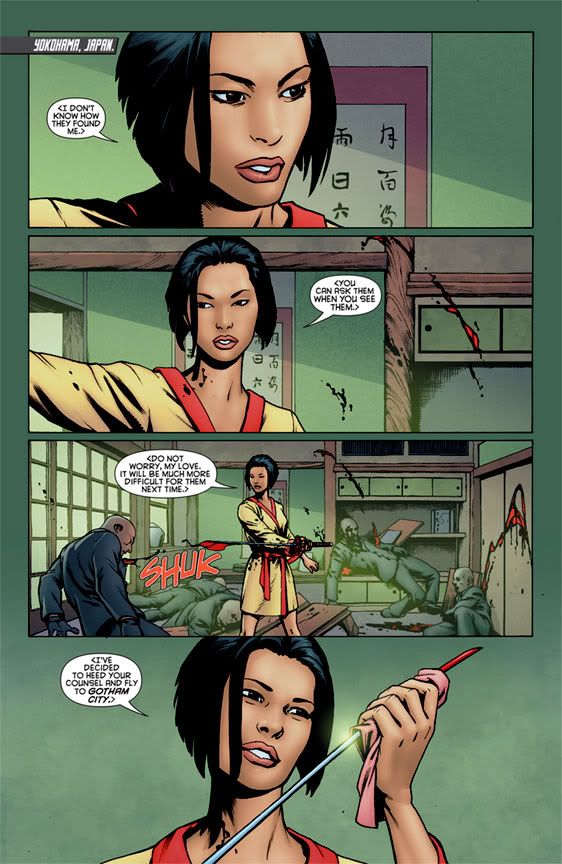
"SHUK" instead of "SHAKKKT," but Katana shows up in Birds of Prey #2 (by writer Duane Swierczynski and artist Jesus Saiz) and immediately racks up quite the body count.  On her first page, she's already diced and cubed five members of the Crazy 88s without changing her facial expression. Or even having one.  Katana kills and kills and in between killing she sometimes takes breaks to kill.

Why, I remember this one time Katana woke up, killed a couple of guys on the way to the kitchen, poured herself a bowl of Frosted Flakes, killed three more guys while getting the milk from the refrigerator, ran outside to kill a team of ninja trying to steal her morning paper, then killed a few more people on the way back to the front door before sitting down and reading For Better or For Worse while eating her cereal; a breakfast ritual for her-- she loves that strip.  She spent the rest of the day killing.

So if you're not willing to take my word for it and you're still wondering whether or not Katana uses her sword in the way The A-Team used their Ruger Mini-14s or if she swings it in earnest, I think this image pretty much settles the issue:


"SSSSSHK?"  Wrong again.  It's "SHAKKKT."  Just a flesh wound.  The flesh being the center of that guy's heart.  I don't think those two rubes in the bottom panel are going to be bouncing their children on their knees or swinging them up to the blue, blue sky anytime soon, either.  Or breathing.

No one really seems interested in stopping her murderous ways, which is kind of odd.  We all love dark stories where the murk hides the boundaries between right and wrong, but honestly, what kind of hero team amasses that many corpses and remains a hero team?  And why don't the international authorities care about due process and basic human rights?  Sure, these are villains and some of the killings can be justified as self-defense, but one has to wonder how many and what the limitations are on deadly force as they pertain to superheroes.

Hey, I'm not judging her.  I'd rather have a killer Katana than a Katana who waves around a mostly useless sword and only uses it to cut ropes and buttons off villain shirts and pants.  I'm just wondering why people like Black Canary-- and even Batman back in the day-- tolerate it, and why Interpol or the United Nations or even Amnesty International doesn't get involved at some point.  I understand why Starling doesn't; she's too busy shooting people in the face.

Katana has evolved on other ways over the years.  Her costume was once Ronald McDonald-esque with a vaguely Asian motif.  Now she's one of the more visually impressive heroes in DC's roster.  The new Superman flies around in a hideous cast-off that looks like a collaboration between Mr. Data of Starfleet Hills and the people who invented "Mighty Men and Monster Maker" (when he isn't wearing a bath towel, t-shirt and jeans), Batman now wears a codpiece or an adult incontinence pad, but Katana sports a sleek armored suit reminiscent of Japanese lacquer wear, with a samurai shoulder protector and greaves.  She hides her face behind a half-mask and Kabuki-inspired make up.  It's an extreme look, making her somewhat monstrous and robotic and all together menacing.  She's one of the few sensibly protected female characters in comics.

We'll probably learn later it's a plastic bikini and some kind of shiny body paint.  But until that day comes-- and perhaps it never will-- she looks fantastic.  Not someone you want to mess with.  Or sit next to on a crowded train.


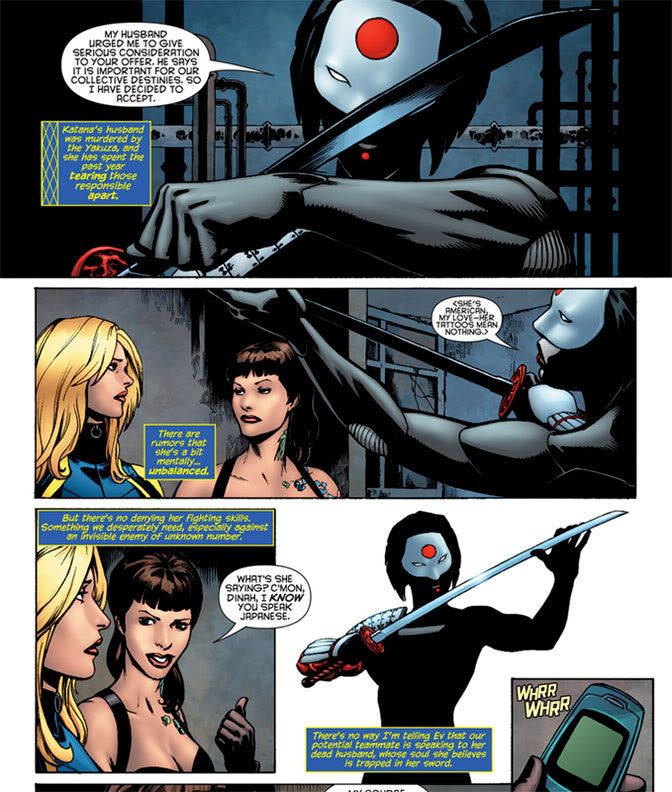
Also different is her hair style.  No more bangs or Louise Brooks bob, nor does she sport the Davis-era shag.  But the change most telling of its era is that it's now ambiguous as to whether or not her sword contains her husband's soul.  She obviously still believes it does, but we readers are no longer party to their conversations.  Black Canary and Starling are presented as kind of dubious about the whole "talking to an inanimate object" thing as well.  The point is to call into question Katana's hold on reality.  Is she a little off?  A little nutty?  That makes her all the more dangerous.  And anyway, flying people and half-robot people are completely within the realm of possibility, but talking swords are only ridiculous, right?


Katana no longer uses contractions when speaking English.  As one of those EFL teachers over here in Japan, I find that kind of difficult to believe in someone who's as fluent in English as Katana.  It does give her that cold, almost inhuman feel to go along with the costume.  I have a hard time accepting a stiff, overly formal Katana knowing what I know about her relationship with Halo.  Still, as we've seen, people do change and Katana most of all.

On that note, time will tell if she's still competing for Substitute Mother of the Year.  I hope she is.  It gives her depth and humanizes her so she's not just a relentless human lawnmower-of-faceless-goons.  I hope she fixates on Starling and starts smothering her with concern and buying her clothes to cover that gothy corset top.  Or, alternately, offering to pay for more tattoos to make her arms appear more symmetrical.

Wednesday, June 17, 2009

Tokyo Visionaries: Images of Japan from Western Comics

As an American comic book fan living in Japan, I'm fascinated by depictions of my adopted home in my old favorites. My inspiration for living here is more pop cultural than spiritual or financial. I'm more of a live show and contemporary Tokyo person than a temple and garden type. And I'm not all that into manga or anime; I have a few favorites. No, my earliest imaginings of Japan consisted of images drawn from Speed Racer, Ultraman, Space Giants, Sonny Chiba movies, James Clavell's Shogun and-- for some reason-- Pink Lady.

As I got older, I became enamored of Japanese noise rock and street fashion, cinema and subcultures. I'd be lying, however, if I said in all of that I didn't find some inspiration from American comics and depictions of Japan found in them. These were and remain heavily reliant on Clavell-esque storylines of Westerners getting deeply involved with modern-day samurai, ninja or, in a more recent switch, yakuza gangsters seemingly born from both Michael Crichton's anti-Japanese paranoia-laced Rising Sun and Kitano Takeshi's ultra-violent films, among others-- the yakuza film is a longterm genre in Japan, just as gangster films have been in America for decades. Lots of arrogant, angry, high-strung characters like Silver Samurai, Katana, the female Dr. Light and occasional X-Men ally Sunfire, references to revered ancestors and "losing face" and "retaining honor" and life debts and all that junk...

Well, the chances of encountering genuine ninja in contemporary Japan are just about nil, and meeting up with yakuza thugs with ancestral castles only slightly more likely. But if the storylines are somewhat ridiculous, how do their visuals match up to the real thing? Let's take a look at some carefully selected examples. It's by no means a comprehensive overview because it consists only of comics I've actually read.

First up is the Chris Claremont-scripted, John Byrne-illustrated The Uncanny X-Men #118, "The Submergence of Japan." In this story, the X-people have escaped the Savage Land and traveled by the research ship Jinguichi Maru to Japan, where they find the ship's "home port of Agarashima," a fictional seaport ablaze in a fire so hot they can feel it from "ten kilometers from shore." Byrne treats us to an epic double-page splash with our heroes in the foreground, a backdrop of the devastated cityscape spewing massive, lurid red flames and billowing smoke, Air Self-Defense Force fighter jets streaking overhead and with a snow-covered Mt. Fuji off in the distance, as if gazing impassively at the destruction. The buildings are a little exotic-shaped, but it does give one a feeling of place; Agarashima, if it existed, would probably be somewhere on the southern coast of Honshu, somewhere between Shizuoka prefecture and Tokyo, an area where there are plenty of coastal cities hugged to the Pacific by mountains.

Coming ashore, the X-Men make their way through the ruins. Neither Claremont's narrative captions nor Byrne's art dwell much on travelogue, so we miss a chance to see if Byrne can match his ultra-detailed North American settings-- that counterfeiting of reality that adds so much verisimilitude to the X-Men's superheroic antics during this classic period-- with some postcard-perfect Japanese backgrounds, albeit ones crumbled by an earthquake. Byrne gives us just enough to make the setting at least seem real:

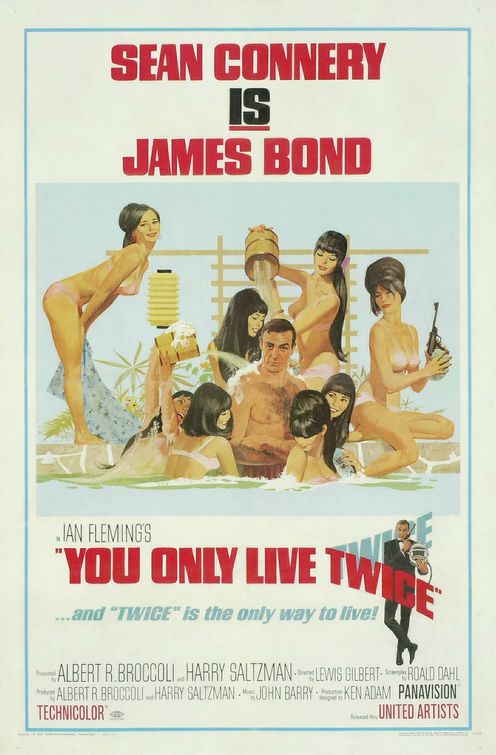
The story quickly replaces modern Japan with more James Clavell-style fantasies, and Byrne deftly draws all the shoji (paper sliding door) and wooden walkways you could desire in a comic book story before he and Claremont send their protagonists off to some secret island base to fight Moses Magnum, a nut who wants to sink Japan. Interestingly, this idea of Japan's submergence has been a theme in Japanese science fiction literature. Magnum's hideaway is right out of the 1967 James Bond adventure You Only Live Twice, also set in Japan and the poster for which carries Western sexual fetishization of subservient Japanese women to ludicrous extreme.

Sorry... I digress...

Even in such a fast-paced story, Wolverine finds time to meet and begin wooing a character who would become intrinsically linked with him, at least throughout the 1980s, Lady Mariko Yashida. He even presents her with a chrysanthemum and displays a heretofore unknown ability to speak perfectly fluent Japanese!

In the 1982 Wolverine miniseries, Claremont teams up with the artist most known in America for the influence of Japanese comics and cinema on his stories, Frank Miller. Together, they send Wolverine on a very Bond-like adventure in a modern day Japan practically overrun by crazed ninja assassins. This story is like a compendium of the American popular mythologizing of Japanese culture-- all samurai honor and Asian exoticism but set against the sleek electric cityscapes of the late 20th century. Clavell meets William Gibson, with Sonny Chiba as interlocutor.


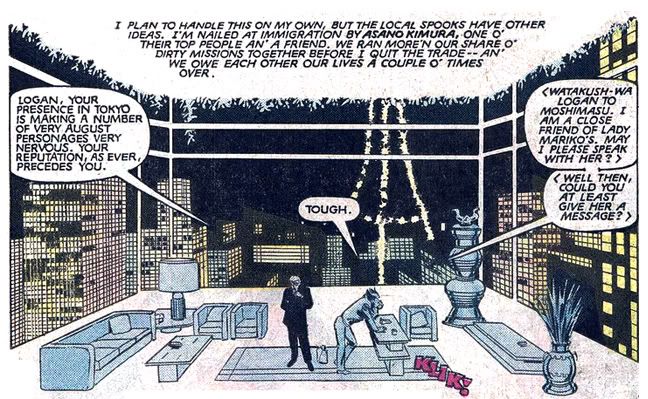
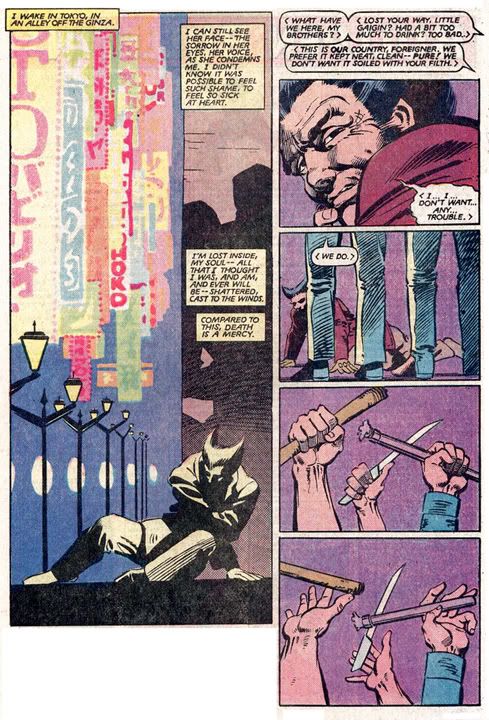
In this image, Wolverine has checked into either an upscale apartment or the fanciest hotel on earth. It appears to be in Minato ward, because that's Tokyo Tower in the background. Minato is home to Roppongi and Roppongi Hills and in places is pretty much the skyscraper forest Miller illustrates here. Later, Wolverine finds himself drunk in an "alley off the Ginza." Ginza is a shopping district within the Chuo ward. I've never heard it referred to as "the Ginza," but who knows?

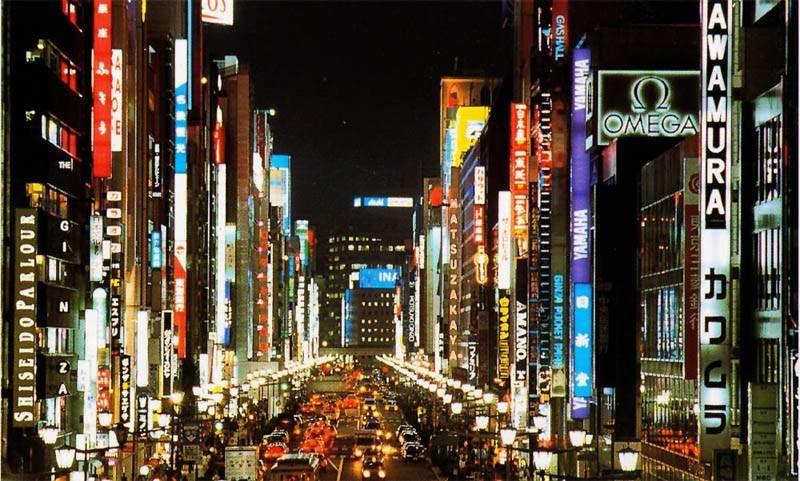
While I'm doubtful about the presence of anti-foreigner thugs in that particular area of Tokyo, again Miller's backgrounds prove surprisingly accurate:


Not too shabby, eh? He even appears to have gotten the streetlamps correct. Still, I think if Wolverine were really looking to get his drunk on in a seedy part of Tokyo, he would have been better off hitting Kabuki-cho in Shinjuku. Ginza features its share of hostess bars, but is a bit more upscale and pricey. Kabuki-cho is often referred to by my students and friends here as the "most dangerous place in Japan." It's a down-and-dirty fun zone where at night you can see prostitutes, street-level yakuza, Nigerian gangsters and perhaps even members of Chinese tongs if you're lucky. They'll be mixed in with lots of businesspeople doing the after-work drinking thing and young couples in search of exciting nightlife so you may not even notice them. Sounds more like a Wolverine kind of place.

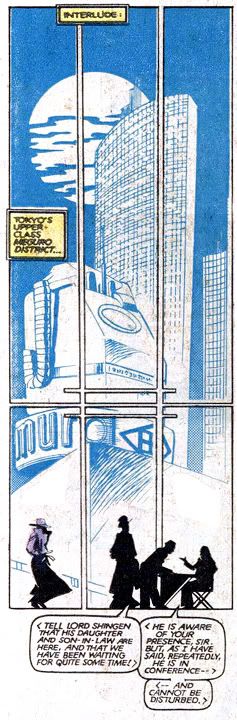
This is interesting:

As Claremont describes it in the caption, Meguro is indeed an "upper class" area. A number of celebrities make their homes there. What you need to remember, however, is the phone-shaped building. It will become important later.

The story's climax and closing actions take place within the castle-like Yashida family "ancestral stronghold." Miller's architecture even more accurate here, but given the unfortunate destruction of most castles during the Meiji Period and flattening of Japan's major cities during WWII, it's pretty unlikely any private family would be living in something so... historical. In comic books as in life, sometimes coolness must trump accuracy. Would you want to read a story where a vengeful Wolverine scales the less-than-impressive walls of a fancy apartment building?

Perhaps, but Wolverine in a Edo-style castle is a bit more visually compelling.

The 1980s were prime time for Japanese influences in American pop culture. The decade began with the hugely successful TV miniseries adaptation of Clavell's Shogun and the major failure of Pink Lady and Jeff, a bizarre yet energetic attempt to make two talented J-Pop singers variety stars in the States. Later American television audiences would pretty much ignore The Master, an absolute bullshit adventure TV series starring Lee Van Cleef as a blue-eyed ninja; it would last a mere thirteen episodes and become Mystery Science Theatre 3000 fodder. This probably says as much about Western cultural misappropriation as having Canadian-born Wolverine described as "more truly Japanese than any Westerner I have ever known" by one of his allies. At least Claremont qualifies it somewhat. Wolverine can master the language and cultural mores, defeat the yakuza boss and win the hand of the nigh-unreachable Lady Mariko, but as a mutant as well as gaijin, he remains an outsider in Japan as well as in the West. Lee Van Cleef bests even the Japanese at their own martial arts, then walks away for personal reasons.

But I digress yet again...

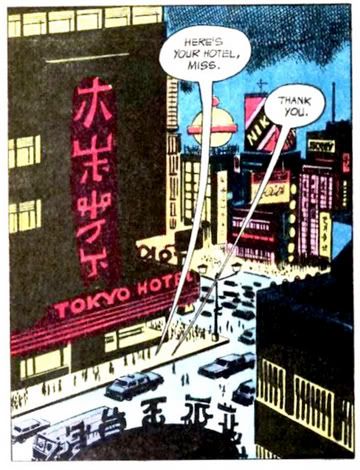
Perhaps inspired by Wolverine's Japan sojourn, Batman would take his Outsiders to Tokyo in 1984's Batman and the Outsiders #11. In this story writer Mike W. Barr and penciller Jim Aparo tackle the increasingly cliche story themes of the Japanese concept of honor and family loyalty as native-born Japanese Katana (described the following issue as the "She-Samurai") confronts her past and we learn all about her magical sword. The story is heavy on the ninja tropes but how do Aparo's Tokyo cityscapes fare as accurate depictions of that particular megalopolis?
Not too badly, if this image is any clue:


He gets the omnipresent advertising signs correct. Many buildings here do feature giant signage on their rooftops and various kanji and katakana or hiragana running down their sides. This particular panel is somewhat reminiscent of the Kabuki-cho side of Shinjuku Station, although there's no "Tokyo Hotel" in the station, and there'd be a small plaza to the right instead of what appears to be a parking lot of some kind. Those types of lots are extremely rare here in land-starved Japan; more likely would be a high-rise parking deck looking like a big steel Rubik's Cube, but not nearly so colorful.

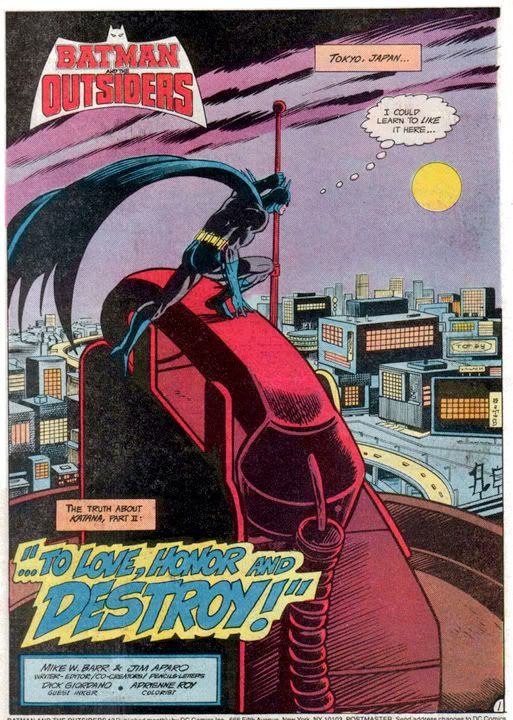
And again:


I have no idea if there is now or if there ever was a building with a gigantic telephone on top, but Frank Miller and Jim Aparo seem to insist upon its existence. Maybe it was a famous landmark of the 1970s and 1980s and both artists saw it on some kind of comic book publicity junket here. Or else Aparo is paying homage to the work Miller did with Chris Claremont. Since this story hits some of the same cultural notes, that's a distinct possibility. Aparo's buildings are a far cry from the Meguro seen in Wolverine, though. This looks more industrial (and generic) than "upper class," so perhaps the phone building is merely a fantasy.

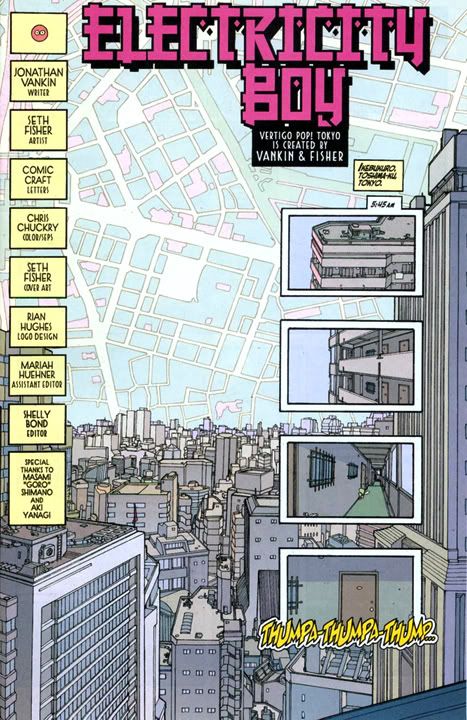
A more recent comic book look at Tokyo comes courtesy Vertigo Pop: Tokyo! by Jonathan Vankin and Seth Fisher. Vankin's story is another "Japan-as-other" fantasia, this time seen not through the eyes of superheroic adventurers but those of an ordinary American electronics geek. To that end, Vankin's protagonist is somewhat dull and colorless, his Japanese are laughable flakes and the story is a vibrant romp through newer paradigms of our outsider's view of contemporary Japan. As someone who actually lived in Japan, Vankin obviously has an encyclopedic knowledge of Japanese pop culture and presents it in a comically extreme form for our amusement. Gone are the samurai and ninja, replaced by ditzy fashion girls and would-be flight attendants, incompetent gangsters, sci-fi pop stars, perverted old men and fast food restaurants. Candy-colored Japan.
I don't know if it's exacly an improvement, but it is closer to what you might actually find if you came here.

Like Vankin, Fisher (who tragically passed away much too young) actually lived in Japan, so I imagine he was able to do a lot more first-hand location scouting than Byrne, Miller or Aparo. Consequently, despite the story's comedic exaggeration, Fisher's Tokyo is almost documentarian in its accuracy. Oh, like Vankin, Fisher takes some license here and there, but only in the service of the narrative. Here's his version of Ikebukuro, one of Tokyo's busiest but somewhat second-rate districts. Sorry, Ikebukuro! I love you but I mean "second-rate" compared to trendier wonderlands like Shinjuku, Shibuya and Harajuku:


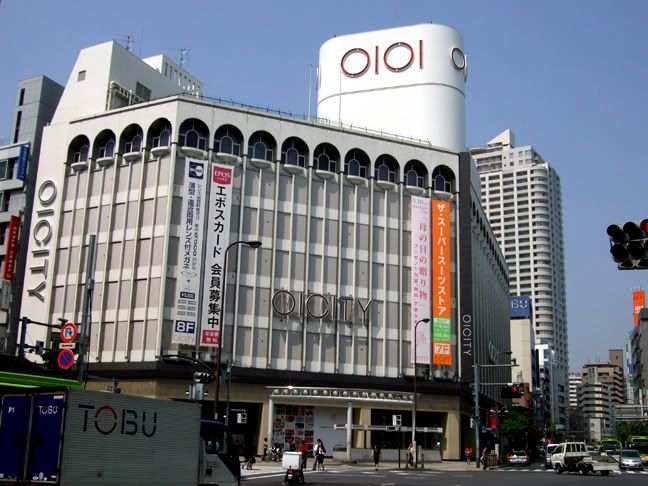
To my eyes, the backstreets of Tokyo-- the places where people actually work and live as opposed to shop and play-- look like this. A bewildering jumble of high-rise buildings in dull concrete, stretching from horizon to horizon. No comic book story (and few movies) can prepare you for Tokyo's immense scale. Once inside, you are in an artificial world of steel and glass and after a while, it's hard to imagine there are any other environments on earth.

Here's a photo I took in Ikebukuro:


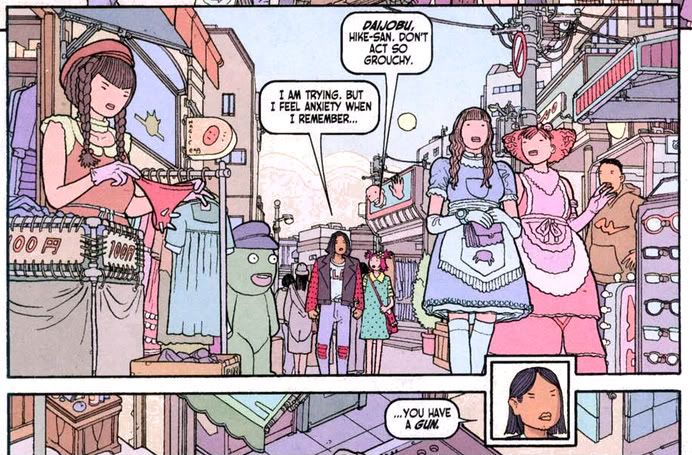
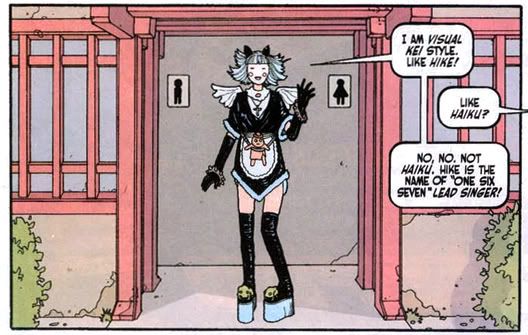
As Vankin's story unfurls, Fisher treats us to backdrops of some of the coolest places on earth. Here's a panel where crazed schoolgirl (another trendy stereotype) Maki has kidnapped her idol Hike to show him off to her Harajuku girl friends. This is more than likely Takeshita-dori, which during the 1990s was the epicenter of Japanese youth fashion culture:


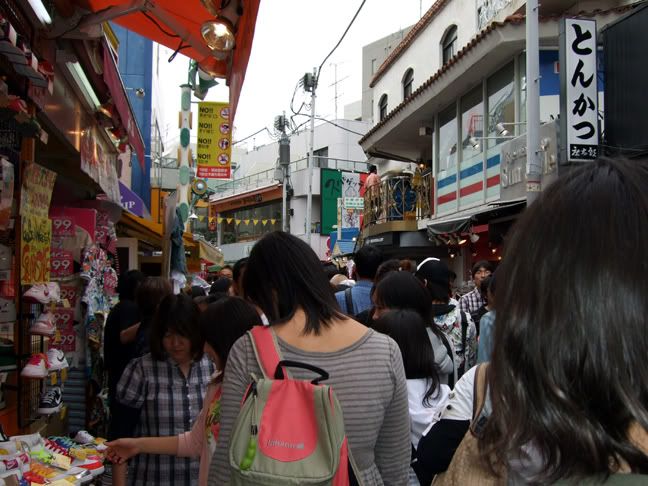
That's one problem with Vertigo Pop: Tokyo!-- Japan's trends change so fast what was current as recently as 2002 is practically antediluvian now. And a lot of the elements in the story seem more contemporaneous with the mid- to late-1990s. Well, perhaps not a problem, per se, but more a transmuting it to a kind of literary time capsule or period piece. Jidai geki for the visual-kei set. And here's the real Takeshita-dori as it appears today:


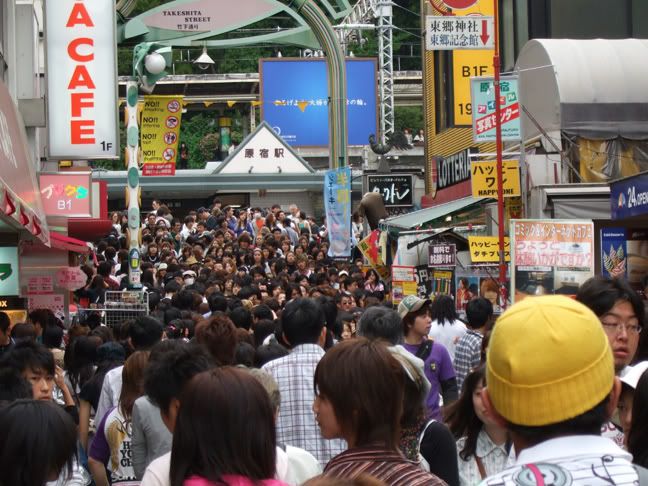
As you can see, Fisher pretty much nails it and I was standing in almost the exact same spot the panel appears to depict. If an artist draws Takeshita-dori as crowded as it truly is, we wouldn't be able to see the main characters at all. Behold Takeshita-dori in all its glory:


It can take you thirty minutes to an hour to walk its length on the weekend. Unfortunately for this story (and Gwen Stefani), the classic Maki-style "Harajuku Girl" doesn't really exist in that form anymore. She's been name-branded out of existence in Harajuku, subsumed by gothic lolitas and cosplayers and driven by photo-happy tourists to quieter, trendier neighborhoods like Kichijoji (where my own personal version of Maki eventually settled). But FRUiTS magazine continues to document her colorful, creative stylistic heirs faithfully so there's still some hope. Here's an image set just outside Yoyogi Park proper, crossing the Yamanote Line rails in Harajuku:

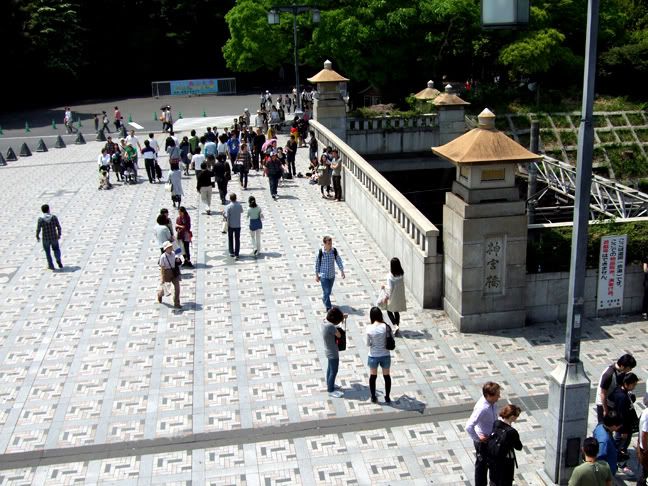
Here's the park itself, in reality. Fisher almost perfectly matches the real-life location. The lower wall is bit taller in the real world and there are some slight differences in the end caps, but it's instantly recognizable:


You can even spot the exact location crazy-pops Maki daringly tightrope walks along the wall. It's roughly between the guy in the light shirt and khaki slacks and the person in the face mask in this photo:


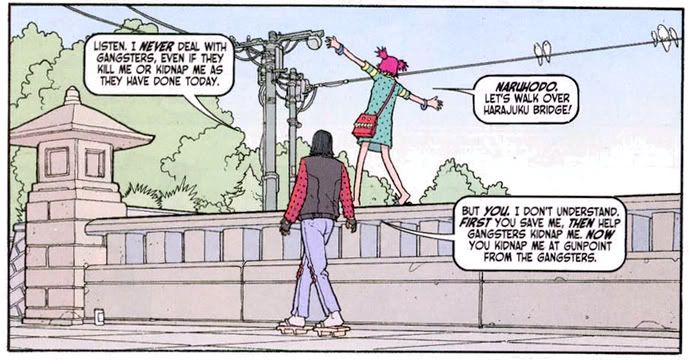
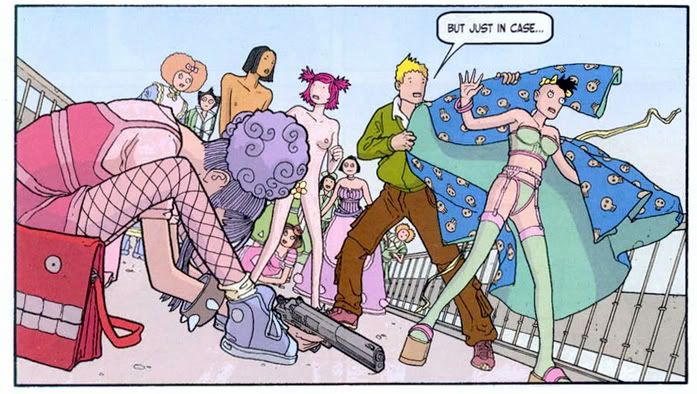
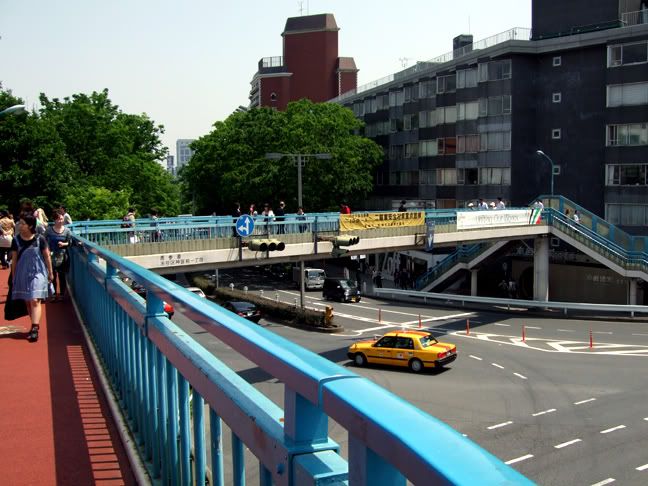
But I don't advise you to duplicate her stunt. If you fell and were injured or killed, I'd feel somewhat responsible and your friends and family would sorely miss you. Part of the action takes place on the pedestrian bridge overlooking the park:


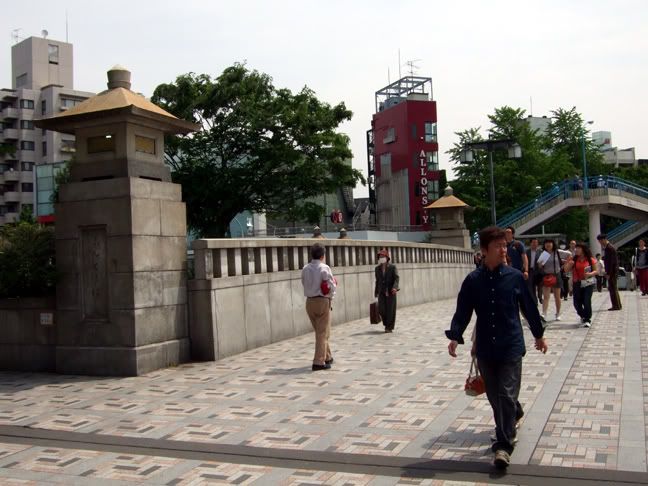
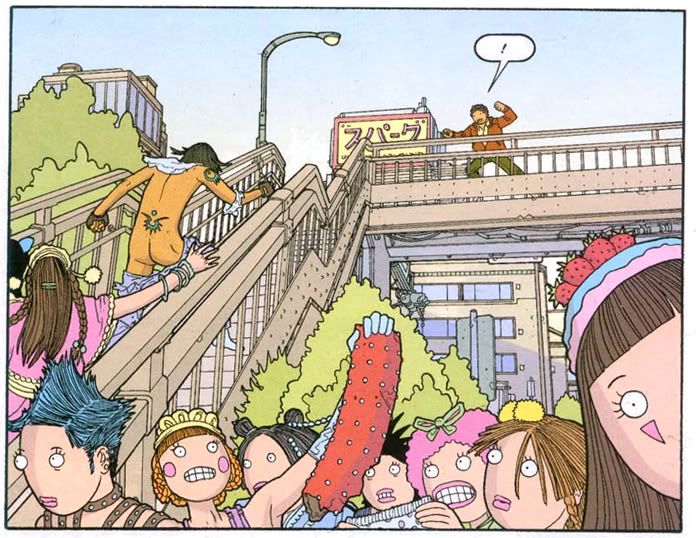
I end up on this bridge every time I visit Tokyo so I can attest to Fisher's accuracy, even with a bit of artistic license. While the color is wrong (although it may have changed from 2002, the year the story is set, to today), Fisher gets the basic look of the bridge itself down, and even includes some of the surrounding greenery:


There's one moment where two characters fall off the bridge and land in the park plaza below, which is almost impossible. The bridge doesn't span the park; it crosses the street over a busy intersection. If they'd have fallen, they would've instantly been run over by cars, as you can see here:


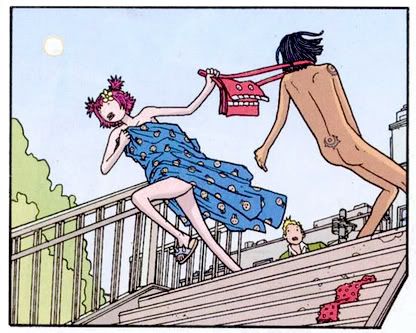
Also, notice that it's not a single span but several, in a rectangular shape. Here's in interesting scene where a nearly naked Maki attempts to escape the chaos she herself has caused, dragging a completely nude Hike behind:

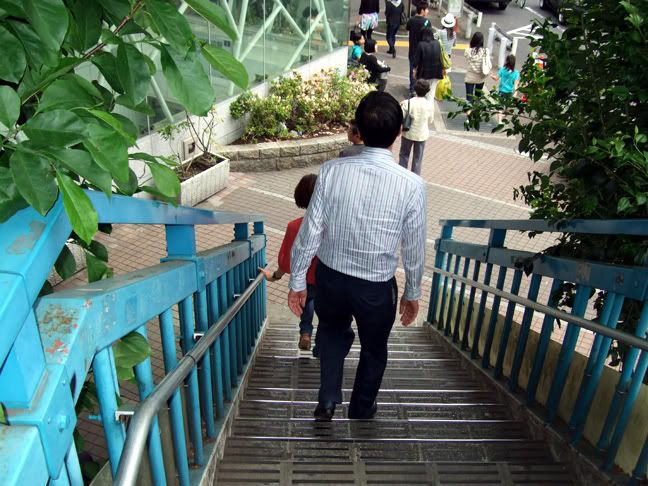
And this is my best guess as to where this event occurs:

I stupidly shot this photo from the top rather than matching the comic book panel's lower angle from the bottom. Oh well, maybe next time.

So how do our comic book artists fare with their depictions of Tokyo? Not bad at all. Fisher obviously takes the prize, but the old school dudes pleasantly surprised me. In my memory, they were all much less accurate but I'm gratified to be wrong and actually able to praise these guys for how "right" they got Tokyo rather than rag on them for falling far short. Sure, each could've done a bit more research and gotten it exact, but I doubt either Marvel or DC were willing to spend that kind of money for location sketching. Plus deadlines and all.

Remember-- it's pretty easy for a writer to type "Wolverine hops a jet and lands in Tokyo, then takes a taxi to Shinjuku. On the way there, fighting jet lag, he marvels at his own face gazing down at him from various advertisements in the wild neon lights down the sides of buildings along the street," but the artist has to take those words and make them at least somewhat visually plausible. And Byrne, Miller, Aparo and Fisher accomplish that with their work in these books.

I still have this desire to find some of the actual locations from Yazawa Ai's glorious comic book creation Nana, including Jackson Hole where I plan to try a Jackson Burger (Hachi swears by 'em). Yazawa gets around the accuracy and time constraint issues by using actual photographs as her backgrounds.

Until then:

Bai-bai!