Showing posts with label Wally Wood. Show all posts

Tuesday, October 28, 2014

October is Spookey Month: Wally Wood brings you a new path to a life of peace and love in Creepy #38 (March 1971)

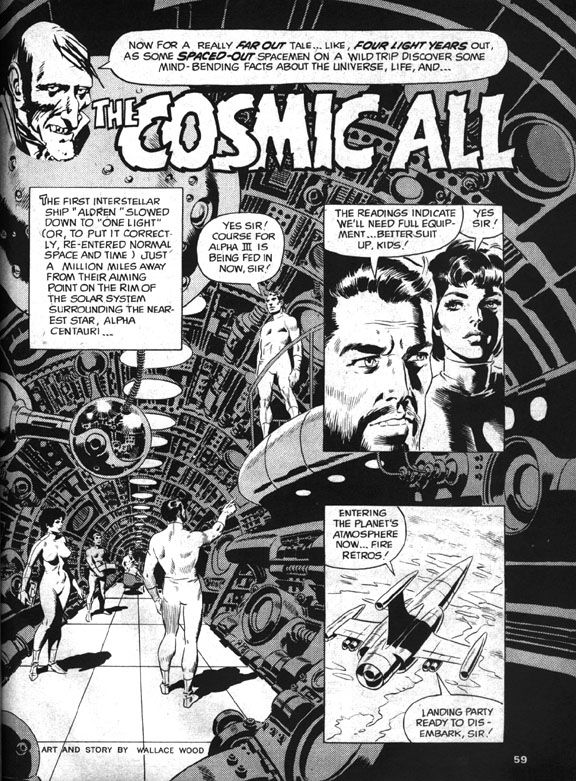
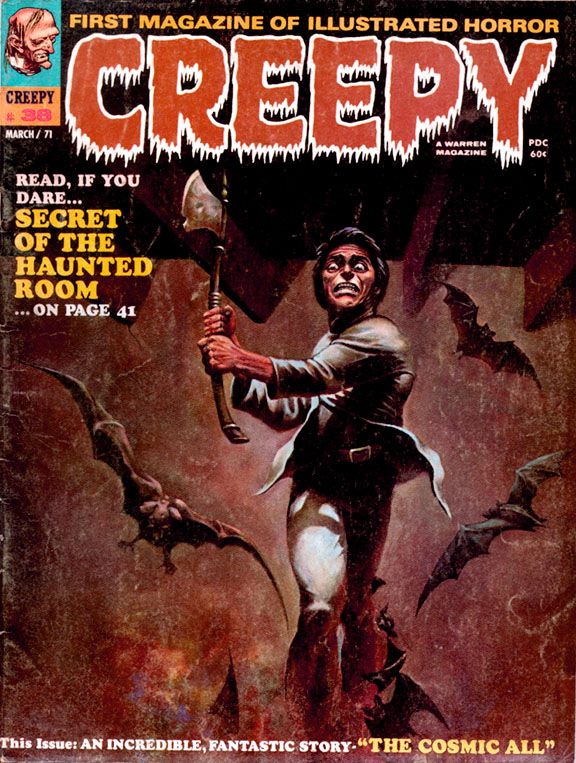
Behind a lurid and appealing Ken Kelly ax-maniac cover (Kelly's Creepy debut), you'll find a late career gem in the EC Comics mode written and illustrated by Wally Wood.  James Warren, who was not only publishing Creepy at this point but also editing it (along with associate editor Archie Goodwin), must have been particularly happy with Wood's "The Cosmic All," because he gives it a cover spotlight and the honor of closing out an issue that also includes work by Rich Buckler, Mike Royer and Ernie Colon.  Warren would also reprint the story just over a year later in Creepy #48, a special, all-reprint issue.

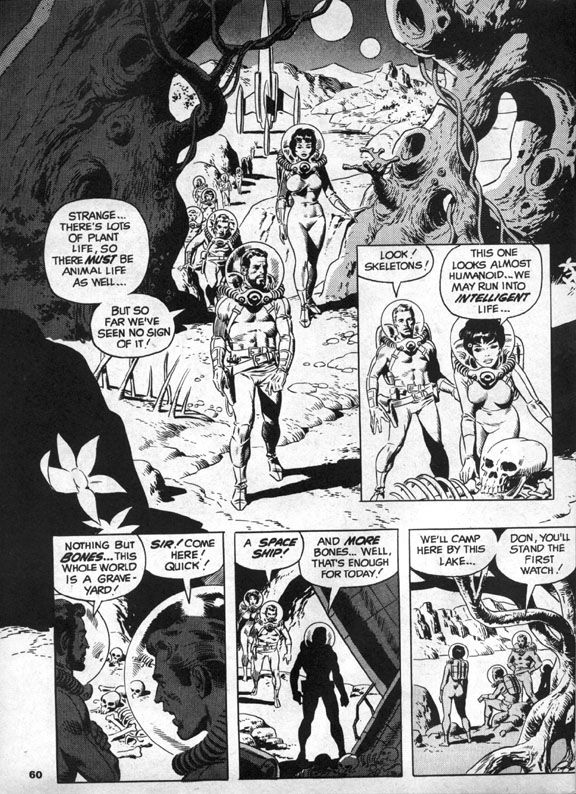
Sometime in earth's future, we've sent an intrepid mixed-gender exploratory mission led by a bearded captain (along with Don!  And Sue!) to Alpha Centauri, which is now, more than 40 years after this story's publication, a popular tourist destination.  In those days, it was the distant frontier of outer space.  After finding bones on their first planetary stop, the explorers anticipate a possible meeting with intelligent life.  Which is kind of ironic.  I mean, they do meet it.  It's just not the kind they were hoping for. 

You know how the hierarchy of space aliens goes—in order from least to most objectionable, it’s generally humanoids, reptilians, insectoids, cephalopods, non-tentacled mollusks, blobs and, finally, slimes.  The further its appearance gets from the human template, the more repulsive the alien.  And usually, the more likely to have philosophies contrary to the kinds we find comforting.  So Wood’s slime terrifies the space explorers by trying to absorb Sue.
 
Wally Wood

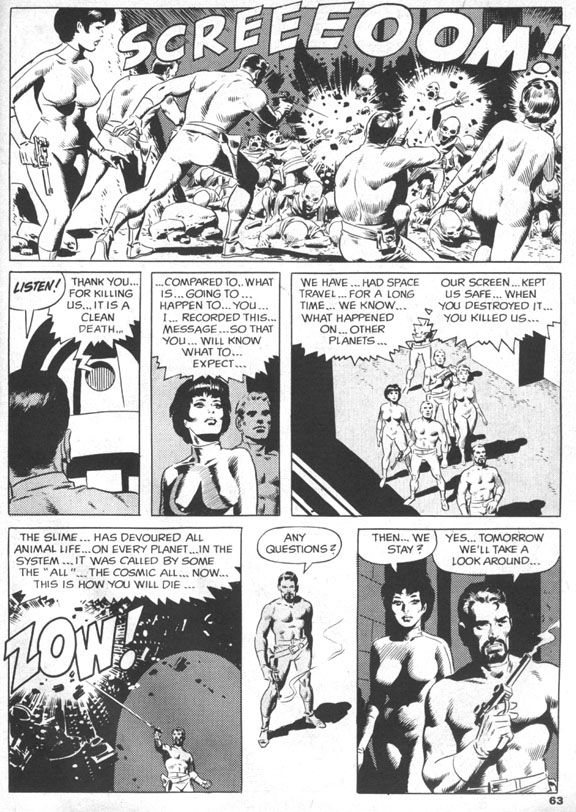
In familiar comic book sci-fi fashion, Don shoots the slime with his phallic laser zapper gun, then everyone flees in their retro-finned rocket ship, only to find the slime on yet another planet.  Having achieved what they believe is their due quota of slime-based encounters, they orbit a comfortably earth-like planet that gives them a very rude greeting in the form of more laser beams.  In response, the human explorers (And Don!  And Sue!) blast through planetary shields and receive a series of puzzling messages.  The civilization below no longer seem angry, but rather depressed and resigned to first contact.  They invite the astronauts to land, then ambush them in a suicidal rush. 
And, ironically enough, they're comfortably humanoid in appearance.  Bulbous, bald heads (like my own) and large black eyes notwithstanding.  A recording reveals this was their deliberate self-extinction and a cleaner death than the one that awaits the astronauts.  Who stand around puzzled, as anyone would be, but the next day all but two of them are skeletons as well.  And those two are Don and Sue!
 
Wally Wood

Which is probably just as well.  After all, even if it was a case of suicide-by-human-astronaut, these men and women did commit genocide.  Are they any less monstrous than the slime?  Perhaps they're precisely as monstrous, as we soon discover.  Don and Sue make for earth where they suddenly experience a strange elation and crash the rocket into the ocean.
 
Wally Wood

There Don and Sue slough off their skins and mutate into the now-familiar slime.  Everything becomes clear.  The humanoid aliens chose to die as a group with each individual’s self-awareness intact because the slime infects other beings and absorbs them into the titular cosmic all, a vast collective without individual thought.  The two space travelers become one with the intent of spreading their all-ness to every living thing on earth.  Starting with all sea life, I suppose.  Uncle Creepy appears at the end and tells us the ultimate twist—they’re glad to be this way, so it’s technically a happy ending.  I’m not going to argue with him.  It certainly made me happy!
 
Wally Wood

The ending is one reason.  The ambiguity of it lingers.  So many deaths, but no escape for Don and Sue, just the loss of humanity both physical and mental, a blending of their minds with the vastness of the alien slime, all-knowing and unstoppable.  Is their joy at the becoming genuine, or simply an effect the slime has on their minds?

 The other is Wood’s artwork.  The splash page is a spectacular image, the kind of Woodian spaceship interior he drew regularly during EC’s heyday.  Round vents, layers of exposed pipes like the veins in a human arm.  Similarly exciting scenes follow, with the explorers trudging across a planetary landscape, the slime attacking like a huge ocean wave and then a space battle followed by an alien-wave attack and the intimate concluding sequence which is equal parts bleak and elating, an uneasy mix that elevates this story to legendary status.  It has the feel of a particularly memorable EC tale, but with an expansiveness the larger page size affords. 
 
And that ending!  That ending!

Monday, February 18, 2013

Richard Dragon Kung-Fu Fighter #5: Lady Shiva's first appearance

Her name is Lady Shiva, and she does hate Dragon's guts.  Actually, her name is Sandra Woosan and the reason she hates Richard Dragon is because she thinks he caused her sister Carolyn's death.  This is how she appeared in DC's Richard Dragon Kung-Fu Fighter #5 (December-January 1975-1976).

She's changed a lot since then-- even more so since the advent of the New 52-- but back in the mid-1970s, Lady Shiva wore a head scarf stolen from Rhoda Morgenstern.  One thing that's remained constant throughout her various DC comics incarnations is Lady Shiva's ability to deal out ass-whippings.

When we first see her, she's in a purple hood and green pants and art team Ric Estrada and Wally Wood have craftily drawn her to look like a man.  In her very next scene, they have her in some kind of Asian fetish dress and looking definitely female.  Later, when she finally gets to fight Richard Dragon, she's back in that purple-green hooded outfit but this time sporting a more feminine shape.  She quickly ditches the hood and spends the rest of the issue in the same green outfit we see her in on the cover.  She starts by throwing shuriken at Dragon, but doesn't hit him, for as she declares in her best Inigo Montoya impression, "I deliberately missed you, pig... To prove I could kill you easily!  Instead, I prefer to do it otherwise...  ...To pound the life from you!  For I am Sandra Woosan...  ...And you caused the death of my sister!"

As the fight begins, Dragon protest, "Sandra... Shiva... We have no quarrel--"

"Afraid to strike a woman, pig?"  Sandra sneers and punches him in the face.

Lady Shiva's first appearance.  Ric Estrada and Wally Wood, Richard Dragon Kung-Fu Fighter #5 (Dec.-Jan. 75-76)

Within a few moments, Dragon convinces her he's not the one responsible for Shiva's loss, that it's Cravat, grotesque-looking guy shooting death-rays at both of them just to make their fight more interesting.  He's drooling, too.  Without missing a beat, Shiva turns her rage on Cravat, but Dragon prevents her from landing a killing blow.  He asks her if the two them are now friends.

"Until further notice, Richard Dragon... we are!"  Lady Shiva tells him as they shake hands.

What a performance.  What a first impression!  Of course, Lady Shiva is another of those dragon lady stereotypes, but she's delightfully amoral and her free way with insults combine with that quality to allow her to steal every panel she's in.  She's way more charismatic and interesting than Richard Dragon, which may explain why she keeps re-appearing in the DC narrative while Dragon has long been relegated to a footnote and why when Cassandra Cain needed a powerful mom to complement her creepy dad, Scott Peterson and Kelley Puckett went with Lady Shiva, renamed Sandra Wu-San by that time.  Fighting is her thing and she's one of the best in the DC universe right from the get-go.  She'd go on to help Dragon in further adventures and we'll talk about them soon right here!

Saturday, September 1, 2012

Cindy Lee really digs pyramids!

It's the summer of that Bicentennial year, 1976, and high school student Cindy Lee is much like her classmates.  The other girls at Larkspur High adore America, their families and friends, Leif Garrett, the "Wings Over America" concert tour and Welcome Back, Kotter.  Cindy's friend Belinda is confused by her own day-dreamy fascination with Kristy McNichol ("She's just so... so... NEAT!"), but she never misses an episode of ABC's Family.  An outgoing, involved student and all-around nice person, Cindy shares her friends' love for all the mundane cultural clutter so common in this, the final year of the Gerald Ford presidency, the year of the first Ramones album, punk rock and malaise still months away.  But there's another not-so-little something that makes Cindy's youthful heart quicken.  Something that thrills her apart from all the pop stars and TV shows that otherwise occupy her friends and dominate as topic of lunch time conversation in the Larkspur cafeteria.

Something she is not shy about sharing with anyone and everyone within earshot.

Pyramids!  Specifically, Egyptian pyramids rather than the Aztec versions (although she approves of those in a diffused sort of way).  Cindy Lee is absolutely nuts about Egyptian pyramids.  She goes for them majorly.  The kid can't get enough.

It started in kindergarten after she read an article in National Geographic magazine about the building of the Great Pyramids of Giza.  She began dreaming of them, of the powers of the pharaohs who commissioned them, their inner passageways and burial chambers, the heavy limestone blocks making up their outer shells.  While she finds each charming, Cindy has her favorite.  She imagines most would prefer the largest of the pyramids, the one commissioned by the Pharaoh Khufu.  But Cindy, unpretentious herself, favors the Red Pyramid of Pharaoh Snefru.  Its smaller size and sleek acute angles appeal to her, this girl without ostentation, who keeps her hair in simple ponytails.

But just as Snefru and his builders had to struggle with geometry before achieving perfection, Cindy's faced her own resistance.  Not the difficulties of experimentation with new forms of architecture and construction techniques:  the concern and disapproval of authority figures and loved ones.  At one point in third grade, Cindy wrote so many reports about pyramids her teachers had to call a special meeting with her parents to find out if their daughter hadn't cracked from academic stress.  No, they discovered to their amazement, she was just a fan of pyramids.  Declaring it to be just a passing phase in need of a small push out the door-- although her mother expressed the hope Cindy might grow up to become an archaeologist-- the adults asked her occasionally to write about other topics.  Ever the dutiful scholar and daughter, Cindy reluctantly obeyed.  It made her a little sad, and her writing assignments more of a chore.  The well-intentioned adults had temporarily dampened the girl's enthusiasm for her studies and school was no longer quite so fun.  Her marks dipped, just a little.

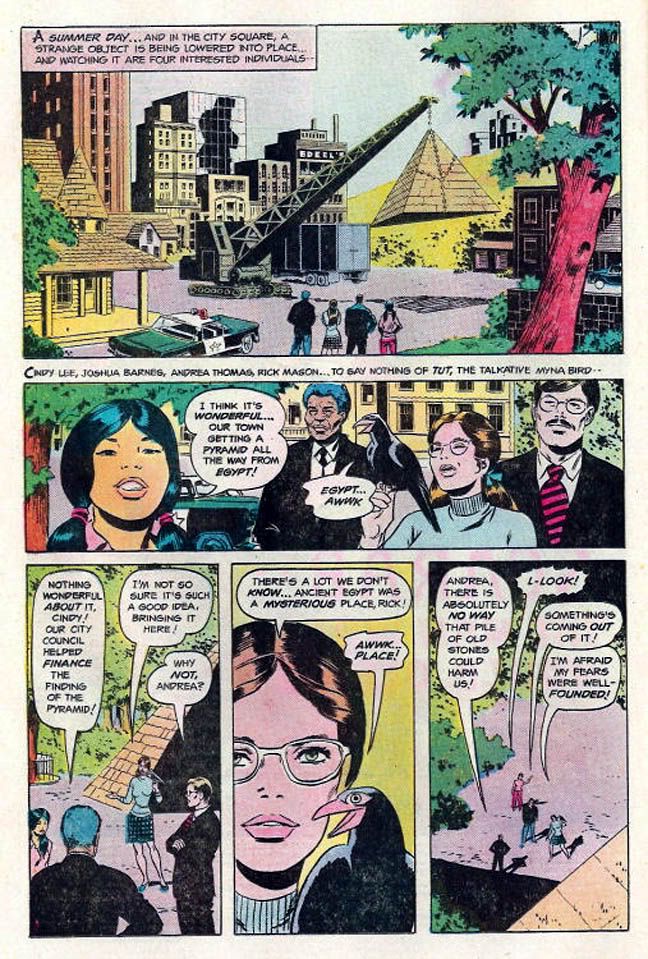
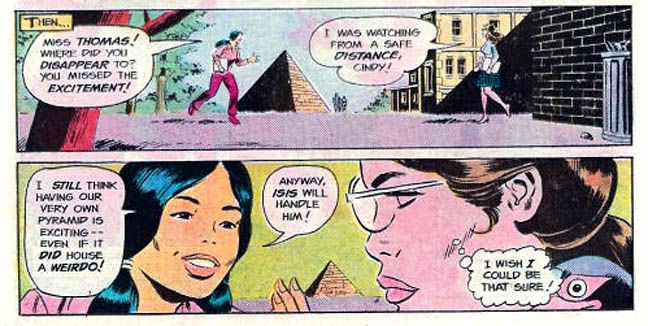
Indomitably cheerful girl that she is, she could only contain her pro-pyramid exuberance for so long.  A few weeks later and her grades began to climb again.  As we can see in DC's The Mighty Isis #1 (October-November, 1976), as a teen, Cindy Lee allows it full flower and such is her enthusiasm for pyramids even the emergence of a dangerous magical freak calling himself Scarab from inside one can't dampen Cindy's spirits.

Pumped with adrenaline at having witnessed the magical attack in close proximity to an actual ancient pyramid that has somehow been stolen from its rightful place in the Egyptian desert in contravention of all international laws regarding the trafficking of valuable artifacts and architecture, Cindy runs to find her teacher, Andrea Thomas, the "dual person" also known as the goddess Isis, to share her excitement.

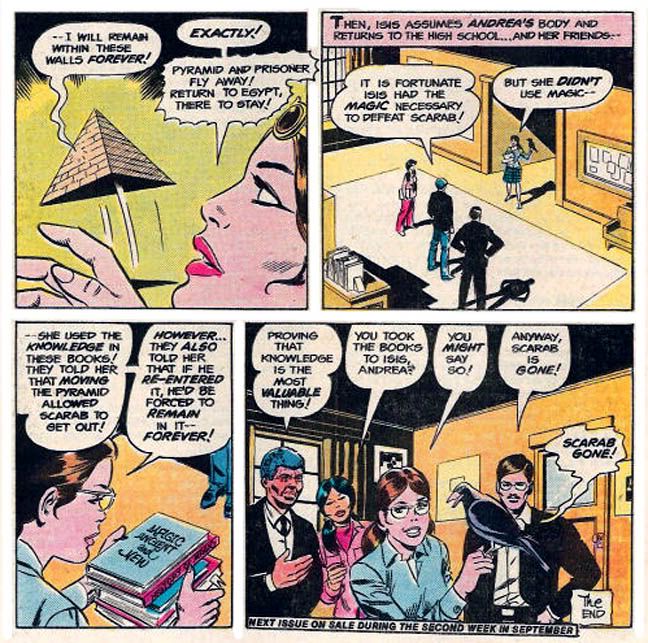
The dastardly Scarab attempts to conquer the United States and force its government to declare war on France and the United Kingdom to satisfy his lust for destruction, but the heroic Isis is having none of it.  Cindy Lee finds herself happily involved in the goddess' eventual triumph over evil by supplying her with informative books on magic and pyramid power, books Cindy herself has frequently checked out of the library as evidenced by the multiple stamps on the due date slip inside their front covers.  With Scarab dispatched by the very pyramid he arrived in, Isis returns to the school and resumes her civilian identity only to encounter a breathless Cindy Lee, who asks the deathless question, "You took the books to Isis, Andrea?"

Be not shocked by Cindy's casual familiarity with her elders!  She wouldn't dream of being cheeky or impertinent.  In the mid-1970s, teachers at Larkspur High used such relaxed relationships to build trust with their students, to "rap" with them and learn what "made them tick," to use the vernacular of youth.  Cindy, as Ms. Thomas's protege and favored pupil, certainly would warrant such privilege.

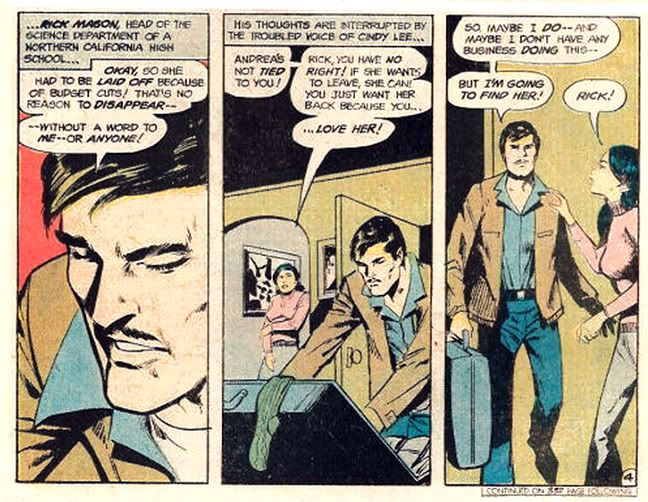
Throughout the story, Cindy functions as a kind of Greek chorus, popping up here and there to comment on the action and provide much-needed expository dialogue and such random questions for which the answers should be obvious to all.  This is a vital function for one so young to fulfill.  But don't think of Cindy Lee as merely a pyramid-minded teen with the uncanny ability to show up wherever her sideline commentary may be necessary.  No, that would be a grave mistake.  The Scarab has already suffered from such assumptions, though he may never know of it.  Because, as we learn from The Mighty Isis #6 (August-September, 1977), she's also an expert on affairs of the heart.

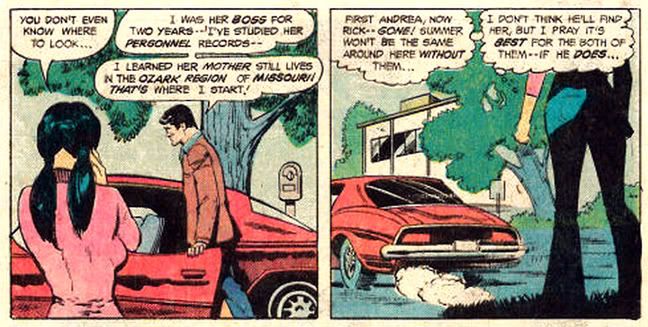
It may be strange to you to think of one so young and ostensibly inexperienced providing advice to Rick Mason, decades her senior, yet another teacher who permits Cindy to address him by his given name.  But the faculty and staff at Larkspur High, being somewhat naive in these things no matter their advanced years, have come to trust Cindy's superior insights and advice.  And if she gushes a bit more than is seemly about both Isis and pyramids-- the one black mark on her permanent record a reprimand for doing an impromptu dance move and loudly singing, "PYRAMID POWER-- YEAH, YEAH, YEAH!" coming out of the gym after P.E. class-- they're more than willing to put up with these quirks if it means smoothing the path to true love.

Pyramids and love advice.  And also The Banana Splits Adventure Hour show.  These are the things Cindy Lee adores.  Cubes and Greco-Roman architecture.  These are the things that fill her with disgust.  She once abruptly ended a date with Lee Webster when he made the mistake of praising the Parthenon.  Poor guy foolishly, yet understandably, thought it would impress her.

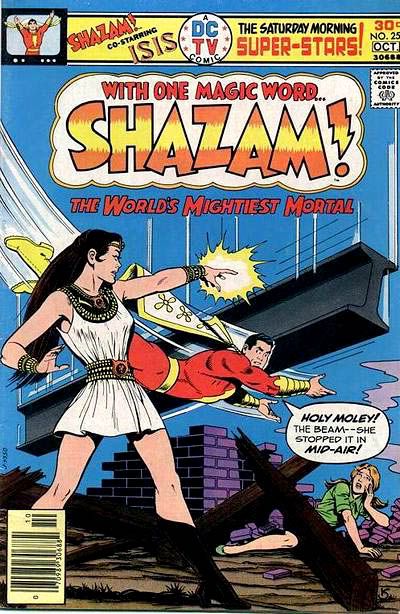
This is all we know of Cindy Lee, and some of it has been extrapolated from partial records.  Further information is difficult to glean.  But I have learned the following:  Cindy (portrayed winningly by the completely awesome Joanna Pang)  has her origins in the Filmation-produced Isis and/or The Secrets of Isis live-action Saturday morning TV show.  Filmation introduced in the series' premiere episode, "The Lights of Mystery Mountain," which aired in the fall of 1975.  A full year later, DC brought the character into their comic narrative via a crossover in Shazam, vol. 1 #25 (October, 1976), where she was menaced by falling building materials on both the comic's cover and interior story.  For some reason, artist Kurt Schaffenberger and the anonymous cover colorist have white-washed her into a generic strawberry blonde.

Jeez.  Right on the cover!  She makes the cover for her inaugural adventure and they botch it.  I'm guessing at the time DC considered her too insignificant to bother consulting the source material for a more accurate portrayal.  Fortunately, the later, more conscientious writers and artists of The Mighty Isis #1-- none other than legendary talents Denny O'Neil(!!), Ric Estrada and Wally Wood(!!!)-- made incredibly precise efforts to match their comic book version with Pang's video appearance and performance, thus giving DC a show-accurate Cindy subsequent creative teams were contractually obligated to match under pain of immediate dismissal and blacklisting from the industry for life.  I assume.  No, that's too harsh.  They probably wouldn't have been allowed the last jelly doughnut in the DC break room.  Sadly, later developments consigned Cindy, her world along with everyone she ever knew and loved to non-existence following the Crisis on Infinite Earths series... and she hasn't been heard of in comics since.

If you Cindy Lee fans out there would like to see her in the New 52 universe, perhaps you should send model pyramids to Dan Didio.  But leave my name out of it.  I like Cindy Lee a lot, but I ain't starting no revolution over this.  Plus I have no desire to see what horrors they'd force this wholesome minor character to endure in the name of appealing to today's audience of jaded hipsters and people who scorn pyramids.

Monday, November 21, 2011

Alex Ross takes on the New Mutants!


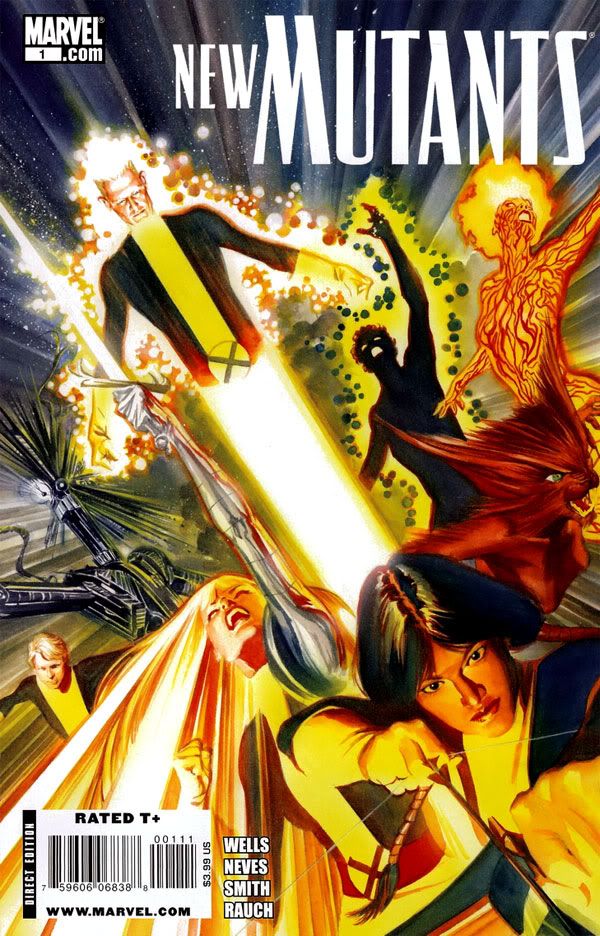
Isn't that a nice cover?  I tend to hold Alex Ross somewhat responsible for the death of storytelling in modern comics, probably unfairly.  His rise to popularity seems to have coincided with an era of too much emphasis on photorealism, an over-reliance on photo reference or outright tracing, too many people getting hung up on cool individual images rather than thinking a page through as a sequence of panels arranged to express mood, movement and action.  I say "seems" because I might have the chronology completely wrong.

But even if I'm right, it's not really Ross's fault so many young artists start their careers telling themselves, "Hey, Ross does it and it looks amazing and sells even better than it looks, so why can't I?"  Blaming Ross is like blaming the Beatles for Strawberry Alarm Clock.  And yet I sort of do...  I just can't help it.

The static, awkward results probably also have a lot to do with artists using tools like Poser and various digital paint programs-- not that these things are in and of themselves negatives.  In the past, greats like Russ Heath, Al Williamson and Wally Wood used photo-reference-- Wood even advocated tracing.  According the Mark Schultz in his amazing and indispensable book Al Williamson's Flash Gordon:  A Lifelong Vision of the Heroic, Williamson relied on tracing at times during the middle stages of his career.  Photo reference, Poser, Photoshop, tracing.  These are useful tools, and artists shouldn't necessarily shy away from their use.   Mis-using might be a better term for what today's artists frequently do.

Williamson didn't just trace-- he would then adjust the drawing to match the heroic proportions of his original images and to fit the scene.  He achieved consistency in this way, something one frequently mocked comic book photorealist would do well to remember when he's so intent on making things "real" he forgets to make them believable.  Not that he gives a rip.

But I digress.  Whatever else you can say about the Alex Ross, he knows how to respect characters and put together an iconic image, then render the heck out of it.

Oh sure, Ross might have taken some photos to get a sense of the poses, to nail the anatomy and stage the lighting, but he manages here to sublimate the photo referencing and stay true to the classic look of the characters.  Dani Moonstar-- right up front, dominating the image where she belongs-- looks a lot like Bob McLeod's version, rather than a model in a bodysuit from a photoshoot in Ross's living room.  Unfortunately, the under-lit Sam "Cannonball" Guthrie looks disconcertingly middle aged.  Life must have been hard on him in the coal-mining regions of Kentucky before he met Charles Xavier.  This is the work of an artist moving away from duplicating photographs towards an artist justifiably confident in his ability to draw and paint anything he can imagine.  An artist who has finally put technique at the service of the artwork, rather than the other way around.

There's also the possibility Ross just made this all up out of his head.  I do believe he's just that good.

Well, however he achieved this cover, it's quite excellent.  A fitting tribute to my favorite of Marvel's super adventure teams.