Showing posts with label Jack Davis. Show all posts

Friday, October 17, 2014

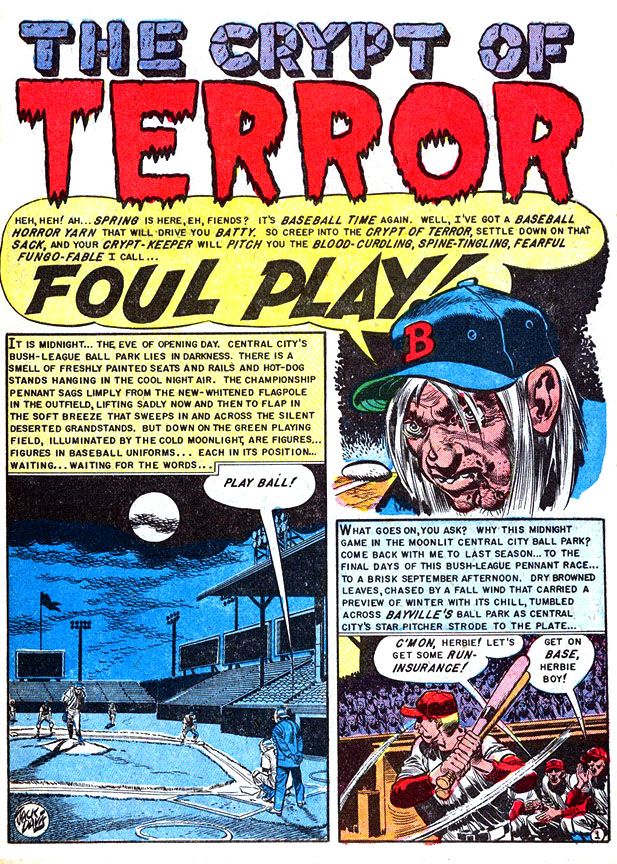
October is Spookey Month: How EC ruined America's pasttime in Haunt of Fear #19 (May-June 1953)

No, they didn't ruin baseball.  That's just me trying to have a little fun and shake things up a bit.  If anything, they made baseball better!  But EC did get itself into hot water with the government over "Foul Play," a story appearing in Haunt of Fear #19 (May-June 1953).  Dr. Frederic Wertham used it as an example of horror comic nastiness in his book Seduction of the Innocent and then did it again during his afternoon session testimony to the 1954 Senate Subcommittee Hearing on Juvenile Delinquency

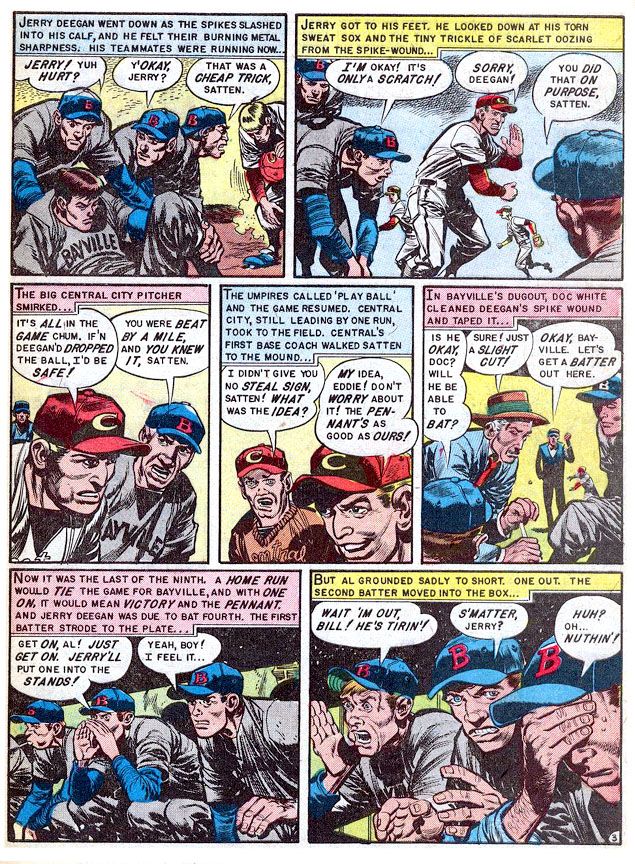
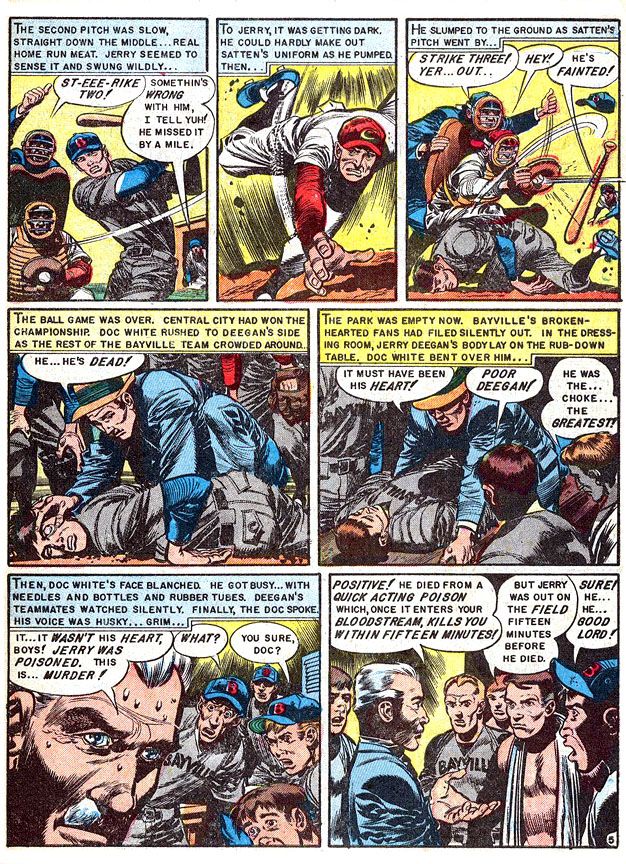
The story is about Central City's Herb Satten, an unscrupulous pitcher who wants to help his team win the pennant by murdering the Bayville's star second baseman, Jerry Deegan.  After all, this Deegan slugger led the league in home runs all season and he's up the next inning in a tight game.  It stretches credulity a bit.  Satten kills Deegan by poisoning his spikes, then allowing himself to get hit with an inside pitch so he can get on first, attempt a steal then slide spikes-high and slash his victim.  He's thrown out and it looks like a bonehead play, but it all works out. Satten kills his man and Central City wins.  This leads to the pitcher's grisly comeuppance the night before the next season's opening day.

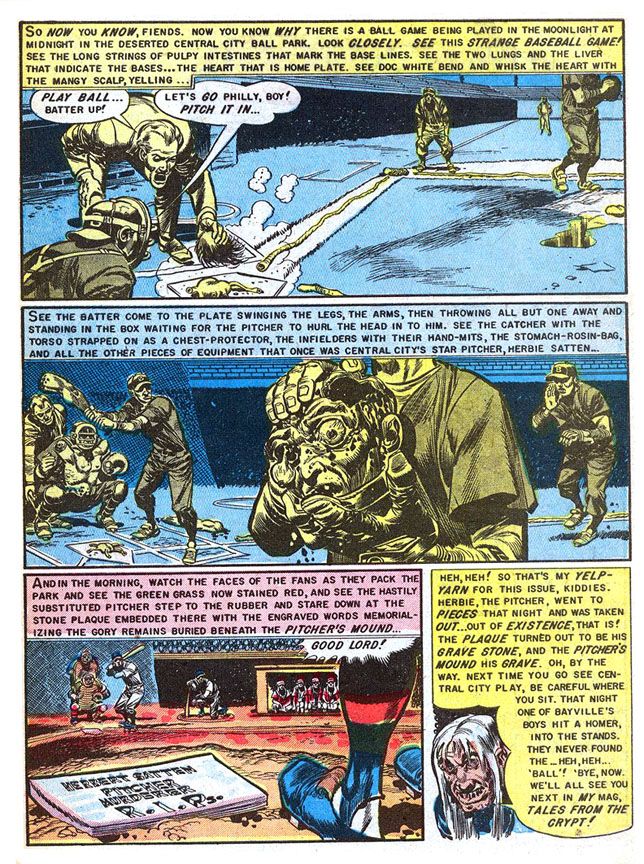
And one of the all-time great gross-out scenes in horror comics history.  The murdered man's teammates literally rip Satten apart late one night and use his body parts to play a moonlit intrasquad game.  Complete with a complicit umpire.  That also stretches believability, but not so far as the poor pitcher's intestines, which serve as foul lines up the first and third base paths.  The grisliest detail is the catcher's using the Satten's chest as his own chest protector.  You wanna wear part of a human body even if he is a sorry murdering cheat?  What is this, the Ed Gein League?

They also incriminate themselves by burying him under the pitcher's mound and inscribing the rubber there with "Herbert Satten.  Pitcher.  Murderer.  R.I.P."

Rest in pieces, baby.  Rest in pieces.

Writer:  Al Feldstein/Artist: Jack Davis

Well, they were angry ballplayers and probably didn't think through the consequences.  The ironic thing about "Foul Play" is, it may have been notorious at the time but the guy who drew it is one of the nicest, most gentlemanly people you'll ever have the privilege of meeting.  If you're so lucky.  I had a chance to phone interview him way back in 1996 for a class project and I came away in such a good mood because he was so jolly and generous.  He answered even my stupidest questions with patience and good cheer.

Writer:  Al Feldstein/Artist: Jack Davis


I'm talking Jack Davis, the dean of American caricaturists.  This story is right in his wheelhouse, so to speak.  Davis is a master of sports cartooning, able to twist his loose-limbed figures into whatever pose necessary to show the physicality of sports.  Baseball, basketball, football, late night murder, these are things Davis visualizes so well.  Obviously made a huge impact on Dr. Wertham and the guys up on Capitol Hill, huh?

Writer:  Al Feldstein/Artist: Jack Davis

I loved Davis' work before I ever read this story (although I'd heard rumors of it for years and they always chilled me to the bone).  He drew magazine covers, movie posters.  His art came into our house on television in the form of character designs for the Jackson 5ive Saturday morning cartoon.  As a University of Georgia graduate, I've seen dozens, if not hundreds, of Davis-drawn Bulldog athletes in motion, with his characteristic lanky body language and large, articulated hands.  Gorgeously rendered in loose, appealing brushstrokes and then watercolored to pop from the page of whatever book, calendar or postcard they adorn.  His 1950s horror work benefits from the Davis approach, one that exaggerates reality for comic effect.  So when you see a Davis severed head, it's not grotesque no matter how decayed it might be.  It's sick... but in a tasteful way.

Writer:  Al Feldstein/Artist: Jack Davis

The Senate Subcommittee Hearing people must not have felt that way, although I believe William Gaines explained it quite well in his testimony.  This is gore in just the right amount.  There's nothing gratuitous about it, but it has to have impact.  If you'll notice, too, colorist Marie Severin gives those panels a blue-yellow complementary color scheme rather than one that emphasizes its fleshy or bloody qualities.  This makes it explicit without going over the top.  Not for the squeamish, certainly.  But it's right in my wheelhouse, too.  Jack Davis is an American treasure, baby.  And so is Marie Severin.  No doubt about that. 

Wednesday, July 17, 2013

Mad #1 for the very acceptable price of zero dollars and zero cents!

I checked out Comixology last night and found a run of the early full-color comic book days of venerable humor mag Mad.  The premiere issue (October-November 1952) is free and the others are $1.99, which seems to be Comixology's (or DC's) basic price point for classic reprints.  Of course I snagged the free issue and I plan to buy the others as soon as I'm able.  Lots of expenditures happening right now that take precedence over my comic book addiction.

Mad magazine.  You may have heard of it.  Does anyone still read Mad?  Is Mad still relevant or even irrelevant these days?  The last time I discussed Mad magazine with anyone it was Jack Davis himself way back in 1996 and his take was he didn't care that much for whatever it was Mad was doing that year.  But because he's Jack Davis, one of the classiest gentlemen ever to work in comics, he didn't belabor the point and we got back to discussing working methods and materials.

Strangely enough, this comes a day after I spent an after-school teacher's meeting drawing Alfred E. Neuman over and over in various styles on my hand outs.  And also other characters saying, "What?  Me worry?"  And less than a week after learning right here on this blog that Comic Book Creator magazine has a look at Harvey Kurtzman in the works (something I'm very much looking forward to, since I know very little about Kurtzman or his career despite his having influenced my sensibilities and those of millions of other kids who grew up with Mad).

NOTE:  And for those of you who enjoy my idiot take on vintage comics, I have a massive post coming up about Slug.  Remember Slug?  She was the rebel leader from Marvel's Micronauts comic.  There's not enough information about Slug online so I'm doing my part to increase the load.

Saturday, June 8, 2013

A Jack Davis retrospective Kickstarter thingy...

The Glynn Art Association is having a public art retrospective honoring the work of the legendary Jack Davis, right there in his current hometown of St. Simons Island, Georgia.  I learned about this via the Mark Schultz Facebook feed-- he's contributing a drawing and some prints, and there's involvement from Arnold Roth, Walt Simonson, Ella McBee Cart, Heidi Arhnold, Tracy Yardley, Brad Walker and many other talented artists.

Not only is Jack Davis one of the finest artists ever to grace the pages of a comic book-- or the cover of TV Guide, for that matter-- he also happens to be a warm and gracious human being who treated this particular fan much better than I deserved when I phone interviewed him for a class project way back in the mid-1990s.  So check it out, please!

Wednesday, May 29, 2013

Artists I've tried to imitate...

Copying can be a good thing.  At least during your learning process.  Rod Serling admitted he was a Hemingway copier when he first started writing, and said everything he wrote began, "It was hot."  So imitation is a thing people do when they're learning to express themselves.  And it works for comic book art, too.  You learn how the greats do things and you eventually develop your own (fairly) distinct mode of expression*.

And yeah, there might be a few geniuses who spring forth fully formed and owe no debt to anyone.  But I'd be willing to bet even Picasso started off drawing and painting like someone else he admired.  He was probably six years old at the time.

I probably have no business discussing this stuff, but I have been studying art practically my entire life-- even now, when I have approximately 5 minutes a week to devote to it.  Obviously I'm no Picasso and I'm not even a Hacky H. Hackerson or a J. Jonah Journeyperson yet.  But what I have in common with practically any comic book artist you can name is I spent a lot of that time looking at other artists and trying to draw like them.  Even established pros do this from time to time.  Check out some of Alex Toth's work when he's obviously channeling Jean Giraud with those little parallel hatch lines.

Here, then, is a list of a lucky fourteen artists I've copied from over the years!

1)  Alex Toth.  He wasn't the first, but out of all the artists on this list-- other than possibly Al Williamson-- he's the guy whose art I want mine to look exactly like.  I should get over that because at this point it's doing more harm than good, but if I'd discovered this when I was ten years old instead of in my mid-thirties, I might have learned a thing or two from him.  I have to add anyone working in the "Toth School" to this entry.  David Mazzucchelli's work on Batman Year One was a revelation as well.  The story didn't do much for me-- crazed Batman, all lawful authorities are irredeemably stupid/corrupt so a man must act outside the law, lots of prostitutes (you know, Frank Miller)-- but the art made it work.  The same goes for all the artists Toth openly admired.  I'm working my way towards primary sources now, too.  I think Toth would want it that way.

2)  Al Williamson.  He probably was the first to really blow my mind completely.  I drew before I discovered Williamson, and I read comics before I ever saw one with his art and I sometimes copied art.  But after seeing his work for the first time-- the Marvel adaptation of Empire Strikes Back-- I got serious about it.  And kind of like I am with Toth, I'm working my way towards Williamson's influences as well. Another artist I admire, Mark Schultz, has seen to that.

3)  Michael Golden.  Like I wrote above, I copied artists before I found Williamson.  Golden was one of them.  I used to sit at our kitchen bar and meticulously copy panel after panel and cover after cover of his Micronauts work.  The detail amazed me, but I think I was mostly taken with how real it seemed even if the figures themselves were slightly cartooned (look at the big eyes, for example).  Oh yeah, and the way he rendered light sources on faces-- double lighting!-- and metal armor and spaceships.

4)  Doug Wildey.  His animation work on Jonny Quest.  I went through a whole period where everything I drew I tried to make look like a Jonny Quest animation cell.  The simplicity of it, plus the heavy black spotting.  I suppose that's kind of Tothian, but the fixation was purely on that Jonny Quest look.  I didn't know Wildey's name until years later, but he gets his own entry because of how important the Jonny Quest visuals were to me at the time.

5)  The people behind Speed Racer.  I conflated this with Jonny Quest, and it had a similar impact.  I could look up the main artist but I'm lazy and there are too many other names to check on this list.

6)  Jack Kirby.  Kirby is the antithesis of Toth in a lot of ways.  Steve Rude can synthesize the two; I can't.  But I love Kirby's work with a passion equal to my love of Toth's and Williamson's.  Plus, he's my all-time favorite guy in comics as a human being.  I mean it; I'm saddened I never got to meet him and buy him a slice of chocolate cake.  Kirby is one of the most comic book distinctive artists, with a look that's more immediately identifiable than just about anyone else you could name.  It's almost bigger than comics themselves and very nearly elevates itself above the form.  A blown-up panel of just about any mid-60s through mid-70s Kirby comic would look splendid on the walls of any museum of modern art in the world.  As fun as Kirby is to read, he's just as much fun to imitate when you're drawing.  If you haven't tried it, you should-- I did a side-by-side reconstruction of a Fantastic Four panel for a color theory class I had in college.  We had to match the yellowed newsprint appearance of an old comic, then create how it would look printed on pure white with no competition from cheap paper and age.  One of the most fun little assignments I ever had.

7)  Jack Davis.  Having attended the University of Georgia to study art and graphic design, I found Davis's influence inescapable.  Not that I would ever want to escape it.  The GD program director's appreciation of cartooning began and ended with Davis.  In fact, if I didn't try to imitate Davis when I did my own little cartoons, he grunted at me.  Grunt, grunt, grunt.  While I had a broader sense of who I wanted to be at the time, I'd long admired Jack Davis for both his horror and funny stuff.  I wanted to caricature just like him.  And he did it in vivid watercolor or gouache or something.  Sorry, I can't remember what, and I even got to interview the man.  Unfortunately, this was about the time my hopes at being a comic book artist or commercial illustrator crashed and burned.  The graphic design program was more geared towards typography and magazine design, disciplines at which I had no native talent and little interest in learning.  I wanted to draw.  Despite getting to work with some great illustration professors, I foolishly bucked the system and came away from this program with my confidence wrecked and unable to complete a drawing for years.  I don't think I've completely recovered and probably never will.

8)  John Byrne.  I think just about every kid with dreams of comic book glory back in the early 80s wanted to draw like Byrne.

9)  Neal Adams.  Byrne always seemed to be talking about Adams.  That is, when he wasn't talking about Jose Luis Garcia-Lopez, another awesome DC artist.  I knew Adams from some Batman reprints that kept turning up during my childhood.  For a time in the late 80s I copied as many Adams Batman drawings as I could find time to do.

10)  Mike Allred.  Super cool art and a really nice guy.  His work made me think I could possibly do comics again after my disaster at UGA.  Not that I thought I'd be as good.  It's just that looking at his fun work made me want to draw again.  And his love for the medium is infectious.  Also inspiring is the way he buckles down and turns out pages.  His runs on The Atomics and Marvel's X-Force/X-Statix are freaky good and all the more impressive for their consistency and Kirby-like work ethic.  Can you imagine a guy who draws like this able to turn around a monthly book? I mean this is following years of self-indulgent lesser artists constantly blowing deadlines.  And a few years ago, Allred suddenly took his art to a higher level and left a lot of people in the dust.  What an amazing cat!

11)  Steve Rude.  The Dude.  There is nothing more need be said.

12)  Rumiko Takahashi.  Her art is the very definition of appeal.  It reminds me a bit of Walt Kelly's in that you just want to hug it as much as you want to look at it.  I'd give anything to produce art with this much appeal.

13)  Mike Mignola.  Deceptively simple.  Geometric, stripped down to basic lines and areas of black.  Easy to copy line-for-line, difficult to produce on your own.  He has a unique way of putting together lower bodies.  What's happening there with that anatomy?  When I look at it, I see.  When I look away, I can't.

14)  Gene Colan.  He should have come earlier on this list.  Man, even now I would give anything to be able to draw like Colan.  He always chose the most interesting angles and while later in his career his anatomy sometimes came apart as a result-- check out Batman's birthin' hips-- Colan in his prime was a true master of mood.  Shadow and mood. Drama.  Reading a Colan comic was like watching one of the better Hammer Studio films.  Drawing from one was difficult.  But even now when I draw a face wearing glasses, I'm thinking Colan.

Okay, there are a number of others I should do full entries on-- John Buscema, Alfredo Alcala, Goseki Kojima, Ai Yazawa, Bob McLeod, P. Craig Russell, plus a whole lot more I'm forgetting at the moment.  But I'm tired of writing about drawing.  I'd rather be drawing.  Too bad I'm at work.

*I can't stress this enough-- this has to be in conjunction with actually learning how to draw.  You need a full education in art basics like composition, perspective and figure construction, which are just some of the universal underpinnings of an artist's methods, plus a LOT of life-drawing!

Thursday, February 9, 2012

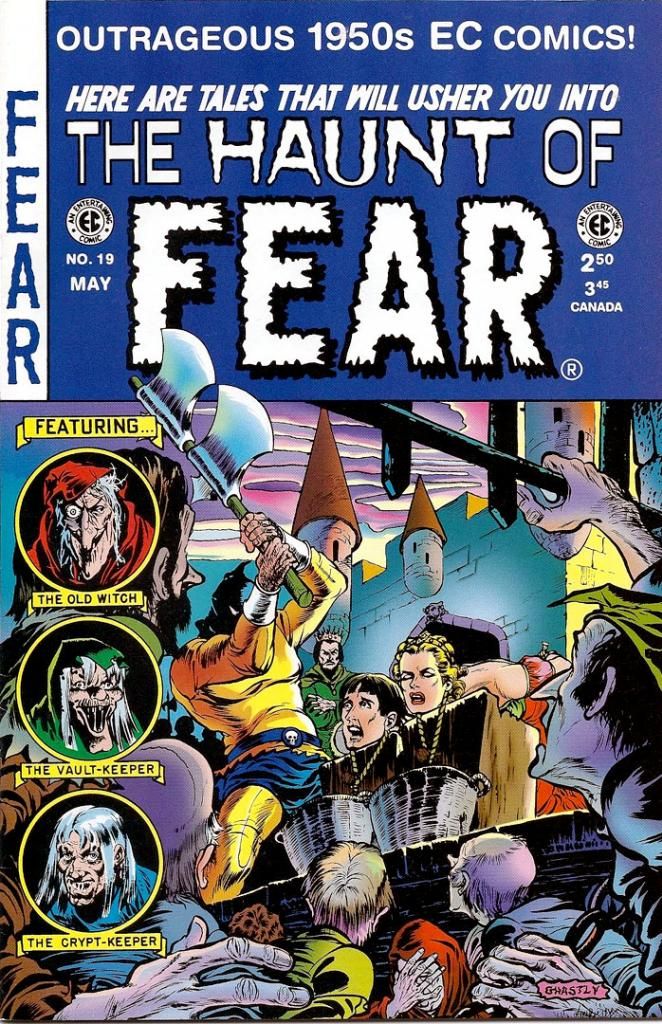
Fantagraphics has a Valentine for Jack Davis!


Look at that line-up of artists! This makes me wish I lived in Seattle, Washington, instead of Asahi-shi, Chiba-ken. Jack Davis is one of the nicest people ever to work in the industry and it's wonderful to see Fantagraphics showering the man and his work with well-deserved love. I'm really looking forward to their Davis art book. That along with the Alex Toth book by Dean Mullaney are musts!

On a personal note, not only did I once interview Davis by phone-- a treat for me-- but I also sent Peter Bagge an embarrassingly fannish email to which he replied in a gracious manner. He even had a nice compliment for some of my stupid art, a t-shirt I'd designed for a local Athens band. I've been pretty lucky in my interactions with various creators. I've only had one somewhat sour experience and that was due mostly to a misunderstanding. I'm one of those foolish hero worshipers and I treasure these moments when the people whose work I admire so much turn out to be genuinely pleasant types who find a moment to answer my gushy-mushy love notes with gentle good humor instead of the restraining orders or the visits from paid assassins I so richly deserve.

Tuesday, December 13, 2011

The Onion A/V Club interviews Jack Davis!

And it's amazing how closely it echoes the talk I had with Davis many years ago when I was a graphic design student, right down to the mention of the kind of brush he uses for inking.  Well, for the most part.  He's probably answered these same questions from people like me a thousand times over the years.  We didn't get into biography all that much.  He did tell me the chain gang story and how he went from the University of Georgia to the Navy in WWII and then pounded the pavement in New York city before he broke into the comics business, and we briefly touched on his time at EC.  In the A/V Club interview he paraphrases what he told me about his feelings about today's Mad.  I asked him what it was like to work with Wally Wood.  But mostly, as an artist, I wanted to know about process and that's what I got.

Here's how I remember it:  His agent faxes him jobs and he picks and chooses the ones he wants to do, otherwise he's on his boat or playing golf.  His initial sketches start off as a "lot of scribble-scrabble" and he inks with a No. 3 Series 7 Winsor & Newton brush.  Seeing that mentioned really brought back a lot of warm memories of our phone conversation, where he was so genial and patient with my hero-worship gushing that I walked on air for two days afterward.  It remains a highlight of my checkered college career.  Somewhere among all my own crappy art files I still have the notebook where I jotted down as much of what he told me as I could.  If I'm ever back in the US, I could dig it up and read through it and try to recapture a little bit of that magic.

Jack Davis is overdue for widespread acclaim.  Not that he hasn't had accolades and praise.  The Society of Illustrators Hall of Fame, the Reuben Award and the Milton Caniff Lifetime Achievement Award from the National Cartoonist Society are certainly that.

It's just he needs to be one of those names dropped alongside people like Charles Schulz and Walt Kelly (although Davis's attempt at a syndicated newspaper strip never really got off the ground), Jack Kirby, Harvey Kurtzman, Will Eisner and Wally Wood.  He needs to be right there in the forefront of your consciousness whenever you think of cartoonists and cartooning.

After all, he worked for EC's most infamous titles-- and interviewer Sam Adams brings up perhaps the most notorious story of them all, the Davis-illustrated "Foul Play"-- as well as for Mad magazine.  Then he did covers for Time and TV Guide, designed the characters for the Jackson Five cartoon, created movie posters and all sorts of amazing stuff.  There's a trade paperback book, now out-of-print, about the man and his art called-- appropriately enough-- The Art of Jack Davis, and it was a decent enough tribute.  Considering the man's done so many high profile jobs and associated with so many other cartooning legends in his time, he really needs something more deluxe.  Something spanning the entirety of his eclectic art career.

That Fantagraphics volume is a must-buy, but I'm thinking even at 208 pages it's a little light.  I think he needs a hardcover series collecting all of his sequential work with color plates of his magazine covers and movie posters to round it out.  Your floorboards should buckle under its weight.  If only someone published, say, a collection of some of his other humor magazine work, or if you could buy a book with some of those horrifying EC stories he drew with mixed feelings but incredible skill-- what a world that would be!  Oh well.

Jack Davis is an American treasure.

Friday, March 25, 2011

Steve Rude talks process

There are a lot of art books about comic book artists. Most of them-- even the very best ones-- tend to dwell on biography, which is not something I'm all that interested in. Unless it's Jack Kirby who grew up in a rough part of New York City, co-created Captain America and then fought in WWII and then partnered with Stan Lee to invent almost the entire Marvel Universe. Even if his line had been insurance sales, Kirby would've still had a pretty incredible life.

What I want to know more about from my favorite artists are their process and tools. How do the greats make the art we love to look at so much and what do they use to make it? One of the great moments of my life was when I got to talk shop with another Jack-- none other than Jack Davis. He let me in on the kind of paper he uses, the brushes and little insightful tidbits such as how his initial sketches are a lot of "scribble-scrabble." That kind of info can be hard to find, probably because most books on comic book artists aren't written by artists but by fans who experience the work from an audience's perspective. Recently, Steve Rude completed a commission to recreate the splash to Captain America #34 from way back in 1944.

According to the Dude, the original is by Kirby himself, but the The Jack Kirby Museum website blog attributes it to Syd Shores. I have no idea what the truth is. Maybe it's Shores working over a Kirby layout. Or vice versa. The Museum says it was done "well after S[imon] & K[irby] departed Timely," and I have no reason to doubt their expertise-- but do you want to tell Steve Rude he's mistaken? I sure as hell don't!

Artist controversy aside, what's important here is Rude didn't merely copy the splash. He zoomed in the plane of vision, tightening the composition, and he gave it more depth of field. In Shore's original, everything takes place along the same plane, which flattens the perspective. Rude pushes the background farther back in layers. This means his version isn't as jumbled and frenetic, but no less action-packed. He also changed Bucky's pose from running along beside Captain America to leaping from the sky above him. Rude's colors are more naturalistic rather than the crude yet vibrant primary-and-secondary color scheme the original comic uses. Yellow sky, Nazis in yellow or green uniforms with purple helmets!

The resulting painting is fun. It captures the spirit of early Captain America without being a mechanical recreation. Whoever commissioned it is getting a beauty. And the rest of us are lucky enough to have been able to follow along as Rude posted his initial sketches, washes and the finished piece as he completed them. He's also posted a short step-by-step on working on this painting as well, complete with a mention of Alex Ross-- who, as Rude notes, "has made a career working in this method."

This is the kind of stuff that fascinates me. Rude goes into his thought process-- the things that go on inside the mind before an artist even touches pencil to paper. He had the original, but he says he's not one of those guys "who get off on this historical stuff." And besides, the image in his head and the one from the comic didn't quite jibe. So he gathered up all the photo reference he would need for uniforms, weaponry and the like. Then Rude started drawing.

Here's where Ross and Albert Dorne enter the story and I abruptly die and float away to art heaven.

The finished artwork looks like this
.