We've lost one of the greats: Jean Giraud, better known as Moebius, passed away March 10th. While he had a lengthy and influential career doing sequential work, I'm more familiar with him as a film conceptual artist thanks to my childhood obsession with the movie Alien. One of my brothers bought me a bargain bin copy of The Book of Alien, a "making of" album full of behind the scenes photos and pre-production artwork. The Moebius drawings for the spacesuits stood out for me, which is saying a lot considering he was only on the film for a few days and the book mostly concentrated on Ron Cobb's excellent spaceship designs, as well as on the always fabulous H.R. Giger sculpting the title creature itself.
I eventually tossed the book or sold it at a garage sale but found a newer edition here in Japan at Tower Records. Of course I bought it immediately upon realizing what it was and once again found myself entranced by Giraud's designs.
His work was always distinctive, instantly recognizable. I didn't have to read the credits to recognize his touch in Luc Besson's The Fifth Element. Especially those cop costumes with their wild, impractical helmets!
Even when he didn't do the design work himself his influence could be so significant it burst out in other people's work. No surprise Giraud and another genius, Hayao Miyazaki, were good friends. Miyazaki's manga Nausicaa of the Valley of the Wind-- and the film, of course-- has a distinct Moebius-esque look. I feel pretty sure Carlos Ezquerra steeped himself in Moebius at some point before designing Judge Dredd and his world for 2000 AD.
Europeancomics don't seem to be as hung up on the same limited genres as our American comics do. At home, Giraud did Westerns, spy conspiracies and and science fiction, but for the American market he teamed up with Stan Lee for a Silver Surfer story and contributed a wickedly beautiful Batman pin-up to DC's Batman Black and White.
I love his clean, open artwork and parallel-line modeling. Every once in a while in my sketchbooks I'd try to channel some Moebius and fail miserably. Time for me to shut up and allow a late master speak for himself in the way he knew best.

Saturday, March 10, 2012


Thursday, March 8, 2012
Cassandra Cain lives on DC's new website... for now
He who makes a beast of himself gets rid of the pain of being a Cassandra Cain fan. -- Dr. Samuel Johncomicbookfanson
DC's new website is... well, I have no opinion about website designs and the like. What care primitive I for such things? But late last night, around 1 AM when I should have been sleeping, I did a quick search for Cassandra Cain news-- yes, in exactly the same way I sometimes do name searches for exes and old crushes and then cry myself to sleep-- and found an amusing tidbit (we Cass fans take what we can get) on the blog Every Day Is Like Wednesday. Someone involved with the DC website design has used an image of Cassandra Cain to illustrate their page about Barbara Gordon.
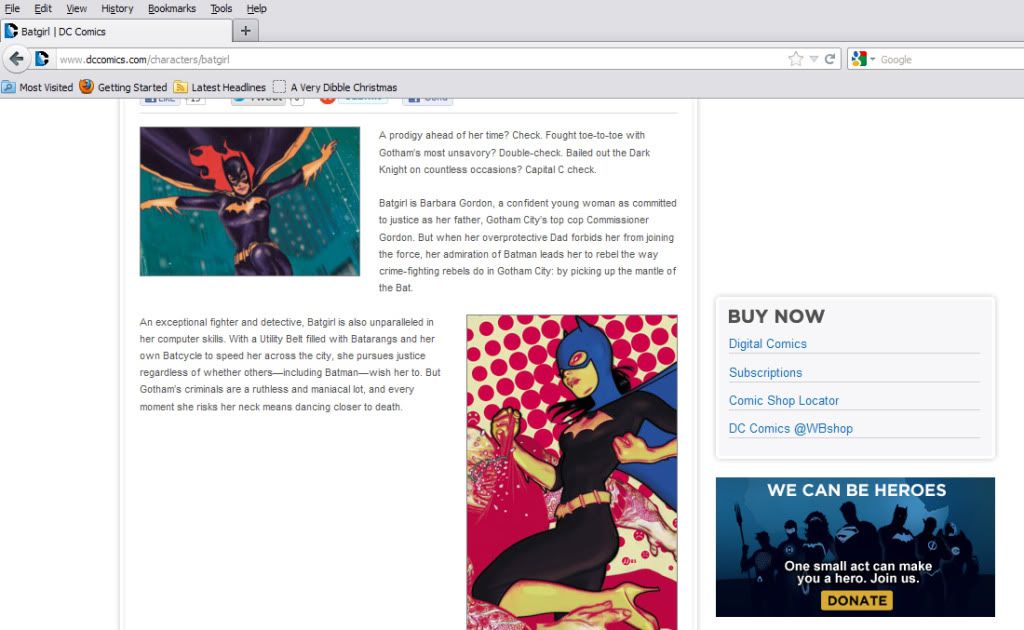 |
| Cass fans! Get your fix! Fast! Before DC fixes this! |
Specifically, it's the gorgeous cover to Batgirl #45. Remember that one? Cass becomes curious about Barbara's career, dresses up in her predecessor's old Batgirl suit and discovers to no one's surprise high heeled boots are impractical for crime-fighting. She's also now subject to the male gaze and queasily uncomfortable comments from Robin about how hot he suddenly finds her. Barbara is pretty happy about it; essentially, the philosophy she espouses once again to Cass is it's important to dress and act in ways boys find cute and if you achieve that, effectively battling crime is a plus. In the end, Cass rejects being that kind of hero and goes back to basic black and even Barbara laments not having worn more sensible footwear.
James Jean's covers during that era are spectacular. Vivid colors, bold imagery and symbolism. This one is no exception. While I have no complaints about Rick Leonardi and Jesse Delperdang's interior work (clean storytelling, well-rendered figures and polished linework always appeal), I really wish DC had tapped Jeans for at least one fill-in issue-- especially the any of the ones immediately preceding Leonardi's run, which are atrocious.
Anyway, enjoy the second life of Cassandra Cain on DC's website. Before they correct it and she goes back to superperson purgatory! Or not! Hee hee! Being a Cass fan is so much fun when you're sleep deprived and stressed out about changing jobs and moving to a new city while living abroad!
Wednesday, March 7, 2012
Uncle Creepy introduces the faces of fear!
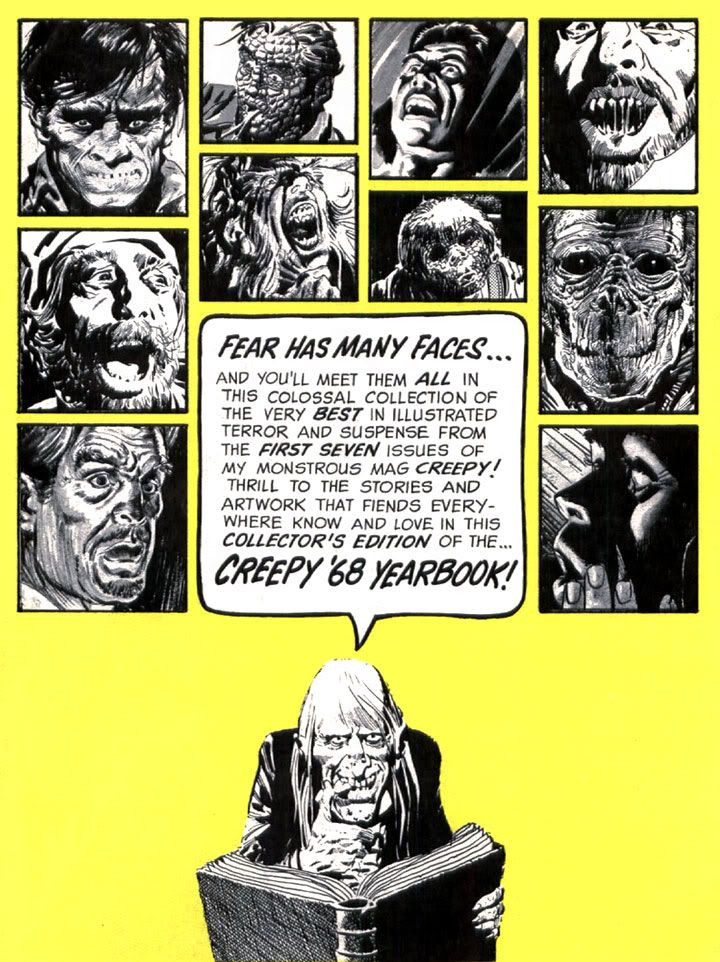
You can't go wrong with a little Uncle Creepy in your day. These Warren house ads are the best. Can you recognize the artists represented here? I see Gray Morrow, Al Williamson, Angelo Torres, Frank Frazetta...
The rest is up to you, my friend.
Monday, March 5, 2012
Hey! Valiant's back!
It's like the fullest blossoming of 1990s nostalgia! I bought into the Valiant universe in a big way back in those days. I had every issue of every single title. In fact, I'm pretty sure I still have them, bagged and boxed at my mom's house. Written by Jim Shooter, Harbinger featured some nice art by David Lapham; while in tone and general look it owed a debt to Chris Claremont and Brent Anderson's X-Men: God Loves, Man Kills graphic novel (which Neal Adams claims Shooter conceived), it prefigured the more comical Gen13 and Marvel's Runaways-- and stands as the best thing Shooter's finest scripting hour, Secret Wars included.
Pete Stanchek, the group's leader, wasn't exactly the most trustworthy of people with his powers of mental control. The intimations that he'd occasionally use it for his own convenience and the implications that has for all his personal relationships made him seem a bit shady despite his frequent protestations of remorse. I was never sure if I even liked him.
Harbinger was also notable at the time for the "play for keeps" nature of the superhero fights. People got hurt-- and badly. Or killed outright. Very different from the low stakes dust-ups in most superhero books at the time. I mean, face it, Wolverine might kill a few ninjas here or there and Katana would SHAKKT someone off-panel, but killing fights in comics were pretty rare. Deaths usually happened to supporting characters to motivate protagonists. Even battles with actual consequences were rare at the time Harbinger came out. No broken, bloody noses for Batman, and only Dani Moonstar had to endure months of painful physical therapy for her injuries-- very little of which we actually saw. Of course, nowadays Katana kills practically in every issue of Birds of Prey and no one says boo about it. Books like The Punisher and Kick-Ass play gory injuries as jokes or as really cool, lots of fun for everyone involved. Spend some hospital time, pop out good as new, join in lopping off people's heads in full bloody color for kicks and giggles. In Harbinger, they were just disturbing. And apparently, Shooter had even more areas to explore with Stanchek.
I also really enjoyed mismatched buddy comedy Archer & Armstrong and their darker take on the old Gold Key series Solar, Man of the Atom. It's too bad Solar and his fellow Gold Key alum Magnus (the guy who, like the Flaming Lips' Yoshimi, fights evil-natured robots) won't be part of this revival; they're over at Dark Horse.
Even though I've gushed here about Harbinger, Valiant's actually kicking off with X-O Manowar this time. I read that one but to be honest, I have very few memories of it.
Wednesday, February 29, 2012
The Black Queen of Sogo-- Barbarella's Enemy!
 |
| Stab on, Slupe/Slupe, stab on... |
Barbarella was kind of amusing but even in our chemically-altered state we found it far less decadent than we'd been led to expect. Despite the infamous scene where Barbarella's inexhaustible sexual energy burns out a machine designed to orgasm her to death, these days it's practically tame, hardly even as risque as 1980's Flash Gordon where Ornella Muti wears a skirt slit all the way up... to... there...
Why am I telling you all this? Because this weekend I got on one of my Swingin' Sixties kicks and decided to watch the last scene of Barbarella on YouTube. I've always liked the last little exchange between Fonda and John Phillip Law as they fly into the credits. The last lines of Barbarella are cleverer than the entirety of most sci-fi movies these days-- the Star Wars prequels don't contain a single memorable line through six or so tedious, joyless hours-- and it's possible to enjoy even the seams in it when they show and its retrograde sexual revolution nonsense later spoofed by Mike Myers in his international man of mystery flicks.
 | |
| The movie version! |
So off I scampered to YouTube to get my fix...
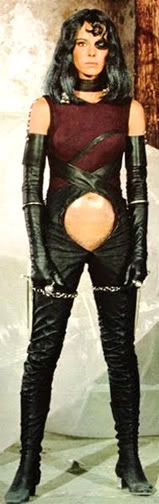
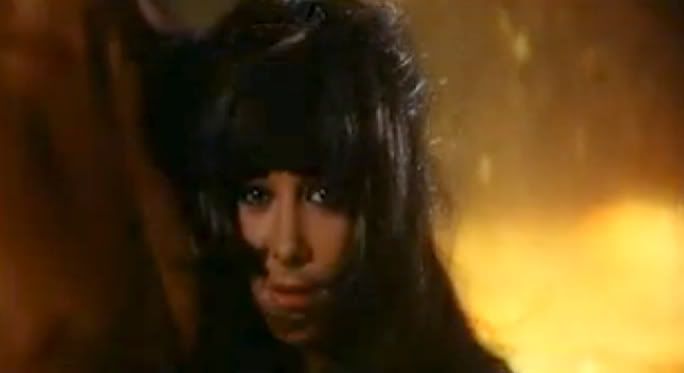
And damned if I wasn't suddenly struck by the thunderbolt that is Anita Pallenberg as the Great Tyrant. As a movie trivia buff, I'd known this but I suppose it had never registered before now. Like the character she portrays, Pallenberg was some kind of formidable woman back in the day. She was born in Italy to German-Italian parents, spoke four languages as a child, studied medicine and graphic design, became a model, an actor, a musician, lover to Rolling Stone Brian Jones. Later she definitely some children with Keith Richards and supposedly had an affair with Mick Jagger. I've also heard she was very into Black Magic, so it's no wonder Jennifer Saunders tapped her to play the Devil opposite Marianne Faithfull's God in an episode of Absolutely Fabulous Then there was the incident in which she had to be cleared of manslaughter charges. She's almost 70 now, younger than my mom but looks ten or even twenty years older.
 |
| Kind of makes me like tyranny... |
Pallenberg was only 23 or 24 when she played the Great Tyrant and when she smiles her face takes on a freshness-- an adorable quality even-- that belies both the character's nastiness and her own reputation. And the frequently idiotic costumes, like the one where they strap a horn to her forehead. Oh, and also the somewhat haggard overdubbed voice they stick her with. I don't know what Pallenberg's own voice sounded like at the time. Was it wispy and too girly for the Black Queen, or was she just not much for line readings? A sweet-voiced villain might have been interesting, especially contrasted along with that smile against the character's depravity.
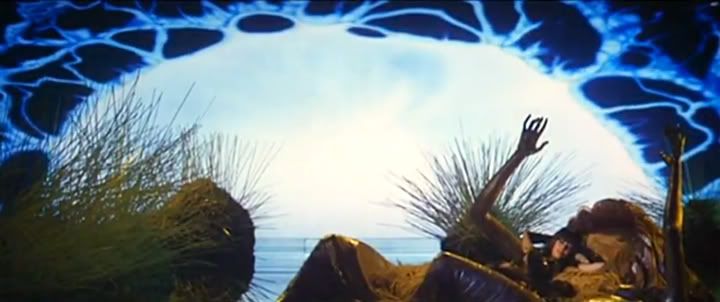 |
| Sweet dreams in Studio 27. |
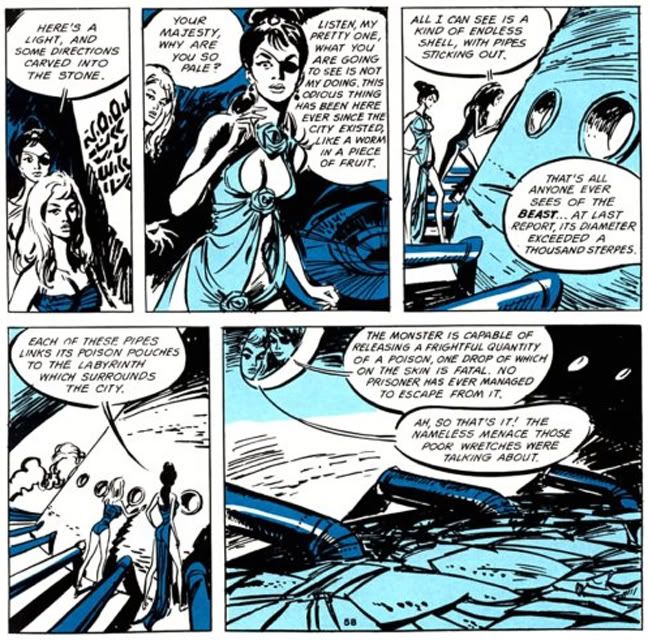 |
| The Queen isn't friends with it the way she is in the movie. |
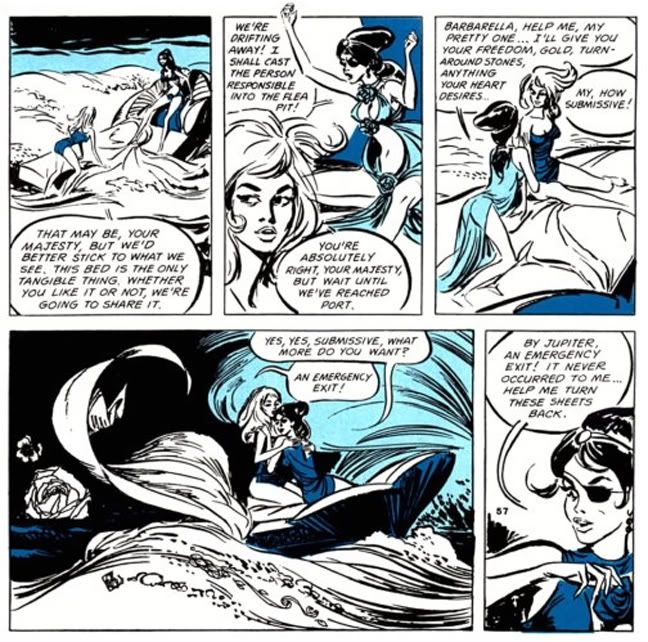
Continuing on her way, Barbarella runs into a couple of creepy "beggers." They intend to do her harm, but a petite one-eyed woman in a skintight black bodysuit stabs them from behind, then tries to put some serious moves on Barbarella herself, despite only speaking broken English. Making her way to the palace, Barbarella gets involved in a revolt and learns her wicked little savior is actually the Queen herself. The Queen throws Barbarella into a giant birdcage where the birds conveniently peck off most of her clothes.
Barbarella learns the evil Queen has her own problems-- when she isn't coming up with new forms of perversion and torturing angels to "extend the frontiers of human pleasure," she's suffering from remorse-driven insomnia. She's like a one-eyed female Caligula. After a busy day making his horse Incitatus consul, torturing prisoners to death, spoofing religious rites, having sex with noblemen's wives right in front of them and dressing up like Venus, Caligula would spend a sleepless night wandering his palace inviting the moon to come to bed with him. Supposedly.
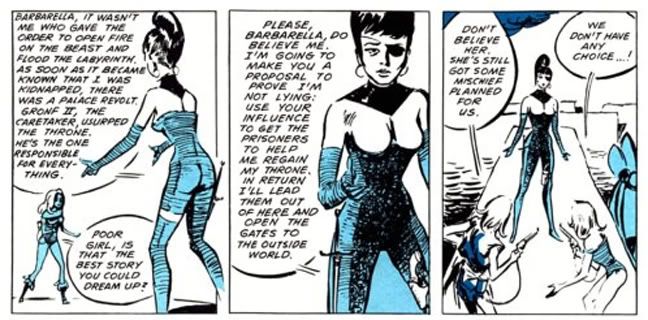 |
| She just wants to be friends! |
And like both those emperors the Queen has her enemies. Barbarella is one, for righteous reasons, and even her own palace locksmith is completely fine with allowing Barbarella into the Queen's secret room of dreams to assassinate her. He betrays Barbarella as well. He locks her in with the helpless Queen as the deadly dream energy swirls. Waking, the Queen begs Barbarella to save her in exchange for submissive sex. Barbarella turns her down for the second time and they escape through a secret passageway in the Queen's bed.
But this little episode merely showcases one of the major flaws of being evil-- you attract other evil people as your followers and you can never trust them. I don't believe in this concept of evil. Usually the things we end up declaring evil take the form of groups of people convinced of their own virtue. The Nazis were the good guys in their own minds, terrorists of whatever stripe either political or religious feel their murders will improve the world somehow. Only in comic books and movies like Star Wars do we find antagonists who consciously embrace evil, and it almost always blows up in their faces. Sometimes that's even an intrinsic part of the evil system they follow. What Sith Lord hasn't been murdered by his apprentice?
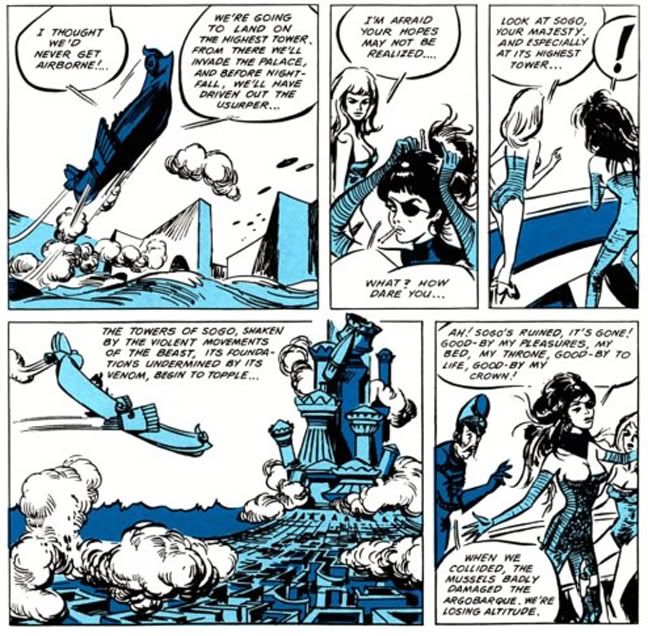 |
| You can't always get what you want... |
Oh, but she does have Pygar down there with his wings pinioned to what appears to be a giant bowling ball. For some reason, the Queen is especially proud of this detail, but it only succeeds in finally pissing off Barbarella, who attacks her, takes her prisoner and frees Pygar.
The threesome flies off into the labyrinth only to crash. Barbarella and Pygar reunite with Durand and all hell breaks loose. It seems some idiot-- the obvious suspect is the crazed Queen-- has let loose the watery monster and it's angrily poisoning everyone as it washes through the city and the labyrinth. Trapped, Barbarella and friends engage the city guards in a brief fight before the Queen shows up in what appears to be a flying Venetian gondola. Stepping out of it onto the rampart where the survivors wait, the Queen happily greets them. See, she really likes Barbarella. It's not just sexual attraction but a genuine fondness.
"Barbarella, my pet," the Queen says, cheerfully waving. "I was sure I'd find you safe and sound!"
Still miffed by the Queen's mistreatment of Pygar and completely outraged by the wanton destruction of life and property she's now witnessing, Barbarella's ready to finish her off-- "What nerve she has coming here! I'm going to disembowel her," our hero growls-- but the Queen explains this latest madness isn't her doing it all. In fact, although she politely declines to say so, it's kind of Barbarella's fault. Believing the Queen kidnapped by Barbarella, Gronf II, the "caretaker," chose to take advantage of the power vacuum by leading a palace revolt. Then he stupidly unleashed the beast. What a total jerk!
The Queen enlists Barbarella and Pygar to help her take back her throne, but it's too late. Even her mighty palace has collapsed. Beaten, the Queen laments, "Ah! Sogo's ruined, it's gone! Good-by my pleasures, my bed, my throne, good-by to life, good-by my crown!" She declares her end fitting, as "the queen cannot outlive her city" and prepares herself as her flying boat falls from the sky towards the deadly waters.
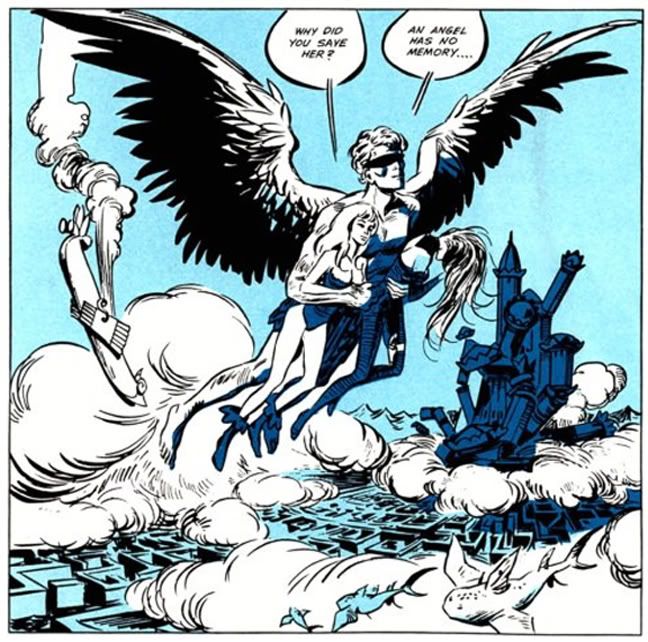
Barbarella turns to Pygar as her last hope and the angel flies her to safety. But he also takes the Queen, who hangs from his arm like a limp doll. Barbarella asks him why he saved her, and Pygar tells her, "An angel has no memory," and Sogo-- like Edgar Allen Poe's House of Usher-- consumes itself.
Like anyone adapting a comic, Vadim made a lot of changes great and small in the story. Durand-Durand becomes a villain, the Queen owns her evil a bit more, being linked to and gaining power from the Matmos beneath her palace rather than somewhat frightened by it. She puts some moves on Pygar in the movie and even dreams of him in her secret chamber, while in the comic she's more into Barbarella and just sort of offhandedly disposes of the angel.
 |
| It's true. We don't. |
Forest makes it quite terrifying, the queen's one attempt at executing her enemy, but in live action it's just Durand-Durand's way of torturing Barbarella for the audience's supposed titillation and to pad the film's running time. It appears vaguely Hitchcockian, like the clumsier moments of The Birds, but without the Master's touch to make it work anyway. While a number of sequences threaten her dignity-- scantily-clad Barbarella spends a great deal of time being tied up-- Fonda usually pulls through by relying on Barbarella's essential positive outlook. She cries for help when things get too bad, but mostly she just seems unfazed by all the insanity. Unfortunately, in the bird cage Fonda only looks ridiculous lying there pretending to be distressed while colorful birds flutter around playfully, completely sans aggression. Plus, she's already been pecked or bitten by tiny dolls once before in the movie; twice is gratuitous even by Barbarella's standards.
But here's the most important thing. Instead of dangling almost comatose from Pygar's arms with her hair in disarray and her face turned from us in abject defeat the way her comic avatar does, despite being measurably a worse person, the Black Queen of the movie gets to look directly into the camera with a kind of enigmatically pleased expression. Sure, she's ruined, but it makes one think she's already plotting a phoenix-like return to power. Or perhaps it's simply the afterglow from some well-played destruction. As played by Pallenberg, the Black Queen will never know true defeat. Fonda's Barbarella can only look on her persistent rival in dismay.
 |
| The look of love... |
Speaking of... I need to re-read League of Extraordinary Gentlemen: Century #2 - 1969 to see if there are any Pallenberg references. This is the kind of thread-chasing I enjoy. The story opens with a riff on Brian Jones's death, so it just seems natural Alan Moore and Kevin O'Neill would do something with his lover or at least her 1960s image as a kind of real-life Black Queen of Sogo. If not, what a missed opportunity. Then again, she could probably consume the League in less than a page and put that Moon Child to rout. She probably would have cooked the damned thing in a spoon and injected him into her veins.
Wednesday, February 22, 2012
Interested in buying American comics in Japan?
Yeah? Well, forget about it. The monthlies at least. I know I've touched on this subject before, but if you're addicted to the American-style four color slender magazine we popularly refer to as the "comic book" and you live in Japan you'd better get ready for some hard cold turkey time, complete with DTs and hallucinations of Batman crawling under your skin. Your best bets are either learn to live without, start buying digitally, order from overseas or have some sympathetic pusher-type friend mail you your fix.
Another thing you can do is make a pilgrimage to Blister. This is problematic because it's not all that easy to get to these days and involves figuring out the Tokyo subways, being very patient while waiting for your arrival at the proper stop and then a fairly long walk through what will no doubt be unfamiliar territory to a small store that may or may not have what you're looking for.
It used to be easier. At one point there were two comic book shops in Shibuya that sold American monthlies, with Blister being the largest and most exciting. It was right in the heart of the shopping area just outside the station and across the famous Shibuya scramble intersection you've certainly seen in movies and in photographs.
In those days, Blister was an orange multi-story geek heaven and had one of the actual screen-worn Spider-man movie costumes on display! All the action figures you could ever want and then comics and trades in the basement, plus a really cool young staff. It moved to smaller digs in Harajuku and that's where I used to drop 100-200 bucks on comics and more whenever I hit Tokyo. I experienced my first Free Comic Book Day at the Harajuku store, and it was marvelous. So many people packed into the comic book section you had to wait your turn to flip through the longboxes.
Then Blister moved again and shrank to a less impressive storefront in a hard-to-reach neighborhood that isn't nearly so cool as either Shibuya or Harajuku, but probably leases space at more affordable rates for people selling comics apparently only I want. My second FCBD at Blister's new location wasn't so exciting and a day or two later, I was jetting back over the Pacific Ocean, leaving Japan behind me forever. Or so I thought.
Man, I loved Blister back in the day! I still do, but I'm not sure I'll be making a return trip there this year. Sorry to give you the bad news. Now for the good.
If you love collected trades, graphic novels or English-translated manga, you're totally in luck here in Japan. Japan's got you covered. More than covered. It's an embarrassment of riches, really. You can order COD from Amazon.jp (currently my favorite source). Sometimes you can even find things that are out of print in the US still available at Amazon. At the very least, anything you can get from Amazon in your own country, you can get in Japan. And the exchange rates make them comparable in price, or even cheaper. And if you're in Tokyo, it's easy to hit up Tower Records in Shibuya and Kinokuniya in Shinjuku. Tower Records is a straight shot from Shibuya Station and Kinokuniya is right behind Shinjuku Station.
But don't take my word for it. Ask Christopher Butcher, who found out in 2007 what I learned about the same time: that Fantagraphics is majorly represented here at Kinokuniya (and also at Tower Records, although I don't think he went there). You can also find your precious superhero books at Kinokuniya as well. But the English-language manga section is the store's real appeal. Butcher's right on about how large that section in Kinokuniya is. It's large and stocked in-depth with all kinds of titles and genres. While Kinokuniya does maintain a shelf of superhero trades, it's nowhere near as breathtaking as their English-translated manga selection.
Here's another good point he makes:
You have to understand Kinokuniya did this within the context of a market where comics are already widely accepted by a population-wide general readership, but as a business person, Butcher obviously understands the scope of what Kinokuniya offers. I also enjoyed Butcher's photos of the Shinjuku night-scape, complete with the NOVA sign that no longer exists because that NOVA branch went belly-up along with the company not long after he shot it.
Which is to say in Japan terms, this photo essay is old news. And also in the world of American comic book fans. That doesn't mean it still isn't useful. The info about Kinokuniya was still accurate as of May, 2010, the last time I set foot in the store. I just happened to tumble across Butcher's photos this morning while thinking about whether or not American comics are popular here in Japan and if any new outlets for them had popped up since I my departure and return. The late, lamented Journalista! once linked to it, so you may have already read it. I didn't, much to my chagrin. Wish I had. Wish I'd known he was in Japan at the same time I was.
Not that he knows me or vice versa, but I could have clued him into Blister. I miss Journalista! Journalista! once linked to someone else's link to my angry evisceration of that overblown toilet paper-worthy book Identity Crisis and called it the "ultimate take-down" of said book. And then I died and was no longer relevant to comics fandom!
Another thing you can do is make a pilgrimage to Blister. This is problematic because it's not all that easy to get to these days and involves figuring out the Tokyo subways, being very patient while waiting for your arrival at the proper stop and then a fairly long walk through what will no doubt be unfamiliar territory to a small store that may or may not have what you're looking for.
It used to be easier. At one point there were two comic book shops in Shibuya that sold American monthlies, with Blister being the largest and most exciting. It was right in the heart of the shopping area just outside the station and across the famous Shibuya scramble intersection you've certainly seen in movies and in photographs.
In those days, Blister was an orange multi-story geek heaven and had one of the actual screen-worn Spider-man movie costumes on display! All the action figures you could ever want and then comics and trades in the basement, plus a really cool young staff. It moved to smaller digs in Harajuku and that's where I used to drop 100-200 bucks on comics and more whenever I hit Tokyo. I experienced my first Free Comic Book Day at the Harajuku store, and it was marvelous. So many people packed into the comic book section you had to wait your turn to flip through the longboxes.
Then Blister moved again and shrank to a less impressive storefront in a hard-to-reach neighborhood that isn't nearly so cool as either Shibuya or Harajuku, but probably leases space at more affordable rates for people selling comics apparently only I want. My second FCBD at Blister's new location wasn't so exciting and a day or two later, I was jetting back over the Pacific Ocean, leaving Japan behind me forever. Or so I thought.
Man, I loved Blister back in the day! I still do, but I'm not sure I'll be making a return trip there this year. Sorry to give you the bad news. Now for the good.
If you love collected trades, graphic novels or English-translated manga, you're totally in luck here in Japan. Japan's got you covered. More than covered. It's an embarrassment of riches, really. You can order COD from Amazon.jp (currently my favorite source). Sometimes you can even find things that are out of print in the US still available at Amazon. At the very least, anything you can get from Amazon in your own country, you can get in Japan. And the exchange rates make them comparable in price, or even cheaper. And if you're in Tokyo, it's easy to hit up Tower Records in Shibuya and Kinokuniya in Shinjuku. Tower Records is a straight shot from Shibuya Station and Kinokuniya is right behind Shinjuku Station.
But don't take my word for it. Ask Christopher Butcher, who found out in 2007 what I learned about the same time: that Fantagraphics is majorly represented here at Kinokuniya (and also at Tower Records, although I don't think he went there). You can also find your precious superhero books at Kinokuniya as well. But the English-language manga section is the store's real appeal. Butcher's right on about how large that section in Kinokuniya is. It's large and stocked in-depth with all kinds of titles and genres. While Kinokuniya does maintain a shelf of superhero trades, it's nowhere near as breathtaking as their English-translated manga selection.
Here's another good point he makes:
So, here’s my closing thought: A Japanese bookstore in Japan has a
better selection and diversity of product for English-language graphic
novels, including manga, bd, superheroes, artcomix, strip collections,
etc., than 90% of comic stores in North America; if Kinokuniya can
develop a market for that material then North American stores could too,
and there’s nothing stopping them.
You have to understand Kinokuniya did this within the context of a market where comics are already widely accepted by a population-wide general readership, but as a business person, Butcher obviously understands the scope of what Kinokuniya offers. I also enjoyed Butcher's photos of the Shinjuku night-scape, complete with the NOVA sign that no longer exists because that NOVA branch went belly-up along with the company not long after he shot it.
Which is to say in Japan terms, this photo essay is old news. And also in the world of American comic book fans. That doesn't mean it still isn't useful. The info about Kinokuniya was still accurate as of May, 2010, the last time I set foot in the store. I just happened to tumble across Butcher's photos this morning while thinking about whether or not American comics are popular here in Japan and if any new outlets for them had popped up since I my departure and return. The late, lamented Journalista! once linked to it, so you may have already read it. I didn't, much to my chagrin. Wish I had. Wish I'd known he was in Japan at the same time I was.
Not that he knows me or vice versa, but I could have clued him into Blister. I miss Journalista! Journalista! once linked to someone else's link to my angry evisceration of that overblown toilet paper-worthy book Identity Crisis and called it the "ultimate take-down" of said book. And then I died and was no longer relevant to comics fandom!
Tuesday, February 21, 2012
Another Nexus update-- inks and coloring!
The official word is Steve Rude will ink himself and also do the lettering for the new 42-page Nexus story dropping this May in Dark Horse Presents from... wait for it... Dark Horse. Well, not all 42 pages, not right away. Dark Horse Presents isn't formatted for that. Expect 10 or so in the first installment. Glenn Whitmore will do the coloring.
Mystery solved thanks to the Rudes themselves. I can't wait to read this! I'm sure Rude and Mike Baron have something amazing in store for us. But then, they usually do! And the Dude inking the Dude sounds good to me!
Mystery solved thanks to the Rudes themselves. I can't wait to read this! I'm sure Rude and Mike Baron have something amazing in store for us. But then, they usually do! And the Dude inking the Dude sounds good to me!
Subscribe to:
Posts (Atom)