Showing posts with label Robin. Show all posts

Sunday, March 3, 2013

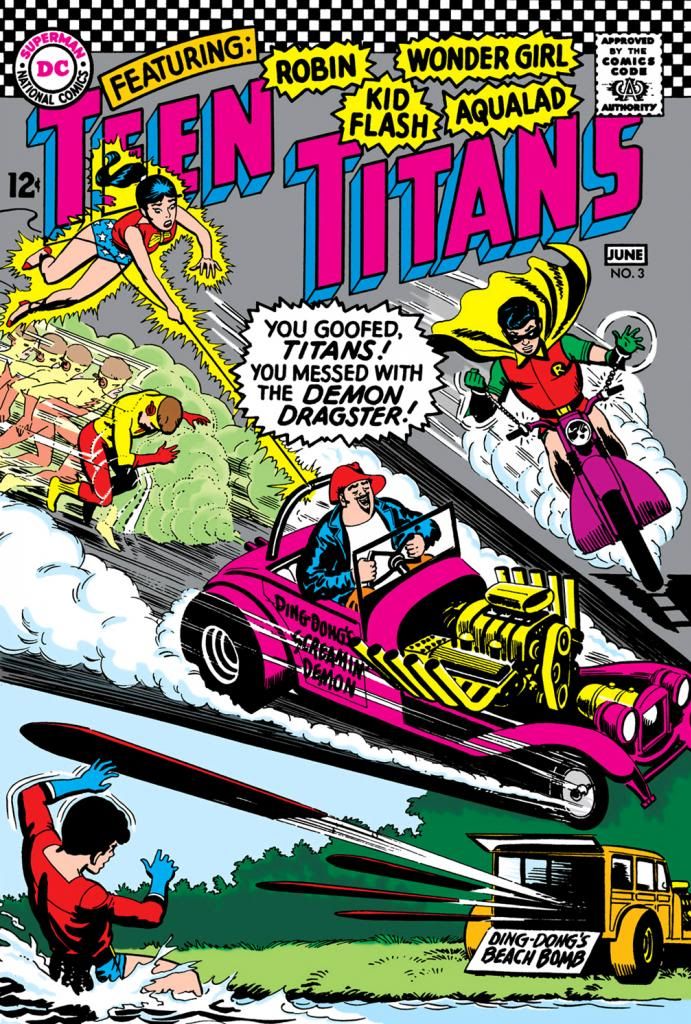
Teen Titans #3: And then they beat up "Big Daddy" Ed Roth on government orders

Why, Titans?  Why?  I love "Big Daddy" Ed Roth, but apparently the President's Commission on Education has a gripe with the creator of Rat Fink.  That son of a bitch Lyndon Johnson!  Oh... you mean it's really Ding-Dong Daddy Dowd and not Roth?  Well, that's okay then!

Anyway, "The Revolt at Harrison High," from Teen Titans #3 (June 1966), finds the Johnson administration trusting its anti-drop out initiative to a group of costumed kids who, if we measured IQ in houses, would have to climb up out of the basement to get to stupid.  The Teen Titans in this issue are ultra-establishment types who believe when Uncle Sam says "Jump!" you jump, right across the Pacific into Southeast Asia where, if you're lucky, you come back minus just your innocence or part of your leg.  Or in this case, to Harrison, USA, where statistically average teen David Robinson has dropped out of school and taken to spinning around town in a souped-up jalopy while working for Ding-Dong Daddy, who just happens to be a dead ringer for Ed Roth.

The Titans don't do much to prove me wrong about their intelligence in this issue.  As soon as Robin hears about David's employer, he has the team check out Ding-Dong Daddy's Hot Rod Hive, which is a pretty obvious move.  There Dowd-- a mountain of a man much like his real-world inspiration-- comes on way too strong with hip cat talk and his refusal to show anyone his secret room.  Once again, the barely-sentient Robin senses something amiss-- I mean, secret room!-- and sends Kid Flash vibrating through the steel door to find a group of teen-aged boys doing what teen-aged boys do best.

No, not that.  Are you kidding me?  They'd go blind!  Plus, that's more a hygiene issue and this is about societal ills.  What these out of sight groovesters are doing is equipping an ice cream cart with a machine gun to kill cops.  Robin knows this is all kinds of wrong, so he has the Titans beat a hasty yet nonchalant retreat so they can plan the next step.  After tangling with a trio of Ding-Dong Daddy's hot rods and losing, the Titans disguise themselves as some less-than-convincing motorcycle toughs so they can help Danny and his no-good pals fight an even worse scourge of wholesome American highways-- an honest-to-goodness motorcycle gang called the Scorchers.  The Scorchers wouldn't survive ten seconds in a rumble with the Hell's Angels.  I doubt they'd last much longer against the Black Widows.  Our favorite teens soon subdue the Scorchers and impress David and pals enough they help the heroes infiltrate the Hot Rod Hive where Wonder Girl-- her hair bleached blond-- entertains Ding-Dong Daddy by dancing away in his office and the boys fight some goons and a robotic gas pump.
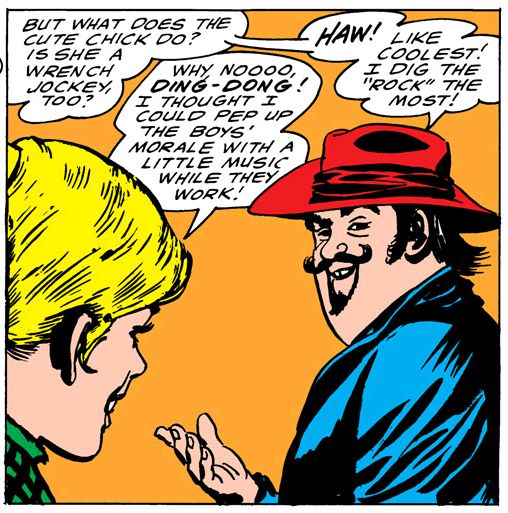
You sleaze!  You're more than twice her age! (Bob Haney, script/Nick Cardy, art, Teen Titans #3)

There's even a nasty little double-entendre a few moments earlier when Ding-Dong Daddy asks, "But what does the cute chick do?  Is she a wrench jockey, too?"  This sets up a scene where Wonder Girl leads Ding-Dong Daddy by the arm to his office-- both figures largely silhouetted in a sinisterly suggestive way-- to "keep him occupied" (Robin's phrase, not mine).  Once in the office, our bold young Amazon gyrates away while Ding-Dong Daddy, obviously middle-aged, leers at her and declares, "Haw!  I like it, babe!"  But the creep soon gets his as Wonder Girl takes him down herself and everyone agrees to return to school.  Two years later, David Robinson gets his draft notice and it's off to Cu Chi with the 25th Infantry Division.  But that's a Titans tale for another time!

Of course, there are few things less cool than middle-aged men trying desperately to capture the youth zeitgeist, but paradoxically, there are also few things cooler.  Stan Lee somehow managed to do it with ease by using a lot of WW II-era GI slang ("Hang tough!" and "Face front!" come to mind), but DC never quite got with it despite their best efforts.  Bob Haney lays on the teen-talk pretty thick throughout this issue, which dates it (along with its super square, pro-establishment naivete, which no doubt dated it even in 1966), but it's that very product-of-its-time quality that makes these early Teen Titans issues such fun.  Like, baby, I dig Teen Titans the most!  And that includes the pop-art checkerboard design on the cover.

That and the use of a Roth stand-in as the villain.  Which, my friends, is inspired.  The only thing that could have been better would have been a Bob Dylan-esque folk singer pushing pot to Robinson and pals.  Okay, Haney never would have gotten that one past the Comics Code.  Roth and his hot rod culture were pretty popular around this time-- DC comics frequently included ads for toys based on his designs-- and he was such a colorful figure in his own right.  Plus, using a Roth avatar gives Nick Cardy the chance to go absolutely nuts with crazy custom car designs- one has bank-robbing mechanical tentacles, even-- and whacky motorcycle gang outfits.

Come to think of it, if Ding-Dong Daddy hadn't been a villain, he would have made the perfect protagonist for his own title.  That is, if you took away his pervy "barely legal" predilections.  Of course, it would have flopped like a lot of DC's youth-pandering efforts did later in the 60s and early 70s when they got ever more desperate to stem the Marvel tide and capture some of those Baby Boomer bucks, but then we'd have more Ding-Dong Daddy material to talk about and there's nothing wrong with that.

It's just too bad they couldn't have worked in some version of Rat Fink as Dowd's side-kick in place of some unfortunately generic thugs-- so dull I initially mistook one for David, who sports a white tee and jeans throughout.  Yawn!-- who beat up Robin.

These early Titans issues are nothing if not socially conscious, as well.  Which is fitting considering the book's young cast and the tumultuous times in which these books first appeared.  Even though it's handled less subtly than in one of those classroom films we used to watch in PE on rainy days during junior high, Haney and Cardy don't let their preachy anti-drop out message get in the way of a lot of frantic action, with the dread Batman in his Batmobile getting his ass handed to him by Ding-Dong Daddy's technologically superior automotive stylings, Robin handcuffed to a "hot Honda" (a phrase which tickled Haney so much he uses it again later in the book), which nearly speeds him to his death, Kid Flash running in place to save a school bus full of teens and Aqualad falling prey to a car that shoots flying surfboards.  They just awkwardly toss the message into the dialogue and let the story continue on its rambunctious way.

We're having fun, but I can't shake the feeling Haney really hoped he might reach a few at-risk kids with this comic and do some real-world good.  That kind of kind heartedness counts a lot with me, especially looking back from a vantage point where so many of today's books seem simply negative for negativity's sake, crass, the results of lowest-common-denominator thought, or cynical attempts to exploit headlines for controversy.  Haney probably wrote this with an eye on the headlines as well, but his mission wasn't simply to profit from them.  Instead, I get the idea he hoped to find some constructive way for silly superheroes to have a positive impact on their readership, rather than just confirm them in their downbeat pessimism.

Realistically, this comic probably did little if anything to convince readers to stay in school or trust the Johnson administration.  On the other hand, it must have sent more than a few of them in search of CARtoons magazine.

Wednesday, February 20, 2013

Teen Titans #1 (February 1966): Nick Cardy makes a splash, Bob Haney makes a point


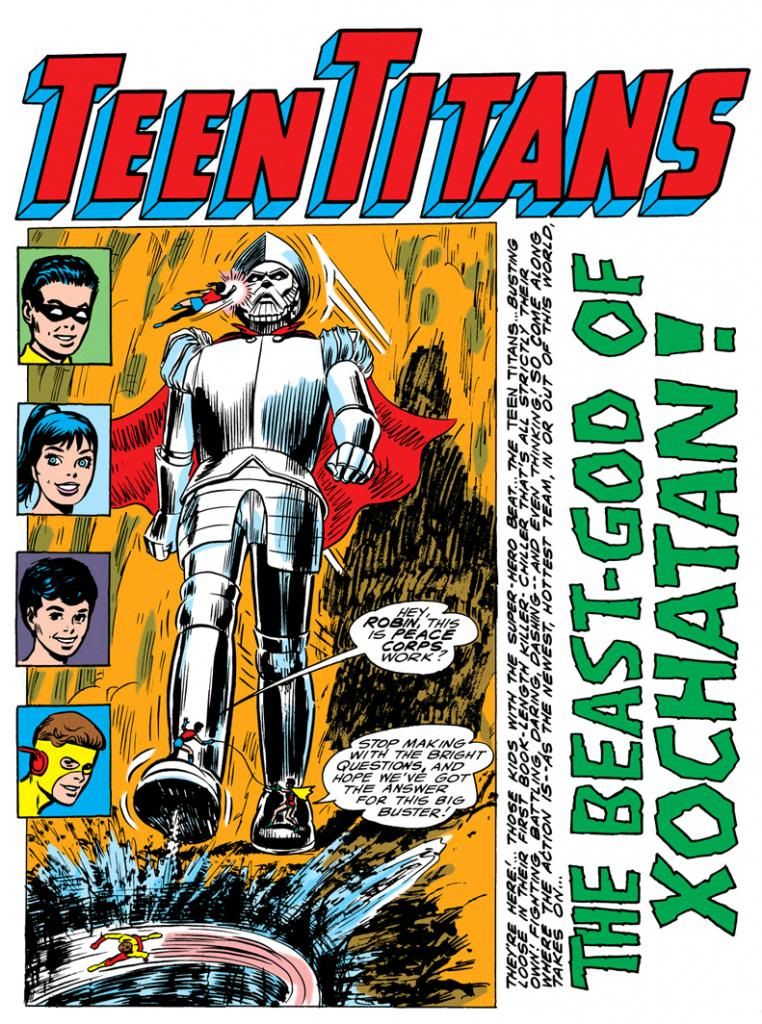
This is the colorful splash page to Teen Titans #1 (February 1966), drawn by Nick Cardy.  Written by the great Bob Haney, this first issue of Titans is essentially a positive, happy-go-lucky propaganda piece about the glories of the Peace Corps, which was a big deal for socially-conscious youngsters back in the early- to mid-1960s.

Officially established by John F. Kennedy with Executive Order 10924  in March 1961, the Peace Corps has been sending young Americans all over the globe to win hearts and minds by doing good works in developing nations ever since.  Back when the Titans made their collective bid for membership, the United States was still basking in the afterglow of having helped defeat fascism in the 1940s and taking leadership in facing down communism ever since.  World War II and the Cold War had frosted isolationism (except for a few backwards people living in mountain shacks and dank caves) in favor of internationalism, engagement on a global scale, and we Americans believed in solving humanity's problems and fostering democracy abroad by providing clean water and education.

In fact, we learn that almost every adult hero in the DC universe is some kind of Kennedy Democrat, a bunch of gaudily costumed but easily recognizable Eastern Establishment types of the kind hated and feared by Tricky Dick Nixon.  Or at least Rockefeller Republicans.  It's not enough that their young wards regularly risk their lives fighting crime.  It's joining their the Peace Corps that makes Batman, Flash, Aquaman and Wonder Woman beam with pride.  Not a single hero expresses anything but almost giddy enthusiasm for this Peace Corps thing.

We miss only Superman's reaction.  Why?  Because Superman is a god who needs no teen sidekick.  He's the father figure to all the other adult heroes, not a bunch of shirt-tail kids.  He's off trying to solve galactic entropy while they're fighting mutated fiddler crabs and giggling morons with chemical burns.  Superman does have his famous cousin, but Supergirl is probably digging canals, inoculating babies against tuberculosis and smallpox and teaching birth control and crop rotation on her own time.

Incredibly, even though he lives with Robin in palatial Wayne Manor, Batman has to learn of his ward's decision from a newspaper headline while he's scaling a drainpipe on a building in downtown Gotham City.  In the "dark of night."  Great night-vision this guy has after years of nocturnal crime-busting, hug?  The Caped Crusader may be on a case-- unless he practices urban mountaineering for fun-- but he still has time to turn, eyeball a handy newsstand through the gloom, make his discovery and loudly proclaim his joy to no one in particular.  I'm guessing he doesn't bother to buy the paper because the fabulously wealthy Bruce Wayne very wisely refuses to carry loose change in his Batman costume in case he gets into combat, kind of like Colonel "Bat" Guano in Stanley Kubrick's Doctor Strangelove.

The teen heroes let Wonder Girl choose their destination by sticking a pin in a map, which she does with an athletic flourish and characteristic joie de vivre.  So it's off to the Andes Mountains after a quick training montage to lend a helping hand to those in need.

And, as you can see from this splash page, the Teen Titans version of Peace Corps work doesn't differ all that much from the organization's directives; it's just a bit more aggressive.  They aid the needy using their personal expertise in punching, hitting and kicking things.  But that's not all they do.  They right historical wrongs, as well.  What else is toppling that giant conquistador but the defeat of  the lingering effects of European imperialism and a refutation of criticism America is merely engaging in a modified, cleaned-up twentieth century version?

In case you miss the point that America isn't like all those other old, abusive world powers, the ultimate villain turns out to be a greedy landowner run out of the village before the story even begins by the hard-working campesinos-- all your rapacious developing-world pirate capitalists out to thwart progress, one ruffle-collared bastard representing the kind of repressive guys who made communist revolutions in places like Cuba and Nicaragua necessary because the U.S. sided with them instead of doing what the Titans and the Peace Corps do here.  Of course, there's even one continuing in Peru to this day, but not for lack of Titans effort.

But this book isn't just politics.  After all, it would be a dull-ass comic with just Sargent Shriver making speeches to the Titans.  We readers demand some kind of giant menace for the kids to clamber all over (plus angry, attacking animals with human faces), and Haney knew how to deliver his patriotic, yet somewhat socialist, message in a colorful, action-packed way (like those sneaky vitamins in our chocolate-coated sugar-frosted rice puff cereals).

Looking back, it's obvious what this prescient story is telling us is the U.S. could have avoided a lot of grief in the coming decades if we'd only modeled ourselves after Wonder Girl, Robin, Kid Flash and Aqualad and taken on the real menace instead of merely replacing recalcitrant dictators with more compliant ones.  But there's none of that cynicism in this story.  Haney makes me wish I'd joined the Peace Corps back when I was a teen-aged superhero.

Tuesday, March 13, 2012

My Teen Titans, your Teen Titans, everyone's Teen Titans!

There is no inappropriate story context for this image!
Special note to anyone who finds this from Comic Vine, before you rip me a new one-- the "Wonder Girl goes to Supergirl's high school" never happened in an actual comic.  It would have happened had I ever written one.  But hey, if enough of you pester Dan DiDidio care of DC Comics, maybe we can make it happen for real!

A while back I came up with the stupidest idea for a Teen Titans series.  I mean stupid in that it's an idea of complete genius, a rare beauty that flowered only once in my mind and then perished from the cold winds of the endless winter season we call modern comics.  Also, who really cares what ideas some dumb comic blogger comes up with way over here in a secret corner of Japan?

But I love the original Titans so much, I wanted to try to capture a bit of the magic and fun of these old comics, updated for today's audience that doesn't exist for such things.  It all started several million years ago when comic fans-- including me-- were complaining about the "Girls Gone Wild" version of Supergirl running around the DC universe and the wanton destruction of Cassandra Cain as a character for seemingly no good reason.  My negative feelings got so out of hand I had to turn my thoughts to creative ventures with a positive vibe.  And that's when my brain broke like the fragile egg it is and out spilled a concept for a Cass Cain/Supergirl team-up book I brilliantly called The Brave and the Bold, after the old DC team-up title.  But my Cass and Supergirl were somewhat altered from the existing versions.  I wanted to turn the angry teen party girl and the "I just want to be normal" cliches on their heads.

My Supergirl is incredibly smart, cheerful, helpful and endlessly idealistic-- her main flaw.  Too much heart.  Instead of being surly and "trying to find her way in the world" or whatever excuse writers gave for the crappy behavior of the official Supergirl, this Supergirl is one of those overworked activist type teens, interested in saving the world from itself to an unrealistic degree.  In her civilian identity, she's class president, on the debate team, the yearbook staff, the art club, the math club, easily winning top honors.  In her heroic guise, she flies around the world doing anything and everything to improve conditions for the downtrodden and oppressed.  Not so much fighting crime as fighting a Quixotic battle for the impossible dream of our world as a love-filled utopia where no one fears for his or her life or goes to bed hungry.  Superman is proud of her, but somewhat worried, too.  What if she ever becomes disillusioned?  What if she burns herself out?  Given her emotional investment in everything she does, these are very real dangers.

It's too much for one person, even one who can fly supersonically around the world and hear a rabbit's heartbeat from a mile away.  When Supergirl discovers a new Batgirl prowling around Gotham City and learns a bit about her past and her solitary ways, of course she's instantly smitten with the idea of befriending her.  After all, Superman and Batman have a history of partnership.  And this silent Batgirl sure could use a friend.  She becomes Supergirl's latest project, but at first things don't go so well.

Batgirl in this story can speak, but English (or any kind of verbalization, for that matter) isn't her first language so she prefers not to use it unless absolutely necessary.  She's kinesthetically fluent and her native tongue the Massive  Beatdown dialect of the language we call Ass-Whuppin'.  She's not very interested in being friends with Supergirl.  She feels she doesn't need friends, especially when there are so many criminal asses out there for the kicking.  In normal conversations, Batgirl's taciturn and totally lacking a sense of humor.

In all other aspects of her heroic life, she's also scarily violent.  Batman likes her that way.  He's taken her amazing abilities and given her a mission to which she's totally dedicated, suicidally so thanks to deep-seated feelings of guilt at having murdered a man for her biological father, David Cain.  But she can't shake Supergirl and deep down, she really does crave human contact and validation of her innate goodness-- a quality she fears she lacks.  So Batgirl eventually accepts the partnership.

At this point I had a huge adventure planned for the two of them that I'm not going into because I'm going to rework it for my own purposes.  But believe me, it's awesome.  Then I decided not to not stop there.  I'd been reading the Showcase Presents The Teen Titans books-- highly recommended because they're full of Nick Cardy artwork-- and doing angry little doodles of Batgirl kicking Robin's ass in retaliation for DC's grotesque depiction of her in Robin #150 and 151.  Inspiration!  Yes!  A team book!  Wowee! That's dumb!  So dumb I had to develop it even further!

I decided my dopey version of Robin needed to join the fun.  He wouldn't let his adopted sister run around with Supergirl without involving himself somehow-- because he harbors unrequited love for Batgirl, who views him with contempt because he's less than half the weapon against crime she is.  He's also conflicted and jealous of her.  It's not that he's a terrible crime-fighter, it's just that both he and Batgirl know she's so much better.  Robin has more deductive skills, but Batgirl is a whirlwind of combat capability.  She may not be able to finish even the simplest crossword puzzle, but one-on-one with Robin she'd cream him in seconds flat.  And that's all that matters to her.

But Robin is persistent if nothing else and they're stuck with him.  Now they're a trio and no longer just The Brave and the Bold.  And other young heroes are starting to notice.

Enter Wonder Girl, fresh from Paradise Island, on her first visit to the modern world.  Bold, strong, fun-loving and almost completely ignorant of "appropriate" behavior, Wonder Girl enrolls at Supergirl's high school and immediately overturns the social order.  She wants to participate in everything, including varsity football.  One subplot has her enthusiastically joining in football practice, breaking the coach's mighty heart with her reckless playing style and open field tackling.  Who is this girl?  How did she learn to do that and why is she so fast and strong?

In one of my more developed sub-plots-- I even scripted several pages of it-- losses at the state level dog the coach's career.  He's known locally as the man who can't win the Big One, and feels the team is perpetually one or two pieces short of that elusive perfect season.  They've come so tantalizingly close so many times, he doesn't know if he can take disappointment anymore.  He lobbies hard to get her onto the team, but Wonder Girl is too busy pursuing her own fun-- while she enjoys the physicality of the sport, to her mind she's already proven her superiority to the sweaty, fragile boys in their armored suits and moved onto to other flights of fancy.  Music, parties and all kinds of all-ages-reader-safe hedonistic pursuits, in a joyful, infectious sort of way that wins the admiration of all who meet her.  Even loner Batgirl can't help but like this crazy chica.

Eventually, I would have had Cyborg from the later Titans join along with Aqualad, Speedy, Kid Flash and the perpetually randy Changeling, who would become everyone's favorite punching bag in place of Robin, who earns some respect along the way.  Other DC teen heroes as well.  While they form a social network of friends and acquaintances-- some liking each other, some disliking-- they wouldn't all share every adventure, just the ones appropriate to their powers.  You might have Cyborg, Speedy and Kid Flash teaming with Robin as their leader in one issue, or Batgirl and Wonder Girl in another.  Sometimes Supergirl would take a number of them with her into space or to Tokyo (being a world traveler, Supergirl is something of a fashionista as well) for some kind of crazy cross-cultural adventure or wherever trouble appears.

My plan was largely to emphasize characterization over plot and fun over angst, but also to deal with serious problems on occasion, too.  Work in different shades and emotional palettes as the plots demand.  While the tone and the positive portrayal of the main characters-- even while poking fun at them-- would have been something of a throwback to a simpler time, the series would have also acknowledged current issues.  For one thing, if I wrote a solo Cassandra Cain series, the tone would be a lot more Lady Snowblood/Battle Royale/Kill Bill than Buffy the Vampire Slayer.  I see her storyline as involving her death wish, her guilt, the parental issues-- the dad who raised her to kill, the mother who wants either to kill her or corrupt her-- and all sorts of horrific things.  For another, Supergirl could never ignore things like drugs, depression, bullying and other issues I won't get into here.  The character as I conceive her demands involvement and doesn't shy away from handling things that might be beyond even her capabilities.

Well, we'll have a robot for a king long before I get the chance to develop all these ideas.  That's probably a good thing!

Thursday, March 8, 2012

Cassandra Cain lives on DC's new website... for now

He who makes a beast of himself gets rid of the pain of being a Cassandra Cain fan.  -- Dr. Samuel Johncomicbookfanson

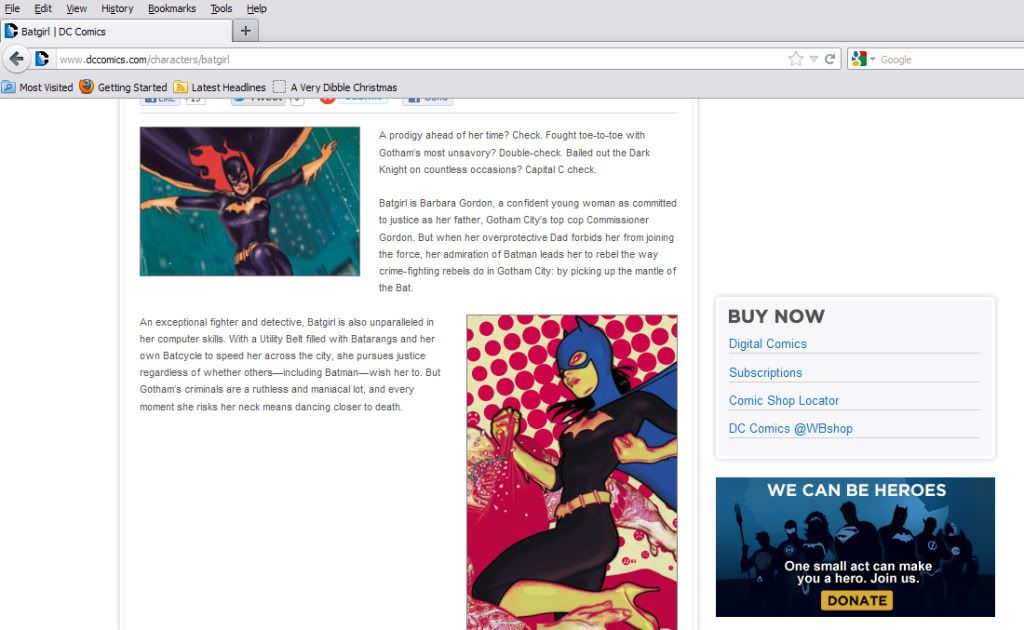
DC's new website is... well, I have no opinion about website designs and the like.  What care primitive I for such things?  But late last night, around 1 AM when I should have been sleeping, I did a quick search for Cassandra Cain news-- yes, in exactly the same way I sometimes do name searches for exes and old crushes and then cry myself to sleep-- and found an amusing tidbit (we Cass fans take what we can get) on the blog Every Day Is Like Wednesday.  Someone involved with the DC website design has used an image of Cassandra Cain to illustrate their page about Barbara Gordon.

Cass fans!  Get your fix!  Fast!  Before DC fixes this!

Specifically, it's the gorgeous cover to Batgirl #45.  Remember that one?  Cass becomes curious about Barbara's career, dresses up in her predecessor's old Batgirl suit and discovers to no one's surprise high heeled boots are impractical for crime-fighting.  She's also now subject to the male gaze and queasily uncomfortable comments from Robin about how hot he suddenly finds her.  Barbara is pretty happy about it; essentially, the philosophy she espouses once again to Cass is it's important to dress and act in ways boys find cute and if you achieve that, effectively battling crime is a plus.  In the end, Cass rejects being that kind of hero and goes back to basic black and even Barbara laments not having worn more sensible footwear.

James Jean's covers during that era are spectacular.  Vivid colors, bold imagery and symbolism.  This one is no exception.  While I have no complaints about Rick Leonardi and Jesse Delperdang's interior work (clean storytelling, well-rendered figures and polished linework always appeal), I really wish DC had tapped Jeans for at least one fill-in issue-- especially the any of the ones immediately preceding Leonardi's run, which are atrocious.

Anyway, enjoy the second life of Cassandra Cain on DC's website.  Before they correct it and she goes back to superperson purgatory!  Or not!  Hee hee!  Being a Cass fan is so much fun when you're sleep deprived and stressed out about changing jobs and moving to a new city while living abroad!

Wednesday, November 2, 2011

More of the same Batgirl!


Another version of the same ol' Batgirl. My theory is she had so little regard for protecting her secret identity, she would often leave her mask at home. I enjoy drawing Batman acting like a freak almost as much as I enjoy drawing Batgirl and Supergirl. Poor Robin. If you look closely, there's a Todd McFarlane-era Spider-Man picking lice out of a Neal Adams Superman's hair. Todd McFarlane-era Spider-Man loves to groom his friends!

Sunday, August 7, 2011

Is this the first Cassandra Cain as Black Bat cosplay ever?

Well, is it? I'm a fan of well-done cosplay. For that matter, I'm also a fan of crappily-done cosplay. But I'd rather praise the cosplayers who get it right and creatively embody the characters they portray than make fun of those who choose poorly. Let's praise, shall we?

These two look fantastic and obviously I couldn't be more thrilled with this person's decision to go as Black Bat. She looks better than most of the comic book depictions I've seen so far. The Robin's snazzy, too. The photo description lists Damian Wayne among its tags, so I'm going to guess this young woman is portraying that particular version-- but I prefer her in the role to the hateful little comic book character.

My suggestion to DC? Kill off the comic kid right at the start of your relaunch, loosely base the new Robin on this cosplayer, and then do a team-up book featuring her as a neophyte hero being mentored by Cass. Obviously, I'd buy it.

Thursday, May 26, 2011

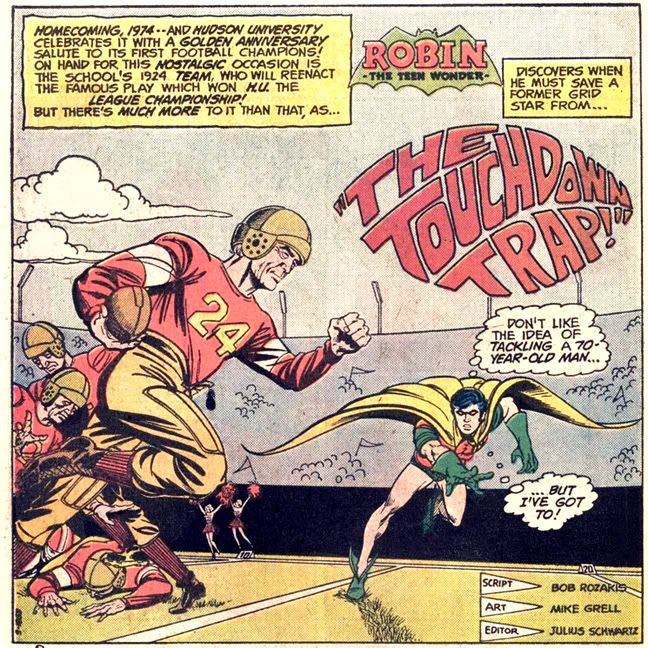
"The Touchdown Trap" from Detective Comics #445: Remember that time Robin tackled an old man and made him cough up the football?

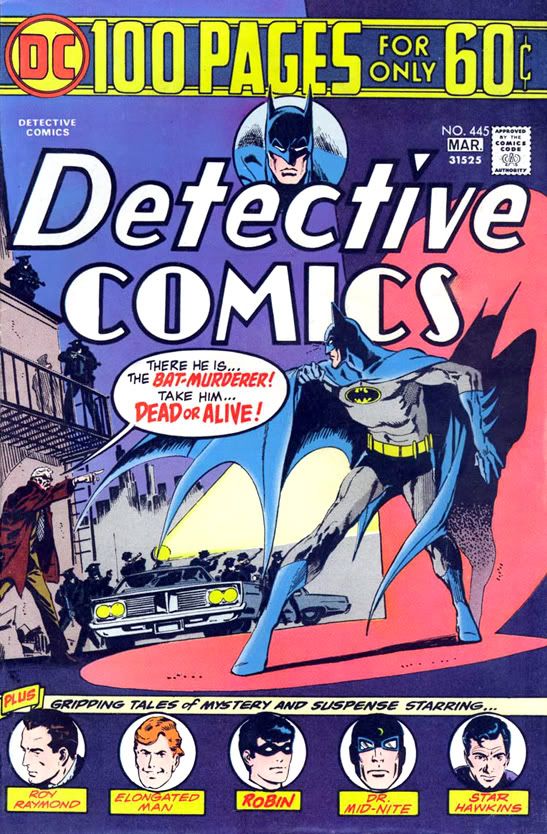
You may be too young to remember the days before genetically engineered super-comics grew on cybertrees in all the colors of the rainbow, but when I was your age they were made of paper. In 1975, DC's Detective Comics consisted of 100 pages for 60 cents (I know! Imagine paying more than a quarter for anything less than 600 holographic pages!), and starred such iconic characters as Roy Raymond (subject of 1995's Oscar winner for Best Picture), Marty Moran (Headline Hunter) and Star Hawkins (in 1986, an act of Congress replaced Labor Day with a new holiday in Star's honor), plus those almost forgotten failures Batman and Robin, whose brief literary careers went nowhere-- aside from being occasionally unearthed and derided by nostalgia bloggers looking for obscure pop culture artifacts upon which to exercise their snide humor.

Yet at one point, this so-called Batman was a popular enough character to command the cover spot for a few issues of Detective Comics. Then again, people living in those days also loved Irwin Allen's disaster movies and belted jumpsuits. There's no accounting for taste, or so they tell me. What do I know? I'm just a clone. From the future!

1974's Robin is quite a bit different from today's version, the wretched little asshole Damian Wayne. This Robin is the original one, Dick Grayson, better known now as... well, Robin, because I doubt most people outside of comics have ever heard of Nightwing, or of Grayson's stint as Batman. I also seriously doubt they even know the name Dick Grayson. It just doesn't stick in the mind like Bruce Wayne, Clark Kent, Roy Raymond, or Marty Moran (Headline Hunter).

Here we have young Robin as a college student at Hudson University, which sounds as though it should be located in upstate New York. And perhaps it is, because Robin and his university pals frequently pop over to Rutland, Vermont, for the annual Halloween parade. Almost once a year, in fact.

I'm not sure what kind of school Hudson University is. Ivy League? Big 10? One of the Seven Sisters? All "The Touchdown Trap" tells us is it's the 50th anniversary of the school's first football championship. Ah yes, Hudson University. It's coming back to me now, the legendary Hudson University football dynasty, when the school won 5 consecutive national championships.

But that was decades after the storied 1924 season, during which their offensive attack was spearheaded by Heisman Trophy winner, "Hurricane" Hurley. As our story begins, the school has invited back the offensive squad of that storied team to recreate the play that won them the league championship (the entire defensive team having died in the interim).

The Hudson University Beavers play their home games before an appreciative crowd
of lumpy mashed potatoes turning gray with age.


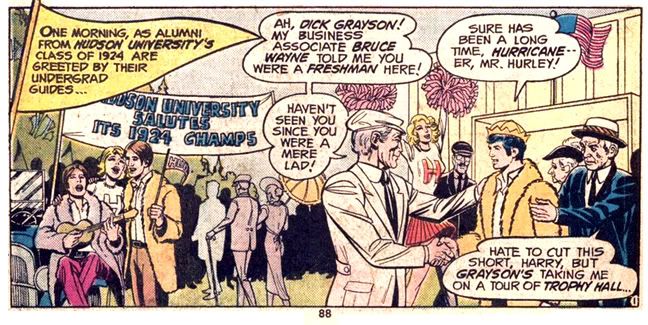
No student is more excited to see these aged gridiron warriors than our boy Dick. Hurley is an old family friend, and Dick is so thrilled to see him again, he's beaten up Jughead Jones of Riverdale and stolen his crown-like hat, then killed and skinned a goat and donned its still bloody pelt, steaming in the crisp autumn air. Hudson University, where goats are plentiful on campus and students gather around ukele-playing audioanimatronic figures to sing hymns to the coming socialist utopia.

When 23-skidoo met far freakin' out.

This is some nice dialogue. There's not the least bit of awkwardness in the way scripter Bob Rozakis has Hurricane Hurley reference his relationship to Bruce Wayne while addressing Dick by his full name and scholastic status. It's so natural and unforced, in fact, a lone cheerleader celebrates its soulful smoothness by soundlessly leaping into the air and shaking her pink pompoms. As good as his word, Dick takes straw-hat wearing Mr. Benson on a tour of the school's trophy hall. Benson's so impatient to see the trophys, he doesn't even want to drop of his bag. Or change his adult undergarments, which must be soaked after the long drive up from Gotham City. The man loves sports mementos and dampness in his personal area is not about to stop him from having fun. And it's a good thing, because as soon as Dick and Benson reach the hall, they find some fun-loving students engaged in a Hudson University tradition.

This guy entered the fight wielding a sliver of balsa wood, or a canvas stretcher stolen from some poor art student's locker.

Which is wearing white gimp masks and matching disco costumes to smash the award-laden glass displays. Careful! Those shards of glass might cut and the all the sports-related puns will stick to your shoes and make them smell something awful! Dick changes to Robin and beats up the disco kids, just as the campus cops show up. They're as timely and effective as most campus cops.

For a second I thought I was dead. But, when I heard all the noise, I knew they were cops. Only cops talk that way. If they'd been wiseguys, I wouldn't have heard a thing. I would've been dead.

"Okay, Robin... ...What the fudge is goin' on here?!" Only he didn't say "fudge." He said the "f-dash-dash-dash" word. Seems one of the "jocks" received a letter full of money with orders to smash up the trophy hall. Never one to question letters full of money, he and his friends immediately went out and spent their entire windfall on masks and matching leather jackets, then proceeded to wreak havoc. Now they're broke and in jail, but at least everyone knows they're together! A matching set. And that's what really counts. Togetherness. And Benson himself carves the roast-- actually, what Benson does is recover the game-winning football.

While Robin's trying to figure all this out, we cut to the stadium's locker room where the head coach from the 1924 squad is showing his team game film from their championship effort. Let's think about this for a moment.

The old guys behind "Coach" are all smiling because, in his senility, he forgot to wear pants. Sports teams are notorious for their cruel, mocking humor.

The former players are all in their late 60s or early 70s. Their coach was probably in his 30s or 40s when they won the championship. Which means this guy is pushing 80 or perhaps even as much as 100 years old! Look at him! Time has left him a withered, toothless wreck of a man, and deposited a gigantic carbuncle on his chin. Yet he proudly wears a dirty old crewneck t-shirt upon the collar of which he's crudely lettered the word "COACH" in red marker. A younger man would have bought a nice sweatshirt with stitched lettering, or at least used iron-ons. But not this walking mummy. Look how high those letters are. This might be because artist Mike Grell didn't trust the readers to fill in the parts of the letters the bottom of the panel cut off, but that's not it. What happened is exactly as I've described it. It's in Rozakis's original script. Writers include little details like that in their scripts even though we'll probably never read them because it helps the artists figure out the characters they're drawing.

We get to see how the winning play went down. Hurley, the quarterback, took the snap from center, then turned to hand off to fullback Benson. With the pocket collapsing around him, he decided to keep the ball. The cameraman somehow managed to get a sweet close-up of that moment, so clear you can see the shock and disappointment on Benson's face when Hurley snatched the ball away from him. Then it's 90 yards down the field and he... could... go... Okay, yeah, we already know Hurley scored the winning touchdown.

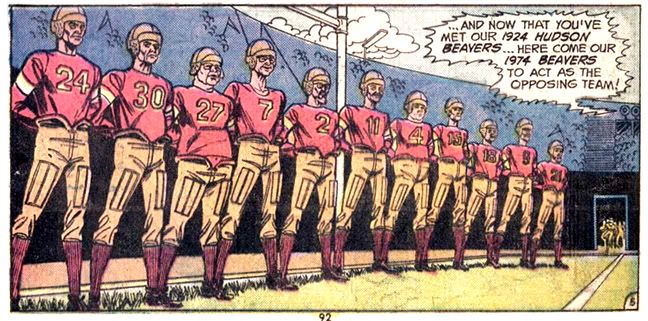
A few minutes after the old coach passes away, the players take the field, wearing their original 1924 uniforms complete with leather helmets. Luckily, they've stayed in shape all those years and everything fits perfectly.

Behind the men: a wall made of natural stone. Granite, I believe. With little flags poked into it to mark specimens of particular interest to rock hounds.

The plan is to use the original game ball for the recreation, but someone has destroyed Hudson University's most precious sports artifact. Robin learns of this from none other than a time lost Burt Reynolds as he appeared in his starring role as police officer Nick McKenna in the 1993 cinematic masterwork Cop and a Half.

Robin never had a strong grasp of meteorological phenomenon. That's why he failed so many science classes.

At which point Robin deduces the reason for all the disco-style vandalism-- a distraction while someone switched footballs. And being a superb detective trained from childhood by the master himself, Batman, Robin also knows there was only one person in position to handle the old switch-a-roo. Hurley's in danger and there's not a moment to lose! After a trip to the concession stand for a large, icy Pepsi and one of those delicious Hudson University stadium chili dogs, then an interminable wait in the line an open urinal (millions in alumni donations for luxury skyboxes and a Jumbotron scoreboard, zero for restroom facilities), Robin leaps over the retaining wall and hurls himself down the field.

He takes Hurley down with a fine open-field tackle, snapping the man's brittle tibias and fibulae as though they were merely dried twigs, old wood, dead these many winters. The substitute ball contains a time bomb, as evidenced by the muffled ticking coming from within.

"I don't care what kind of hero this moldy old chump used to be, ain't nobody crosses the goal line on Robin's field!"

I'm left wondering why someone would use a timebomb in this situation. Wouldn't some kind of remote triggering device work much better? If you're a ball-handling offensive player on a football team-- a quarterback or fullback, for example-- chances are you're going to be near the football at some point during a play. Especially if your participation is a major component of said play. Granted this is merely a recreation, but the timing on these things isn't always precise. There are delays. These are old men; they don't move as quickly as they used to. Using a timed explosive is taking a major risk. But I don't know. I have a superstition about standing too close to explosions, so I may not be the most objective person to judge.

Unfortunate timing led to the demise of all the doves released during the pre-game ceremony.

Forget all that! Not only is he a textbook tackler, but marvel at the height Robin gets with that punt! Lord have mercy! Imagine the hang time he'd have had if the ball hadn't contained a timebomb! Why isn't the current Hudson University coach trying to recruit this guy? "You can even wear the mask, kid, but we need you on special teams!"

I've been poking fun at "The Touchdown Trap," but it's really an effective eight-page story, with a concise, direct plot. Rozakis probably came up with it over lunch, ran it by editor Julius Schwartz and tapped it out on an IBM Selectric II at the DC offices in less than an hour, one of many he'd write that afternoon. Grell doesn't seem to have labored over the art-- and he obviously skimped on the stadium crowd shots. Lumpy gravy? Week-old grits? But you know what? That's fine. Rozakis and Grell weren't trying to produce a masterpiece. They were just trying to tell an entertaining Robin mystery to fill a slot in the magazine. Stripped of flash, efficient, not a wasted moment, no loose ends, just enough character development to propel the narrative to its conclusion.

Written today, "The Touchdown Trap" would attempt some gross-out thrills with a few gruesome murders. Also, it would consist of a four-issue prologue mini-series, then twelve issues running across most of DC's monthlies for an entire summer, and finally, a couple of epilogue stand-alone issues and a new on-going series starring the daughter of the original Roy Raymond, also named for some reason Roy Raymond. The real culprit behind it all-- manipulating Benson and Hurley for his own nefarious ends-- would be an insane Star Hawkins with help from a brain-damaged, drug-addicted Marty Moran (Headline Hunter). And as a parting gift, Robin would also learn Hurley had molested Benson's daughter and consequently come away a Boy Wonder disillusioned with hero-worship. A few months later, and we'd all get to buy the hardcover annotated version with an introduction by some best-selling author of horror novels or techno-thrillers sold by the pound at airports, re-mastered art on super-slick glossy paper and self-congratulatory commentary from the creators. Two more years and there'd be the direct-to-DVD animated adaptation. Then the new Roy Raymond title would be cancelled, she'd show up from time to time badly mischaracterized in various Batman-related books and finally, be raped and murdered as a minor plot element in yet another multi-title crossover event.

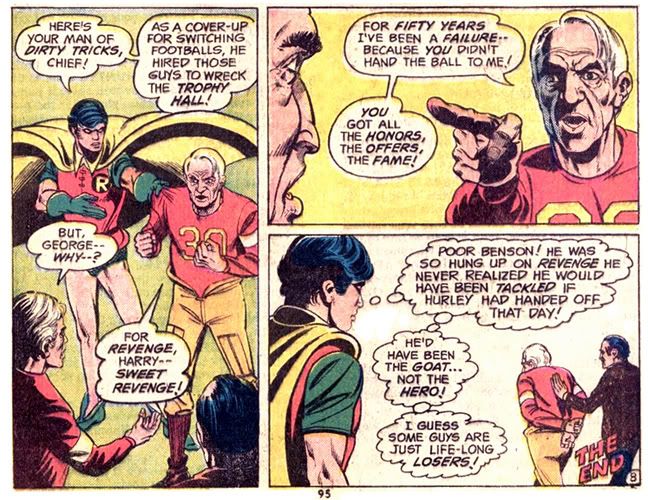
A relic of a simpler, brighter time, Rozakis's plot would've worked beautifully as a segment of Super Friends or an episode of The New Scooby Doo Movies guest-starring the Dynamic Duo, or the Caped Crusaders. Or Sonny and Cher. All that's missing is an unmasking. We have to settle for an unhelmeting. Actually, we don't even get that much. Poor Benson. Fifty years nursing a grudge and this is the best revenge he can come up with? Like Robin notes, "I guess some guys are just life-long losers!" Luckily for Benson, he won't have long to stay in prison. Because he's so old, he's bound to die there in a month or two! Freddie, Velma, Daphne, Shaggy, Scooby, Batman and Robin all laugh heartily and...

Roll credits.

Sunday, May 22, 2011

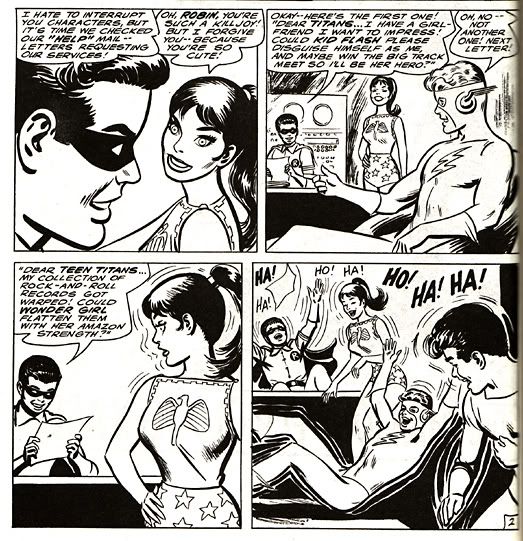
Don't bother asking the Teen Titans for help...


They're just going to laugh at you! Not pictured- the next scene where they read more requests for help and mean-spiritedly mock the writers, just totally picking them apart in the nasty way teens sometimes do. They reserve their cruelest remarks to the poor kids who foolishly enclosed photographs of themselves.

Even Wonder Girl! Oh man, you do not want to know what Wonder Girl said about you and that pimple you got right between your eyebrows like a big red pus-filled third eye! Oh sorry... that is what she said.

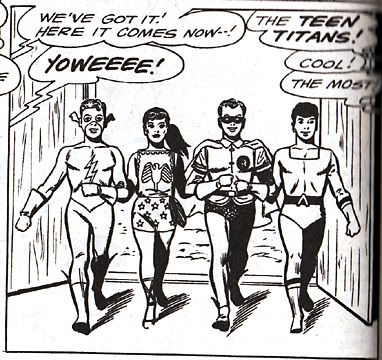
And even if they do deem your request a worthy one and show up at your teen clubhouse or malt shop or teen barn, you have to put up with this:


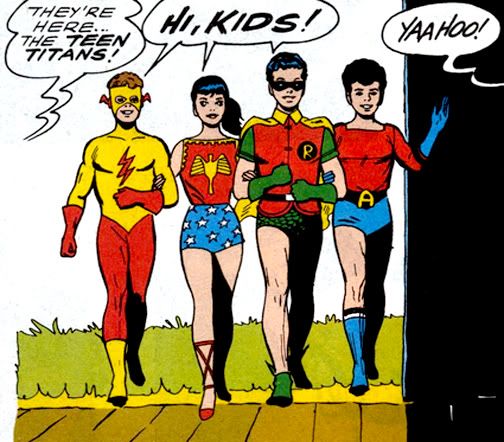
Yoweeee, indeed! Here come the Teen Titans, arm-in-arm. Possibly to laugh at you, maybe to solve your teen dilemmas.

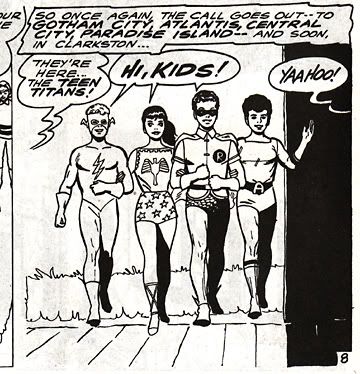
And again:


What the hell kind of teenagers walk around arm-in-arm like this? What kind of teens hang out in barns, for that matter? And look at Aqualad, waving sheepishly, wishing the boy-girl ratio of the team were more favorable to his public image.

Aqualad: C-can't we at least talk to Batgirl about joining?

Kid Flash, Wonder Girl, Robin: NO!

Aqualad: Then how about we knock out the ar-

Kid Flash, Wonder Girl, Robin: NO!

I feel I should also point out their growth spurt between the second-to-last panel and the last panel. That's why their adult mentors refuse to buy them expensive clothes and insist on shopping at discount department stores.

That's something the Mad Mod should exploit in a story. YOWEEEEE! What an idea! I'm inspired!