Showing posts with label planet of the apes. Show all posts

Wednesday, October 29, 2014

October is Spookey Month: Someone's rockin' list of the "10 Most Frightening Horror Comics Ever!"

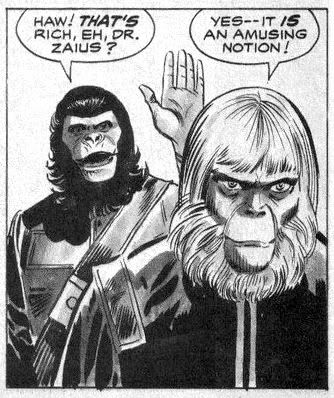
I know nothing of this Herald Scotland site, but I salute the good (or foul, depending on your perspective and whether or not you go through life talking like one of EC Comics' horror hosts) taste of Graphic Content writer Teddy Jamieson.  Not only does Jamieson quote Halloween III: Season of the Witch, but he manages to include Junji Ito's horror masterwork Uzumaki on the list.  At Paste Magazine you can read a similar 13 item list called "13 Terrifying Modern Horror Comics," which I saw posted by Fantagraphics on Facebook earlier this week.  That one is very Western comic-centric and the choices more conventional than Jamieson's, but they overlap, too.  I admire Jamieson for having the guts to lead off the list with a most personal choice.  He also puts Jack Chick tracts on his list.  I remember coming across those from time to time when I was a kid and he's right.  They're scary!  At least they were when the threat of hell or running into a hippie mocking my religious beliefs with a dismissive "HAW HAW!" were the worst things I could imagine.

Personal choice is appropriate because our most frightening comic is the one that affects us most regardless of its wider reputation.  I found myself exposed to a great many shitty horror comics when I was a kid and quite a few managed to genuinely frighten me even with crude art and strained writing. 

Sometimes even genre doesn't matter.

Jack Kirby scared the snot and the buggers out of me with his chilling final image in Kamandi #20 of our long-haired hero alone on a ruined pier.  I mean utterly alone, overlooking what I assumed at the time to be a monster-haunted Lake Michigan.  No one to help him, not the indifferent gulls circling overhead, certainly not the angry gorillas ravaging the robotic theme park Kamandi had just escaped.  No humans, just robots going through the motions of 1920s-era Chicago gangland clichés.  Poor lonely Kamandi.  The imagery was bleak, the closing copy promised more horrors to come.  Shudder!

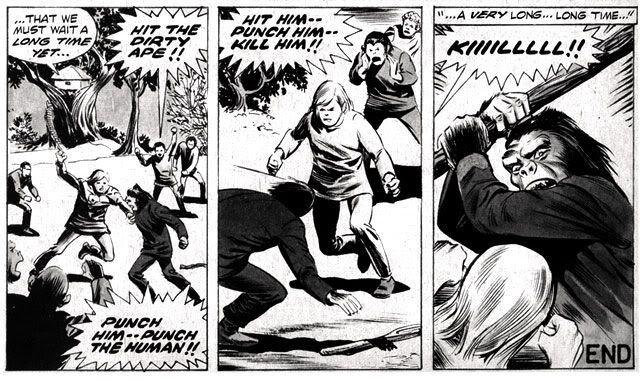
Another story that gave me the willies was "Evolution's Nightmare" in Marvel/Curtis Planet of the Apes #5.  It opens with humans and gorillas fighting El Cid-style in a desert wasteland, then ends with radioactivity-devolved apes and men duking it out with rocks and clubs in a bomb-ruined San Francisco.  They even kill the two main characters (who spent the intervening pages painfully learning tolerance) before grunting and screaming in mindless hate at each other from atop wrecked cars full of skeletons and across piles of shattered asphalt.  Doug Moench's depressing narrative captions inform us everything moves in circles and those circles stink.  Artist Ed Hannigan's (Jim Mooney inks, by the way) double-page spread of piles of dead warriors with their eyes lifelessly open only added to the lingering fear instilled in me by this creepy story.

Obviously, neither of those two are horror stories.  They're both rough-house science-fiction adventures.  You can find horror-like frights anywhere.  In a plot twist in an otherwise innocuous superhero book, gazing at you from a house ad in a humor comic, jumping out at you from behind a brick wall on a sunny street in Riverdale, USA.

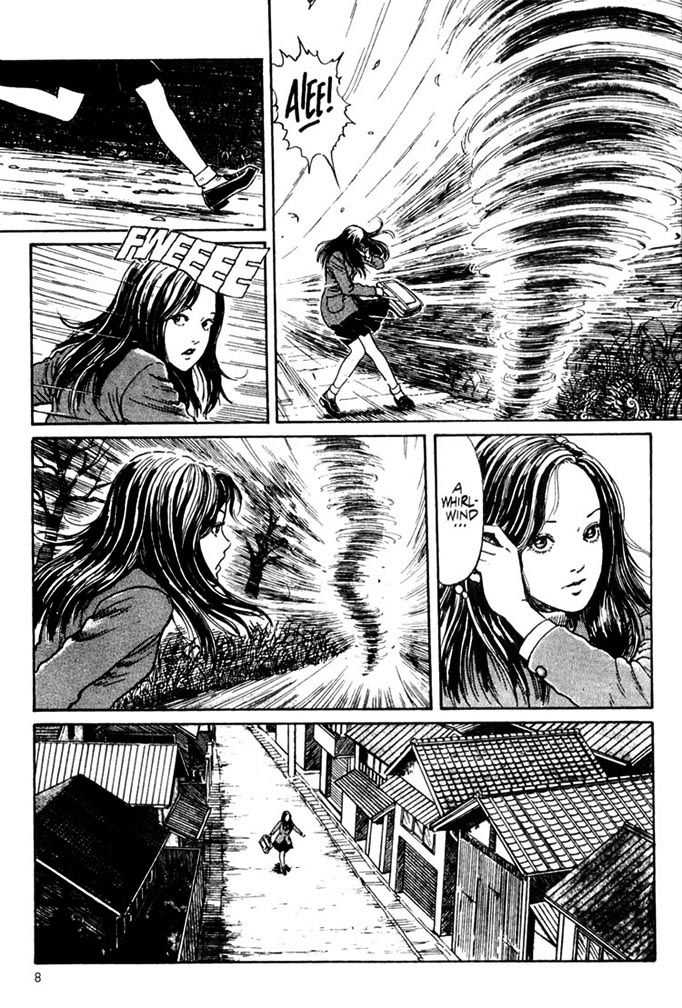
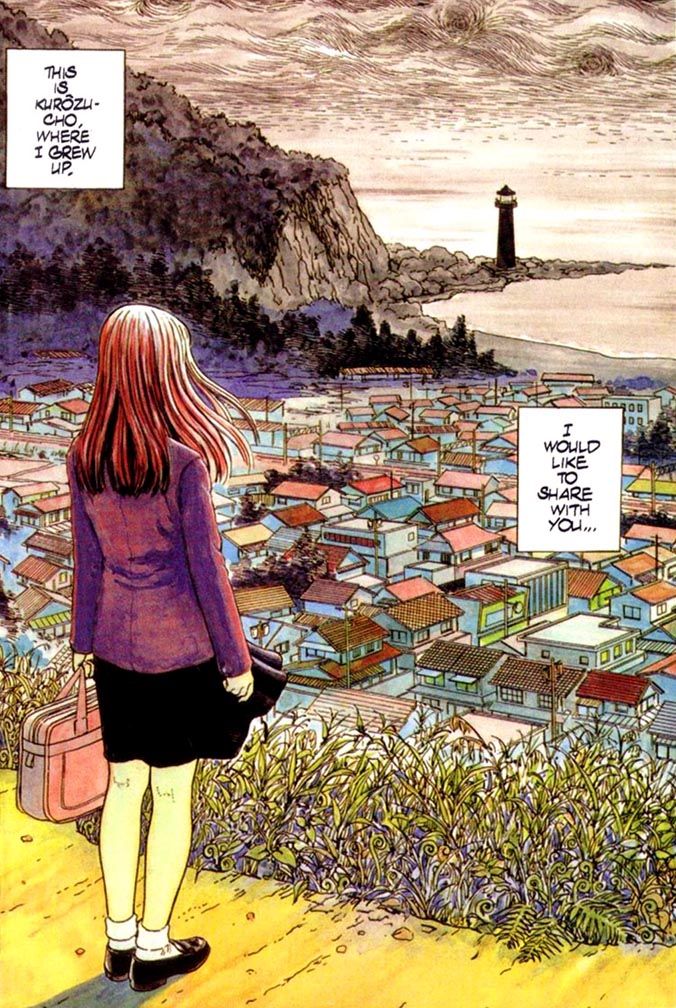
Or in an actual horror comic.  Like Uzumaki.  Serialized in Big Comic Spirits (it's a seinen manga, or dude's comic, so be careful opening that link) from 1998 to 1999, Ito's Uzumaki is the greatest horror story ever published in comic book form.  I'm comparing it to everything from Charles Burns' Black Hole, which made Fantagraphics' list (and is a moody, troubling work in its own right) to EC and every horror comic in between.  Out of all the fright fun I've had reading horror comics, only Uzumaki gave me feeling of truly dreading the next development in a story in my life.  Of doom.  Or of being genuinely grossed out by so many drawings in one place.  Uzumaki's dreamlike inevitability remains after you close the book having followed its main characters deep into the heart of ancient fears.

Uzumaki tickles your fright bone the way a cold wind from across the dry grass of graveyard might gooseflesh your arms.  Bruised clouds passing overhead like witches, their shadows falling around like concentrated night, on the move, looking for you.  Dead leaves hissing at you along the curb.  Hurrying you homeward where you face a dark, empty house where the rooms echo only with your voice.

Story and art by Junji Ito

And the soft footsteps of another.  Though nobody else is home.

Here's something that's not frightening.  It's a performance by Hamamatsu's own Spookey!

Wednesday, April 3, 2013

Don't Ask: Just Read It! April is Kamandi Month!


There are many things I love and two of the things I love most-- as close friends know-- are Jack Kirby and Planet of the Apes. Sometimes the things I love don't quite fit together, like Kirby layouts and Alex Toth pencils on X-Men #12.  But every so often they combine into a third thing I also end up loving.  So it was when Cornelius met the King.  Kind of.

I've always heard Kamandi resulted when Carmine Infantino asked Kirby to do something like Planet of the Apes.  And no wonder-- the films set off a huge merchandise boom that pre-figured the one for Star Wars-- action figures, playsets, garbage cans, board games, coloring books; everything an Apes-happy kid could want.  So it's easy to see why Infantino would want to put DC in the talking ape business (also, DC has a long history with apes).

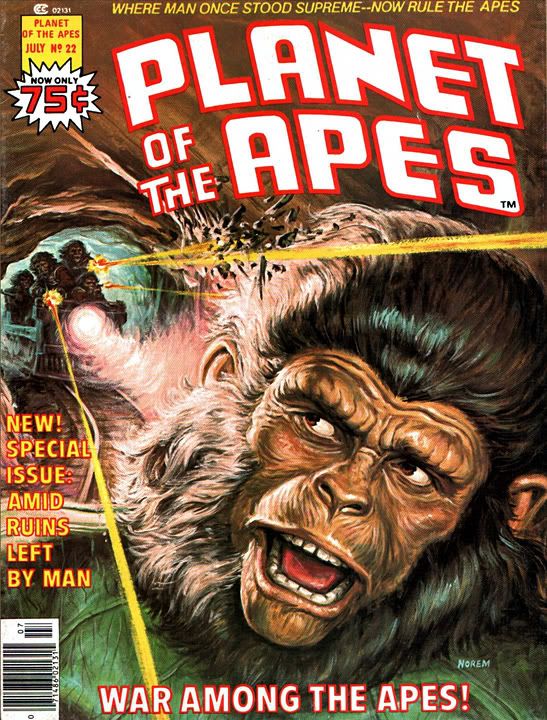
Eventually, Marvel landed the Apes license and produced eleven issues of a monthly series and twenty-nine of a black and white magazine.  Neither book drew more than a cultish following, but on another DC-style earth (Earth-K), Infantino worked a deal with 20th Century Fox and Kirby drew the first five or so issues of DC's Planet of the Apes (along the lines of the 2001 adaptation he later produced for Marvel here in our reality) before handing it off to Mark Evanier and a rotating cast of artists.

Go seek out that black hole that's spinning almost at the speed of light.  It'll take you right to this fabulous universe, where Kirby's Fourth World epic went exactly as he'd planned it and his Planet of the Apes ran for 150-odd issues and witnessed the art debuts of both Michael Golden and Frank Miller and an annual written by Alan Moore.  Bring some of those comics back with you, too.  I'd like to read them!

But here in our world, things didn't work out that way.  Denied by 20th Century Fox but stuck on his idea, Infantino cancelled Forever People, ripping a hole in the Fourth World, and then put Kirby to work on a derivative tale of talking apes and the end of the world.

How lucky for us Kirby could never contain himself to mere imitation.  Instead, he took some old concepts he had rattling around and worked them into a post-apocalyptic tale in his own style, with a rambunctious long-haired teen as its lead and more than just talking apes as villains.  In Kamandi's world, not just apes but animals of all kinds talk.  They have little kingdoms of their own and wage interspecies war against each other with Kamandi frequently caught between the furred factions.

Marvel's Apes tales, written by Doug Moench and initially drawn by Mike Ploog, went beyond the meagre budgetary considerations of the movie series and gave us all kinds of weird vistas.  Giant brains floating in tanks, apes acting like 19th century mountain men, an adventure inside Mount Rushmore, bionic apes.  And those crazy city-ships.  Kirby's vision was even more expansive, covering the entirety of North and parts of South America, germs from space, radioactive astronauts, Kamandi as a jockey on the back of a horse-sized grasshopper, the fevered paranoia of Richard Nixon and my favorite-- Chicagoland, a Prohibition-era museum city populated by robots enacting all the classic gangster stereotypes of the era.

While Moench's "Terror on the Planet of the Apes" opus features Jason, one of comics' true assholes, as its human lead, Kirby's book stars a young man billed as "The Last Boy on Earth."  His name comes from the bunker in which he lived with his grandfather, but his looks and personality are made up of purest Kirby.

Actually, Kamandi resembles any number of young dudes who used to terrify me back when I was a kid in the deep south.  I mean, obviously we had modern swimming pools way down there in Georgia, but these guys-- and their girlfriends-- also liked swimming in rivers, lakes and "blue holes," where underground aquifers bubbled up in the form of cold springs.  Or tubing down creeks.  And their swimwear of choice was usually cut-off blue jeans just like the ones Kamandi sports.  Like those guys, Kamandi's a roughneck who takes no guff from anyone.  Not from lion kings, panther princes, or angry ape sergeants.  With his quick temper and shirtless style, Kamandi would fit right in with these Lynyrd Skynyrd-loving southern boys.

He's prettier, though.  Look at his glorious hair, the kind even Farrah Fawcett-Majors would have envied in her Charlie's Angels heyday.

And a heck of a lot smarter.  Kamandi's got brains.  He doesn't just experience his world and fight against it; he searches for answers to all its mysteries.  The "Last Boy on Earth" (as the book's subtitle calls him), Kamandi journeys largely alone through Kirby's madcap future, always on the lookout for others like himself and the ultimate answer to how things got so mixed up in the first place.  Cortexin, huh?

For the next few weeks, we're going to spend some time with Kamandi and really get to know him, his friends and his world.  Come along with me, won't you?  Let's close our eyes, drift into comas for hundreds of years and awaken in the future, after the Great Disaster.  Humanity has abandoned its cities and fled into the forests.  The ascendency of animal-kind has arrived.

Now-- open your eyes.

What do you see?

Friday, February 15, 2013

Power Records does Beneath the Planet of the Apes


Enjoy the shouty goodness of this Power Records (PR 20, originally released in 1974) adaptation of the 1970 film classic Beneath the Planet of the Apes where the action "comes alive" as you read!!  The story adaptation art and design are credited to Arvid Knudsen and Associates, but that art has the unmistakable look of one of those amazing artists from the Philippines like Alfredo Alcala, Nestor Redondo or someone closely emulating their style.  In other words-- gorgeous!

Thursday, February 7, 2013

Space diplomacy, 1970s Marvel-style!

Look! It's Colonel George Taylor of ANSA, our first ambassador to the stars...
George Tuska, Mike Esposito, Adventures on the Planet of
the Apes #1 (October 1975)
That's going to do wonders for interstellar relations.

Sunday, November 20, 2011

How do people find this blog?

Overwrought and poorly written, I suppose.  But no, I mean what search terms do people type into Google, only to have this disaster of a blog pop up in their results?  Allow me to share them with you.

1.  alicia silverstone batgirl
2.  roddy mcdowall
3.  cassandra cain
4.  dani moonstar
5.  harlem globetrotters cartoon
6.  batgirl alicia silverstone
7.  batgirl boobs
8.  dave toschi
9.  heavyset girl body stocky big short nude sex pic movie
10.  claude akins

What can we learn from this?  Apparently, I write a lot about Batgirl, Dani Moonstar and Planet of the Apes.  That's true.  I think I mentioned Alicia Silverstone (256 hits) one time and one time only in one of my many Batgirl blog posts, and now her name is going to haunt me every time I check my traffic sources.  She's a popular woman.  I probably knock off some ill-informed rant about Cassandra Cain once or twice a month, and I know I've frequently criticized the way various artists have drawn her breasts.  Somehow I don't think that's what the "batgirl boobs" searchers (65 total, including 11 this month alone) have in mind when they go a-lookin' for that kind of stuff.

Actually, I get a lot of hits from people searching for things like "batgirl porn" (21 this month, but I'm surprised this isn't my search leader), "batgirl big boobs" (5 this month) or "bat girl boobies" (a semi-literate 2).

I honestly don't remember writing anything about the Harlem Globetrotters, but I probably did.  Maybe a shout out to one of their cartoons from the 1970s, of which I was a huge fan.  Roddy McDowall and Claude Akins starred together in Battle for the Planet of the ApesDave Toschi is a retired San Francisco police inspector whose unusual upside-down shoulder holster rig Steve McQueen copied in the movie Bullitt.  He later investigated the Zodiac murders and was portrayed by Mark Ruffalo in David Fincher's movie about the case-- which I highly recommend.  A modern classic and instantly one of my top 5 favorites of all time.


But number 9 on that list?  I'm guessing that's the result of a post I wrote about Xi'an Coy Manh when she briefly became morbidly obese.  Amazingly, 51 people typed in those exact same search terms.  Or else the same person typed them 51 times.

Some amusing oddball searches:

1.  comic female quarterback
2.  sexy phyllis diller
3.  hayley kiyoko
4.  styx kilroy was here
5.  billy zabka red jacket

I have no idea where that first one comes from.  Number two is a "whatever floats your boat" kind of thing.  I love Phyllis Diller, but I'm not sure I've ever found her sexy.  Hayley Kiyoko is a multi-talented up-and-comer who played Velma in a couple of Cartoon Network live-action Scooby Doo movies and recently starred in a Disney musical called Lemonade Mouth, which I understand was something of a smash hit.  Ten of her fans found my lousy blog clogging up their Hayley Kiyoko Google stalking this month because I made an off-handed reference to someone's drawing of Cassandra Cain resembling her facially.  My apologies, Kiyoko-ites.  Or, if you prefer, Kiyokians.  Billy Zabka-- better known as William Zabka, better known as Johnny Lawrence of Cobra Kai-- I salute you!

Yes, I'm a fan.

Thursday, September 15, 2011

What About the Future?: The Lost Issue of Marvel's Planet of the Apes Magazine

Does it ever bother you that the story "Terror on the Planet of the Apes," serialized in Marvel's Planet of the Apes magazine, ends on a cliffhanger? Sure, it's not quite of the same order as that maddening final episode of Twin Peaks, but it's unfinished business nevertheless. I probably spend a lot more time bemoaning the lack of a third season for David Lynch's weird show than I do an ending to Doug Moench's even weirder comic book saga, but I'd never turn down either.


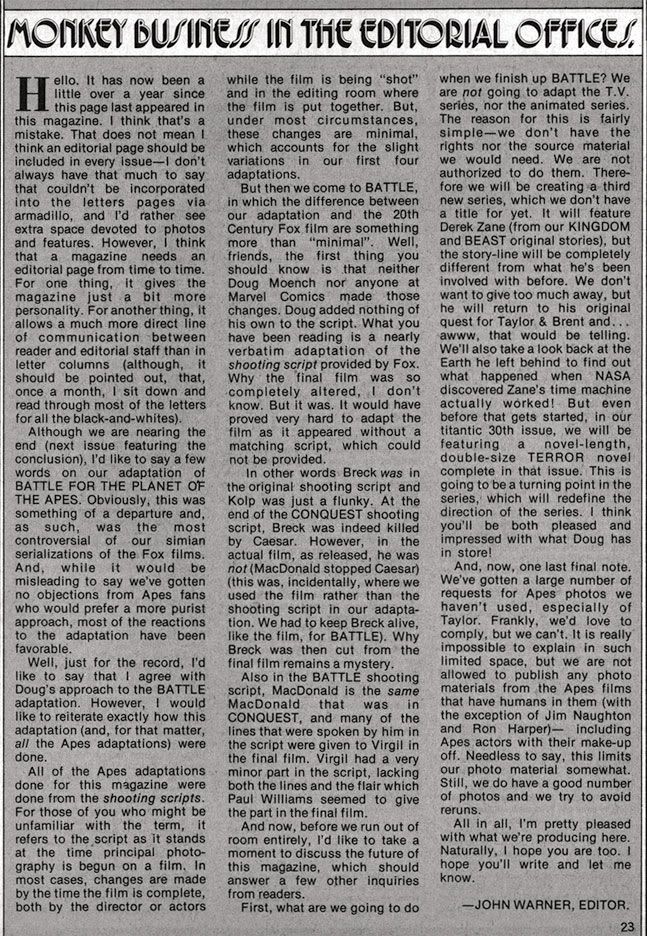
What's tantalizing about Apes is how in #27, editor John Warner promised a "novel-length, double sized TERROR novel," set to appear in the never-published thirtieth issue of the magazine. It would have sparked a "[redefined] the direction" of a narrative that already had too many of them.


Directions, that is. "Terror" is the picaresque story of Jason, the loin-cloth wearing, fiery-tempered human and Alexander, his long-suffering chimpanzee friend.  Yes, Jason and Alexander.  They're on the run from gorilla Brutus, the ironically-titled "peace officer," an ambitious gorilla who uses his respected office as a cover for recruiting other gorillas into his violent ape supremacist movement. Brutus stops at nothing, not even the murder of his own wife, which he pins on Jason. The human-ape buddies flee into the Forbidden Zone, but not without a lot of fist waving and angry emotional showboating on Jason's part.

Actually, let me just take a moment here and say for the record Jason is one of the most annoying and unlikable protagonists ever to grace a Marvel title. Really, I can't imagine why Alexander puts up with him. Jason is just that much a jerk. Self-pitying and largely unforgiving, too.

The two fugitives have all kinds of increasingly psychedelic adventures as they encounter cultures all too coincidentally similar to different historical epochs-- gnarly old frontier types in buckskins and with names like Gunpowder Julius (an ape) and Steely Dan (a human); the Assimians, who appear to have spent quite a bit of time studying James Fenimore Cooper's Leatherstocking Tales; apes of the far north in horned helmets who love wild feasts in their warm meadhalls and go raiding in longboats.  Along the way, Jason and Alexander make friends with a techno-hippie who calls himself Lightsmith, after the flashlight he wields and Maleguena, who becomes Jason's lover even though even she can't stand his arrogant posturing.  But her previous boyfriend was a jealous chimp, so I guess on the Planet of the Apes, this is considered trading up.

And don't forget the mush-faced drones led by giant floating brains, the googly-eyed aliens and their pet flying monkey-demons inside mountains and a vast ecosystem of mutated beasts-- like the former horses that now resemble maiasaura.  They add zest!

The story climaxes as Brutus attempts to invade Ape City with his rogue ape army supplemented by the Gorilloids-- bionic apes made by yet another group of human mutants, the Makers.  This leads to an epic battle sequence where practically every character in the story shows up to scream and run around shooting guns at each other. Jason reduces Brutus to a prisoner in chains, but finds it's a bitter victory because he will never know the joys of wearing pants. Meanwhile, some dumb kid ape has gotten himself turned into a nearly mindless cyborg by the Makers-- they plan to attack as well-- and comes strolling up in the battle's aftermath.

And that's all we ever get of "Terror."  From gorgeous but occasionally rushed-looking art by Mike Ploog, to serviceable work by Herb Trimpe, Moench's story is the comic book equivalent of ghost riding the whip.  And then falling off the hood, landing on one's head and entering a coma from which one never awakens.  The final issue of Planet of the Apes, #29, consists largely of an installment of the "Future History Chronicles," which features talking apes but otherwise has only the merest connection to the movies that spawned the magazine, and there is no #30.

So we never get to see the Makers attack, or find out what happens to cyber-ape-kid. My guess is this vaporous thirtieth issue would have wrapped all of this up and future storylines would have explained how Gunpowder Julius, the viking apes and the Assimians all came to adopt such specific, anachronistic lifestyles in just a few short years after the collapse of modern civilization.  Then more of "Future History Chronicles."  According to Warner, Marvel had no plans to adapt the two Apes TV properties, the live action show and the animated one.  But he did hint at a third series starring Derek Zane, hero of the magazine's lamest-- yet, oddly enough, more closely-tied to movie continuity-- stories about a guy who invents a time machine and then has a lot of Mark Twain-inspired adventures among apes who've patterned their society after Camelot, complete with jousting knights and a Robin Hood.

But after that?  Who knows?  Let's ask the Lawgiver if the day will ever come when we Apes-fans will get to read more thrilling tales of jerky Jason and agreeable Alexander:

I'm afraid, my children...

Monday, September 12, 2011

Ape-Quest '11: "Quest for the Planet of the Apes" Edition, Part 2!

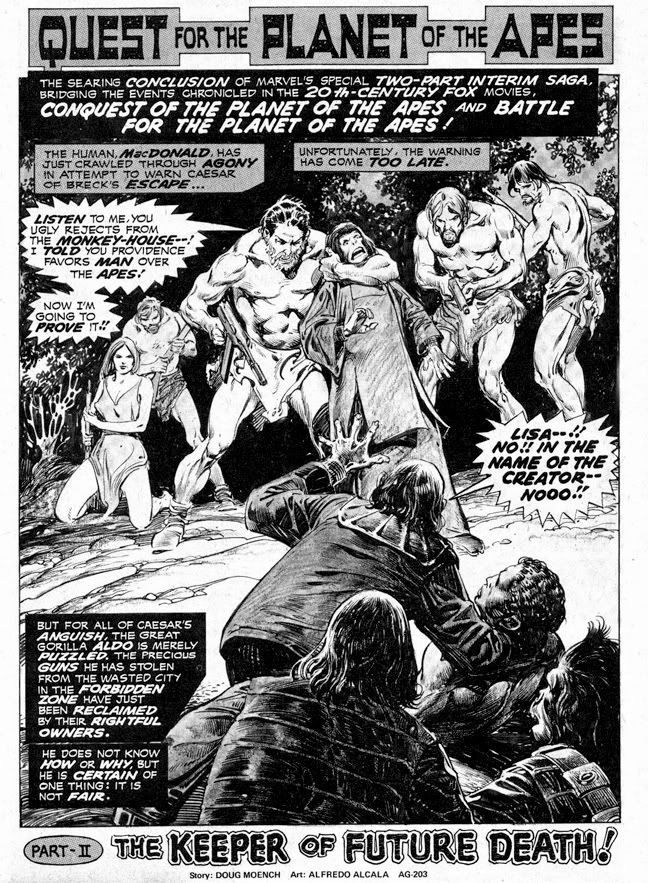
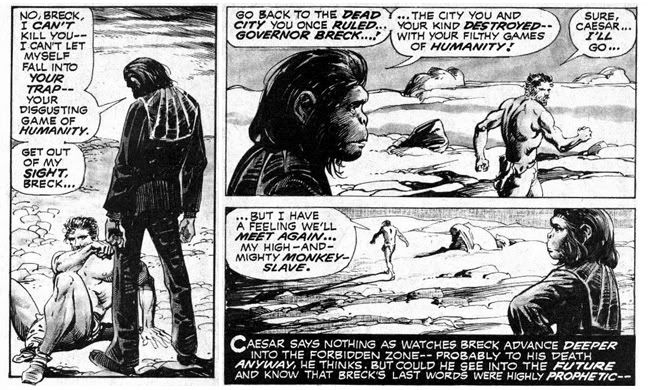
Remember a couple of years ago I wrote a piece making affectionate fun of the story "Quest for the Planet of the Apes" right here in this very blog? You don't? Okay, go read it here and then report back to me. It was meant to be the first part of a two-part look at an obscure bit of Planet of the Apes lore. And it still is, goshdarnit! Here's the second part! When we last left our jolly ape friends, they were about to fight an angry Governor Breck and his his band of nearly-naked humans.

 What's Breck so angry about? Well, he used to be ruler of a mighty state, but thanks to Caesar the super-smart boss of all the talking apes, he's now a bearded bum in a soiled loincloth. Just about anyone else in Breck's reduced position would look back on his life and think, "Maybe running a repressive regime that enslaved anthropomorphized apes wasn't the best career move," but the ex-governor isn't like most people-- refusing to recognize his own culpability for his fall from power, he places sole blame on Caesar and wants revenge!

Rico Rival has been replaced by my favorite Apes artist-- one of my favorite artists, period-- Alfredo Alcala.  Alcala's art here isn't as ornate as his work on the black & white Beneath the Planet of the Apes adaptation, a series highpoint.  It's a little simpler, the gray tones a bit flatter.  It's still quite lovely, with a slightly comical quality, especially in the apes' expressions.


Even after two years of constant study, I haven't figured out why the humans are in Tarzan rags. In the movie Battle for the Planet of the Apes, which this story immediately precedes, they just wore regular clothes. It would be thousands of years into the future before the humans started making like the extras in a Hammer Studios prehistoric romp-- my favorite is Prehistoric Women because it has the amazing Martine Beswick in it as the evil high priestess of a decadent tribe-- in Apes film continuity.  Another thing I don't understand is why the woman on the far left felt it necessary to kneel.  Other than to fit into the scene without Breck's jagged speech bubbles covering her face.

This page has an excellent feeling of depth, though.  The apes are almost silhouetted in the foreground, Breck and his gang occupy the well-lit middle ground, then there's a suggestion of foliage behind them.

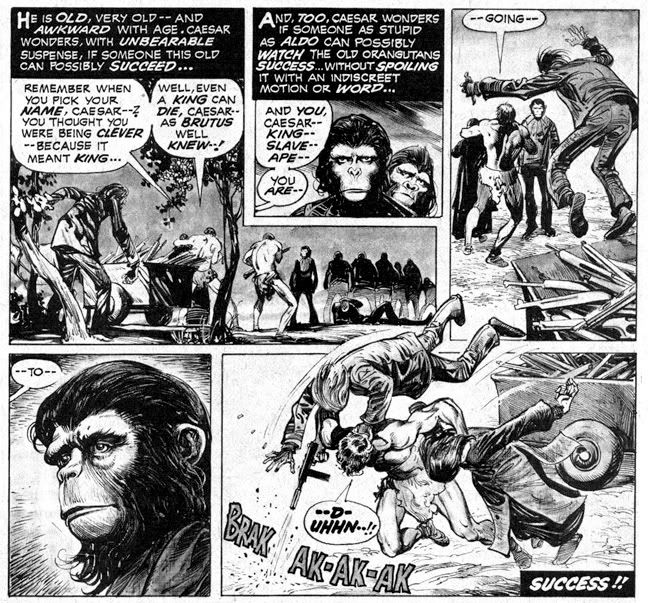
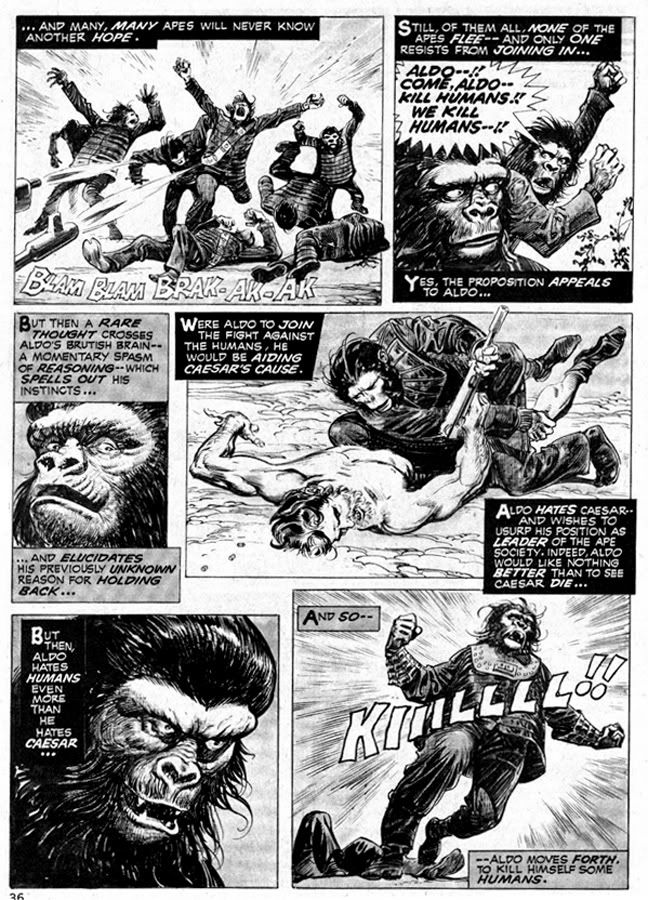
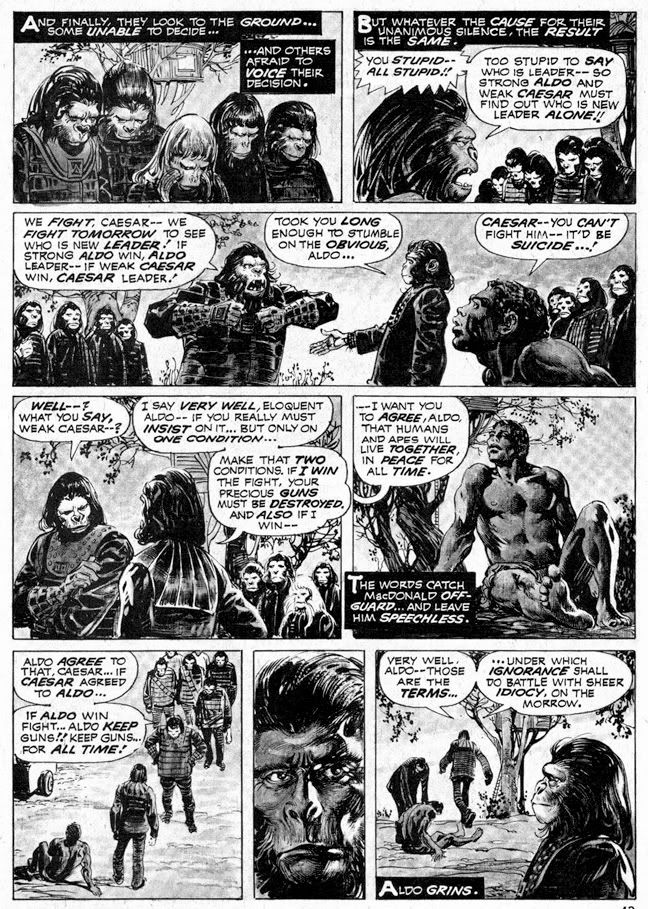
Instead of just shooting Caesar and being done with the whole ordeal, Breck has to voice all his grievances while Caesar and Aldo squirm uncomfortably.  It allows an old orangutan time to climb up on a wagon full of guns-- ever-generous Aldo brought them back from the ruined city in the Forbidden Zone to share with all his pals-- and jump on Breck.  This sequence occupies approximately 12 days of story-time.


Then comes the big fight!


Yeah, it's pretty much a re-write of Battle. My memories of that movie are confused with those of the David Gerrold prose adaptation. The novel is infinitely superior to the movie, which is common with film versions of literary works but rarely seems to work in the opposite direction.

But in this case, Gerrold worked from a shooting script that was written for a significantly higher-budget movie than the one that eventually reached the screen. If I'm remembering correctly, Aldo holds his gorilla cavalry out of the big third act fight after a disastrous headlong charge into the humans' automatic weapons, then has his horse-apes chase down and slaughter the fleeing and demoralized survivors after their defeat by the other apes led by Caesar.

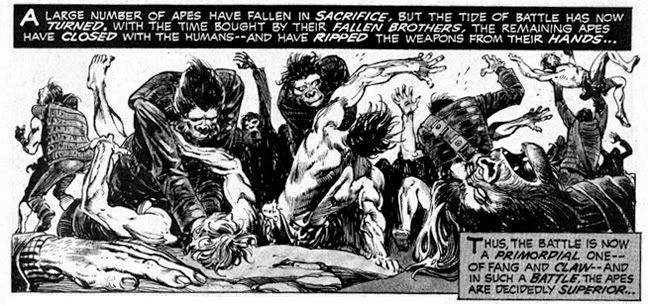
I believe that sequence never made it as far as the filming stage, which is too bad; the movie could have used a little more epic scope a "Charge of the Ape Brigade" would have lent it-- mutants to the left of them, mutants to the right, mutants in front of them, volley'd and thunder'd. You get the idea. Here, Aldo just can't decide. Let the hated Breck kill the hated Caesar or kill the hated humans? Eventually, he decides to do both. Which is good for us, because we get to see his gorilla soldiers do this:


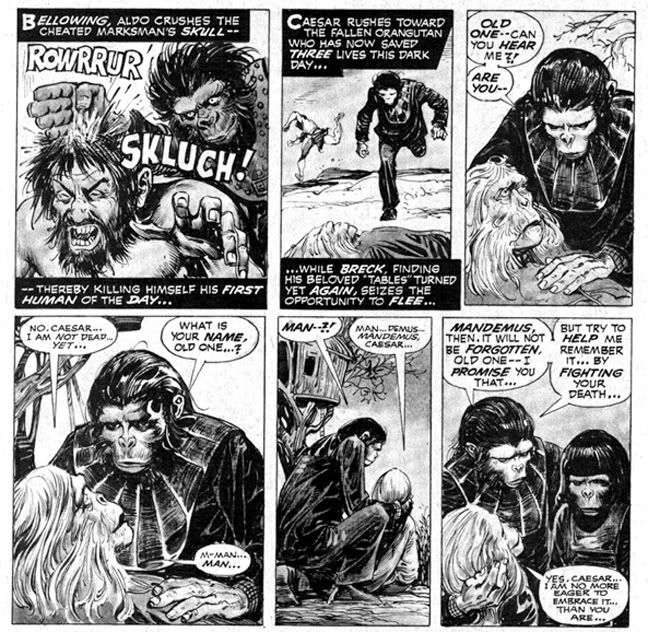
And then Aldo himself do this:


"Skluch!" Wow, these old Marvel magazines have the sickest sound effects, don't they? Take that, you filthy, gun-wielding counter-culture artifact! "Skluch" is the perfect "gorilla general karate chop to the skull" onomatopoeia, isn't it? Unless it's supposed to be, "Rowrrur!" and Aldo's actually sawing into the hippie's brain. But that hardly seems likely.

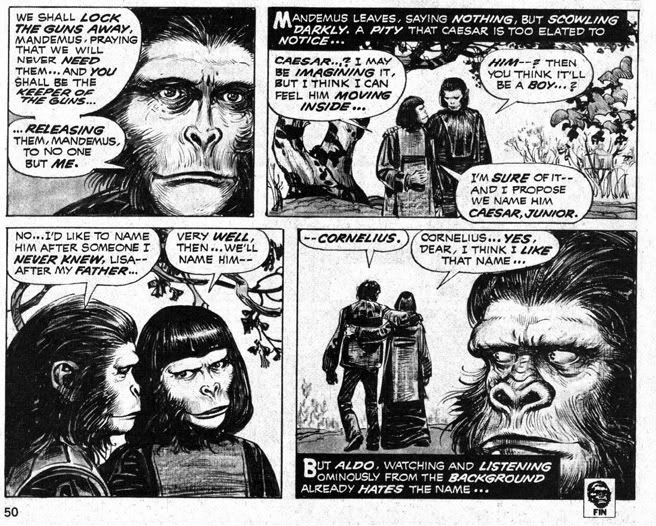
Oh yeah, that old orangutan turns out to be Mandemus, played by Lew Ayres in Battle.  Mandemus guards the Ape City arsenal in the movie, and his appearance here seems to contradict a bit of dialogue in the film.  Do you remember a scene where genius ape Virgil describes Mandemus as his former teacher?  I seem to, but I'm still not sure I trust my memories.  In this story, he's already an elderly kook.  Well, maybe he is a teacher and we just don't get to see his classroom.  But does it seem likely as familiar with Virgil as Caesar is later, he wouldn't know the primary teacher of the ape school in this story?

Am I confusing my sources again?


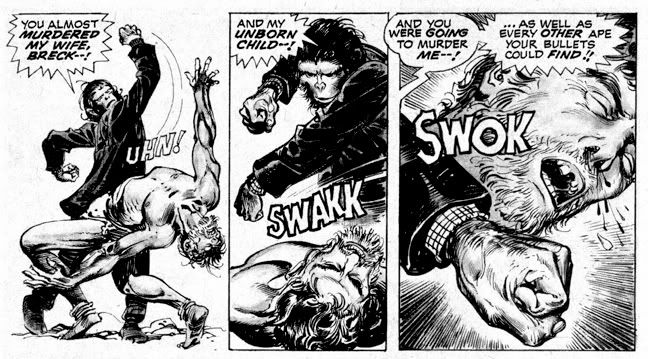
Not to be outdone by his more savage rival, Caesar engages the nearly-naked Breck in some mano-a-mano fisticuffs using the Marquess of Queensberry rules. Caesar is a civilized ape, but he throws a wicked right uppercut. BALD BULL! UPPERCUT! UPPERCUT! Sorry, that's the only punch I ever knew how to throw when I played that old video game.


Finally, his feelings deeply hurt (he's a sensitive man), Breck sniffles a little, then storms off, vowing never to invite Caesar to his birthday party. Which would be held in the bowels of a city devastated by nuclear war, the kind of thing that sort of cuts down on the festive atmosphere.  And then, pumped up on adrenaline, Caesar goes and does something kind of stupid.


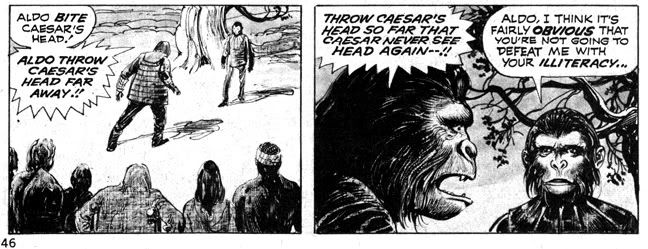
The next day, the two adversaries face off and toss arch bon mots at each other.  Caesar uses his wit like a rapier; Aldo uses his like a big wooden mallet.  He kind of reminds me of Animal Mother from Stanley Kubrick's Full Metal Jacket here:  "Well, I've got a joke for you.  I'm going to tear you a new asshole."  Animal Mother and Aldo, brothers in subtlety.  Might I suggest Adam Baldwin for this part in the remake?  I mean, not taking anything away from Claude Akins's fierce portrayal, but he's no longer alive.


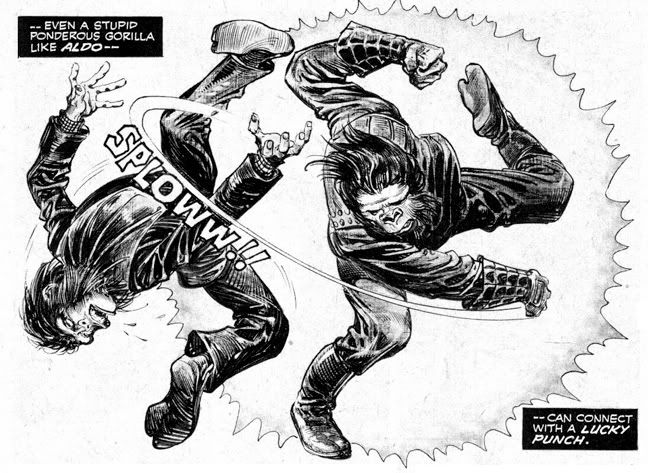
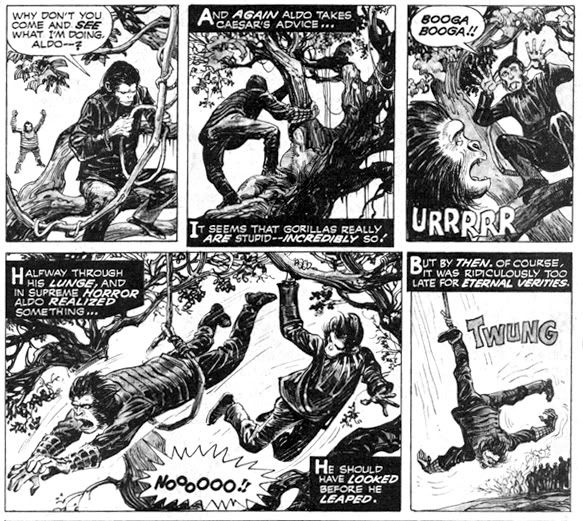
Now it's Caesar's turn to see how it feels! Check out the body language Alcala gives his battlin' apes here. Aldo just hit Caesar so hard, his unborn son Cornelius felt it!  He hit Caesar so hard, the shelf containing all the Mego Planet of the Apes action figures collapsed at K-Marts across the land!  There were plastic figures recalled all over the place at Christmas time that year because they came out with lop-sided faces and dark marks over their eyes.  He hit Caesar so hard, Roddy McDowall had to sit down for a few minutes while filming an episode of Rod Serling's Night Gallery.  Which makes the punch all the more impressive, because McDowall guest-starred on that show about seven years before Marvel published "Quest!"


It's pretty much the final sequence of Battle, with Aldo taking to a tree. Only in this one, the outcome is a bit different.


Ah, slapstick!  Cue the circus music.  Perhaps "Sabre Dance" as Aldo struggles and spins beneath the swaying limbs of the big oak tree.  All's well that ends well, right? No, this is Planet of the Apes. Not only do things never end well, thanks to the circular nature of the series' narrative, they never end at all.


Oh, that irrepressible scamp Aldo! You know there's going to be all kinds of delicious trouble ahead!

While it may lack in originality as far as plot points go, "Quest for the Planet of the Apes" more than makes it up to us in sheer fun.  I wish Marvel had done a few more stories within the movie series continuity-- not that I don't dig all the weird-o stuff they did do-- but more than anything, I really wish someone would get on the ball and reprint all of Doug Moench's insanely brilliant Apes work.  Dark Horse... Dark Horse...  come in, Dark Horse!

Tuesday, May 24, 2011

For Kamandi -- With Love and Squalor

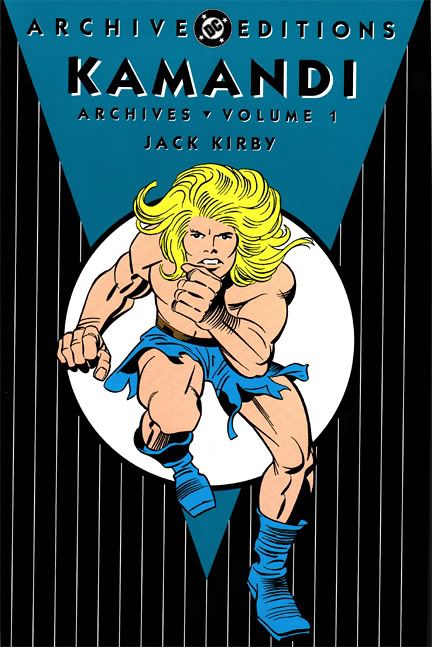
What do you get when you’re DC publisher Carmine Infantino and you float the idea that Jack Kirby should rip off Planet of the Apes? Not a Planet of the Apes rip-off, that’s for sure. If Infantino expected Kirby to content himself with mere talking simians, he was sorely mistaken. And yet that’s pretty much how it happened, and how approximately 65 million years later, we lucky fools ended up with this slick and weighty DC Archives edition of Kamandi.

Or, as I like to call it, Kamandi: The Last Boy on Earth, because that’s the series’ title and I’m clever that way.

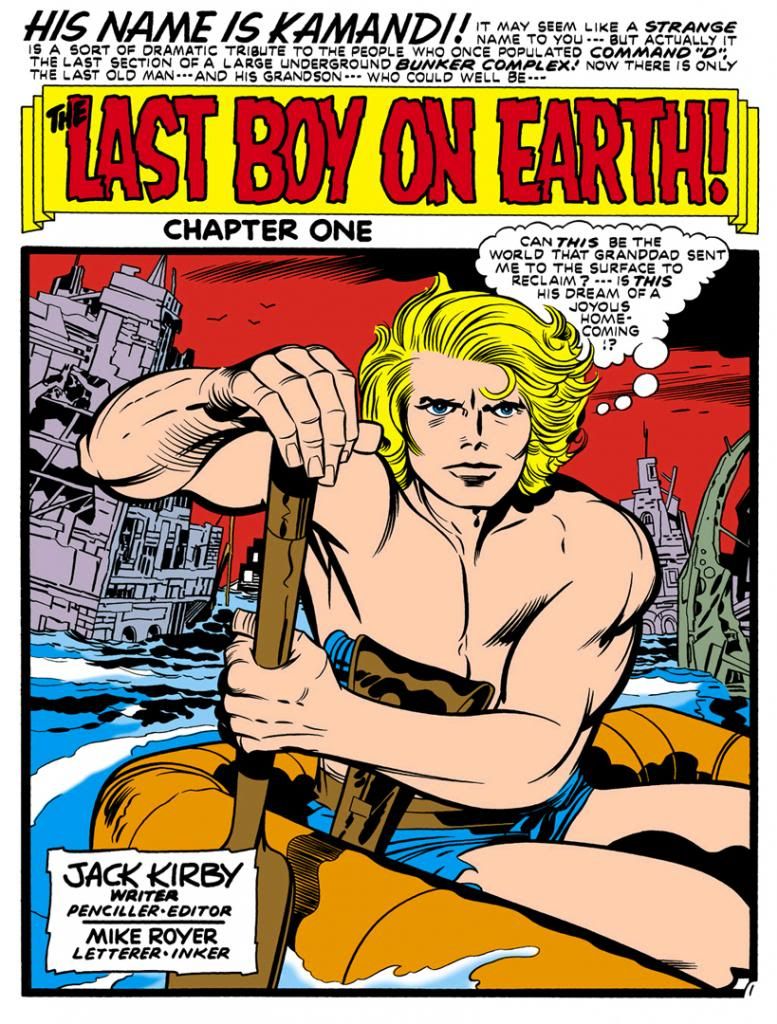
Chapter One: The Last Boy on Earth!

Kamandi is a futuristic, roughneck young hippie in a time where barbers have gone extinct, but cut-off denim and motorcycle boots are all the fashion rage. He’s the Charlton Heston surrogate for this madhouse world where not only do gorillas talk and ride horses, but lions and tigers tool around on three-wheelers and radioactive scientists float overhead in helium balloons.

Because it’s Kirby, Kamandi can scarcely contain itself. While he was always possessed of a febrile creativity, as soon as Kirby hit DC, his imagination went into some sort of turbocharged overdrive. His Fourth World stories are over stuffed with incident and new characters, and Kamandi features a similar breathlessly paced narrative. Reading a DC-era Kirby comic like reading ten stories in one.

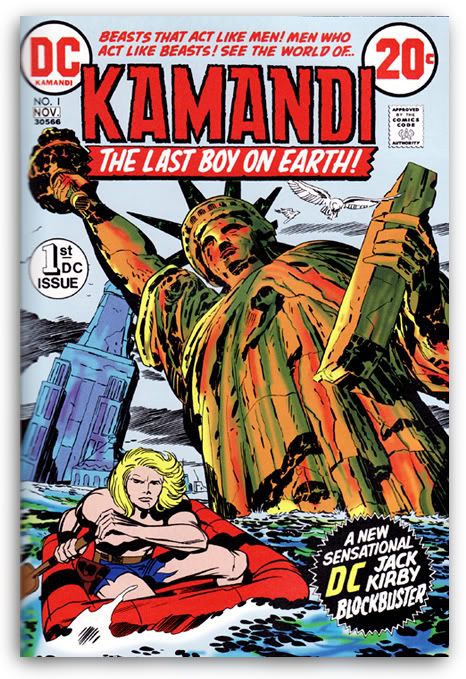
Kirby himself was busy then, too. I believe he was simultaneously producing Jimmy Olsen, Orion, Mr. Miracle and Forever People, spackling his living room wall in preparation for repainting it and mediating the Paris Peace Talks between the United States and the Democratic Republic of Vietnam (DRVN). And just as he saved our world in reality, Kirby destroys it in the pages of Kamandi. It's the post-apocalypse with a new status quo of underground bunker-dwelling and scavenging for food. Kirby destroys that almost as soon as he introduces it, too. When we first meet Kamandi, he's rafting through a flooded New York with a Statue of Liberty as majestically ruined as the one in the Apes film series, its obvious antecedent. Kirby leads with a splash page followed by a double-page spread no less!

DC... next time you destroy
the Statue of Liberty in a story,
do it the Kirby way.

Six pages in and Kamandi’s guardian/mentor is dead (he barely gets any dialogue), Kamandi’s battling a talking wolf who foolishly beckons, “Here! Give me that gun! --- Come on ---! I won’t hurt’cha!” and then Jolly Jack decides he needs to do something to pick up the pace before reader ennui sets in.

The second sees Kamandi’s new-found radioactive buddy Ben reminding him “Don’t forget Ben Boxer, boy! I’m not like the other humans you’ve seen!” As if Kamandi or the readers could forget- Ben Boxer is a man who has to wear an astronaut suit in order not to kill everyone around him with deadly radiation. Oh, and he turns into steel then deals out ass-whuppin’s. Just like the X-Men's Colossus, only not Russian. And a couple of years earlier.

Then we get yet another double page spread, this time of anthropomorphic rats looting the wreckage of the George Washington Bridge.

Kirby's gorillas are cooler than
the ones from 20th Century Fox.
Just keep Timothy Burton away
from them.

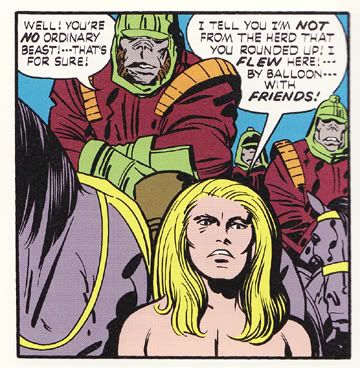
It’s not until #3 that the Planet of the Apes similarities fully emerge as roughneck gorillas (are there any other kind?) in green hunting caps and purple jumpsuits capture Kamandi. The cover blurbs come backing more hyperbolic bombast than a decade’s worth of today’s comics:

Welcome to a buried Las Vegas! Once a playground for men – now, a sinister hunting ground for gorillas!

So the apocalypse didn’t change much. And then this:

Complete in this issue! “The Thing That Grew on the Moon!”

A thing! And it grew… on the moon! As if the loincloth-sporting gorilla on the cover wasn’t enticement enough. Comics today could use more of this kind of cover copy-- at once hucksterish and tongue-in-cheek, and instantly appealing.

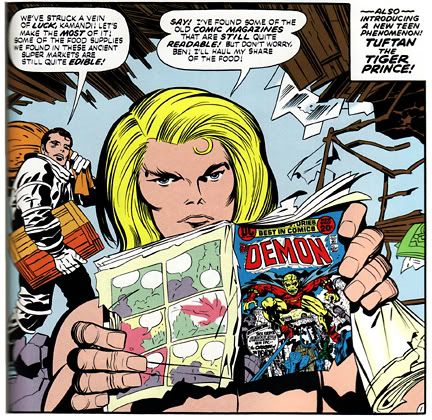
Who says this isn't the Age of
Kirby Self-Promotion? Kirby
works in a little plug for another
of his comics. "Quite readable,"
Kamandi? Quite readable indeed!

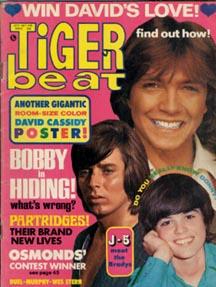
I think Kirby may have had bigger plans for Tuftan, the Tiger Prince. He comes on the scene in #4, heralded by a splash page text box labeling him a “new teen phenomenon.” I’m not sure if Kirby means Tuftan is a teenager (and more to the point, a tiger), or that he hopes Tuftan catches on with 70s teens the way David Cassidy and his half-brother Sean did, or Kristy McNichol, or skateboarding, or discotheques or feathered hair. After all, the kids loved Tiger Beat magazine; how could they not love Tiger Prince?

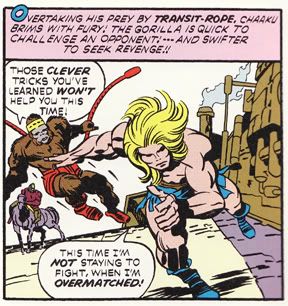
In the post-apocalyptic future,
half-naked neo-hippies will frolic
with headband and loincloth wearing
gorillas on transit ropes!

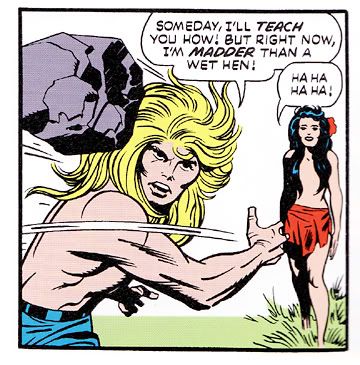
Kamandi and Tuftan get caught between the warring tiger and gorilla armies, and Kamandi gains a talking human girlfriend named Flower… who shamelessly goes around shirtless! Which is only fair, since Kamandi also flaunts bare-chestedness. Flower’s hair gives her some Lady Godiva-style modesty but Kirby’s notion of upper-body nudity is amazingly egalitarian.

In Kirby's future anyone may go
topless without shame! Viva la difference!

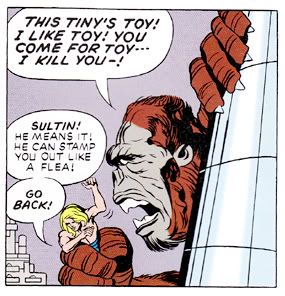
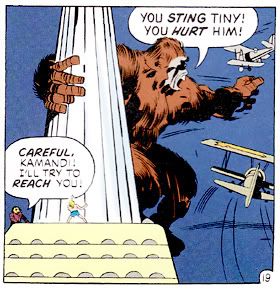
Almost as soon as Kirby establishes the romance between Kamandi and Flower and hints at the eventual reestablishment of some sort of humancentric society, tragedy strikes our young lovers. Kirby examines its aftermath in Kamandi #7, with a chapter intriguingly titled “The United States of Lions." Surprisingly, it has little if anything to do with unions, states and only tangentially features lions. Beginning with a funeral and ending with a skyscraper battle, it's actually Kirby’s parody of King Kong, substituting a massive gorilla; Kong’s equal in stature but superior in conversational skill.

And that’s just a quick overview of the first seven issues! I’m too exhausted to tell you all the details about the last three in this book, in which we visit “Tracking Site,” battle the savage flying bats and the freakish, sinister homunculus who dwells there, intent on unleashing a world-ending bacterium for some obscure reason Kirby can barely take time to explain to us in the breathless rush of his futuristic narrative.

Chapter Two: The Waiting Secret!!

If you haven't guessed by now, Kirby goes pretty far afield, given the series’ original mandate. And while Kirby wasn’t above rehashing classic movie plots he never failed to add twists the original wouldn’t dare. Imagine how insane Beneath the Planet of the Apes would’ve been if, instead of skinless mutants, the gorilla army had encountered talking lions on three-wheelers.

While suffering from an over-reliance on capture, escape and evasion plotting (it becomes repetitive), Kamandi is a sterling example of Kirby’s off-the-wall and unrestrained storytelling, honed over decades of professional work. While he may not have been as interested in the book as he was in his New Gods, the fact remains the man just could not half-ass things even if he tried.

Who else would engineer an entire future Earth, populate it with talking animals of nearly every species, continually hint at a central mystery that unravels intermittently throughout the adventures and introduce brand new characters practically on a page-by-page basis?

From reading these, I can’t help but see Kirby as a mostly intuitive storyteller. Certainly the man was a sponge, soaking in bits of science, legend and myth, and good old Hollywood movies; all of this he'd combine and alter to suit his story needs. Mike Evanier's recollections give me the impression Kirby would frequently come up with a particular direction for a story... then produce something almost totally counter to his original intent. Creating on the fly, always bubbling over with ideas. With that in mind, I don’t see an overall plan here, just incidents piled on incidents.

Groovy incidents. With the intent to entertain the bejeezus out of anyone who buys Kamandi.

And while Kirby may never have written the Great American Novel, it’s probably no accident Kamandi’s adventures take place in the western regions of the former United States. As soon as he departs his underground bunker near New York, Kamandi becomes the classic American pilgrim, sojourning in locales near Las Vegas, Yellowstone Park, even ranging as far as South America in a tip of the hat to Butch Cassidy and his partner in crime, the Sundance Kid.

From James Fenimore Cooper to Mark Twain and Brett Hart, to the relatively more recent Jack Kerouac and Thomas Berger plus many others, American novels frequently explore western migration as related to rugged individualism, which Kamandi certainly personifies. In fact, this is probably the most important defining traits of what we characterize as American literature, at least in the 19th century, and much of the 20th.

The west is the quintessential setting for American literature, with Kamandi the descendant of Huckleberry Finn by way of Col. George Taylor. And like Huck, and Berger’s Jack Crabb, Kamandi rebels against unjust societal expectations, cannot tolerate a life in either literal or figurative captivity. He must remain in motion, forever restless, the personification of our nation in its youth. Unable to relate to most surviving humans, Kamandi remains apart from each culture he encounters. Kirby reinforces this by repeatedly separating Kamandi from Ben Boxer's scientists and having Kamandi assert his human identity and equality to his animal overlords who insist on treating him condescendingly as either a pet, a mascot or an enemy.

As science fiction, technological themes abound in Kamandi, but these are traditionally conflated with western ones in more mainstream American literature as well. While Cooper might bog down the narrative of his 1823 novel The Pioneers to describe a stove in almost Luciferian terms, Kirby, the once and future king of his four-color milieu, creates bizarre flying vehicles and war machines with a gestural whim, yet never slackens the story's pace.

The series has a strange dichotomy-- for humans, advanced technology is of the past, and there’s a nostalgia for what humanity has lost, but along with it, an implied criticism of the queasy, mindless consumerism and complacency that led to this outcome in Kirby’s use of imagery featuring the detritus of a lost civilization: familiar shopping mall signage and weathered sculptures of American presidents (even significantly including one of Richard M. Nixon, never a Kirby favorite) whose identities have been lost to history.

Still, in order to reclaim mastery over the world, which Kamandi sees as a human birthright, he must solve these archaeological mysteries. To this end, Ben Boxer and his scientific comrades are forever seeking the lost “Apollo Project” in an effort to understand this disordered reality.

And while technology is used to destroy (being a Kirby action-fest, violence and weapons-based imagery predominate), there’s also a hopeful quality. If one can defeat the barbarian bat-creatures and the horrific human-created bacterium that can kill all life… one might at the very least, as in "The United States of Lions," find a peaceful place where one might belong.

If, that is, Kamandi can overcome his temper and tendency towards violence. Then again, to Kirby these were also human qualities. To create and destroy, our recurring pattern, even among animals with anthropomorphic qualities. Kamandi lives in a world ruled by violence, both casual and institutionalized- rowdy fistfights, warfare and gladitorial games coexist. Kirby might remind us these, too, are human inventions.

Kirby does Kong. Get Peter
Jackson on the phone! We need
an epic Kamandi movie!

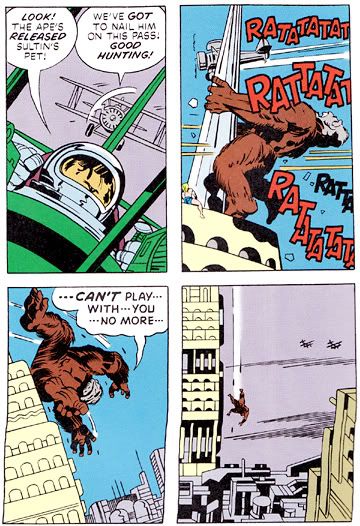
Franklin Schaffner never thought
to put his apes in biplanes, but it
would've been cool if he did. These
are actually lions. Lions in biplanes,
attacking a giant, talking ape who
calls himself Tiny. God, we need
another Jack Kirby.

Chapter Three: The Monster Fetish!

We’re lucky enough of the art exists for DC to gather it all into this hefty and cleanly-designed hardcover. We can enjoy its prime Kirbyness, where his stylistic flourishes, unhindered by the slick ink work from Joe Sinnott at Marvel and the scratchy, unfinished line of Vince Colletta at DC, erupt. Kirby's use of splashes backed by innovative gutter-crossing double spreads on pages 2 and 3 gives the stories a wide-screen feel, opening up the scope and dazzling the reader with Cineramic imagery like a ruined Nevada town, preserved for animal archaeologists by the dry desert air, an Ozymandian image at once humorous and melancholy.

Sic semper Tiny! "Can't play---
with --- you --- no more." He's not
even angry at the lions who killed him.
Isn't that the saddest comic panel ever?

In the Kamandi Archives reprint, the blacks are crisp, the colors smooth. The reconstruction is akin to looking at a restored print of a Cecil B. DeMille epic. These stories were originally printed on grey-toned newsprint which almost immediately began to yellow. And they featured line screens that were practically planet-sized compared to today’s. Now we can see the art on glossy white, with screens so fine they allow the color fields to appear as smooth, flat areas. While this takes away some of the immediacy and ephemeral quality of the originals, it allows us to study the line work unobscured by cheap paper and indifferent printing.

This is especially educational because Mike Royer’s inks always bring out the Kirbyness of Jack Kirby’s pencils. From interviews I’ve read with Royer in the Jack Kirby Collector (a product of the wonderfully nice people at TwoMorrows), it seems his intent was always to preserve the pencils as much as possible. I love this approach, because the attraction of a Kirby comic is its uniqueness. He’s oft-imitated, but no one has ever fully captured the intangibles of the true Kirby.

The most others can do is provide the bombast and overkill, without the humane qualities. Kirby strikes me as having a genuine love for people, be they the shirtless, blonde hippie kid type or the kind hidden in an animal’s fur and sinew.

Saturday, April 16, 2011

The Rising of the Planet of Apes That Rose


Ah, the teaser trailer. It looks like it's condensing the entire backstory of how the Planet of the Apes... er... planet came to be into a single James Franco-heavy film. In the original series, some kind of plague kills off the dogs and cats and over the next few years, people turn to chimpanzees, orangutans and gorillas for animal companionship. Which is an incredibly stupid idea, given what we now know about chimps. They make lousy pets, unless you think having your eyeballs gouged out and your genitals ripped off is fun stuff. And yet pets they become. A generation or two later, the apes are smarter yet enslaved by a bunch of fascists living in Los Angeles's Century City development. Then talking chimp Caesar shows up and leads the apes in a great rebellion, which sparks a nuclear war. In the new movie, it looks as though the planet rises in a matter of weeks.

Cool stuff, though, and I doubt many in the audience will care about this movie's continuity disconnect with an old film series that frequently couldn't keep its own story straight. Plus, it already looks to be a massive improvement over the bone-headed version told in Tim Burton's dopey "re-imagining."

But it's so gloomy. You know why bad things happen at companies like James Franco's Famous Farmaceuticals (NYSE: FFF)? Because they're all glass and steel and blue-tinted mood lighting. If they'd brightened things up with some warm colors, maybe Franco would've smiled a bit more and none of these genius apes would've gone on murderous rampages-- which I'm assuming they do based on some of the creepy images here. Unless they stalk people and leap at helicopters only to present them with Edible Arrangements gift bouquets.

Lesson learned: If you make your workplace look like a haunted house, evil will befall it.