Showing posts with label Chris Claremont. Show all posts

Friday, September 5, 2014

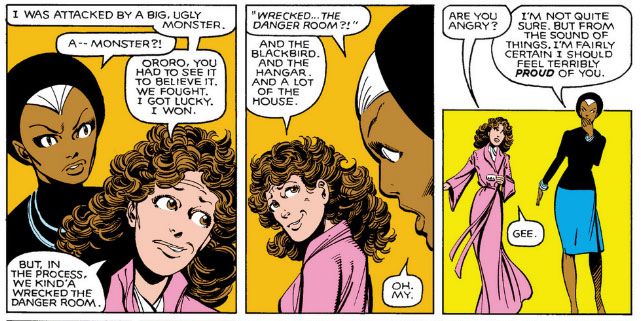
"Forget it, Kitty! You're not good enough for us 'X-Babies!"


Ah, I remember New Mutants #13 (March 1984) when Kitty Pryde was like, "Oh, guys, can I hang out with you?" and Dani Moonstar was all, "Nuh uh!  You called us 'X-Babies,' so you can take your sorry butt right on out of these woods we're hanging out in and suck an egg!"  I was thinking about that the other day.  I've always loved the cover by Tom Mandrake.  Crying Kitty's in the foreground in her garish green circus costume, phasing sadly through a fallen tree, and the New Mutants are behind her looking fierce.  Especially Dani, who Mandrake places in this pose of haughty dismissal.
 
The story inside is heavy on Amara, Kitty and Doug Ramsey, none of whom I had the least interest in back in the day.  I briefly gave up reading the series right around this issue because the book seemed moribund.  No more Bob McLeod art, the team's central conflict-- Dani versus a Brood-controlled Professor X-- had long been resolved and the X-Men were back from space, where everyone had believed them dead.  There was really no need for a junior X-Team, unless it was to give Chris Claremont's complex narratives in Uncanny X-Men extra space to play out as a kind of main story footnote.  Hardly a compelling reason for another title, although it's standard operating practice at both Marvel and DC these days.
 
Rather than establish a distinct identity, New Mutants in its second year tended towards dull, generic super-kid stories. It hooked me again when Bill Sienkiewicz became the regular artist and Chris Claremont re-established his unique authorial voice by taking the kids and their narrative in a darker direction.  Demon bears, slumber parties, shape-shifting cyber-aliens from outer space.  All classic stuff.

But I loved this conflict between Kitty and Dani.  I took Dani's side, of course.  Who wouldn't?  Dani is only Marvel's greatest post-Jack Kirby creation.  Kitty's fine, but there's no competition there.  Mandrake's cover stuck with me for years after I'd forgotten Amara gets her codename in the story, long after I'd given up comic book reading for serious literature only to start in with them again, kind of the same way I did with New Mutants.

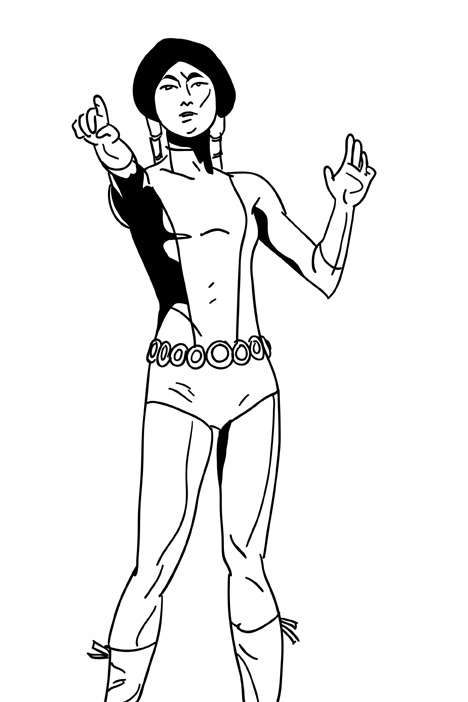
Every so often, I want to revisit that cover image, only my brain invariably turns it into something that only slightly resembles the Mandrake original.  Like with this drawing, which I knocked out the other day before work.  I felt like working on a foreshortened pointing pose, because I'd convinced myself Mandrake had drawn Dani that way.  Actually, if you take a look at New Mutants #13, she's just sort of waving her hand at Kitty.  And I really thought since Dani was establishing herself as team leader and spokesperson she was the one who let Kitty have it with the cover dialogue.  How wrong I was!  Well, my little sketch is poor Kitty Pryde to Mandrake's powerful Dani Moonstar.

Friday, May 16, 2014

Comixology has 45 old school Uncanny X-Men issues on sale for .99 each right now...

I can't help shilling for Comixology from time to time.  But sometimes I have to.  I really, really do.  I mean, I run a blog largely dedicated to old comics-- which I liberally define as "anything published prior to the year 2000"-- and a big part of that includes yakking at length about Uncanny X-Men back when Chris Claremont was writing it and Wolverine was but a hairy, beer-swilling pup.  Or whatever it is you call baby wolverines.  Right now they're selling 45 classic issues of Uncanny X-Men for .99 each.  I already bought them all for 1.99 apiece, and I considered that a bargain at the time.  If you haven't experienced the foundation of practically everything people love about Marvel Comics these days, this is your big chance to catch up.

The art is outstanding throughout, with Dave Cockrum and John Byrne pencilling most of the issues and a few guest art teams here and there.  And wow, beyond the visual treats, these are fun comics to read.  They're occasionally goofy, but they have all the theatrics and high drama you could possibly want in a superhero comic, with in-depth characterization of even the least-loved and lowliest of cast-offs.  You know, like Banshee.  Poor guy.  And the long-simmering "Dark Phoenix" storyline is one of those seminal comic book events, an era-defining tale, as is "Days of Future Past," which seems to have inspired a movie recently with a lot of familiar characters.  Where have we seen them before?

Anyway, Marvel can't seem to leave this stuff alone.  They must have retold all of Claremont's stories more times than DC has redone "Crisis on Infinite Earths."  Even Marvel movie guru Joss Whedon couldn't resist dipping into the Claremont well when he wrote his own much-lauded run not so long ago.

Wednesday, February 19, 2014

Uncanny X-Men #172 and #173: Bad News Mutants in Breaking Training So They Can Go To Japan... Yet Again!

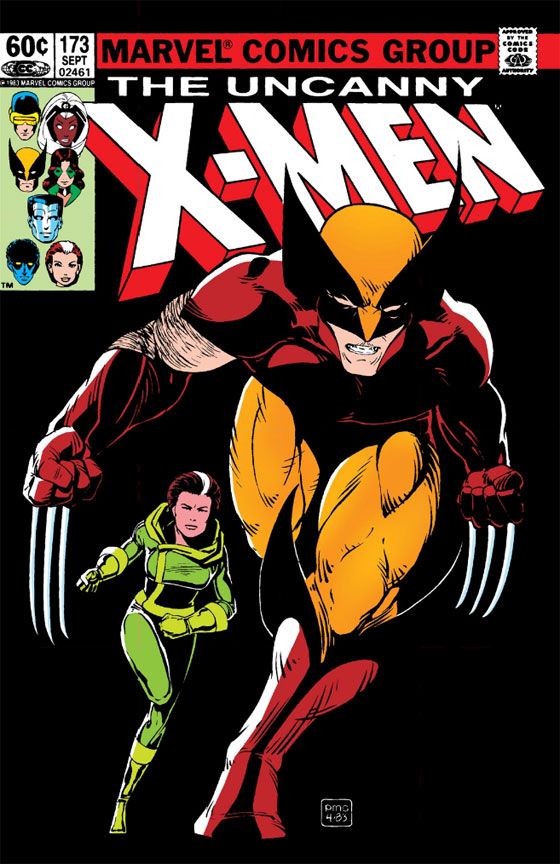
As anyone who's read this blog knows, I live in Japan and I love American comics with this country as their setting.  Imagine my delight when Comixology delivered up Uncanny X-Men #172 (August 1983) and #173 (September 1983), a couple of thrill-filled Nihon-centric issues originally delivered right to the mailbox of my childhood home and featuring a glimpse of my current home, Marvel-style.

Come to think of it, Uncanny X-Men writer Chris Claremont may be one of the reasons I moved here.  If so, I owe him a huge debt of thanks not just for the entertainment his writing provided me when I was kid about Dani Moonstar's age, but also because here in Japan, I live a life every bit as exciting as Wolverine's.  Okay, not really.  I'm boring.  I've only fought ninja or Yakuza thugs on rare occasions, and only once did I love and have my heart broken by someone as regal and unattainable as Lady Mariko.  I'd love to tell you all about it, but we have important things such as comics to discuss!

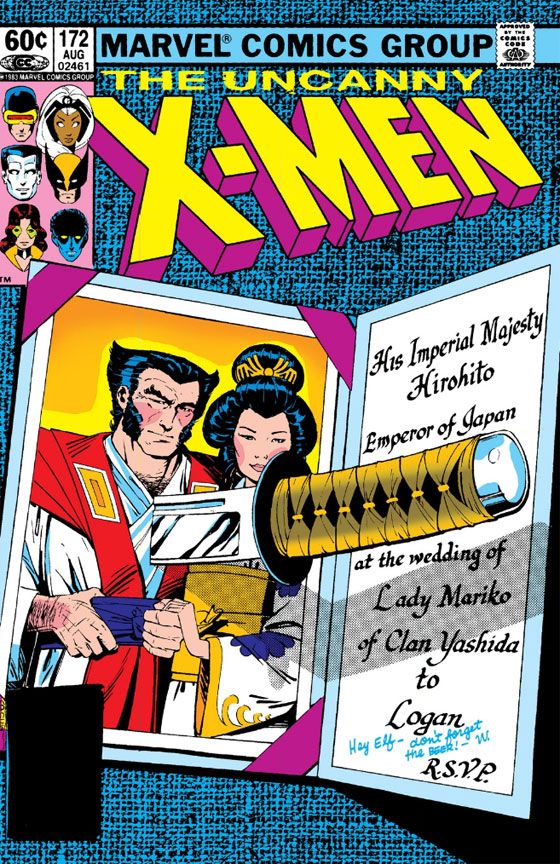
It's been years since I last read these two issues.  I plan to give them my full literary attention someday, but for now we're going to confine our discussion to Smith's images of Japan and bits of narration and dialogue in the pages I chose to illustrate this blog entry.  Just from looking at these very pretty pictures, I can tell this story is a direct sequel to 1982's four-issue Wolverine miniseries by Claremont and Frank Miller.  Wolverine Miller's influence runs all throughout their visuals, so much so the cover to #172 features the invitation Wolverine sent his friends at the end of Wolverine #4.  Paul Smith recreates Miller's original image, and even includes the cute handwritten little note from Wolverine to Nightcrawler about bringing beer.

"His Imperial Majesty Hirohito, Emperor of Japan."  He is now referred to as the Emperor Showa, and if you want to place this book within its era here in Japan it would be the Showa 58, the 58th year of the Showa Era.  Imagine receiving an invite from an emperor!  That is one heavy-duty invitation.  Lady Mariko, Wolverine's fiancĂ©e, is from a powerful family, apparently.  I love the fanciful Miller-designed attire the loving couple wear in the photo, too.

By the way, beer is readily available in Japan and has been for quite some time, so either Wolverine means bring any decent local brand Nightcrawler can pick up at a convenience store on the way to the ceremony or else pack in his suitcase some favored Canadian label he can't get there.

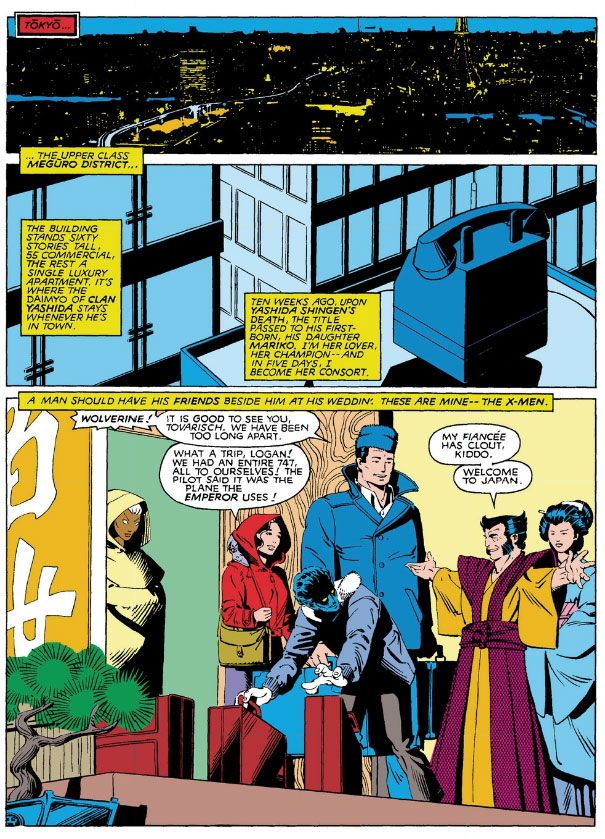
For this story, Claremont and Smith don't waste any time with flights or airports.  They immediately open with a "widescreen" cityscape and tell us it's Tokyo.  Certainly looks like Tokyo to this ex-pat.  Smith appears to have used a high-contrast photo paste-up to create this image, so what we have is a very convincing night view of the huge concrete and steel electrified wonderland we call Tokyo.

Then we zoom in for a closer view to establish exactly where in...

Uncanny X-Men #172 (August 1983), script: Chris Claremont, pencils: Paul Smith, inks: Bob Wiacek


And there it is!  That telephone-topped building again!  Frank Miller used it in Wolverine, Jim Aparo followed suit in Batman and the Outsiders.  Al Milgrom would also draw it in Kitty Pryde and Wolverine, yet another sequel to or continuation of this storyline.  In this issue, we get to see Smith's super-clean rendering of same. 

Was this telephone an actual Tokyo landmark?  I've been researching this online, but either it wasn't so special people have memorialized it or else it's a figment of Miller's imagination.  Even if this is the case, I think a Tokyo building with a big telephone on top is much more plausible than the existence of a Frank Miller movie that doesn't make Ed Wood weep the tears of artistic validation.  Tokyo is the place for all kinds of outdoor advertisement.  I don't know of any building currently topped with an old-fashioned telephone, but I do know of one topped with what the locals refer to as the "Golden Shit."  It's supposed to be a droplet of beer.  I have to agree with its more scatological nickname.

Anyway, you know you're in 1980s comic book Tokyo if you see the giant telephone.  You know you're in today's real Tokyo if you see a big, gilded turd.

Meguro, as Claremont informs us here, in the voice of his character Wolverine, is indeed an upper class district.  Celebrities and the like live there in expensive high-rise apartments.  It's just the place Mariko's family, the Yashidas, might maintain in Tokyo for their visits there.

Since this is an adventure comic, most of the outdoor scenes take place on the rooftops of those apartments, at night.  That's where the ninja sneak around so they can disrupt wedding plans when they take a notion to do so.  Wolverine and his pal Nightcrawler are pretty good at sneaking around up there, too.  As is Wolverine's erstwhile lover, the thrill-crazed Yukio.

Well, kind of...

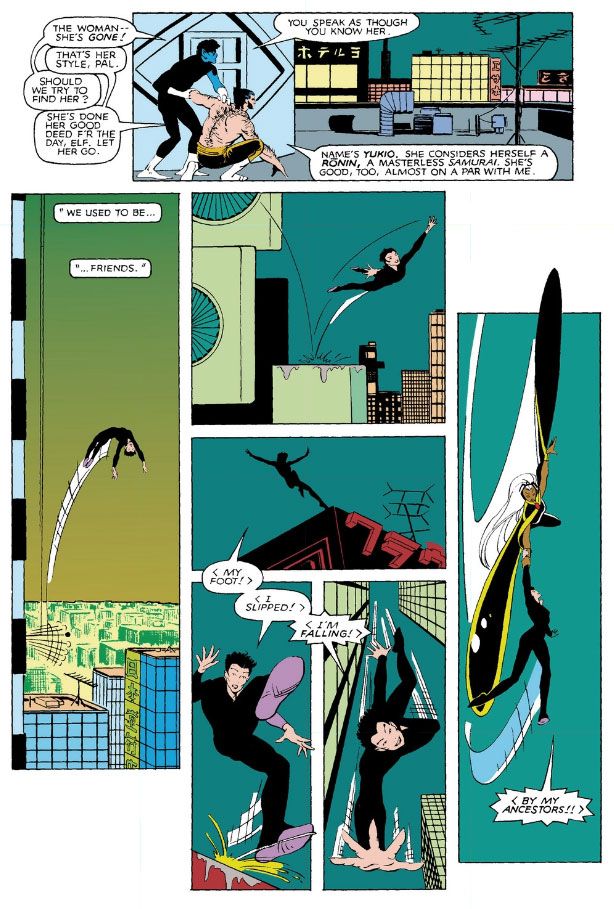
Uncanny X-Men #172, Claremont, Smith, Wiacek


"I slipped!"  That would have been a pretty stupid way for Yukio to die, huh?  Lucky for her, Storm was out flying around.

As you can see from this page, Smith constructs his buildings very simply.  Even so, he and inker Bob Wiacek toss enough katakana or hiragana up and down their sides to make things convincing.  His kimono-clad women are the real visual draw in this story.  There's something about the Smith-Wiacek clean-line look, with things pared down to sleek minimalism that goes well with traditional Japanese clothing.  It also helps that Smith and Wiacek draw amazingly beautiful women.  Unfortunately, they also tend to draw them so they resemble each other, except for Yukio and her punk-rock hair.  Smith and Wiacek give her a face with more sharply defined cheekbones and it individualizes her.

The fun extends to the next issue where Wolverine reluctantly teams up with new team member Rogue to fight the villains.  As I've said, I haven't re-read these in detail, so all I know about the plot is the Silver Samurai and Viper want to stop Lady Mariko from marrying Wolverine.  And Storm debuts her Mohawk after hanging out with Yukio.  No doubt spending any amount of time with someone as uninhibited as Yukio would inspire you to drastic style changes.  We'll get into all of this in the future, but for now you don't really need to know the specifics to enjoy our Claremont-Smith travelogue.

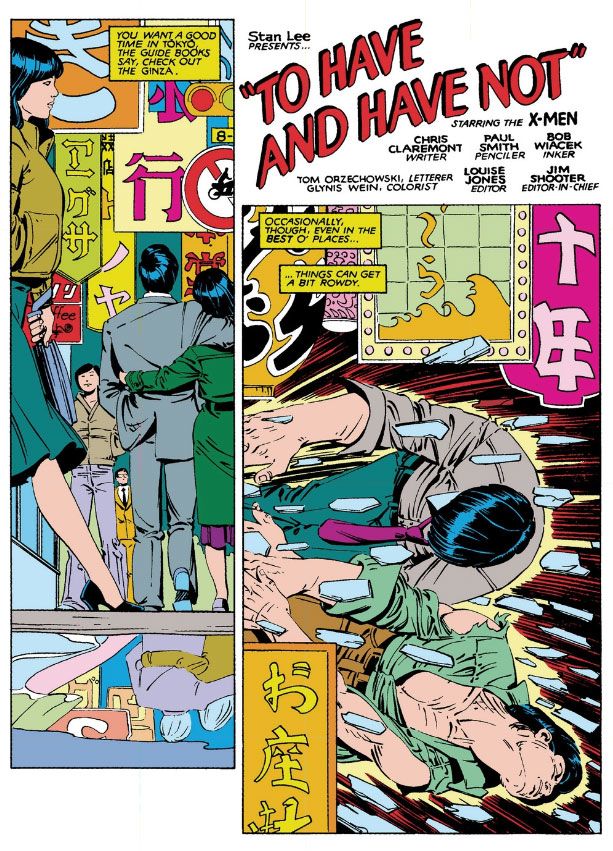
Uncanny X-Men #173, the story starts in "the Ginza."  Claremont has Wolverine tell us guide books recommend "the Ginza" for a "good time."  Wolverine's idea of a good time is getting drunk and into a bar fight.  So that's where we find him. 

I really think Wolverine has read the wrong guide books, because Ginza (minus the definite article) is more a shopping area.  And not just any shopping area.  Ginza is where the rich go to drop the big money on Rolex watches, Chanel and Louis Vuitton couture and bags and other luxury goods, many of which cost more each than I make in a month.  There may have been dive bars there in the 1980s.  There may be now.  But I doubt it.  I rather think Wolverine's destination of choice would be the wilder, woolier environs of Golden Gai in Shinjuku's Kabuki-cho neighborhood.

That's where I went when I wanted to pretend to be Wolverine and act all tough.  Whenever I told people I hung out in Kabuki-cho, they'd smile and shake their heads and tell me, "Don't go there!  It's dangerous!"  Dangerous to the tune of the thousands of yen you blow in the kinds of bars Wolverine would more than likely spend his nights. 

No one has ever said anything like that to me about Ginza.  They just told me to go to this famous chocolate shop, which I could never find the one time I tried, way back in 2008.  I did find a toney toy store selling Indiana Jones and the Kingdom of the Crystal Skull actions figures, the ones with amblyopia.  Some Wolverine, huh?

If you take a closer look at that first vertical panel, notice how Smith includes a puddle in the gutter.  Nice work on the reflections there.  It rains a lot in Japan, so that's a little detail that goes a long way to establishing the setting's bona fides as well.  That image has an impressive sense of place.  That's the Tokyo I've seen with my own eyes.

Uncanny X-Men #173 (September 1983), Claremont, Smith, Wiacek


I'm not too certain about those guys Wolverine's launched through the window.  He does a lot of stuff like that whenever he's in Japan.  Things like this may or may not happen here.  I have a feeling if a foreigner started tossing locals through bar windows, we'd hear about it on the NHK news.  Even more so in the early 80s when we were a rarer breed.  If I had to guess, I'd say this is a more likely to happen in Okinawa where the US military always seems to be stirring things up and causing trouble.  But then, as I've already proven, I'm not Wolverine. 

The worst incident I've ever been involved with was having a guy repeatedly scream, "Pearl Harbor say 'Fuck you!'" at our little drinking group until the bar-owner kicked us out for causing trouble.  I don't blame her.  He was a regular and we were just passing through.  I still wonder what set him off, though.  He approached us in what we thought was a friendly way.  We made small talk in Japanese and tried to use the little abdomen exercise wheel when he asked.  Maybe he felt patronized, or someone said something to offend him when I wasn't paying attention to the conversation.  Perhaps he just hated whitey.  I still don't know what was in his heart.  But I do know he was drunk.

You might read worse stories from other ex-pats here and there around Japan.  Some people attract negativity and bad scenes.  I suppose I've been very lucky in all my years here.  Despite the occasional run-in with Sunfire, mine has been a smooth, laid-back kind of life.  But once again, I don't have adamantium-coated bones or a mutant healing factor.

Marvel Japan is a pretty fun place to visit, isn't it?

Monday, February 17, 2014

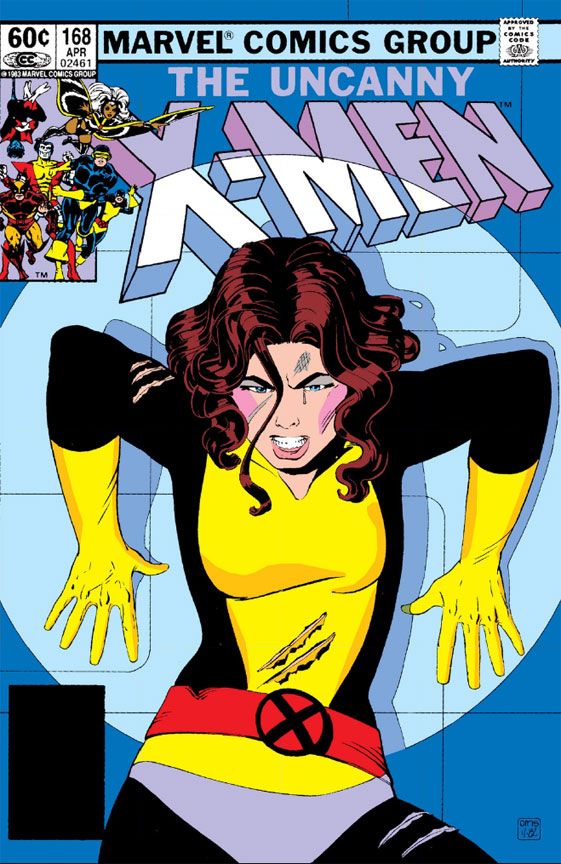
Uncanny X-Men #168 (April 1983): My first subscription comic!

Did you ever love a comic so much you subscribed to it?  Sure, people have "pull lists" these days.  We had those back in the antediluvian days of comic book fandom, too.  I mean, my antediluvian days, which were the early 1980s.  I had a pull list at two different comic book shops, but both of them went out of business fast.  There were not enough people like me to support them in our small southern town.  So to primitive me, subscribing to a comic for a year and getting issues in the mail was the sign of true love.  Like offering a sweater or a ring to that special someone.  My special someone was Uncanny X-Men.  And Uncanny X-Men #168 (April 1983) was the first issue that came straight from Marvel to my mailbox.  What a day that was!  I was always the first person home, so my responsibilities included running out and checking the mail.  And there was a brown wrapper with a battle-damaged Kitty Pryde inside.

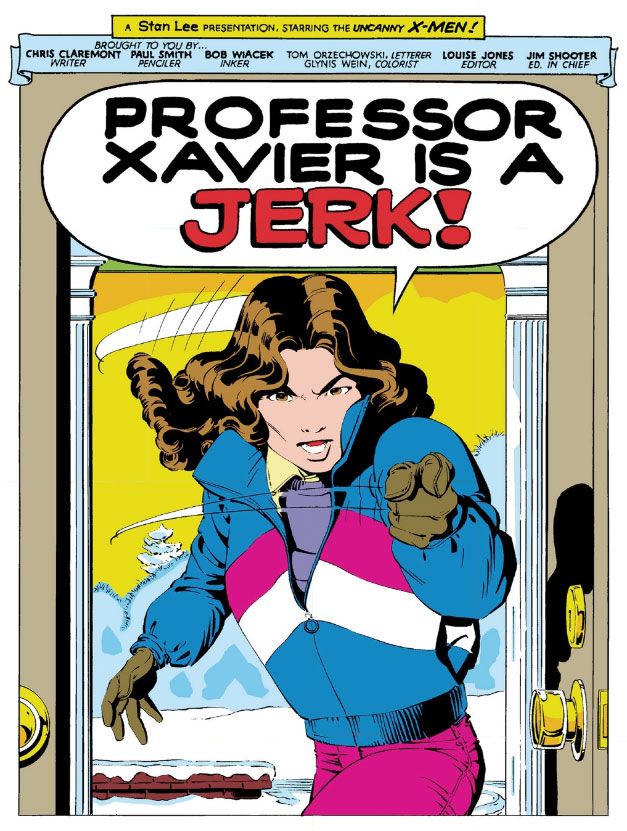
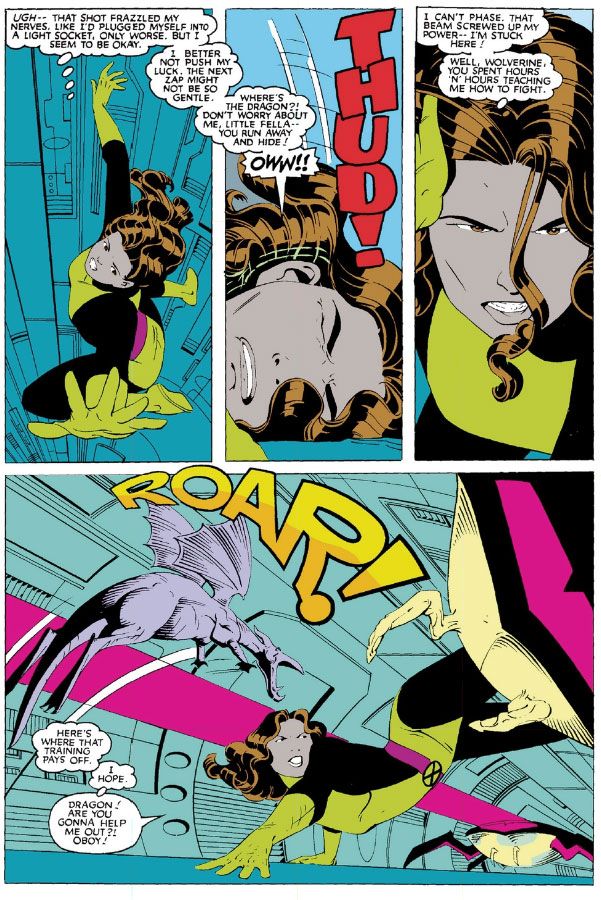
"PROFESSOR XAVIER IS A JERK!" Kitty exclaims in the splash panel, pointing accusingly back at the readers as if we don't believe her. 

I remember this as a shocking moment, a new, upstart character badmouthing an old school stalwart.  Apparently, others felt the same about it because Joss Whedon and John Cassaday would recreate it as a Kitty memory when she returns to the mansion during the first moments of their initial Astonishing X-Men story arc.  What had Xavier done to piss off Kitty?  He refused to let her be an X-Man because it was too dangerous.  To add insult to injury, he also forced her to join the New Mutants trainee team, which is like being demoted from the Majors to low A ball in the middle of the season.

Uncanny X-Men #168 (April 1983), Script: Chris Claremont, Pencils: Paul Smith, Inks: Bob Wiacek

Kitty does her best to prove Xavier wrong throughout the issue, but at first, her attitude is pretty much what you'd expect from a disappointed fourteen year old.  She flips.  Her calmer, cooler friend Illyana immediately calls her out for acting like the child Xavier already thinks she is.  And Illyana should be the one to show maturity.  She and Kitty are roughly the same age, but Illyana is also the demon queen of the Limbo dimension.  Being a demon queen gives one a more advanced perspective. 

Ah, the art!  There is some excellent acting throughout this book and it's all just so clean, so slick, so easy on the eyes.  Paul Smith took over Uncanny X-Men after Dave Cockrum left the book for a second time to write and draw his own property, The Futurians. While I really dug his return, Smith immediately piqued my interest with his ultra-sleek linear style.  With Bob Wiacek finishes, practically everything in the book seems made of polished metal.  Okay, I'm exaggerating, but Kitty's hair certainly has a metallic look.  And good portions of the story take place in the X-Mansion's lower levels where the walls actually are polished metal.  The Smith-Wiacek team is my third art team on this book and the last to capture my imagination.  I copied their Kitty-hair and style of drawing noses for months, but the Smith-Wiacek Storm is the character at her most goddess-like.  Absolutely beautiful.  Then they gave her a Mohawk.

Dubious fashion choices aside, the father-daughter dynamic Chris Claremont works in this issue is a lot of fun.  Professor Xavier has the dad role, of course, and Kitty is the typical teen who wants to prove to her parents she's grown up enough to make her own choices about risk taking.  For most of Kitty's contemporaries, this would mean going un-chaperoned to a Duran Duran or Michael Jackson concert.  Everyone else is going!  Why can't I?  Since Illyana is apparently Kitty's only age-appropriate friend and the rest of the people she hangs out with rarely attend pop concerts but instead have superpowers and enjoy dressing in colorful leotards to launch into space and fight insectoids, that's what she wants to do.

After she realizes throwing a tantrum isn't going to help, Kitty calms down and puts her intellect to work on the problem.  She tries various strategies to change the Professor's mind, from whipping him at chess while explaining her considerable advantages to shouting to shameless brown-nosing.  The progression Claremont presents is just so believable.  Who hasn't tried each of these with parents?

Then, unlike those of us who never got to see the Go-Gos or the Replacements until we were out of the house and in college, Kitty gets lucky, because some space cockroaches who shoot magenta ray beams from their eyes have infiltrated the mansion's creepy-crawly basement.  This is all very reminiscent of the time Kitty faced off against a N'Garai demon by herself, but provides another, very convenient way for Kitty to present her case.  And out of all the things Kitty's tried, it's the most effective, because she gets to showcase a number of her intrinsic capabilities and all those extra things she's learned so far from people like Xavier, Cyclops, Storm and even Wolverine.  Yeah, as if Wolverine knows anything about fighting.

Claremont, Smith, Wiacek

And that brings us back to the cover, because fighting these bugs is how Kitty ended up in the bruised, ripped and still defiant pose I first saw after slipping the comic out of the wrapper.  Colossus turns up just in time to save our gutsy Kitty, but she's finally made her point.  Professor X puts her back on the team, with a probationary proviso which Kitty sensibly agrees to.  She also gets a pet dragon, which is like the ultimate wish fulfillment fantasy.  Imagine for a moment what it's like to be Kitty Pryde.  You're young, you're a genius, you're spunky and heroic, you've got hair so shiny people in shampoo commercials turn weepy with envy, you get your fondest wish... and you get to have the coolest pet ever.

As an added bonus, you also get your own fan page:

Uncanny X-Men #168 (April 1983):  Alliteration sometimes leads to adverse accidental acronyms


Nobody did all that for me when I was 14!  Oh well, shoot, after all that, she deserves it.

Wednesday, February 12, 2014

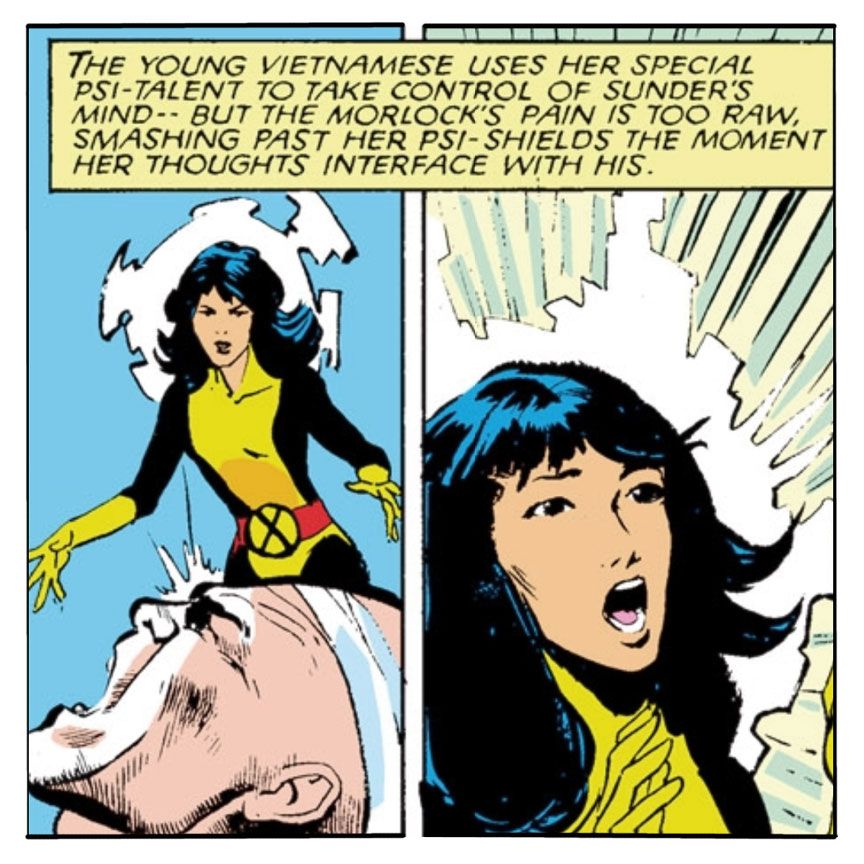
New Mutants #29-34: Xi'an Coy Manh returns from beyond(er)!

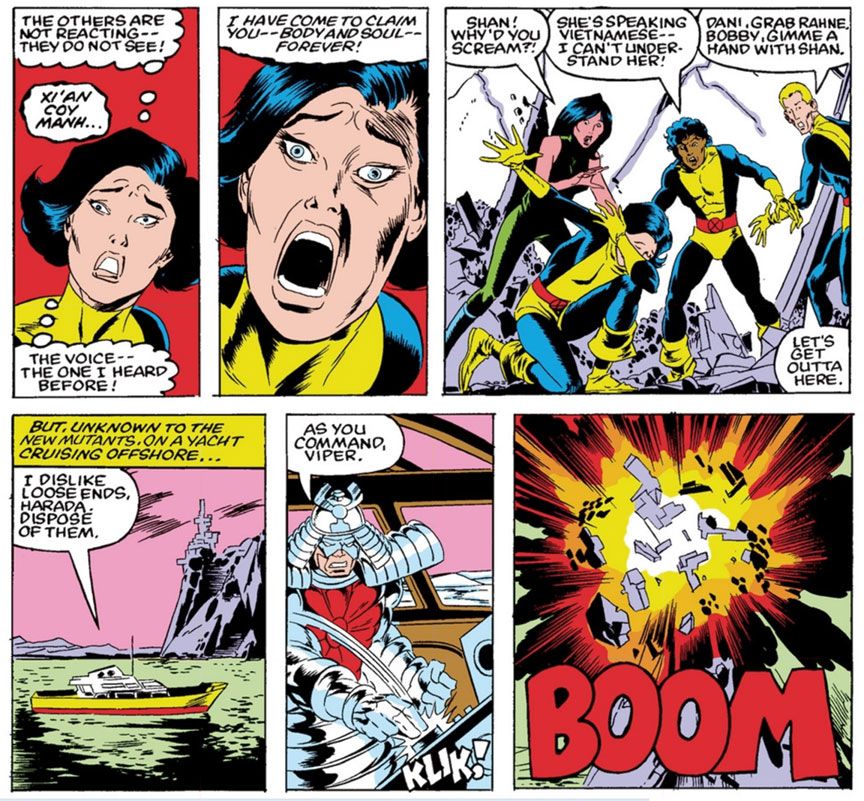
We all remember the tragic moment at the end of New Mutants #6 (August 1983) when Xi'an Coy Manh experienced a moment of terror and then everyone exploded and fell into the sea.  It reminds me of what happened to poor Josie Packard on Twin Peaks.  Sure, Josie wasn't as innocent or nice as she initially led us to believe, but she died similarly afraid, on an episode that aired almost eight years after "Road Warriors!" hit the newsstands and comic shops around the world.  Or else she turned into a wooden knob on a piece of furniture.  We can never be completely sure.  Xi'an's fate is equally strange and even involves what appears to be a Packard-like heel-turn or betrayal. 

And at first exactly what happened to her is also every bit as mysterious as Josie Packard's final moments.  After the smoke clears and her friends sort themselves out, Xi'an is nowhere to be found, so everyone reasonably assumes she drowned when her friend and teammate Roberto DaCosta lost her in the undertow.  But what about that mysterious, last-moment voice in her mind?  Why was Xi'an screaming in Vietnamese and cowering, apparently at nothing, just before the explosion?

New Mutants #6 (August 1983), script: Chris Claremont, pencils: Sal Buscema, inks: Armando Gil

Writer Chris Claremont chose to leave these questions unanswered for a time.  The kids mourned Xi'an, then jetted south to the Amazon for new adventures and new teammates.  And so the New Mutants went on for several years with lead character Dani Moonstar becoming a comic book legend, easily the equal of Spider-Man, Batman, the Crypt-Keeper or Herbie Popnecker, and Xi'an shrinking to little more than a tragic footnote.  

All the way until 1985, that is.  July of that year brought to the increasingly Dani-centric Marvel universe New Mutants #29, which begins with Sam Guthrie and Illyana Rasputin, inappropriately dressed in swimsuits, blasting their way into the terminal of a snowed-in airport in pursuit of unseen thugs who have kidnapped teammates Roberto DaCosta and Amara Aquilla right out from under their noses.  You can imagine how upset they are.  Not only have they lost two friends, but, boy oh boy, is Dani ever going to be pissed at them.!

Illyana and Sam end up in Los Angeles thanks to an errant teleportation spell and have to ask Sam's lover, fabulous insterstellar rock star Lila Cheney, for help.  This brings Dazzler into the story, and she's just ever so coincidentally recently gotten herself out of a tangled mess involving the very same kidnappers.  The heroes track down the villains to an underground gladiatorial contest the likes of which makes Bloodsport look like cricket.  Even for a place as decadent as the story's take on LaLa-Land, I'm not sure I buy all this.  The logistics for putting on such a show and keeping it secret strain my suspension of disbelief, especially when the guy who hires the support team is a surly talking horse who doesn't seem to do anything to hide his unusual appearance.  Things like that tend to attract unwanted attention to your murder sprees.    Still, we're barely into the plot and Claremont may have one heck of an explanation waiting for us.

Unfortunately, New Mutants #30 (August 1985) is a mess.  In it, Roberto and Amara gloomily agree to do something against their morals because an evil hologram says they must or he'll injure some children.  The hologram certainly doesn't volunteer any proof and the kids neglect to demand any.  This seems questionable judgment on their part at best.  But even characters acting like dopes isn't as catastrophic to the narrative as would be, say, the creative team being forced to tie it all into a completely unrelated and god-awful massive crossover event.

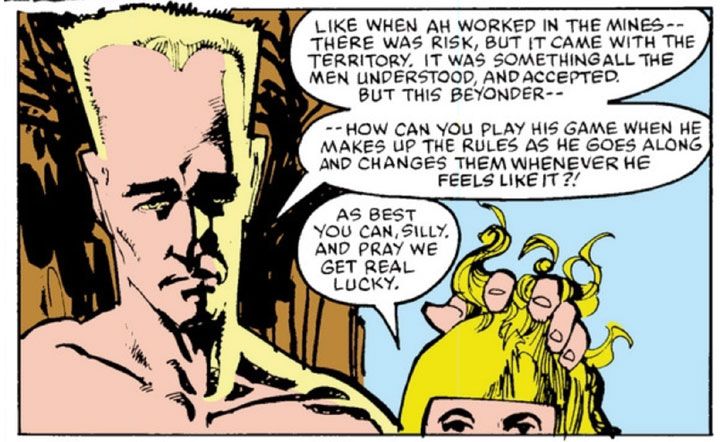
Which is exactly what happened.  As a result, the issue starts abruptly with the resolution of a moment from a comic called Secret Wars II #1 (I don't feel like looking up the date for this).  The splash page positively groans under the weight of expository narrative captions referencing events in other books we couldn't care less about.  There's suddenly an extra character in the mix who looks alarmingly and confusingly like series regular Rahne Sinclair.  And there are also totally static moments interrupting the ongoing action where characters discuss the theological implications of the Beyonder, who seems to be a real cosmic asshole.  You know, one of those Star Trek-style godlike beings who like to change reality on a whim for reasons that in hindsight turn out to a huge pile of shallow Introduction to Philosophy (PH 100 A1 at Boston University in case you're interested in signing up and learning more about the Beyonder) horseshit and who are completely unstoppable until stopped.

In some other book.  Which we'll never read.

Why do I get the feeling this is a dig at the boss?

These moments do nothing to advance either the New Mutants or the Secret Wars II story, but do allow us to think, "Yeah, that's exactly what good ol' Sam Guthrie would think about some poorly-planned and executed nonsense."

Most damagingly, after having devoted so many pages to boneheaded Secret Wars II miscellany, Claremont must then dispose of his own story matters with a few dialogue exchanges so brief you might even miss them after trying to fast forward out of the truly useless crossover parts.  Instead of showing us fun adventuresome stuff like Kitty's detective work (after she takes the trouble of infiltrating the hologram's business), the book just has her explain things on the run:  "Oh, before I forget, here's the scoop on the hologram and those hostage kids, guys..."  There's even a subplot about whether or not Dazzler can break her addiction to fame that gets shafted as well.  Damn you, daddy Beyonder dearest.

With Robin Williams (that's who artist Bill Sienkiewicz makes the Beyonder look like, Williams in one of his patented "holy fool" roles) finally out of the picture (mostly), and our story in grave danger of turning into a summary of Kitty's apparently mad intuitive leaps, we eventually find out it's not the evil hologram but instead a shadowy blob who runs the whole shebang, all the horse-headed weirdos and Frankenstein's monsters and evil holograms and Dazzler solves her problems in a diary entry and the show must go on. 

And with that realization comes a shocking revelation in New Mutants #31 (September 1985), which should have, Beyonder-less, happened as a cliffhanger ending to the previous issue--

New Mutants #31 (September 1985), script: Claremont, art: Bill Sienkiewicz

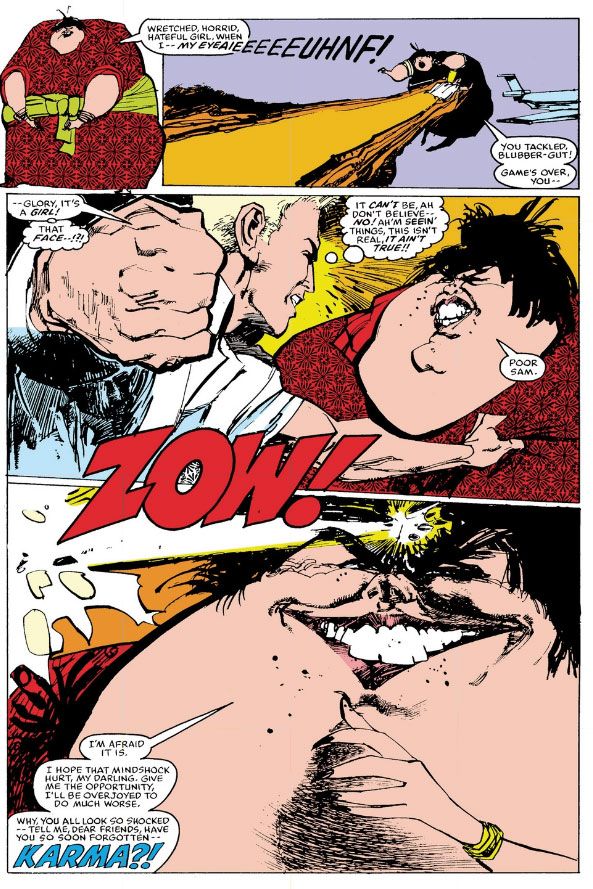
It's Xi'an Coy Manh!  Welcome back, Xi'an!  We're all glad to see you again.  But now you're huge.  And evil!  What the heck happened to you?  Somehow she's even ruined her formerly pristine teeth.  I don't remember Bob McLeod or Sal Buscema drawing Xi'an with gigantic rat-like gnashers like those.  I also don't remember her having a chin-cleft in a big Jay Leno-sized mandible, but there it is.

And because I'm a big fan of his, Sienkiewicz's interior art here doesn't really help.  His covers are incredibly compelling and creative-- I especially like the one with the marionettes.  But inside the two issues he draws, he's wildly inconsistent.  Even for someone with an real expressionist touch.  His "Neal Adams-inked-by-Ralph-Steadman" style reinvigorated the series at first, but in New Mutants #31, he pushes the experimentation and stylistic distortions to the point where they actively fight reader engagement.  Unless Sam Guthrie's head being shaped like a large slice of pizza appeals to you.  Much of the action takes place within featureless voids and even the crowd scenes seem under-populated, with a few circles here and there representing the screaming audience in the gladiator sequences.  Claremont lays on the dense prose to make things clear, but that's no happy joining of prose and visuals in the manner we learned to expect from this team when they had the kids fighting demon bears and evil drug dealers.

Ah, but are the New Mutants really up against Xi'an herself turned evil?   Illyana thinks so, no doubt inspired by everyone's stories of Xi'an's bad seed brother Tran Coy Manh and equally dastardly uncle General Nguyen Ngoc Coy (who makes a non sequitor cameo here that has to be explained in a later issue, yet another plot-casualty of Shooter... I mean... Secret Wars II).  The people who love Xi'an best are not convinced, so the next, vastly improved part of the story involves their investigation into how someone so right could have gone so wrong.

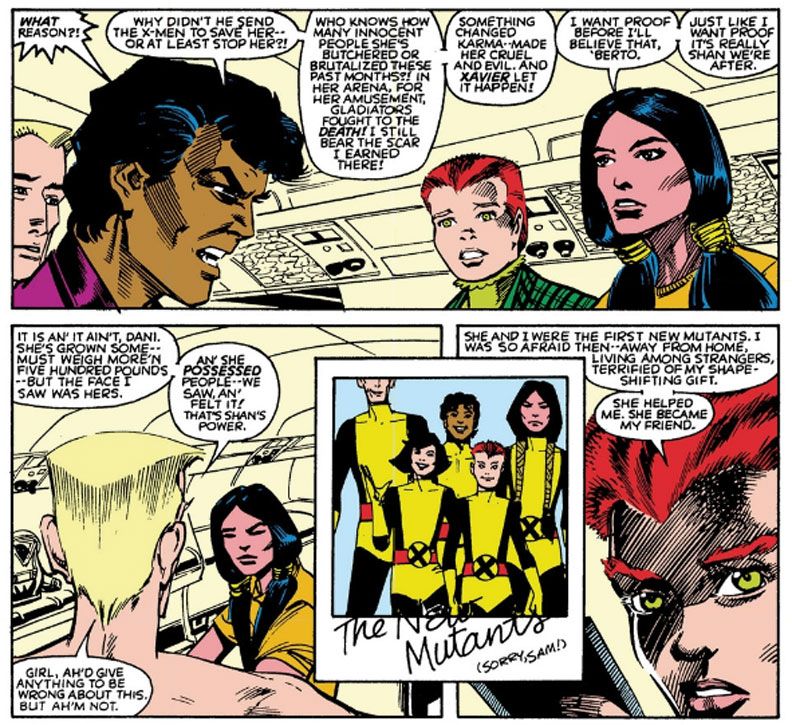
It starts in New Mutants #32 (October 1985) with a flashback covering the events of New Mutants #6.  In this telling, Claremont places the burden of a guilty conscience on Roberto, who ends up acting very much the hothead the rest of the way, even to the point of daring to disapprovingly compare Dani to Professor X.  Roberto's anger-- largely the outward manifestation of self-directed frustration and troubled conscience-- is set up by this very effective sequence, well-drawn by Leialoha, who inherits the book from Sienkiewicz to finish the arc.  Leiahola's self-inked linework at times pleasingly recalls the Swamp Thing team of Steve Bissette and John Totleben, but more angular and less organic.  Sometimes it conjures Sienkiewicz at his most controlled.  Sequentially, it's refreshingly clear and direct.  Just little things like formal perspective and being able to tell where the characters are in relation to each other and the world around them help a lot.  And also the kids looking more or less human throughout.

New Mutants #32 (October 1985), script: Claremont, art: Steve Leialoha

Led now by Dani, and receiving a huge intelligence boost as a result, the team jets (on a really amazing 747 complete with sleeping compartments!) across the world looking for Xi'an while Doug uses "various computer networks" to track Xi'an's path of global hedonism to Pharaoh, her giant Egyptian casino.  Doug's computer work strikes me as genius moment of prescience by Claremont, the kind of thing Secret Wars II prevented in the previous arc.  Nowadays, every second comic out there features a scene where some brainiac Googles a solution to everyone's problems. Well, Claremont has Doug doing his little version of this a decade before there was even a Google!

It turns out a really nasty guy named Amahl Farouk abducted Xi'an immediately after the big explosion everyone thought claimed her life.  And by "abducted," I mean he stole her body and imprisoned her inside it with himself in the driver's seat.  Besides being a psychic body-snatcher and all-around scumbag, Farouk is also a glutton, both for people's souls and for food. You know, the high life.  Once in possession of Xi'an's lithe body, he parties it up and starts a big time entertainment business-- while dominating all manner of humans and superhumans with is psychic powers.

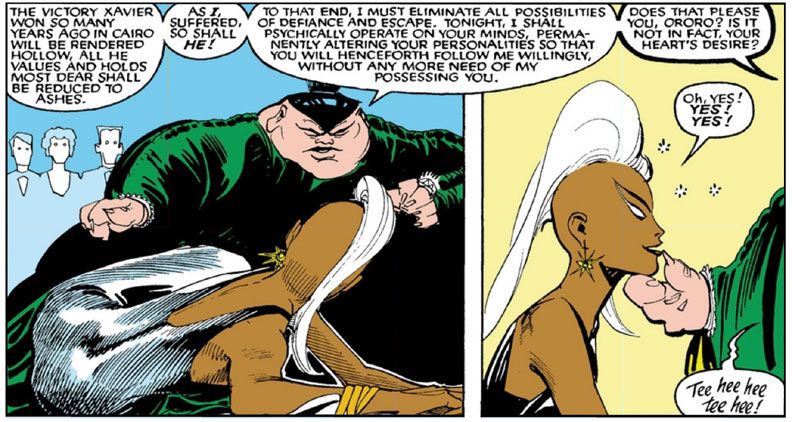
So starting with New Mutants #33 (November 1985), we get a great deal of that kinky corrupting-the-innocent and bondage-type stuff, with the New Mutants falling under Farouk's spell and in New Mutants #34 (December 1985) the antics even come to include an ostensibly experienced and strong-willed adult, the punkishly mohawked Storm.  We even get one of those patented "Will you become my groveling slave and gladly do things your ordinary self would find repulsive and degrading?" moments with Storm struggling at first-- literally crawling on her belly and forced to kiss Xi'an foot as a guy in the crowd begs to go next.  Then Xi'an demands more of Storm as the former demi-goddess resists-- before giving in and exclaiming in orgasmic ecstasy, "Oh, yes!  YES!  YES!"

Also in New Mutants #34, after seemingly betraying her friends, Illyana traipses to the past with Warlock, the team's comedic relief, a kind-hearted "techo-organic" creature from outer space who's sort of a mix between Star Trek: The Next Generation's Data and the earlier, funnier, more manic Robin Williams circa Mork and Mindy.

This by itself is a huge boost to the story because we actually get to watch Illyana in action, complete with an adventuresome cameo by li'l Ororo, the once-and-future Storm.  Cleverly concealing herself behind a wall, Illyana sees a young Charles Xavier going into a bar in Cairo and emerging with a big scorch-mark.   On the back of his safari jacket, for the scatalogically inclined out there.  Using her own arcane powers and Warlock's sensors, Illyana realizes Xavier's been in a psychic battle and walked away the winner.  And the loser was Farouk, hence this whole narrative.

New Mutants #34 (December 1985), script: Claremont, art: Leialoha

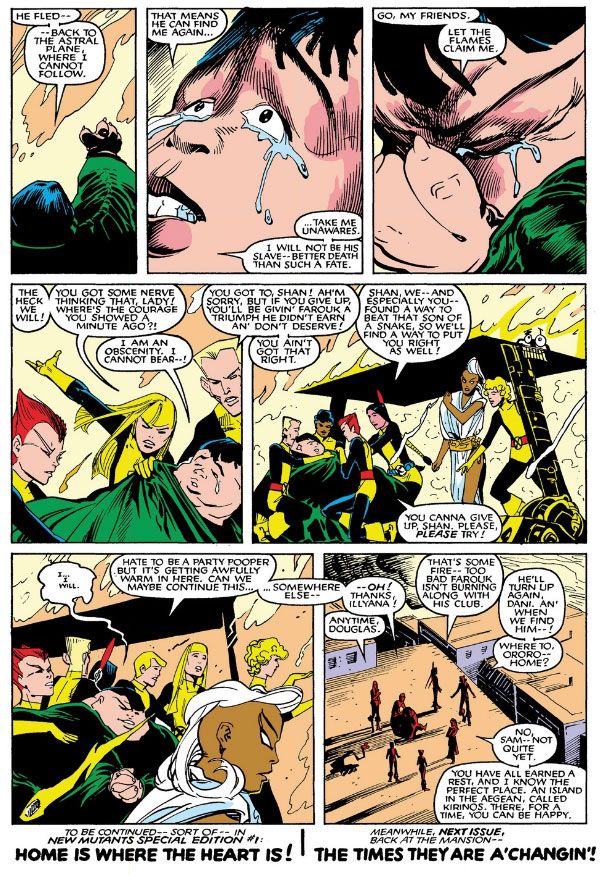
While mind control is a recurring X-Men/New Mutants theme, so is redemption.  We don't talk about this one as much because it's not so easy to poke fun at as all those bondage/humiliation scenarios.  But Banshee in the early issues of Uncanny X-Men, Jean Grey in the penultimate moment of her life, Sam himself, Illyana (endlessly), Magneto, Rogue.  Claremont is always giving his characters a second or third chance and changing their lives for the better, no matter how far they'd fallen.  Adding complexity and richness to their inner lives in the process.  At the climactic moment of New Mutants #34, Xi'an seeks her redemption by fighting Farouk on the astral plane.  Solo, which is fitting.  At first, she's helpless before him, but eventually her psychic-self breaks free of her bloated imago, and looks just like her old, athletic self, complete with bobbed haircut.  She mentally kicks Farouk's mental ass and returns to our reality free of corruption.  Her mind may be free, but the physical damage of Farouk's possession of her body remains.

New Mutants #34 (December 1985), script: Claremont, art: Leialoha

The little text blurbs at the bottom promise more action to come, this time all the way in Asgard itself, the mystical realm of the Norse gods and homeland of the mighty Thor himself.  There Xi'an goes through a long desert ordeal where she sheds the excess pounds and just a year later, when Jackson Guice and Kyle Baker come aboard to provide guest art in New Mutants #46 (December 1986), she's right back with the team and looks like this:

New Mutants #46 (December 1986), script: Claremont, pencils: Jackson Guice, inks: Kyle Baker

Even her teeth and chinbone have shrunk back to the way they once were.

And  that's the story of how Xi'an Coy Manh climbed waaay up to the forty-fourth floor of the Hudsucker Building, and then fell all the way down but didn't quite squish herself. You know, they say there was a mutant who jumped from the forty-fifth floor?

But that's another story.

Monday, January 13, 2014

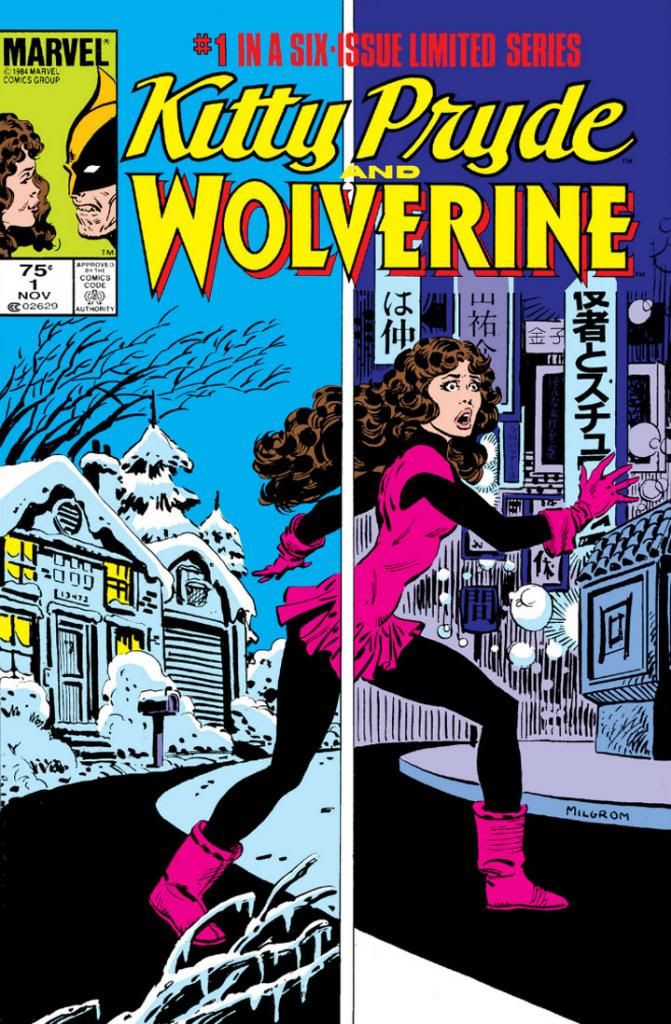
Kitty Pryde and Wolverine #1 (November 1984): Bad News Mutants Go (Back) to Japan!

When I was a much younger comic book fan Japan was mostly just that place Speed Racer and Pink Lady came from.  Then at some point, I must have gone insane because I moved there to start a new life and go to Melt-Banana shows whenever I damn well feel like it.  While it's not nearly as exciting a place as Pink Lady and Jeff would have you believe, Japan is still a pretty cool place to live.  I've had a lot of misconceptions corrected since I was a young comic book reader living in south Georgia, and I've probably formed more than a few new ones now that I'm an old comic book reader living in south Shizuoka.  This is why I love taking a look at American comics depicting my adopted home.

Marvel Japan!  I can't know for certain (since I wasn't working for them), but I get the feeling Japan was Marvel's go-to country for remaking characters back in the 1980s.  In their classic and influential 1982 Wolverine mini-series, Chris Claremont and Frank Miller sent Wolverine there, tore him apart, put him back together again and cemented his place as one of Marvel's top draws.  Along the way, they created a fabulous fantasy Japan (we've discussed this already), where the high-tech marvels of modern Tokyo form a backdrop for a lot of pseudo-mystical martial arts tough guy nonsense.  In the Marvel Japan Claremont and Miller invoked you could still encounter hordes of ninja and stoic old people still living the ways of bushido in their ancestral castles.  It's silly, but it's the best kind of silly.  I dug it, you dug it, lots of people dug it, so much so this story recently formed the basis for The Wolverine (in Japan it's called Wolverine: Samurai) starring Hugh Jackman.

In Kitty Pryde and Wolverine (November 1984-April 1985), it's Kitty Pryde's turn to visit Japan and experience life-changing events.  And you couldn't ask for a better protagonist, or one more in need of a fresh start than 1984 Kitty Pryde.  Lovingly written here by Claremont, our heartbroken yet smart'n'spunky (TM) Kitty is plenty interesting on her own to have headlined a two or three issue romp through 1980s-era Tokyo, capital of a country then enjoying a huge resurgence in economic prowess, self-confidence and cultural energy-- Shinjinrui!  Visual kei!  Para Para!  With New Wave artists already appropriating its looks and imagery, Japan's youth culture stood poised to conquer the pop culture world, and this could have provided plenty of material without anyone resorting to martial arts clichĂ©s.  Instead, in the second issue, Wolverine muscles his hairy way into the plot and the series becomes a deadly serious remake of his solo story, only with Kitty fighting ninja and yakuza for redemption.  Those aspects just don't provide the same kick or appeal the second time around. 

But rather than shoot my figurative BB gun at a comic for not doing what I want it to do, I'd rather focus a positive spotlight on the way-cool first issue, which has Kitty lost in translation all by herself, desperately in over her head.  So let's take a long, loving look at Kitty Pryde and Wolverine #1.  How do Claremont and artist Al Milgrom depict Japan?  Is it believable?  Does it make a reader feel as if he or she has been there?  That's what you're asking me right now, isn't it? 

No?  Well, okay!  I'll tell you anyway!

First, there's the trip journey itself.  To get to Tokyo, Kitty stows aboard a JAL flight from Chicago, and I can promise you there absolutely is such a flight, known as JAL Flight 9.  These days, the aircraft flying the route is a Boeing 777-300ER, but Kitty hops a 747-400 (I think).  That's the same plane I took, only I didn't phase onto it through the cargo bay.  I had a ticket, so my arrival at Narita Airport was a lot smoother (and drunker, thanks to JAL's liberal free drinks policy at the time) than Kitty's.  Not having my good luck, Kitty then spends a page or so escaping Narita.  Today's Narita doesn't look much like the one Milgrom draws, but I first visited it some twenty years after Kitty, so it probably underwent a renovation or two in the interim.  Oh, there's a funny bit where Kitty phases onto a bus and accidentally slaps a salaryman on the ass as she solidifies.  Today we're more likely to get to Tokyo proper by way of the Narita Express, because Narita is actually way out in the rice fields of rural Chiba prefecture, a fair distance from the urban neighborhoods the where the rest of the story takes place.

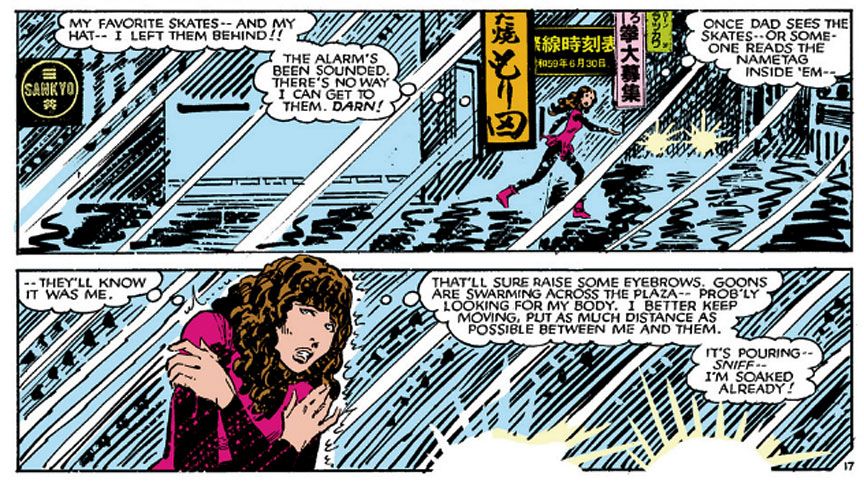
Now we come to the meat of this post:  Tokyo.  Godzilla's Stomping Ground.  Where the Bears played the Japanese Little League champs.  Kitty visits Tokyo in winter and let me tell you-- Japanese winters are cold!  Cold and windy!  Because her trip is on the spur of the moment with no time to pack or dress more appropriately, Kitty's skater costume is cute but hardly practical for running around outdoors here.  And to top it off, she gets soaked by the rain.

Script by Chris Claremont, art by Al Milgrom

Claremont's Kitty may be impulsive at times due to her youth and naivetĂ©, but she's also a thinker.  During this sequence, she's sizing up her situation after receiving a pretty heavy duty system shock and already figuring out not only has she made a sizable error in judgment trying to help her dad, she'll also be lucky just to stay out of jail herself.  Then the weather takes a dump on her, too.  It actually rains a lot in Japan (while Kitty can't because she lacks money, less desperate visitors should buy a cheap umbrella at a convenience store; the wind's just going to destroy an expensive one anyway), so this vaguely Blade Runner-esque cityscape looks pretty accurate.  Milgrom inks his pencils with a bold, energetic line and spends more time on the rain shower than the surroundings, but those squiggly blacks Kitty's running across are reasonable visual shorthand for the wet streets and reflective lighting of a rainy Tokyo evening.  The vertical signage creates a convincing Tokyo look as well.

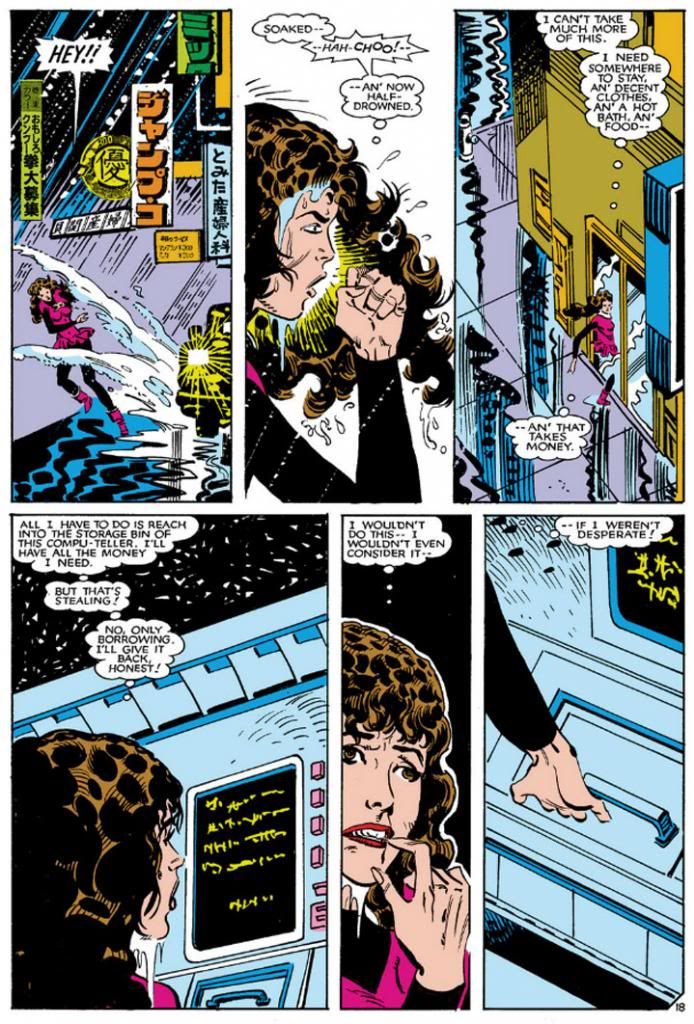
In the next sequence, the rain lets up a little so Milgrom shows us more of the city.

Claremont, Milgrom

It looks as though Milgrom uses some paste-up lettering here, possibly clipped from Japanese newspapers or magazines, or even actual photos of Tokyo.  That's a smart idea.  All that lettering would have been a pain for either him or the book's letterer to recreate, and they would have had to hire a translator to make sure they weren't just slapping down squiggles and squares or accidentally writing something rude.  Plus, Japanese comic book artists sometimes paste up entire pre-drawn backgrounds from special manga-tool artbooks, or use half-tone photographs.  Milgrom does the last, too, but I forgot to capture a screen image of it so you'll just have to take my word here.

Milgrom's version of a Japanese ATM is fun.  Since it's the 1980s, Kitty can't quite decide what to call it.  "Compu-teller," huh?  Now you find ATMs all over the place in Japan-- in banks, post offices, malls and convenience stores.  Inconveniently, some of them are not open 24 hours so sometimes you have to be prepared to wait until business hours the next day to withdraw money.  Imagine Kitty's dilemma here when she needs cash, it's after hours... and she doesn't have an ATM card or even a bank account.

Don't do it, Kitty!  Don't steal that money!  Not only is it illegal, but it's also not worth the guilty feelings and depression!

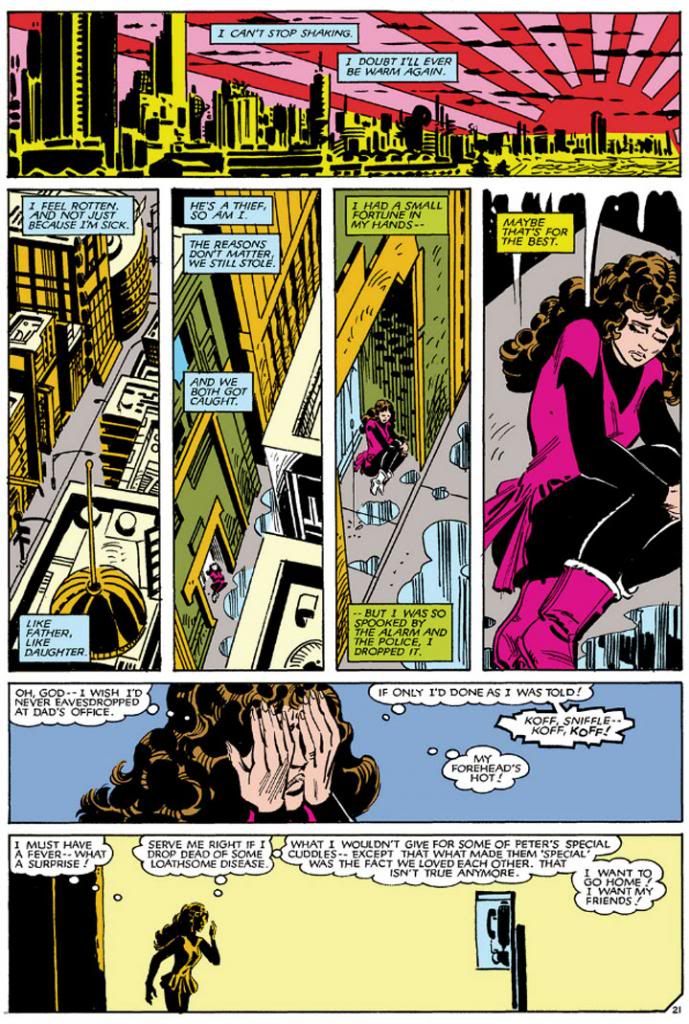
Milgrom waits until almost the end of the issue to give us a widescreen Tokyo cityscape.

Claremont, Milgrom

Ah!  The "Rising Sun" motif!  How Buckaroo Banzai, baby!  Now we really know we're in 1980s Japan.  Milgrom enjoyed this effect so much he used it again in the fourth issue, rising behind a Japanese castle.  After a spectacular overview of the big city, Milgrom zooms in on a neighborhood, finding a sick and miserable Kitty huddles in a doorway.  And she hasn't even hit bottom yet.  Kitty's back alley/sidestreet hideaway in the second panel tier looks reasonable to me.  Granted I spend most of my time in the hip, upscale districts hobnobbing with trendsetting fashionistas like Chiaki Kuriyama and Kyary Pamyu Pamyu, but I've occasionally glanced at just these kinds of lowly city spaces as we've swept by in our motorcycle-escorted limousine motorcades.  That pay phone looks pretty generic, but a phone is a phone, I guess.

"I can't stop shaking.  I doubt I'll ever be warm again."  I get the feeling Chris Claremont visited Japan himself some winter prior to writing this.  Anyway, welcome to a country where few buildings feature insulation or central heating even now.  Think how rare that must have been almost thirty years ago when Kitty came.  These days, I pile on the layers starting with Uniqlo Heat-Tech and ending with a quilted hanten, and my wife and I run an electric heater in the mornings when we get up.  I still shiver all winter.  And Kitty spent the night outdoors with only her wet skater dress and some tights to protect her.  She also swam through a sewer pipe a few hours before.  No wonder she's in no mood to enjoy the sunrise.

The rest of the mini-series stages fights inside office buildings or on rooftops (Tokyo Tower makes a background appearance as Wolverine's friend and sometimes lover Yukio dangles an unfortunate oaf over the distant street) and martial arts training sessions at secluded castles right out of Akira Kurosawa flicks.  Claremont and Milgrom score high marks on the Japan scene-setting throughout, and while I wish they had kept things Kitty-centric and lighthearted, at least she comes out of it with a spiffy new costume (a softer version of a leather outfit she wears as part of a disguise later in the story), some boss fighting skills and a grown-up codename:  Shadowcat.

She does get an ugly New Wave haircut, though.

Sunday, December 29, 2013

Uncanny X-Men #118 (February 1979): Bad New Mutants Go To Japan!

Script: Chris Claremont; Art:  John Byrne and Ric Villamonte

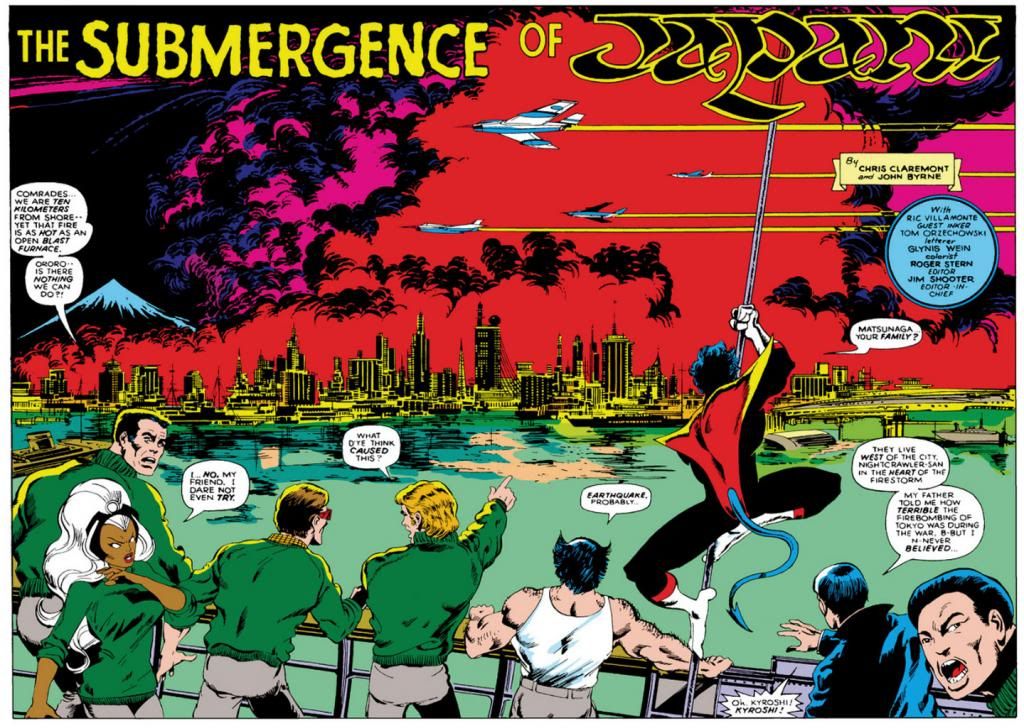
Enjoy this spectacular double-page spread from Uncanny X-Men #118 (February 1979), pencilled by John Byrne and inked by Ric Villamonte.  Maybe Terry Austin was off that month.  Agarashima, the city on fire here, is completely fictional but the visible architecture in Byrne's rendition is plausible enough.

Except for Mt. Fuji in the background.  An online source tells me Agarashima is in Miyagi prefecture, which is way up north along the eastern coast of Honshu.  Actually, that same source reports the city to be "300 kilometers north of Tokyo" and misspells the prefectural name as  "Miyago."  This may be a fictionalized flourish on Chris Claremont's part, freeing him to use his imagination and create a fanciful Marvelized Japan.

Fake Miyago or very real Miyagi, it's a likely location for a medium-sized port city, which is what Agarashima appears to be here.  Mt. Fuji is much farther west, so there's no way if this city resides 300 kilometers north of Tokyo you would see it looming that large in the background because it would be about 500 kilometers away.  I live in a city in the same prefecture as Mt. Fuji, about 116 kilometers away, and even when we can see it from here (it's visible from several vantage points on clear winter days when it's wearing its snow cap), it's only about the same size as my thumb.  So this is more than likely a little artistic license on Byrne's part as well.  We just need some cherry blossoms blown out to sea by the conflagration to achieve perfection.

So, with all that in mind (or better yet, out of it), let's just admire this glorious drawing, huh?  Unfortunately, after this image, there's not a lot of travelogue imagery in this story.  Much smaller panels, and a lot of the action confined to interiors.  By the next issue, the X-Men are on a volcanic island off the coast where they fight a pissed-off nutjob named Moses Magnum, who wants to sink Japan, so we're denied more John Byrne-drawn vistas of late 1970s Japan.  Think what he might have done with Tokyo.  I would love to have seen it.
You know, not on fire.

Monday, November 25, 2013

X-Men #101: Phirst Phoenix... and Wolverine gets all wiggly?

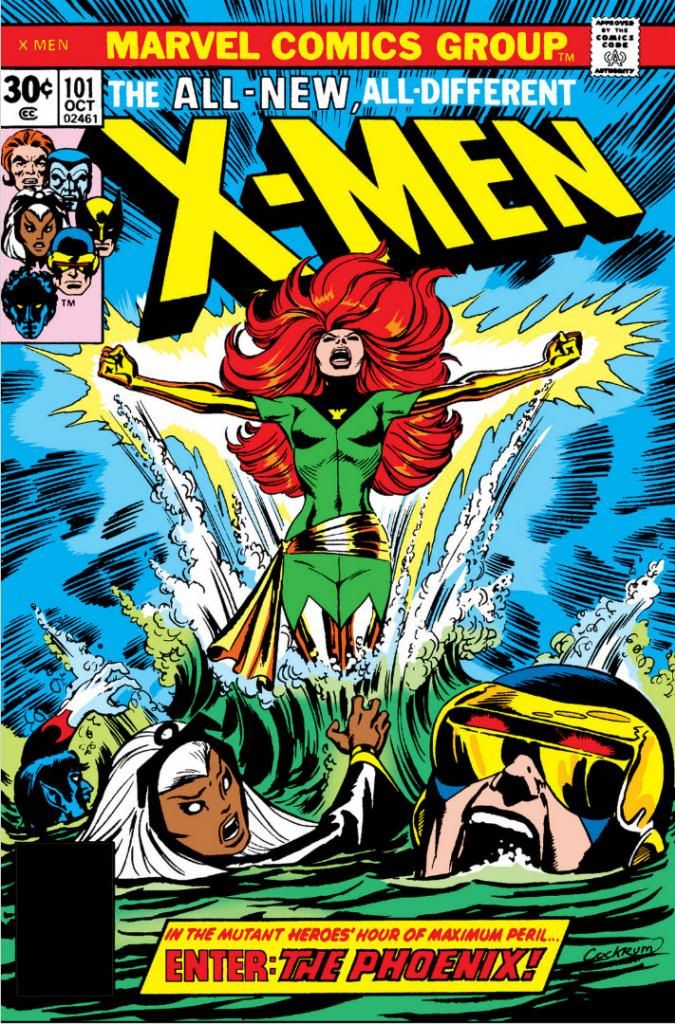
Uncanny X-Men #101 (October 1976) brings a bruised and battered group of X-sters back from a mission into space.  In the preceding issues, they'd taken a Starcore space shuttle-- accurately drawn for the most part (as was the Harrier jet in X-Men #94) by Dave Cockrum, even though NASA's real thing wouldn't get off the earth for another five more years-- to an orbiting space station (nothing like anything anyone's ever put up there, but still pretty cool) where they fought Stephen Lang (or, as some authorities have it, Steven Lang).  Lang is human, but more than that, he's a complete nutjob who hates mutants the way lions and hyenas hate each other. 

Maybe even more so, because Lang stoops to murdering even a non-mutant USAF officer who calls him out on just how insane his schemes are and lions and hyenas only kill each other in their feuds.  I can't think of a single lion who went so far as to bump off a leopard for telling him he's gone around the bend with the anti-hyena robot building enterprise.  Lang captures the team and forces them to fight for their lives in space.  It takes a couple of issues, but the good guys eventually prevail and, on the way home, fly through a solar storm.  Only Jean Grey (or Marvel Girl as she was known then) can pilot them safely back. 

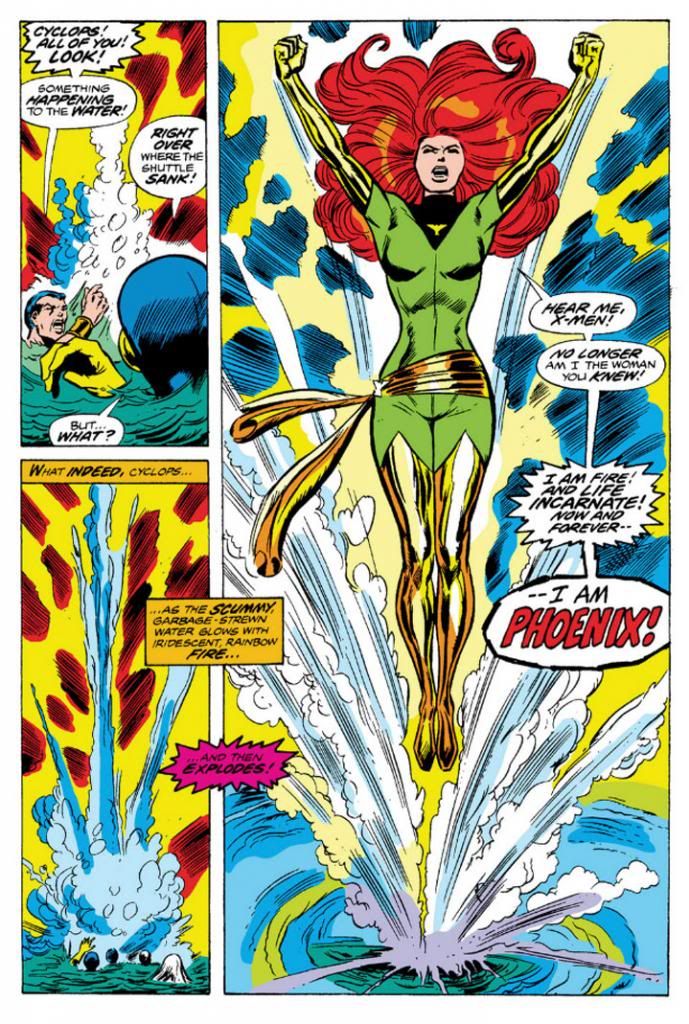
The intense radiation, depicted psychedelically by Cockrum, triggers Jean's transformation into Phoenix, the all-powerful.  But let's let Chris Claremont tell us what the new Jean Grey is all about as only he can:

X-Men #101, script by Chris Claremont, art by Dave Cockrum and Frank Chiaramonte

Ahhhh!  My, that's some good Claremont.  "I am fire!  And life incarnate!" has always struck me as a characteristically Chris Claremont phrasing.  This may be because he was the guy who taught me the word "incarnate" in the first place.  It's certainly not a word one slips into everyday conversation, at least not when I was a southern kid and living in my childhood home, where people were letter carriers, school secretaries and baseball players, not all-powerful mutants.  And so this is the exact moment "incarnate" entered my vocabulary.  To me, "incarnate" and "eldritch" are forever Claremont words, and when I read them in other comics, I always assume the writer has stolen them from Claremont's run on Uncanny X-Men.  And by shouting this phrase, Phoenix lets us know she's here, she's for real, and readers look out!
This is the issue where Claremont found his X-voice.  While he’d already shown a sure hand at characterization, giving each rookie in his cast (and even the previously-established veterans) distinct personalities and moods, the first few issues trot out a tired Avengers villain, a random to the point of being non sequitor demon attack and some story elements from the first X-Men series.  The new faces and the ultra-detailed Cockrum art are the draws, not the stale plots.  I know things were beginning to spark before #101.  Claremont had already started one slow-building subplot about Professor X's strange dreams of distant interstellar conflict.  This has a major pay-off later, and for the moment it meant Professor X gained what he'd largely lacked before-- a personality. 
But the Phoenix story as it begins here is something else altogether.  Claremont allowed it to flicker around the edges of succeeding issues as he dropped clues and intriguing interludes before the whole thing blazed up into major event unto itself, at once epic in scope and intensely personal as well.  Jean Grey’s transformation into the most powerful of all the X-Men also serves notice Claremont’s stories will be about the women as much as the men of the group.  Jean and Storm wouldn’t act as cheerleaders or simple love interests, or worse, damsels in distress, with the stories really being about the boys in the band.  They wouldn’t be co-stars in someone else’s adventures.  They’d be stars, too.  The women would get to drive the narrative as much as anyone.
Cockrum emphasizes this moment in all its drama by having Phoenix dominate the page in a fury steam and lightning, one of those razzle-dazzle comic book light shows.  It's also significant her rebirth takes place as she bursts from water-- both Claremont and Cockrum would have been fully aware of the symbolism.  As she rises we see she's got this startling new costume and even seems to have more hair.  The rest of the team end up crowded into those narrow panels on the left so Phoenix can own the entire space to the right.  If you were holding this comic, this would be the outside part of the page, and this placing promises more Phoenix to come because she's the last thing you see before you turn to the next.  Jean Grey and X-Men would never be the same.

But what's this?  Back in those early, free-wheeling days before the X-Men became one of the major pillars holding up the Marvel cosmology, there was another little subplot happening, one Claremont didn't choose to develop into a major storyline.  Back then, Wolverine wasn't a huge fan favorite and star of every single comic Marvel puts out each month plus his own movie series.  In the first year or so of X-Men, he was just a short asshole mainly known for having fought the Hulk, but Claremont wasn't about to leave him as simple or one-note as all that.  So the team rebel, the loner who doesn't need anyone (needed by no one in return, it seems) turns out to have a bit of a sweet side.  Seems Wolverine has a cute little crushy-crush on none other than Jean "Phoenix" Grey herself.

X-Men #101, script by Claremont, art by Cockrum and Chiaramonte

Aww!  Like a lovestruck high school boy, he's not sure how to go about wooing her, but in his insecurity he plays the arrogant fool in his mind.  Little bit of the caveman, I suppose.  Claremont's narration is pretty harsh on the poor guy, though, don't you think?  I mean, yeah, Wolverine thinks some dickish thoughts while awkwardly trying a tender gesture, but does he deserve the caption box hectoring he gets here?

X-Men #101, script by Claremont, art by Cockrum and Chiaramonte

Probably.

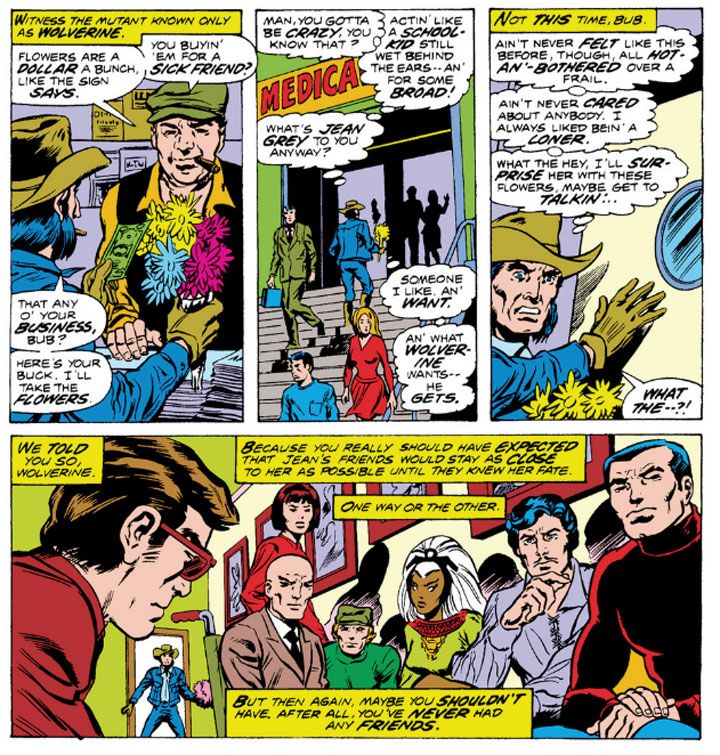
In the last panel Claremont really lets the guy have both barrels, even though everyone involved knows there's a heart inside Wolverine's gruff, hairy, somewhat psychotic exterior.  Actually, I've always thought of the intrusive, judgmental narrator as representing Wolverine's self-recriminations.  That he didn't really like himself.  It would be a while before they humanized him... and then overexposed him... but isn't it fun to see Wolverine getting a case of the goofies over Jean?

Thursday, November 21, 2013

Dani Moonstar versus Sarah Rainmaker (or How I learned to stop worrying and love Gen13)

Epitomizing 90s fluff, Gen13 was a kind of MTV Real World look at superheroics on one hand, an excuse for near-nudity and fart jokes on the other, and just some guys good-naturedly riffing on their favorite New Mutants and Uncanny X-Men storylines, plus throwing in a Trent Reznor clone as a villain for good measure on the third.  Or one of your feet, if you're not an alien or mutant creature.  Outrageously derivative, cluttered with pointless storylines that go nowhere, at times little more than a vehicle for J. Scott Campbell's "good girl" art-- and also so light and breezy entertainment I couldn't get enough of, so much so I even wrote a fan letter.  That's something I had done only once years before, to the fine folks responsible for making Sgt. Rock

And a lot of other readers felt the same way, at least for a while, because Gen13 inspired Gen13 Bootleg, a spin-off series with stories and art by the likes of Alan Davis, James Robinson, Walt and Louise Simonson, Adam Warren and even a two-issue miniseries by Adam Hughes which I think of as a largely forgotten near classic.  No less than Warren Ellis himself took a hand at writing the team's adventures in one regular series annual and one for Bootleg.  Image/Wildstorm also published DV8 and a number of mini-series.  Then the fun stopped.  Writer Brandon Choi and Campbell decamped and new creative teams came aboard.  They tried to use the comic's powers for good, but its zeitgeist had passed and subsequent attempts at revival in the years since have failed.

But back in those days, most Gen13 readers wanted to read about super-strong, super-smart, super-bodied team leader Caitlin Fairchild and the various ways she would lose her clothes, the "youngest and spunkiest member of the team" Roxy Spaulding and gross-out comedic relief -- with a code name dated even then-- Percival Edmund "Grunge" Chang.  There was also Bobby "Burnout" Lane, who had kind of an emo personality and a soul patch but otherwise made little impression on anybody.

But I, being forever contrary, preferred little-regarded Sarah Rainmaker, who was slightly more popular than Burnout only because, well, the main purpose of Gen13 wasn't beefcake.  I liked her because the creative team didn't seem to, and because she was more than a little similar to my beloved early-teens hero Dani Moonstar.  I mean, besides both being Native Americans. 

Poor Sarah Rainmaker.  The original writers used her mostly as a straw-figure to mock feminism, campus activists and also to do a bit of that MTV-style "amorphous sexuality tease aimed at hetero boys" stuff that later made such a star of Kate Perry.  But written sympathetically by Hughes in Gen13: Ordinary Heroes a more interesting, deeper character comes through and makes me wish they'd tweaked Rainmaker in the monthly to something a bit less... well... insulting.  Sometimes they did.  Often they didn't.  Anyway, maybe what I really I liked all along was this alternate Hughes-inspired version of Sarah Rainmaker I had in my mind.  One more righteous and less of a strident punching bag with a lot of "Take that, Political Correctness!" dudebro-humor wear and tear. 

Still, if you're going to do your own version of The New Mutants, of course you're going to do your own version of that book's most vital character and obvious star.  You know who I'm talking about from the title of this post, so with no further ado, here are some Dani Moonstar moments echoed by Sarah Rainmaker.

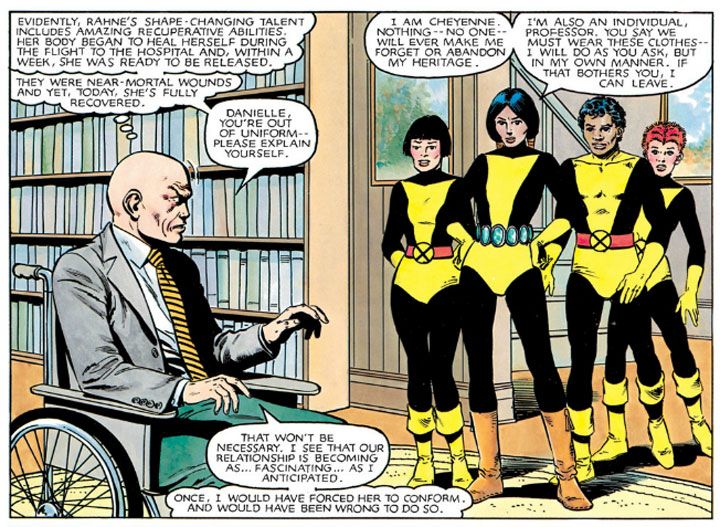
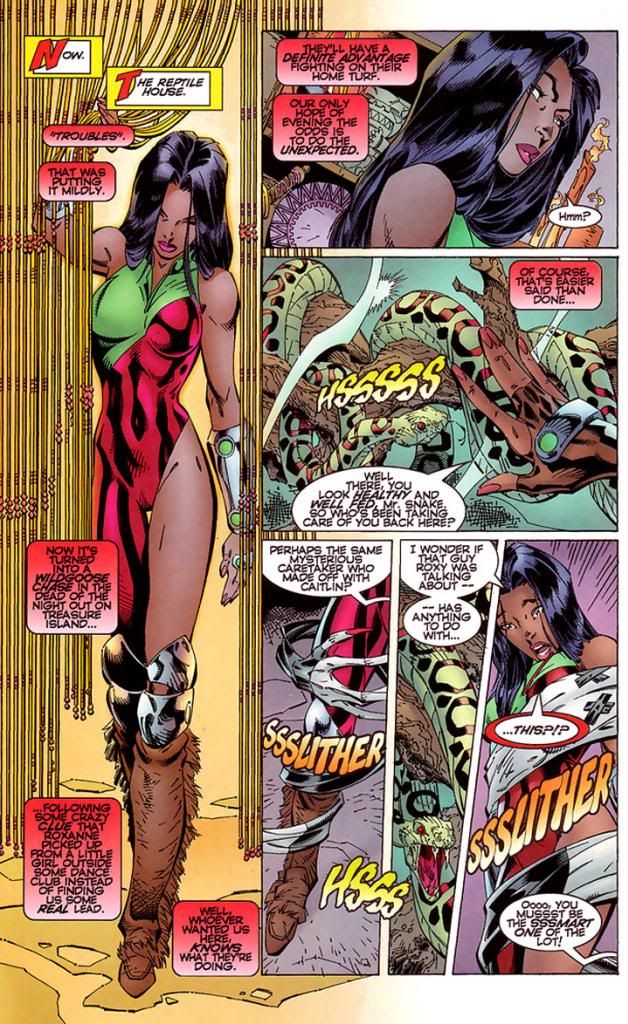
1.  Fabulous footwear.  In Marvel Graphic Novel #4 New Mutants (September 1982), Dani makes damn sure Professor X recognizes not just her individuality but her cultural heritage by accessorizing her one-size fits all uniform to something more unique.  The Gen13 kids received their own super suits right from the start, but obviously Rainmaker was paying attention when Dani set a precedent.  Because I'm about as Native American as Vladimir Putin, I have no idea how appropriate Rainmaker's boots are-- Dani is Cheyenne, Sarah is Apache and those are two distinct cultures-- but I do know when things look similar because I watched Sesame Street growing up.

Dani:

Marvel Graphic Novel #4: Script by Chris Claremont, art by Bob McLeod

Sarah:

Gen13 #8: Script by Brandon Choi, Jim Lee and J. Scott Campbell, art by Campbell and Alex Garner... or Richard Friend!

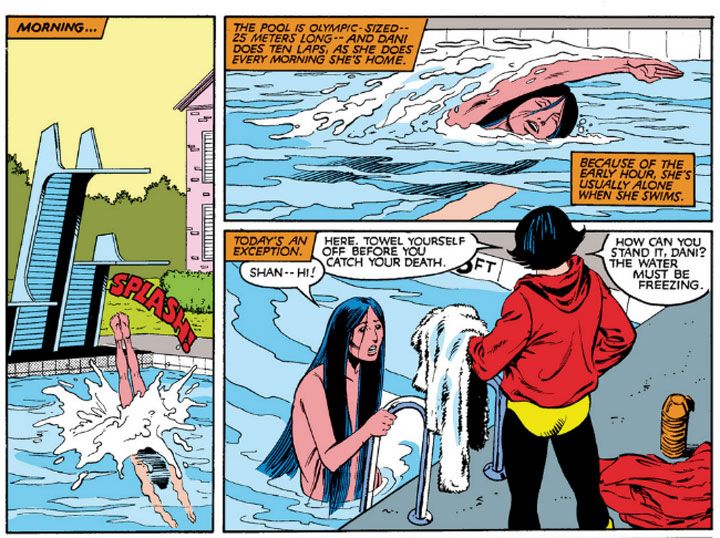
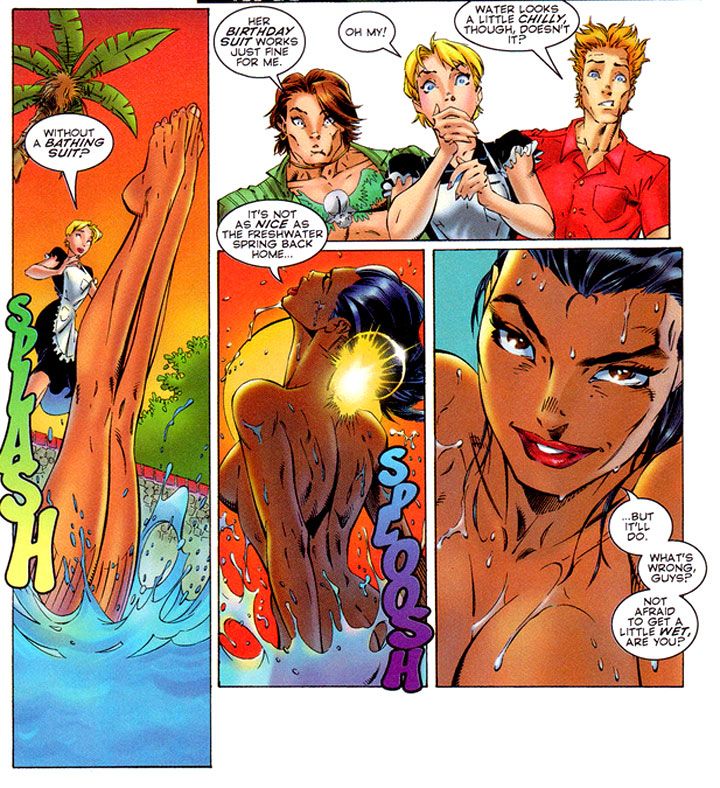
2. Swimming nude.  Dani makes a point to swim au natural in New Mutants #3 (May 1983) and Rainmaker follows (birthday) suit in Gen13 #1 (March 1995).  Chris Claremont treats this moment seriously and tastefully and it leads to a revealing (personality, not body) moment between Dani and her friend Xi'an Coy Manh where they bond and we get to know both of them better.  When Rainmaker takes a dip, Choi and Campbell play it as a striptease and while we do get to know a little more about the cast from this (Sarah likes to show off, the guys are pantingly hetero-sexist), the characterizations are roughly at the level of a beer commercial.

Dani:

New Mutants #3: Script by Claremont, art by McLeod and Mike Gustovich

Sarah:

Gen13 #1: Script by Choi and Campbell, art by Campell and Alex Garner... or Sandra Hope!

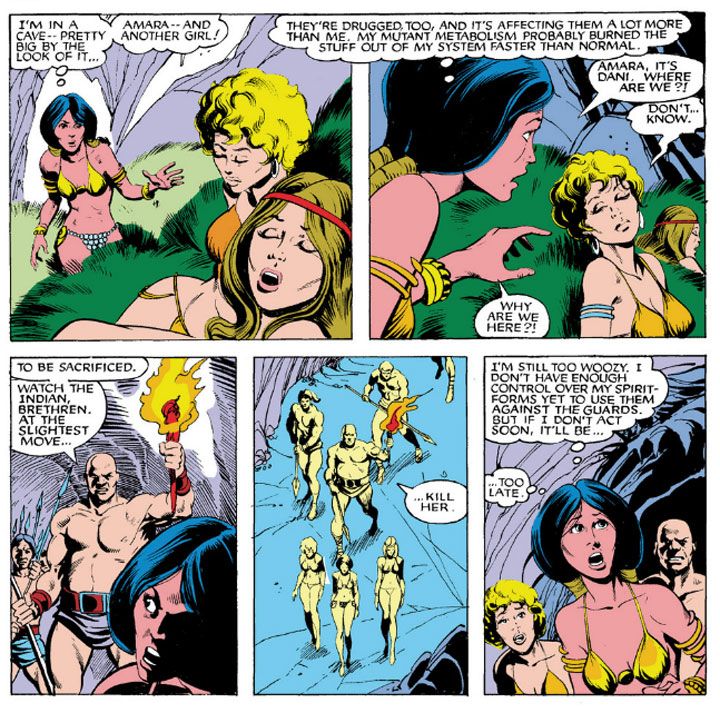
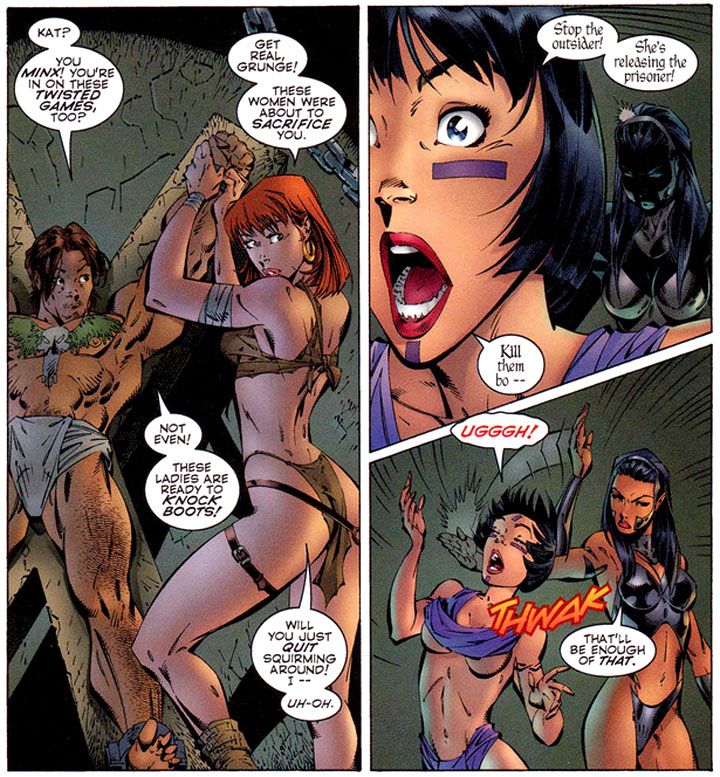
3.  Jungle adventures with anachronistic cultures that result first in wearing rags and then even more revealing outfits.  In New Mutants #8 (October 1983), the kids travel to the Amazon rainforest, have a lot of misadventures in which Dani first has to wear a swimsuit and then torn clothing.  When she and the rest of her team end up in Nova Roma, a hold out from the days of Imperial Rome, they adopt cultural-appropriate clothing.  Then a sorceress shows up and tries to sacrifice Dani, which requires her to wear a chain-mail bikini outfit stolen from a Red Sonja comic and then a low-cut evil sorceress gown.  When the Gen13 gang takes a similar journey to Africa in issues 3 through 5 of their comic (July-October 1995), they come across an all-female society of supermodel Amazonians who favor skimpy metal swimwear of their own.  Rainmaker quickly goes from ragged prisoner to shiningly metallic masturbatory fantasy warrior before you can say "Psyche-Mirage-Moonstar-Spellbinder-Dark Rider."

Dani:

New Mutants #10: Script by Claremont, art by Sal Buscema and Tom Mandrake

Sarah:

Gen13 #5: Script by Choi, Lee and Campbell, art by Campbell and Garner, Friend and Scott Williams 

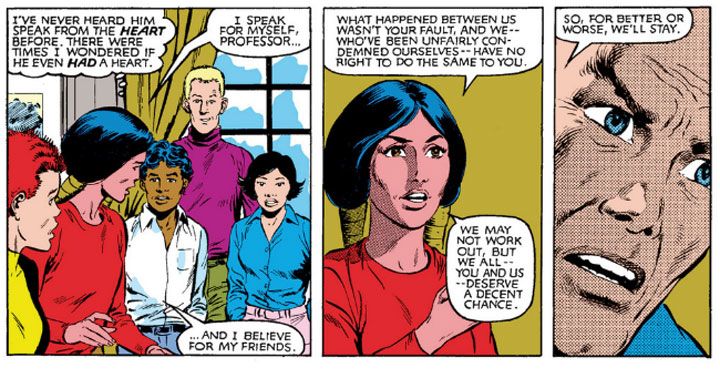
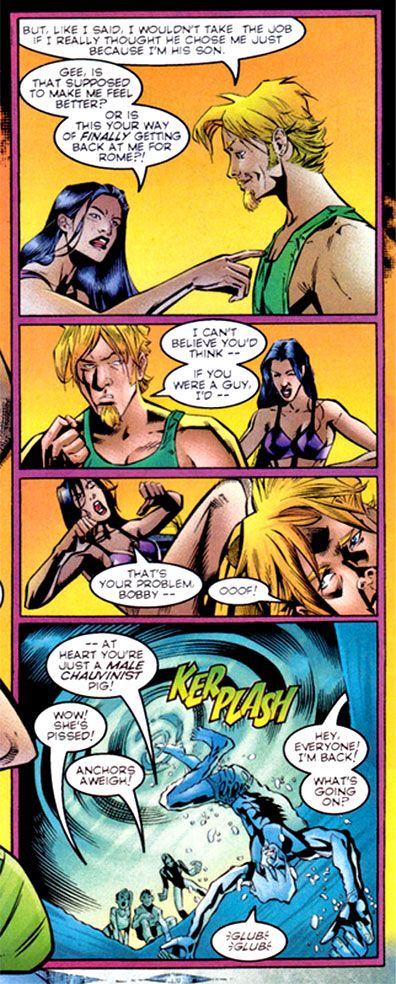
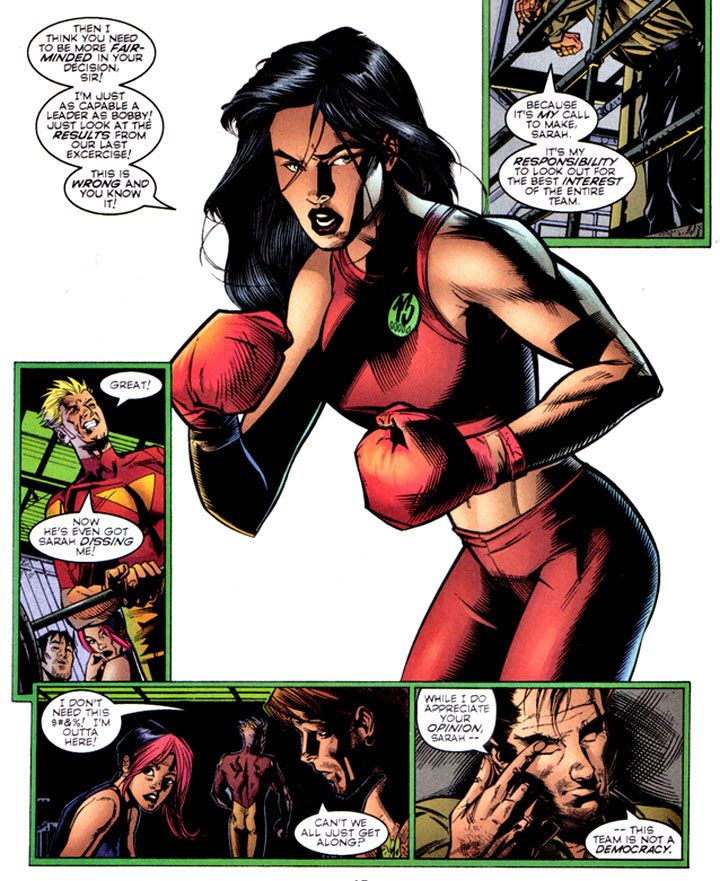
4.  That leadership thing.  Despite being a year or two younger than Sam Guthrie, the more capable Dani quickly takes over the top spot in the New Mutants team after first leader Xi'an Coy Manh goes missing.  In fact, she's already pushing Xi'an out of the top slot as early as New Mutants #4 (June 1983), with her friend standing right beside her!  When leader Caitlin Fairchild temporarily quits, Rainmaker makes an attempt to do the same in Gen13 #12 (August 1996), only to have mentor John Lynch (supposedly this ultra-tough black ops veteran) appoint his own dopey son over the smarter, more mature and combat-skilled Rainmaker in what's obviously a decision based solely on nepotism.  Burnout has shown absolutely zero leadership skills to that point, and kind of a mopey, shrinking-violet personality, while Rainmaker's intelligence is second only to Caitlin's, plus she's much wiser and more self-assured in many ways.  No wonder she reacts unfavorably to Lynch's completely illogical move (although in Lynch's defense, he may be pitting the two against each other in a "survival of the fittest" competition-- although that could also wreck team morale and field effectiveness in the long run as well, so maybe he is an idiot after all).  This also positions Sarah as the Dani-style team rebel.  In the same vein, both characters seem to have an innate talent for combat tactics, as well, with the New Mutants becoming more of a fighting force to be reckoned with under Dani's command, and with Sarah frequently barking out orders of her own during the many confrontations in Gen13.

Dani:

New Mutants #4: Script by Claremont, art by Bucema and McLeod

Sarah:

Gen13 #12: Script by Choi, Lee and Campbell, art by Michael Lopez and Troy Hubbs (I think) 

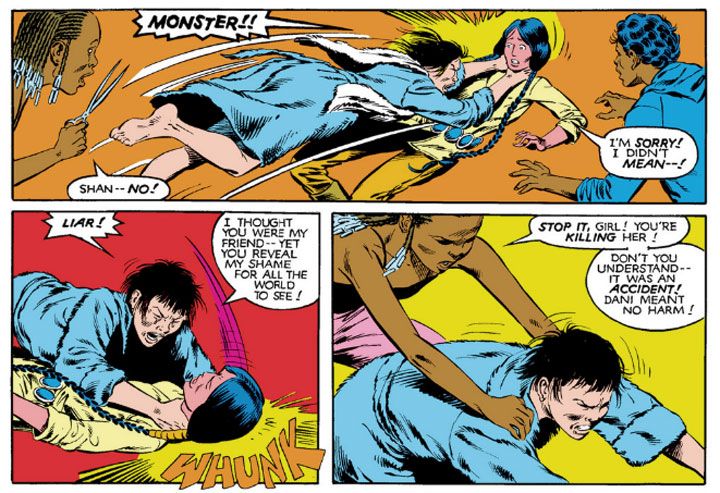
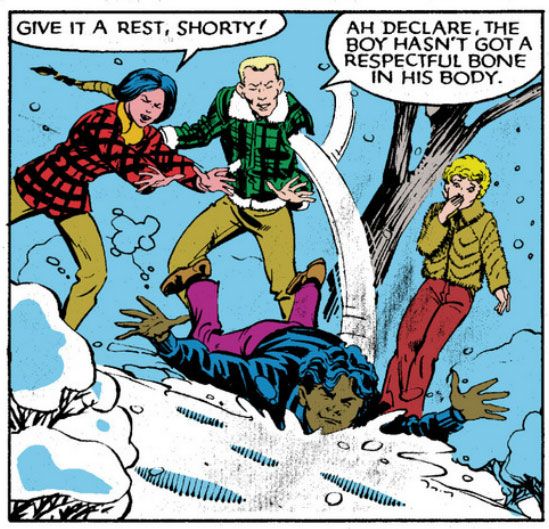
5.  Tussles with teammates.  I seem to remember Dani doing this a lot more, but I must be more than a little mixed up and fully conflating her with Sarah at this point.  I'm surprised Dani didn't beat up those two idiots Sam and Bobby two or three times a day with that temper of hers.  Instead, she seemed to take out her aggressions more on inanimate objects.  And despite frequently referencing the martial heritage of her Cheyenne people, she wasn't all that adept at fighting.  Oddly enough, in New Mutants #1 (March 1983), it was Xi'an who first went fisto-a-fisto with Dani-- well, actually, she choked the hell out of Dani and slammer her head against the floor with good reason: Dani had accidentally used her powers to pull images of her Xi'an's violent, tragic past out for all to see.  While the New Mutants had their share of inter-team arguments, it would be more than a year later, in New Mutants #14 (April 1984), before we'd see another instance of Dani-on-friend violence, this time a playful shove into the snow for Roberto DaCosta.  Sarah, on the other hand, goes full on kung fu queen on Bobby Lane after he made a poorly-timed snide remark at her expense during their leadership crisis. It happens in Gen13 #12.

Dani:

New Mutants #1: Script by Claremont, art by McLeod and Gustovich
New Mutants #14: Script by Claremont, art by Buscema and Mandrake

Sarah:

Gen13 #12: Script by Choi, Lee and Campbell, art by Lopez and Hubbs (I still think)

Okay, now I'm obviously reaching.  But I believe I've made my point-- there are certainly parallels, enough so Sarah Rainmaker became my favorite Gen13er.  What's been fun for me looking for these little moments is contrasting the writing on both series.  While Claremont's dialogue is sometimes stilted and a bit advanced for his characters' ages, his stories and characterizations are nothing if not sincere.  He genuinely cares about his cast and immersing the readers in their world.  Plus he displays the literary chops of a true writer's writer, someone in love with language.  If any of his work here is derivative, it's of real life or novels.  And occasionally movies.

By comparison, the Gen13 characters-- scripted by no less than two writers at a time!-- usually speak casually and naturally (unless there's need for some hard expository dialogue, that is). Actually, their dialogue is almost exclusively made up of then-current catchphrases and youth lingo.  While as individuals they're amusing enough, they're more tongue-in-cheek, broadly-sketched types owing most of their personalities to television shows and other comics (and not just New Mutants).

There are some interesting comic book characters in Gen13, but it would take other writers to flesh them out into real characters, especially under Warren who managed to make the book as smart as it was funny and sexy.  And, oddly enough, that's when the Gen13 finally died.

Wednesday, October 9, 2013

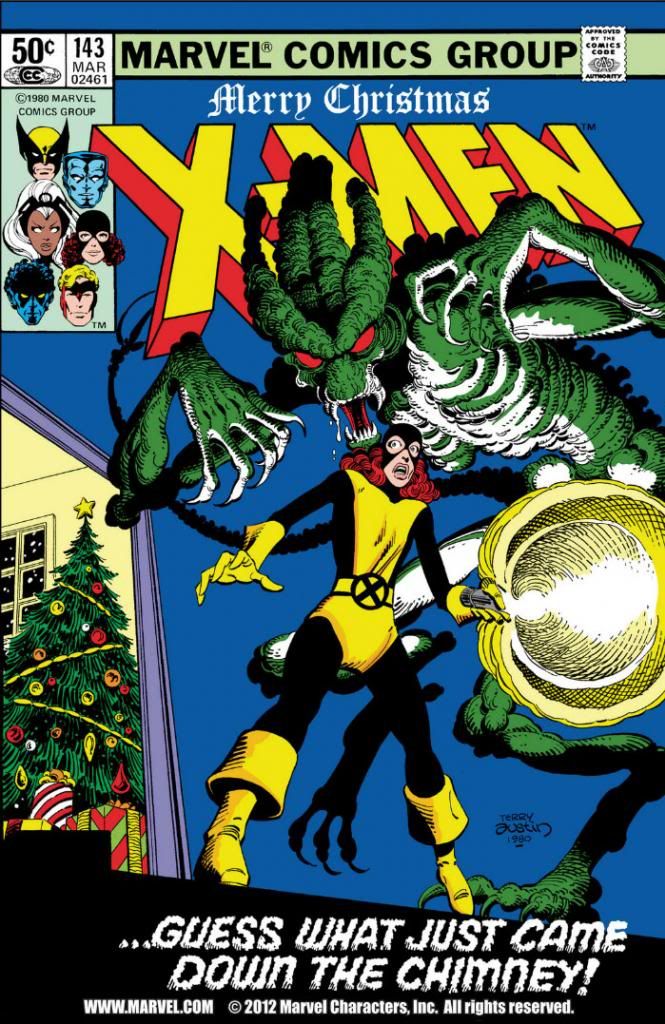
October is Spookey Month: Uncanny X-Men #143 in which Kitty Pryde recreates the movie "Alien" just for kicks

Remember the N'Garai, the H.P. Lovecraft-inspired smoke demons led by that big, energy-draining jerk Kierrok?  One September afternoon and/or evening, they gave the X-Men a lot of trouble until Storm blew their stone cairn apart with a lightning bolt and sent them back to whatever hell-space they crawled out of.  Flash forward a few years and intro Kitty Pryde to the book. 

One Christmas Eve the rest of the gang leave her home alone, just like in that fun holiday movie about being left home alone.  The title escapes me.  Oh yeah-- It's a Wonderful Life.  Unknown to everyone but Chris Claremont and John Byrne (those scamps!), it turns the portal to the N'Garai dimension is still slightly ajar.  One of them, or a close relative, pops out, having visited Swiss surrealist H.R. Giger for a makeover sometime during the intervening years.  The first thing the new, Alien-style N'Garai does is shred an unfortunate couple out poaching a small Christmas tree for their apartment.  Then the poor, lost little demon, as lonely and in need of companionship as Kitty, goes looking for a friend.  After all, it's no fun to be by yourself during the holidays.  Kitty knows this, because this is the first Chanukah she's spent away from home herself.  Unfortunately, thanks to various cultural differences, things don't go the way the demon planned.  Kitty is less than appreciative of its presence, they don't get along, there's a misunderstanding, a fight and a blast from a white-hot jet engine.

This story, called simply, "Demon," ran in Uncanny X-Men #143 (March 1981) a pretty minor work compared to the galaxy-spanning drama that made up the recently-concluded "Dark Phoenix Saga," and it lacks the influence of "Days of Future Past," which took up the previous two issues  It's kind of the Claremont-Byrne team's last little laugh before the team split, and from its title to its monster and most of its plot, it's openly cribbed from Ridley Scott's sci-fi/horror masterpiece.  You know, White Squall.  Claremont must have enjoyed using Scott as much as he did H.P. Lovecraft in the prequel to this issue; he'd later re-homage Alien with his Brood creatures,a kind of otherworldly insect species with a life-cycle that resembles a toned-down version of the Giger creature's.  I don't know if Byrne tried again.  He seemed to content himself with mining Marvel's own history for ideas when he moved over to Fantastic Four as writer and artist.  And tossing in a little Twilight Zone or Invasion of the Body Snatchers for good measure-- remember that issue with the town that drank the cow-Skrull milk and turned into evil shapeshifters?  That one was disquieting in a way this one can't quite match.

The monster itself tries its best, but falls a little short because neither Claremont nor Byrne seem particularly interested in it.  Their main concern is putting Kitty through her paces and making readers adore her.

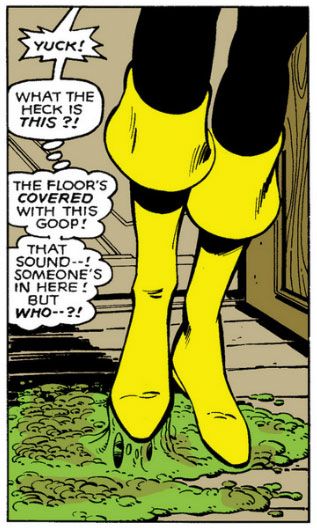
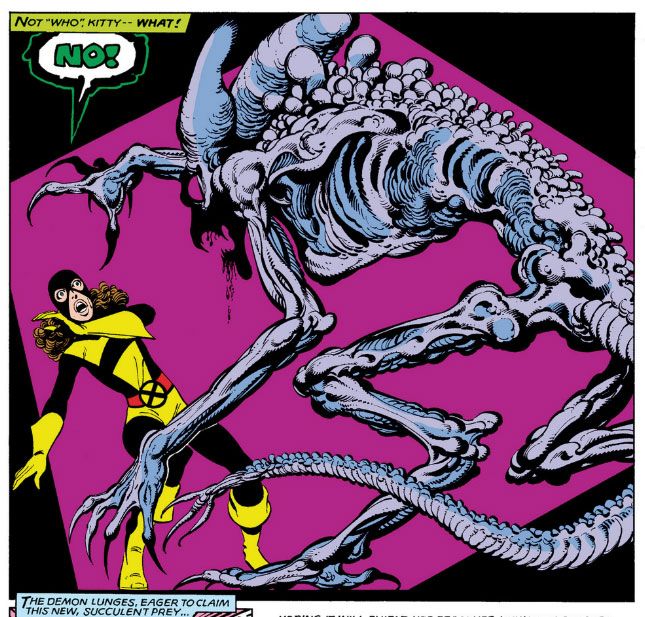
Let's examine our N'Garai for a moment.  In X-Men #96, the story makes the point these smaller demons consist of smoke, and Dave Cockrum makes them more bug-eyed.  Storm is even able to wave one of them away with her hand.  They do, however, sometimes use long spears or lances with which they can stab someone and inflict pain and perhaps drain away life force like Kierrok does with his very presence.  Claremont is almost out of pages with no time to explain it fully, and Storm herself only says something about pain and possible death if she's stabbed again.  In this issue, the lone N'Garai is definitely made up of solid matter of some kind, albeit demonic, and it uses its claws and teeth on the young marrieds before eating their bodies and their souls.  It also leaves Alien slime wherever it goes and crashes through walls.  Essentially, it's an unauthorized guest appearance by the movie monster without any of the icky bio-mechanical sexual reproduction connotations.


Confined within the pages of a single issue and the limits of what the Comics Code would approve, the poor beastie doesn't really get to cut loose and terrify us.  The chase it inspires is chaotic but not as frightening as it needs to be.  Byrne smudges Kity's face and draws some sweat droplets on her brow and Claremont has her tell us through a thought balloon she's scared but "coping," but she comes across as a bit too unflappable throughout most of the comic.

Sigourney Weaver's redoubtable Lt. Ellen Ripley-- for whom Kitty acts as a stand-in and occasionally physically resembles here-- is self-possessed throughout the majority of the film, but frazzles during her frantic escape attempt.  Then she just about loses her shit when she discovers she's accidentally taken the alien with her in her little life pod before she pulls herself together.  Weaver's iconic performance helps, as she's able to convey both Ripley's palpable fear and her agency simultaneously.  This crucial element is missing in Uncanny X-Men #143, despite the tear in Kitty's eye in one close-up.  Also, we haven't really seen the demon do a whole lot beyond kill two people-- both taken by surprise and, as civilians, without even Kitty's ghostly phasing powers-- and a room full of plants.

The story comes close to its full  Alien-esque horror potential when the creature jumps out at Kitty and slashes through her, causing her pain and the temporary loss of feeling in one arm even though she's in her incorporeal "phase state," and in the hyper-kinetic Danger Room sequence as well, but  there's no real feeling Kitty's in serious jeopardy.  After all, this entire issue is more or less a love letter to her, so we seriously doubt from the get-go Claremont and Byrne plan to kill off this kid so soon after the start of her comic book career.

So what we're left with is more a puzzle situation, and the interest is in watching how courageous and clever Kitty solves it.  Which, I suppose, makes it kind of akin to one of those Quinn Martin detective shows.  Barnaby Jones or something.  We see the criminal commit the crime right at the outset and instead of a whodunnit, we get a how-solve-it.

Speaking of how Kitty solves things-- well, if you've seen Alien, you know how it all ends.  Byrne even borrows heavily from the film's visuals to show it, a kind of acknowledgement of just how baldly he and Claremont are riffing on Scott.  To set it up, there's a neat bit of foreshadowing right at the start when we see Professor X teaching Kitty how to start the Blackbird.  I find it really fun to see a young hero's education in process, and who would have thought the day's lesson would pay dividends so quickly?  This premise-- how superheroes learn to be superheroes within a school setting-- is a lot more interesting to me than the demon/Alien stuff.  It's a precursor to The New Mutants and it's almost as if we're watching Claremont inspire himself along those lines, with the genesis of that series appearing right here on these pages.

The weirdly saccharine denouement also foreshadows Claremonts of future past when the team returns to the mansion only to find a tired but otherwise unshaken Kitty sipping hot cocoa in front of the fireplace.  That's right-- she has barely escaped death or even worse at the demon's claws, has no way of knowing if this was a one-time event or the harbinger of a full-scale monster invasion, isn't expecting anyone home for hours... and Claremont has her drowsily lounging about in her robe, as if nothing at all out of the ordinary had happened.

Okay, so Kitty's much tougher than I'd ever imagined, and she's recently returned from the future where she watched everyone die, but don't you think almost being killed by a demon warrants some kind of emotional response beyond the slight embarrassment one gets from denting the family car?  And even if Kitty is too cool to worry, you'd think the older superheroes who almost died fighting Kierrok and supposedly have years of combat experience would do some kind of reconnaissance or go into a defensive posture on the chance there are more demons or enemies lurking around.  They don't even spend much time trying to debrief Kitty.  Storm just gives her the concerned mom act.  After all the mayhem, it turns out nothing more is at stake here than in any given episode of Facts of Life.


This comes dangerously close to making the whole "spunky teen girl joins the team" aspect insufferable.  I guess my tolerance for this stuff was a lot higher when I was Kitty's age.  The New Mutants, which came out a mere year or two later, would consist almost entirely of this kind of tonal dissonance, and I ate it up.  And still do, but then my outright hero worship-love for Dani Moonstar has always overshadowed my liking of Kitty Pryde.  As it is here, everyone's muted reaction further undermines any peril Kitty might have been in earlier in the story and reveals a Claremont a little too in love with his cast.  While it's nice to show Kitty as a teen character able to pull herself together and save herself (a trait she's going to need when the team rockets into space or faces down Dracula himself later on), if you're going to take your superhero story the sitcom route, a better, more appropriate gag for the ending would have been the team coming back to find a pumped up Kitty toting around a baseball bat or that M16 rifle Moira MacTaggert used on Kierrok when these demons first appeared.

And one more thing, gosh darn it-- it's really too bad this wasn't set at Halloween.