Showing posts with label Tokyo. Show all posts

Wednesday, February 19, 2014

Uncanny X-Men #172 and #173: Bad News Mutants in Breaking Training So They Can Go To Japan... Yet Again!

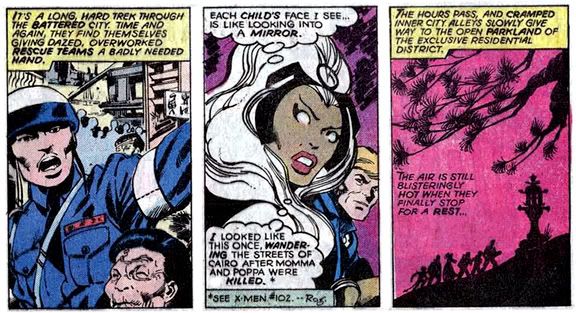
As anyone who's read this blog knows, I live in Japan and I love American comics with this country as their setting.  Imagine my delight when Comixology delivered up Uncanny X-Men #172 (August 1983) and #173 (September 1983), a couple of thrill-filled Nihon-centric issues originally delivered right to the mailbox of my childhood home and featuring a glimpse of my current home, Marvel-style.

Come to think of it, Uncanny X-Men writer Chris Claremont may be one of the reasons I moved here.  If so, I owe him a huge debt of thanks not just for the entertainment his writing provided me when I was kid about Dani Moonstar's age, but also because here in Japan, I live a life every bit as exciting as Wolverine's.  Okay, not really.  I'm boring.  I've only fought ninja or Yakuza thugs on rare occasions, and only once did I love and have my heart broken by someone as regal and unattainable as Lady Mariko.  I'd love to tell you all about it, but we have important things such as comics to discuss!

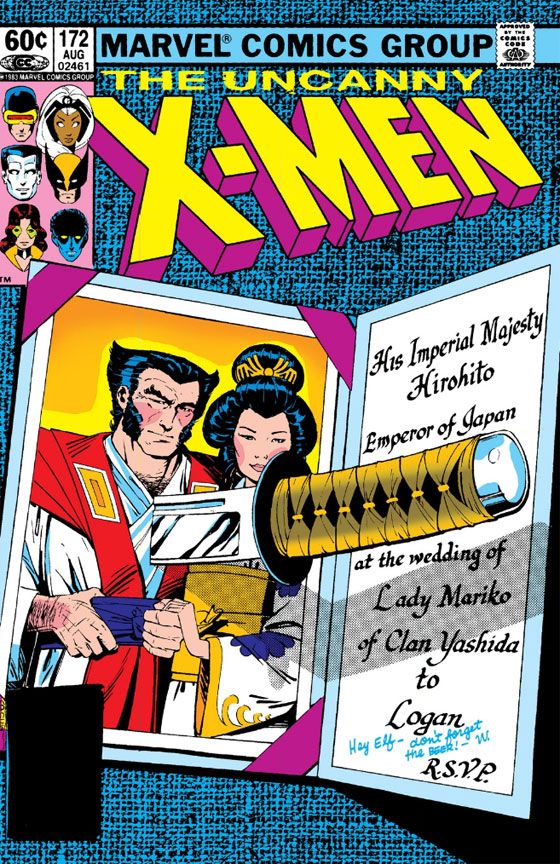
It's been years since I last read these two issues.  I plan to give them my full literary attention someday, but for now we're going to confine our discussion to Smith's images of Japan and bits of narration and dialogue in the pages I chose to illustrate this blog entry.  Just from looking at these very pretty pictures, I can tell this story is a direct sequel to 1982's four-issue Wolverine miniseries by Claremont and Frank Miller.  Wolverine Miller's influence runs all throughout their visuals, so much so the cover to #172 features the invitation Wolverine sent his friends at the end of Wolverine #4.  Paul Smith recreates Miller's original image, and even includes the cute handwritten little note from Wolverine to Nightcrawler about bringing beer.

"His Imperial Majesty Hirohito, Emperor of Japan."  He is now referred to as the Emperor Showa, and if you want to place this book within its era here in Japan it would be the Showa 58, the 58th year of the Showa Era.  Imagine receiving an invite from an emperor!  That is one heavy-duty invitation.  Lady Mariko, Wolverine's fiancĂ©e, is from a powerful family, apparently.  I love the fanciful Miller-designed attire the loving couple wear in the photo, too.

By the way, beer is readily available in Japan and has been for quite some time, so either Wolverine means bring any decent local brand Nightcrawler can pick up at a convenience store on the way to the ceremony or else pack in his suitcase some favored Canadian label he can't get there.

For this story, Claremont and Smith don't waste any time with flights or airports.  They immediately open with a "widescreen" cityscape and tell us it's Tokyo.  Certainly looks like Tokyo to this ex-pat.  Smith appears to have used a high-contrast photo paste-up to create this image, so what we have is a very convincing night view of the huge concrete and steel electrified wonderland we call Tokyo.

Then we zoom in for a closer view to establish exactly where in...
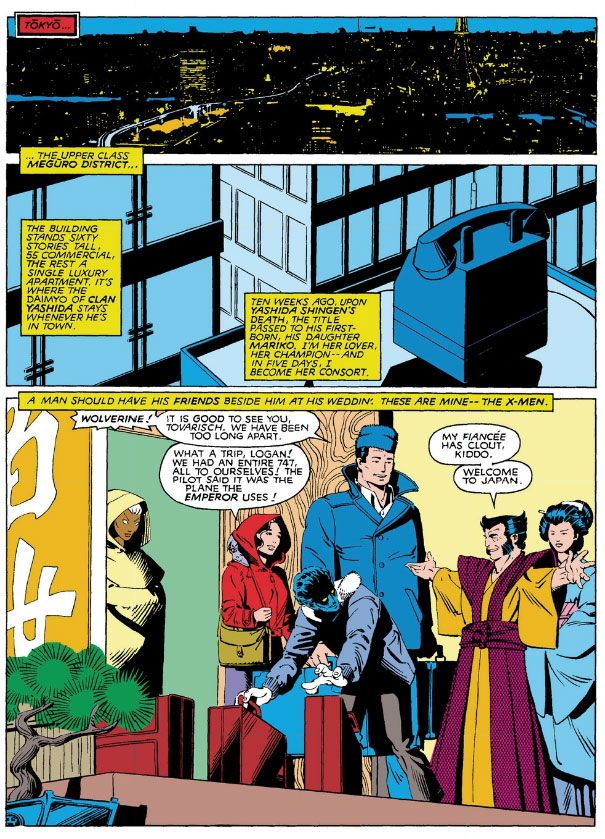
Uncanny X-Men #172 (August 1983), script: Chris Claremont, pencils: Paul Smith, inks: Bob Wiacek


And there it is!  That telephone-topped building again!  Frank Miller used it in Wolverine, Jim Aparo followed suit in Batman and the Outsiders.  Al Milgrom would also draw it in Kitty Pryde and Wolverine, yet another sequel to or continuation of this storyline.  In this issue, we get to see Smith's super-clean rendering of same. 

Was this telephone an actual Tokyo landmark?  I've been researching this online, but either it wasn't so special people have memorialized it or else it's a figment of Miller's imagination.  Even if this is the case, I think a Tokyo building with a big telephone on top is much more plausible than the existence of a Frank Miller movie that doesn't make Ed Wood weep the tears of artistic validation.  Tokyo is the place for all kinds of outdoor advertisement.  I don't know of any building currently topped with an old-fashioned telephone, but I do know of one topped with what the locals refer to as the "Golden Shit."  It's supposed to be a droplet of beer.  I have to agree with its more scatological nickname.

Anyway, you know you're in 1980s comic book Tokyo if you see the giant telephone.  You know you're in today's real Tokyo if you see a big, gilded turd.

Meguro, as Claremont informs us here, in the voice of his character Wolverine, is indeed an upper class district.  Celebrities and the like live there in expensive high-rise apartments.  It's just the place Mariko's family, the Yashidas, might maintain in Tokyo for their visits there.

Since this is an adventure comic, most of the outdoor scenes take place on the rooftops of those apartments, at night.  That's where the ninja sneak around so they can disrupt wedding plans when they take a notion to do so.  Wolverine and his pal Nightcrawler are pretty good at sneaking around up there, too.  As is Wolverine's erstwhile lover, the thrill-crazed Yukio.

Well, kind of...
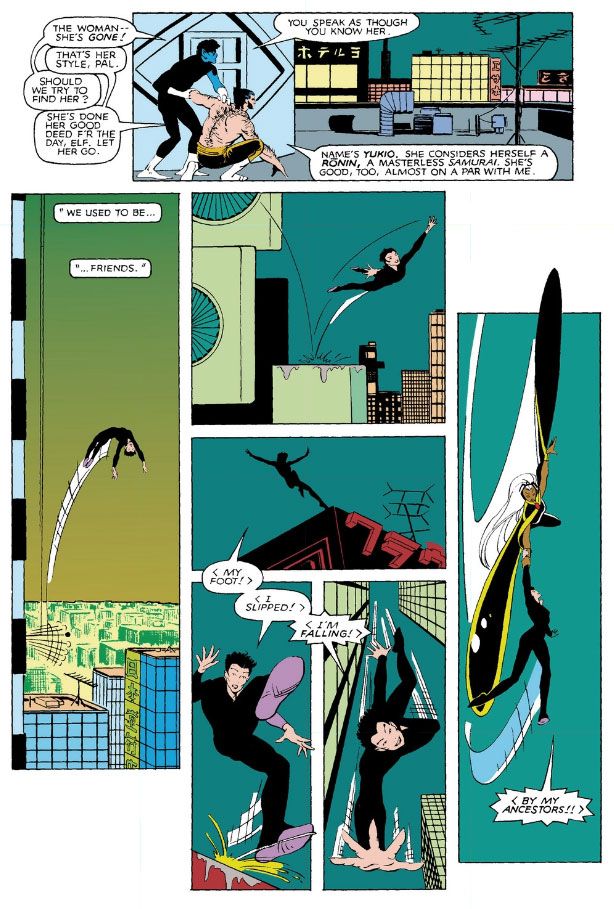
Uncanny X-Men #172, Claremont, Smith, Wiacek


"I slipped!"  That would have been a pretty stupid way for Yukio to die, huh?  Lucky for her, Storm was out flying around.

As you can see from this page, Smith constructs his buildings very simply.  Even so, he and inker Bob Wiacek toss enough katakana or hiragana up and down their sides to make things convincing.  His kimono-clad women are the real visual draw in this story.  There's something about the Smith-Wiacek clean-line look, with things pared down to sleek minimalism that goes well with traditional Japanese clothing.  It also helps that Smith and Wiacek draw amazingly beautiful women.  Unfortunately, they also tend to draw them so they resemble each other, except for Yukio and her punk-rock hair.  Smith and Wiacek give her a face with more sharply defined cheekbones and it individualizes her.
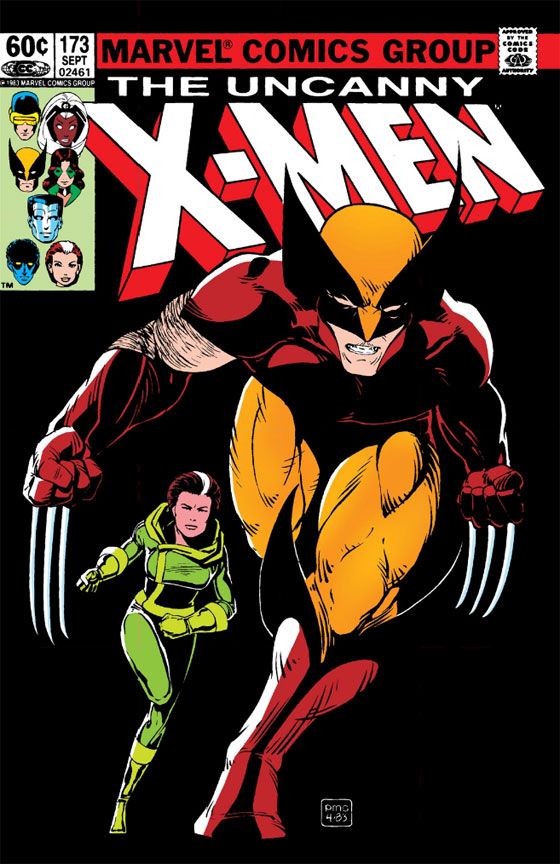
The fun extends to the next issue where Wolverine reluctantly teams up with new team member Rogue to fight the villains.  As I've said, I haven't re-read these in detail, so all I know about the plot is the Silver Samurai and Viper want to stop Lady Mariko from marrying Wolverine.  And Storm debuts her Mohawk after hanging out with Yukio.  No doubt spending any amount of time with someone as uninhibited as Yukio would inspire you to drastic style changes.  We'll get into all of this in the future, but for now you don't really need to know the specifics to enjoy our Claremont-Smith travelogue.

Uncanny X-Men #173, the story starts in "the Ginza."  Claremont has Wolverine tell us guide books recommend "the Ginza" for a "good time."  Wolverine's idea of a good time is getting drunk and into a bar fight.  So that's where we find him. 

I really think Wolverine has read the wrong guide books, because Ginza (minus the definite article) is more a shopping area.  And not just any shopping area.  Ginza is where the rich go to drop the big money on Rolex watches, Chanel and Louis Vuitton couture and bags and other luxury goods, many of which cost more each than I make in a month.  There may have been dive bars there in the 1980s.  There may be now.  But I doubt it.  I rather think Wolverine's destination of choice would be the wilder, woolier environs of Golden Gai in Shinjuku's Kabuki-cho neighborhood.

That's where I went when I wanted to pretend to be Wolverine and act all tough.  Whenever I told people I hung out in Kabuki-cho, they'd smile and shake their heads and tell me, "Don't go there!  It's dangerous!"  Dangerous to the tune of the thousands of yen you blow in the kinds of bars Wolverine would more than likely spend his nights. 

No one has ever said anything like that to me about Ginza.  They just told me to go to this famous chocolate shop, which I could never find the one time I tried, way back in 2008.  I did find a toney toy store selling Indiana Jones and the Kingdom of the Crystal Skull actions figures, the ones with amblyopia.  Some Wolverine, huh?

If you take a closer look at that first vertical panel, notice how Smith includes a puddle in the gutter.  Nice work on the reflections there.  It rains a lot in Japan, so that's a little detail that goes a long way to establishing the setting's bona fides as well.  That image has an impressive sense of place.  That's the Tokyo I've seen with my own eyes.
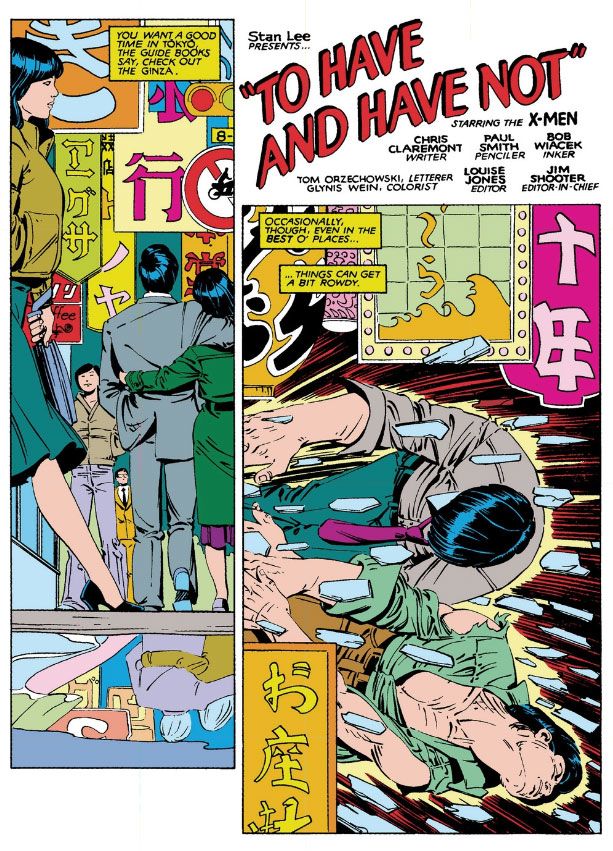
Uncanny X-Men #173 (September 1983), Claremont, Smith, Wiacek


I'm not too certain about those guys Wolverine's launched through the window.  He does a lot of stuff like that whenever he's in Japan.  Things like this may or may not happen here.  I have a feeling if a foreigner started tossing locals through bar windows, we'd hear about it on the NHK news.  Even more so in the early 80s when we were a rarer breed.  If I had to guess, I'd say this is a more likely to happen in Okinawa where the US military always seems to be stirring things up and causing trouble.  But then, as I've already proven, I'm not Wolverine. 

The worst incident I've ever been involved with was having a guy repeatedly scream, "Pearl Harbor say 'Fuck you!'" at our little drinking group until the bar-owner kicked us out for causing trouble.  I don't blame her.  He was a regular and we were just passing through.  I still wonder what set him off, though.  He approached us in what we thought was a friendly way.  We made small talk in Japanese and tried to use the little abdomen exercise wheel when he asked.  Maybe he felt patronized, or someone said something to offend him when I wasn't paying attention to the conversation.  Perhaps he just hated whitey.  I still don't know what was in his heart.  But I do know he was drunk.

You might read worse stories from other ex-pats here and there around Japan.  Some people attract negativity and bad scenes.  I suppose I've been very lucky in all my years here.  Despite the occasional run-in with Sunfire, mine has been a smooth, laid-back kind of life.  But once again, I don't have adamantium-coated bones or a mutant healing factor.

Marvel Japan is a pretty fun place to visit, isn't it?

Sunday, December 23, 2012

Sorry I didn't get to those Isis posts!

The week before winter vacation proved busier than I anticipated, with longer days.  Circumstances didn't leave much time for watching The Secrets of Isis, much less blogging about it.  I'm on vacation now so once again let me offer you a hollow promise of fun and frivolity to come.  But it will have to wait.  I'm about to spend a few days in Tokyo.  I'll do some comic book buying while I'm there, but most of what I find will be posted on my new blog about being an American comic book fan in Japan.  That's where I plan to talk about the latest books and news, leaving this blog for the good old stuff we all love so much.  Jack Kirby, Alex Toth, Al Williamson, Dani Moonstar, classic Marvel, Dell and EC and that sort of thing.

Happy Holidays, True Believers!

Tuesday, August 14, 2012

Tokyo Comic Book Report: Japanese girls love Deadpool!

Majority of patrons that Saturday were women.
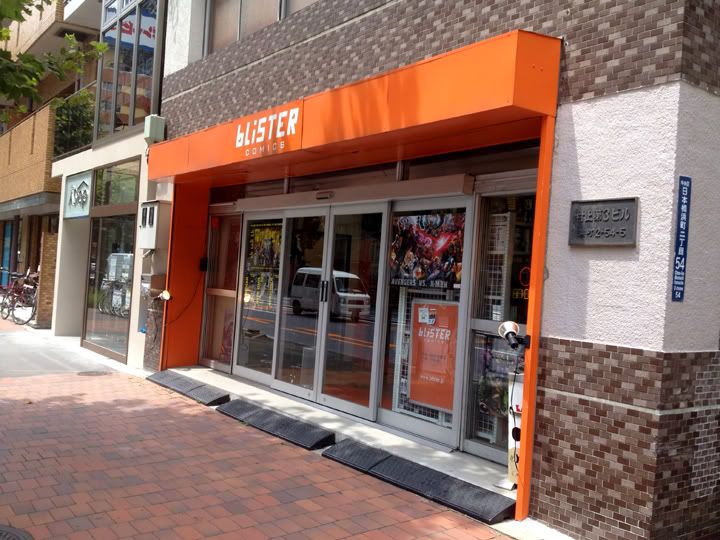
Well, to turn a generalization into something more accurate... at least one does.  When I visited Blister in Hamacho, one young woman was flipping through a Deadpool comic, cracking up and excitedly sharing various panels with her friend.  Before I left, she had in her hands a huge stack of American comics, at least one of which featured Deadpool.  So someone in Japan likes Deadpool, Marvel.  Take my infallible advice and start a huge marketing push centered on Deadpool over here and I'm sure it'll pay dividends!  Thank me with money.  You're welcome.

I'm not sure how I got the idea Blister was so difficult to reach, like a comic book Shangri-la.  It turns out it's pretty darned easy if you're staying in Hatagaya.  The subway train that takes you to Shinjuku will deliver you to Hamacho Station and from there it's about a five minute walk.  The first time I visited Blister I believe I went to a different platform in Shinjuku Station, but that was several lifetimes ago.  I've cheated death so many times since then, they all tend to blur together.

Blister's running on limited hours these days, but on Saturdays, they're open from 11am to 5pm, which gives you plenty of time to get in and browse.  The store is very cramped, and on this particular day there were six or seven other customers.  It felt crowded.  The store is heavily invested in Marvel and DC, mainstream stuff.  The going price for a brand new American comic magazine in Japan these days is 540 yen.  That's about 6.85 USD to you and me, Russ.  Blister does feature some bargain 100 yen comics in longboxes to your right as you enter.  The selection is hodgepodge and I long ago bought them out of every single Cassandra Cain Batgirl back issue they had.  None are to be had these days, but you can still buy issues of the Stephanie Brown series.

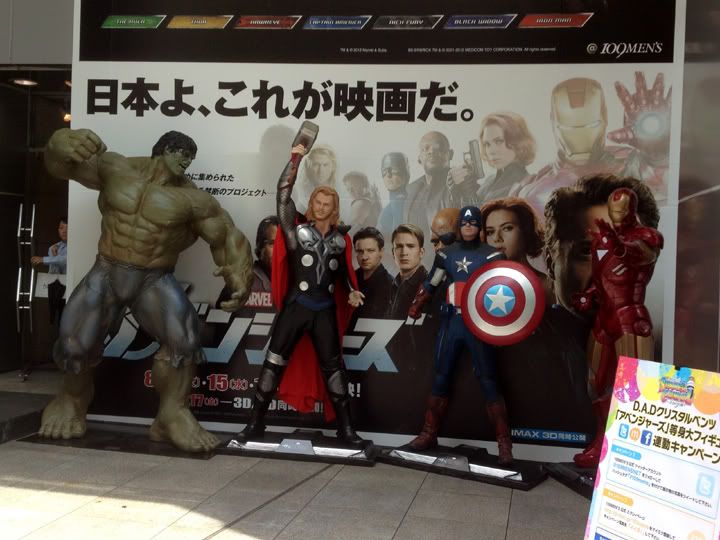
The Avengers were hanging out in Shibuya.
Speaking of Cass, I bought the very last copy of Batgirl: Fists of Fury found in the wild here in Japan, so don't look for that, either.  It cost 1800 yen (22.83 USD, quite a mark-up from the 14.95 US SRP), but it was worth it to reaffirm my position as her #1 fan in Japan.  It seems the other Cass trades like Silent Running and Death Wish are slipping out of print and going for mega-yen on Amazon.jp.  While Fists seems to be hanging in there and I could have paid 500 yen less for it online, the trouble I've had getting things like Showcase Presents Batman and the Outsiders 1 and New Mutants Classic Volume 1 means snap it up if you see it.

Besides the Cass book, I also bought Astonishing X-Men #52 (because it has a neat Xi'an Coy Manh cover), Conan #32 (a random choice because it was 100 yen and I still enjoy Kurt Busiek's run on that title), Conan the Barbarian #2 and 3 (more Dark Horse, love Becky Cloonan's art), Minutemen #1 and 2 (the pull of Darwyn Cooke proved too strong to resist), New Mutants #46 (more Xi'an, but this time with Dani Moonstar, also irresistable) and Walking Dead #100 (Robert Kirkman and Charlie Adlard-- this is the second time you've scarred me with a single horrific image!  I nearly barfed!).  No Dark Horse Presents, so no new Nexus.

Blister is stocked deep with Before Watchmen titles.  I only wanted a sample, so I didn't catalog everything they had, but I think I could have bought the entire run up to current if I'd been so inclined.  Good runs of the New 52, if you're into that.  Heavy on the Marvel mutant stuff.  They also have a lot of trades and collections, plus just about every Avengers movie action figure you could want, along with The Dark Knight Rises stuff.  The guy working the cash register was friendly enough, but we didn't chat due to the language barrier.  I think he recognized me from my last visit there, way back in 2010.  Now that I know an easier way to get there I could see myself patronizing Blister a bit more if I lived in Tokyo.  Maybe they could order more Fantagraphics and Dark Horse stuff for me, too.

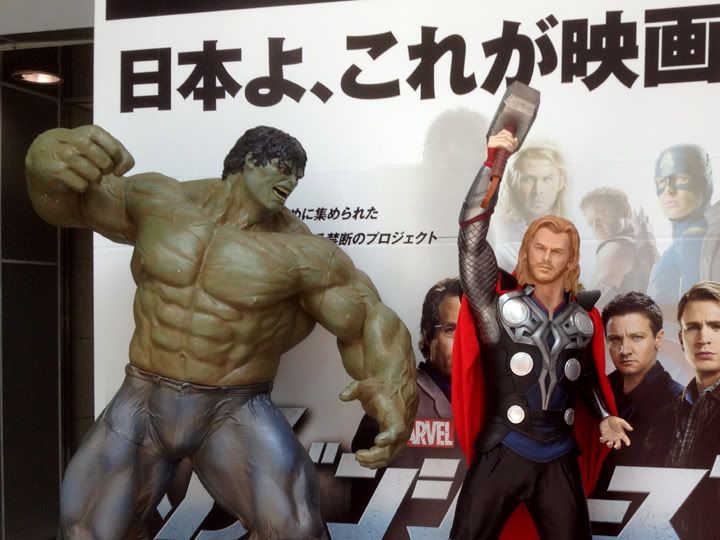
Probably jet-lag, but Hulk really wanted to punch Thor.
My other comics-related activities included visits to Tower Records in Shibuya and Kinokuniya in Shinjuku.  Tower Records was having a major sale in their English-language book department so I snapped up a few bargains.  Now, Tower Records stocks a lot of Fantagraphics titles, but they seemed kind of depleted.  Coupled with the close-out type prices on other books, I'm wondering if they're overhauling things or getting out of the business.  That would truly be tragic because Tower Records has been a Tokyo destination if you want groovy things by Los Bros Hernandez, Peter Bagge and the like.

At Tower Records, I bought Lone Wolf and Cub volumes 4 (783 yen, marked down from 1565, or 9.93/19.85 USD), 19, 20, 22, 23, 25 and 26 (290 yen each, 3.68 USD).  I was tempted to go back and clean them out entirely.  I also found and bought a shelf-worn copy of Showcase Presents Batman and the Outsiders 1 (2573/32.64).  See what I mean about snap it up?

Kinokuniya has a very small section for Western comics, but it was there I managed to find and buy the elusive Perla La Loca (receipt lost, price unknown, a pearl of great value to me) to complete my Locas collection.  I'd ordered it months ago from Amazon.jp, but kept getting messages that it was delayed.  This was the only Love and Rockets book they had in stock, so apparently it was meant for me.  And now we are together at last and all is right in the comic book world.

Wednesday, August 8, 2012

Comic book quest... begins!

I'll be gone for a few days.  I plan to find Blister, the comic book/toy store hidden somewhere in Tokyo.  I've been there before.  Come to think of it, it may not be open.  Well, here's hoping.  Wish me luck and all that.  My goal is to buy the new Dark Horse Presents with Nexus.  If I can accomplish that, it will be worth the heat, the humidity and the broiling sun of Tokyo in August.

If you want my advice-- stay out of Tokyo in summer.  Go in spring or fall.  I'm just not that bright.

Tuesday, October 25, 2011

2nd Annual Spookey Month: Enjoy some Japanese horror shorts because I don't feel like writing some long, involved post about Halloween today!


That's a pretty lousy elevator. I don't think I'd enjoy riding that one, either. I rode some creepy elevators during my time in Japan, but I was lucky in that I never had that poor girl's experience. Nice job with those English subtitles by "montecristo73returns," though. What else can we find? How about this one?


Lesson learned? Cram school sucks! Again, great job on the subtitles. But if you stay out of elevators and cram schools, you're completely safe, right?


Yikes! That looks a lot like my old apartment! Nice job, KuljeetChauhan. I have no idea where these short films come from. Shown on television? From a DVD? They're pretty cool and there seem to be dozens of them. Now... here's a movie I made. You may have seen it before!


Wednesday, June 17, 2009

Tokyo Visionaries: Images of Japan from Western Comics

As an American comic book fan living in Japan, I'm fascinated by depictions of my adopted home in my old favorites. My inspiration for living here is more pop cultural than spiritual or financial. I'm more of a live show and contemporary Tokyo person than a temple and garden type. And I'm not all that into manga or anime; I have a few favorites. No, my earliest imaginings of Japan consisted of images drawn from Speed Racer, Ultraman, Space Giants, Sonny Chiba movies, James Clavell's Shogun and-- for some reason-- Pink Lady.

As I got older, I became enamored of Japanese noise rock and street fashion, cinema and subcultures. I'd be lying, however, if I said in all of that I didn't find some inspiration from American comics and depictions of Japan found in them. These were and remain heavily reliant on Clavell-esque storylines of Westerners getting deeply involved with modern-day samurai, ninja or, in a more recent switch, yakuza gangsters seemingly born from both Michael Crichton's anti-Japanese paranoia-laced Rising Sun and Kitano Takeshi's ultra-violent films, among others-- the yakuza film is a longterm genre in Japan, just as gangster films have been in America for decades. Lots of arrogant, angry, high-strung characters like Silver Samurai, Katana, the female Dr. Light and occasional X-Men ally Sunfire, references to revered ancestors and "losing face" and "retaining honor" and life debts and all that junk...

Well, the chances of encountering genuine ninja in contemporary Japan are just about nil, and meeting up with yakuza thugs with ancestral castles only slightly more likely. But if the storylines are somewhat ridiculous, how do their visuals match up to the real thing? Let's take a look at some carefully selected examples. It's by no means a comprehensive overview because it consists only of comics I've actually read.

First up is the Chris Claremont-scripted, John Byrne-illustrated The Uncanny X-Men #118, "The Submergence of Japan." In this story, the X-people have escaped the Savage Land and traveled by the research ship Jinguichi Maru to Japan, where they find the ship's "home port of Agarashima," a fictional seaport ablaze in a fire so hot they can feel it from "ten kilometers from shore." Byrne treats us to an epic double-page splash with our heroes in the foreground, a backdrop of the devastated cityscape spewing massive, lurid red flames and billowing smoke, Air Self-Defense Force fighter jets streaking overhead and with a snow-covered Mt. Fuji off in the distance, as if gazing impassively at the destruction. The buildings are a little exotic-shaped, but it does give one a feeling of place; Agarashima, if it existed, would probably be somewhere on the southern coast of Honshu, somewhere between Shizuoka prefecture and Tokyo, an area where there are plenty of coastal cities hugged to the Pacific by mountains.

Coming ashore, the X-Men make their way through the ruins. Neither Claremont's narrative captions nor Byrne's art dwell much on travelogue, so we miss a chance to see if Byrne can match his ultra-detailed North American settings-- that counterfeiting of reality that adds so much verisimilitude to the X-Men's superheroic antics during this classic period-- with some postcard-perfect Japanese backgrounds, albeit ones crumbled by an earthquake. Byrne gives us just enough to make the setting at least seem real:

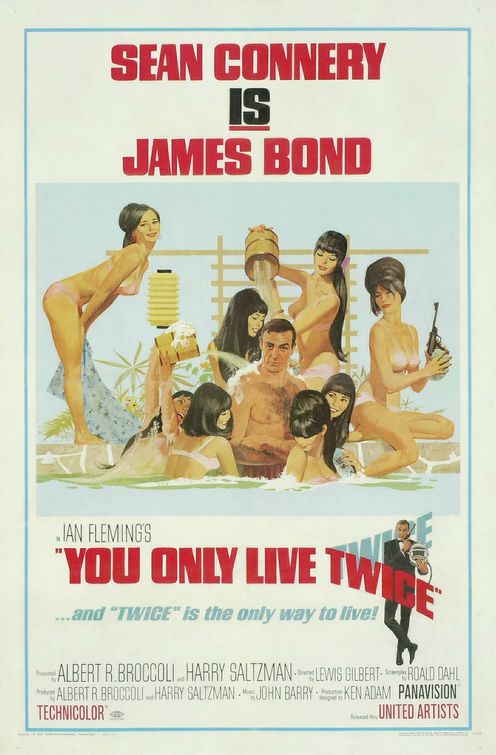
The story quickly replaces modern Japan with more James Clavell-style fantasies, and Byrne deftly draws all the shoji (paper sliding door) and wooden walkways you could desire in a comic book story before he and Claremont send their protagonists off to some secret island base to fight Moses Magnum, a nut who wants to sink Japan. Interestingly, this idea of Japan's submergence has been a theme in Japanese science fiction literature. Magnum's hideaway is right out of the 1967 James Bond adventure You Only Live Twice, also set in Japan and the poster for which carries Western sexual fetishization of subservient Japanese women to ludicrous extreme.

Sorry... I digress...

Even in such a fast-paced story, Wolverine finds time to meet and begin wooing a character who would become intrinsically linked with him, at least throughout the 1980s, Lady Mariko Yashida. He even presents her with a chrysanthemum and displays a heretofore unknown ability to speak perfectly fluent Japanese!

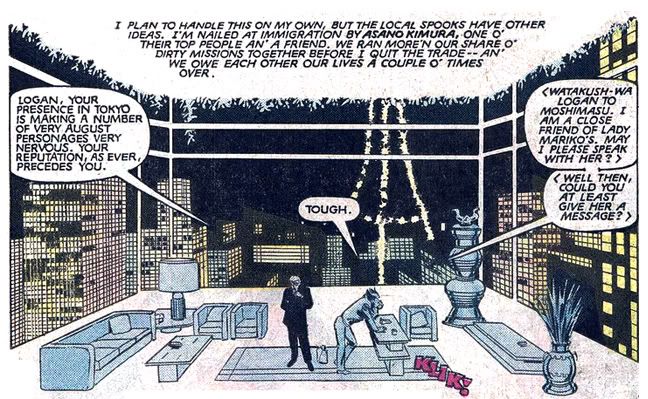
In the 1982 Wolverine miniseries, Claremont teams up with the artist most known in America for the influence of Japanese comics and cinema on his stories, Frank Miller. Together, they send Wolverine on a very Bond-like adventure in a modern day Japan practically overrun by crazed ninja assassins. This story is like a compendium of the American popular mythologizing of Japanese culture-- all samurai honor and Asian exoticism but set against the sleek electric cityscapes of the late 20th century. Clavell meets William Gibson, with Sonny Chiba as interlocutor.


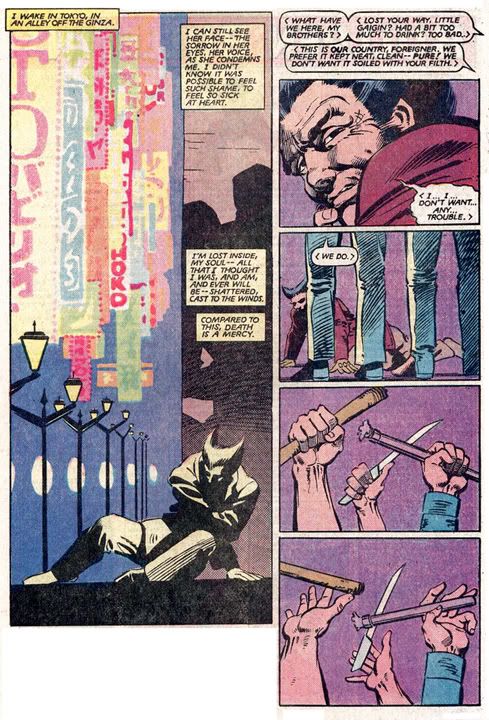
In this image, Wolverine has checked into either an upscale apartment or the fanciest hotel on earth. It appears to be in Minato ward, because that's Tokyo Tower in the background. Minato is home to Roppongi and Roppongi Hills and in places is pretty much the skyscraper forest Miller illustrates here. Later, Wolverine finds himself drunk in an "alley off the Ginza." Ginza is a shopping district within the Chuo ward. I've never heard it referred to as "the Ginza," but who knows?

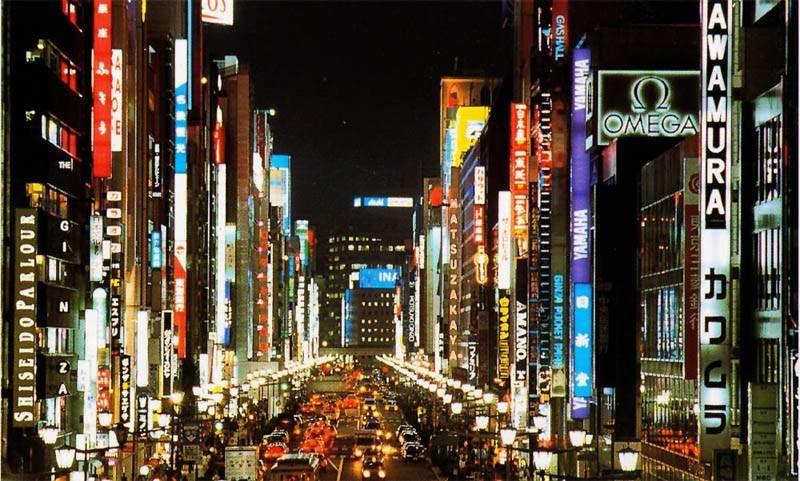
While I'm doubtful about the presence of anti-foreigner thugs in that particular area of Tokyo, again Miller's backgrounds prove surprisingly accurate:


Not too shabby, eh? He even appears to have gotten the streetlamps correct. Still, I think if Wolverine were really looking to get his drunk on in a seedy part of Tokyo, he would have been better off hitting Kabuki-cho in Shinjuku. Ginza features its share of hostess bars, but is a bit more upscale and pricey. Kabuki-cho is often referred to by my students and friends here as the "most dangerous place in Japan." It's a down-and-dirty fun zone where at night you can see prostitutes, street-level yakuza, Nigerian gangsters and perhaps even members of Chinese tongs if you're lucky. They'll be mixed in with lots of businesspeople doing the after-work drinking thing and young couples in search of exciting nightlife so you may not even notice them. Sounds more like a Wolverine kind of place.

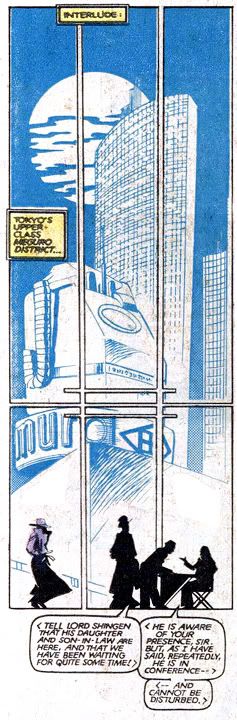
This is interesting:

As Claremont describes it in the caption, Meguro is indeed an "upper class" area. A number of celebrities make their homes there. What you need to remember, however, is the phone-shaped building. It will become important later.

The story's climax and closing actions take place within the castle-like Yashida family "ancestral stronghold." Miller's architecture even more accurate here, but given the unfortunate destruction of most castles during the Meiji Period and flattening of Japan's major cities during WWII, it's pretty unlikely any private family would be living in something so... historical. In comic books as in life, sometimes coolness must trump accuracy. Would you want to read a story where a vengeful Wolverine scales the less-than-impressive walls of a fancy apartment building?

Perhaps, but Wolverine in a Edo-style castle is a bit more visually compelling.

The 1980s were prime time for Japanese influences in American pop culture. The decade began with the hugely successful TV miniseries adaptation of Clavell's Shogun and the major failure of Pink Lady and Jeff, a bizarre yet energetic attempt to make two talented J-Pop singers variety stars in the States. Later American television audiences would pretty much ignore The Master, an absolute bullshit adventure TV series starring Lee Van Cleef as a blue-eyed ninja; it would last a mere thirteen episodes and become Mystery Science Theatre 3000 fodder. This probably says as much about Western cultural misappropriation as having Canadian-born Wolverine described as "more truly Japanese than any Westerner I have ever known" by one of his allies. At least Claremont qualifies it somewhat. Wolverine can master the language and cultural mores, defeat the yakuza boss and win the hand of the nigh-unreachable Lady Mariko, but as a mutant as well as gaijin, he remains an outsider in Japan as well as in the West. Lee Van Cleef bests even the Japanese at their own martial arts, then walks away for personal reasons.

But I digress yet again...

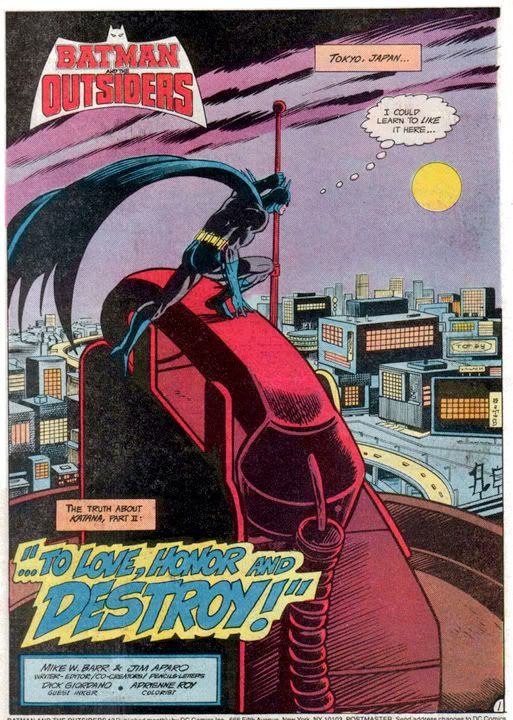
Perhaps inspired by Wolverine's Japan sojourn, Batman would take his Outsiders to Tokyo in 1984's Batman and the Outsiders #11. In this story writer Mike W. Barr and penciller Jim Aparo tackle the increasingly cliche story themes of the Japanese concept of honor and family loyalty as native-born Japanese Katana (described the following issue as the "She-Samurai") confronts her past and we learn all about her magical sword. The story is heavy on the ninja tropes but how do Aparo's Tokyo cityscapes fare as accurate depictions of that particular megalopolis?
Not too badly, if this image is any clue:


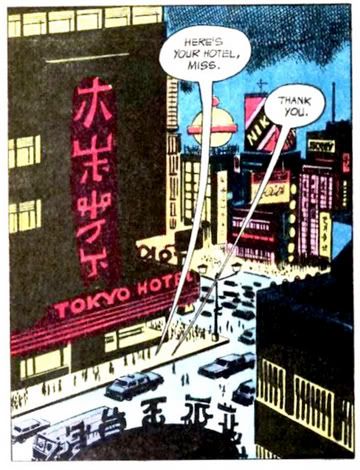
He gets the omnipresent advertising signs correct. Many buildings here do feature giant signage on their rooftops and various kanji and katakana or hiragana running down their sides. This particular panel is somewhat reminiscent of the Kabuki-cho side of Shinjuku Station, although there's no "Tokyo Hotel" in the station, and there'd be a small plaza to the right instead of what appears to be a parking lot of some kind. Those types of lots are extremely rare here in land-starved Japan; more likely would be a high-rise parking deck looking like a big steel Rubik's Cube, but not nearly so colorful.

And again:


I have no idea if there is now or if there ever was a building with a gigantic telephone on top, but Frank Miller and Jim Aparo seem to insist upon its existence. Maybe it was a famous landmark of the 1970s and 1980s and both artists saw it on some kind of comic book publicity junket here. Or else Aparo is paying homage to the work Miller did with Chris Claremont. Since this story hits some of the same cultural notes, that's a distinct possibility. Aparo's buildings are a far cry from the Meguro seen in Wolverine, though. This looks more industrial (and generic) than "upper class," so perhaps the phone building is merely a fantasy.

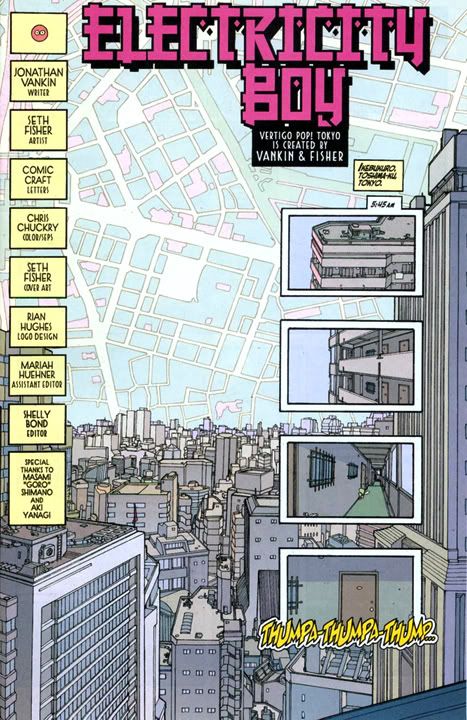
A more recent comic book look at Tokyo comes courtesy Vertigo Pop: Tokyo! by Jonathan Vankin and Seth Fisher. Vankin's story is another "Japan-as-other" fantasia, this time seen not through the eyes of superheroic adventurers but those of an ordinary American electronics geek. To that end, Vankin's protagonist is somewhat dull and colorless, his Japanese are laughable flakes and the story is a vibrant romp through newer paradigms of our outsider's view of contemporary Japan. As someone who actually lived in Japan, Vankin obviously has an encyclopedic knowledge of Japanese pop culture and presents it in a comically extreme form for our amusement. Gone are the samurai and ninja, replaced by ditzy fashion girls and would-be flight attendants, incompetent gangsters, sci-fi pop stars, perverted old men and fast food restaurants. Candy-colored Japan.
I don't know if it's exacly an improvement, but it is closer to what you might actually find if you came here.

Like Vankin, Fisher (who tragically passed away much too young) actually lived in Japan, so I imagine he was able to do a lot more first-hand location scouting than Byrne, Miller or Aparo. Consequently, despite the story's comedic exaggeration, Fisher's Tokyo is almost documentarian in its accuracy. Oh, like Vankin, Fisher takes some license here and there, but only in the service of the narrative. Here's his version of Ikebukuro, one of Tokyo's busiest but somewhat second-rate districts. Sorry, Ikebukuro! I love you but I mean "second-rate" compared to trendier wonderlands like Shinjuku, Shibuya and Harajuku:


To my eyes, the backstreets of Tokyo-- the places where people actually work and live as opposed to shop and play-- look like this. A bewildering jumble of high-rise buildings in dull concrete, stretching from horizon to horizon. No comic book story (and few movies) can prepare you for Tokyo's immense scale. Once inside, you are in an artificial world of steel and glass and after a while, it's hard to imagine there are any other environments on earth.

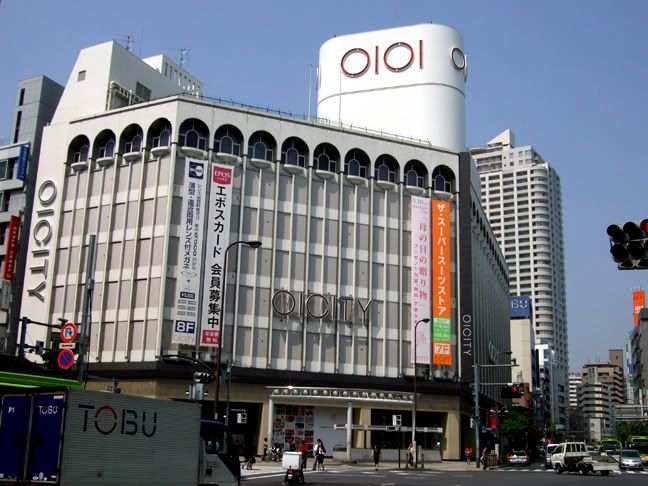
Here's a photo I took in Ikebukuro:


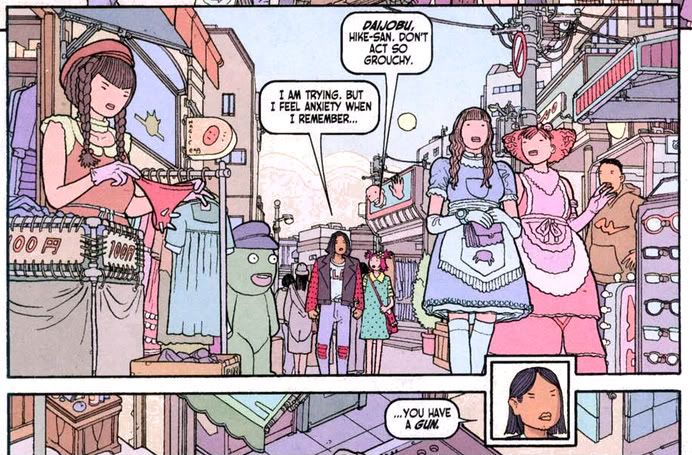
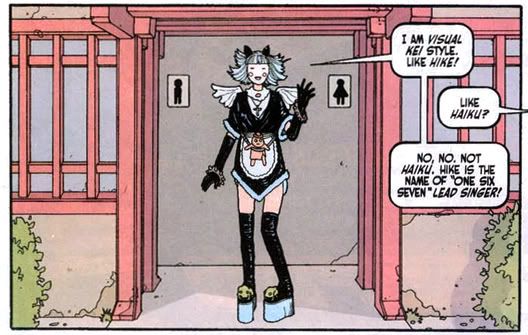
As Vankin's story unfurls, Fisher treats us to backdrops of some of the coolest places on earth. Here's a panel where crazed schoolgirl (another trendy stereotype) Maki has kidnapped her idol Hike to show him off to her Harajuku girl friends. This is more than likely Takeshita-dori, which during the 1990s was the epicenter of Japanese youth fashion culture:


That's one problem with Vertigo Pop: Tokyo!-- Japan's trends change so fast what was current as recently as 2002 is practically antediluvian now. And a lot of the elements in the story seem more contemporaneous with the mid- to late-1990s. Well, perhaps not a problem, per se, but more a transmuting it to a kind of literary time capsule or period piece. Jidai geki for the visual-kei set. And here's the real Takeshita-dori as it appears today:


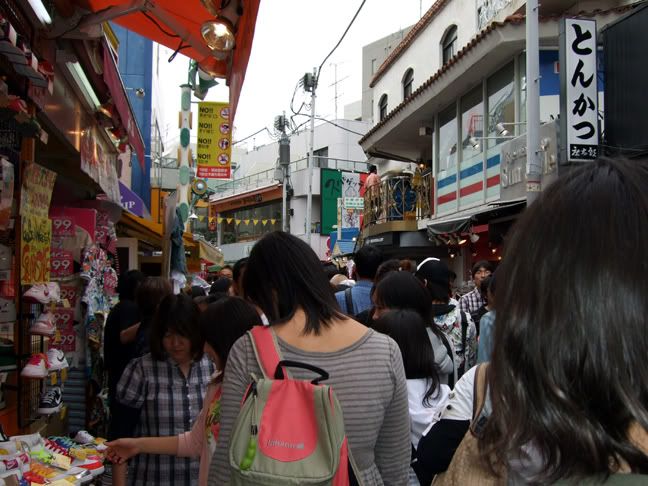
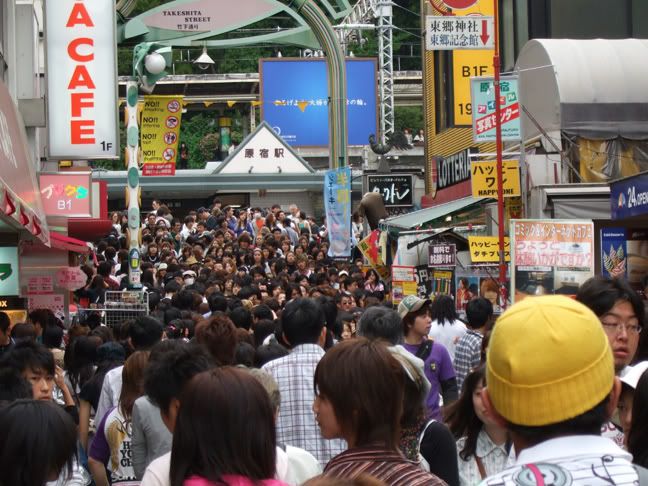
As you can see, Fisher pretty much nails it and I was standing in almost the exact same spot the panel appears to depict. If an artist draws Takeshita-dori as crowded as it truly is, we wouldn't be able to see the main characters at all. Behold Takeshita-dori in all its glory:


It can take you thirty minutes to an hour to walk its length on the weekend. Unfortunately for this story (and Gwen Stefani), the classic Maki-style "Harajuku Girl" doesn't really exist in that form anymore. She's been name-branded out of existence in Harajuku, subsumed by gothic lolitas and cosplayers and driven by photo-happy tourists to quieter, trendier neighborhoods like Kichijoji (where my own personal version of Maki eventually settled). But FRUiTS magazine continues to document her colorful, creative stylistic heirs faithfully so there's still some hope. Here's an image set just outside Yoyogi Park proper, crossing the Yamanote Line rails in Harajuku:

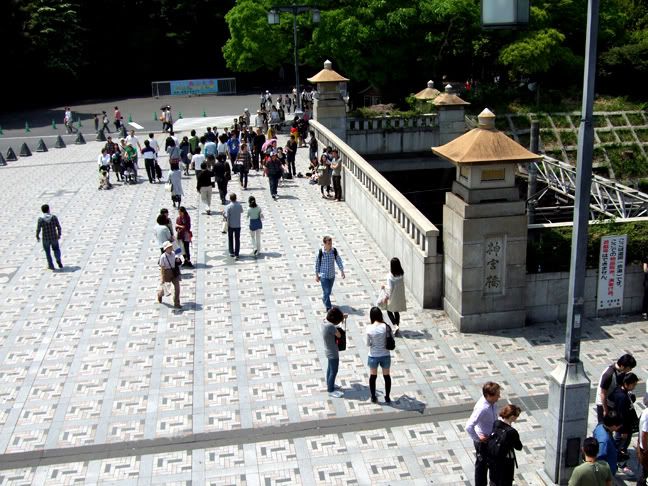
Here's the park itself, in reality. Fisher almost perfectly matches the real-life location. The lower wall is bit taller in the real world and there are some slight differences in the end caps, but it's instantly recognizable:


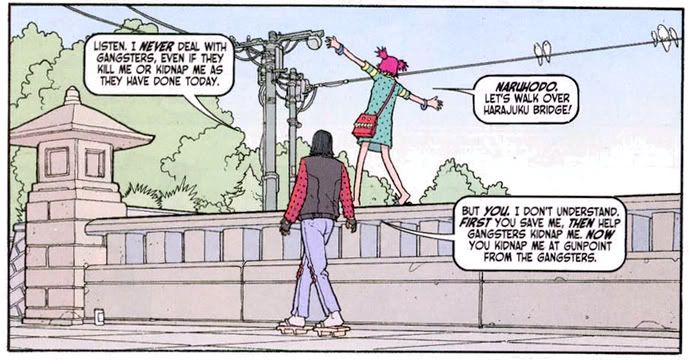
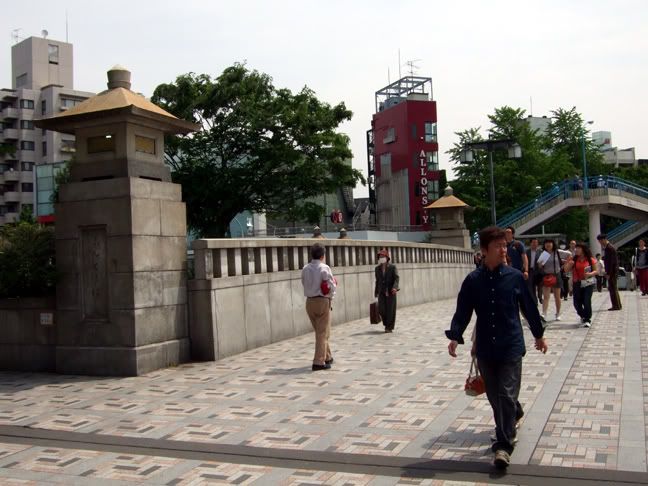
You can even spot the exact location crazy-pops Maki daringly tightrope walks along the wall. It's roughly between the guy in the light shirt and khaki slacks and the person in the face mask in this photo:


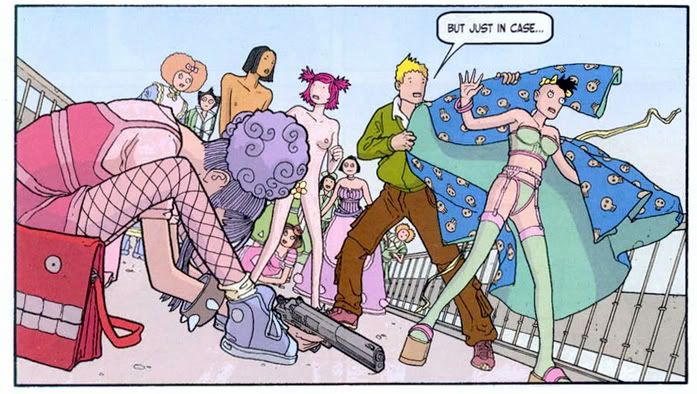
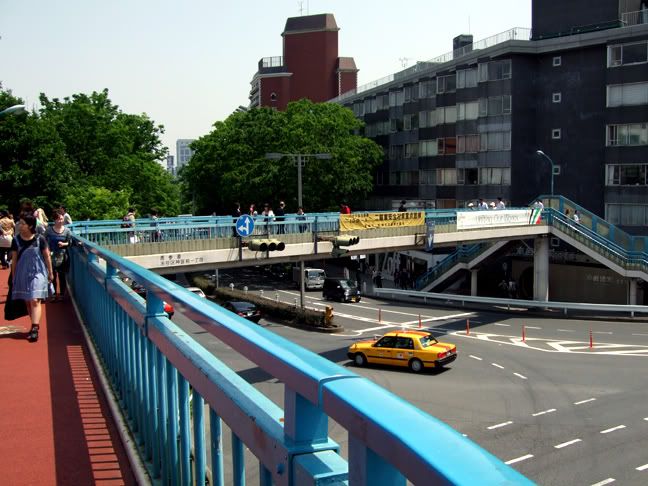
But I don't advise you to duplicate her stunt. If you fell and were injured or killed, I'd feel somewhat responsible and your friends and family would sorely miss you. Part of the action takes place on the pedestrian bridge overlooking the park:


I end up on this bridge every time I visit Tokyo so I can attest to Fisher's accuracy, even with a bit of artistic license. While the color is wrong (although it may have changed from 2002, the year the story is set, to today), Fisher gets the basic look of the bridge itself down, and even includes some of the surrounding greenery:


There's one moment where two characters fall off the bridge and land in the park plaza below, which is almost impossible. The bridge doesn't span the park; it crosses the street over a busy intersection. If they'd have fallen, they would've instantly been run over by cars, as you can see here:


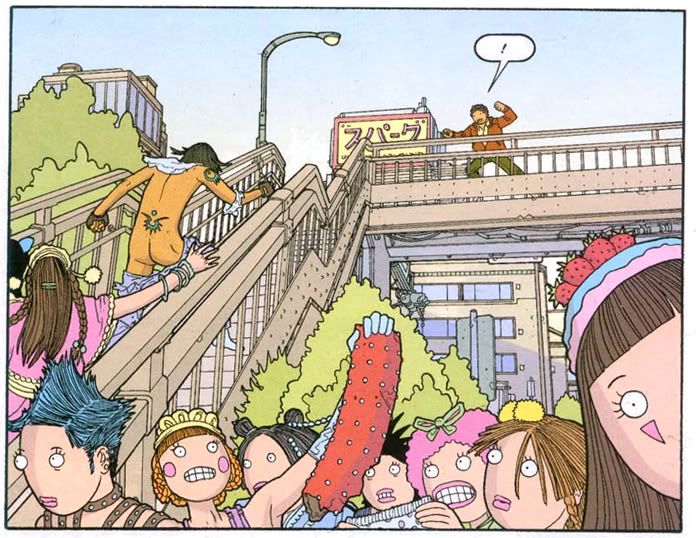
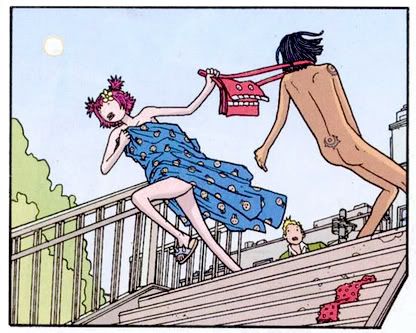
Also, notice that it's not a single span but several, in a rectangular shape. Here's in interesting scene where a nearly naked Maki attempts to escape the chaos she herself has caused, dragging a completely nude Hike behind:

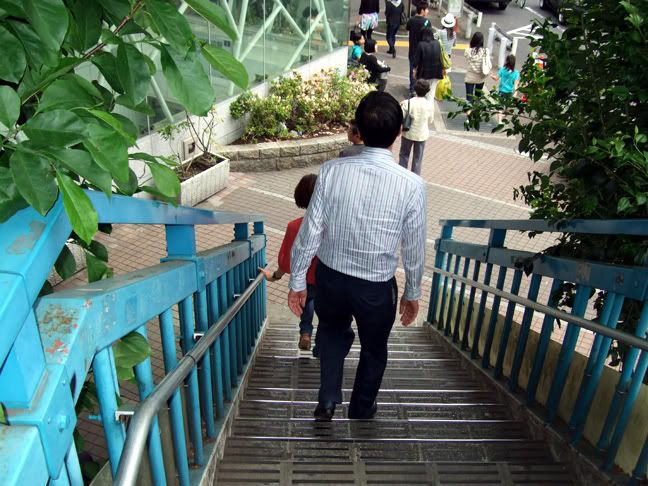
And this is my best guess as to where this event occurs:

I stupidly shot this photo from the top rather than matching the comic book panel's lower angle from the bottom. Oh well, maybe next time.

So how do our comic book artists fare with their depictions of Tokyo? Not bad at all. Fisher obviously takes the prize, but the old school dudes pleasantly surprised me. In my memory, they were all much less accurate but I'm gratified to be wrong and actually able to praise these guys for how "right" they got Tokyo rather than rag on them for falling far short. Sure, each could've done a bit more research and gotten it exact, but I doubt either Marvel or DC were willing to spend that kind of money for location sketching. Plus deadlines and all.

Remember-- it's pretty easy for a writer to type "Wolverine hops a jet and lands in Tokyo, then takes a taxi to Shinjuku. On the way there, fighting jet lag, he marvels at his own face gazing down at him from various advertisements in the wild neon lights down the sides of buildings along the street," but the artist has to take those words and make them at least somewhat visually plausible. And Byrne, Miller, Aparo and Fisher accomplish that with their work in these books.

I still have this desire to find some of the actual locations from Yazawa Ai's glorious comic book creation Nana, including Jackson Hole where I plan to try a Jackson Burger (Hachi swears by 'em). Yazawa gets around the accuracy and time constraint issues by using actual photographs as her backgrounds.

Until then:

Bai-bai!