Monday, February 20, 2012

A touching moment with Sarah Rainmaker...

She tries her best not to look...


I’ve been re-reading the original Gen13 series from Image.  It’s one of my guilty pleasures, thoroughly enjoyable in a stoopid way—sort of like Van Halen’s “Hot for Teacher” video.  Because it's a cheesecake-heavy comic very much of the 1990s,  it has me thinking a lot about the male gaze, without which there probably wouldn’t have been a Gen13 in the first place.  It emphasizes ogling its female characters to the point where the Gen13 Zine (1996) informs us their measurements are the same as those of Elle McPherson, Stephanie Seymour and Natalie Portman.  Wow!  Readers know exactly what they're looking at.  That’s a level of objectification that’s breathtaking in its specificity.  

 The regular creative team tosses in a running joke in which Caitlin Fairchild, the red-haired, highly intellectual muscle of the team, ends up unclothed at various points in practically every issue and sometimes comments on it in a metatastically ironic way.  In Gen13 #3 (July, 1995), when Fairchild washes up half-naked-- her lower half, naturally-- on a tropical island, the moment involves breaking the fourth wall, with Fairchild covering her genitals from the readers in an embarrassed way as if she's aware of the artist functioning as an imaginary camera eye.  It’s a kind of “Aren't we the cutest?  Can you believe what we’re getting away with here?” nudging of the readers.  Come on, it’s all in good fun!  Even Fairchild can see the humor in it!

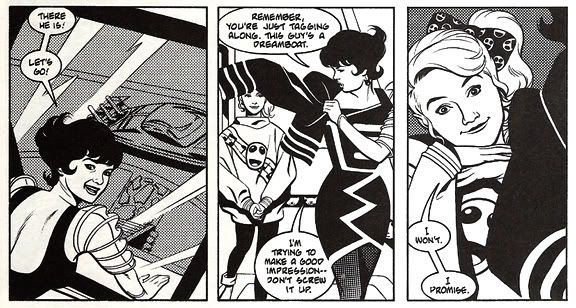
My favorite version of this joke comes in Adam Hughes’s two-part Gen13:  Ordinary Heroes (February/July 1996), which he also wrote.  The characterizations are sharper and the inciting element is smarter than anything found around the same time in monthly magazine.  Fairchild-- Hughes gives her an appropriately heroic physique rather than base her on a willowy swimsuit model-- goes back to her old university to pick up some junk, then the Gen13 team shows up in a sci-fi rocket ship to take her on an adventure.  As Sarah Rainmaker provides useful exposition, Hughes has Fairchild undress all the way down to implied nudity-- we don't get to see that, but given her costume's configuration, there's no way she's wearing anything under it, at least not the undies Hughes shows Sarah and the reader-- so she can put on her superhero costume.  

... while Caitlin remains clueless.
The two girls are alone together and the sight of Fairchild revealed proves too much for poor Rainmaker.  In the Hughes version, you’re invited to ogle Fairchild as per usual—but in order to do so, you have to mask yourself as, or at the very least identify with, the team’s resident lesbian.  This is accomplished first by a series of panels focusing on Rainmaker's face, ending on the first page with a circular panel with a background in a complementary color scheme (opposites on the color wheel; this creates emphasis) compared to the more traditional rectangular panels that come before it.

This stands out in my mind because I recently read a Facebook post from Bob McLeod where he touches on using circular panels.  I can't find the comment and his exact wording escapes me (it may have had something to do with an editor he worked with on a job for the European market not liking them), but as you can see a circular panel really stands out.  It's something that has to be used sparingly as a result.

It’s funny to see Rainmaker give into the same sort of sexually admiring stare the regular monthly book usually gives over to its male characters—most frequently the team’s good-natured horndog Grunge.  Grunge all but salivates each time Fairchild either disrobes herself or due to circumstances beyond her control.  As Fairchild's first person narration takes over from Rainmakers's expository dialogue, the humor becomes more about Fairchild's obliviousness about the source of her teammate's discomfort.  Oh, she's aware enough that Rainmaker's voice keeps trailing off, but assumes it's because of her emotional response to the disturbing story she's telling.

Rainmaker personifies the 90s fan.
However, Hughes takes the gaze one step further-- to its logical conclusion-- when he hints both visually and in dialogue that Rainmaker is actually going to masturbate as a result.  Finally dressed in her costume, Fairchild goes to join the rest of her teammates and asks Rainmaker—who on this page is suggestively depicted with her hands between her thighs— if she's coming.  Rainmaker responds in a way that creates a double entendre: “In a minute.”

By this point, the gaze has returned to its more customary form, as Rainmaker recedes into the background and even loses her head and face in favor of a panel-breaking image of Fairchild zipping up her costume.  The Gen13 status quo is largely restored and we're all smirking as required, but Hughes is a smart storyteller so it's subtler than Grunge with his tongue hanging out and Freefall reacting jealously.

In the next issue, Hughes gives Rainmaker one more moment of glory.  In the monthly, at least under the original creative team, Rainmaker functions as another element of comedic relief:  a shrill, politically-correct killjoy and college-age feminist caricature whose sexuality is largely played as a tease or as a kind of Girls Gone Wild or YouTube party video same-sex kissing thing aimed largely at hetero males.  At her best, when sensitively portrayed, Rainmaker functions as the team's conscience, with Fairchild as the intellect in a kind of absent-minded professorial way, a la Reed Richards.  Which I suppose makes Grunge the id.  And Freefall and Burnout simply along for the ride.

Smarts, huh?
Here, Burnout has said something characteristically asinine and Sarah swiftly destroys him.  Hughes doesn't play this as a comedic moment where the readers are supposed to chuckle at Rainmaker's mindless recitation of some lefty or environmentalist talking point.  Oh yeah, Rainmaker is pretty harsh with Burnout and reduces him to tears, but she alone among her teammates has shown complete understanding of the situation and the enemy they face.  She alone among them has guessed team mentor Lynch's motivations and she's not afraid to confront him with this knowledge.  As she slams Burnout, Hughes breaks the panel borders with a sober portrait of a deadly serious Rainmaker, nothing cheeky or mocking about the moment.  Burnout's tearful reaction is pretty apt.  Rainmaker lays his hollow center bare for all to see and because he's basically a decent kind of guy, it hurts.

Sunday, February 19, 2012

Nexus Update!

According to his wife Jaynelle, Steve Rude has finished the pencils for the new Nexus to be featured in Dark Horse Presents starting with issue #12 this May.  And get this-- it's forty-two pages!  Forty-two pages of Mike Baron story and Steve Rude art.  This means it's going to run for a while and then come together in book form at some point.

That's thrilling news for a die-hard Nexus fan like me.  Back in 1997 I was pretty sure we'd seen the last of Horation Hellpop, Sundra Peale, Dave, Ursula XX Imada and all the rest-- hundreds of them-- and it truly depressed me.  Those were dark times for my favorite titles; just a year before, our beloved Xenozoic Tales faltered and faded away.  Nine years later, Rude tried self-publishing.  That didn't take and the Dude turned his energies towards fine art and gallery shows.  It seemed once again Nexus had gone the way of everything good and fanciful.  Because it's all infinite and crisis now.  Post-modern irony, graphic violence, massive crossovers full of miserable characters,  massive crossovers full of second- and third-hand ideas, crossovers of this, that, and the other. No place for three-legged cyclopes in the South Seas. No place for cucumber trees and oceans of wine. No place for me.

Not that Nexus ever contained cucumber trees or three-legged cyclopes.  It never needed them; it has riches aplenty.  There are some four-armed aliens, though.  So here we are in 2012 and not only is a brand new Nexus story on its way, it's a huge one!  The Dude's done it!  He's back in comics, which so desperately needs artists like him.  And he's brought Baron with him; comics also need writers of his caliber.  Isn't it beautiful? It's like a dream come true. It's the dawning of the age of lovely, intimate things.


The Adventures of Baron Munchausen — MOVIECLIPS.com

I wonder who's inking it.  Gary Martin has provided a sympathetic brush on Rude's pencils for a number of years now.  I really enjoyed their teamwork on The Moth, which Martin wrote as well.  He'd be my first choice.  But I'm sure they wouldn't pick some incompetent to replace him if he's not available.  I suppose I could go do some Google searching and find out if Martin's coming back...

Wednesday, February 15, 2012

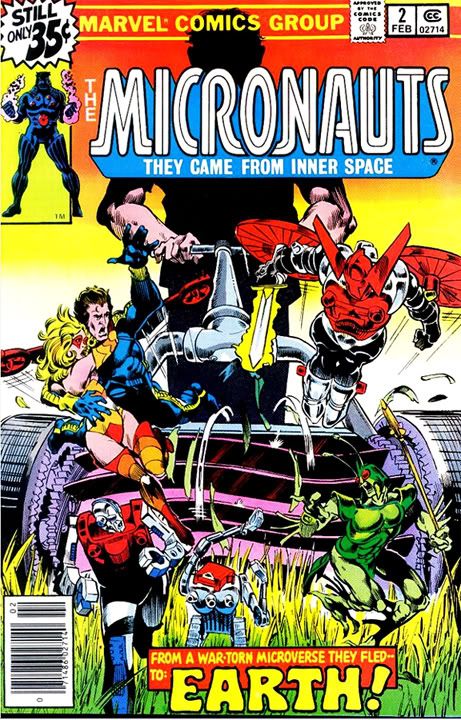
Whither Micronauts indeed!

Noel Murray and I must have had very similar childhoods.  We both got into the Micronauts toys, but neither of us had very many of them.  I had a few of the more generic-looking (and more importantly, cheapest) figures and one of the vehicles.  Eventually I traded with a friend for an Acroyear whose metallic parts I promptly painted red.

I'm just establishing what everyone already knows:  I am the supreme Micronauts comic book nostalgic on the web.  Well, I know it because I'm the kind of jerk who knows things like that, things that make me out to be the kind of jerk I am.  Others may know more, may show more devotion but I... Okay, I'm a sham.  A fraud.  I admit it.  But I do love me some Micronauts toys.  And I especially love the old Micronauts comic.

Murray just wrote a short think-piece on how the Micronauts' place in pop culture is currently occupied by something of a void.  There's a fan base out there, but as a property, Micronauts is stone dead.  Or at least comatose.  Meanwhile, new Star Wars figures hit the toy store shelves at an alarming rate, even of characters appearing for nanoseconds in the movies or cartoon shows.  Of course, these characters all have backstories of their own now thanks to the exponentially increasing Star Wars narrative, but the point is they exist and thrive while our beloved Micronauts barely register on the cultural radar even for jaded hipsters whose entire frame of reference consists of ironic nostalgia for things they may or may not have had as children.

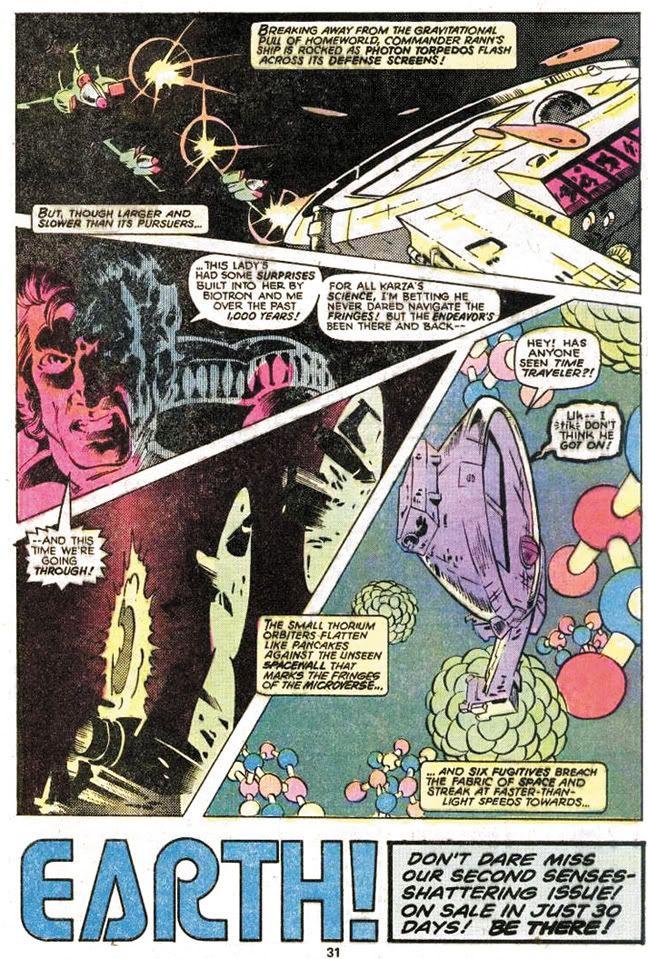
I've wondered, much like Murray, why there hasn't been a Micronauts reprint book.  The first twelve issues of this comic comprise an almost forgotten classic.  Bill Mantlo's epic, sprawling tale takes the toys and provides them with a surprisingly rich milieu made of parts lifted from here and there and artfully combined.  Michael Golden's art is better than a comic based on a toy line deserves.  While the one we got was certainly fun in a campy sort of way, Micronauts was the Star Wars comic we all really wanted.

And like Murray, over the years I've done some research and it seems the rights are a bit too entangled for a proper reprinting.  What we have here is a toy line from Takara Tomy Co. Ltd. licensed in the US by Mego overlaid with characters owned by Marvel or, ultimately, Disney.  The in-house characters created by Mantlo still appear from time to time in Marvel comics, but they're now known as the Microns.  Someone else-- Takara or perhaps the mysterious entity known as Abrams/Gentile Entertainment-- owns other key characters like omniscient exposition-provider Time Traveler, robotic comedic relief team Biotron and Microtron, the heroic warrior-king Acroyear and arch-villain Baron Karza.  While working out some kind of financial and legal arrangement that probably isn't worth the money or effort, a would-be Micronauts reprint publisher faces a battle along the lines of reassembling the complete Beatles.  I mean back in the 1970s when there were still four of them.  Difficult though it may be, I doubt putting out a Micronauts reprint would be nearly so daunting a task as putting the Beatles back together these days.

In the meantime, other comic book companies have taken up the Micronauts license and attempted to recreate the magic, only to fail.  There may be a movie version in the works, and possibly some new toys from Hasbro, but I wouldn't waste time making plans to camp out for tickets or hassling the stockers at your local Toys-R-Us just yet.

However, should the movie happen maybe-- just maybe-- someone will find a way to cash in with a reprint of the Mantlo-Golden book.  Or maybe some well-connected superfan with more money than common sense will somehow make this happen.  After all, Bill Sargent once offered the Beatles fifty million dollars for a reunion.

Tuesday, February 14, 2012

John Severin Passes

This is heartbreaking news.  Comics great John Severin, 90, passed away on February 12th.  I haven't written about him here, but he was one of my all-time faves.  He truly was.  Years ago I bought America at War: The Best of DC War Comics, a book full of-- you guessed it!-- DC war comics.  One of the standouts was the John Severin-illustrated "Push-Button War!", (originally printed in Our Army at War #67, DC, 1952) about a B-17 bombadier and how "easy" his war was compared to that of everyone else.  He had a distinctive way of drawing eyes that was instantly recognizable, and a unique crosshatching method to build up tone.  There was no mistaking whose work it was.  Plus, it was signed.  This story was from the guy I knew and enjoyed for his humor work with Cracked magazine at the time.  I was astounded.  I was a fan.  It made me appreciate his comedy stuff all the more.  When he drew Cracked's E.T. parody, the caricatures were dead-on.  Subtler than Mort Drucker's or Jack Davis's, but no less amusing for it.

I was in junior high at the time and drawing my own epic comic, a completely insane story in which every Marvel character along with whatever other pop culture property caught my attention-- Indiana Jones and Jake Cutter from the TV show Tales of the Gold Monkey plus John Belushi and Dan Aykroyd in their parts from Steven Spielberg's flop panic-comedy 1941 play secondary roles-- fight a war against the Theragran-M delivery man for some reason.  Severin's version of Elliott tossing the softball into the garden shed makes an appearance, painstakingly copied line-for-line as best I could at the time.  In fact, I copied every figure in the story from various comics.  It didn't matter that none of them were stylistically compatible.  I just knew I had to work some John Severin into the mix.

In those days it had simply never entered my thinking artists could cross genres, or if they did, they could do so at John Severin's lofty level.  Later I learned just how many genres Severin worked in.  War, western, horror, fantasy, superheroes.  Science fiction?  Sports?  I'm not sure.  I feel like he did it all.  I know he did it all with an amazing sense of verisimilitude.  From the gunner positions in the heavy bomber of that first story I read to his EC stories in Two-Fisted Tales and Frontline Combat to the pirates in his Warren classic "Drink Deep" (Creepy #7, February 1965) and stories in Blazing Combat to more recent work for Marvel and Dark Horse, everything Severin drew looked and felt authentic.  Real, without the crutch of photorealism.  I think one of the highest compliments you can pay an artist is to recognize him or her as being able to "draw anything."

John Severin could draw anything.

I can't think of too many artists with Severin's career longevity.  He did his first professional work at age 10, later served in WWII, broke into comics in the late 1940s (probably 1948) and just last year illustrated Witchfinder:  Lost and Gone Forever, a five-issue miniseries for Dark Horse--  with no appreciable drop in quality!  His last published job looks every bit as fresh as anything he did in the 1950s and 1960s for EC and Warren!  That in itself is almost superhuman!

Many artists follow a kind of bell curve trajectory in their careers.  There's the rise to competence-- or in some lucky cases, pure genius-- followed by a peak period, then a long decline.  Few artists appear fully-formed, and if it appears so it's more than likely because he or she spent those formative, rising years working in secret.  We discover them and enjoy their peak time, which, if they stay mentally and physically healthy, can last decades.  If not, the decline makes an abrupt and steep downturn on the chart, a cliff-like drop off in output.  Even with geniuses like Jack Kirby and Al Williamson, we can trace a late career decline in quality.  For some tragic individuals like Wally Wood and Reed Crandall, the end comes suddenly, shockingly.

In John Severin's case, the rise took place way before I was born.  "Push-Button War!" came early in his career and it was still eye-catching to me when I first read it even during a time when Neal Adams, John Byrne, George Perez, Michael Golden and others like them had become the gold standard.  The fan faves.  The ones we all wanted to draw like.  I'm happy I had the good taste to pick up on John Severin.  Those others were and still are idols of mine, and their work figured largely in my stupid self-drawn comic book.  But my love for good art recognized no trendiness.  I saw "Push-Button War!" and I knew at once I was looking at some fantastic stuff.  I had to try and assimilate it as well.  I had to seek out more John Severin.  He never disappointed me.  A fill-in issue of The 'Nam?  Sweet.  Rawhide Kid?  Well, okay!  Working with Mike Mignola and John Arcudi?  Holy Hellboy!

As far as I can tell, Severin spent the entire duration of our overlapping time alive on a high-altitude plateau of brilliance.  He really skewed the charts on maintaining one's gifts.  He's left behind a lot of richly deserved admiration and a generation-spanning body of work a comic fan could spend a lifetime examining.

Well done, Mr. Severin.  I will miss you dearly.

The Loomis sisters loom large of late...


You know the Loomis sisters, right?  Creations of that amazing comic duo, writer Mike Baron and artist Steve Rude.  Ring a bell?  You know, the Loomis sisters!  Stacy, Lonnie and Michana Loomis, beloved daughters of General Loomis.

We first meet them in Nexus #25 (First Comics, October 1986).  Much like today's developed or industrialized nations, the Web, the galaxy-spanning league of planets of which the Loomis sisters are citizens, requires vast amounts of energy and resorts to ever more dangerous means to gain it.  To meet this need, the Web government builds the Gravity Well, a vast Goldbergian machine that uses white dwarf stars to provide almost unlimited energy.  With General Loomis as its chief, the project comes at a cost:  the destruction of the Planet Periwinkle and its 500,000 sentient inhabitants.  Elvonic extremists attempt to assassinate Loomis to stop the Gravity Well, but Horatio Hellpop-- better known as the super-powered executioner Nexus-- gets there first.  Despite some misgivings, Nexus executes the general after promising to provide for his girls.

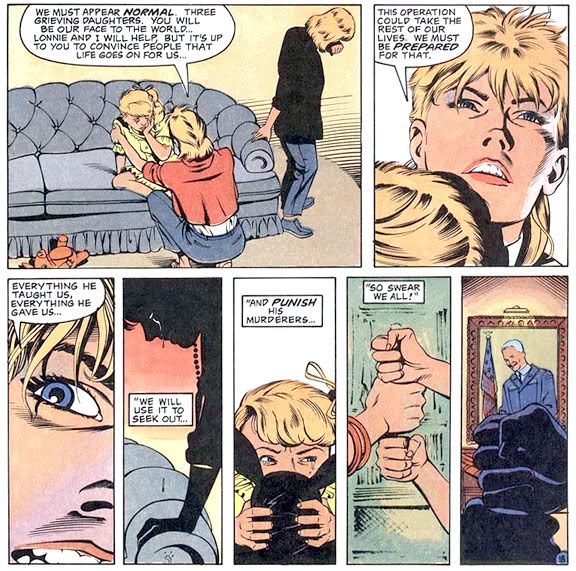
 Back home, the seemingly ordinary suburban sisters close ranks and vow revenge on their father's killer.  And symbolically, they make this pact in that homeliest yet blandest and most cliched of suburban settings, the living room.  Complete with a comfy sofa.

The trust fund he sets up for them and his guilty conscience aside, Nexus soon becomes the Loomis's target.  These kids are smart and it was only a matter of time before they realized who did the deed that broke their hearts.

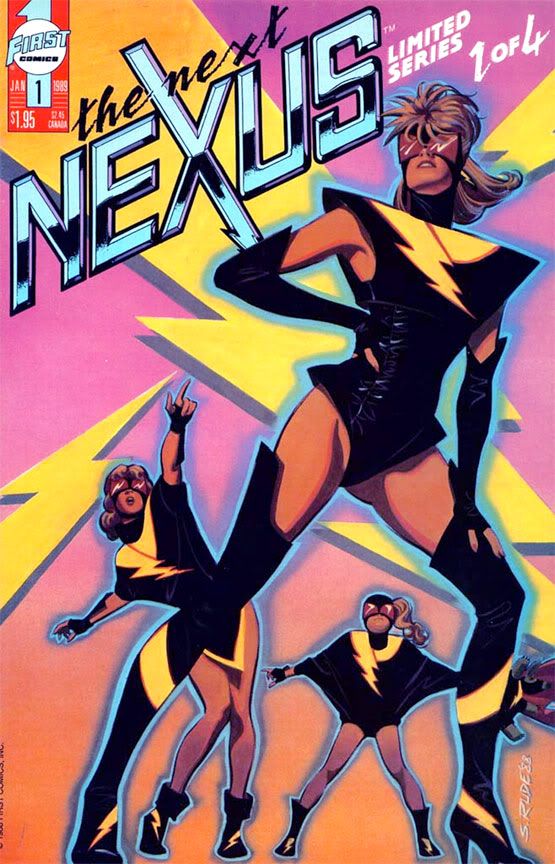
In The Next Nexus miniseries (First Comics, 1989), the sisters receive Nexus's power when he quits being the cosmic avenger for all of humanity.  Here Baron plays on the old theme of absolute power corrupting absolutely.  The ability to blast people and aliens into atoms has long troubled Nexus, so imagine if you will how it affects his greatest, youngest enemies.  Stacy becomes Ahab-like, conscience drives middle sister Lonnie from her siblings and Michana, the youngest, goes kind of batshit.

When Stacy and Michana finally meet a largely helpless and disillusioned Nexus, they have to fight Scarlett and Sheena, his own daughters by the delightfully formidable despot Ursula X.X. Imada.  It's classic generational warfare, a story as old as the concept of family itself.  This is how the crappy things parents do live on in their children, who repeat them, an object lesson in the way our past continually returns to us in a new shape that's really just a reflection of the old shape.

General Loomis is decent guy, an upstanding officer and widower devoted to his daughters.  He offers them stability and discipline with unconditional love, but unknowingly infects them with the darker aspects of his military profession.  Nexus kills mass-murderers, but struggles with self-recrimination as his own body count rises. Neither man can escape the consequences of his actions.  In the end, can any killing be redeemed by another?

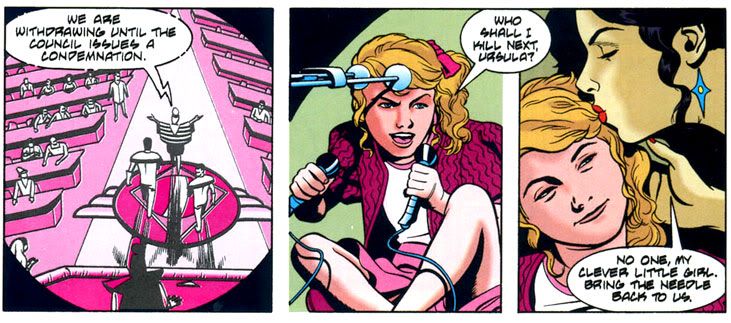
The Loomis sisters would suggest violence in response to violence only creates a cycle of destruction that corrupts as much as power.  Their revenge invites a change that would horrify the father they seek to honor, something especially embodied by Michana whose adorable exterior can barely contain her lust for destruction.  While Lonnie eventually settles into the life of a single woman making her own way in the world, Michana spends her childhood assassinating Ursula XX Imada's enemies and when she screws that up, runs a highly successful teen gang on a mass murder and armed robbery spree.

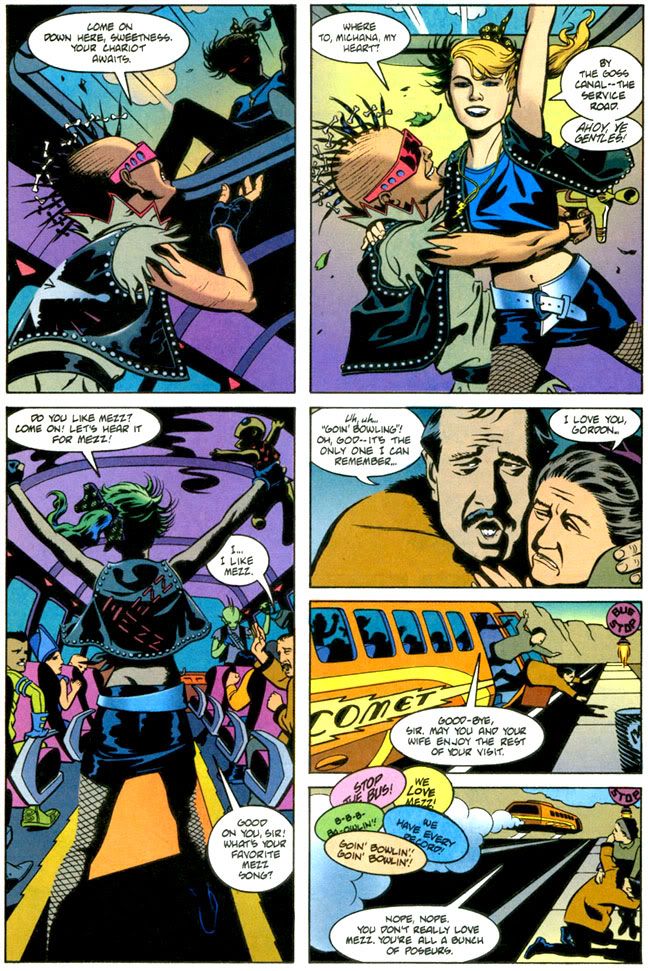
Angelically pretty, clothing herself in punkish leather and fishnets and toting around a small doll to which she's devoted (another symbol of her warped childhood, she communes with it for advice), Michana's a monstrously narcissistic Bonnie Parker and makes Hit Girl from Kick-Ass look like Cindy Brady.  She terrorizes ordinary citizens, enchants a dimwitted thug, bedevils Nexus, ends up in jail.  In Nexus Nightmare in Blue (Dark Horse, 1997), Michana resurfaces.

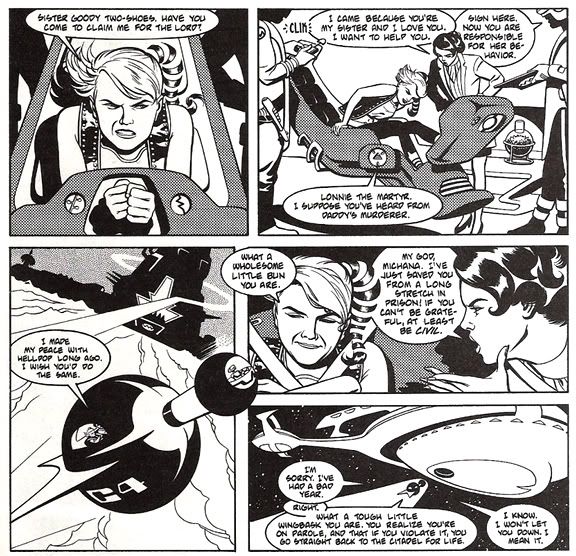
 Instead of violent mayhem, Baron involves her in an amusingly sitcomish digression from the main narrative, expertly drawn in all its domestic splendor by Rude.  While Nexus struggles to decide his next mission-- eventually turning to the readers for help-- the surviving Loomis sisters set up housekeeping on Mars.

Reconciling with her sister Lonnie, who now holds the somewhat pathetic yet imminently respectable job of "junior assistant to the mayor's secretary," Michana still dreams of power.  She drops the punk look and adopts the guise of a typical suburban teen, but sneaks out at night to indulge her wild side and meet up with a member of her former gang.  You get the idea it's only a matter of time before she cuts off someone's finger to get a ring.

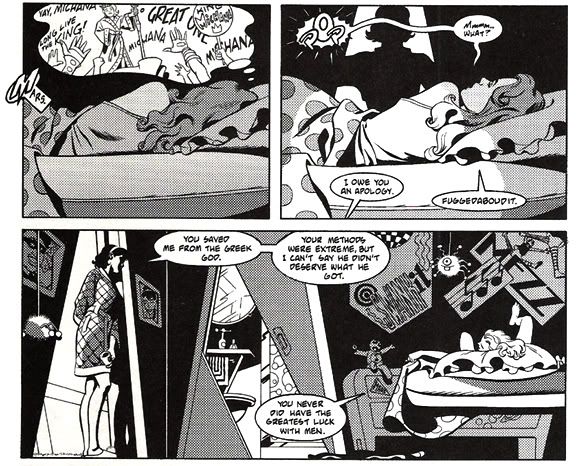
Biding her time, Michana contents herself with helping Lonnie with her relationships, much to the detriment of sleazy Tom Cruise-lookalike Tom Zeus, a lawyer who specializes in something called "jewelry fraud."  Zeus turns out to be the kind of creepy perv who would sleep with an underage girl and video all his other sexual encounters.  Hundreds upon hundreds of them.  Wealthy, handsome, self-assured and not afraid to get his hands dirty helping out the bouncers of his favorite haunt, a stylish bar, Zeus has it all.  A smitten Lonnie breathlessly recites his possessions:  "A Lambo, a Slambo and a Pomerini GT," no doubt coached by Zeus himself.  I don't know what those things are, but they're probably expensive.  Zeus never fails to mention the pride of his fleet, a 250-meter S&J star cruiser that "sleeps twelve."

S&J, by the way, stands for "Sundra and Jil."  Sundra is Nexus's lover and Jil is her business partner in their very successful star cruiser venture.  A posh, arrogant ass like Zeus would only have a starcruiser from S&J.  The ultimate status symbol.

Zeus never ran into someone versed in military tactics, assassination, spycraft and crime of every type before, though.  Michana learned from the best; that Ursula is no joke and there's probably a bit of her father mixed in as well, plus Nexus.  In the aftermath, Lonnie tells Michana her methods are "extreme," but she's grateful to baby sister for putting Zeus in his place.  The Greek God will no doubt survive to seduce another night, but in the future he may be a bit wiser about how he does it and more honest with his partners.  We hope he learned his lesson well.

The ultimate lesson taught us by the Loomis sisters is you don't want to mess with the Loomis sisters.  Actually, you also don't want to mess with Ursula XX Imada or Scarlett and Sheena.

As Baron and Rude prepare a new Nexus story for Dark Horse, I can't help but wonder if Lonnie and Michana will make another appearance.  It doesn't seem all that likely, but one can always hope.

The Nexus cast consists of hundreds of characters, and the most recent storyline-- the "Space Opera" issues self-published by Rude's Rude Dude Productions-- mostly involve topical religio-political machinations and the birth of Nexus and Sundra's son Harry.  Nexus battles the shade of his father and the two weird little aliens who were his companions when he was a child, more of that recurring "sins of the parents" thread that runs through so much of Nexus.  That makes me think it's the appropriate time for some more Loomis action.

While Lonnie has forgiven Nexus, how can we be sure Michana has?  Various assassins have already targeted the newborn and he seems like a natural target for Michana Loomis.  She could continue to be a powerful enemy for Nexus.  She's deadly as all get out, but it doesn't seem likely the conscienced Nexus could equal Michana's amorality by killing her.  It would mean a powerful ending to her saga, one as horrifying as imagining the psychotic thoughts behind Michana's deceptively sweet countenance.  There's still a lot of unfinished business between her and Scarlett and Sheena.  On the other hand, maybe the influence of her big sister really does have Michana on the path to rehabilitation and redemption.  Or is Lonnie truly as upright as she appears.  Could she be hiding something herself?

I'm pretty confident Baron and Rude will wow us when the time comes.

Monday, February 13, 2012

Mark Schultz and Gary Gianni celebrate 75 years of Prince Valiant!

Hal Foster debuted his legendary Prince Valiant strip 75 years ago on Saturday, February 13, 1937.  My mom was one year old.  She was an early reader, but I doubt she was reading early enough for Prince Valiant's premiere.  Foster wrote and drew Prince Valiant for many years before turning it over the art duties to John Cullen Murphy, who later had his son Cullen Murphy script.  Now it's a collaboration between Mark Schultz and Gary Gianni.  In the interest of full disclosure, I'm more of a Schultz fan than I am a fan of either Prince Valiant or Hal Foster.

Shocking, huh?

Schultz's Xenozoic Tales is one of my favorite books, one of the comics that got me reading them again after years of anti-comics snobbery.  If I had one comic-related wish, it would be Schultz returning to the fabulous Xenozoic Era for a few more stories and a completion of his unfortunately truncated epic.  In the meantime we have Schultz writing this classic comic strip.  He's an amazing, award-winning artist in his own right and a solid storyteller in the classic mold.  The perfect fit. 

I'm not as familiar with Gianni's work, but what I've seen of it has been dazzling.

Their anniversary installment features a whole lot o' Valiant characters.  I don't know who all these people are.  There's a woman who looks kind of like Dani Moonstar, though.  And Inigo Montoya.


Wow. I really need to start reading some Prince Valiant.

And meanwhile, as an art form, comics have never been better!

You know what?  Screw both DC and Marvel.  All the talk about the health of the industry centers around whatever those two companies are doing.  Well, logically so because they're the big players.  And they do put out some good books here and there.  They've got some great talent working for them.  But screw them.  I'm sick to death of discussing the future of the medium as if it totally hinges on whether or not the New 52 brought in new readers (it didn't) or The Avengers will make millions that will be forever denied Jack Kirby's family (it will).

The form itself is stronger than ever.  You don't have to be concerned with whatever new books come out this month and how they sell.  Step back and look at comics as a whole.  You can draw from the entire history of comics for your entertainment.  You can cross oceans and experience comic culture in Europe and Asia.  There are millions of comic book stories out there we haven't even read yet.  Dark Horse puts out some amazing books, both new and reprinted, American and international.  Fantagraphics publishes all kinds of amazing titles like Love and Rockets, Buddy Does Seattle/Jersey, Wandering Son and huge books containing entire years worth of Peanuts strips.  Don't forget Charles Burns's Black Hole from Pantheon.  Have you read that yet?  Dan Clowes's Ghost World.

There's a new book on Alex Toth coming out, but in the meantime there's Torpedo and Zorro.  Viz puts out some fantastic Japanese comics like Nana to name only one.  People are putting out their own comics online or through print-on-demand publishers.  If you must-- and you know where to look-- you can download practically every comic ever printed for free.  People are spending their free time scanning entire runs of books and putting them online and they're not charging anything for this!  Others are translating and localizing Asian comics and making them available totally for free, too!

Flesk recently printed an incredible book collecting Al Williamson's entire Flash Gordon-related output, compiled and edited by Mark Schultz.  There are Alex Raymond reprints.  There are Creepy and Eerie archive books (or even Vampirella if that's your taste), Vanguard Productions has a massive book of Frank Frazetta strips, Fantagraphics put out a softcover version of their Blazing Combat book, there are Hal Foster books, Carl Barks books, books like the amazing Skim by Mariko and Jillian Tamaki, Wendy and Richard Pini have their entire Elfquest saga online for free, Image has tons of stuff available, Drawn and Quarterly with Kate Beaton's Hark! A Vagrant (one of the best things ever to exist in this world or any other) plus books by Lynda Barry, Oni Press, Slave Labor Graphics, Top Shelf Productions, Knockabout Comics, Archie Comics and Checker Book Publishign Group with their Gold Key Star Trek reprints and more.

And more and more and more.  I'm just tossing out some things off the top of my head.  I love comics.  If DC and Marvel went away today, I'd still love comics and I'd still have plenty of comics to read.