Showing posts with label Bill Mantlo. Show all posts

Sunday, October 6, 2013

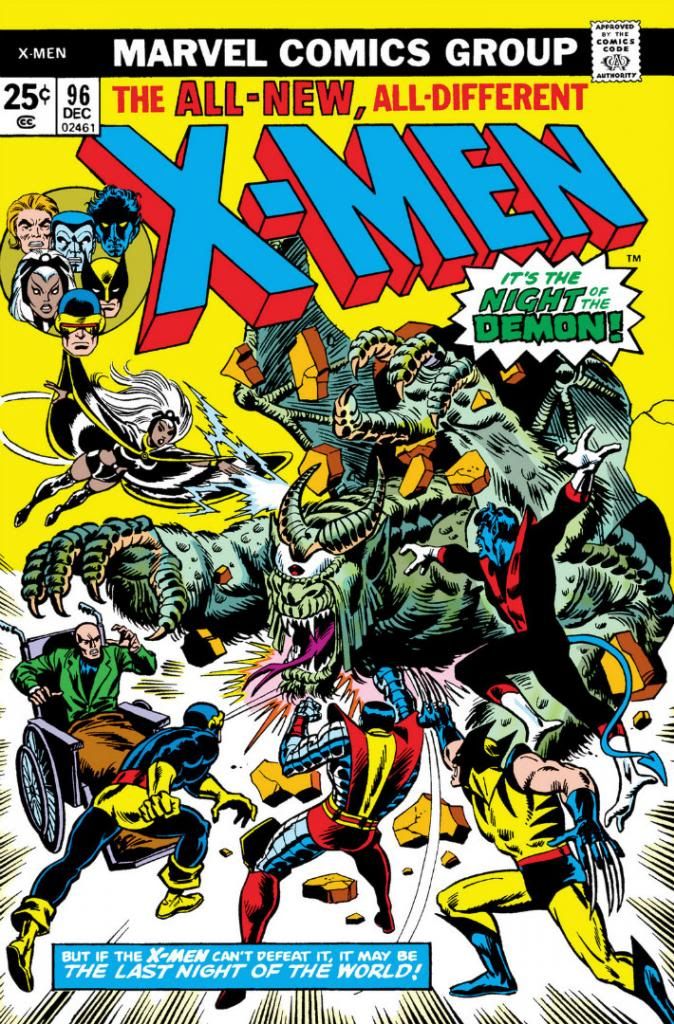
October is Spookey Month: Uncanny X-Men #96 in which the X-Men meet H.P. Lovecraft or a version thereof...

What is your favorite Halloween fright creature?  Is it the ever-popular vampire?  The werewolf?  The ghost?  The demon?  How about the demon who's a riff on H.P. Lovecraft's whole "Old Ones" mythology?  I can't even pretend to understand Marvel's cosmology or theology, but if we're to believe "Night of the Demon" from X-Men #96 (December 1976), we are dealing with a universe where Lovecraftian analogues co-exist with gods and demi gods from just about every religion past and present alongside science both ordinary and extraordinary.

Our story opens on a lovely fall day with text-heavy narrative captions floating in the air.  This is a seasonal tradition in upstate New York, from what I understand.  They do help Chris Claremont establish mood, and the first couple of pages are all about mood.  Guilty over his role in teammate Thunderbird's death in the previous issue, Cyclops broods alone in the woods near the X-Mansion.  The setting proves aptly symbolic:  the recently deceased Thunderbird and the crunchy leaves combine to produce not a winter but an autumn in Cyclops' soul.  Also, it's September, which is close enough to Halloween for our purposes.  Penciller Dave Cockrum and inker Sam Grainger conjure up a tasty forest setting, aided by a crackerjack coloring job by Phil Rachelson.  You can almost hear the wind through those crisp red and orange leaves and feel the dry air.  Then Claremont taunts poor Cyclops so much, the man loses control of his optic blasts.  Cyclops accidentally decapitates an ancient obelisk-shaped cairn with indecipherable hieroglyphics carved on its sides.

This suave move-- I'm wondering how far Cyclops' eye-blasts travel before their energy or force dissipates enough to be harmless to anyone unlucky enough to be caught by one of his indiscriminate outbursts-- frees a demon from a type called "N'Garai" (Claremont was always fond of apostrophes in his monster/demon/alien species names).
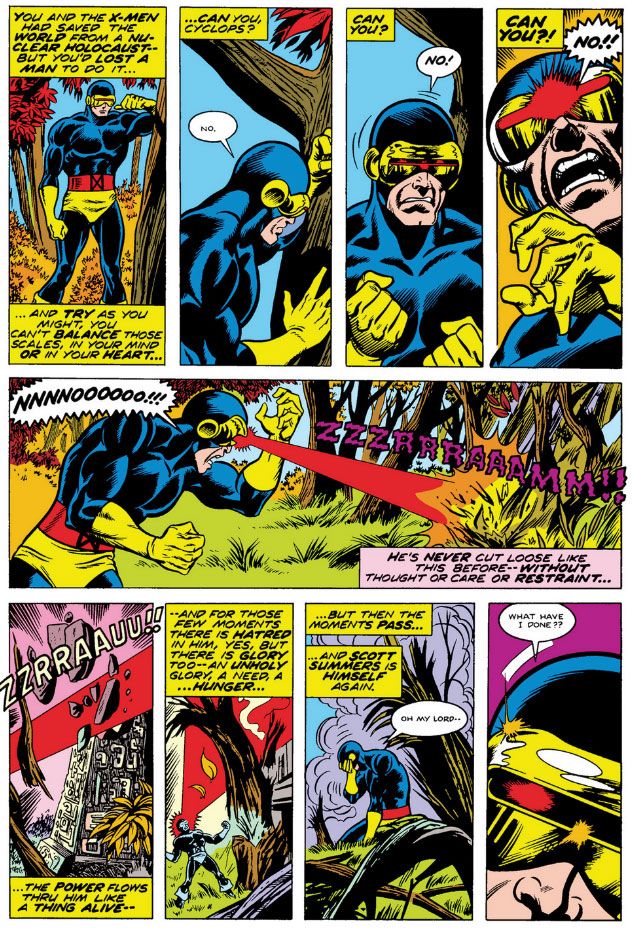

The cairn itself is kind of an oddball element.  Sure, Claremont has to introduce this issue's enemy somehow.  It's just hard to suspend disbelief such a spectacular artifact would be undiscovered so close to the X-Mansion.  There must be county roads or even an interstate or something similar running nearby, too.  Plus, this thing is supposed to be thousands of years old.  You can't tell me a hunter, hiker, birdwatcher or Cub Scout pack hasn't stumbled across it before now, with a horde of archaeologists following soon after.  And to have Cyclops blast it open at random stretches belief to the breaking point, even for a book where we have a blue-furred teleporter running around.  But it's in the story, and we all know the gang at Marvel was simply working from reports submitted by the actual superheroes they published comics about, so it must have happened in exactly this way.
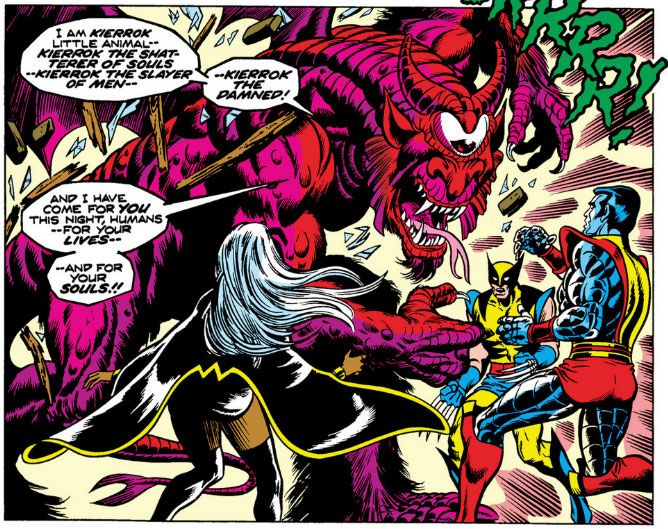

The boss N'Garai is a bat-winged, shaggy, one-eyed dude named Kierrok, and he burst through the mansion's wall like the Kool-Aid Man on a PCP rampage.  As a bit of side trivia, his name is an in-joke because he's portrayed by none other than William Shatner himself in a spectacular costume of someone's design. 

Someone?  I can't say who gets credit as creature-creator here.  Marie Severin and Sal Buscema drew the rather hectic cover instead of Cockrum, and no one has ever told me why.  I read in Comic Book Artist magazine many years ago how Stan Lee used to demand all monstrous enemies be humanoid in appearance to the point where he had Severin re-pencil a dog-like beastie originally drawn by Neal Adams, even if it meant the stupid thing was too big even to stand upright thanks the confines of the page layout.  There may have been a similar situation here, with editorial deciding not to use Cockrum's original design because it didn't fit the Marvel anthro-centric standard.  As you can see, there's also a slight continuity mistake thanks to the cover/interior art duties split.  On the cover, Kierrok is mean and green and pretty far between, but in the story he's kind of reddish or magenta.

Whoever designed him and whatever his color, inside the book Cockrum makes damned sure this nutty Kierrok creature can not only stand on a couple of muscular legs, but also flail about.  Kierrok tosses the heroes around like a big brother lumbering into a little kids' pretend wrestling match.  He also drains their powers and makes Wolverine frown as if he's an offended Sunday School teacher out of some Mark Twain book.  Tom Sawyer, perhaps.  What I love about Kierrok isn't so much that he gives the X-Men all sorts of trouble, but the way he insists in perfect English he's not likely to suffer defeat.  He's like a three-way cross between the Mugatu from Shatner's cult-fave series Star Trek, one of those body-suit Muppets and an enraged pro wrestler in an after-match interview.

As far as I can tell, this is where Claremont starts making his reputation for writing strong women (mostly justified, with caveats extensively covered elsewhere), because Storm comes into her own in this issue.  While the X-Men first attempt to deal with Kierrok one at a time-- which really makes their team training exercises seem useless or Cyclops even a worse leader than he thinks he is-- it takes Storm to shut the magic gateway between our world and wherever it is the N'Garai come from.  While Storm braves the demon hordes alone and also fights off a flashback to her childhood, the male X-Men apparently huddle around Professor X and pray for salvation.
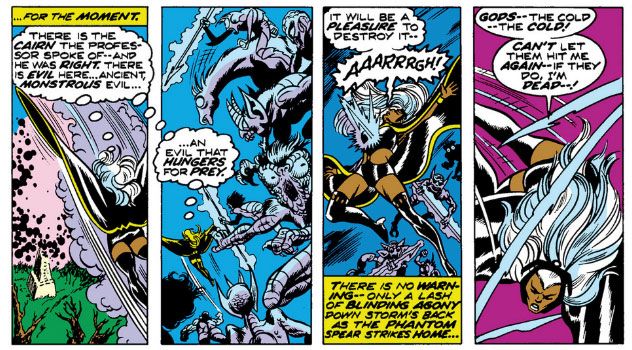

Oh yeah, dig those crazy demons.  They look like something out of Disney's "Night on Bald Mountain" Fantasia sequence.  Cockrum keeps the mayhem contained within some tight, narrow panels that emphasize Storm's ever-growing claustrophobia.


We all know Wally Wood and Gil Kane influenced Cockrum's art.  Well, there's one panel that I swear looks like Cockrum and Grainger channel a little Kane.  Maybe it's Cockrum's choice of camera angles and Storm's clutching hand, both of which are very Gil Kane-like, or the way Grainger inks the demon's scaly texture and Storm's face.  On the other hand, the rest of the drawing elements seem less like Kane, like the double lines on Storm's knuckles and the hatching on the demon's bicep and under Storm's arm.  If Cockrum had chosen a full-figure pose for Storm and the cairn below her in the background, we could blow this image up into a pretty cool cover for this issue.

At this point-- because we only have about a page left before the comic ends-- Storm shrugs off the smoke demons and puts the finishing touch on the events courtesy of a huge lightning bolt.  And so concludes an action-packed one-off that falls one Innsmouth denizen shy of being a full-blown "Cthulhu Mythos" tale.

Claremont and Bill Mantlo share plot credit here, so it's difficult to know who came up with all these events.  The overall characterization and quick flashback to Storm's childhood scream Claremont, but the way Kierrok lumbers into the story without any foreshadowing or much of a set-up is generic comic book stuff that could be by anybody.  I don't know if Mantlo had a Lovecraft fixation-- I can't find much evidence of it in his Micronauts work-- but if you've read Giant Size Dracula #2 (September 1974), you've already encountered Claremont's appropriation of Lovecraftian elements.  That story pits our favorite vampire against a cult led by an Elder God-worshipping demon or warlock or warlock-demon named... wait for it... Y'Garon. 

This isn't a criticism by any means.  After all, just about everyone working in creepy genre fiction, film or art cribs from Lovecraft at some point.  Robert E. Howard, Robert Bloch, Stephen King, H.R. Giger, Sam Raimi, Mike Mignola (who does it best, as far as I'm concerned), Frank Sinatra (remember his his hit song, "Fly Me to Yuggoth?"), Tony Bennett, Alan Alda.  I've read Lovecraft's stories dozens of times and enjoy them, but to paraphrase Kurt Vonnegut, "If only he could write!"  Claremont's writing might have some cloying tendencies at times (especially in his post-John Byrne Uncanny X-Men era), but even at his wordiest he's never as awkward as Lovecraft and his rhythms and modern vernacular are much more appealing.  Mix the two writers together and you get Professor X doing a mindmeld and falling straight into the Necronomicon.
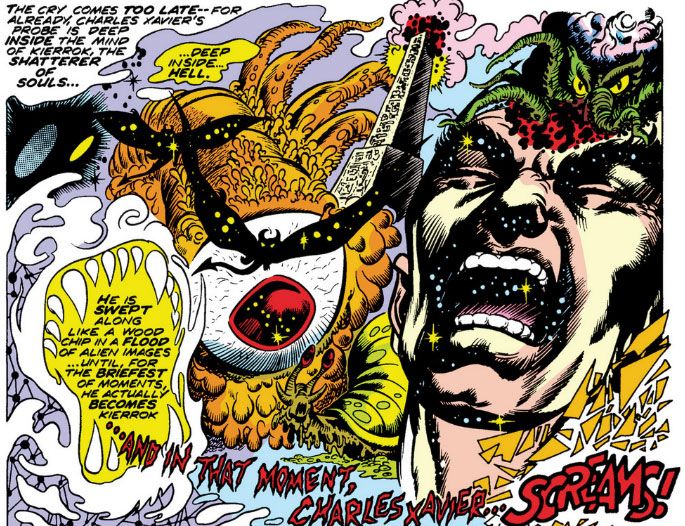

Yep.  Ph'nglui mglw'nafh Cthulhu R'lyeh wgah'nagl fhtagn!  Eyeballs, tentacles, winged creatures that fly through the void between planets, geometries unknown on earth.  That's Lovecraft all over, but "... and in that moment, Charles Xavier... screams!" is pure Chris Claremont.

We're not through with the N'Garai by any means.  They make a reappearance a few years later in a story that borrows even more heavily from a more contemporaneous horror source, this time a little movie called Alien.  We'll discuss that in our next installment.

Now I'll share with you my favorite part of this comic.  It has to do with yet another of those strong women, for this is also the issue that introduces Professor X associate Moira MacTaggert, who will play an increasingly important role in stories to come.
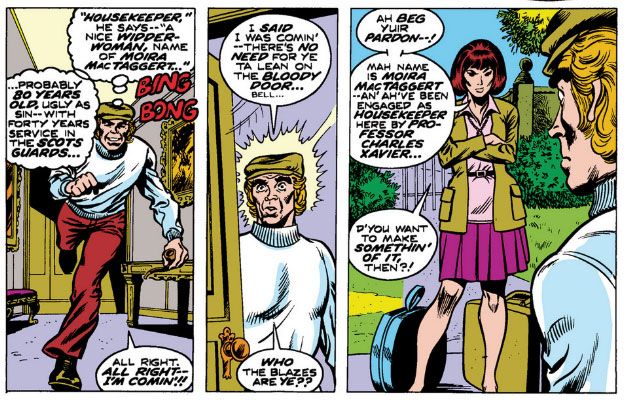

That's some advanced Irish-Scottish stereotype-speak, Marvel-style!  All that's lacking is an argument about whether or not leprechauns eat haggis.  She may not have powers, but does Dr. MacTaggart have the toughness to hang with the X-Men?  Check this out:
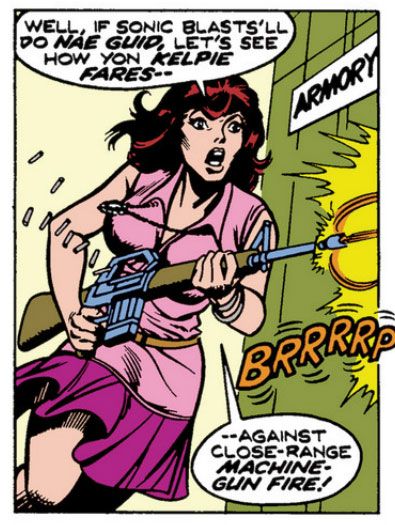

She does what none of those highly-trained military dudes at our Valhalla Mountain NORAD command could manage in X-Men #94, firing from the hip, no less!  And all at once we have an exciting addition to the cast and we know never to mess with her.

Sunday, July 28, 2013

In Which We Sing of Slug


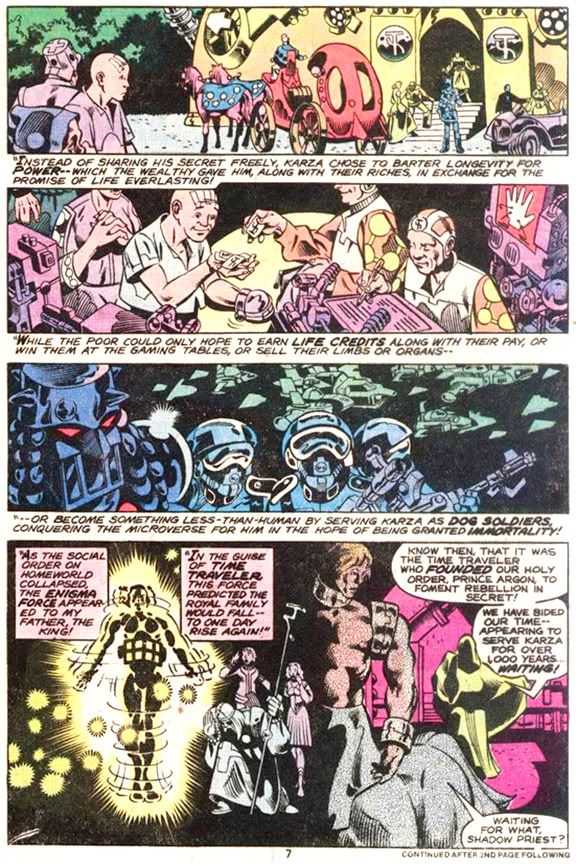
In writing Marvel's Micronauts series, Bill Mantlo took a toy line with no narrative and gave it one, set in a sub-atomic universe filled with all sorts of settings and characters.  As the toys touted their "interchangeability," so too did Mantlo assemble the comic out of various parts-- a little Flash Gordon, some Kirby Fourth World, a bit of Star Wars (which I think is obvious and certainly no crime, though Mantlo denied it forcefully in a letter page response to a reader who pointed it out-- to be fair, let's just say Mantlo and Lucas drew from the same source material).  To this rich mix he added some cool flourishes that give Micronauts its own identity. Acroyear, for example, was merely the name of two of the toy bad guys, but Mantlo created an entire race of honorable warrior Acroyear, led by a noble outcast who became a major player on the Micronauts team.  This innovation came a few years before Star Trek:  The Next Generation reconfigured the Klingons from crudely-motivated space cossacks into a clan-and-honor-based culture drawing from Japanese martial tradition.  Mantlo also came up with a lot of interesting little supporting characters, too—characters like rebel leader Slug.

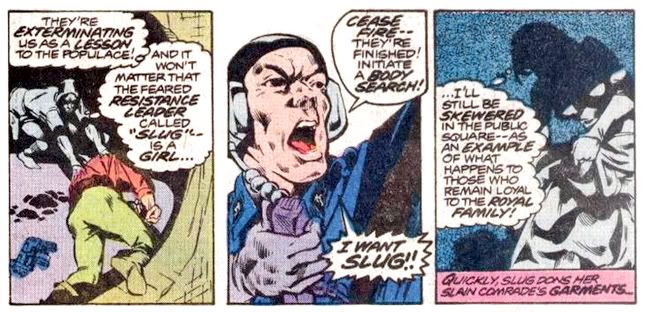
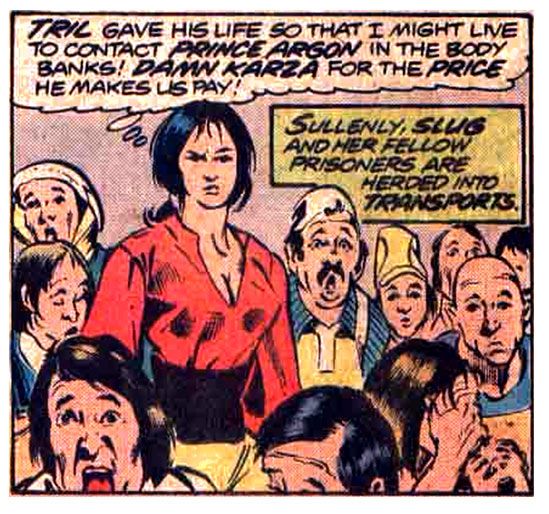
Slug.  Not her real name, yet not exactly a nickname.  A nom de guerre, if you will, but more than that.  Slug debuts in the story "A Hunting We Will Go" from the second issue I bought fresh off the spinner rack, Micronauts #4 (April 1979).  The book features splendid art by Michael Golden and Josef Rubinstein and I can't figure out why this team wasn't used on Marvel's Star Wars title.  Right from the splash they delight readers with high-tech vehicles, a chaotic firefight and lots of everyday type slobs caught in the middle as minor villain Major D'Ark commands an assault on "Sector 7" of Homeworld, the comic's main planet (other than earth, of course).  Dodging lasersonics, laser bolts or beams or blaster shots or whatever, Slug jumps into a hole in the wall and changes clothes with a dead man for no apparent reason.  After all, it's not as if the rebels wear uniforms or that she wouldn't tip off the bad guys with her defiant eye-squint among a bunch of stunned, gape-mouthed goobers.  Somehow this clothes-swap makes someone known only by name and reputation completely anonymous.  From there she goes to the worst possible place on Homeworld.  By design.

Where did this woman come from?  In her brief, violent life, we don't learn a whole lot about her or her motivations, and precious little biography.  Mantlo wouldn’t even reveal the story behind her humble handle for another three years, in Micronauts #48 (December 1982).  This is when we learn doomed, defiant Slug was born to a prisoner of Baron Karza, the science-mad dictator of the Microverse.  She became Slug via one of Karza’s offhand insults as soldiers drag her mother away.  With whatever name her parents gave her left unsaid, it's Slug she remains for the rest of her life.  The only question is, who told her she was a Slug?

Because she's a secondary character rather than main cast, Mantlo never fills us in on what Slug does between birth and rebellion.  This means we're free to imagine the hardscrabble life Slug must have lived from that day. Homeworld hosts a hierarchical society with Karza on top, followed by the wealthy elite who support his tyranny. At the bottom, the poor, mostly used by Karza as a recruiting pool for his Dog Soldier armies or for experiments in his Body Banks, the genetic madhouse where Karza dissects and maims at will.  It's obviously a dehumanizing system.  An orphan among its lowest class, Slug probably learned to steal and hide at first, and later to fight.

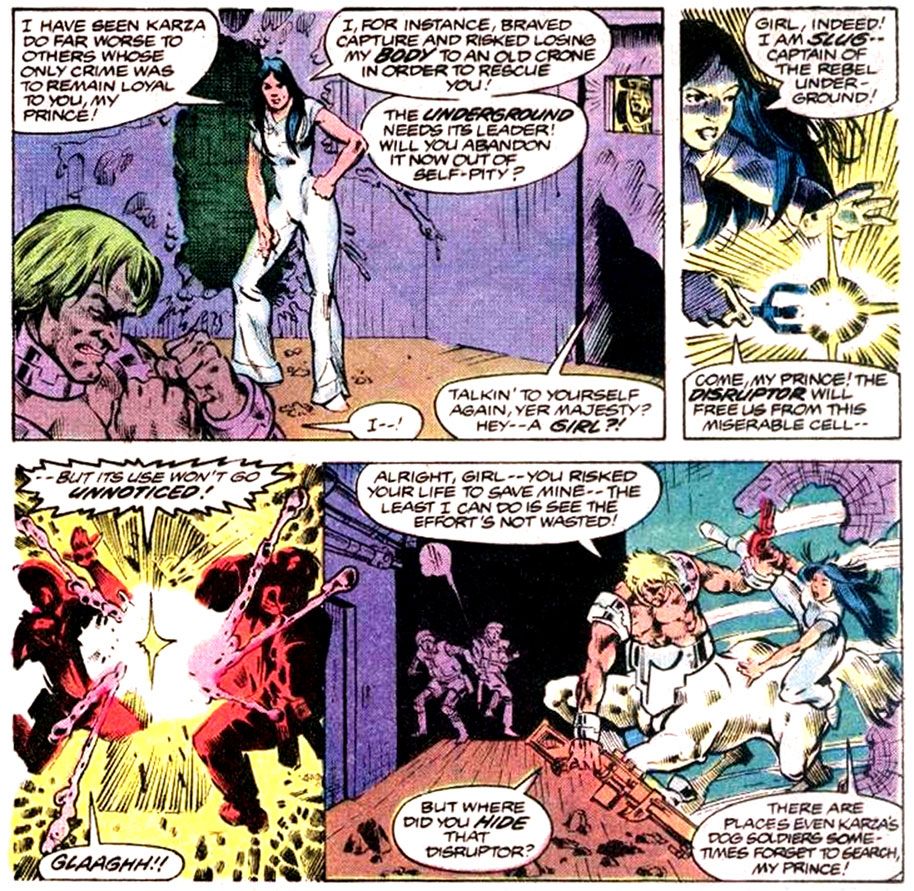
Emphasis on the fighting, because when she first appears Slug is already the semi-legendary leader of the anti-Karza rebellion, no doubt using her street smarts and toughness to plan and survive running street battles with the Dog Soldiers—until she allows herself to be captured. Locked away inside the Body Banks herself, Slug faces the potential horror of having her body taken from her and given to a loyalist. But before that can happen, she uses an energy weapon (I don’t even care to speculate where she hid it, because in on scene she’s forced to disrobe completely in front of Karza’s men) and breaks into the cell of Prince Argon, who’s already suffered the indignity of having his upper body surgically grafted to his horse’s lower body. You know it could’ve been worse: if Karza had more of a sense of humor, he might have done it the other way around.  I would have.  Look into your heart and you may find you would have, too.  Since he didn't, we're free to imagine somewhere in the unseen sections of the Body Banks, there's a horse head running around on human legs.

Flights of horse-ass based fantasy aside, Slug quickly convinces the despairing Argon to fight for his life and they blast their way out of the Body Banks. With Slug riding on Argon’s back.  Which is pretty sensible, when you think about it.  After all, it is a horse's body which means it has horse's legs.  Strong and fast enough for both Slug and Argon to make good their escape.

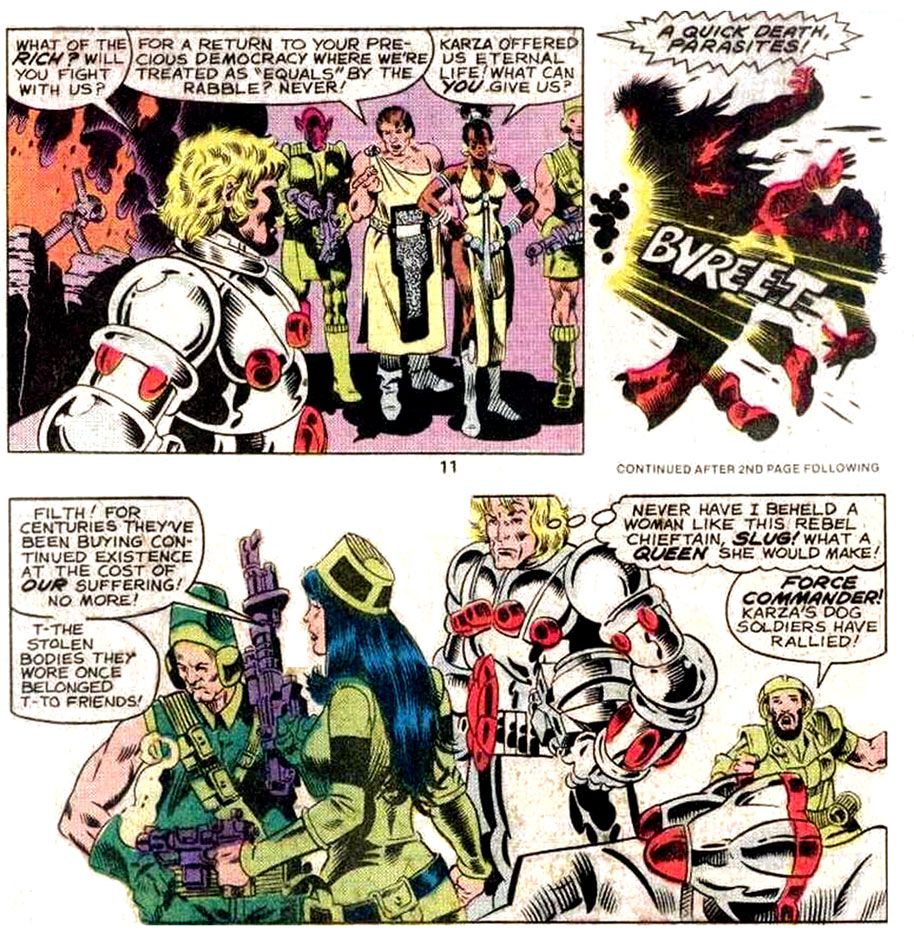
After that, Slug doesn’t contribute a whole lot to the fight against Karza, at least not on-panel. But when Mantlo and Golden do depict Slug in action, it’s to gun down some rich jerks who won’t join the rebellion. That’s pretty hardcore. Che Girlvera.


This happens in Micronauts #7 (July 1979).  Yes, Argon, what a queen Slug would make.  The queen of summary executions.

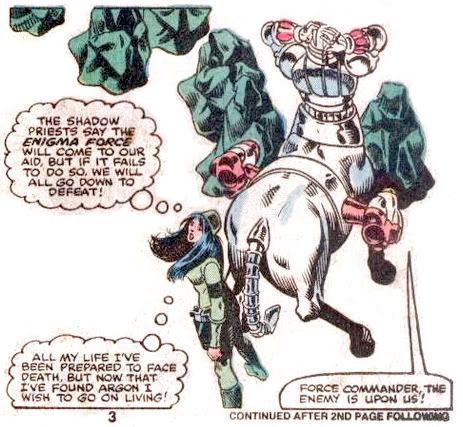
Fighting for freedom side-by-side (the freedom to be ruled by a king instead of a baron), the two fall madly in love. Under Slug's influence, Argon dons King Dallan’s holy armor, which looks like the negative version of Karza’s unholy armor.  Despite being something of a dumbass as it turns out, Argon takes charge of the rebellion, no doubt coached at every turn by the more-capable Slug.  At least I hope that's the subtext Mantlo intends as he relegates Slug to a more supporting role in the conflict.  But despite lacking Slug's brains, Argon does have four hooves and a couple of rockets on his back, and so proves himself every bit as gutsy as his girlfriend.

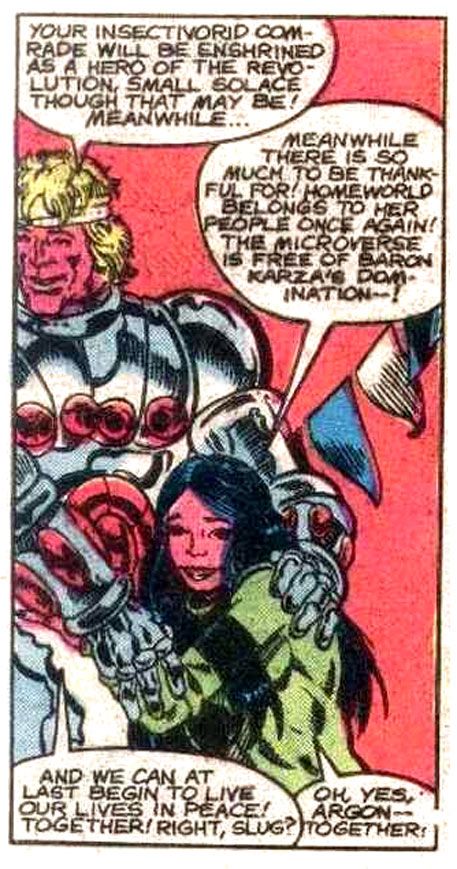
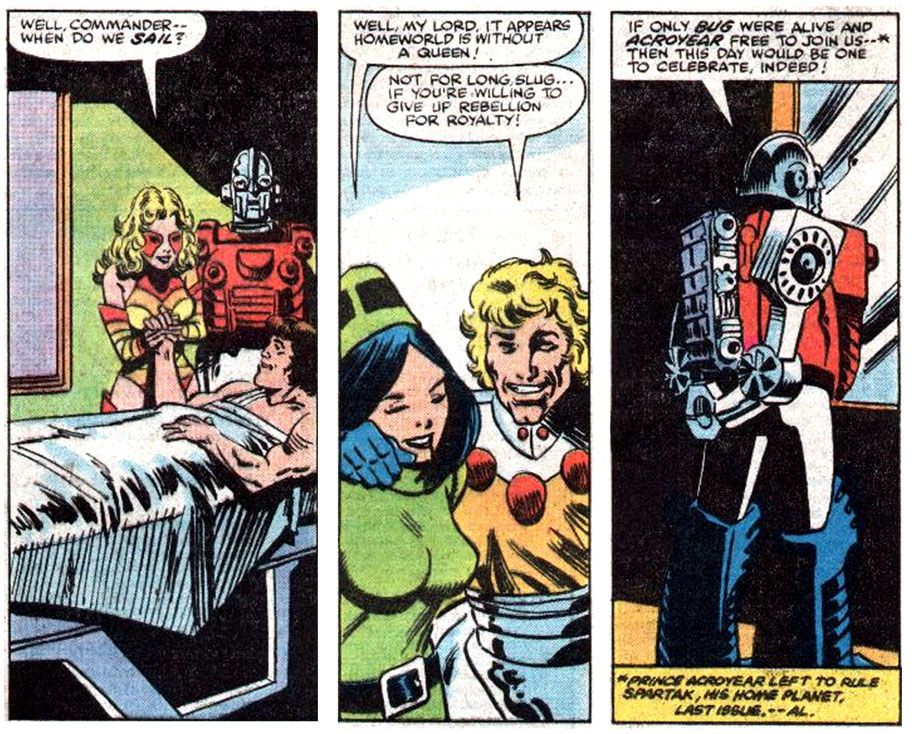
By Micronauts #12 (December 1979), with the war against Karza apparently finished, Slug prepares to hang up her guns and start exploring the softer side of life.  The very same young woman who once blew the upper class away with a laser-blaster coquettishly melts into the arms of the heir apparent.   You can’t help but think Slug feels a little pang of guilt when Argon asks her in #13 (January 1980) if she’s ready to trade rebellion for royalty.  Or not.  Her politics are more than a little odd when you consider her rebellion wasn't a democratic one by any means.  It was more of a pro-monarchist insurrection.  She fought to replace an autocratic regime with an aristocratic one, not to give the people a voice in their government, unless revolution counts as a voice.  Now that I think it over, I'm sure it does.  I prefer elections to violence, however, but with a monster like Karza in charge, Slug and her fellow rebels didn't have that choice.  Whatever her former beliefs, Slug seems happy to hint at a new role for herself.  She's to marry into royalty as her reward.

Life afterwards doesn't go as smoothly as Slug might have hoped, despite being drawn for a few issues by Howard Chaykin, with inks by series editor Al Milgrom.  Chaykin was penciller on Marvel's Star Wars movie adaptation, so he might have seemed a natural fit for Micronauts, just as Golden would have been for that other property.  Unfortunately, Milgrom's inks are far from sympathetic and give the book a rushed look.  Which it may very well have been-- Micronauts features a lot of complex machinery and a massive cast so it must have been a chore for art teams to meet deadlines.  And even when matched with ideal material, Chaykin never had much luck with inkers at Marvel.  He fared much better doing his own finishes in his American Flagg series at First Comics.

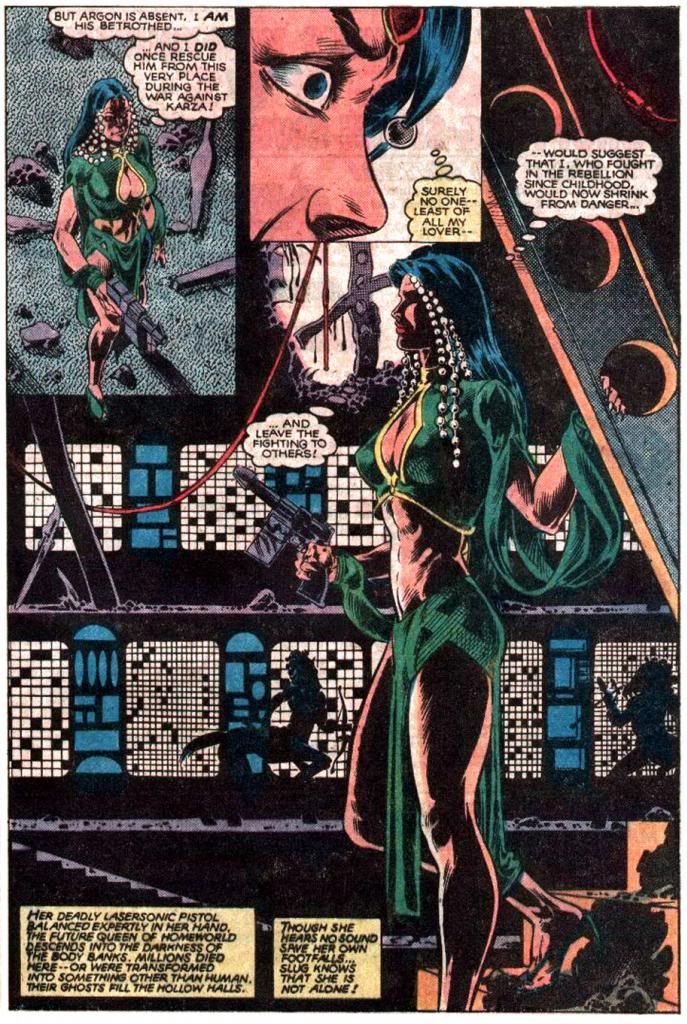
Possibly as disappointed by the art as I was at the time, Slug slinks away until Micronauts #22 (October 1980), and when she reappears, she's still a fiesty one.  And more than a little strident, a trait she hadn't evidenced before despite having been a fine leader.  Guess success does that to a person.  New artist Pat Broderick with his Michael Golden-esque style has Slug ditch her tomboyish green fez and functional pantsuit look for space lingerie and strands of pearls in her hair.


This choice seems a little off given Slug's rough-and-tumble origins, but as a character look it has precedents.  Maybe it's because of Dejah Thoris, Edgar Rice Burroughs's original space queen.  From what I understand, Martians of her tribe generally run around naked but for some jewelry (they think clothes are weird, which, from a quick Google search for new Dejah Thoris comics, proves convenient for today's comic book artists whose only exposure to female anatomy seems to have come from porn magazines).  Alex Raymond contributed Princess Aura and Queen Azura.  They're pretty modest by Barsoomian standards but like leisure Slug, they favor mid-drift exposure in jeweled bras and diaphanous skirts.  No doubt directly inspired by those two creations, Al Williamson and Wally Wood favored this look for their female characters in various EC titles.  Broderick's Slug is very much drawn in this tradition.

While we're on the topic of costumes, I'm going to challenge artists of our next generation of space princesses and guerilla-girls-turned-space-princesses to draw some inspiration from the Renaissance, or even the Baroque or Rococo periods.  Not because I'm against skin (check out some Francois Boucher paintings), but because this kind of finery has regality and offers ample opportunities for sumptuous drawings of lace and folds and printed patterns, plus differing fabric textures.  Your Dejahs and Auras are fine and dandy, but my image of the ideal space princess is Virginia Madsen as Irulan in David Lynch's 1984 adaptation of Dune.  We just don't see this kind of thing often enough, but we have plenty barbarian-queens-in-silk-or-metal-bikinis imagery.

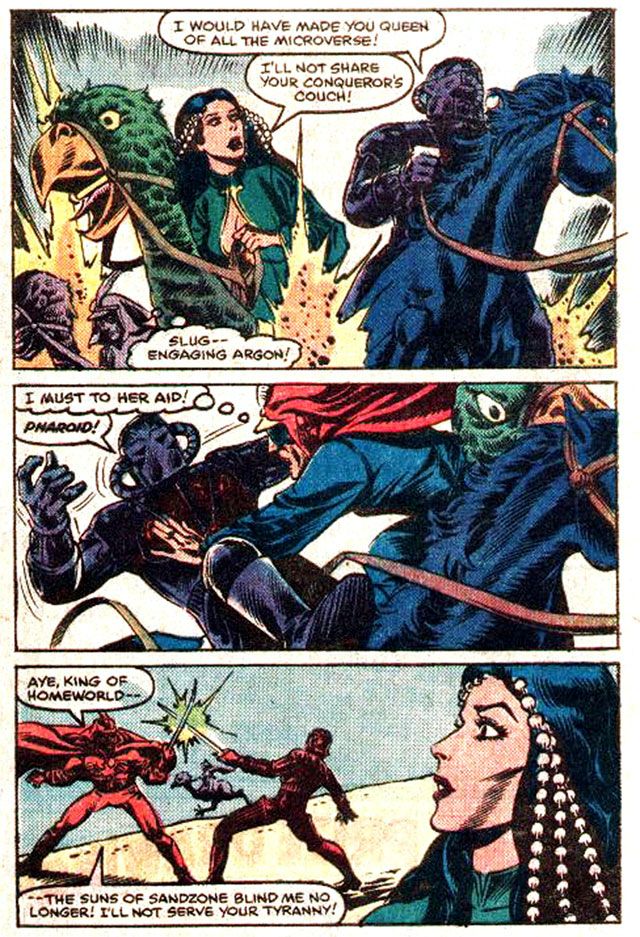
And whatever Slug's new fashion sense, it doesn't prevent her from finding a world of trouble.  Argon abruptly kidnaps her to Aegypta, a desert-like zone of Homeworld-- more Flash Gordon influence; Homeworld is made up of different zones each with its own distinct ecosystem, much like Mongo-- where men are men and women are women and everyone rides green ostriches.  There she's rescued by Pharoid, the leader of the ostrich-riders.  Like Argon before him, Pharoid falls madly in love with Slug but unlike his romantic rival, he spends the rest of his days trying to prove worthy of her.

But why does Slug's fiance drag her against her will into the desert in the first place?  Well, it has to do with the nature of mainstream comics where a good villain can never stay dead and a popular story has to repeat itself.  Even with an entire micro-galaxy possibly full of all kinds of heretofore never-seen-in-comics stories to explore, the Micronauts still end up fighting massive space wars against Karza, twice after he's possessed or otherwise transformed poor, stupid Argon.

The first plot redux renders Argon the mindless slave under the influence of Karza's mind control.  After Mantlo thoroughly sets the stage for it, Argon jumps into a live volcano and comes out transformed into the arch-villain.  Once again it's our heroes against Karza, and Slug does her part largely off-panel.  The main fighting takes place in a pseudo-Disneyland between the forces of Karza and those of SHIELD, led by good ol' Nick Fury.

Actually, after her kidnapping, Slug's major contribution to the war is to stand by Prince Argon at the mass funerals that conclude the storyline.  Given the circumstances, they make an appropriately downbeat pair, but at least Argon has his human legs back.

The next time Karza rears his ugly mind, Slug watches as her beloved dimwitted Argon lowly goes insane, first bringing back the Dog Soldiers as his personal guard in Micronauts #34 (October 1981) and then declaring his rule absolute.  To have your Argon transform into Baron Karza once is unfortunate; twice smacks of carelessness.  As for Slug, she finally starts to rethink her commitment to a man who can't decide who he is today-- nice king in white or totally different guy in black.  When Argon dons Karza's armor and declares the Micronauts outlaws while ranting and raving like a loony, Slug has had enough.  Now riding her very own green desert ostrich, she attacks her fiance, only to have Pharoid jump in and reduce her to an observer.  At this point it's been quite a while since Slug actually did much of anything, but this desultory attempt at reclaiming her "action girl" is her next-to-last attempt at reclaiming agency.  And she does so while wearing her pearls and bra look again.  Does she own only the one outfit?


You probably wonder yourself what kept Slug attached to the increasingly pathetic Argon for so long.  Perhaps it's the chance to have herself drawn by the legendary Gil Kane, who takes up the pencils with Micronauts #40 (April 1982), inked by Danny Bulanadi, who transforms him into a pseudo-Broderick.


With his slick feathered modeling and heavy black-spotting, the stalwart Bulanadi provided visual continuity on a book that must have been hell on pencillers to judge by the turnover on art.  In those days, pencillers usually didn't do the tight rendering they do now and it was up to inkers to finish the art and make things look more or less the same from issue to issue.  Bulanadi was a master at this-- Val Mayerik breakdowns, a short run of Keith Pollard pencils, even a single issue by as unique a stylist as Steve Ditko look almost identical apart from differing approaches to page layouts and character dynamics.  Along came Kane, who was born for this book despite having a more linear approach and a surer hand with the storytelling than either Golden or Broderick.  Bulanadi knocks himself out on the finishes, but we lose a lot that's essentially Gil Kane.

Maybe longtime readers would have balked at such a radical departure on the interiors, but at least Kane was able to ink his own covers.  Eventually, the massive workload of Micronauts ground down Kane, who switched to supplying only breakdowns, with Bulanadi maintaining the book's look.  I don't know about you, but those pure Kane covers make my mouth water for something more characteristic of his work.


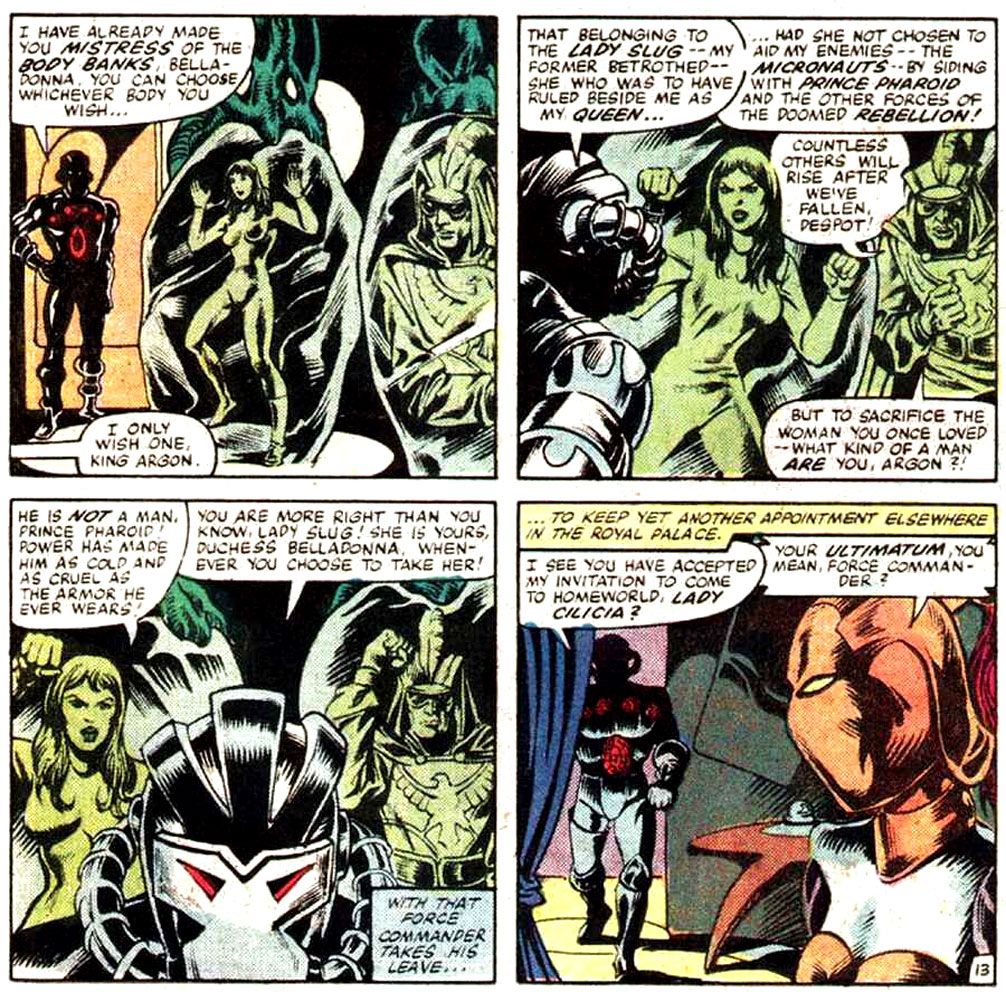
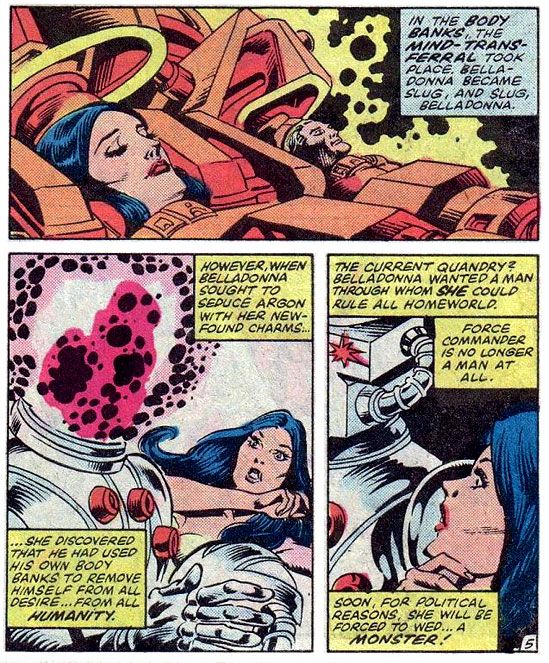
In the end, Argon has Slug's soul switched into the body of Lady Belladonna, a dessicated old poop and Karza loyalist.  The plan is for Argon to wed Belladonna in Slug's body and not tell the people of Homeworld.  That way they'll see that no matter how much of a tyrant he becomes, at least one of the great anti-tyrants of our time loves him enough to marry him.  That's suppose to shut up any protests.  Here at the bitter end of her career as rebel and royal, Slug gets a few panels hobbling around with a gun.  Then the body-switched women team up to infiltrate the Body Banks in a desperate bid to fix themselves, but it's too little, too late for Slug.  She's been reduced to complete ineffectuality.


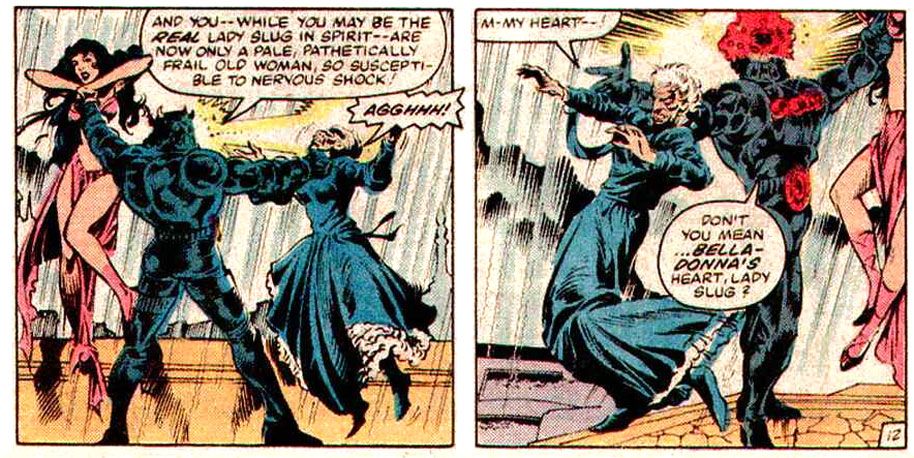
In Micronauts #49 (January 1983), as pencilled this time by Jackson "Butch" Guice, Argon literally rips himself in half and out steps a fully-formed Karza, which should have surprised no one.  Well, the tearing himself in half might have been a shocker, but the re-emergence of Karza wouldn't have been for anyone with a brain.  In the rain, while everyone engages in a massive comic book fist fight, Belladonna's aged body simply gives out from the strain with Slug still inside it and then Karza throws her younger form against a wall, breaking its neck and killing Belladonna as well.  That happens in Micronauts #50 (February 1983).  The series went on for another two years, but among the various deaths and resurrections, there's nothing remaining for a character introduced with a bang and disposed of with a whimper.  Poor Slug.


The Microverse is kind of a dark place, isn't it?  Makes Macbeth seem sort of cheerful by comparison.  Characters die all the time, heroic Commander Rann suffers all kinds of torments and loses his hand, Karza commits genocide on a planetwide scale.  So maybe it's thematically fitting Slug's infancy was so harsh, her life full of conflict and tragedy, her attempts at fighting for life and freedom abortive, her death abrupt and anti-climactic.

Thursday, August 30, 2012

Dani Moonstar and Baron Karza. I take care of both of 'em, which ain't easy, 'cuz when they met... it was moider!

For a moment, I had hope...
You'd probably expect something called The X-Men and the Micronauts (January-April 1984) to be a light romp, a bit on the silly side. After all, one group is known for its various underage members while the other is based on a toy line.  You'd also expect with Chris Claremont and Bill Mantlo handling the script it'd be a worthy reflection of their considerable writing talents.  Wrong, wrong and wrong.  It's a queasy slog through some fetishy set-pieces before it finally devolves into a ludicrous mess.

It starts pleasantly enough, with space opera.  Who doesn't love space opera?  The Micronauts lead a lot of clunky-looking spaceships into battle with an unknown invader with a starfleet of his own.  It turns out this mysterious enemy is so terrible our familiar characters, the Micronauts, have even joined forces with their recurring nemesis, Baron Karza.  Karza is a deposed tyrant, a mass-murderer, a thief of bodies and souls.  That his lifelong enemies have teamed up with him-- he's the lesser of two evils-- shows just how nasty a foe this mysterious invader truly is.

I truly did.
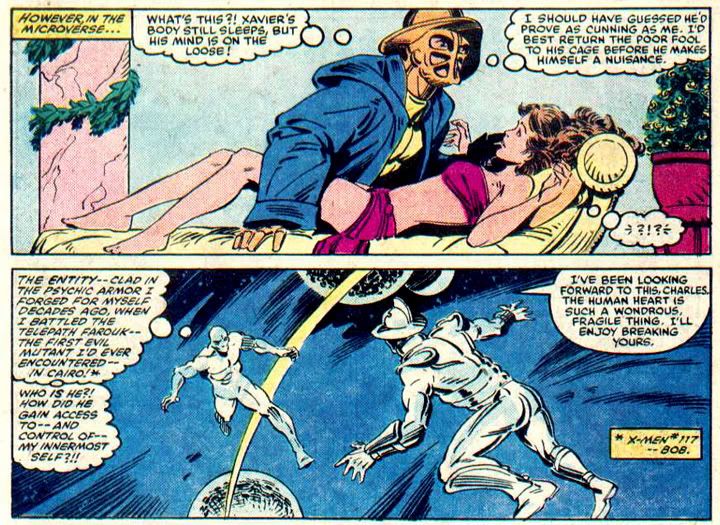
Who is this nefarious being, so terrible he causes the Micronauts to compromise years of anti-Karza activism?  The Entity.  With a name like the Entity you wonder why his parents didn't just call him the Being or the Guy.  No, he's the Entity and what the Entity is, is a maniacal mesomorph in a golden gladiator helmet.  He wreaks all this havoc simply because he gets off on it.  Not metaphorically, or in the sense he enjoys causing trouble for its own sake.  It sexually arouses him.  His male member becomes rigid.

Start with Storm.  Of course.
We know this because if there's one thing the Entity enjoys as much as destroying and enslaving, it's talking about destroying and enslaving.  He captures the Micronauts with ludicrous ease and straps them to rocks so he can tell them all about himself, his plans, and his desires.  He's like a celebrity who gives interviews where he can't shut up about his sexual encounters.  The Entity is so lascivious with his captive audience he doesn't stop blabbing about this stuff even when he finally notices Baron Karza.  Karza, being smarter than the Micronauts, takes that as his cue to get the hell out of Dodge.  He jumps in the Bioship, a living robot/spaceship and escapes.

Cut to... Earth.  It's the X-Mansion in Westchester, NY, and the X-Men are lounging about in various states of undress.  Storm poses in a bikini, Nightcrawler juggles because he's an ex-circus performer and Kitty Pryde complains about having to study while wearing only a top and a body suit.  Professor X and the New Mutants are hard at work in the Danger Room when Baron Karza pops in to say hello and borrow a cup of underwear.

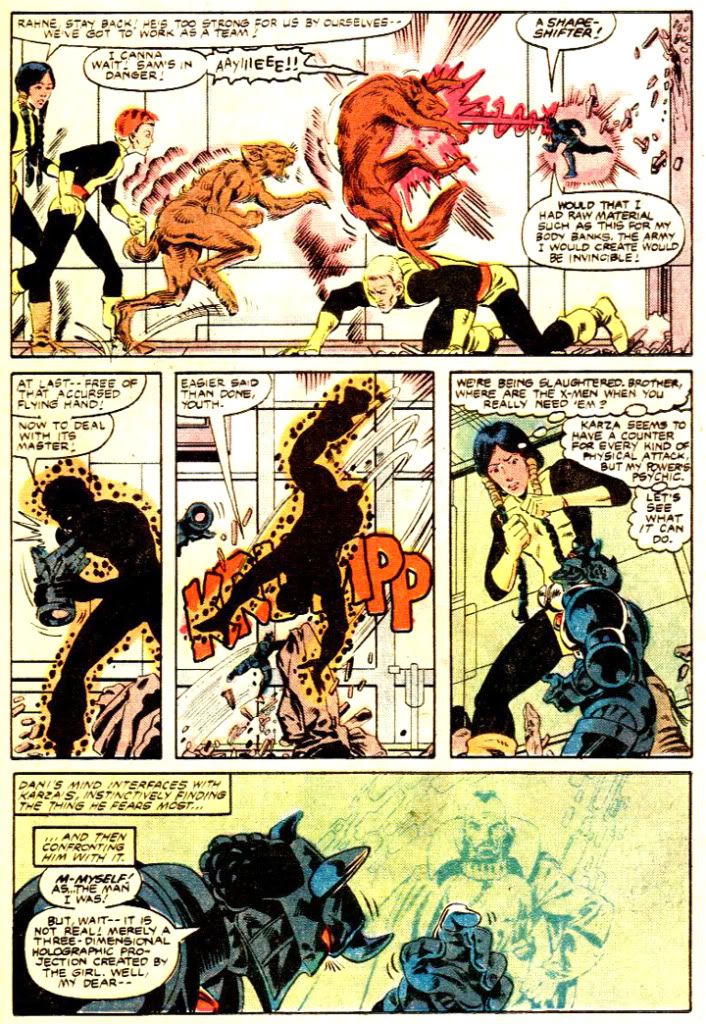
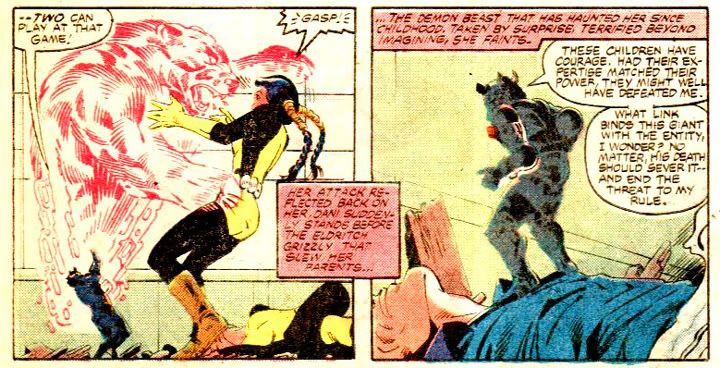
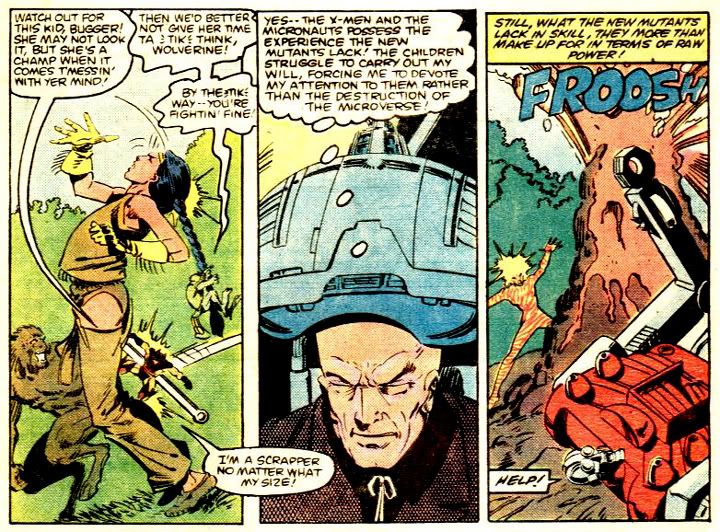
That's when Dani Moonstar, with her new codename "Spellbinder," uses her powers on Karza and for her trouble gets beaten up by a toy.  Actually, her entire team loses to teensy-tiny Karza.  I know Karza is practically all-powerful within the framework of this narrative, but the sight of a miniscule figure manhandling normal sized teenagers illustrated in a semi-realistic/slightly heroically-exaggerated style is absolutely hilarious.  At this point you can almost forget the villain's motivation isn't anything so prosaic as conquest or revenge but sexual perversion.  Almost.  It's going to be rubbed in your face later, and considering the Entity's tastes in fun, if he had his way that would be literal.  He would literally rub his genitals in your face.  He no doubt does this to several of the characters in this story at various off-screen moments.

Like a mid-90s chatroom.
Where were we?  Oh yeah...  Karza beats up the New Mutants, fights the fully-grown X-Men to a stalemate, then switches bodies with Kitty Pryde for some reason.  Since he has mental powers enough to control both bodies, he keeps it a secret and Kitty spends most of the following three issues of The X-Men and the Micronauts being puppeted around by an evil dictator from another dimension.  Their personalities start to merge, too, so that Kitty slowly begins to enjoy acting out ruthlessly from inside her black armored prison and Karza, in her body, learns to say things like, "He has a point, Storm.  I... am kinda scared."

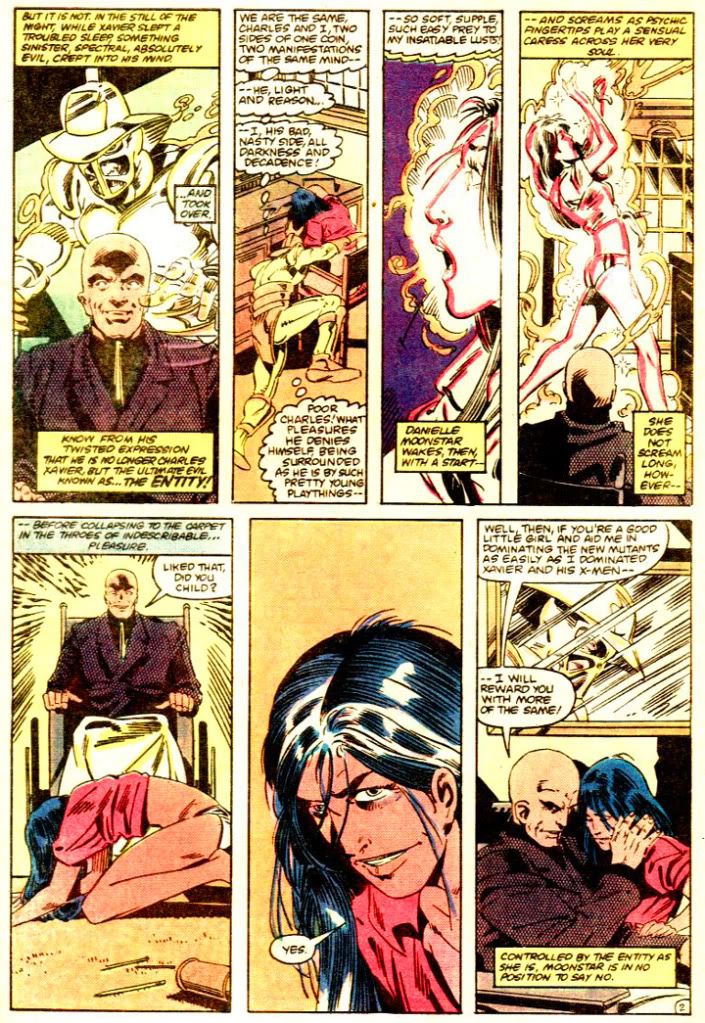
It turns out the Entity isn't just some sadistic cosmic outsider come to subjugate both super-teams for concupiscent kicks (thanks, Wallace Stevens).  He's the "evil side" of good ol' Professor X.  Not only is this convenient for involving the ever-popular X-Men in the story, but also Professor X's evil side likes to involve everyone around him in bondage scenarios.

When the idiotic interrupts the disturbing.
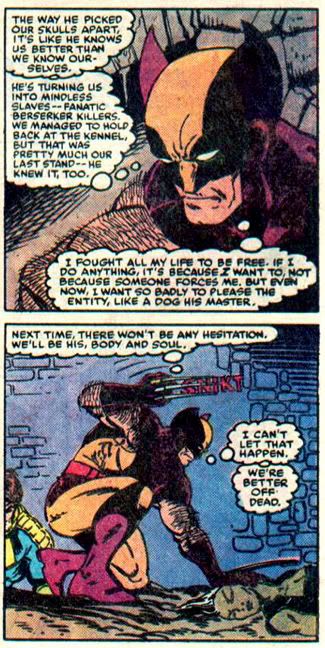
In the third issue, we get to see bearded, beefy Commander Rann simper before being killed and resurrected, then stammering, "T-thank you, Father!  I-I'll be good from now on!" while the Entity playfully strokes the poor bastard's chin.  Later in the same issue, Wolverine, in despair at being subjugated so thoroughly and comparing himself to an eager-to-please dog, attempts to murder his teammates then commit suicide as a means of escape.  And if Wolverine hasn't already made the point, formerly proud warrior-king Acroyear falls to his knees and details his similarly ambivalent reaction to complete emasculation while tears stream down his face.  I mean, if you love the idea of mind-controlled heroes fully aware of their debasement and endless pages of them bemoaning it as entertainment, then you’ve come to the right comic.  Okay, we get the point mind control is kind of invasive.  But the book drubs you with this concept to the point where it goes past that mark only to circle around to where the story really seems to be reveling in it.  I just wanted to read about the time Dani Moonstar fought a toy.  Have a few laughs with a little light-hearted entertainment.

But allow me share with you the two most magical moments of all.  

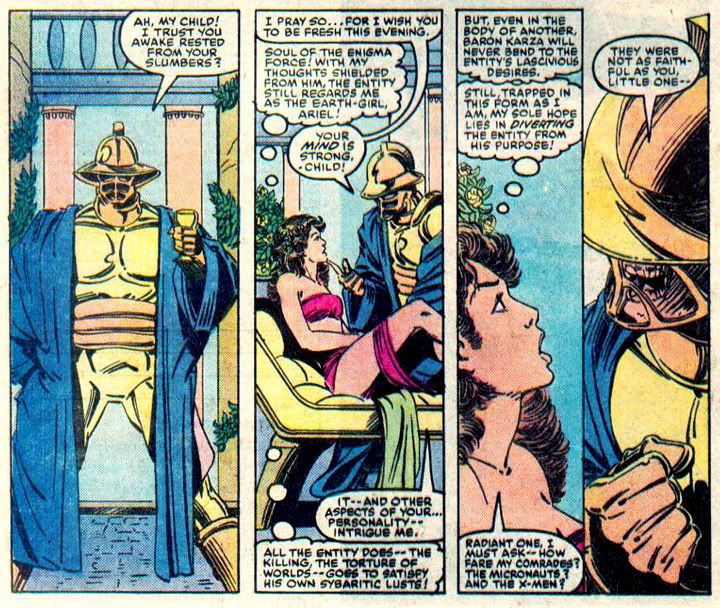
Halfway through this issue (wittily entitled "Mine Eyes Have Seen the Glory!"), the Entity, after having dressed Kitty Pryde in some kind of chiffony harem girl outfit, attempts to seduce her.  He's even wearing a Hugh Hefner-style robe over his armor and has a snifter of fine liquor.  Courvoisier, perhaps?  Doesn't bother to take his helmet off, though.  I suppose knowing it’s Baron Karza’s thousand year old consciousness inside Kitty’s underage body makes it slightly less creepy—until you once again face the fact that the Entity is the dark id of her trusted mentor and teacher and thinks he's about to score with a teen.  This takes the power exchange to a new level of wrongness—really, you have to wonder just what the hell was going through the writers’ heads when they scripted this—because here, revealed for all to see, are Professor X’s secret fantasies.  This is the stuff that goes on in the recesses of his brilliant mind when it’s idling.  I’m sure we’ve all had passing inappropriate thoughts at one time or another.  That’s human.  This, however, is a comic that uses those micro-fancies as not only the fuel for its villain’s scheme, but also his existence.
Unfortunate implications, indeed.
This leads to a mind-boggling scene in #4 where the Entity, in the guise of his normal self Professor X, Dani's trusted mentor and the man her grandfather specifically chose to look out for her wellfare, literally orgasms Dani Moonstar into joining his ever-growing harem.

On panel.

That's all it takes:  a single super-duper psychic climax and the promise of more to come and Dani immediately tosses aside everything she believes in and the very person she was up until that moment.  Sure, there's mind control involved as well.  Gotta have a little of that for seasoning.  She's no longer herself, but there's no getting past that it comes as the result or some kind of side-effect of the sexual assault.  The new Dani wants more of this treatment, too.  Also note when Dani loses herself, she alone among her teammates doesn't put on her regular team uniform.  Everyone else turns evil but they keep their ordinary, non-evil fashion sense.  New, improved evil-Dani, on the other hand, decides to wear some variation on what's supposed to be Native American clothing.  I thought she was going for the Dani Pornstar look she sports in New Mutants #17 when she joins Illyana in Limbo and dons a torn deerskin halter top and ass-less chaps, but that book is cover-dated July, three months after this book.

Well, I don't know why she doesn't just put on her New Mutants uniform like the rest of the kids.  The story, which will belabor explanations at its end, doesn't see fit to spend any time telling us.  There may be a real-world reason, though.

The X-Men and Micronauts isn't the first mainstream superhero comic to fill itself with barely sublimated sexual subtext-- or text, in this case.  A more honest comic would actually acknowledge there's more to Professor X's duality than just some split-personality villainy that leaves his usual benign self blameless.  It would deal with Dani's mind-rape by her trusted teacher as something more than just an extra-sleazy way-- both in-story and, inadvertently, at the script level-- to add a layer of difficulty to the final battle. A better story would probably would just leave it out altogether since, as a plot detail, it's completely gratuitous.  After all, it wouldn't have been that difficult to simply have Entity-Professor X use his position of trust to talk Dani, Sam and the others into fighting the Micronauts.  But that wouldn't have been as decadently fun as involving Dani with a sex fiend, right?

Still, all the darkness and humiliation might be worth it if this story had anything interesting to say about betrayal of trust, loss of self or built towards some kind of revelatory moment.  But no such luck.


Why isn't she wearing her regular costume?
Mantlo and Claremont separately wrote some fantastic stories, which means it’s reasonable to assume together they’d work up some kind of synergistic magic.  Unfortunately, X-Men and Micronauts once again proves the old adage about making assumptions.  Have you ever been watching a Major League baseball game when a top pitcher uncorks something so wild you think, “Jesus, you actually have to be a pretty damn good athlete to throw something that erratic?”  Any fool can bounce one to the plate.  It takes a top flight hurler to wing something off at such a cock-eyed angle that leaves everyone goggling in disbelief.  This is the comic book equivalent of that kind of wild pitch, a misfire so wrong it could only have come from a couple of men working in such complete confidence of their mechanical writing skills no one thought to say, “Uh… no.”

Don't worry, Prof.  Not your fault, huh?
Essentially, after they’ve exhausted all the readers with these padded-out scenes of tops and bottoms, Mantlo and Claremont abruptly end it all with a song-and-dance number.  Arbitrary metaphysics and the ridiculous rules of comic book psychic warfare.  Oh, and a whole lot of body-switching plus some perfunctory fisticuffs-- Dani gets her ass whipped again, this time by a teensy-tiny Bug and Wolverine-- and then a sequence where Professor X and the Entity in their naked ghost forms writhe around in some nether region. Fortunately, for no discernable reason, while in the Microverse-- where presumably the laws of physics are completely different thanks to the whims of plot device-- Professor X’s Entity-self has the ability to alter reality with a snap of the fingers, while in our universe he’s only an orgasm-inducing mind-reader and susceptible to naked ghost-wrestling on the astral plane.

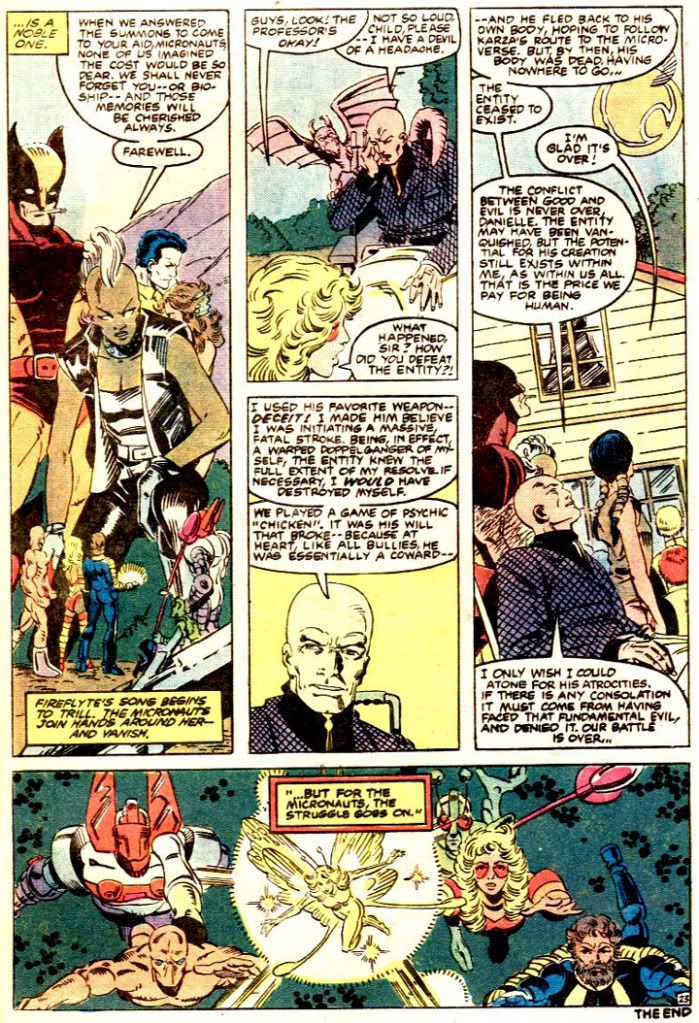
I truly feel for Jackson Guice and Bob Wiacek (Kelley Jones is in there somewhere, too), because they draw their asses off in the service of this mess.  Starships and superheroes, exploding planets and naked ghosts.  As far as Michael Golden impersonations go, this is one of the better ones.  And for their efforts, they get to illustrate the last couple of pages which consist of characters standing around like a bunch of idiots while Professor X fills their heads with a huge wheelbarrow-full of complete horse shit.  This lets the poor readers know what they just witnessed because it doesn't make much sense otherwise and the writers need to wrap it all up before the page count runs out.


Marionette of the Micronauts, as confused and disappointed as anyone else, asks, “How’d we beat that all-powerful godlike pervert?” and Professor X helpfully explains, “Well, I tricked him.”  With the script already badly stressed, the seams finally come undone, groaning in protest.  And if you're wondering just how empty of substance this tedious exhibition of soft-core fetishism has been, the final proof comes with Professor X’s conclusion where he blames the whole mess on the darkness inside us all, then says words to the effect of, “It’s too bad I can’t resurrect all those micro-people I murdered or un-rape all of you, but I can’t, so let’s never speak of this incident again.”  And they never did.

I'm so very sorry to have done this to you.  Here, this will make you feel better:

Wednesday, February 15, 2012

Whither Micronauts indeed!

Noel Murray and I must have had very similar childhoods.  We both got into the Micronauts toys, but neither of us had very many of them.  I had a few of the more generic-looking (and more importantly, cheapest) figures and one of the vehicles.  Eventually I traded with a friend for an Acroyear whose metallic parts I promptly painted red.

I'm just establishing what everyone already knows:  I am the supreme Micronauts comic book nostalgic on the web.  Well, I know it because I'm the kind of jerk who knows things like that, things that make me out to be the kind of jerk I am.  Others may know more, may show more devotion but I... Okay, I'm a sham.  A fraud.  I admit it.  But I do love me some Micronauts toys.  And I especially love the old Micronauts comic.

Murray just wrote a short think-piece on how the Micronauts' place in pop culture is currently occupied by something of a void.  There's a fan base out there, but as a property, Micronauts is stone dead.  Or at least comatose.  Meanwhile, new Star Wars figures hit the toy store shelves at an alarming rate, even of characters appearing for nanoseconds in the movies or cartoon shows.  Of course, these characters all have backstories of their own now thanks to the exponentially increasing Star Wars narrative, but the point is they exist and thrive while our beloved Micronauts barely register on the cultural radar even for jaded hipsters whose entire frame of reference consists of ironic nostalgia for things they may or may not have had as children.

I've wondered, much like Murray, why there hasn't been a Micronauts reprint book.  The first twelve issues of this comic comprise an almost forgotten classic.  Bill Mantlo's epic, sprawling tale takes the toys and provides them with a surprisingly rich milieu made of parts lifted from here and there and artfully combined.  Michael Golden's art is better than a comic based on a toy line deserves.  While the one we got was certainly fun in a campy sort of way, Micronauts was the Star Wars comic we all really wanted.

And like Murray, over the years I've done some research and it seems the rights are a bit too entangled for a proper reprinting.  What we have here is a toy line from Takara Tomy Co. Ltd. licensed in the US by Mego overlaid with characters owned by Marvel or, ultimately, Disney.  The in-house characters created by Mantlo still appear from time to time in Marvel comics, but they're now known as the Microns.  Someone else-- Takara or perhaps the mysterious entity known as Abrams/Gentile Entertainment-- owns other key characters like omniscient exposition-provider Time Traveler, robotic comedic relief team Biotron and Microtron, the heroic warrior-king Acroyear and arch-villain Baron Karza.  While working out some kind of financial and legal arrangement that probably isn't worth the money or effort, a would-be Micronauts reprint publisher faces a battle along the lines of reassembling the complete Beatles.  I mean back in the 1970s when there were still four of them.  Difficult though it may be, I doubt putting out a Micronauts reprint would be nearly so daunting a task as putting the Beatles back together these days.

In the meantime, other comic book companies have taken up the Micronauts license and attempted to recreate the magic, only to fail.  There may be a movie version in the works, and possibly some new toys from Hasbro, but I wouldn't waste time making plans to camp out for tickets or hassling the stockers at your local Toys-R-Us just yet.

However, should the movie happen maybe-- just maybe-- someone will find a way to cash in with a reprint of the Mantlo-Golden book.  Or maybe some well-connected superfan with more money than common sense will somehow make this happen.  After all, Bill Sargent once offered the Beatles fifty million dollars for a reunion.

Monday, September 5, 2011

Micronauts #8: What do you get the comic book that has everything?

I'm Facebook friends with artist Bob McLeod, co-creator of one of my all-time favorite super-teams, the New Mutants. McLeod has been doing a series of photo album posts he calls "When the Inker Really Made a Difference," where he showcases some of his work from the good ol' days at Marvel and talks a little bit about the artistic decisions he made, what it was like doing finishes for various artists and working with the editors. Did you know pencillers used to work a lot looser than they do today, giving the inker more room for interpretation? And editors would keep an inker on a book to keep it looking consistent from issue to issue, rather than a penciller?

News to me! But I've long known McLeod as one of the ace inkers. Many of his recent posts have been of his tonal work over Michael Golden's breakdowns for the Howard the Duck black and white magazine. A Michael Golden breakdown features all the little details of his full pencils, only mostly in outline form. There's a leafy tree in one panel Golden has rendered as simply the exterior holding line and he's taken the time to outline practically every individual leaf. Historically accurate models of WWII airplanes hang from the ceiling in another panel, which also features caricatures of several of Golden's friends. McLeod, working in ink, markers and airbrush, later added all the shadows and blacks, rounding out the figures and giving the pages depth and atmosphere through the addition of rich gray tones-- it's almost as if he's painted the finished artwork. Two masters. Comic book art seldom gets any better than Michael Golden with Bob McLeod finishes.


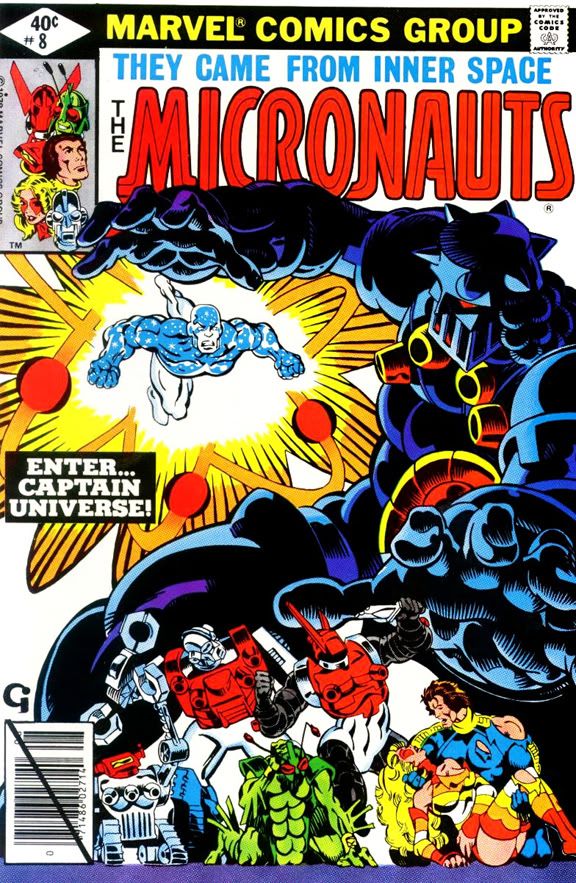
I asked McLeod if he'd ever inked Golden's color work. He said yes, he inked page 1 and 22 of The 'Nam #7, working from Golden's breakdowns again. What about Golden's full pencils? Check out Micronauts #8, the comic that has everything you could possibly want in an action-adventure book.

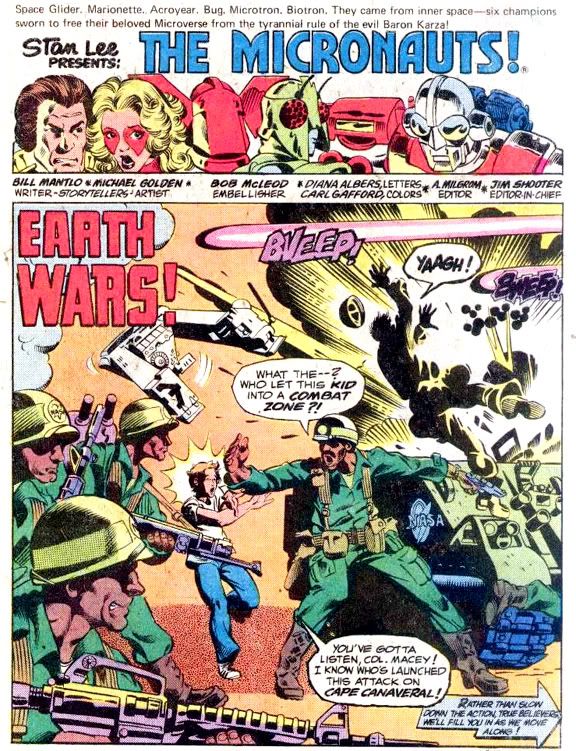
When they produced it way back in the 1970s, Golden and writer Bill Mantlo were just about to wrap up a space opera epic. As the issue begins, villain Baron Karza has emerged from the "Prometheus Pit" in a secret NASA laboratory and is wreaking havoc. Back in the subatomic reality known as the Microverse, Prince Argon (the guy with a horse's ass-- literally) decides to don some sacred white armor and lead the rebellion against Karza. And while this is happening, a retired astronaut who's fallen into the Prometheus Pit meets up with mystical magical Time Traveller and turns into the superhero Captain Universe-- "The Hero That Could Be You!"*

So not only do we have Golden's gorgeous rendering of a fire fight at the Kennedy Space Center in Florida featuring dozens of heavily-armed combatants and armored vehicles, we also get about 1000 years of Microversian history as Argon learns Karza's backstory. To round off these events, Golden, McLeod and Mantlo toss in all the spaceships and superhero fist-fighting a Star Wars geek with a Spider-Man fetish can handle.

Last Friday, McLeod posted a page from this issue and talked about it, with Joe Rubinstein and Larry Hama adding their perspectives. As McLeod recalls, Rubinstein inked the first few issues of Micronauts, but McLeod replaced him because the editors didn't particularly like Golden's artwork because it "looked 'weak'" and the book wasn't selling as well as they wanted. They were after Golden to draw it more like Jack Kirby.

According to McLeod, Rubinstein would have done been truer to the original pencils, which were bolder and featured more blacks this go around. That's interesting enough, but it gets better!

Rubinstein soon responds in the comments and backs up McLeod's point about the pressure to Kirby-ize the art, and describes how the editor asked him to change Golden's pencils by simplifying them and adding more blacks, although he argued against it. He also talks about visiting the Marvel offices and seeing a stat of the cover to #3 with a crude "improvement." Rubinstein convinced them to let him fix whatever Marvel considered a problem on the original art, but he makes the whole thing sound like a struggle an artist could never win. After finishing #7 with guest-star Man-Thing, he quit. Which is how McLeod came to ink this single issue.

Hama then explains it wasn't so much the editors themselves as it was their response to pressure from the fans, a group he characterizes as "solidly anti-Golden at the time." It may seem strange to comic book art aficionados today-- when Golden is recognized as a major influence on top talents and favorites like Art Adams and Jim Lee-- but apparently his stuff didn't go over with the readers in the 1970s. That the book wasn't selling very well helps prove Hama's point, although that may have also been due to its being based on a toy line and its awkward relationship to the superhero monthlies dominating sales. Continuity! How do Bug and Spider-Man relate to each other? What does Acroyear feel about anti-mutant hysteria? That's important stuff to some people!

Hama further points out that Al Milgrom, editor of Micronauts at the time, actually championed Golden's work to the higher ups. McLeod concurs, saying he didn't feel the art was something Milgrom would complain about. Hama also recalls DC stalwarts Murray Boltinoff and Julie Schwarz initially rejecting Golden's art, with himself and Al Milgrom giving him his first jobs there. Hindsight being what it is, this is practically inconceivable, huh? Thankfully, there were people like Hama and Milgrom around.

Despite fan objections and editorial demands, Micronauts #8 is quite the artistic tour de force. I'd say Golden achieved a bolder, more dynamic look without sacrificing his characteristic eye for teensy-tiny detail, and McLeod inked with a sympathetic line that didn't overwhelm.

Milgrom took over inks on Micronauts starting with #9, and he did ink with a bolder, simpler line. Hama maintains the fans felt Golden's work was "too cartoony," but Milgrom's inks look cartoonier than either Rubinstein's or McLeod's. I'm not sure how telling the inkers to make the art look more like Jack Kirby would have alleviated that particular complaint, either. Especially considering how Kirby himself was no longer in fashion with the fans at the time and subject to a certain amount of disrespect at the Marvel offices during this period as well. At least that's how I've always heard it told.

I wonder if sales improved. They must have been acceptable, since the book continued for several more years. In retrospect, Golden was the perfect choice for this book, much more appropriate for its milieu than Howard Chaykin, who took over pencils with #13. And as fine an inker as Milgrom is, he and Chaykin don't mesh very well. The art appears clumsy and rushed compared even to the work Golden and Milgrom produced in the previous issue. Chaykin really needs to ink himself. Why did Marvel keep plugging him into these space opera type books? It's not that he can't handle science fiction or action-- check out American Flagg. It's just this type of spaceship-and-heavy-equipment storytelling and Marvel-style inking never did him justice. His perfect fit would have been Marvel's The Further Adventures of Indiana Jones, but that's a post for another day. This one's already ridiculously rambling and prolix enough!

As much as I love this series, I sometimes wish Mantlo and Golden had just stopped after #12, the aftermath of the anti-Karza rebellion. Everyone except Karza (of course) has done what he or she set out to do. They've made new friends, freedom has been restored, Acroyear and his embittered albino brother Shaitan have fought to the death. The first twelve issues form a self-contained epic, much better than any comic based on a toy line needs to be.

As the title continued, it began to suffer from repetitive storytelling. Karza comes back from the dead, reconquers his domain, invades the Earth, has his butt kicked. Repeatedly. And the Microverse-- being an entire universe unto itself-- would seem to offer a limitless backdrop for any number of original plots, but because it's in the back pocket of the Marvel universe, the Micronauts fight Doctor Doom, Plant Man and Molecule Man while teaming up with the Fantastic Four and Ant-Man. Eventually, they join forces with the X-Men while Karza and Kitty Pryde switch bodies. That's where I break with most fandom-- I would have preferred Marvel's Dracula not fight Brother Voodoo or vampirize Storm, for example. Luke Skywalker didn't have to team-up with Nick Fury and Dum Dum Dugan; why should Commander Rann? Don't get me wrong-- quite a few of these individual stories are a lot of fun to read, but they're standard comic book fare without the grandeur of title's first dozen issues.

Throughout, Golden-esque artists like Pat Broderick and Jackson Guice-- kind of ironic, huh?-- maintain a high level of gloss and gleam. Despite the the deja vu-inducing plots, Mantlo continues to develop his cast-- especially the lead, Rann, who starts to feel his age, grows a beard and loses his hand. But there's a sense they'd told the tale and then succumbed to the inherent weaknesses of open-ended serialized storytelling.

While I was reading this, one of the best ideas I've ever had suddenly came to me. Sit down. You really need to be sitting before I share it with you. Comfortable? Good. Imagine this: Chris Claremont scripting a New Mutants flashback issue featuring the original team with Michael Golden and Bob McLeod providing the art!

Oh baby!

*Restrictions may apply. Offer not valid in every state. Marvel and When Comic Books Rule the Earth do not mean to imply you actually could be Captain Universe and make no claims-- legal or otherwise-- that are to be considered binding contracts.

Sunday, May 29, 2011

MIcronauts: Perfect summer comic book reading

Summer is upon us and that means school's out, big-budget/small-brained blockbusters dominate the nation's movie screens, there's nothing on TV but reality shows and dramas too lame to make the regular season and people are putting down their hefty copies of James Joyce's Ulysses and picking up lighter reading fare. My suggestion?

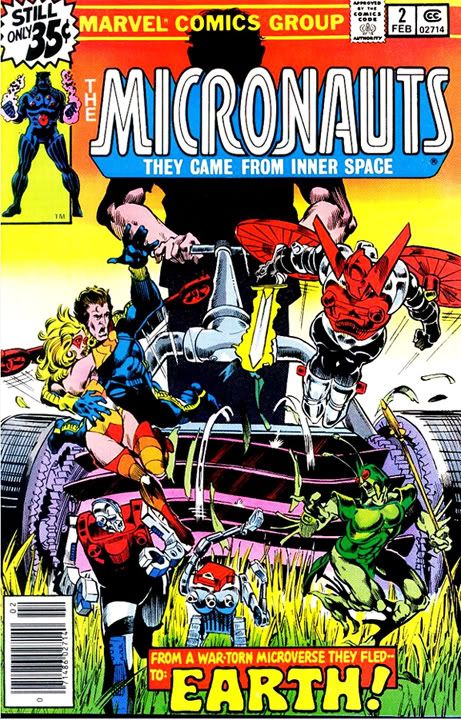
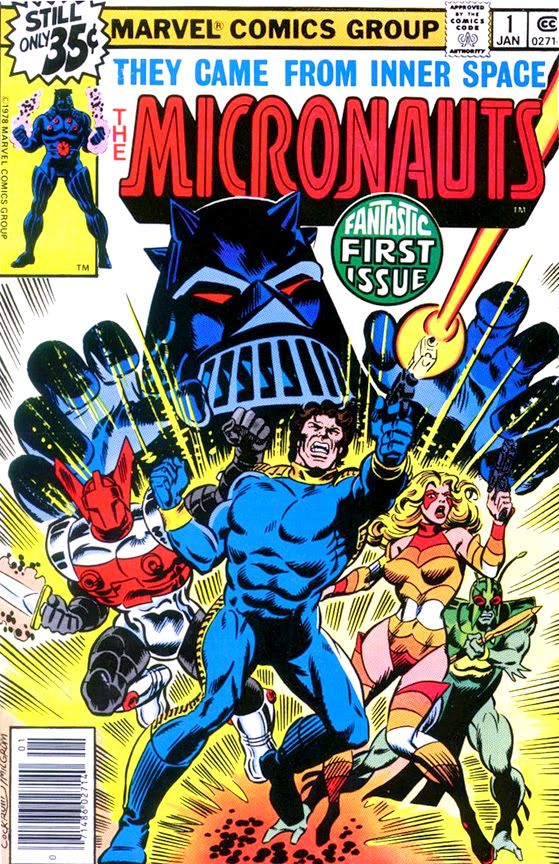
Marvel's Micronauts series. It's kind of like the Star Wars comic that never was, only there was a Star Wars comic that was also kind of like Micronauts. Actually, the first Star Wars artist Howard Chaykin later illustrated a few issues of Micronauts, which is a neat overlapping of similar summer fun fare. While Bill Mantlo filled the Arthur Digby Sellers role and wrote the bulk of the series (all 59 issues of the first volume), superstar artist Michael Golden illustrated the first 12 issues and its classic storyline, a dimension-spanning epic featuring a hero with a connection to a mysterious cosmic force, a couple of plucky robots, a spunky space princess and their rebellion against a black-armored mastermind and his Nazi-like army. Which reminds me of something or other. Battlestar Galactica?

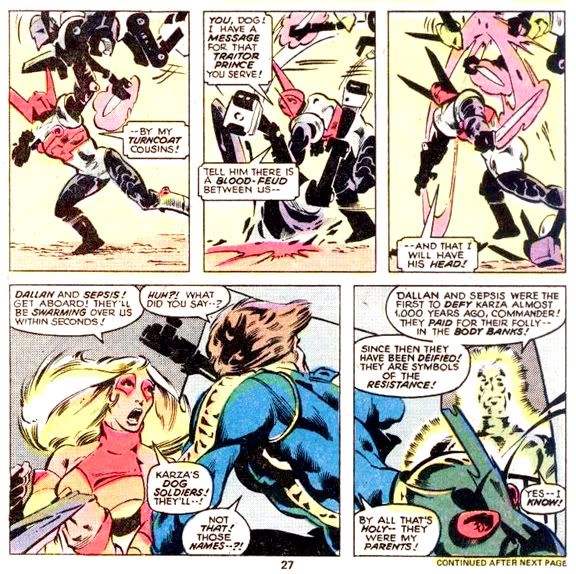
In the first issue, Commander Rann, a bold explorer, returns to his home planet after centuries in deep space only to find himself something of a legend and his parents-- the former king and queen-- worshiped as gods. And their science adviser Baron Karza ruling the place with an iron fist. Sensing a threat to his regime, Karza has Rann imprisoned. This proves to be a mistake, because it isn't long before Rann makes friends with the stoic warrior Acroyear, his comedic relief insectoid buddy Bug and Princess Mari, sister of the deposed Prince Argon. Together, they become a team of freedom fighters. But first they have to escape Karza's dungeons.

Script by Bill Mantlo, art by Michael Golden and Josef Rubinstein: Welcome home, Commander Rann!

Mantlo quickly sketches his world and its central conflict, filling his story with action sequences and little snippets of characterization. Princess Mari is so spirited she has to be convinced by her self-sacrificing brother to flee and fight another day, Rann conquers his initial confusion and takes charge of his own destiny, Bug cracks jokes and Acroyear provides muscle. And it's all gloriously illustrated by Golden and inker Josef Rubenstein. Taking as his inspiration a line of Japanese toys imported by the Mego company, Mantlo grafts on a few elements of Flash Gordon, the first Star Wars movie (there wasn't a second in those days) and Jack Kirby's Fourth World. Golden has always excelled at this kind of material-- armored warriors, sci-fi weaponry ever so slightly exaggerated from real-world examples, starships and fire-fights.

Hot Acroyear-on-Acroyear action! Notice how Golden makes the character Acroyear look "real," but the anonymous enemy version looks like one of the Mego toys, complete with metal joints!

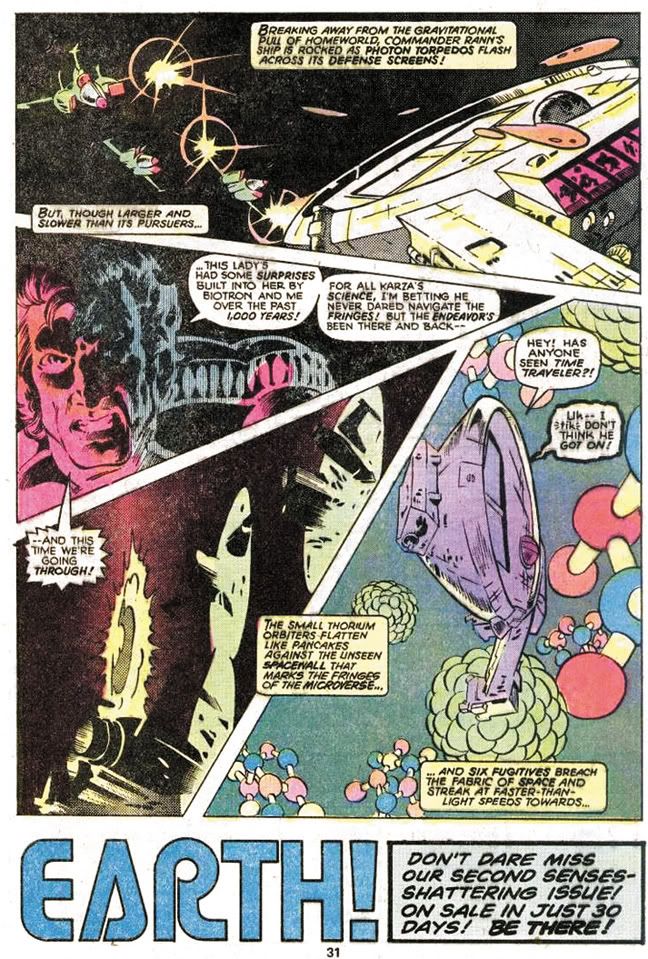
Mantlo's script really turns him loose. I remember looking at issue #2 and being completely enthralled with Golden's artwork. The way he seemed to draw every nut and bolt on the robots and the starships, the lighting effects that reminded me so much of the movies-- rather than the fairly flat figures I'd been used to from coloring books and Super Friends cartoons.

Where else would they go? How else are they going to meet the ever lovin' blue-eyed Thing?

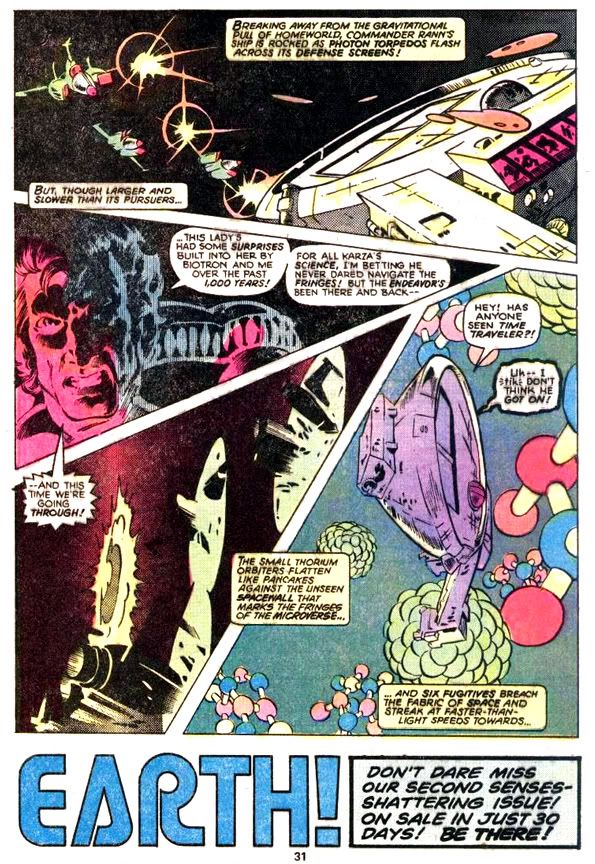
And, of course, the Micronauts end up on earth, where they're exactly the same size as the action figures my friends and I were so crazy about that year. Yeah, my best friend owned practically every Micronauts toy, no matter how complex or expensive. He never particularly cared for the comic book, but I was hooked, at least initially. The only problem was, it was so difficult to find. I never saw #1, didn't find another issue until #4 (introducing my favorite 'Naut, the valiant guerrilla leader Slug), managed to get #5 (the Micronauts invade NASA) and #6 (they fight Man-Thing in a swamp) and then nothing until #12 (the post-climactic battle between estranged brothers Acroyear and Shaitan, a traitor). And yet thanks to Mantlo's ability briefly recapitulate the action from previous issues, I never felt lost or left behind.

If the series had ended there, it would've been the first maxi-series, I suppose. Or a pioneering graphic novel. But it was popular and financially lucrative enough to continue. So Golden handed off the interior art chores to Chaykin-- something I didn't discover for months. I honestly thought the story was over. Imagine my surprise when I found Micronauts #17 (guest-starring the Fantastic Four) and #18 at a convenience store in Florida. Same awesome Golden covers, but with Chaykin story art inked by Al Milgrom that, frankly, left me appalled. Later I came to appreciate and admire Chaykin when he inked himself, but I dropped the title in dismay for a while. It wasn't until I came across #20 with pencils by Pat Broderick and inks by Armando Gil that I became a re-confirmed Micronauts fan and stuck with the book through all the repetitive Karza returns-- how many times can this guy take over Argon's mind and re-conquer over the Microverse?-- and laborious trips back and forth through time and space, Nick Fury and Timothy Aloysius Cadwallader "Dum Dum" Dugan and the X-Men showing up, visits to increasingly familiar locales like the same NASA laboratory they'd already escaped from. Gil Kane provided some memorable covers but had his distinctive look on the pages inside all but obliterated by some heavy-handed Dan Bulanadi inks; hey, I just told you I like Pat Broderick's stuff, but I don't think Gil Kane's art needs to look anything like it. There were still plenty of fun moments, but Mantlo really seemed to be writing stories in circles. Maybe that's what Marvel wanted-- those amazing first twelve issues repeated endlessly.

Well, that's hindsight. At the time, that's what I wanted too! That and more Slug.

I recently found #3 and #4 in practically mint condition at my local comic book shop, and re-reading those I can feel those summer breezes and see the cool morning grass still wet with dew. It's like being 10 years old again, only now I no longer have my lush, androgynous 70s hair and I fart more frequently. If you can find the first 12, you really need to buy them and read them this summer. They're a lot better than that John Grisham book with the wrinkled spine and the cookie crumbs flattened against some of the pages you're going to find in the magazine basket in your beach condo and probably no more expensive than that braindead 3D robot movie that's going to leave your ears ringing and your head pounding from lost IQ points.