|
| Aunt Bee: not in this issue! |
Andy Griffith was always a big favorite in my family. My dad introduced me to
The Andy Griffith Show when I was a small child and despite our being lifelong pals in the classic dad-kid way, our mutual love for the show was one of those few things we really had in common. Since it came on almost every night of the week, he and I watched the series all the way through from black and white premiere to color finale five or six times and individual episodes dozens. Ol' Dad was also pretty fond of Griffith's "What It Was, Was Football" monologue and I lost count of how many times he paraphrased the "Buddy, have a drink/Well, I believe I will have another Big Orange" exchange while pouring himself a glass of tea or whatever.
So it wasn't much of a coincidence I'd been planning to write a little bit about the Dell
Andy Griffith Show comics when I heard about Griffith's death. I think about my dad every day and if I reminisce about him long enough, it invariably leads me to thinking about Andy Griffith. I just wrote about
No Time for Sergeants, a hilarious flick that hasn't gotten its due over the years. It helped bring about Mayberry, all its citizens and spin-off
Gomer Pyle, U.S.M.C., for which we'll forgive it. We're generous that way.
 |
| They sure move around a lot. |
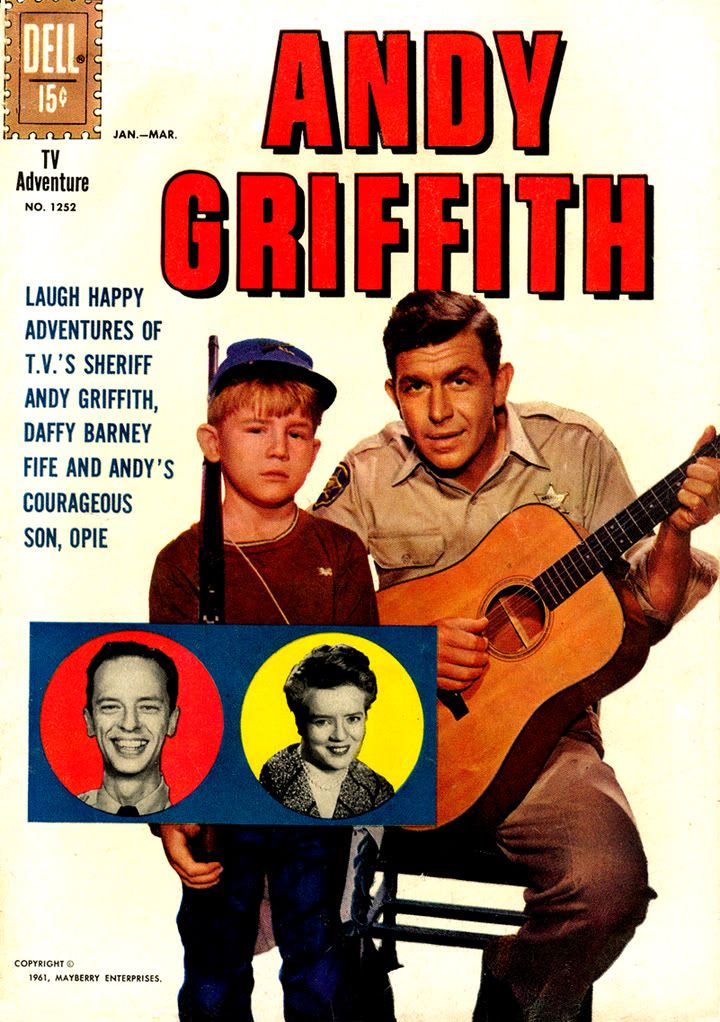
Dell published two issues of
The Andy Griffith Show comic in their long-running
Four Color series, the first numbered 1252 (January-March 1962) and the second 1341 (April-June1962). Both sport attractive full-color photo covers and some fun blurbs-- witness the anonymous copywriter's description of Opie as Andy's "courageous son."
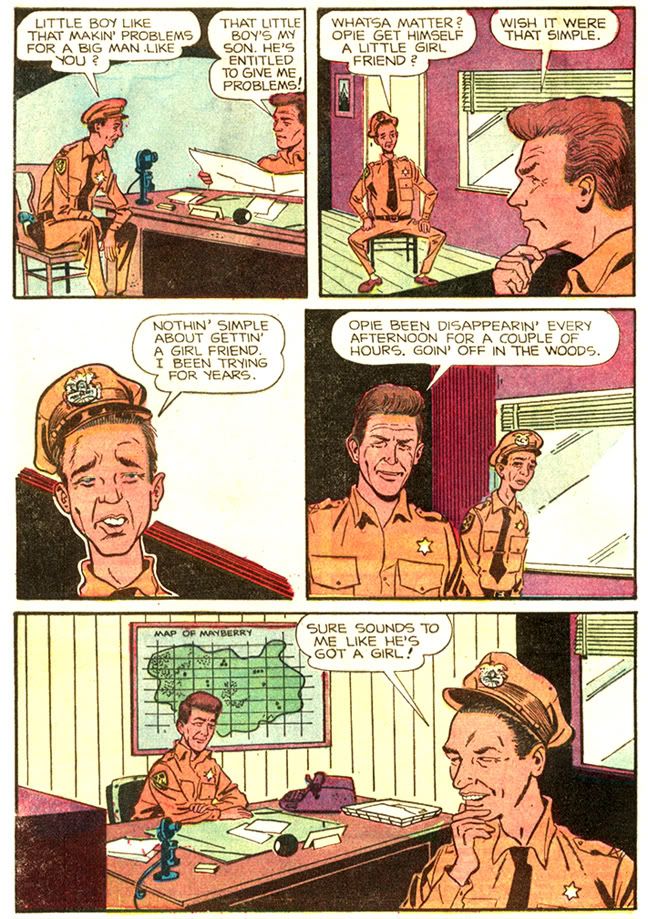
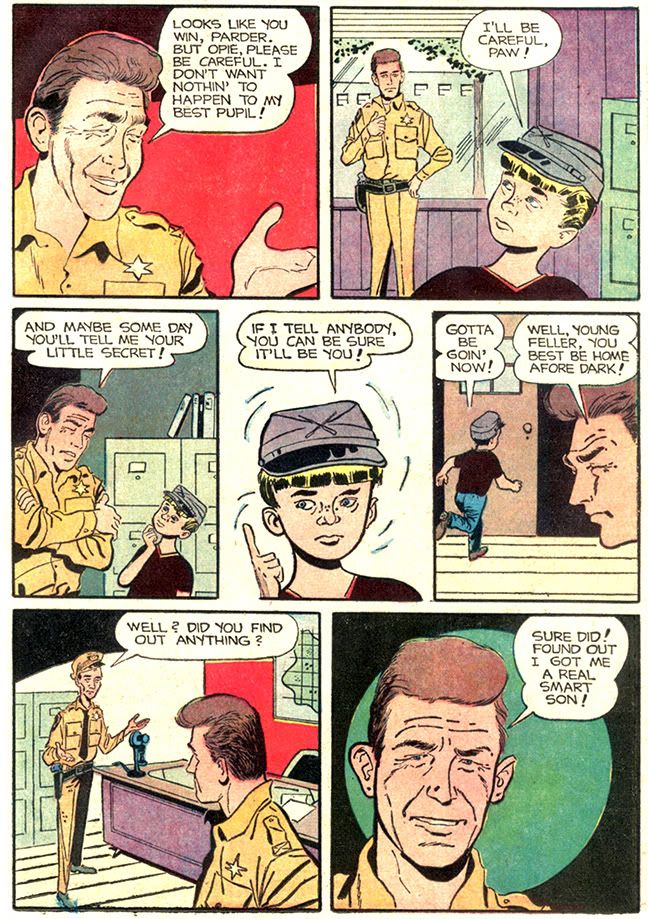
I'm not sure what makes Opie so courageous. The story inside is called "Opie's Secret," which turns out to be pretty lame as far as secrets go. Andy worries that the boy's spending too much time in the woods outside town, but instead of wandering off with a crinkled paper sack of porn for furtive masturbation sessions like Joaquin "Leaf" Phoenix in Ron Howard's own
Parenthood, Opie's just caring for a litter of puppies. Plus, we know the Mayberry woods are about as dangerous as a daycare center, and not one of those ones with the careless teachers who leave matches lying around and rusty knives. The good daycare centers.
None of Opie's wholesome activities require much in the way of bravery, or, if you will, courageousness. I tend to reserve the label "courageous" for kids who sail solo around the world, do something wonderful for the disadvantaged in the face of community disapproval, rescue their families from burning houses, inspire others with their perseverance against some fatal disease or take a stance against bullies. But perhaps the people at Dell were mild-mannered to the extreme and in their eyes Opie was some kind of free-spirited adventurer, living life on the razor's edge of danger.
 |
| Ron Howard wore this cap in "Eat My Dust." |
Andy's dialect is over-done and reminiscent of the broad, grinning way Griffith plays Sheriff Taylor in the show's early episodes-- a more sophisticated, educated variation on his Will Stockdale characterization from
No Time-- before he realized he was better off as the straight man for everyone else's antics.
On the other hand, the writer captures quite a bit of the show's flavor, especially in the way Andy relates to Opie and Barney.
Ron Howard's Opie was one of the more "real" kid characters on TV, neither a smart-aleck nor a naif. And unlike poor Theodore Cleaver, who seems to have been a bit slow at times (putting it politely), Opie was more than capable of handling his own problems with just a smidgen of guidance and advice from his pa. And avoiding embarrassing scenes like getting his head stuck in iron fences or falling into giant bowls of fake soup.
In episodes like "Opie the Birdman," (which aired a year or so after these comics hit the newsstands) the show's writers give father and son a mutual respect and even allow for a little anger between them. Opie would learn from Andy, but occasionally Andy would also learn from Opie. The heart-to-heart talk scene between Andy and Opie in "Opie's Secret" captures this dynamic quite well and so gains its own mild emotional resonance. I can't imagine Pa Kent talking to Clark as honestly as this in a
Superboy story. Come to think of it, Superboy is usually portrayed as a dimwit anyway.
The comic manages the other relationships with a similar steady hand. When Barney brags of his prowess as a woodsman, Andy sarcastically declares him the "Magellan of Mayberry," a teasing monicker you can easily imagine Griffith applying to Knotts in one of those scenes where the laid-back sheriff can't help but needle his overly sensitive deputy and best friend.
 |
| This page has a "Love and Rockets" vibe. |
Ellie Walker, charmingly portrayed on the show by Elinor Donahue (
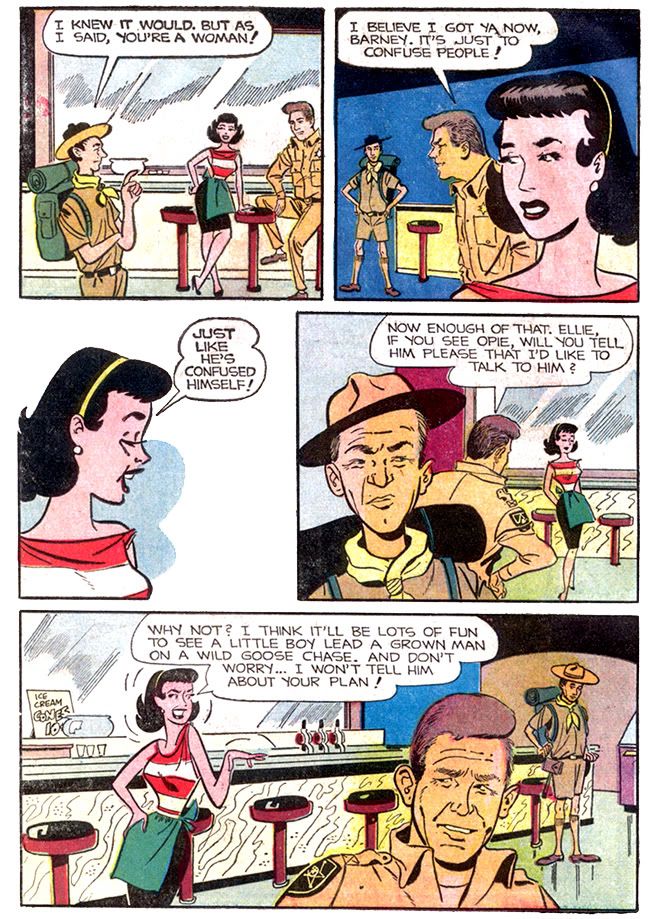
a Father Knows Best alum whose lengthy career after Mayberry includes a Star Trek guest spot and a role as Chris Elliot's mother in the cult TV classic Get a Life alongside Elliot's real father Bob), appears mid-story to banter with Barney. Barney all but declares her an idiot because she's a woman, his point of view undermined not only by its sexism but also his costume-- a ludicrous Boy Scout uniform with Smokey Bear hat and short pants. This conversation features some mild early-1960s battle-of-the-sexes dialogue reminiscent of episodes "Ellie for Council" and "Those Gossipin' Men." Ellie justifiably sneers at Barney's braggadocio, with Andy caught uncomfortably in the middle. There's a real sense of Ellie's anger here, even a bit sharper than what you'd find on the show without Donahue's incandescent smile to soften it a little. Admittedly, social issues and especially gender politics were not
The Andy Griffith Show's forte.
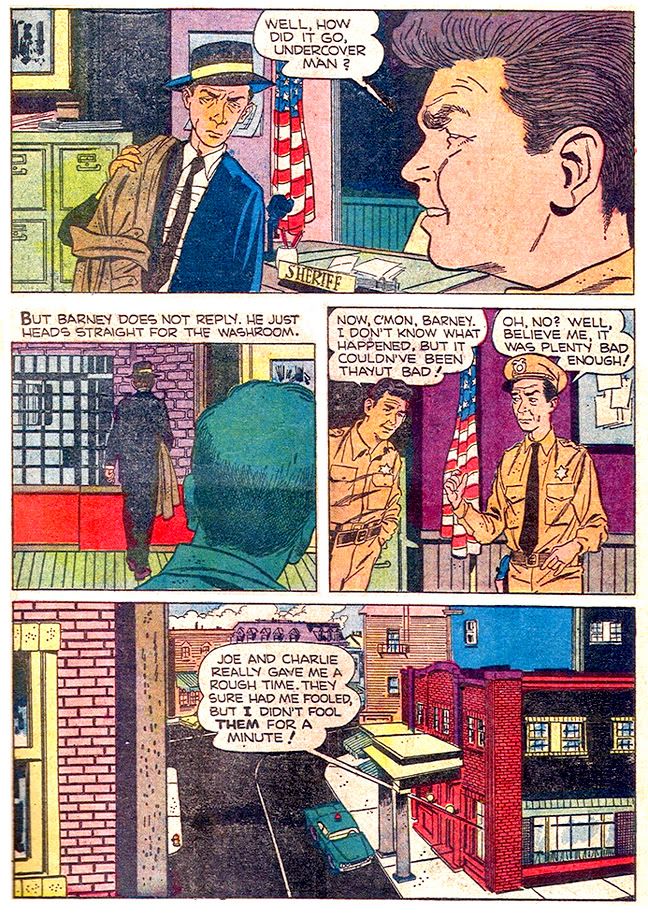
Ellie disappears from the comic after the first issue, and Opie barely appears in "Undercover Man," the story making up the second issue-- just long enough to mock Deputy Barney, who's on a crime-busting kick involving crazy disguises-- but what's really lacking in both is more of Mayberry's vividly realized citizenry. The most glaring omission is Floyd the barber. Floyd is a Mayberry essential. In the show's first two or three seasons, the barber is kind of an energetic loud mouth, a bit excitable and with a wife and teenaged son (although they seem to have been dropped down the same memory hole as Ellie about the time Floyd started courting a woman via romantic letters in "Floyd, the Gay Deceiver"). When veteran comedic actor Howard McNear suffered a debilitating stroke, the show temporarily dropped the character before bringing him back as the soft-spoken, addle-pated soul so uncannily parodied by Eugene Levy on
SCTV.
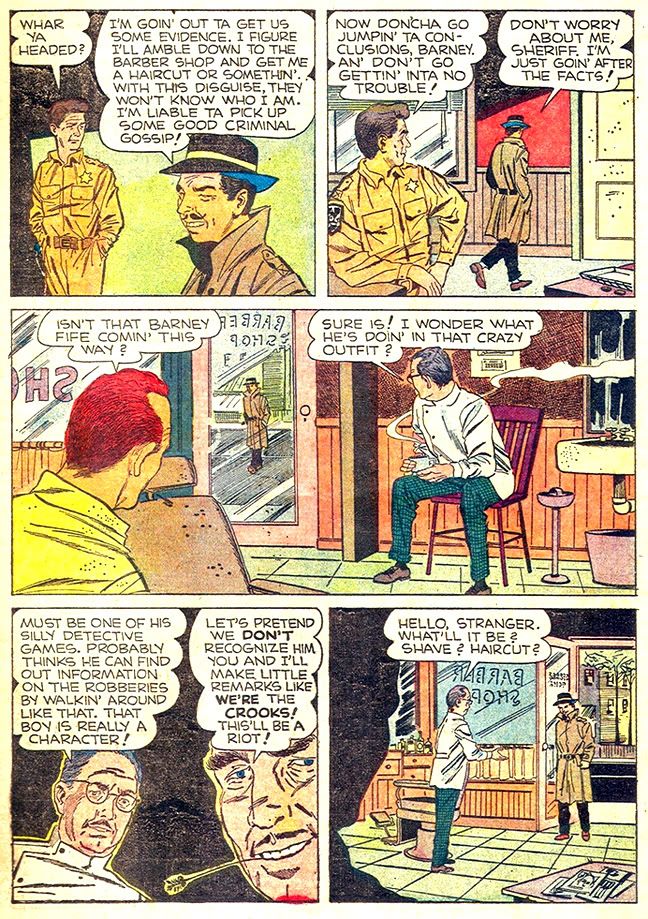
It's just not Mayberry without a visit to Floyd's barber shop, but the comic's version is a mean-spirited lout named either Joe or Charlie. Barney never makes it clear which is which. He only refers to them using both names. Joe, or Charlie as he may be called, vaguely resembles McNear, but his physical humiliation of Barney is a step beyond something Floyd would do, not that first season Floyd was shy about dogpiling on the excitable deputy with the other Mayberrians. Or Mayberrites.
 |
| Green, red, purple walls, orange uniforms! |
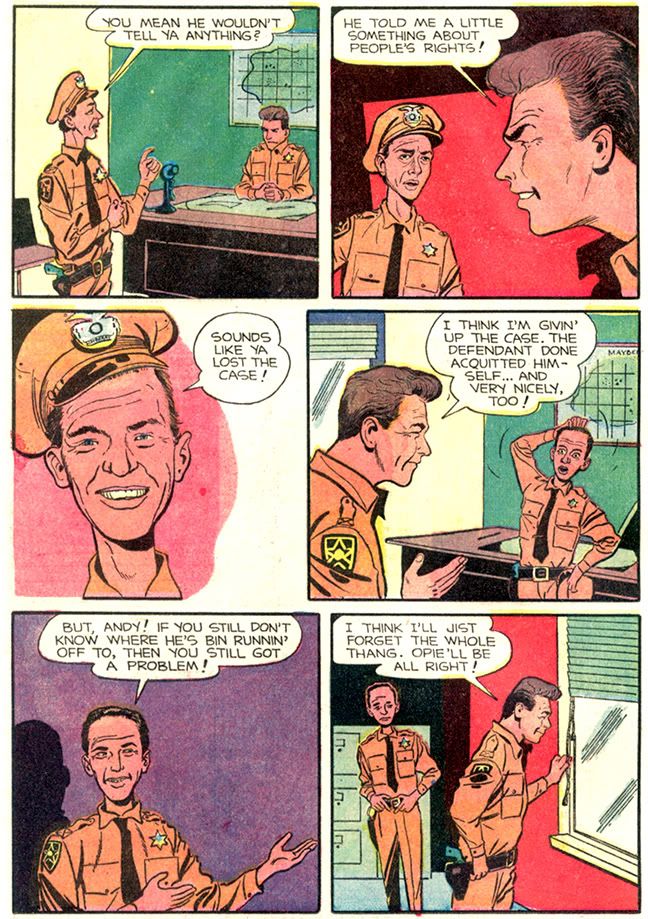
Barney claims the barber as one of his old classmates, but Floyd was at least a generation or two older. This makes me wonder if the writer screened a few episodes featuring the Andy-Opie dynamic but absent McNear's character, while artist Henry Scarpelli had a vague idea there was supposed to be a middle-aged barber with a thin mustache somewhere in the mix, with the end result this bizarre mutation. Whatever his origins, Joe-Charlie the Barber is a complete dick, and gets his comeuppance later when Andy threatens him with jail for obstructing a police officer-- and he walks away with his equally dickish friend talking about how attractive they find Barney in drag.
We get a token appearance from Aunt Bee, who helps Barney with his cross-gender disguise, but I can picture an entire spin-off series starring Ernest T. Bass, with the Darling family as his supporting cast or antagonists. You know, Bass as an anti-hero, kind of like Marvel's
Tomb of Dracula minus the supernatural horror, murders and misogyny but with a heapin' helpin' of bluegrass music and Denver Pyle blowing into a jug. Speaking of, there's nary a hint of either Pyle, Gomer or Goober. And Helen Crump had not yet made her way onto the faculty of Mayberry's elementary school.
 |
| Who are these jackasses? |
Scarpelli's attempts at likenesses are acceptable, but in "Opie's Secret," he constructs figures indifferently, awkwardly at times. Their bodies don't really hang together the way they should. Heads seem off-center and there's a lot of variation in proportion. Barney walks around on little pin-like legs with his feet pointing in opposite directions. Knowing what he was capable of in strictly humor cartoon style and later in the Archie Publications house style
a la Bob Montana and Stan Goldberg, I get the feeling Scarpelli hacked these out as fast as he could. He inked a lot of
Archie rip-offs for DC Comics in the late 60s before handling the genuine article; that makes me wonder if he skipped the pencil phase on some of these pages and drew them straight to ink. I have a feeling the page rates on these comics were pretty low. A comic book artist is a commercial artist and that means taking jobs that pay, but you have to forgive someone who might rush things a bit in an effort to keep food on the table and clothes on his or her family's back.
I have to say his acting is a strong point in "Opie's Secret." First rate, even. Scarpelli rarely repeats a facial expressions, and when the focus is on the faces, his drawings are absolutely fun and appealing. Some of the faces remind me of Daniel Clowes's work, where he seems to be illustrating a specific type of human being. There's no ironic distancing or sense of alienation in Scarpelli's drawings, just successfully adding interest to scenes that are mostly just two or three people standing around talking to each other. I really love Ellie's pissed off looks and Andy's obvious discomfort in "Opie's Secret."
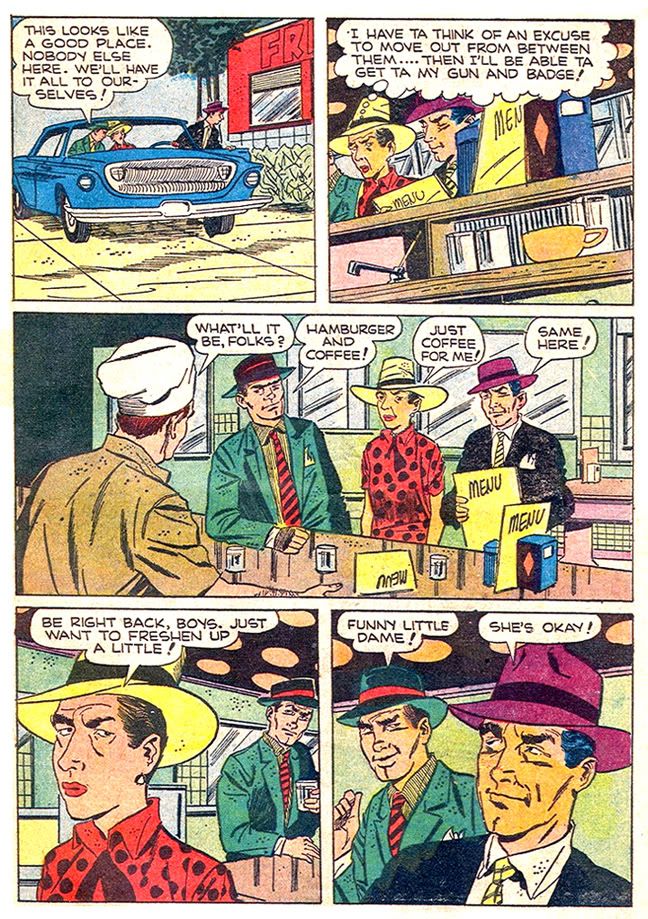
For the Barney-centric "Undercover Man," which features a lot more crime-busting action than "Opie's Secret," (i.e., some) Scarpelli adopts a more naturalistic approach. Bodies are degrees more realistically proportioned and not nearly so exaggerated. Scarpelli attempts caricatures more than Alex Toth did with his
No Time For Sergeants adaptation and the characters are easily recognizable, despite a few lapses. There's Barney's occasional weasel-like nose, but the lips are pure Don Knotts, even coated with bright red lipstick. While there's plenty of Griffith in him, Andy also frequently resembles character actor
Hoke Howell, who played Dud Wash on the show before being supplanted in the part by Bob Denver, TV's Gilligan. It's still reasonably close.
 |
| Show accurate Mayberry! |
What really freaks me out, however, is Scarpelli's insistence on drawing Andy with a gunbelt and pistol. Not just in an odd panel or two the way he sometimes adds a black tie to the sheriff's uniform, but consistently and throughout both comics. Andy did arm himself in the very few episodes where law enforcement actually plays a part in the plot, but one of the show's repeated gags was Barney's single bullet in his shirt pocket, symbolic of his failed approach at enforcing the letter of the law with depersonalized tools and technology. Barney wears a hat, tie, black leather gun belt and totes a service revolver in emulation of police officers far more effective than he will ever be, while the more casually-dressed, unarmed Andy takes a laid-back approach to public safety and successfully relies on his wit and understanding of human behavior. A few years after Dell published these the show did its own meta-spin on the issue with a two-part episode in which Andy, Aunt Bee and Opie head to Hollywood to visit the set of a movie loosely based on a magazine article about Andy entitled
Sheriff Without a Gun. As an
Andy Griffith Show fan, believe me, it matters!
 |
| Dick Tracy villains think Barney's cute. |
In the first story, Scarpelli makes Mayberry a generic suburb. Oddly enough, this is probably a more accurate depiction of the south in the early 60s than the show's. The TV Mayberry was practically antiquated even in its day, closer to the nostalgic 1920s depicted in
To Kill a Mockingbird. Even today, in my own Deep South hometown, you can trace the architectural progress of the region by moving west from the Flint River bounded by houses and apartments built in the early 20th century to the Cape Cods of the immediate post-WWII to the modern red brick suburbs that sprang from the early days of urban sprawl contemporaneous with
The Andy Griffith Show's first season on CBS. By the second issue, however, Scarpelli seems to have gotten his hands on some photo reference of the show's outdoor and indoor sets and adjusts his artwork accordingly. The courthouse, an iconic location to Griffith fans, sports the familiar portico and big plate glass window with blinds.
Of the two comics, the second is the most artistically successful and appealing. Scarpelli is a fine choice as artist, and his work is adequate, if not quite as inspired as his later
Archie strip.
I don't know who else you'd give this job to with my own first choice Jack Davis doing movie posters and covers to
TV Guide, high paying, high prestige gigs
and second choice Mort Drucker holding forth in
Mad.
The Andy Griffith Show
isn't a property that would necessarily benefit from photorealism or
some of the sub-Hal Foster flourishes you find in Dell's adaptation of the Kirk Douglas epic
The Vikings, for example. Or even the kind of moody black-spotting someone like Alex Toth would have
brought to it.
 |
| Nobody's perfect! |
What's really nice about these is, as with all the Dells, kids got a lot of comic for their 15 cents. Besides the lengthy main stories, the comics have these funky one-page gag strips on the inside and back covers. They have the slapstick feel of something from
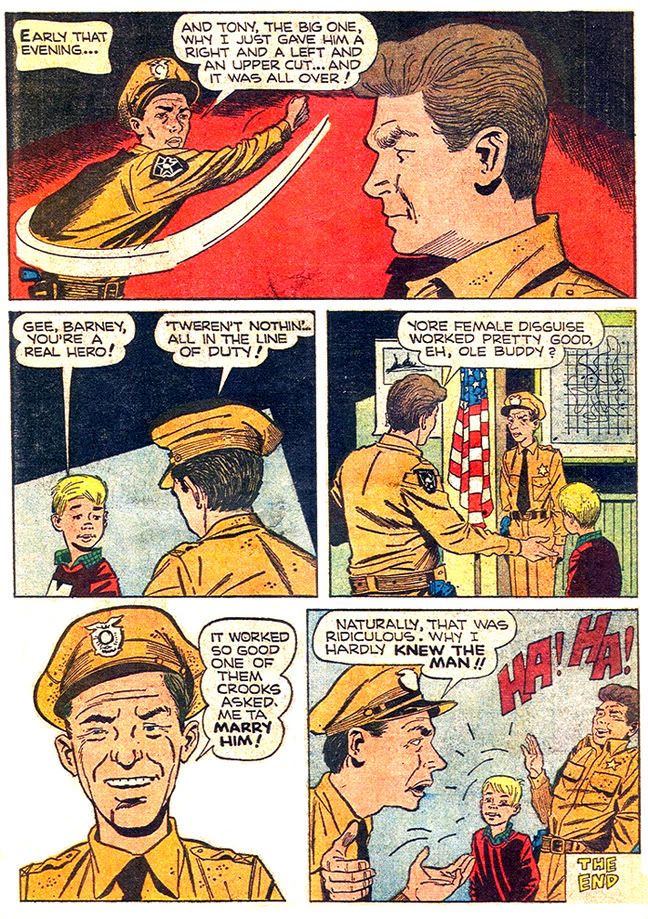
Archie, and aren't as true to the show as the rest of the material. These gag pages also rely on the simplistic idea that Barney, as the comedic relief, would be capable of any ol' ridiculous thing-- in one he challenges Andy to a shooting contest which he handily wins after substituting the sheriff's live rounds for blanks. And then the stories themselves, where the writer or writers generally avoid outright jokes, and instead poke fun at Barney's foibles. Occasionally there's even a little pathos, a little self-awareness on Barney's part that hint at some real potential for a continued series. "Opie's Secret" is a bit on the bland side, and the meat of "Undercover Man" isn't about barbershop humiliations but rather Barney's female disguise as so inexplicably successful various men fall for him. In fact, the closing joke is kind of a weaker version of the final scene of
Some Like It Hot.
These are just pleasant trifles, but I'm surprised at how they generally respect their source material. Nothing world-beating, though. These aren't lost early efforts from creators later recognized as genius-- like coming across an
Our Gang comic written and drawn by Walt Kelly-- and the world hasn't suffered due to a lack of more
The Andy Griffith Show comics from Dell. Scarpelli drew the
Archie syndicated strip for fifteen years, and his
art there is slick and easy on the eyes. Here, his work on the first
issue hovers uncomfortably between realism and caricature, where masters
like Jack Davis and Mort Drucker excelled. Scarpelli isn't up to their
level, but that's like damning someone for being physicist without
equalling Einstein. I'd be happy if anyone thought highly enough of my
art to label me "not a genius."
No geniuses involved? Some expert will probably prove to me these were written by Jules Feiffer or a 9-year-old Alan Moore.
Given the choice-- and I often am-- I'd rather just watch an episode of the TV show. On the other hand, I wonder what Ron Howard thought about becoming a comic book character as a boy. No one called me "courageous" when I was ten. "Rotten little shit?" Oh man, all the time!