Getting my hands and eyes on American comics can be a bit of a hassle here in Japan. Luckily, I'm more into vintage comics than the new stuff (except for a few titles from Dark Horse, Fantagraphics, Boom! and IDW, that is) and I can buy all the Essentials, Archives, Best ofs and Collected Editions I want from Amazon.jp. They're a bit pricey, though, and while I love the feel of a nicely-designed hardcover archival comic collection printed on quality paper, those take up a huge amount of space and they're heavy. Buying them digitally from the Dark Horse website or single issues from Comixology means transferring money home and keeping track of my US funds and that's a huge headache because the post office bank here isn't open on weekends for that kind of stuff.
So what to do? Why, find a way to pay with my Japanese money. Amazon.jp makes that easy when you want a paper version. You can order COD, for crying out loud, a system that resulted in my receiving a box a day there for a while. You can also go to the nearest convenience store, input your order number into a special machine and print out an invoice, then pay at the register. A day or two later, a delivery person shows up with your package. It's fun. But that doesn't help now that I'm married and I have to share space. I can't just pile up a huge library of gigantic comics reprints anymore. Plus, we're kinda trying to save money for our future, something I never considered having before transforming myself from a single person into one half of a couple.
Switching my collection to mostly digital makes a lot of sense, but it entails a new set of solutions. Comixology has been fantastic, but there's that bank transfer thing, and Dark Horse has its archival material exclusive to its website which involves doing that even more. Rats.
Luckily, there's Kindle. Dark Horse has generously provided Amazon with Kindle versions of its Creepy and Eerie books, and DC has done the same with a lot of its collected editions. IDW even put out a Kindle version of Torpedo with Alex Toth art. I don't have a Japanese credit card, but I can buy an Amazon gift card for myself and go nuts. The best thing is, instead of paying the equivalent of 40 or 50 bucks for a book, I can get a digital copy for about 17 dollars. This means even more of the Creepy and Eerie volumes become desirable, whereas before I had to cherry-pick them based on material I considered "essential."
Now the Kindle I have is the base model and it's pretty old now-- in relative terms as these gadgets go. It won't display graphic novels. And I should have checked to see if I could read them on my Windows Kindle app before I bought them. That would've been the smart thing to do. But I was so excited by the prospect of buying Creepy cheaply (say that five times fast) I jumped the gun. The end result is I'm contemplating buying one of those full-color expensive Kindle things and I have Creepy Archives Volume 1, Torpedo 1 and DC's Jack Kirby's OMAC on my iPhone now. That's where I'll leave things for a while. I'm not in any big hurry to buy the new Kindle and it's the kind of thing I have to vet with my wife before I do. Major purchase. It's a good system we have, and luckily for us both I've inherited my dad's Depression-born reluctance to spend more than 100 dollars a year unless it's on food. It took me two years to work up the nerve to buy the computer I usually read comics on these days and even then I felt sick to my stomach for a month.
On the other hand, I'm addicted to books and old comics.
Now with Amazon having bought Comixology, it will be interesting to see how the payment plans shake out. Will Comixology start accepting Amazon gift cards, for example? And will they furthermore accept them if they're bought with Japanese yen? That doesn't seem likely, but it would certainly make my comics buying-- even of new titles-- much easier. And what about Dark Horse? How do they fit in since they have their own proprietary digital comics-reading engine?

Showing posts with label Creepy. Show all posts
Showing posts with label Creepy. Show all posts
Tuesday, June 10, 2014


Wednesday, October 31, 2012
October is Spookey Month: Let Doug Moench and Richard Corben show you how to trick-or-treat!
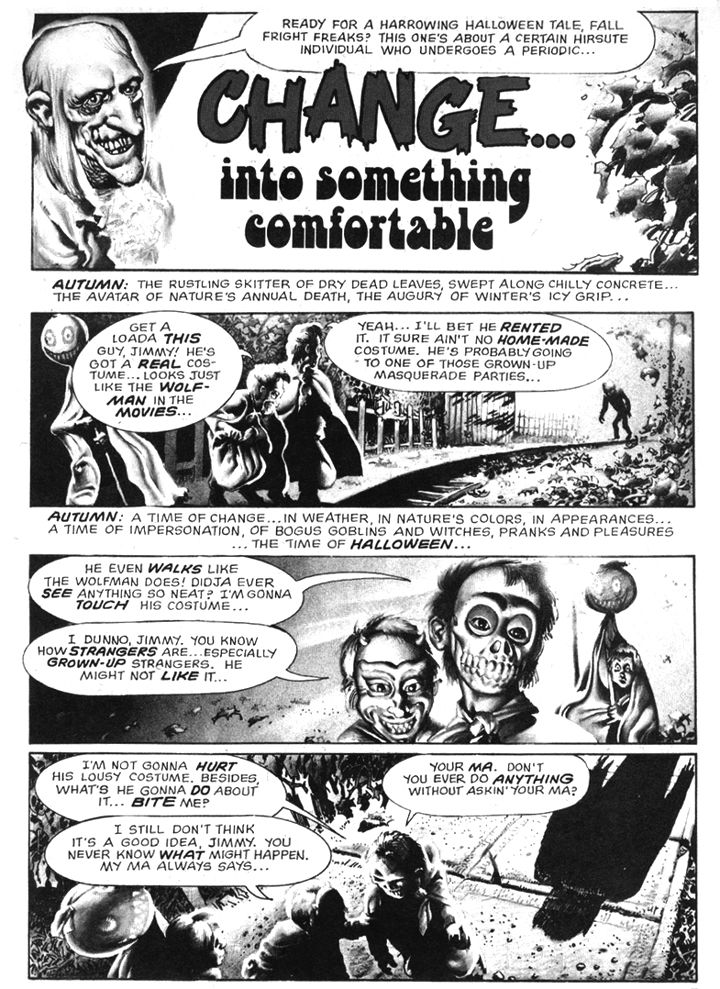
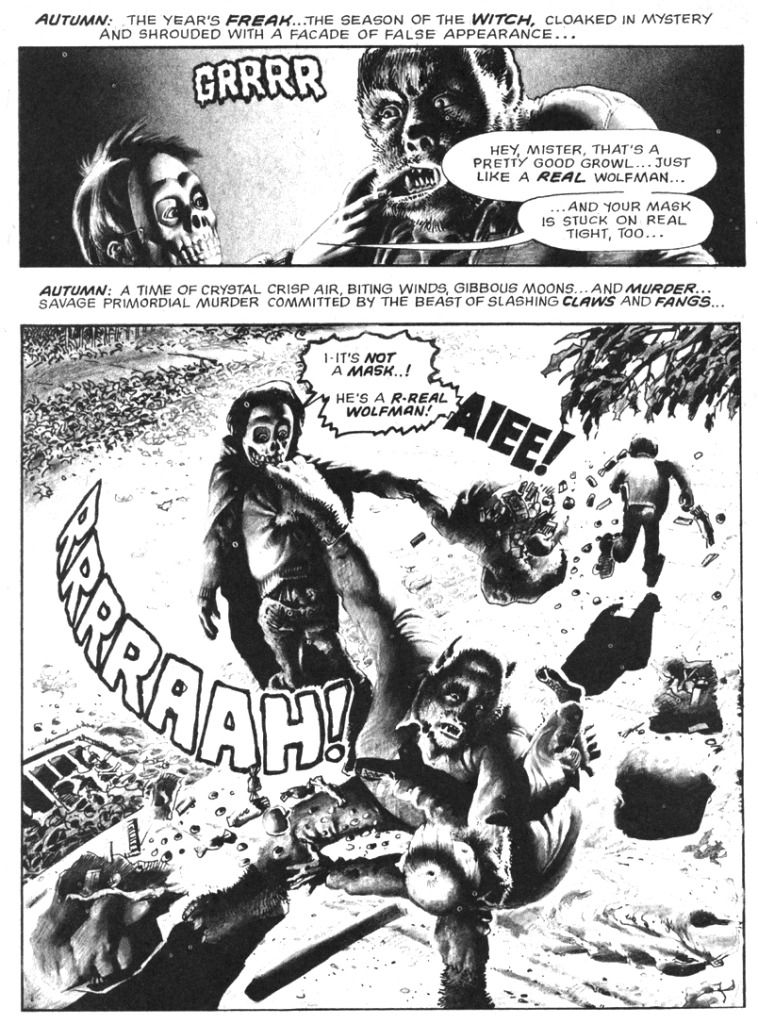
Yes, Halloween is a fun holiday, but you should exercise at least a little caution when out trick-or-treating. Go in a group, wear a costume with reflective tape so motorists can spot you, go only to well-lit houses. And most importantly-- don't pull on a werewolf's lip. These are a few simple safety tips brought to you by Doug Moench and Richard Corben in their horror-comedy classic, "Change... into Something Comfortable," which appeared in Creepy #58 (December 1973), a "special Halloween horror issue" (so it says right there on the cover). While I didn't particulary enjoy "The Slipped Mickey Click-Flick," I'm a huge fan of this little seasonal-flavored gem.
It starts with a real werewolf ripping some smart ass kids to shreds and ends with a sweet twist I find both irresistible and hilarious. I mean if you've ever wondered what creatures of the night disguise themselves as on Halloween, here's your chance to find out. "Comfortable" is sort of a companion piece to Corben's even more hilarious "Lycanklutz" from Creepy #56 (September 1973). That earlier full-color romp features a somewhat luckier werewolf in a medieval setting with some surprisingly anachronistic products available for sale. By contrast, our contemporary, kid-killing monster in "Comfortable" strays into EC territory with tragic results. I could have hit you with "Lycanklutz," but this one is all about Halloween and disguises and has those melodramatic Moench narrative captions. You can read it in the Dark Horse Creepy Archive Volume Twelve.
Come to think of it, you can read them both in that book.
Monday, October 22, 2012
October is Spookey Month: "The Slipped Mickey Click-Flip"
"The Slipped Mickey Click-Flip" by Doug Moench and Richard Corben first appeared in Creepy #54 (July, 1973) and readers seemed either to love it or hate it, if the letters pages for the next two issues are any indication. And they must be; they're the letters pages for Creepy, which printed the story, for corn's sake.
But I have to admit I don't love this story. It's a pretty good story, but I don't think it works as well as it could have.
A twisted mutant named Diment (as in "dementia") takes offense at a certain Dr. Nugent for trying to cure him of his insanity. He takes over Creepy magazine and marginalizes poor, innocent Uncle Creepy himself to punish the doctor. Diment does this by way of his "Click-Lick" device, the workings of which we never truly learn; he keeps turning away from us before using it.

I'm a fan of both Moench and Corben, and I admire them for their audacity in breaking the fourth wall-- and especially Corben for visually interpreting Moench's feverish, hallucinatory script. They playfully push the boundaries of good taste-- even by the admittedly lax standards of mid-70s black and white horror magazines-- with gruesome images like eyeball-sucking butterflies and crazy-eyed trains that decapitate people. Oh, and a woman who explodes into maggots. I mean, if you like people who explode into maggots, you really need to buy Dark Horse's Creepy Archives #10 so you can experience this singular event rendered by Corben in full loving detail. Never before have maggots looked so full-fleshed as they explode out of a comic book character's torso. Gorgeous, gorgeous maggots. Still, I thank my Uncle Creepy this story wasn't one of their color sections, which the magazine experimented with during this era, usually with Corben's art.
Unfortunately, a lot of the non sequitor dialogue seems forced and ham-fisted, sometimes repetitious ("idiot" is over-worked and begs for a week off in the Bahamas), Nugent and his wife are little more than puppets to the story and we never learn enough about them to develop any sympathy for them or become overly concerned with their plight. But Diment himself is no prize, either. I find him repulsive and off-putting. I could see myself settling down on some moldy divan to listen to Uncle Creepy spin many a yarn, but once is enough with Diment. More than enough.
Of course, "Slipped Mickey" is psimply a psick psychedelic romp, not meant to be taken seriously by any means, but as a supposedly enlightened 21st century citizen of the world, I can't help but find the depiction Diment's mental illness troubling and retrograde even for its time. But I have to admit I apply this standard inconsistently. What bothers me here might not in another story.
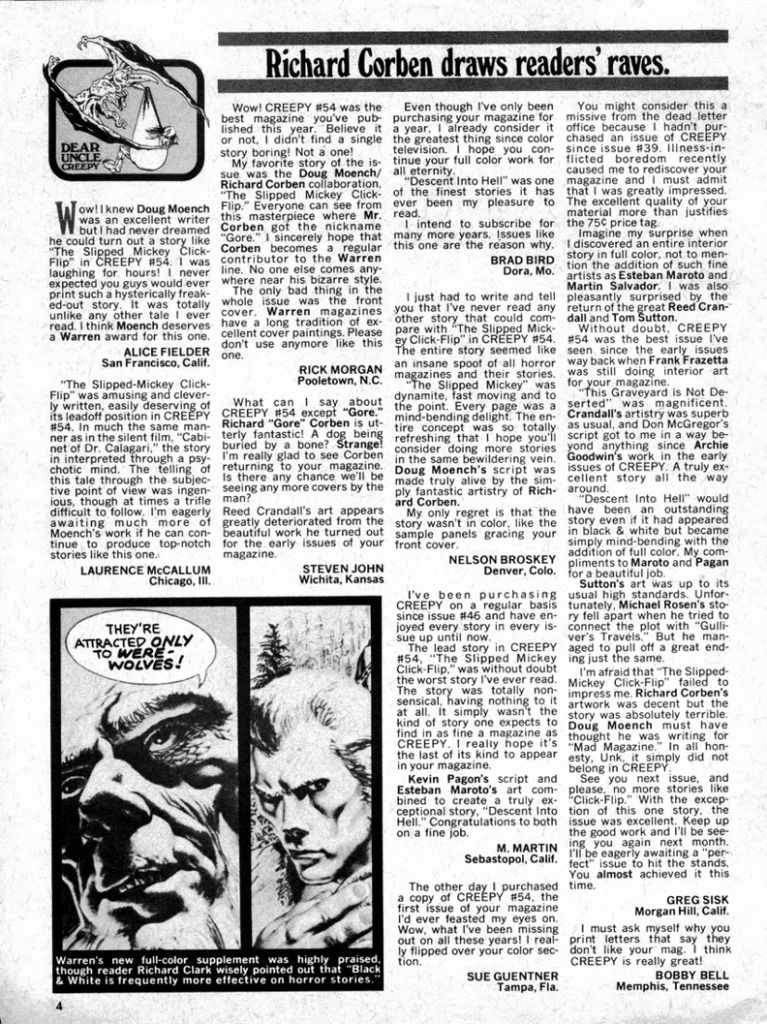
I'm a fan of both Moench and Corben, and I admire them for their audacity in breaking the fourth wall-- and especially Corben for visually interpreting Moench's feverish, hallucinatory script. They playfully push the boundaries of good taste-- even by the admittedly lax standards of mid-70s black and white horror magazines-- with gruesome images like eyeball-sucking butterflies and crazy-eyed trains that decapitate people. Oh, and a woman who explodes into maggots. I mean, if you like people who explode into maggots, you really need to buy Dark Horse's Creepy Archives #10 so you can experience this singular event rendered by Corben in full loving detail. Never before have maggots looked so full-fleshed as they explode out of a comic book character's torso. Gorgeous, gorgeous maggots. Still, I thank my Uncle Creepy this story wasn't one of their color sections, which the magazine experimented with during this era, usually with Corben's art.
Unfortunately, a lot of the non sequitor dialogue seems forced and ham-fisted, sometimes repetitious ("idiot" is over-worked and begs for a week off in the Bahamas), Nugent and his wife are little more than puppets to the story and we never learn enough about them to develop any sympathy for them or become overly concerned with their plight. But Diment himself is no prize, either. I find him repulsive and off-putting. I could see myself settling down on some moldy divan to listen to Uncle Creepy spin many a yarn, but once is enough with Diment. More than enough.
Of course, "Slipped Mickey" is psimply a psick psychedelic romp, not meant to be taken seriously by any means, but as a supposedly enlightened 21st century citizen of the world, I can't help but find the depiction Diment's mental illness troubling and retrograde even for its time. But I have to admit I apply this standard inconsistently. What bothers me here might not in another story.
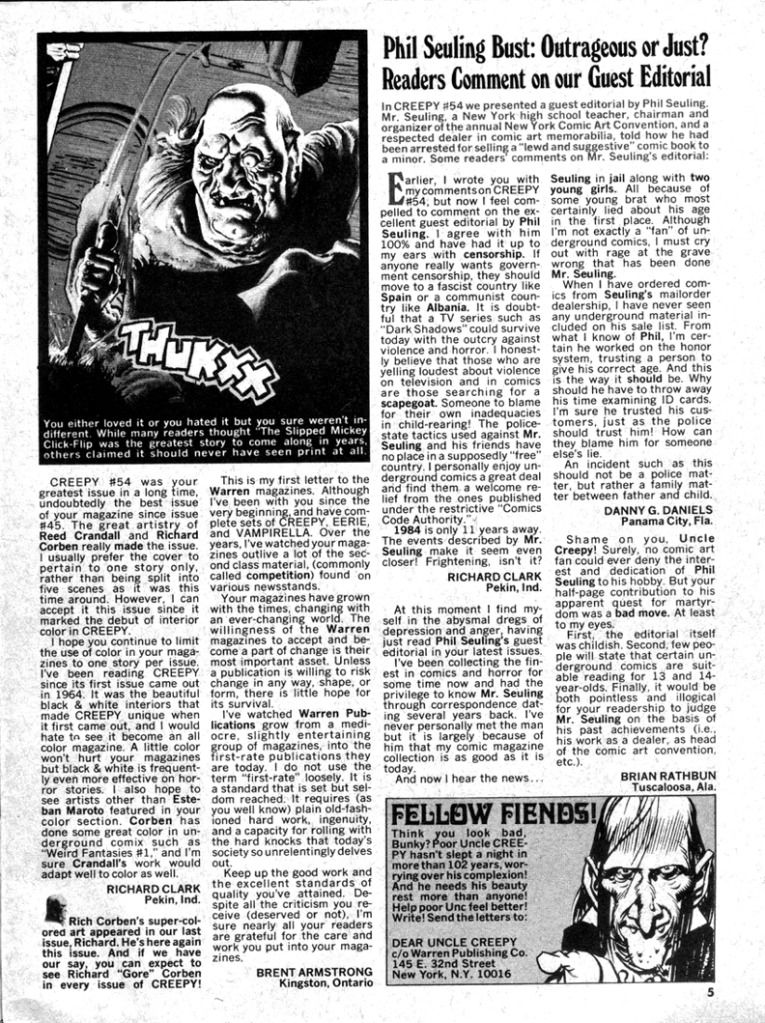
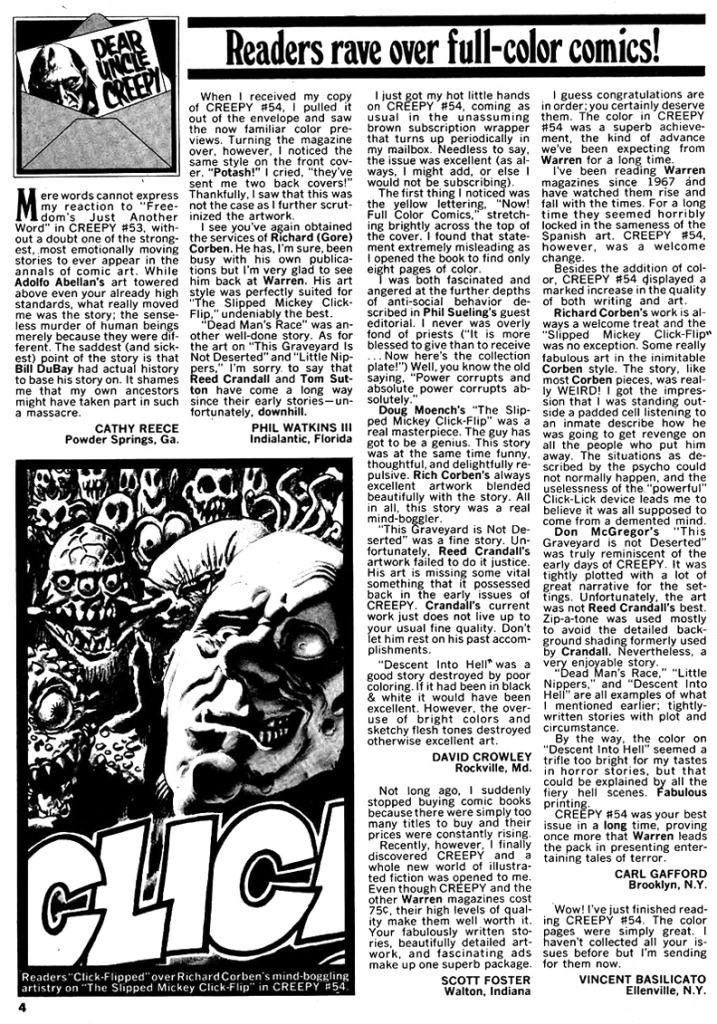
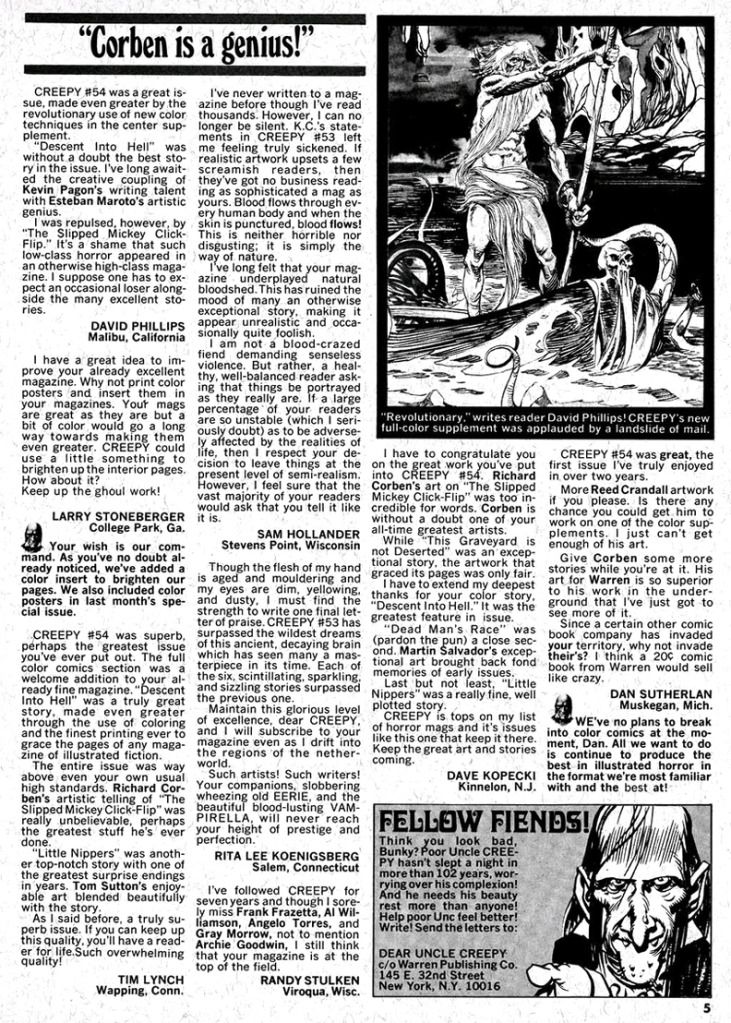
It's memorable as all get out, enough so you can find it in its entirety posted online and a few reminisces about it from fans who read it back in the day or in the years since and fell in love. After all, for a horror story the only true mark of failure is boring readers to sleep, and "Slipped Mickey" definitely avoids that. As you can see, the Creepy letters page in issue #56 (September, 1973) features nothing but praise for the story, with one reader calling it a masterpiece and Moench a genius and another praising it before opining it takes place entirely in Diment's mind (which is a comforting reading, I have to admit). Negative reaction slips into the mix with a lone dissenter, who declares it "low class horror," then intensifies ever so slightly for Creepy #57 (November, 1973) when seven letters (out of 14) mention the months-old story, five praising it and two criticizing it.
One thing I enjoy about reading the Creepy letters pages-- even though we're now years past the point their relevancy died like poor ol' Dr. Nugent, his wife and even their dog-- is the editors weren't afraid to allow some nay-saying, and in this case actually spotlighted it with a sidebar box. There's a feeling of some real give-and-take and that someone actually read the letters and put some thought into it, but also that the letters page is largely a forum for reader opinion without a lot of defensiveness from the Creepy staff, as if dare the readers to form their own opinions instead of just joining a praise-pack, that it was just as much the fans' comic as it was theirs. You can imagine what the message boards would have been like had this taken place in today's Internet-savvy comic book society.
Oh, and before I leave you to Google search for this story and read it for yourselves-- to make up your own minds about it, just like Uncle Creepy would have it-- let me tell you this is exactly the kind of story that would have sent me off the rails for a few days if I'd read it as a child. I had this stupid over-imaginative reaction to horror comics, especially stories as whimsically arbitrary as this one. I can imagine little-me trying not to think much about Diment for fear of his being real, or somehow making him emerge from the comic book into our world and wreaking havoc on me specifically. You just do not want to piss Diment off, and disapproving of him would probably be more than enough to earn his wrath
So I would have been sleeping with the lights on in my bedroom, picturing the happy little crazy train running over my head or killing my dog. DC's House of Secrets and Weird War Tales were bad enough, Marvel's black and white Planet of the Apes magazines scared me as often as they thrilled me with adventure (especially with their house ads for Tales of the Zombie and even Unknown Worlds of Science Fiction, the latter featuring a Michael Moorcock story that crosses the border into blasphemy for those of us in the Bible Belt deep South). I'm a little nervous even now, writing about it.
Saturday, October 13, 2012
October is Spookey Month: "The Coffin of Dracula"

For Warren's Creepy magazine, Archie Goodwin and Reed Crandall created a two-part sequel centering on one Lord Varney (his name borrowed from one of Dracula's vampire antecedents) and his stupid misadventures with Dracula's coffin. Not that the story is stupid. It's not exactly a classic-- although Warren thought highly enough of it to reprint it in one of their best-of issues-- but Varney's the idiot here. What kind of fool buys Dracula's coffin and climbs into it? It's a bonehead move by an arrogant jackass and actually one of the most bizarre ways I've yet seen of contracting the dread disease we know as gingivitis. I mean, vampirism.
Seriously, if you must become a vampire, have the common decency to drink the blood of one of the undead. Get your own coffin. Sharing coffins isn't sanitary, anyway. And it's not true vampirism. It's more like possession at first. Varney can't even get that right. Man, I hate this Varney guy!
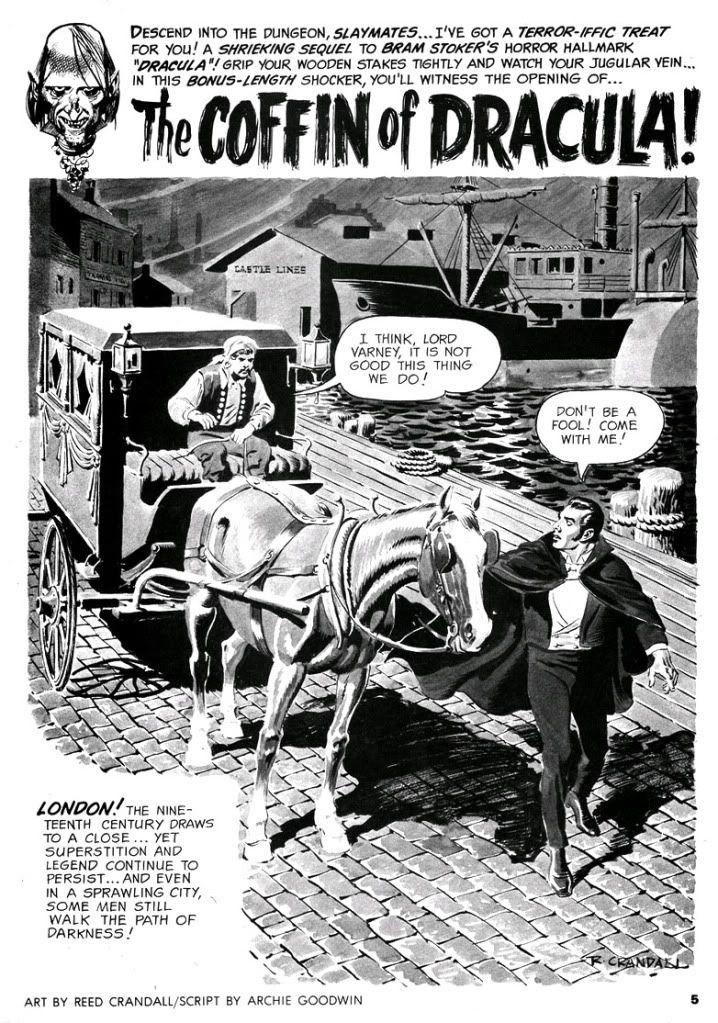
Part one clawed its way out of the crypt in time to anchor Creepy #8 (April 196), while part two coalesced from swirling ash in #9 (June 1966). Both segments are gorgeously illustrated by Crandall at the height of his artistic powers, "Coffin" plays like an overly abridged adaptation of the Stoker original, with Dracula more a presence than a character. Dopey, delusional Varney kidnaps Mina, Jonathan, van Helsing and Dr. Steward pursue him back to Whitby, one of the central settings in the novel and where Dracula began his reign of terror by vamping virginal young aristocrat Lucy Westenra. The heroes hope to kill a vampire left over from the novel and prevent Varney from truly becoming one of them. After that, they plan to save Mina. The plan doesn't sit too well with Harker, but he's too dim to argue with van Helsing's logic.
There's some decent violence and fully-rendered vampire-staking (tastefully sans outright gore), but Varney is a vamp-come-lately, a pale imitation of the great one and lacks charisma. Once fully vampirized, he doesn't even have any dialogue. Ultimately, gorgeous art or not, the story is mainly mild fun for fans of books like Alan Moore's League of Extraordinary Gentlemen, itself an extension of Dracula through the character Mina. If you finished Dracula and hoped for more story, then here's your chance and you don't have to know 19th and 20th century literary references and pop culture to fully appreciate it.
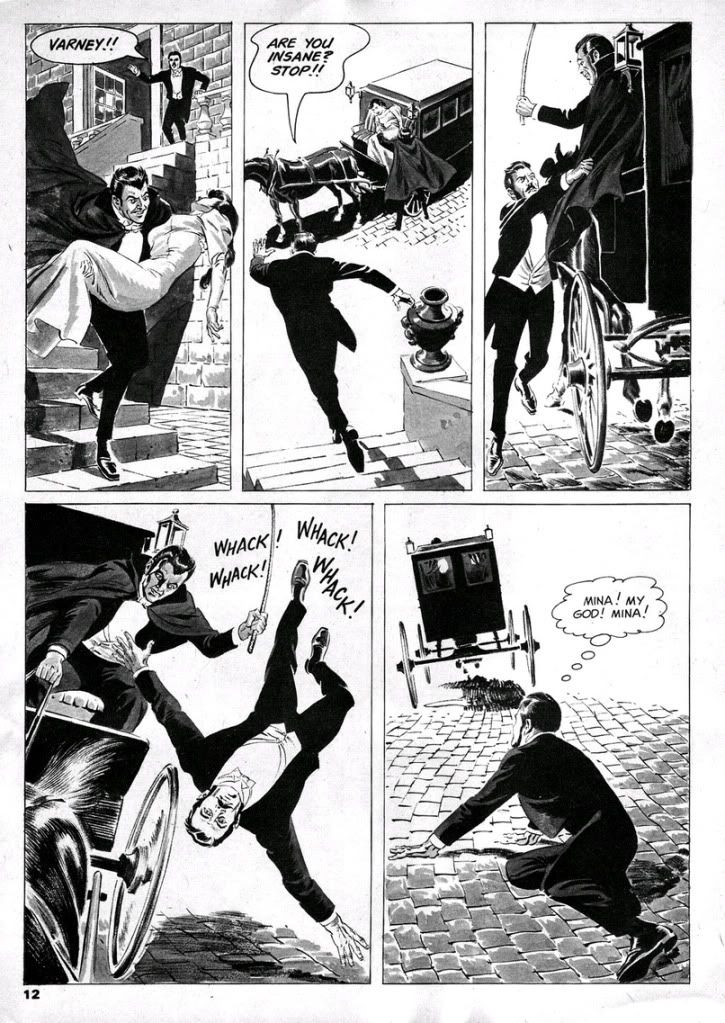
At least Moore picked up on the nascent feminist aspects of Mina, given that ultimate compliment by van Helsing in the book of having a "man's brain." The novel's Mina is a schoolteacher with a strong empiricist bias before she encounters the supernatural. Moore really ran with the notion and made her a lot steelier than Stoker's Mina, but Goodwin goes the opposite route and reduces Mina to your standard damsel in distress, kind of a dishrag. She barely has any dialogue, and none at all in the second part where we only see her unconscious before we follow Harker as he pursues Varney.
Well, Stoker puts Mina in jeopardy and in need of rescuing by men as well, but she does get in a few shots of her own, and because it's an epistolary novel, she at least had the privilege of speaking for herself. Goodwin shifts his focus exclusively to those menfolk, here rendered as a a dull crew of stick-up-their-asses types. When Varney kidnaps Mina, she disappears for the bulk of the story, which diminishes her plight. Goodwin does a wonderful job of recreating Abraham van Helsing's stilted Continental dialogue, though. Van Helsing is like a Dutch Yoda. "Friend Jonathan," indeed.
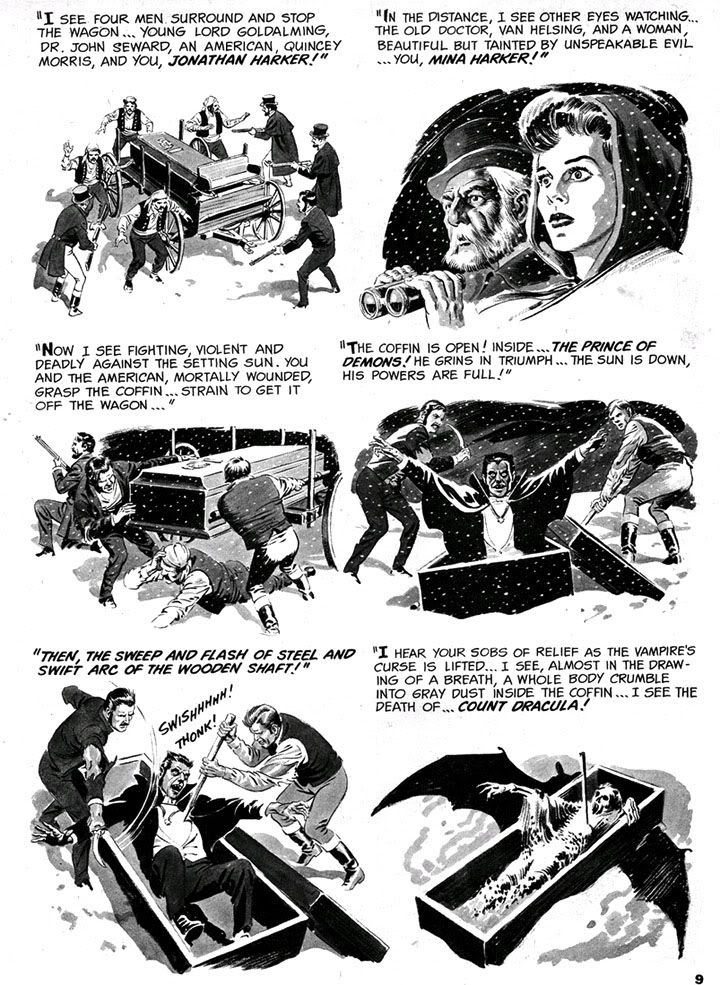
My favorite page is the collage-like recapitulation of Dracula's climax. I wish Goodwin and Crandall had done a full-fledged adaption of Stoker rather than this rehash, pretty as it is.
Poor Reed Crandall. While I immediately loved what I saw when I encountered his color jobs for EC in those early 1990s Gladstone reprints (I sorely miss those), his black and white art in the Creepy archives books from Dark Horse is a revelation. I can only describe it as beautiful, like those illustrated plates you encounter in ancient, heavy tomes from the darker corners of a library collection. Finely proportioned and posed figures, beautiful contour lines and modeling, depth of field, absolute control and mastery of individual panels and the page as a whole. And yet he seems to have been in competition with Wally Wood for "most tragic former EC great." Alcohol dependency and failing eyesight robbed him of his talent and sent his output into a shockingly steep decline in quality, so much so his last few jobs seem more the work of a talented amateur trying to do a Crandall impression. Reading them is like viewing a slow motion film of a ship sinking with a man still visible on the deck. On the other hand, he did leave behind an impressive body of work, especially in these early issues of Creepy.
And now it's time for one of my all-time favorite videos starring Spookey:
Monday, July 30, 2012
More leftist art...

Your guess is as good as mine as to why these people and a giant gorilla are all raising their left arms. I think Batgirl is going to kick that erzatz Uncle Fester's ass (if she can ever untangle herself from that flowing mess of a cape), and Enid is confused as to how she got involved in this mess. Frazetta's happy monkey wants to play.
Friday, October 21, 2011
2nd Annual Spookey Month: Bernie Wrightson!
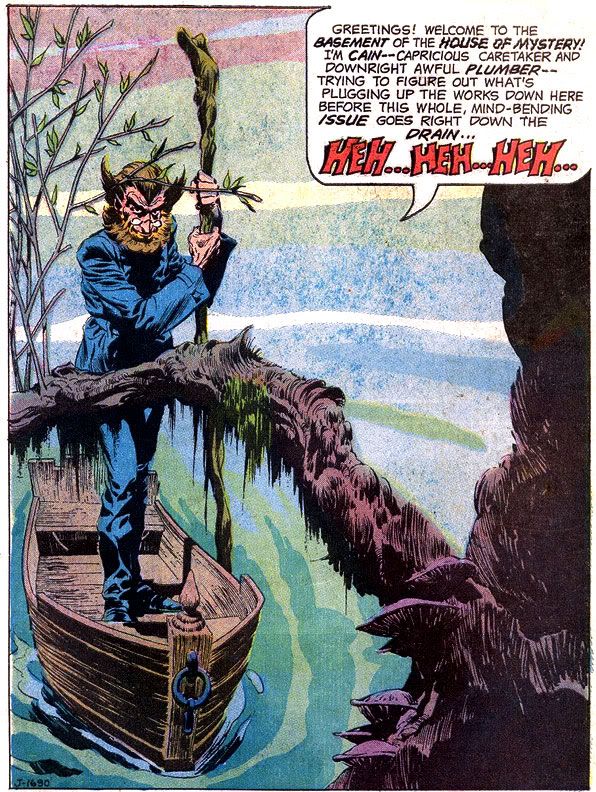
How about that, eh? It's Cain, poling his little boat through a swamp-- a haunted swamp, no doubt. Or basement. Haunted basement. Well, wherever it takes place, it's a very nice splash page drawing by Bernie Wrightson, published in House of Mystery #205. Wrightson's career began at DC the same year I was born so I've had a lifetime to associate him with the finest in horror comics illustration. Over that time, I've dug many artists who've excelled at horror: Richard Corben, Nestor Redondo, Umezu Kazuo, Ito Junji, Michael Wm. Kaluta, Joe Orlando, Jack Davis, John Bolton to name a very few. All those EC cats who worked for Warren Publications. Then there are all those Italian guys who drew those bizarre and erotic comics where characters are often naked or rotten or both covered (so to speak) over at The Goovy Age of Horror.
You can find horror artists better at anatomy and with slicker finishes, but few who match Wrightson's ability to concoct instantly iconographic horror images, with gobs of chilling atmosphere and sinister mood to spare. Throughout, Wrightson has used varying approaches to his finishes-- from feathering and modeling in ink resembling the classic works of Graham "Ghastly" Ingels and Frank Frazetta, to etching-like fine lined hatching to rich ink washes. Whatever his approach, Wrightson kills. Figuratively.
My first encounter with Wrightson was his work on Swamp Thing, no doubt in some house ad or other. I didn't read that comic until DC released the second volume when I was a teen. By then, I'd seen this choice Wrightson image:
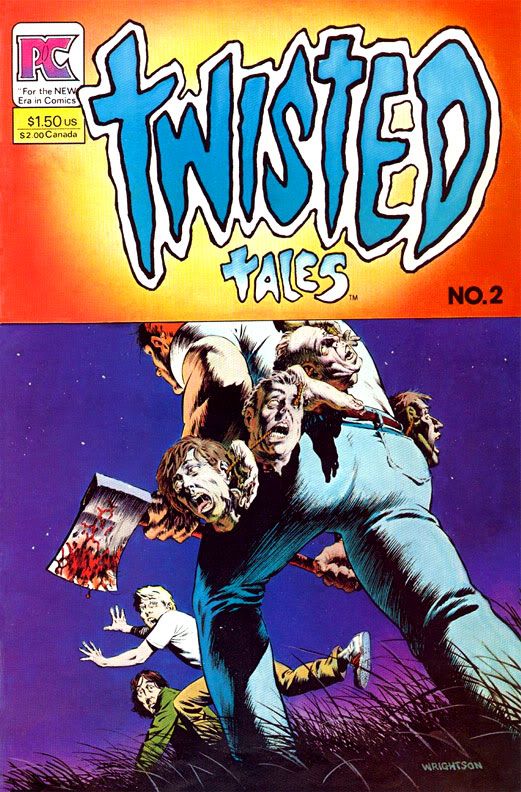
EEP!! The worst tricks or treats ever! And it's the kind of thing that sticks with you when you're an imaginative and impressionable young doofus looking for the latest Hulk and Spider-Man stories. Now I think what a good thing for that axe murderer he's so beefy-- he's wearing about 40 pounds worth of human heads. He's going to need those powerful leg muscles if he ever hopes to add those two kids' noggins to his collection.
That came out about the time I read Creepshow. Soon after that I contaminated my brain with the issue of Bernie Wrightson: Master of the Macabre containing the infamous "Jenifer," one of the sickest stories I've ever read. It affected me so badly I had to give the comic away the same afternoon I read it to a less-squeamish friend, and yet I still lost sleep over it that night. Of course, its hold on my imagination proved too strong over the years. Every so often, I'd get the urge to draw Jenifer's twisted face in the margin of my notebook page, and I'm pretty sure I drunkenly described the story to various people whenever we started talking about things that frightened us as kids. I finally tracked it down again and it proved every bit as disturbing as I remembered. When a story does that to you, someone, somewhere, has done his or her job!
In this case, that person is Bernie Wrightson. Well, Wrightson and writer Bruce Jones.
Here's another wicked Wrightson splash:
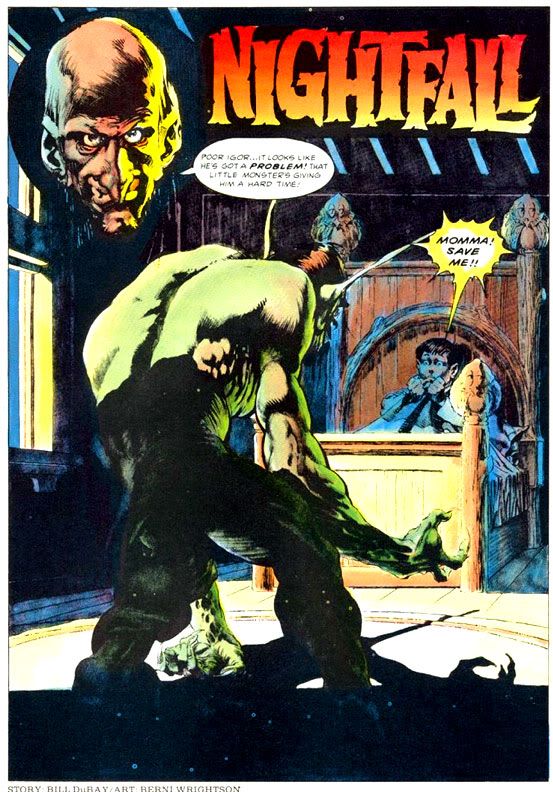
Much like Jones's tales, Bill DuBay's scripts gave Wrightson the opportunity to make our nightmares come to life on the magazine page. "Nightfall" first appeared in Creepy #60 (1974), and features a kid bedeviled by sinister goblins who come into his room at night, only to retreat whenever his increasingly exasperated parents come in to check on him. DuBay's script accurately captures the way a child's imagination transforms shadows into malicious monsters, and the impossibility of getting this across to well-meaning but lunk-headed adults who just want a peaceful night's sleep. Wrightson's creatures cavort and caper in the moonlit bedroom in a way that's dreamlike yet completely convincing.
Reminds me a lot of those nights I grew up experiencing thanks to Bernie Wrightson's art! And speaking of disturbing, here's Hanatarashi's legendary 1985 "Bulldozer Gig" in slideshow form:
Eye, that's what I call music!
Subscribe to:
Posts (Atom)