Showing posts with label Bill Sienkiewicz. Show all posts

Wednesday, June 18, 2014

Marvel's Marvelous Movie Adaptations #1: An overview of those colorful Marvel Super Specials!

Before they started putting out their graphic novels and Epic Illustrated magazine, the Super Special series was Marvel’s most visually arresting product.  Their black and white magazines usually featured attractively lurid covers by Bob Larkin, Earl Norem and, occasionally, guys like Neal Adams and Grey Morrow.  But face it—the interiors varied wildly in quality from the knock-out gorgeous or even thrillingly bizarre (John Buscema, Alfredo Alcala, Rudy Nebres, Mike Ploog, Tom Sutton) to the serviceable and even the slap-dash (I won’t name names, but I have my suspects). 

The Super Specials, on the other hand, featured fully-painted color jobs, at least on many of the earlier issues.  Regular monthly comics came printed cheaply on grayish newsprint.  But a Super Special came on slick, white paper.  A Super Special was more than a comic.  It was an event unto itself.  It was super.  And special.  There'd be a painted cover, or one featuring photos or artwork from whatever movie the comic was adapted from.  It would have a full-length comic book story and then a few breathlessly informative articles or interviews related to the magazine's subject matter.  All this... and a higher price tag! 

The very first Marvel Super Special, which was officially a Marvel Comics Super Special, stars rock group Kiss and word on the street is the group contributed some of their blood to be mixed in with the ink.  It's hard to get more super or special than actual rock star bodily fluids inside your comic!  But no thanks.  The second issue features tried-and-true fan favorite Conan in adventures too epic for his regular monthly.

Then Marvel adapted Close Encounters of the Third Kind, the first of many Marvel Super Special film adaptations.  A Wiki check shows Close Encounters penciller Walt Simonson complaining about working on that book.  Worst experience of his career.  If so, I sympathize, but you can’t tell he was unhappy by looking at the finished product.  He and Klaus Janson turned in a spectacular effort, making the story work in a Marvelized format even though the conflict is largely internal—Roy Neary thinks he’s going crazy for most of the movie before he figures it all out and goes UFO-hunting—and co-stars every lightbulb in California.  They invented so many ways of depicting lighting effects I’m surprised they didn’t go blind from staring at them too long.  This was the first Marvel Super Special I bought, and it came to me via mail order.  It would not be the last, as these magazines quickly became one of my favorite Marvel purchases.

And this is where we come in.  Marvel’s other movie adaptations.  Jaws 2 swam up next, accompanied by a musical motif ripped off from Stravinsky.  This one was the first Super Special drawn by Tomb of Dracula team supreme Gene Colan and Tom Palmer.  They’d do a few more, each time absolutely rocking the results.  Colan had already done underwater horror in black and white for Warren Publications, but here Palmer adds vivid colors that make the book both gorier than you might expect in a comic and, strangely enough, also more attractive.  Jaws 2 is one of those shitty movies that are actually pretty fun, eschewing the Steven Spielberg original’s emphasis on characterization and suspense for schlocky, unintentionally hilarious setpieces (the shark eats a helicopter!) that do nothing to help its ludicrous premise—essentially shark-shaped lightning striking twice.  While not nearly as dire as subsequent films in the series, the movie suffers from diminishing returns.  The comic book holds things together by simply giving the material a more lavish treatment than it deserves.  I would have loved to see the same team go back and re-tell the first film.  That’s a real missed opportunity for a matched set.

While the Super Specials had already given us a bowdlerized Beatles biography, their adaptation of the infamous BeeGees-starring musical flop Sgt. Pepper’s Lonely Hearts Club Band never saw print.  This meant Marvel’s next offering was actually of a TV movie that similarly cribbed from a superior source and suffered from comparisons.  We knew it as Battlestar Galactica.  I had the Marvel Treasury Edition because it was huge and therefore caught my notice.  This one has art by Ernie Colon of Richie Rich and Jackie Jokers fame, and while his linework is looser than the Colan/Palmer stuff, and the colors flat rather than richly painted, it’s an energetic retelling.  It differs from the televised movie in some respects.  A villain gets a bloody comeuppance here, which would make his reappearance a bit… er… unlikely.  And yet there he was, on our TV screens every Sunday evening until ABC punched not only his ticket but everyone’s via cancellation.  And broke my heart.

The next film adaptation to see print?  Crappy sci-fi disaster film Meteor, a major flop with Sean Connery as an astronomer fighting an oncoming… well, you know.  A meteor.  What else?  The movie, which co-stars an unhappy Natalie Wood, forces Brian Keith to speak with a fake Russian accent (a few years after playing a small-town cop comedically contending with “invading” commie submariners in The Russians Are Coming, the Russians Are Coming, and not long before using this accent again for one of those WWIII TV movies the kids used to love so much back in the 1980s), with Henry Fonda as the President, putting it kindly, is complete dogshit.  On your shoe, after you stepped in it.  The comic, with Colan/Palmer art, is not.  In fact, it’s quite a visual treat.  There’s even a double-page spread of a massive tidal wave destroying Hong Kong.  Palmer not only handpainted the colors, but there’s also what appear to be Craft-Tint tones involved as well.  I’m not sure what their lead-time was for the artwork, but nothing looks rushed, especially towards the end when the meteor unleashes hell on New York.  Once again the Marvel comic proves better than the film on which it’s based.

From here out the Super Specials would consist almost entirely of movie material, with one exception-- Tarzan of the Apes.  Because they generally went for blockbusters and had to prepare the comics in advance of the films’ release dates, Marvel took on hits and misses alike. 
 
The adaptations of misses are a lot more fun than the ones of hits as far as I’m concerned.  How could you not love mondo-strange-o comics like Xanadu (#17, Summer 1980), Annie (#23, Summer 1982, with Win Mortimer pencils and lots of crossed eyes courtesy the Vinnie Colletta inks, no less), Rock & Rule (#25, 1983 with art consisting of stills from the movie itself)?  And sometimes the results would be miracles both major and minor, like Marvel’s lovely Dragonslayer (#20 , 1981), the storybook-like Santa Claus: The Movie (#39, 1985, richly drawn by Frank Springer and adapting one of the lousiest movies ever made) and the beautiful Labyrinth (#40, October 1986, with breakdowns by John Buscema and finishes by Romeo Tanghal, an unlikely pairing on this fairy tale material and killing on it). 
 
And then there’s Bill Sienkiewicz’s Dune (#36, 1984), the perfect meshing of artist and subject matter.  Space princesses, screaming magical messiahs, bloated barons with skin diseases and desert warriors dressed in skin-tight black rubber are visuals tailor made for Sienkiewicz’s “Neal Adams drops acid and hangs out with Ralph Steadman too much” artwork with its heavy blacks.  And giant penis monsters.  I mean worms.  Yeah.  Shai-hulud.  Those spice worms look nothing like a bunch of dicks springing up out of the sand.  Sure.  Seinkiewicz brilliantly translates into two dimensions the general weirdness of David Lynch’s fever-dream take on Frank Herbert’s novel.  And you get the added benefit of not suffering through the pacing problems created by trying to chop a huge novel down into a manageable running time, from not being able to tell all the spaceships are obviously teeny-tiny miniatures and not having to endure the repetitive, whispered voiceovers.  And dumb additions like the “weirding modules.”

Occasonally, though, Marvel would adapt a hit and blow it.  Raiders of the Lost Ark (#18, 1981).  What the hell happened there?  John Buscema and Klaus Janson provide curiously unfinished-looing and flat artwork, with none of the film’s retro-romance.  Dull, off-model colors add nothing to the art and the final product is lackluster at best.

That’s not to say the rest of the hits aren’t pretty sweet.  There are three Al Williamson/Carlos Garzon jobs—The Empire Strikes Back (#16, Spring 1980 and my personal choice for best movie adaptation of all time), Blade Runner (#22, September 1982) and Return of the Jedi (#27, 1983).  Much like with Seinkiewicz and Dune, Williamson was the perfect choice to adapt the second and third Star Wars films.  He seems an odd choice for Ridley Scott’s downbeat sci-fi noir, but he, Garzon, Dan Green and Ralph Reese generate all the film-accurate rainy cityscapes you could hope for, even if a number of panels seem a bit too photo reference-heavy and static.  They reproduce the film’s atmosphere to a startling degree, sort of making up for that lack in the Raiders book.  Should have put them on that one, too. 
 
Buscema pencils and inks himself on the two Conan movie adaptations, too, both for John Milius’ Conan the Barbarian (#21, 1982) and the lighter, less boob-filled Conan the Destroyer (#35, 1984).  He doesn’t try to make his barbarian look anything like Arnold Schwarzeneggar, which is a good thing.  Although the Destroyer Conan sports Arnold’s headband.  You can never go wrong with Buscema inking himself on a Conan story, whether or not you appreciate Milius’ heavy-handed philosophizing and libertarian politics (I actually kinda dig it, even if I don’t agree with it) or director Richard Fleischer’s duller, less edgy and politicized take.

I’ve skipped around a lot.  What about the rest?  Well, there are two crappy and then crappier Roger Moore-era James Bond flicks (For Your Eyes Only achieves mediocrity by pairing otherwise appropriate Howard Chaykin with a disinterested Vince Colletta and then dumping a dull, standard monthly-comic-type color job on the results, totally wasting the format’s color possibilities); the tragically doomed Dark Crystal; another Indiana Jones flick with improved art but a sillier story; a nicely cartooned version of The Muppets Take Manhattan; desultory passes at clunkers like Krull, The Last Starfighter and 2010; the ahead-of-its-time Buckaroo Banzai (#33, 1984), all hip and tongue-in-cheek, makes a bow and turns immediately into a cult film; and Marvel even attempted both Sheena (#34, 1984, decent artwork by great Gray Morrow wasted on dreck) and Red Sonja (#38, 1985, a worthy effort by Louise Simonson and Mary Wilshire, with surprisingly deft Colletta inks, doomed from the start by its source material but finally sunk by the decision to go the cheap route yet again with a standard color palette).

The best, however, they saved for last.  The final Marvel Super Special, lucky #41 (November 1986) adapts George Lucas’ long-neglected masterwork Howard the Duck.  No knock on writer Danny Fingeroth or artist Kyle Baker, but this comic fairly cried out for some Gene Colan or Val Mayerik artwork.  Only they could have possibly salvaged this one. 
 
It has an appropriate cover date, though, doesn’t it?  November, towards the end of fall.  An inbetween time, a neither-nor time, a waiting time.  The happy Halloween graveyard ghost-dance past, the joys of Christmas, Hanukah, Kwanzaa and New Year’s yet to come.  Despite Thanksgiving, which I really conflate with the Christmas holidays, November is a dull, gray month.  Too bleak to be tedious, too tedious to be fun.  The first cold rains come, and we’re given our initial glimpse of the dying of the year and the bleak winter that comes after our holiday revelry.  That’s all that November means to me.  The promise that, after the gifts and pretty lights, winter will be hard.  Long and hard and dead.  And with this, with the arrival of Howard, our symbol of the death of everything summer-bright in the world, Marvel Super Special was no more.
 
What I'm hoping to do with this series is take on each of these books, probably in order, and try to find some nice things to say about them.  We've already looked at two of these in detail, so we don't have to worry about them again!  Whew!  Some of the rest will be easy, even if the movies they're based on were complete stinkers.  Some won't be so easy.  But therein lies what I hope will be the fun.

Wednesday, February 12, 2014

New Mutants #29-34: Xi'an Coy Manh returns from beyond(er)!

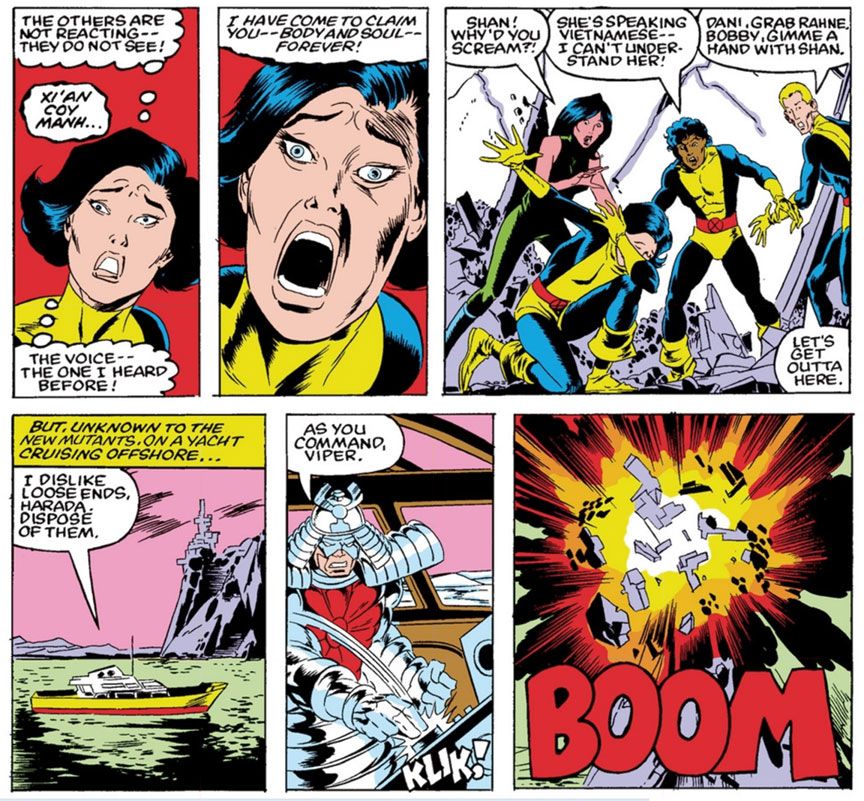
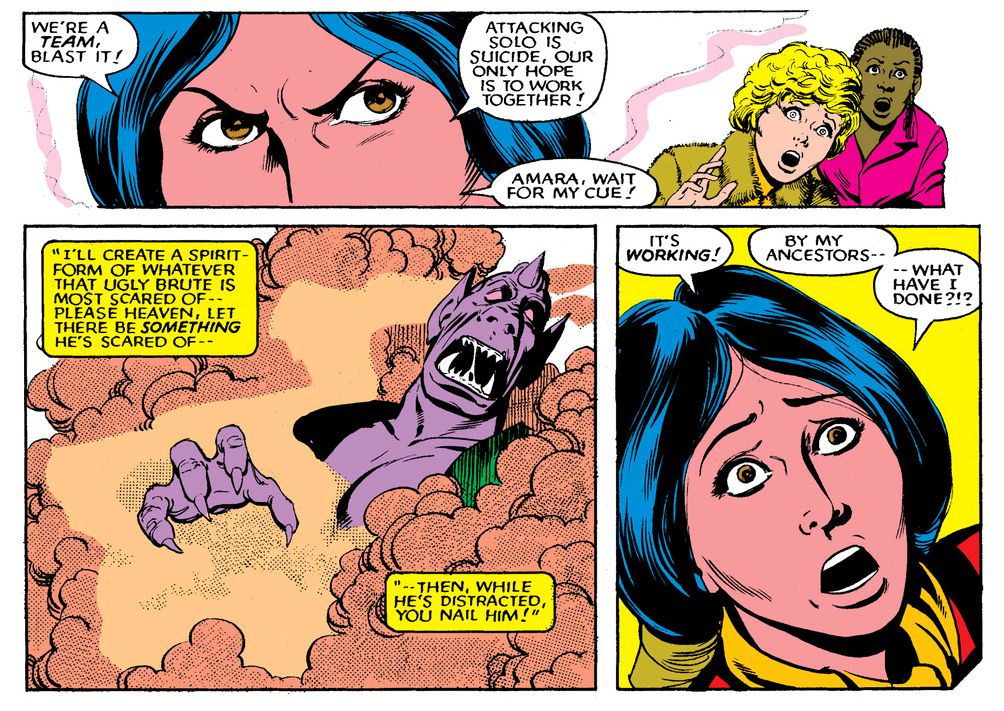
We all remember the tragic moment at the end of New Mutants #6 (August 1983) when Xi'an Coy Manh experienced a moment of terror and then everyone exploded and fell into the sea.  It reminds me of what happened to poor Josie Packard on Twin Peaks.  Sure, Josie wasn't as innocent or nice as she initially led us to believe, but she died similarly afraid, on an episode that aired almost eight years after "Road Warriors!" hit the newsstands and comic shops around the world.  Or else she turned into a wooden knob on a piece of furniture.  We can never be completely sure.  Xi'an's fate is equally strange and even involves what appears to be a Packard-like heel-turn or betrayal. 

And at first exactly what happened to her is also every bit as mysterious as Josie Packard's final moments.  After the smoke clears and her friends sort themselves out, Xi'an is nowhere to be found, so everyone reasonably assumes she drowned when her friend and teammate Roberto DaCosta lost her in the undertow.  But what about that mysterious, last-moment voice in her mind?  Why was Xi'an screaming in Vietnamese and cowering, apparently at nothing, just before the explosion?

New Mutants #6 (August 1983), script: Chris Claremont, pencils: Sal Buscema, inks: Armando Gil

Writer Chris Claremont chose to leave these questions unanswered for a time.  The kids mourned Xi'an, then jetted south to the Amazon for new adventures and new teammates.  And so the New Mutants went on for several years with lead character Dani Moonstar becoming a comic book legend, easily the equal of Spider-Man, Batman, the Crypt-Keeper or Herbie Popnecker, and Xi'an shrinking to little more than a tragic footnote.  

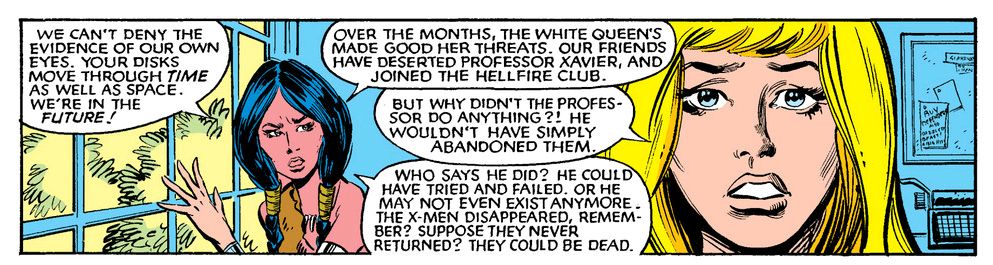
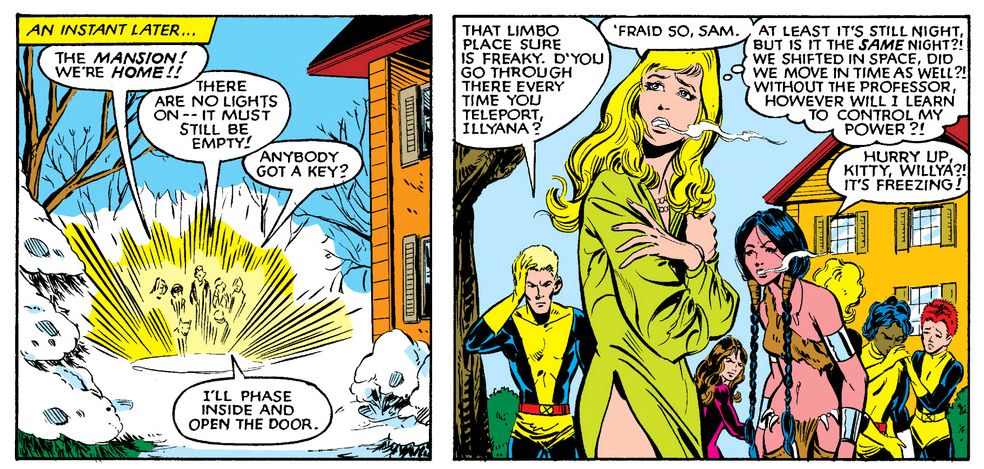
All the way until 1985, that is.  July of that year brought to the increasingly Dani-centric Marvel universe New Mutants #29, which begins with Sam Guthrie and Illyana Rasputin, inappropriately dressed in swimsuits, blasting their way into the terminal of a snowed-in airport in pursuit of unseen thugs who have kidnapped teammates Roberto DaCosta and Amara Aquilla right out from under their noses.  You can imagine how upset they are.  Not only have they lost two friends, but, boy oh boy, is Dani ever going to be pissed at them.!

Illyana and Sam end up in Los Angeles thanks to an errant teleportation spell and have to ask Sam's lover, fabulous insterstellar rock star Lila Cheney, for help.  This brings Dazzler into the story, and she's just ever so coincidentally recently gotten herself out of a tangled mess involving the very same kidnappers.  The heroes track down the villains to an underground gladiatorial contest the likes of which makes Bloodsport look like cricket.  Even for a place as decadent as the story's take on LaLa-Land, I'm not sure I buy all this.  The logistics for putting on such a show and keeping it secret strain my suspension of disbelief, especially when the guy who hires the support team is a surly talking horse who doesn't seem to do anything to hide his unusual appearance.  Things like that tend to attract unwanted attention to your murder sprees.    Still, we're barely into the plot and Claremont may have one heck of an explanation waiting for us.

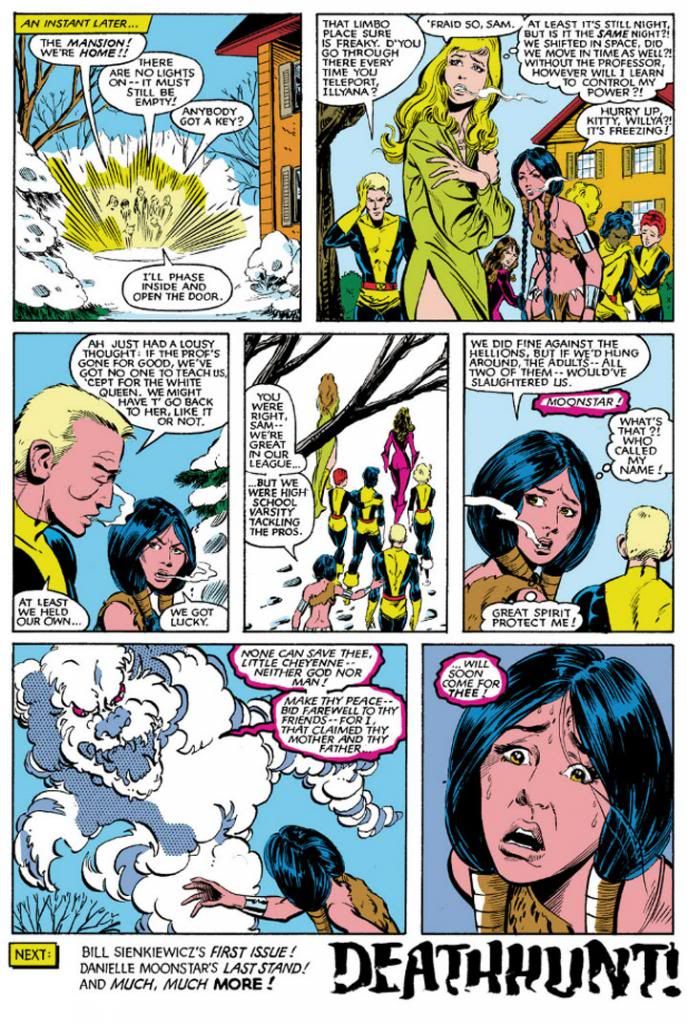
Unfortunately, New Mutants #30 (August 1985) is a mess.  In it, Roberto and Amara gloomily agree to do something against their morals because an evil hologram says they must or he'll injure some children.  The hologram certainly doesn't volunteer any proof and the kids neglect to demand any.  This seems questionable judgment on their part at best.  But even characters acting like dopes isn't as catastrophic to the narrative as would be, say, the creative team being forced to tie it all into a completely unrelated and god-awful massive crossover event.

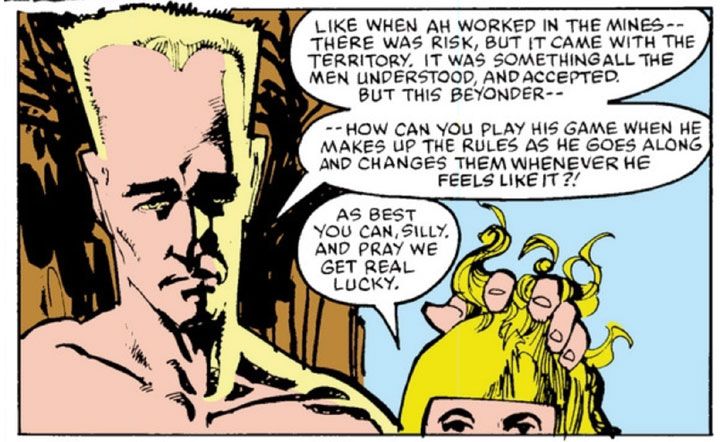
Which is exactly what happened.  As a result, the issue starts abruptly with the resolution of a moment from a comic called Secret Wars II #1 (I don't feel like looking up the date for this).  The splash page positively groans under the weight of expository narrative captions referencing events in other books we couldn't care less about.  There's suddenly an extra character in the mix who looks alarmingly and confusingly like series regular Rahne Sinclair.  And there are also totally static moments interrupting the ongoing action where characters discuss the theological implications of the Beyonder, who seems to be a real cosmic asshole.  You know, one of those Star Trek-style godlike beings who like to change reality on a whim for reasons that in hindsight turn out to a huge pile of shallow Introduction to Philosophy (PH 100 A1 at Boston University in case you're interested in signing up and learning more about the Beyonder) horseshit and who are completely unstoppable until stopped.

In some other book.  Which we'll never read.

Why do I get the feeling this is a dig at the boss?

These moments do nothing to advance either the New Mutants or the Secret Wars II story, but do allow us to think, "Yeah, that's exactly what good ol' Sam Guthrie would think about some poorly-planned and executed nonsense."

Most damagingly, after having devoted so many pages to boneheaded Secret Wars II miscellany, Claremont must then dispose of his own story matters with a few dialogue exchanges so brief you might even miss them after trying to fast forward out of the truly useless crossover parts.  Instead of showing us fun adventuresome stuff like Kitty's detective work (after she takes the trouble of infiltrating the hologram's business), the book just has her explain things on the run:  "Oh, before I forget, here's the scoop on the hologram and those hostage kids, guys..."  There's even a subplot about whether or not Dazzler can break her addiction to fame that gets shafted as well.  Damn you, daddy Beyonder dearest.

With Robin Williams (that's who artist Bill Sienkiewicz makes the Beyonder look like, Williams in one of his patented "holy fool" roles) finally out of the picture (mostly), and our story in grave danger of turning into a summary of Kitty's apparently mad intuitive leaps, we eventually find out it's not the evil hologram but instead a shadowy blob who runs the whole shebang, all the horse-headed weirdos and Frankenstein's monsters and evil holograms and Dazzler solves her problems in a diary entry and the show must go on. 

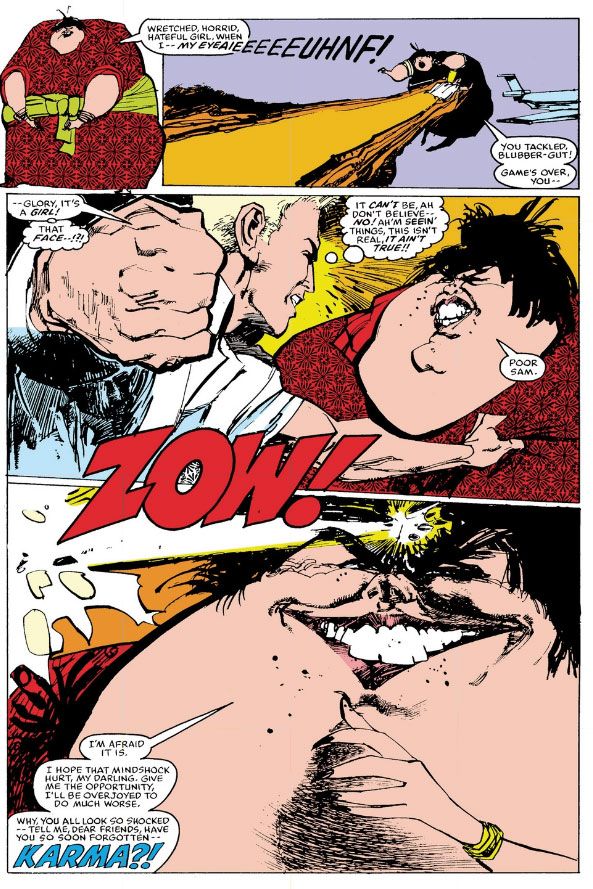
And with that realization comes a shocking revelation in New Mutants #31 (September 1985), which should have, Beyonder-less, happened as a cliffhanger ending to the previous issue--

New Mutants #31 (September 1985), script: Claremont, art: Bill Sienkiewicz

It's Xi'an Coy Manh!  Welcome back, Xi'an!  We're all glad to see you again.  But now you're huge.  And evil!  What the heck happened to you?  Somehow she's even ruined her formerly pristine teeth.  I don't remember Bob McLeod or Sal Buscema drawing Xi'an with gigantic rat-like gnashers like those.  I also don't remember her having a chin-cleft in a big Jay Leno-sized mandible, but there it is.

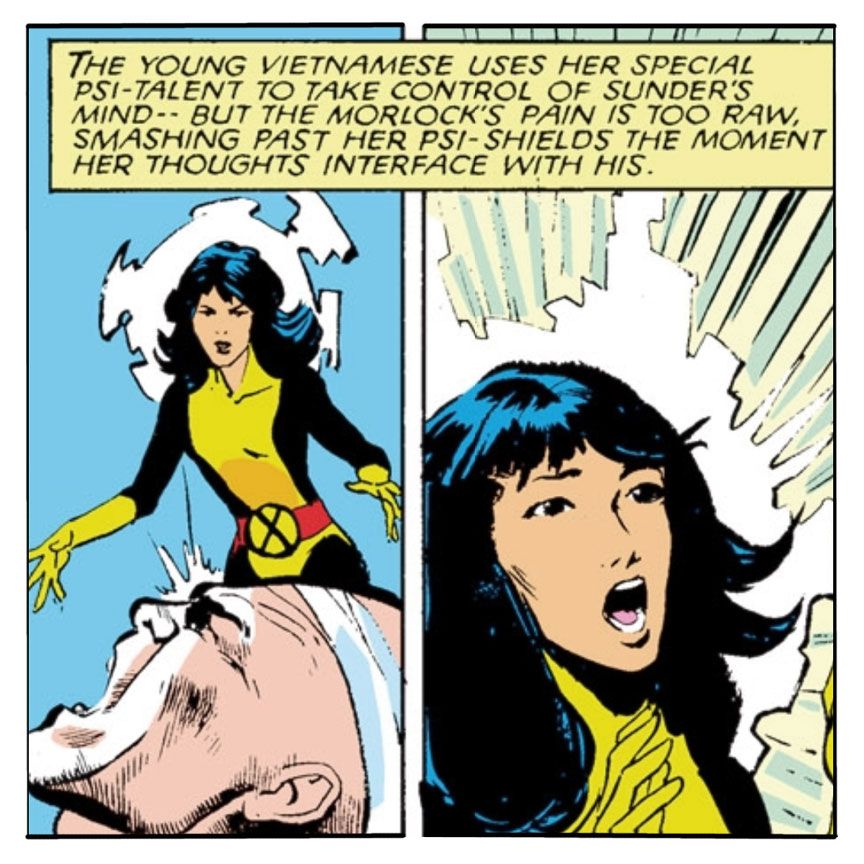
And because I'm a big fan of his, Sienkiewicz's interior art here doesn't really help.  His covers are incredibly compelling and creative-- I especially like the one with the marionettes.  But inside the two issues he draws, he's wildly inconsistent.  Even for someone with an real expressionist touch.  His "Neal Adams-inked-by-Ralph-Steadman" style reinvigorated the series at first, but in New Mutants #31, he pushes the experimentation and stylistic distortions to the point where they actively fight reader engagement.  Unless Sam Guthrie's head being shaped like a large slice of pizza appeals to you.  Much of the action takes place within featureless voids and even the crowd scenes seem under-populated, with a few circles here and there representing the screaming audience in the gladiator sequences.  Claremont lays on the dense prose to make things clear, but that's no happy joining of prose and visuals in the manner we learned to expect from this team when they had the kids fighting demon bears and evil drug dealers.

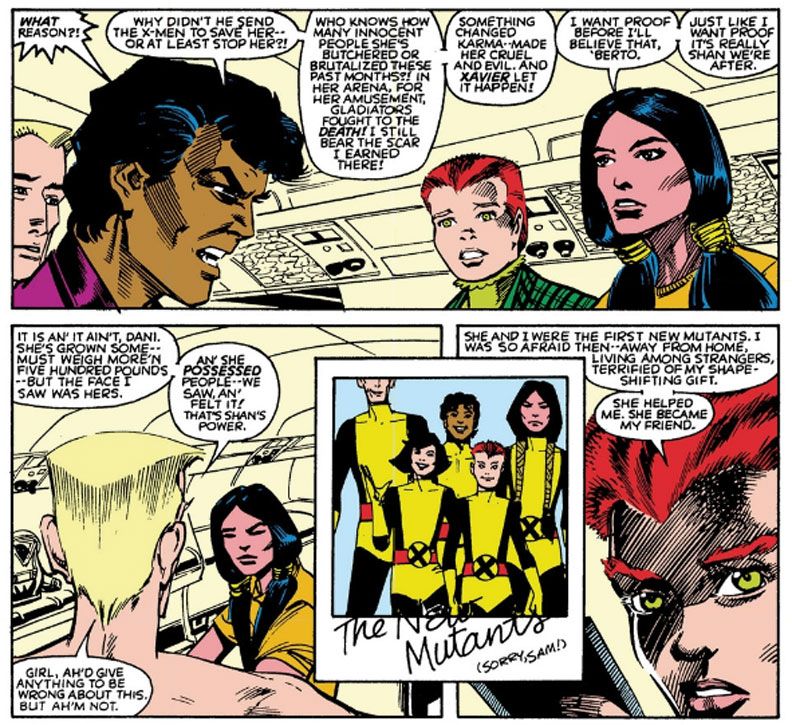
Ah, but are the New Mutants really up against Xi'an herself turned evil?   Illyana thinks so, no doubt inspired by everyone's stories of Xi'an's bad seed brother Tran Coy Manh and equally dastardly uncle General Nguyen Ngoc Coy (who makes a non sequitor cameo here that has to be explained in a later issue, yet another plot-casualty of Shooter... I mean... Secret Wars II).  The people who love Xi'an best are not convinced, so the next, vastly improved part of the story involves their investigation into how someone so right could have gone so wrong.

It starts in New Mutants #32 (October 1985) with a flashback covering the events of New Mutants #6.  In this telling, Claremont places the burden of a guilty conscience on Roberto, who ends up acting very much the hothead the rest of the way, even to the point of daring to disapprovingly compare Dani to Professor X.  Roberto's anger-- largely the outward manifestation of self-directed frustration and troubled conscience-- is set up by this very effective sequence, well-drawn by Leialoha, who inherits the book from Sienkiewicz to finish the arc.  Leiahola's self-inked linework at times pleasingly recalls the Swamp Thing team of Steve Bissette and John Totleben, but more angular and less organic.  Sometimes it conjures Sienkiewicz at his most controlled.  Sequentially, it's refreshingly clear and direct.  Just little things like formal perspective and being able to tell where the characters are in relation to each other and the world around them help a lot.  And also the kids looking more or less human throughout.

New Mutants #32 (October 1985), script: Claremont, art: Steve Leialoha

Led now by Dani, and receiving a huge intelligence boost as a result, the team jets (on a really amazing 747 complete with sleeping compartments!) across the world looking for Xi'an while Doug uses "various computer networks" to track Xi'an's path of global hedonism to Pharaoh, her giant Egyptian casino.  Doug's computer work strikes me as genius moment of prescience by Claremont, the kind of thing Secret Wars II prevented in the previous arc.  Nowadays, every second comic out there features a scene where some brainiac Googles a solution to everyone's problems. Well, Claremont has Doug doing his little version of this a decade before there was even a Google!

It turns out a really nasty guy named Amahl Farouk abducted Xi'an immediately after the big explosion everyone thought claimed her life.  And by "abducted," I mean he stole her body and imprisoned her inside it with himself in the driver's seat.  Besides being a psychic body-snatcher and all-around scumbag, Farouk is also a glutton, both for people's souls and for food. You know, the high life.  Once in possession of Xi'an's lithe body, he parties it up and starts a big time entertainment business-- while dominating all manner of humans and superhumans with is psychic powers.

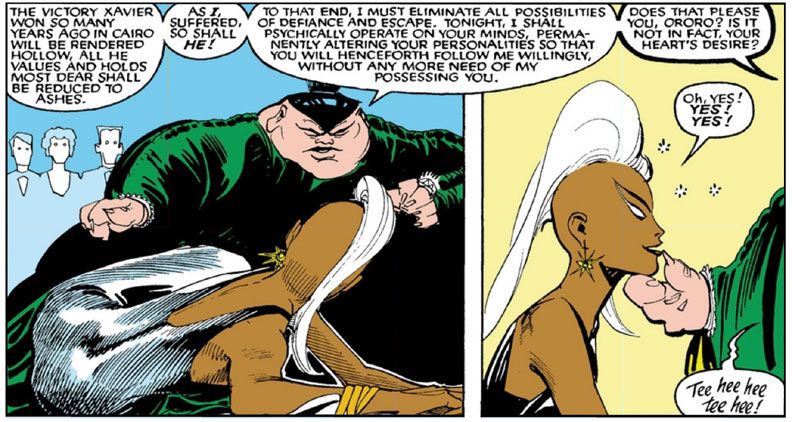
So starting with New Mutants #33 (November 1985), we get a great deal of that kinky corrupting-the-innocent and bondage-type stuff, with the New Mutants falling under Farouk's spell and in New Mutants #34 (December 1985) the antics even come to include an ostensibly experienced and strong-willed adult, the punkishly mohawked Storm.  We even get one of those patented "Will you become my groveling slave and gladly do things your ordinary self would find repulsive and degrading?" moments with Storm struggling at first-- literally crawling on her belly and forced to kiss Xi'an foot as a guy in the crowd begs to go next.  Then Xi'an demands more of Storm as the former demi-goddess resists-- before giving in and exclaiming in orgasmic ecstasy, "Oh, yes!  YES!  YES!"

Also in New Mutants #34, after seemingly betraying her friends, Illyana traipses to the past with Warlock, the team's comedic relief, a kind-hearted "techo-organic" creature from outer space who's sort of a mix between Star Trek: The Next Generation's Data and the earlier, funnier, more manic Robin Williams circa Mork and Mindy.

This by itself is a huge boost to the story because we actually get to watch Illyana in action, complete with an adventuresome cameo by li'l Ororo, the once-and-future Storm.  Cleverly concealing herself behind a wall, Illyana sees a young Charles Xavier going into a bar in Cairo and emerging with a big scorch-mark.   On the back of his safari jacket, for the scatalogically inclined out there.  Using her own arcane powers and Warlock's sensors, Illyana realizes Xavier's been in a psychic battle and walked away the winner.  And the loser was Farouk, hence this whole narrative.

New Mutants #34 (December 1985), script: Claremont, art: Leialoha

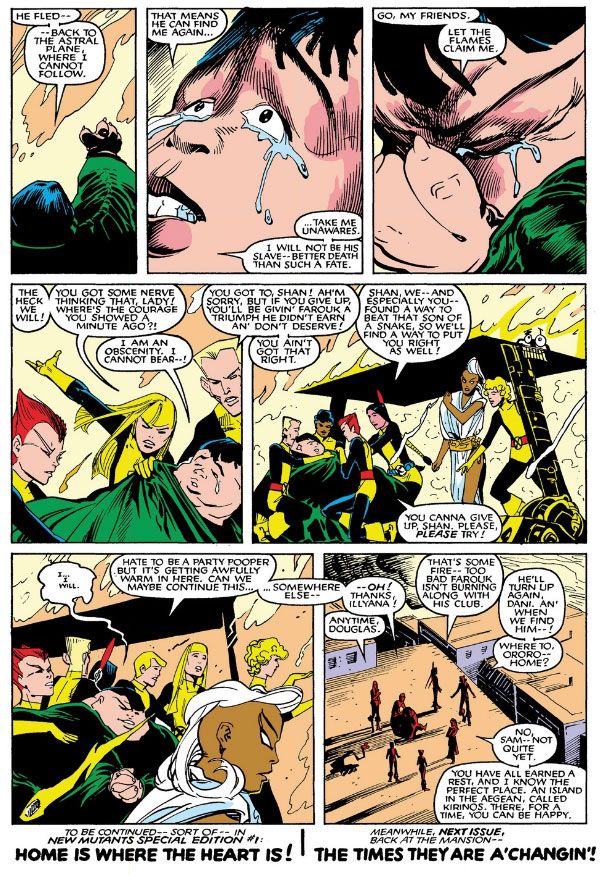
While mind control is a recurring X-Men/New Mutants theme, so is redemption.  We don't talk about this one as much because it's not so easy to poke fun at as all those bondage/humiliation scenarios.  But Banshee in the early issues of Uncanny X-Men, Jean Grey in the penultimate moment of her life, Sam himself, Illyana (endlessly), Magneto, Rogue.  Claremont is always giving his characters a second or third chance and changing their lives for the better, no matter how far they'd fallen.  Adding complexity and richness to their inner lives in the process.  At the climactic moment of New Mutants #34, Xi'an seeks her redemption by fighting Farouk on the astral plane.  Solo, which is fitting.  At first, she's helpless before him, but eventually her psychic-self breaks free of her bloated imago, and looks just like her old, athletic self, complete with bobbed haircut.  She mentally kicks Farouk's mental ass and returns to our reality free of corruption.  Her mind may be free, but the physical damage of Farouk's possession of her body remains.

New Mutants #34 (December 1985), script: Claremont, art: Leialoha

The little text blurbs at the bottom promise more action to come, this time all the way in Asgard itself, the mystical realm of the Norse gods and homeland of the mighty Thor himself.  There Xi'an goes through a long desert ordeal where she sheds the excess pounds and just a year later, when Jackson Guice and Kyle Baker come aboard to provide guest art in New Mutants #46 (December 1986), she's right back with the team and looks like this:

New Mutants #46 (December 1986), script: Claremont, pencils: Jackson Guice, inks: Kyle Baker

Even her teeth and chinbone have shrunk back to the way they once were.

And  that's the story of how Xi'an Coy Manh climbed waaay up to the forty-fourth floor of the Hudsucker Building, and then fell all the way down but didn't quite squish herself. You know, they say there was a mutant who jumped from the forty-fifth floor?

But that's another story.

Monday, December 23, 2013

New Mutants Winter Holiday Extravaganza starring Dani Moonstar!

If there's anything the New Mutants love more than ostracizing Kitty Pryde or cuddling up together on the sofa with some popcorn to watch Magnum, P.I., it's enjoying seasonal hijinks in the snow.  Let's take a moment to share a few holiday memories with Dani, Sam, Roberto, Rahne, Xi'an and all the rest.

The snow love starts as early as New Mutants #4:

New Mutants #4 (June 1983); words: Chris Claremont; art: Sal Buscema and Bob McLeod

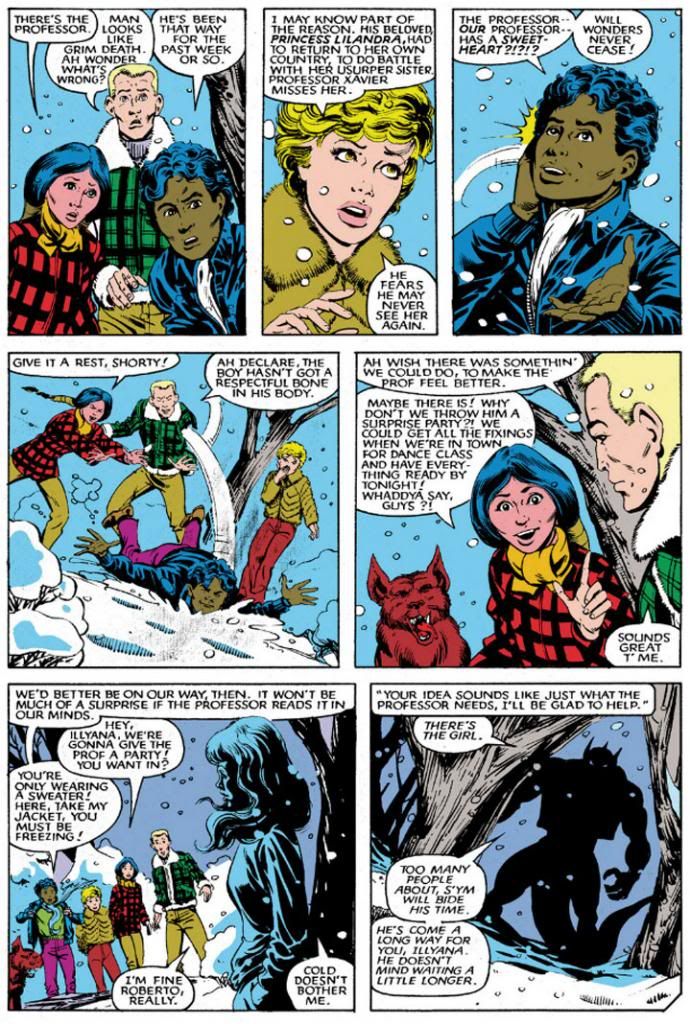
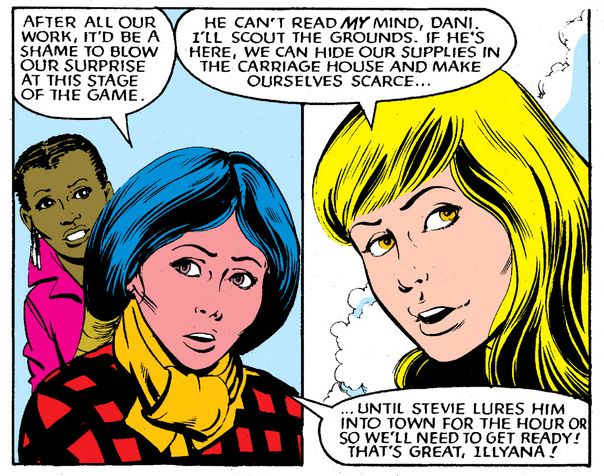
These sequences are useful for showcasing each kid's powers or personality, and for comedic relief.  Outdoor frolicking later helps the team quickly recover from the apparent death of leader Xi'an Coy Manh and welcome new additions Amara Juliana Olivians Aquilla and Illyana Rasputin to the team roster.  Amara shows her holiday spirit by helping plan a surprise party for a moping Professor Xavier.  Did you realize the Xavier School for Gifted Youngsters allows its students to get out of class early during inclement winter weather, even though they both live and study inside the school itself?  I didn't, either.  Here's proof, though:

New Mutants #14 (April 1984); words: Claremont; art: Buscema and Tom Mandrake

We all know how Dani shuns clothing in favor of what Xi'an jokingly calls l'aventures naturelles.  Leave it to the coolest mutant around to don a winter ensemble consisting of assless chaps and a loincloth even as the mercury dips below zero...

New Mutants #17 (July 1984); words: Claremont; art: Buscema and Mandrake

As someone who grew up in the Colorado mountains, Dani has probably developed a greater tolerance for low temperatures, but this is a bit much even for her.  After a quick hallucination as frostbite sets in, it's time to repair to the mansion to warm up with some hot cocoa and possibly a long inner monologue about recent events. 

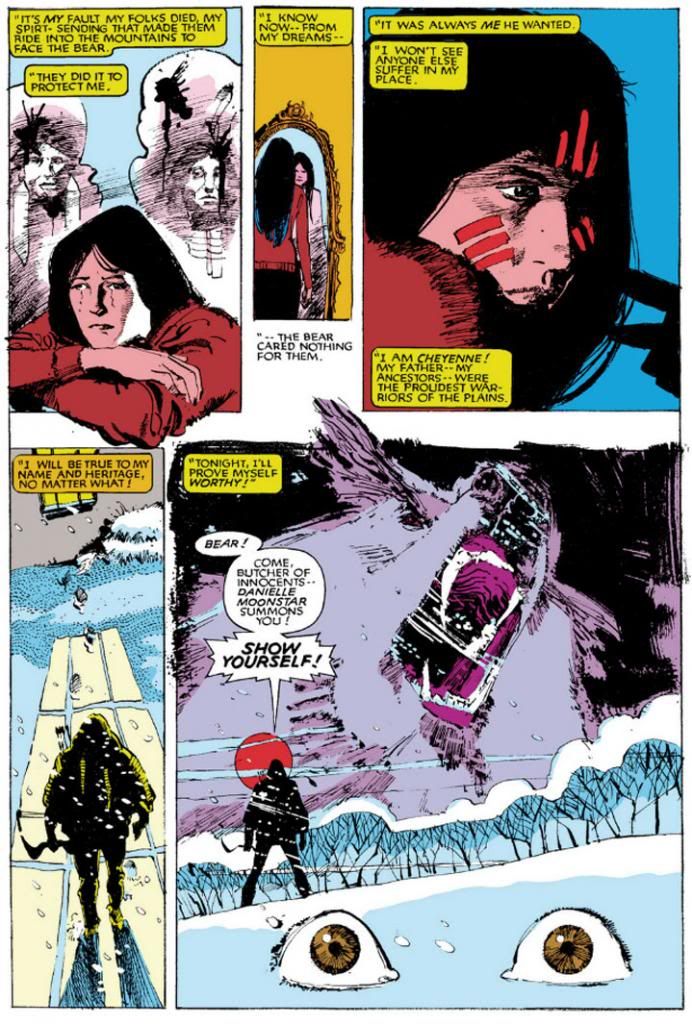
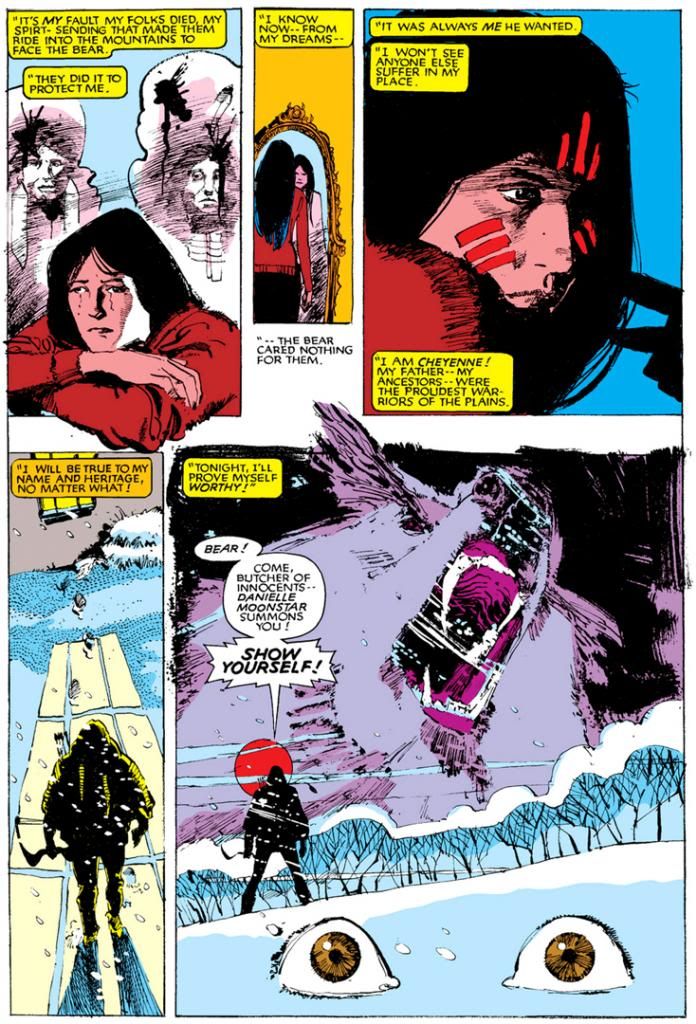
This next example isn't so much fun and festive as it is moody and menacing.  For Dani, snow isn't just about having fun and walking around half (or wholly) naked.  It's also about undertaking spirit quests.  Here's a dark and troubling page by Bill Sienkiewicz from New Mutants #18, where Dani goes solo against the demon bear that consumed her parents.

New Mutants #18 (August 1984); words: Claremont; art: Bill Sienkiewicz

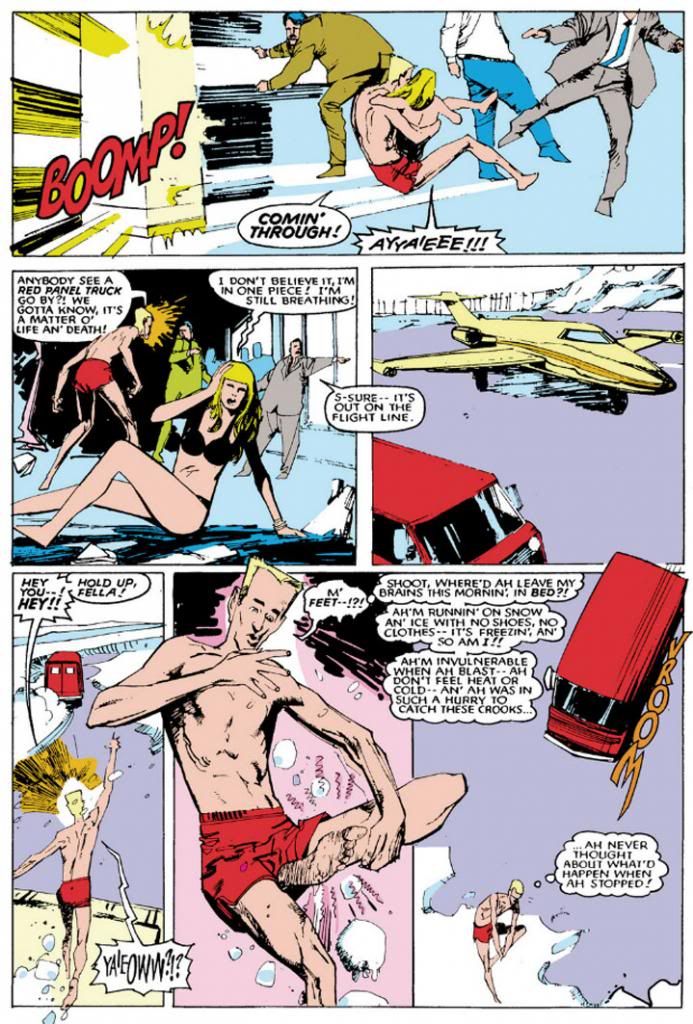
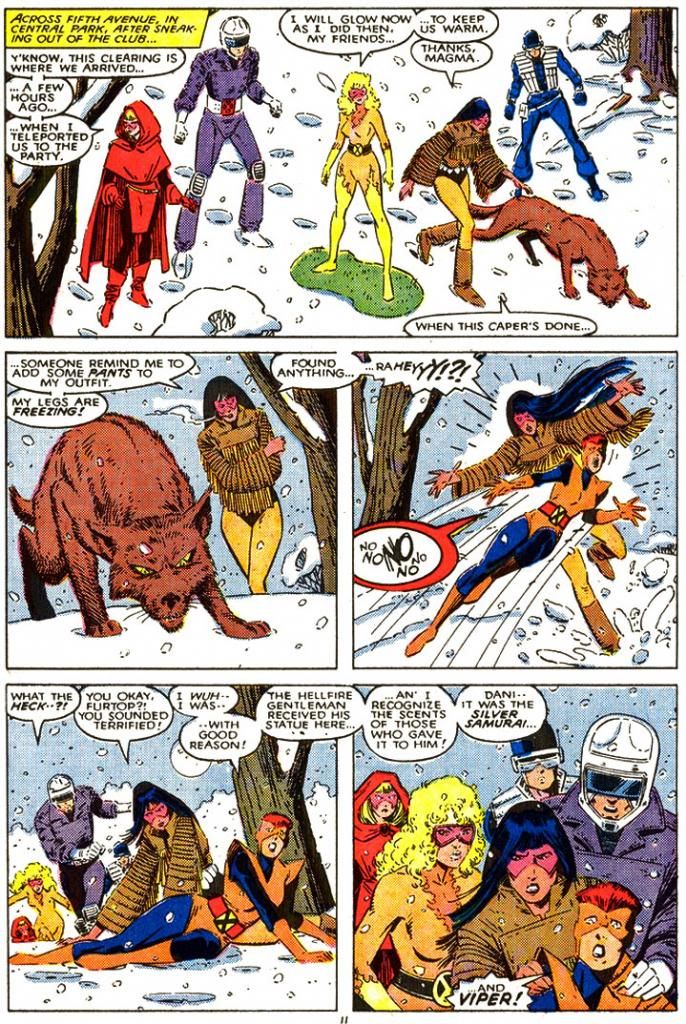
With Chris Claremont's genius for involving characterization, New Mutants rarely goes wrong when the story focuses on Dani, the best of all its characters.  But what's this?  Looks like Dani's not the only New Mutant trying for a membership in the Polar Bear Club.  Check out Sam Guthrie and Illyana in this slapstick sequence set at a local airport.

New Mutants #29 (July 1985); words: Claremont; art Sienkiewicz

Okay, so they're not just flying around in swimsuits because they enjoy it.  They do.  But more importantly, they're chasing after kidnappers who have just spirited away Roberto and Amara.  This happens while Dani and the others are fighting for their lives in a wartorn dreamscape inside a kid's mind.  No snow there, though, which is why I left it out.

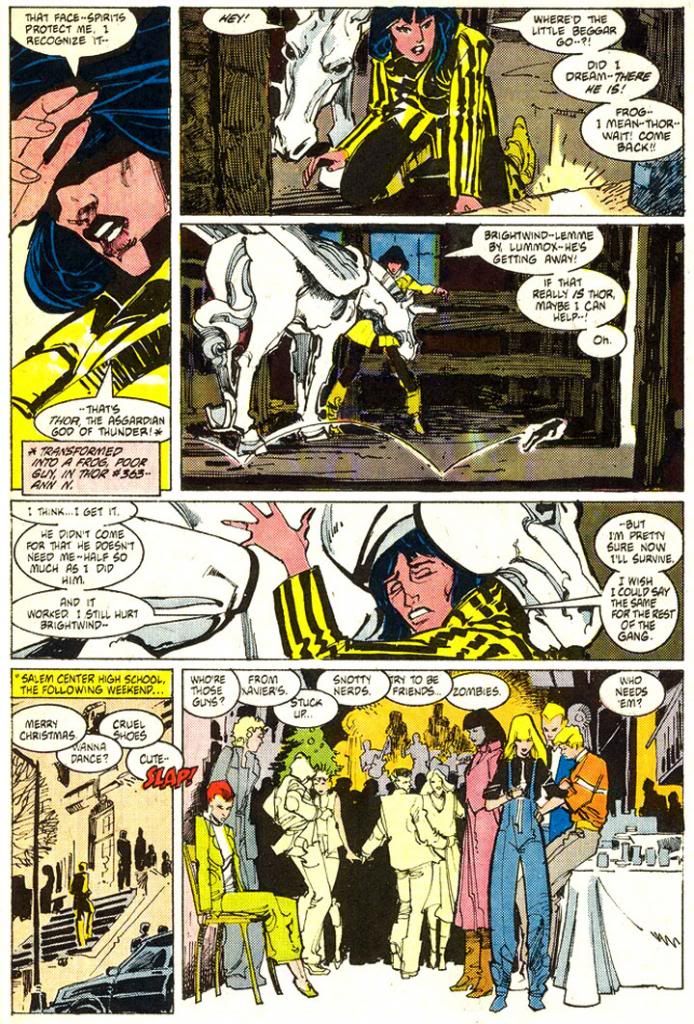
I'd hoped to find an issue with the team decorating a Christmas tree, lighting Chanukah or Kwanzaa candles, with Rahne doing her best Tiny Tim impression and Amara sharing a few Saturnalia traditions, but the only overt reference to a winter holiday comes in New Mutants #38, where the kids attend a party at Salem Center High School.  Dani, despite wearing a sweet party-appropriate black and yellow striped winter coat, decides to hang out in the Xavier school stables with Brightwind, her winged horse from Asgard.  Instead of the ghosts of Jacob Marley and Christmases Past, Present and Future, she gets a visit from what I believe is Thor in the guise of a frog.

New Mutants #38 (April 1986); words: Claremont; art Rick Leonardi and Sienkiewicz

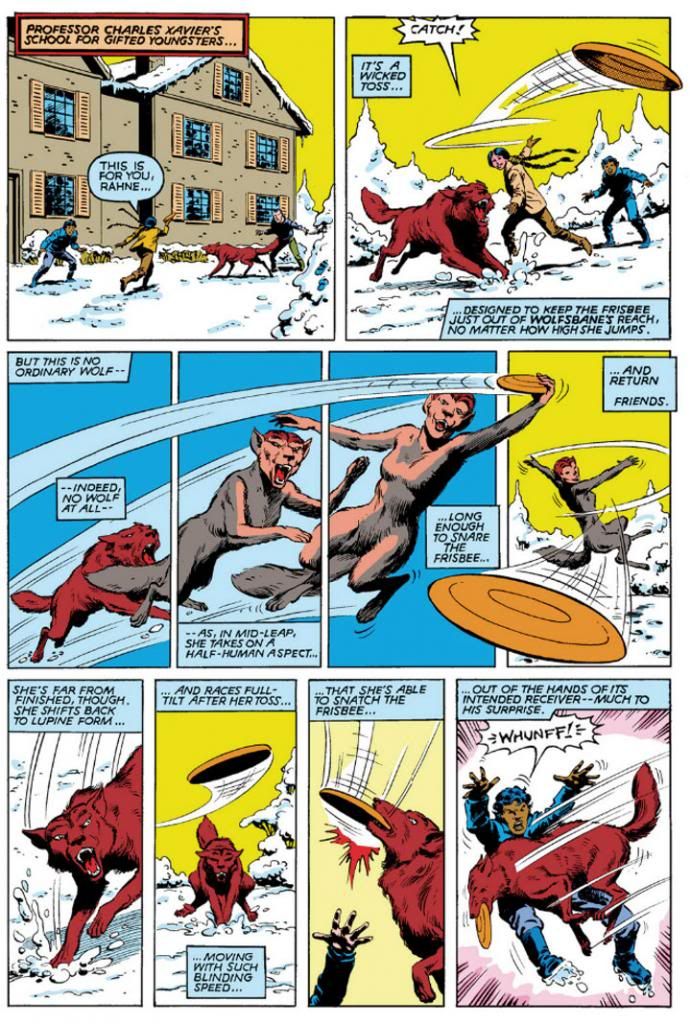
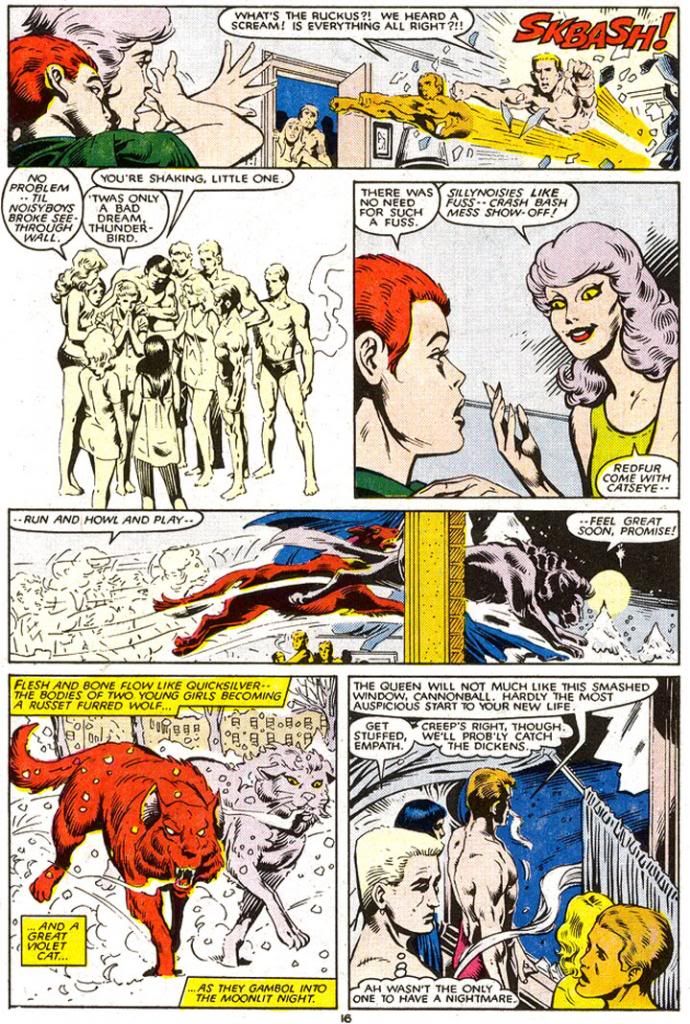
While Dani proves largely impervious to cold due to her upbringing and frequent nudity, her young pal Rahne Sinclair has the natural advantage of being able to transform into a wolf.  Each time she and Catseye (a member of the Hellfire Club's off-brand version of our heroes they call the Hellions), meet, they shapeshift into their "furforms" and go do lord knows what together.

New Mutants #39 (May 1986); words: Claremont; art: Keith Pollard and Del Barras

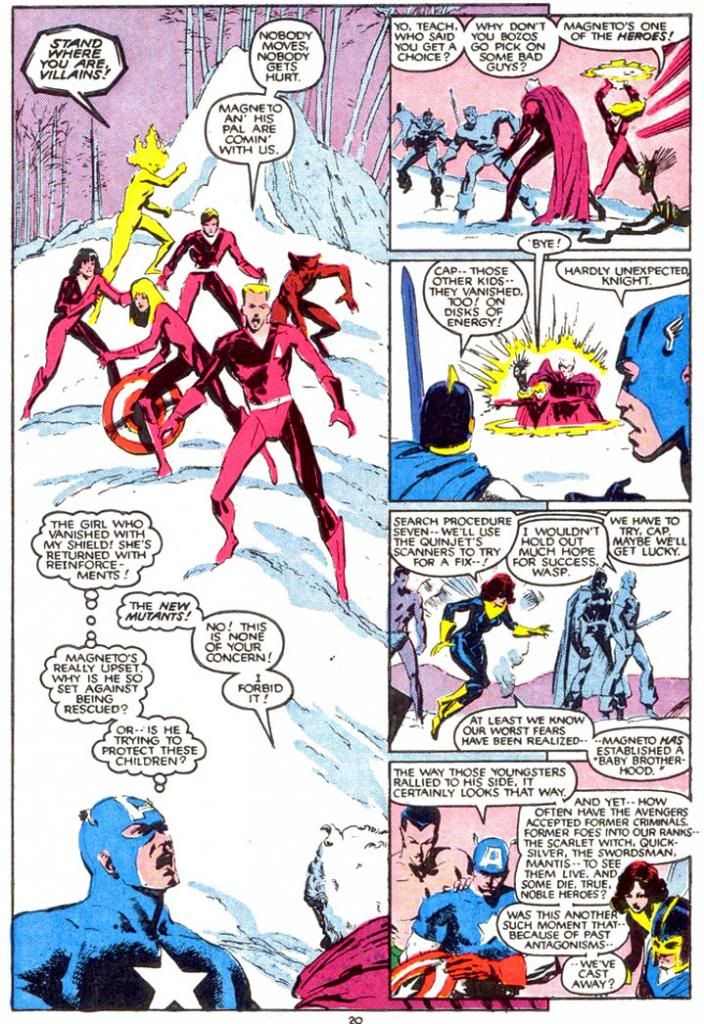
Around this time, new school headmaster Magneto decides it's better for his charges to become Hellions themselves, which leads to an extended run of issues where practically everyone wears magenta costumes.  And also to conflict with some of the Avengers.  Which, appropriately enough for today's theme, takes place in a scenic snow-frosted wilderness.

New Mutants #40 (June 1986); words: Claremont; art: Jackson Guice and Kyle Baker

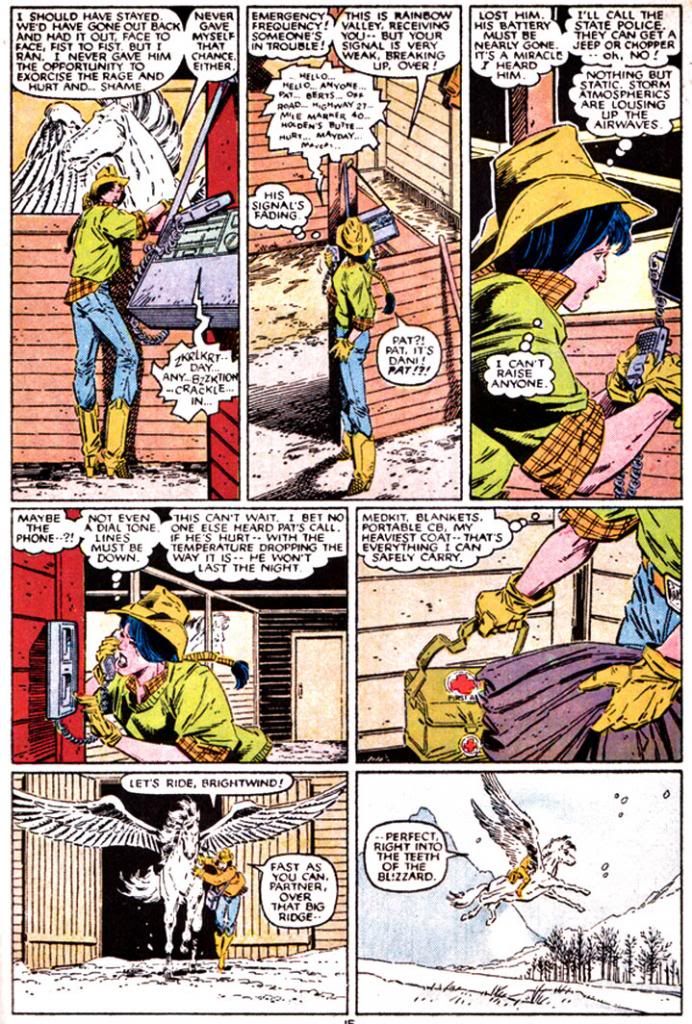
But what of the most important of all the kids, Dani Moonstar?  Not wanting any part of this magenta nightmare, she bugs out for her hometown in Colorado where she spends a lot of time...  you guessed it... in a stable with Brightwind.

New Mutants #41 (July 1986); words: Claremont; art: Guice and Terry Austin

I've never been, but I imagine with the Rocky Mountains being right there and all Colorado must have some beautiful winters.  During this particular story, a would-be boyfriend from Dani's past turns up and she has to engage in a fast draw duel with the personification of Death itself to save the guy's life (even though he's a complete creep).  It's your typical "guy likes girl, girl wants to be just friends, guy gets drunk and crashes his truck then goes into insulin shock, girl gunfights Death to save guy's life" story.

As if the Hellions costumes weren't bad enough, the team received their "graduation" uniforms soon after.  Poor Sam gets stuck in a purple and white jumpsuit with some kind of rejected prototype helmet left over from the Robocop pre-production phase and kneepads and Dani, much to her horror, has to wear a top that seems to have been woven from an old carpet Professor X had stored in the mansion's attic.

New Mutants #54 (August 1987); words: Claremont; art: Buscema and Austin

Amara looks like she just came from the Jem and the Holograms concert, or else she's splitting the visual difference between Spider-Man's animated friend Firestar and one of Santa's elves.  But with Rahne providing the perfect fifty-issue bookend by once again knocking over one of her teammates in the snow we've reached an appropriate stopping point.

Happy Holidays and a joyous 2014 to our reader!

Sunday, March 31, 2013

Dani Moonstar, the Early Years 4! The UnBEARable Lightness of Being Dani

Then came the Second Golden Age of the Dani Moonstar.  And yet it was a dark age, as well.  With the addition of Bill Sienkiewicz on art-- a guy who combined Neal Adams and Ralph Steadman in almost equal measures-- The New Mutants became one of Marvel's most visually distinctive books.  Chris Claremont's writing took a great leap forward stylistically as well, the language becoming ornate and the plots ever more complex, with characterizations to match.  Finally, Dani Moonstar would have a story worthy of her, albeit one where she'd spend a good portion of it in a coma while her new friend Magik did the heavy lifting.

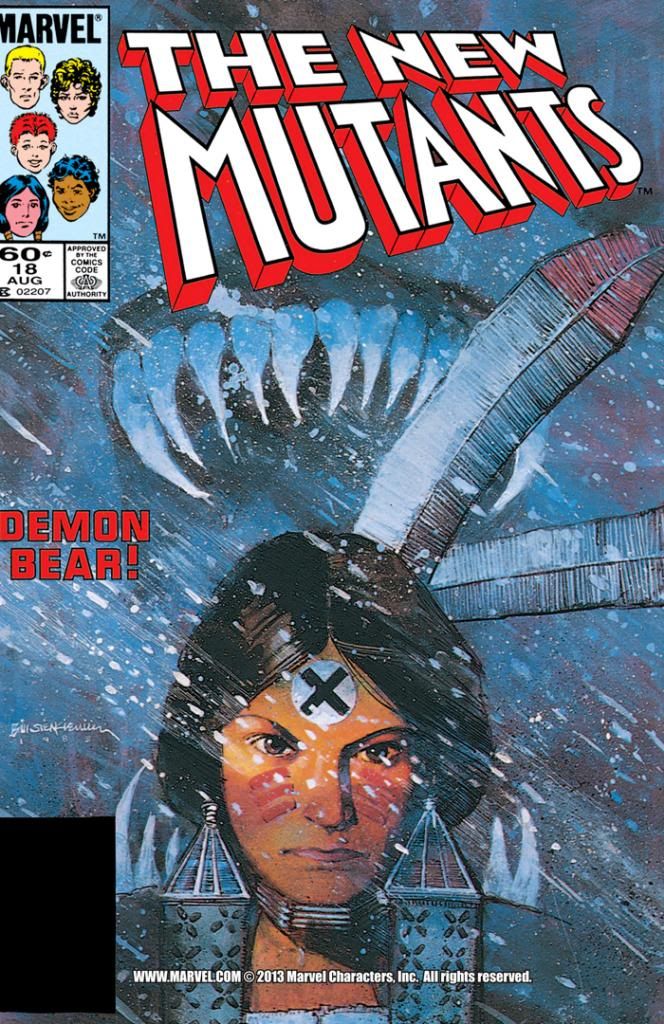
It kicks off in The New Mutants #18 (August 1984) with a painted Sienkiewicz cover that wastes no time announcing the book is something special.  Not the one you've been used to and slightly disappointed by for the last six months or so.  The Sienkiewicz Dani gazes intently at the reader, with a face recognizable as the Bob McLeod character, but now with thin-lipped determination and more culture-specific accessorizing (the forehead X is especially clever).  Behind her, however, the fangs of discord.  Danger in the snow.  Sienkiewicz brings a painterly approach with a strong design sense as well.

If you'll remember, way back in the first issue, Dani told Rahne a little bit about herself and the story of how her parents vanished while possibly fighting a mystical bear.  It was one of Dani's earliest moves towards becoming the book's standout character.  Then, in the third issue, we got to see the bear itself.  Kind of.  It was more than likely a mind-game the Brood-infected Professor X was playing on Dani, drawing out her worst fears.  Then the book went off on a Team America-Romans-living-in-South-America-Magik tangent and no one mentioned Dani's magic bear for a while.

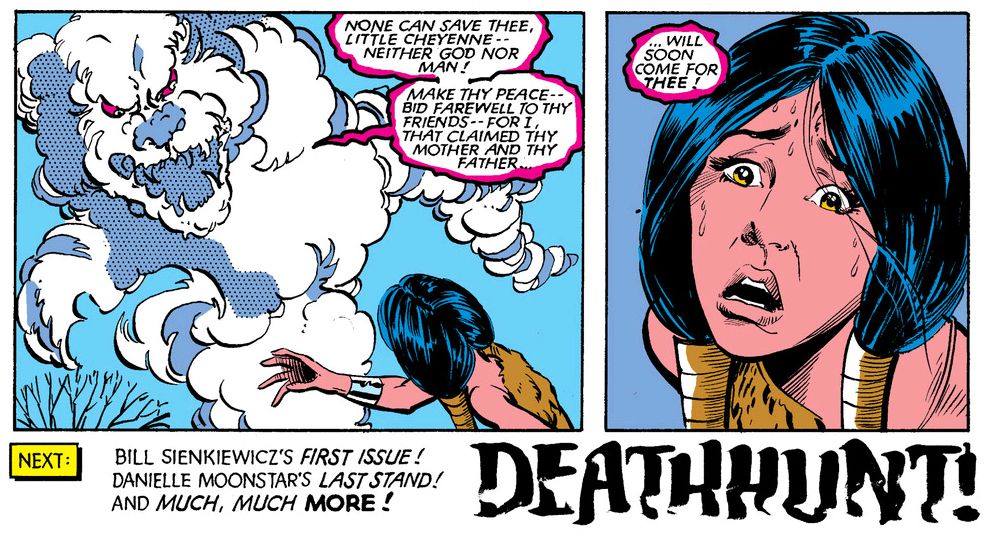
Well, readers might have forgotten the exact details, but rest assured, Claremont did not.  A master of the slowly developing subplot, Claremont returned to this little biographical tidbit and spun it into a unique tale as psychological as it was action-packed, a genre-stretcher that took the kids out of their cozy heroic adventure home and tossed them into the deep, dark woods we like to call horror.  If this had been a DC book and Vertigo had existed in 1984, "The Demon Bear Saga" with its dripping blood and ever-shifting dreamscapes would have been a perfect fit.  And Seinkeiwicz, who must have bought india ink by the tanker truck-full, was just the guy to illustrate it.

Why a bear?  What am I, a cultural anthropologist?  What little I know about Native American culture comes from a single university folklore class, reading a few histories and novels like Tom Berger's novel Little Big Man and the essay  They Have Not Spoken:  American Indians in Films by Dan Georgakas.  In short, I know just enough to make an ass of myself.  To make matters worse, I'm going to rely on the Internet.  Apparently, bears are very powerful animals.  Magically powerful.  There's a wonderful story in which a great bear chased some girls (perhaps Lakota, not Cheyenne, but many tribes tell variants of this one), who took refuge on a rock.  They prayed that the rock would grow and save them from the bear.  It did and they took to the sky as the Pleiades (also known in Greek myth as the "Seven Sisters").  The bear in its hunger and rage clawed the sides of the rock, leaving it scarred.  Today we know this rock as the Devils Tower, Wyoming.

The point is, bears figure in a lot of myths and stories, so a bear makes an excellent choice for Dani's spirit antagonist.

One aspect of Marvel's mutant books is how mutant powers and the reactions of those manifesting them and by society at large as a response to these powers can be read as an allegory on race, gender, sexuality, or any kind of "othering."  The sexuality reading has ascendancy these days, especially in light of its treatment in the X-Men films, where Iceman's parents ask him if he's tried not being a mutant (X2: X-Men United, 2003)  and where Mystique anachronistically tells Beast to be "mutant and proud" in 1962 (X-Men: First Class, 2011).  The scene where Beast has his mutant status inadvertently revealed is especially evocative of an outing.  Reinforcing this is the trope within the comics themselves that mutant powers typically manifest at puberty.

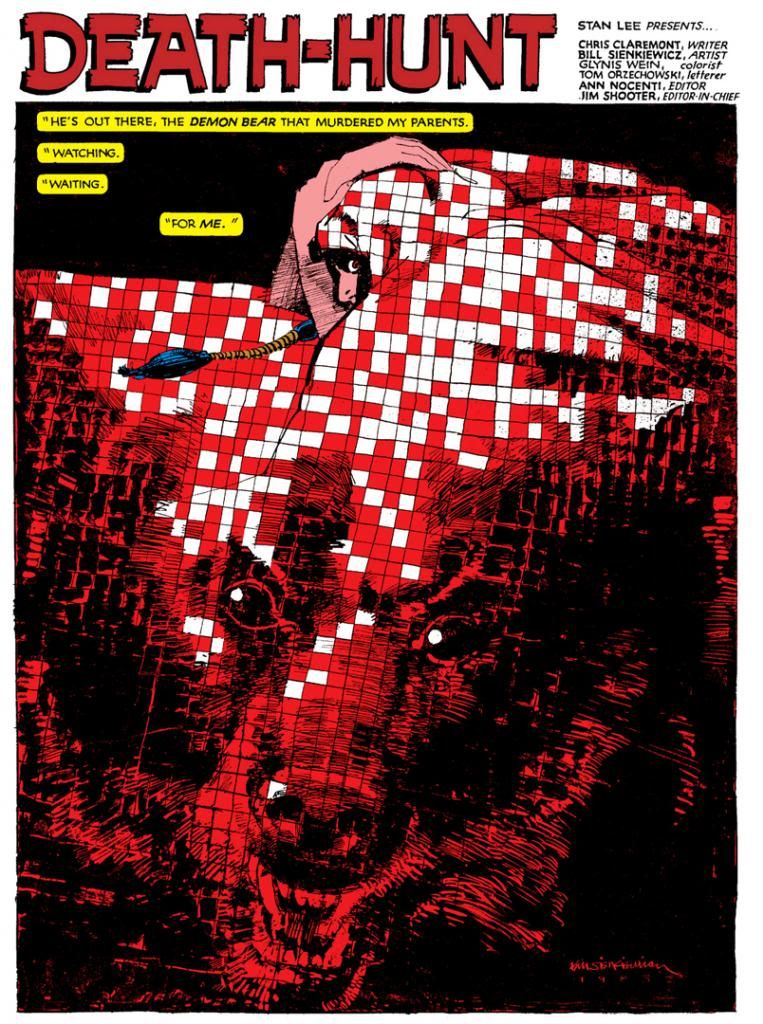
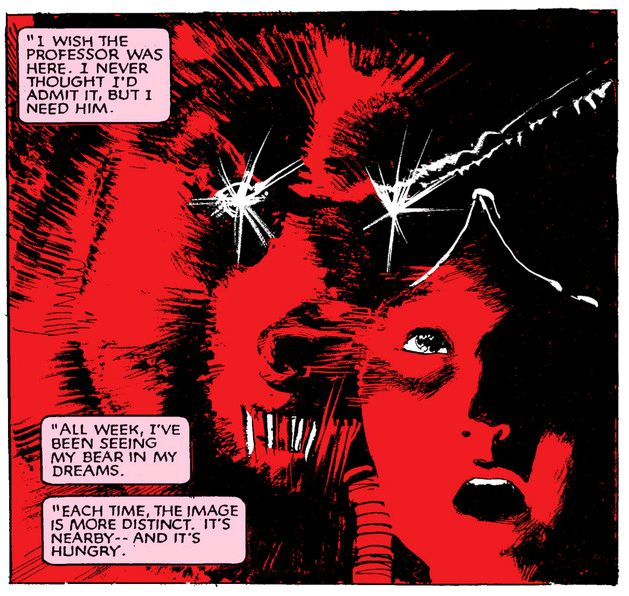
Appropriately, “The Demon Bear Saga” is a story rife with sexual symbolism, no doubt resulting from a happy synergy between Claremont, operating at the utmost of his considerable skills as a writer and an insightful artist in Sienkeiwicz, one open to expanding the literary vocabulary of superhero comics through experimental techniques.  In the opening splash page, Dani cowers in bed while Claremont has her narrate her plight and Sienkeiwicz and colorist Glynis Wein cover her in a red sheet imprinted with a dream image of the demon bear.  It’s a shocking image, our favorite mutant swaddled in what appear to be blood-soaked sheets and the red motif would recur, reappearing with the bear imagery as Dani thinks about her most recent dreams involving her foe in a later scene and again when Dani ritualistically paints her face as she prepares for the climactic confrontation.

Chris Claremont, scipt/Bill Sienkiewicz, art/Glynis Wein, colors (The New Mutants #18,  August 1984)

Significantly, the bear enters Dani’s life at the same time her mutant powers appear, roughly around puberty as per Marvel's mutant mythology—one of her first acts as a full-fledged mutant is to show her parents their apparent deaths at the bear’s claws, which becomes a self-fulfilling prophecy.  In the real world, there is another power, another type of becoming, of a great and personal change, that fulfills itself at puberty through blood.  You can find it providing one subtextual reading of the fairy tale "Little Red Riding Hood" and horror authors and creators before Claremont and since have used it more overtly to add resonance to their works.  Steven King and Brian DePalma used this theme to great effect in both the novel Carrie (1974) and its classic film adaptation (1976).  More recently, screenwriter Karen Walton explored these associations in the werewolf film Ginger Snaps (2001), directed by John Fawcett.  Dani’s horrified response to developing a power she lacks the experience and understanding to control, and one that causes her parents’ deaths is ultimately a signifier of her ambivalent response to having matured sexually in a patriarchal society that marginalizes her as a woman.  Dani's real struggle is to overcome this ambivalence and the shame and self-loathing that results.

Chris Claremont, scipt/Bill Sienkiewicz, art/Glynis Wein, colors (The New Mutants #18,  August 1984)

Unfortunately for Dani, her parents were unable to protect her at a time when these changes were at their most intense.  In fact, the root of Dani's guilt is that this maturation, this physical change, visited in her desires or thoughts she equates with the bear's utter destruction of her parents.  Feeling betrayed by her body, she has taken responsibility at having violated the nuclear family.  But because she is essentially a strong, brave young woman, after an initial period of understandable dread, she will attempt to attack the problem head-on.  It won't be easy, and requires an elaborately ritualistic preparatory regimen. 

Chris Claremont, scipt/Bill Sienkiewicz, art/Glynis Wein, colors (The New Mutants #18,  August 1984)

In preparing herself to contest the bear, Dani turns not to her chaste and inexperienced friend Rahne, but to the wiser-- and therefore, no longer innocent-- Magik.  Magik, having spent her formative years in Limbo, is an enigmatic figure, and an outsider.  She is also symbolically corrupt in the same way Dani believes herself to be.  Not quite human, not quite mutant, not quite demon.  Dani reveals through her narration that she's not even particularly close to Magik-- Illyana is best friends with Kitty Pryde-- so this makes her choice of confidante all the more telling.  But such is Dani's confused acquiescence to the cultural idea there is shame and uncleanliness in having become fertile that she is unable to tell even Magik her true motivation.  The more experienced Magik provides Dani an outlet for exploration and experimentation as she seeks to understand the nature of her new-found desires and physically ability to feel and act upon them.

Chris Claremont, scipt/Bill Sienkiewicz, art/Glynis Wein, colors (The New Mutants #18,  August 1984)

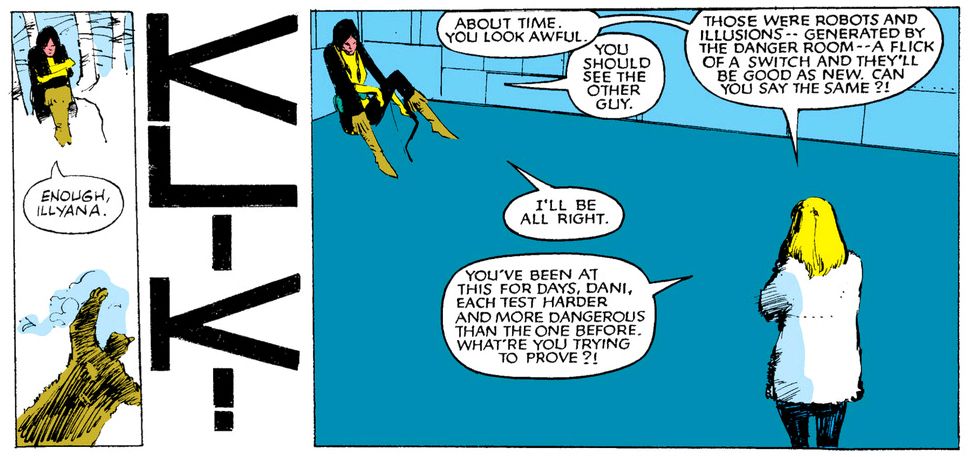
Bears are largely masculine figures, and in order to confront hers, and with Magik playing the role of sexual agent, Dani must cross genders (at one point she jokes with Magik, "You should see the other guy," guy being sometimes gender neutral, but generally a masculine noun; Dani clearly identifies herself here as a guy at least in a symbolic sense), or at least add male characteristics to her own innate female identity.  In the Cheyenne tradition, men acted as hunters and warriors, but one might reject this path and begin living as a woman.  Dani subverts, or rather, inverts this by taking on the role of hunter-warrior, but not without symbolically daubing herself with her own menstrual blood (I'm also reminded of the scene in Sylvia Plath's The Bell Jar, where her protagonist, Esther, bloodies the nose of her attempted-rapist and he similarly paints her face with it), represented as red war paint.  Only then is she prepared to do more than cower in bed or react in fear.  Thus cloaked in the accouterments of maleness, Dani is free to act, to slay the bear.  

For this, Dani uses a weapon associated with Native Americans by history and custom, the bow and arrow.  The arrow is phallic.  It penetrates and Dani has made herself expert in its use thanks to her training sessions with Magik.  And yet Dani is also reminiscent of Diana of Roman myth, from the similar names, to the choice of weapon, to the time at which she forces this confrontation-- that is, night time.  Diana has associations with the moon.  She is also the goddess of the hunt.  And of chastity.  It's worth noting, too, that Artemis, the Greek version of Diana, is goddess of childbirth as well.  In order to battle the bear, Dani requires herself to embody both sides of the gender dichotomy.  In this way she becomes both her own father and mother.
 
Chris Claremont, scipt/Bill Sienkiewicz, art/Glynis Wein, colors (The New Mutants #18,  August 1984)

The confrontation with this male presence occurs in snowy woods.  The snow, of course, is white.  This can be seen as purity, but snow may also be representative of death.  Woods hide mysteries and figure in many fairy tales as places where terrible things may happen to children.  Here, Dani-- drawn by Sienkiewicz as a silhouette, all her sexual characteristics blotted out or hidden-- calls out the bear as "butcher of innocents," which we can also understand as "butcher of innocence."  The dialogue here is artificial and lacks the voice of a teenage girl.  It's more in the epic tradition, something Beowulf might say to Grendel in translation.  The bear then appears, and Wein colors it various shades of purple, representing pain or bruising, while on the next page it's a more naturalistic brown as it has fully manifested before Dani.  Its threat is no longer confined to the subjective space of Dani's dreams but rather has become real and potent. 

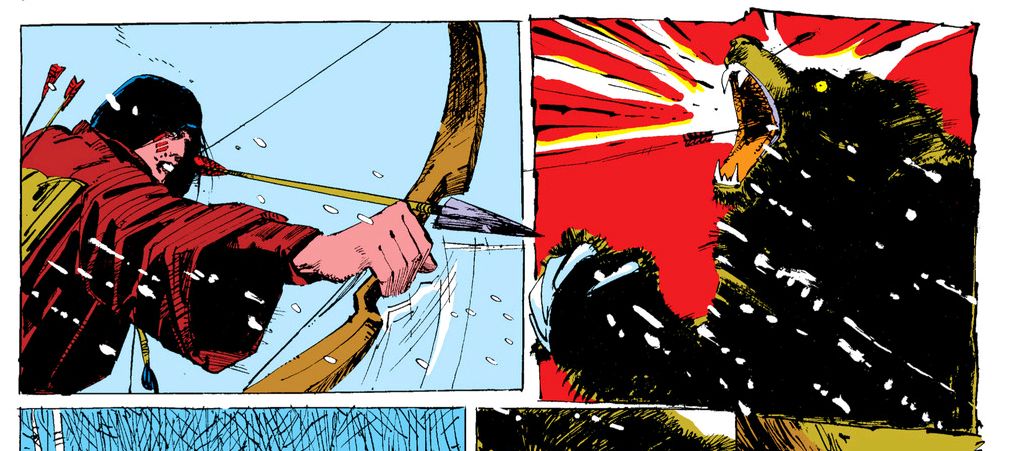
Dani first uses her mutant power-- which she has always found problematic-- to attack the creature with its greatest fear.  Which turns out to be Dani herself.  The masculine power fears the feminine one.  The basis of gender relationships in Western culture is an unequal power dichotomy in which female strength is denied and negated in favor of the male out of fear and loathing, which includes a belief that menstruating women are somehow unclean.  Here, using her innate strength, Dani comes closest to achieving victory.  Dani, however, does not attempt to derive any deeper understanding of why the bear fears her as much as she fears it.  Instead, she reverts to using the phallic arrow, striking the bear harmlessly in the neck, though she describes it as a "killing shot."  If she intends to use the patriarchy's weapons against it, this proves to be a fatal decision.  The bear easily sweeps the bow from her hands and batters Dani.  She's able to injure the bear with a handheld arrow and earn a brief respite.

Escaping the bear's clutches, Dani retrieves her bow and fires another phallus into the one vulnerable opening the bear presents-- its mouth.  Here, having penetrated the bear at last, she achieves a false victory and turns from her foe in premature triumph.  In relying on a substitute penis, and denying herself the use of her own power-- despite its tantalizing glimpse of deeper wisdom-- Dani has not dealt fully with her own ambivalence towards her sexual maturation and gender role.  As she walks away into the night, the bear's eyes open. 

Chris Claremont, scipt/Bill Sienkiewicz, art/Glynis Wein, colors (The New Mutants #18,  August 1984)

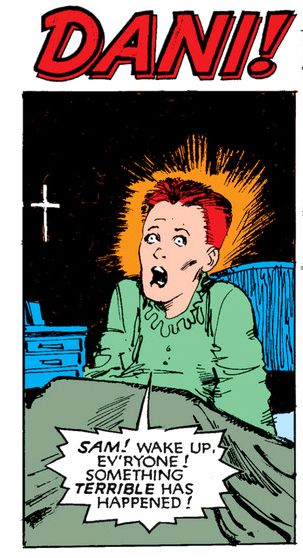
And, importantly, it's the virginal Rahne (Sienkiewicz clothes her in a prim, ruffled nightgown and places a cross behind her) who senses the danger and alerts the others.  Dani has been struck down by the complexities and ambiguities of adulthood, but it's the most child-like of the New Mutants who reacts, having felt it psychically.  Dani's friends run to help her-- Sam, the oldest boy, carries yet another phallus, what appears to be a shotgun-- and find Dani's gutted body staining white the snow of innocence with the red of her secret knowledge, which she is now in no shape to parse.


Not to equivocate, but simply as a response to the richness of Claremont’s writing, I want to offer some alternate readings to the “Demon Bear Saga.”  The jumbled mess above—no more than a B- effort if I were to turn it in to one of my old lit professors—is just one way of reading the subtext.  Here are some others, probably equally as confused.


Hm.  That is equivocation.  Oops!

In another reading, the bear isn’t a stand-in for the patriarchy, but rather Dani’s rage at the patriarchy and her enforced role within a system devised to limit her choices.  Just as Dani’s mutant power allows her to call forth the images of anyone’s greatest fears, her mutation allows her to project her rage as a monstrous, destructive creature.  This is supported by her guilt pangs at having to carry the weight of her parents’ deaths.  Why would Dani’s rage have struck them down?  Because they were—however protective they meant it—participating in Dani’s diminution, the limiting of her spirit. 

Let’s also consider the bear as representing Dani’s sexual maturation in another way.  At some point, Dani violated the incest taboo by involving her parents—one or the other, or both—in a masturbatory fantasy.  Remember—she lives in guilt because of transgression against her parents, not the other way around.  She had what was essentially a fleeting, blameless thought, one that’s probably quite common at the onset of sexual yearnings, but one fraught with shame, and was perhaps caught by her parents during the act.  Humiliated, and with no one to turn to, Dani becomes confused and self-loathing.  Hence the bear, a stern, punishing father figure she creates in reaction to these negative feelings.  In this reading we can view Dani’s Danger Room preparations also as a form of masturbation.  The X-Men use the unreal world of the Danger Room to rehearse real world scenarios in much the same way we prepare ourselves sexually by self-exploration and fantasization.  To this end, as we’ve already discussed, Dani seeks the counsel of the (sexually) experienced Magik.

In a related reading, the bear is sexual maturation itself as loss of innocence.  Corruption of an innocent is a recurring Claremont theme—Magik is the prime example, so much so he wrote an entire miniseries about just that.  In Uncanny X-Men #160 (August 1982) and the Magik (December 1983-March 1984) series, the devilish Belasco abducts child Illyana into Limbo where she literally loses her soul by gaining premature knowledge of the world.  Her innocence becomes corrupted by this knowledge—one cover by John Buscema shows what’s essentially an underwear-clad Illyana given diabolic aspect complete with horns and a phallic knife—and she literally loses her soul.  As a result, Illyana instantly returns to the real world miraculously the immediately post-pubertal age of thirteen years old.  It’s hard to think of another genre story that examines these themes so overtly.

And not just Illyana.  For whatever reason, Claremont visits this theme most frequently (but not exclusively… it just seems that way sometimes) upon female characters.  Jean Grey becomes Dark Phoenix, Illyana becomes Magik, Selene attempts to seduce Dani into becoming her evil sorcerer’s apprentice, super-innocent Rahne turns into a nearly mindless avatar of light under the influence of drugs in a story involving adult predators victimizing teen runaways, Storm from a powerful yet naïve goddess into the worldly punk-look leader of the Morlocks, Madelyn Pryor becoming the Goblin Queen, Dani again in Asgard going from high-flying Valkyrie to evil, skeletal Odin-slaying version thanks to Hela.  And those are just the ones I know by heart.  We can approach the bear as another version of this theme, with Dani’s war against it a struggle of innocence versus knowledge, supported by the use of Magik as her teacher/helper, the red versus white color scheme and the setting of the main confrontation within snowy woods.

So Dani responds negatively to this knowledge, which, as it did with Magik, comes much too soon.  Unready or unwilling, she rejects it, literally and figuratively fights against it.  Through this struggle, she comes to terms with it and assimilates it within her healing psyche thanks to the intervention of guide Magik and the others.  This saves Dani and reaffirms her friendships, but as many do to gain wisdom, Dani pays a heavy price—as do others; this is a transformative wisdom in a literal sense—and temporarily loses the ability to walk.

Then there’s the matter Dani’s gendering.  While Dani may or may not be transgender, she does have an ambivalent response to her biological gender.  When we first see her in Marvel Graphic Novel #4:  The New Mutants, she’s a solitary figure, free from the misperceptions of others and, thus, allowed to clad herself in attire that codes as male or, at most, ambiguously female.  Throughout the subsequent comics, Dani frequently wields her grandfather’s knife (a specific provenance it’s important to note, as well as the knife’s phallic nature) and invokes the Cheyenne warrior tradition and Claremont gives her clipped, militaristic speech at times.  As she frequently casts off her clothes, she is casting off the coding of the gender role in which she’s largely perceived by her friends and the larger society in which she operates.  In The New Mutants #5 (July 1983), Dani essentially becomes a man when, under the influence of the exclusively male gestalt Team America, she transforms into Dark Rider, with a firm and powerful machine between her legs.  Motorcycles traditionally code as male, both in movies and in literature.  For a woman to ride one is seen as transgressive and empowering, tropes exploited by B-movies and genre TV shows like James Cameron’s Dark Angel.  

In the biker world, women are largely constrained to the subsidiary role of “mama,” and the spot behind the motorcycle’s rider is colloquially and dismissively referred to as the “bitch seat.”  But Dani becomes neither supporting player, nor domme a la Russ Meyer.  She's the Dark Rider and so characters see Dani as a man.  It’s not until she tumbles from the motorcycle-- suffered a figurative castration-- that they can strip away the male disguise and reveal her true gender.  Which is also a matter of perception in absence of any definitive identification by Dani herself.  And yet we must ask ourselves, why did this male gestalt power single out Dani among the thousands of people attending the Team America performance, including the biologically male members of the New Mutants and bystanders?

As we’ve already seen, in the “The Demon Bear Saga,” Dani symbolically genders herself largely male—albeit with elements of the female-- in order to fight the bear.  Once again, the menstrual imagery comes into play as Dani struggles to come to terms with her sexual maturation as a biologically functioning woman, a limiting of options and something she dreads and fears in the same way young transmen and transwomen struggle with their own unwelcome bodily changes and processes.  If we accept her Danger Room sessions as symbolic masturbation, then we read the arrow as a phallus and Magik as her fantasy-partner as Dani assumes the masculine, if not outright male, role.  While there are plenty of story elements suggesting a largely heterosexual female identification for Dani, Claremont introduces enough ambiguity to suggest Dani may not occupy any definitive place within the gender or sexuality spectrum and the struggle with the bear is a struggle with either herself or with society at large to establish her own gender and sexual identity, free from all these imposed concepts.

And all this is without even getting into Dani’s frequent association with horses and horse imagery and symbolism!  That’s a term paper unto itself.


While supporting multiple readings and interpretations-- the psychological, the mythic, as a gender critique and the literary-- this story also functions as a straightforward action narrative.  Because this is a comic book, the bear isn't just a manifestation of Dani's psyche.  It's also a very real external threat.  What makes "The Demon Bear Saga" such a rich work (even though it does have a few of those terse Claremontian couplets in the narration-- "The bear misses.  I don't."-- that lend themselves so easily to parody) is how well it assimilates all these aspects of storytelling while presenting a compelling and genuinely frightening read.   While Marvel made good use of Claremont's "Dark Phoenix Saga" and "Days of Future Past" storylines, and similarly considered important enough for a graphic novel collected edition to call its very own, I rank this particular tale ahead of them because it digs deeper for its themes and motivations than simply "absolute power corrupts absolutely" or "prejudice is a bad thing."

And we're talking largely about the first half of the story.  The second can no doubt be mined for just as much meaning.  It takes place largely within a dreamscape and features the transformation of two minor characters into Native Americans.  What can we make of this?  Well, we'll just have to think about it for a while and see what we come up with.  

Time to turn our gaze towards the future and another of my favorite characters...

Wednesday, March 27, 2013

Dani Moonstar, the Early Years 3! Mutants in Rivalry

By the time the first year of The New Mutants drew to a close, Dani Moonstar had assumed leadership of the team.  Co-leadership, but come on, obviously Sam Guthrie was a mere figurehead, there to rubberstamp Dani's decisions and give the others a sense of false security that they were in anything other than a benevolent dictatorship headed by the Coolest Comic Character Ever Created.

Unfortunately, the comic itself had become lethargic, with lackluster plots and art to match.  While it had once promised to become the platonic ideal of a Chris Claremont book-- ostensibly empowered teen girls repeatedly finding themselves bound and gagged and forced to wear skimpy costumes, a couple well-meaning but vaguely dim-witted dudes, all of them awash in a frothy mix of soap opera-ish personal drama, mundane daily events and superheroic adventure complete with overwrought dialogue filling each panel with dense word-walls-- The New Mutants had become simply generic, a timid tag-along to its older, wiser sibling, Uncanny X-Men.

Dani had earned her starring role in what was supposed to be an ensemble book by defeating all comers-- her creators, teammates, the Hellfire Club, an alien insect, a space empress, a Mr. T rip-off, holdovers from the Roman Empire, some kind of soul-sucking witch who wanted to adopt her as an apprentice.  All had challenged Dani's supremacy and all had fallen before her strength of character and force of will.  While writer Claremont made a few efforts to re-establish the team dynamic, Dani was having none of it.  Until Claremont presented her with her most dangerous foe.

Chris Claremont, script/Sal Buscema, Tom Mandrake, art (The New Mutants #14,  April 1984)

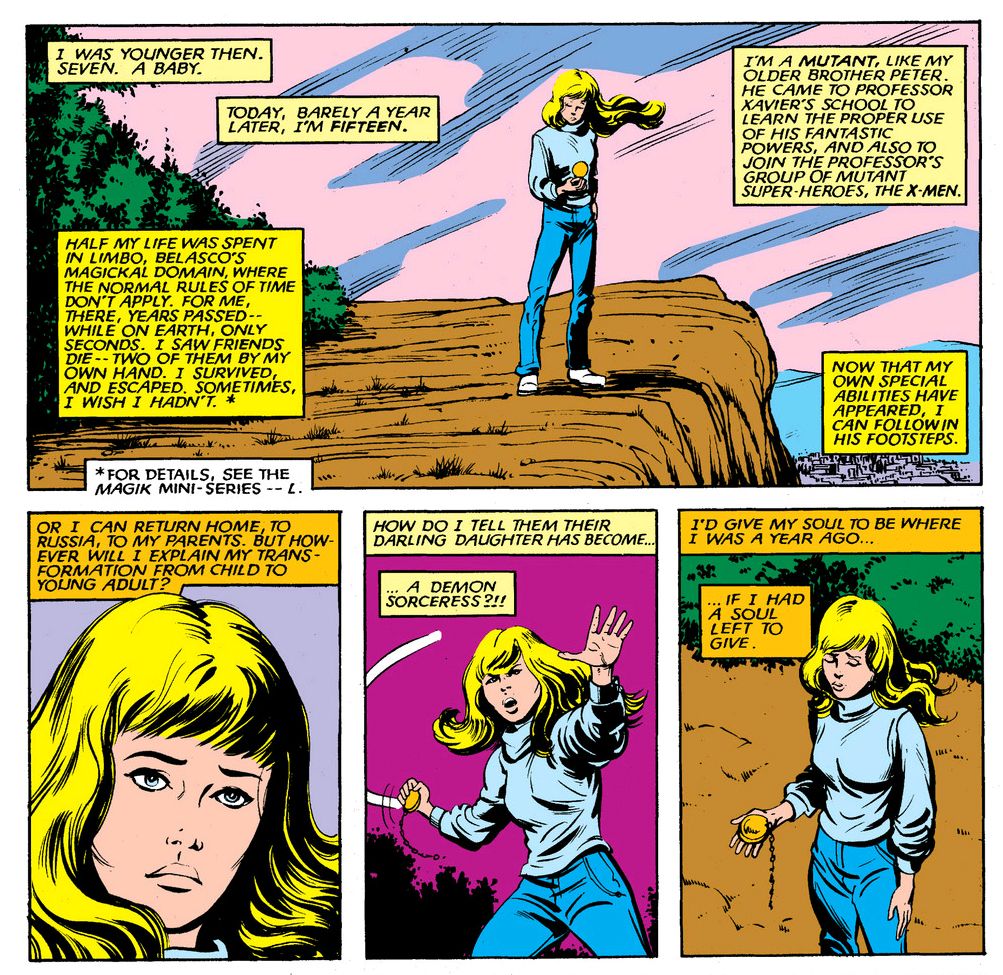
Illyana "Magik" Rasputin had been around for a few years as a minor X-Men character, little sister to metal man Colossus.  In fact, she made her first, albeit nameless, appearance in Giant-Size X-Men #1 (April 1975), the legendary issue that showed the world international stereotypes could be forged into a top-selling comic book fighting force.  The first time we see Illyana, she's practically an infant, and Soviet agricultural technology being what it was at the height of the Cold War, her big bro has to use his mutant powers to save her from a runaway tractor on their collective farm.  This could not have happened at a privately-owned farm here in the Free World.  Our tractors are the flawless product of a capitalist system, where the invisible hand of the free market has already weighed and rejected any farm machinery that doesn't work exactly as advertised.  Illyana survives her brush with the ineptly-manufactured product of a flawed, atheistic political system only to grow up into a young woman best described as...

Semi-evil.

Chris Claremont, script/Sal Buscema, Tom Mandrake, art (The New Mutants #14,  April 1984)

Claremont's crafty plan to undermine Dani and wrest control of his comic from her originates in Uncanny X-Men #160 (August 1982), where Claremont and art team Brent Anderson and Bob Wiacek have a demon named Belasco spirit the child away to a timeless limbo called, conveniently if unimaginatively, Limbo.  At the end of the issue, Illyana pops back in, only now she's thirteen years old and she's not only a mutant, but also a demonic sorcerous with a magical sword that manifests itself from time to time.  Flash-forward two years and, with Dani putting pressure on editor Louise Jones to have her book re-named Moonstar and the Other Mutants, Claremont knew it was time to take decisive action.  He tossed Illyana, now code-named Magik, into The New Mutants and instantly changed the book's power structure.

While no scheme or villain the increasingly desperate creative team could devise would force Dani completely into the background, she would now have to learn to share the spotlight with Magik, who appears to have been especially beloved by Claremont, possibly because she embodied a number of his characteristic tropes of this era-- a young girl with vaguely BDSM leanings, a penchant for transformations and inner turmoil lending itself to verbose internal monologues.  Plus frequent opportunities to indulge himself in baroque adjectives like "eldritch" and the creation of portmanteau words like "Darkchild" and "Soulsword."

Chris Claremont, script/Sal Buscema, Tom Mandrake, art (The New Mutants #14,  April 1984)

Not one to underestimate Dani, Claremont and Jones knew they had to do more than simply foist Magik off on the New Mutants.  They had to further enhance Magik's position as prime Dani-challenger.  Rather than dole out Illyana's Limbo experience through the occasional flashback or multi-panel thought bubble reverie, Claremont teamed with artists John Buscema, Ron Frenz, Sal Buscema and Tom Palmer to produce Storm and Illyana: Magik, a four-issue mini-series, from December 1983 to March 1984.  Wow, Marvel was really pushing Magik on their readers, weren't they?  What Dani did organically by inhabiting the book with her own innate awesomeness, Magik would do through corporate strategy.  Top that, Dani!

In fact, under the aegis of Claremont and with the approval of Marvel's upper echelon-- specifically, editor-in-chief Jim Shooter, who feared Dani might supplant the Amazing Spider-Man as the company's flagship character and force them to produce a whole slew of new promotional materials as well as wreck their deal with toy manufacturer Mattel (the company licensing Marvel's heroes for a line of action figures and play-sets based on Shooter's Marvel Super Heroes Secret Wars title, due to hit the shelves in May of that year)-- Magik gets to do something Dani never could: she actually narrates her very first The New Mutants issue, #14 (April 1984), in a story called "Do You Believe in Magik?" (Marvel certainly did!) which is all about how her twisted minions journey to Xavier's school to steal her back. Claremont and Sal Buscema even gift Magik with those solo pages once accorded to Dani.  Oh, you know Dani felt the sting.

So, how did Dani handle this upstart?  Actually, the career-savvy Dani was smart enough to cozy up to Magik almost from the start, quickly becoming her partner in crime.  Mild crimes, like planning a party for Professor X and trying to figure out how to surprise a guy who can read your merest thoughts.  And adding Magik to the group proved to be a move of pure Claremontian genius, because it was at this point The New Mutants began to develop its own voice, becoming darker and more mysterious.

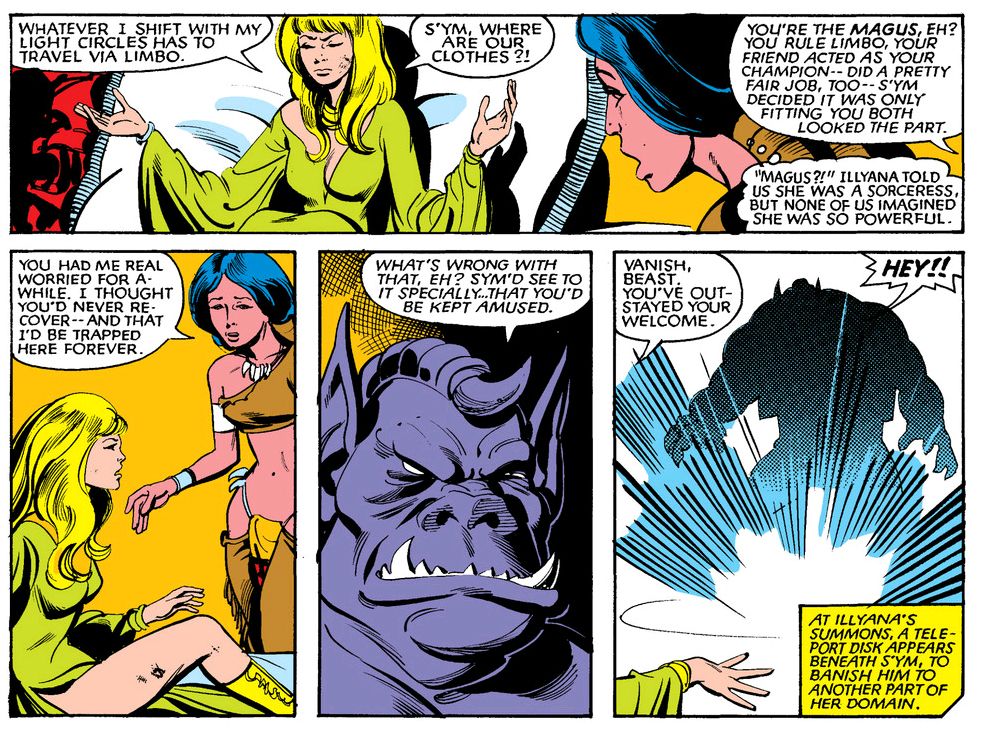
Much as the artistic tension between Paul McCartney and John Lennon fueled some of the Beatles' finest albums, the strange dichotomy between the straight-forward Dani and the shadow-motivated Magik recharged Claremont's creative batteries.  The first pairing between these visual and philosophical opposites comes during the Mutants' multi-part battle with Emma Frost's Hellion team (caused by that snobby Kitty Pryde) in The New Mutants #15-17 (May-July 1984).  While this kind of story-- where the stakes are nothing more than deciding which fake philosophy will triumph while people wearing different-colored clothes clash meaninglessly-- never impressed me, it does provide us with a glimpse of better things to come when Magik takes Dani to her personal hell-dimension and introduces her to leather vest and ass-less chaps.

Chris Claremont, script/Sal Buscema, Tom Mandrake, art (The New Mutants #16,  June 1984)

Oh, and S'ym, one of those Claremont touches where he pays homage to whatever comic book he happened to be a fan of at the time because the world of comics in the Eighties was just one big, happy family of like-minded creatives making fabulous art.  So you'd see a poster featuring certain properties hanging in Kitty Pryde's room, or one of Dani's friends would gushingly mention a sci-fi/fantasy writer you just know Claremont had dinner with on a regular basis or at least hung out with after hours at some comic convention or another and you'd go, "Wow!  Even though I'm a dork, I'm validated because a fictional teen who has amazing adventures across space and time also likes the same weird things I love that everyone in my real life thinks are a waste of time!"

I mock, but I really have to thank Claremont sincerely for that because it did keep me going during those lonely, masturbatory years.

What point was I making?  Oh yeah.  S'ym.  S'ym is Magik's demon assistant, but his name is curiously similar to a particular Canadian independent comic book creator's and he just happens to somewhat resemble that creator's famous aardvarkian-barbarian creation right down to his vest.  His lurid interest in "amusing" Dani is probably reminiscent as well, but it's been years since I last read anything about earth pigs.

Chris Claremont, script/Sal Buscema, Kim DeMulder, art (The New Mutants #17,  July 1984)

Well, whatever his inspirations, the now fully-engaged Claremont has both girls work together to save the team this time (from a nasty future in which they've become Hellions) for almost two full issues.  And throughout, Dani refrained from plunging her knife into Magik's semi-evil heart and Magik didn't transform Dani into a toadstool and sit on her.  Progress of a sort, I guess.

Chris Claremont, script/Sal Buscema, Kim DeMulder, art (The New Mutants #17,  July 1984)

 Speaking of progress, the success of the Magik-gambit led Claremont to inaugurate phase two of his plan.  This involved the arrival of Bill Sienkiewicz on art duties, and would see The New Mutants become more consistently interesting and genre-expanding than the book it spun-off from.  Which in turn benefitted Dani, because without Magik giving Claremont the impetus to start experimenting and moving away from stale Uncanny X-Men cast-off plots and toy line team-ups, Dani might not have achieved her greatest victory, over a plot element introduced way back in the very first issue and all but forgotten since.

Which would very nearly prove Dani's untimely death, leaving Magik the undisputed lead character.

Chris Claremont, script/Sal Buscema, Kim DeMulder, art (The New Mutants #17,  July 1984)