Showing posts with label Bob McLeod. Show all posts

Monday, December 23, 2013

New Mutants Winter Holiday Extravaganza starring Dani Moonstar!

If there's anything the New Mutants love more than ostracizing Kitty Pryde or cuddling up together on the sofa with some popcorn to watch Magnum, P.I., it's enjoying seasonal hijinks in the snow.  Let's take a moment to share a few holiday memories with Dani, Sam, Roberto, Rahne, Xi'an and all the rest.

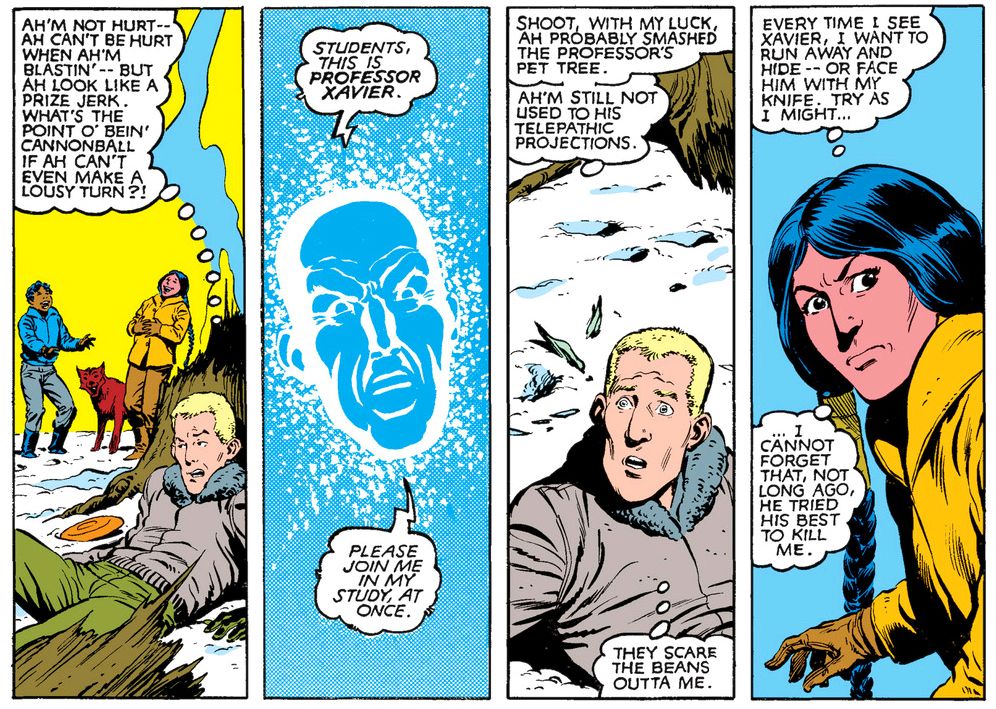
The snow love starts as early as New Mutants #4:
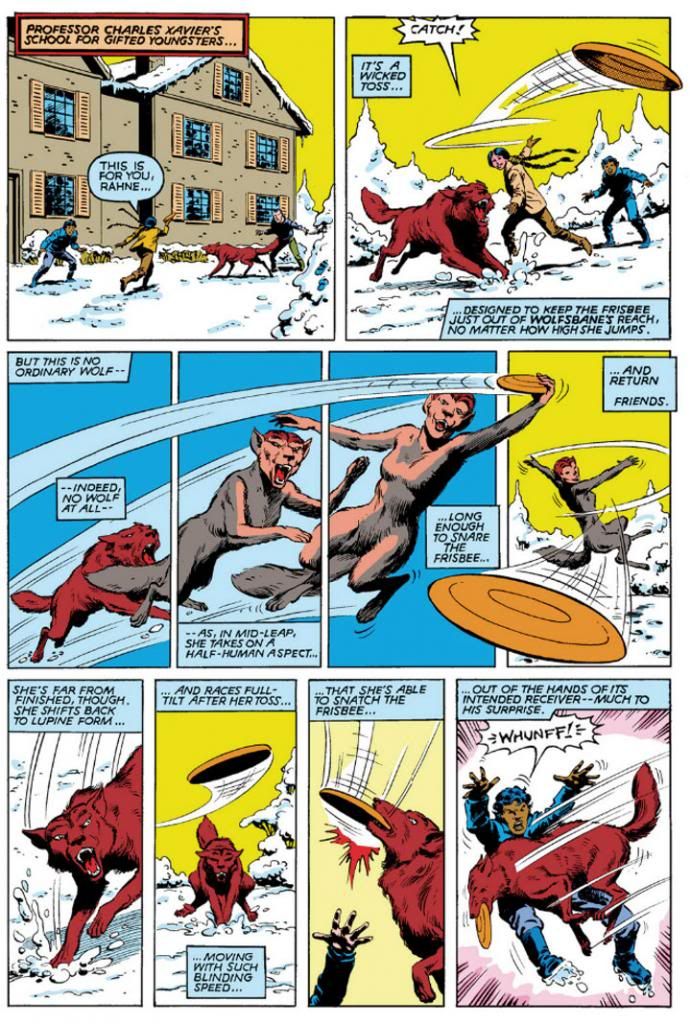
New Mutants #4 (June 1983); words: Chris Claremont; art: Sal Buscema and Bob McLeod

These sequences are useful for showcasing each kid's powers or personality, and for comedic relief.  Outdoor frolicking later helps the team quickly recover from the apparent death of leader Xi'an Coy Manh and welcome new additions Amara Juliana Olivians Aquilla and Illyana Rasputin to the team roster.  Amara shows her holiday spirit by helping plan a surprise party for a moping Professor Xavier.  Did you realize the Xavier School for Gifted Youngsters allows its students to get out of class early during inclement winter weather, even though they both live and study inside the school itself?  I didn't, either.  Here's proof, though:
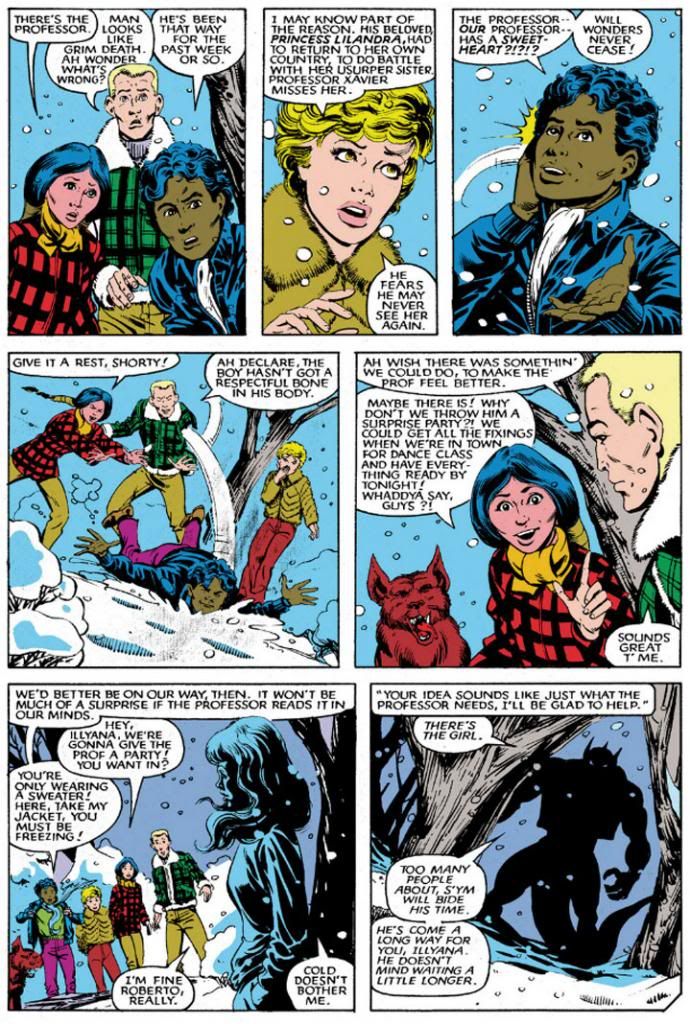
New Mutants #14 (April 1984); words: Claremont; art: Buscema and Tom Mandrake

We all know how Dani shuns clothing in favor of what Xi'an jokingly calls l'aventures naturelles.  Leave it to the coolest mutant around to don a winter ensemble consisting of assless chaps and a loincloth even as the mercury dips below zero...
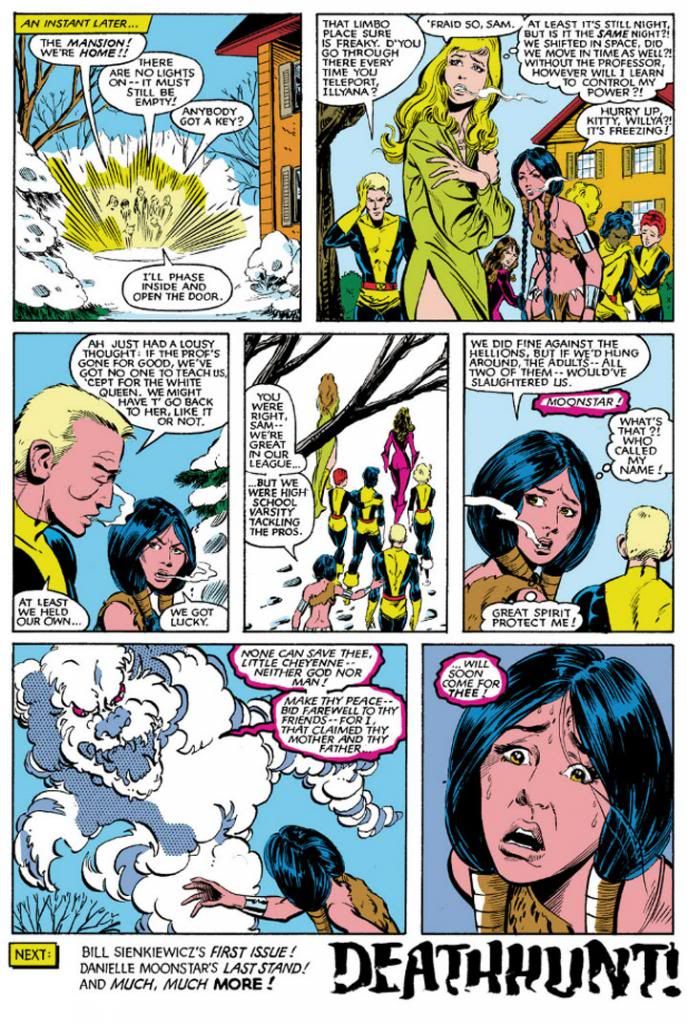
New Mutants #17 (July 1984); words: Claremont; art: Buscema and Mandrake

As someone who grew up in the Colorado mountains, Dani has probably developed a greater tolerance for low temperatures, but this is a bit much even for her.  After a quick hallucination as frostbite sets in, it's time to repair to the mansion to warm up with some hot cocoa and possibly a long inner monologue about recent events. 

This next example isn't so much fun and festive as it is moody and menacing.  For Dani, snow isn't just about having fun and walking around half (or wholly) naked.  It's also about undertaking spirit quests.  Here's a dark and troubling page by Bill Sienkiewicz from New Mutants #18, where Dani goes solo against the demon bear that consumed her parents.
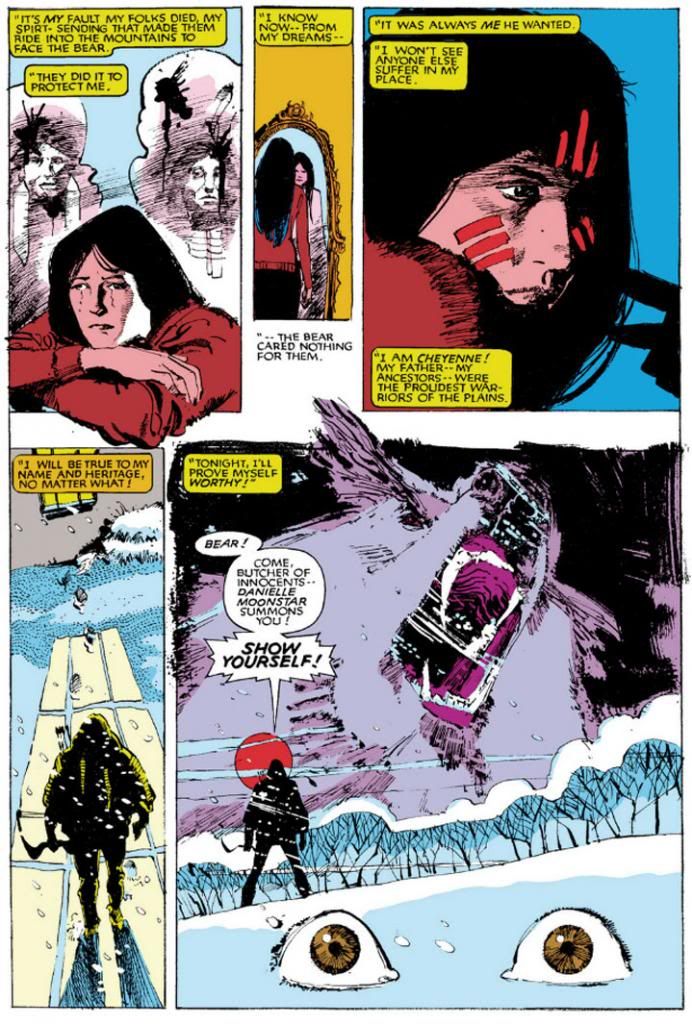
New Mutants #18 (August 1984); words: Claremont; art: Bill Sienkiewicz

With Chris Claremont's genius for involving characterization, New Mutants rarely goes wrong when the story focuses on Dani, the best of all its characters.  But what's this?  Looks like Dani's not the only New Mutant trying for a membership in the Polar Bear Club.  Check out Sam Guthrie and Illyana in this slapstick sequence set at a local airport.
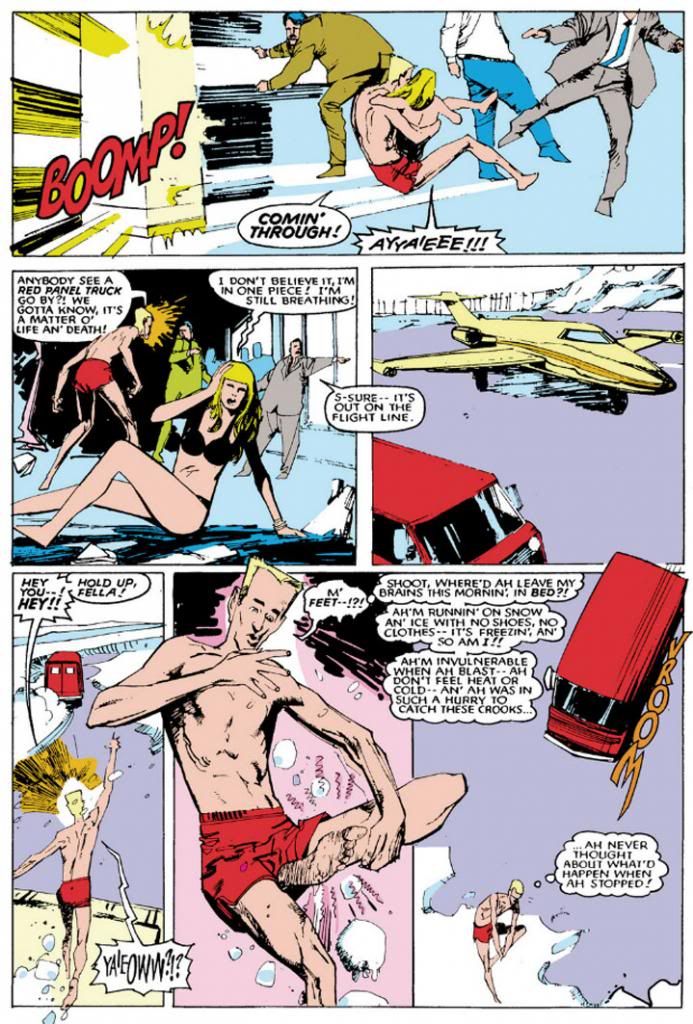
New Mutants #29 (July 1985); words: Claremont; art Sienkiewicz

Okay, so they're not just flying around in swimsuits because they enjoy it.  They do.  But more importantly, they're chasing after kidnappers who have just spirited away Roberto and Amara.  This happens while Dani and the others are fighting for their lives in a wartorn dreamscape inside a kid's mind.  No snow there, though, which is why I left it out.

I'd hoped to find an issue with the team decorating a Christmas tree, lighting Chanukah or Kwanzaa candles, with Rahne doing her best Tiny Tim impression and Amara sharing a few Saturnalia traditions, but the only overt reference to a winter holiday comes in New Mutants #38, where the kids attend a party at Salem Center High School.  Dani, despite wearing a sweet party-appropriate black and yellow striped winter coat, decides to hang out in the Xavier school stables with Brightwind, her winged horse from Asgard.  Instead of the ghosts of Jacob Marley and Christmases Past, Present and Future, she gets a visit from what I believe is Thor in the guise of a frog.
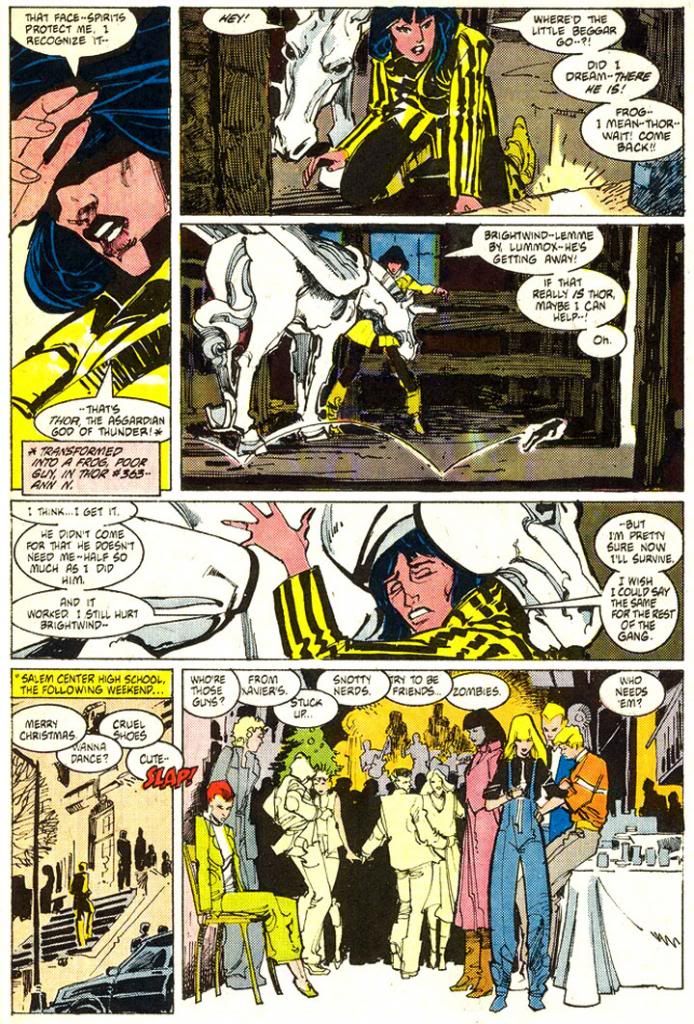
New Mutants #38 (April 1986); words: Claremont; art Rick Leonardi and Sienkiewicz

While Dani proves largely impervious to cold due to her upbringing and frequent nudity, her young pal Rahne Sinclair has the natural advantage of being able to transform into a wolf.  Each time she and Catseye (a member of the Hellfire Club's off-brand version of our heroes they call the Hellions), meet, they shapeshift into their "furforms" and go do lord knows what together.
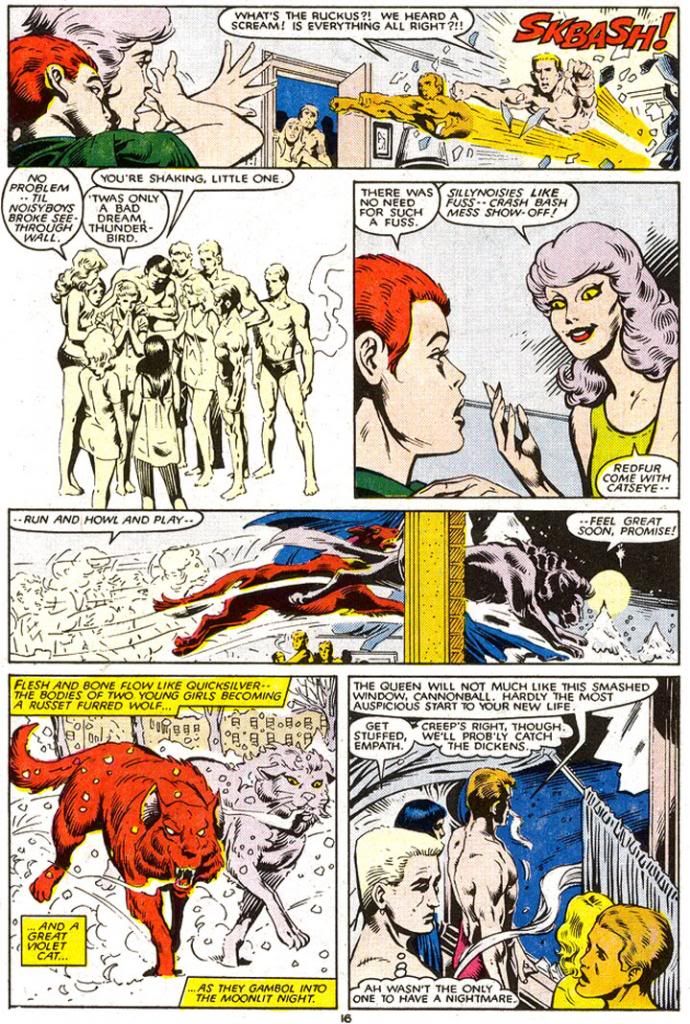
New Mutants #39 (May 1986); words: Claremont; art: Keith Pollard and Del Barras

Around this time, new school headmaster Magneto decides it's better for his charges to become Hellions themselves, which leads to an extended run of issues where practically everyone wears magenta costumes.  And also to conflict with some of the Avengers.  Which, appropriately enough for today's theme, takes place in a scenic snow-frosted wilderness.
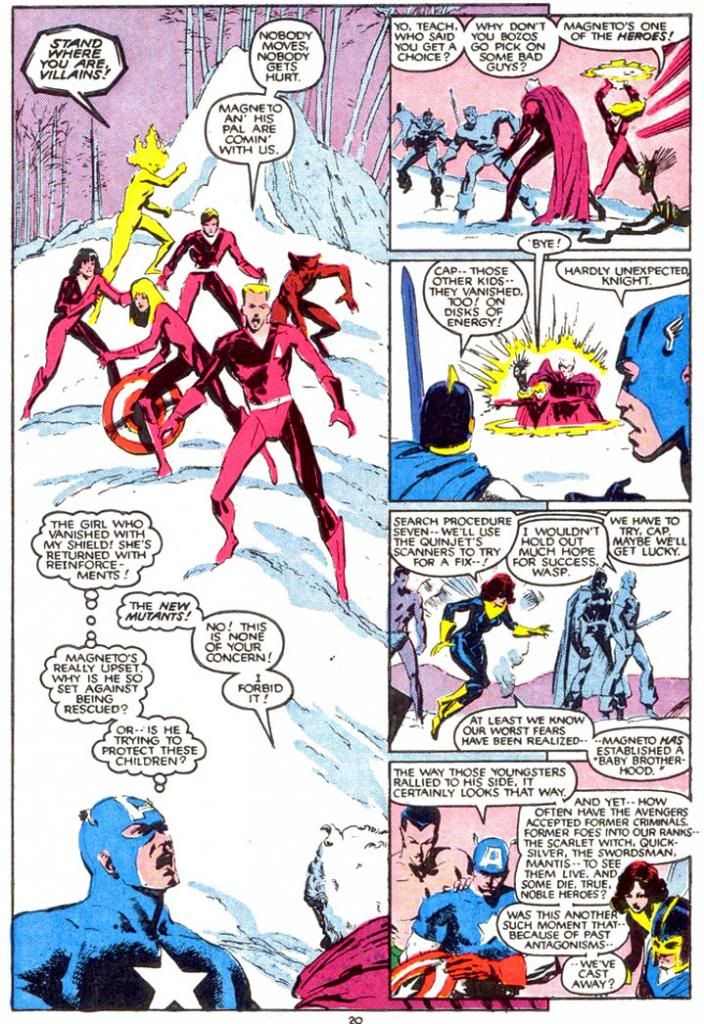
New Mutants #40 (June 1986); words: Claremont; art: Jackson Guice and Kyle Baker

But what of the most important of all the kids, Dani Moonstar?  Not wanting any part of this magenta nightmare, she bugs out for her hometown in Colorado where she spends a lot of time...  you guessed it... in a stable with Brightwind.
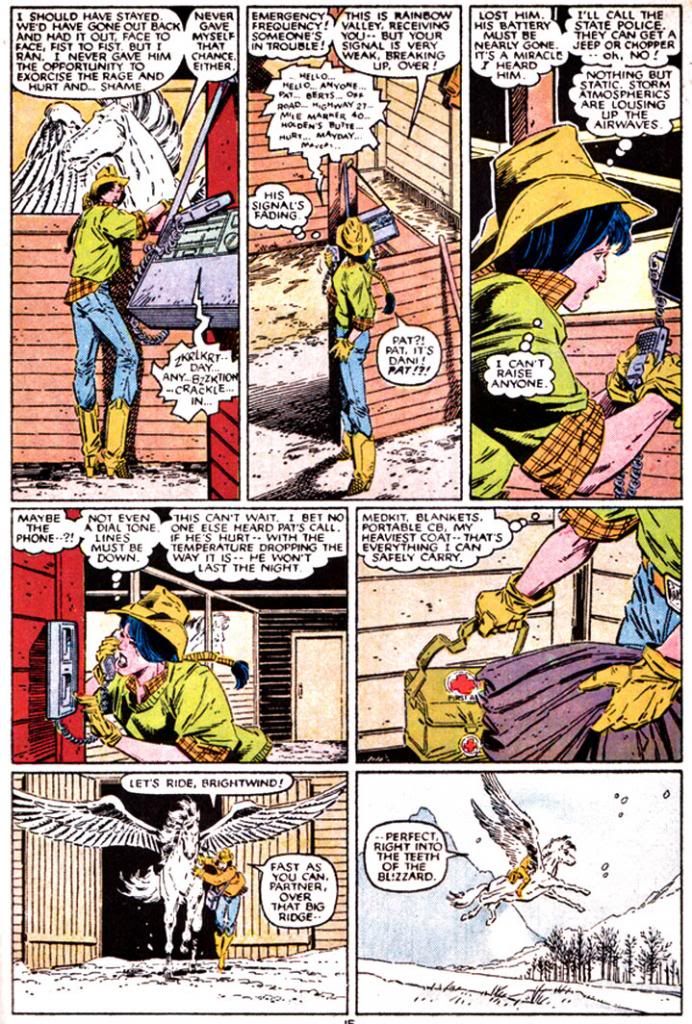
New Mutants #41 (July 1986); words: Claremont; art: Guice and Terry Austin

I've never been, but I imagine with the Rocky Mountains being right there and all Colorado must have some beautiful winters.  During this particular story, a would-be boyfriend from Dani's past turns up and she has to engage in a fast draw duel with the personification of Death itself to save the guy's life (even though he's a complete creep).  It's your typical "guy likes girl, girl wants to be just friends, guy gets drunk and crashes his truck then goes into insulin shock, girl gunfights Death to save guy's life" story.

As if the Hellions costumes weren't bad enough, the team received their "graduation" uniforms soon after.  Poor Sam gets stuck in a purple and white jumpsuit with some kind of rejected prototype helmet left over from the Robocop pre-production phase and kneepads and Dani, much to her horror, has to wear a top that seems to have been woven from an old carpet Professor X had stored in the mansion's attic.
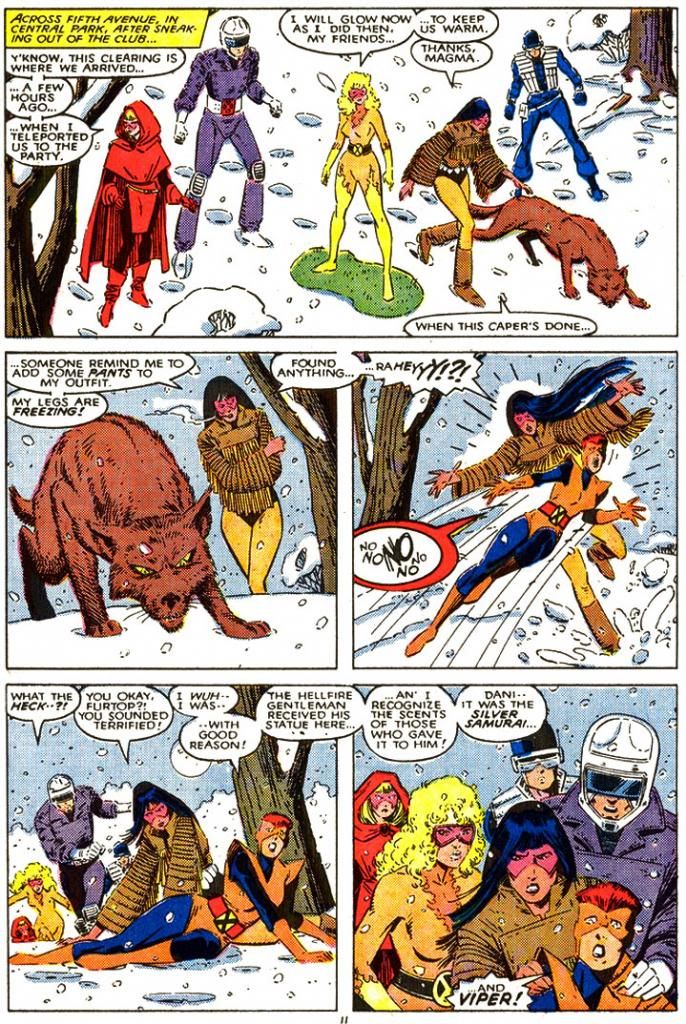
New Mutants #54 (August 1987); words: Claremont; art: Buscema and Austin

Amara looks like she just came from the Jem and the Holograms concert, or else she's splitting the visual difference between Spider-Man's animated friend Firestar and one of Santa's elves.  But with Rahne providing the perfect fifty-issue bookend by once again knocking over one of her teammates in the snow we've reached an appropriate stopping point.

Happy Holidays and a joyous 2014 to our reader!

Thursday, November 21, 2013

Dani Moonstar versus Sarah Rainmaker (or How I learned to stop worrying and love Gen13)

Epitomizing 90s fluff, Gen13 was a kind of MTV Real World look at superheroics on one hand, an excuse for near-nudity and fart jokes on the other, and just some guys good-naturedly riffing on their favorite New Mutants and Uncanny X-Men storylines, plus throwing in a Trent Reznor clone as a villain for good measure on the third.  Or one of your feet, if you're not an alien or mutant creature.  Outrageously derivative, cluttered with pointless storylines that go nowhere, at times little more than a vehicle for J. Scott Campbell's "good girl" art-- and also so light and breezy entertainment I couldn't get enough of, so much so I even wrote a fan letter.  That's something I had done only once years before, to the fine folks responsible for making Sgt. Rock

And a lot of other readers felt the same way, at least for a while, because Gen13 inspired Gen13 Bootleg, a spin-off series with stories and art by the likes of Alan Davis, James Robinson, Walt and Louise Simonson, Adam Warren and even a two-issue miniseries by Adam Hughes which I think of as a largely forgotten near classic.  No less than Warren Ellis himself took a hand at writing the team's adventures in one regular series annual and one for Bootleg.  Image/Wildstorm also published DV8 and a number of mini-series.  Then the fun stopped.  Writer Brandon Choi and Campbell decamped and new creative teams came aboard.  They tried to use the comic's powers for good, but its zeitgeist had passed and subsequent attempts at revival in the years since have failed.

But back in those days, most Gen13 readers wanted to read about super-strong, super-smart, super-bodied team leader Caitlin Fairchild and the various ways she would lose her clothes, the "youngest and spunkiest member of the team" Roxy Spaulding and gross-out comedic relief -- with a code name dated even then-- Percival Edmund "Grunge" Chang.  There was also Bobby "Burnout" Lane, who had kind of an emo personality and a soul patch but otherwise made little impression on anybody.

But I, being forever contrary, preferred little-regarded Sarah Rainmaker, who was slightly more popular than Burnout only because, well, the main purpose of Gen13 wasn't beefcake.  I liked her because the creative team didn't seem to, and because she was more than a little similar to my beloved early-teens hero Dani Moonstar.  I mean, besides both being Native Americans. 

Poor Sarah Rainmaker.  The original writers used her mostly as a straw-figure to mock feminism, campus activists and also to do a bit of that MTV-style "amorphous sexuality tease aimed at hetero boys" stuff that later made such a star of Kate Perry.  But written sympathetically by Hughes in Gen13: Ordinary Heroes a more interesting, deeper character comes through and makes me wish they'd tweaked Rainmaker in the monthly to something a bit less... well... insulting.  Sometimes they did.  Often they didn't.  Anyway, maybe what I really I liked all along was this alternate Hughes-inspired version of Sarah Rainmaker I had in my mind.  One more righteous and less of a strident punching bag with a lot of "Take that, Political Correctness!" dudebro-humor wear and tear. 

Still, if you're going to do your own version of The New Mutants, of course you're going to do your own version of that book's most vital character and obvious star.  You know who I'm talking about from the title of this post, so with no further ado, here are some Dani Moonstar moments echoed by Sarah Rainmaker.

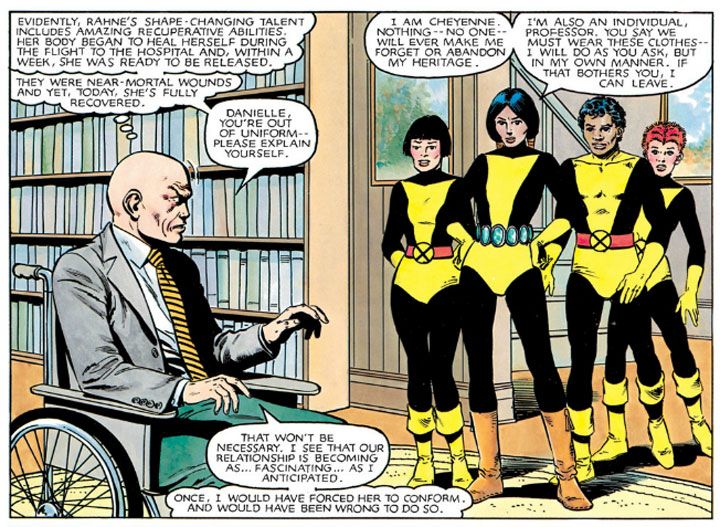
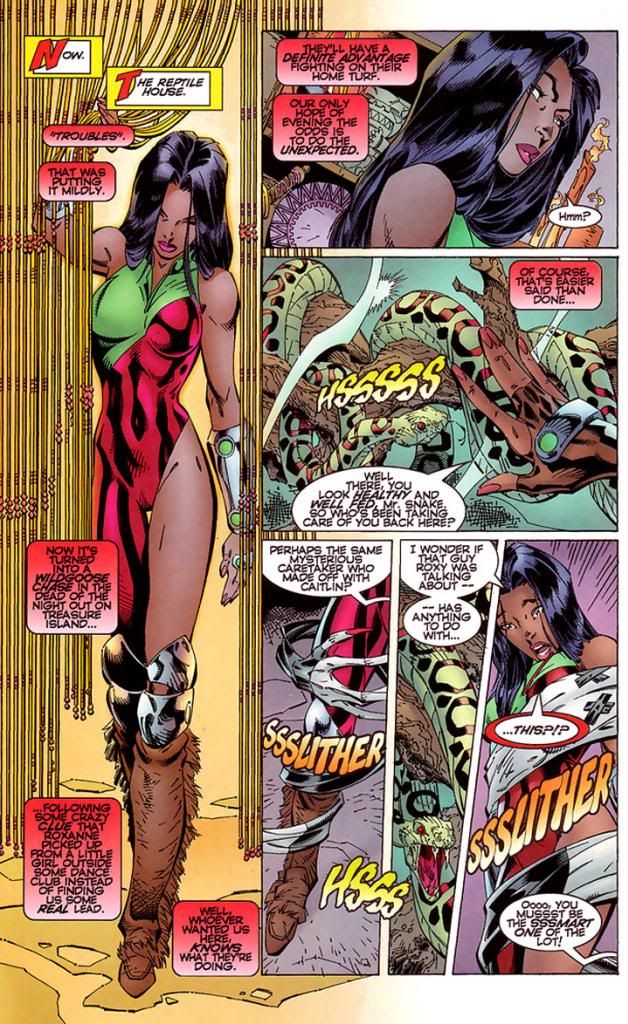
1.  Fabulous footwear.  In Marvel Graphic Novel #4 New Mutants (September 1982), Dani makes damn sure Professor X recognizes not just her individuality but her cultural heritage by accessorizing her one-size fits all uniform to something more unique.  The Gen13 kids received their own super suits right from the start, but obviously Rainmaker was paying attention when Dani set a precedent.  Because I'm about as Native American as Vladimir Putin, I have no idea how appropriate Rainmaker's boots are-- Dani is Cheyenne, Sarah is Apache and those are two distinct cultures-- but I do know when things look similar because I watched Sesame Street growing up.

Dani:

Marvel Graphic Novel #4: Script by Chris Claremont, art by Bob McLeod

Sarah:

Gen13 #8: Script by Brandon Choi, Jim Lee and J. Scott Campbell, art by Campbell and Alex Garner... or Richard Friend!

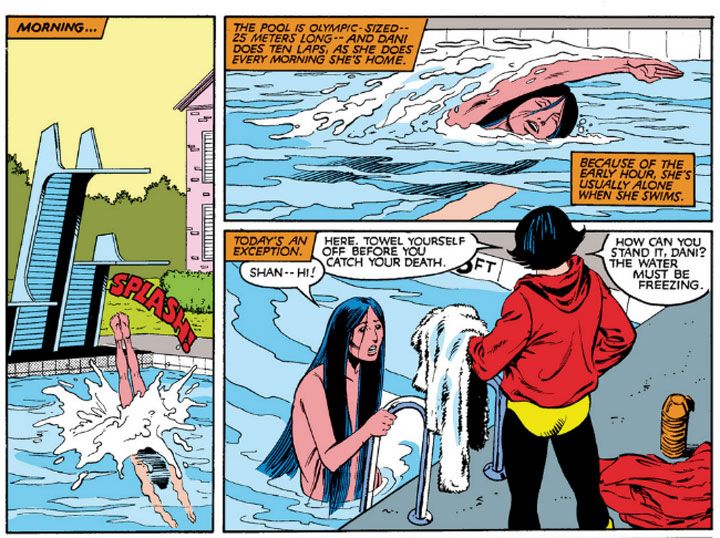
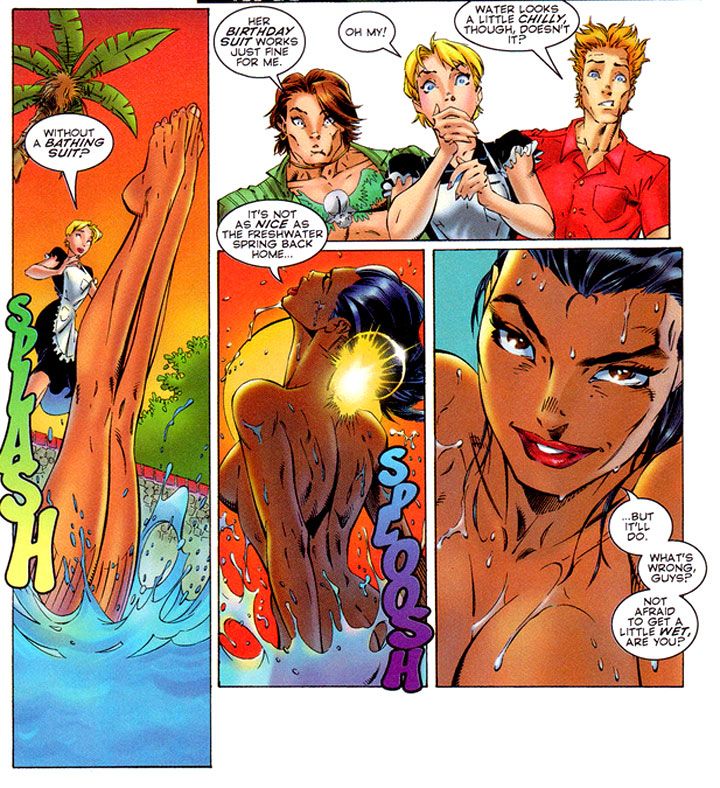
2. Swimming nude.  Dani makes a point to swim au natural in New Mutants #3 (May 1983) and Rainmaker follows (birthday) suit in Gen13 #1 (March 1995).  Chris Claremont treats this moment seriously and tastefully and it leads to a revealing (personality, not body) moment between Dani and her friend Xi'an Coy Manh where they bond and we get to know both of them better.  When Rainmaker takes a dip, Choi and Campbell play it as a striptease and while we do get to know a little more about the cast from this (Sarah likes to show off, the guys are pantingly hetero-sexist), the characterizations are roughly at the level of a beer commercial.

Dani:

New Mutants #3: Script by Claremont, art by McLeod and Mike Gustovich

Sarah:

Gen13 #1: Script by Choi and Campbell, art by Campell and Alex Garner... or Sandra Hope!

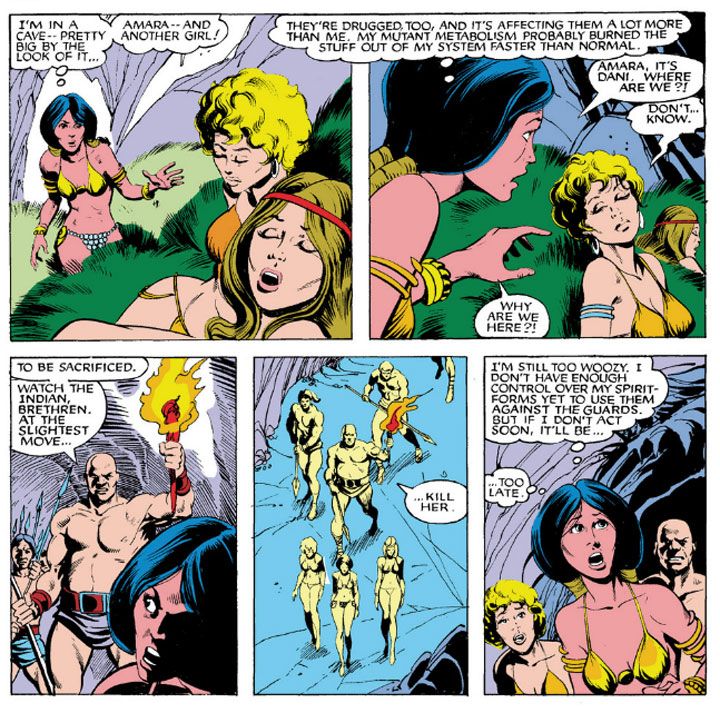
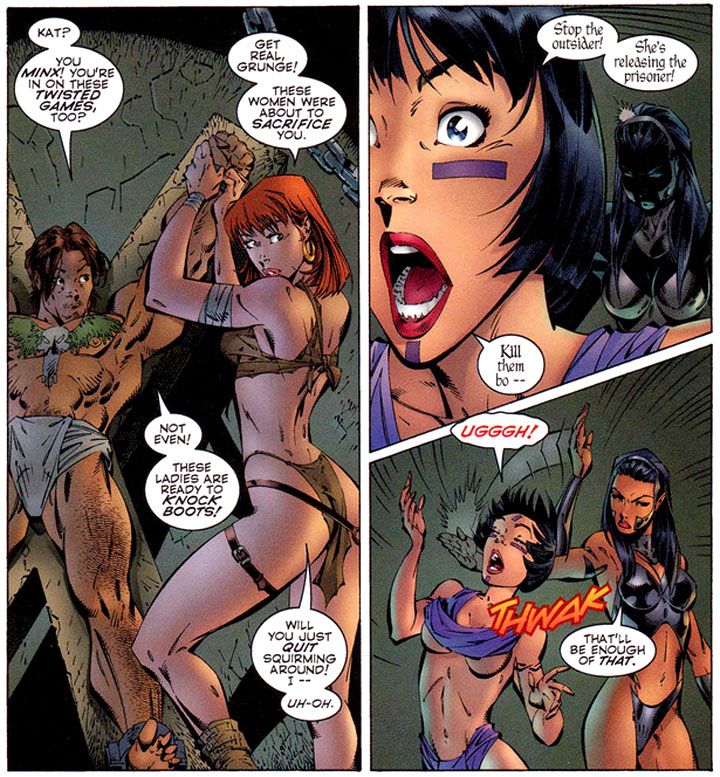
3.  Jungle adventures with anachronistic cultures that result first in wearing rags and then even more revealing outfits.  In New Mutants #8 (October 1983), the kids travel to the Amazon rainforest, have a lot of misadventures in which Dani first has to wear a swimsuit and then torn clothing.  When she and the rest of her team end up in Nova Roma, a hold out from the days of Imperial Rome, they adopt cultural-appropriate clothing.  Then a sorceress shows up and tries to sacrifice Dani, which requires her to wear a chain-mail bikini outfit stolen from a Red Sonja comic and then a low-cut evil sorceress gown.  When the Gen13 gang takes a similar journey to Africa in issues 3 through 5 of their comic (July-October 1995), they come across an all-female society of supermodel Amazonians who favor skimpy metal swimwear of their own.  Rainmaker quickly goes from ragged prisoner to shiningly metallic masturbatory fantasy warrior before you can say "Psyche-Mirage-Moonstar-Spellbinder-Dark Rider."

Dani:

New Mutants #10: Script by Claremont, art by Sal Buscema and Tom Mandrake

Sarah:

Gen13 #5: Script by Choi, Lee and Campbell, art by Campbell and Garner, Friend and Scott Williams 

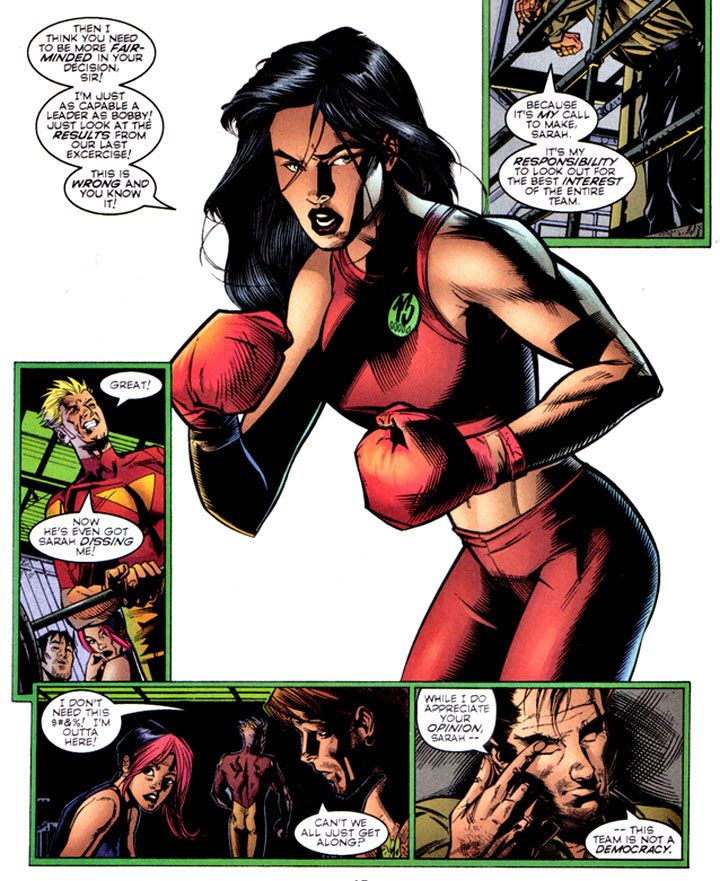
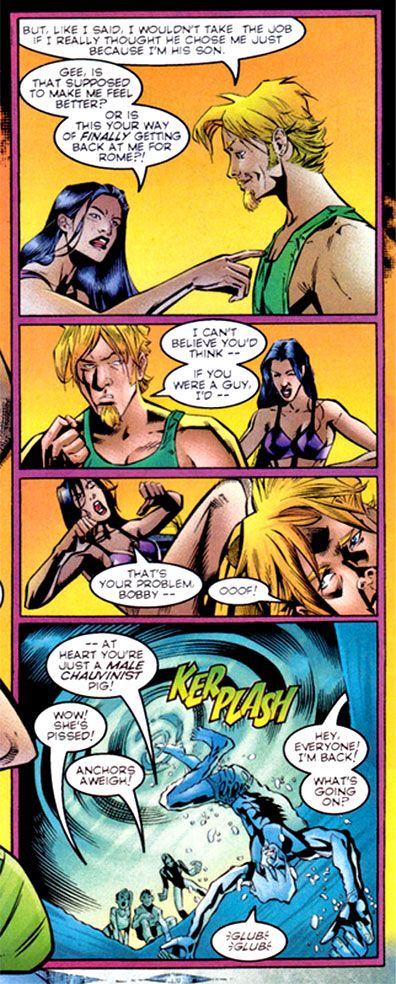
4.  That leadership thing.  Despite being a year or two younger than Sam Guthrie, the more capable Dani quickly takes over the top spot in the New Mutants team after first leader Xi'an Coy Manh goes missing.  In fact, she's already pushing Xi'an out of the top slot as early as New Mutants #4 (June 1983), with her friend standing right beside her!  When leader Caitlin Fairchild temporarily quits, Rainmaker makes an attempt to do the same in Gen13 #12 (August 1996), only to have mentor John Lynch (supposedly this ultra-tough black ops veteran) appoint his own dopey son over the smarter, more mature and combat-skilled Rainmaker in what's obviously a decision based solely on nepotism.  Burnout has shown absolutely zero leadership skills to that point, and kind of a mopey, shrinking-violet personality, while Rainmaker's intelligence is second only to Caitlin's, plus she's much wiser and more self-assured in many ways.  No wonder she reacts unfavorably to Lynch's completely illogical move (although in Lynch's defense, he may be pitting the two against each other in a "survival of the fittest" competition-- although that could also wreck team morale and field effectiveness in the long run as well, so maybe he is an idiot after all).  This also positions Sarah as the Dani-style team rebel.  In the same vein, both characters seem to have an innate talent for combat tactics, as well, with the New Mutants becoming more of a fighting force to be reckoned with under Dani's command, and with Sarah frequently barking out orders of her own during the many confrontations in Gen13.
Dani:

New Mutants #4: Script by Claremont, art by Bucema and McLeod

Sarah:

Gen13 #12: Script by Choi, Lee and Campbell, art by Michael Lopez and Troy Hubbs (I think) 

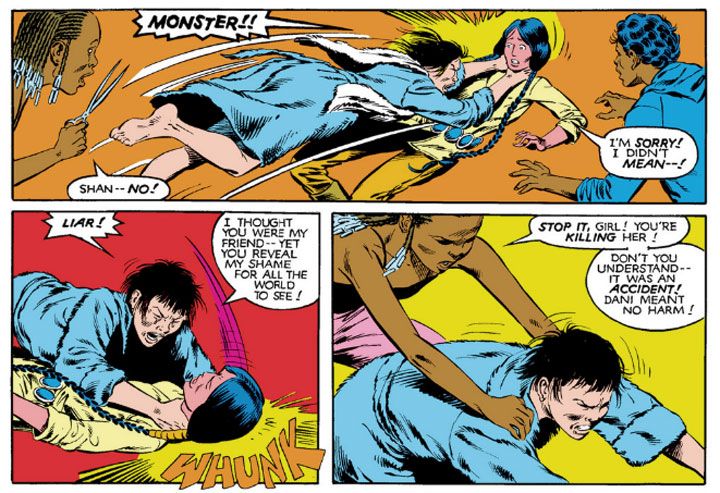
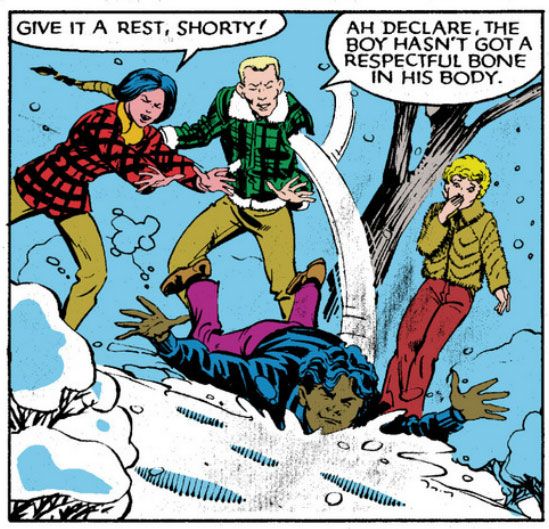
5.  Tussles with teammates.  I seem to remember Dani doing this a lot more, but I must be more than a little mixed up and fully conflating her with Sarah at this point.  I'm surprised Dani didn't beat up those two idiots Sam and Bobby two or three times a day with that temper of hers.  Instead, she seemed to take out her aggressions more on inanimate objects.  And despite frequently referencing the martial heritage of her Cheyenne people, she wasn't all that adept at fighting.  Oddly enough, in New Mutants #1 (March 1983), it was Xi'an who first went fisto-a-fisto with Dani-- well, actually, she choked the hell out of Dani and slammer her head against the floor with good reason: Dani had accidentally used her powers to pull images of her Xi'an's violent, tragic past out for all to see.  While the New Mutants had their share of inter-team arguments, it would be more than a year later, in New Mutants #14 (April 1984), before we'd see another instance of Dani-on-friend violence, this time a playful shove into the snow for Roberto DaCosta.  Sarah, on the other hand, goes full on kung fu queen on Bobby Lane after he made a poorly-timed snide remark at her expense during their leadership crisis. It happens in Gen13 #12.

Dani:

New Mutants #1: Script by Claremont, art by McLeod and Gustovich
New Mutants #14: Script by Claremont, art by Buscema and Mandrake

Sarah:

Gen13 #12: Script by Choi, Lee and Campbell, art by Lopez and Hubbs (I still think)

Okay, now I'm obviously reaching.  But I believe I've made my point-- there are certainly parallels, enough so Sarah Rainmaker became my favorite Gen13er.  What's been fun for me looking for these little moments is contrasting the writing on both series.  While Claremont's dialogue is sometimes stilted and a bit advanced for his characters' ages, his stories and characterizations are nothing if not sincere.  He genuinely cares about his cast and immersing the readers in their world.  Plus he displays the literary chops of a true writer's writer, someone in love with language.  If any of his work here is derivative, it's of real life or novels.  And occasionally movies.

By comparison, the Gen13 characters-- scripted by no less than two writers at a time!-- usually speak casually and naturally (unless there's need for some hard expository dialogue, that is). Actually, their dialogue is almost exclusively made up of then-current catchphrases and youth lingo.  While as individuals they're amusing enough, they're more tongue-in-cheek, broadly-sketched types owing most of their personalities to television shows and other comics (and not just New Mutants).

There are some interesting comic book characters in Gen13, but it would take other writers to flesh them out into real characters, especially under Warren who managed to make the book as smart as it was funny and sexy.  And, oddly enough, that's when the Gen13 finally died.

Tuesday, September 24, 2013

X-Men #94: Nefarious Nefaria and how he blew a fortune

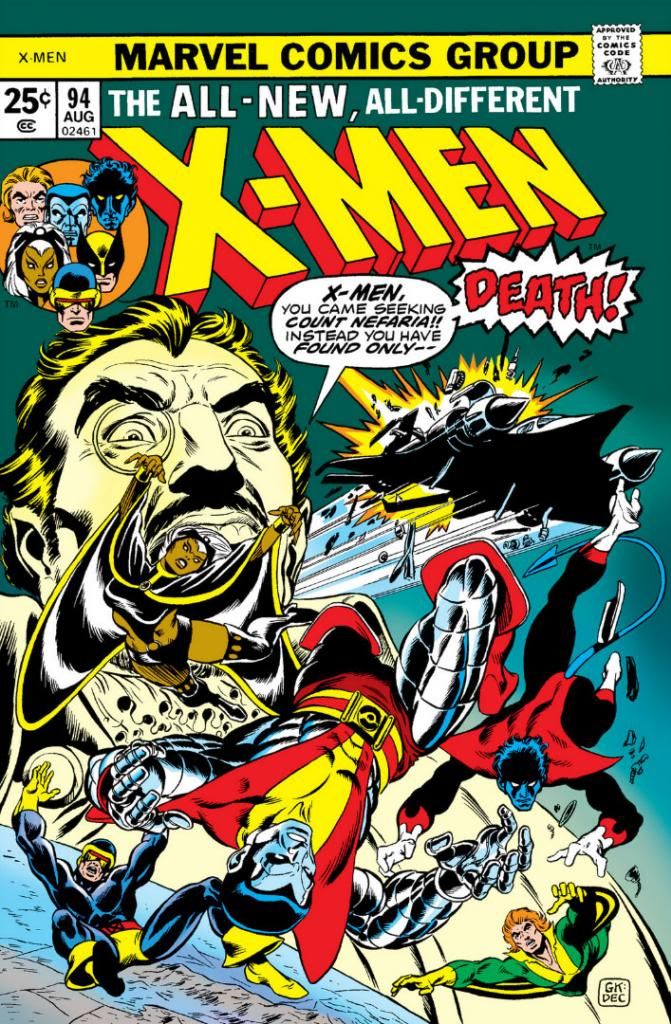
X-Men #94 (August 1975) was the first X-comic I owned.  A friend's mother worked for a regional magazine distributor and he got the leftovers.  This kid had piles of comics in his room, but he kept the X-Men issues in a cabinet in the living room for whatever reason.  Probably anti-mutant bigotry on his part.  After all these years I can't remember why he decided to sell some comics to me that day, nor can I remember why I wanted to buy them.  I liked comics, knew the difference between Jack Kirby and Alex Toth, loved Joe Kubert's art and had already discovered Al Williamson.  I just don't remember being comics crazy, but I was a junior high sequential art connoisseur of sorts because I loved drawing.

So years later, I'm going to claim it was the Gil Kane/Dave Cockrum cover that caught my fancy.  Even now, this cover impresses with its high (literally) drama and contorted heroes hurtling earthward to their deaths.  Well, except for Banshee, who seems to be flying to the rescue.  Poor Storm has completely forgotten she knows how to ride the winds-- and note Wolverine and Thunderbird don't even rate appearances!  Even without those two adding to the excitement, it looks kind of like Count Nefaria (the guy with the giant white head) is barfing mutants.  That characteristic Kane up-the-spout shot of Nefaria's face influenced the heck out of me for the next few years and I drew noses from that angle blacked in so I wouldn't have to work out the difficult low-angled perspective of the various nasal planes.  It seemed an elegantly simple solution to a drawing problem that had me stumped.  And you absolutely cannot beat the energy of Colossus in the foreground, boldly sporting primary colors of red and yellow.  Barfed or falling, that figure practically bursts from the picture plane and lands in your lap.  I probably bought the comics because I wanted to draw this particular cover.  I still do.  Good gravy, I love me some Gil Kane! 
My friend and I worked out a little deal where I paid him all the money I had in my pocket with a promise for more.  I think the original deal was supposed to be twenty bucks for a stack of books that, amazingly (or uncannily, if you will) included the first five or six issues of the "All-New, All-Different" X-Men.  In the end, I forked over a grand total of fourteen dollars and  the use of my left-handed baseball glove in P.E. a couple of weeks later.  By the time my pal and I completed the transaction on that long-ago spring day, I was in completely in goo-goo-ga-ga love with comic books in general and X-Men in particular.
 
Enough biography.  Let's read!

"The Doomsmith Scenario" introduces us to a man who has access to a matter transporter (maybe he invented it; the story never says where it comes from) and has also used some kind of genetic technology to mutate humans into anthropomorphic animal weirdos (which, admittedly, is a process that has fewer immediately-apparent practical applications).  Rather than launch a second Industrial Revolution by transforming the travel, transportation and medical industries and reaping billions, if not trillions, in ongoing profits, all he can think to do with this technology is invade a military base to hold the world hostage for a one-time payoff.  Granted, that involves each nation paying as much as it's capable, but it's still taking a huge risk versus a guarantee of unprecedented wealth if he just patents his tech and sells, sells, sells.


His name is Count Nefaria, and he is one of the most visually boring antagonists I’ve ever seen.  I believe these days he's some kind of immortal energy being, but when this book hit the spinner racks, Nefaria was just a goateed twerp in a suit with a ruffled shirt and evening cloak, a second-rate Bela Lugosi impersonator.  Off-the-rack, ready-to-wear, one-size-fits-all villainy.  His name essentially means Count Bad Guy, just to further illustrate how little effort went into his creation.  We can argue that dumb names are a hallmark of ol' Marvel.  I certainly will... Doctor Doom.  But to look at the magnificent Doom is to understand Nefaria's generic quality.  The Avengers dealt with the Count in #13 (February 1965) of their own book-- the synopsis of which makes the story seem completely interchangeable with just about any found in other Marvel team titles of the era-- and the unfortunate X-Men get stuck with him in the first regular issue of their revamped title. 

Our kid Nefaria and his Ani-Men invade Valhalla Mountain, home of NORAD’s super-sensitive defense center.  Despite looking like refugees from a line of He-Man knock-off toys, the Ani-Morphs or Ani-Men (one of whom is female, by the way) quickly subdue thousands of armed soldiers and military police who don’t simply shoot them on sight. 

The Ani-Men have the advantage of surprise for a few minutes, plus they're fast and strong.  That's more than enough to defeat the first bunch of uniformed slackers.   After that the entire base is on alert, yet the troops commit themselves piecemeal and not one soldier or airman gets off a shot despite being armed to the hilt.  They don't even try to shoot.  They must have been trained to use their rifles as clubs, and badly at that.  After this inexplicably incompetent response by our armed forces, Nefaria gasses everyone else to sleep.  It's just that easy for our tuxedo-wearing criminal genius.  I understand that in 1975, our armed forces were doing some serious soul-searching as the country emerged from the prolonged humiliation of the Vietnam War, but even the Mayaguez incident had a more satisfying military conclusion than this Nefaria deal. 

Of course, if we closed this plot hole we'd have a five page story where the X-Men watch a news report about a strange incident where Nefaria and the Ani-Men died in a hail of gunfire, and the rest of the comic would consist of pre-Thor Journey Into Mystery reprints.  That would never do, so the men and women guarding the United States' most important and secure military installation allow themselves to get their asses handed to them and, with the Avengers conveniently shelved, it’s up to our new X-Men to fly in and try to save the world.

Which they eventually do, but not before Cyclops spends an entire night roaming the halls of the mansion and bellowing his despair to the world, the original X-Men say a tear-filled farewell and a training montage where Thunderbird injures himself and Cyclops plays drill sergeant.  Since Chris Claremont takes a little time in his dialogue and thought-balloons to give both men clear motivations for what they do and how they act (Thunderbird is insecure, Cyclops is seasoned professional who has seen too many deaths and injuries in his time), the conflict between them works better than the seemingly random arguments that plagued Giant Size X-Men #1, where characters sniped at each other on practically every page and with no good reason.  It also pays major dividends in X-Men #95, but that’s a story for another day.

Penciller Dave Cockrum already had experience with group books, having worked on stories featuring the Legion of Superheroes in Superboy over at DC, and he co-created Nightcrawler, Storm and Colossus for this book.  Oh, and he drew the aforementioned Giant Size.  You'd imagine drawing a living island would tax a guy's creative faculties.  Not Cockrum's.  And here?  Wow, the man just absolutely cuts loose.  He must have wrecked his drawing hand filling panels with detailed backgrounds-- his Valhalla features a gargantuan situation room with elevated walkways between digital maps that must be hundreds of feet high to judge by the teensy-tiny antlike figures teeming all over. 

I remember being especially impressed by the training sequence and a collage-like one-page panel centered around Cyclops’s giant shouting head.  I copied that head line-for-line on notebook paper dozens of times over the next few years, always hoping to glean those Cockrum art secrets.  With the fine-lined inking of Bob McLeod giving the figures a bit of roundness and generally introducing a little bit of a Neal Adams-vibe, Cockrum's dynamic art dazzles.  It's pretty.  I mean, X-Men #94 has some of the prettiest art of its era.  I look at it and I feel joy.

Part of that joy comes from the absurdity of it all.  The first half of this book tends towards the talky, which leads to what I think of as a very fun kind of dissonance, like having a company of acrobats in spangled costumes perform Arthur Miller.  At one point, angry Japanese hero Sunfire scolds Professor X starting in the X-Mansion living room, but concludes his rant thousands of feet in the air above it.  All alone.  Well, the Professor is a telepath, so he probably read Sunfire's thoughts or something.  When Dave Cockrum provides the acrobats at least you’re getting a primo Cirque du Soleil version of Death of a Salesman.  Come to think of it, I’d pay good money to see that.

Since these are by far the best and most entertaining parts of the book, I kind of get the idea Chris Claremont would have been content to have his characters actually hang out around the mansion and watch Nefaria die a pathetic death on television while carrying on various conversations about their feelings and why they're sticking with Professor X.  Cyclops may look a little ridiculous expressing his essential dilemma, but at least Claremont gives him one.  All these years later, it's easy (and fun!) to parody Chris Claremont's more precious elements (many have, including this blogger) which would eventually overwhelm the book, but the man knew how to invest his audience in the characters and their dilemmas in a way that obsessed readers as never before.  When I was 14 years old, I was more emotionally involved in Kitty Pryde and Dani Moonstar than I was in the flesh-and-blood kids of the same age surrounding me at school, and Claremont made it good to feel that way.

But oh yeah-- superheroics!  Let's get back to Count Nekot Wafer.  After the tearful goodbyes and character-building, the X-Men finally get the call to action.  With almost all the pages already used up, the story ends on a cliffhanger, the X-Men falling to their apparent deaths as the result of a “sonic disrupter” Count Nefaria finds in Valhalla’s arsenal.  A sonic disrupter is a magical death ray that can disintegrate a supersonic aircraft but leave its passengers intact.  Pretty selective!  And yet we had to settle for a tie in Southeast Asia.

You can’t tell me any country that can produce a weapon like that and surround it with thousands of armed troops is going to tumble its nuclear warfare nerve center to a ragtag group even Dr. Moreau would discard as failures.  Then again, what is Marvel paying all its mutants for?  We’ve got the colorful suits, we’ve got Colossus and Storm and Wolverine.  Might as well use ‘em!

Tuesday, August 20, 2013

The mental powers of Liana and Jason... and Xi'an Coy Manh!

The other day I bought the digital version of Colleen Doran's remastered A Distant Soil: The Gathering. I read the first ten or so pages, just enough to get interested. It reminds me of what Chris Claremont was doing with the X-Men around the same time, especially the Marvel Graphic Novel #5: God Loves, Man Kills (November 1982) which introduced some darker, more mature elements. Specifically, kids getting killed for being mutants. Right at the start, too.  This kind of stuff-- and gorier-- happens all the time in the regular monthlies these days, but back then it was startling.

At least it was for me.

By now we're all pretty familiar with the "teens with powers in the hands of sinister researchers" trope.  I'm wondering if good ol' Stephen King isn't the father or at least godfather of this theme in comics.  It wouldn't take much reconfiguring to work Firestarter (1980) into Uncanny X-Men continuity.  And then there's his earlier telekinetic horror classic Carrie (1974) with its epistolary elements for added realism.  I read that for the first time this year and it gave me a strong sense of deja vu.  If only Professor X had detected Carrie White with his Cerebro a lot of kids could have been saved.  Even some jerky ones.  And we shouldn't forget Tia and Tony from Alexander Key's 1968 novel Escape to Witch Mountain, which I first encountered via Disney's sunnier 1975 film adaptation.

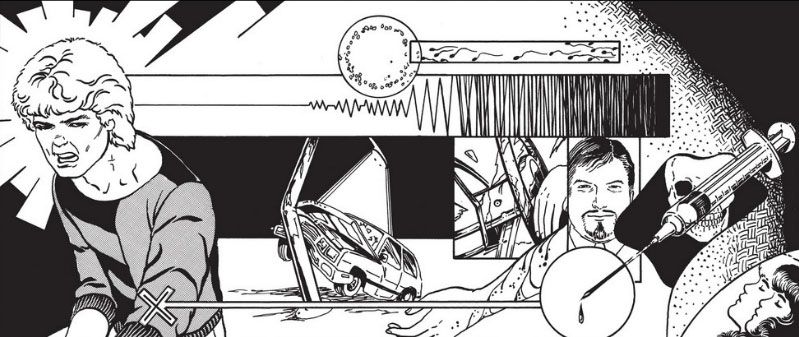
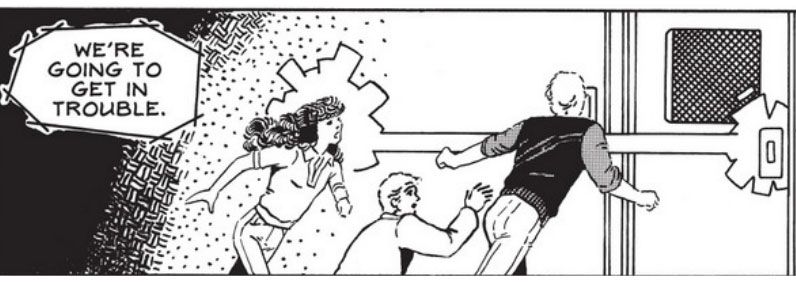
When people are working on stories with this element, there are bound to be some similarities.  Why am I telling you all this?  Because right at the beginning of A Distant Soil, I came across this scene:

 
And this one:
 
 
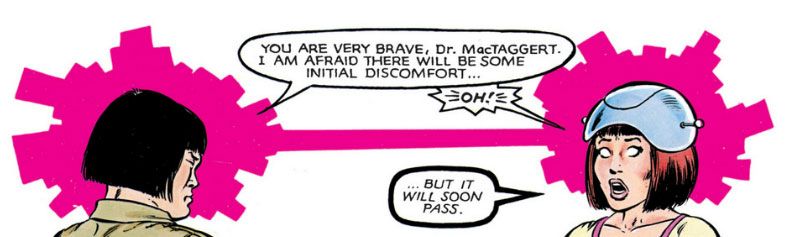
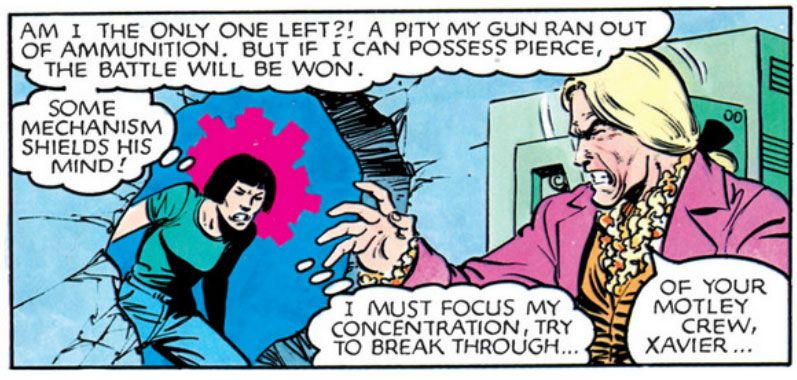
Which immediately reminded me of this, from Marvel Graphic Novel #4: The New Mutants (September 1982):
 
 
And this:
 

Liana and Jason, Colleen Doran's leads, aren't possessing anyone in the same manner as Xi'an Coy Manh as drawn by Bob McLeod, but I'm sure Xi'an would be pleased with how Doran depicts whatever it is they're doing here.  Actually, this early in the story I'm not exactly sure what kind of powers Doran's siblings possess.  They have telekinesis, but the I haven't seen what they can do to the fullest as yet.  I'm looking forward to finding out. 

What's the point of this?  That there are only so many ways to depict mental powers visually and have it read on a comic book page.  McLeod and Doran could just as easily have used the black dots Kirby favored for energy bolts and the movement of water or curvy or dotted lines.  Instead they both hit upon this weird radiating rectangles device and it looks cool as all get out.  And it's just pleasing to me to make a lot of little connections between things.  Magical kids, evil laboratories.  Feeling different or special, identifying with characters who are different and special.  Beautiful artwork in black and white or in color.  Xi'an Coy Manh in just about anything.  After just a few pages of A Distant Soil I'm even more surprised I wasn't all over this back when it first appeared.  It's apparently right in my wheelhouse.

Monday, March 25, 2013

Dani Moonstar, the Early Years 2! The Era of Continued Dominance

After almost turning The New Mutants monthly into Marvel Presents Dani Moonstar and Some Largely Useless Goobers, writer Chris Claremont seems to have tried his best to prevent The House of Idea's Greatest Character from completely overshadowing the other players in what was ostensibly a team book.  Having Professor X-- himself one of the Marvel universe's premiere minds-- mentally dominated by a Brood creature to draw these kids together and then torture poor Dani pretty much negates some of his more emotive writing in Marvel Graphic Novel #4:  The New Mutants (at least to those of us obsessed with all things X), but Claremont never let consistency of characterization or motivation get in the way of telling a ripping tale.

A ripping tale in which Dani refuses to play by Professor X's-- and by extension, Claremont's-- rules.

Chris Claremont, script/Sal Buscema and Bob McLeod, art (New Mutants #4, June 1983)

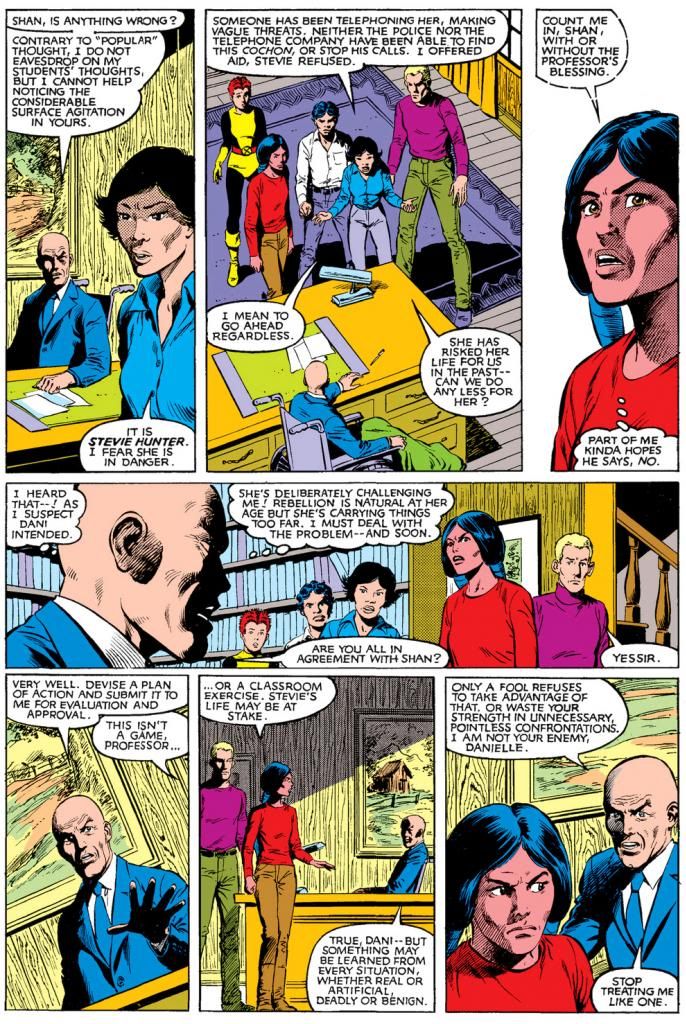
The Brood are Claremont's homage to Ridley Scott's nightmare-inducing Geiger-designed "xenomorph" from the film Alien (this was before James Cameron's expansion of the idea in Aliens and way before the travesty of the later sequels and dimbulb involvement with the Predator franchise).  Claremont and co-plotter/artist John Byrne had already relied heavily on Alien for a Kitty Pryde story in Uncanny X-Men #143 (March 1981) and like all the greats, they knew to steal from the best.  When the xeno-Brood inside Professor X failed to drive Dani insane or turn her into a host for its spoor, Claremont turned to a completely new storyline, one that promised to take the book in a more earthbound direction.  In The New Mutants #4 (June 1983), Dani and the rest tackle a more mundane menace.  Someone is stalking their dance teacher, Stevie Hunter.

I remember excitedly reading "Who's Scaring Stevie?"* in study hall at good ol' Albany Junior High and hoping Claremont and company were taking the book in a less superheroic direction, one that would see the team using their powers less and dealing with teen concerns and social issues more.  Or investigating haunted houses and breaking up smuggling rings dealing in old pirate gold a la Nancy Drew and the Hardy Boys.  With the older, more powerful X-Men back, I didn't see any reason why a bunch of kids my age needed to fight aliens or save the world when there were so many smaller threats around few comics at the time addressed but were the central stuff of many S.E. Hinton and Judy Blume books-- not to forget J.D. Salinger, William Golding or even Anthony Burgess, for pretention's sake.  As a junior high schooler with "outsider" status much like the New Mutants themselves (largely caused by reading comic books in study hall), I wanted stories that used the superheroic genre to comment directly on real-life concerns of the kinds my friends and I dealt with every day.

Years later, I'd write a letter to Image asking that they do something similar with Gen13 (why waste a chance to explore the dichotomy between being a super-being and a party-crazed college student by blatantly rehashing The New Mutants plots?) and they nicely told me to keep my stupid ideas to myself.

In setting up this story, Claremont tries valiantly to re-establish The New Mutants as an ensemble piece.  Gone are the extended solo Dani sequences as Claremont and new penciller Sal Buscema reduce her "screen" time and plump up the roles of Roberto, Sam, the Other One and Whatsherface.   After a playful romp in the snow where Dani treats poor, naive Rahne like a canine pet and Sam once again displays his winning propensity for spectacular power failures, the kids have to report to Professor X for a heart-to-heart.

Claremont, Buscema, McLeod (New Mutants #4, June 1983)

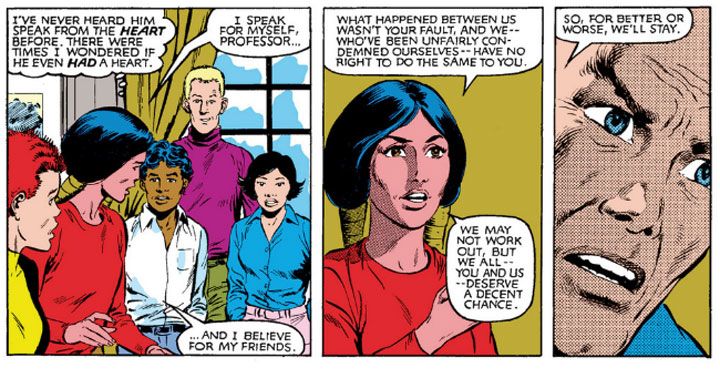
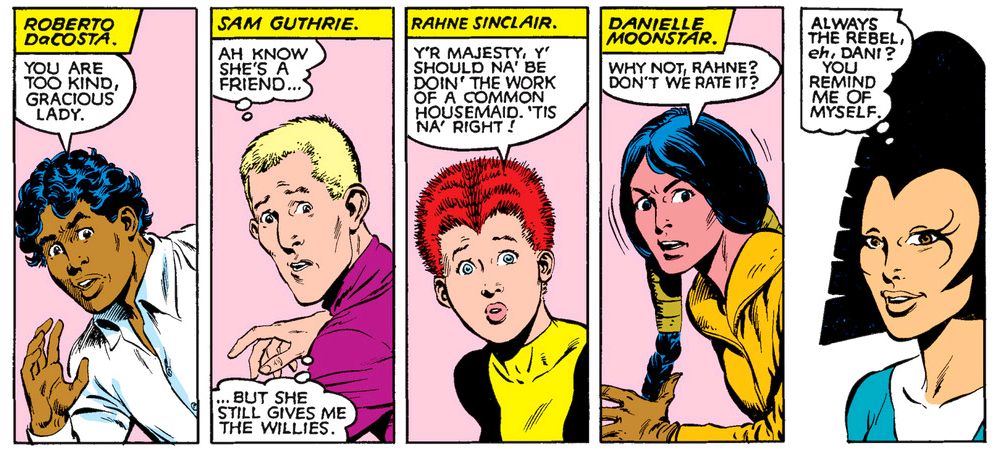
But Claremont can't help giving rebellious Dani the best lines and most memorable moments.  On the way to the Professor's study, Dani refuses to back down-- giving Claremont a chance to use some of his classic arch dialogue to make Dani sound more like Scott "Cyclops" Summers or one of Sgt. Fury's Howling Commandos than any teen we've ever encountered, fictional or real-- from Lilandra, the pointy-headed empress of a vast space empire.  That's right.  Dani sasses a SPACE EMPRESS, which earns her Lilandra's (and this reader's) admiration in the process.  As a follow-up, Dani then presumes to speak for the entire team without even taking a moment to do something democratic like listen to their opinions.  Buscema and inker Bob McLeod give Professor X a brilliant close-up panel where the look on his face registers sheer horror and dismay at Dani's obvious power play.  The world's most powerful psychic is scared shitless of this pig-tailed girl and her red t-shirt.

Claremont, Buscema, McLeod (New Mutants #4, June 1983)

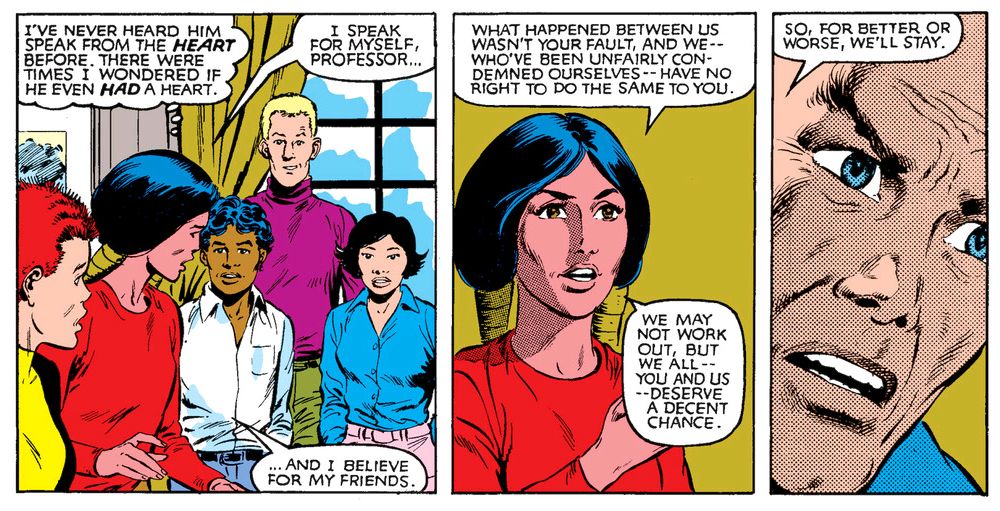
And while Xi'an does her expository best to get the plot rolling, Dani has other ideas-- she turns this scene into a moratorium on Professor X's leadership which ends with the poor exasperated guy practically begging her to stop making his life miserable and get with the program, please.

Claremont, Buscema, McLeod (New Mutants #4, June 1983)

While the rest of the story is given over to the team as a whole investigating Stevie's stalker, it's Dani who makes the strongest impact.  Again.  She won't shut up, won't back down, won't take guff from anyone.  Oh yeah, and when they find the kid, it's Dani who reduces him to a sniveling wreck by blasting the shit out of him with her powers.  She tells Xi'an she can't help it, but we suspect the real reason is she's taking out her frustration at not getting the center spot on this issue's cover or a double-page spread all her own where she interacts with squirrels and chipmunks while plotting Professor X's ultimate downfall and renaming his school Danielle Moonstar's Academy of Ass-Kicking.

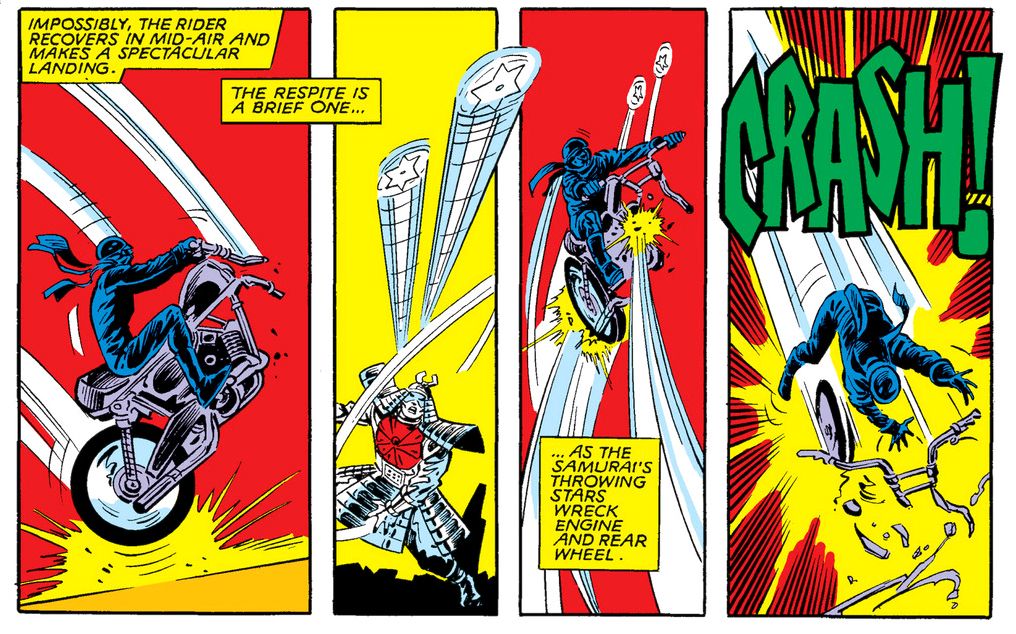
Then my hoped-for emphasis on well-meaning kids solving their peers' social issues turned into a Saturday morning TV commercial for Ideal Toys.  I'm not sure how this happened-- it smacks of editorial interference in an attempt to create synergy for a licensed product-- but in The New Mutants #5 (July1983), the team suddenly finds itself involved with Team America.  Not those delightfully profane marionettes who savaged both Bush-era jingoism and Hollywood liberalism in equal measures but the motorcycle riding dullards you could buy at K-Mart if you didn't have the simple human decency to collect G.I. Joe.

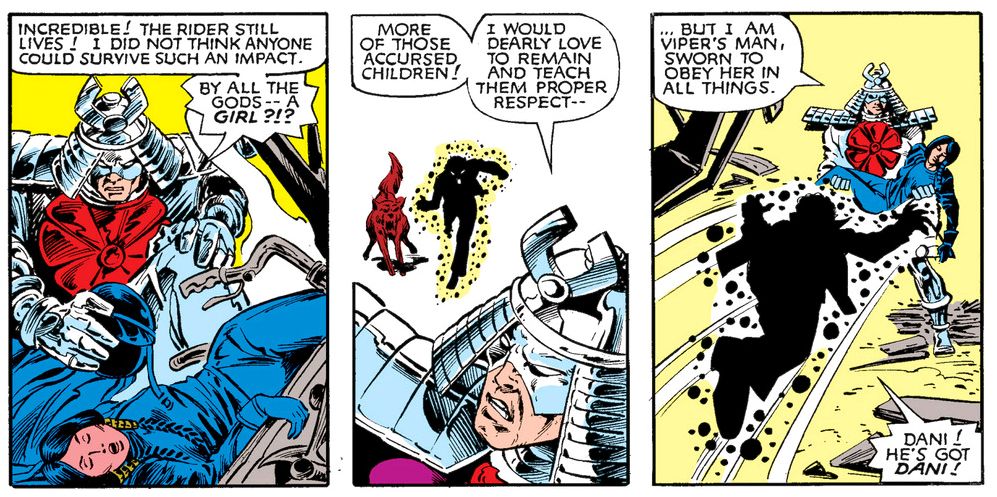
Incredibly, this spins itself into a two-issue tussle with Hydra and, even more nonsensically, the Silver Samurai where even Claremont can't generate enough enthusiasm to do more than phone in the rotest of rote plots.  Yes, Hydra had its glory moments in quite a few stories, but here their involvement smacks of "Well, we need some bad-guys and Hydra doesn't take much effort: they're always doing crazy world-domination shit."  And what the heck does Hydra have to do with the New Mutants anyway?  Then there's the art.  Oh brother, the art!

In this era, most pencillers didn't do the completely finished drawings they do these days and inkers usually played a more important role in maintaining a book's consistent look.  If a penciller felt concerned about how an inker might interpret the pages, then he or she might render things more completely, or "tightly."  But these tight pencils took time and time was something many of these deadline-oriented books could not spare.  Some pencillers would simply do layouts, which were just roughly blocked-in panels with figures in outline or quickly sketched; these could go either to another penciller for clean-up and finish and then to an inker, or simply to an inker.  Masters like John Buscema drew loosely and it was up to the inkers to clean things up and actually draw in ink.

Bob McLeod is one of those inkers who flat-out knows how to draw.  On The New Mutants, if I'm remembering what he told us on Facebook correctly, McLeod was knocking himself out with tight pencils to try to control the book's look (after all, he co-created these characters), but couldn't maintain the brutal pace and keep up the quality.  So they brought in John's brother Sal Buscema because he could provide clean-reading pages for McLeod to work over.  It worked beautifully in The New Mutants #4, which looks more or less like a McLeod solo job.  But what happened here?  Armando Gil excelled at inking Michael Golden on The 'Nam, but he and Buscema are a lethal mix.  The art in the book's latter stages is as ugly and slapdash as its plot.

Anyway, Team America.  Oh, they turn out to be mutants.  How convenient!  This half-assed connection is enough for the kids to get themselves entangled with these motorcycle stunt riders (led by a guy with the admittedly awesome name R.U. Reddy).  And it's here where Dani begins to take things into her own hands.

Claremont, Buscema, and probably Armando Gil (New Mutants #5, July 1983)

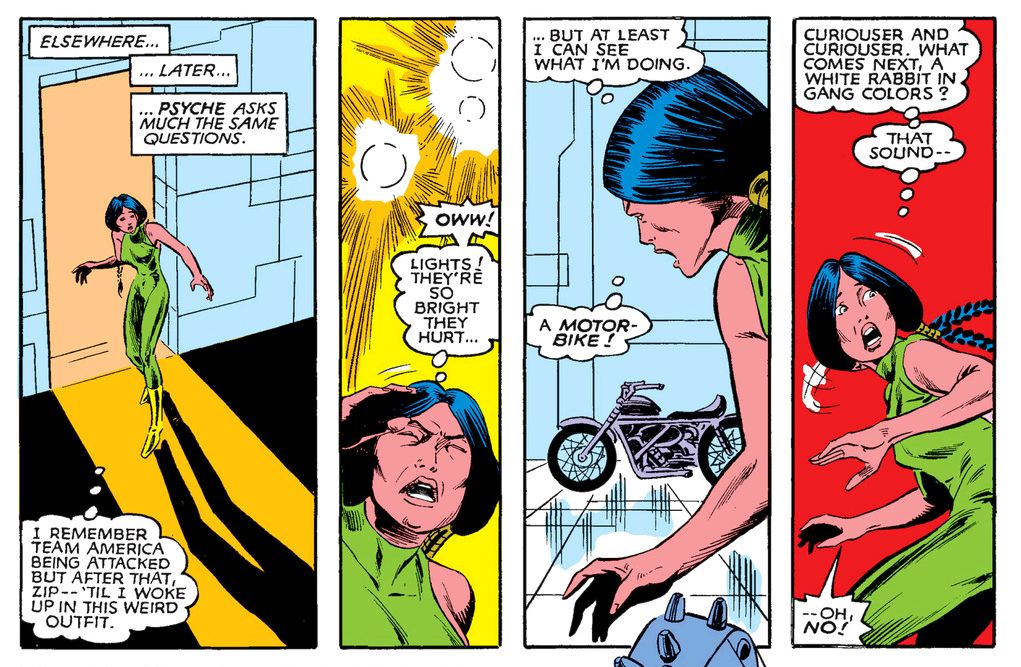
Some fictional characters take on a life of their own.  Their mass within the plot tends to deform narratives much in the way gravity bends lightwaves.  At this point, with Claremont seemingly phoning in these issues and the art going wonky, Dani makes her move.  Whose headstrong nature finds her kidnapped and dressed in a green catsuit?  Who is the vessel for the manifestation of Team America's gestalt mutant power and gets to tear-ass around on a dirtbike as the Dark Rider?  Of course it's Sam Guth-- no.

Dani Moonstar.

Claremont, Buscema, probably Gil (New Mutants #5, July 1983)

As we've seen through five issues, anything interesting is happening in any given The New Mutants, it's happening to Dani.  Well, until Xi'an finally gets a storyline in #6 (August 1983).  But even that is mostly an excuse to bump her off so Dani can assume leadership of the team.  Claremont hedges his bets by having her share the honors with Sam, but we all know who's the weaker in their partnership.  There's no way Sam's good-natured country boy manner can stand up against Dani's hotheaded ways.

Claremont, Buscema, definitely Armando Gil (New Mutants #5, July 1983)

Notice, too, that even though they're ostensibly mourning the loss of Xi'an, the true reason for the kids' detour to Rio de Janeiro in The New Mutants #7 (September 1983)  is so Dani can indulge herself in the wearing of a skimpy Carnival outfit.  I've already written at length about Dani's clothing-optional lifestyle so I won't go into that here.  Suffice it to say, Dani is at home in her skin and thinks nothing of flaunting it.

And why not?  She's Dani Moonstar, for cripes' sake!  She's defeated the Hellfire Club, Professor X, the Brood, Hydra and Chris Claremont.

Soon, however, she would face her greatest challenge.

*The answer to that question-- if you care-- is Peter Bristow.

Sunday, March 24, 2013

Dani Moonstar, the Early Years! A Look at How Moonstar Stole the Spotlight in the First Issues of The New Mutants

Arguably the greatest comic book character ever created, Dani Moonstar just made her debut as a team member in Fearless Defenders, having survived the cancellation of the most recent New Mutants series. It's not luck.  She demands to be in books.  Created by Chris Claremont and Bob McLeod, Dani Moonstar has been flying around the Marvel universe on her magical winged horse for more than thirty years now and no matter how they change her-- new powers, no powers-- she just keeps on doing her thing.  With sheer grit and determination, she elbows others aside and takes over entire narratives.  The other characters in Fearless Defenders had better watch out lest they find themselves mere sidekicks to Dani Moonstar.  It's been so from the very beginning, and I will prove it.  Mathematically.  Scientifically.  Magically.

Chris Claremont, script/Bob McLeod, art (Marvel Graphic Novel #4, October 1982)

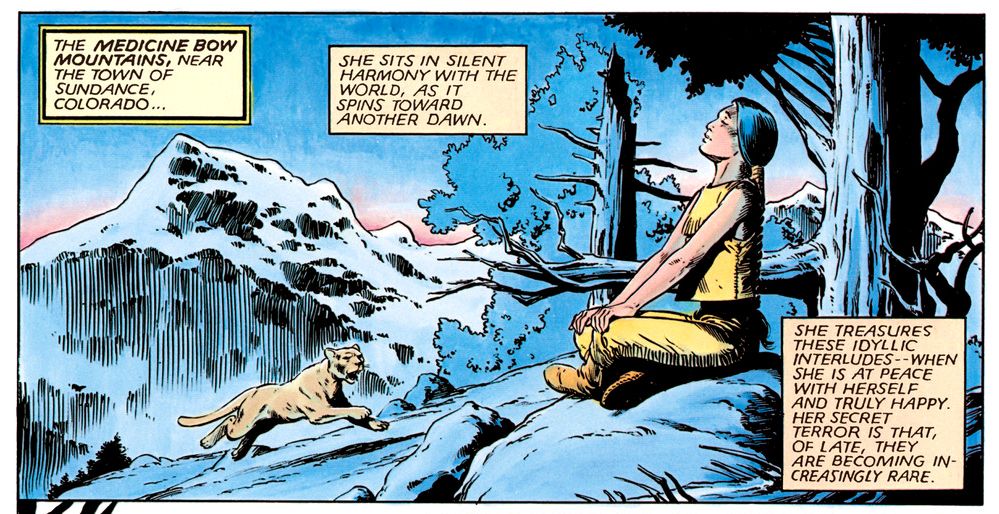
Our girl Dani debuted in Marvel Graphic Novel #4:  The New Mutants, way back in October of 1982, the fourth of the new... er... mutants in order of appearance, but first by far in order of kick-assness.  Her first moment in the book sees her chilling out on a mountainside after essentially reducing herself to a recluse because her mutant power of drawing out a person's worse fears has alienated her from her peers.  Yeah, as if Dani has peers.  A Native American of the Cheyenne people, pre-heroic Dani likes to sport some kind of deerskin outfit that's probably more comic book than real world, but with her black hair in braids, it's enough to visually imprint the idea of her cultural origins.  Chris Claremont's economical narrative captions serve only to emphasize what Bob McLeod's art has already made obvious, but in those days, at the height of his creative powers, Claremont excelled at adding depth and shading to characters that are essentially stereotypes, drawing in readers with his sympathetic take on their personalities.  Like with Dani.

In a graphic novel full of introductions and kind of crowded with incident and scene changes-- the locale shifts from Scotland to Brazil to the United States to Brazil again before returning to the good ol' US of A to wrap things up-- Dani's volcanic temper, rebelliousness and single-minded quest for vengeance set her apart from the other characters.  While Rahne is shy, Roberto kind of stiff, Sam dopey and X'ian a bit uptight, Dani emerges as the most well-defined and charismatic.

Chris Claremont, script/Bob McLeod and Mike Gustovich, art (The New Mutants #1, March 1983)

Claremont and McLeod must have known they were on to something, because Dani becomes the star almost immediately in The New Mutants monthly comic, repeatedly getting solo spotlight moments while the other kids are out at the mall or practicing their moves.  Look at it this way-- in the first three issues, she gets the central position on a cover, 12 and a half solo pages-- two of them title page splashes-- and fifteen story pages devoted either to her problems or actions in which she's the main participant in some way.

No one else comes close.  Roberto gets a nice double-page spread at one point.  Sam and Rahne get one solo page each.  Poor Xi'an gets zero, and her most dramatic story moments relate to something Dani did to her.  Out of sixty-six interior pages over one-third of them-- slightly more than one complete comic-- are Dani-centric.  When the story features the other kids, they're usually sublimating their individuality to the group dynamic.

Chris Claremont, script/Bob McLeod and Mike Gustovich, art (The New Mutants #2, April 1983)

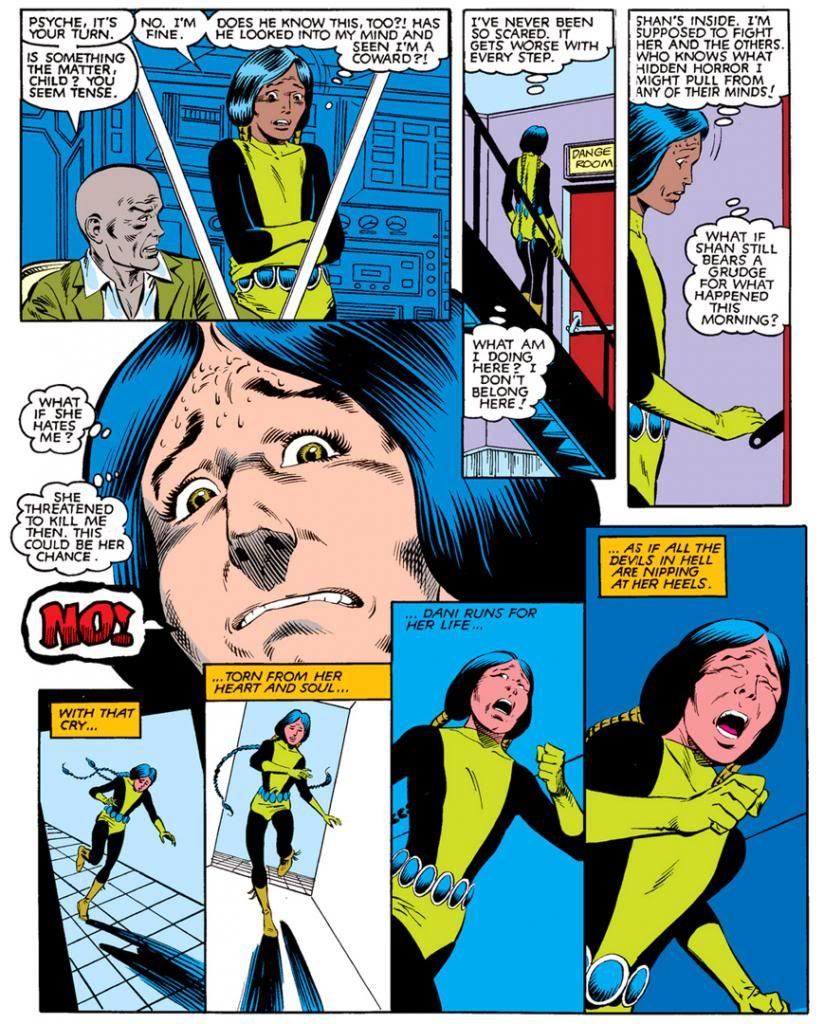
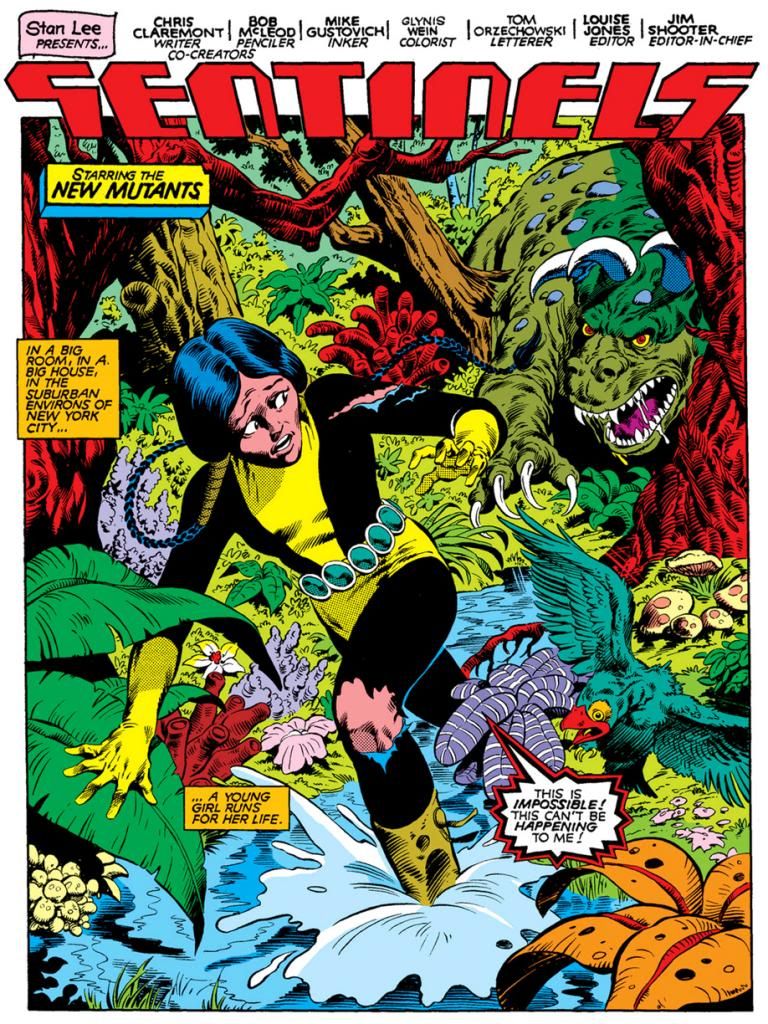
Not Dani.  She's all about the awesomeness of being Dani.  Humiliated by her cowardly failure to confront the Danger Room the first time in The New Mutants #1 (March 1983), she takes it on all by her lonesome and ends up stalked through a jungle landscape by a fabulous creature out of McLeod's imagination in #2 (April 1983).

One underappreciated aspect of McLeod's long comic book career is his ability to draw really cool jungle environments.  Look at all those strange fronds and bizarre polyps sprouting all over the place, plus that crazy bird in the foreground that seems as frightened of Dani as she is of that three-horned behemoth-- so powerful it can knock down fully-mature trees-- coming up behind her.  Run, Dani, run!

McLeod takes advantage of the Danger Room's holographic capabilities to go absolutely nuts with the forest primeval, which leads directly to one of Claremont's own specialties-- the development of the hints and intimations of a mysterious subplot into an action-and-dialogue packed main plot.  An unknown miscreant is manipulating Dani's emotions for some nefarious end.  And attempting to murder her.

Claremont tells us a great deal about Dani during this period, more so than of any of the other characters other than perhaps Xi'an (again, only because Dani draws out a lot of this info).  For example, not only is she full of self-reproachment for failing to live up to her own standards (she calls herself a coward), but she also tells Rahne about her parents' apparently supernatural death and that her father was Horse Clan and her mother was Eagle Clan.  While Claremont never elaborates on the meaning of these clan affilitions, Dani's parents play an important role in a later storyline that wraps up this aspect of her history.  By contrast, we haven't learned Rahne's parents' names at this point (I still don't know them!), and all we know about Sam's family is they're a bunch of Kentucky coal miners and he should be writing sad honky-tonk songs about them instead of wasting his time trying to learn how to change directions in mid-air while blasting fire out of his ass like a human rocket.

Chris Claremont, script/Bob McLeod and Mike Gustovich, art (The New Mutants #3, May 1983)

We also learn there's a chance Dani might be mentally ill.  This is a lot for readers to absorb about a single character in what's supposed to be an ensemble this early in a series, and it renders the book more or less Dani Moonstar and Her Amazing Friends!  Screw Sam, Rahne and the rest-- this is Dani's book and they're merely supporting players.

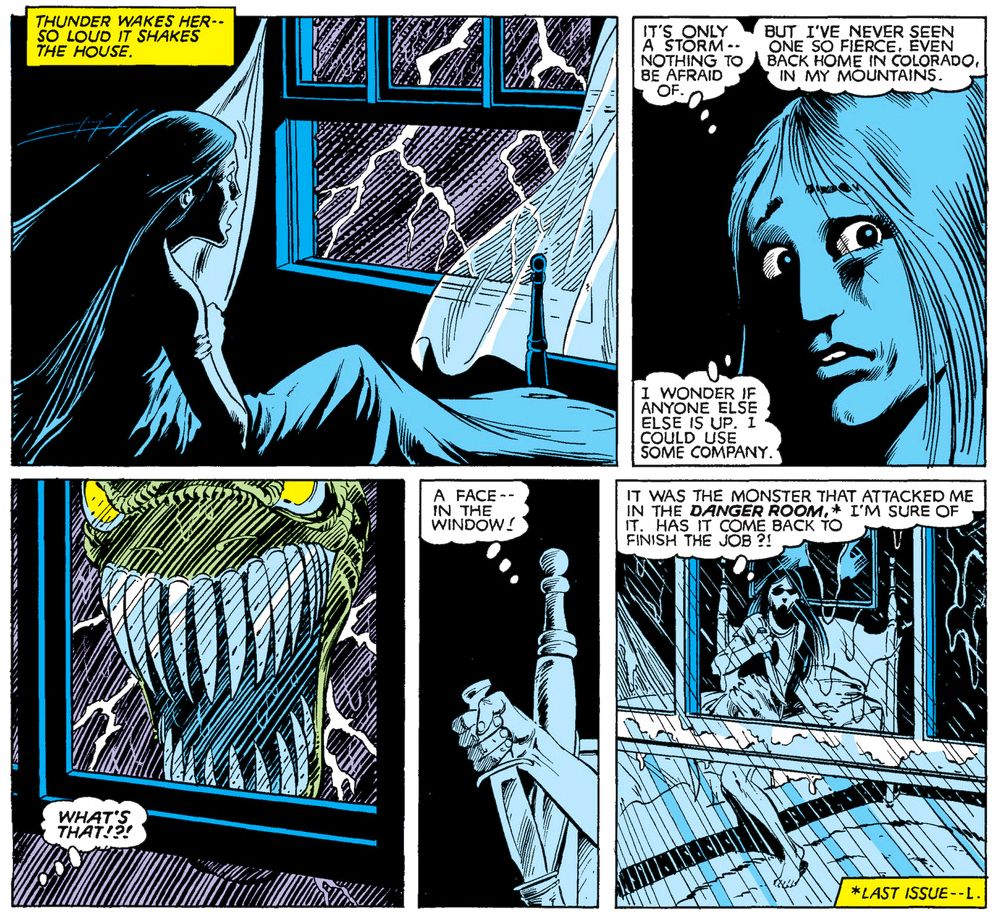
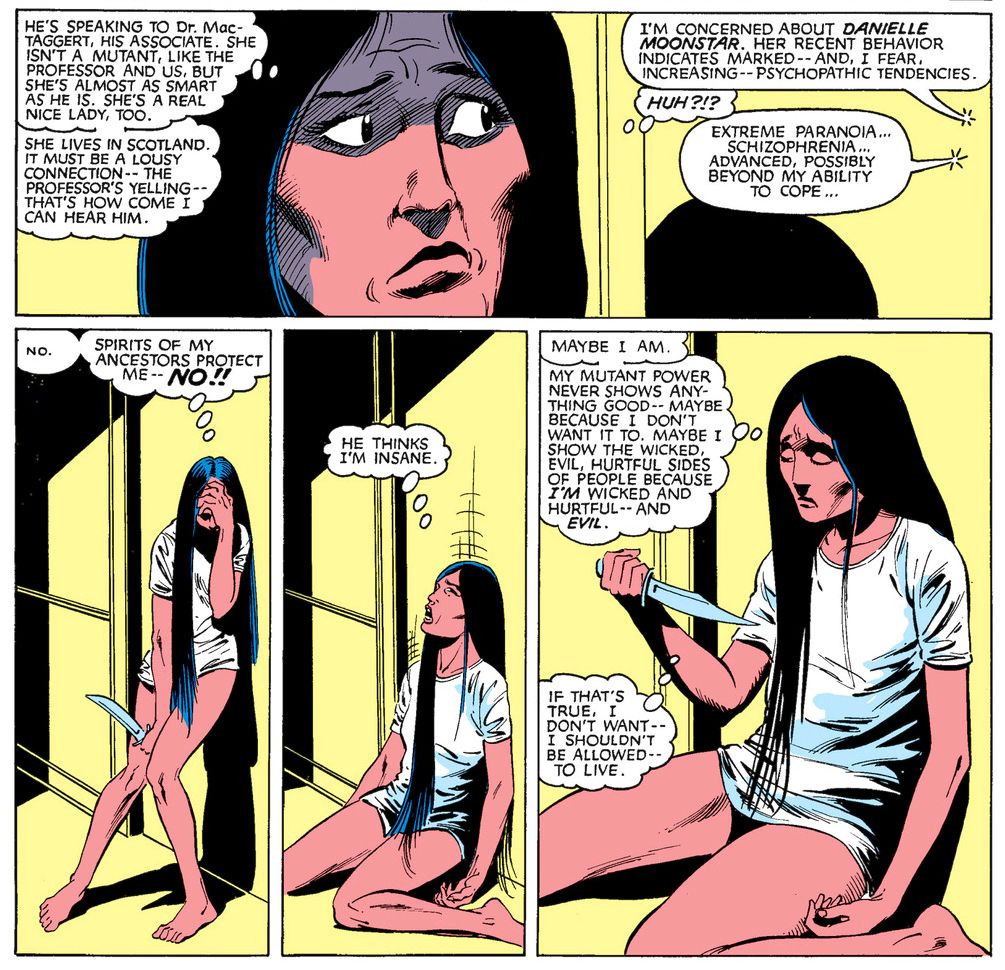
In The New Mutants #3 (May 1983), Dani gets another dramatic solo moment as she dreams of the demon bear that she believes killed her parents and the deaths of her new friends.  In the aftermath-- and while clutching a wicked-looking knife-- Dani overhears Professor X himself on the phone telling Moira McTaggart the incident represents a psychotic break, that's it's nothing more than paranoia, symptomatic of schizophrenia.  I think the proper medical term is "losing her shit."  She doesn't take it well.  I mean, what thirteen-year-old girl wants to be diagnosed as schizophrenic by a seemingly all-knowing authority figure?  Dani's young mind conflates having a mental health issue with being broken and unworthy, confirming her growing tendency towards self-loathing.  Her thoughts turn towards the suicidal.

Okay, stop and think about how genius this is.  At this point, having shown us all of Dani's fears-- that Xi'an wants to kill her, that her cowardice is out of character, that she's being persecuted by some strange dream-like figure, that her powers are somehow some manifestation of inner evil-- and having no reason to doubt the usually reliable Professor X, Claremont makes us doubt her sanity.  Just enough.  Claremont's obviously building to something here-- either the demonic creature is real or we're going to have a very dramatic storyline about a teen losing her hold on reality.

Chris Claremont, script/Bob McLeod and Mike Gustovich, art (The New Mutants #3, May 1983)

And McLeod reinforces very distinct possibility it's the latter by posing Dani-- her hair unkempt, wearing only a sleep shirt that's a signifier of dream-states and other levels of consciousness, or perhaps even a hospital gown one might wear at a mental health facility-- with the business end of her knife ominously towards her own heart.  Out of all the characters in this book, of course it's Dani who's the most at-risk.  A cliff-hanging end to issue #3, with the entire direction the series in the balance... and it's all about Dani Moonstar.

For now, let's leave young Dani slumped against Professor X's office door out of respect and come visit her again when she's feeling better...

Thursday, March 14, 2013

The Teen Titans versus the New Mutants-- reactions to authority in contrast


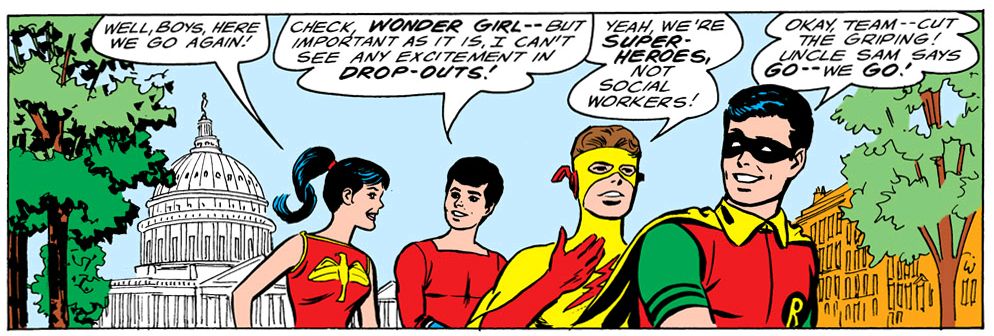
Bob Haney-script/Nick Cardy-art, Teen Titans #3 (May/June 1966)

Many years ago, before you and I were even born, the US government needed someone to help with school drop-outs.  So they turned to DC's premiere group of costumed teens (most of whom were sidekicks, wards or protégés of similarly-themed adult characters).  Calling Robin, Kid Flash, Aqualad and Wonder Girl to Washington, D.C., concerned officials charge them with journeying to the middle American heartland and confronting their age-peers.  "Stay in school," the Teen Titans preach, "the United States government wishes it!"

People had youth on the brain back in the 1960s.  While adults and kids have always had their differences, the post-WWII baby boom expanded what they used to call the "generation gap" to almost revolutionary levels.  It started in the 1950s, but intensified the following decade due to the continued pressures of an unpopular war, struggles for racial and gender equality, new forms of musical, artistic and self-expression, the Sexual Revolution and even the cynical media exploitation of this huge, new-- and relatively affluent-- demographic.  With even a cursory reading of history, we can, just as people did back in the 1960s, divide these opposing forces into the establishment and the anti-establishment.

When "The Revolt at Harrison High" in Teen Titans #3 -- with its heroes optimistically working for the establishment writer Bob Haney (himself a self-described socialist and pacifist) characterizes as largely benign-- hit the newsstands in the summer of 1966, the anti-war movement was already in full swing.  Young people had already burned draft cards, various groups had successfully staged several large scale anti-war rallies (Haney had participated in some by this time as well) and a number of veterans had attempted to return their medals to the White House.

The next year, 1967, witnessed the Summer of Love and the Beatles' psychedelic masterpiece Sgt. Pepper's Lonely Hearts Club Band.  Colorful Utopian dreams seemed within reach if the young simply turned their eyes to the sky in search of diamonds and tuned their sitars to the cosmic.

Then, in 1968, the world erupted, with the Tet Offensive rocking America's confidence in its military's ability to defeat a technologically-inferior foe, two major assassinations at home, racial violence, student violence, police violence in Chicago during the Democratic National Convention, a Soviet invasion of a liberalized Czechoslovakia, tyranny stamping its iron boot on the human face forever.  

Things fractured further.  That year, American International Pictures released Wild in the Streets, in which a 24-year-old rock star becomes president of the United States and throws people over 35 into concentration camps where they’re dosed with LSD.  Coming years would see more war protests, the watershed music festival Woodstock giving way to legendary bummer Altamont, the Tate-LaBianca Murders (via the demonic influence of Charles Manson-- the perfect hippie bugbear to chill the spines of parents everywhere), the invasion of Cambodia and the 1970 Kent State shootings—an event preceded by the Ohio governor angrily denouncing anti-war protesters on campus as a “militant, revolutionary group.”

Then came further betrayals.  The crushing loss of George McGovern in the 1972 election to Richard Nixon.  Watergate.  The energy crisis.  Recession.  Malaise.  Cities like New York suffering from collapsing infrastructure.  No wonder youth culture curdled into the nihilism and anarchy of punk rock on one hand and the mindless hedonism of disco on the other.

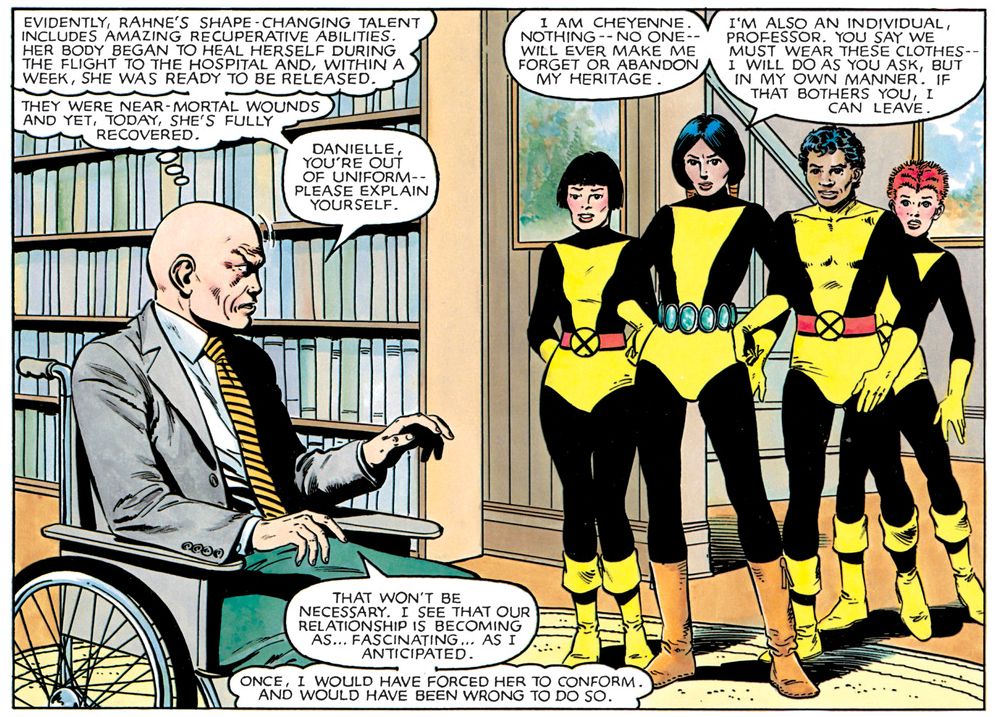
Chris Claremont-script/Bob McLeod-art, Marvel Graphic Novel #4 (October 1982)

Which might be why just a generation after the Titans marched proudly out of Washington filled with the evangelical furor and a hopeful message for high school drop-outs everywhere, Dani Moonstar of the New Mutants, Marvel’s premiere group for costumed young people (none of whom were sidekicks, wards or protégés of similarly-themed adult characters) responds with open rebelliousness to Professor X’s demand for uniformity among his pupils.  And also why the Professor himself decides not to quash her individualism.

Bob Haney-script/Nick Cardy-art, Teen Titans #3 (May/June 1966)

The two teams take different tactics when interacting with their peers, too.  In "Harrison High," the Titans act as establishment mouthpieces, which renders their attempts at talking frankly with their age-peers awkward and forced.  They fail because few people enjoy being talked down to, especially by others their own age.  This approach pays no dividends, as the Titans learn here.  Later they take a different tactic-- strangely enough, involving violence-- and find positive results.

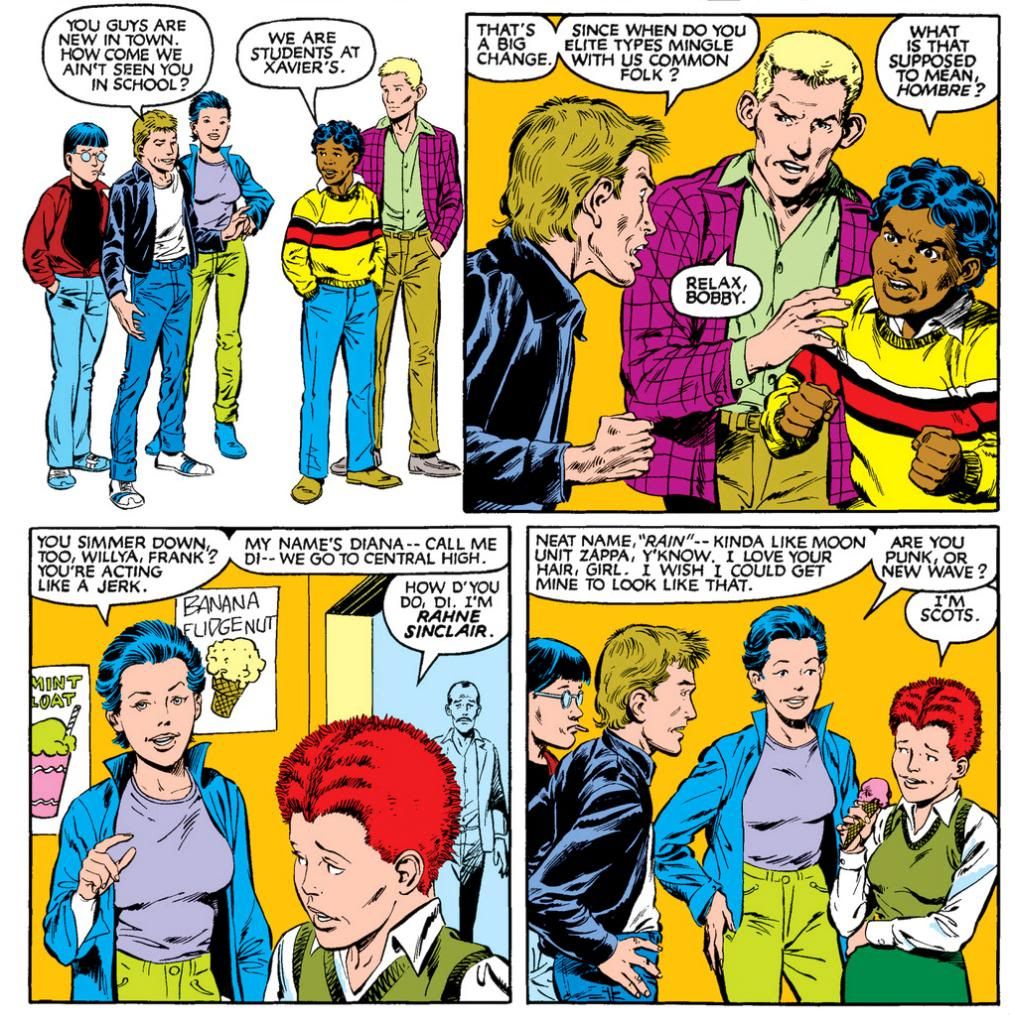
Chris Claremont-script/Bob McLeod, Mike Gustovich-art, New Mutants #2 (April 1983)

The New Mutants, on the other hand, have no ulterior motives-- certainly none that are government-directed-- and relate to people in their age demographic more or less as equals, so their interaction, while a bit contentious, is comfortingly naturalistic.  Within moments, the mutant students and the townies have forged the bonds of friendship despite their socio-economic, cultural and genetic differences.

But don't let me give you the idea the Titans didn't learn to swing.  It wasn't long before they got with their times and began questioning authority.  They'd drop their self-righteous pro-establishment stance and come into conflict with their mentors and the adult world at large.  That's an essay for another time.  But just think about this-- today Robin is a grandfather and Dani is my age and they're both just as confused and troubled by today’s kids as the grown-ups of yesteryear.

Wednesday, March 6, 2013

Do you realize how difficult it is to get New Mutants Classic volume 1?

That's right.  One of Marvel's best releases in the past few years has been their full-color New Mutants Classic reprint series.  I rank it up there with their Tomb of Dracula color reprints.  New Mutants Classic 1 features the debut of a cast of winning characters (many of whom still figure majorly in Marvel's X-narrative), some of Chris Claremont's finest writing, gorgeous Bob McLeod art and some solid work by Sal Buscema.  It starts with the entirety of Marvel Graphic Novel #4, then segues into the first issues of the New Mutants monthly in which Dani Moonstar quickly assumes the lead role with her rebellious attitude and melodramatic mental issues.  It also has a funky and clunky cross-over with Team America, based on a toy line by Ideal, in which Dani turns into Dark Rider.  This leads to the team tangling with Hydra and Dani being forced to wear a green backless catsuit.  Well, you really have to read it to believe it.

Anyway, the series itself marches on (volume seven, featuring issues #48-54 and Annual #3, came out in May 2012 and you can find #55-61 in X-Men: Fall of the Mutants volume 1, just released in February 2013), but it seems the first book is now either out of print or still in print in incredibly small runs, leading to scarcity.  Which is crazy.  For a book this good, Marvel needs to be banging the drum and distributing it free to schools.  It should be found in motel rooms across the United States along with Gideons Bibles and local phonebooks.  But they don't listen to me.  Whoever "they" are.  

Instead, you have to source it yourself from secondhand sellers and well-stocked comic book shops.  For now, you can find reasonably-priced used copies at Amazon.com or unreasonably-priced new copies (one seller has theirs priced at $900!).  Don't expect this to last.  

Because I'm a billionaire genius inventor/consulting detective, I could easily afford to pay vighBooks $84.20 for a pristine copy shipped here to my vast estate and land holdings in rural Japan.  It arrived yesterday so well-packed it took my robot staff hours to open the various envelopes.

So if you're a fan of Dani, Sam Guthrie, Xi'an Coy Manh and the rest, you really need to snap up a copy of this book so you can complete your collection before they completely vanish into the hands of wealthy and mysterious individuals such as myself.  You other option is to buy individual issues on Comixology.

This I have also done.

Thursday, October 18, 2012

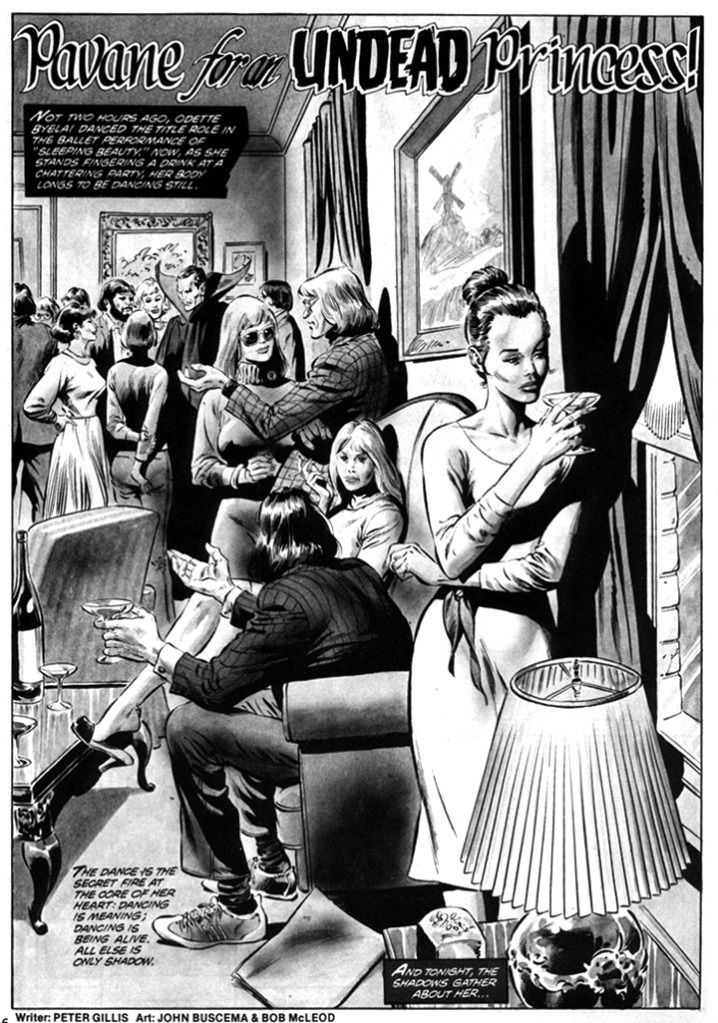
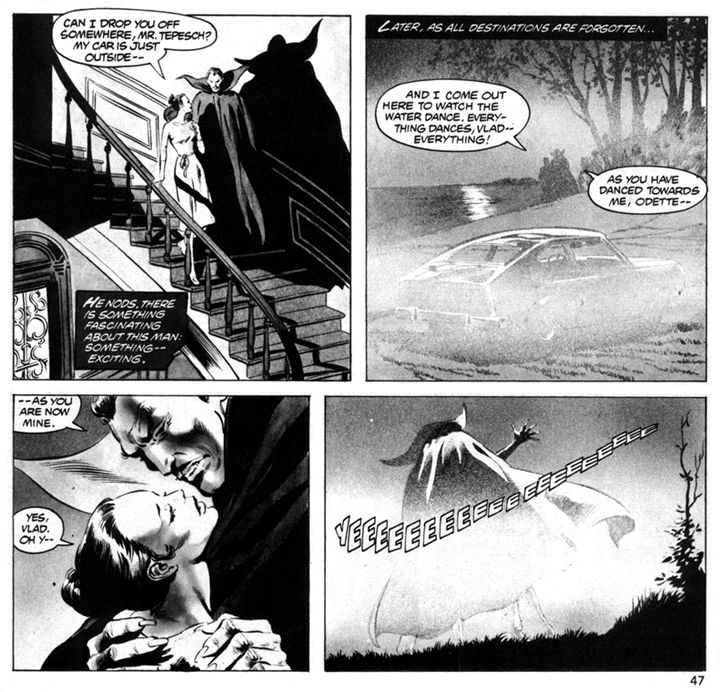
October is Spookey Month: "Pavane for an Undead Princess!" (Tomb of Dracula Magazine #5, June 1980)

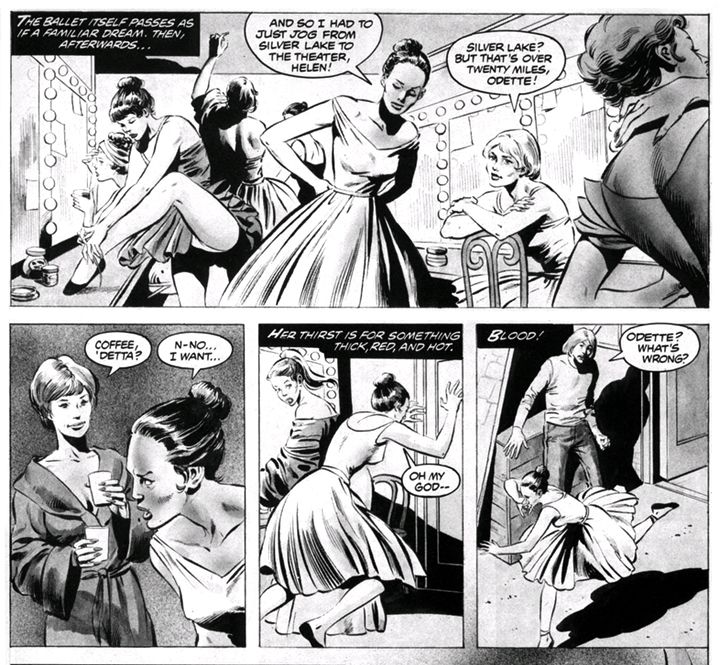
If it takes a soul to appreciate music truly and deeply, what happens when a prima ballerina, whose very being is dance and music, becomes a vampire?  That's the question brilliantly asked and answered in "Pavane for an Undead Princess!," which, despite its flaws remains a short, tragic gem.  Peter Gillis's story reminds me of a vampire Black Swan and I can easily see Natalie Portman essaying the starring role of Odette.

Yes, the ballerina character's name is Odette.

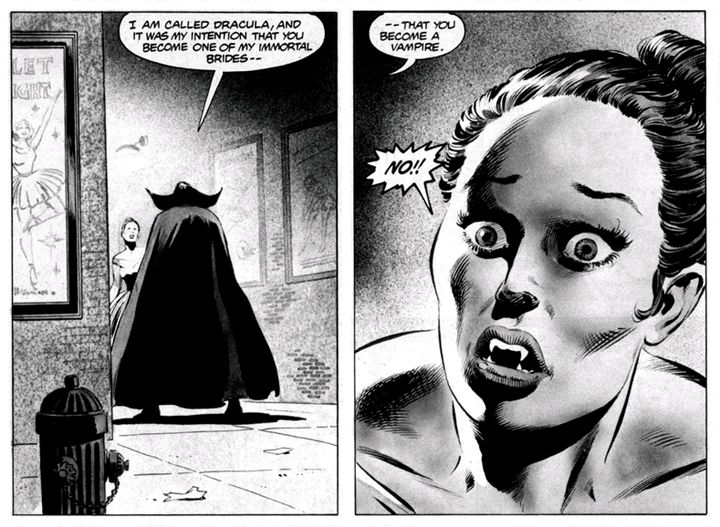
Odette, as Gillis tells us, lives to dance.  We first see her standing aloof against a windowsill, gazing moodily into the night.  She's not a snob or some sort of arrogant pseudo-princess.  It's that she can't even enjoy an after-party with her snooty artsy friends because her muscles "long to be dancing still."  Then she makes the mistake of leaving the party with a cloaked gentleman calling himself Vladimir Tepesch.  If only she'd spent more time watching In Search Of... and less time mastering her art, she might have avoided her fate-- waking up later in the woods with her car missing and having to run 20 miles back to the theater where Greg, the poor man's Alexander Godunov (who had defected from the USSR just a year before this story saw publication), gapes at her and wants to know where she's been for three whole days.  Remember those three days in case you ever find yourself in Odette's pointe shoes-- in classic vampire lore, the vampire's resurrection mocks Christ's; Gillis knows his stuff.

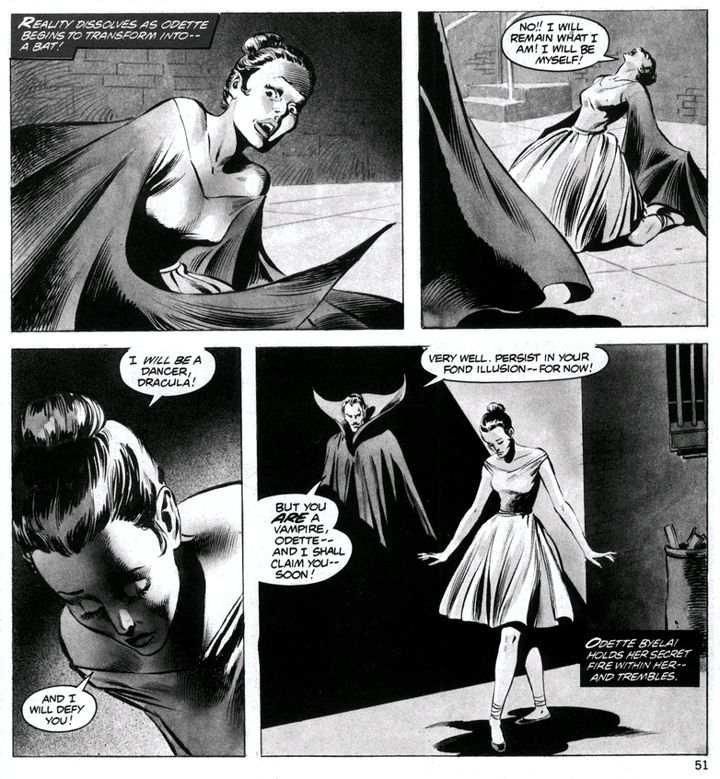
Anyway, Odette learns she's undead.  She refuses to accept it even when Dracula transforms her partially into a bat.  No, she has to spend her nights dancing rather than skulking around in the shadows sucking blood.  I'll have you know Isadora Duncan simply adored skulking and sucking.  But not our Odette.  She goes on an extended dance tour, then returns to her apartment and throws herself into practice, only to discover as a soulless monster she no longer has an ear for her favorite composers.  First Prokofiev, then Tchaikovsky devolve into "NOISE!  NOISE!  NOISE!!"  This is the kind of reaction that puts a bit of a crimp in your dance career.  Odette reminds me of some friends of mine who, when they turned 30, suddenly told me they couldn't relate to any of the new music and were becoming interested in blues and soft jazz.  In other words, "I'm old now, so I hate music."

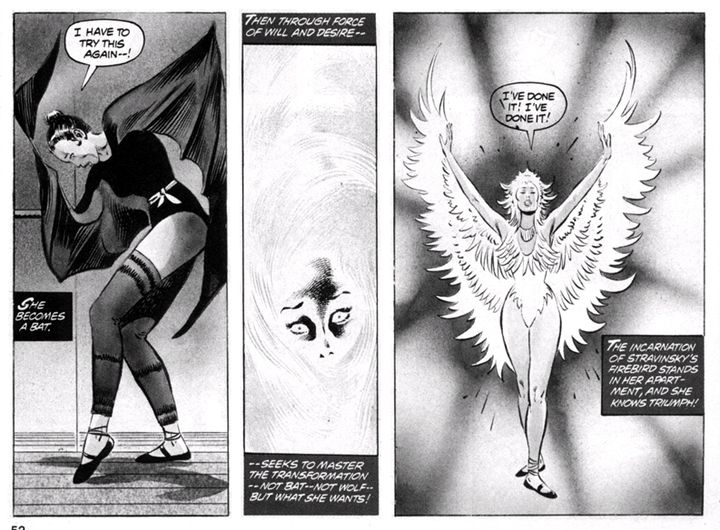
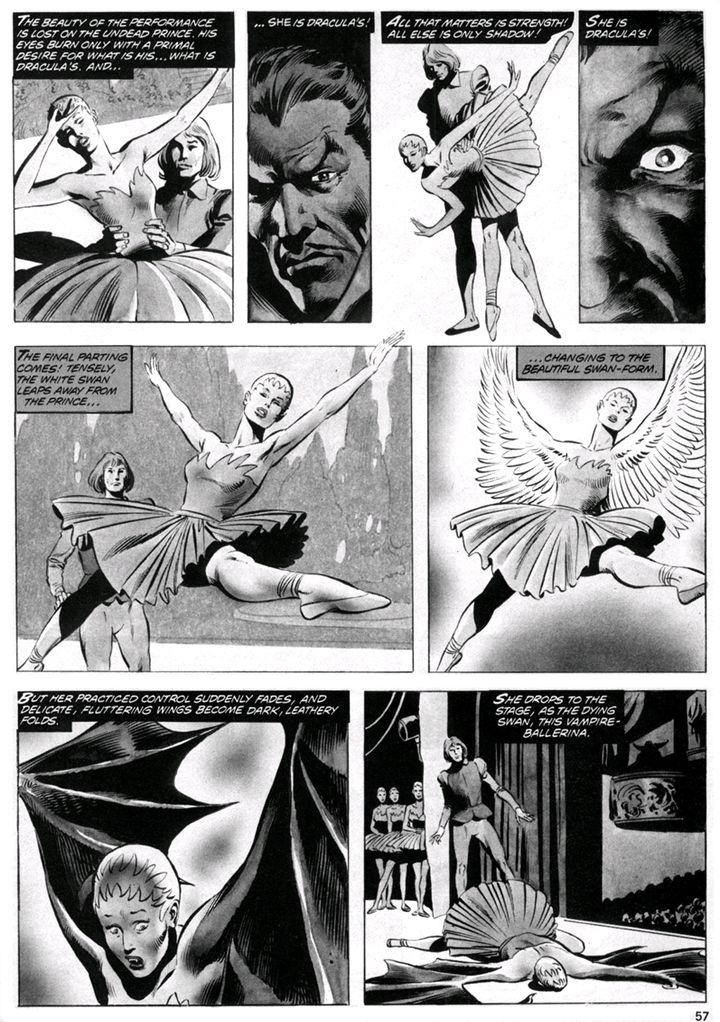
Actually, I'm a little puzzled as to how Odette was able to perform to their music for weeks before this breakdown.  Maybe this particular symptom of being a vampire takes a few weeks to present.  We never find out, but that's a relatively minor plot hole we have no time to investigate because Gillis quickly covers for himself with a brilliant inspiration, possibly the source image for the entire story:  Odette finds she can use her vampiric powers to morph not only into a bat but also into a half-swan... or even a full one.  She gets Anatoly (sounds like a Commie name if you ask me), her company's choreographer, to help her reconfigure great ballets into showcases for her amazing new abilities, but she can't escape the vampiric curse and it all ends pretty much the way Black Swan ended but with more self-impaling and none of the self-pleasuring.

And it also requires us to ignore that losing the spirit of music thing again, but maybe Odette comes up with some way to compensate.  Earplugs and strictly counted beats or whatever.  It's not as if music is all that important to dance, anyway.

While the page count reduces Gillis to telling rather than showing Odette's obsession with dance and her posthumous performance rebirth-- first a collage-like panel and later, after she starts using her metamorphic powers, a single panel with just the ballet titles-- the prima ballerina's plight still moves.  She's truly done nothing to bring this curse upon herself and then she's propelled along a tragic path similar to the characters she danced during life, damning herself in a moment of weakness and rage.  And ol' Dracula is a complete bastard.  He cares only for beauty only so much as he can possess it, but his touch inevitably corrupts and destroys.  Like the parasite he is, he'll move on to other victims.  But Odette loses more than her soul, and even her ultimate triumph is couched in death and her sad isolation from that which she loves most.

John Buscema provides his usual sold storytelling, largely confining his layouts to the three-tier format.  Each page is a little miracle of panel-to-panel continuity, but the real star here is Bob McLeod.

If I remember correctly, Buscema usually worked pretty loose and left a lot for the inkers to finish.  As a result, this art job looks a lot more like McLeod's solo work than a strictly Buscema job might, or one inked by Tom Palmer, Ernie Chua or even Big John's preferred partner, his brother Sal.  I've always admired McLeod's work on his solo efforts, and his figure construction and detail work-- such as how he deals with cheeks-- was always a bit Buscema-esque anyway, so they make a fine team here.  I don't know how much of the black-spotting Buscema indicated in his pencils, but McLeod's use of dark shadows pooling around the characters or climbing the walls behind them works wonders in creating a subtle menacing mood.  Dracula himself seems to loom out of darkness or carry his own shadows with him wherever he goes throughout this story, setting him somewhat apart as a malevolent force crawling up from Odette's own id as the vampire's power over her grows and distorts her life's work.  McLeod also lays down gray tones and creates lighting effects during Odette's transformations with what appears to be airbrush.  Reading some of these later Marvel mags, a lot of inkers seem to have been enchanted with the airbrush for tonal work as opposed to doing the traditional ink washes.  I wonder if there's some Richard Corben influence going on there, or if the airbrush lent itself to faster turnaround times, or perhaps a little of both.

Bob Mackie vampire.
Whatever the reason, the end result is lovely to look at.  A minor classic.  Kind of like that ballet I wrote back in 1994, Who's Watching the Kids, based on the 1978 NBC television comedy starring Caren Kaye, Linda Goodfriend and Scott Baio-- where Jim Belushi made his national debut.  I myself danced the Belushi role.  We would have taken it to larger venues but I pulled a calf muscle and we had to cancel the final performance.  After that, funding for the arts just dried up and it was back to working retail.  Now I'm prepping a ballet based on the Kaye-starring sitcom classic It's Your Move, where she played a scheming Jason Bateman's mom opposite Married With Children's David Garrison as her love interest.  La danse, c'est le mouvement, et le mouvement!