Showing posts with label Dick Ayers. Show all posts

Wednesday, March 12, 2014

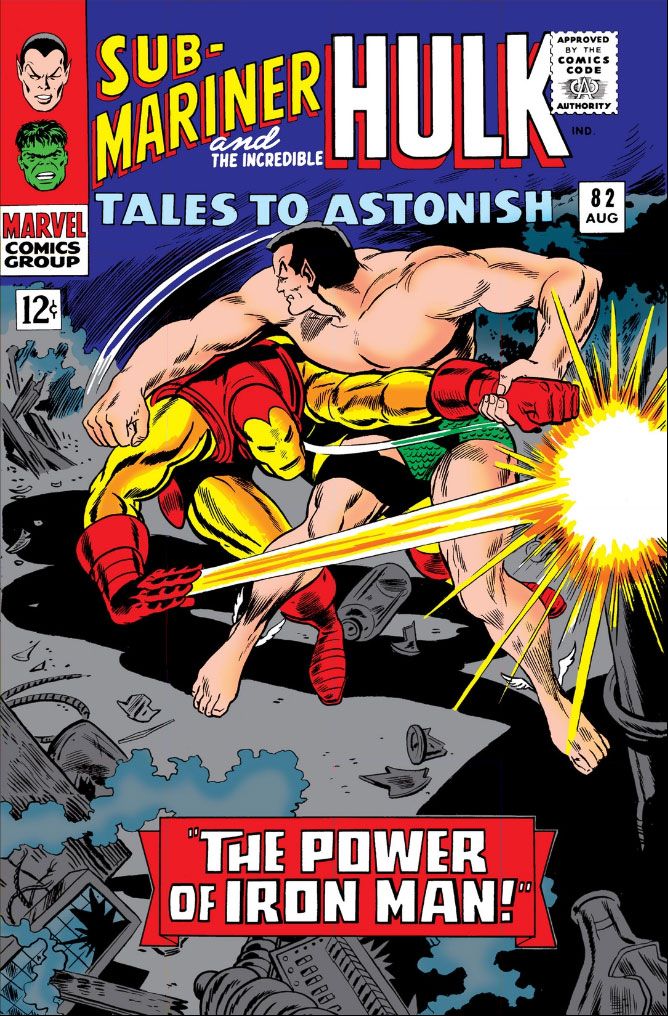
Tales to Astonish #82 (August 1966): I bought this for Gene the Dean, found Jack the King!

Tales to Astonish #82 (August 1966)  Pencils: Gene Colan,
Inks: Dick Ayers (according to Comic Vine) 
Well, that was a pleasant surprise!  I recently bought a digital handful of Marvel Comics superhero books by Gene Colan.  Some people were talking about him on Facebook the other day and I suddenly developed a hunger for his work.  And also for one of those old Marathon bars, but you can't buy those on Comixology. 

Anyway, my appetites aside, Gene Colan is one of my top five or six all-tme art heroes, a guy I've tried to imitate in my own art however futilely.  While I own a DC hardcover full of Batman stories by Colan, and I know he was responsible for a storied run on Daredevil, I tend to think of Colan as more of a horror artist because of his stellar art on Marvel's Tomb of Dracula and for Warren Publications.  After reading all that jazz from people way more knowledgeable than I about this stuff, I decided it was time to fill a gap in my education and study up on his superhero work.

Well, I already knew Colan for a horror master.  Love his moody, shadowy imagery and the extreme figure foreshortening because he chose very unusual "camera" angles.  He was incredibly cinematic, with a strong feel for intense drama and noir-ish lighting.  So I was really looking forward to reading this and seeing how he put that to use in one of those two-character long-underwear dust-ups printed before I was born.   I opened to the splash, scanned the credits to see who inked it (inking interests me lately) and got a surprise.  After the cover, there are only two pages of Colan in this book!  But we're not going to complain because after those two pages it's none other than Jack Kirby the rest of the way.
 
Tales to Astonish #82 (August 1966) has a Stan Lee plot and a Roy Thomas script, and it's a continuation of a fight started in another title, which is easy to confuse with this one, especially since their numbering runs so close together.  I'm talking about Tales of Suspense #80, which also has Lee's and Kirby's famous "He Who Holds the Cosmic Cube!"  I say it's famous because it's a Captain America story I read many years ago in the book Captain America: Sentinal of Liberty.  All the stories in that book are famous because Stan Lee says so.

Anyway, Captain America isn't in this.  It's just Iron-Man and Namor.  Their story starts over there, continues here in this one, then goes of into another comic.  I haven't had time to sit down and really give Tales to Astonish #82  a reading, but just from staring at the art, this story, called "The Power of Iron Man!," is a frenzy.  Just two characters duking it out.  I have no idea why, don't really care all that much.  I'm downloading it into the Comixology iPhone app as I type this, so I'll read it in those scant free moments I'm not shaking the earth and building a better future or whatever the hell it is I do.  I don't really wax nostalgic over things like two characters having a fight, or that this is "the first real inter-book crossover."  I'm more interested in the artwork by Colan and Kirby.

Despite Dick Ayers' inking, it would be obvious we've got two very different pencillers even if we haven't read the helpful credit boxes on the splash page which tell us Colan came down with the flu and Kirby had to take over.  I wonder if that's really the case, or if this is one of those cute jokey things Stan and Roy liked to use as an easy explanation for some other chain of events they didn't want us to know.  Seems likely enough, much more so than Kirby drawing the book then asking who the Sub-mariner is, but that's the claim here, too.

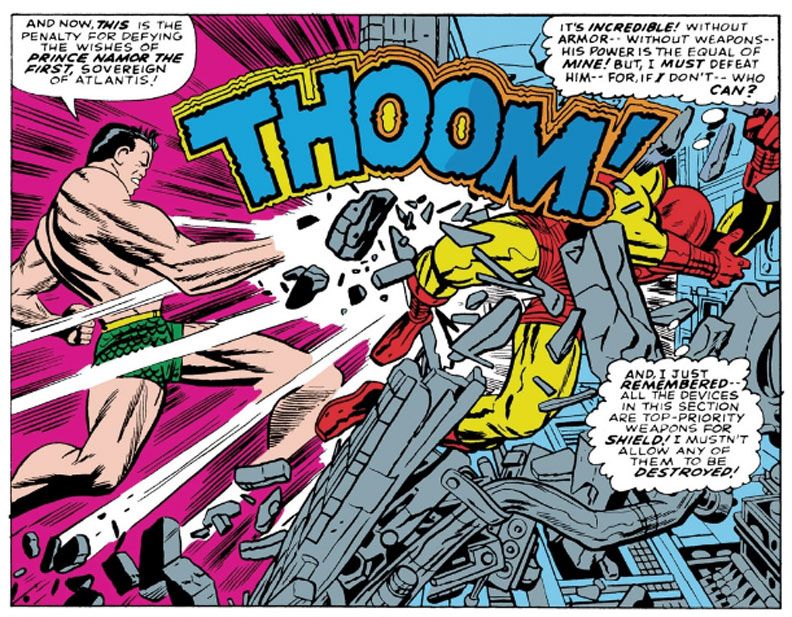
Here's where Iron Man hits Namor the Sub-Mariner so hard they both turn from Gene Colan figures...
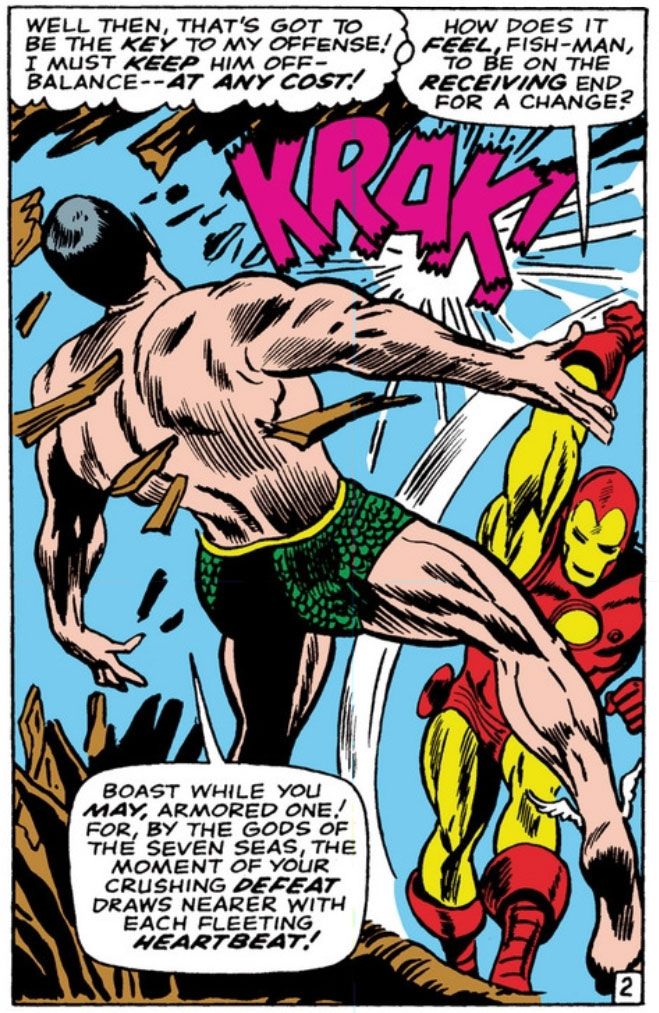
Script:  Roy Thomas, Pencils:  Gene Colan, Inks: Dick Ayers
... into Jack Kirby figures:

Thomas, Pencils: Jack Kirby, Inks:  Ayers

Jagged purple "KRAK!" is the sound of metal-clad fist striking flesh and bone chin.  Earthquake-like yellow and blue "THOOM!" is what happens when fish-guy knocks armor-guy through a wall. 

In the Colan panel, notice how Iron-Man's weight is planted on that front foot.  Most of his body is moving towards Namor in the foreground because he's put everything into one massive hay-maker of a blow, which landed a split-second or so before Colan "photographed" this moment.  Even though he's still able to talk, Namor is flying upwards and backwards with his right foot dangling loosely.  This is follow-through, the impact completed, an interesting split-second between the moments of collision and release and much closer to the latter so the figures are opening up, becoming loose-limbed and extended, although I imagine Iron-Man's left thigh is clenched because he's planted that foot and is stopping his forward momentum with it.

Now look at Kirby's panel.  This isn't follow-through.  This is the exact moment of impact.  Namor has punched Iron-Man with a more compact body-blow.  Notice the rigidity of Kirby's figure drawing here.  Namor lowers and draws in his chin, which means his chest and abdominal muscles are clenched, tense.  He's still performing the action itself.  In Colan's, taking place nano-seconds after the action, we see Iron-Man's fist.  In Kirby's, at the moment of impact, Namor's fist has vanished in a white starburst.  And Kirby either gives us two time differentials here or else that punch is so powerful, the transfer of kinetic energy has already thrust Iron-Man through the wall in exact moment Namor landed it!  It seems impossible, two states at one time, but there you have it.  Also, like Namor before him, Iron-Man flies backwards from blow, but Kirby puts his upper body into a kind of defensive posture, arm raised to protect his face, while the other arm goes limp and he appears to be drawing his legs up so that he can land in a ball on the other side.  Or the fetal position.

Colan's is kind of athletic and even graceful, Kirby's is as hard and bone-shattering as two cars in a head-on collision.

These panels come a couple of pages apart.  I just wanted to show you one of Namor's answering blows because it wouldn't have been fair to give Iron Man two consecutive shots.  The art switch is just this abrupt, though.  You get that Iron Man punch at the end of one page-- and I find very entertaining Thomas's characterization of Namor as the kind of cool customer who can fall backwards after a sock to the jaw and still find it in himself to make a sneering speech about how Iron Man's "crushing defeat draws nearer with each fleeting heartbeat"-- then the very next page starts with a Kirby-drawn panel of Iron Man shooting his "repulsor rays" right at us, the readers! 

What gives?  Aim those things elsewhere, buddy!

Since I was born a generation later than the kids who bought these issues new off the stands, stories like these were hard to find unless they popped up as a back-up feature in an annual or else in one of those hardcover collections at the library.   The ones that were constantly checked-out and never available.  Or that Sentinel of Liberty book I was just telling you about, which I bought at Waldenbooks at our mall along with one about Dr. Strange. 

We didn't have all the archive reprints and essentials and, of course, digital comics had yet to be invented.  I didn't have the disposable income to buy swanky back issues, and I probably wouldn't have been inclined to even if I did.  There were always new comics to buy.  And living in a small southern town, I was largely isolated from fandom at large and things like fanzines and mailing lists.

This means I don't have an encyclopedic knowledge of storylines predating my interest in comics, nor do I know a whole lot about the inner workings of Marvel or DC or who drew or wrote what when or where.  It also means every time I go on a Gene Colan or Jack Kirby rampage, I'm liable to find stuff completely new to me.  I like that.  The joy of discovery!  The joy of turning a page drawn by Gene Colan and finding the next one drawn by Jack Kirby!

Oh, and there's a Bill Everett-pencilled Hulk story as the back-up feature, and that looks pretty cool, too.

Monday, July 8, 2013

Hulk Cassidy and the Sundance Thing: The Early Days

Okay, actually it was just Butch and Sundance:  The Early Days without their surnames, but that didn't have enough of that pop culture fusion stupidity I enjoy so much (to the detriment of all my personal relationships).  And those two guys actually got along much better than the Hulk and the Thing.  The Hulk and the Thing are Marvel's two heavy hitters and their dust ups from the first few years of Fantastic Four are pure comic book fun.

First, you have the Thing.  A mouthy orange rock-man, the muscle and the ever-lovin' heart of the Fantastic Four.  The Thing was essentially nice.  Who the heck could hate the Thing?  Then, you have the Hulk.  In the 1960s, at least for a time, the Hulk had a command of language beyond simple statements in favor of smashing, or admonishments to puny humans to leave him alone.  He was an anti-hero hearkening back to Marvel's early years when they put out comics where Namor would show up pissed off for whatever reason and start tearing up the place.  Namor was the kind of dangerous character you rooted for only because he was fighting Nazis (only other Nazis root for Nazis), mad scientists or because he was like your own repressed child-id striking back at adult authority figures-- otherwise, Namor was angry specifically at you, the reader, for existing on land.  It's a similar story with the Hulk and Space Age-era Communists and outright villains.

With two opposing forces like these in a single comic book universe, it was only a matter of time before they clashed.  And clash they did in Fantastic Four #12 (March 1963) by Stan Lee, Jack Kirby and inks by Dick Ayers, from those fabled days when Kirby hadn't yet settled on the correct number of fingers and toes for the Hulk.  In this issue, the Jade Giant flaunts three of each, plus opposable thumbs for a grand total of fourteen digits.  Strangely enough, the same number sported by the Thing.  That's okay, because there's at least one instance of Mr. Fantastic showing six on one hand in a later issue.

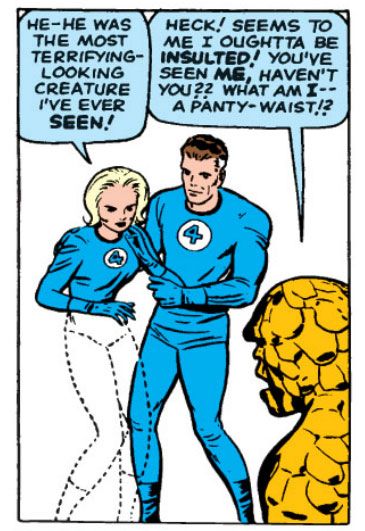
The story opens with the Thing looking natty in a tux, out on the town with his girlfriend Alicia Masters.  Within moments, things take a tragi-comic turn as they frequently do in this old Marvel stories-- soldiers on the alert for the Hulk cause a scene, an old man accidentally pokes the Thing, the Thing reacts angrily, attracts the attention of the soldiers, there's a fight as a result of mistaken identity and the Thing is publicly humiliated once again.  Why the soldiers are out looking for the Hulk is obvious-- he's a destructive menace. But why their officers sent them out without first briefing them on what the Hulk's actual appearance is something neither Stan Lee nor Jack Kirby care to explain.  And if being mistaken for a green monster in purple pants isn't pathetic enough for our orange monster in blue pants, the Thing also forgets his key to the Fantastic Four's special elevator and has to climb up the cables to get home.

None other than General "Thunderbolt" Ross (oddly appearing in an army uniform rather than one from the USAF) then comes to the Baxter Building to recruit the team to fight the Hulk for him.  To prove the Hulk's existence, Ross screens some top secret film footage of the Hulk in action, which causes the testosterone-laden male heroes-- including ostensibly mature older genius Reed Richards-- to act out their fantasies of single-handedly defeating the Hulk, while lone female Sue Storm frets about her uselessness.  At least until the men decide she's good "for morale."  Guess the Thing isn't the only one meeting with humiliation this fine evening.

The issue features the debut of a new whiz-wagon for the gang, the Fantasticar redesigned in-story by Johnny Storm, and featuring one of the many meta-moments Lee and Kirby inserted into the book in those days-- supposedly fans of the team wrote in complaining that the old Fantasticar looked too much like a flying bathtub.  The new one is a sleek Kirby creation that gives Ross a military-industrial complex boner.  The five rocket to the western desert and fight's on.

The Hulk is actually a big green herring as it turns out-- the real villain is someone called "the Wrecker" (a likely name) who sabotages our American way of life for his Commie overlords.  I don't want to spoil the story's big secret, but the Wrecker turns out to be the guy with the membership card in a communist subversive organization right there in his wallet.  Great detective work there, Rick Jones.  This leaves the Thing wondering out loud, "Just what the heck was I fighting the Hulk for?"  No reason, really, other then the very coolness of Thing versus Hulk, Thing!  Oh, and advertising for another hero even if his own title flopped.  In their first bout, our boys seem pretty evenly matched, and it's useless Sue Storm who manages to knock out the Wrecker and save the day for everyone.  Never underestimate Sue, fellas.  The Hulk, weakened by a laser beam, gives up and slinks away to fight another day.  So after all that, we don't even get a definitive answer to the question of which hero is muscle supreme in the Marvel universe.


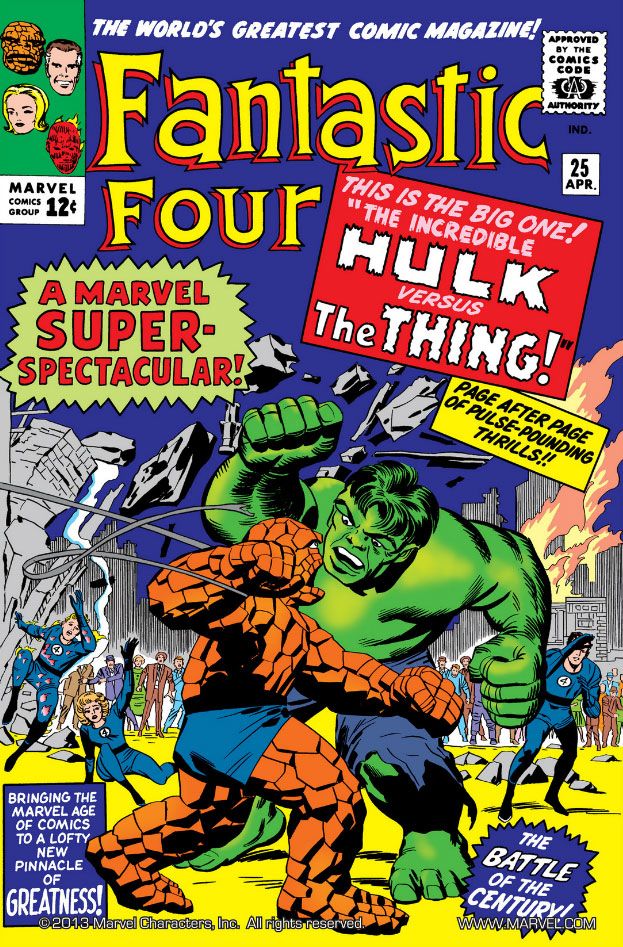
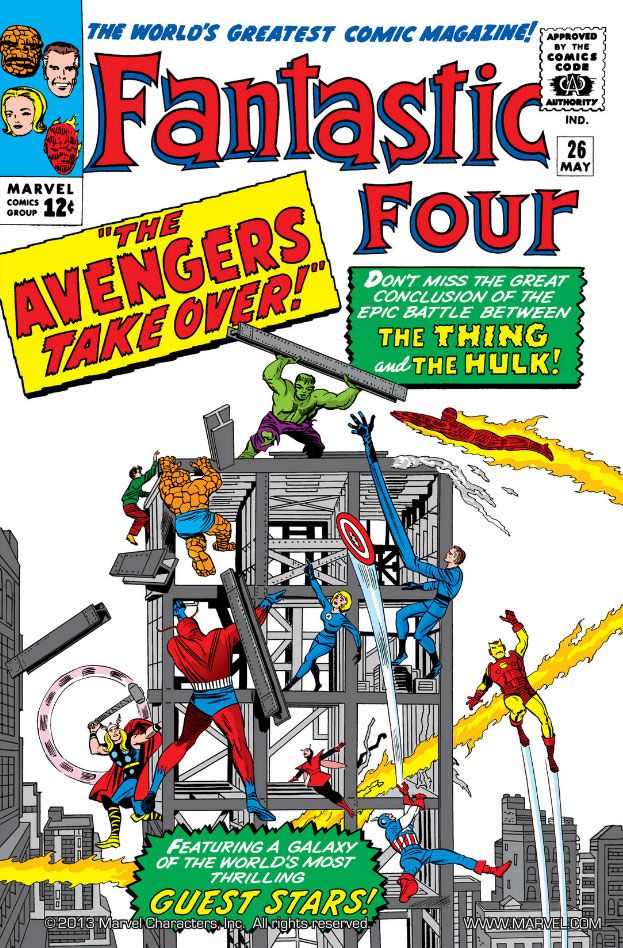
That is until a year later when Marvel published Fantastic Four #25 and 26 (April and May 1964 with George Roussos on inks this time, credited as George Bell), a story so big it sprawls over two complete issues and involves practically every other Marvel hero of the time.  I'm guessing it was Lee who crammed all the hyperbolic copy onto the cover of #25, the Man at his carnival barker's best.  This is the kind of stuff I've come to associate with the feeling of reading Marvel comics from the 60s and 70s-- a relentless barrage of overblown propaganda, indoctrinating the readers in the Mighty Marvel Mindset with phrases like "PULSE-POUNDING" and "SENSES-SHATTERING" (as if the latter was even remotely desirable).  This time the Fantastic Four don't have to go hunting the Hulk-- the big green galoot himself turns up in New York City because he's angry at the Avengers for booting him in favor of Captain America.


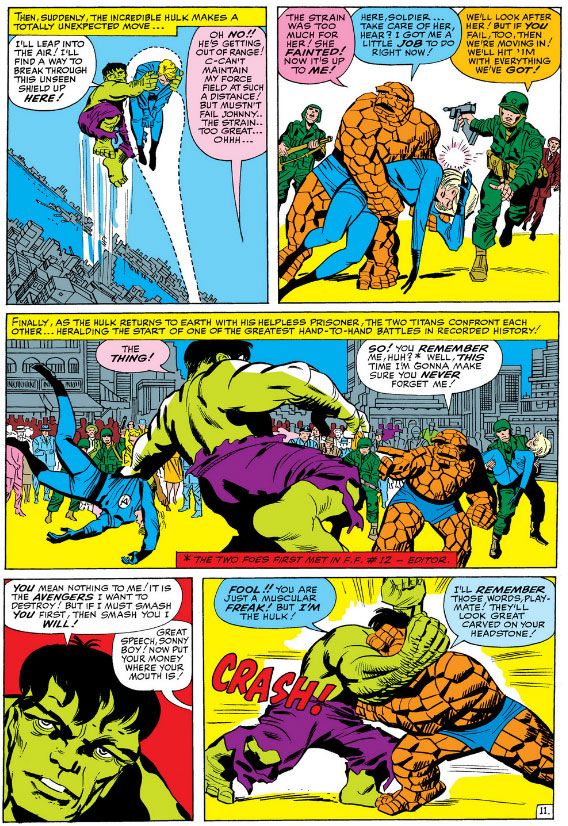
I can't blame the Avengers.  Who would you rather have on your team anyway-- a rational, intelligent strategist with acrobatic fighting skills and years of war-time experience, or an overly-sensitive rage-aholic with the strength to flatten entire cities?  No, you can't choose both.  Now imagine how well the Hulk takes your decision and you can see the problem this dilemma presents.  As if a vengeful Hulk weren't enough, the FF are fighting amongst themselves as well because the Thing refuses to drink Reed's newest cure for his condition-- which apparently was such a lab accident Reed doubts he can re-create it.  Shortly after that, Reed abruptly collapses into a coma and everyone is screwed.  The Hulk gives the remaining Fantastics a thorough thumping of the kind world champ Sonny Liston received from 22-year-old Muhammad Ali roughly a month before this issue hit the newsstands.  The Human Torch ends up in the hospital and Sue poops out when the Hulk's strength severely taxes her relatively-new invisible forcefield powers.  This leaves the Thing to fight alone, which he does for most of the issue until the Hulk finally grinds him down.

Never having been defeated outright before, the Thing spends a moment questioning his purpose in the world.  But he figures it out-- as a hero, his job is to take any beating necessary, even if he fails or dies as a result.  Once again, it's the Thing doing the world's dirty work, overmatched and underappreciated, a lone man against impossible odds and, unlike Liston, he decides to come out of his corner at the bell.

While poignantly scripted by Lee, this is Kirby storytelling, a moment where his contributions as a full-fledged writer-- not simply co-plotter and certainly not merely penciller-- breaks through most obviously.  You can't help but feel Kirby working autobiographically here, concerns of an intensely personal nature filtering through the fat line screens of the 1960s four-color printing process.  So characteristically Kirby is it, he'd return to it again and again-- most memorably in "The Death Wish of Terrible Turpin" from New Gods #8 (April 1972), but also as a running subtext to the entirety of his run on Kamandi the Last Boy on Earth.

Together, Lee and Kirby develop this theme over the course of #26, where we see Richards attempting to come off his sickbed to help the Thing and the Human Torch flying back into the fray despite being decked out in asbestos bandages from the beating he took in the previous issue.  Captain America shows a lot of the heroic stuff Kirby-style as he uses judo he learned in the Army against the Hulk, even though he knows he's involved in a massive weight-class mismatch.  So Captain America proves himself as an Avenger, but it's the Thing's example that inspires him and provides the story's beating heart.

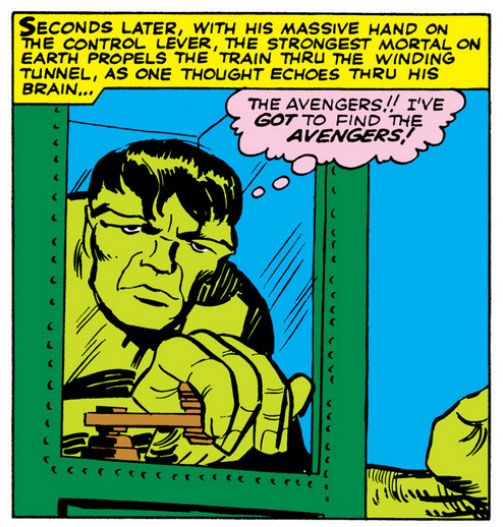
It's a fairly funny story as well, and I don't mean just inadvertently (for example, when the Hulk calls his weaker alter-ego "Bob" Banner for some reason-- we'll cut him some slack; he has a lot on his mind what with needing to file for unemployment and all that).  At one point the Thing threatens to use his powers of pathos against the Hulk.  My favorite sequence has the Hulk hijack a subway train and drive it to the Avengers' mansion.  Kirby treats us to a sweet shot of a mopey Hulk at the controls which  reminds me a lot of that Shaquille O'Neal commercial where he's too large for a sporty convertible.  I'm pretty sure Lee and Kirby got a huge kick out of tossing in this particular scene.

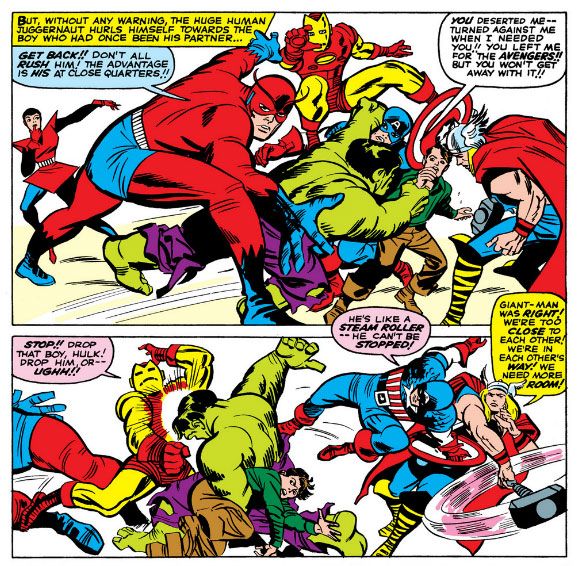
Speaking of the Avengers, they finally make the scene and flub their fight against the Hulk because there are just too many costumed clowns running around.  It gets worse when the fully recovered Fantastic Four pitch in, and then the two teams start a jurisdictional squabble.  Reed Richards suggest the Thing decide whether or not the two teams join forces since he's the one who's been doing most of the fighting and carrying the story on his rocky shoulders.

The Hulk and the Thing come together atop an under-construction building and trade blows.  Teenager Rick Jones pulls a Sue Storm and saves the day by tossing a gamma pill into the Hulk's mouth.  The Hulk falls into the river, but it's Bruce Banner its currents sweep away.

Two complete issues probably seemed overblown in 1964, but in our current era of drawn-out, marketing-driven storytelling I'm amazed how economically Lee and Kirby run through this plot.  Today's version would require an editor's meeting of a dozen or more thinkers to plan it (they'd spread it over an entire summer's or even a year's worth of titles priced at $2.99 or $3.99 each, interrupting whatever storylines the various writers have going), feature some supposedly-beloved secondary character like Rick Jones having his arms ripped off on-panel (the blog-o-sphere goes wild!) and climax in an over-sized special edition.  Entertainment Weekly would give it a B+ and declare it "the superhero epic of the season" while praising it for the repeated flashbacks to Bruce Banner's abusive childhood.  They'd also go nuts over the photo-realistic art, consisting mainly of pages of wide panels stacked broken by frequent full-body portraits of various involved characters, all of which would quickly show up in online auctions with hefty price-tags.


Lee and Kirby neatly pack it all into two standard-sized issues, minus any hint of gore but with plenty of action and characterization.  It also lacks today's trendy Joss Whedon-style dialogue where every character is a quip-making machine, but apologizes by having the Thing call Thor a "lantern-jawed, long-haired lummox."


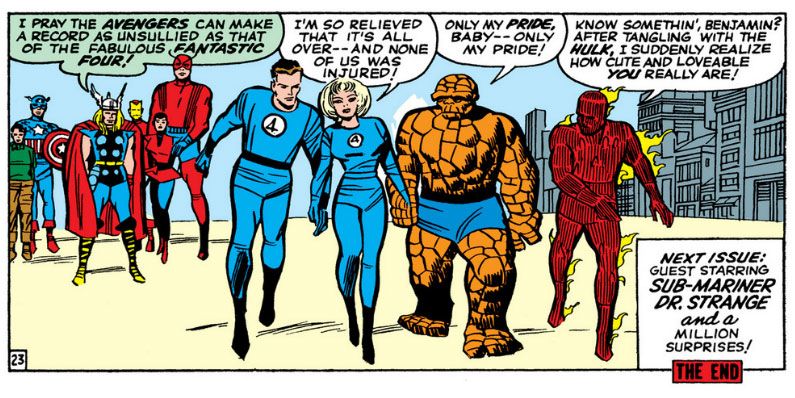
And yes, Sue, no one was injured.  Except the Thing and your brother, Johnny (twice!).  And probably Iron Man when the Hulk head-butted him right in the chest.