Friday, September 30, 2011

When Batgirl Discovered Art


Batgirl and the homeless guy.  This is from Batgirl #51 where Dylan Horrocks introduced the concept of Cassandra Cain shocking people by saying inappropriate things.  The story containing these moments is a two-parter in which Poison Ivy has tricked this goofball artist wannabe into helping her create a mind-controlling garden the heart of Gotham City.  It opens with your standard comic book action sequence-- Gotham police chasing some generic criminal scumbags in cars, Batgirl swoops in from some impossible angle and saves a homeless man from being run over.  It's not really integrated into the plot, so it's more just a framing device that sets up an interesting concept only to give it up in favor of a standard and somewhat stale super-villain plot.

The book's artist uses a chalk-line device to outline each panel featuring the homeless man because his thing is making lines on the sidewalk with a piece of chalk.  These frames-- reminiscent of some of the stuff the art team on Alan Moore's Swamp Thing series used to play with-- set him apart spatially and conceptually from the chase, in much the same way he's extraneous to the main story, with quick cuts from oblivious artist to the car chase, right up until Batgirl appears.  Then Batman shows up and explains to her the man is creating a map of a fantasy Gotham City, one from out of his head.  Batman sympathizes with him, describing him as "an old man who should be in the hospital," and telling Batgirl he also wishes the real city could be like the man's pretend one.


It's pretty neat thinking of Batman as being so aware of Gotham City he knows all about the psychosis of one of its street people.  There's almost an element of caring on his part.  And truly, Gotham is Batman's city.

Digression-- Batgirl sports enormous breasts during this sequence.  Later, she's shown wearing only a towel, and after that a little black dress; by this time, her breasts are a more natural proportion compared to the rest of her body.  Perhaps her costume has some sort of breast-enhancement padding.  I suppose it could be some kind of armor, but it apparently cups, lifts and separates.  It's as if Batgirl gets her armor from the Combat Goddess collection at Victoria's Secret.  It's not a superhero comic with a female protagonist if it doesn't feature at least some objectification, I suppose.  The towel scene is more than a little gratuitous-- okay, Batgirl showers after she fights crime, hooray for hygiene, but the conversation could have taken place at any point before or after she cleaned herself up.  As ridiculous as this is, I'm much more horrified by the bizarre facial construction throughout.  The rendering is so hit-or-miss, Cass's forehead also changes sizes frequently.  If this were a movie, they'd have hired six different actors to play each role.  Digression ends.

The chalk guy disappears until the end of #52, after Batgirl, Oracle and Batman defeat Poison Ivy and return Gotham City to its normal, overrun-with-crime-hellhole state.  On her way home or to fight more criminals, Batgirl swoops over the guy, and he's still at it, making his chalk map.  Batgirl, a little wiser in the ways of art, gazes down at him in passing, an ever-so-slight and enigmatic smile showing through her mask.  The Rick Leonardi art is a major improvement, more consistent with character appearance and with stronger storytelling.


What was the purpose of the chalk artist?  Was he there to contrast with Poison Ivy's "art?"  Just symbolic of a more pleasant Gotham that can never be?  Perhaps if the story had been more about Batgirl's reaction to this concept and a deeper exploration of the nature of art itself, with the Poison Ivy plot tied more into that, he might have had more of an organic fit.  More of a story-driven purpose.  As it is, he serves as a marker for another idea that really demands a more thorough investigation, rather than more super punch-outs and rope-swinging.

Can you imagine what it would be like to explain art to Cassandra Cain?  I wonder if Barbara took her to an art museum following this adventure.  I really wish that had formed the crux of the next issue.  It would have done more for her mental health and development as a well-rounded person than that time Barbara took her on a cruise, made her wear a bikini and exposed her to the male gaze like one of those parents who teach their kids to swim by tossing them into the deep end without warning.

It's not certain art would register on Cass, the purpose of it all.  Try to explain to her the concept of "art for art's sake," for example.  Much less the whole of art history.  Would she prefer abstraction to the representational, or vice versa?  As someone who can "read" people's movements, would she read the artist's intent?  Could she look at visible brushstrokes on a canvas and "see" the artist's technique, or the moment pigment hit pigment?

What would Cass's own art look like?  Would she draw something childish, yet disturbing?  Two crude stick figures, one with pointed ears and a cape and the other toting a gun, a small figure cowering between them, in response to Barbara's request to "Draw your family?"  Maybe a looming Barbara, threatening to crowd a smaller figure completely off the page.  Or would she be able to recreate the physical movements making up the art methods she saw in the museum?  Or how about action painting? 

I can see Cass getting really into Jackson Pollock.  Flicking paint on a huge canvas on the floor, pouring it, splashing it.

Something violent, something savage, paint splashed and slashed across the canvas.

Too bad we'll never get to see that.

Monday, September 26, 2011

When Batgirl Said "Sweet Patootie"


Dylan Horrocks wrote some of my favorite Batgirl issues and some of my least favorite.  He often had some wonderful ideas, like Batman and Batgirl working out their father-daughter issues in the way that works best for them-- brutally beating up on each other.  These are people who believe in tough love in its most literal sense.  He also had some crappy ideas, like Barbara Gordon constantly enforcing gender stereotypes on Cassandra.  It helped a lot when he had a seasoned pro like Rick Leonardi to make solid storytelling choices; landing him on pencils was a big plus for the title.  If only some of the fill-in artists had been up to the task...

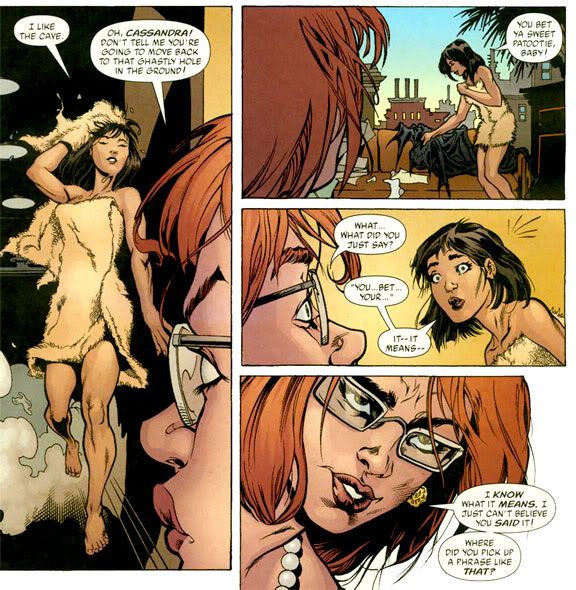
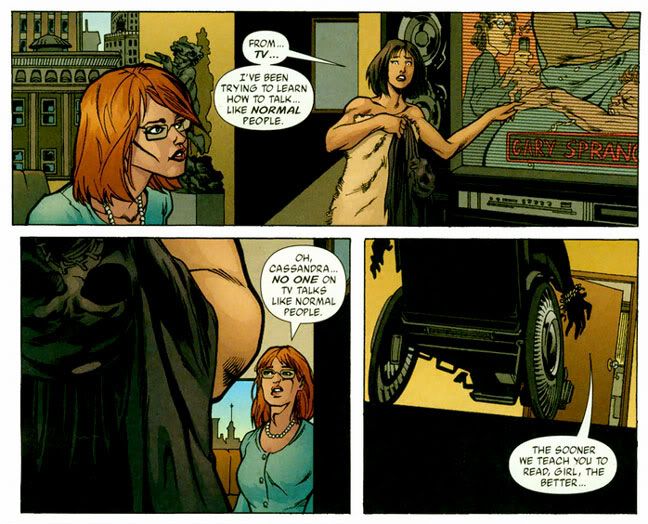
Having Cass shock her friends as she experiments with language learned from television in #51, "The City is a Garden," (2004) is a pretty clever notion.  Horrocks didn't do a whole lot to develop it in subsequent issues, and what little it appears in the comic could have been handled a whole lot better in the artwork.


The clumsy storyelling here really murders the gag.  The artist has to think in terms of acting-- read John K's blog entries about this in animated cartoons; it's almost the same thing-- and Cass's shocked, silly, scared expression, doesn't match up with Barbara's fairly mild remonstration.  It adds a forced quality to the joke.  It's oversold, and previous artists characterized her as fairly unemotional even when baldly lying face-to-face with Batman.

So this response rings false.  After all, it's not as if she's being screamed at, which would be a huge mistake on Barbara's part anyway.  Conversation with someone like Cass would be like running with scissors-- you might get away with taking chances 9 times out of 10, but that last time will spill some blood.  Why not have Cass respond with a serious, determined look on her face:  "That's what they said on TV, how could it be wrong?"  Or a mere inattentive shrug, as if to say she doesn't really care that much, talking is such a useless burden anyway.  Which would leave Barbara exasperated and at a loss, thinking over more strategies to get through to this girl.  After all, how do you deal with someone like Cass, explaining things that would be self-evident to someone more conventional in comprehension and response?

Also, I find Barbara's insistence that no one on TV talks like normal people pretty ironic coming from a character in a superhero comic.  Horrocks deserves extra points for that, at least.


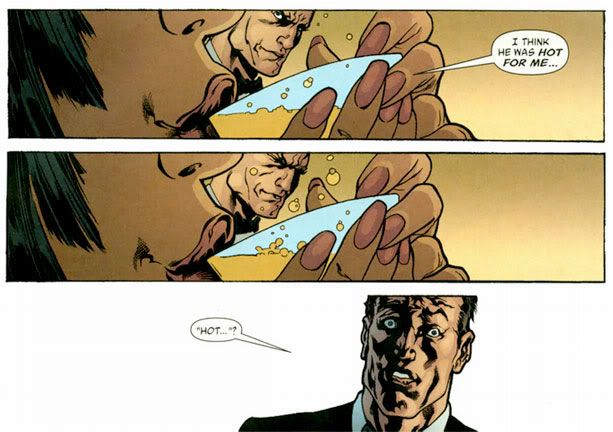
The second instance is more successful.  Instead of showing Cass's reaction, we only get Bruce Wayne's.  And he's flabbergasted.  Why does it work this time?  Because it's easy to imagine Cass, experimenting with language, not realizing the impact of word choice.  If this comic really had the strength of its convictions, she might even have said, "I think he wants to fuck me."  To that end, we really don't need to see her full face because the dialogue is enough to convey her naivete.  Batman's reaction is a little over the top-- I think it's much more likely he'd just grunt or narrow his eyes and make a mental note to have Barbara instruct Cass later-- but at least it's appropriate.

I only hope that's apple juice in that glass.  Isn't Cass only about 18 or 19 at the most in this issue?

Well, Cass-the-language-shocker is right on.  As a once-and-future ESL teacher, I often noted the difficulty English learners have with nuance.  A friend of mine-- whose English is actually pretty good-- once responded to a compliment I paid her by blurting, "It's a LIE!"  She meant it as a humble deflection of my flattery (which I meant sincerely), but it came out much stronger than she intended, without modulation.  We both ended up laughing about it.  Another time I was dating a girl with a somewhat lower fluency.  One night, we had to walk in a driving rain to a convenience store to bring back snacks for her friend.  The entire length of that walk, my semi-girlfriend griped, "Fuck the selfish bitch!  Fuck the selfish bitch!"

And that's the kind of thing I can see Cass doing without her even realizing it.  I wish writers had done a bit more thinking about this.  They really missed a chance at enriching her character, adding some comedic flourishes to her personality.  But hey, DC, it's not too late.  Fabian Nicieza handled her dialogue pretty well in two issues of Red Robin in which he got to use Cass, before the reboot.  It still works even with the more language-experienced Black Bat.  Or inexperienced, if she's going to be 5 years younger or whatever the heck's going on over there right now.

Besides picking up on the usages of friends, where else would an illiterate increase her vocabulary besides movies and TV?  Imagine if Cass gets into Batman's Complete Laugh-In DVD set.  We might get some hilarious scenes where she tells villains to "Sock it to me," or stuns Batgirl-Barbara by demanding she "Bet [your] sweet bippy."  Or catching a little TV Land and telling Damian Wayne to "Kiss mah grits!" or "Sit on it!"  What if she caught an HBO comedy special and started working a little blue?

One second thought...

Sunday, September 25, 2011

I always did prefer Veronica to Betty

Veronica presents Kevin Keller #1.  Why is this?  Come on, Betty, get with the 21st century.  Actually, Archie Comic Publications has managed to become relevant again.  I mean, assuming their books ever were in the first place.  Archie has always changed with the times-- going from clean-cut teen in a bow-tie and a v-necked sweater vest in the 1950s to a clean-cut teen in a wide collar and bell-bottoms in the 1970s.  Then they did those "Archie gets married" stunts and the "Archie New Look" stories, but despite the character's history spanning the years of the Civil Rights Movement, the Vietnam War, free love, Watergate, energy crises, disco, punk, New Wave, Reaganomics, hip-hop, grunge, nu-metal, the Internet, the War on Terror and the current recession, his creators and fans haven't exactly been on the forefront of social change before now.

On the other hand, there's always been something comforting knowing that as superheroes went all ironic and self-loathing on us, visiting characters with rape and other forms of ultra-violence complete with lovingly-rendered gore while constantly tearing down their universes only to restart them again in a weird cycle of diminished returns, Archie remained slung chastely between Betty and Veronica, that classic Riverdale dichotomy-- sweet girl next door, somewhat scheming and vain yet generally nice rich girl.  Reggie's still preening, Jughead's still eating and eating and eating.  Midge and Moose are still madly in love.  Mr. Weatherbee continues to sport his pince-nez.  And Kevin Keller is a welcome part of the gang.

I was quite the Archie aficionado when I was a kid.  Those Archie digest books-- especially Archie's Double Digest-- you could buy in the check-out lane at the grocery store packed a lot of reading fun for their cover price.  When I had my tonsils out, the youth minister at my church brought me some of those Spire Christian Comics starring Archie which confused me on one hand but made me feel validated in my comic book reading as well as my spirituality on the other.  As I grew up, I grew out of Archie and into things like... well, real literature.  And the occasional Watchmen type book.  The affection remained, though.

This is a big leap for them, and yet they're doing it in the same ol' gentle Archie way, lightly, humorously and with respect for the characters and readers.  That's what continues to comfort about the Archie books.  They're taking some hits because of the perception they're staid and representative of an America past.  Fluffly kid stuff.  And they are that.  Which is why I like this so much.

So I want to take a moment to give the Archie folk a little praise.  Because while other companies have seemingly gone out of their way to disappoint me in the last few years, during that same time frame Archie Comic Publications hired Misako Rocks-- I'm a big fan-- to write some stories for them, and now this.  It makes me feel once again I didn't waste precious play time reading about Riverdale when I was a kid.

Happy National Comic Book Day!

It's finally here!  National Comic Book Day!  The turkey is roasting in the oven, the cranberries are doing whatever it is cranberries do, Wonder Girl is dancing around with her headphones on while Robin, Speedy and Kid Flash glower unappreciatively from along the far wall.  I didn't get you anything.  Sorry.  I've just been so busy reading old Teen Titans and back issues of Batgirl while pretending the DC reboot doesn't exist.  Also, my hours have been severely cut at work-- I'm a bad employee, I'm rude to everyone and my attitude stinks-- so I don't really have the money to buy new comics for deconstruction/review/mockery/gifts for my reader.  Tightening the belt, loosening the shoes, selling my toupees.

But I do have some great stuff coming up.  There's yet another entry about Cassandra Cain, some Planet of the Apes nonsense, possibly a visit with Mars's top teen and so forth.  More importantly, October will be our 2nd Annual Spookey Month here at When Comic Books Ruled the Earth as well as my Super-Gaijin '76 blog.  We'll be celebrating some gruesome horror comics along with that wonderful punk combo from Hamamatsu, Japan, Spookey.  In the meantime, in honor of Gnarrk, please enjoy this NBC promo featuring Phil Hartman as the Unfrozen Caveman Lawyer:

Saturday, September 24, 2011

Gnarrk: Smartest of the Teen Titans


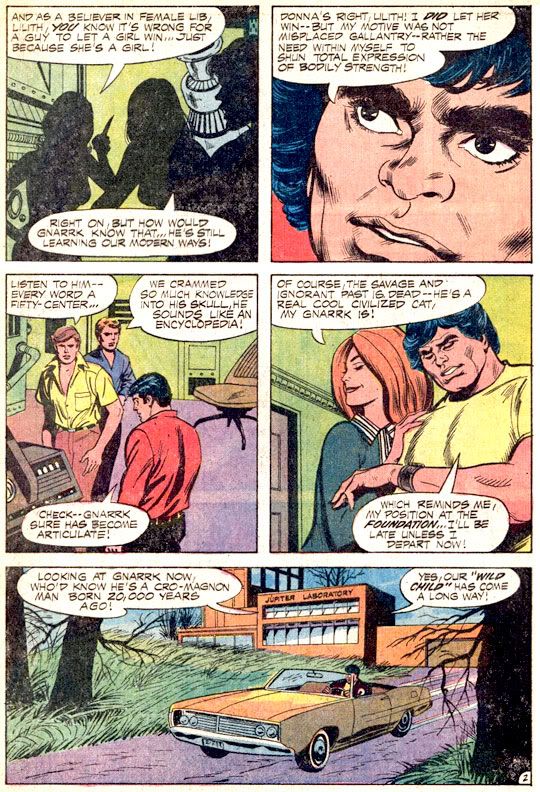
We've pretty much established the original Teen Titans are no brain trust. No think tank. Even by the standards of typical teenage behavior, the Titans are a pretty dim-witted bunch. With the addition of Gnarrk, a Cro-Magnon ("Early Modern Human" or "Anatomically Modern Human" in today's terminology) teen from 20,000 years ago, their collective intelligence quotient took a mega-leap upward. Unfortunately, as we see in this page from Teen Titans # 39 (1972), the other male members of the Titans find Gnarrk's vocabulary troubling.  From his pose and facial expression, Robin takes it particularly hard.  See, growing up in a circus family and then becoming the ward and partner of Batman left him with little time for things like education and self-esteem, or developing and expressing ideas that aren't simple re-wordings of things he's just heard.

What Gnarrk should have said in the second panel is, "Donna's hip to my scene, Lilith, baby.  I wasn't making like some crazy Sir Lancelot on a Camelot trip.  My bag is taking it easy with the muscle stuff and using my noggin, dig?"

Friday, September 23, 2011

I tried Dark Horse Digital the other day and I didn't die!


That's right.  I've entered the digital age of comic book consumption.  No more glossy covers and the ever-present danger of receiving a paper cut so severe I have to go to the emergency room and risk contracting that nasty flesh-eating bacteria strain our local hospitals are rife with.  The only reflections interfering with the pure joy of reading a comic book are the ones on the monitor glass, instead of on the shiny, coated paper.  But I'm only reading Dark Horse's free digital offerings because I'm broke.  No money.  Zilch.

My first digital comic?  The first issue of Gilberto Hernandez's Speak of the Devil, which begins as the mysterious story of a young gymnast who dons a smiling devil mask and black clothes to spy on her neighbors.  Why is she doing this?  Who are all these people?  At first it seems Hernandez has simply created an intriguing little world, kind of insular and suburban with a lot of those bizarre touches he brings to his Love and Rockets stories-- the ones with all the nude sex with naked people having sex with other naked people without any clothes on.

Obviously, there's a lot more to Gilberto Hernandez than just nekkid getting-it-onness.  His Palomar stories form a multi-generational epic with dozens of richly developed characters spread out over time and place.  Speak of the Devil eventually turns into a story about an ultraviolent crime spree.  I know this because I read one other issue of this in print form several years ago.  I bought it relatively cheap during the Free Comic Day sale at Blister when it was in Harajuku, something I'd completely forgotten until researching a little more about Speak of the Devil for this blog post and coming across a very negative review.  Somehow I'd blocked it out of my mind.

Ordinarily, ultra-violent killings stick with you.

Lesson learned?  When you're reading the works of a writer-artist who created as one of his early signature characters a stigmatic punk, did some X-rated work during the early 90s porn comic boom and recently sent a couple of low-rent Martin and Lewis imitators to an alien world, you have to expect dark twists and turns from time to time.  Hernandez has never been one to shy away from depicting the lows of human behavior along with the highs.  I've never known him to wimp out on a story.  Also, along with his more calculated work, he has this kind of experimental, stream-of-consciousness mode where he follows characters all through the various shock corridors down which they care to traipse.  I get the idea the stories are telling themselves and Hernandez is only recording them with his brush.  And I, for one, love stream-of-consciousness and surrealism.

Speak of the Devil is as twisted as any of the other more experimental stories he's written, those surreal tales of decadence and violence that would make David Lynch go, "Whoa, careful there, buddy" and tug uncomfortably at his collar?  The first issue reminds me of Blue Velvet and its small town with so many secret bedroom worlds of drugs and violence uncovered by a protagonist with a strong voyeuristic streak.  The other issue was more like Natural Born Killers, with more killing added.

This is particularly fitting because it's also a metatextual tale, the "true story" behind a movie in which one of his characters-- Fritz from High Soft Lisp and other stories-- stars.  In his poem "The Two," W.H. Auden writes of a green field coming off like a lid, "revealing what was much better hid," but Gilberto Hernandez has no problem showing us these things in startling clarity with his clean, direct artwork.

But yeah, digital comics.  What about those?

It took me a few minutes of clicking back and forth to figure out the interface.  This isn't a flaw in the design; it's the product of my technical incompetence.  At first I was frustrated with these dark bars covering some of the dialogue at the top of the page.  Eventually, I learned these go away when you move the cursor to certain spots on the screen.  The drawbacks are eye strain from staring at a computer screen and the intense isolation of each panel which detracts a bit from context and storytelling.  When you read a printed comic book, you're still aware of the relationship of the panel you're currently reading to the others around it, and its size and shape within that relationship affects the "cinematic" feel of a page-- that the events are unfolding as actions, rather than as a grouping of related but frozen tableaux.  With the Dark Horse interface, this effect is almost-- but not quite-- eliminated, creating a stronger focus on the panel.  You end up absorbing more information from it, at the cost of most of what you'd get from the whole page. 

You can look at the entire page, but it appears very small and the text is unreadable.  I can see this eventually affecting storytelling in much the same way the increasing popularity of trade collections caused writers to telescope their stories into arcs and pace them so the story beats fall with certain financially-desirable page counts.  With the best writers and really compelling story arcs, you're not losing a whole lot.  With hacks, you're actually getting ripped off if you bother with the monthly magazines because they're padding; you're getting less storytelling for your three bucks.  But then again, they're hacks so their stories by definition can be no better than mediocre and therefore aren't worth reading in any format.

When writing print comics that companies will also publish digitally, writers and artists might choose proportional rectangular panels of various sizes for different effect, and asymmetrical or odd-shaped panels-- or in our best-case scenario, even the current lazy-ass "widescreen" pages with lots of squished horizontals-- could become a thing of the past-- who wants to put just a section of a panel on a page?  Or two out of an action sequence of four?  That would severely inhibit e-readability!  But with planning, the skilled creators could still get various pacing and impact effects on the printed page and intensify them for e-version, which would result in something closer to the weird hybrid of literature and movies the best comics usually are.   Even now it feels like a failure of imagination to make web comics and constrain yourself with the pretense that you're making a printed page.  Although I may do that one day myself.

But how will these new comics that work both in print and digitally come about?  Don't look at me!  When someone gifted beyond my kindergarten-level artistic skill and thought process decides to pull an Orson Welles and gifts us with the Citizen Kane of digital comics, then we'll all know.

Actually, do look at me!  'Cuz I can dance!  Check it!  Woo hoo!

Tuesday, September 20, 2011

Congratulations, DC! I knew you could do it!


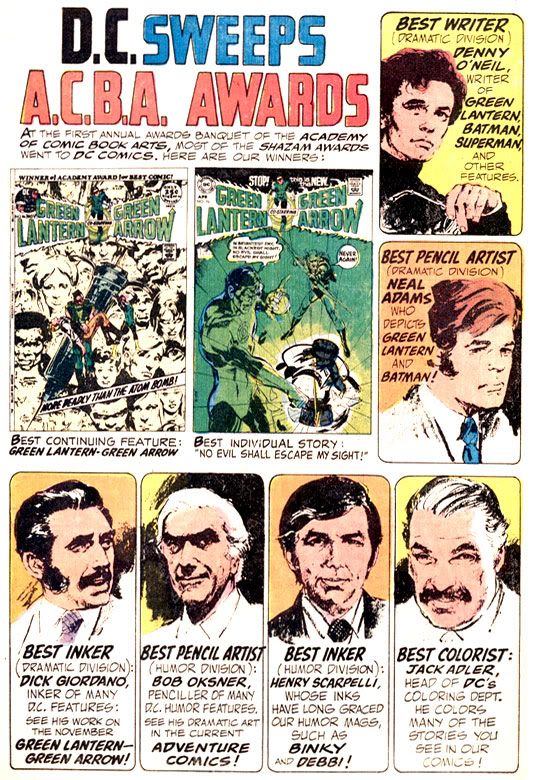
In the olden days, the people who made your comics were all middle-aged and wore ties, except for Denny O'Neil, who wore a turtleneck.  He's thinking, "Hurry up and draw me.  I've got stories to write.  But first let me take off my glasses for a slightly casual, candid look."  I'm going to steal that pose for my author's portrait, only I'm going to hold a pipe.  Why a pipe instead of glasses?  Why not?  Why so glum, Neal Adams?  Is it because in order to fit the copy in your panel, you weren't able to draw the back of your own head?  Someone just said, "Hey, Dick!  Have you finished that job for Detective?"  Bob Oksner looks cool; kind of a Doc Brown vibe, but snappy and not disheveled.  I'd like to think his hair was really that startlingly white in real life.  Henry Scarpelli later added his actor son, Glenn, to the Archie universe.  Jack Adler started working at DC in 1946 and retired in 1981.

PS:  Blogger wouldn't allow me to add "Denny O'Neil" to my tags.  Guess I'll never write about his work again.