Remember that horrible clown doll from Poltergeist? You know the one I mean. This story features his trans-Pacific pen pal:
The price of these canteloupes is pretty frightening:
Here's a hard-working guy trying to be a good father. Too bad he can't get it the right way 'round:
Don't hold your breath waiting for Tommy Lee Jones and Will Smith to show up. By the way, Tommy Lee Jones is the face of Boss coffee here:
And last but far from least:
And that is that! Enjoy your night of horrors, then join us here in November as I once again start hoppin' down the Cindy Lee trail with more Secrets of Isis reviews starring Cindy Lee. I'm going to review every single one and toss in more fun stuff from the DC comic as well.

Showing posts with label Japanese punk. Show all posts
Showing posts with label Japanese punk. Show all posts
Wednesday, October 31, 2012


October is Spookey Month: Let Doug Moench and Richard Corben show you how to trick-or-treat!
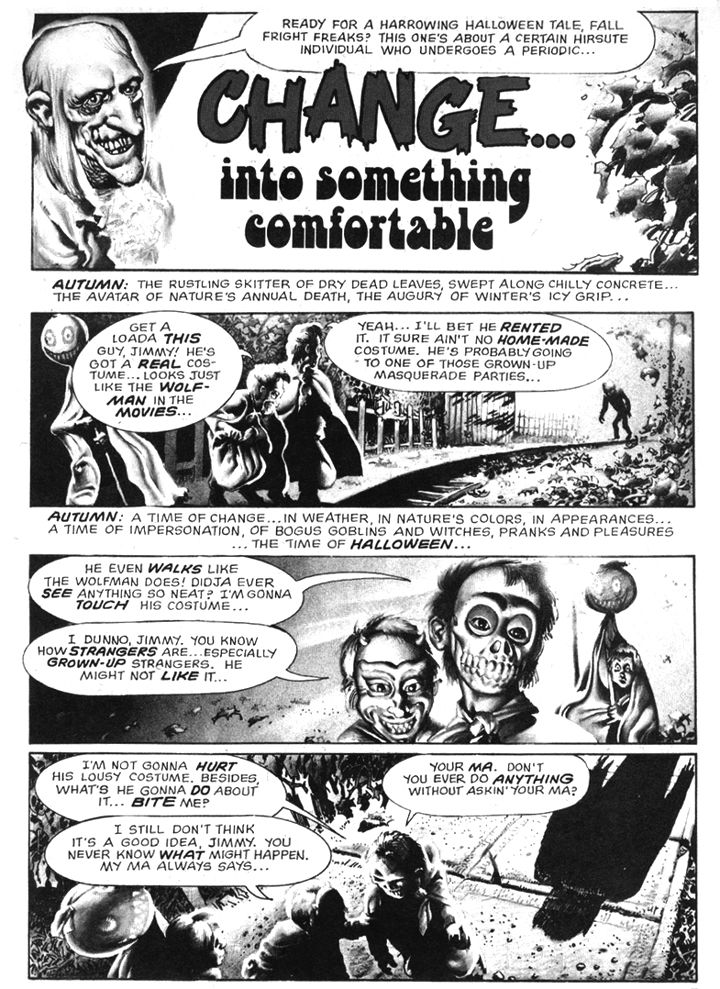
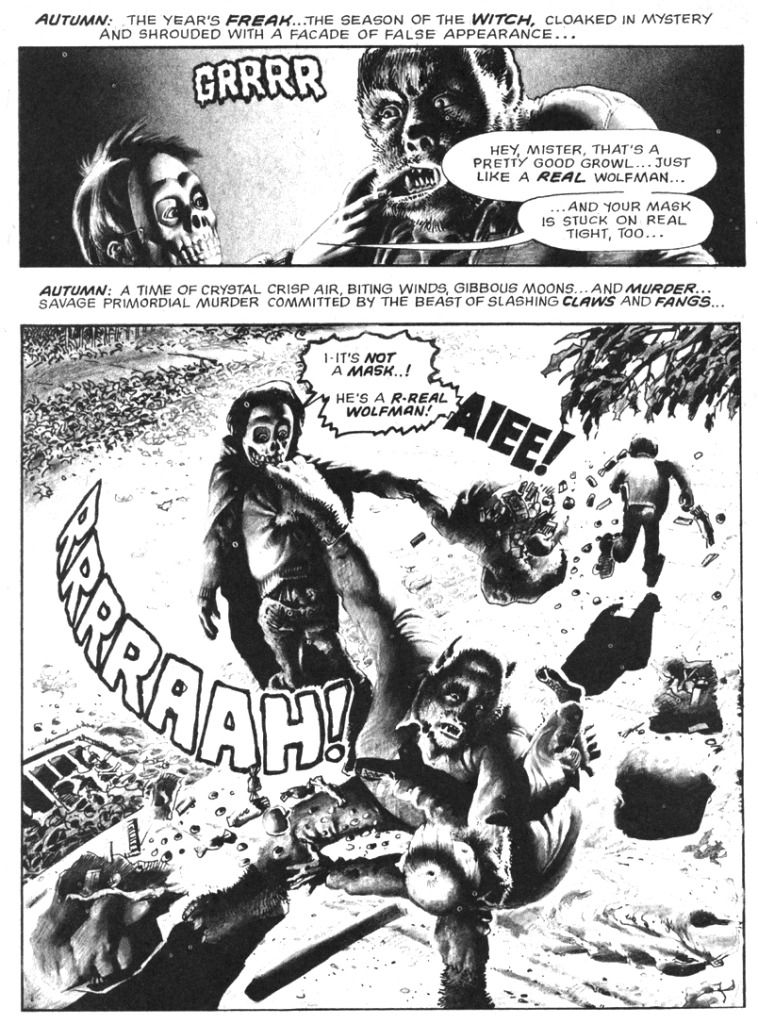
Yes, Halloween is a fun holiday, but you should exercise at least a little caution when out trick-or-treating. Go in a group, wear a costume with reflective tape so motorists can spot you, go only to well-lit houses. And most importantly-- don't pull on a werewolf's lip. These are a few simple safety tips brought to you by Doug Moench and Richard Corben in their horror-comedy classic, "Change... into Something Comfortable," which appeared in Creepy #58 (December 1973), a "special Halloween horror issue" (so it says right there on the cover). While I didn't particulary enjoy "The Slipped Mickey Click-Flick," I'm a huge fan of this little seasonal-flavored gem.
It starts with a real werewolf ripping some smart ass kids to shreds and ends with a sweet twist I find both irresistible and hilarious. I mean if you've ever wondered what creatures of the night disguise themselves as on Halloween, here's your chance to find out. "Comfortable" is sort of a companion piece to Corben's even more hilarious "Lycanklutz" from Creepy #56 (September 1973). That earlier full-color romp features a somewhat luckier werewolf in a medieval setting with some surprisingly anachronistic products available for sale. By contrast, our contemporary, kid-killing monster in "Comfortable" strays into EC territory with tragic results. I could have hit you with "Lycanklutz," but this one is all about Halloween and disguises and has those melodramatic Moench narrative captions. You can read it in the Dark Horse Creepy Archive Volume Twelve.
Come to think of it, you can read them both in that book.
Tuesday, October 30, 2012
October is Spookey Month: Remember when Swamp Thing visited the Winchester Mystery House?
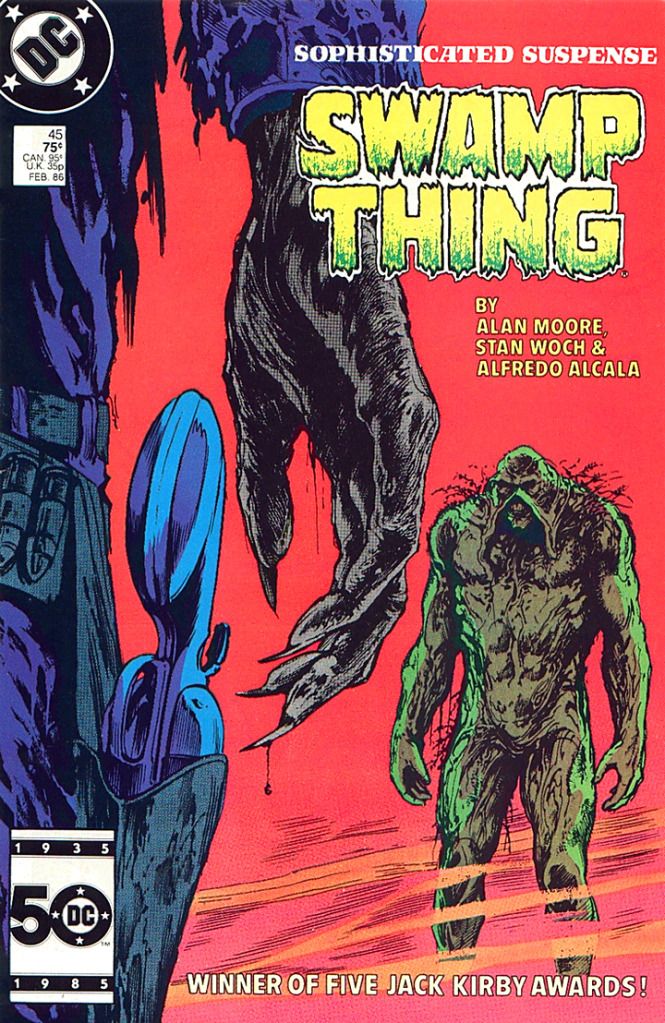
You don't remember? How about the time Swamp Thing visited the Cambridge Mystery House, the DC universe version of the same place? Rings a bell, huh? Bangs a nail. Hammers and all that. The Winchester Mystery House is a fascinating place, the life's work of Sarah Winchester, widow of William Winchester and heiress to the Winchester Repeating Arms fortune. Somehow she took it in her head spirits would kill her if she ever completed the mansion where she lived, so construction went on around the clock for nearly 38 years until Mrs. Winchester's death in 1924. Mrs. Winchester was a little eccentric (according to the Winchester House's official website, some of her employees actually thought she herself had supernatural powers), obsessed with the number 13, and her house is equally... er... original. Stairs to nowhere, fake bathrooms, windows on the inside, liberal use of redwood because Mrs. Winchester preferred it-- although it all had to be stained or painted to look like some other kind of wood because she hated its appearance. Given the house's origins and bizarre interior, it's no wonder the Winchester Mystery House has a reputation as a haunted mansion.
Alan Moore puts the Winchester lore to good use in "Ghost Dance" from Swamp Thing #45 (February 1986) with the help of some evocative art by Stan Woch and Alfredo Alcala. A group of friends enter the dilapidated Cambridge House for a laugh while the reedy, Howard Sprague-with-red-hair-looking one (he proves to be as cuckolded as Jack Dodson's character in The Getaway, as well) explains the backstory, which Moore takes directly from the Winchester House. One character even namechecks the real-life inspiration in case you had any doubts, and the NRA bumper sticker displayed on their car provides a visual clue that we're in for a lecture wrapped inside a horror yarn, one with obvious intent and an anti-gun-- or at least, anti-gun violence-- point of view, but a touch more subtle than the "Nuke-Face" environmental tale from Swamp Thing #35 and #36 (April and May 1985) with its pages full of newspaper-based collages.
This was during one of my favorite Swamp Thing story arcs, in which John Constantine, the British mystic based on Sting, takes Swamp Thing around the world to stop a rising tide of supernatural events culminating in... you guessed it... the end of the world. Moore uses this premise to explore horror mythology, but with his characteristic brilliant improvisations on familiar material. Swamp Thing fights vampires, but they're underwater. He tangles with a werewolf, but it's a woman and a commentary on our patriarchal society. In this issue, Constantine has Swamp Thing facing down the Cambridge ghosts.
And just what are these ghosts? Apparently, they're everyone in North America who ever died from a bullet fired from a gun or rifle manufactured by Cambridge Arms. Dead cowboys blast away at each other in the seance room (Mrs. Winchester would approve of its thirteen Victorian fireplaces), bullets whittling them both down to next to nothing while their battle rages all night. Little girls, murdered on Christmas Day by their father, walk innocently through the spectral carnage, their wounds like red ribbons in their hair. Buffalo stampede from a free-standing wardrobe, apparently all the way from Gunpowder Narnia. Cowards linger in the kitchens, shamed, faces hidden in hands, each back stamped with the red badge of fear. One especially tragic note comes when the narration points out what percentage of the ghosts are Native Americans.
"Ghost Dance" is a melancholy look at our capacity for violence and the tool that truly built our modern American society even more so than the car, the train or the rocket to the moon, as evidenced by Moore's repetition of the phrase, "The sound of hammers must never stop," fraught with double meaning. Guns, the love of guns and gun violence are so engrained in the American psyche, we can't even have a rational discussion about them no matter how many bodies pile up. Moore, though this fiction, might argue the victims wind up in a Mystery House of the American soul, a haunted mansion we're all still guiltily building just like Sarah Winchester and her fictional analogue Amy Cambridge, even as the sound of hammers continues to ring from coast to coast.
They have never stopped.
October is Spookey Month: Anton Arcane's Un-Men enjoy the refreshing taste of 7 Up, the Uncola
And in the interest of complete disclosure, I must admit I do, as well. And why not? 7 Up is crisply delicious. When one tires of those everyday, commonplace colas, it's pleasing to do what the Un-Men do and indulge one's palate with 7 Up, the Uncola, which isn't made using cola nuts. 7 Up is made using un-cola nuts: lemons and limes. So in this, the Un-Men and I are completely in agreement. In all other things, however...
What kind of man deliberately creates monstrosities? When Dr. Frankenstein attempted to glean the secrets of life, he meant to produce beauty but failed. Anton Arcane, on the other hand, perversely sets out to make hideous things he then cruelly dubs the "Un-Men." It's both a parody of the creation story-- God made perfection in 6 days, then rested-- and a misuse of science to tickle the fancy of an egotistical degenerate who wants to achieve immortality. To this end, Arcane sends the Un-Men to the Louisiana bayou country to capture Alec Holland, who has recently become the Swamp Thing.


Marvelous! Absolutely marvelous! Just try making something like that out of a cola nut! As we see in these exquisitely rendered Bernie Wrightson pages from "The Man Who Wanted Forever" in Swamp Thing #2 (January 1973), they succeed, at least temporarily. But even this small achievement leaves the Un-Men lost in a world that never desired them. In some ways, though, they are our children. The unwanted, the living embodiment of our worst creative impulses, our vanity in thinking we might better nature itself, our ambivalent response to mortality. In their nakedness, they are as newborns. In their cruelty, they reflect their treatment at the hands of their twisted creator, as we do with our own petty crimes and misdemeanors. Neither men nor women, they could only in the end become monsters.

What kind of man deliberately creates monstrosities? When Dr. Frankenstein attempted to glean the secrets of life, he meant to produce beauty but failed. Anton Arcane, on the other hand, perversely sets out to make hideous things he then cruelly dubs the "Un-Men." It's both a parody of the creation story-- God made perfection in 6 days, then rested-- and a misuse of science to tickle the fancy of an egotistical degenerate who wants to achieve immortality. To this end, Arcane sends the Un-Men to the Louisiana bayou country to capture Alec Holland, who has recently become the Swamp Thing.
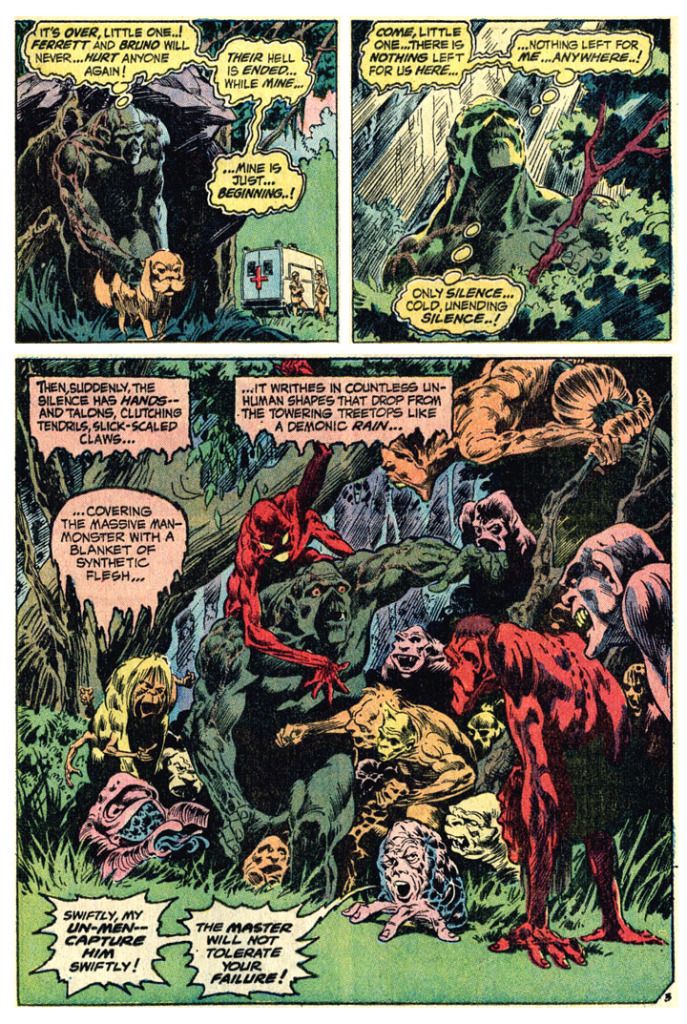
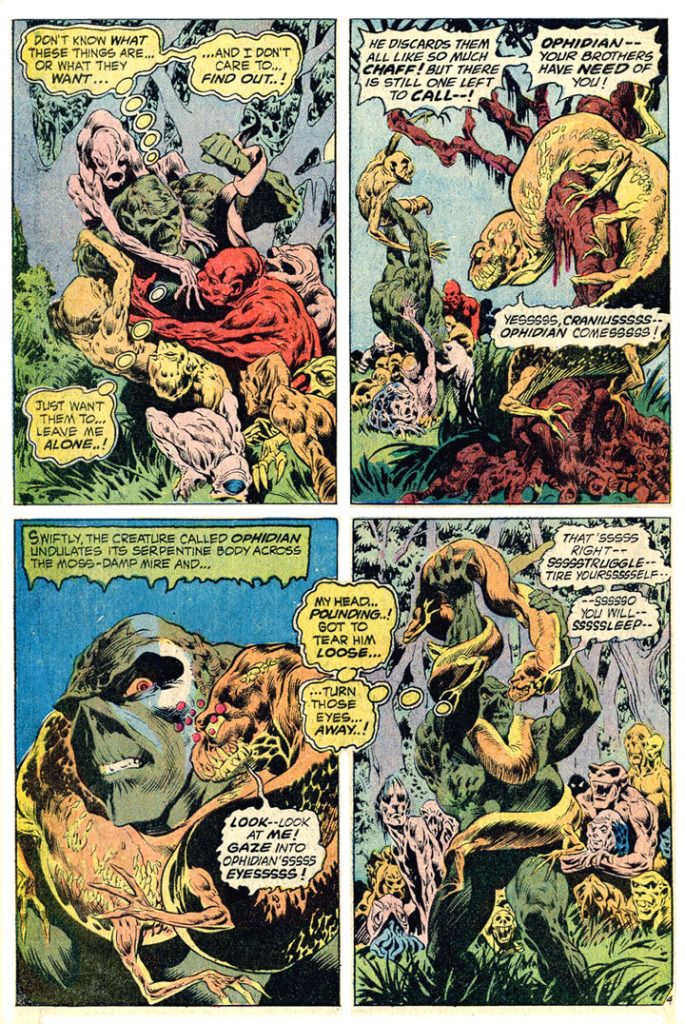
Marvelous! Absolutely marvelous! Just try making something like that out of a cola nut! As we see in these exquisitely rendered Bernie Wrightson pages from "The Man Who Wanted Forever" in Swamp Thing #2 (January 1973), they succeed, at least temporarily. But even this small achievement leaves the Un-Men lost in a world that never desired them. In some ways, though, they are our children. The unwanted, the living embodiment of our worst creative impulses, our vanity in thinking we might better nature itself, our ambivalent response to mortality. In their nakedness, they are as newborns. In their cruelty, they reflect their treatment at the hands of their twisted creator, as we do with our own petty crimes and misdemeanors. Neither men nor women, they could only in the end become monsters.
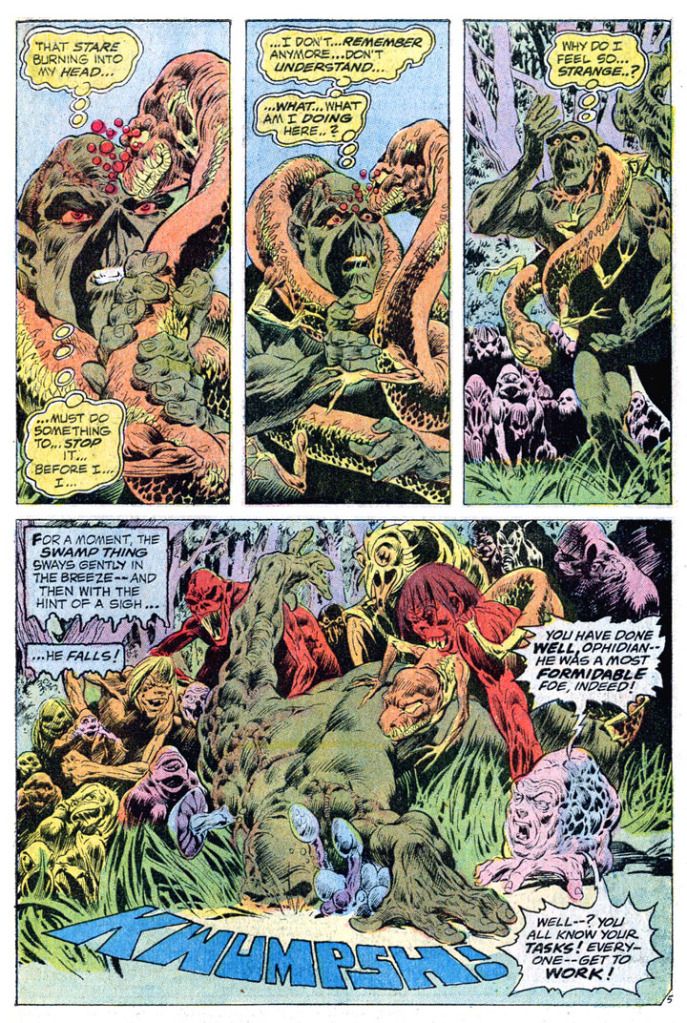
Holland himself, his soul encased in plant matter and mud, provides a further tragic note. This is before Alan Moore re-created Swamp Thing to suit his own needs-- the creature is not a transformed human, but rather a consciousness mistaken in its belief in that identity; it's a brilliant bit of revisionist storytelling that freed Swamp Thing from his ongoing quest to regain humanity and allowed Moore to take the tales along a more epic path. But for our purposes-- and those of writer Len Wein-- this is definitely the soul of poor Holland trapped within a hulking, plant-based body, isolated not only from the humanity he desperately hopes to reclaim but also human society. Lost in the night world of his new life, Holland now has more in common with the Un-Men than he does with Matt Cable, the human government agent searching for Swamp Thing just a few short miles away geographically, but a universe apart existentially. Holland is also an un-man.
Now, let's all share the delicious taste of 7 Up. The Uncola. Why, it's even prettier than a cola. Nuttier than a cola, actually! HAHAHAHAHAHA!
Sunday, October 28, 2012
October is Spookey Month: John Severin's zombie soldiers
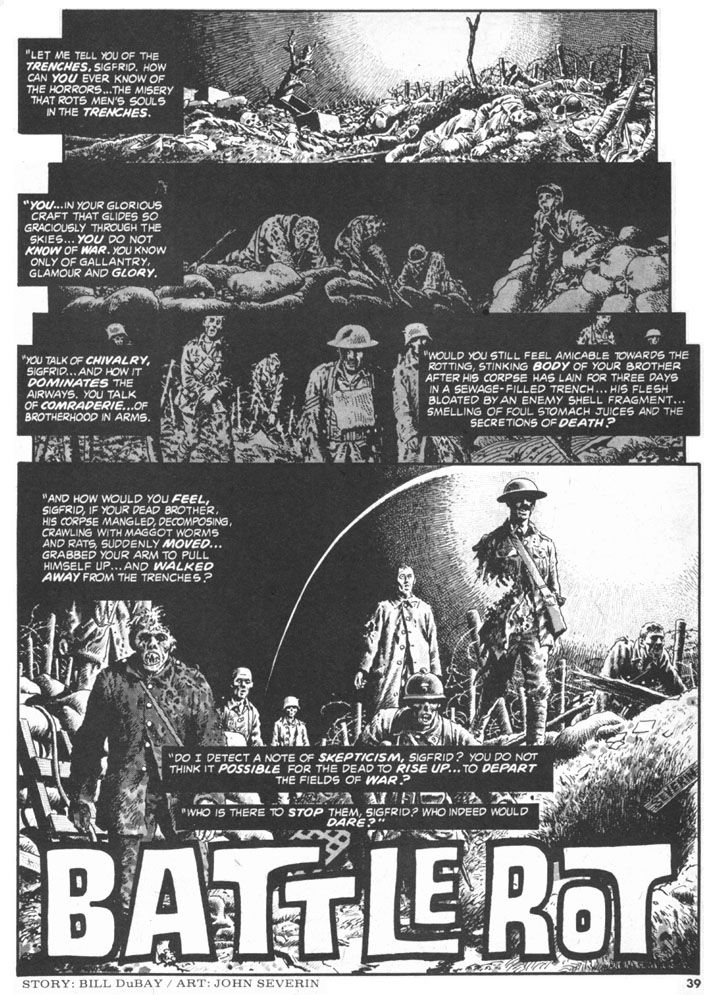
Personally, I'm sick of zombies. Well, I thought I was, anyway. Turns out I'm sick of zombies unless they're WWI soldier zombies drawn by John Severin. Severin could draw anything. Zombies, war comics, westerns, horror. Horror-war. This is the first page of "Battle Rot," a genre-bending tale from Creepy #81 (July 1976). Written by Bill DuBay, it's the story of a German flyer who holds his ground-based fellow officers in contempt, especially when one of them starts rambling on about undead soldiers wandering around the trenches at the front. Later, while villainously attempting to bomb a hospital, the arrogant pilot learns this story has its basis in fact.
"Battle Rot" would fit right in with DC's similarly themed Weird War Tales anthology comic. The final page packs a wallop, and I was tempted to share it. But I prefer the title page because it's just so haunting, evoking the climaxes of both versions of J'Accuse, the pacifist films French director Abel Gance (later a Petain supporter, unfortunately) made and re-made in 1919 in 1937 in which the war dead return; the earlier film features actual war footage and both have maimed veterans as the walking corpses, back to lay the blame for war on everyone equally. All war is terrible, but WWI with its rolling artillery barrages, frontal assaults into fortified positions bristling with machine guns, mass gassings, filthy, diseased-ravaged trenches, No Man's Land full of unburied corpses and satiated rats must have been a special level of Hell unto itself. Its mechanized, technology-based slaughter convinced a number of artists and writers life itself was absurd, was without no meaning and gave rise to Dadaism, an anti-art movement that's had a profound impact on my own sensibilities (I believe life is very meaningful, yet still absurd). It would inform the horror genre in film and literature throughout the 1920s and 1930s as well, and we can extrapolate a similar reaction to the atomic bomb in the giant bug and lizard monster films of the 1950s.
Especially here in Japan.
Monday, October 22, 2012
October is Spookey Month: "The Slipped Mickey Click-Flip"
"The Slipped Mickey Click-Flip" by Doug Moench and Richard Corben first appeared in Creepy #54 (July, 1973) and readers seemed either to love it or hate it, if the letters pages for the next two issues are any indication. And they must be; they're the letters pages for Creepy, which printed the story, for corn's sake.
But I have to admit I don't love this story. It's a pretty good story, but I don't think it works as well as it could have.
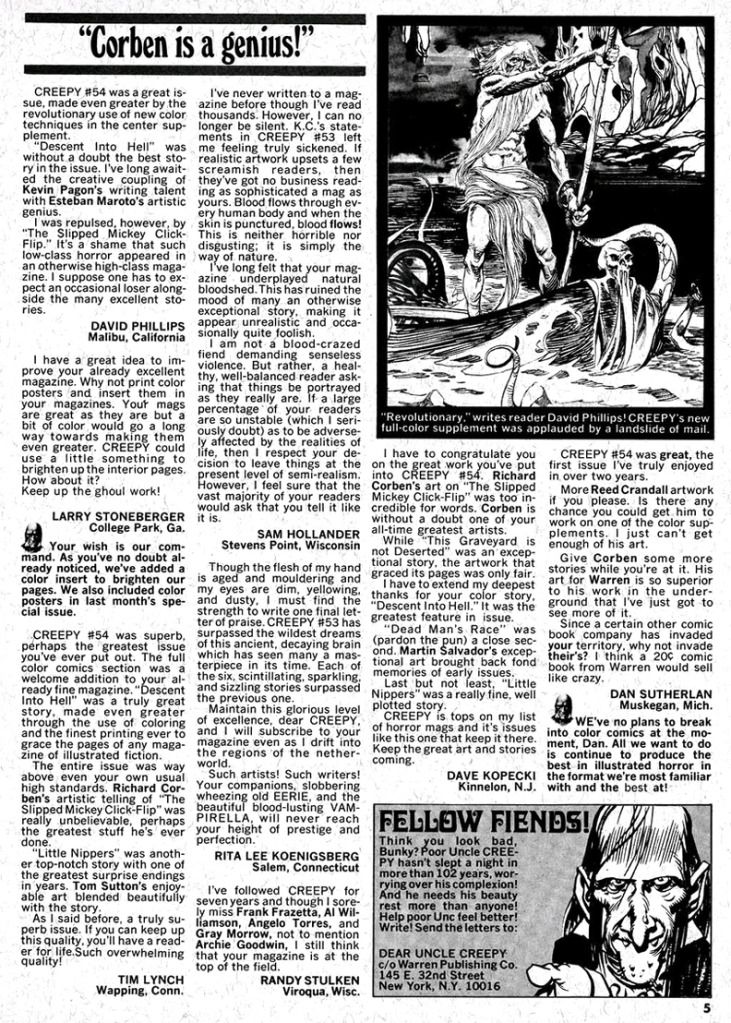
A twisted mutant named Diment (as in "dementia") takes offense at a certain Dr. Nugent for trying to cure him of his insanity. He takes over Creepy magazine and marginalizes poor, innocent Uncle Creepy himself to punish the doctor. Diment does this by way of his "Click-Lick" device, the workings of which we never truly learn; he keeps turning away from us before using it.

I'm a fan of both Moench and Corben, and I admire them for their audacity in breaking the fourth wall-- and especially Corben for visually interpreting Moench's feverish, hallucinatory script. They playfully push the boundaries of good taste-- even by the admittedly lax standards of mid-70s black and white horror magazines-- with gruesome images like eyeball-sucking butterflies and crazy-eyed trains that decapitate people. Oh, and a woman who explodes into maggots. I mean, if you like people who explode into maggots, you really need to buy Dark Horse's Creepy Archives #10 so you can experience this singular event rendered by Corben in full loving detail. Never before have maggots looked so full-fleshed as they explode out of a comic book character's torso. Gorgeous, gorgeous maggots. Still, I thank my Uncle Creepy this story wasn't one of their color sections, which the magazine experimented with during this era, usually with Corben's art.
Unfortunately, a lot of the non sequitor dialogue seems forced and ham-fisted, sometimes repetitious ("idiot" is over-worked and begs for a week off in the Bahamas), Nugent and his wife are little more than puppets to the story and we never learn enough about them to develop any sympathy for them or become overly concerned with their plight. But Diment himself is no prize, either. I find him repulsive and off-putting. I could see myself settling down on some moldy divan to listen to Uncle Creepy spin many a yarn, but once is enough with Diment. More than enough.
Of course, "Slipped Mickey" is psimply a psick psychedelic romp, not meant to be taken seriously by any means, but as a supposedly enlightened 21st century citizen of the world, I can't help but find the depiction Diment's mental illness troubling and retrograde even for its time. But I have to admit I apply this standard inconsistently. What bothers me here might not in another story.
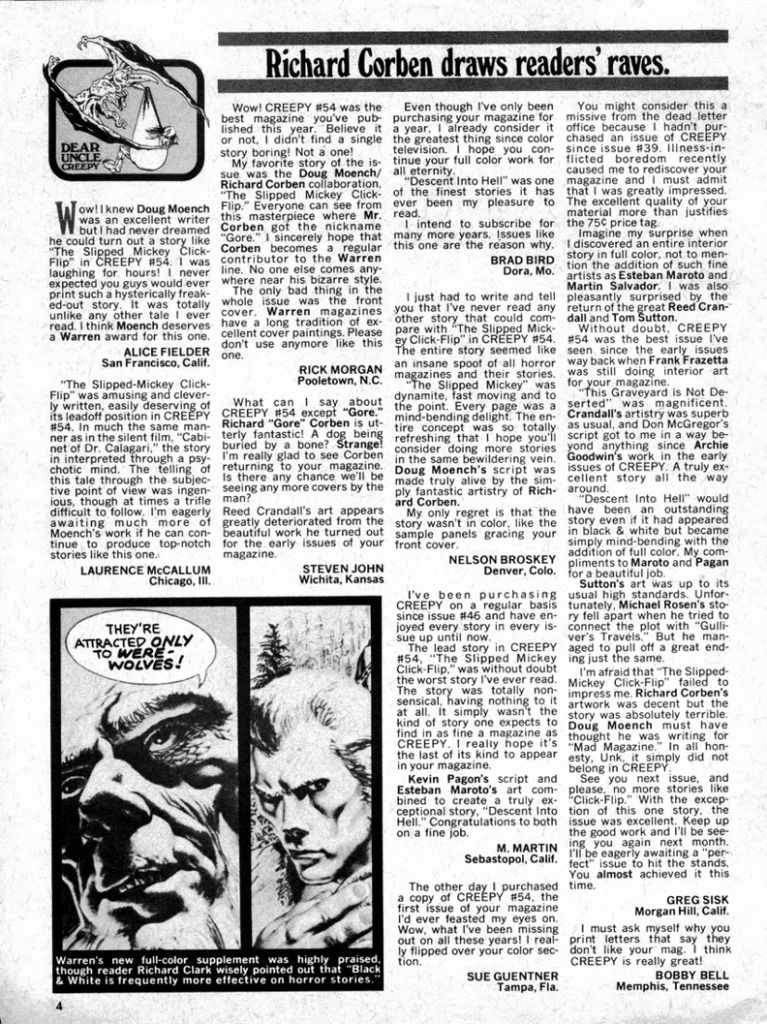
I'm a fan of both Moench and Corben, and I admire them for their audacity in breaking the fourth wall-- and especially Corben for visually interpreting Moench's feverish, hallucinatory script. They playfully push the boundaries of good taste-- even by the admittedly lax standards of mid-70s black and white horror magazines-- with gruesome images like eyeball-sucking butterflies and crazy-eyed trains that decapitate people. Oh, and a woman who explodes into maggots. I mean, if you like people who explode into maggots, you really need to buy Dark Horse's Creepy Archives #10 so you can experience this singular event rendered by Corben in full loving detail. Never before have maggots looked so full-fleshed as they explode out of a comic book character's torso. Gorgeous, gorgeous maggots. Still, I thank my Uncle Creepy this story wasn't one of their color sections, which the magazine experimented with during this era, usually with Corben's art.
Unfortunately, a lot of the non sequitor dialogue seems forced and ham-fisted, sometimes repetitious ("idiot" is over-worked and begs for a week off in the Bahamas), Nugent and his wife are little more than puppets to the story and we never learn enough about them to develop any sympathy for them or become overly concerned with their plight. But Diment himself is no prize, either. I find him repulsive and off-putting. I could see myself settling down on some moldy divan to listen to Uncle Creepy spin many a yarn, but once is enough with Diment. More than enough.
Of course, "Slipped Mickey" is psimply a psick psychedelic romp, not meant to be taken seriously by any means, but as a supposedly enlightened 21st century citizen of the world, I can't help but find the depiction Diment's mental illness troubling and retrograde even for its time. But I have to admit I apply this standard inconsistently. What bothers me here might not in another story.
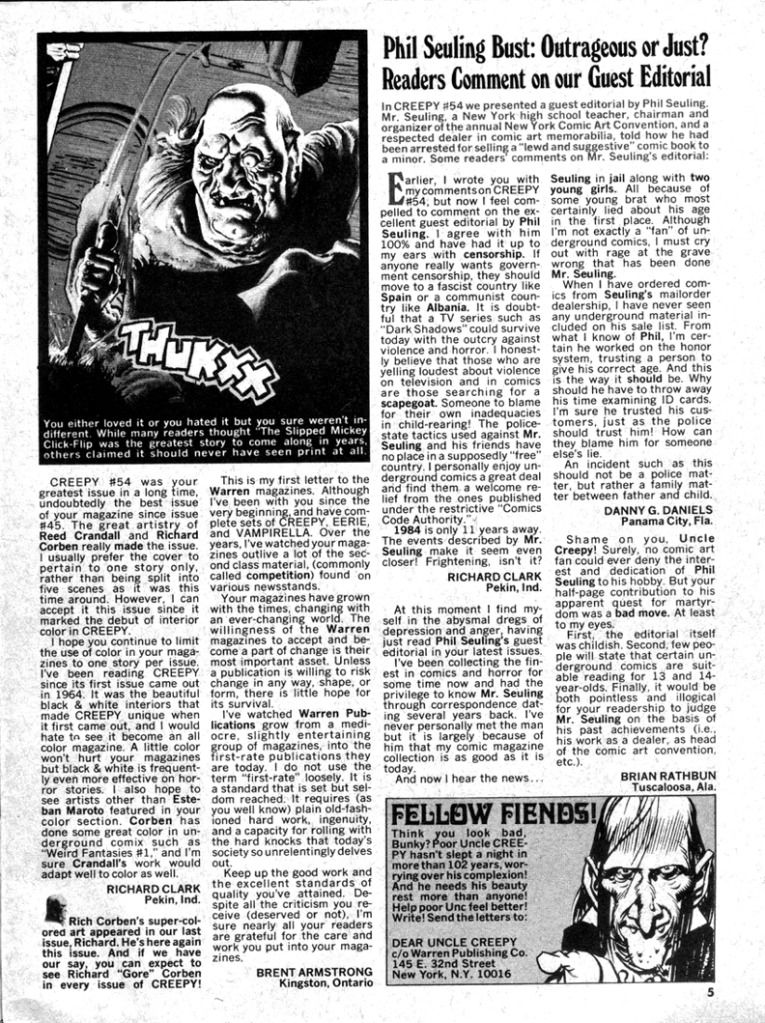
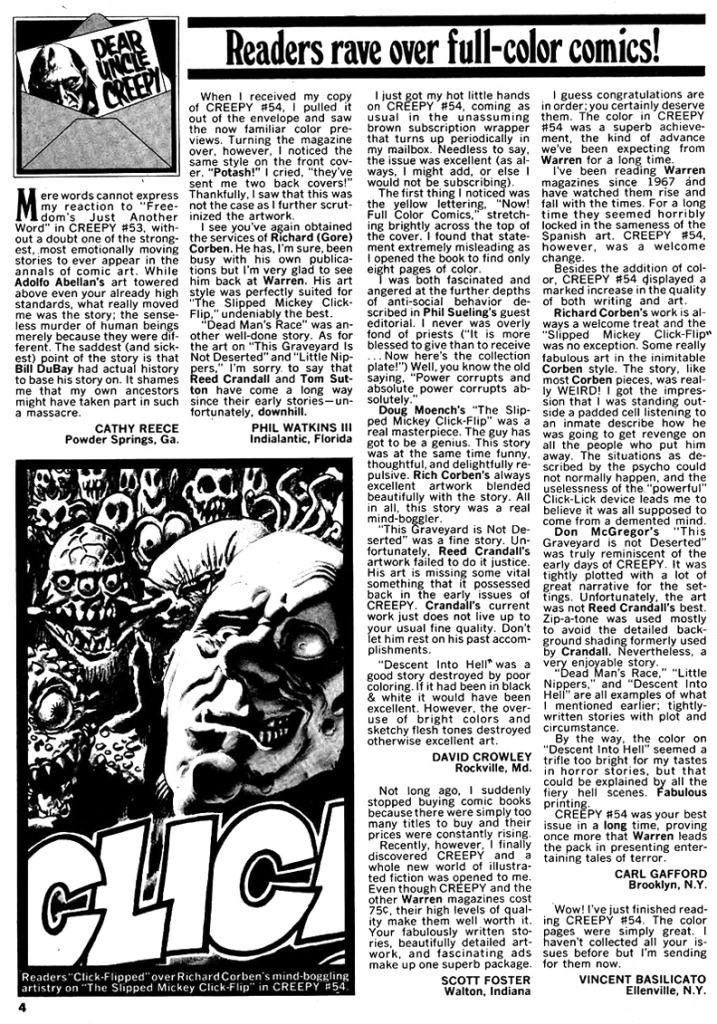
It's memorable as all get out, enough so you can find it in its entirety posted online and a few reminisces about it from fans who read it back in the day or in the years since and fell in love. After all, for a horror story the only true mark of failure is boring readers to sleep, and "Slipped Mickey" definitely avoids that. As you can see, the Creepy letters page in issue #56 (September, 1973) features nothing but praise for the story, with one reader calling it a masterpiece and Moench a genius and another praising it before opining it takes place entirely in Diment's mind (which is a comforting reading, I have to admit). Negative reaction slips into the mix with a lone dissenter, who declares it "low class horror," then intensifies ever so slightly for Creepy #57 (November, 1973) when seven letters (out of 14) mention the months-old story, five praising it and two criticizing it.
One thing I enjoy about reading the Creepy letters pages-- even though we're now years past the point their relevancy died like poor ol' Dr. Nugent, his wife and even their dog-- is the editors weren't afraid to allow some nay-saying, and in this case actually spotlighted it with a sidebar box. There's a feeling of some real give-and-take and that someone actually read the letters and put some thought into it, but also that the letters page is largely a forum for reader opinion without a lot of defensiveness from the Creepy staff, as if dare the readers to form their own opinions instead of just joining a praise-pack, that it was just as much the fans' comic as it was theirs. You can imagine what the message boards would have been like had this taken place in today's Internet-savvy comic book society.
Oh, and before I leave you to Google search for this story and read it for yourselves-- to make up your own minds about it, just like Uncle Creepy would have it-- let me tell you this is exactly the kind of story that would have sent me off the rails for a few days if I'd read it as a child. I had this stupid over-imaginative reaction to horror comics, especially stories as whimsically arbitrary as this one. I can imagine little-me trying not to think much about Diment for fear of his being real, or somehow making him emerge from the comic book into our world and wreaking havoc on me specifically. You just do not want to piss Diment off, and disapproving of him would probably be more than enough to earn his wrath
So I would have been sleeping with the lights on in my bedroom, picturing the happy little crazy train running over my head or killing my dog. DC's House of Secrets and Weird War Tales were bad enough, Marvel's black and white Planet of the Apes magazines scared me as often as they thrilled me with adventure (especially with their house ads for Tales of the Zombie and even Unknown Worlds of Science Fiction, the latter featuring a Michael Moorcock story that crosses the border into blasphemy for those of us in the Bible Belt deep South). I'm a little nervous even now, writing about it.
Thursday, October 18, 2012
October is Spookey Month: "Pavane for an Undead Princess!" (Tomb of Dracula Magazine #5, June 1980)
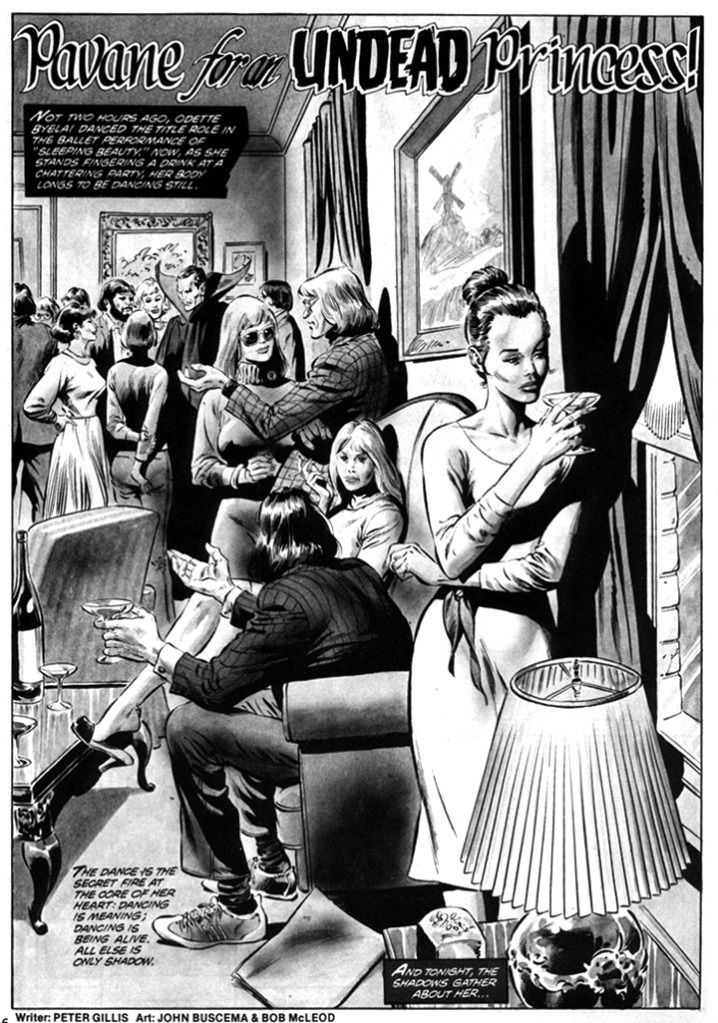
Yes, the ballerina character's name is Odette.
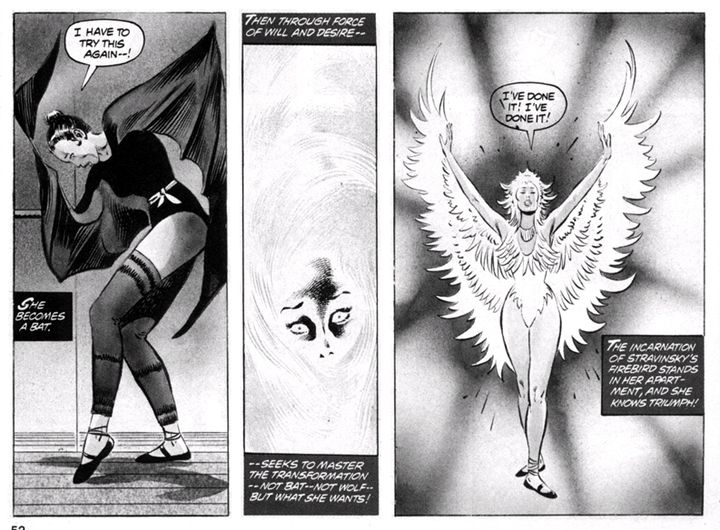
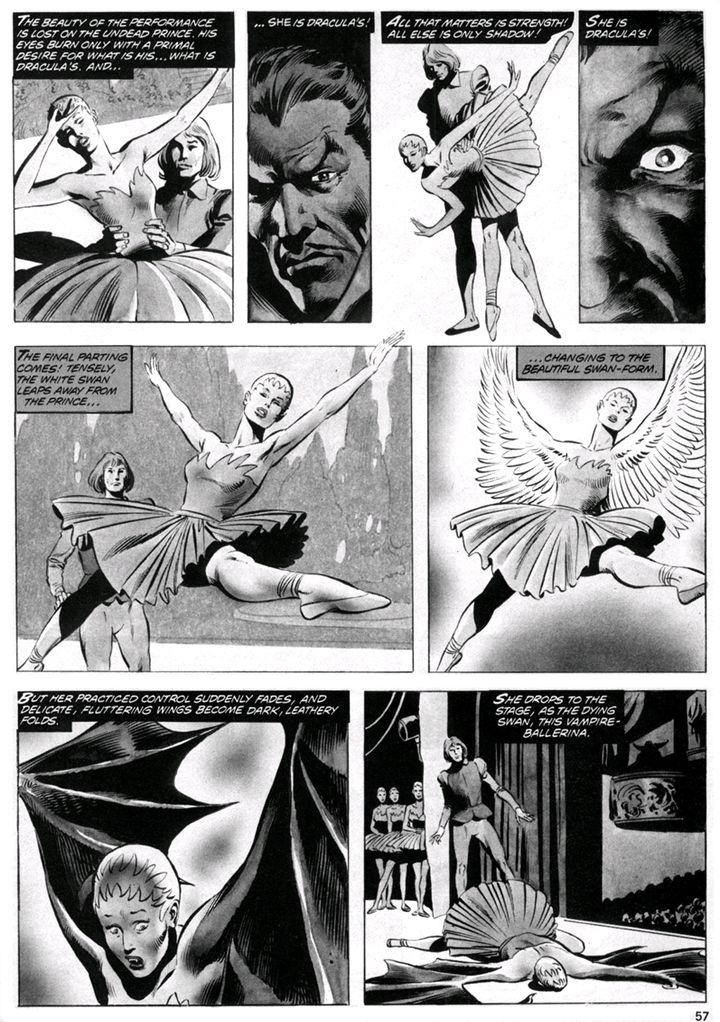
Odette, as Gillis tells us, lives to dance. We first see her standing aloof against a windowsill, gazing moodily into the night. She's not a snob or some sort of arrogant pseudo-princess. It's that she can't even enjoy an after-party with her snooty artsy friends because her muscles "long to be dancing still." Then she makes the mistake of leaving the party with a cloaked gentleman calling himself Vladimir Tepesch. If only she'd spent more time watching In Search Of... and less time mastering her art, she might have avoided her fate-- waking up later in the woods with her car missing and having to run 20 miles back to the theater where Greg, the poor man's Alexander Godunov (who had defected from the USSR just a year before this story saw publication), gapes at her and wants to know where she's been for three whole days. Remember those three days in case you ever find yourself in Odette's pointe shoes-- in classic vampire lore, the vampire's resurrection mocks Christ's; Gillis knows his stuff.
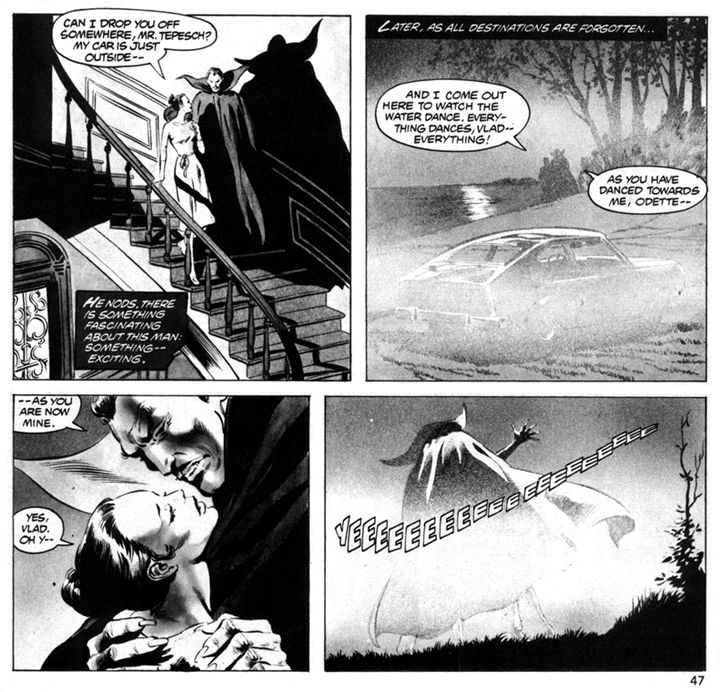
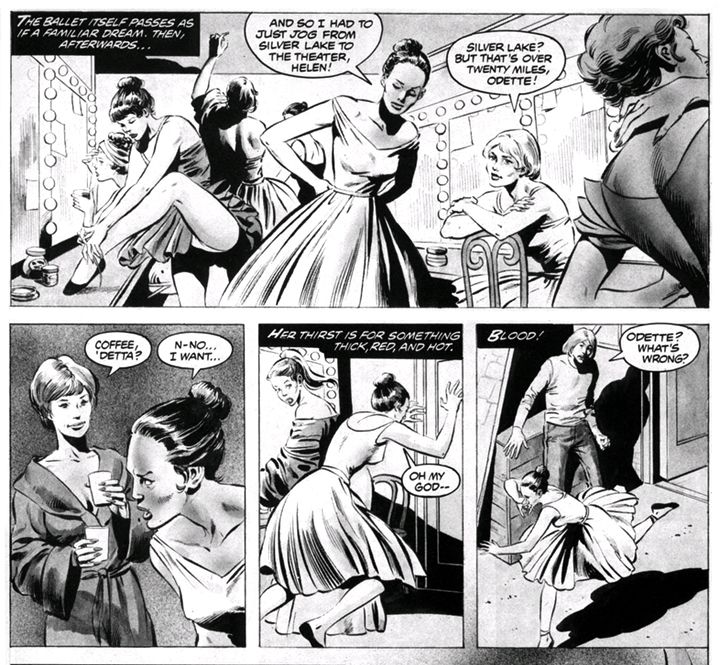
And it also requires us to ignore that losing the spirit of music thing again, but maybe Odette comes up with some way to compensate. Earplugs and strictly counted beats or whatever. It's not as if music is all that important to dance, anyway.
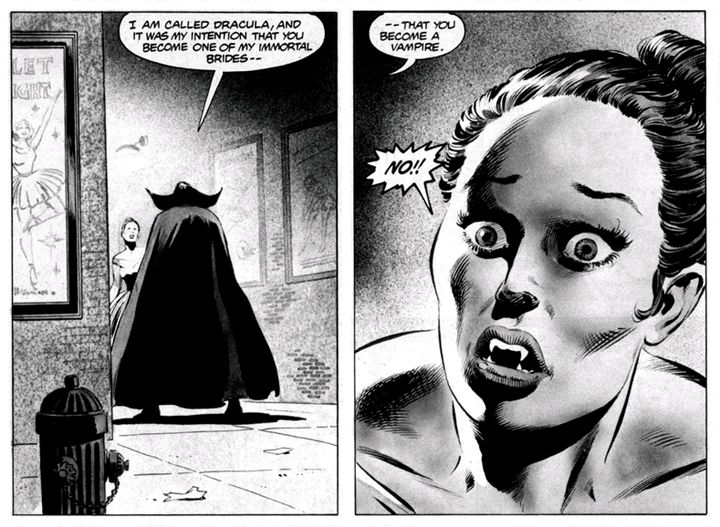
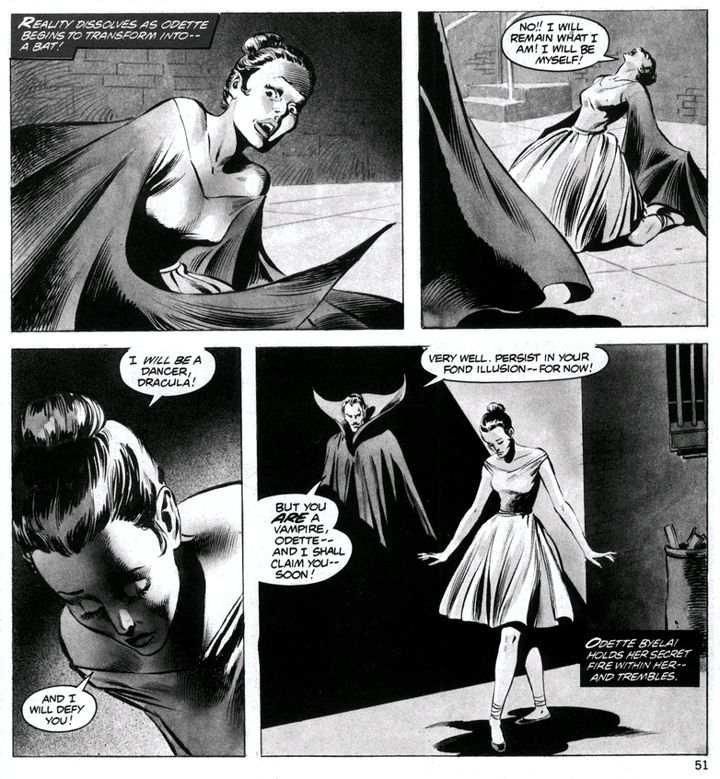
If I remember correctly, Buscema usually worked pretty loose and left a lot for the inkers to finish. As a result, this art job looks a lot more like McLeod's solo work than a strictly Buscema job might, or one inked by Tom Palmer, Ernie Chua or even Big John's preferred partner, his brother Sal. I've always admired McLeod's work on his solo efforts, and his figure construction and detail work-- such as how he deals with cheeks-- was always a bit Buscema-esque anyway, so they make a fine team here. I don't know how much of the black-spotting Buscema indicated in his pencils, but McLeod's use of dark shadows pooling around the characters or climbing the walls behind them works wonders in creating a subtle menacing mood. Dracula himself seems to loom out of darkness or carry his own shadows with him wherever he goes throughout this story, setting him somewhat apart as a malevolent force crawling up from Odette's own id as the vampire's power over her grows and distorts her life's work. McLeod also lays down gray tones and creates lighting effects during Odette's transformations with what appears to be airbrush. Reading some of these later Marvel mags, a lot of inkers seem to have been enchanted with the airbrush for tonal work as opposed to doing the traditional ink washes. I wonder if there's some Richard Corben influence going on there, or if the airbrush lent itself to faster turnaround times, or perhaps a little of both.
 |
| Bob Mackie vampire. |
Monday, October 15, 2012
October is Spookey Month: Few things in this world are as perfect as a Hellboy story written and drawn by Mike Mignola
Comicbook.com has a fun little interview with Mike Mignola where he talks about a variety of things including the possibility of Hellboy 3. It seems the third installment is dependent on Mignola himself raising about $150 million.
Actually, I offered to pay for the whole thing myself if they'll write me in as Hellboy's ne'er do well brother-in-law. Or sister-in-law. Hell, boy, I ain't picky. As long as this movie gets made, and as long as we keep getting Hellboy comics from Mignola and all the brilliant people he chooses to collaborate with. Yeah, fan-type gushing. It's been a hard day. Just trying to end it on a positive note.
Speaking of positive things-- I was a little worried Spookey might have split, but they recently posted a message that they're still together and plan to play again in the near future. Some sort of unspecified problem stands in the way, but I'm sure they'll lick it and get back to rocking. It's a dream of mine to finally see them live! In the meantime, here's another video we've probably seen before but we're definitely going to see again because it's great:
Actually, I offered to pay for the whole thing myself if they'll write me in as Hellboy's ne'er do well brother-in-law. Or sister-in-law. Hell, boy, I ain't picky. As long as this movie gets made, and as long as we keep getting Hellboy comics from Mignola and all the brilliant people he chooses to collaborate with. Yeah, fan-type gushing. It's been a hard day. Just trying to end it on a positive note.
Speaking of positive things-- I was a little worried Spookey might have split, but they recently posted a message that they're still together and plan to play again in the near future. Some sort of unspecified problem stands in the way, but I'm sure they'll lick it and get back to rocking. It's a dream of mine to finally see them live! In the meantime, here's another video we've probably seen before but we're definitely going to see again because it's great:
Saturday, October 13, 2012
October is Spookey Month: "The Coffin of Dracula"

For Warren's Creepy magazine, Archie Goodwin and Reed Crandall created a two-part sequel centering on one Lord Varney (his name borrowed from one of Dracula's vampire antecedents) and his stupid misadventures with Dracula's coffin. Not that the story is stupid. It's not exactly a classic-- although Warren thought highly enough of it to reprint it in one of their best-of issues-- but Varney's the idiot here. What kind of fool buys Dracula's coffin and climbs into it? It's a bonehead move by an arrogant jackass and actually one of the most bizarre ways I've yet seen of contracting the dread disease we know as gingivitis. I mean, vampirism.
Seriously, if you must become a vampire, have the common decency to drink the blood of one of the undead. Get your own coffin. Sharing coffins isn't sanitary, anyway. And it's not true vampirism. It's more like possession at first. Varney can't even get that right. Man, I hate this Varney guy!
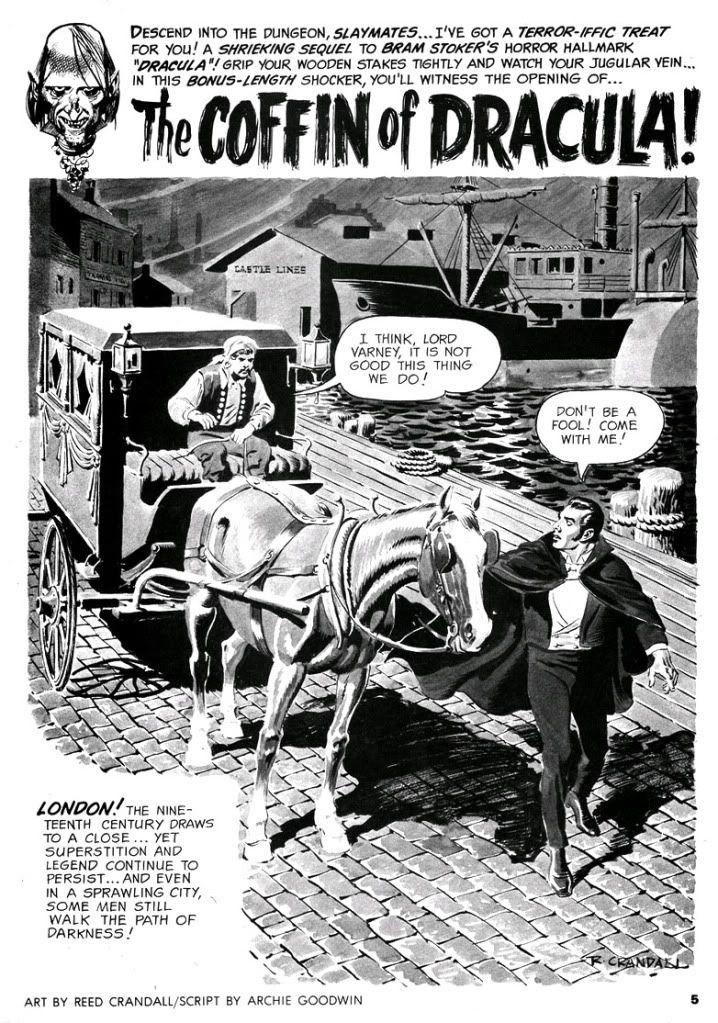
Part one clawed its way out of the crypt in time to anchor Creepy #8 (April 196), while part two coalesced from swirling ash in #9 (June 1966). Both segments are gorgeously illustrated by Crandall at the height of his artistic powers, "Coffin" plays like an overly abridged adaptation of the Stoker original, with Dracula more a presence than a character. Dopey, delusional Varney kidnaps Mina, Jonathan, van Helsing and Dr. Steward pursue him back to Whitby, one of the central settings in the novel and where Dracula began his reign of terror by vamping virginal young aristocrat Lucy Westenra. The heroes hope to kill a vampire left over from the novel and prevent Varney from truly becoming one of them. After that, they plan to save Mina. The plan doesn't sit too well with Harker, but he's too dim to argue with van Helsing's logic.
There's some decent violence and fully-rendered vampire-staking (tastefully sans outright gore), but Varney is a vamp-come-lately, a pale imitation of the great one and lacks charisma. Once fully vampirized, he doesn't even have any dialogue. Ultimately, gorgeous art or not, the story is mainly mild fun for fans of books like Alan Moore's League of Extraordinary Gentlemen, itself an extension of Dracula through the character Mina. If you finished Dracula and hoped for more story, then here's your chance and you don't have to know 19th and 20th century literary references and pop culture to fully appreciate it.
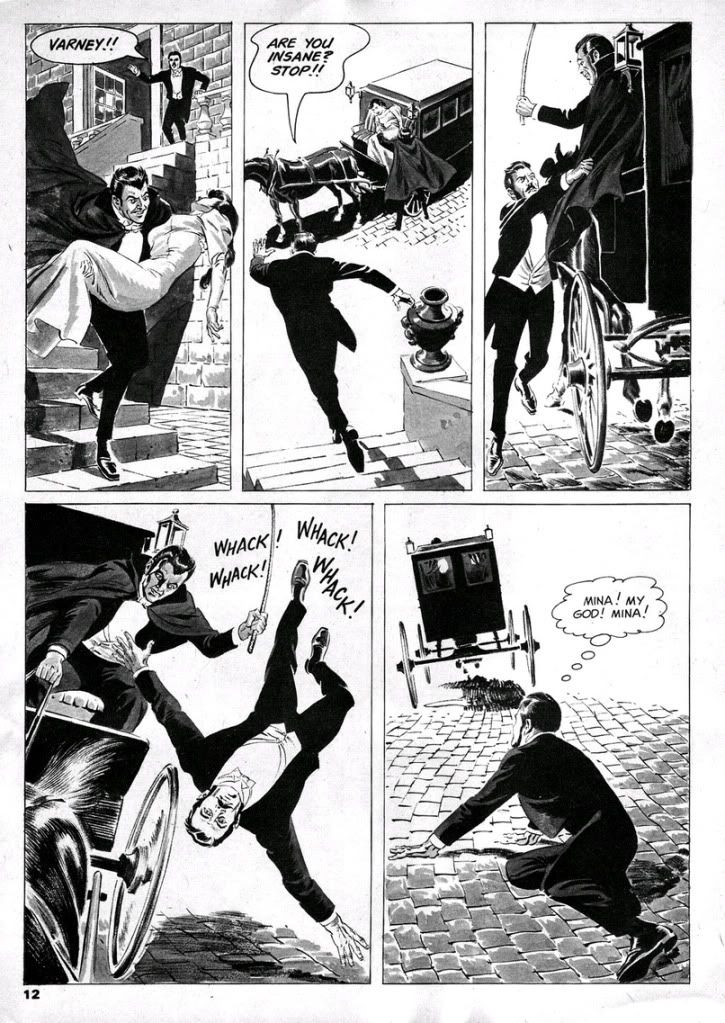
At least Moore picked up on the nascent feminist aspects of Mina, given that ultimate compliment by van Helsing in the book of having a "man's brain." The novel's Mina is a schoolteacher with a strong empiricist bias before she encounters the supernatural. Moore really ran with the notion and made her a lot steelier than Stoker's Mina, but Goodwin goes the opposite route and reduces Mina to your standard damsel in distress, kind of a dishrag. She barely has any dialogue, and none at all in the second part where we only see her unconscious before we follow Harker as he pursues Varney.
Well, Stoker puts Mina in jeopardy and in need of rescuing by men as well, but she does get in a few shots of her own, and because it's an epistolary novel, she at least had the privilege of speaking for herself. Goodwin shifts his focus exclusively to those menfolk, here rendered as a a dull crew of stick-up-their-asses types. When Varney kidnaps Mina, she disappears for the bulk of the story, which diminishes her plight. Goodwin does a wonderful job of recreating Abraham van Helsing's stilted Continental dialogue, though. Van Helsing is like a Dutch Yoda. "Friend Jonathan," indeed.
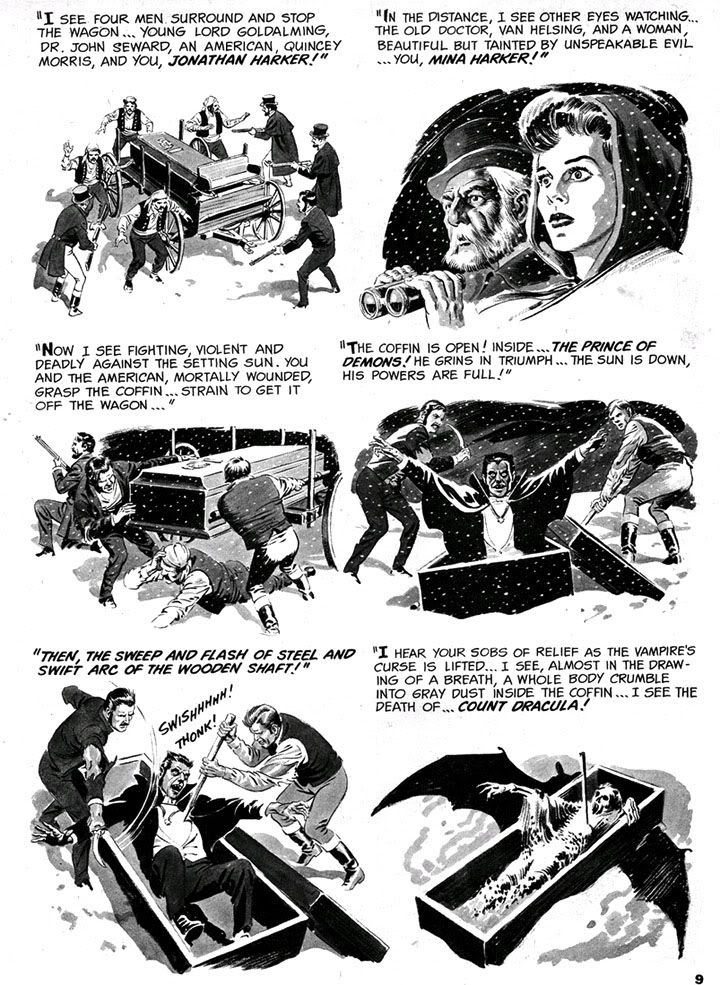
My favorite page is the collage-like recapitulation of Dracula's climax. I wish Goodwin and Crandall had done a full-fledged adaption of Stoker rather than this rehash, pretty as it is.
Poor Reed Crandall. While I immediately loved what I saw when I encountered his color jobs for EC in those early 1990s Gladstone reprints (I sorely miss those), his black and white art in the Creepy archives books from Dark Horse is a revelation. I can only describe it as beautiful, like those illustrated plates you encounter in ancient, heavy tomes from the darker corners of a library collection. Finely proportioned and posed figures, beautiful contour lines and modeling, depth of field, absolute control and mastery of individual panels and the page as a whole. And yet he seems to have been in competition with Wally Wood for "most tragic former EC great." Alcohol dependency and failing eyesight robbed him of his talent and sent his output into a shockingly steep decline in quality, so much so his last few jobs seem more the work of a talented amateur trying to do a Crandall impression. Reading them is like viewing a slow motion film of a ship sinking with a man still visible on the deck. On the other hand, he did leave behind an impressive body of work, especially in these early issues of Creepy.
And now it's time for one of my all-time favorite videos starring Spookey:
Tuesday, October 9, 2012
October is Spookey Month: "Hellboy," yet another Halloween reading recommendation
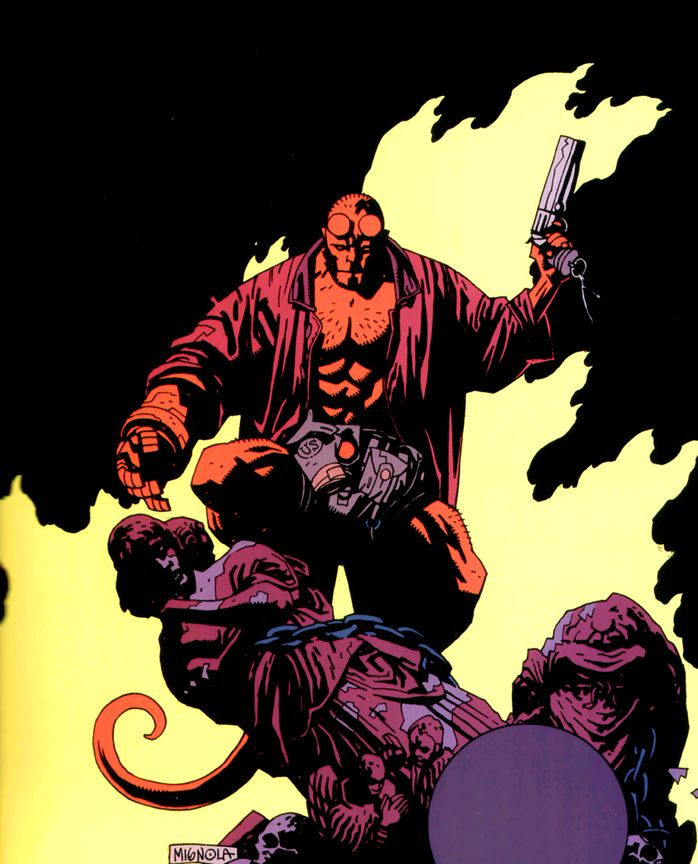 |
| Mike Mignola (1994) |
After two decades and so many miniseries and titles it can be hard to know where to start with Hellboy. It doesn't help matters Mignola's chronology jumped around depending on whatever inspired him to write and draw a particular story. In one book, Hellboy could be in Ireland in 1959 or 1961, then show up in Japan in 1967 for the next, then guest star in an issue of The Goon telling the story about Japan. Or something like that. Working it out this way, Mignola and his later collaborators have built a massive narrative spanning decades, continents and even the galaxy, with characters dying and other joining, menaces burbling up from the background, others springing full-blown into the foreground plot.
From his earliest days fighting un-frozen Nazis and their spiritual leader Rasputin-- yes, the historical Rasputin, the one Prince Felix Yusupov, Grand Duke Dmitri Pavlovich and some concerned friends poisoned, shot, beat and drowned in 1916-- to various creatures from European myth, with an underpinning of H.P. Lovecraft, Hellboy now inhabits a sharply defined world with all kinds of incidents and epics. So how do you jump into this world?
Sorry, I'm not much help there. I'm not a continuity junkie or obsessed with minutia. All I ask is whatever story I'm reading to be internally consistent. And I tend to prefer Mignola's moody, sometimes peculiarly random one-offs with Hellboy himself to the longer apocalyptic tales generally starring the BPRD cast (althought these are good, too). That's why I say, "Don't worry about a reading order with Hellboy." My advice is just buy the Seed of Destruction collection and start there. Move on to whatever story catches your fancy.
In short, you must do as you see fit.
For me, Hellboy pushes a number of buttons. Let's examine four of them in detail. Mignola's art is the first. I love bold, heavily stylized art, the kind where you say, "Now there's a nice drawing, just the essentials" rather than take in something that looks like it was traced from a still frame out of a movie, or a swimsuit magazine. Mignola's work has become more essentialist and geometrical over time and that's my bag.
The second is my love of the weird and fantastic. Since earliest childhood, I've read books about cryptid animals, UFOs, alternate dimensions, the Bermuda Triangle, ghosts, urban legends and the like. I've always loved stories where teams of people investigate the unknown and come to grief, from Kolchak to Venkman, Stantz, Spengler and Zeddmore to Mulder and Scully to Hellboy and company. I'm a friend to them all.
Folklore and myth make the third. Mignola draws heavily on European traditions and Lovecraft, but he has broken with this on a few memorable occasions. Two are team-ups with horror art legend Richard Corben-- Makoma, informed by African folktales and The Crooked Man, set in the Appalachian Mountains of the good ol' U.S. of A. Both are lovely and strange. How can anyone not read these?
And the fourth is a specific story. As an ex-pat living in Japan, "Heads," set in Kyoto, is a lot of fun in a very personal way. Mignola claims in his introduction to the story not to know a whole lot about Japan. Yeah, but his art, as influenced by Alphonse Mucha, who himself drew on Japanese ukiyo-e and their extremely linear forms as it is by European woodcuts, Jack Kirby or P. Craig Russell, makes him particularly apt for this kind of material. I wish Hellboy would revisit Japan sometime in the near future. If Mignola or any of his collaborators need some first hand experience and reference-- or just want to hang out while doing a research trip-- well, now, I know just the blogger to volunteer his services!
Friday, October 5, 2012
October is Spookey Month: "Tomb of Dracula," a Halloween reading suggestion
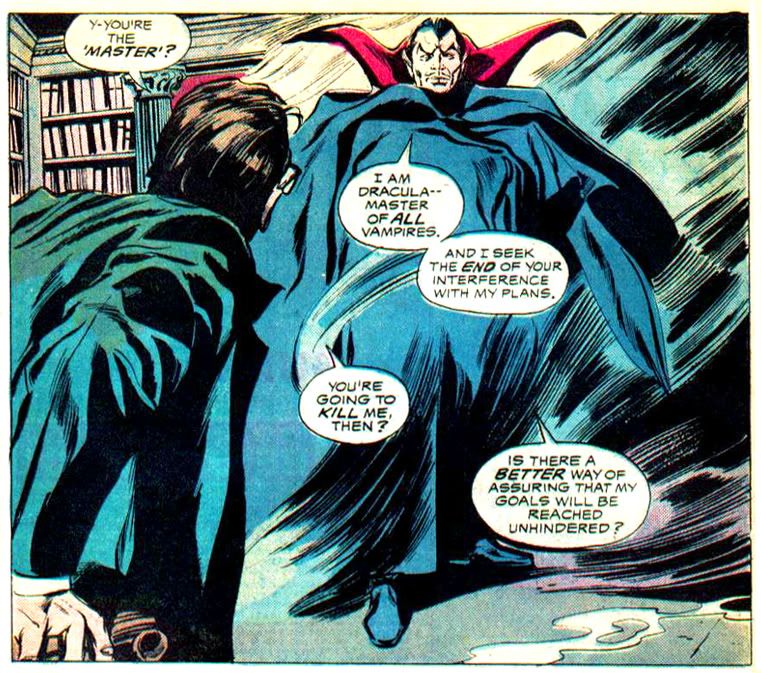 |
| Marv Wolfman, Gene Colan, Tom Palmer, Tomb of Dracula #31 (April 1975) |
Your perfect Halloween reading is Marvel’s Tomb of Dracula by Marv Wolfman and Gene Colan. I’m a Halloween traditionalist. As far its denizens go, I tend to avoid all slashers other than Michael Myers (or is he more of a stabber?) and stick with the classics—werewolves, ghosts, mummies, witches and vampires. And vampires don’t come any better than the main man himself, Vlad Dracula. Forget those Varneys, Ruthvens, Yorbas, Mamuwaldes and all those other pretenders to the throne. Barlow? A clown.
But when you want the true Lord of the
Undead, there’s no other choice for choosy consumers. You want Dracula. He’s packed with vitamins, stays crunchy in
milk and has a taste that can’t be beat.
Kids and moms agree-- the wholesome goodnesss of Dracula is part
of your complete breakfast. And Wolfman’s
purple prose funny book serial is the third finest Dracula tale after Bram
Stoker’s novel and the Hammer Films series starring the greatest of the screen
Dracs, Christopher Lee.
It’s got gothic elements and touches of
Robert Bloch and Richard Matheson, and occasionally Sax Rohmer by way of Ian
Fleming. Disembodied Communist
brains? If the series unfortunately
takes place in the Marvel universe at large—Johnny Storm, the Kree Empire and vampires have no
business co-existing, sorry (although we might make a case in favor of a Fin Fang Foom crossover)—Wolfman wisely and largely keeps the colorful
longjohns crowd at bay, beyond a brief
visit by Brother Voodoo and a tete-a-tete with earth’s Sorcerer Supreme Dr.
Strange. Chris Claremont’s tales in the
Giant-Size issues tend to draw on H.P. Lovecraft as well. They’re okay, not really Claremont’s finest—the
man mastered mutants, not vampires—but then again, he didn’t have the benefit
of Gene Colan handling the art.
Colan made his horror bones—so to speak—drawing
some memorable ink-washed Creepy tales for Warren, but he made his mark at
Marvel pencilling Daredevil and Captain America.
Tomb of Dracula, however, is the man’s masterpiece. Tomb was an assignment he sought, and he was
right to do so. While his superhero work showcases his ability to depict bodies in motion, Tomb proves him a master at distorting them through foreshortening. Constrained from showing gore by the Comics Code, and due to the talky nature of a lot of scenes-- vampire hunting requires planning while sitting around coffee tables-- Colan would choose the most difficult angles, then stretch page design to its outer limits by framing them with panels of odd shape, or going for collage-like effects. But always under control, always moving the reader's eyes across the page in a way that makes sense and lends to a clean reading experience. Actually, reading a Colan Dracula page is like reading a movie.
His chiascuro style—heavy on shadows and mood—finds its ideal match in the sinuous ink line of Tom Palmer. Through Palmer's finishes, Colan’s art coalesces further into the kind of dark beauty that also prints well on the cheap newsprint comics companies used in those days. When you find them in black and white in an Essential Tomb of Dracula or one of the slick collections in full color, you see just how endlessly attractive and rewarding of close study these pages truly are.
Palmer interprets Colan's shaded modeling with parallel feathering and cross-hatching to create a feeling of form, depth of field, added clarity and emphasis. At times he seems less an inker than an
extension of Colan’s artistic consciousness.
There are other pencil-ink teams where the partners’ sensibilities mesh
so well. Neal Adams and Dick Giordano, George
Perez and Romeo Tanghal, Jack Kirby and Mike Royer, John Byrne and Terry
Austin, Steve Rude and Gary Martin. But
Colan and Palmer made Tomb of Dracula Marvel’s most consistently gorgeous book
of the 1970s.
Wolfman takes a novelistic approach to his cast of characters, especially lead Frank Drake. When we first meet Drake in Tomb #1 (April 1972), he's a cjaded, shallow rich boy who's squandered his fortune. Only Castle Dracula remains, but betrayal by a close friend leads to Dracula's resurrection and sets the series in motion. Drake is at times selfish, mule-headed, morose and self-reproaching. When he moves to embrace outright heroism, he does so in about as jerky a way a person could, alienating his friends. The quest to stop Dracula changes him over the course of his adventures. The same can be said of Rachel van Helsing, whose character transformation finds stark symbolism in facial scars she eventually acquires, marring forever her icy blonde beauty.
Like many open-ended narratives, Tomb seems content to spin its stories out, changing direction abruptly, introducing new characters like shlubby Harold H. Harold, the hacky writer, and Blade, the half-vampire vampire hunter who proved popular enough to inspire a Wesley Snipes-starring movie franchise and a syndicated TV series, then following them down twisting story paths until things conclude rather abruptly in Tomb # 70 (August 1979)-- which was supposed to be a three-issue arc, but ended up mutilated into a double-sized single issue thanks to a Jim Shooter decision. The stitched-together seams show badly, but the series ends up having a strange Victorian serialized novel feel, which is appropriate for vampires.
Like many open-ended narratives, Tomb seems content to spin its stories out, changing direction abruptly, introducing new characters like shlubby Harold H. Harold, the hacky writer, and Blade, the half-vampire vampire hunter who proved popular enough to inspire a Wesley Snipes-starring movie franchise and a syndicated TV series, then following them down twisting story paths until things conclude rather abruptly in Tomb # 70 (August 1979)-- which was supposed to be a three-issue arc, but ended up mutilated into a double-sized single issue thanks to a Jim Shooter decision. The stitched-together seams show badly, but the series ends up having a strange Victorian serialized novel feel, which is appropriate for vampires.
Dracula himself would go on to appear ever more ridiculously in issues of The Uncanny X-Men and ---, a kind of supernatural Dr. Doom, every new iteration watering down Wolfman's indelible characterization of a proud, misanthropic anti-hero until Drac becomes just another super-villain in the Mighty Marvel manner. He even fights Apocalypse at one point. Sheesh. But during the run of his own title, Wolfman, Colan and Palmer found majesty in a character who suffers from being overly familiar to the point he's inspired parody and mockery. Besides Dracula himself, obviously Blade is still kicking around. I'm not sure what's up with Frank Drake, although he resurfaced in 1991 for a four-issue Epic miniseries also called Tomb of Dracula, where we find him trying to put the past behind, only to have the infamous vampire reappear. Wolfman deliberately ignores all the Drac appearances in between, having the vampire lord reappear at precisely the same place he apparently perished in that last issue of Tomb.
I, for one, applaud that choice.
Which is why every October I find myself
brushing away the cobwebs, creeping down the stone steps weeping condensation,
the darkness breathing chill air like a dying man… and opening the tomb. This Halloween, if you haven’t already, you
should, too.
October is Spookey Month: Merry Marvel monster monologue!
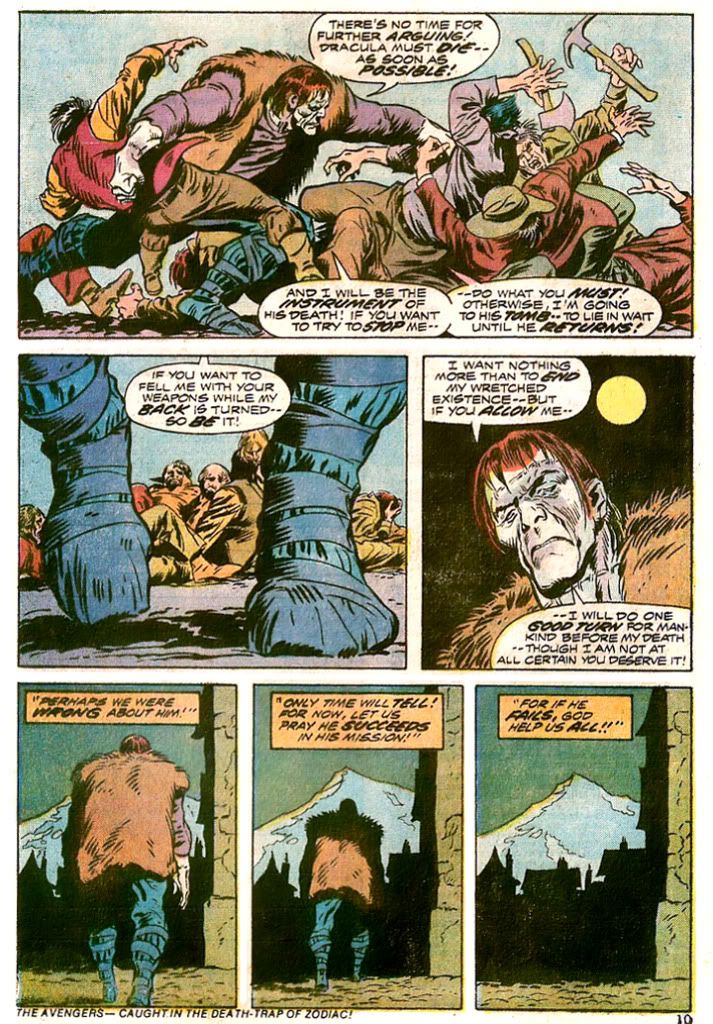 |
| Gary Friedrich, John Buscema, John Verpoorten, The Frankenstein Monster #9 (March 1974) |
One of the great things about Marvel back in the day was no matter how busy their characters were fighting multiple enemies, thanks to the intense aerobics training Stan Lee put them through as part of their contractual obligation to the company, they always had wind enough to explain their basic motivations. Or, in the case of Frankenstein's Monster here, to protest not having enough time to do so, while doing so.
I really don't see how this sequence makes Frankenstein's Monster (although this characterization is closer to Mary Shelley's original than the more well-known Boris Karloff movie version) all that different from the Incredible Hulk or the Silver Surfer or any of those yahoos. Yeah, Monster is more eloquent than the Jade Giant, but I'm sure they could commiserate over beers: "I don't have time to explain myself to you idiots despite my amazing ability to multi-task."
Thursday, October 4, 2012
October is Spookey Month: Johnny Craig's "... And All Through the House..."
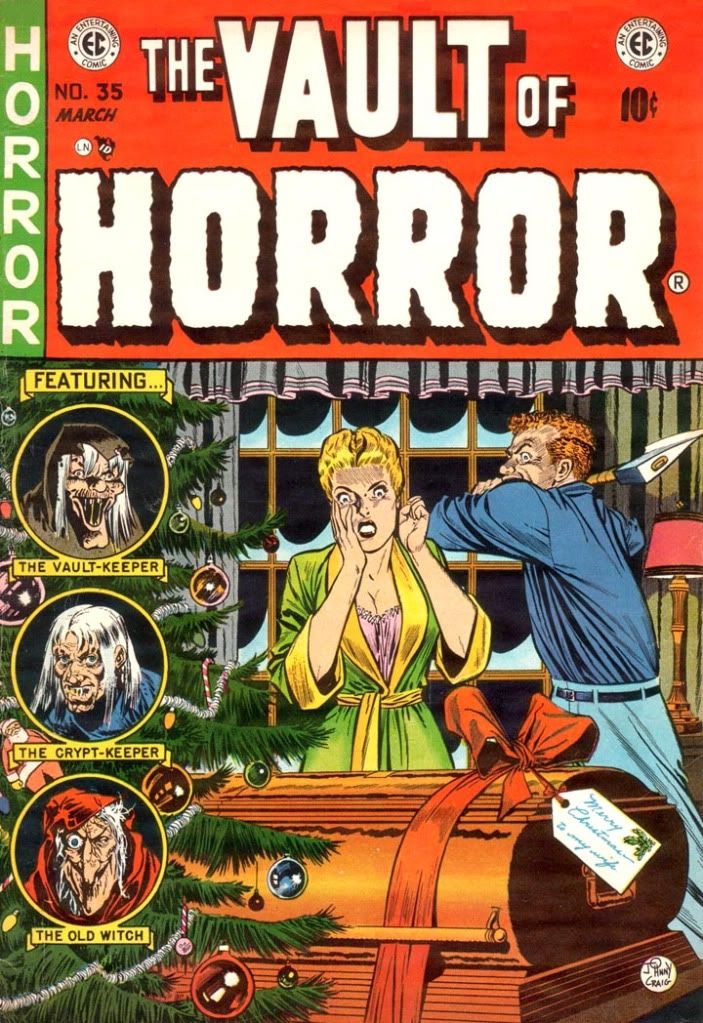
So to that end, let's revisit Johnny Craig's original story from The Vault of Horror #35 (EC Comics, March 1954). And here... we... goooo!
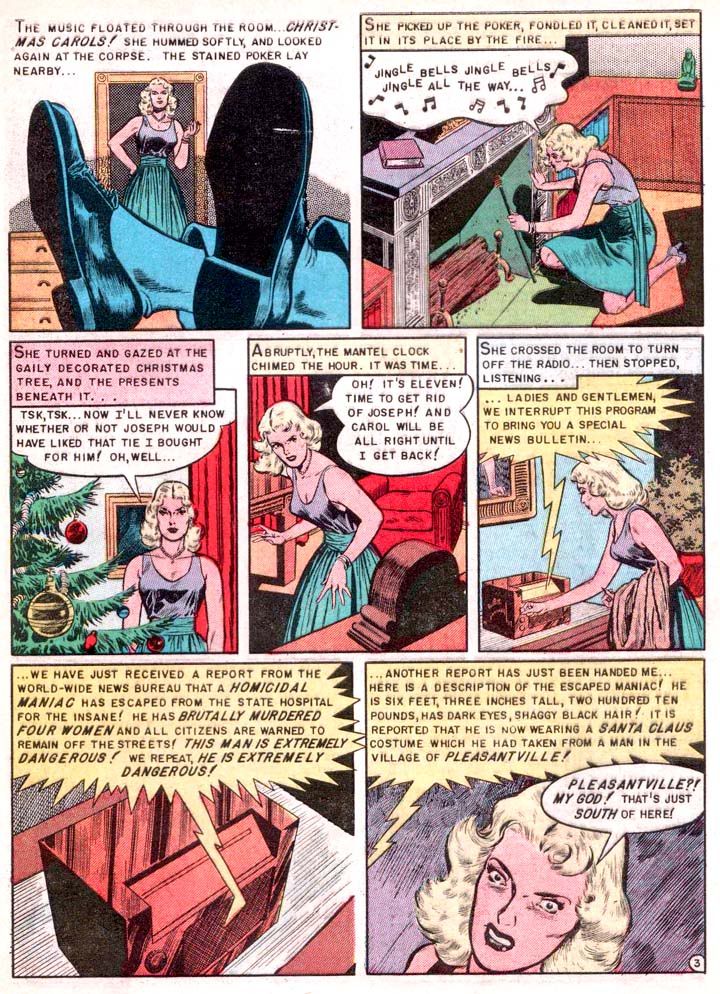
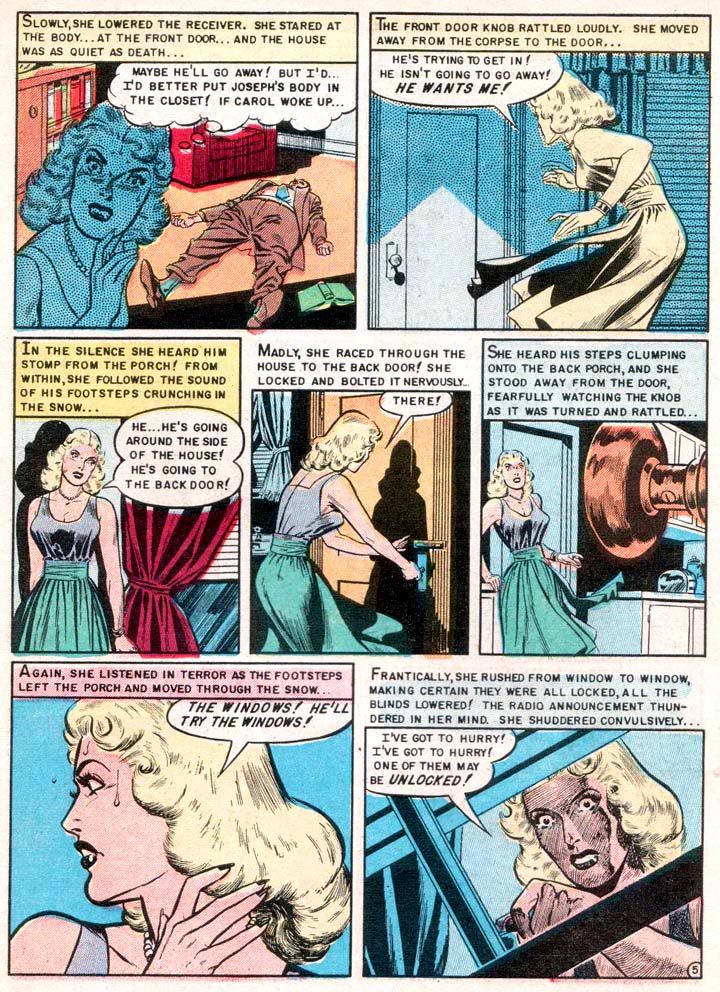
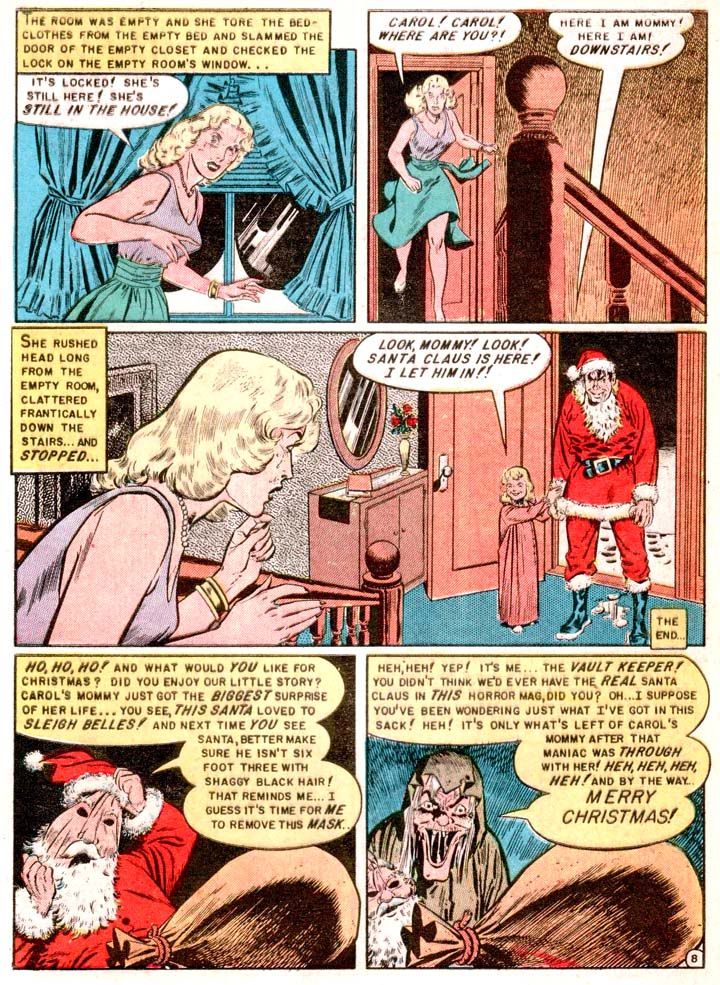
The film's version is a very close adaptation (they even kept the daughter's name the same, and the dialogue in scenes with her is almost word-for-word from the comic), but the Craig's story is pretty taut and doesn't lend itself to a lot of padding. Sure, a few differences crop up here and there. For example, the comic story is red white and blue in its all-American look at Christmas-related murder. The movie transplants the story to the UK, where it gains Collins, with Sir Ralph Richardson as the Crypt-Keeper. In the comic, the protagonist is a blond, while Collins is famously a brunette, a quality that would serve her and her stunt double well on ABC's night time soap opera Dynasty during the infamous Krystle-Alexis fight. In the movie, the Santa-suit wearing madman throttles the Collins character for a violent comeuppance. It's a movie and movies rely on action. Otherwise, they might just as well be photographs. And instead of photographs, drawings. Which brings us right back to comic books again, where it's just as effective to have un-jolly old St. Nick simply stand there in the final panel. The reader's imagination supplies the killing. Or, if you're of a less sanguinary persuasion, the murmured discussion followed by a night of gentle love-making.
Since there's not a lot to say about the story I haven't already written about at great length while blathering on in my usual sub-moronic way about the film, here are some choice moments from the comic. Get ready to enjoy a little bit of Johnny Craig-style holiday cheer...

Monday, October 31, 2011
2nd Annual Spookey Month: Happy Halloween!
I've got one more horror comic post in the pipe, but I haven't had time to finish it yet. Later this afternoon! In the meantime, here are a few more of those delightful Tales of Terror videos. First up: a spooky sleep-over!
Looks like another of those ubiquitous school trips. Japanese students go on these excursions each year. Some stay within Japan, like these unfortunate girls, and others go abroad. Do you think this experience will cure Yuki of her school trip insomnia?
Here's yet another school trip.
Most school trips are meant to be educational experiences. From this one, I learned that if I leave my lip cream in the bathroom, I should just wait until morning to retrieve it.
Of course, terror doesn't confine itself to creepy old ryokan in the middle of the night. Sometimes it sneaks up on you around lunchtime in ordinary city apartments.
That was a lovely little flat. Didn't the sister decorate it nicely? Love the dot motif, but it's too bad about the visitor problem.
Well, there are dozens of those Tales of Terror on YouTube. But there are very few Spookey ones. Here's a favorite of mine:
Happy Halloween!
Looks like another of those ubiquitous school trips. Japanese students go on these excursions each year. Some stay within Japan, like these unfortunate girls, and others go abroad. Do you think this experience will cure Yuki of her school trip insomnia?
Here's yet another school trip.
Most school trips are meant to be educational experiences. From this one, I learned that if I leave my lip cream in the bathroom, I should just wait until morning to retrieve it.
Of course, terror doesn't confine itself to creepy old ryokan in the middle of the night. Sometimes it sneaks up on you around lunchtime in ordinary city apartments.
That was a lovely little flat. Didn't the sister decorate it nicely? Love the dot motif, but it's too bad about the visitor problem.
Well, there are dozens of those Tales of Terror on YouTube. But there are very few Spookey ones. Here's a favorite of mine:
Happy Halloween!
Saturday, October 29, 2011
2nd Annual Spookey Month: What does Halloween have to do with the Banana Splits?
And comic books for that matter? Nothing, really. But since I go on a Spookey kick every Halloween, I thought you might enjoy comparing their cover of "The Tra La La Song (One Banana, Two Banana)," the theme song to The Banana Splits Adventure Hour, to the original and the versions by the Dickies and Liz Phair.
Here's the original:
And here's the circa 1979 cover by the Dickies. They upped the tempo a bit for that punk rock feel:
Liz Phair and Material Issue covered it in 1995 and this was the result:
And here's a live performance by Spookey:
I wish that video had better sound quality. Their rendition of the song from their Shakin Pop 'n' Roll album sounds a lot better. Not really surprising, considering the whole "recorded in a studio" versus the "recorded onto some person's digital camera" thing, right? Their take owes a great deal to the Dickies's version, especially with the nearly incomprehensible verse sections. The studio cut is especially hilarious because you can actually hear them not really give a damn about what they're singing. They make the barest effort to enunciate, instead putting all of their energy into simply having fun with a ridiculous song.
Yes, I know the Dickies version was used in the movie Kick-Ass. While researching this little article I forced myself to watch that particular scene-- you can find it on YouTube if you haven't already seen it. While using this song was an inspired choice, the overall effect was lost on me. I didn't find the crude language or the over-the-top violence offensive; it just struck me as a dumbed-down version of much cooler fare. Voice courtesy Dirty Harry Callahan, cursing from your junior high locker room, setting from Pulp Fiction, fight choreography and editing nicked from Hong Kong cinema, gore from Kill Bill Vol. 1. Watching it made me feel like I'd stepped on a soiled diaper with my bare foot and did nothing to convince me to read the comic or watch the rest of the movie. I'd rather just listen to Spookey-- their cover predates the movie-- or watch this:
Didn't see that coming, did you? Hey, I'll shoot straight with you-- neither did I!
And here's the circa 1979 cover by the Dickies. They upped the tempo a bit for that punk rock feel:
Liz Phair and Material Issue covered it in 1995 and this was the result:
And here's a live performance by Spookey:
I wish that video had better sound quality. Their rendition of the song from their Shakin Pop 'n' Roll album sounds a lot better. Not really surprising, considering the whole "recorded in a studio" versus the "recorded onto some person's digital camera" thing, right? Their take owes a great deal to the Dickies's version, especially with the nearly incomprehensible verse sections. The studio cut is especially hilarious because you can actually hear them not really give a damn about what they're singing. They make the barest effort to enunciate, instead putting all of their energy into simply having fun with a ridiculous song.
Yes, I know the Dickies version was used in the movie Kick-Ass. While researching this little article I forced myself to watch that particular scene-- you can find it on YouTube if you haven't already seen it. While using this song was an inspired choice, the overall effect was lost on me. I didn't find the crude language or the over-the-top violence offensive; it just struck me as a dumbed-down version of much cooler fare. Voice courtesy Dirty Harry Callahan, cursing from your junior high locker room, setting from Pulp Fiction, fight choreography and editing nicked from Hong Kong cinema, gore from Kill Bill Vol. 1. Watching it made me feel like I'd stepped on a soiled diaper with my bare foot and did nothing to convince me to read the comic or watch the rest of the movie. I'd rather just listen to Spookey-- their cover predates the movie-- or watch this:
Didn't see that coming, did you? Hey, I'll shoot straight with you-- neither did I!
Sunday, September 25, 2011
Happy National Comic Book Day!
It's finally here! National Comic Book Day! The turkey is roasting in the oven, the cranberries are doing whatever it is cranberries do, Wonder Girl is dancing around with her headphones on while Robin, Speedy and Kid Flash glower unappreciatively from along the far wall. I didn't get you anything. Sorry. I've just been so busy reading old Teen Titans and back issues of Batgirl while pretending the DC reboot doesn't exist. Also, my hours have been severely cut at work-- I'm a bad employee, I'm rude to everyone and my attitude stinks-- so I don't really have the money to buy new comics for deconstruction/review/mockery/gifts for my reader. Tightening the belt, loosening the shoes, selling my toupees.
But I do have some great stuff coming up. There's yet another entry about Cassandra Cain, some Planet of the Apes nonsense, possibly a visit with Mars's top teen and so forth. More importantly, October will be our 2nd Annual Spookey Month here at When Comic Books Ruled the Earth as well as my Super-Gaijin '76 blog. We'll be celebrating some gruesome horror comics along with that wonderful punk combo from Hamamatsu, Japan, Spookey. In the meantime, in honor of Gnarrk, please enjoy this NBC promo featuring Phil Hartman as the Unfrozen Caveman Lawyer:
But I do have some great stuff coming up. There's yet another entry about Cassandra Cain, some Planet of the Apes nonsense, possibly a visit with Mars's top teen and so forth. More importantly, October will be our 2nd Annual Spookey Month here at When Comic Books Ruled the Earth as well as my Super-Gaijin '76 blog. We'll be celebrating some gruesome horror comics along with that wonderful punk combo from Hamamatsu, Japan, Spookey. In the meantime, in honor of Gnarrk, please enjoy this NBC promo featuring Phil Hartman as the Unfrozen Caveman Lawyer:
Subscribe to:
Posts (Atom)