1. Barbarella. Humanoids, Inc. will publish a brand-new English language version of Jean-Claude Forest's sexy 1960s space adventure featuring the coolest 1960s space adventurer with updated and modernized whatchamallits by Kelly Sue DeConnick. Dialogue? Worldview? I don't care. Her adventures have been out of print in English for some time now, which is kind of ridiculous when you consider her pop culture significance. There wouldn't be a Vampirella without Barbarella, and possibly not even a Red Sonja series. As a character, Barbarella kicks much ass. Despite her reputation as a sex kitten, in today's terms, she has what you would call "agency." Therefore, she's a sextacularly retro space ace for today's on the go post-modern libertine! Or something like that.
2. Teen Titans. With the publication of the long-awaited volume two in the Teen Titans DC archives hardcover series, it's just a matter of time before individual issues pop up on Comixology. And this means more Wonder Girl with art by Nick Cardy.
3. Pepper. Last week I bought an Archie Comics digital exclusive containing 100 pages of gorgeous Dan DeCarlo-drawn pre-"ears for hats" She's Josie comics, which led me to discover the star's witty erstwhile best pal Pepper. Pepper didn't make the transition to rock stardom with Josie and Melody, and that's a real shame because she's super cool with her cynical attitude and wild cat-framed glasses. Those would have been so appropriate for the band. Don't get me wrong-- Valerie is great. But why couldn't the Pussycats perform as a quartet? You know, Pepper on bass? She could have been their Kim Deal, for crying out loud! Anyway, 2014 is the year I bore you to tears celebrating Pepper.
4. X-Men. Marvel has been dropping John Byrne-drawn issues on Comixology like they're on fire (that cliché worries me-- is this a good quality or a bad quality for something to have?), which means we're about one or two away from having a complete run available stretching from the initial Dave Cockrum issues (glorious) all the way to the celebrated "Days of Future Past" storyline that's being adapted into the latest film in the X-Men movie franchise (as my wife says, "I don't give a shit about that," but you might, so there!). They'll probably get to the second Dave Cockrum run, which suffers from lackluster scripting but looms large in the early days of my initial fandom because those were the ones I bought in convenience stores and newsstands as Marvel published them. I subscribed during the Paul Smith days, which saw Chris Claremont return to form. Those should be on Comixology this year, too.
5. Fantastic Four #51. Marvel and Comixology have every issue of Jack Kirby's legendary company-building stint on Fantastic Four through #50, which is the overall narrative's natural climax. But it's in its anti-climax Kirby and Stan Lee produced the humanistic "This Man, This Monster," which is as close to superhero comic perfection as you are ever likely to find. Kirby and Lee turned out a few solid stories and even some classics after this, but this is Marvel's 1960s apogee.
6. Samurai Executioner Omnibus. Dark Horse is putting out a single book containing 798 pages of ultra-violent samurai slashing action from masters Kazuo Koike and Goseki Kojima. A guy named Frank Miller would mine their stuff for his own reputation in the 1980s, but this is the 1972-76 original from a couple of legitimate geniuses. Their Lone Wolf and Cub is essential, but Samurai Executioner is pretty darn close to necessary, with plenty of cinematic, evocative storytelling at its finest. Oh, and it's only $19.99 for something that provides a meatier reading experience (as in the meat that Yamada Asaemon carves from his foes) than its equivalent in monetary (if not aesthetic)value-- about 5 flimsy 32-page issues of any given new monthly from Marvel or DC that will take you about 5 minutes to read and forget. Okay, I admit I'm being unfair. But even the best current series from either of the Big Two cannot hope to measure up to this work and you're paying less per page for it. This should be the Event Comic of the Year. Trust me-- you will never forget Yamada Asaemon.
7. Lone Wolf and Cub Omnibus Volume 4. Speaking of... here it is. As I wrote above, these are essential. Everything I gushed about with Samurai Executioner goes double for these. This one is 696 pages for $19.99 and it's simply one of the greatest comics ever published. I will be purchasing all of these in 2014.
8. The EC Archives: Vault of Horror Volume 3. Dark Horse does it again! This is a very pricey book, but it's the continuation of Dark Horse's deluxe reprints of EC classics. The Archives series started at Gemstone (I own several of them as well), but hit a rough patch. Dark Horse re-launched the series in October 2013 with Tales from the Crypt Volume 4. Fantagraphics is putting out books spotlighting individual artists (and those are beautiful), but here's your chance to see their work in context, with colors recreated from Marie Severin's originals. Volume 1 of their Weird Fantasy reprints follows in April. I'm more of a horror and Weird Science freak when it comes to EC, but any of these archives would be a welcome addition to my library. And yours.
9. Warren horror. Yeah, I know I'm going to sound like a Dark Horse shill, but they consistently put out products I love! They're not only giving us EC and influential manga, but they're also continuing their long-running Creepy and Eerie Archives series this year. I received Creepy Archives 10 for Christmas, and I'm certain 2014 will see me adding to my collection.
10. New discoveries of amazingly cool old stuff. Like Pepper up there. A couple of weeks ago, I had no inkling she even existed. My knowledge of comics doesn't extend much farther than the ones I read when they were new and the artists and writers I grew up admiring, so I'm discovering wonders almost daily. Certainly there are Jack Kirby stories out there and more I haven't read that I'm looking forward to uncovering and sharing with you, the reader of this blog!
Note: Oh yeah, there are some new comics coming out this year that I'm also looking forward to. Fantagraphics has Love and Rockets books coming out and their reprinting of Takako Shimura's heartbreaking Wandering Son. Plus a whole lot more from Dark Horse, Image and even Marvel and DC I'll be checking out. And there's a slight chance for some more Nana-related artwork from Ai Yazawa. She revisited "Junko's Place" last year and apparently produced a Christmas card for Cookie magazine. And even if we don't see new Nana, my big wish for Ms. Yazawa in 2014 (and in the future) is recovery, health and happiness.

Showing posts with label Eerie magazine. Show all posts
Showing posts with label Eerie magazine. Show all posts
Sunday, January 5, 2014


Friday, April 15, 2011
Tough times at Dark Horse?
I hope not, despite the story I just read on Comic Book Resources that informed me Dark Horse Comics has laid off a number of staffers. Well, I'm not qualified to comment on industry economics or business decisions, but I want to wish all involved the best of luck. I know all too well what it feels like to stress over job hunting and financial insecurity, so I'm offering my sincere hopes and wishes that at least some-- if not all-- of you had some advance warnings and were able to get some paying gigs lined up in time! And as a fan of Warren's horror titles, I especially want to single out Shawna Gore for her work bringing us the Creepy and Eerie Archives books and the new Creepy magazine. I can't thank her enough for being part of the move that enabled me to buy these crazy things!
It makes me nervous for the company's future as well. It seems they've launched a lot of titles recently-- the Doctor Solar and Magnus books, the new Dark Horse Presents, Dollhouse, Let Me In, plus all those traditional favorites-- Star Wars, Hellboy, Buffy and Robert E. Howard comics. And the digital comics. I thought they were doing pretty well with all that product expansion. Just goes to show how much I know. Maybe they need to bring back Dr. Giggles.
It makes me nervous for the company's future as well. It seems they've launched a lot of titles recently-- the Doctor Solar and Magnus books, the new Dark Horse Presents, Dollhouse, Let Me In, plus all those traditional favorites-- Star Wars, Hellboy, Buffy and Robert E. Howard comics. And the digital comics. I thought they were doing pretty well with all that product expansion. Just goes to show how much I know. Maybe they need to bring back Dr. Giggles.

Thursday, March 31, 2011
And a Gene in Every One: A Look at Some Gene Colan Horror Stories
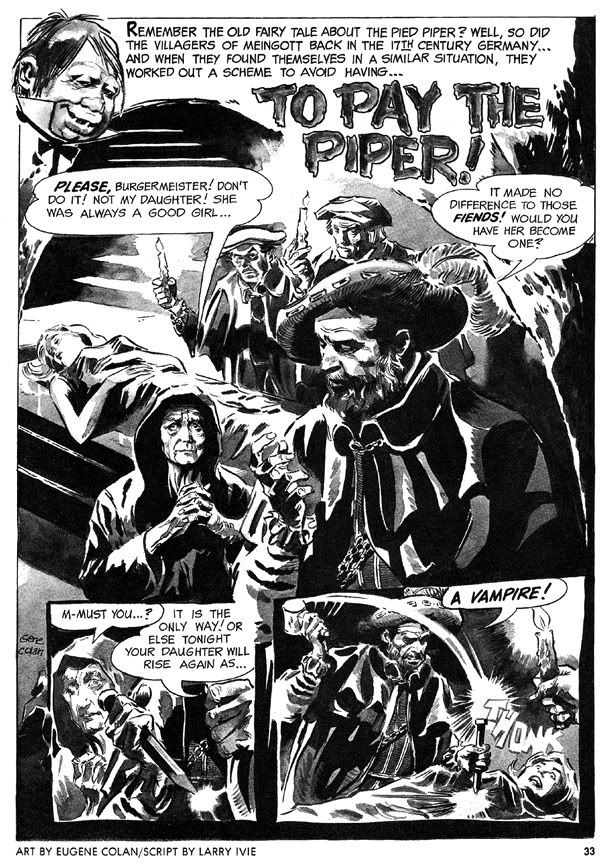 One of the neatest surprises about Dark Horse's Eerie Volume One hardcover archive monstrosity is how many Gene Colan stories it contains. I hadn't realized Colan did any work for Warren Publications. I mean, I knew he had to have done something before Tomb of Dracula at Marvel. He obviously didn't just magically appear out of nowhere, or descend in a silver orb-like spacecraft from another planet or emerge from some pocket dimension, hand Stan Lee some samples, lift his Rayban Wayfarers and say, "Dig this and dig it good, Daddy-O, I wanna draw Dracula for you cats."
What the heck am I babbling about?
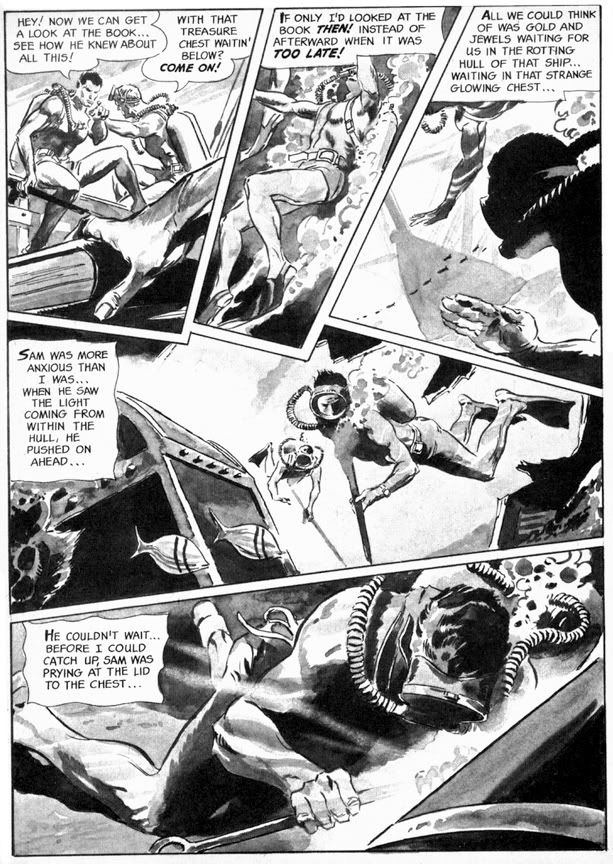
Colan has always been a master of extreme foreshortening, able to twist and turn the human figure in any direction. Very useful because he isn't the kind of artist who draws simple eye-level panel compositions. No, he likes to use high "camera" positions or his patented "worm's eye view" low angle shot. And then he breaks up the page with all kinds of crazy panel shapes, the results frequently looking like shards of broken glass arranged on the paper. Tom Palmer laid down some impressive inks on Colan's Tomb of Dracula pages, but here in Eerie, we get unfiltered Colan with his characteristic heavy shadowing-- but also marvelous ink washes where he creates an illusion of value and depth with just a few well-chosen gray tones.
His first Eerie story is a twisted retelling of the old Pied Piper legend, "To Pay the Piper," which substitutes vampires for rats. This time, the cheapskate villagers are as familiar with the story as we are, so they resort to outright murder so they don't have to pay, only to suffer yet another twist involving werewolves. The final panel-- the punchline-- is a bit too crowded to be fully effective (or as horrific as it should be) but the story's creepy European setting prefigures Colan's depictions of Marvel Universe Transylvania.
More original is "Full Fathom Fright" (Eerie #3), this time with a script by Archie Goodwin that allows Colan to go bonkers with the fractured panel shapes. This story goes from the booby hatch to Davy Jones' Locker as we first see a mental patient throwing a monster hissy fit, then learn all about the undersea misadventure that made him that way. Goodwin puts Colan's storytelling and rendering skills to their fullest. The undersea sequence is particularly nice, with Colan creating a real sense of weightlessness, with deep water shadows and lighting effects. And the final gag panel with its Lovecraftian conclusion is nice and large and much more effective this time.
 Eerie #4 features "Hatchet Man," a grisly Goodwin-Colan take on that horror comic evergreen, the deranged axe murderer. As opposed to the polite, mild-mannered axe murderer, I suppose. What is it about geeks with axes that so fascinates horror writers and readers? The blunt simplicity of the weapon? We've seen it a billion times on EC covers alone, but for some reason we never quite grow tired of these Lizzie Borden-style "forty whacks" antics. This effective little story has an obvious psychological element that's slightly reminiscent of the movie Psycho but features some startling action sequences where Colan chops the action itself into wedge-shaped panels that showcase his ability to depict bodies in motion and in pieces. And if you ever wanted to see Bob Newhart totally lose his shit and go on a killing rampage, then this is the story for you.
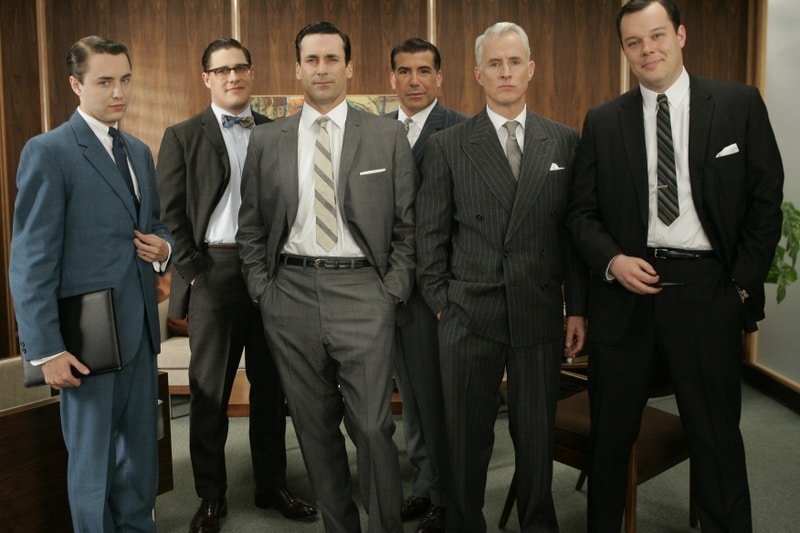
The final story, "A Matter of Routine" (Eerie #5) seems a little rushed. The figures are simpler and the ink washes read a bit flatter than in the previous shorts. It's kind of a nightmare version of the Mad Men era-- a fedora-wearing flannel-suited commuter type (he's even got a 1960s George Grizzard buzz cut) gets off his afternoon train, slips the key in the door at home and steps quite literally into Hell itself. Goodwin's narrative captions are in breathless second person: "You fall to the scorched black cinders of earth, your only escape route banished..." and the denouement is an extremely lame "Was it all a daydream or do I dare open this door after all?" type cop-out. Not the finest work by either gentleman, but still an interesting cultural relic of a bygone era.

It also features axes.
Wednesday, March 30, 2011
Alex Toth and the Pie
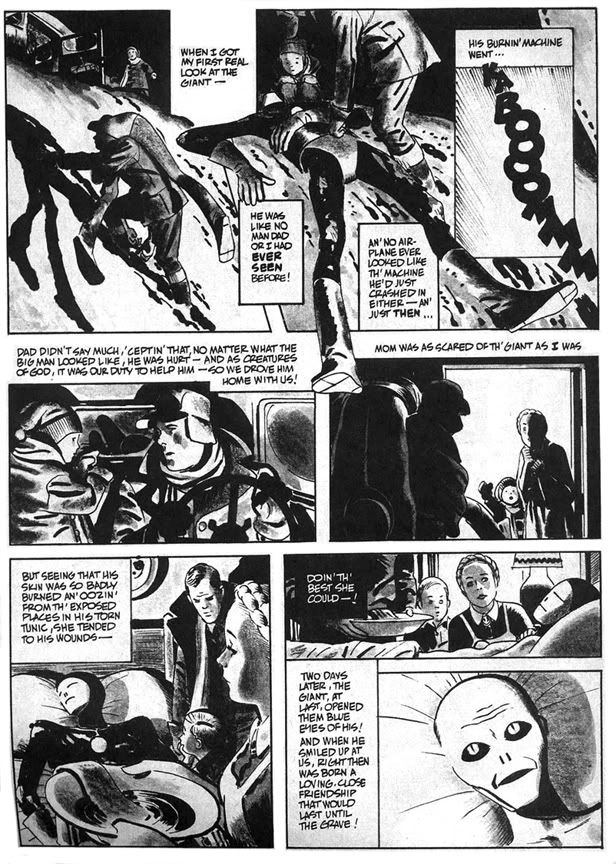 In 1977, Alex Toth illustrated "Daddy and the Pie," from a Bill DuBay script. It appeared in Warren Publications' UFO and Alien Comix #1, dated January 1978. People were going crazy for all this space alien stuff about that time. Probably had something to do with Star Wars and Close Encounters of the Third Kind setting box office records. Or maybe it was because Zontarr, ambassador from the planet Horvis VII, was all over TV in the mid-70s during his futile campaign to convince the people of earth to give up their dangerous nuclear weapons programs-- which threatened galactic civilization-- and his more successful efforts to popularize John Travolta via the sitcom Welcome Back, Kotter and disco music. Poor Ambassador Zontarr. Today he teaches political science at a community college and smokes way too much pot.


"Daddy and the Pie" hearkens back to those message stories EC used to run where they'd sucker you in with gloriously drawn gore and freaky octopus-like creatures then teach you some kind of life lesson, like in that one tale about the little mutant girl who was so misunderstood. "Daddy and the Pie" also has a distinct Ray Bradbury feel in its mix of small town nostalgia, the melancholy truth of just how crappy we humans can be to each other and science fiction. The moralizing doesn't overwhelm the plot, thanks in no small part to Toth's beautiful drawings. He evokes a sense of mystery and wonder on each page, and the heavy use of blacks along with ink washes make this one of his finest pieces. I was all set to write enthusiatically about how brilliant DuBay is for having the boy narrate the story in a kind of naive voice and how that contrasts with the action to give us a more complete understanding of what really happened with Daddy and the Pie-- then I re-read it and realized the narration is pretty spot-on, with Toth's images merely amplifying DuBay's script.
Oh well. DuBay does tell the story from the boy's limited perspective and it's a script worthy of Toth's best efforts. The kid learns that heroism isn't beating up bad guys the way the two-fisted ruffians in the movie serials and radio adventures do. It's also quietly helping others and accepting them for who they are. Just doing the right thing and asking nothing in return.
He learns this not only because of the Pie's influence on his life, but also because the example his father sets. As DuBay has him tell us, "I was lucky to have two heroes all my own... ...Two of the biggest, bravest legends ever to walk God's green earth. Daddy and the Pie." Children need parents they can look up to in the absence of saintly blue aliens. When kids inevitably encounter various forms of hate and prejudice they need strong role models within their own families to teach them open-mindedness and acceptance of differences.
Ultimately, however, "Daddy and the Pie" also reminds me of that Kenny Rogers song, "The Coward of the County." Some people-- and blue giants from other worlds-- can only be pushed so far before they have to give up pacifism and counter aggression with mysterious glowing orbs that focus mental power to wreak retribution. DuBay and Toth wisely keep the action offscreen, making us imagine its horrors, rather than fully depicting and and possibly glorifying it in the way comics and films frequently do. The Pie is fully benign but he, like the less evolved people who finally drive him to reaction, is capable of destructive acts. In some ways his sacrifice and victory in the town is the most human moment in the story. By not showing it-- by confining it to a couple of small, dark panels with flame on the horizon and ominous "BOOM! BLAAMM! KA-BAAMMM! BOOM!" sound effects, DuBay and Toth tell us this is also the least heroic thing the Pie does. This capacity for meeting violence with violence-- even when justified-- is perhaps a universal failing of all sentient beings. That we even bother to try and overcome this is a much more heroic act than burning down a town, even if it is full of bigots.
This story is also similar thematically and in plot to the 1953 Western classic Shane, starring Alan Ladd.
Subscribe to:
Posts (Atom)