Showing posts with label Star Trek. Show all posts

Sunday, July 6, 2014

Marvel's Marvelous Movies #3: Star Trek: the Motion Picture (December 1979)

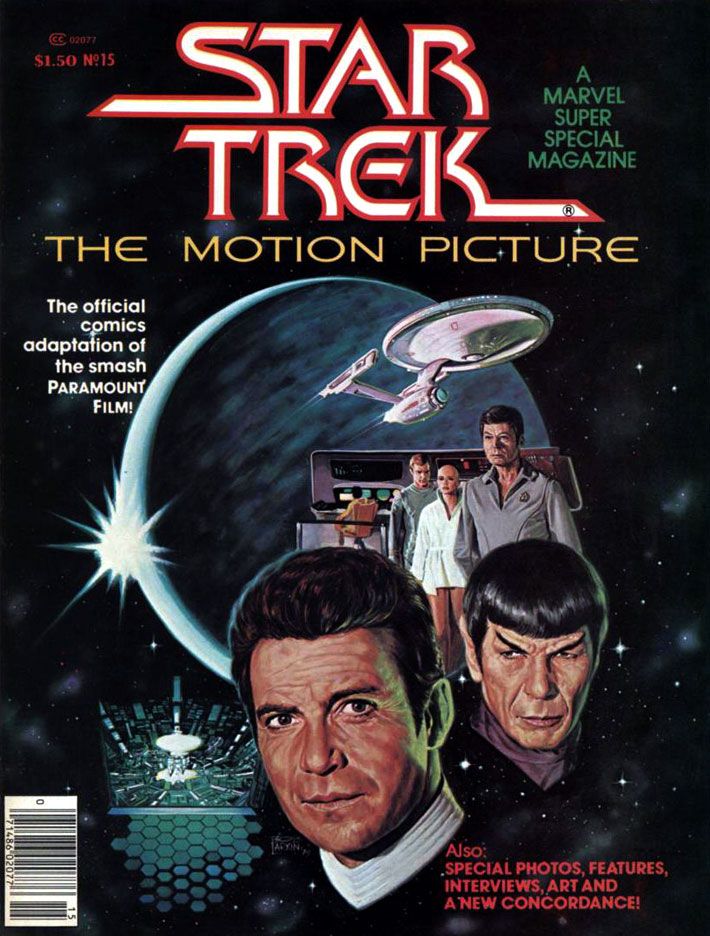
I'm going to tell you upfront this was one of my favorite individual comic book stories when I was 11 years old.  I have no idea how many times I read it.  The following year, Marvel's Empire Strikes Back adaptation would knock this one (and just about every other comic I'd ever read and loved prior to encountering Al Williamson) down a spot or two on my personal hit parade, but I still have a deep and abiding love for Marvel Super Special #15.  I'd been a Star Trek TV show fan for as long as I could remember, and this was in the wilderness years of the 1970s.  Back then, you had to find Trek at odd hours on some local station.  Ours came out of Tallahassee on Saturday afternoons, subject to atmospheric interference.  When your station dropped whatever Trek syndication package they'd licensed, you lost touch with the crew until they popped up somewhere else within antenna range.  In the interim, you could read the James Blish short story collections with episode adaptations, and the often silly Gold Key comics.  Or collect and play with the Mego action figures.  That was as Treky as we got before 1979's Star Trek: the Motion Picture came out and relaunched the franchise as a movie series.

It almost didn't.  The movie, directed by two-time Academy Award winner Robert Wise and based on a premise written by series creator Gene Roddenberry, made money, but it was expensive to produce and wasn't as big a hit as Paramount had hoped for.  It certainly looked fantastic, with a sleeker, updated Enterprise and everyone in pajamas for a sweet slumber party atmosphere.  But it suffers from endless shots of the Enterprise slowly drifting along set to repetitive music cues and people staring in awe at light shows.  It's like watching the audience at Laser Floyd: Dark Side of the Moon.  The film allows its characters to ask existential questions, but when it comes to answering them, the result is akin to a 2001: A Space Odyssey where, after boring you for more than two hours, Stanley Kubrick has the astronauts explain to each other (and the audience) exactly what the monolith represents and why it does what it does.  The cheaper, more action-oriented Star Trek II:  The Wrath of Khan turned out to be the franchise's salvation, not this glacially-paced epic.  But in 1979, for me, it was enough seeing Kirk, Spock, McCoy, Scotty, Uhura, Sulu and Chekov (along with Janice Rand, for cripe's sake!) back in action.

And, after watching this movie again on Blu-Ray recently, I've decided I'll take it with all of its flaws and dull stretches over either of the terminally stupid "reboot" flicks any day of the week.  Star Trek The Motion Picture at least has ideas and something to say about the basic human dilemma ("Is this all there is?  Is there nothing more?"), things it takes very seriously.  Can you imagine a major studio nowadays dropping this kind of money on a sci-fi flick starring a lot of middle-aged people and without any meta-humor or product placement?  There's not even a sky-diving sequence!  There's barely any sex!


But let's talk about the comic.

It must have been a daunting challenge to adapt into an entertaining comic a story that consists mostly of long sequences of nothing more than the Enterprise gliding over the giant V’Ger ship and then small groups of characters conversing about it in staff rooms and small corridors.  The comic really benefits from the deft way Marv Wolfman condenses scenes.  Wolfman ruthlessly edited down long scenes into a few panels, quickening the pace and generally tightening things up.  Wolfman uses his narrative captions-- always a strength of his writing-- to clarify character motivation and add descriptions and exposition to guide readers along.  We're engaged throughout.

For the art team, which consists of Dave Cockrum on pencils and Klaus Janson on inks, the problems are finding ways to make all the conversations work visually and reproducing the movie’s many, many special effects shots.  Cockrum, a master of crowded team compositions and action-packed superhero action, comes through with strong "acting" from the principals, downplaying the usual Marvel dynamics but upping the emotional content of various scenes.  His Commander Decker in particular comes alive with various angry faces and hand-chop poses emphasizing his frustration.  The likenesses are consistent throughout, a real plus when dealing with familiar, iconic characters.  The results aren't photographic, but Cockrum never confuses the readers.  Kirk has his poofy hair, McCoy his sharply arched eyebrows and drooping, lived-in face.  Of course Spock is easy to get right, but even more conventionally good-looking people like Uhura, Sulu and Chekov look pretty much the way you expect.  Every so often there's a dead face, but they never become a distraction.


What an ink job Janson provides, too.  While he and Walt Simonson outdid themselves on innovative lighting effects in Close Encounters, here he and colorist Marie Severin use color holds to reproduce Douglas Trumbull's lightning balls and wormholes.  This kind of stuff is easy to do these days with digital inking and coloring.  It's nothing to isolate an element and change the color channels to whatever you want.  But when Janson and Severin tackled Star Trek, they had to rely on acetate or vellum overlays.  It must have been a tedious, time-consuming process because they use one or more on practically every page.  The results are nothing less than astounding.


For all its pacing flaws, the film is effective at making space seem like an infinite frontier full of dangers.  It's not just that there are Klingons and V'Gers out there ready to zap unfortunate astronauts and Starfleet personnel.  Space itself is dark and perilous.  For one thing, the ships have to provide their own exterior lighting.  None of that Star Wars stuff where everything in space is brightly lit no matter how far away it is from an actual light source.  To the human mind, space appears largely empty, dark and vast.  Even the vaunted technology its space explorers count on for survival turns on them.  The transporter goes awry in a shocking incident and, later, the warp drive throws the ship into what the characters call a “wormhole.”  Contending with these, the Enterprise crew truly seems to be going boldly.  This isn't sailing along to some cute world where you find 1920s gangsters or the White Rabbit out of Lewis Carroll.  You could end up a data stream in a godlike machine's memory banks or transformed into a robotic copy of yourself with a lighted jewel embedded in your throat.  Or merge with the overmind into a stream of light.  Wolfman’s script reproduces each of these episodes faithfully and Cockrum, Janson and Severin provide some spectacular visuals to match them, with all the production design details faithfully reproduced.  Ultimately, this is an extremely accurate recreation of the film's look and mood, minus its shambolic tendencies.


The story also appeared in three monthly issues (Star Wars, a much shorter but action-oriented film, ran in four, which is further evidence of how Trek should have been pared down a bit) which led to a short-lived Marvel Star Trek comic.  I never read a single issue of that.  After all this time, I'm not sure why, especially considering how much I enjoyed this one.  Maybe it was enough for me Wolfman, Cockrum, Janson and Severin had already provided fabulous glimpse of what a Star Trek comic could be, one-upping its cinematic source material.  Too bad they didn't get a chance to take on Khan.


Looks like I forgot to talk about the Bob Larkin fully-painted cover.  That's just as well.  I'd have written a paragraph consisting only of superlatives.  I look at it kind of like Kirk, McCoy, Decker, Ilia and the rest gaze at Laser Floyd.

Thursday, May 1, 2014

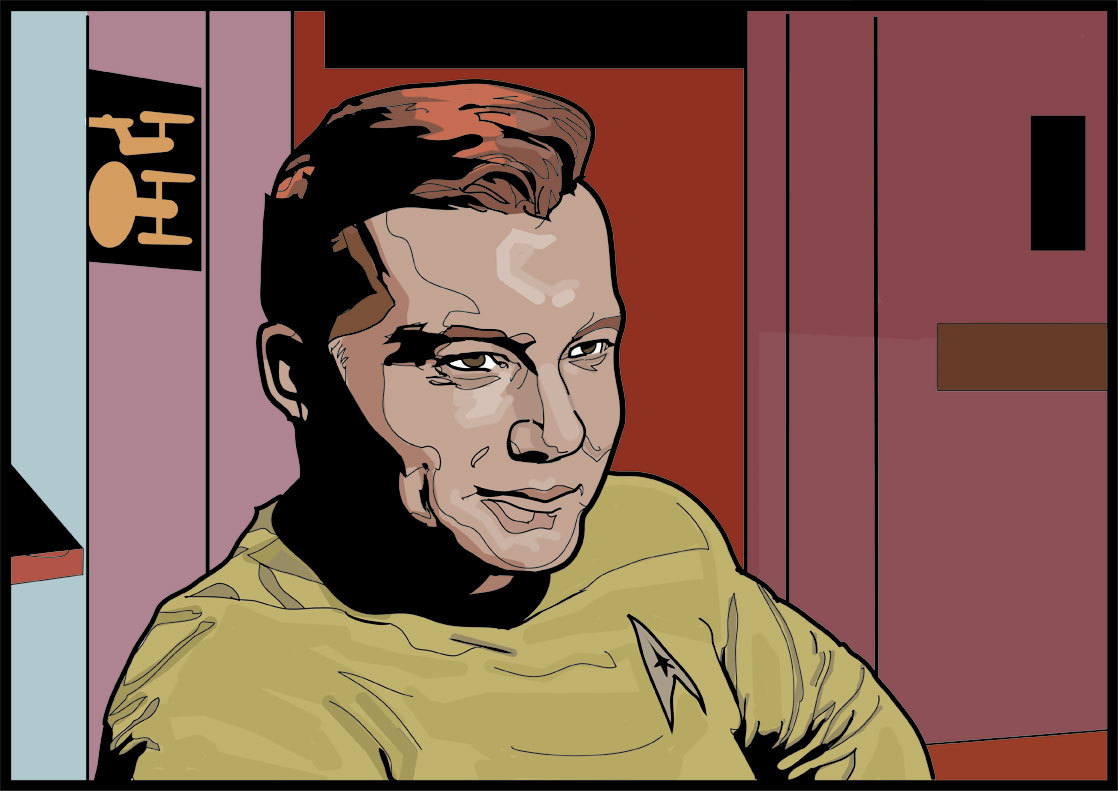
Captain Kirk on NBC...


You know, "The following program is brought to you in living color on NBC."  I don't think I'm any great shakes as an artist or renderer, but I do like my coloring abilities.  Not so much the shapes there, but the choices.  They may not be exactly accurate, but they're very rich and interesting to look at.  

Don't you agree Kirk's shirt is a strange and fascinating garment?  I think the originals were made of velour, which gives them a thickness and surface texture that comes across as particularly Star Trekian on TV.  Nothing wrinkles exactly like a Starfleet uniform tunic.  Now that we have Blu-Ray, we can see the nap more in early episodes.  The third season seems to have substituted some other material for velour.  Also, Kirk's tunic is longer and more tapered to his body.  His hair is a little longer, too.  

But the point of all this blather is what the heck color was Kirk's shirt in the first two seasons?  We like to say "gold," but it's kind of a greenish-gold that sometimes appears yellower and sometimes a kind of off-green (if I can be permitted to create such a thing).  The cartoon series gave him a yellow-orange shirt.  I've seen art with that corrected to something closer to the live action color, but those never look quite as charming to me.  My Mego Kirk definitely had a shirt much closer to yellow.

I read somewhere the Kirk shirt (and by extension, the Chekov and Sulu shirts as well) is actually a color known as tenne.  This is an orange-brown that can go so far as to be quite yellow.  It worries me.  I'm a worrywart about color.  

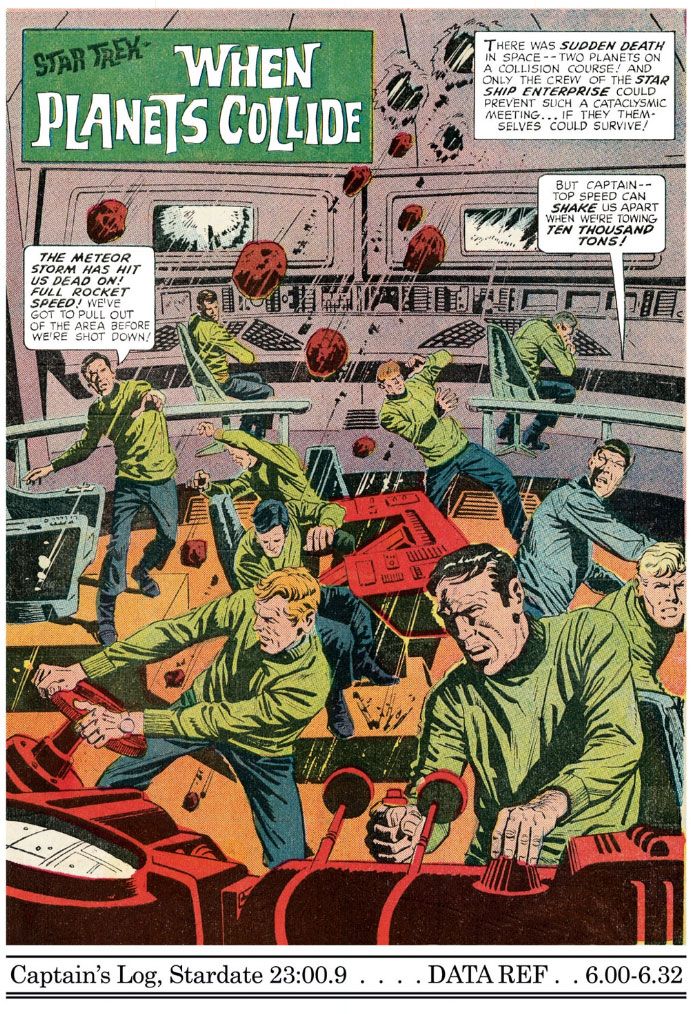
It's probably better to be like the colorists at Gold Key.  In the early issues of their Star Trek series, they simplified their lives by making everyone's shirts green, except Spock's.

Star Trek #6 (December 1969), art by Alberto Giolitto

Wednesday, April 30, 2014

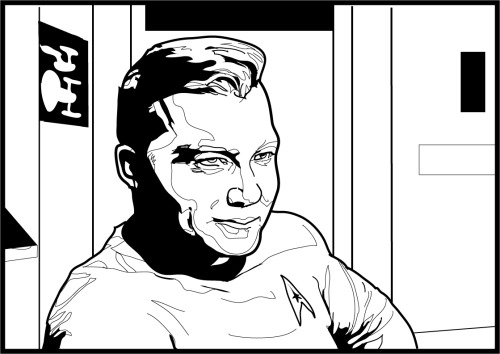
Re-downloading those Gold Key Star Trek comics inspires this Captain Kirk ink drawing...


Not really.  Actually, it was the other way around.  I've been writing about Comixology and drawing lately and working on this drawing reminded me I needed to get those Star Treks back onto my phone.  Any excuse for drawing Trek characters, though, is a good one.  Grabbing the new Comixology iPhone app requires we download all our comic books again.  There are a few series I absolutely cannot do without:  Kamandi, New Mutants, Teen Titans and, of course, Gold Key Star Trek.  I'd add New Gods and Mister Miracle if they were available.  There's one more, but I blog about it elsewhere because it falls outside our mission statement here.  It's nice being able to carry around entire runs of Fantastic Four, Uncanny X-Men and Amazing Spider-Man, too.

The first thing I did when I started the app is fill one very important area of it with Kamandi.  Yesterday, I started the process of re-acquiring my digital Trek books from IDW.  You have two options.  One is to purchase the individual issues, which is my preference.  Be warned, though-- for some reason the first few substitute the old Checker Publishing softcover artwork for the original comic book covers.  Then they start in with the original and very lovely photo-montage covers and-- even better-- the off-model fully-painted ones!  The other option is to buy them in little groups as collections.  At $11.99 a pop, that's probably the cheaper of the two, but for me, money is little or no object.

Well, even if you think I'm an ass for shilling for Comixology-- I haven't meant to; it's just worked out that way-- please enjoy Captain Kirk wearing something of a smirk.  I need to fix his left eye, mouth and chin, but I'm almost as satisfied with this drawing as ol' Kirk here is with himself!

Sunday, October 13, 2013

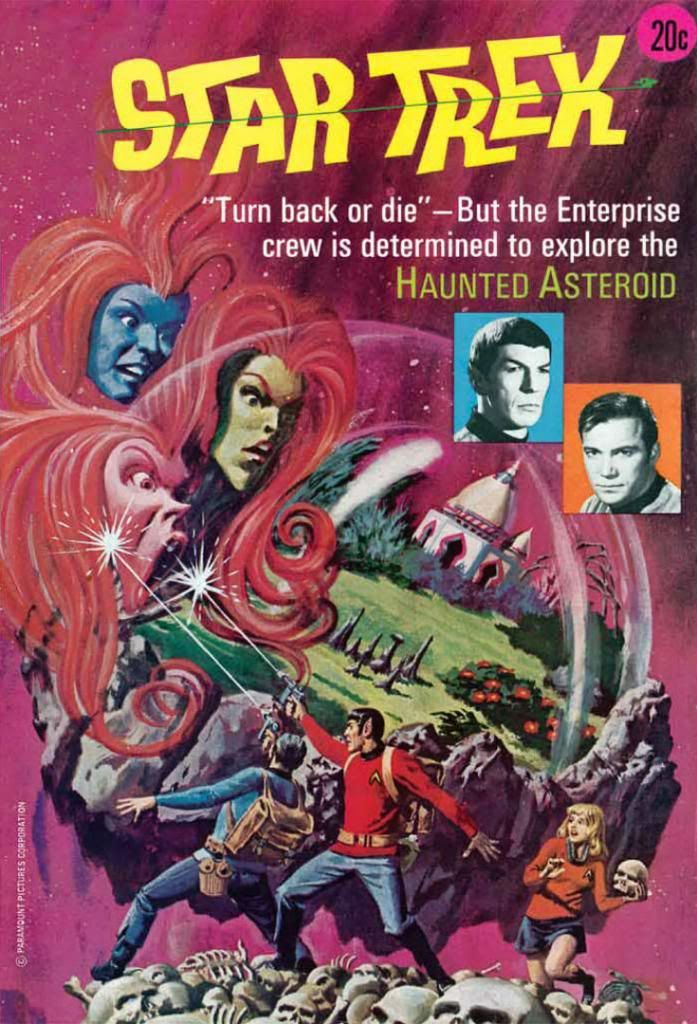
October is Spookey Month: Star Trek #19 in which a space criminal is frightened into incontinence...

The original Star Trek series sometimes combined science fiction with straight up horror, maybe softened a bit by a little dialogue about an "energy source" that creates whatever magic Kirk, Spock and the rest come up against.  But the idea was still using the old cliches to fill fifty minutes worth of story without being so obvious about it.  The very first episode to air, "The Man Trap" (September 8, 1966), featured a "salt vampire" that was pretty much just a version of a regular vampire story dressed up a little for a futuristic setting.  The crew met a witch in "Catspaw," written by Psycho author and H.P. Lovecraft protege Robert Bloch.  It ran just in time for Halloween (October 27, 1967, to be exact) and came complete with a black cat and a gothic castle.  And let's not forget "Wolf in the Fold" (December 22 the same year), also written by Bloch.  That's the one where we find out Jack the Ripper was possessed by some kind of immortal, incorporeal entity that feeds on fear.  When it gets into the ship's computer and starts screaming "RED JACK!  RED JACK!" over the intercom, Trek for the first time managed to scare me silly.  Even reading the James Blish short story adaptation of that particular episode frequently gave me the willies, the heebiejeebies, the whimwhams or small pox.


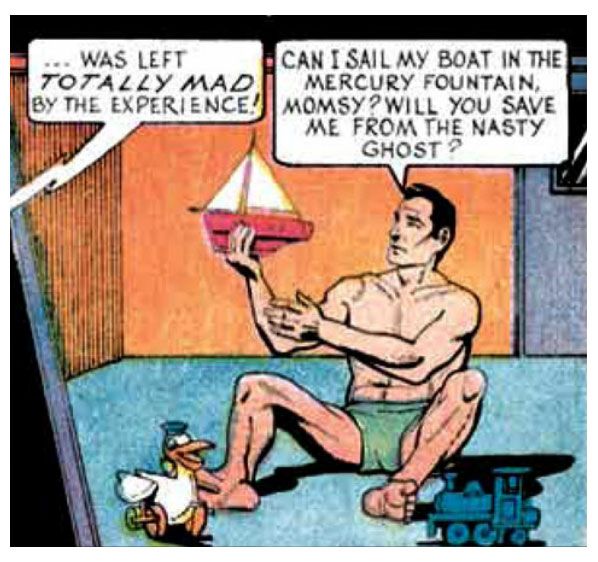
The Gold Key Star Trek comic adds ghosts to the mix in #19 (July 1973) , where (according to Comixology at least) writer Len Wein-- of all new, all different X-Men and Swamp Thing fame-- presents our daring space explorers with a supposedly haunted asteroid where something fearful dwells.  How fearful?  So fearful that after encountering it, this poor guy reverts to childhood and has to wear diapers for the rest of his life:


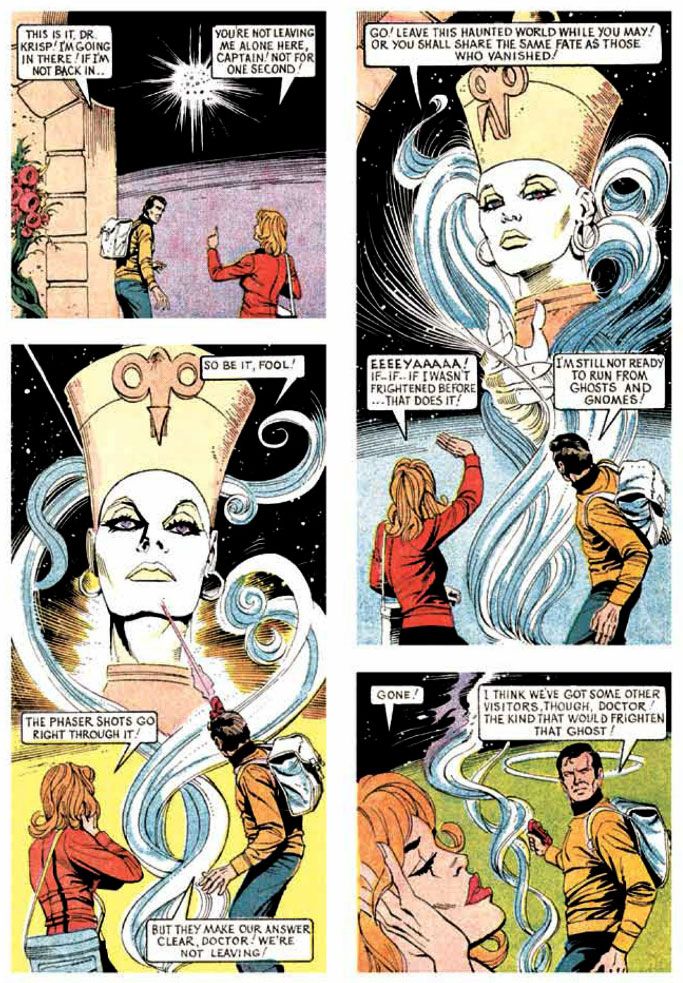
Because Starfleet favors the empirical over the metaphysical, the Enterprise warps to the asteroid for an investigation.  Kirk's old Academy pal Jay Nordyke goes down and comes back with selective amnesia.  Hypnotic regression reveals he's erased from his memory a horrifying encounter with a ghost.  At least he can still function as an adult.  Kirk, Spock, Sulu and some others beam down to check things out and gamble they're mentally tough enough to stay grown ups and in control of their bowels no matter what they face.


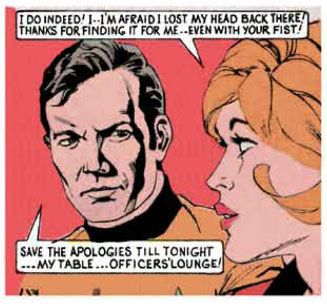
Aiding the ghostbusting is Dr. Krisp (first name Cookie) who, despite wearing a smart black skirt, proves a bit shaky in the field.  She and Kirk get down... to business (get your mind out of the gutter, please) and solve the mystery.  It turns out it's more science than supernatural, a variation on the old Scooby Doo, Where Are You? ploy of someone pretending to be a ghost to frighten people away when we all know that would only attract hordes of macho jackasses with night vision video cameras and heat signature detectors and a whole lot of pseudo-scientific bullshit to run around shouting at the walls for SyFy.


By borrowing heavily from the story of the Taj Mahal, Wein does a sweet job of setting up and then explaining the mystery.  There are some characteristically goofy moments because it's Gold Key, like hardened space travelers trained in scientific observation screaming "zombies" when what they're looking at is patently something else with which they should be very familiar given the Federation's technology.  And I love Alberto Giolitti's off-model artwork.  He sometimes all too obviously uses photo reference for some portrait-style panels, but most of the time it just seems like he had only the vaguest idea about the property he was working on.  As a result, a few things have been lost in translation, but a lot of charm has been gained.  Giolitti's art has its own Giolittian flavor, kind of fusion cuisine, some Trek, a side of Flash Gordon, a liberal dollop of European comics.  In the end, it proves a deliciously satisfying yet wild stew of different ingredients.  The exterior of the mausoleum looks Mughal, the interior gothic, the costumes strictly Ancient Egyptian.  At the same time, that's not too far from what the show itself used to do, where the set and costume designers seemed to lean on whatever was available in the prop and wardrobe departments at Desilu.

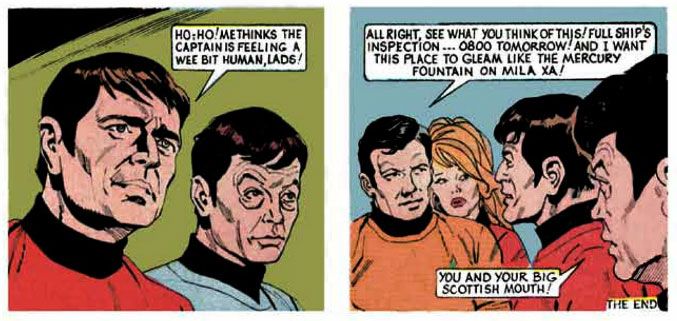
The ultimate solution is a surprise, but it fits the evidence and it's also made of stuff that's very familiar to Trek fans, so we'll accept it.  Or not.  That is to say, I'm fine with it but you'll have to make up your own mind.  This sets up a more traditional Star Trek dilemma where the crew now knows exactly what it's up against but still has to figure out how to escape an overwhelming power.  It helps that Sulu reveals himself to be a champion gymnast and Scotty a champion weightlifter.  I've always considered myself a solid Trekker, but I can't for the life of me remember either man possessing those skill sets.  I know Sulu is an expert fencer and botanist, and that Scotty can drink anyone under the table be it Klingon or godlike evolutionarily advanced super-being.  Neither of those apply here.

And what is it Kirk is good at, better than any other man?


Being a hard ass.

Saturday, August 3, 2013

Gold Key Star Trek #2: Some of these characters are instantly recognizable!

Gold Key's Star Trek #2 came out the same month I was born.  We've grown up together.  We're both awesome.  Star Trek #2 edges me by just a hair in the awesome department.  And that hair is comic book Scotty's mousy brown versus James Doohan Scotty's glossy black.

Scripter Dick Wood takes the Enterprise and its crew to a mysterious glowing asteroid, but the story's title gives everything away-- "The Devil's Isle of Space."  While Targu, the leader of the asteroid's castaway population insists they're simply victims of an unfortunate accident, Captain Kirk soon learns they're actually a prison population.  Their culture has a novel approach to incarceration.  Prisoners go to various asteroids to await execution at some unspecified future time.  They're not even to know how they're to die.  Spock adds the rather alarming extra bit of information that the asteroid is going to turn into a "super nova."  I thought only stars did that, but Spock is a United Federation of Planets scientist, science officer of Starfleet's finest exploratory vessel and all-around genius so I'm going to bow to his superior space knowledge.  Firing squad, gas chamber, electric chair, injection, exploding asteroid.  Don't do the crime if you can't do the time, or so Sammy Davis, Jr. once advised us.


Spock certainly keeps his eye on the sparrow.  He goes right to work doing what he does best-- solving problems.  But this is a doozy, with moral implications.  Spock's boss Kirk has a bit of a personal objection to the execution methodology and he's got even more of one when said methodology includes his own execution and those of his crewmembers, for whom he feels at least partly responsible.  The obvious solution is to get the hell out of Dodge.


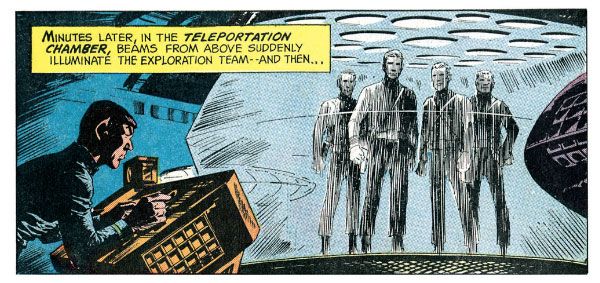
There are two complications.  The first, an energy field trapping the Enterprise in orbit around the asteroid, lasts only as long as it takes Spock to apply his vast intellect to solving its problem.  He invents "counter energy" to "flood the area," and that does the trick.  The second isn't so easily done away with.  Since the Enterprise transporters-- called the "teleportation chamber" here-- seem to lack the discriminatory circuits of the TV show's version, the landing party can't beam up... er... teleport back to the ship without bringing along a random selection of Targu's hardened criminals.


Fortunately for the landing party Spock isn't merely a top-notch astronomer; he's also a master of strategy.  He has pseudo-Scotty and company build a flying replica of one of the prison rockets and fools the inmates into believing they're receiving a missile's worth of fresh fish.  Surprise!  It's pseudo-Scotty and his merry band of rescuers with "fire bombs," apparently some sort of relatively harmless flash-bang devices they use to chase away the convicts.


Within minutes, the Enterprise rockets to safety and all's well except for the criminals who die when the asteroid explodes.

Let's take a look at some of artist Nevio Zaccara's embellishments to the Star Trek universe.  First, there are the knives he puts on the landing party's belts.  Well, you never know.  Some away missions may require whittling or making scrimshaw.

Also, he has Kirk mistake his tricorder for his communicator.  Well, not just Kirk, but everyone, including the narration.  Incredibly, it's a very screen-accurate tricorder as well, which makes it even more glaring to a hardened Trekker like myself, especially contrasted with Zaccara's free-wheeling version of the Enterprise interior and the crew's weapons, finally referred to in the comic as phasers.

Zaccara has a unique take on rendering likenesses among the secondary characters, i.e., anyone not named Kirk, Spock or McCoy: don't even attempt them.  Here's a typical scene:


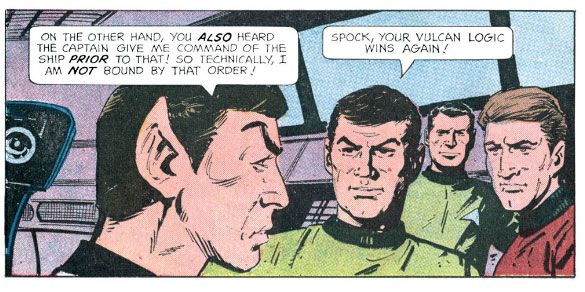
Spock appears Nimoyish but with that makeup an artist could hold the pencil with a couple of toes and stand a chance of drawing a passable caricature. Next to him is McCoy, in a green shirt.  The eyebrows are sort of reminiscent of Deforest Kelley's.  That guy in the red shirt, however, is the Scotty I've been telling you about.  And between them, looking on from the back is Uhura.  Other than drawing her hair a little shorter than it appears on the show, Zaccara has done a bang-up job on Uhura.  Come to think of it, while Zaccara caricatured him accurately in the first issue, in this one Kirk often looks a lot like Sean Connery rather than William Shatner.  Interesting bit of casting that would have been, huh?  If not for that spy movie series...

Speaking of Uhura, the character actually has a non-speaking cameo earlier in the story and Zaccara produces a reasonable facsimile of Nichelle Nichols, but the colorist botches it in a way that's more obvious and egregious than Scotty's hair or anyone's service tunic.  And I'm not talking about the bright yellow dress she sports for some reason known but to our anonymous colorist.

Zaccara can draw this stuff any old way he pleases as far as I'm concerned.  Yeah, it's fun to pick at it but at least Zaccara produced vigorous stuff.  Because he seemingly wasn't tied to producing perfect images for licensing purposes-- make the bridge look like the TV show because we've got a playset coming out and we need the extra advertisement, please-- he just invents using his own unique visual flair and we get something kind of weird, kind of funky, definitely fun.  It's not his fault my brain has been trained over the years into an encyclopedia of useless crapola, but with startling gaps.  What Zaccara's art lacks in Trek accuracy it makes up for with energy and a kind of EC-ish feel.  That's a more than fair trade-off, plus it gives me something to write about 45 years later.

On that note, one final observation.  In what had quickly become a Gold Key Star Trek tradition, the plot ends rather abruptly and violently.

"The Devil's Isle of space-- nothing but a floating cloud of dust now!  It seems brutal to have left those people there..." Kirk says in the last panel.

"Execution by asteroid explosion is the way of their society!  We had no other choice but to leave them, Captain!" Spock concludes.  In other words, "To hell with them."

NOTE-- I'm off for a couple of weeks, so no updates until later this month.  I'm sure you're breathing a sigh of relief there!

Gold Key Star Trek #1... when Yeoman Rand wore the Phrygian cap!

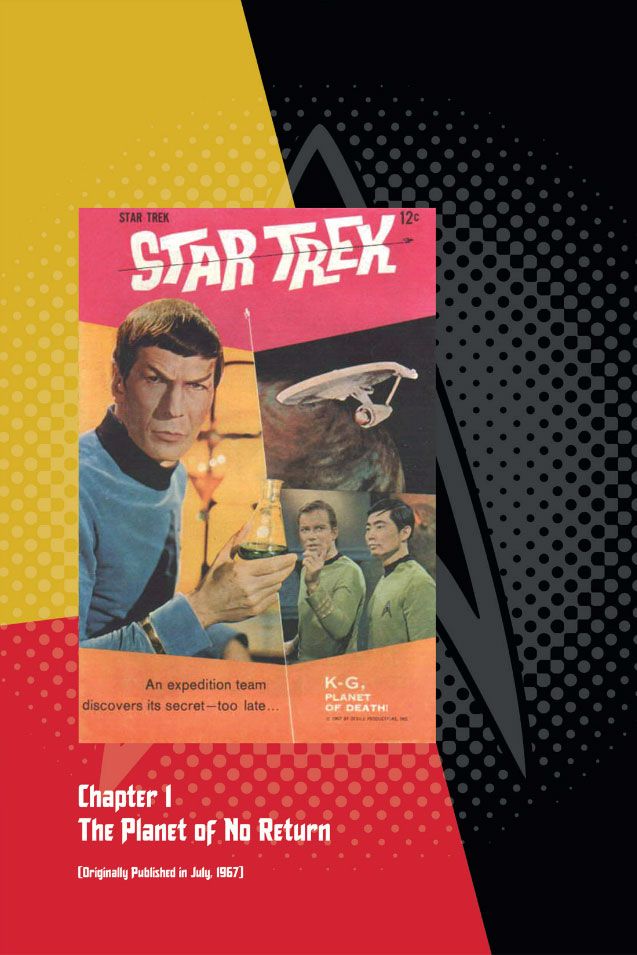
I bought a lot of the Gold Key Star Trek comics last night.  I've owned the Checker Book Publishing Group reprint books for a while, and in all this time one thing has troubled me-- why does Yeoman Rand wear a red Phrygian cap in the first issue?

This morning I finally realized it's not a Phrygian cap at all.  It's the crazy cone-head braided wig Grace Lee Whitney wore as Rand and the Gold Key colorist-- whoever he or she was-- simply mistook it for a Phrygian cap.  Understandable when you consider how ridiculous and un-hairlike that wig looks in the first place.  I'd almost prefer a Phrygian cap to the thought of Whitney laboring under twenty pounds of lacquered yak hair or gorilla fur or whatever they made it from.

Comixology doesn't have the most accurate credits for this book.  Checker must have just provided them with a list, so they added everyone.  No matter, I enjoy reading blogs by those who know more than I do.  According to Martin O'Hearn at Who Created the Comics, it was scripted by Dick Wood, a writer I know nothing about.  Wood isn't listed on Comixology at all, but maybe someone can contact them and provide details.  O'Hearn also informs us Nevio Zaccara drew the comic.  That I actually knew.

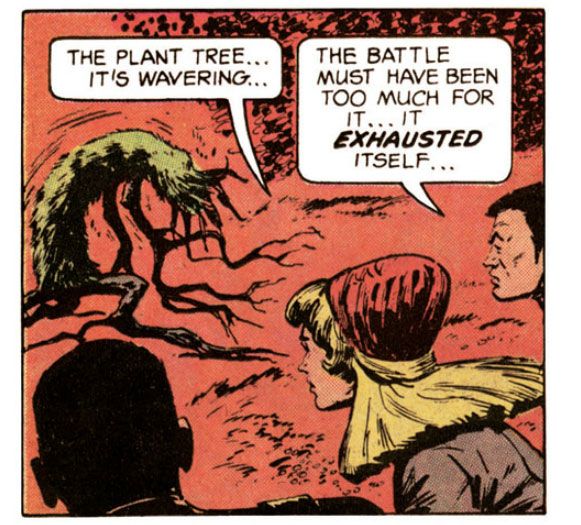
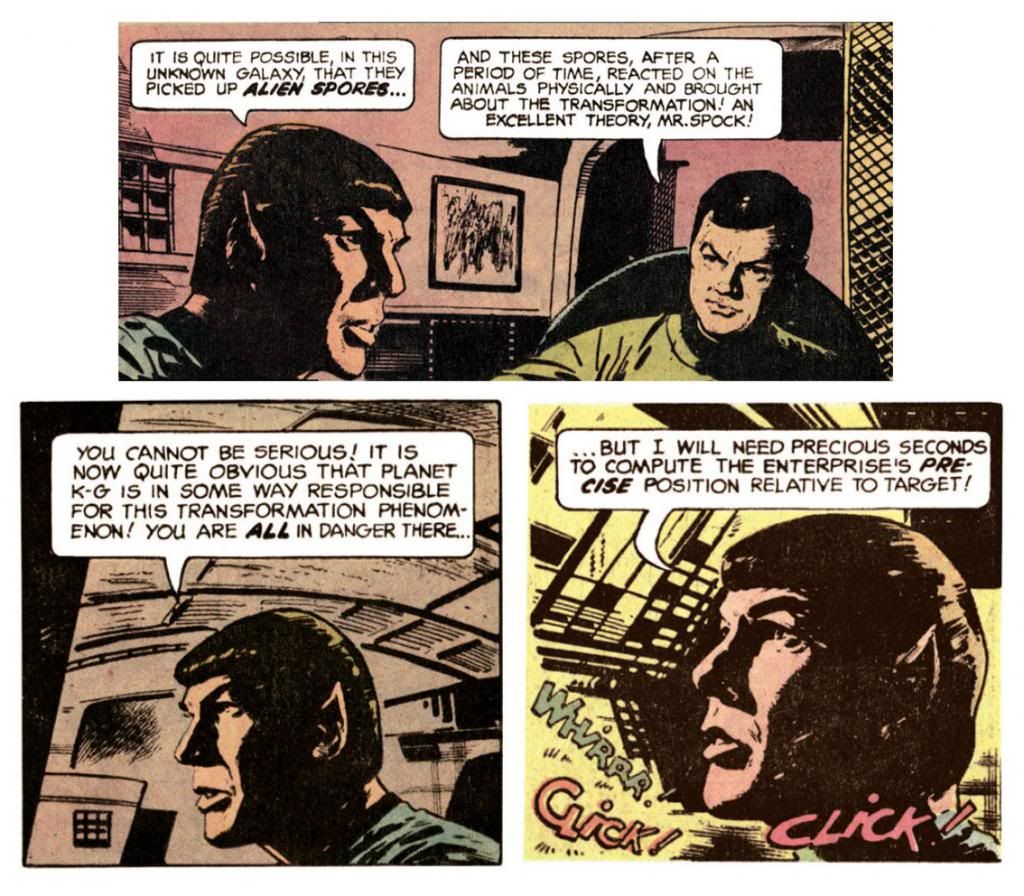
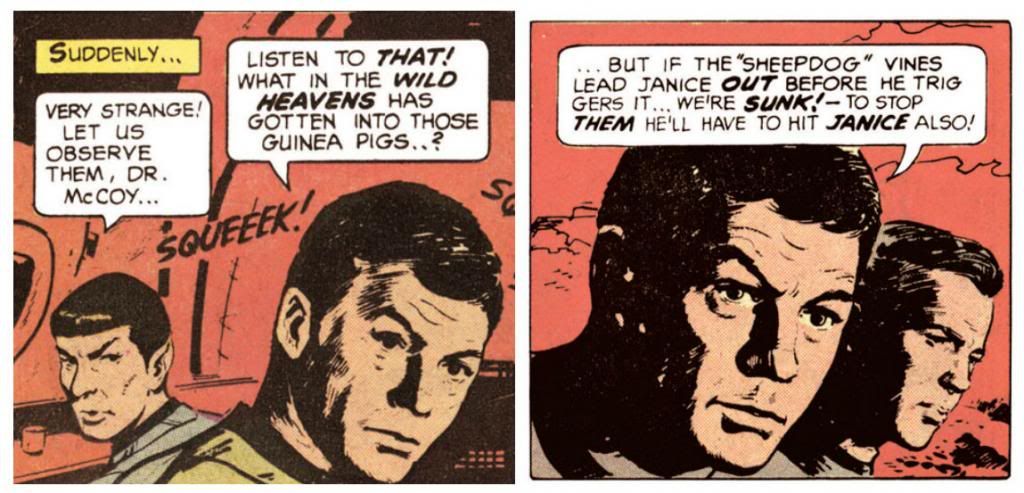
The story is called "The Planet of No Return," but the planet itself is called K-G.  That's K-G for, as the script tells us, "Kelly Green," not K-Y for you Trek fans out there who are also into body lubricants and turning everything into a sex joke.  The space explorers investigate because as the Enterprise flies through a "space cloud," tiny spores seep through the ship's hull-- I'm no NASA scientist, but even as a layperson it seems that's some pretty slipshod ship construction-- and start raising hell within by transforming common guinea pigs into tentacled plant monsters.  In the immediate aftermath of the struggle, Spock directly contradicts scripter Wood by declaring the reason for the transformation is they tested the guinea pigs outside the ship a few weeks before and that's when the animals picked up the spores.

Make up your mind, Star Trek #1!


Kirk and his away team put on really slick body-hugging gray jumpsuits and beam down (from inside a transporter imagined as a glass chamber) to find K-G a planet where ambulatory plants have achieved dominance over animals.  As you can imagine, a group of animals transporting themselves down to investigate such a situation would soon find themselves quite literally in a world of trouble, Phrygian caps or incorrectly-colored tunics notwithstanding.  Blaster guns, as they call them here instead of phasers, are little help.  It takes the redoubtable Mr. Spock and his mathematical genius to calibrate the Enterprise's lasers (again instead of phasers) to a pin-point accuracy so he can fire it at the planet and free the landing party without cooking them.


Along the way you might have noticed most of the crew wear green shirts rather than gold, blue or red, although one unnamed crewperson does wear a red one.  This leads me to conclude the colorist had very little in the way of color reference to go by.  The same might be said of the Zacarra, who seems to re-use the same publicity stills for a few panels here and there and then his fertile imagination freely to create Enterprise interiors more fanciful than the show's.  A reader might at this point get the idea Gold Key took a somewhat casual approach to their Trek verisimilitude.  Hey, in the second issue Captain Kirk carries a knife on his belt and talks into his tricorder at one point, too.  Well, you don't go to Gold Key for accuracy.  These books are more about having fun.


That's probably why Wood has Kirk and company stammer uncharacteristically and use exclamations like "S-suffering solar showers!" to complain about their predicament.  And the rather abrupt and violent solution Spock comes up with for the dilemma of proliferating plant spores threatening the galaxy.

Comixology has a pile of these joyful little Star Trek books for 99 cents each, which is one reason we're going to be talking about them a lot as soon as the wife and I return from our overseas trip.  The other reason is simply that I love them!

Monday, August 15, 2011

I finally tracked down that "The Kirk Cries Yipes!" bootleg by Jimi Hendrix


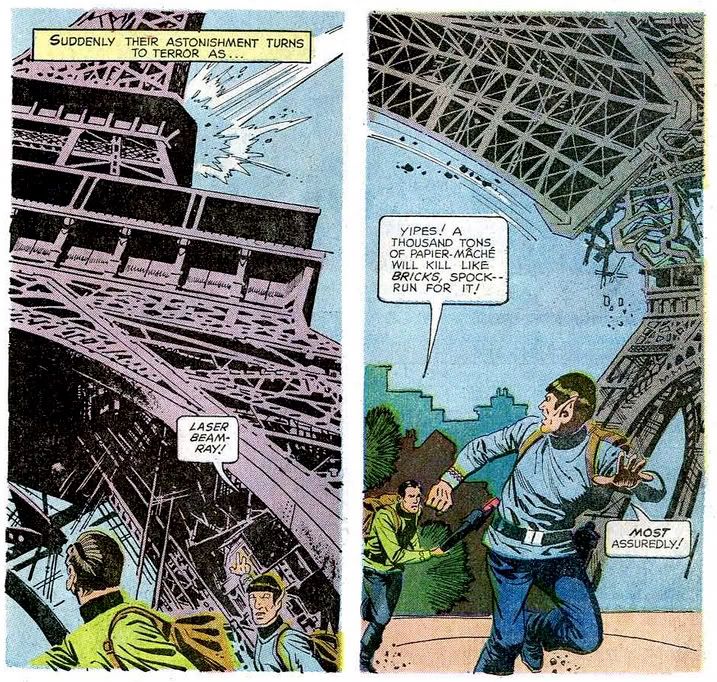
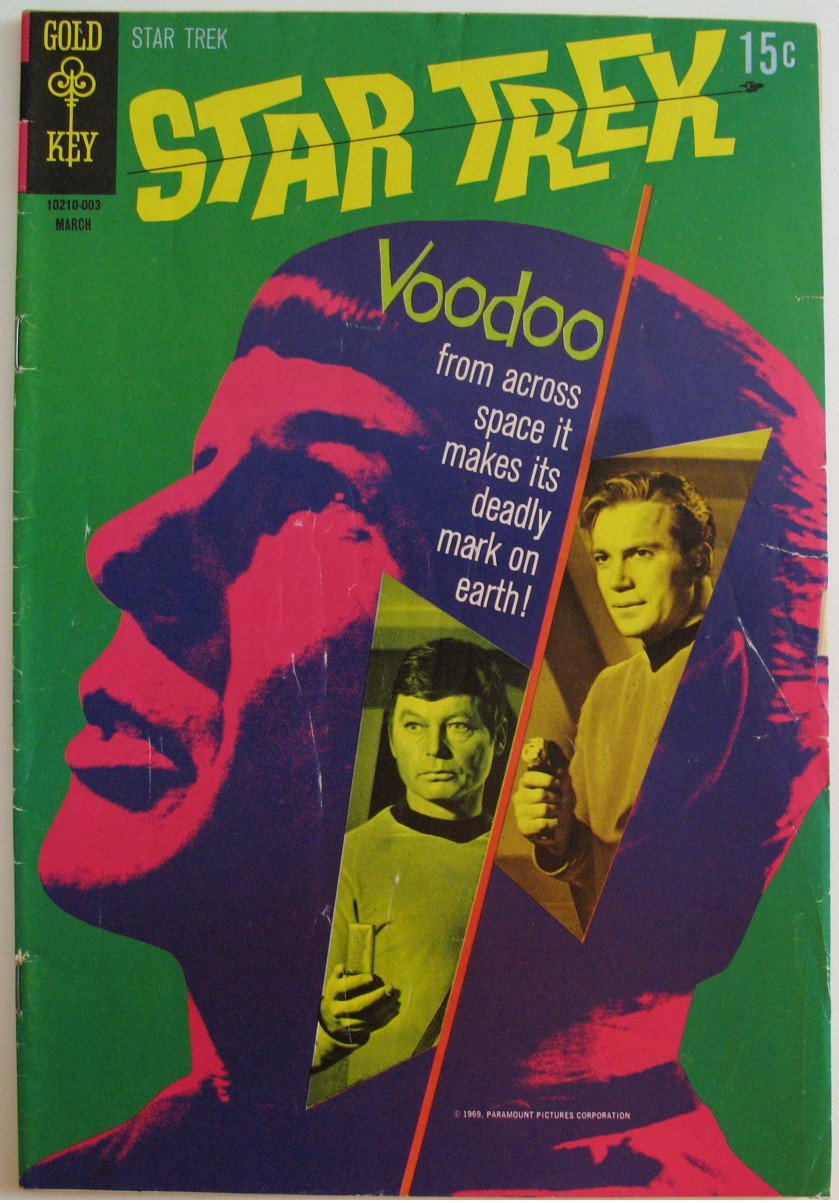
Even bold space explorers like Captain James T. Kirk experience moments of terror. Depicting one of these humanizes them for the readers. I'm just not convinced Kirk would yelp the word "Yipes!" even if a papier-mache Eiffel Tower threatened to crush him. This is a sequence from Gold Key's Star Trek #7, "The Voodoo Planet" (1970). The Enterprise crew encounters yet another space jerk, some deposed Earth ruler named Count Dressler, who has mastered the art of voodoo magic. Using his full-size replicas (which must have cost a fortune to build) and a laser beam-ray, Dressler destroys some of our most famous monuments before Kirk and Spock overcome psychosomatic pain to put an end to his idiotic revenge scheme.

The cover to this comic is awesome, by the way. It features a groovy psychedelic duotone Spock head in high-contrast magenta and purple containing some asymmetrically-cropped publicity photos of Kirk and McCoy all on a green background suitable for framing. I love the cut-out style type Gold Key used for the title, too. Far out, mannnnn!

Thursday, August 11, 2011

It's easy to tell you're not in heaven...

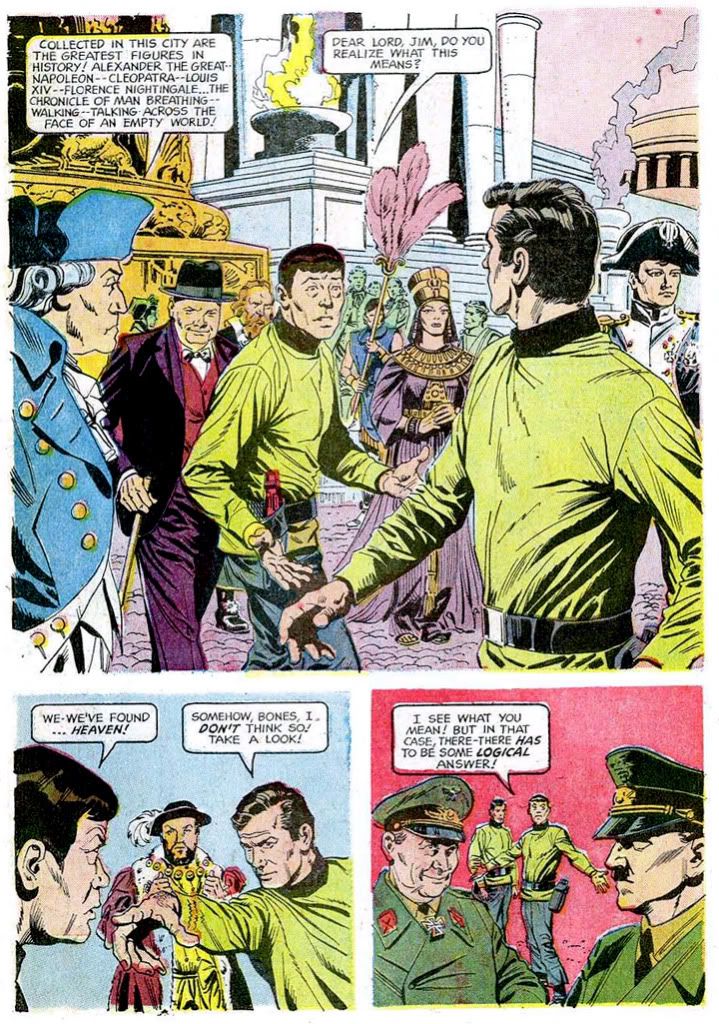
Yeah, I don't think so either, Capt. Kirk. This is a page from the Gold Key Star Trek series, namely issue #9, "The Legacy of Lazarus." This particular story may or may not have been written by Len Wein, but the art is definitely by Alberto Giolitti or someone in his employ doing a fantastic Giolitti impression. How's that for clarification? Well, someone's responsible, dammit, and I hope we can get to the bottom of this the way Kirk, Spock, McCoy and the rest of the Enterprise crew solve the mystery after they beam down to a planet where the entire population appears to be made up of Earth history's greatest-- and worst-- figures.

How do they handle social engagements? I mean, I can't imagine Winston Churchill inviting Adolf Hitler to his dinner parties no matter what planet they're stuck on-- it's bad enough when they meet out on the street, as they no doubt do just off-panel on this page. Those are probably tense moments. Somehow, I think Hitler and Herman Goering there probably spend most of their days skulking around together, ostracized by the likes of Henry VIII and Cleopatra's personal assistants.

I love these goofy old comics. As I've related here before, these were difficult to find when I was growing up. Coming across one was always a treat. I'm not sure why Kirk and McCoy are wearing lime green shirts with black turtleneck collars, but it makes me happy. Disgraced historian Alexander Lazarus and his museum-quality replica people all turn out to be complete jerks in the end, but in what other comic can you find a blood-crazed Abraham Lincoln attacking people with what appears to be part of a kite frame or canvas-stretcher?

Sunday, May 22, 2011

This one has everyone in it!


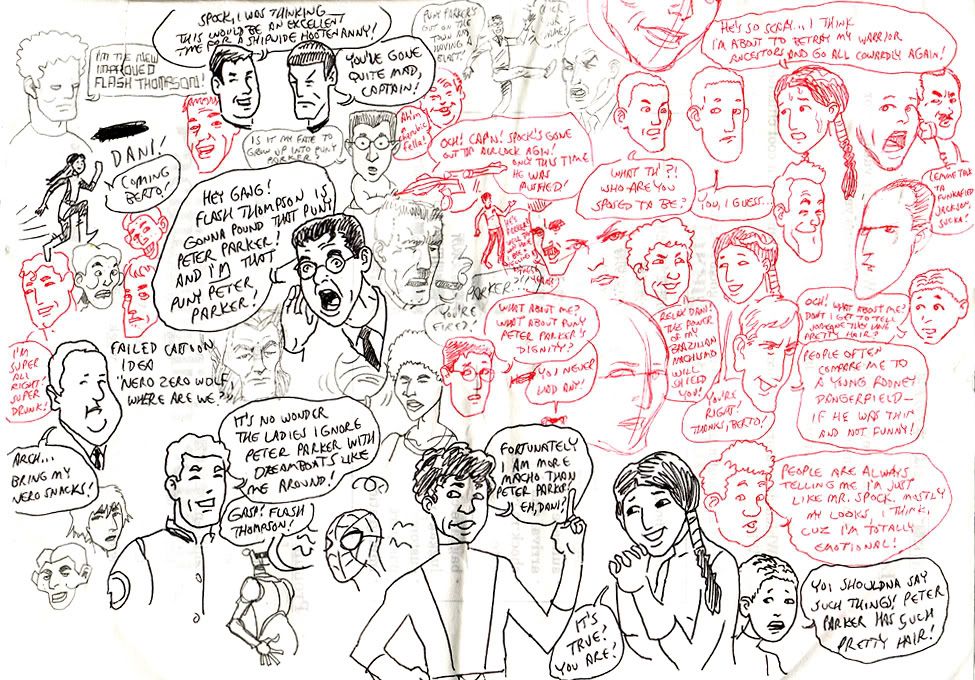
This is something I drew a few years ago. A little doodle done between English conversation classes. I like to imagine it's some sort of revolutionary post-modern comic book story told in a single page. See if you can figure out who's who and what's what!