Wednesday, May 22, 2013

Series I have loved: My comic fan biography

What titles made me the idiot I am today?  Let’s take a look at some of the series I made it a point to buy whenever I found them back there in my distant past, the titles that entranced me the most and made me spend way too much time thinking about and guessing what would happen next.  I’m going to try to put these in chronological order, but I’ll probably screw it up.  Oh well, what the hell? Let's go!

1)    Sgt. Rock/Our Army at War.  Both of the Sgt. Rock-starring titles.  As far as I know—and until we get the results of my hypnotic regression sessions-- these were literally the first comics I read.
2)    Richie Rich.  Any title with Richie.  I went through an intense Richie Rich period at one point.  Also, to a lesser extent, Casper.
3)    Archie.  Any of the Archie titles.  Since they all pretty much featured the same cast of characters, I didn’t differentiate between them.  But I generally preferred the digests because they packed more value and featured cool stories from the characters’ earliest days and I liked that art more than the newer stuff.  I also got into Little Archie in a big way.
4)    Planet of the Apes.  The Curtis/Marvel black and whites.  I liked the color series but it didn’t last long, while these showed up at the grocery store fairly frequently and for a few years.  Although they were pricey and scary, I managed to talk my parents into buying them for me one a few magic occasions.  I’d have bought them all if they’d had better distribution and we were a little better off financially.
5)    Batman.  This was more off and on, but I never turned down a chance to read either Batman or Detective Comics starring Batman.
6)    Superman.  The original.  The greatest of the superheroes.  If you don't dig Superman, you probably should go read another blog.  Or keep reading this one.  Either way.  I don't mind.  Much like with Batman, I bought Superman and Action Comics whenever the need to read about the Man of Steel struck me.  Sometimes I could go for over a year without seeing what he was up to.  When the Christopher Reeve movies came out, I started buying these whenever I could.
7)    Spider-Man.  Starting with Amazing, and then, when I was a teenager, the Spectacular.  My intro was the Gil Kane era, and I had the first appearance of the Punisher.  Left it out in the rain and it fell apart.  This is a character whose books would really catch on with me from time-to-time depending on the creative team.  During the 1980s, I had a massive run of them, with over 100 issues at one point, including some major milestones of that era.
8)    Star Trek.  The Gold Key series.  Since I was a huge fan of the TV show, I tried to get my hands on as many of these as I could.  But, like a lot of Gold Key books, they only showed up intermittently and everyone ended up with huge gaps in their Star Trek collections.  I read the two or three I had until they fell apart.
9)    Teen Titans.  The first volume.  I have vivid memories of borrowing a lot of these from a friend of mine and reading them at dinner, forever associating the Titans with steak and dinner rolls in my mind.
10)  Justice League of America.  All the heroes in one title!  A bargain!  Plus it was a little like Superfriends.  When you're a kid and your income derives mainly from change found between sofa cushions or near the drain at the deep end of the local swimming pool, you tend to economize and look for more heroes for your money.  Justice League was a wallet-saver.  I got into this book thanks to a reprint paperback I had of the team taking on the Adaptoids or some such thing.
11)  The Incredible Hulk.  Of course I bought this.  The TV was a must-watch weekly event.
12)  Micronauts.  All the coolness of Star Wars but with better artwork.  Plus, my friends and I were really into the toys.  This is one of the first books I seriously collected, searching for back issues and new issues no matter where we were—at home, at the beach, in the mountains.
13)  Conan the Barbarian.  And Savage Sword of Conan.  My middle brother introduced me to this character and I was hooked.  A monthly buy, especially when drawn by either John Buscema or Gil Kane.  Conan the Barbarian marked the beginning of my serious comic book fandom, when I began reading comics almost obsessively and began dreaming of becoming a comic book artist.
14)  Uncanny X-Men. I got into this title around the same time.  A friend of mine had a run of issues starting with #94 and I bought them all for about a buck each, plus one-time use of my left-handed baseball glove.  I had no idea I was risking addiction. Through this comic I became a fan of Chris Claremont, Dave Cockrum, John Byrne and Paul Smith.  I didn’t like John Romita, Jr.’s art on the X-people; I much preferred him on Spidey.
15)  New Teen Titans.  At one point the new Titans were more popular than the X-Men around my parts.  I started reading this title with #1 mostly because of the slick George Perez art.
16)  Daredevil.  The Frank Miller run, naturally.  Friends kept telling me about it but it wasn’t until I bought a couple of issues—including the first one Miller wrote and drew—at a flea market that I realized what they were talking about.  The panel-to-panel storytelling was a revelation, as was Miller’s wonky, slapdash anatomy.  I decided if I could just learn how to tell comic book stories cinematically it wouldn’t matter that I couldn’t draw for squat.
17)  E-Man.  A couple of comic book shops opened in our town at almost the same time, one in a small storefront and the other at an indoor flea market.  The owners of the former were a middle-aged married couple, super friendly people who often commissioned me to do artwork for their store and paid in posters and comics.  The owner of the latter was a skinny, loud guy who wasn’t shy about mocking the other store’s name.  But they all gave me sterling recommendations for reading material and broadened my comic book horizons considerably.  E-Man was the first of the indie comics I latched onto, the First Comics version. Man, I thought it was the funniest thing I’d ever read, especially when Martin Pasko and Joe Staton took potshots at Uncanny X-Men, a title I was still very much in love with at the time, so much so I even enjoyed parodies of it.
18) Judge Dredd.  The Eagle Comics color versions.  Could you ever go wrong with Brian Bolland covers?  His interior art blew my mind, too, but I also came to appreciate Ron Smith and Mike McMahon as well.  The coloring on these books was gorgeous, too.  And Dredd himself, never suspecting the joke was on him, made a compelling figure with his perpetual scowl and his big green boots.
19)  American Flagg.  I probably shouldn’t have been reading this because of all the double entendres and the lingerie-clad women, but read it I did and I loved it.  The typography was really catchy and I dug Howard Chaykin’s art and writing.  This book made me feel smart.
20)  Cerebus.  This was before the whole misogyny rap.  At this point, it was just a cleverly-written series with some laugh-out-loud moments and obviously something deeper going on.
21)  The New Mutants.  The X-Men, but my age.  Dani Moonstar quickly took over the lead spot in the book and as my favorite superhero character.
22)  Alpha Flight.  Byrne goes back to his Canadian roots and puts together a pretty cool team from the crumbs Claremont left on the table.  Puck was, and is, filled with more awesome than most characters twice his height.  I really like Marina, too.  When she turned into a savage version of herself, I ached for her.
23)  Fantastic Four.  The John Byrne era.  It was the last book I latched onto and very possibly the last I let go of when I decided I’d outgrown comics.  These books really captured the excitement of the superhero genre, plus I could never grow tired of looking at Byrne’s art.  The stories were smart, too.  Maybe not as smart as Byrne thought they were, but smart nevertheless.  Remember when the moon fell apart like an anthill and that sideways issue?  Byrne's issues inspired me to read the Stan Lee/Jack Kirby originals and to this day I'm a dedicated 1960s-era Fantastic Four fan.

One title I liked but didn't collect?  Wonder Woman.  I loved the TV show and occasionally read the comic but I considered my enjoyment of it something of an embarrassment.  Why was that?  It didn't come naturally; I learned it.  I lived in the conservative Deep South and entertainment, as with many other aspects of life, tended to be severely gender segregated.  Wonder Woman was, well, a woman, and therefore her comic was for girls.  Whenever I expressed any interest in "girly" things, I got my hand slapped metaphorically by my peers and well-intentioned adults who happened to be complete dopes.  So my love for Wonder Woman, just like my enjoyment of Charlie's Angels for their cool adventures rather than their physical appearance or skimpy undercover outfits, remained top secret.

And then I grew up.  Kinda.  Liking any comic book became an embarrassment to me, so I sold off a lot of my collection—most of those early Uncanny X-Men and New Teen Titans, plus my Cerebus and even the first two issues of Marvel’s Conan the Barbarian—which I traded for a ton of Kitchen Sink The Spirit reprints, which I still have.  Reading comics in high school and junior college wasn’t considered cool, not even when the first Batman movie came out.  I had to escape my hometown to shrug of the snobbery.  And then came…

24)  EC.  The Gladstone/Gemstone reprints.  When I wasn’t spending my student money on pizza, booze and live shows, I bought every one of these I could find.
25)  Namor.  Byrne again.  Namor as a suit-wearing multi-billionaire?  Sign me up!
26)  Nexus.  Post-college, with a little spending money, I could afford to indulge myself a little.  So when Dark Horse brought back Mike Baron and Steve Rude’s Nexus with a run of fantastic mini-series, I was there.  I still am.  It broke my heart when the Dark Horse run ended, so I'm thrilled Baron and Rude have taken up the story again, first as a self-published effort and then back at Dark Horse.  Here's hoping we get to visit Ylum again.
27)  John Byrne’s Next Men.  Byrne telescoped the storytelling, which frustrated me, but I found his science-based approach to superpowers fascinating, as well as the way he tortured his poor cast.
28)  Harbinger.  Jim Shooter shoots… he scores!  Imagine the X-Men with more of a low rent real-world vibe.
29)  Archer and Armstrong.  More Valiant goodness.  A team book, kind of an action comedy.
30)  Doctor Solar, Man of the Atom.  Who am I to argue with Barry Windsor-Smith?
31)  Xenozoic Tales.  I discovered this one via Marvel’s color Epic reprints, then started buying the black and white albums whenever I could afford them.  Yes, I was back in college, studying graphic design this time.  Mark Schultz re-introduced me to an old friend of mine, a certain Al Williamson.  And also classic adventure storytelling and lush artwork.  The stories started off as EC-rips and soon evolved into something epic unto themselves.
32)  Gen13.  And then things got stoopid.  This is a book that cheered me up when life took an extended downward turn, just the kind escapist nonsense I desperately needed at the time.  Hard to believe this book was once so popular it spun off into an experimental title where some of the top names in comics took chances with the characters the creative team behind the regular monthly wouldn’t dare.  But my biggest obsession was—I freely admit—with the dumber-than-dumb but still quite fun main title.  I even drew a couple of pages of continuity with a mind towards submitting them in the hopes of getting hired.  I ended up simply sending in a fan letter.  J. Scott Campbell’s art improved exponentially in each issue even if the plots consisted of recycled elements of better comics.  Later writers and artists turned this into a real comic, but by then the craze was over and nobody cared.  Except me!  I cared.  I care.
33)  Hellboy.  Mike Mignola’s Bram Stoker’s Dracula adaptation was another one of the wow moments where I knew I’d found something I’d been missing without even being aware I’d been missing it.  So when he launched Hellboy, I was ready.  Still one of the best franchises out there.
34)  Hate.  Peter Bagge’s signature title is one of those “funny because it’s true” titles, especially if you’ve ever lived in a music-oriented college type town.  You can transpose a lot of the cast’s antics to my friends and me.  I’m not bragging.  It’s embarrassing to read this book.  Really cringe-inducing.  Because we lived it.
35)  Love and Rockets.  Working as a graphic designer/illustrator at a newspaper allowed me to buy a few comics every once in a while and I chose these.  I can’t remember what inspired me to pick up Love and Rockets Volume 2 #5, but it was love at first read.  I very quickly bought all the collections and back issues.  Still one of my all-time faves.  Hopey is an obsession with me.
36)  Kirby's Fourth World.  New Gods, Mister Miracle, Forever People and, to a lesser extent, Jimmy Olsen.  Love 'em to pieces.  I didn't see many of these as a kid, but I've long been a Jack Kirby fan.  His books just didn't come my way very often.  Case in point, Kamandi.  Kamandi (while not part of the Fourth World epic) is another series I'm into in a major way, but I only ever owned that single issue.  Most of what I knew of Kirby I discovered in various reprint collections at the local library or bookstore.  None of these were Fourth World stories, just his early work with Joe Simon or some of his Marvel creations.  A few years ago, DC started repackaging Kirby and I was finally able to read some of his greatest stories in their proper order.
37)  Tomb of Dracula.  Gene Colan.  Marvel collected a few issues as specials back in the 90s, which is when I first caught up with a book whose art I'd been in love with for years because of the panels reproduced in How To Draw Comics the Marvel Way.  But it wasn't until the Essential Tomb of Dracula books came out that I was finally able to fully indulge myself in Marv Wolfman's deliciously purple prose and Gene Colan's nigh-flawless art.
38)  Warren.  Whether it's Creepy or Eerie or Blazing Combat, I cannot get enough of those old Warren books.  Big thanks to Dark Horse and Fantagraphics for putting these babies back into print in hefty, expensive hardcover form.


And now we’ve reached the end of the list.  It's longer than I expected, and I'm pretty sure I've left out a few things.  Some of them I still read, some I’ve long since given up on.  I’ve gotten into a few newer titles in the years since, but these are the ones I concentrate on in this nostalgia blog.  Anything that started post-1996 goes elsewhere!

Thursday, May 9, 2013

On Dan Adkins and weird rumblings in the comic book world

I learned this morning via P. Craig Russell's Facebook feed Dan Adkins passed away.  He was one of those artists I knew by name even when I was a kid, but I never really caught onto his visual style the way I did others whose work I could pick out from the angle of a face (John Buscema, Gil Kane), the set of a jaw (Carmine Infantino) or a certain lean, muscular phsyical type (Neal Adams).  I just associated his name with solid craftsmanship.  This was before I ever heard of a guy named Wally Wood or knew what was up with those scary Creepy and Eerie magazines I always avoided at the convenience store while looking for Sgt. Rock.

Adkins was Wood's assistant, which couldn't have been easy, back in the 1960s.  Thanks to Dark Horse's Creepy Archives, I'd been getting into Adkins-- things he did with Wood, things he did solo.  His "The Doorway" in Creepy #11 (October 1966) is a six-page visual knockout with an Archie Goodwin script.  While its neat-o concept involving science and black magic at a government research lab anticipates some of Stephen King's stories (especially his novella The Mist) the narrative reads a bit clunky.  The real draw is Adkins's clean, Woodsian artwork and his supremely controlled use of gray tones.  He painted the cover for Creepy #12 (December 1966), but the cramped design doesn't do him any favors, especially following a spectacular Frazetta ape on the previous cover, a full bleed image with room to rampage.

They also compressed Gray Morrow's graveyard werewolf into a small box on the following cover-- what were they thinking?

He went on to draw a ton of stuff like a run of Dr. Strange tales starting in... wait for it... Strange Tales and continuing in the first two issues of Dr. Strange:  Master of the Mystic Arts for Marvel.  He inked all over the place for them, too.  But I'm most familiar with Adkins from this era as Virgilio Redondo's inker on a story in Giant-Size Dracula #5 (June 1975) because I read it in the second Essential Tomb of Dracula reprint book.

The greatest impact Adkins had on my personal fandom came when he gave career starts to three guys you may have heard of-- namely Paul Gulacy, Val Mayerik and Russell himself.

In other comic book artist news, there's a cool little debate on the Al Williamson Fans Facebook feed, too.  What was Williamson's last published comic book work?  One guy says Williamson told him one thing, J. David Spurlock says another and it goes back and forth from there.  Both men knew Williamson and that makes me jealous.

Monday, May 6, 2013

I'll be back...

Sorry I haven't been posting a whole lot lately.  I still have a few Kamandi posts to drop here and I'm working on a look at the love life of one Hopey Glass, plus some more stuff about Micronauts.  I'm working a lot and getting married this week, so the blog is a low priority matter right now.

Thursday, April 25, 2013

We interrupt Kamandi Month for a couple of Batman sketches...


You know I really had the best of intentions with this whole Kamandi Month thing but non-Great Disaster disasters have really taken a bite out of my free time.  So to make it up to you, here's an art offering.  Enjoy!

Tuesday, April 16, 2013

April is Kamandi Month: Who gash? Ugash!

Script/pencils:  Jack Kirby, inks: D. Bruce Berry
(
Kamandi #18, June 1974)
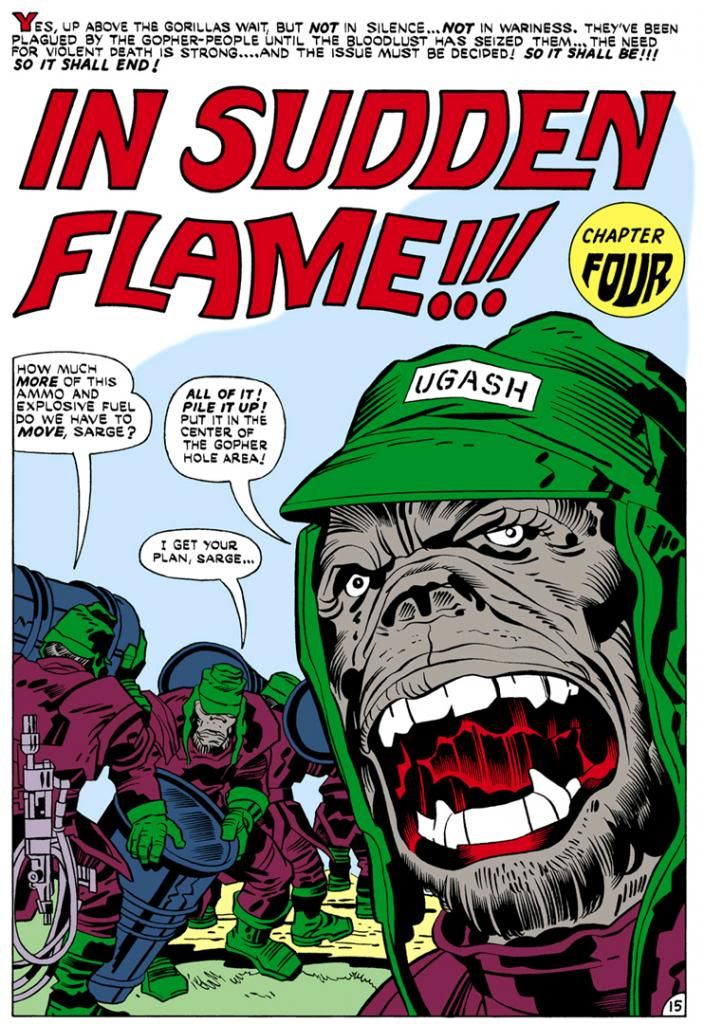
That's Sgt. Ugash to you, ya lousy animal!  Jack Kirby must have had a love for angry tough guys.  I imagine he knew some real life versions of these bombastic characters growing up on the Lower East Side in New York, and he must have encountered more than a few during his wartime army stint.  Look at all the variations on this theme he created or co-created-- Brooklyn, from the Boy Commandos; Scrapper, of the Newsboy Legion; Dum Dum Dugan, one of Sgt. Fury's Howling Commandos; Ben Grimm, the Thing; Detective Dan "Terrible" Turpin, with a death wish in New Gods #5 (later revealed by other sources to be a grown-up Brooklyn, a truly terrible idea and one we'll ignore since we operate under the "If Kirby Didn't Write It, It Never Happened Theory" around these parts).

Those are just the ones I know by heart.  You could usually identify these guys by their ubiquitous derby hats or well-chewed cigars, or both.  Or, in the case of Sgt. Ugash, a green cap (with his name printed on it!), purple jumpsuit and lots and lots of hair.

Sgt. Ugash first appears in Kamandi #17 (May 1974) and he's as rambunctious from the get-go as any of those other classic Kirby creations.  He's not only fighting the tiger army, but he's also having trouble keeping his troops supplied because the gopher people keep tunneling up under the ape bivouac and stealing everything they can get their clawed hands on.  Pumping water, bullets and fire into the holes doesn't solve the problem, so Ugash sends Kamandi down like a ferret with bombs strapped to his back.  That rascally Kamandi, of course, turns on Ugash, so the sergeant and his ape soldiers spend the next couple of issues pursuing the Last Boy on Earth, who fights back using a giant worm, the likes of which would make Maud'Dib's mouth water at the thought of riding it against the Harkonnen hordes.  We might consider this some kind of phallic symbolism.  If big apes represent masculinity run amok, then it takes a really big dick to beat a really big ape.

By Kamandi #20 (August 1974), however, Kirby has abandoned the tiger-gorilla war and forced Sgt. Ugash and Kamandi into an unfriendly alliance against the Roaring Twenties-style robots inhabiting Chicagoland.  Some chump years before the Great Disaster decided it would be a hoot to build a theme park based on Chicago's violent Prohibition days and equip the various factions with real bullet-spraying tommy guns.  This theme park-designing asshole must not have watched Westworld; I'm guessing Kirby did, or at least absorbed a little of it from television commercials.

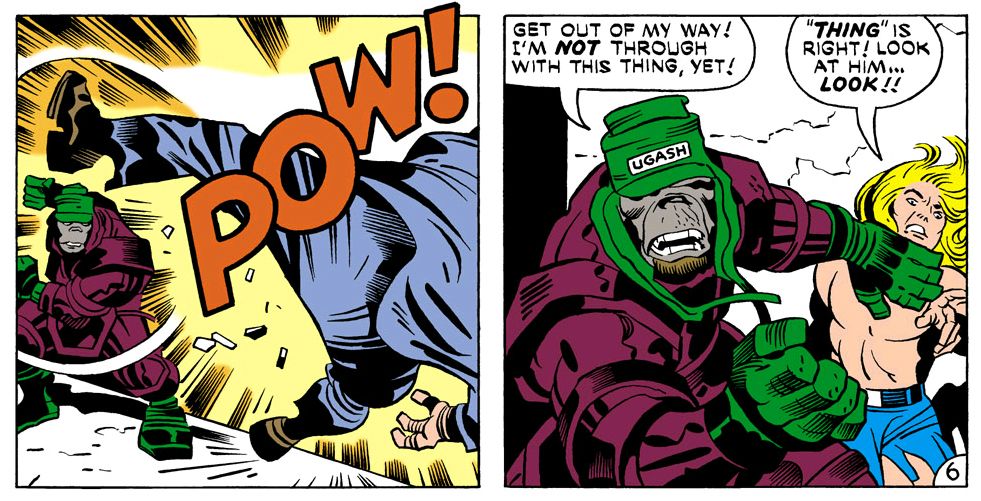
Kamandi #20, "The Electric Chair!!!"  This was my first Kirby comic, my first encounter with Sgt. Ugash.  This single issue of Kamandi came my way and as far as I knew, Ugash co-starred in all the others as well.  As a Planet of the Apes fan, I immediately liked him more than the kid who gave his name to the comic.  Plus, Kamandi reminded me of the filthy hippies we saw on the news, or one of my oldest brother's baseball teammates who sometimes teased me or got drunk at our house and barfed in my bedroom when my parents went away for the weekend.  Throughout the story, Kamandi tries to use reason and puzzle out what's happening, a rational but-- to a child reader-- unsatisfactorily unassertive way of dealing with the situation.  Ugash couldn't care less about the whys of Chicagoland; he simply starts smashing the place.  But for me, Ugash had another thing going for him besides ape-appeal and hands-on approach to problem solving.

Kirby/Berry (Kamandi #20, August 1974)
The pre-programmed robots ram Ugash through a nightmare parody of the US justice system as if he were just another anachronistic hoodlum, and the gorilla's baffled rage at this railroading by mysterious, implacable authority figures who will not listen to reason was an all-too-familiar experience for a lot of us who were about to start elementary school.  Adults and their bizarre ideas and arbitrary rules!  We were already sick of them.  As a comic book reading six-year-old, it made more sense to go down swinging like Ugash.  Ugash got his licks in for all us kids, even though he could never win.

Even then, we understood the futility of those kinds of grand gestures (rebellion in the 1970s meant spankings both at home and at school, or at least the dreaded "writing lines" in the principal's office, which kept us trapped well past the final bell), but what Kamandi did seemed shameful.  In retrospect, it makes a lot more sense--  Kamandi splits.

Sunday, April 14, 2013

April really is Kamandi Month: Sorry for the delay!

Yeah, Kamandi Month has run into its own Great Disaster.  This one is made up of several mini-disasters:  1) the school year just started and I have more classes to teach, 2) my fiancee was ill all last week with a stomach virus and I had to take care of her and 3) I'm working on my own comic (spoiler alert-- it sucks!).  But there will be some Kamandi posts.  Some of them are finished, some are in rough draft form and all are waiting for me to get some of that elusive free time that I feel wouldn't be better spent drawing.  Oh yeah-- and I don't like to post things about Kamandi unless they're illustrated with some cool Jack Kirby art.  That way there's at least one positive thing about each.

I know millions of Kamandi fans are waiting for what I have to say about the series and I hate to disappoint them.  Sorry!

Saturday, April 6, 2013

April is Kamandi Month: On Command D


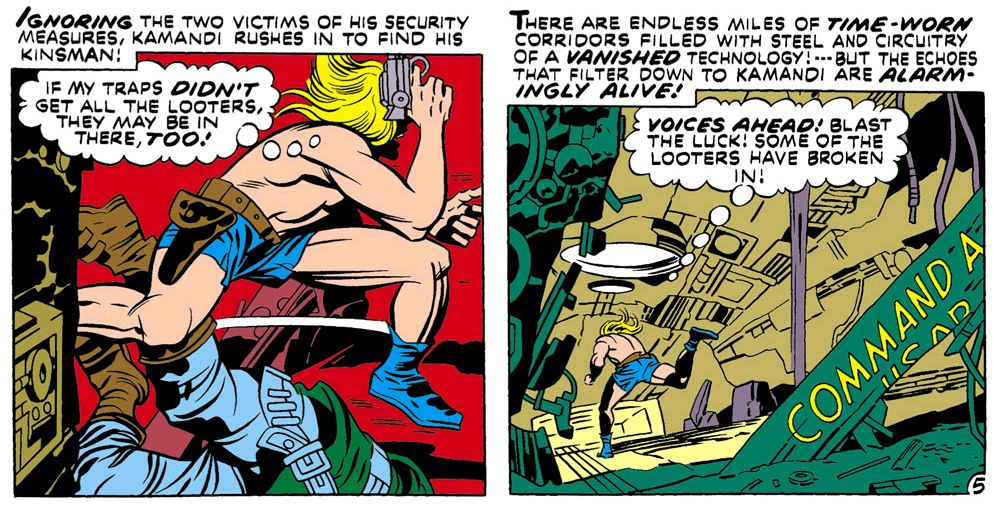
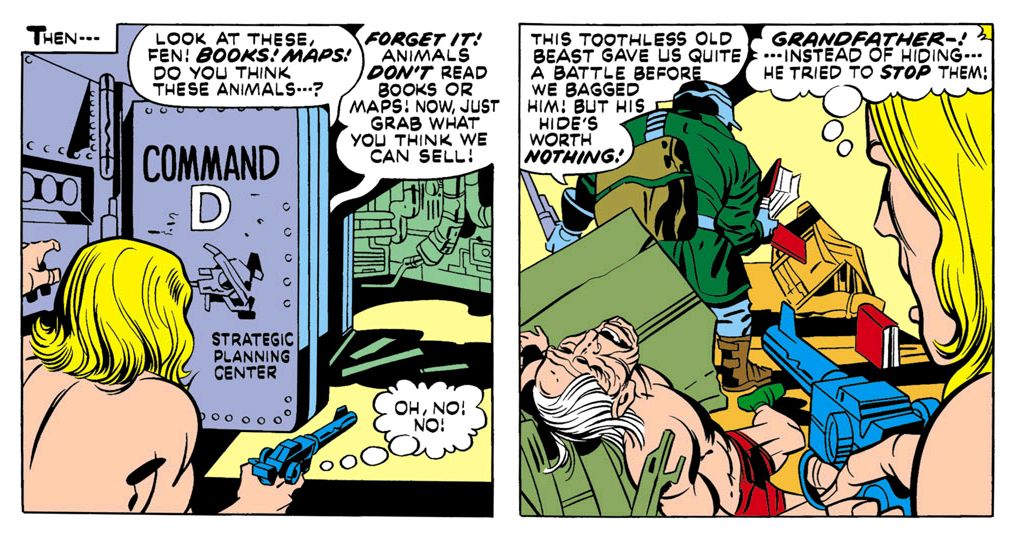
When we speak of “Command D,” what is it we’re talking about?  Specifically, the underground bunker in which Kamandi grew up, raised by a white-haired man he believes to be his grandfather.  Given their relative ages there must have once been younger people in the bunker-- Kamandi’s parents.  Kamandi doesn’t mention them, so it’s likely they died when he was an infant, leaving him in the elderly man's care.  I'm immediately reminded of Pitcairn Island of HMS Bounty fame, when an American whaling ship found John Adams (sole male survivor of the mixed group of English mutineers, Tahitian men and women who sailed into legend) as aged patriarch of a small society there. 


I take writer/artist Jack Kirby at his word when he describes Kamandi as the old man's grandson, at least in terms of the boy's belief they're related.  Kamandi refers to him as Granddad at the story's outset and Grandfather the rest of the way, and while these may simply be culture-based honorifics, the narration calls him Kamandi's grandfather so have no reason to doubt he is biologically rather than simply functionally.  Whatever the true nature of their relationship, someone named the boy after the bunker, either his parents, grandparents, simply the man known as Grandfather, or some other subsequently deceased co-survivor (Kamandi’s dialogue doesn’t hint at such, so that doesn’t seem likely).  Spelling seems not to have mattered, or else this mysterious person or people decided Kamandi seemed more appropriate for a boy's name than Command D.  

The story begins with Kamandi having emerged from his namesake domicile and received massive culture shock— Grandfather with his memory tapes and micofilm has inadvertently acted as an unreliable teacher and has not only failed to prepare Kamandi what he encounters in the post-Cataclysmic world, he also imparted in the boy certain goals that at first glance seem unattainable.  Kamandi has been trained, if not disciplined.  That Grandfather has passed on some mistaken assumptions is to be expected.


Because his knowledge of the story's settings approximates ours, Kamandi acts as our masking agent, and we are meant to identify with him and his solitary plight.  Positing the typical comic book fan who might be attracted to Kamandi:  The Last Boy on Earth as approximately the character’s age and gender, or perhaps younger and able to imaginatively inhabit the protagonist’s role, that is.  So it’s necessary at this point in the story for Kamandi to possess a naiveté so that we might experience the story surprises and twists along with him.  It’s an age-old gambit in fiction (Stephen Crane and Horatio Alger would probably approve) and Kirby, being a born storyteller and a past master of the “kid gang” comic, appropriates it.

Grandfather expects Kamandi singularly to “reclaim” a shattered world for humanity.  Unfortunately, given the ruins Kamandi encounters, the feral and mute nature of the first humans he encounters and the rule of talking animals with their mastery of firearms and motor vehicles and firmly-established feudal kingdoms and small empires, one boy—indeed, the “last boy”—seems to have little chance at re-establishing humanity’s dominance.  And should humanity, the species responsible for the current topsy-turvy nature of the planet, be allowed this second (or third, or fourth) chance?  Might the world be better off, or at least no worse off, in the hands of various tigers, lions and gorillas, all of whom seem to have inherited humanity’s various vanities and prejudices?

Fortunately, in all other aspects, the Grandfather’s tutelage was more than enough, as we’ll see when Kamandi adjusts psychologically to his changed circumstances and shattered belief system.

What is the nature of “Command D?”  Who built it?  At this point in the narrative, Kirby is content to leave us with hints.  This is all set-up.  The point is getting Kamandi out of his comfort zone and to thrust him into adventure so we might experience his world and encounter its mysteries along with him.

For now we may assume Command D to be some sort of military safe-place.  The name suggests so.  Command D.  Kirby, having shaped by his combat experience in the European Theater of Operations during WWII, was familiar with this type of militaristic nomenclature.  We can't be sure which service branch operated the bunker.  On the outside, Kirby places what appears to be a United States Air Force insignia, but within we find the partially obscured words "US AR" (or perhaps even "US AP"), which suggests it might have been an army facility. 
  From its alphabetical coding, and thanks to a sequence where Kamandi returns from his initial surface foray to discover his home invaded and runs through them, we know there are other Commands, with A being the closest to the surface; Command D features a door labeling it the "Strategic Planning" section.  From whence the great military and scientific brains of the past held forth, no doubt.  

Someone from this class realized things were beyond the tipping point and descended into this vast underground complex of heavy safe-like doors where they seem to have kept certain martial traditions and at least a few elements of 20th century (i.e., contemporary) culture and mores.  Kamandi possesses a complete body of knowledge from that era and speaks as any mid-1970s teen might (albeit minus period slang, fortunately).  As we also see, he's very handy with firearms and skilled in hand-to-hand combat.

But what became of the others who dwelt in the complex?  The inhabitants dwindled and vanished.  Other “last children” might have made journeys like Kamandi’s, only to come to grief.  It’s a dangerous world out there, post-cataclysm, as Kamandi soon discovers.