Who is the greater fool, the fool or the fool who follows him? Cindy Lee tries to find out in this turbulent episode of Isis. It's "Fool's Dare," which first aired Saturday, September 20, 1975. Car theft runs rampant and it's got the Larkspur High School faculty worried. Not far from the school, Cindy handily (or foot-ily) defeats two friends in a bike race. The sore loser dares her to spend one hour in an abandoned junk yard. Her pride wounded, Cindy hops the fence. Right into danger. Can Isis rescue the injured girl from a couple of (tepidly) desperate characters?
This otherwise adequate episode could have been improved with one simple addition. The bike race! We only get to see its aftermath. While Cindy's adventure behind the junkyard wall provides child-appropriate suspense, there are just too many shots of the girl limping around and between old wrecked cars. Opening with even a short action sequence with quick-cuts of the kids speeding along on their bikes would have provided a better visual hook to lead viewers into the talky first half and they could have cut the fat down to the real meat of the junkyard sequence.
We do get some Isis staples. Teacher Andrea Thomas as a natural-born sleuth, Rick Mason's low-key sense of humor, Dr. Barnes's calm wisdom and Tut providing forced comedic relief. Tut the talking crow is one of the few pandering elements here, an out-of-place touch of Saturday morning juvenilia on a show that generally avoids it. I mean, avoids it as much as a children's show can with its main conceit a crime-fighting Egyptian goddess who works magic through rhyming couplets.
And Cindy. Perpetually chipper. Sunny. The girl is so positive and trusting, so confident in the people around her and their motives, she's completely caught off guard when embittered loser Ernie first accuses her of cheating. "I didn't cut you off," she insists, laughing innocently because she has no way of judging his wounded ego or how far he'll go to salve it. She's backed up by boy #2, who seems squirmily uncomfortable about the whole thing, and cheerfully tells Ernie, "It's just a bike race. It's not important!"
Not to you, Cindy. You have your sincerity and self-esteem. Others aren't so lucky or secure in themselves. Like Ernie, who issues his petulant challenge. He must have felt emasculated by his loss because he first employs the gender superiority stratagem. Cindy knows girls are every bit as capable and curious as boys. She's stung by Ernie's foolish assertions, but not fatally. Undaunted, Ernie goes with that tried and true favorite: threatening Cindy with the "chicken" label. This, Cindy finally decides, is completely unacceptable. Plus, for our own selfish entertainment needs we must have her in jeopardy so we can call in Isis and solve the car thefts. Cindy can't do it all by herself, but she can spy on the crooks as they paint Ms. Thomas's car yellow.
The show's view of crime and criminals is a signifier of both a simpler time and its target demographic of Saturday morning kids. When they realize Cindy's spotted them, the two car thieves' inclination is to run away before she can call the cops. Actually, that's a pretty smart idea as far as criminality goes. In our darker time or on a more adult-oriented show (or a hypothetical gritty hardnosed comic book reboot), they'd grab her and either beat her or kill her. They'd at least threaten her with injury or death. But then they'd go from theft to violent crime and more serious penalties. Smarter to cut your losses. After all, this is Isis, not The Dark Knight Returns. All it takes is our hero tossing quips, old tennis nets and tires to put an end to car thievery forever.
Notice too how Ernie realizes on his own the disservice he's done Cindy and comes back to put things right. Without a prompting from Isis he apologizes. Cindy, being infinitely kind-hearted, instantly forgives him. "And I realize you're a better bike rider than I am," Ernie tells her. "Some of the time," Cindy quips. When Ernie admits he shouldn't have dared her, Cindy accepts her share of the blame for taking him up on it. Ms. Thomas gently reinforces what the kids have learned for themselves, and the two boys help the injured girl walk away to get medical aid or ice creams or both. The end of an Isis episode leaves its audience with positive vibes about just about everyone in the story. Except the car thieves, and even they're apparently good at painting cars because the next time we see Ms. Thomas's car in the series, it's still yellow.
Makes you wonder if they shouldn't have just opened a legitimate paint and body shop. If that's not an oxymoron in itself.
Speaking of cars, Ms. Thomas has a sweet ride, doesn't she? It's a '74 or '75 Pontiac Firebird, baby! No wonder these guys targeted it. The car must have strained the show's meagre budget because they display not one but two of them-- the original in red and the re-painted yellow one. It's impressive for Isis. Did they rent two or actually find one in need of re-painting and work things out in trade? Maybe it belonged to a crew-member or actor and the paint was in lieu of pay. I'm not sure it was intentional, but giving the straitlaced science teacher a hot rod hints a bit at her dual nature. Teacher and goddess. And yet Ms. Thomas has her own skill set that should be appreciated-- she cracks the car theft ring using ordinary high school science equipment and strong observations skills. Even Rick Mason scores on that one.
A couple of trivia points. Joanna Pang slips up and refers to her teacher as "Miss Andrea" while spying on the thieves. We can probably forgive her because Cindy seems to have the privilege of referring to her teachers by their first names. And the two boys-- we never see them on the show again-- are played by Josh Albee and Jeff Tyler, a reunion because they earlier essayed Tom Sawyer and Huckleberry Finn in a 1973 TV adaptation of the Mark Twain classic Tom Sawyer.

Monday, September 24, 2012


Sunday, September 23, 2012
Cindy Lee loves parties, boating alone in storms and scavenger hunts!
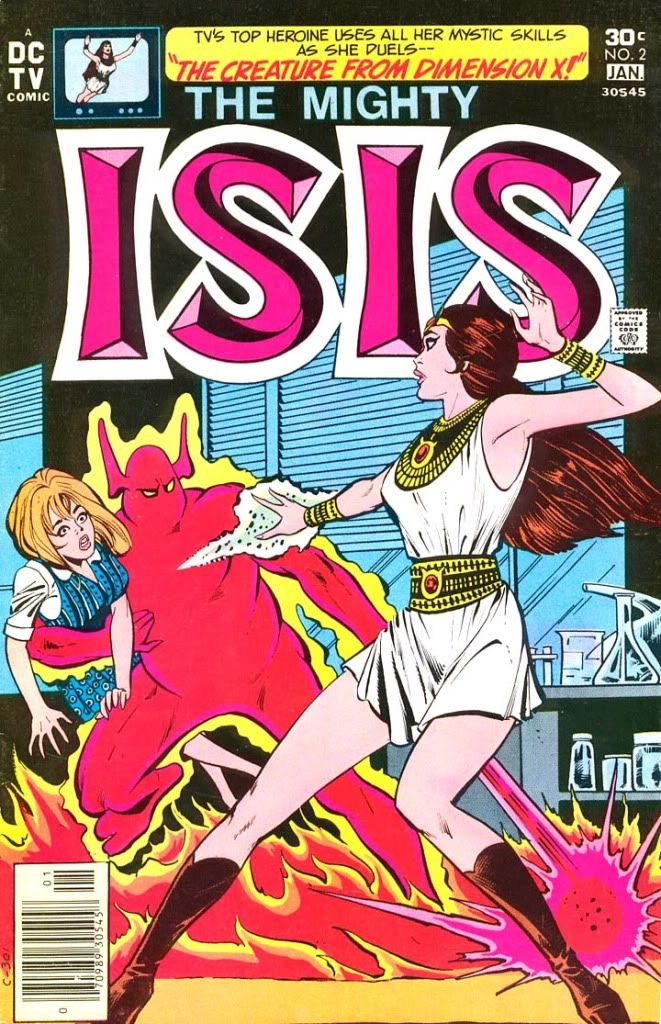
"Say, what's the rumpus?" they asked of DC, using then-current vernacular. "Give us the scoop, the low-down, the straight dope, and none of the high hat, ya palookas." DC's official answer: "Creative decision."
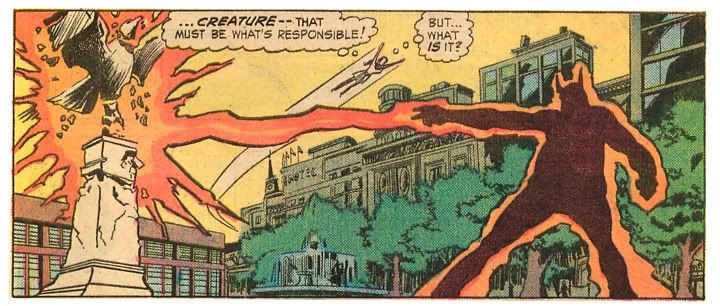
Writer Steve Skeates conjures up in her place a clever lad named Roger who uses Rick Mason's high school science equipment to create a pocket black hole that turns out to be a doorway into another dimension. Instead of earning himself a Nobel Prize for creating a limitless energy source from what's essentially an overgrown Erector set, Roger allows some kind of red monster to lurch out of it into our reality. Isis chases the destructive bugger back home, but Roger's friend Gini-- who looks a lot like Jan Smithers as Bailey Quarters from the early episodes WKRP in Cincinnati, by the way-- makes a special visit to the junior genius' hospital room so she can scoff at his wild monster story. Gini (who really should have been Cindy) vows to continue the experiment, this time with Mr. Mason supervising.
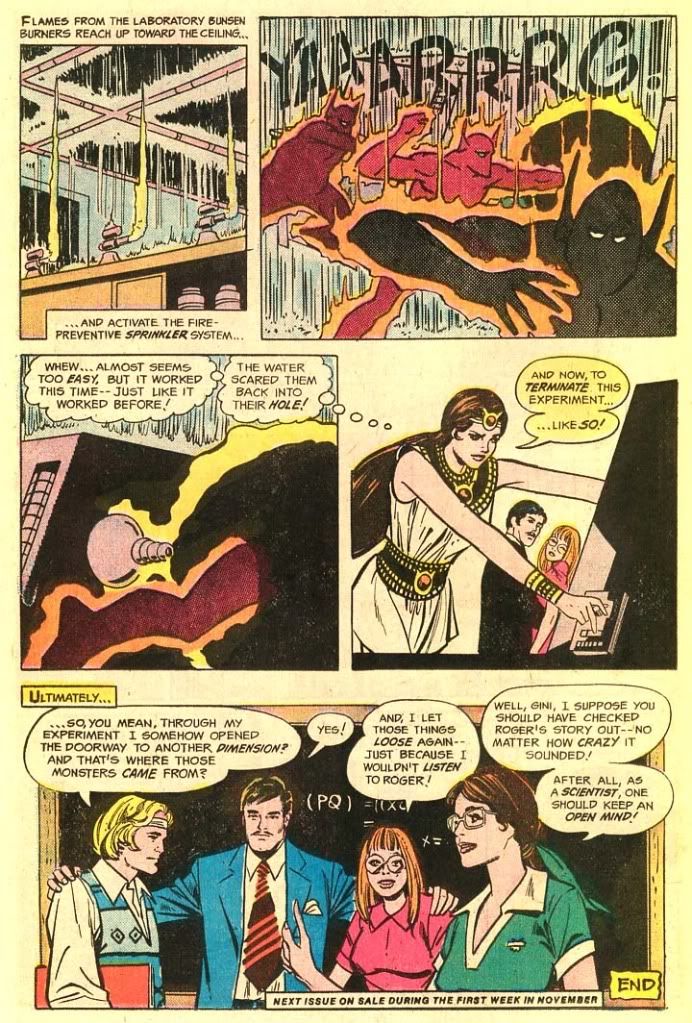
Nothing can possibly go wrong recreating the exact circumstances that unleashed a destructive creature on our world, right? Within minutes Isis has to contend with four of these monsters. John, Paul, George and It's Only Ringo. She defeats them simply by activating the school's sprinkler system, then turning off the machine. Gini admits her empiricism was a mistake, and Andrea Thomas tells her a scientist should always keep an open mind. And yet Cindy Lee isn't involved in the action in any way. She doesn't rush into a room to raise the alarm, doesn't bear witness to the wonders of science. She's not even menaced by the extra-dimensional creatures and doesn't get to help Isis deliver the moral. Instead, in an almost-criminal act of story self-sabotage, Skeates confines Cindy to two measly panels, with no dialogue. Name checked by Gini, some star-student-come-lately, then forgotten.
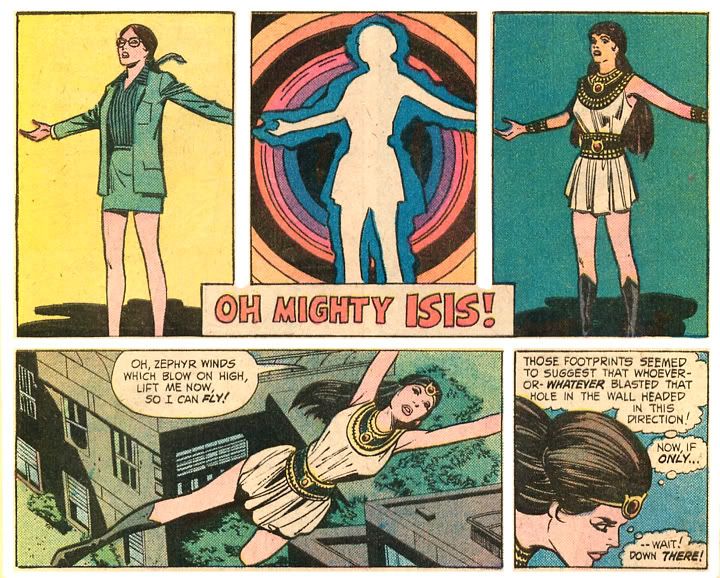 While they do give us a psweetly psychedelic Isis transformation, artists Mike Vosburg and Vince Colletta manage further the injury by whitewashing Dr. Barnes. Skeates strips him of his advanced degree and calls him mister instead of doctor, too. Why, it's almost as if no one working on this book had never seen a single episode of the show and merely relied on Shazam! #25 (Sept.-Oct. 1976) and Isis #1 (Oct.-Nov. 1976), and possible a couple of flippant remarks at an editorial meeting as their reference sources for all the characters. But that would be artistically irresponsible, right?
Hundreds of fans read this story, then tore their comics in disappointment and despair (ready to wait 20-odd years until the invention of the Internet and comic book blogging to vent their rage more fully), the remnants fluttering to the shag carpet like so many colorful autumn leaves—but wait! On a tattered shred from somewhere in the back of the comic. Could it be? Yes! It’s Cindy Lee! And what kind of trouble has she gotten herself into this time? Let's find out!
 Where the main topic of conversation is none other than Cindy Lee herself. She's not there. It's almost a meta-commentary on the lead story. Thomas is surprised and immediately asks about her, because she of all people Cindy “likes
a party.” School, her teachers, pyramids, danger,
parties. These are the things Cindy Lee
loves so well.
From what we now know of Cindy it's obvious would never miss a chance to hang out at school with her favorite teachers barring earthquake or death itself. In her DVD interview, actor Joanna Pang confirms at least some of my more rational Cindy Lee theories-- she's the kind of girl who always volunteers to stay after school, has her permission slips signed first and is unfailingly positive and go-getting. She's into anything and everything about school life, whether it's academics or just spending all day there soaking up the atmosphere and offering to help out wherever she can. So it's pretty believable people would remark on her absence from a school event.
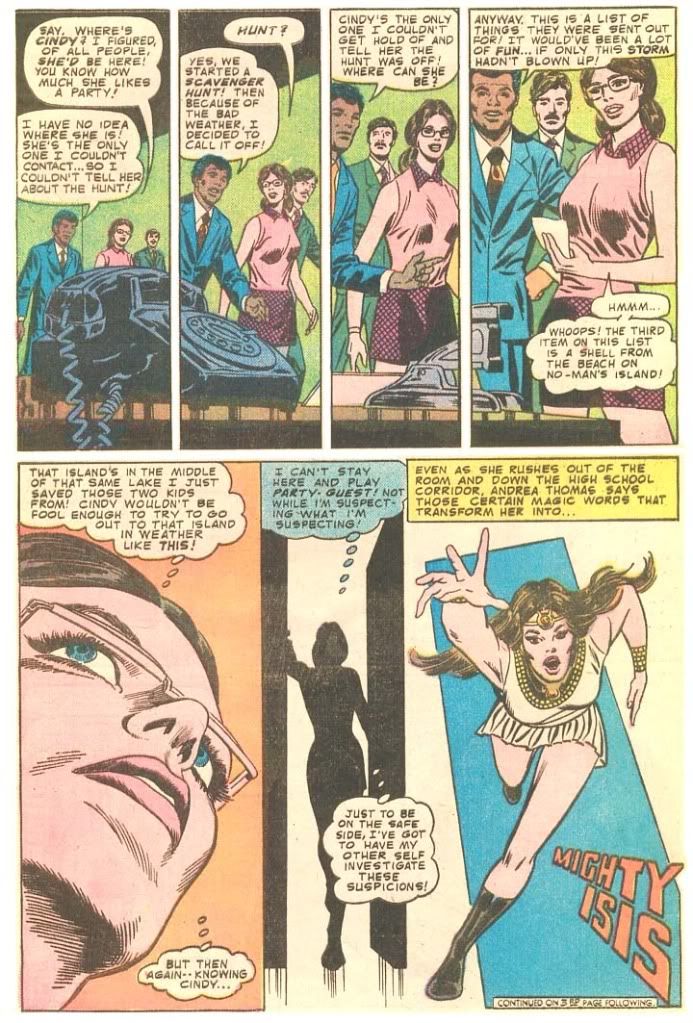 But what about everyone else? Another unrecognizable Mr. Barnes, apparently drunk to the point of hallucination (although he seems rational enough) insists he organized a scavenger hunt, then cancelled it due to the bad weather. But there's no sign of would-be scavenger hunters. Truth, alcohol-induced daydream or is Mr. Barnes just making this all up so Ms. Thomas won't think he and Rick Mason are pathetically hanging out by themselves?
Maybe Skeates didn't specify a lavish attendance of students and faculty, but the very least art team Mike Nasser and Frank Giacoia could have done was infer from the dialogue more than three people in the room so Barnes doesn't look like either the saddest clown in the circus or a complete madman. We know the Filmation TV show was low-budget, but I'm pretty sure they had a few scenes with more than three people. After all, they created a fairly convincing school picnic for the "Bigfoot" episode. What was the budget DC allowed this comic for extras and supporting characters? Did Skeates and company blow it all on the science experiments in the lead story and have to skimp here?
We could ask Rick Mason, but he refuses to speak for most of this story.
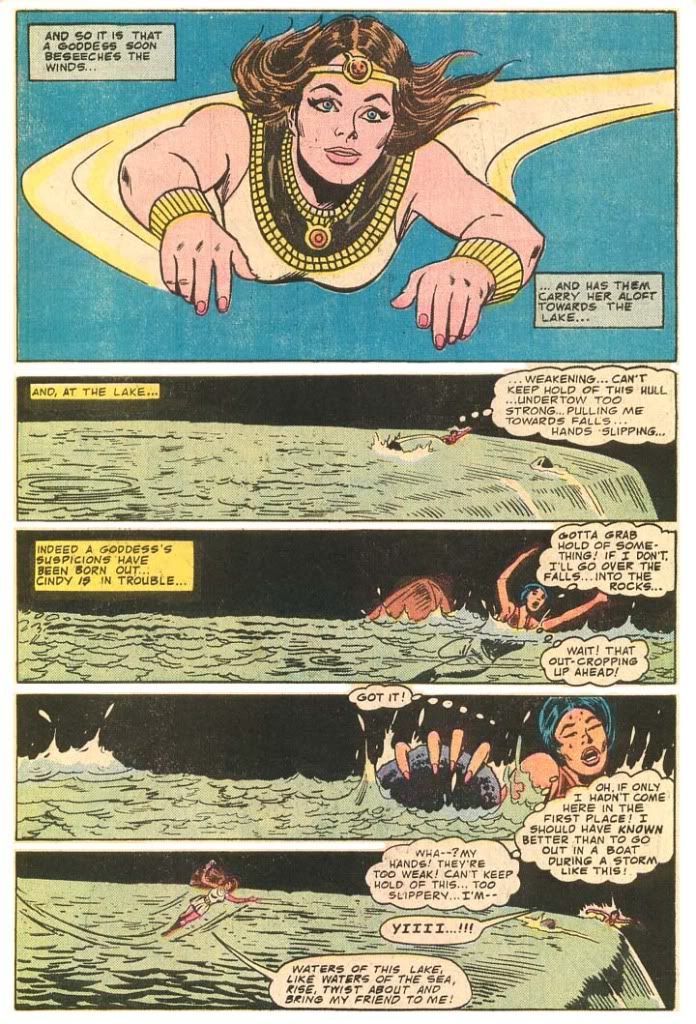 Mr. Barnes (he's a PhD on the TV show, by the way) must have convinced Cindy, at least, because the only explanation anyone can come up with for her absence is she's off trying to win the scavenger hunt. And yet they still expected to call her up and tell her the event was off. This is Cindy Lee in the era before cell phones. You send her on an errand, don't expect to ring her at home and find her there. If you even float the vaguest idea for a school activity, before you can say, "Nah, on second thought," she's organized the decorating and refreshments committees, nominated herself for vice-president of both, requisitioned petty cash from the school's general fund, bought five miles of colorful bunting and booked REO Speedwagon as the entertainment.
Of course you're not going to reach her, Mr. Barnes. She's Cindy Lee and you sent her looking for item number three, "a shell from the beach of No-Man's Island," you fool! Thank Isis you didn't think it would be funny to add "a golden apple from the Garden of the Hesperides" as item number two.
Perhaps in an editorial meeting with Denny O'Neil, Skeates learned it's not an Isis story unless Cindy Lee finds herself facing death. No-Man's Island is on the same lake where those other kids nearly came to grief. Worried that her star pupil is even now intrepidly sailing to her doom, Ms. Thomas dashes out into the rain and transforms. Isis confirms her alter-ego's suspicions when she flies back over the storm-tossed lake only to find Cindy Lee clinging desperately to a tiny rock. Cindy is thinking to herself going boating alone in a gale might not have been the wisest of decisions, even had she possessed the nautical skills of Popeye himself.
 In terms of Cindy Dilemmas, where do we rank this? Somewhat worse than jumping a junkyard fence to spy on car thieves? Not as rash as using Rick Mason's car to chase coin thieves? On my patented Cindy Dilemma Scale, with one being the least dangerous and ten being the most, I give this an eight.
Over the waterfall she goes, our little daredevil, but Isis uses her Egyptian goddess magic to conjure up a life-saving waterspout. Anyone else would be traumatized, but all the resilient Cindy can think of is getting to that sparsely-attended party. What school spirit! What joie de vivre! Is there extra credit involved, or perhaps a letter of recommendation to go in her records?
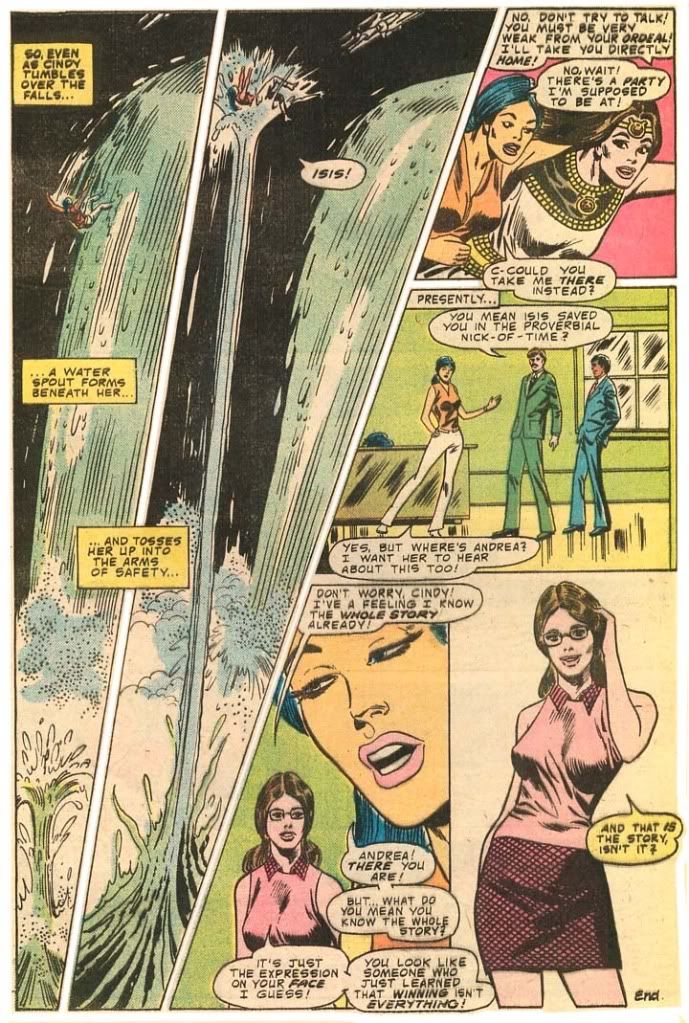 In terms of Cindy Dilemmas, where do we rank this? Somewhat worse than jumping a junkyard fence to spy on car thieves? Not as rash as using Rick Mason's car to chase coin thieves? On my patented Cindy Dilemma Scale, with one being the least dangerous and ten being the most, I give this an eight.
Over the waterfall she goes, our little daredevil, but Isis uses her Egyptian goddess magic to conjure up a life-saving waterspout. Anyone else would be traumatized, but all the resilient Cindy can think of is getting to that sparsely-attended party. What school spirit! What joie de vivre! Is there extra credit involved, or perhaps a letter of recommendation to go in her records?
Once at the school and thoroughly dried-- although she's wearing the same outfit-- Cindy regales the party-goers (Rick Mason, Mr. Barnes and Andrea Thomas, again) with the hair-raising tale of her brush with death. Andrea Thomas makes a veiled allusion to being Isis, Cindy responds in confusion, Thomas somehow intuits Cindy's boating mishap had something to do with her desperation at winning the scavenger hunt which I'm still not convinced hasn't taken place solely within the confines of Mr. Barnes's mind.
Thursday, September 20, 2012
The Mystery of Cindy Lee
Okay, that video isn't all that helpful, and the "Personal information unknown" subtitles seem a little ominous. As far as I know, the always awesome Brian "Rick Mason" Cutler seems to be doing fine (I've been giving ol' Rick the business here on this blog, but it's the way DC's writers characterized him in the comic and doesn't reflect at all on Mr. Cutler or my warm feelings towards his role on the show), I haven't had time to look into Joanna Cameron. But what of that other Joanna? The one who played Cindy Lee? And why didn't Cindy appear in the truncated second season?
It's not much of a mystery, and it didn't take Isis and her magical goddess powers to solve it. Obviously, I'm on something of a The Secrets of Isis kick lately, having rediscovered this childhood favorite of mine. I was a huge fan of Filmation's live action shows and watched both Isis and Shazam! each week. I adored them uncritically. Low budgets and clunky special effects didn't matter to me, and I took to heart the simplistic yet valid moral messages.
But through all the years, my only solid memory of either of these shows was the minor personal trauma caused when Cindy Lee vanished from its second season. Rennie Carol? Who are you jokers trying to fool? Hey, I was eight years old and Cindy was my favorite character on the show. Not having her in the mix changed the character dynamics. It destroyed my sense of continuity.
That was my first experience with that kind of change. TV and comics can be harsh on young psyches. Networks abruptly cancel shows you love, actors quit due to contract disputes so producers write out their characters, comic book creators kill off others or turn them into villains, or the publishers re-boot their universes and consign any number of fan favorites or marginals to oblivion. Nothing against her replacement Ronalda Douglas, but I gave up on Isis when it became apparent Cindy wasn't simply absent from school due to the flu-- although given her personality, I doubt anything short of a coma would have kept her away from good ol' Larkspur High.
So, what happened to Cindy Lee? This was 1976, years before the Internet and fan blogging. If she'd appeared in Starlog magazine, I missed it. And I had no idea the DC comic book-- the letters page being a potential info source-- even existed. I probably could have written to Filmation or CBS and asked for an explanation, but the idea never occurred to me. By then I was busy with school, Halloween, Ark II and eventually Isis, Rick Mason and even Cindy Lee passed from my conscious into the scrapbook of my subconscious and I lost the tiny key to its little lock. Until this month. And I remembered. Cindy Lee! What the heck happened to Cindy Lee? Got herself into a jam but even this time Isis couldn't save her, huh?
Fortunately, Joanna Pang, the actor who so charmingly brought her to life in all her enthusiastic, perpetually cheerful glory, is very Cindy Lee-esque in real life. The Secrets of Isis complete series DVD contains a chatty, informative interview with her, and just like the character she once portrayed, she came prepared. She re-watched the old shows, found her diary from the time-- she apparently thought she was auditioning for Ices, a show about frozen Italian desserts-- shares production anecdotes and details her failed request of either Norm Prescott or Lou Scheimer to change Cindy's hairstyle from pigtails to something, anything, else. It's good stuff. But the heart of the matter comes towards the end when she good-naturedly addresses the issue of that second season.
After all this suspense, you're probably going to be disappointed to learn there's nothing sinister involved. She completed filming on the first season, returned to New York and waited for the call to start the second. It never came. She phoned her agent in California, who got in touch with Filmation and learned they'd decided to "go in a different direction." Pang says this is the reason you get when there isn't really a reason. And that was that. She moved on.
We moved on. Then, for the purposes of this dumb blog, I moved back to the old neighborhood. The old school is still there, only it's being used strictly for storage these days.
Tuesday, September 18, 2012
Identifying with Batman and Spider-Man makes you feel good about yourself...
What do you think of this report? Apparently, some men who identify with Batman or Spider-Man feel better about their bodies when they look at pictures of their heroes, but if they're indifferent, the pictures make them feel worse. A previous study found a similar effect in women who viewed celebrity photos.
I love this stuff. I'm a psychology buff, and I know just enough about it to use its jargon to make bizarre, counter-factual claims and asinine pronouncements that can't withstand close scrutiny with facts. To me, this report actually raises more questions than provides answers. Here are a few.
1) What if you identify with Dani Moonstar or Cassandra Cain? What effect does looking at drawings of Spider-Man and Batman have on your self-confidence?
2) What if you identify with Buddy Bradley?
3) Or the Crypt-Keeper?
4) Have they done this study specifically with female comic book fans?
5) Would doing the above study produce similar results? Or, given the sexualized or fetishistic nature of how many female characters are presented, would they be opposite? I'd be very interested in seeing how this plays out, because while their numbers aren't as great as with male fans, female comic fans are incredibly passionate about their favorite characters.
6) What is the nature of identification with characters involving female comic book fans? Is it the same or different than with male fans?
7) What about fans with other gender identities?
8) Related to number one, how much cross-gender identification is there? Is this common, or isolated?
9) In the study of women and celebrities, what kind of photos were used? Were they candid shots, photos from public events or sexualized photo-spreads from men's magazines? And would any of those affect the results?
10) Is identification with characters-- in effect, the reader "masking" himself or herself with certain characters-- important to creating a fan base or readership?
BONUS 11) What about fans who identify with villains?
I'm seriously interested in someone doing a study on these, and some in-depth surveying of women who read superhero comics. Isn't it a fairly common belief male characters are idealized and more inviting of identification while female characters are objectified and more involving the reader in the male gazed based on an assumption that the readership is almost exclusively male? And yet women who are into superhero comics really latch onto these characters and they're extremely vocal with their opinions. Well, maybe that's just part of being a superhero comic fan. But you know... Stephanie Brown. Oracle. Huntress. Lois Lane. You dismiss or degrade these characters at your peril.
I'm also keenly interested in the gender dynamics. As someone who easily identifies with female characters-- I have my entire life and probably pretended to be Wonder Woman, the Bionic Woman or any one of Charlie's Angels and even Cindy Lee from The Secrets of Isis as often as I portrayed Superman, the Incredible Hulk, Sgt. Rock, Batman or Spider-Man as a child, and Dani Moonstar quickly became my masking character of choice in New Mutants-- and responds strongly to their positive and negative portrayals, I'm guessing I fall somewhere outside the control group or whatever the heck they used here. So I also want to know how other fans who view gender and sexuality in ways that aren't traditionally accepted.
And, strangely enough, I also identify quite a bit with characters with ambiguous morality-- in fictional, comic book dichotomous terms, not real life. I find we have to go outside the mainstream to find these kinds of richly drawn, troublesome characters. When I read Nexus, I tend to mask myself with Horatio Hellpop, but I find myself drawn to Ursula X.X. Imada whenever she appears on the scene. Outside of genre fiction, I find Hopey Glass and Terry Downe from Love and Rockets have always fascinated me more than Maggie, the star. And I have much more in common with Buddy Bradley from Peter Bagge's Hate than I'm comfortable admitting.
When I see drawings of them, how do I feel about myself? Pretty good, I guess.
Monday, September 17, 2012
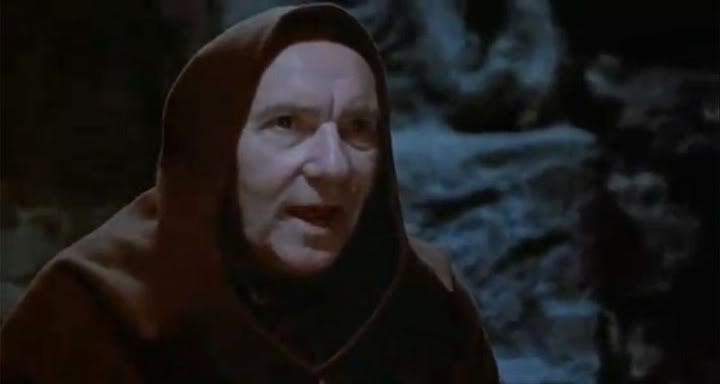
"...And All Through the House:" Joan Collins visits the Cryptkeeper for a merry li'l Christmas murder
 |
| The sign you're in for some real fun. |
 |
| "Dare you enter the Crypt-Keeper's Crypt?" |
 |
| "The fu-- ?!" |
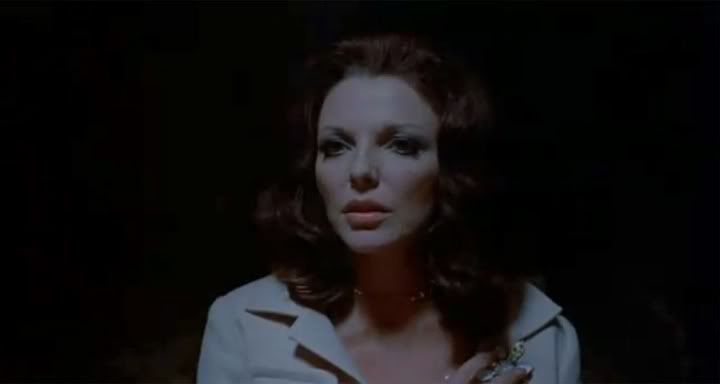
The movie adaptation follows the story note-for-note if not visual-for-visual. As such, it's virtually a one-woman show starring Joan Collins in kind of role she was seemingly born to play-- a cold-hearted murderer. She brains her husband with an iron poker on Christmas Eve, just after he's put her gift under the tree and settled in to read the newspaper and listen to some seasonal music on the radio. He goes down on the rug spilling blood and brains, his eyes bulging grotesquely and his tongue sticking out. Collins is wearing a party hat is a touch of the morbid humor that ran through each and every EC horror title.
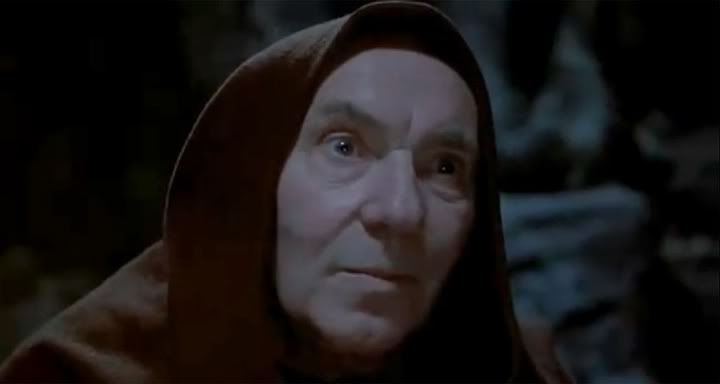 |
| "Hmmm?" |
And he's right outside the house! Out of all the houses he could have picked, he's drawn to the one where the future star of a movie delightfully titled The Bitch and hate-queen of the TV show Dynasty has offed her spouse! How very coincidental! How convenient! How lucky for us! Now Joan has to dispose of a body and secure the homestead against an unwelcome holiday guest. The poor woman goes through hell, only to have her innocent daughter let the seasonally-costumed killer right inside where he...
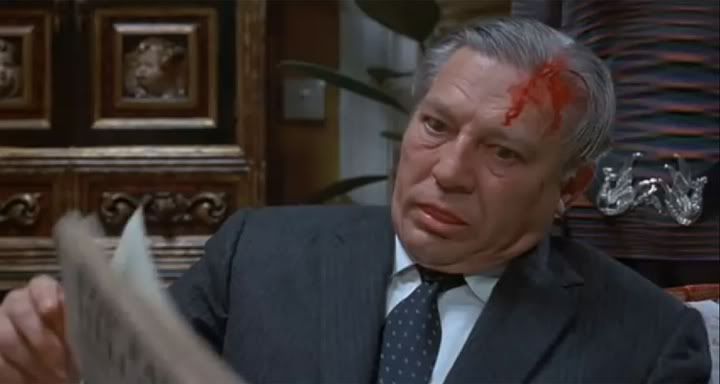 |
| "And down I go..." |

Director Freddie Francis, a horror veteran who would later provide cinematography for David Lynch and Martin Scorsese, camera-stalks poor Collins... all through the house (boo hoo hoo). She makes the most of her screen time. From her satisfied reaction to having committed murder-- with a sneering inflection to her post-poker "Merry Christmas," Collins coolly conveys this in such a way you believe it's been building for a while-- to her growing hysteria as she shutters the windows and locks the doors and tries to figure out what to do about her husband's carcass, it's a performance of perfect pitch. She makes you loathe yet feel strangely sympathetic to this woman when essentially you're watching a scenario that pits a calculating murderer against one of those old school nutzoids. He can't help himself. What's her excuse? No matter; Francis and Collins have done their work well.
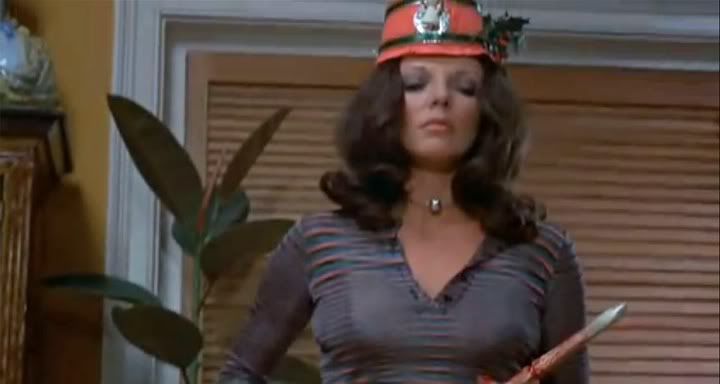 |
| "Merry Christmas..." |
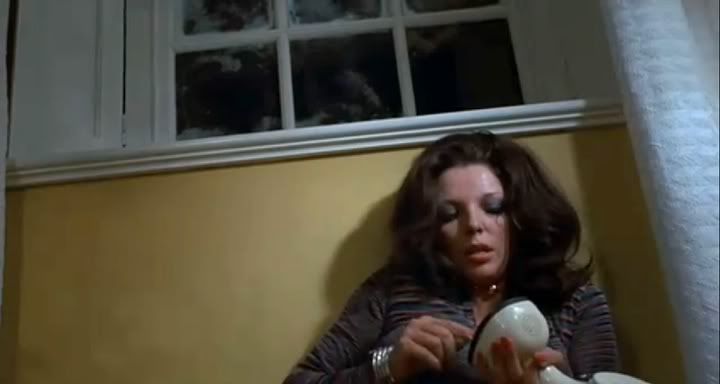 |
| "Blast! Speed dial won't be invented for years!" |
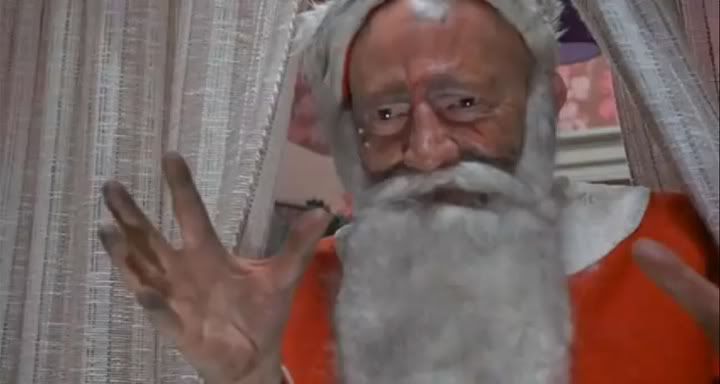 |
| "Grandpa! You're Santa?" |
Later we're going to take a look at Craig's original and drool over it like deranged Santa Claus.
Saturday, September 15, 2012
Shazam! #25: Cindy Lee Loves Danger!
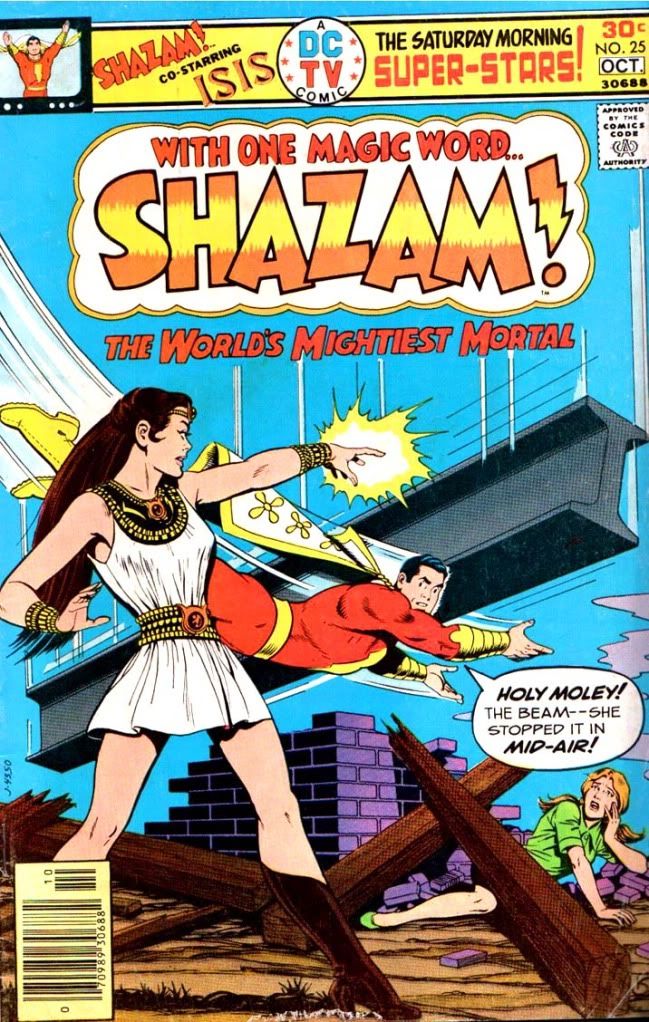
Ah, Shazam! #25 (DC Comics, September-October 1976). This is what feel-good comics are all about. It's also a breakthrough moment enshrined forever in comic book history. Why?
Because even though cover artist Kurt Schaffenberger seems to have little or no idea who she is, this book marks the sizzling debut of our favorite sidekick and teacher's pet from the CBS Saturday morning live action television show Isis (also know as The Secrets of Isis), Cindy Lee. Oh yeah, and if the introduction didn't clue you in enough, this is the first comic book appearance of Cindy's co-star Isis, too. She's okay, too. I guess. I mean, if you're interested in such things. But we know the real draw is Cindy Lee.
And what a splash she makes! Editor Julie Schwartz must have known he had something special in Cindy, because he put his varsity team on this story. It's written by Denny O'Neil, with art by none other than Dick Giordano himself. I do miss Giordano. His art in this story is just so smooth, so appealing. Rik Estrada and Wally Wood do a bang-up job on The Mighty Isis #1, but after reading this, Giordano is forever my artist pick for these characters. And I prefer O'Neil as writer. After all, O'Neil and Giordano are the team-- along with some guy you may have heard of named Neal Adams-- that brought to life some of the most influential and memorable Batman stories of all time.
Here's how it starts:

CINDY LEE?! OH NO! The last thing you expect to see when the wrecking ball crashes into your old high school is your star pupil in mortal danger. This is one of those moments where you can almost see O'Neil's script showing through the drawings. He has ten pages, needs Isis in action as soon as possible, so he puts Cindy Lee in harm's way. She's from the TV show, right? Stick her inside the school as it comes tumbling down, explain it later.
As you can see, science teacher Andrea Thomas and her colleague Rick Mason are a little concerned because they know damn well Cindy's parents didn't sign the school's special permission slip with the indemnity clause regarding any and all Cindy-related fatalities, including her own. So much for their raises for the next several years. So much for any more field trips to Egypt. So much for the computer lab. So much for art supplies.
As you can see, science teacher Andrea Thomas and her colleague Rick Mason are a little concerned because they know damn well Cindy's parents didn't sign the school's special permission slip with the indemnity clause regarding any and all Cindy-related fatalities, including her own. So much for their raises for the next several years. So much for any more field trips to Egypt. So much for the computer lab. So much for art supplies.
The football stadium will still get its new scoreboard and the team its new uniforms, however. And they can't cut the head coach's pay. In fact, they can't even fire the guy without buying out his contract to the tune of four or five language, visual arts and home ec faculty members. Fortunately for the school system, Andrea Thomas has a secret power beyond that of any two or three thousand lawyers. She's the "dual person" known as Isis. A quick change and some rhyming magic...

And then this muscle-headed guy shows up all, "Uh-- er-- Well, I was about to do that, but since you already did it for me..." Nice try, Captain Marvel. You zoom in a few long moments after too late and try to make Isis feel less special. Well, he does exert his male authority figure privilege to get Cindy's explanation of why she thought it would be a good idea to hang out in a building during its demolition. And here we go...
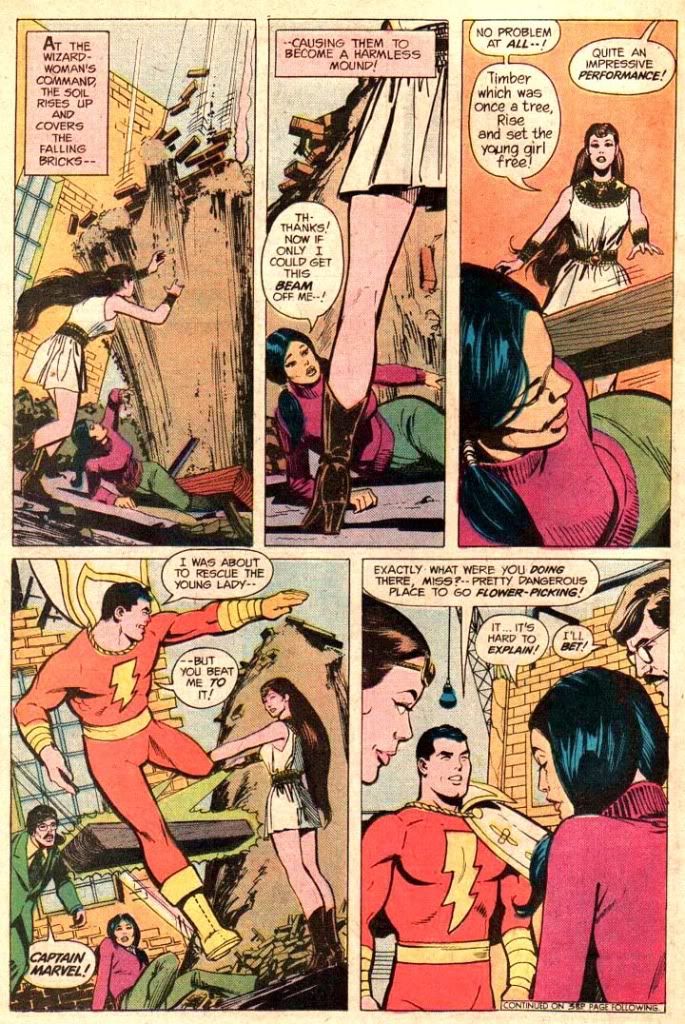
O'Neil quickly and brilliantly seizes on the little-known fact that the future valedictorian and resident pyramid enthusiast of Larkspur High School (class of 1978) is a sensation-seeker. Dare you doubt me? I have proof-- in "Fool's Dare," (September 13, 1975), the second episode of Isis, Cindy enters a dangerous junkyard in answer to some hurtful words from a classmate and tangles with car thieves wearing pitted-out shirts.
Back here in the four-color world, our secret thrill-junkie was once again doing some sleuthing of her own and followed a couple of suspicious creeps right into danger's maw. She's so intrepid she'll chase them round Good Hope, and round the Norway Maelstrom, and round perdition's flames before she'll give them up... if that's what it takes to bring them to justice. Whatever it was they did. Which we don't know yet. We'll find out later, thanks to Cindy.
There's a flashback to Isis's origin at this point in the story, too. Boring. And, his work finished, the Big Red Cheese soars away feeling self-satisfied at having patronized Isis. Back to The Simply Awesome Misadventures of Cindy Lee!

Wow! Check that out! She actually puts moves on Rick Mason! Cindy Lee, bold seeker of dangerous, age-inappropriate love. Certainly can't blame her. In life, if you want something, you have to go right for it. It's good Cindy understands this, and of course, we all know Rick Mason is one swell fella. At least he's not married. Cindy is no Tracy Flick. However, for her well being, I really think Cindy should go for someone more in her peer group. A student. Like photographer/budding cryptozoologist Lee Webster.
What a guy, that Rick Mason. He's right to quash Cindy's romantic notions. While it's natural for a student-- especially one we now know harbors a hell-bent streak-- to confuse admiration for an authority figure with love, as a dedicated educator Rick Mason knows even giving Cindy the slightest--- WHAT THE HELL? Loaning her his car? What kind of responsible teacher does something like that? I take it all back. Rick Mason is a mixed-signal sending bastard.


What a guy, that Rick Mason. He's right to quash Cindy's romantic notions. While it's natural for a student-- especially one we now know harbors a hell-bent streak-- to confuse admiration for an authority figure with love, as a dedicated educator Rick Mason knows even giving Cindy the slightest--- WHAT THE HELL? Loaning her his car? What kind of responsible teacher does something like that? I take it all back. Rick Mason is a mixed-signal sending bastard.
And look how nonchalantly he does it. It's the ol' over the shoulder "I'm godlike in my lack of concern whether you live or die" keys toss. It's not even a decent throw because Cindy has to lunge into a semi-crouch to catch them. The least Rick Mason could have done-- since even this much is wildly beyond the bounds of proper teacher-student interaction-- is place the keys in her hand. Once the school officials get wind of this, he's out on his guitar-strumming ass faster than you can say, "Matthew Broderick as Mr. McAllister" anyway. Show some class while you simultaneously destroy a girl's feelings and your career. Instead, our ostensibly nice guy teacher puts on this smug, superior act as if to tell her, "You can't have me, but take my car for a spin, you baby."

Down in the dumps, sitting on a pile of rubble that visually symbolizes her fractured heart, Cindy soon finds another adrenaline-pumping adventure. I'm so impressed with this characterization I'd buy a Cindy Lee monthly. No superheroics. Just Cindy Lee and her pals getting themselves into all kinds of crazy scrapes. You know what this comic is starting to remind me of? A mid-70s kiddie version of David Lynch's Blue Velvet.
Now there's a thought. In fact, Cindy prefigures Kyle MacLachlan's Jeffrey Beaumont in many ways. He finds an ear, becomes involved with an older woman and discovers an underworld of crime and perversion in his little town, Cindy Lee sees the aftermath of a crime, wants to become involved with an older man and finds a tame young-readers version of the Lynchian paradigm right there in whatever town it is she lives in. And much like Jeffrey, Cindy's involvement nearly results in her death.

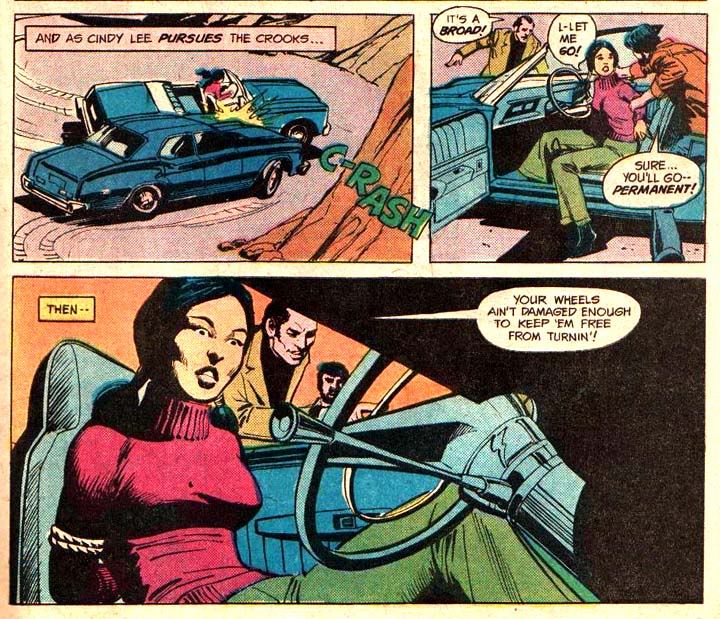
"When the green field comes off like a lid/Revealing what was much better hid," wrote W.H. Auden in his poem "The Two." Some things you and I-- and Cindy Lee-- are just not meant to know. But characters like Jeffrey Beaumont and Cindy are impelled to pull off that lid and reveal the sinister, sordid things happening all around us. There are no gas-huffing Dennis Hoppers or lip-synching, make-up wearing Dean Stockwells in Cindy's world. Just vaguely menacing thugs in leisure jackets Luckily for Cindy her planet orbits a sun a bit brighter and friendlier than the one in Blue Velvet.
But Cindy and pals would easily update to modern, darker storytelling. Lynch famously described his film as "The Hardy Boys Go to Hell." Well, apparently O'Neil's take-- which I'm guessing he based largely on "Fool's Dare"-- on Cindy Lee is she's a 21st century Nancy Drew with a knack for getting herself into trouble of the same sort. We could build on that and have her enthusiastically investigate crimes, her optimism and incorruptible innocence contrasted with the sick, perverse things she uncovers and reveals to the world. Meth labs, porn rings, bizarre blackmail plots, public figures who are secret degenerates. Narrow escapes without an Isis there to bail her out, forcing Cindy to rely on her own pluck and quick wits.

Or not. Maybe she'll always need an Isis for advice and guidance. Cindy is smart and spunky but she is, after all, a risk taker. She's lucky to have a friend and guardian like Isis. Solve a crime and win Rick Mason's heart? Oh, Cindy...
As a special bonus, here's Captain Marvel beating up a bear.

Friday, September 14, 2012
What's Eating Dani Moonstar?
 Dani's always had issues. Rage issues. Mental health issues. Comic book issues.
Her initial outings with the New Mutants in their monthly are equal parts rage and nervous breakdown. Her mind subtly manipulated by an alien-controlled Professor Xavier, Dani reacts with fear when first confronted by the Danger Room and its virtual reality training exercises. Consumed with self-loathing for her apparent cowardice and betrayal of her Cheyenne traditions, Dani begins to exhibit symptoms of mental illness, escalating from high-risk behavior-- attempting to defeat the Danger Room alone-- to suicidal thoughts. Before the mind-tampering element enters the narrative, it seems Dani is on the path to severe problems. Schizophrenia or something similar. A huge fight alongside the X-Men against the Brood, insectoid authors of many of her problems, and Dani begins to heal, but she remains volatile.
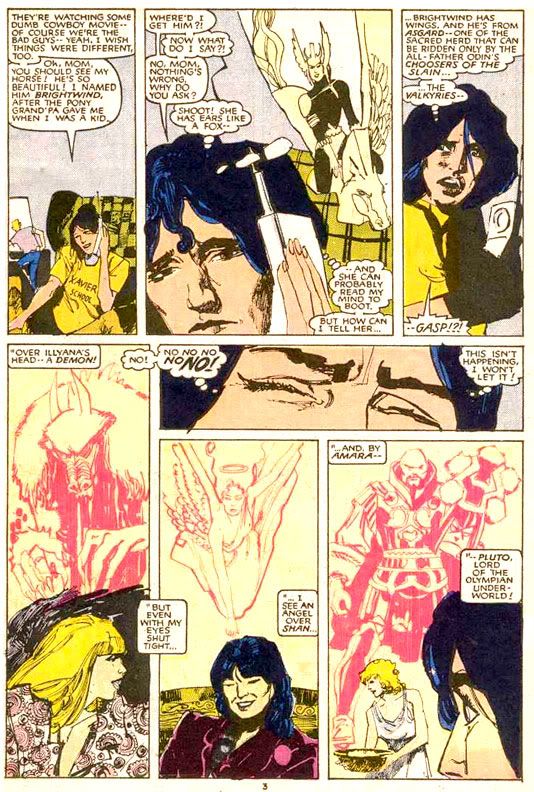
 Here's an example from New Mutants #37 (March 1986). It starts with a typical New Mutants-style scene: the gang are all watching a Western on TV while Dani tries to ignore their insensitivity and have a long distance phone conversation with her mom. It's a John Wayne Western, no less. Fantastic choice, kids. Only Rahne has presence of mind to identify Dani with the culture being so badly portrayed in the movie by various non-Native stunt people and stick up for her friend. While Dani loves her pals enough not to act out in rage when they callously and, frankly, stupidly cheer for the cavalry to kill all those Indians-- hooray for genocide!-- something sets her off. Something always sets Dani off.
This time it isn't so much anger as it is a psychotic break triggered by her Valkyrie power of seeing who will soon die. This issue ends very badly for the New Mutants. Very badly indeed.
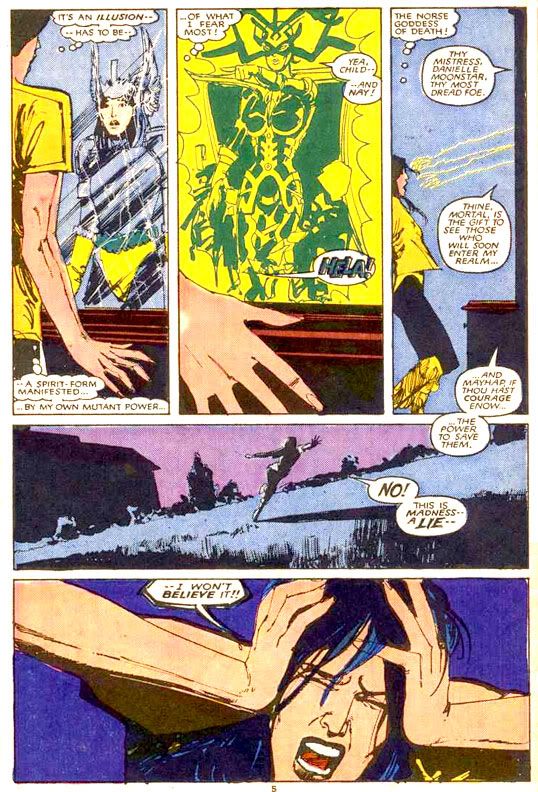
In a sequence stunningly illustrated by penciller Mary Wilshire and inker Bill Sienkiewicz, Dani sees the manifestation of death above her teammates' heads and begins hallucinating all sorts of fun things, such as herself in Asgardian armor and Hela, or Hel, the goddess of the underworld in Norse mythology. Hel, who rules over Hel. I'm no scholar of this stuff. I prefer the Greek and Roman pantheons, and the Egyptian. Personal taste.
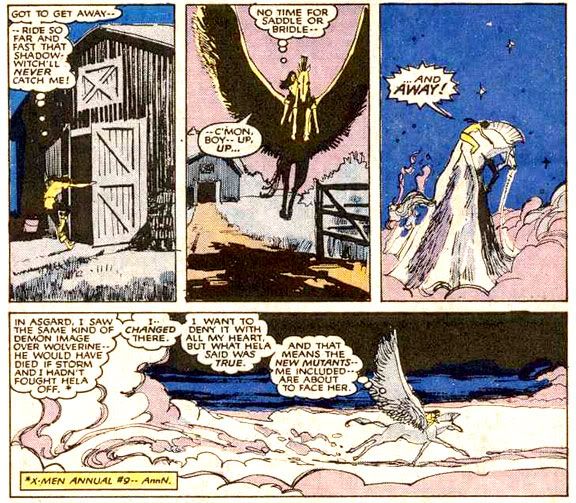 Storytelling is key here. Nice acting by Wilshire-- look at the shock and fear on Dani's face contrasted with the blissful ignorance shown by Illyana and Xi'an. As an artist, you have to have an understanding of your characters as individuals and think in terms of their body language and reactions, just as an actor does during a performance. Dani doesn't get mad the same way her hotheaded pal Roberto does, for example. Chris Claremont writes it knowing this, but it's up to Wilshire to interpret it visually and communicate it to the readers.
Beyond that, I also admire Wilshire's page layouts. The panels read so easily, just a straightforward left-to-right flow, vertical top tier containing one moment, vertical lower tier with quick jump-cuts from Dani's point of view set off by a horizontal one with a close up of her eyes, then the last panel taking us to a more objective viewpoint, which continues on the next page. Dani freaks out at her reflection in the mirror in verticals that continue the sequence inside the house before breaking into horizontals with a location change. This isn't the only way to do this; there are probably many others, all equally effective. Here I really like the pacing. Those tall panels function as quick cuts, emphasizing Dani's sped-up reactionary state, while the wide ones slow things down. She's outside, there are no doubt crickets chirping. She runs across the mansion grounds. The freak-out happens in seconds, it takes longer for her to reach the barn. The three panels where she tears open the barn doors, comes riding out on Brightwind, her magical winged horse, then bursts through a cloud trailing it like gossamer each occur in roughly equal segments of time. Finally, Wilshire draws a panel that stretches the length of the page, expanding the time frame as Dani and Brightwind-- blame that punk mane on Art Adams, I believe-- take a long gallop across the almost endless cloud tops. This moment probably seems timeless to Dani, and yet not long enough.
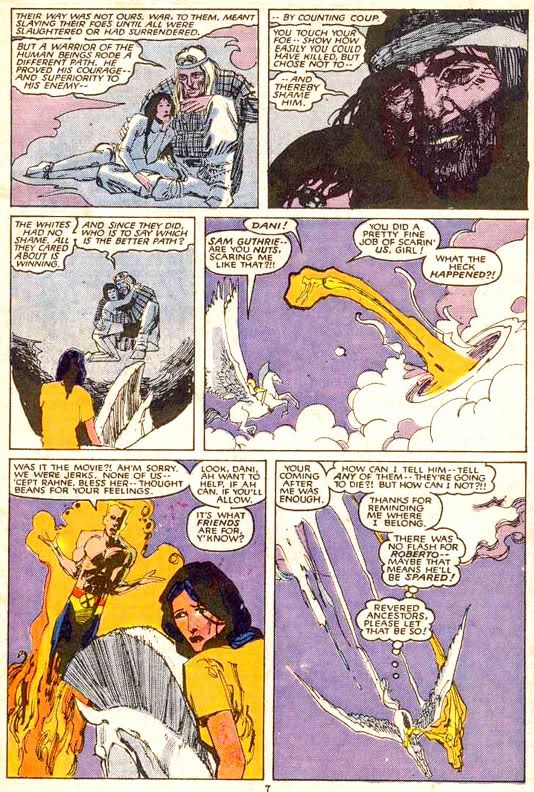
Even if Chris Claremont hadn't added all the helpful dialogue and thought balloons that explain things, you'd know someone was having an episode, seeing craziness in a mirror, then running outside into the night.
Somewhere in the sky, Dani finds comfort in words of wisdom from another hallucination, this time of her dear, departed grandfather, Black Eagle. This is the kind of thing I used to love about New Mutants-- how the book could go from a mundane moment with the kids eating popcorn and celebrating Manifest Destiny to a fantasy-tinged sequence of a teenaged girl galloping across a silvery, moonlit sky on a winged horse. This happens in a matter of minutes in story-time. And then an exploding yokel appears sans shirt and ruins the magic. It's the way you wanted your life to be when you were 15 or 16 years old. Only if you were like me, you were faced with a daily plethora shirtless yokels and none of the winged horses.
Anyway, that's Dani Moonstar all over. You don't get half-assed reactions from this girl. She's all in, all the time. Well, most of the time. She's the epitome of the Marvel character. She has a strongly defined personality apart from her powers. Your basic Marvel character strikes me as a human being worth reading about whether or not they're a mutant or spider-bit or an irradiated scientist and his equally-irradiated friends. Even if she were a character in some kind of John Knowles A Separate Peace coming-of-age novel, merely a non-powered Cheyenne teen who happened to be studying at an exclusive boarding school back east, with racism, culture clash or self-expectations her major problems rather than anti-mutant hysteria and extra-dimensional kidnappings, Dani would still be touchy, angry and oh so volatile, still interesting in her own right. Now why writers felt the need to change her powers and give her a flying horse, I'll never understand. But that they could do that and have the core Dani remain intact is a testament to her strong conceptualizing by Claremont and Bob McLeod.
Subscribe to:
Posts (Atom)