Thursday, May 26, 2011

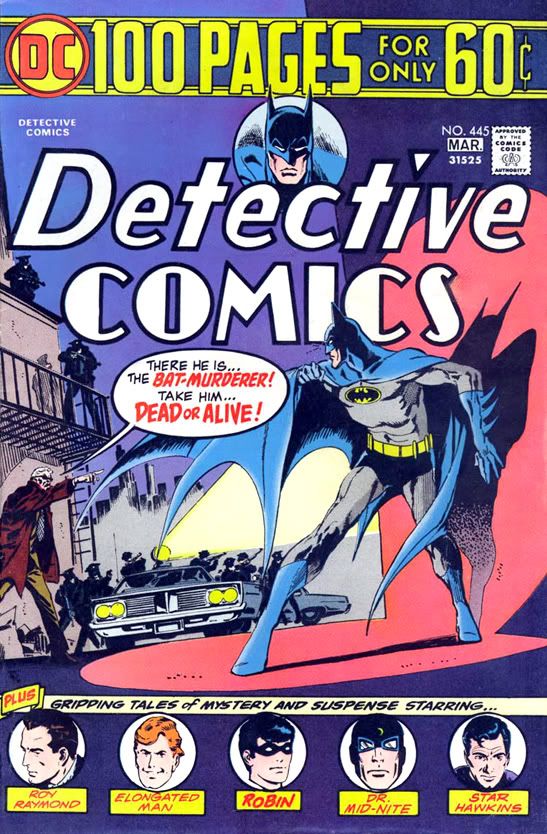
"The Touchdown Trap" from Detective Comics #445: Remember that time Robin tackled an old man and made him cough up the football?

You may be too young to remember the days before genetically engineered super-comics grew on cybertrees in all the colors of the rainbow, but when I was your age they were made of paper. In 1975, DC's Detective Comics consisted of 100 pages for 60 cents (I know! Imagine paying more than a quarter for anything less than 600 holographic pages!), and starred such iconic characters as Roy Raymond (subject of 1995's Oscar winner for Best Picture), Marty Moran (Headline Hunter) and Star Hawkins (in 1986, an act of Congress replaced Labor Day with a new holiday in Star's honor), plus those almost forgotten failures Batman and Robin, whose brief literary careers went nowhere-- aside from being occasionally unearthed and derided by nostalgia bloggers looking for obscure pop culture artifacts upon which to exercise their snide humor.

Yet at one point, this so-called Batman was a popular enough character to command the cover spot for a few issues of Detective Comics. Then again, people living in those days also loved Irwin Allen's disaster movies and belted jumpsuits. There's no accounting for taste, or so they tell me. What do I know? I'm just a clone. From the future!

1974's Robin is quite a bit different from today's version, the wretched little asshole Damian Wayne. This Robin is the original one, Dick Grayson, better known now as... well, Robin, because I doubt most people outside of comics have ever heard of Nightwing, or of Grayson's stint as Batman. I also seriously doubt they even know the name Dick Grayson. It just doesn't stick in the mind like Bruce Wayne, Clark Kent, Roy Raymond, or Marty Moran (Headline Hunter).

Here we have young Robin as a college student at Hudson University, which sounds as though it should be located in upstate New York. And perhaps it is, because Robin and his university pals frequently pop over to Rutland, Vermont, for the annual Halloween parade. Almost once a year, in fact.

I'm not sure what kind of school Hudson University is. Ivy League? Big 10? One of the Seven Sisters? All "The Touchdown Trap" tells us is it's the 50th anniversary of the school's first football championship. Ah yes, Hudson University. It's coming back to me now, the legendary Hudson University football dynasty, when the school won 5 consecutive national championships.

But that was decades after the storied 1924 season, during which their offensive attack was spearheaded by Heisman Trophy winner, "Hurricane" Hurley. As our story begins, the school has invited back the offensive squad of that storied team to recreate the play that won them the league championship (the entire defensive team having died in the interim).
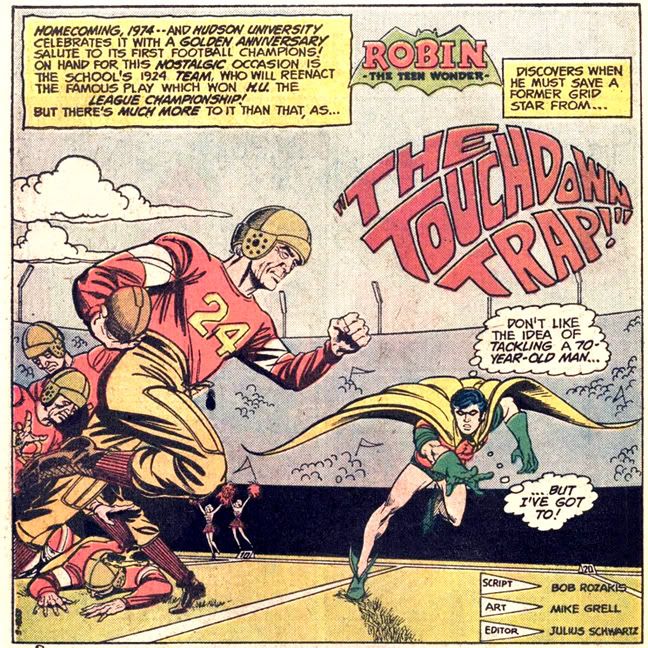
The Hudson University Beavers play their home games before an appreciative crowd
of lumpy mashed potatoes turning gray with age.


No student is more excited to see these aged gridiron warriors than our boy Dick. Hurley is an old family friend, and Dick is so thrilled to see him again, he's beaten up Jughead Jones of Riverdale and stolen his crown-like hat, then killed and skinned a goat and donned its still bloody pelt, steaming in the crisp autumn air. Hudson University, where goats are plentiful on campus and students gather around ukele-playing audioanimatronic figures to sing hymns to the coming socialist utopia.
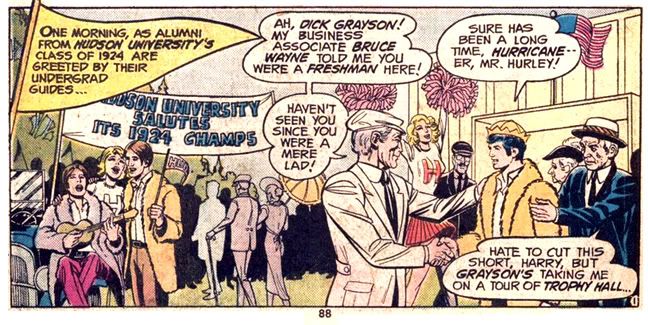
When 23-skidoo met far freakin' out.

This is some nice dialogue. There's not the least bit of awkwardness in the way scripter Bob Rozakis has Hurricane Hurley reference his relationship to Bruce Wayne while addressing Dick by his full name and scholastic status. It's so natural and unforced, in fact, a lone cheerleader celebrates its soulful smoothness by soundlessly leaping into the air and shaking her pink pompoms. As good as his word, Dick takes straw-hat wearing Mr. Benson on a tour of the school's trophy hall. Benson's so impatient to see the trophys, he doesn't even want to drop of his bag. Or change his adult undergarments, which must be soaked after the long drive up from Gotham City. The man loves sports mementos and dampness in his personal area is not about to stop him from having fun. And it's a good thing, because as soon as Dick and Benson reach the hall, they find some fun-loving students engaged in a Hudson University tradition.

This guy entered the fight wielding a sliver of balsa wood, or a canvas stretcher stolen from some poor art student's locker.

Which is wearing white gimp masks and matching disco costumes to smash the award-laden glass displays. Careful! Those shards of glass might cut and the all the sports-related puns will stick to your shoes and make them smell something awful! Dick changes to Robin and beats up the disco kids, just as the campus cops show up. They're as timely and effective as most campus cops.

For a second I thought I was dead. But, when I heard all the noise, I knew they were cops. Only cops talk that way. If they'd been wiseguys, I wouldn't have heard a thing. I would've been dead.

"Okay, Robin... ...What the fudge is goin' on here?!" Only he didn't say "fudge." He said the "f-dash-dash-dash" word. Seems one of the "jocks" received a letter full of money with orders to smash up the trophy hall. Never one to question letters full of money, he and his friends immediately went out and spent their entire windfall on masks and matching leather jackets, then proceeded to wreak havoc. Now they're broke and in jail, but at least everyone knows they're together! A matching set. And that's what really counts. Togetherness. And Benson himself carves the roast-- actually, what Benson does is recover the game-winning football.

While Robin's trying to figure all this out, we cut to the stadium's locker room where the head coach from the 1924 squad is showing his team game film from their championship effort. Let's think about this for a moment.

The old guys behind "Coach" are all smiling because, in his senility, he forgot to wear pants. Sports teams are notorious for their cruel, mocking humor.

The former players are all in their late 60s or early 70s. Their coach was probably in his 30s or 40s when they won the championship. Which means this guy is pushing 80 or perhaps even as much as 100 years old! Look at him! Time has left him a withered, toothless wreck of a man, and deposited a gigantic carbuncle on his chin. Yet he proudly wears a dirty old crewneck t-shirt upon the collar of which he's crudely lettered the word "COACH" in red marker. A younger man would have bought a nice sweatshirt with stitched lettering, or at least used iron-ons. But not this walking mummy. Look how high those letters are. This might be because artist Mike Grell didn't trust the readers to fill in the parts of the letters the bottom of the panel cut off, but that's not it. What happened is exactly as I've described it. It's in Rozakis's original script. Writers include little details like that in their scripts even though we'll probably never read them because it helps the artists figure out the characters they're drawing.

We get to see how the winning play went down. Hurley, the quarterback, took the snap from center, then turned to hand off to fullback Benson. With the pocket collapsing around him, he decided to keep the ball. The cameraman somehow managed to get a sweet close-up of that moment, so clear you can see the shock and disappointment on Benson's face when Hurley snatched the ball away from him. Then it's 90 yards down the field and he... could... go... Okay, yeah, we already know Hurley scored the winning touchdown.

A few minutes after the old coach passes away, the players take the field, wearing their original 1924 uniforms complete with leather helmets. Luckily, they've stayed in shape all those years and everything fits perfectly.
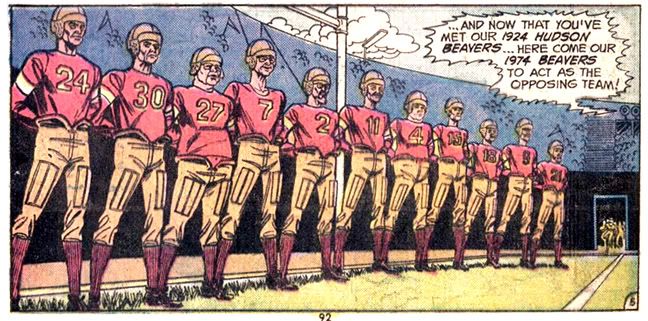
Behind the men: a wall made of natural stone. Granite, I believe. With little flags poked into it to mark specimens of particular interest to rock hounds.

The plan is to use the original game ball for the recreation, but someone has destroyed Hudson University's most precious sports artifact. Robin learns of this from none other than a time lost Burt Reynolds as he appeared in his starring role as police officer Nick McKenna in the 1993 cinematic masterwork Cop and a Half.

Robin never had a strong grasp of meteorological phenomenon. That's why he failed so many science classes.

At which point Robin deduces the reason for all the disco-style vandalism-- a distraction while someone switched footballs. And being a superb detective trained from childhood by the master himself, Batman, Robin also knows there was only one person in position to handle the old switch-a-roo. Hurley's in danger and there's not a moment to lose! After a trip to the concession stand for a large, icy Pepsi and one of those delicious Hudson University stadium chili dogs, then an interminable wait in the line an open urinal (millions in alumni donations for luxury skyboxes and a Jumbotron scoreboard, zero for restroom facilities), Robin leaps over the retaining wall and hurls himself down the field.

He takes Hurley down with a fine open-field tackle, snapping the man's brittle tibias and fibulae as though they were merely dried twigs, old wood, dead these many winters. The substitute ball contains a time bomb, as evidenced by the muffled ticking coming from within.

"I don't care what kind of hero this moldy old chump used to be, ain't nobody crosses the goal line on Robin's field!"

I'm left wondering why someone would use a timebomb in this situation. Wouldn't some kind of remote triggering device work much better? If you're a ball-handling offensive player on a football team-- a quarterback or fullback, for example-- chances are you're going to be near the football at some point during a play. Especially if your participation is a major component of said play. Granted this is merely a recreation, but the timing on these things isn't always precise. There are delays. These are old men; they don't move as quickly as they used to. Using a timed explosive is taking a major risk. But I don't know. I have a superstition about standing too close to explosions, so I may not be the most objective person to judge.

Unfortunate timing led to the demise of all the doves released during the pre-game ceremony.

Forget all that! Not only is he a textbook tackler, but marvel at the height Robin gets with that punt! Lord have mercy! Imagine the hang time he'd have had if the ball hadn't contained a timebomb! Why isn't the current Hudson University coach trying to recruit this guy? "You can even wear the mask, kid, but we need you on special teams!"

I've been poking fun at "The Touchdown Trap," but it's really an effective eight-page story, with a concise, direct plot. Rozakis probably came up with it over lunch, ran it by editor Julius Schwartz and tapped it out on an IBM Selectric II at the DC offices in less than an hour, one of many he'd write that afternoon. Grell doesn't seem to have labored over the art-- and he obviously skimped on the stadium crowd shots. Lumpy gravy? Week-old grits? But you know what? That's fine. Rozakis and Grell weren't trying to produce a masterpiece. They were just trying to tell an entertaining Robin mystery to fill a slot in the magazine. Stripped of flash, efficient, not a wasted moment, no loose ends, just enough character development to propel the narrative to its conclusion.
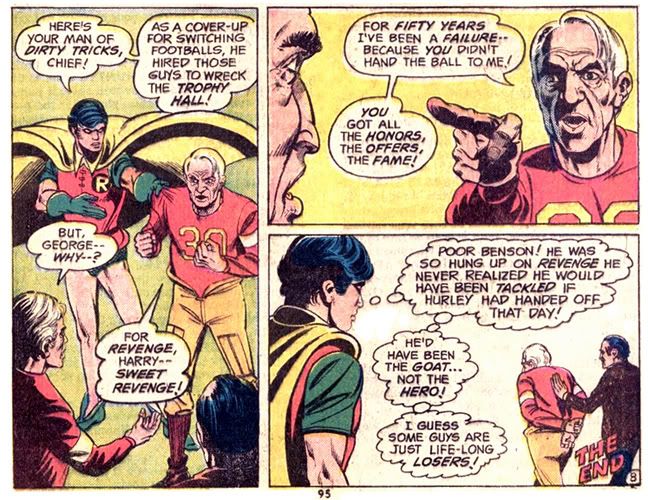
Written today, "The Touchdown Trap" would attempt some gross-out thrills with a few gruesome murders. Also, it would consist of a four-issue prologue mini-series, then twelve issues running across most of DC's monthlies for an entire summer, and finally, a couple of epilogue stand-alone issues and a new on-going series starring the daughter of the original Roy Raymond, also named for some reason Roy Raymond. The real culprit behind it all-- manipulating Benson and Hurley for his own nefarious ends-- would be an insane Star Hawkins with help from a brain-damaged, drug-addicted Marty Moran (Headline Hunter). And as a parting gift, Robin would also learn Hurley had molested Benson's daughter and consequently come away a Boy Wonder disillusioned with hero-worship. A few months later, and we'd all get to buy the hardcover annotated version with an introduction by some best-selling author of horror novels or techno-thrillers sold by the pound at airports, re-mastered art on super-slick glossy paper and self-congratulatory commentary from the creators. Two more years and there'd be the direct-to-DVD animated adaptation. Then the new Roy Raymond title would be cancelled, she'd show up from time to time badly mischaracterized in various Batman-related books and finally, be raped and murdered as a minor plot element in yet another multi-title crossover event.

A relic of a simpler, brighter time, Rozakis's plot would've worked beautifully as a segment of Super Friends or an episode of The New Scooby Doo Movies guest-starring the Dynamic Duo, or the Caped Crusaders. Or Sonny and Cher. All that's missing is an unmasking. We have to settle for an unhelmeting. Actually, we don't even get that much. Poor Benson. Fifty years nursing a grudge and this is the best revenge he can come up with? Like Robin notes, "I guess some guys are just life-long losers!" Luckily for Benson, he won't have long to stay in prison. Because he's so old, he's bound to die there in a month or two! Freddie, Velma, Daphne, Shaggy, Scooby, Batman and Robin all laugh heartily and...

Roll credits.

Tuesday, May 24, 2011

Happy Birthday Carmine Infantino!

Carmine Infantino turns 86 today. One of the all-time greats, Infantino helped launch the Silver Age of comics with his work on a more sci-fi based Flash with Robert Kanigher at DC, but eventually drew for both Marvel and Warren as well. He's one of those guys it'd be easier to list the characters he didn't draw during his career. Wolverine. The end. Heck, Infantino probably drew Wolverine. I'm just clowning around here.

But I'm being very serious when I say that it's great to know Infantino's still around, and these days I'm really enjoying his work on the Marvel Star Wars series as reprinted by Dark Horse in their Star Wars Omnibus books. I also think his re-designed costume for the Flash is one of the most visually appealing costumes worn by any superhero. It's bold, bright, simple and conveys exactly what the character is all about-- he's fast as lightning.

For Kamandi -- With Love and Squalor

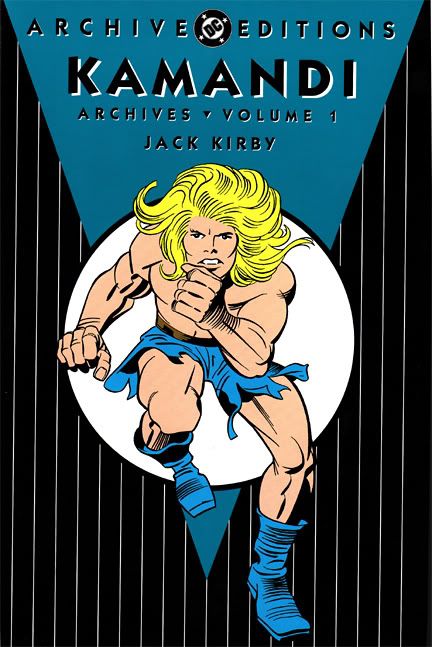
What do you get when you’re DC publisher Carmine Infantino and you float the idea that Jack Kirby should rip off Planet of the Apes? Not a Planet of the Apes rip-off, that’s for sure. If Infantino expected Kirby to content himself with mere talking simians, he was sorely mistaken. And yet that’s pretty much how it happened, and how approximately 65 million years later, we lucky fools ended up with this slick and weighty DC Archives edition of Kamandi.

Or, as I like to call it, Kamandi: The Last Boy on Earth, because that’s the series’ title and I’m clever that way.

Chapter One: The Last Boy on Earth!

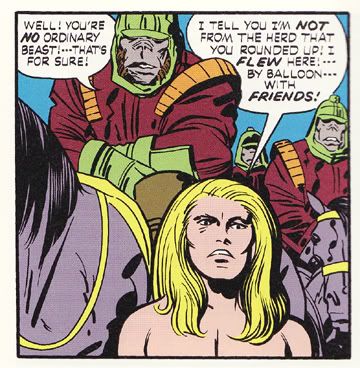
Kamandi is a futuristic, roughneck young hippie in a time where barbers have gone extinct, but cut-off denim and motorcycle boots are all the fashion rage. He’s the Charlton Heston surrogate for this madhouse world where not only do gorillas talk and ride horses, but lions and tigers tool around on three-wheelers and radioactive scientists float overhead in helium balloons.

Because it’s Kirby, Kamandi can scarcely contain itself. While he was always possessed of a febrile creativity, as soon as Kirby hit DC, his imagination went into some sort of turbocharged overdrive. His Fourth World stories are over stuffed with incident and new characters, and Kamandi features a similar breathlessly paced narrative. Reading a DC-era Kirby comic like reading ten stories in one.

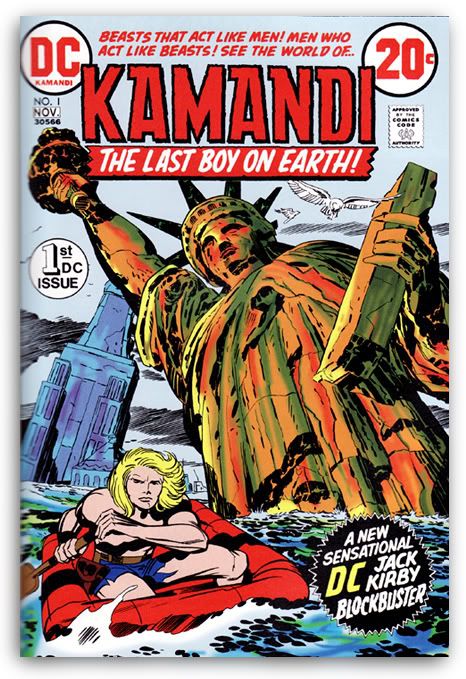
Kirby himself was busy then, too. I believe he was simultaneously producing Jimmy Olsen, Orion, Mr. Miracle and Forever People, spackling his living room wall in preparation for repainting it and mediating the Paris Peace Talks between the United States and the Democratic Republic of Vietnam (DRVN). And just as he saved our world in reality, Kirby destroys it in the pages of Kamandi. It's the post-apocalypse with a new status quo of underground bunker-dwelling and scavenging for food. Kirby destroys that almost as soon as he introduces it, too. When we first meet Kamandi, he's rafting through a flooded New York with a Statue of Liberty as majestically ruined as the one in the Apes film series, its obvious antecedent. Kirby leads with a splash page followed by a double-page spread no less!

DC... next time you destroy
the Statue of Liberty in a story,
do it the Kirby way.

Six pages in and Kamandi’s guardian/mentor is dead (he barely gets any dialogue), Kamandi’s battling a talking wolf who foolishly beckons, “Here! Give me that gun! --- Come on ---! I won’t hurt’cha!” and then Jolly Jack decides he needs to do something to pick up the pace before reader ennui sets in.

The second sees Kamandi’s new-found radioactive buddy Ben reminding him “Don’t forget Ben Boxer, boy! I’m not like the other humans you’ve seen!” As if Kamandi or the readers could forget- Ben Boxer is a man who has to wear an astronaut suit in order not to kill everyone around him with deadly radiation. Oh, and he turns into steel then deals out ass-whuppin’s. Just like the X-Men's Colossus, only not Russian. And a couple of years earlier.

Then we get yet another double page spread, this time of anthropomorphic rats looting the wreckage of the George Washington Bridge.

Kirby's gorillas are cooler than
the ones from 20th Century Fox.
Just keep Timothy Burton away
from them.

It’s not until #3 that the Planet of the Apes similarities fully emerge as roughneck gorillas (are there any other kind?) in green hunting caps and purple jumpsuits capture Kamandi. The cover blurbs come backing more hyperbolic bombast than a decade’s worth of today’s comics:

Welcome to a buried Las Vegas! Once a playground for men – now, a sinister hunting ground for gorillas!

So the apocalypse didn’t change much. And then this:

Complete in this issue! “The Thing That Grew on the Moon!”

A thing! And it grew… on the moon! As if the loincloth-sporting gorilla on the cover wasn’t enticement enough. Comics today could use more of this kind of cover copy-- at once hucksterish and tongue-in-cheek, and instantly appealing.

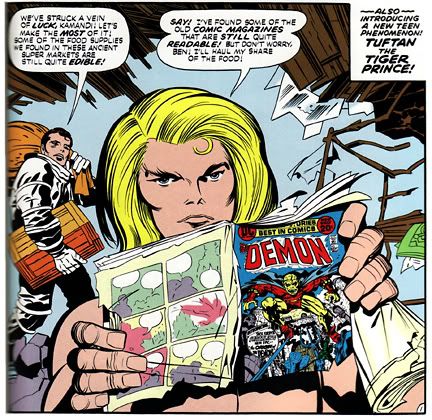
Who says this isn't the Age of
Kirby Self-Promotion? Kirby
works in a little plug for another
of his comics. "Quite readable,"
Kamandi? Quite readable indeed!

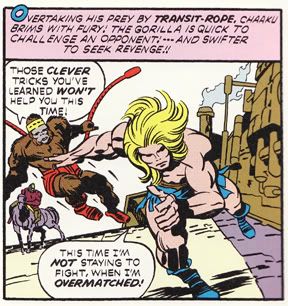
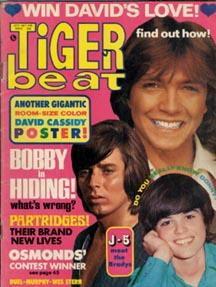
I think Kirby may have had bigger plans for Tuftan, the Tiger Prince. He comes on the scene in #4, heralded by a splash page text box labeling him a “new teen phenomenon.” I’m not sure if Kirby means Tuftan is a teenager (and more to the point, a tiger), or that he hopes Tuftan catches on with 70s teens the way David Cassidy and his half-brother Sean did, or Kristy McNichol, or skateboarding, or discotheques or feathered hair. After all, the kids loved Tiger Beat magazine; how could they not love Tiger Prince?

In the post-apocalyptic future,
half-naked neo-hippies will frolic
with headband and loincloth wearing
gorillas on transit ropes!

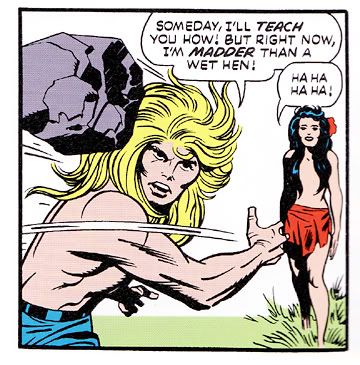
Kamandi and Tuftan get caught between the warring tiger and gorilla armies, and Kamandi gains a talking human girlfriend named Flower… who shamelessly goes around shirtless! Which is only fair, since Kamandi also flaunts bare-chestedness. Flower’s hair gives her some Lady Godiva-style modesty but Kirby’s notion of upper-body nudity is amazingly egalitarian.

In Kirby's future anyone may go
topless without shame! Viva la difference!

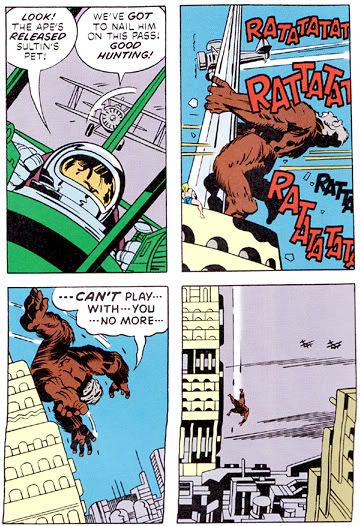
Almost as soon as Kirby establishes the romance between Kamandi and Flower and hints at the eventual reestablishment of some sort of humancentric society, tragedy strikes our young lovers. Kirby examines its aftermath in Kamandi #7, with a chapter intriguingly titled “The United States of Lions." Surprisingly, it has little if anything to do with unions, states and only tangentially features lions. Beginning with a funeral and ending with a skyscraper battle, it's actually Kirby’s parody of King Kong, substituting a massive gorilla; Kong’s equal in stature but superior in conversational skill.

And that’s just a quick overview of the first seven issues! I’m too exhausted to tell you all the details about the last three in this book, in which we visit “Tracking Site,” battle the savage flying bats and the freakish, sinister homunculus who dwells there, intent on unleashing a world-ending bacterium for some obscure reason Kirby can barely take time to explain to us in the breathless rush of his futuristic narrative.

Chapter Two: The Waiting Secret!!

If you haven't guessed by now, Kirby goes pretty far afield, given the series’ original mandate. And while Kirby wasn’t above rehashing classic movie plots he never failed to add twists the original wouldn’t dare. Imagine how insane Beneath the Planet of the Apes would’ve been if, instead of skinless mutants, the gorilla army had encountered talking lions on three-wheelers.

While suffering from an over-reliance on capture, escape and evasion plotting (it becomes repetitive), Kamandi is a sterling example of Kirby’s off-the-wall and unrestrained storytelling, honed over decades of professional work. While he may not have been as interested in the book as he was in his New Gods, the fact remains the man just could not half-ass things even if he tried.

Who else would engineer an entire future Earth, populate it with talking animals of nearly every species, continually hint at a central mystery that unravels intermittently throughout the adventures and introduce brand new characters practically on a page-by-page basis?

From reading these, I can’t help but see Kirby as a mostly intuitive storyteller. Certainly the man was a sponge, soaking in bits of science, legend and myth, and good old Hollywood movies; all of this he'd combine and alter to suit his story needs. Mike Evanier's recollections give me the impression Kirby would frequently come up with a particular direction for a story... then produce something almost totally counter to his original intent. Creating on the fly, always bubbling over with ideas. With that in mind, I don’t see an overall plan here, just incidents piled on incidents.

Groovy incidents. With the intent to entertain the bejeezus out of anyone who buys Kamandi.

And while Kirby may never have written the Great American Novel, it’s probably no accident Kamandi’s adventures take place in the western regions of the former United States. As soon as he departs his underground bunker near New York, Kamandi becomes the classic American pilgrim, sojourning in locales near Las Vegas, Yellowstone Park, even ranging as far as South America in a tip of the hat to Butch Cassidy and his partner in crime, the Sundance Kid.

From James Fenimore Cooper to Mark Twain and Brett Hart, to the relatively more recent Jack Kerouac and Thomas Berger plus many others, American novels frequently explore western migration as related to rugged individualism, which Kamandi certainly personifies. In fact, this is probably the most important defining traits of what we characterize as American literature, at least in the 19th century, and much of the 20th.

The west is the quintessential setting for American literature, with Kamandi the descendant of Huckleberry Finn by way of Col. George Taylor. And like Huck, and Berger’s Jack Crabb, Kamandi rebels against unjust societal expectations, cannot tolerate a life in either literal or figurative captivity. He must remain in motion, forever restless, the personification of our nation in its youth. Unable to relate to most surviving humans, Kamandi remains apart from each culture he encounters. Kirby reinforces this by repeatedly separating Kamandi from Ben Boxer's scientists and having Kamandi assert his human identity and equality to his animal overlords who insist on treating him condescendingly as either a pet, a mascot or an enemy.

As science fiction, technological themes abound in Kamandi, but these are traditionally conflated with western ones in more mainstream American literature as well. While Cooper might bog down the narrative of his 1823 novel The Pioneers to describe a stove in almost Luciferian terms, Kirby, the once and future king of his four-color milieu, creates bizarre flying vehicles and war machines with a gestural whim, yet never slackens the story's pace.

The series has a strange dichotomy-- for humans, advanced technology is of the past, and there’s a nostalgia for what humanity has lost, but along with it, an implied criticism of the queasy, mindless consumerism and complacency that led to this outcome in Kirby’s use of imagery featuring the detritus of a lost civilization: familiar shopping mall signage and weathered sculptures of American presidents (even significantly including one of Richard M. Nixon, never a Kirby favorite) whose identities have been lost to history.

Still, in order to reclaim mastery over the world, which Kamandi sees as a human birthright, he must solve these archaeological mysteries. To this end, Ben Boxer and his scientific comrades are forever seeking the lost “Apollo Project” in an effort to understand this disordered reality.

And while technology is used to destroy (being a Kirby action-fest, violence and weapons-based imagery predominate), there’s also a hopeful quality. If one can defeat the barbarian bat-creatures and the horrific human-created bacterium that can kill all life… one might at the very least, as in "The United States of Lions," find a peaceful place where one might belong.

If, that is, Kamandi can overcome his temper and tendency towards violence. Then again, to Kirby these were also human qualities. To create and destroy, our recurring pattern, even among animals with anthropomorphic qualities. Kamandi lives in a world ruled by violence, both casual and institutionalized- rowdy fistfights, warfare and gladitorial games coexist. Kirby might remind us these, too, are human inventions.

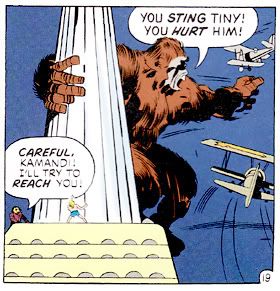
Kirby does Kong. Get Peter
Jackson on the phone! We need
an epic Kamandi movie!

Franklin Schaffner never thought
to put his apes in biplanes, but it
would've been cool if he did. These
are actually lions. Lions in biplanes,
attacking a giant, talking ape who
calls himself Tiny. God, we need
another Jack Kirby.

Chapter Three: The Monster Fetish!

We’re lucky enough of the art exists for DC to gather it all into this hefty and cleanly-designed hardcover. We can enjoy its prime Kirbyness, where his stylistic flourishes, unhindered by the slick ink work from Joe Sinnott at Marvel and the scratchy, unfinished line of Vince Colletta at DC, erupt. Kirby's use of splashes backed by innovative gutter-crossing double spreads on pages 2 and 3 gives the stories a wide-screen feel, opening up the scope and dazzling the reader with Cineramic imagery like a ruined Nevada town, preserved for animal archaeologists by the dry desert air, an Ozymandian image at once humorous and melancholy.

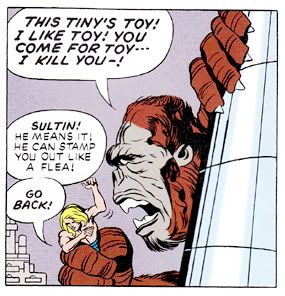
Sic semper Tiny! "Can't play---
with --- you --- no more." He's not
even angry at the lions who killed him.
Isn't that the saddest comic panel ever?

In the Kamandi Archives reprint, the blacks are crisp, the colors smooth. The reconstruction is akin to looking at a restored print of a Cecil B. DeMille epic. These stories were originally printed on grey-toned newsprint which almost immediately began to yellow. And they featured line screens that were practically planet-sized compared to today’s. Now we can see the art on glossy white, with screens so fine they allow the color fields to appear as smooth, flat areas. While this takes away some of the immediacy and ephemeral quality of the originals, it allows us to study the line work unobscured by cheap paper and indifferent printing.

This is especially educational because Mike Royer’s inks always bring out the Kirbyness of Jack Kirby’s pencils. From interviews I’ve read with Royer in the Jack Kirby Collector (a product of the wonderfully nice people at TwoMorrows), it seems his intent was always to preserve the pencils as much as possible. I love this approach, because the attraction of a Kirby comic is its uniqueness. He’s oft-imitated, but no one has ever fully captured the intangibles of the true Kirby.

The most others can do is provide the bombast and overkill, without the humane qualities. Kirby strikes me as having a genuine love for people, be they the shirtless, blonde hippie kid type or the kind hidden in an animal’s fur and sinew.

Monday, May 23, 2011

Prinprin Monogatari!


I'd been looking for this for months. When I lived in Japan, I'd occasionally find this airing in the mornings or early afternoons on Cartoon Network. It's a puppet/marionette show called Prinprin Monogatari (or Purinpurin Monogatari). It originally aired on NHK in the early 1980s and has a gentle Mr. Rogers' Neighborhood feel. All I know about it beyond that is the characters would sometimes ride around in a Jeep.

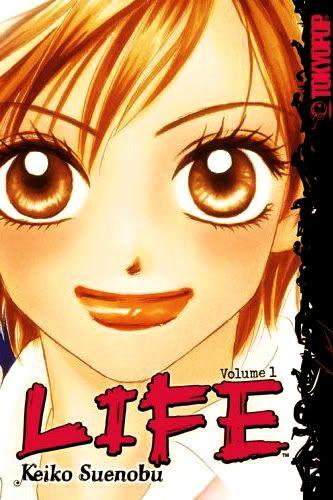
Life 1: A Comic Review

Life
Writer/Artist: Suenobu Keiko

Translation: Michelle Kobayashi
English Adaptation: Darcy Lockman
Publisher: Tokyopop

This is Life the comic, not the game. Or the cereal. And this is how life works: while in the U.S. we get assigned to high schools based on demographics and geographic location, in Japan junior high kids have to pass a test. Ayumu is an underachieving girl who latches onto high scoring smarty Shinozuka (Shii-chan for short but only if you’re close) for friendship and tutoring. As Ayumu’s grades improve, so does her outlook on life. Now she has a super-supportive best friend and if things work out, they’ll be together at the coolest school in the city, Nishidate High.

Sometimes things don’t work out. Shinozuka’s grades plummet as she expends energy on the needy Ayumu and when the big test scores come in, Ayumu’s the one going to Nishidate. Solo. This scotches the friendship and Ayumu finds herself isolated and hurting among the seemingly happy Nishidate student body. Luckily for her, she’s cute enough to catch the attention of the instantly popular Manami. Manami’s perky, pretty, has a sweet boyfriend and a sunny outlook on life. She’s everything Ayumu wants to be so she learns to bask in Manami’s reflected light. But…

Why is Ayumu still so unhappy? Losing Shii-chan’s friendship has left her with an introspective streak and the more she exercises it on Manami, the more this brightly effervescent girl proves to be spinning somewhat out of control. So out of control, Ayumu’s going to have cause to regret the pinky swear they made to always help each other out on pain of being “stabbed by a thousand needles.” And finally there’s Hatori the mysterious girl with a bad reputation who makes Ayumu’s heart pound.

Well, it may not be a game or a breakfast food but it was a hit Japanese TV drama in 2007. The show’s theme became hugely successful on the pop charts; more sequential connections here-- it was sung by Nakashima Mika, the actress who plays rocker Nana in the two films based on that comic.

Here's a link to the music video, which features scenes from the drama:


It accurately depicts how much more over-the-top the TV series is compared to the comic. While the show quickly veers into melodrama that approaches grand guignol, Suenobu Keiko’s comic series starts with a slow building and expertly observed psychological portrait of a vulnerable teen coming apart under the strains of everyday life.

The Shiiba sisters have more needs than their single mom can deal with, so as the eldest, Ayumu is left to deal with her issues alone. Status as something of an afterthought around the home combines with the intense pressure to pass those entrance exams until Ayumu resorts to desperate measures to attune herself. First she discovers the deliciousness of pain through poking herself with her compass and when Shi-chan turns on her in jealousy and disappointment, Ayumu becomes a cutter.

Suenobu deftly depicts the dynamic between Ayumu's despair and the false sense of control she gets from cutting. Each slice must be strangely comforting in a way I really can't understand, but also shameful, as when Ayumu realizes her school will soon switch to their short-sleeved summer uniforms and she has so many visible scar. When these scars intensify her feelings of isolation and freakishness if discovered, Ayumu will find herself locked in a vicious cycle.

Suenobu’s Manami is another smart sketching of a teen in crisis. Her ever-present smile and chirpy demeanor draw Ayumu to her. Manami definitely has charisma; almost everyone wants to either know her or be her. But she possesses a shocking and overt cruel streak, one that Ayumu tries to overlook as Manami draws her into a sort of codependent relationship which they consummate with the fateful pinky swear. Despite her upbeat demeanor and her perfect hair, there’s something cracked about Manami, an ugly and even helpless side that, increasingly, Ayumu finds repulsive yet compelling; she constantly reminds herself that no matter how ugly things get, she truly is Manami’s friend.

Suenobu’s artwork features clean line work combined frequently with mechanical or computer-generated gray screentones, cartooned emotions and page layouts with overlapping panels. Take away the gritty psychological realism and it could be any generic high school romance story. And like the artists of those lighter comedic tales, Suenobu opens each chapter with idealized, romanticized inkwash images that in Life belie the harshness within.

In fact, there’s an almost disturbing disparity between these fashionable, large-eyed, cutesy looking characters within their overly familiar high school setting and the stark imagery of dark beads of blood bubbling out of Ayumu’s shallow wrist cuts. It plays against the reader’s expectations of frivolity and increases the emotional impact. A powerful dissonance.

I started reading this manga because a friend turned me onto the drama and we both enjoyed its campier elements. At the time, I was actually living in Japan and teaching English to students of all ages. I tried my best not to pry into my students’ personal lives, but sometimes I saw tears and stark mood changes even in our classroom. Life may be somewhat exaggerated for dramatic effect and the reality may or may not be so dark, these kids’ lives are shaped by enormous stresses and responsibilities. Many of them are up at 6am and not home before 9pm, 6 or even 7 days a week.

Club activities; frequent exams that cover Japanese, biology, history, Classical Japanese (which they amusingly call “Old Japanese”), mathematics and English all at once; nights spent fighting sleep in favor of studying leading to somnolence throughout the day; bullying; and those looming college entrance exams… these kids rarely stand still. The pace causes break-downs.

It would’ve killed me dead. Suenobu ably sketches out all of these stresses and strains and compresses them into her narrative as background details. In one ironic scene, a radio DJ glibly exhorts hard-studying students about battling the Sandman while Ayumu viciously slaps herself to stay awake, then stabs her hand with her mechanical pencil and before upping the ante with her compass. The adult world seems only vaguely aware of its impact on Life's teens.

Throughout, Suenobu willfully eschews many tropes and clichés (there’s a girl in glasses, but she’s not a major character, confidant or comedic nerd) in favor of an earnest and emotionally affecting look at the trials of teen life that are anything but cute. With a damaged protagonist who’s obviously in store for more torture, Life Vol. 1 is an emotionally affecting and eye-opening story that despite hints of hope, ends on a desolate note. Obviously, life for Ayumu means further pain if she’s to find her way into the light.

The translation by Michelle Kobayashi and Darcy Lockman is solid. The dialogue comes off as youthful and chatty, and Ayumu's interior monologues are age-appropriately introspective. There's also an informative and sensitive essay about cutting by licensed clinical psychologist Susan M. Axtell.

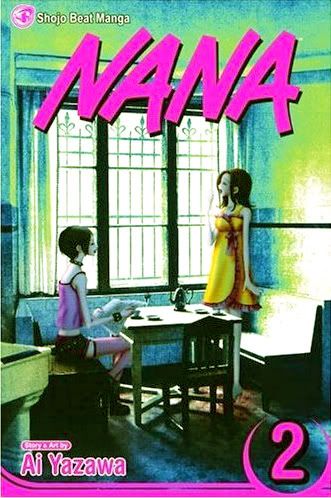
Nana 2: A Comic Review

Nana vol. 2
Publisher: Shojo Beat/Viz Media
Writer/Artist: Yazawa Ai
English Adaptation: Allison Wolfe
Translation: Goto Koji


What happens when two girls named Nana meet? Will physics allow them to occupy virtually the same physical space, or will the universe die screaming as anti-matter and matter collide, ripping reality apart? Actually, all potential problems are solved when punk Nana Osaki notices girly Nana Komatsu’s resemblance-- in personality only, please-- to a famous dog and renames her friend Hachi, thus reducing the Nana surplus by one and saving the universe as we know it.

The fun starts when Shoji, Nana K’s long distance boyfriend, sends her a special text message: “Cherry blossoms R blooming!” and tells her he finally got into art school. So she quits her video store job, runs through the snow in her monster lace-up platform boots, jumps the shinkansen for Tokyo for their long-awaited reunion. She’s saved her money, waited ever so patiently and now all her dreams are coming true…

If only Nana K can be patient for a few hours more. The trains’s delayed due to snow and there’s only one empty seat- empty but for a sinister looking black guitar case guarding the sleeping girl in the window seat next to it. This girl is nothing like Nana K; she’s all dressed up in black, looks like an erotic vulture in her leather jacket, thigh-high fishnets and clunky engineer boots.

Nana K’s decision to take the seat changes both of their lives. And her name.

You know, with the comic series emerging as one of Japan's top-selling titles of all time and the 2005 film adaptation spawning even more Nanamania, a sequel became inevitable:

Nana 2 debuted in 2006. Again, Nakashima Mika starred as Nana O, the fame hungry punk rocker. But Miyazaki Aoi didn't reprise her role as Hachi. Why? What do I look like, Japan Film Insider? Whatever the reason, Ichikawa Yui took over the role. The sequel wasn't as big a hit as the first, and the few people I talked to about it when I lived in Japan expressed their disappointment with both movies, and their preference for the animated series. Oh well, at least Nose Anna returned as Junko!

Anyway, back to the comic review.

And so Yazawa Ai finally brings our two Nanas together, on a snowbound train aimed at Tokyo. Through various circumstances and perhaps the machinations of Nana K's personal deity/devil the Demon Lord, the girls end up as roommates in a funky Tokyo suburb along what I’m guessing is the Sumida River. I base this on my own scientific Nana research, consisting of going to Tokyo and looking for a river. During one Golden Week excursion to Tokyo, I wanted to go to Kojima-cho to look for Jackson Hole and have a Jackson Burger (Hachi's favorite food), but a nasty cold and frequent chilly downpours caused me to limit myself merely to reading about it, and having Wendy's (since closed) in Shibuya instead.

Yazawa also begins weaving together the supporting casts. At first it seemed as though we were going to be treated to parallel narratives but Yazawa skillfully mixes the very different characters to create dramatic tension and humor.

Nana K’s impulsive nature comes to the fore as she falls head over heels in platonic love with her slightly sinister, definitely mysterious doppelganger. If fate and coincidence are to be recurring themes, then it certainly seems that Nana K’s intuition serves her well. Because the story cannot happen unless she appends herself to Nana O’s life, works her way into the center despite their differing backgrounds and outlooks. Failing that, both characters and all their friends would be out of work and they'd end up hanging around Junko's snack bar all day. And we would have nothing to read.

Nana K is a reckless romantic, while Nana O is coolly self-possessed. But how will her punk rock façade hold up when living with a girl who loves Trapnest, the very band her own lover abandoned her to join (to the point of adorning their shared pad with a massive fannish poster of the group)… with her love crazed, puppydog-like-in-her-clumsy-enthusiasm roomie? That’s the origin of the name Hachi.

Hachiko was a dog who waited at Shibuya Station every day for her college professor owner even after he died. A symbol of loyalty, she’s immortalized in a statue outside the station, and the exit to that area is named after her: the Hachiko Exit. People say if you stand there long enough, the one you’d most like to see will eventually walk by. You can speed up the process by simply text messaging that person and arranging a rendezvous beforehand. But given the mob usually lounging around the Hachiko statue, you should probably wave a flag.

Nana, meet Hachi, your very own loyal, loving pet girl friend.

I think we can all agree Nakashima Mika is perfect as Nana O. She's also a big-time singing star in her own right, and released an album called The End: Nana starring Mika Nakashima that features her songs from the second film. Her comics connection continues- last fall she had a hit song with the theme to the TV drama adaptation of the comic Life.

And despite falling victim to the law of diminishing returns, the movie certainly looks like the comic:

Volume 2 is where the story really gets going, where Yazawa sets up Hachi’s fascination with Nana’s shadowy past. It’s strongly character driven, with Hachi’s manic energy linking her with her namesake, entangling them both in each other’s lives. Things don’t so much happen as Hachi makes them happen, from wheedling her way into her dream apartment with Nana, to finding a job at a hip vintage clothing store, to spending all her money getting set up in Tokyo.

Beyond the addictive charms of the lead story, Yazawa gives us the fun and frivolous “Junko’s Place” backup story, where the Nana cast break the fourth wall while remaining totally in character. Their awareness not only of their existence as fictional comic book characters but also of the cast hierarchy is hilariously meta. As much as I love the narrative, as I accumulated volumes I found myself flipping back to "Junko’s Place" to catch up on Jun and her boyfriend and their little area of the Nana world. Each hint Junko’s restaurant might close due to lack of business only intensifies my obsession. What if Junko’s Place does close? What will she do? What will we do?

Nana is a drug. You should have to get a doctor’s okay before buying it. A prescription or something, and your health should be carefully vetted before they hand it out. On the other hand, some stressed out, over-worked mothers here are actually turning over all their parental responsibilities to the Nana comic series and allowing it to raise their children:

PS- Note how the covers actually tell a wordless little story of a day in the lives of the two Nanas. On the cover of volume 1, Nana O wakes first and reads the paper in their cozy little dining alcove, Hachi takes longer to get dressed but appears on volume 2, they have breakfast, go downstairs on volume 3, and on subsequent covers do some shopping, have lunch, ride the trains...

Pretty sneaky, Yazawa Ai!

Sunday, May 22, 2011

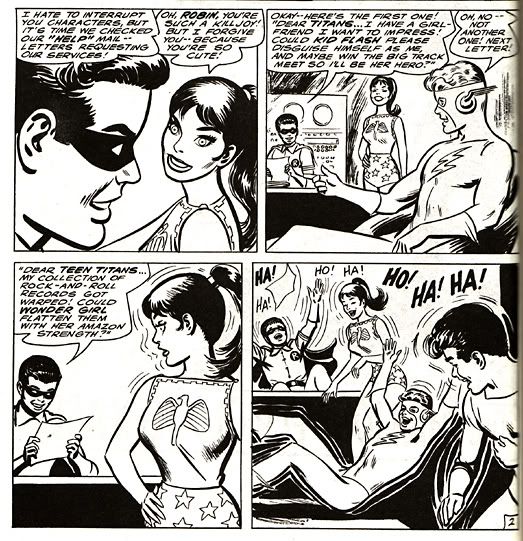
Don't bother asking the Teen Titans for help...


They're just going to laugh at you! Not pictured- the next scene where they read more requests for help and mean-spiritedly mock the writers, just totally picking them apart in the nasty way teens sometimes do. They reserve their cruelest remarks to the poor kids who foolishly enclosed photographs of themselves.

Even Wonder Girl! Oh man, you do not want to know what Wonder Girl said about you and that pimple you got right between your eyebrows like a big red pus-filled third eye! Oh sorry... that is what she said.

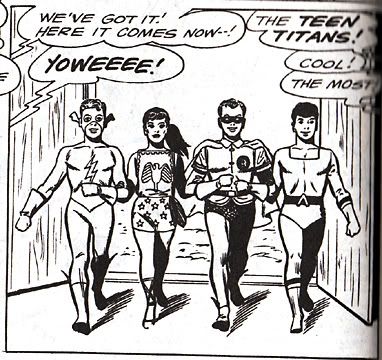
And even if they do deem your request a worthy one and show up at your teen clubhouse or malt shop or teen barn, you have to put up with this:


Yoweeee, indeed! Here come the Teen Titans, arm-in-arm. Possibly to laugh at you, maybe to solve your teen dilemmas.

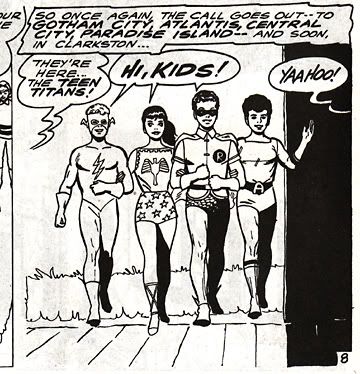
And again:


What the hell kind of teenagers walk around arm-in-arm like this? What kind of teens hang out in barns, for that matter? And look at Aqualad, waving sheepishly, wishing the boy-girl ratio of the team were more favorable to his public image.

Aqualad: C-can't we at least talk to Batgirl about joining?

Kid Flash, Wonder Girl, Robin: NO!

Aqualad: Then how about we knock out the ar-

Kid Flash, Wonder Girl, Robin: NO!

I feel I should also point out their growth spurt between the second-to-last panel and the last panel. That's why their adult mentors refuse to buy them expensive clothes and insist on shopping at discount department stores.

That's something the Mad Mod should exploit in a story. YOWEEEEE! What an idea! I'm inspired!