Monday, February 17, 2014

Uncanny X-Men #168 (April 1983): My first subscription comic!

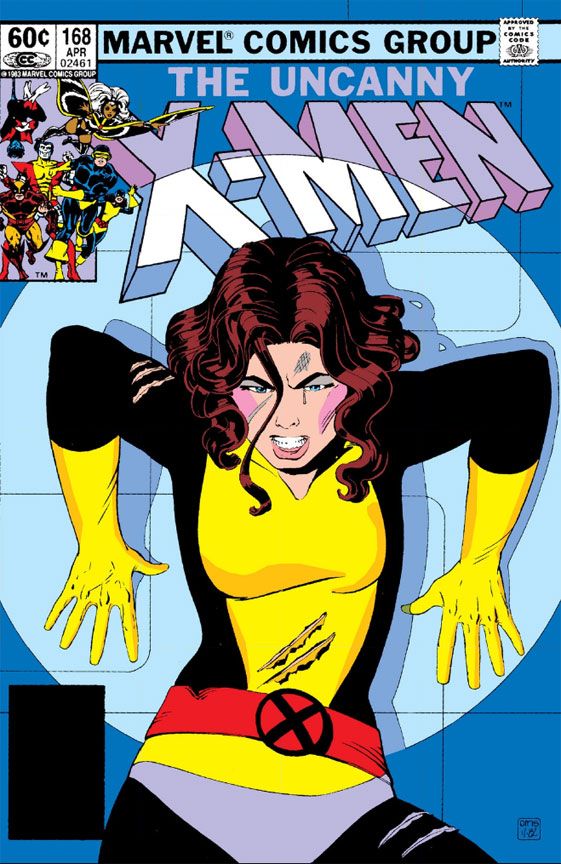
Did you ever love a comic so much you subscribed to it?  Sure, people have "pull lists" these days.  We had those back in the antediluvian days of comic book fandom, too.  I mean, my antediluvian days, which were the early 1980s.  I had a pull list at two different comic book shops, but both of them went out of business fast.  There were not enough people like me to support them in our small southern town.  So to primitive me, subscribing to a comic for a year and getting issues in the mail was the sign of true love.  Like offering a sweater or a ring to that special someone.  My special someone was Uncanny X-Men.  And Uncanny X-Men #168 (April 1983) was the first issue that came straight from Marvel to my mailbox.  What a day that was!  I was always the first person home, so my responsibilities included running out and checking the mail.  And there was a brown wrapper with a battle-damaged Kitty Pryde inside.

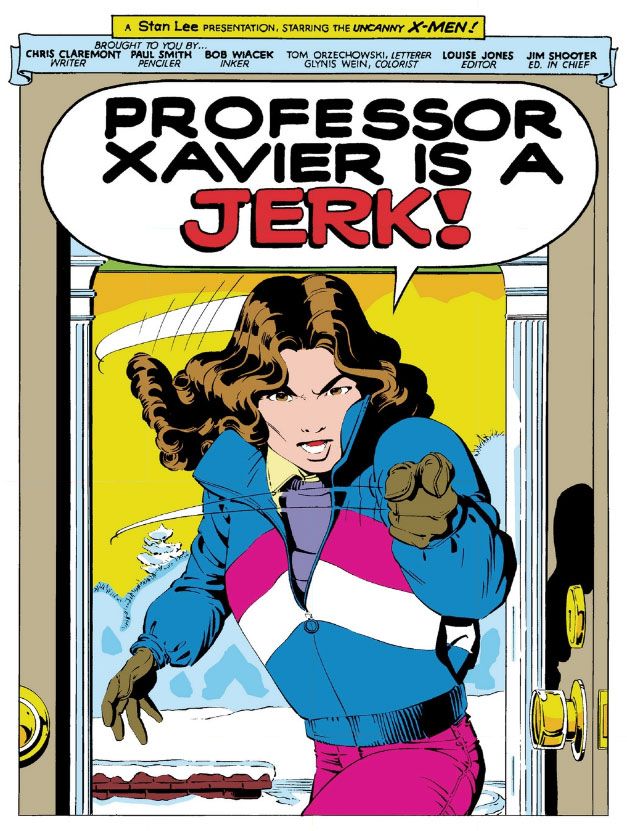
"PROFESSOR XAVIER IS A JERK!" Kitty exclaims in the splash panel, pointing accusingly back at the readers as if we don't believe her. 

I remember this as a shocking moment, a new, upstart character badmouthing an old school stalwart.  Apparently, others felt the same about it because Joss Whedon and John Cassaday would recreate it as a Kitty memory when she returns to the mansion during the first moments of their initial Astonishing X-Men story arc.  What had Xavier done to piss off Kitty?  He refused to let her be an X-Man because it was too dangerous.  To add insult to injury, he also forced her to join the New Mutants trainee team, which is like being demoted from the Majors to low A ball in the middle of the season.

Uncanny X-Men #168 (April 1983), Script: Chris Claremont, Pencils: Paul Smith, Inks: Bob Wiacek

Kitty does her best to prove Xavier wrong throughout the issue, but at first, her attitude is pretty much what you'd expect from a disappointed fourteen year old.  She flips.  Her calmer, cooler friend Illyana immediately calls her out for acting like the child Xavier already thinks she is.  And Illyana should be the one to show maturity.  She and Kitty are roughly the same age, but Illyana is also the demon queen of the Limbo dimension.  Being a demon queen gives one a more advanced perspective. 

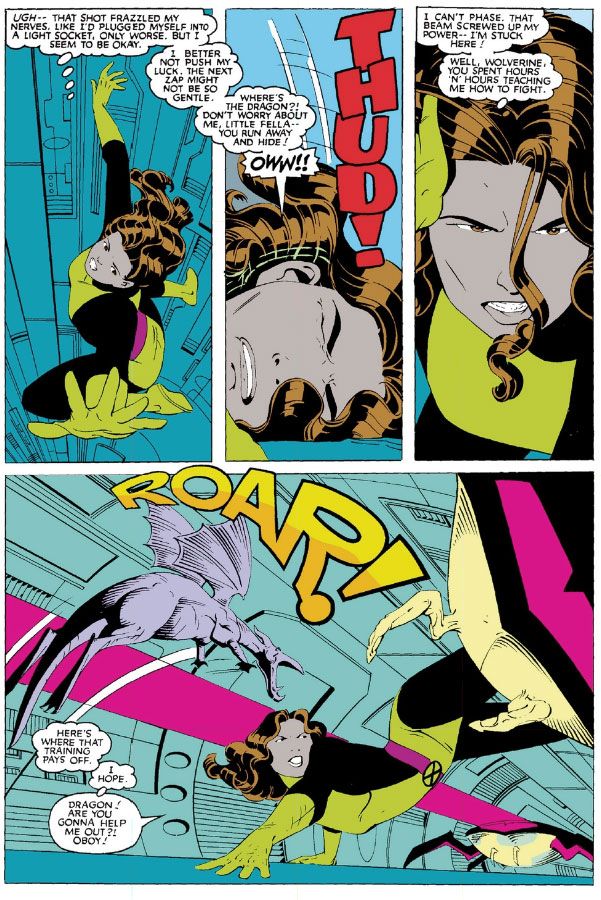
Ah, the art!  There is some excellent acting throughout this book and it's all just so clean, so slick, so easy on the eyes.  Paul Smith took over Uncanny X-Men after Dave Cockrum left the book for a second time to write and draw his own property, The Futurians. While I really dug his return, Smith immediately piqued my interest with his ultra-sleek linear style.  With Bob Wiacek finishes, practically everything in the book seems made of polished metal.  Okay, I'm exaggerating, but Kitty's hair certainly has a metallic look.  And good portions of the story take place in the X-Mansion's lower levels where the walls actually are polished metal.  The Smith-Wiacek team is my third art team on this book and the last to capture my imagination.  I copied their Kitty-hair and style of drawing noses for months, but the Smith-Wiacek Storm is the character at her most goddess-like.  Absolutely beautiful.  Then they gave her a Mohawk.

Dubious fashion choices aside, the father-daughter dynamic Chris Claremont works in this issue is a lot of fun.  Professor Xavier has the dad role, of course, and Kitty is the typical teen who wants to prove to her parents she's grown up enough to make her own choices about risk taking.  For most of Kitty's contemporaries, this would mean going un-chaperoned to a Duran Duran or Michael Jackson concert.  Everyone else is going!  Why can't I?  Since Illyana is apparently Kitty's only age-appropriate friend and the rest of the people she hangs out with rarely attend pop concerts but instead have superpowers and enjoy dressing in colorful leotards to launch into space and fight insectoids, that's what she wants to do.

After she realizes throwing a tantrum isn't going to help, Kitty calms down and puts her intellect to work on the problem.  She tries various strategies to change the Professor's mind, from whipping him at chess while explaining her considerable advantages to shouting to shameless brown-nosing.  The progression Claremont presents is just so believable.  Who hasn't tried each of these with parents?

Then, unlike those of us who never got to see the Go-Gos or the Replacements until we were out of the house and in college, Kitty gets lucky, because some space cockroaches who shoot magenta ray beams from their eyes have infiltrated the mansion's creepy-crawly basement.  This is all very reminiscent of the time Kitty faced off against a N'Garai demon by herself, but provides another, very convenient way for Kitty to present her case.  And out of all the things Kitty's tried, it's the most effective, because she gets to showcase a number of her intrinsic capabilities and all those extra things she's learned so far from people like Xavier, Cyclops, Storm and even Wolverine.  Yeah, as if Wolverine knows anything about fighting.

Claremont, Smith, Wiacek

And that brings us back to the cover, because fighting these bugs is how Kitty ended up in the bruised, ripped and still defiant pose I first saw after slipping the comic out of the wrapper.  Colossus turns up just in time to save our gutsy Kitty, but she's finally made her point.  Professor X puts her back on the team, with a probationary proviso which Kitty sensibly agrees to.  She also gets a pet dragon, which is like the ultimate wish fulfillment fantasy.  Imagine for a moment what it's like to be Kitty Pryde.  You're young, you're a genius, you're spunky and heroic, you've got hair so shiny people in shampoo commercials turn weepy with envy, you get your fondest wish... and you get to have the coolest pet ever.

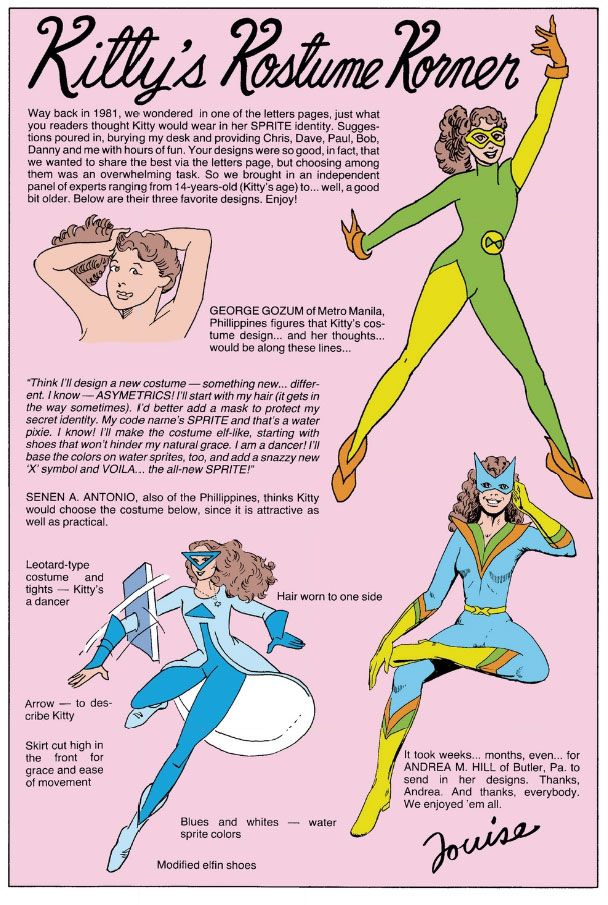
As an added bonus, you also get your own fan page:

Uncanny X-Men #168 (April 1983):  Alliteration sometimes leads to adverse accidental acronyms


Nobody did all that for me when I was 14!  Oh well, shoot, after all that, she deserves it.

Thursday, February 13, 2014

Happy Valentine's Day! Here are some of my favorite love pairs in comics...

1. Superman and Lois Lane.  No, not Superman and Wonder Woman.  Superman and Lois Lane are the couple of comic book record and trying to change that is stupid.  There is no greater comic book pairing than these two.  The demigod with the human heart and the kick ass intrepid reporter.

2. Big Barda and Mr. Miracle.  I love these two together.  Mr. Miracle is the gentle soul, Barda is the iron-willed warrior who seeks to protect him, an inversion of the expected gender roles.  However the thing I like most about these two is when they're written and drawn by Jack Kirby they have one of the most genuine loves depicted in comics.  It's warm and organic and they have a lot of chemistry.  There's is one of the few truly adult relationships depicted in superhero comics.

3. Terra and Changeling.  These two are a couple of freaks and their love is strange and wrong.  That's what makes it so fun to read about.

4. Cyclops and Phoenix.  Classic doomed pair.  Well, one of them was doomed.  Which means their love was doomed.  Who doesn't love reading about doomed love?  Even Dr. Doom loves doomed love.

5. Maggie and Hopey.  This is one that makes for some amazing reading.  I can't decide if I like them better together or apart.  Either way, good stuff.

6. Nexus and Sundra.  Another very adult relationship.  They've gone through a lot together and we've watched them grow and develop over many long years.

7. Reed Richards and Sue Storm Richards.  This is one of those relationships that-- at least in the early Stan Lee/Jack Kirby years-- is mostly what little boys think love and all that gooey junk is all about.  There's this stalwart, relatively emotionless guy who needs to get some work done and there's the flighty, childish, super-moody girl who always demands his attention.  Sue would put on a pouty scene and Reed would turn to his pal Ben Grimm and say something like, "Women.  Even with all my scientific knowledge, there's no understanding their mysteries!"  Ben would say, "They sure smell nice, though."  And Reed would conclude, "They do, old pal.  I suppose all we men can do is give up trying to figure out women and simply protect them and their silly little fantasies from the harsh realities of the multiverse."  Cut to a close-up of Sue getting a manicure or trying on a wig.

8. Buddy and Lisa.  The unfortunate pair from Hate, the perfect comic.  Buddy is kind of an asshole and Lisa is a complete mess.  Together, they're a disaster.  No wonder they got married and had a kid.

And with that, I give up!  Go read about your own favorites and leave me alone!

Wednesday, February 12, 2014

New Mutants #29-34: Xi'an Coy Manh returns from beyond(er)!

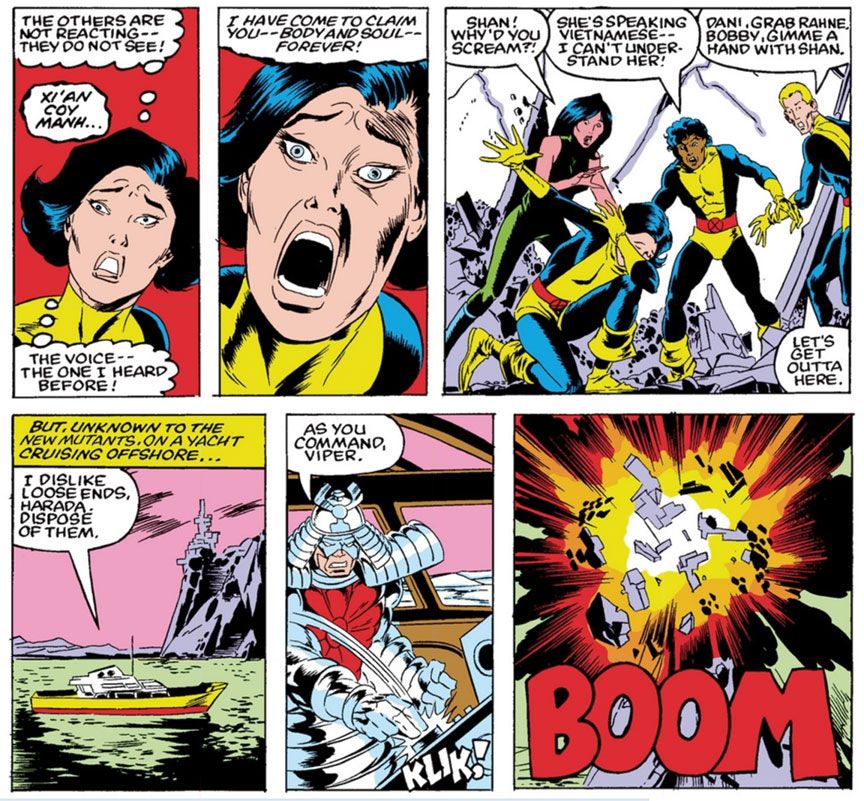
We all remember the tragic moment at the end of New Mutants #6 (August 1983) when Xi'an Coy Manh experienced a moment of terror and then everyone exploded and fell into the sea.  It reminds me of what happened to poor Josie Packard on Twin Peaks.  Sure, Josie wasn't as innocent or nice as she initially led us to believe, but she died similarly afraid, on an episode that aired almost eight years after "Road Warriors!" hit the newsstands and comic shops around the world.  Or else she turned into a wooden knob on a piece of furniture.  We can never be completely sure.  Xi'an's fate is equally strange and even involves what appears to be a Packard-like heel-turn or betrayal. 

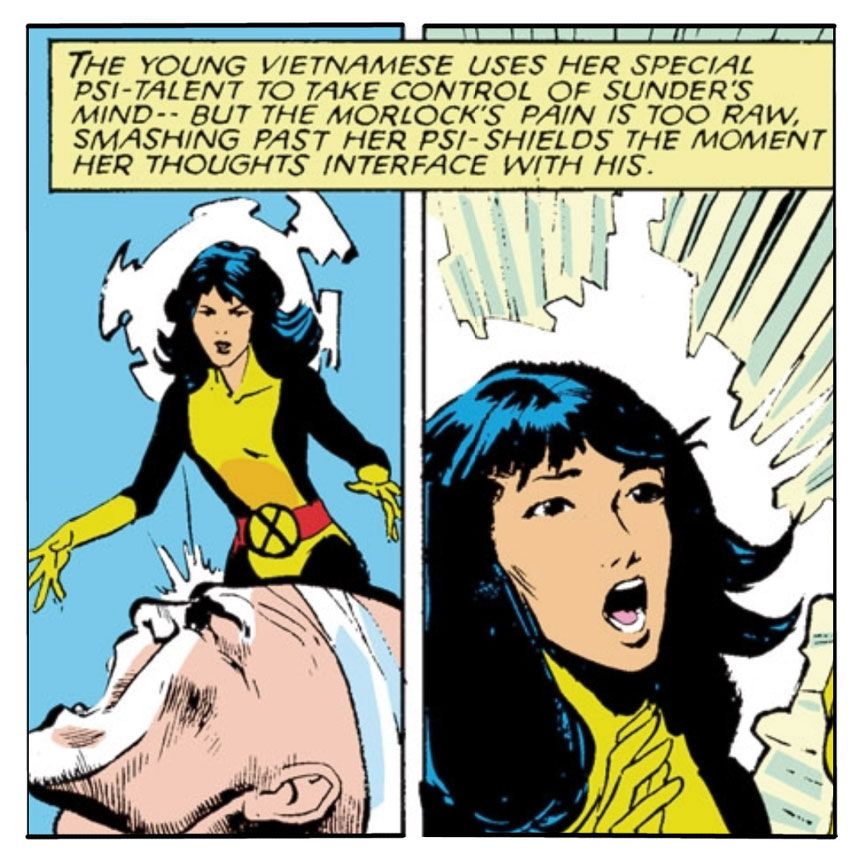
And at first exactly what happened to her is also every bit as mysterious as Josie Packard's final moments.  After the smoke clears and her friends sort themselves out, Xi'an is nowhere to be found, so everyone reasonably assumes she drowned when her friend and teammate Roberto DaCosta lost her in the undertow.  But what about that mysterious, last-moment voice in her mind?  Why was Xi'an screaming in Vietnamese and cowering, apparently at nothing, just before the explosion?

New Mutants #6 (August 1983), script: Chris Claremont, pencils: Sal Buscema, inks: Armando Gil

Writer Chris Claremont chose to leave these questions unanswered for a time.  The kids mourned Xi'an, then jetted south to the Amazon for new adventures and new teammates.  And so the New Mutants went on for several years with lead character Dani Moonstar becoming a comic book legend, easily the equal of Spider-Man, Batman, the Crypt-Keeper or Herbie Popnecker, and Xi'an shrinking to little more than a tragic footnote.  

All the way until 1985, that is.  July of that year brought to the increasingly Dani-centric Marvel universe New Mutants #29, which begins with Sam Guthrie and Illyana Rasputin, inappropriately dressed in swimsuits, blasting their way into the terminal of a snowed-in airport in pursuit of unseen thugs who have kidnapped teammates Roberto DaCosta and Amara Aquilla right out from under their noses.  You can imagine how upset they are.  Not only have they lost two friends, but, boy oh boy, is Dani ever going to be pissed at them.!

Illyana and Sam end up in Los Angeles thanks to an errant teleportation spell and have to ask Sam's lover, fabulous insterstellar rock star Lila Cheney, for help.  This brings Dazzler into the story, and she's just ever so coincidentally recently gotten herself out of a tangled mess involving the very same kidnappers.  The heroes track down the villains to an underground gladiatorial contest the likes of which makes Bloodsport look like cricket.  Even for a place as decadent as the story's take on LaLa-Land, I'm not sure I buy all this.  The logistics for putting on such a show and keeping it secret strain my suspension of disbelief, especially when the guy who hires the support team is a surly talking horse who doesn't seem to do anything to hide his unusual appearance.  Things like that tend to attract unwanted attention to your murder sprees.    Still, we're barely into the plot and Claremont may have one heck of an explanation waiting for us.

Unfortunately, New Mutants #30 (August 1985) is a mess.  In it, Roberto and Amara gloomily agree to do something against their morals because an evil hologram says they must or he'll injure some children.  The hologram certainly doesn't volunteer any proof and the kids neglect to demand any.  This seems questionable judgment on their part at best.  But even characters acting like dopes isn't as catastrophic to the narrative as would be, say, the creative team being forced to tie it all into a completely unrelated and god-awful massive crossover event.

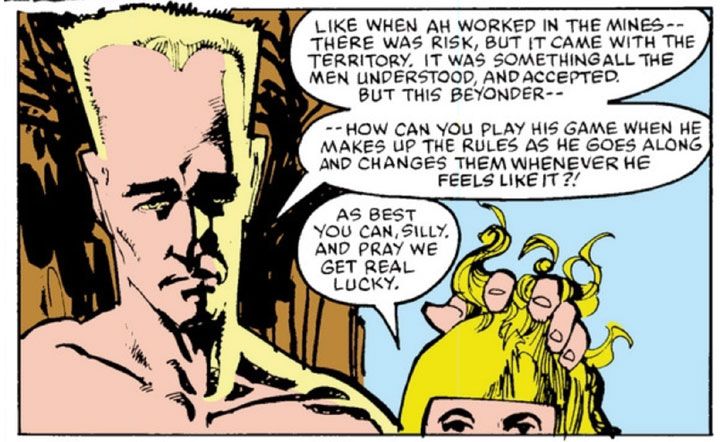
Which is exactly what happened.  As a result, the issue starts abruptly with the resolution of a moment from a comic called Secret Wars II #1 (I don't feel like looking up the date for this).  The splash page positively groans under the weight of expository narrative captions referencing events in other books we couldn't care less about.  There's suddenly an extra character in the mix who looks alarmingly and confusingly like series regular Rahne Sinclair.  And there are also totally static moments interrupting the ongoing action where characters discuss the theological implications of the Beyonder, who seems to be a real cosmic asshole.  You know, one of those Star Trek-style godlike beings who like to change reality on a whim for reasons that in hindsight turn out to a huge pile of shallow Introduction to Philosophy (PH 100 A1 at Boston University in case you're interested in signing up and learning more about the Beyonder) horseshit and who are completely unstoppable until stopped.

In some other book.  Which we'll never read.

Why do I get the feeling this is a dig at the boss?

These moments do nothing to advance either the New Mutants or the Secret Wars II story, but do allow us to think, "Yeah, that's exactly what good ol' Sam Guthrie would think about some poorly-planned and executed nonsense."

Most damagingly, after having devoted so many pages to boneheaded Secret Wars II miscellany, Claremont must then dispose of his own story matters with a few dialogue exchanges so brief you might even miss them after trying to fast forward out of the truly useless crossover parts.  Instead of showing us fun adventuresome stuff like Kitty's detective work (after she takes the trouble of infiltrating the hologram's business), the book just has her explain things on the run:  "Oh, before I forget, here's the scoop on the hologram and those hostage kids, guys..."  There's even a subplot about whether or not Dazzler can break her addiction to fame that gets shafted as well.  Damn you, daddy Beyonder dearest.

With Robin Williams (that's who artist Bill Sienkiewicz makes the Beyonder look like, Williams in one of his patented "holy fool" roles) finally out of the picture (mostly), and our story in grave danger of turning into a summary of Kitty's apparently mad intuitive leaps, we eventually find out it's not the evil hologram but instead a shadowy blob who runs the whole shebang, all the horse-headed weirdos and Frankenstein's monsters and evil holograms and Dazzler solves her problems in a diary entry and the show must go on. 

And with that realization comes a shocking revelation in New Mutants #31 (September 1985), which should have, Beyonder-less, happened as a cliffhanger ending to the previous issue--

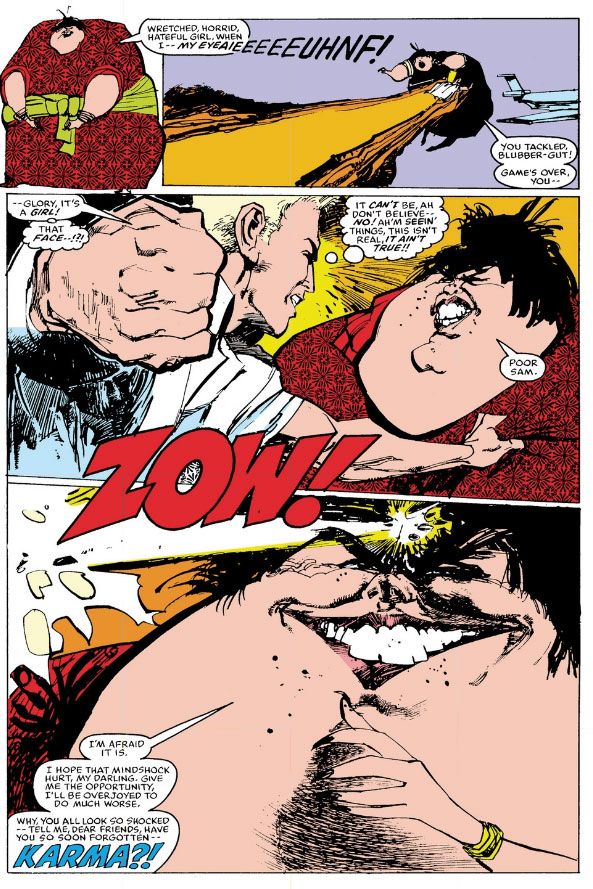
New Mutants #31 (September 1985), script: Claremont, art: Bill Sienkiewicz

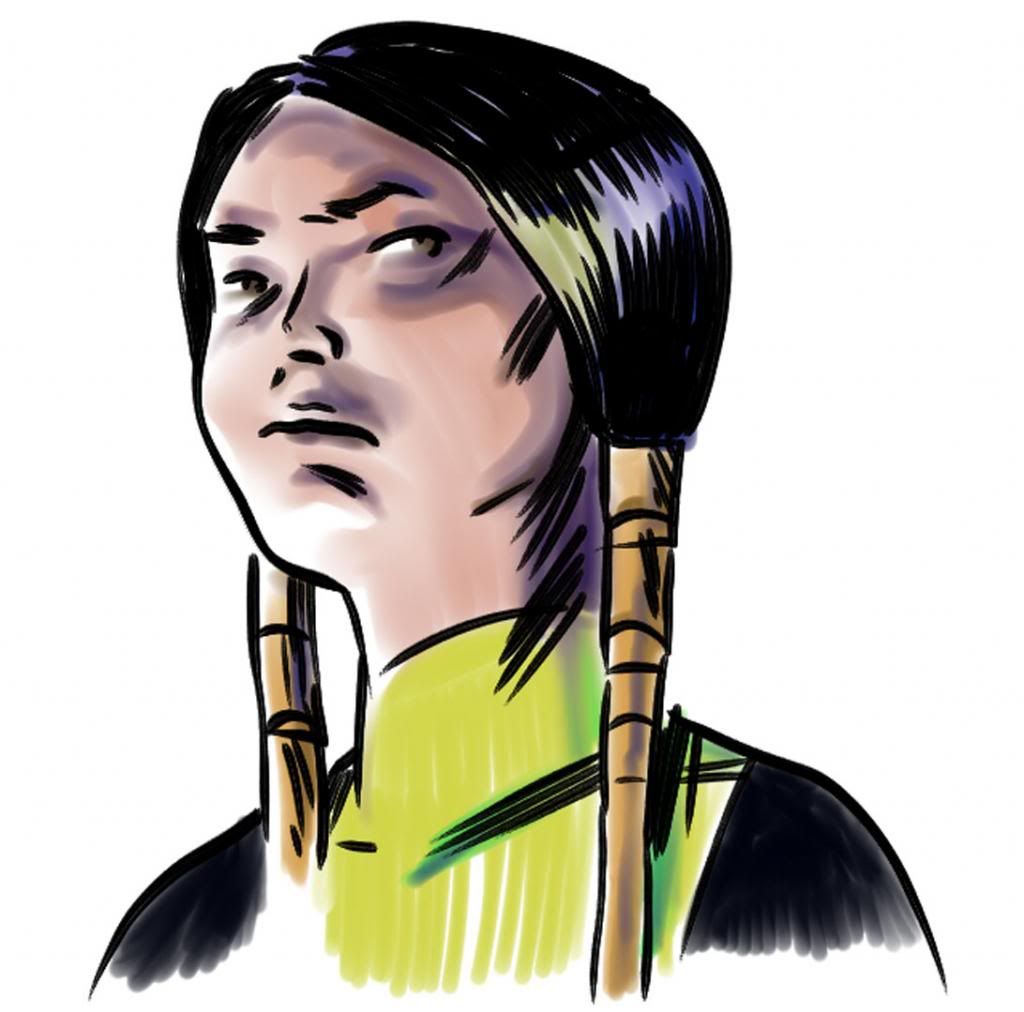
It's Xi'an Coy Manh!  Welcome back, Xi'an!  We're all glad to see you again.  But now you're huge.  And evil!  What the heck happened to you?  Somehow she's even ruined her formerly pristine teeth.  I don't remember Bob McLeod or Sal Buscema drawing Xi'an with gigantic rat-like gnashers like those.  I also don't remember her having a chin-cleft in a big Jay Leno-sized mandible, but there it is.

And because I'm a big fan of his, Sienkiewicz's interior art here doesn't really help.  His covers are incredibly compelling and creative-- I especially like the one with the marionettes.  But inside the two issues he draws, he's wildly inconsistent.  Even for someone with an real expressionist touch.  His "Neal Adams-inked-by-Ralph-Steadman" style reinvigorated the series at first, but in New Mutants #31, he pushes the experimentation and stylistic distortions to the point where they actively fight reader engagement.  Unless Sam Guthrie's head being shaped like a large slice of pizza appeals to you.  Much of the action takes place within featureless voids and even the crowd scenes seem under-populated, with a few circles here and there representing the screaming audience in the gladiator sequences.  Claremont lays on the dense prose to make things clear, but that's no happy joining of prose and visuals in the manner we learned to expect from this team when they had the kids fighting demon bears and evil drug dealers.

Ah, but are the New Mutants really up against Xi'an herself turned evil?   Illyana thinks so, no doubt inspired by everyone's stories of Xi'an's bad seed brother Tran Coy Manh and equally dastardly uncle General Nguyen Ngoc Coy (who makes a non sequitor cameo here that has to be explained in a later issue, yet another plot-casualty of Shooter... I mean... Secret Wars II).  The people who love Xi'an best are not convinced, so the next, vastly improved part of the story involves their investigation into how someone so right could have gone so wrong.

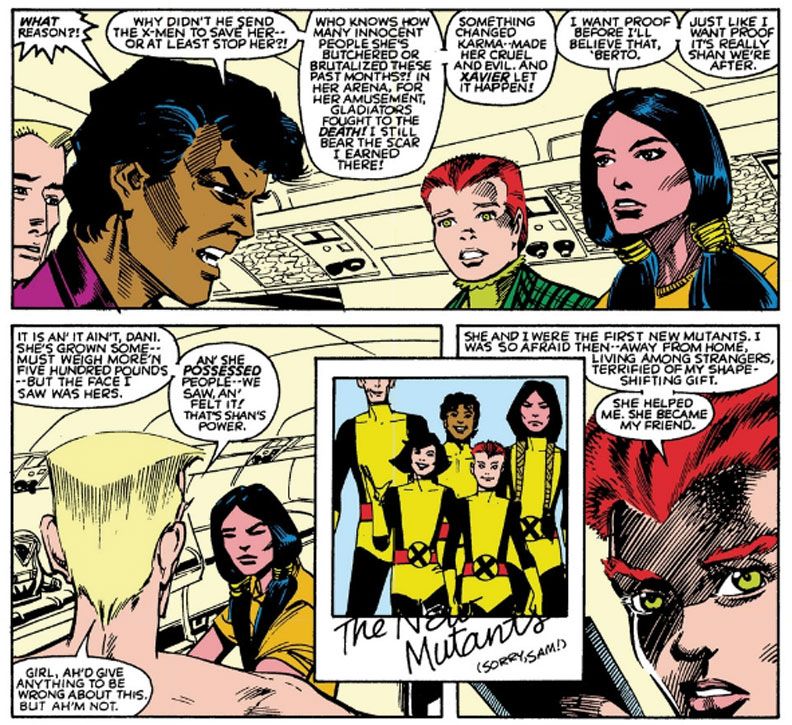
It starts in New Mutants #32 (October 1985) with a flashback covering the events of New Mutants #6.  In this telling, Claremont places the burden of a guilty conscience on Roberto, who ends up acting very much the hothead the rest of the way, even to the point of daring to disapprovingly compare Dani to Professor X.  Roberto's anger-- largely the outward manifestation of self-directed frustration and troubled conscience-- is set up by this very effective sequence, well-drawn by Leialoha, who inherits the book from Sienkiewicz to finish the arc.  Leiahola's self-inked linework at times pleasingly recalls the Swamp Thing team of Steve Bissette and John Totleben, but more angular and less organic.  Sometimes it conjures Sienkiewicz at his most controlled.  Sequentially, it's refreshingly clear and direct.  Just little things like formal perspective and being able to tell where the characters are in relation to each other and the world around them help a lot.  And also the kids looking more or less human throughout.

New Mutants #32 (October 1985), script: Claremont, art: Steve Leialoha

Led now by Dani, and receiving a huge intelligence boost as a result, the team jets (on a really amazing 747 complete with sleeping compartments!) across the world looking for Xi'an while Doug uses "various computer networks" to track Xi'an's path of global hedonism to Pharaoh, her giant Egyptian casino.  Doug's computer work strikes me as genius moment of prescience by Claremont, the kind of thing Secret Wars II prevented in the previous arc.  Nowadays, every second comic out there features a scene where some brainiac Googles a solution to everyone's problems. Well, Claremont has Doug doing his little version of this a decade before there was even a Google!

It turns out a really nasty guy named Amahl Farouk abducted Xi'an immediately after the big explosion everyone thought claimed her life.  And by "abducted," I mean he stole her body and imprisoned her inside it with himself in the driver's seat.  Besides being a psychic body-snatcher and all-around scumbag, Farouk is also a glutton, both for people's souls and for food. You know, the high life.  Once in possession of Xi'an's lithe body, he parties it up and starts a big time entertainment business-- while dominating all manner of humans and superhumans with is psychic powers.

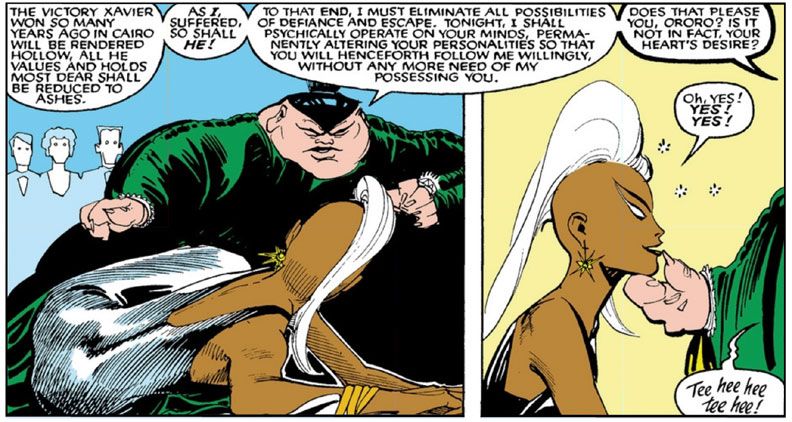
So starting with New Mutants #33 (November 1985), we get a great deal of that kinky corrupting-the-innocent and bondage-type stuff, with the New Mutants falling under Farouk's spell and in New Mutants #34 (December 1985) the antics even come to include an ostensibly experienced and strong-willed adult, the punkishly mohawked Storm.  We even get one of those patented "Will you become my groveling slave and gladly do things your ordinary self would find repulsive and degrading?" moments with Storm struggling at first-- literally crawling on her belly and forced to kiss Xi'an foot as a guy in the crowd begs to go next.  Then Xi'an demands more of Storm as the former demi-goddess resists-- before giving in and exclaiming in orgasmic ecstasy, "Oh, yes!  YES!  YES!"

Also in New Mutants #34, after seemingly betraying her friends, Illyana traipses to the past with Warlock, the team's comedic relief, a kind-hearted "techo-organic" creature from outer space who's sort of a mix between Star Trek: The Next Generation's Data and the earlier, funnier, more manic Robin Williams circa Mork and Mindy.

This by itself is a huge boost to the story because we actually get to watch Illyana in action, complete with an adventuresome cameo by li'l Ororo, the once-and-future Storm.  Cleverly concealing herself behind a wall, Illyana sees a young Charles Xavier going into a bar in Cairo and emerging with a big scorch-mark.   On the back of his safari jacket, for the scatalogically inclined out there.  Using her own arcane powers and Warlock's sensors, Illyana realizes Xavier's been in a psychic battle and walked away the winner.  And the loser was Farouk, hence this whole narrative.

New Mutants #34 (December 1985), script: Claremont, art: Leialoha

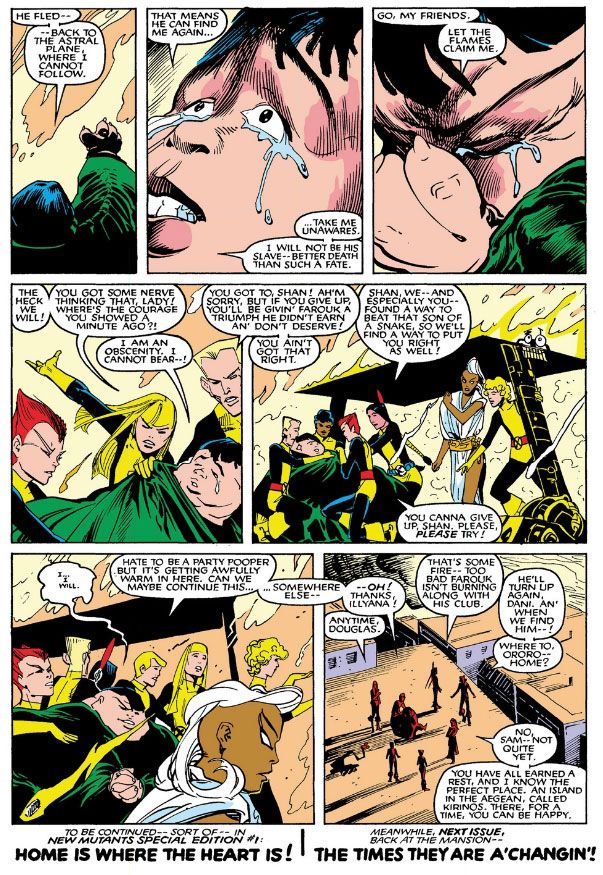
While mind control is a recurring X-Men/New Mutants theme, so is redemption.  We don't talk about this one as much because it's not so easy to poke fun at as all those bondage/humiliation scenarios.  But Banshee in the early issues of Uncanny X-Men, Jean Grey in the penultimate moment of her life, Sam himself, Illyana (endlessly), Magneto, Rogue.  Claremont is always giving his characters a second or third chance and changing their lives for the better, no matter how far they'd fallen.  Adding complexity and richness to their inner lives in the process.  At the climactic moment of New Mutants #34, Xi'an seeks her redemption by fighting Farouk on the astral plane.  Solo, which is fitting.  At first, she's helpless before him, but eventually her psychic-self breaks free of her bloated imago, and looks just like her old, athletic self, complete with bobbed haircut.  She mentally kicks Farouk's mental ass and returns to our reality free of corruption.  Her mind may be free, but the physical damage of Farouk's possession of her body remains.

New Mutants #34 (December 1985), script: Claremont, art: Leialoha

The little text blurbs at the bottom promise more action to come, this time all the way in Asgard itself, the mystical realm of the Norse gods and homeland of the mighty Thor himself.  There Xi'an goes through a long desert ordeal where she sheds the excess pounds and just a year later, when Jackson Guice and Kyle Baker come aboard to provide guest art in New Mutants #46 (December 1986), she's right back with the team and looks like this:

New Mutants #46 (December 1986), script: Claremont, pencils: Jackson Guice, inks: Kyle Baker

Even her teeth and chinbone have shrunk back to the way they once were.

And  that's the story of how Xi'an Coy Manh climbed waaay up to the forty-fourth floor of the Hudsucker Building, and then fell all the way down but didn't quite squish herself. You know, they say there was a mutant who jumped from the forty-fifth floor?

But that's another story.

Tuesday, February 4, 2014

Monday, February 3, 2014

Hell's Angel: The Strange and Terrible Saga of the Outlaw New Mutants and the Time They Adopted Bird Brain

From the vantage point of our current mass media, where its characters permeate the zeitgeist, it may seem ridiculous, even the stuff of lunacy, but there came a time in the late 1980s when America's comics-hungry masses turned away from New Mutants.  As interest in the comic fell and sales flagged and talking heads hit the airwaves to postulate almost hysterically on the reasons-- anxiety over the ending of the Reagan era? Pre-millennial jitters?-- series star Dani Moonstar phoned the home office and demanded someone at Marvel do something. The Marvel solution as scripted by Louise Simonson was to honor that most wonderful and time-tested of sitcom traditions with the addition of a cute tagalong to the familiar cast.

In the human world, this new character would most likely be a baby or even Ted McGinley (already having done sterling work on Happy Days, The Love Boat and at the time coming off a stint revitalizing Dynasty as Clay Fallmont on his way to achieving legendary status as Jefferson D'Arcy on Married With Children).  Or a bespectacled blond-headed moon-faced boy susceptible to both pies in the face and Bobby Brady's ridiculous detective schemes.  In the world of teen mutant super-beings, the ideal Cousin Oliver proved to be a hideous feathered freak, the very antithesis of the almost supernaturally handsome McGinley.

And while The Brady Bunch failed to escape the event horizon of its particular ratings black hole, adding Bird Brain to the cast gave New Mutants enough of a lift to carry on for a few more years.  Bird Brain, the lovable weirdo.  Bird Brain, who made Gonzo the Great look like Cary Grant and the Chicken Lady from Kids in the Hall resemble his To Catch a Thief co-star Grace Kelly.  Bird Brain, who ate fish and probably smelled something awful. 

New Mutants #55 (September 1987), script: Louise Simonson, pencils: Bret Blevins, inks: Terry Austin

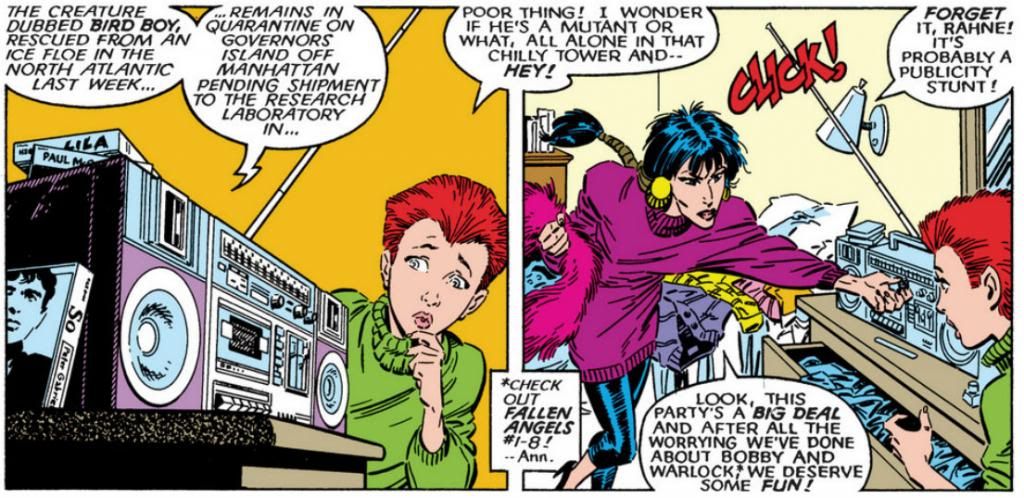
Online sources list New Mutants #55 (September 1987) as Bird Brain’s first appearance, and that's technically correct, although it's a mere cameo.  We do feel his presence throughout, starting early in the issue when the kids learn about Bird Brain from a radio news story.  Remember radio?  Artist Bret Blevins reminds of what this obsolete technology looks like with a highly detailed rendering that will no doubt become useful for future historians and archeologists as they try to recreate our late 20th century society. 

To you, highly advanced people of the future:  Yes, we primitives once used these devices to listen to music and learn about the world around us. 

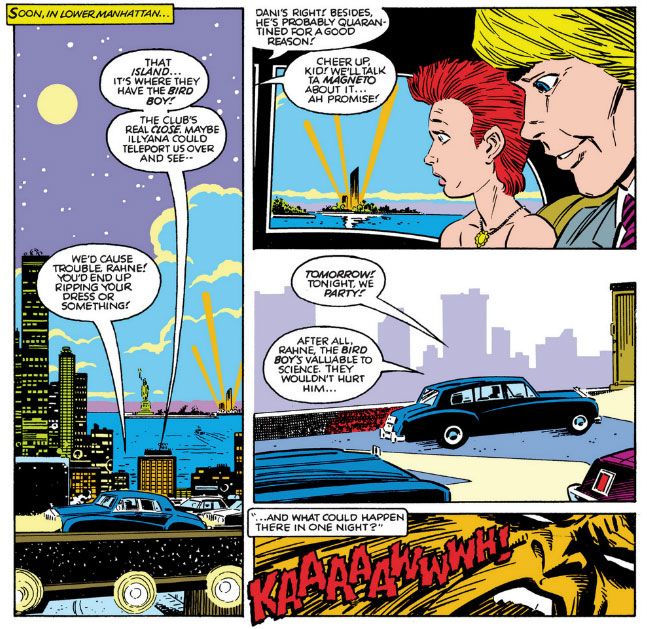
Later, Rahne urges her friends to do something about Bird Brain's plight, and Bird Brain himself appears in an insert panel soon afterwards.  All we see is his beaked face.  Most of the story involves Sam Guthrie taking drugs at a party to impress his sometimes lover Lila Cheney, a space-thief who spends her down time rocking earth as a kind of Patti Smith/Pat Benatar/Joan Jett stand-in. 

For the record, I would fully support a Lila Cheney solo series.

New Mutants #55 (September 1987), script: Simonson, pencils: Blevins, inks: Austin

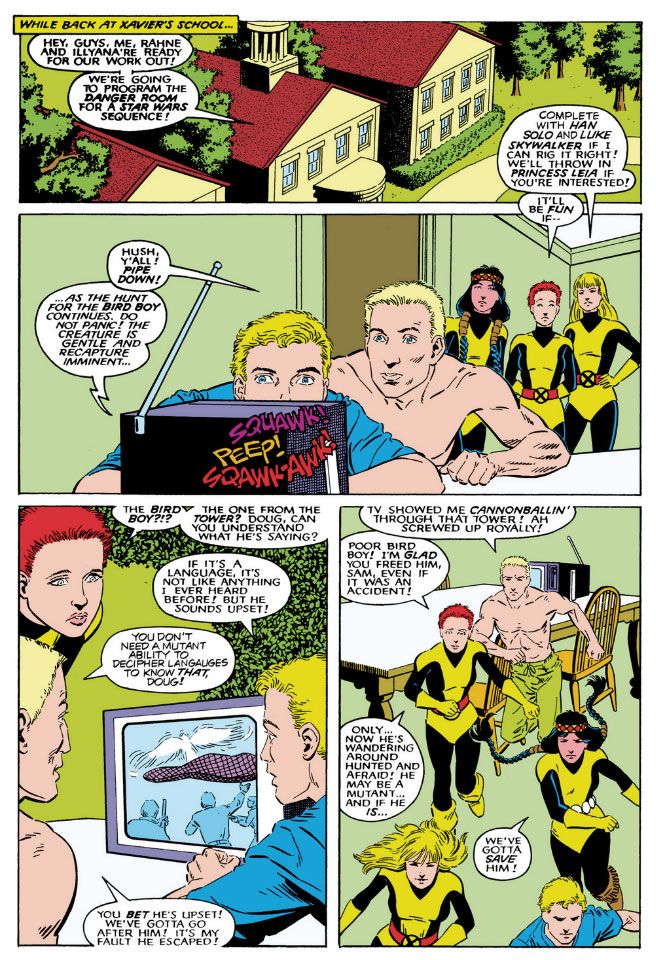
Anyway, Bird Brain.  New Mutants #56 (October1987) is the first comic truly to be all about his birdness and his brain.  We learn Sam has somehow inadvertently freed Bird Brain from his imprisonment in a research lab—it must have happened while he was groggily flying around trying to avoid some aliens who have it in for Lila.  For unknown reasons, we don’t actually see this happen in the story.  Just take Dani's word for it.  Or Sam’s.  Or Rahne’s.  Whether or not he's truly responsible, Sam feels so and goes to find the fugitive freak while Dani involves the entire team.  She even makes them wear their hideous “graduation uniforms,” for disguise purposes.  See, if they wore their New Mutant garb, everyone would know them, but a group of teens with identical powers and similar appearance in different clothes constitute a mystery even Reed Richards couldn’t solve.  And that guy is a genius, but obviously not as much so as Dani Moonstar. 

New Mutants #56 (October 1987), script: Simonson, pencils: June Brigman, inks: Austin
 
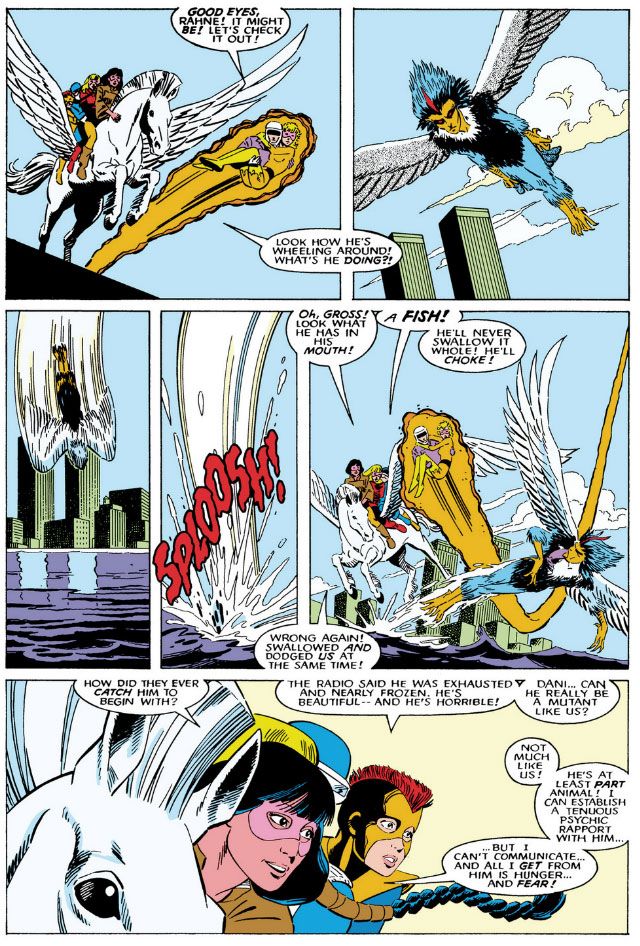
Let me just take a moment to express how much I wish June Brigman had penciled more New Mutants.  She did this issue and annual #4 (September 1988), but Marvel should have given her the monthly assignment.  She’s gold on this team, especially with Simonson's scripting.  Regular artist Blevins has an edgy, sketchy style with a lot of energy, but he makes Dani look about fifty years older than her supposed age (and kind of mean!), which is an unforgiveable lapse (although his Rahne Sinclair is cute as a button).  So while I admire Blevins' cartoony body language, with bent knock-kneed poses and dramatic gestures, I prefer Brigman's cleaner visuals and more controlled rendering.  Brigman, with the able assistance of inker Terry Austin, provides a sleek look that's a cool alternative to Blevins' more jittery work.  Her storytelling is fine, but it's the way she draws figures with lifelike proportions and impeccable facial “acting”  that grounds the book in some much-needed reality.  This gives outré characters like Bird Brain a bit more believability.  And this is without relying on the crutch of photorealism.

New Mutants #56 (October 1987), script: Simonson, pencils: Brigman, inks: Austin

Also, Louise Simonson has a way with naturalistic teen-speak that I find superior to Chris Claremont's more stilted dialogue.  Claremont crafted some dark classics during his run on the characters, particularly the "Demon Bear Saga," which received its own trade paperback collection (something that can't be said for the "Bird Brain Saga"), but Simonson's teens "sound" more like actual teens.  Especially when combined with Brigman's art, where they look like actual teens as well. 

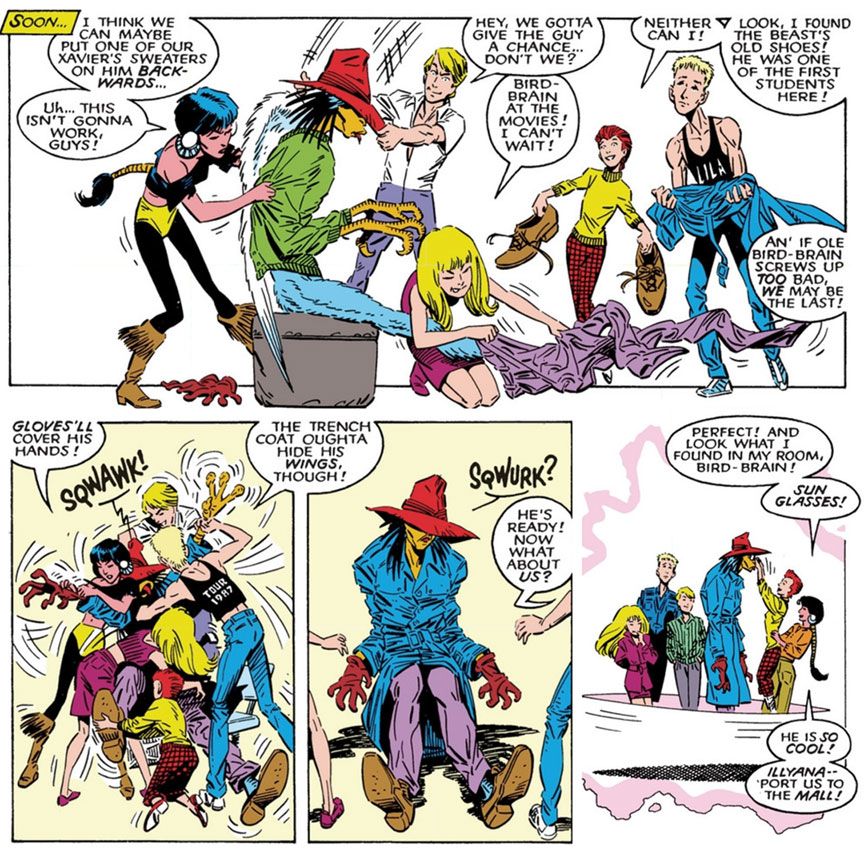
Also, Simonson's Bird Brain certainly is a bird brain!  It doesn't take Dani and the rest long to teach him the importance of dressing well.

New Mutants #57 (November 1987), script: Simonson, pencils: Blevins, inks: Austin

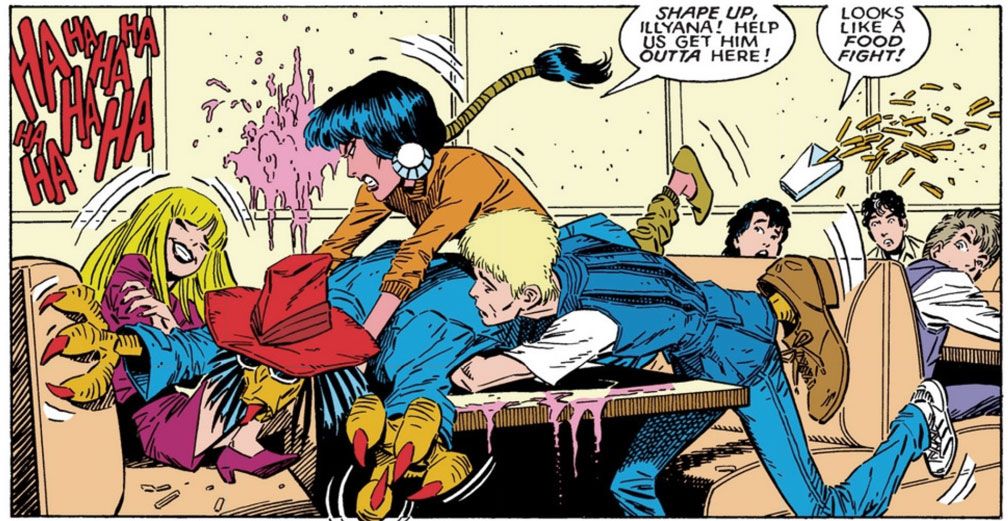
And the deliciousness of fast food.

New Mutants #57 (November 1987), script: Simonson, pencils: Blevins, inks: Austin

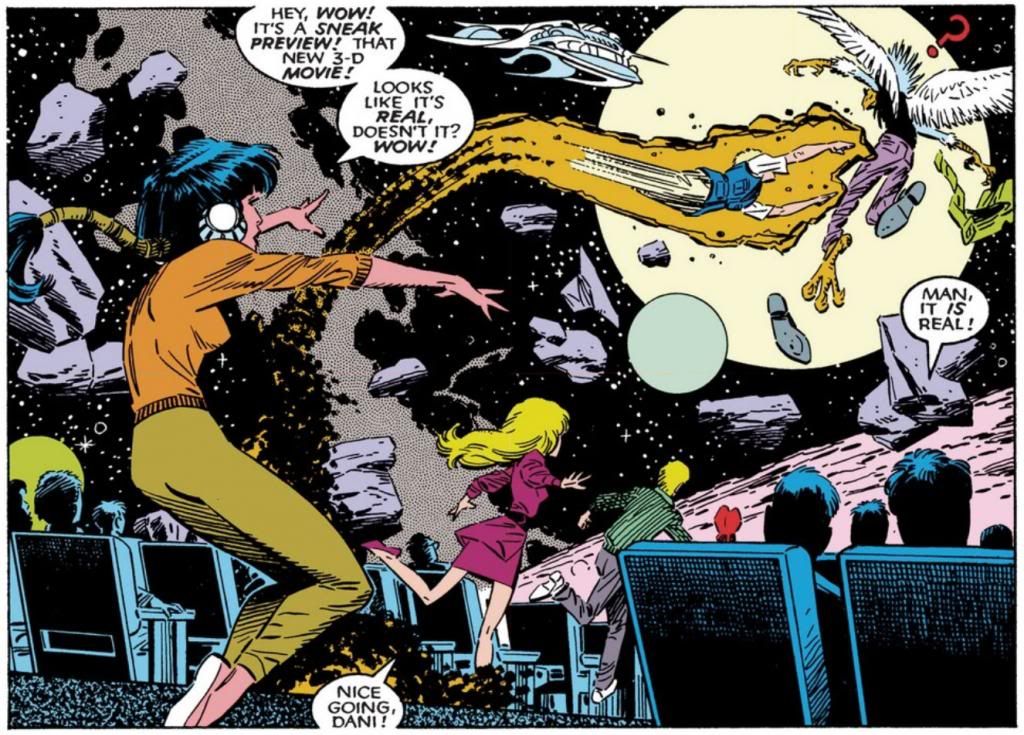
And the wonders of modern cinema.
 
New Mutants #57 (November 1987), script: Simonson, pencils: Blevins, inks: Austin

At this point, I will excuse you for asking,  "Just what in the name of Bill Sienkiewicz is going on here?"  In fact, ask me that.  Right now.

I don't know!  As a minor character Bird Brain would have been slightly annoying, but Simonson spotlights him over Dani Moonstar and other, more pressing plotlines like Sam's romance with Lila, Magneto's taking over the team and Amara's love-hate for one of the Hellions and her resulting arguments with Dani.  The kids' clumsy attempts at assimilating so alien a creature into teen society are amusing, but this is also a comic co-starring a girl who's literally from Hell and characters just one mistake away from death.  And the "Bird Brain Saga" isn't just a one or two issue romp.  It lasts approximately seven issues and for most of those seems little more than slapstick sit-com fodder, a bizarre digression for the series as a whole.

Okay, actually, I do know.  Because just when you've had about all the Bird Brain you can stand, Simonson ups the dramatic stakes by adroitly shifting tonally from comedy to sci-fi horror and the plot into a Moonstar-starring H.G. Wells' The Island of Dr. Moreau.  This happens in New Mutants #58 (December 1987) when the kids journey to a mysterious island to finally learn the true origin of Bird Brain.  After all, Bird Brain had to come from somewhere, so why not an island of animal-human hybrids presided over by a mad scientist with a skull for a hat?  By #59 (January 1988), the New Mutants are themselves captives and their humanity at risk.  

From there, the jeopardy growing from this development leavens the oddball comedy of the preceding issues.  The Moreau-style plotline is also particularly apt when dealing with characters on the cutting edge of human evolution.  Wells' themes--- including cruelty to animals (in Moreau, it's vivisection, in this story it's updated for the 80s to a more generalized laboratory research and then genetic splicing), which the Bird Brain story addresses obliquely from the beginning-- jibe quite well with Simonson's take on the team as concerned young people trying to make the world a better place.  By providing a classic literary explanation for this bizarre Bird Brain character, she finishes strongly, with a tragedy with lasting ramifications for the team in #60 (February 1988). 

Which I won't share with you because you owe it to yourself to read the entire Bird Brain saga in all its strangeness.   It's not exactly a "Demon Bear Saga," but on the other hand, it does feature Bird Brain.

Friday, January 24, 2014

Kirby's Kustoms! A selection of Jack Kirby's creative conveyances...

Jack Kirby created so many wonderful characters in his long career, but he also came up with all sorts of wild contraptions to get those characters to and from their adventures.  Your typical Kirby vehicle is somewhat outlandish, certainly futuristic, but also surprisingly plausible at a glance, as if he generated detailed plans before inserting them into his stories.  You're likely to find jet fans, air intakes and plexiglass cockpits along with all kinds of valves and pipes.  A Kirby vehicle is as instantly recognizable as one of his muscular, almost steel-like heroes.

Let's start with a one of his first from the fabled Fantastic Four comic.  Whatever happened to that?  Are they still publishing it?  Anyway, here we go--

Fantastic Four #3 (March 1962), inks by Dick Ayers

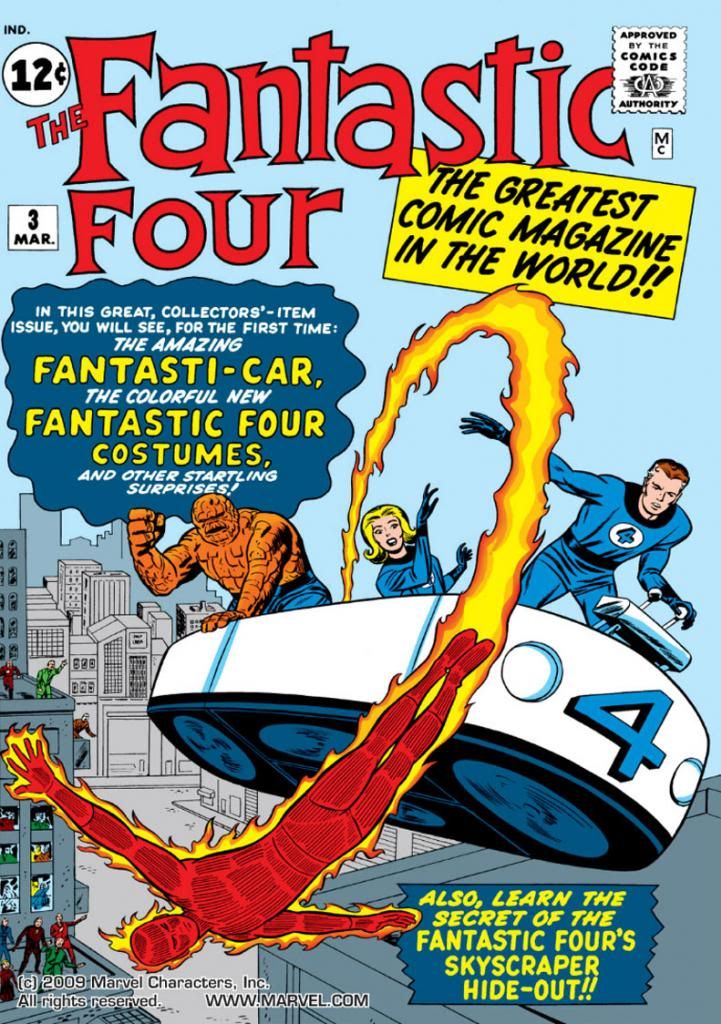
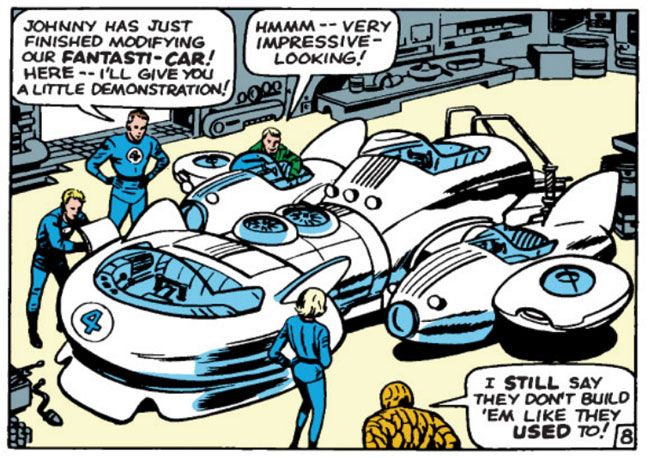
The Fantasti-Car!  The Fantasti-Car debuts in Fantastic Four #3 (March 1962), which also saw the adventuresome quartet donning their blue costumes for the first time.  Like those plain but functional-appearing duds, the Fantasti-Car is a simple design, just a tub with headlights for safety and what appear to be four fans underneath for generating lift.  I'm not sure how Reed Richards controls pitch and yaw or generates forward thrust in this version of the Fantasti-Car, but I'm sure Kirby could have explained it if I'd been around in 1962 to ask him.  Unfortunately, this isn't the most visually impressive design, and I'm guessing Kirby must have been a little dissatisfied with it, because about a year later, the Fantastic Four upgrade to a hotter version.

Fantastic Four #12 (March 1963), words by Stan Lee, inks by Dick Ayers

Yeah!  That's more like it!  The Fantasti-Car, Mark II made its debut in Fantastic Four #12 (March 1963).  This one has aerodynamic styling and possibly a much greater range.  Ignore Ben Grimm's little griping remark.  Some people just aren't pleased with anything.  The Fantastic Four use this Fantasti-Car to travel cross-country and take on the Hulk.  But what about ocean-hopping, when the team needs to cross hemispheres, date lines and other such geographic demarcations?

That's where this baby comes in--

Fantastic Four #21 (December 1963),  words by Lee, inks by George Roussos

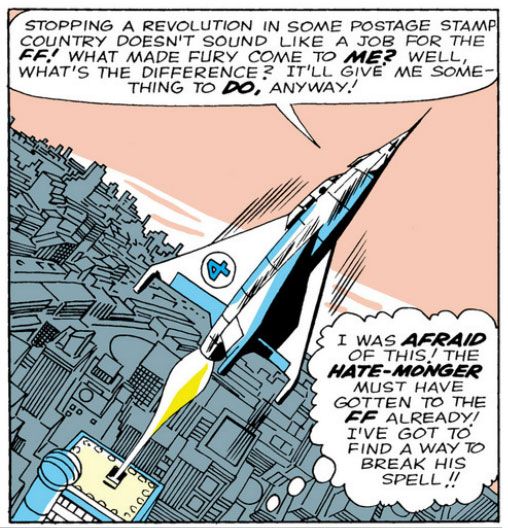
The Pogo Plane.  The Pogo Plane previously appeared in issue #3, but it really gets to strut its strato-stuff here as the FF prepare to face the Hate-Monger in Fantastic Four #21 (December 1963).  Kirby gives this aircraft a state-of-the-art appearance (at least for the 1960s), like something the USAF or NASA might have been toying around with in the early days of space exploration.  The X-51 or  the Lifting Body.  Man In Space Soonest.  The Flying Flapjack.  The Apollo Applications Program.  Somebody stop me or I'll go on forever.  I love aviation history!

This could be a wild, right-off-the-drawing-board design lifted from a Popular Mechanics article of the time.  It's got huge stabilizing fins and even flaps.  Plus it's a tail-landing VTOL aircraft.  That's "vertical take-off and landing," to you and me, Russ.  I'm no aeronautical engineer, but Reed Richards has that skill set among his many, and you can imagine he saw this one through from the initial design phase to wind-tunnel testing with a scale model to prototype production to flight test with none other than Ben Grimm at the controls.

Now that we're on the topic of his piloting skills, here's a little Ben Grimm-related aside-- Ben generally plays the fool with his gruff street-style patois, but he's actually vastly intelligent himself, the kind of guy who would have made the Mercury Seven if he'd actually existed.  Ben was a highly-regarded test pilot with a fighter background before he became a superheroic freak, which means he's got quite the expertise in engineering.  Tom Wolfe in his book The Right Stuff describes how Ben's closest real-world analog Chuck Yeager (no mean engineer himself) influenced not only aviation history but also how pilots of the era spoke-- I don't know if it's true or not, but Wolfe makes a hilarious and compelling case for airline pilots of the time doing their cockpit announcements in pseudo-West Virginia drawls in imitation of the man at flying's apex.  I can imagine in the Marvel world the same thing happening, only with pilots shouting, "It's clobberin' time!" when pushing the outside of that o' envelope, or making reference to their Aunt Petunias in put-on Brooklyn accents. 

If not for that fateful rocket flight...

Coming up next is a stripped-down sport model--

Fantastic Four #45 (December 1965),  words by Lee, inks by Joe Sinnott

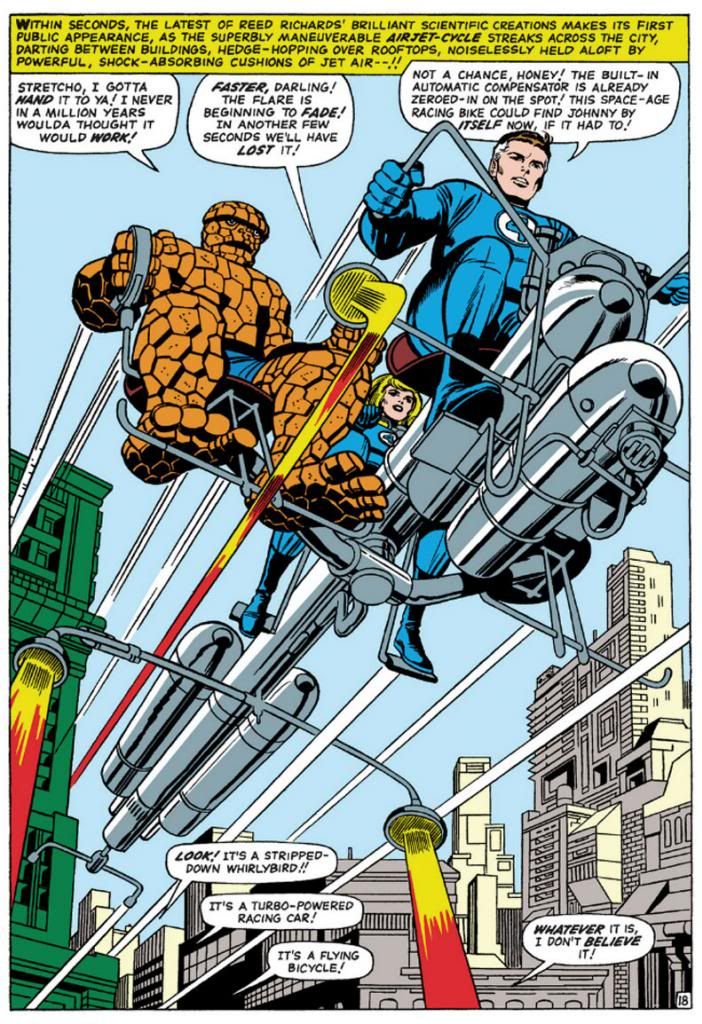
The Airjet-Cycle.  This one has neat nozzles and tanks, but it's mostly just pipes and doesn't really look capable of lifting Reed alone, much less Ben and Sue as well.  Not the most practical of earthly designs, although it looks like something NASA might have considered for lunar mobility.  Leaves the passengers kind of exposed and vulnerable, too-- I love the look of sheer embarrassment on the Thing's ever-lovin', blue-eyed face as he holds on for his very life.   The Airjet-Cycle probably comes in handy for jetting to the supermarket, or getting little Franklin to school when he misses the bus.  Not as spectacular as either the Fantasti-Car or the Pogo Plane, the Airjet-Cycle nevertheless makes further appearances in Fantastic Four #46 (January 1966), #48 (March 1966) and #57 (December 1966), to name three.  The Avengers also use a version.  You can look it up.  I did!

And now--

Fantastic Four #50 (May 1966), words by Lee, inks by Sinnott

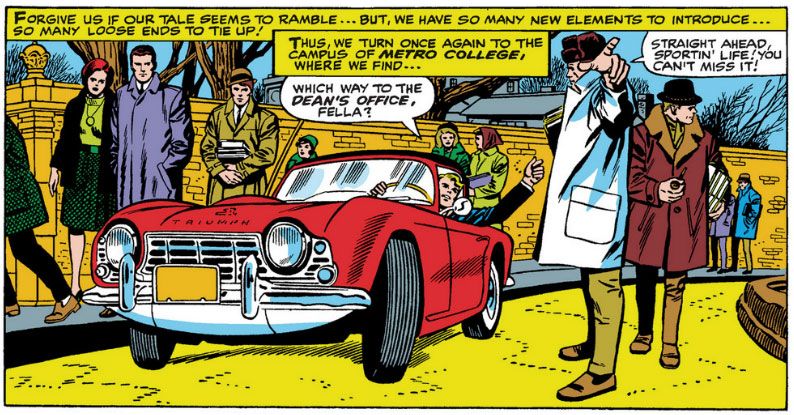
Oops!  A ringer!  Don't ever think Jack Kirby couldn't bring things down to earth (relatively speaking-- Johnny's got one unearthly ride there) and draw realistic cars.  This one reminds me of the classic 1967 film The Graduate, directed by Mike Nichols.  Dustin Hoffman actually drives a 1966 Alfa Romeo Spider 1600 "Duetto" in that movie, but Johnny Storm here has a 1966 Triumph GT6.  Yeah, a Spitfire might have been more appropriate for the Human Torch, but Triumph introduced the GT6 the year Marvel published Fantastic Four #50 (May 1966), so leave it to Johnny to pick up the latest thing in sports cars.  Maybe he's auditioning for a part in The Undergraduate.

Let's leave behind the fast and the furious for the slow and reliable--

Kamandi #1 (November 1972), words by Jack Kirby, inks by Mike Royer

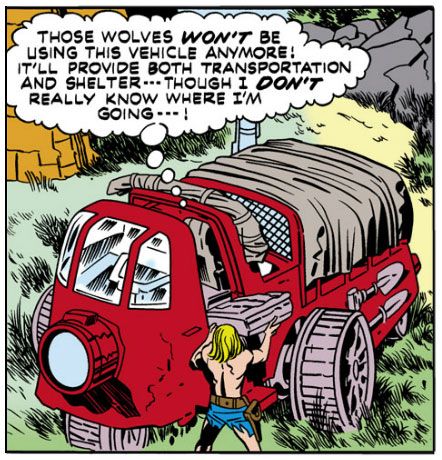
We're also ditching one comic company for another.  Just as Kirby and family left New York for California and Marvel for DC, in the first issue of his eponymous book (November 1972), Kamandi leaves his bunker home in this utilitarian military contraption with a very interesting outboard wheel arrangement.  They're heavy duty wheels, too.  Probably made of some kind of metal or composite alloy for years of wear.  Shovels clamped to the side, weatherproof tarp over the back.  This is a very appropriate get-about for Kamandi, and just the kind of thing you'd expect to find at a former military outpost.

Even after the Great Disaster, off-roading offers thrills and spectacle.  Witness--

Kamandi #6 (June 1973), words by Kirby, inks by Royer

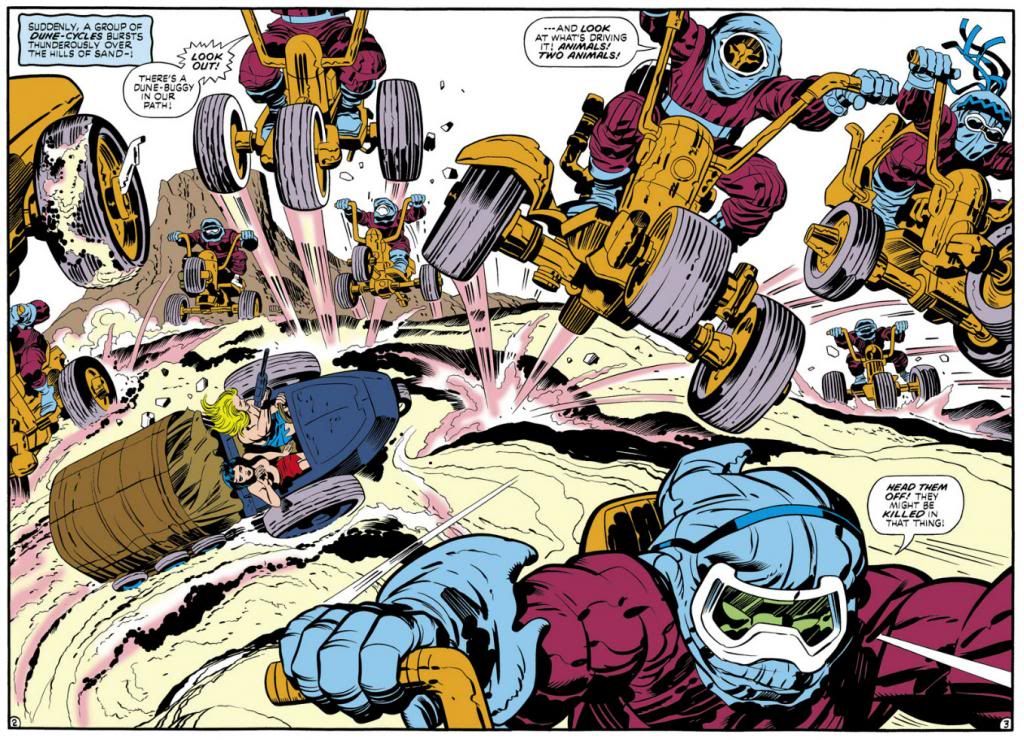
As you can see, Kirby anticipated the ATV craze.  For a while there in south Georgia, you couldn't take a drive without a three- or four-wheeler loaded with people in camouflage barreling out in front of your car from a side road or a trailer park entrance.  In fact, you still can't.  They're a menace, I tell you, and in this panel from Kamandi #6 (June 1973), you can see why.  Kamandi and his tragic girlfriend Flower have found yet another hard-working cargo carrier to explore the world, but suddenly they're capsized by a gang of three-wheeling lions!  They're huge, too.  Look how they dwarf Kamandi and Flower in their little cart.  These hot-doggin' felines think they own the dunes.  They're wrong.

Because there's one vehicle that's gonna shut 'em down, just like that little Cobra from a long ago Rip Chords song--

Jimmy Olsen #133 (October 1970), words by Kirby, inks by Vince Colletta

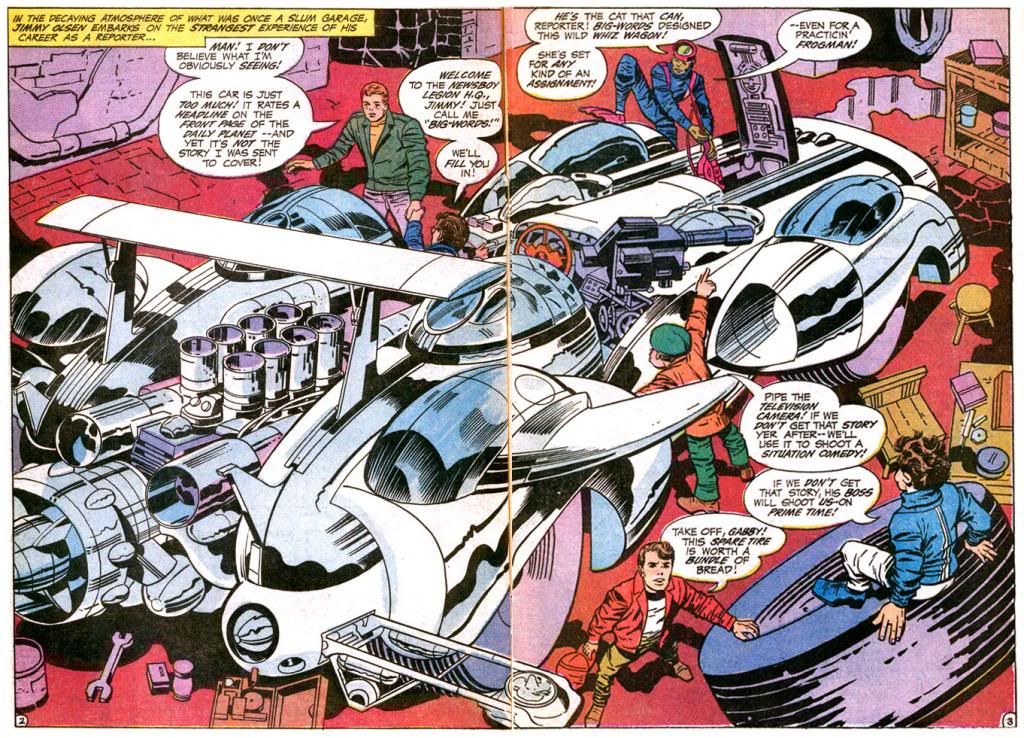
The best is last, but not for long!  In this spectacular image from Superman's Pal, Jimmy Olsen #133 (October 1970), we first greet the Whiz Wagon, custom-built by the Newsboy Legion just in time to explore the Wild Area with a certain cub reporter.  Or photographer.  Whatever the hell job it was Olsen did when he wasn't driving Perry White to distraction.  Look at the rear spoiler and those crazy intake pipes.  Is that a hint of a jet turbine beneath them?  Looking like the love child of the second Fantasti-Car and Speed Racer's fabulous Mach 5 by way of a maternity ward in the deepest, darkest, most top secret ward of Area 51, there's almost nothing the Whiz Wagon can't do.  The Newsboy Legion uses it to roar down the highway, chase after the Mountain of Judgment with the Hairies from the Habitat, fly, even travel underwater.  This is the ultimate in Kirby vehicle design. 

The Whiz Wagon by itself is an amazing visual, but Kirby doesn't simply fill two pages with a car and call it a day.  He loads this spread with details to help you believe in this phantasmagorical creation.  There's the spare tire with Newsboy Gabby perched on it (where do they buy those?), Flipper-Dipper and the forward cargo-hatch, plus tools galore and even some kind of liquid draining away in the background.  Hydraulic fluid?  Oil?  Tears from other artists who saw this and realized they'd never create anything even half so cool?

Wednesday, January 22, 2014

Steve Rude announces the end of Nexus

That's tough news to take, but every story has to end sometime.  According to the latest Steve Rude newsletter, jauntily titled "Old Year, New Year, Easy on the Cold Beer-- It's Still Rock and Roll to Me," when Rude and writer Mike Baron finish the Nexus story currently running in Dark Horse Presents, they will "suspend things for now."  Or, as Rude writes, "[We feel] our finest work is yet to come, as represented with the upcoming climax of the Nexus/Clayborn saga in Dark Horse Presents comics."

Baron will continue writing novels, and Rude will do some mysterious project for DC West, then jump back into his personal, creator-owned properties with the return of The Moth.  You may remember a certain 5-issue miniseries Rude worked up with Gary Martin a while back for Dark Horse.  I liked it a lot.  The circus setting, the diverse cast of characters, the old-fashioned heroic virtues on display and all that kind of thing.  Right in my comics-enjoying wheelhouse, as it were.  This won't be self-published; it's coming out under the Flesk Publications banner.

So here comes the end of about thirty years of exciting and provocative space adventuring.  I'm not sure what more Baron and Rude could have done with Nexus and Sundra.  Nexus has quit being Nexus, come back again, killed more mass murderers than any handful of Wolverines, Ursula X. X. Imada met her long-fated demise, other characters have died and lived and aged, and now there's a newborn child in the mix.  While I don't know how Baron and Rude will leave their little family and cast of thousands, I have a feeling there will be a fitting valediction that will leave us satisfied.

And yet still wanting more.

At least they have the opportunity to conclude Nexus where they want, unlike with "Nightmare in Blue" where economic factors forced them to leave things kind of hanging.  That was truly heartbreaking in a way this latest announcement isn't.  I wanted to weep at the time.  Similar causes seem to have crashed Rude's attempt at self-publishing, too.  Hey, I forget that story and it's too cold here to spend a lot of time looking it up.  You probably know more about it than I do.  We Nexus fans were definitely lucky Mike Richardson at Dark Horse acted the way I wish all comics publishers did: making sure Baron and Rude got their character and story rights back, then giving them a place to tell more Nexus stories when they felt it was time.

One thing I really regret about this is, they had just introduced long-anticipated character Origami into the storyline.  I don't think the character is exactly as they intended.  My guess is they took the concept and folded (ha ha, aren't I clever) it into the Nexus universe just to make sure the name and costume didn't go to waste.  I would love for them to revisit her sometime.  Or someone under their supervision!  It's hard to resist a character whose catchphrase is, "I like to fold things" as she zips away from the mayhem she's caused.

Well, I'm looking forward to more Baron and Rude.  And The Moth!