"Bang. Bang. Bang."
You don't remember? How about the time Swamp Thing visited the Cambridge Mystery House, the DC universe version of the same place? Rings a bell, huh? Bangs a nail. Hammers and all that. The Winchester Mystery House is a fascinating place, the life's work of Sarah Winchester, widow of William Winchester and heiress to the Winchester Repeating Arms fortune. Somehow she took it in her head spirits would kill her if she ever completed the mansion where she lived, so construction went on around the clock for nearly 38 years until Mrs. Winchester's death in 1924. Mrs. Winchester was a little eccentric (according to the Winchester House's official website, some of her employees actually thought she herself had supernatural powers), obsessed with the number 13, and her house is equally... er... original. Stairs to nowhere, fake bathrooms, windows on the inside, liberal use of redwood because Mrs. Winchester preferred it-- although it all had to be stained or painted to look like some other kind of wood because she hated its appearance. Given the house's origins and bizarre interior, it's no wonder the Winchester Mystery House has a reputation as a haunted mansion.
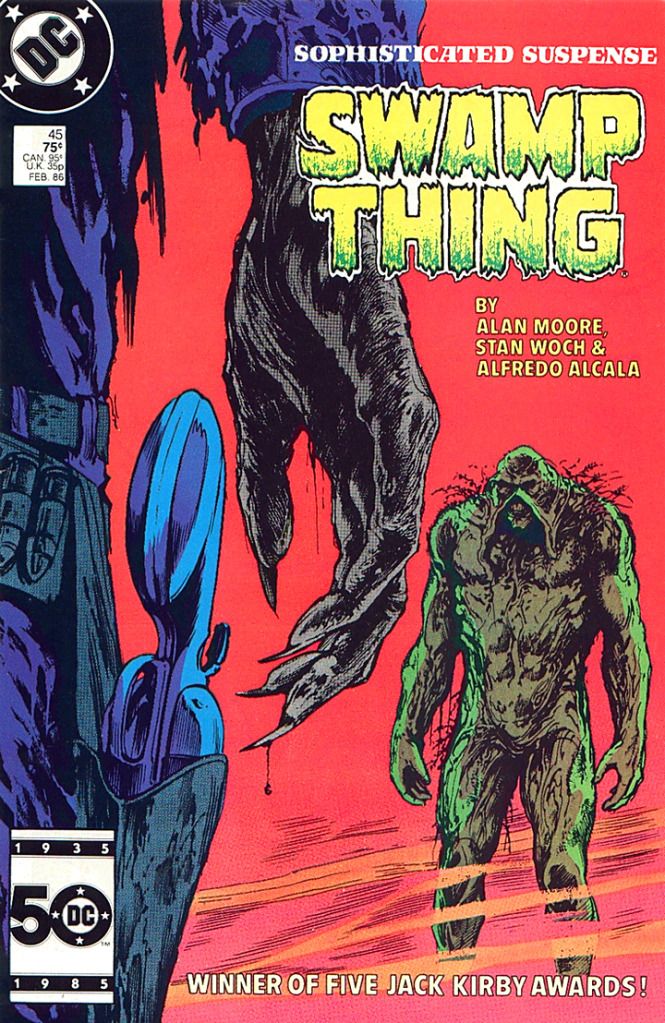
Alan Moore puts the Winchester lore to good use in "Ghost Dance" from Swamp Thing #45 (February 1986) with the help of some evocative art by Stan Woch and Alfredo Alcala. A group of friends enter the dilapidated Cambridge House for a laugh while the reedy, Howard Sprague-with-red-hair-looking one (he proves to be as cuckolded as Jack Dodson's character in The Getaway, as well) explains the backstory, which Moore takes directly from the Winchester House. One character even namechecks the real-life inspiration in case you had any doubts, and the NRA bumper sticker displayed on their car provides a visual clue that we're in for a lecture wrapped inside a horror yarn, one with obvious intent and an anti-gun-- or at least, anti-gun violence-- point of view, but a touch more subtle than the "Nuke-Face" environmental tale from Swamp Thing #35 and #36 (April and May 1985) with its pages full of newspaper-based collages.
This was during one of my favorite Swamp Thing story arcs, in which John Constantine, the British mystic based on Sting, takes Swamp Thing around the world to stop a rising tide of supernatural events culminating in... you guessed it... the end of the world. Moore uses this premise to explore horror mythology, but with his characteristic brilliant improvisations on familiar material. Swamp Thing fights vampires, but they're underwater. He tangles with a werewolf, but it's a woman and a commentary on our patriarchal society. In this issue, Constantine has Swamp Thing facing down the Cambridge ghosts.
And just what are these ghosts? Apparently, they're everyone in North America who ever died from a bullet fired from a gun or rifle manufactured by Cambridge Arms. Dead cowboys blast away at each other in the seance room (Mrs. Winchester would approve of its thirteen Victorian fireplaces), bullets whittling them both down to next to nothing while their battle rages all night. Little girls, murdered on Christmas Day by their father, walk innocently through the spectral carnage, their wounds like red ribbons in their hair. Buffalo stampede from a free-standing wardrobe, apparently all the way from Gunpowder Narnia. Cowards linger in the kitchens, shamed, faces hidden in hands, each back stamped with the red badge of fear. One especially tragic note comes when the narration points out what percentage of the ghosts are Native Americans.
"Ghost Dance" is a melancholy look at our capacity for violence and the tool that truly built our modern American society even more so than the car, the train or the rocket to the moon, as evidenced by Moore's repetition of the phrase, "The sound of hammers must never stop," fraught with double meaning. Guns, the love of guns and gun violence are so engrained in the American psyche, we can't even have a rational discussion about them no matter how many bodies pile up. Moore, though this fiction, might argue the victims wind up in a Mystery House of the American soul, a haunted mansion we're all still guiltily building just like Sarah Winchester and her fictional analogue Amy Cambridge, even as the sound of hammers continues to ring from coast to coast.
They have never stopped.
Showing posts with label Alfredo Alcala. Show all posts
Tuesday, October 30, 2012
Friday, October 7, 2011
2nd Annual Spookey Month: DC's Witching Hour trio
I'm not sure if EC started the tradition of having horror anthology books hosted by recurring characters but by the late 60s and early 70s, it was a pretty well established trope. The Crypt-Keeper is perhaps the most famous of all, immortalized by HBO's Tales from the Crypt series. The EC original looked somewhat more human, but the TV version had that crazy cackle, a warm, infectious laugh, as gleeful as a Christmas morn. In the comics, the Crypt-Keeper and his fellow hosts the Vault-Keeper and the Old Witch directly address readers and are playful rivals, sometimes more interesting than the stories they introduce. Warren Publications had as their presenters Uncle Creepy and Cousin Eerie. They queasily look like the results of several generations of inbreeding within some old money family sliding into decadence and disrepute; the Crypt-Keeper and friends seemed positively savory next to those two geeks. Gold Key had caricatures of real people for their comics; Rod Serling appeared in comics based on his Twilight Zone TV show while Boris Karloff headlined his own title, Boris Karloff Tales of Mystery.
EC and Warren alumnus Joe Orlando outdid them all as an editor with DC, teaming up with Dick Giordano, Bill Draut and Gerry Conway among many others to give horror fans such memorable hosts as Cain and Abel, the ultimate pair of sibling rivals, and their books House of Mystery and House of Secrets, Eve from Secrets of Sinister House... and... Lucien the Librarian. My favorites, however, are from the Giordano-edited The Witching Hour: the three witches, Mordred, Mildred and Cynthia. I'm not sure who gets credit for creating them. Possibly William Shakespeare, although his three "weird sisters" are uniformly hideous, described in Macbeth as "withered," "wild in their attire," and, most alarmingly:
You should be women,
And yet your beards forbid me to interpret
That you are so.
And yet your beards forbid me to interpret
That you are so.
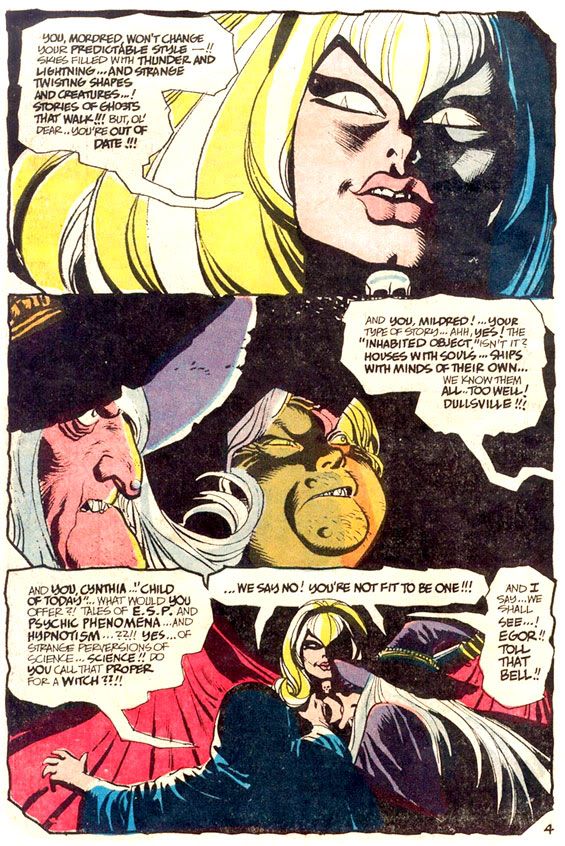
Mordred and Mildred come closest to the Shakespearian example. They're fairly standard witches, complete with a pointy hat and a hooded cloak, stringy hair and appropriately old school ideas about what constitutes a horror tale. Cynthia, however, gives the Bard a middle-finger salute. She's the very model of a modern major witch, a little Samantha Stevens and a whole lotta love. With the pouty face of a Bridget Bardot-- albeit with slitted cat-pupils-- and the voluptuous figure of a Sophia Lauren, Cynthia slinks around in a skin-tight black dress, a skull-shaped brooch at her throat. She speaks in groovy 60s slang-- she'd probably call each issue of The Witching Hour a "scare-in"-- and her bag is telling far out, contemporary stories that swing like a pendulum do.
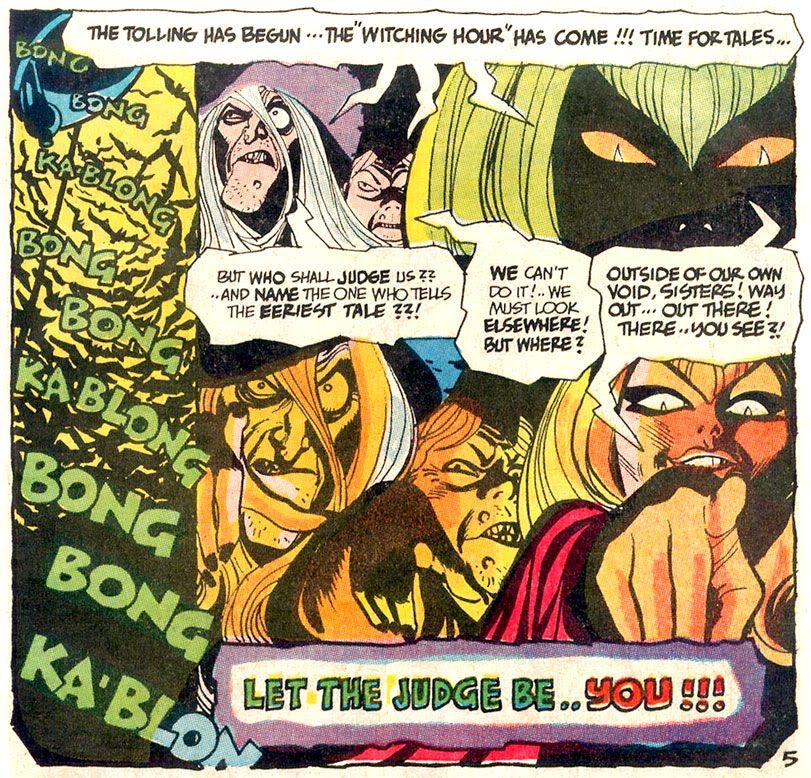
The Witching Hour host segments have a distinct narrative flair all their own, each issue opening with some comedic vignette. Cynthia taunts the older witches, they respond in kind. Cynthia usually comes off best, with an Addams Family-esque joie de mourir. She's just more likable than her companions, too. While Mildred and Mordred gnash their teeth and verbally abuse the help, Cynthia poses vivaciously for the readers, a smile on her fleshy lips. Given the choice between two witches who seem constantly pissed and one who's on a cool trip, daddy-o, which would you choose? I'm turning on, tuning in and dropping dead with Cynthia.
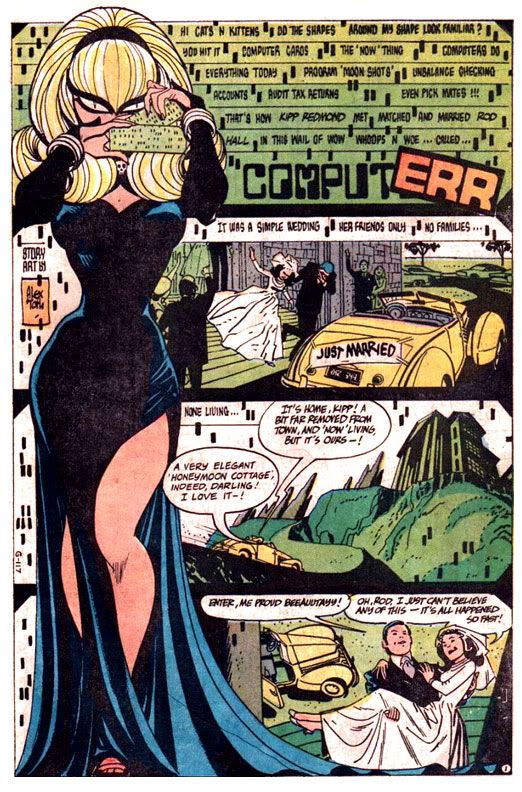
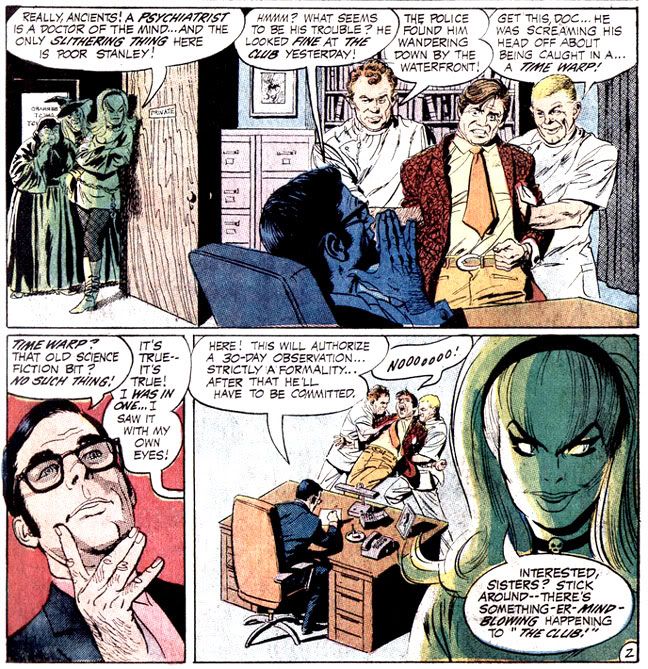
Alex Toth's Cynthia has a strange widow's peak that appears to have consumed her pointy eyebrows, huge feline eyes, lashes heavy with mascara, bee-stung lips and a square-ish jaw with a pronounced chin dimple. Here's a splash page from The Witching Hour #8 (1970) where Toth has her introduce a story in a novel way:
I love her cheeky, playful pose. Lots of personality in that drawing! The page layout is innovative for the time, Cynthia providing a visual frame for the first three panels and black gutters instead of the traditional white. It may be technologically dated now, but even the computer-style typeface was a little ahead of its time. The story is credited to Toth, but the DC Showcase reprint lists none other than Sergio Aragones as the writer. Maybe Toth plotted and Aragones scripted. If you're a Toth fan, the early issues of The Witching Hour are a treasure trove of his work, which makes the DC Showcase volume indispensable.
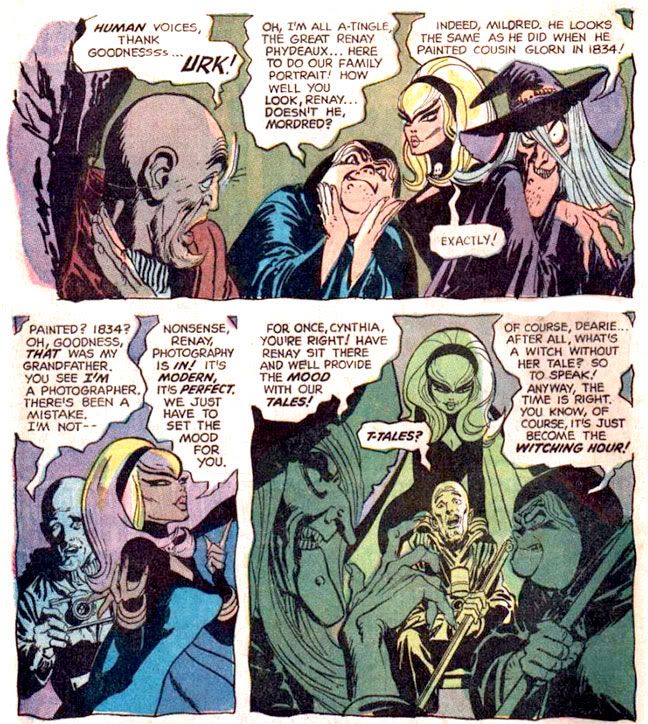
This is from Neal Adams's framing sequence for the same issue, also written by Aragones-- who was apparently on fire that month:
Adams makes his Witches look uncannily like Toth's. That's one of Adams's most amazing artistic abilities-- mimickry. You probably read the Batman story guest-starring Enemy Ace where Adams made the pilot look exactly as if Joe Kubert himself had drawn him.
Gray Morrow's Cynthia from #10 (1970) is more naturalistic than Toth's, but no less alluring:
Morrow is rare among The Witching Hour artists in that he gets Cynthia out of her long Morticia dress and into a mod mini-dress, patterned tights and go-go boots. In a later issue, she sports a purple bodysuit, but Morrow was there first, drawing inspiration from the psychedelic fashions of the time. He interprets her eyebrows as separate entities from her hairline, too.
Other artists interpret her in various shades of sinister beauty, but Mildred and Mordred look pretty much the same throughout. Like the other horror titles, The Witching Hour distinguished itself as the gorgeously appointed home of a number of DC's Filipino artists. Guys like Tony DeZuniga, Alex Nino, Alfredo Alcala, Nestor Redondo and others made their way to the United States where they flooded DC's horror titles with incredibly rendered work.
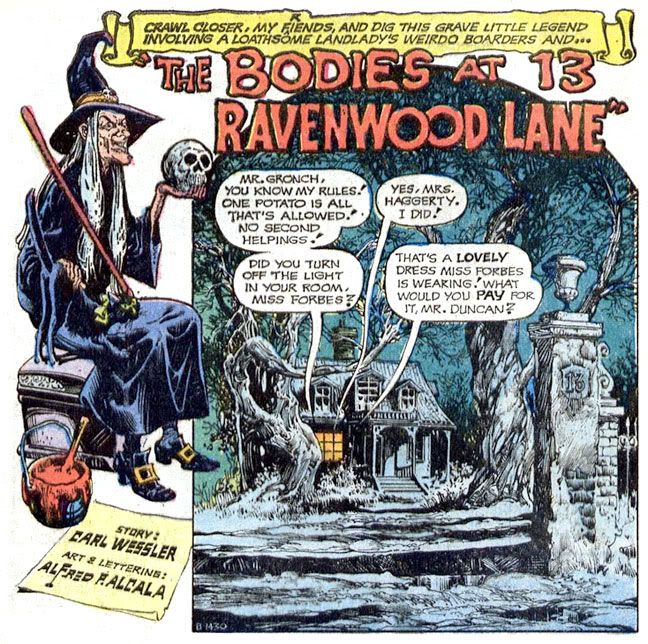
Here's a nice Alcala Mordred from #27:
Very atmospheric and Halloween-appropriate. The buckle-shoed witch, a creepy nightscape, even a skull and the number 13.
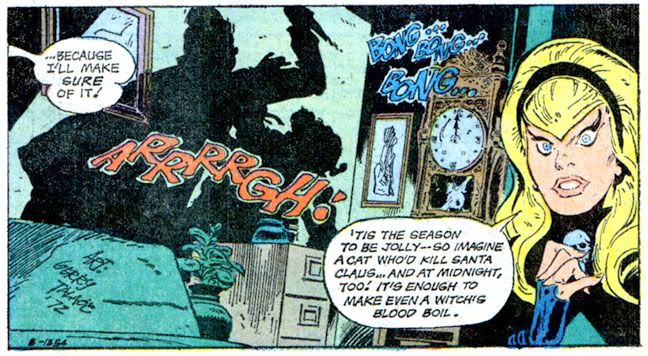
And a Gerry Talaoc Cynthia from #28:
She looks a little surprised. Probably because she's talking about Santa Claus in my Halloween-themed blog entry.
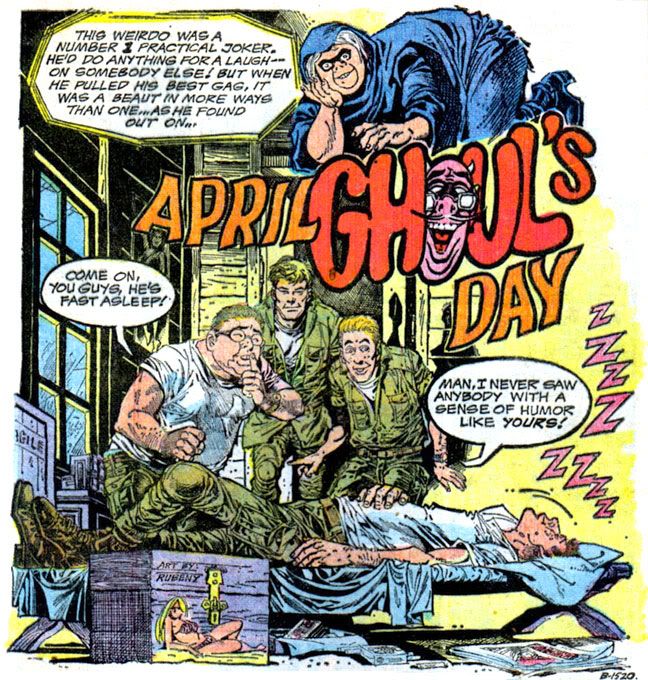
From the same issue, another holiday image, this time with Mildred courtesy of Ruben Yandoc:
It's strange to think these three once headlined their own book and had their own little adventures. Once these horror anthologies ran their course, Mordred, Mildred and Cynthia spent some time with Cain and Abel and then fell into the clutches of Neil Gaiman, who worked them into the supporting cast of his The Sandman series. I have to give him credit for keeping them alive. Gaiman didn't do just that; he also added a lot of symbolism and mythology to the trio-- Erinyes, the Furies, maiden, mother, crone, the Kindly Ones and all that clever, clever stuff that probably didn't occur even to Shakespeare when he was writing his play. I'm only familiar with any of it from the tidbits of Greek mythology my art history professor offered when she desperately tried to fill my head with knowledge of amphora and statuary.
This is more my speed:
But why should these three play supporting roles when they're such powerful female characters, so fascinating unto themselves? All that literary and folkloric synthesis is interesting, but it seems more an exercise in author self-aggrandizement-- I should know since I'm the ruler of that junk-- rather than a true continuation of their narrative. I prefer the witches as stars of their own book, telling their quirky stories rather than as members of the background ensemble within some other character's story, no matter how dazzlingly the author enfolds them with the plot.
I'd love to see them headlining another anthology book, mocking each other, talking directly to the readers and demanding our attention. Cynthia could be updated for the current generation, a little auto-tuned to the post-modern vibe, destroying hipsters and Facebook moguls. Mordred might draw inspiration from Japanese horror comics and movies-- just like Hollywood!-- while keeping up her interest in ghosts and phantoms. She could probably teach all these ghost hunting fool on cable TV a thing or three. And Mildred might find some common ground with tech-savvy forever up-to-date Cynthia by coming up with stories about possessed iPods and Blackberries.
Or not. And now... more Japanese rock from Spookey! Yes, I've posted this one before, but it's directly related to Halloween and it's awesome:
Monday, September 12, 2011
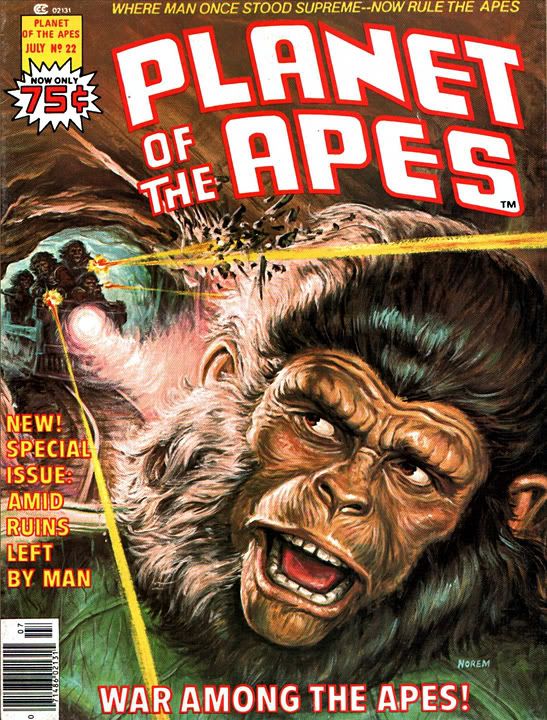
Ape-Quest '11: "Quest for the Planet of the Apes" Edition, Part 2!
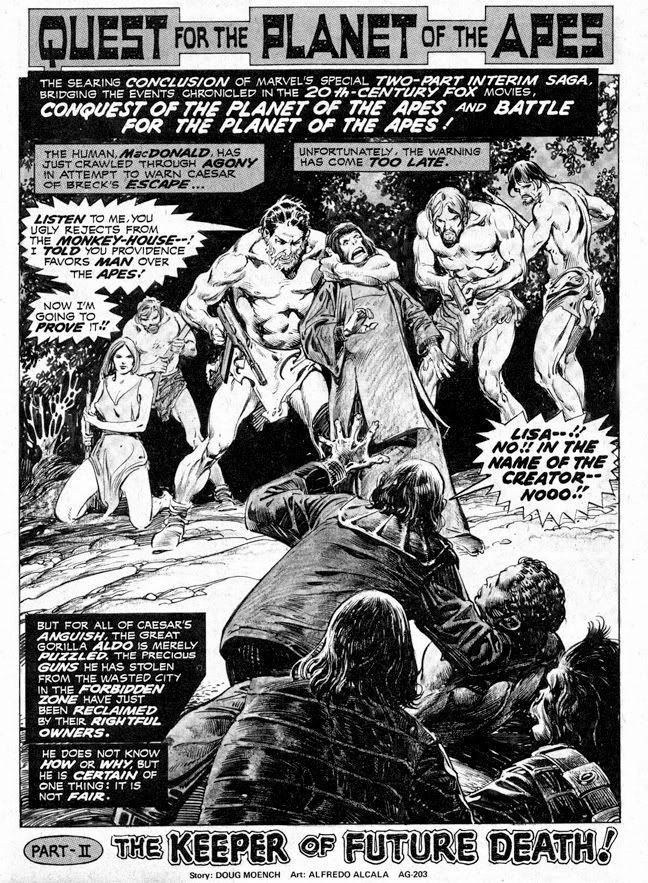
What's Breck so angry about? Well, he used to be ruler of a mighty state, but thanks to Caesar the super-smart boss of all the talking apes, he's now a bearded bum in a soiled loincloth. Just about anyone else in Breck's reduced position would look back on his life and think, "Maybe running a repressive regime that enslaved anthropomorphized apes wasn't the best career move," but the ex-governor isn't like most people-- refusing to recognize his own culpability for his fall from power, he places sole blame on Caesar and wants revenge!
Rico Rival has been replaced by my favorite Apes artist-- one of my favorite artists, period-- Alfredo Alcala. Alcala's art here isn't as ornate as his work on the black & white Beneath the Planet of the Apes adaptation, a series highpoint. It's a little simpler, the gray tones a bit flatter. It's still quite lovely, with a slightly comical quality, especially in the apes' expressions.
Even after two years of constant study, I haven't figured out why the humans are in Tarzan rags. In the movie Battle for the Planet of the Apes, which this story immediately precedes, they just wore regular clothes. It would be thousands of years into the future before the humans started making like the extras in a Hammer Studios prehistoric romp-- my favorite is Prehistoric Women because it has the amazing Martine Beswick in it as the evil high priestess of a decadent tribe-- in Apes film continuity. Another thing I don't understand is why the woman on the far left felt it necessary to kneel. Other than to fit into the scene without Breck's jagged speech bubbles covering her face.
This page has an excellent feeling of depth, though. The apes are almost silhouetted in the foreground, Breck and his gang occupy the well-lit middle ground, then there's a suggestion of foliage behind them.
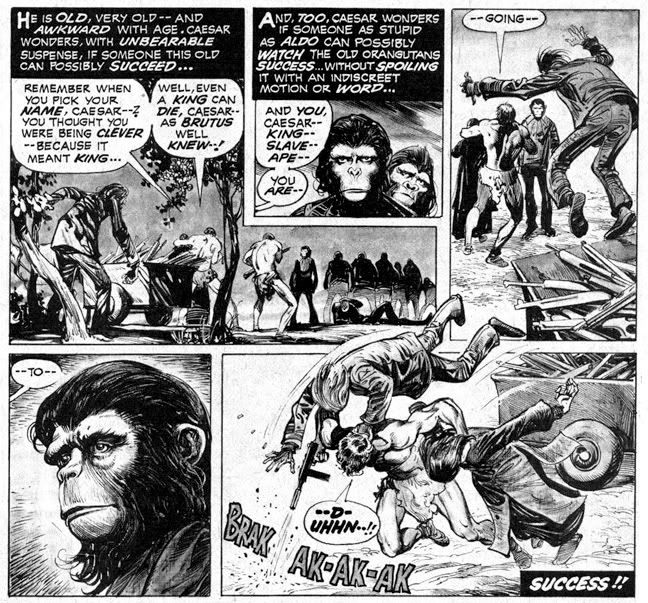
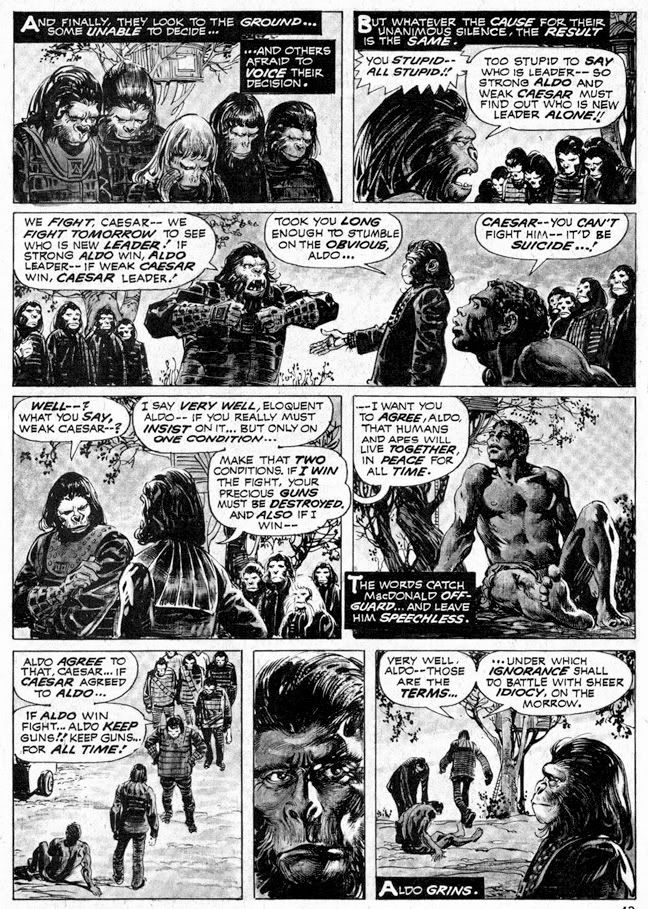
Instead of just shooting Caesar and being done with the whole ordeal, Breck has to voice all his grievances while Caesar and Aldo squirm uncomfortably. It allows an old orangutan time to climb up on a wagon full of guns-- ever-generous Aldo brought them back from the ruined city in the Forbidden Zone to share with all his pals-- and jump on Breck. This sequence occupies approximately 12 days of story-time.
Then comes the big fight!
Yeah, it's pretty much a re-write of Battle. My memories of that movie are confused with those of the David Gerrold prose adaptation. The novel is infinitely superior to the movie, which is common with film versions of literary works but rarely seems to work in the opposite direction.
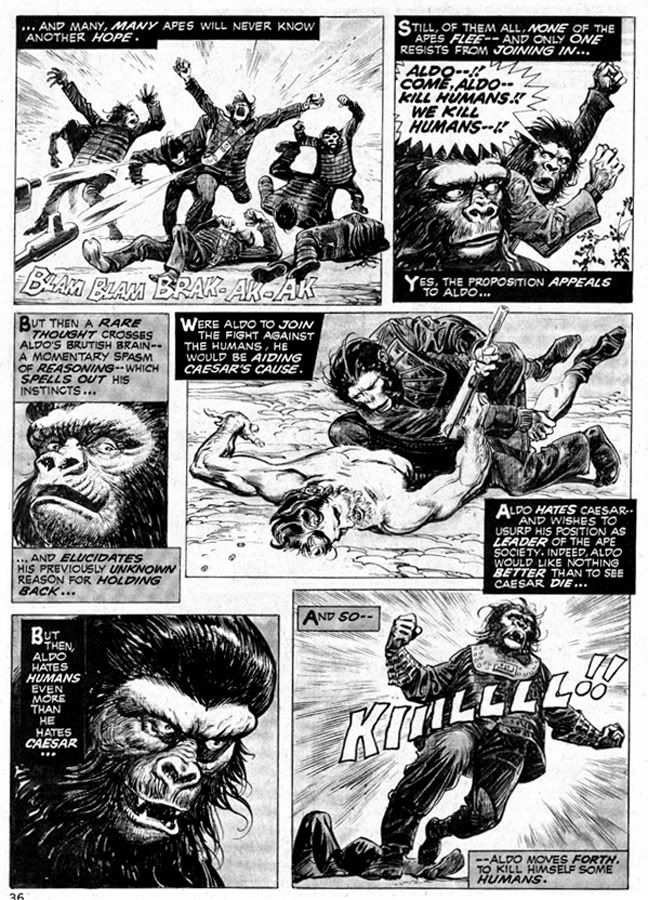
But in this case, Gerrold worked from a shooting script that was written for a significantly higher-budget movie than the one that eventually reached the screen. If I'm remembering correctly, Aldo holds his gorilla cavalry out of the big third act fight after a disastrous headlong charge into the humans' automatic weapons, then has his horse-apes chase down and slaughter the fleeing and demoralized survivors after their defeat by the other apes led by Caesar.
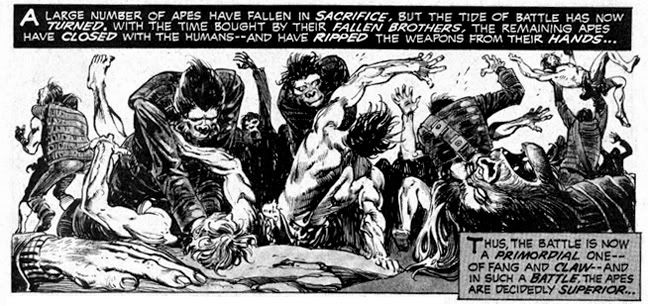
I believe that sequence never made it as far as the filming stage, which is too bad; the movie could have used a little more epic scope a "Charge of the Ape Brigade" would have lent it-- mutants to the left of them, mutants to the right, mutants in front of them, volley'd and thunder'd. You get the idea. Here, Aldo just can't decide. Let the hated Breck kill the hated Caesar or kill the hated humans? Eventually, he decides to do both. Which is good for us, because we get to see his gorilla soldiers do this:
And then Aldo himself do this:
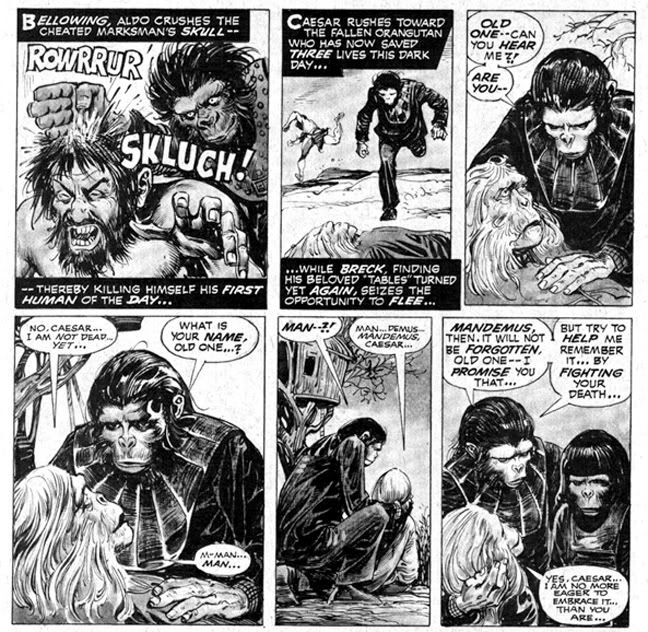
"Skluch!" Wow, these old Marvel magazines have the sickest sound effects, don't they? Take that, you filthy, gun-wielding counter-culture artifact! "Skluch" is the perfect "gorilla general karate chop to the skull" onomatopoeia, isn't it? Unless it's supposed to be, "Rowrrur!" and Aldo's actually sawing into the hippie's brain. But that hardly seems likely.
Oh yeah, that old orangutan turns out to be Mandemus, played by Lew Ayres in Battle. Mandemus guards the Ape City arsenal in the movie, and his appearance here seems to contradict a bit of dialogue in the film. Do you remember a scene where genius ape Virgil describes Mandemus as his former teacher? I seem to, but I'm still not sure I trust my memories. In this story, he's already an elderly kook. Well, maybe he is a teacher and we just don't get to see his classroom. But does it seem likely as familiar with Virgil as Caesar is later, he wouldn't know the primary teacher of the ape school in this story?
Am I confusing my sources again?
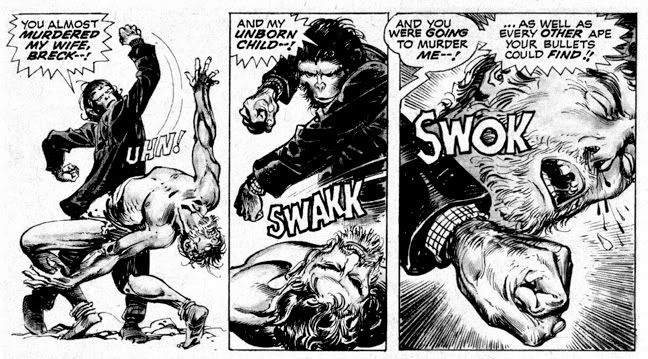
Not to be outdone by his more savage rival, Caesar engages the nearly-naked Breck in some mano-a-mano fisticuffs using the Marquess of Queensberry rules. Caesar is a civilized ape, but he throws a wicked right uppercut. BALD BULL! UPPERCUT! UPPERCUT! Sorry, that's the only punch I ever knew how to throw when I played that old video game.
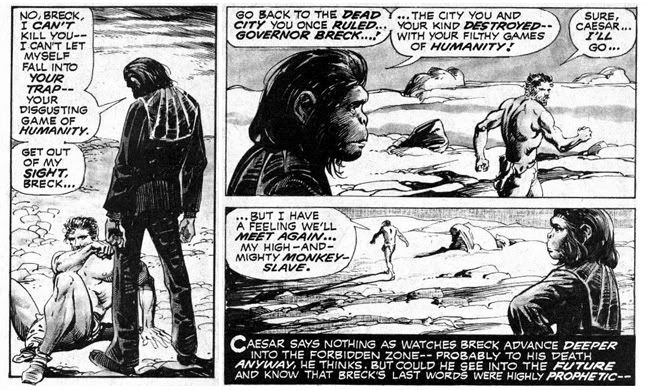
Finally, his feelings deeply hurt (he's a sensitive man), Breck sniffles a little, then storms off, vowing never to invite Caesar to his birthday party. Which would be held in the bowels of a city devastated by nuclear war, the kind of thing that sort of cuts down on the festive atmosphere. And then, pumped up on adrenaline, Caesar goes and does something kind of stupid.
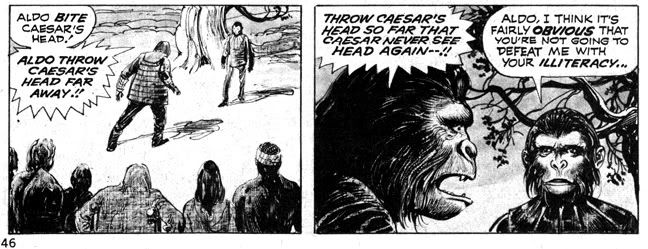
The next day, the two adversaries face off and toss arch bon mots at each other. Caesar uses his wit like a rapier; Aldo uses his like a big wooden mallet. He kind of reminds me of Animal Mother from Stanley Kubrick's Full Metal Jacket here: "Well, I've got a joke for you. I'm going to tear you a new asshole." Animal Mother and Aldo, brothers in subtlety. Might I suggest Adam Baldwin for this part in the remake? I mean, not taking anything away from Claude Akins's fierce portrayal, but he's no longer alive.
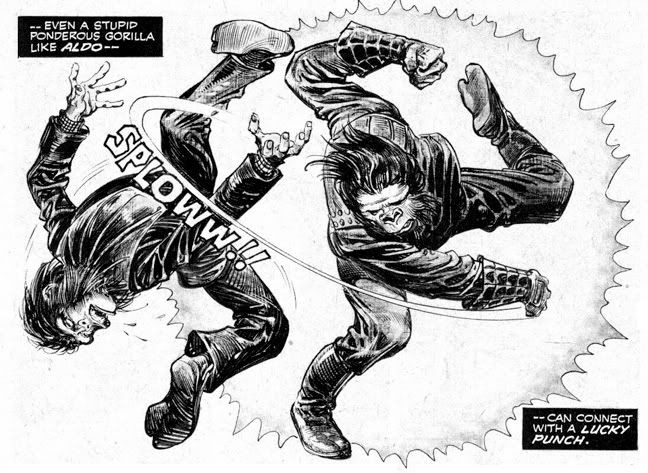
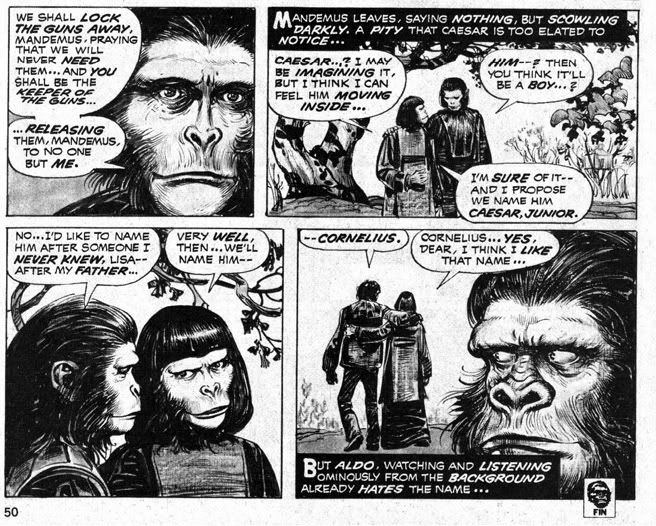
Now it's Caesar's turn to see how it feels! Check out the body language Alcala gives his battlin' apes here. Aldo just hit Caesar so hard, his unborn son Cornelius felt it! He hit Caesar so hard, the shelf containing all the Mego Planet of the Apes action figures collapsed at K-Marts across the land! There were plastic figures recalled all over the place at Christmas time that year because they came out with lop-sided faces and dark marks over their eyes. He hit Caesar so hard, Roddy McDowall had to sit down for a few minutes while filming an episode of Rod Serling's Night Gallery. Which makes the punch all the more impressive, because McDowall guest-starred on that show about seven years before Marvel published "Quest!"
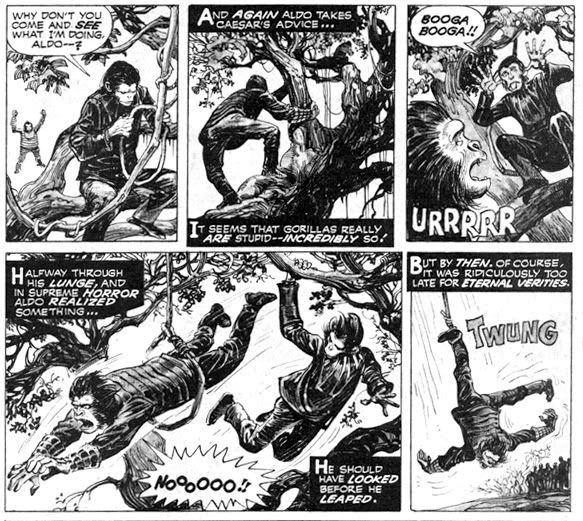
It's pretty much the final sequence of Battle, with Aldo taking to a tree. Only in this one, the outcome is a bit different.
Ah, slapstick! Cue the circus music. Perhaps "Sabre Dance" as Aldo struggles and spins beneath the swaying limbs of the big oak tree. All's well that ends well, right? No, this is Planet of the Apes. Not only do things never end well, thanks to the circular nature of the series' narrative, they never end at all.
Oh, that irrepressible scamp Aldo! You know there's going to be all kinds of delicious trouble ahead!
While it may lack in originality as far as plot points go, "Quest for the Planet of the Apes" more than makes it up to us in sheer fun. I wish Marvel had done a few more stories within the movie series continuity-- not that I don't dig all the weird-o stuff they did do-- but more than anything, I really wish someone would get on the ball and reprint all of Doug Moench's insanely brilliant Apes work. Dark Horse... Dark Horse... come in, Dark Horse!
Labels:
Aldo,
Alfredo Alcala,
Caesar,
Doug Moench,
good art,
Martine Beswick,
Marvel,
planet of the apes,
vintage comics
Subscribe to:
Posts (Atom)