Showing posts with label Doug Moench. Show all posts

Wednesday, October 29, 2014

October is Spookey Month: Someone's rockin' list of the "10 Most Frightening Horror Comics Ever!"

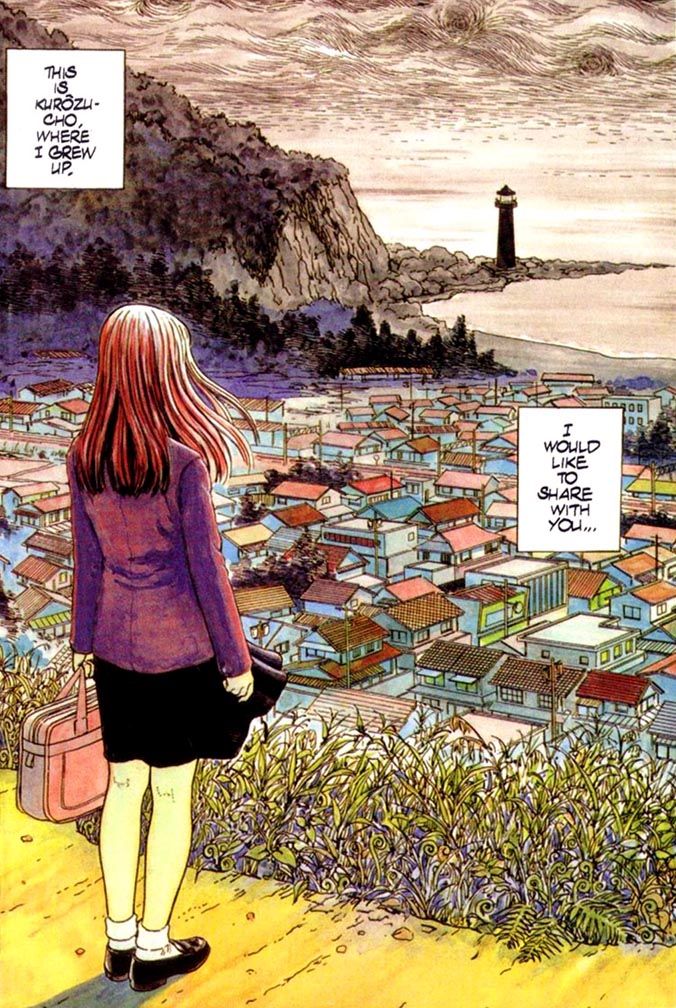
I know nothing of this Herald Scotland site, but I salute the good (or foul, depending on your perspective and whether or not you go through life talking like one of EC Comics' horror hosts) taste of Graphic Content writer Teddy Jamieson.  Not only does Jamieson quote Halloween III: Season of the Witch, but he manages to include Junji Ito's horror masterwork Uzumaki on the list.  At Paste Magazine you can read a similar 13 item list called "13 Terrifying Modern Horror Comics," which I saw posted by Fantagraphics on Facebook earlier this week.  That one is very Western comic-centric and the choices more conventional than Jamieson's, but they overlap, too.  I admire Jamieson for having the guts to lead off the list with a most personal choice.  He also puts Jack Chick tracts on his list.  I remember coming across those from time to time when I was a kid and he's right.  They're scary!  At least they were when the threat of hell or running into a hippie mocking my religious beliefs with a dismissive "HAW HAW!" were the worst things I could imagine.

Personal choice is appropriate because our most frightening comic is the one that affects us most regardless of its wider reputation.  I found myself exposed to a great many shitty horror comics when I was a kid and quite a few managed to genuinely frighten me even with crude art and strained writing. 

Sometimes even genre doesn't matter.

Jack Kirby scared the snot and the buggers out of me with his chilling final image in Kamandi #20 of our long-haired hero alone on a ruined pier.  I mean utterly alone, overlooking what I assumed at the time to be a monster-haunted Lake Michigan.  No one to help him, not the indifferent gulls circling overhead, certainly not the angry gorillas ravaging the robotic theme park Kamandi had just escaped.  No humans, just robots going through the motions of 1920s-era Chicago gangland clichés.  Poor lonely Kamandi.  The imagery was bleak, the closing copy promised more horrors to come.  Shudder!

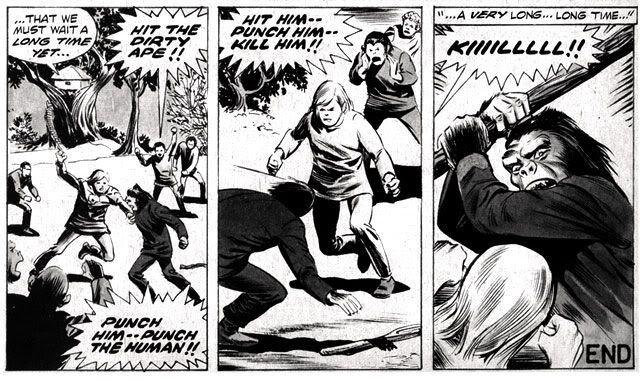
Another story that gave me the willies was "Evolution's Nightmare" in Marvel/Curtis Planet of the Apes #5.  It opens with humans and gorillas fighting El Cid-style in a desert wasteland, then ends with radioactivity-devolved apes and men duking it out with rocks and clubs in a bomb-ruined San Francisco.  They even kill the two main characters (who spent the intervening pages painfully learning tolerance) before grunting and screaming in mindless hate at each other from atop wrecked cars full of skeletons and across piles of shattered asphalt.  Doug Moench's depressing narrative captions inform us everything moves in circles and those circles stink.  Artist Ed Hannigan's (Jim Mooney inks, by the way) double-page spread of piles of dead warriors with their eyes lifelessly open only added to the lingering fear instilled in me by this creepy story.

Obviously, neither of those two are horror stories.  They're both rough-house science-fiction adventures.  You can find horror-like frights anywhere.  In a plot twist in an otherwise innocuous superhero book, gazing at you from a house ad in a humor comic, jumping out at you from behind a brick wall on a sunny street in Riverdale, USA.

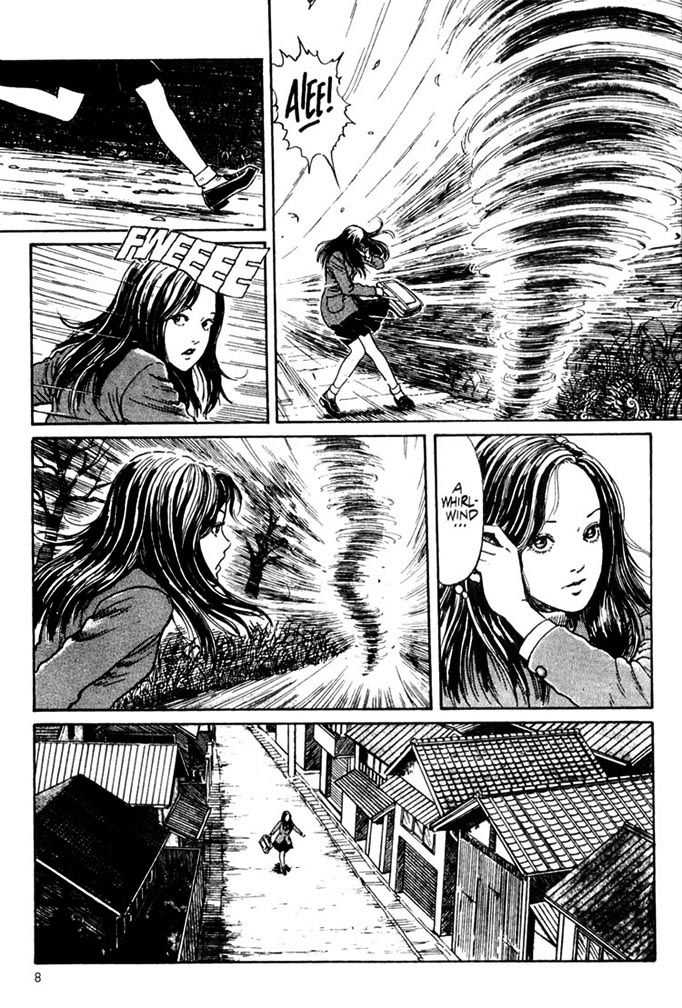
Or in an actual horror comic.  Like Uzumaki.  Serialized in Big Comic Spirits (it's a seinen manga, or dude's comic, so be careful opening that link) from 1998 to 1999, Ito's Uzumaki is the greatest horror story ever published in comic book form.  I'm comparing it to everything from Charles Burns' Black Hole, which made Fantagraphics' list (and is a moody, troubling work in its own right) to EC and every horror comic in between.  Out of all the fright fun I've had reading horror comics, only Uzumaki gave me feeling of truly dreading the next development in a story in my life.  Of doom.  Or of being genuinely grossed out by so many drawings in one place.  Uzumaki's dreamlike inevitability remains after you close the book having followed its main characters deep into the heart of ancient fears.

Uzumaki tickles your fright bone the way a cold wind from across the dry grass of graveyard might gooseflesh your arms.  Bruised clouds passing overhead like witches, their shadows falling around like concentrated night, on the move, looking for you.  Dead leaves hissing at you along the curb.  Hurrying you homeward where you face a dark, empty house where the rooms echo only with your voice.

Story and art by Junji Ito

And the soft footsteps of another.  Though nobody else is home.

Here's something that's not frightening.  It's a performance by Hamamatsu's own Spookey!

Wednesday, October 31, 2012

October is Spookey Month: Let Doug Moench and Richard Corben show you how to trick-or-treat!


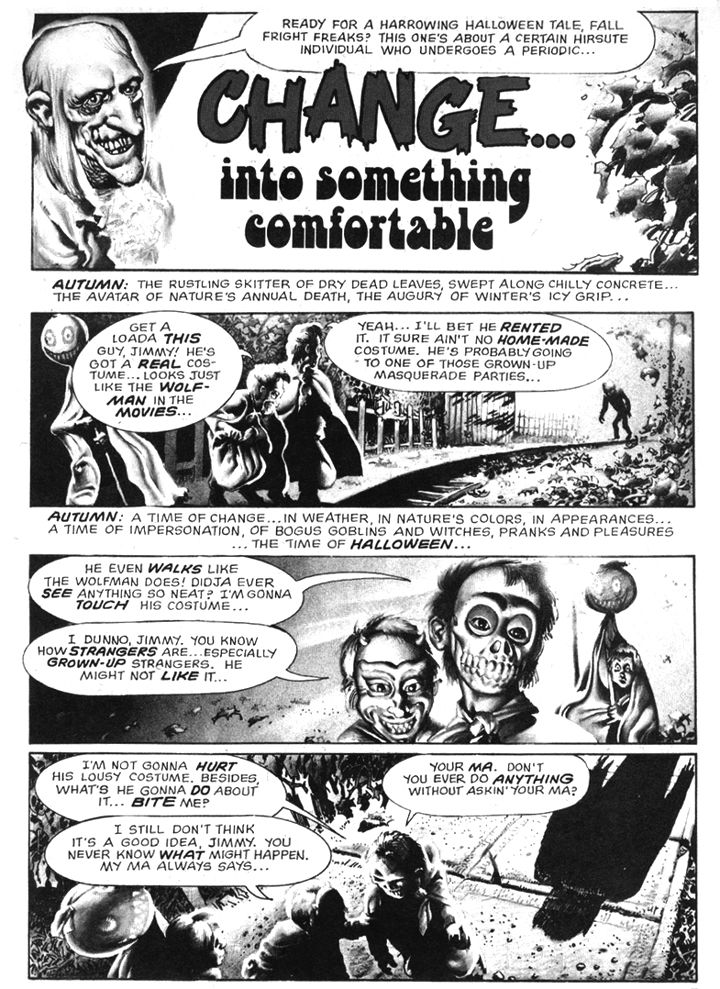
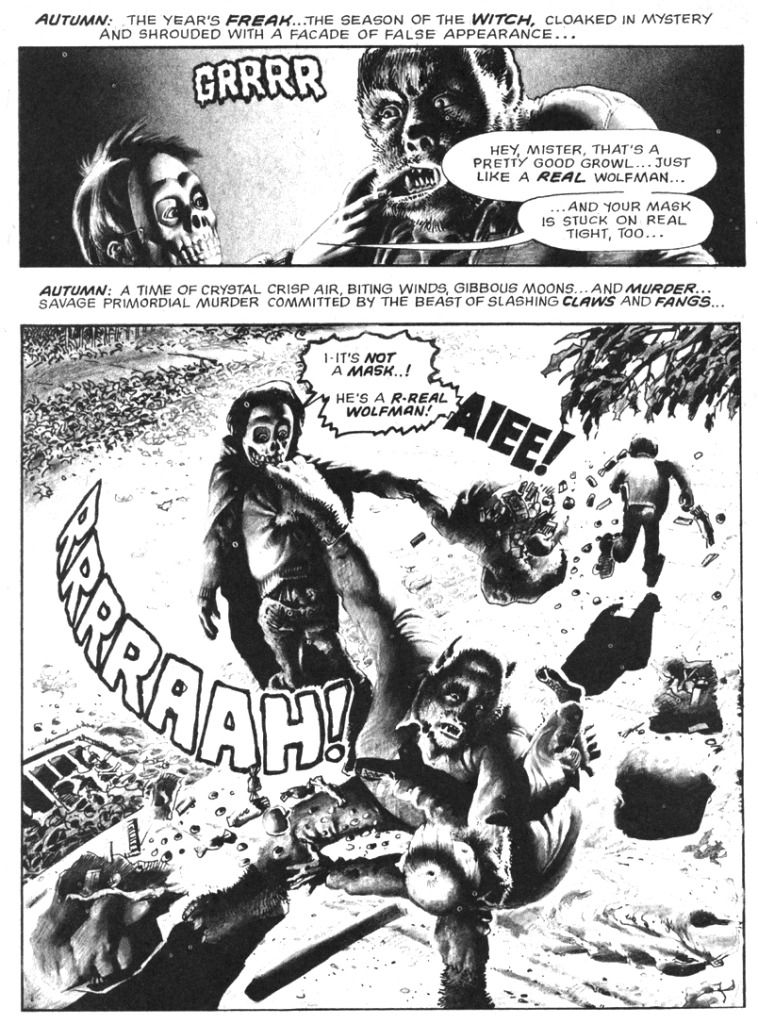
Yes, Halloween is a fun holiday, but you should exercise at least a little caution when out trick-or-treating.  Go in a group, wear a costume with reflective tape so motorists can spot you, go only to well-lit houses.  And most importantly-- don't pull on a werewolf's lip.  These are a few simple safety tips brought to you by Doug Moench and Richard Corben in their horror-comedy classic, "Change... into Something Comfortable," which appeared in Creepy #58 (December 1973), a "special Halloween horror issue" (so it says right there on the cover).  While I didn't particulary enjoy "The Slipped Mickey Click-Flick," I'm a huge fan of this little seasonal-flavored gem.

It starts with a real werewolf ripping some smart ass kids to shreds and ends with a sweet twist I find both irresistible and hilarious.  I mean if you've ever wondered what creatures of the night disguise themselves as on Halloween, here's your chance to find out.  "Comfortable" is sort of a companion piece to Corben's even more hilarious "Lycanklutz" from Creepy #56 (September 1973).  That earlier full-color romp features a somewhat luckier werewolf in a medieval setting with some surprisingly anachronistic products available for sale.  By contrast, our contemporary, kid-killing monster in "Comfortable" strays into EC territory with tragic results.  I could have hit you with "Lycanklutz," but this one is all about Halloween and disguises and has those melodramatic Moench narrative captions.  You can read it in the Dark Horse Creepy Archive Volume Twelve.

Come to think of it, you can read them both in that book.

Monday, October 22, 2012

October is Spookey Month: "The Slipped Mickey Click-Flip"


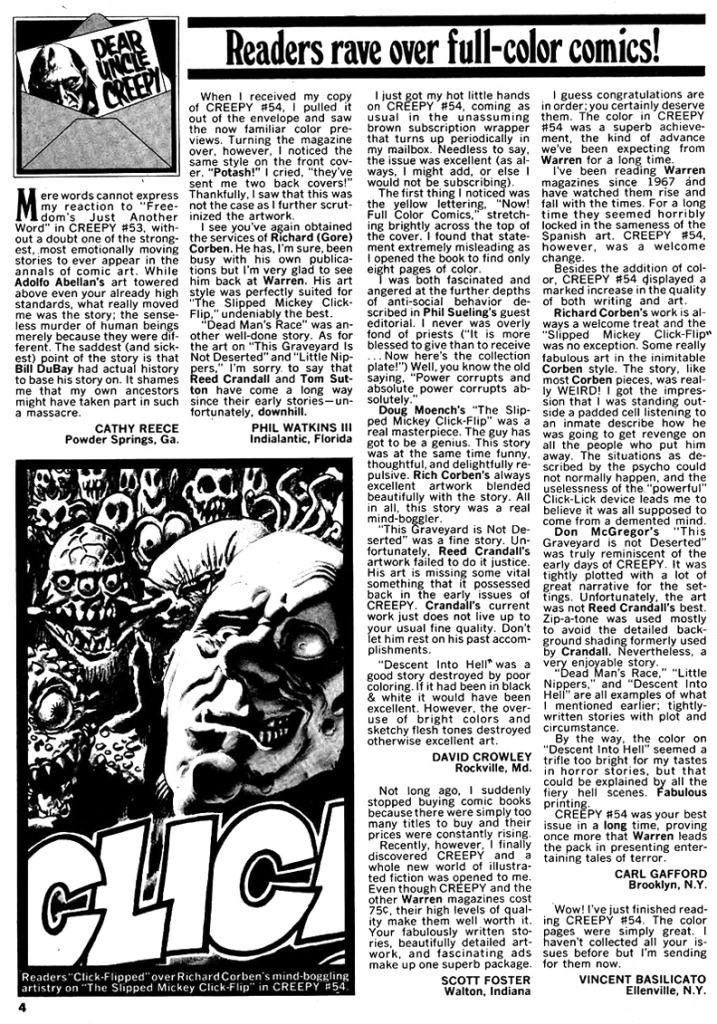
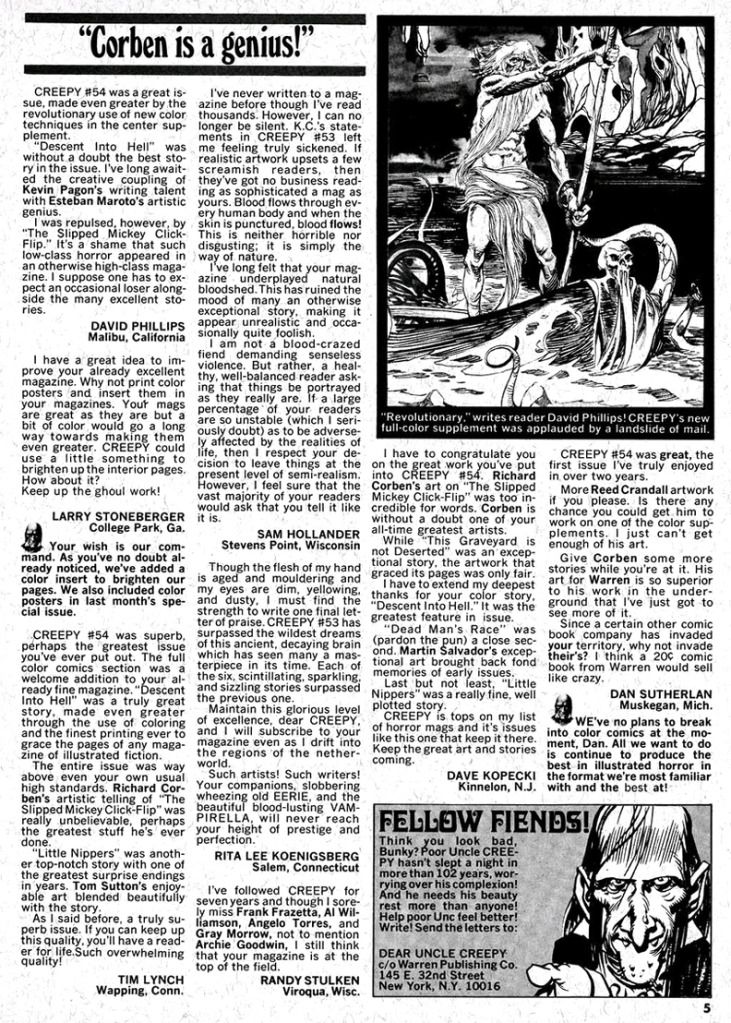
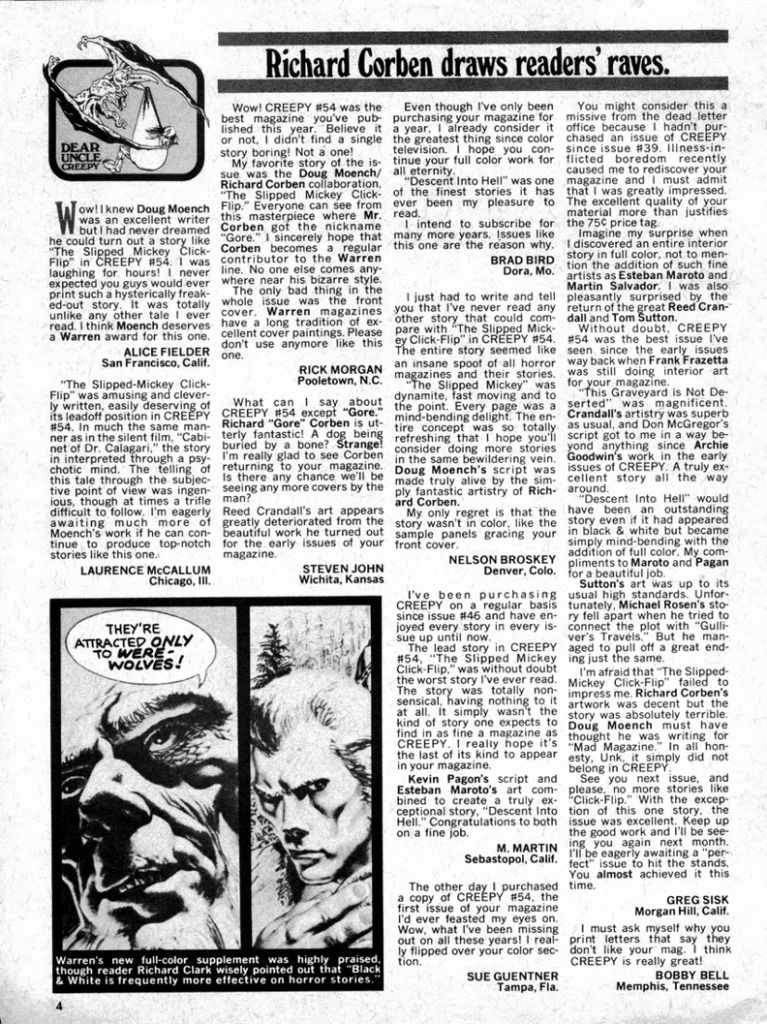
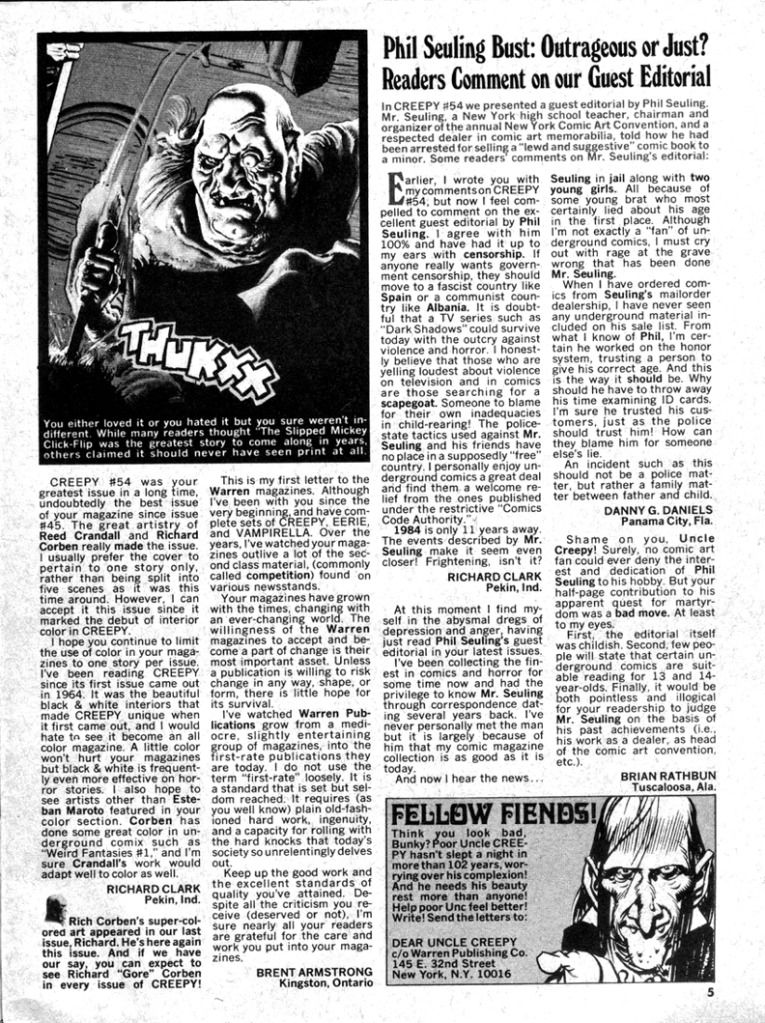
"The Slipped Mickey Click-Flip" by Doug Moench and Richard Corben first appeared in Creepy #54 (July, 1973) and readers seemed either to love it or hate it, if the letters pages for the next two issues are any indication.  And they must be; they're the letters pages for Creepy, which printed the story, for corn's sake.

But I have to admit I don't love this story.  It's a pretty good story, but I don't think it works as well as it could have.


A twisted mutant named Diment (as in "dementia") takes offense at a certain Dr. Nugent for trying to cure him of his insanity.  He takes over Creepy magazine and marginalizes poor, innocent Uncle Creepy himself to punish the doctor.  Diment does this by way of his "Click-Lick" device, the workings of which we never truly learn; he keeps turning away from us before using it.


I'm a fan of both Moench and Corben, and I admire them for their audacity in breaking the fourth wall-- and especially Corben for visually interpreting Moench's feverish, hallucinatory script.  They playfully push the boundaries of good taste-- even by the admittedly lax standards of mid-70s black and white horror magazines-- with gruesome images like eyeball-sucking butterflies and crazy-eyed trains that decapitate people.  Oh, and a woman who explodes into maggots.  I mean, if you like people who explode into maggots, you really need to buy Dark Horse's Creepy Archives #10 so you can experience this singular event rendered by Corben in full loving detail.  Never before have maggots looked so full-fleshed as they explode out of a comic book character's torso.  Gorgeous, gorgeous maggots.  Still, I thank my Uncle Creepy this story wasn't one of their color sections, which the magazine experimented with during this era, usually with Corben's art.

Unfortunately, a lot of the non sequitor dialogue seems forced and ham-fisted, sometimes repetitious ("idiot" is over-worked and begs for a week off in the Bahamas), Nugent and his wife are little more than puppets to the story and we never learn enough about them to develop any sympathy for them or become overly concerned with their plight.  But Diment himself is no prize, either.  I find him repulsive and off-putting.  I could see myself settling down on some moldy divan to listen to Uncle Creepy spin many a yarn, but once is enough with Diment.  More than enough.

Of course, "Slipped Mickey" is psimply a psick psychedelic romp, not meant to be taken seriously by any means, but as a supposedly enlightened 21st century citizen of the world, I can't help but find the depiction Diment's mental illness troubling and retrograde even for its time.  But I have to admit I apply this standard inconsistently.  What bothers me here might not in another story.


It's memorable as all get out, enough so you can find it in its entirety posted online and a few reminisces about it from fans who read it back in the day or in the years since and fell in love.  After all, for a horror story the only true mark of failure is boring readers to sleep, and "Slipped Mickey" definitely avoids that.  As you can see, the Creepy letters page in issue #56 (September, 1973) features nothing but praise for the story, with one reader calling it a masterpiece and Moench a genius and another praising it before opining it takes place entirely in Diment's mind (which is a comforting reading, I have to admit).  Negative reaction slips into the mix with a lone dissenter, who declares it "low class horror," then intensifies ever so slightly for Creepy #57 (November, 1973) when seven letters (out of 14) mention the months-old story, five praising it and two criticizing it.

One thing I enjoy about reading the Creepy letters pages-- even though we're now years past the point their relevancy died like poor ol' Dr. Nugent, his wife and even their dog-- is the editors weren't afraid to allow some nay-saying, and in this case actually spotlighted it with a sidebar box.  There's a feeling of some real give-and-take and that someone actually read the letters and put some thought into it, but also that the letters page is largely a forum for reader opinion without a lot of defensiveness from the Creepy staff, as if dare the readers to form their own opinions instead of just joining a praise-pack, that it was just as much the fans' comic as it was theirs.  You can imagine what the message boards would have been like had this taken place in today's Internet-savvy comic book society.

Oh, and before I leave you to Google search for this story and read it for yourselves-- to make up your own minds about it, just like Uncle Creepy would have it-- let me tell you this is exactly the kind of story that would have sent me off the rails for a few days if I'd read it as a child.  I had this stupid over-imaginative reaction to horror comics, especially stories as whimsically arbitrary as this one.  I can imagine little-me trying not to think much about Diment for fear of his being real, or somehow making him emerge from the comic book into our world and wreaking havoc on me specifically.  You just do not want to piss Diment off, and disapproving of him would probably be more than enough to earn his wrath

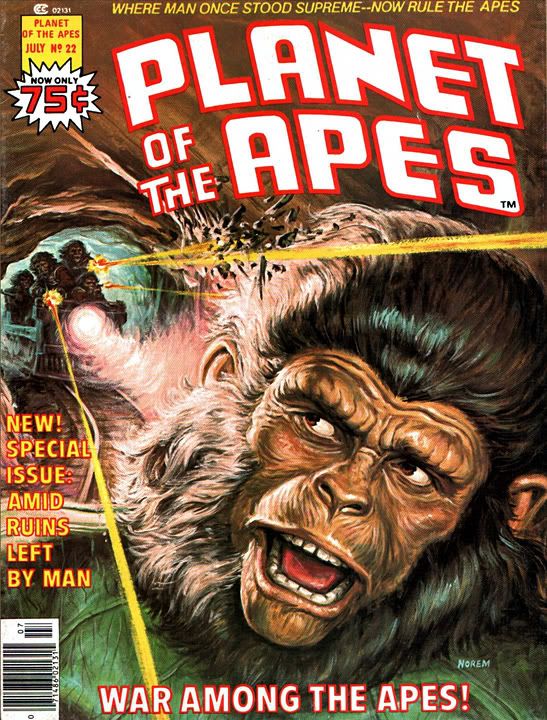
So I would have been sleeping with the lights on in my bedroom, picturing the happy little crazy train running over my head or killing my dog.  DC's House of Secrets and Weird War Tales were bad enough, Marvel's black and white Planet of the Apes magazines scared me as often as they thrilled me with adventure (especially with their house ads for Tales of the Zombie and even Unknown Worlds of Science Fiction, the latter featuring a Michael Moorcock story that crosses the border into blasphemy for those of us in the Bible Belt deep South).  I'm a little nervous even now, writing about it.

Tuesday, December 6, 2011

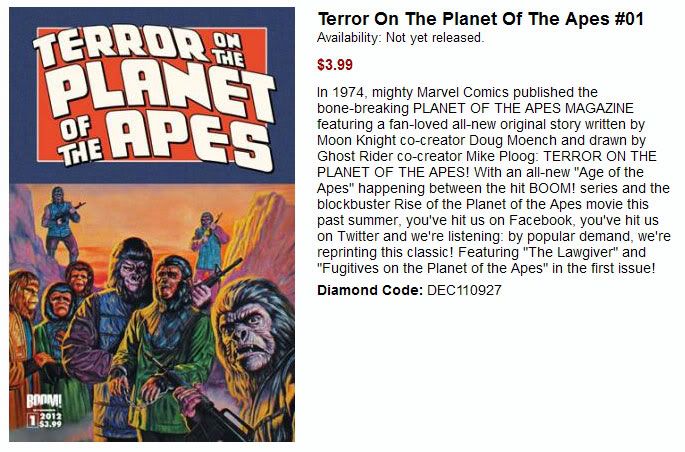
Boom! Studios is reprinting the classic Terror on the Planet of the Apes!


Finally, my demands have been met and I can release the hostages. Wait-- a gorilla sniper! KA-POW!  Damn you, Dr. Zaius! Thank God, I die a true human...  But... first... let me push... this button...

With the frivolity finished, I can announce the happiest comic book news I've heard in quite some time. BOOM! Studios, holders of the Planet of the Apes license from 20th Century Fox and publishers of fine Planet of the Apes comics since about April 2011, will reprint the rambling and mostly off-the-rails epic Terror on the Planet of the Apes by Doug Moench and Mike Ploog, plus contributions by other artists. The geniuses behind this decision at BOOM!  haven't set a release date, but if the cover image holds, it looks like they'll be using the old painted covers from the Marvel series as well. Time to introduce a whole new generation to the lurid charms of these images by Bob Larkin and Earl Norem.

This is what I've been begging for since I started comic book blogging.  The way Dark Horse has been publishing old Marvel/Curtis magazine material, I expected them to come through for me.  But it was BOOM! Studios all along.  I'm grateful to them for doing this, and to all the Apes fans who helped make it happen.

And now the bad news.  This series is going to be difficult for me to come by.  I had problems getting issues of BOOM!'s regular Planet of the Apes title when I lived in the States.  They're also publishing Betrayal of the Planet of the Apes, starring a young Dr. Zaius.  I'm dying to read this book!  How can I get my filthy, stinking paws on these Apes comics here in Japan?

I will not rest until I solve this problem!*

*Actually, I think they have international subscriptions.  And there's always EBay.

Thursday, September 15, 2011

What About the Future?: The Lost Issue of Marvel's Planet of the Apes Magazine

Does it ever bother you that the story "Terror on the Planet of the Apes," serialized in Marvel's Planet of the Apes magazine, ends on a cliffhanger? Sure, it's not quite of the same order as that maddening final episode of Twin Peaks, but it's unfinished business nevertheless. I probably spend a lot more time bemoaning the lack of a third season for David Lynch's weird show than I do an ending to Doug Moench's even weirder comic book saga, but I'd never turn down either.


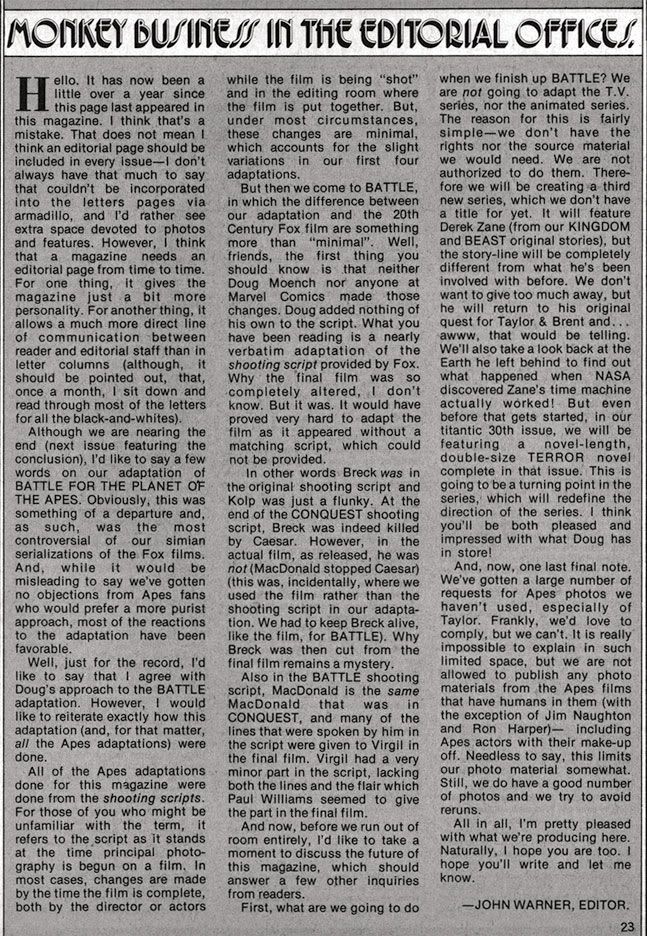
What's tantalizing about Apes is how in #27, editor John Warner promised a "novel-length, double sized TERROR novel," set to appear in the never-published thirtieth issue of the magazine. It would have sparked a "[redefined] the direction" of a narrative that already had too many of them.


Directions, that is. "Terror" is the picaresque story of Jason, the loin-cloth wearing, fiery-tempered human and Alexander, his long-suffering chimpanzee friend.  Yes, Jason and Alexander.  They're on the run from gorilla Brutus, the ironically-titled "peace officer," an ambitious gorilla who uses his respected office as a cover for recruiting other gorillas into his violent ape supremacist movement. Brutus stops at nothing, not even the murder of his own wife, which he pins on Jason. The human-ape buddies flee into the Forbidden Zone, but not without a lot of fist waving and angry emotional showboating on Jason's part.

Actually, let me just take a moment here and say for the record Jason is one of the most annoying and unlikable protagonists ever to grace a Marvel title. Really, I can't imagine why Alexander puts up with him. Jason is just that much a jerk. Self-pitying and largely unforgiving, too.

The two fugitives have all kinds of increasingly psychedelic adventures as they encounter cultures all too coincidentally similar to different historical epochs-- gnarly old frontier types in buckskins and with names like Gunpowder Julius (an ape) and Steely Dan (a human); the Assimians, who appear to have spent quite a bit of time studying James Fenimore Cooper's Leatherstocking Tales; apes of the far north in horned helmets who love wild feasts in their warm meadhalls and go raiding in longboats.  Along the way, Jason and Alexander make friends with a techno-hippie who calls himself Lightsmith, after the flashlight he wields and Maleguena, who becomes Jason's lover even though even she can't stand his arrogant posturing.  But her previous boyfriend was a jealous chimp, so I guess on the Planet of the Apes, this is considered trading up.

And don't forget the mush-faced drones led by giant floating brains, the googly-eyed aliens and their pet flying monkey-demons inside mountains and a vast ecosystem of mutated beasts-- like the former horses that now resemble maiasaura.  They add zest!

The story climaxes as Brutus attempts to invade Ape City with his rogue ape army supplemented by the Gorilloids-- bionic apes made by yet another group of human mutants, the Makers.  This leads to an epic battle sequence where practically every character in the story shows up to scream and run around shooting guns at each other. Jason reduces Brutus to a prisoner in chains, but finds it's a bitter victory because he will never know the joys of wearing pants. Meanwhile, some dumb kid ape has gotten himself turned into a nearly mindless cyborg by the Makers-- they plan to attack as well-- and comes strolling up in the battle's aftermath.

And that's all we ever get of "Terror."  From gorgeous but occasionally rushed-looking art by Mike Ploog, to serviceable work by Herb Trimpe, Moench's story is the comic book equivalent of ghost riding the whip.  And then falling off the hood, landing on one's head and entering a coma from which one never awakens.  The final issue of Planet of the Apes, #29, consists largely of an installment of the "Future History Chronicles," which features talking apes but otherwise has only the merest connection to the movies that spawned the magazine, and there is no #30.

So we never get to see the Makers attack, or find out what happens to cyber-ape-kid. My guess is this vaporous thirtieth issue would have wrapped all of this up and future storylines would have explained how Gunpowder Julius, the viking apes and the Assimians all came to adopt such specific, anachronistic lifestyles in just a few short years after the collapse of modern civilization.  Then more of "Future History Chronicles."  According to Warner, Marvel had no plans to adapt the two Apes TV properties, the live action show and the animated one.  But he did hint at a third series starring Derek Zane, hero of the magazine's lamest-- yet, oddly enough, more closely-tied to movie continuity-- stories about a guy who invents a time machine and then has a lot of Mark Twain-inspired adventures among apes who've patterned their society after Camelot, complete with jousting knights and a Robin Hood.

But after that?  Who knows?  Let's ask the Lawgiver if the day will ever come when we Apes-fans will get to read more thrilling tales of jerky Jason and agreeable Alexander:

I'm afraid, my children...

Monday, September 12, 2011

Ape-Quest '11: "Quest for the Planet of the Apes" Edition, Part 2!

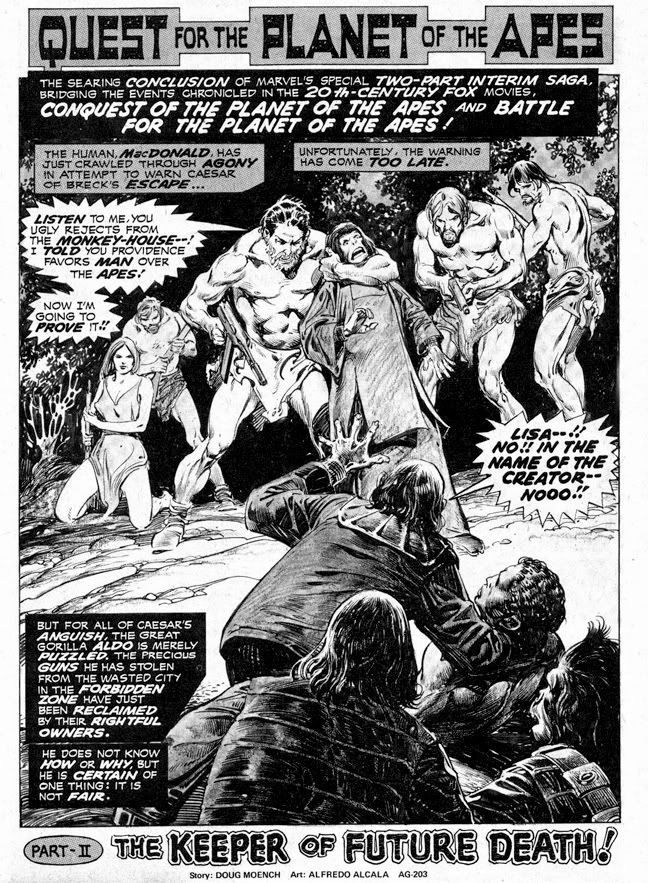
Remember a couple of years ago I wrote a piece making affectionate fun of the story "Quest for the Planet of the Apes" right here in this very blog? You don't? Okay, go read it here and then report back to me. It was meant to be the first part of a two-part look at an obscure bit of Planet of the Apes lore. And it still is, goshdarnit! Here's the second part! When we last left our jolly ape friends, they were about to fight an angry Governor Breck and his his band of nearly-naked humans.

 What's Breck so angry about? Well, he used to be ruler of a mighty state, but thanks to Caesar the super-smart boss of all the talking apes, he's now a bearded bum in a soiled loincloth. Just about anyone else in Breck's reduced position would look back on his life and think, "Maybe running a repressive regime that enslaved anthropomorphized apes wasn't the best career move," but the ex-governor isn't like most people-- refusing to recognize his own culpability for his fall from power, he places sole blame on Caesar and wants revenge!

Rico Rival has been replaced by my favorite Apes artist-- one of my favorite artists, period-- Alfredo Alcala.  Alcala's art here isn't as ornate as his work on the black & white Beneath the Planet of the Apes adaptation, a series highpoint.  It's a little simpler, the gray tones a bit flatter.  It's still quite lovely, with a slightly comical quality, especially in the apes' expressions.


Even after two years of constant study, I haven't figured out why the humans are in Tarzan rags. In the movie Battle for the Planet of the Apes, which this story immediately precedes, they just wore regular clothes. It would be thousands of years into the future before the humans started making like the extras in a Hammer Studios prehistoric romp-- my favorite is Prehistoric Women because it has the amazing Martine Beswick in it as the evil high priestess of a decadent tribe-- in Apes film continuity.  Another thing I don't understand is why the woman on the far left felt it necessary to kneel.  Other than to fit into the scene without Breck's jagged speech bubbles covering her face.

This page has an excellent feeling of depth, though.  The apes are almost silhouetted in the foreground, Breck and his gang occupy the well-lit middle ground, then there's a suggestion of foliage behind them.

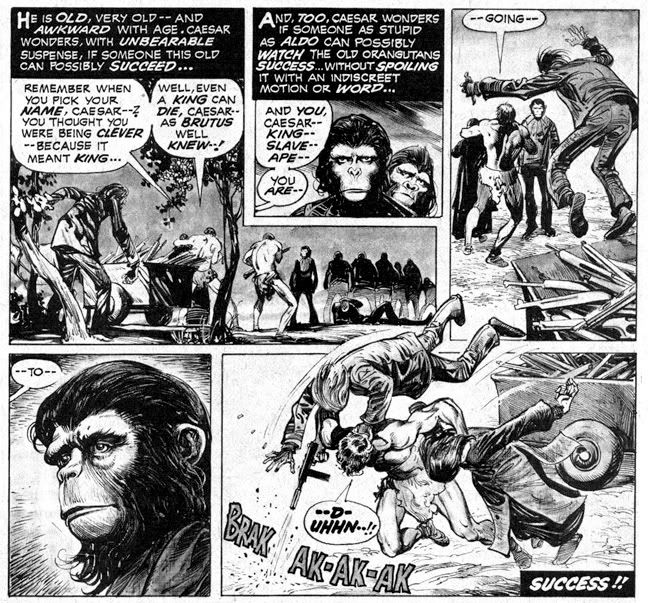
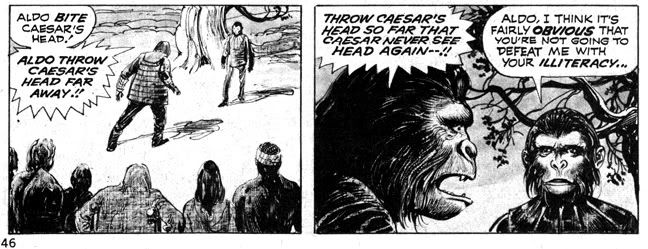
Instead of just shooting Caesar and being done with the whole ordeal, Breck has to voice all his grievances while Caesar and Aldo squirm uncomfortably.  It allows an old orangutan time to climb up on a wagon full of guns-- ever-generous Aldo brought them back from the ruined city in the Forbidden Zone to share with all his pals-- and jump on Breck.  This sequence occupies approximately 12 days of story-time.


Then comes the big fight!


Yeah, it's pretty much a re-write of Battle. My memories of that movie are confused with those of the David Gerrold prose adaptation. The novel is infinitely superior to the movie, which is common with film versions of literary works but rarely seems to work in the opposite direction.

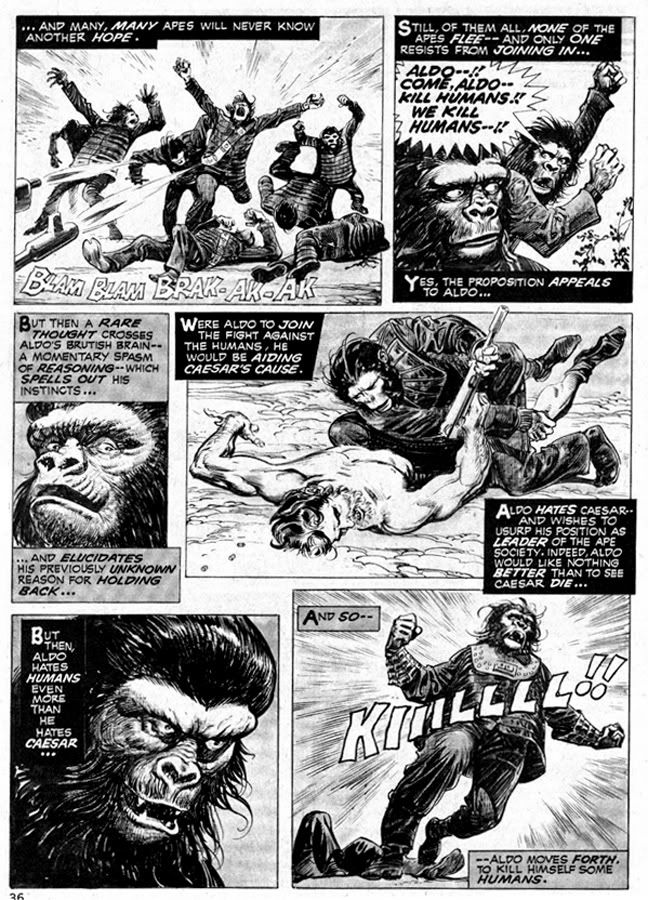
But in this case, Gerrold worked from a shooting script that was written for a significantly higher-budget movie than the one that eventually reached the screen. If I'm remembering correctly, Aldo holds his gorilla cavalry out of the big third act fight after a disastrous headlong charge into the humans' automatic weapons, then has his horse-apes chase down and slaughter the fleeing and demoralized survivors after their defeat by the other apes led by Caesar.

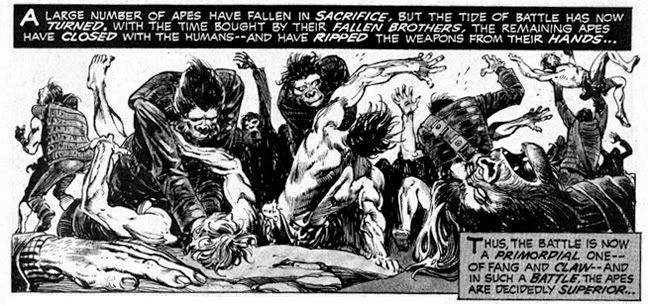
I believe that sequence never made it as far as the filming stage, which is too bad; the movie could have used a little more epic scope a "Charge of the Ape Brigade" would have lent it-- mutants to the left of them, mutants to the right, mutants in front of them, volley'd and thunder'd. You get the idea. Here, Aldo just can't decide. Let the hated Breck kill the hated Caesar or kill the hated humans? Eventually, he decides to do both. Which is good for us, because we get to see his gorilla soldiers do this:


And then Aldo himself do this:


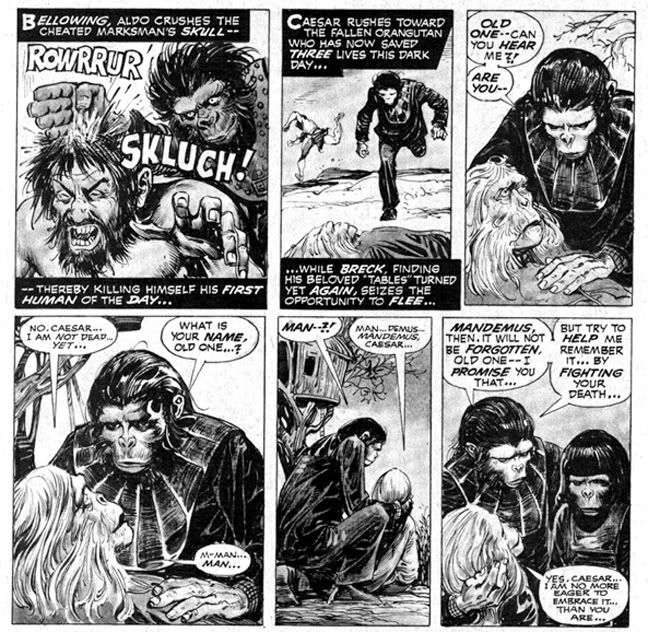
"Skluch!" Wow, these old Marvel magazines have the sickest sound effects, don't they? Take that, you filthy, gun-wielding counter-culture artifact! "Skluch" is the perfect "gorilla general karate chop to the skull" onomatopoeia, isn't it? Unless it's supposed to be, "Rowrrur!" and Aldo's actually sawing into the hippie's brain. But that hardly seems likely.

Oh yeah, that old orangutan turns out to be Mandemus, played by Lew Ayres in Battle.  Mandemus guards the Ape City arsenal in the movie, and his appearance here seems to contradict a bit of dialogue in the film.  Do you remember a scene where genius ape Virgil describes Mandemus as his former teacher?  I seem to, but I'm still not sure I trust my memories.  In this story, he's already an elderly kook.  Well, maybe he is a teacher and we just don't get to see his classroom.  But does it seem likely as familiar with Virgil as Caesar is later, he wouldn't know the primary teacher of the ape school in this story?

Am I confusing my sources again?


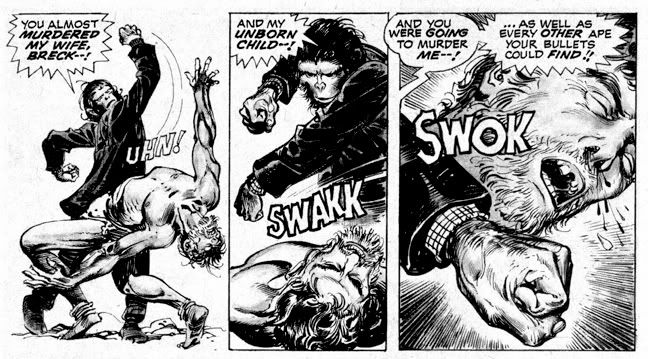
Not to be outdone by his more savage rival, Caesar engages the nearly-naked Breck in some mano-a-mano fisticuffs using the Marquess of Queensberry rules. Caesar is a civilized ape, but he throws a wicked right uppercut. BALD BULL! UPPERCUT! UPPERCUT! Sorry, that's the only punch I ever knew how to throw when I played that old video game.


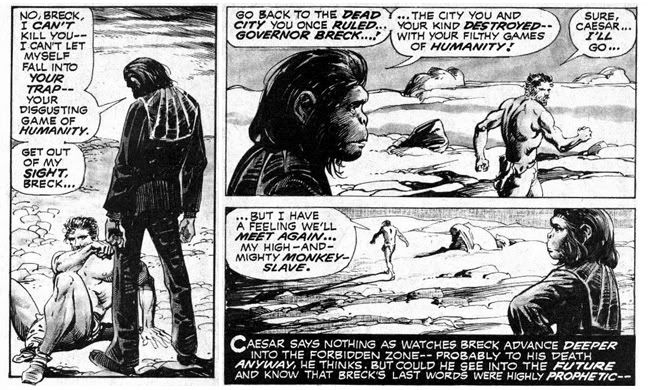
Finally, his feelings deeply hurt (he's a sensitive man), Breck sniffles a little, then storms off, vowing never to invite Caesar to his birthday party. Which would be held in the bowels of a city devastated by nuclear war, the kind of thing that sort of cuts down on the festive atmosphere.  And then, pumped up on adrenaline, Caesar goes and does something kind of stupid.


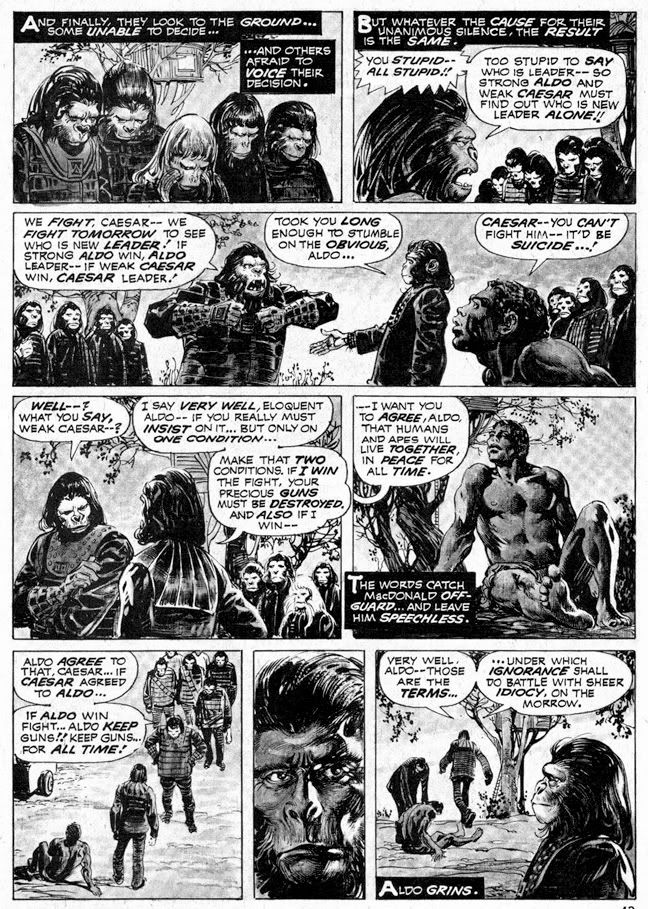
The next day, the two adversaries face off and toss arch bon mots at each other.  Caesar uses his wit like a rapier; Aldo uses his like a big wooden mallet.  He kind of reminds me of Animal Mother from Stanley Kubrick's Full Metal Jacket here:  "Well, I've got a joke for you.  I'm going to tear you a new asshole."  Animal Mother and Aldo, brothers in subtlety.  Might I suggest Adam Baldwin for this part in the remake?  I mean, not taking anything away from Claude Akins's fierce portrayal, but he's no longer alive.


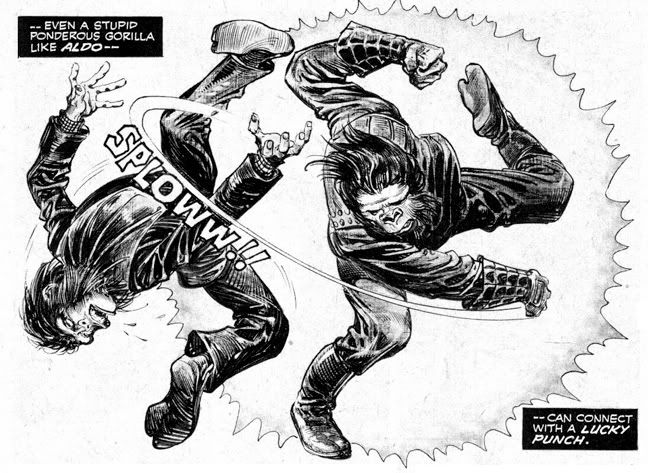
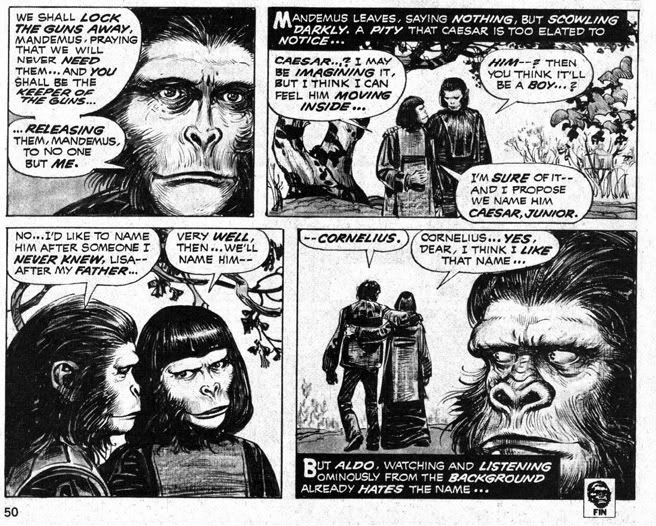
Now it's Caesar's turn to see how it feels! Check out the body language Alcala gives his battlin' apes here. Aldo just hit Caesar so hard, his unborn son Cornelius felt it!  He hit Caesar so hard, the shelf containing all the Mego Planet of the Apes action figures collapsed at K-Marts across the land!  There were plastic figures recalled all over the place at Christmas time that year because they came out with lop-sided faces and dark marks over their eyes.  He hit Caesar so hard, Roddy McDowall had to sit down for a few minutes while filming an episode of Rod Serling's Night Gallery.  Which makes the punch all the more impressive, because McDowall guest-starred on that show about seven years before Marvel published "Quest!"


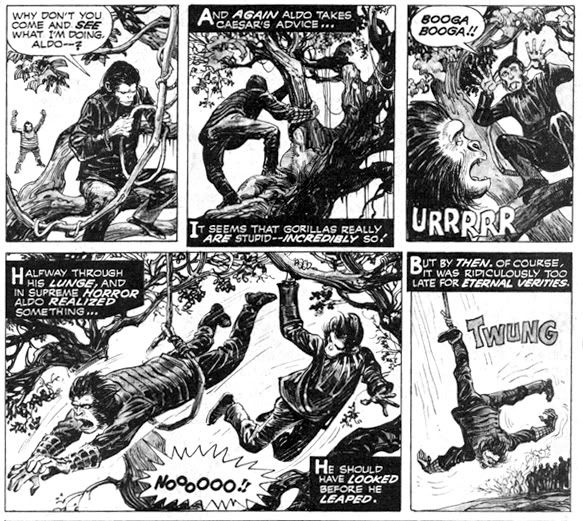
It's pretty much the final sequence of Battle, with Aldo taking to a tree. Only in this one, the outcome is a bit different.


Ah, slapstick!  Cue the circus music.  Perhaps "Sabre Dance" as Aldo struggles and spins beneath the swaying limbs of the big oak tree.  All's well that ends well, right? No, this is Planet of the Apes. Not only do things never end well, thanks to the circular nature of the series' narrative, they never end at all.


Oh, that irrepressible scamp Aldo! You know there's going to be all kinds of delicious trouble ahead!

While it may lack in originality as far as plot points go, "Quest for the Planet of the Apes" more than makes it up to us in sheer fun.  I wish Marvel had done a few more stories within the movie series continuity-- not that I don't dig all the weird-o stuff they did do-- but more than anything, I really wish someone would get on the ball and reprint all of Doug Moench's insanely brilliant Apes work.  Dark Horse... Dark Horse...  come in, Dark Horse!