
Thursday, November 8, 2012
The Secrets of Isis Episode 10: "The Outsider"
Former child star Mitch Vogel (he had a recurring role on the last seasons of Bonanza and appeared with Tim "Otter" Matheson in Yours, Mine and Ours, the 1968 film where Henry Fonda and Lucille Ball play two people with a thousand children each who marry each other and populate an entire town with their offspring) guests as Wayne Moss, the titular outsider of Isis episode 10, "The Outsider," which aired November 8, 1975. Wayne is a nature-loving newcomer to the big city and Andrea Thomas is so beside herself with joy at having a brilliant new biology student she's hitting up the school for more science equipment. All this fuss over one measly guy when there's still Cindy Lee! Cindy's not to upset about being bumped from the top of the teacher's pet ladder, though. See, jealousy and sour grapes just aren't in her nature. She's just too nice, so nice that when Wayne comes under suspicion for stealing the raccoon mascot of a rival school's football team, Cindy follows him to his private spot, a secluded lake area teeming with wildlife. The two students bond over a mutual love for little critters such as ducks and snowy owls. Cindy's admiration for the seemingly gentle Wayne is apparent in the starry-eyed way she gazes at him. At least until Wayne finds out the area's slated for development into a ritzy subdivision. Then he goes on a destructive rampage, first attacking a sign and, when he can't get the more sober and responsible citizen Cindy to help him vandalize it, atop a bulldozer.
"Jump off! Jump off! Get off before you get hurt!" Cindy shouts, but it takes Isis and a giant boulder to save Wayne. Ms. Thomas and Rick Mason soon join Wayne's environmental crusade, but the real raccoon-nappers have a problem-- the little furry fella is sick as can be. Only one person can help them. Former California governor Ronald Reagan. But they'll settle for Wayne Moss.
This is a rebound to glory episode, kind of heavy handed, but it benefits both from a lack of fake gorillas and from an incredibly intense performance from Vogel. His Moss is equal parts John Denver, Huckleberry Finn and barely suppressed rage until he spots the sign advertising the real estate development and turns into a complete maniac. Despite being kid-vid, Isis doesn't shrink from showing this side of him and making it frightening. At times it's almost as if he wandered in from a show aimed at a more mature audience like The White Shadow or Family, or even a 1970s horror movie about a bullied teen with supernatural powers. When the kids tease him, his glower is so intimidating you almost expect him to Carrie White-out on them and telepathically command the animals of the forest to emerge and rip everyone to shreds. But once he realizes he's going about things the wrong way and calms himself, most people end up respecting the lad's passion and affinity for wildlife. Pretty soon even the construction foreman is offering to delay draining the lake-- a process that involves dynamiting a dam-- until Mason can use his powers of persuasion on Mr. Winstead, a rich land tycoon who loves golf as much as Wayne Moss loves snowy owls.
The runaway bulldozer scene is pretty wild and provides a mid-episode action spike that contrasts nicely with the gentle scenes of Wayne and Cindy Lee holding hands as they wander around the meadows and forests near the lake viewing stock footage of squirrels. It almost seems at times the out-of-control machine is going to crush Cindy beneath its treads while Wayne protests the controls "are frozen" and "won't work." Or maybe the problem is a bulldozer is a fairly complex piece of machinery you don't have any business trying to operate, kid!
Interestingly, there isn't any real antagonist in this episode. It's more a story of ideas. Even the two oafs who bully Wayne and try to frame him for raccoon-napping quickly repent when the animal gets sick and the foreman folds after just a few words from Wayne. Meanwhile, Rick Mason must be a silver-tongued devil indeed because it doesn't take him long to convince Winstead to eat the millions of dollars he's already spent on the land and even more he stands to profit from his plans. The biggest moment of suspense comes when Isis has just a few seconds to stop some lit dynamite from going off, but instead of flying up to it quickly, she takes the long way around by running. Well, she knows what she's doing. And wow, what an explosion they have for us, folks!
A recurring element in Isis is whenever a student wanders off, all Thomas and Mason have to do is ask Cindy about his or her habits. She knows everything there is to know about each and every one of her classmates. I say classmates because all along I've been assuming she's a student (I love the idea of a Cindy Lee who admires Thomas and Mason and loves her school so passionately she wants to spend every waking hour there, kind of like a girl Max Fischer, but with excellent grades), but I have to admit at times her position at Larkspur High is a little ambiguous. Supporting my student theory is her response to Thomas's assertion that Wayne knows more about plants and animals than any student she's ever taught: "The rest of us could learn from him."
Speaking of ambiguity, Mason appears to be somewhat senior to Thomas in this episode. The DC comic states outright he's her boss, but perhaps the show's Mason is merely assigned to the budget committee or acting as Dr. Barnes's hatchet person here.
And I wonder about "the pond on the old Wilson property." It looks an awful lot like the lake where Andy Taylor used to take Opie fishing. I should ask Cindy Lee. She'll know. By the way-- yes, she rocks the overalls again!


Wednesday, November 7, 2012
The Secrets of Isis Episode 9: "The Show Off"
Little Steve Elwood has a Napoleonic complex which leads him to take dangerous chances, impressing approximately nobody. The first time we see him, he's angrily climbed a ladder to hang a banner despite being begged by practically everyone not to. I suppose he thinks that's the way to make friends-- act contrary, then dangle helplessly from a rooftop until Isis shows up. And is Steve grateful? He is not. He feels humiliated by the goddess' interference. Later, on the Science Club camping trip, Cindy Lee somehow gets her foot stuck in a bear trap. She's not hurt, but Steve once again tries to make himself a big man by freeing her. He fails because he doesn't read the instructions on the trap. When Andrea Thomas talks to him and he reveals himself as an expert ornithologist, Steve realizes what a fool he's been. Just in time for an escaped gorilla to trap him in a cave along with Cindy Lee, Rick Mason and another student.
Yes. An escaped gorilla.
Okay, I thought the bear attack in "Rockhound's Roost" was laughably bad, but Isis reaches its first season nadir in "The Show Off," which aired November 1, 1975-- kind of a late Halloween trick played on its unfortunate fans, but not enough to destroy the show. The script is full of neat little quips and the Steve Elwood part is fine (plus his last name reminds me of the Blues Brothers, which is never a bad thing unless we're talking Blues Brothers 2000, which we're not and never will), just some standard Isis fare about a troubled student getting himself into problems on his way to maturity. Where the show goes off the rails is someone in power apparently decided Steve's little dilemma wasn't worthy enough for an entire episode. Bizarre plot twist time!
Even before we see the gorilla we're already anticipating the horrors of a Saturday-morning ape costume-- shades of the vastly superior Tracy the Gorilla from The Ghost Busters-- but really, this whole thing is completely out of left field. It's not even foreshadowed, basic Drama 101 stuff. All you have to do is have some dialogue referencing a circus coming to town, or at some point have the characters listen to a radio report about an escaped gorilla. They foreshadow Cindy Lee's animal trap misadventure and that hardly takes a minute of storytime to play out to its resolution. The gorilla is the show's big finale and nada. Zilch. Non sequitor.
Really, this could hardly have been more ridiculous if they'd had the gorilla turn out to be female with the hots for Rick Mason and Isis soaring to the rescue before some kind of half-assed ape-human wedding. It's as if someone spliced together a segment from an ABC Afterschool Special with half an episode of Gilligan's Island.
According to IMDB, Harry "Steve Elwood" Gold had a nice run of guest-starring credits throughout the 70s, a small part in Brian DePalma's 1976 horror classic Carrie and culminating in a 1980 appearance in one of my all-time faves, The Misadventures of Sheriff Lobo. Oh sure, he was apparently in something called First Family after that, but when you've played a bellboy on Lobo, that's like winning the Super Bowl; it's best to bow out while on top. These days he's an actor's agent, and adopted father to the Gold sisters acting dynasty of Missy and Tracey. He's actually quite good in this episode when not playing the jerk or being menaced by an ape. When he finally accepts his limitations and comes into his own by relying on things he's actually good at-- identifying those birds, for example-- he's got a shy smile and explains to Ms. Thomas the difference between a crow and a raven in a bright and winning way.
No one should be asked to act opposite a moth-eaten gorilla costume, though. But even I have to admit the scene where the gorilla's keepers retrieve her and drive off in their jeep is worth the price of admission. There's just something uniquely attractive about the way the performer waddles while looking like nothing so much as someone thinking, "I left Tulsa for this? Thank Christ no one's going to see my face." It's an animal portrayal almost polished enough for a kid's birthday party or a Jaycees haunted house.
The good stuff-- Rick Mason is some kind of freaky pizza gourmand. When we first see him, he's describing the most wondrous pie to Andrea Thomas: mushrooms, pepperoni, meatballs, strawberry jam, onions; even Ms. Thomas can't believe it. He's also planning to turn the Science Club outing into his own personal fishing trip. When an upset Steve runs off into the woods, Mason can't hide his disgust and lets everyone know he was afraid all along Steve would ruin everything. Probably because it means less time for fishing and wearing his awesome bright orange fisherman's bucket hat complete with lures pinned to the top. Tut can knock on doors when he wants to be let into a room. Cindy Lee gets the biggest (intentional) laugh of the episode with her witty reaction to having her foot caught in the trap. She tells Steve, "Why don't you just call a ranger so he can tag me and then let me go." She's wearing the baby blue overalls when she says it, which is always a bonus. I dig how Joanna Cameron can go from playing the compassionate young teacher in the more naturalistic Steve scenes to maintaining her dignity as the stately Isis even while spouting rhyming couplets at a clod in a gorilla suit. She's marvelous!
This episode also showcases the show's increasing tendency for plot specific special effects. Sure they use their handy stock footage of the Isis transformation and a short version of her swirling take-off (minus the "zephyr winds" rhyme), but they also include a short process shot of Isis landing on the school's roof. It's not necessary, but as a viewer I appreciate they spent a little money this time out. The chromakey outline around Isis is very obvious, but it probably looked a lot more convincing on yesteryear's Zenith and RCA television sets beaming in via antenna rather than over cable. DVD and high-def have not been kind to these old shows.
Tuesday, November 6, 2012
The Secrets of Isis Episode 8: "How to Find a Friend"
Let me tell you, if anyone needs a lesson in how to find a friend it's Tom Anderson. He's creeping everyone out and causing concern for teachers like Andrea Thomas and Rick Mason. Mr. Mason even refuses to take Tom along on a field trip the local botanical gardens, which is sure to break the kid's heart because he's so into the rich fragrances of various flowers, especially the way they relate to all-natural herbal shampoos and conditioners.
The lucky kid gets to attend Larkspur High where not only are there caring adults but also a dirtbike track adjacent to the campus where he can go during class hours. Maybe it's a PE class or something: Intro to Dirtbiking. Tom tries to trade his father's war souvenir-- some kind of generic-looking revolver-- for a ride on an older boy's mini-bike. It doesn't work out and a poor car headlight pays the ultimate price. Now there's a reckless gun-thief on the loose with a pistol that will probably explode in his hand the next time he tries to fire it. And that's the best case scenario, because he could just as easily knock over a liquor store or go on a shooting spree. His name is Joe, and what he really wants to do is kill some rabbits. And possibly eat them. Cooked, I hope. Looks like Isis has a life-threatening crisis on her hands and what follows is a tense race against time...
It would be easy to pick the low hanging fruit (to use a phrase that seems to be popular these days) and mock this week's guest star and his connection to The Brady Bunch. Easy, but unfair because erstwhile Bobby Brady Mike Lookinland does a credible job with his goofily-written character. Whatever else The Brady Bunch happened to be-- I consider it kitschy TV sitcom dreck-- it featured a cast of professionals from the grown-ups down to the youngest kids. It's obvious Lookinland has outgrown his Brady cuteness (kid has a magnificent head of mid-70s style wavy hair, though), but he brings a polish to each scene he's in. As young as he is in this episode, he was already an old hand, a seasoned pro and Lookinland delivers his lines with conviction and believability. Another winning guest star performance for Isis.
While playing a weirdo. Tom isn't the worst kid in the world. He just has some severe personality problems and is way too eager to make friends. Witness his hasty attempt to jump several weeks of relationship time during his ill-fated attempt at befriending Joe, otherwise known as the "yellow mini-bike/rabbit hating guy." Later, after losing a race (someone finally let him ride a bike) with Cindy Lee as the judge, Tom angrily accuses the most honest and kind-hearted student at Larkspur of cheating in favor of his rival. I mean anyone who would shout at Cindy Lee-- of all people-- is in real need of counseling. One can only hope at the episode's end he'll get the help he needs.
Here's a rare Isis episode where the stakes are truly high. This isn't a contrived situation where someone's stolen some imaginary device that leaks radiation or another class outing where Cindy Lee or one of her classmates gets a foot stuck in some rocks while running from a bear or a gorilla. Kids watching Isis would never in a million parallel universes of probability find themselves in such straits, but in the United States guns were and remain plentiful. They're attractive and exciting. "Friend" doesn't attempt to demonize guns or gun ownership by any means, just to instill a healthy respect for the dangers inherent in handling them, a lesson my gun-owning father worked hard to impress on me from an early age. I'm sure Isis would agree with my dad-- guns are not toys. Especially not old ones of uncertain provenance. "How to Find a Friend" benefits not only from its hard-biting lesson but also suspenseful race-against-time plotting-- kind of reminds me of the Alfred Hitchcock Presents episode "Bang! You're Dead" (directed by the master himself) where the little boy in a cowboy hat finds a real pistol and we follow him around while we wait for the explosive finale.
Director Hollingsworth Morse isn't exactly a Hitchcock and Isis as a low-budget kid show had to burn throw a lot of set-ups in a day (which means plenty of two-shots and the like rather than complex point-of-view shots) but use of foreshadowing provides a level of suspense beyond Isis's usual offerings. Because the show needs a positive ending, it can only take us a few baby steps towards a violent or tragic outcome (as far as I know, Lucky the dog is the only character who actually dies in an episode), and once again we see in the Isis world, there are few truly bad people. The worst you can say about Joe (Tommy Norden, who played Bud Ricks on Flipper-- another old trouper!) is he shows poor judgement. Even he comes to realize that and all is well once again.
But yelling at Cindy Lee? Now that's what I consider unforgivable, man.
A few little observations-- This is the second episode (maybe third) in a row Cindy Lee wears those infamous baby blue overalls, which we first see as she greets Mason in the opening scene. It's Ms. Thomas's birthday and they've bought her a cake. Thomas's favorite? Chocolate, of course. Tut likes it, too. Crafty Mason invites Thomas out for a birthday dinner-- but she has to agree to handle his sixth period class with troublesome Tom while he takes the rest on the field trip. Cutler gets to clown around a bit in this scene, even breaking out a very nice Arte Johnson-doing-his-German-accent impression. But what made me laugh the hardest this episode is the follow-up scene where Cindy Lee comes back with a birthday bouquet for Thomas and the teacher jokingly asks her if she picked them at the botanical gardens. Cindy gives her a completely sincere, "No! On the way back!" response. Sometimes I get the idea both Thomas and Mason like to tease credulous Cindy by asking her silly questions just to find out how she'll reply.
Another neat moment: Mason reports he's more than likely walked through poison oak.
"You're a science teacher and you don't even know what poison oak looks like?" Thomas razzes him.
"Yeah, it looked very pretty," Mason replies. "I was going to pick you a bouquet." He cracks himself up.
Sunday, November 4, 2012
The Secrets of Isis Episode 7: "Bigfoot"
The Larkspur High kids-- including some we've never seen before and will probably never see again because they're already old enough to be parents of high schoolers themselves-- enjoy a school picnic complete with a mellow performance of "Home on the Range" on guitar by Rick Mason. Of course who else but center-of-every-event Cindy Lee (wearing her baby blue overalls, an outfit that gets quite a workout in the first ten or so episodes) and a male classmate also named Lee come running back with reports of having seen Bigfoot.
Actually, I should point out Cindy first sensibly suggests it may have been a bear; a rational, down to earth explanation despite her hectic state of mind. One can understand her reluctance to commit to cryptid species identification when considering her association with the science faculty and her recent misadventures involving the worst bear costume ever captured on film. Also, take into account Mason's openly irritated response to Lee's insistence what they saw was, in fact, Bigfoot. He is pissed! Cindy Lee's fun-loving and outgoing, but she's been around Mason long enough to judge his moods. No fool that Cindy Lee.
But even the science teacher's remonstration can't stop Lee from becoming obsessed with obtaining photographic evidence of Bigfoot's existence, to the point of endangering his own life. Once again it's Isis to the rescue.
"Bigfoot" (aired October 18, 1975), features some solid guest star work from Scott Colomby, later to play Tony D'Annunzio in Caddyshack. He's got a cool James Franco-ish vibe. But gosh darn it, when you promise Bigfoot you have to deliver Bigfoot, not a bearded 7'3" Bill Engesser in a floppy hat and plaid shirt along with a lot of sermonizing (with a melancholy harmonica on the soundtrack no less) about how people can be cruel to those they think are different, but you should still give them a chance.
I mean, yeah, I agree with the message; respect and cherish each other for the things that make each of us unique and all that. Joanna Cameron certainly delivers it in a stately cadence befitting a wise goddess. But Bigfoot, man. Bigfoot. You promised us Bigfoot and then you wimped out on us. Although considering the show's bad luck with animal costumes, perhaps I should be a bit more charitable.
I haven't talked much about Albert Reed, Jr. as Dr. Joshua Barnes. Mainly because he's not exactly a major character-- after all, the DC comic based on the show couldn't get his age, race or even his academic credentials right most of the time. Dr. Barnes's function is to appear, offer a few words of wisdom, then glide away and let the rest of the episode bear out his gentle admonitions. His air of calm, benign authority probably has something to do with his steady, longtime gig at Los Angeles International Airport where he retired as its Chief of Security in 1983. Reed even played a version of himself and his job in the 1969 air-disaster flick Airport.
Nowhere is Reed's presence as Barnes felt as much as it is in this episode where he espouses a gentle, leave well enough alone philosophy regarding Bigfoot.
"Too many people think that anything they don't understand is dangerous," he tells Lee, who's ready at this point to join an armed mob to hunt down Bigfoot without really knowing why. "That's wrong. If you don't know what something is, you should be cautious, but not afraid. Not set out to hunt it down. As far as we know Bigfoot is only a fable, just like vampires and ghosts. So let's not have anymore idle talk about it, okay?"
Words worth remembering, and Reed is convincing. If only all our leaders were as sensible and open-minded as Dr. Barnes. Could Larkspur High ask for a better principal?
Wednesday, October 31, 2012
October is Spookey Month: Happy Halloween! I'm out of Spookey videos, you're sick of my pretentious-alternating-with-silly writing style so here are some fun horror shorts instead!
Remember that horrible clown doll from Poltergeist? You know the one I mean. This story features his trans-Pacific pen pal:
The price of these canteloupes is pretty frightening:
Here's a hard-working guy trying to be a good father. Too bad he can't get it the right way 'round:
Don't hold your breath waiting for Tommy Lee Jones and Will Smith to show up. By the way, Tommy Lee Jones is the face of Boss coffee here:
And last but far from least:
And that is that! Enjoy your night of horrors, then join us here in November as I once again start hoppin' down the Cindy Lee trail with more Secrets of Isis reviews starring Cindy Lee. I'm going to review every single one and toss in more fun stuff from the DC comic as well.
October is Spookey Month: Let Doug Moench and Richard Corben show you how to trick-or-treat!
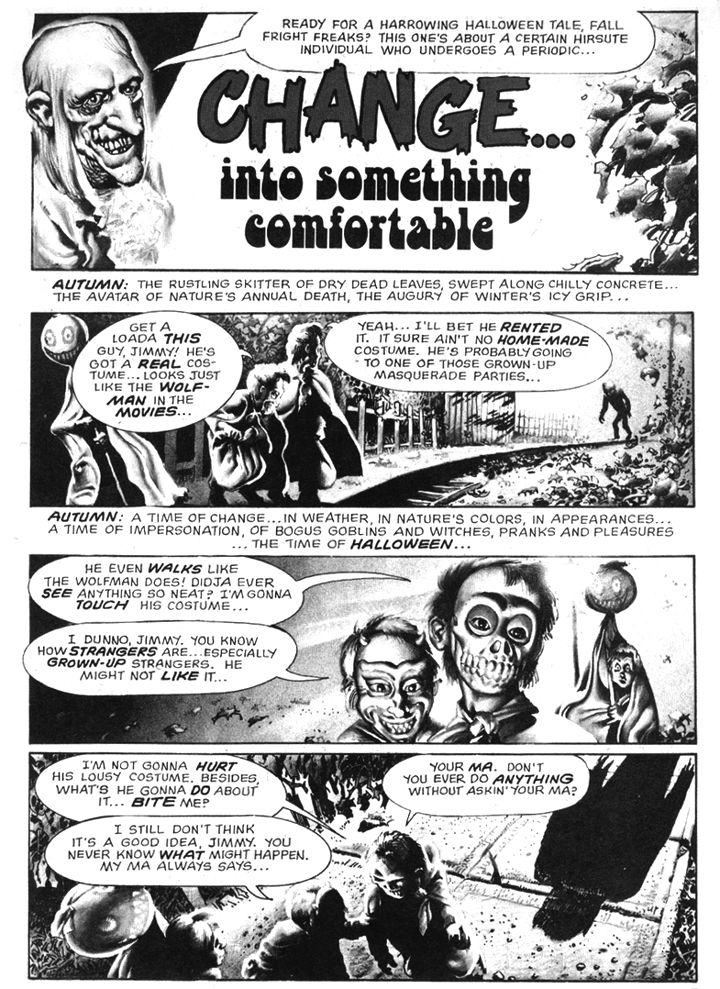
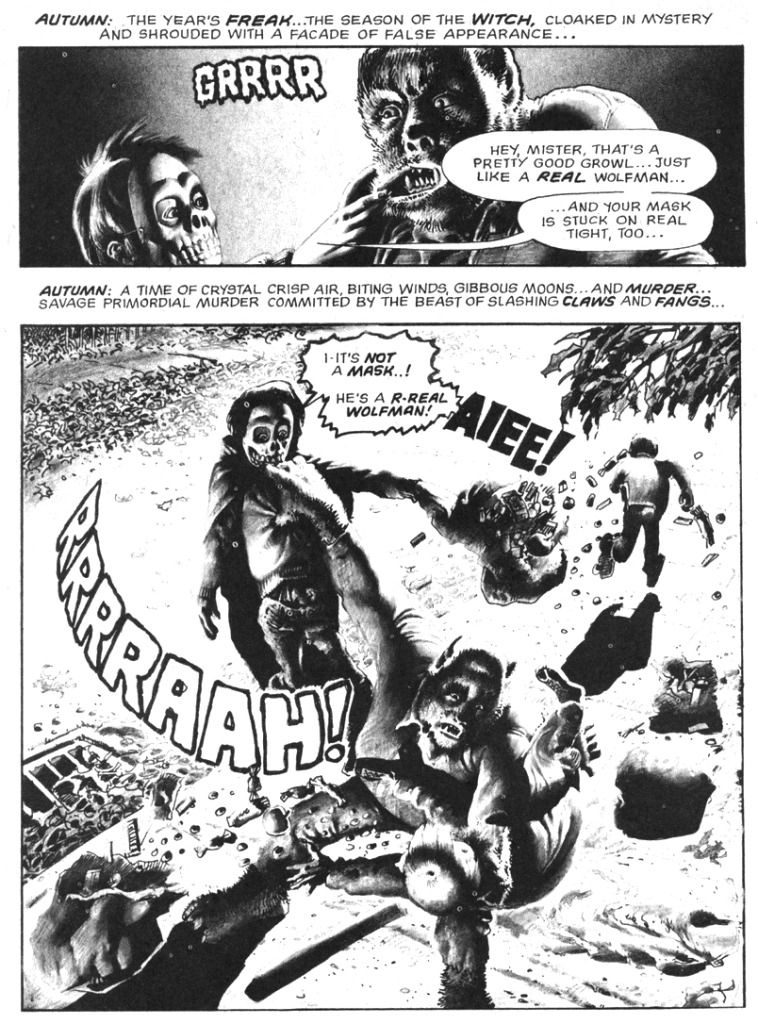
Yes, Halloween is a fun holiday, but you should exercise at least a little caution when out trick-or-treating. Go in a group, wear a costume with reflective tape so motorists can spot you, go only to well-lit houses. And most importantly-- don't pull on a werewolf's lip. These are a few simple safety tips brought to you by Doug Moench and Richard Corben in their horror-comedy classic, "Change... into Something Comfortable," which appeared in Creepy #58 (December 1973), a "special Halloween horror issue" (so it says right there on the cover). While I didn't particulary enjoy "The Slipped Mickey Click-Flick," I'm a huge fan of this little seasonal-flavored gem.
It starts with a real werewolf ripping some smart ass kids to shreds and ends with a sweet twist I find both irresistible and hilarious. I mean if you've ever wondered what creatures of the night disguise themselves as on Halloween, here's your chance to find out. "Comfortable" is sort of a companion piece to Corben's even more hilarious "Lycanklutz" from Creepy #56 (September 1973). That earlier full-color romp features a somewhat luckier werewolf in a medieval setting with some surprisingly anachronistic products available for sale. By contrast, our contemporary, kid-killing monster in "Comfortable" strays into EC territory with tragic results. I could have hit you with "Lycanklutz," but this one is all about Halloween and disguises and has those melodramatic Moench narrative captions. You can read it in the Dark Horse Creepy Archive Volume Twelve.
Come to think of it, you can read them both in that book.
Tuesday, October 30, 2012
October is Spookey Month: Remember when Swamp Thing visited the Winchester Mystery House?
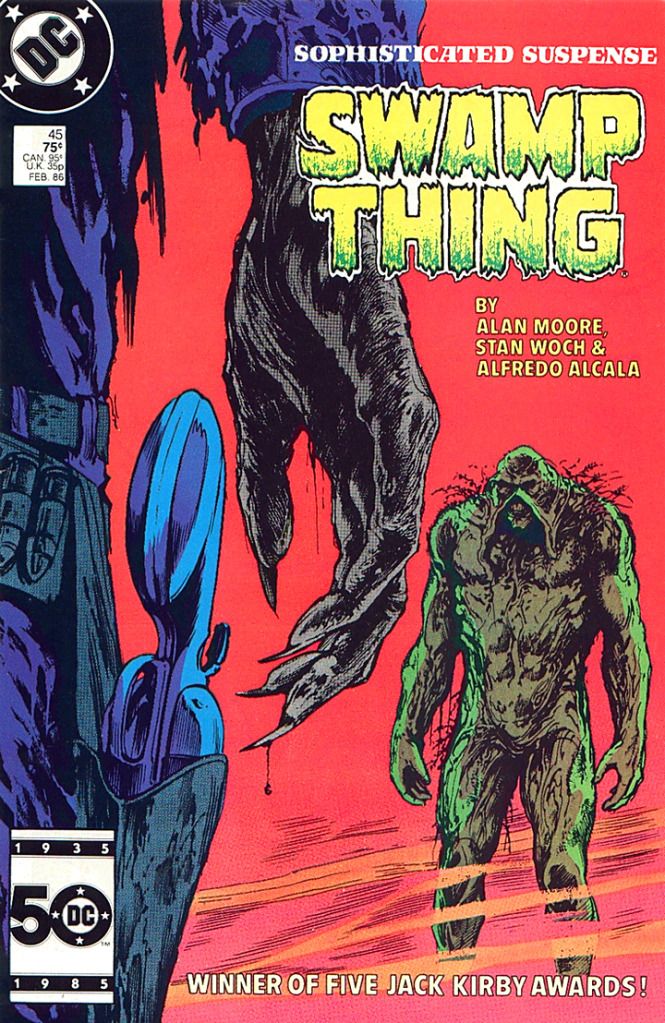
You don't remember? How about the time Swamp Thing visited the Cambridge Mystery House, the DC universe version of the same place? Rings a bell, huh? Bangs a nail. Hammers and all that. The Winchester Mystery House is a fascinating place, the life's work of Sarah Winchester, widow of William Winchester and heiress to the Winchester Repeating Arms fortune. Somehow she took it in her head spirits would kill her if she ever completed the mansion where she lived, so construction went on around the clock for nearly 38 years until Mrs. Winchester's death in 1924. Mrs. Winchester was a little eccentric (according to the Winchester House's official website, some of her employees actually thought she herself had supernatural powers), obsessed with the number 13, and her house is equally... er... original. Stairs to nowhere, fake bathrooms, windows on the inside, liberal use of redwood because Mrs. Winchester preferred it-- although it all had to be stained or painted to look like some other kind of wood because she hated its appearance. Given the house's origins and bizarre interior, it's no wonder the Winchester Mystery House has a reputation as a haunted mansion.
Alan Moore puts the Winchester lore to good use in "Ghost Dance" from Swamp Thing #45 (February 1986) with the help of some evocative art by Stan Woch and Alfredo Alcala. A group of friends enter the dilapidated Cambridge House for a laugh while the reedy, Howard Sprague-with-red-hair-looking one (he proves to be as cuckolded as Jack Dodson's character in The Getaway, as well) explains the backstory, which Moore takes directly from the Winchester House. One character even namechecks the real-life inspiration in case you had any doubts, and the NRA bumper sticker displayed on their car provides a visual clue that we're in for a lecture wrapped inside a horror yarn, one with obvious intent and an anti-gun-- or at least, anti-gun violence-- point of view, but a touch more subtle than the "Nuke-Face" environmental tale from Swamp Thing #35 and #36 (April and May 1985) with its pages full of newspaper-based collages.
This was during one of my favorite Swamp Thing story arcs, in which John Constantine, the British mystic based on Sting, takes Swamp Thing around the world to stop a rising tide of supernatural events culminating in... you guessed it... the end of the world. Moore uses this premise to explore horror mythology, but with his characteristic brilliant improvisations on familiar material. Swamp Thing fights vampires, but they're underwater. He tangles with a werewolf, but it's a woman and a commentary on our patriarchal society. In this issue, Constantine has Swamp Thing facing down the Cambridge ghosts.
And just what are these ghosts? Apparently, they're everyone in North America who ever died from a bullet fired from a gun or rifle manufactured by Cambridge Arms. Dead cowboys blast away at each other in the seance room (Mrs. Winchester would approve of its thirteen Victorian fireplaces), bullets whittling them both down to next to nothing while their battle rages all night. Little girls, murdered on Christmas Day by their father, walk innocently through the spectral carnage, their wounds like red ribbons in their hair. Buffalo stampede from a free-standing wardrobe, apparently all the way from Gunpowder Narnia. Cowards linger in the kitchens, shamed, faces hidden in hands, each back stamped with the red badge of fear. One especially tragic note comes when the narration points out what percentage of the ghosts are Native Americans.
"Ghost Dance" is a melancholy look at our capacity for violence and the tool that truly built our modern American society even more so than the car, the train or the rocket to the moon, as evidenced by Moore's repetition of the phrase, "The sound of hammers must never stop," fraught with double meaning. Guns, the love of guns and gun violence are so engrained in the American psyche, we can't even have a rational discussion about them no matter how many bodies pile up. Moore, though this fiction, might argue the victims wind up in a Mystery House of the American soul, a haunted mansion we're all still guiltily building just like Sarah Winchester and her fictional analogue Amy Cambridge, even as the sound of hammers continues to ring from coast to coast.
They have never stopped.
Subscribe to:
Posts (Atom)