Wednesday, February 20, 2013

Teen Titans #1 (February 1966): Nick Cardy makes a splash, Bob Haney makes a point


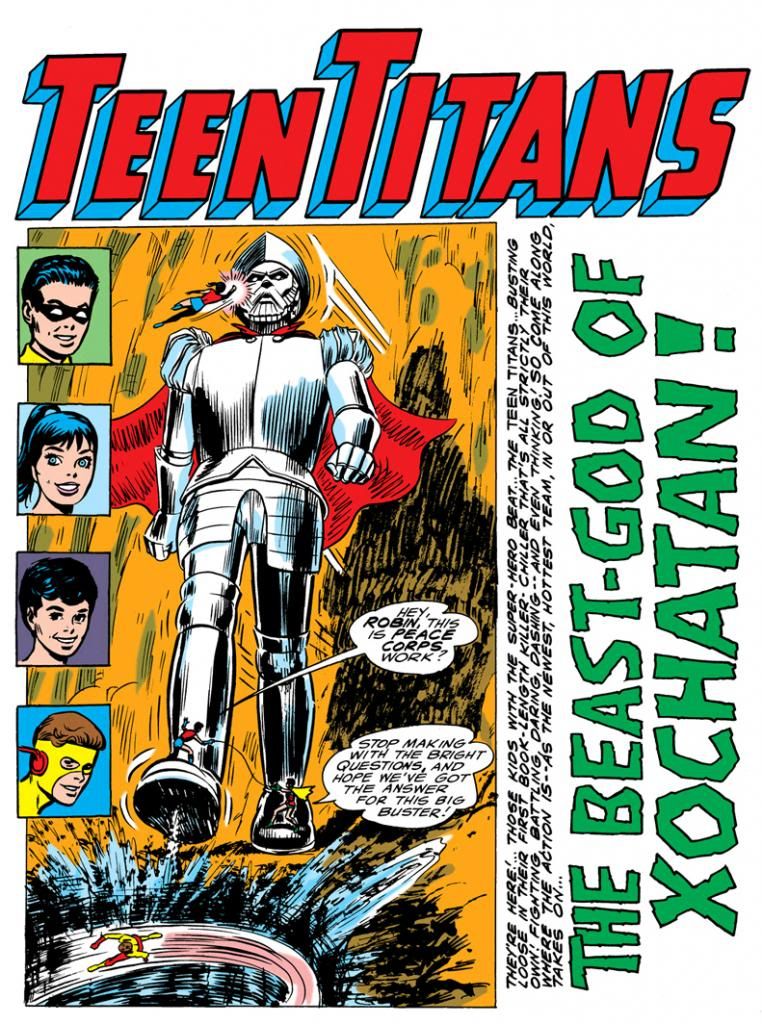
This is the colorful splash page to Teen Titans #1 (February 1966), drawn by Nick Cardy.  Written by the great Bob Haney, this first issue of Titans is essentially a positive, happy-go-lucky propaganda piece about the glories of the Peace Corps, which was a big deal for socially-conscious youngsters back in the early- to mid-1960s.

Officially established by John F. Kennedy with Executive Order 10924  in March 1961, the Peace Corps has been sending young Americans all over the globe to win hearts and minds by doing good works in developing nations ever since.  Back when the Titans made their collective bid for membership, the United States was still basking in the afterglow of having helped defeat fascism in the 1940s and taking leadership in facing down communism ever since.  World War II and the Cold War had frosted isolationism (except for a few backwards people living in mountain shacks and dank caves) in favor of internationalism, engagement on a global scale, and we Americans believed in solving humanity's problems and fostering democracy abroad by providing clean water and education.

In fact, we learn that almost every adult hero in the DC universe is some kind of Kennedy Democrat, a bunch of gaudily costumed but easily recognizable Eastern Establishment types of the kind hated and feared by Tricky Dick Nixon.  Or at least Rockefeller Republicans.  It's not enough that their young wards regularly risk their lives fighting crime.  It's joining their the Peace Corps that makes Batman, Flash, Aquaman and Wonder Woman beam with pride.  Not a single hero expresses anything but almost giddy enthusiasm for this Peace Corps thing.

We miss only Superman's reaction.  Why?  Because Superman is a god who needs no teen sidekick.  He's the father figure to all the other adult heroes, not a bunch of shirt-tail kids.  He's off trying to solve galactic entropy while they're fighting mutated fiddler crabs and giggling morons with chemical burns.  Superman does have his famous cousin, but Supergirl is probably digging canals, inoculating babies against tuberculosis and smallpox and teaching birth control and crop rotation on her own time.

Incredibly, even though he lives with Robin in palatial Wayne Manor, Batman has to learn of his ward's decision from a newspaper headline while he's scaling a drainpipe on a building in downtown Gotham City.  In the "dark of night."  Great night-vision this guy has after years of nocturnal crime-busting, hug?  The Caped Crusader may be on a case-- unless he practices urban mountaineering for fun-- but he still has time to turn, eyeball a handy newsstand through the gloom, make his discovery and loudly proclaim his joy to no one in particular.  I'm guessing he doesn't bother to buy the paper because the fabulously wealthy Bruce Wayne very wisely refuses to carry loose change in his Batman costume in case he gets into combat, kind of like Colonel "Bat" Guano in Stanley Kubrick's Doctor Strangelove.

The teen heroes let Wonder Girl choose their destination by sticking a pin in a map, which she does with an athletic flourish and characteristic joie de vivre.  So it's off to the Andes Mountains after a quick training montage to lend a helping hand to those in need.

And, as you can see from this splash page, the Teen Titans version of Peace Corps work doesn't differ all that much from the organization's directives; it's just a bit more aggressive.  They aid the needy using their personal expertise in punching, hitting and kicking things.  But that's not all they do.  They right historical wrongs, as well.  What else is toppling that giant conquistador but the defeat of  the lingering effects of European imperialism and a refutation of criticism America is merely engaging in a modified, cleaned-up twentieth century version?

In case you miss the point that America isn't like all those other old, abusive world powers, the ultimate villain turns out to be a greedy landowner run out of the village before the story even begins by the hard-working campesinos-- all your rapacious developing-world pirate capitalists out to thwart progress, one ruffle-collared bastard representing the kind of repressive guys who made communist revolutions in places like Cuba and Nicaragua necessary because the U.S. sided with them instead of doing what the Titans and the Peace Corps do here.  Of course, there's even one continuing in Peru to this day, but not for lack of Titans effort.

But this book isn't just politics.  After all, it would be a dull-ass comic with just Sargent Shriver making speeches to the Titans.  We readers demand some kind of giant menace for the kids to clamber all over (plus angry, attacking animals with human faces), and Haney knew how to deliver his patriotic, yet somewhat socialist, message in a colorful, action-packed way (like those sneaky vitamins in our chocolate-coated sugar-frosted rice puff cereals).

Looking back, it's obvious what this prescient story is telling us is the U.S. could have avoided a lot of grief in the coming decades if we'd only modeled ourselves after Wonder Girl, Robin, Kid Flash and Aqualad and taken on the real menace instead of merely replacing recalcitrant dictators with more compliant ones.  But there's none of that cynicism in this story.  Haney makes me wish I'd joined the Peace Corps back when I was a teen-aged superhero.

Monday, February 18, 2013

Wonder Girl: Best of all the Teen Titans!

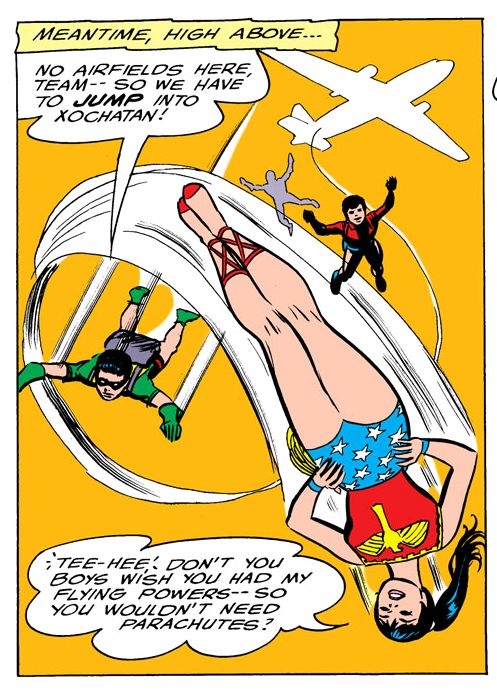
Nick Cardy, Teen Titans #1 (February 1966)

This gorgeous Nick Cardy panel of Wonder Girl showing up the rest of the Teen Titans appeared in Teen Titans #1, way back in February of 1966.  Those were not simpler times.  John F. Kennedy had been assassinated almost three years earlier, the Vietnam War raged in Southeast Asia (the same month this comic came out saw both the Tay Dinh and the Go Dai massacres), John Lennon made his infamous claim that the Beatles were "bigger than Jesus" and a gunshot felled James Meredith during the March Against Fear to encourage African Americans to register to vote.   War, assassinations and riots lay ahead in the next few years as a nation threatened to tear itself apart.  Above it all soared Wonder Girl, held aloft by the hopes of youth in post-war America, amid the fast-fading ghosts of Camelot, the dreams of the Civil Rights Movement, the high-tech hopes of the Space Race, and the attempt at making a Great Society.

How could you not love Wonder Girl?  In fact,* will fist fight at high noon on the corner of 3rd Avenue and Pine Street any sucker who doesn’t like her.  All right, I’m just kidding.  I never get up that early.  We’ll have to fight sometime later in the afternoon, or perhaps just before dinner time.

No, really, Wonder Girl really is a wonder.  Out of all the Teen Titans, she gets the biggest kick out of having powers, being young, being a girl.  The latter would be difficult for the others as they’re all boys, but all gender considerations aside, the 1960s Wonder Girl is pure joy.  She’s a pleasure seeker who finds pleasure almost everywhere, in the smallest things.  Like simply being able to fly.  That’s the kind of true happiness that doesn’t require a lot of extraneous elements; the rest of us—those who aren’t vivacious young Amazons capable of flight-- can get that a similar feeling from running (if we’re runners) or drawing (if we’re artists).  Or whatever it is we like to do with the least fuss. 

Her self-confidence is refreshing, as well.  Being a Titan means she’s probably not the smartest person you’re likely to meet.  She’s more into dancing than reading, for example.  She probably favors Frankie and Annette beach musicals over French Nouvelle Vague cinema, the British invasion over minimalist composers.  There’s nothing wrong with any of that.  It all just goes to show Wonder Girl is comfortable within herself.  And that makes her a positive role model in my book.  A girl to learn from.  Love who you are, love what you do, love life itself.

In the vintage Teen Titans, which are generally easy, breezy, carefree reads about teens who want to help the world rather than tear it apart, Wonder Girl is by far my favorite character.  If DC should ever bring her back, they need to bring back this version or someone similar.  More light.  That’s what’s needed.  More light, fewer shadows.  

*Not in fact.  But you can treat me to lunch.

Richard Dragon Kung-Fu Fighter #5: Lady Shiva's first appearance

Her name is Lady Shiva, and she does hate Dragon's guts.  Actually, her name is Sandra Woosan and the reason she hates Richard Dragon is because she thinks he caused her sister Carolyn's death.  This is how she appeared in DC's Richard Dragon Kung-Fu Fighter #5 (December-January 1975-1976).

She's changed a lot since then-- even more so since the advent of the New 52-- but back in the mid-1970s, Lady Shiva wore a head scarf stolen from Rhoda Morgenstern.  One thing that's remained constant throughout her various DC comics incarnations is Lady Shiva's ability to deal out ass-whippings.

When we first see her, she's in a purple hood and green pants and art team Ric Estrada and Wally Wood have craftily drawn her to look like a man.  In her very next scene, they have her in some kind of Asian fetish dress and looking definitely female.  Later, when she finally gets to fight Richard Dragon, she's back in that purple-green hooded outfit but this time sporting a more feminine shape.  She quickly ditches the hood and spends the rest of the issue in the same green outfit we see her in on the cover.  She starts by throwing shuriken at Dragon, but doesn't hit him, for as she declares in her best Inigo Montoya impression, "I deliberately missed you, pig... To prove I could kill you easily!  Instead, I prefer to do it otherwise...  ...To pound the life from you!  For I am Sandra Woosan...  ...And you caused the death of my sister!"

As the fight begins, Dragon protest, "Sandra... Shiva... We have no quarrel--"

"Afraid to strike a woman, pig?"  Sandra sneers and punches him in the face.

Lady Shiva's first appearance.  Ric Estrada and Wally Wood, Richard Dragon Kung-Fu Fighter #5 (Dec.-Jan. 75-76)

Within a few moments, Dragon convinces her he's not the one responsible for Shiva's loss, that it's Cravat, grotesque-looking guy shooting death-rays at both of them just to make their fight more interesting.  He's drooling, too.  Without missing a beat, Shiva turns her rage on Cravat, but Dragon prevents her from landing a killing blow.  He asks her if the two them are now friends.

"Until further notice, Richard Dragon... we are!"  Lady Shiva tells him as they shake hands.

What a performance.  What a first impression!  Of course, Lady Shiva is another of those dragon lady stereotypes, but she's delightfully amoral and her free way with insults combine with that quality to allow her to steal every panel she's in.  She's way more charismatic and interesting than Richard Dragon, which may explain why she keeps re-appearing in the DC narrative while Dragon has long been relegated to a footnote and why when Cassandra Cain needed a powerful mom to complement her creepy dad, Scott Peterson and Kelley Puckett went with Lady Shiva, renamed Sandra Wu-San by that time.  Fighting is her thing and she's one of the best in the DC universe right from the get-go.  She'd go on to help Dragon in further adventures and we'll talk about them soon right here!

Sunday, February 17, 2013

Jack Kirby satirizes Stan Lee!

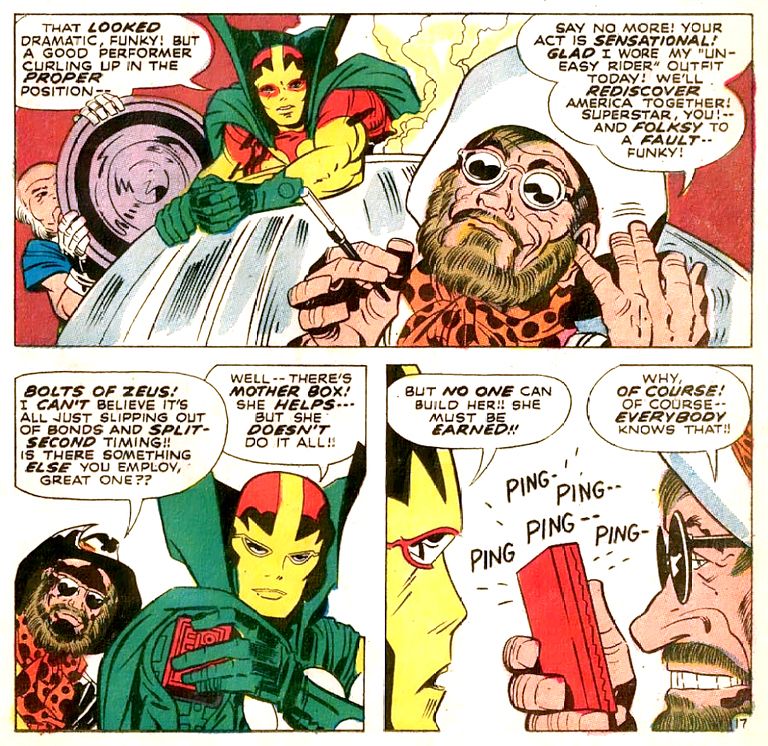
Words and pencils by Jack Kirby, inks by Mike Royer (Mister Miracle #6, Jan.-Feb. 1972)

I'm a little upset about this.  It's not even as if this is some obscure bit of comics history.  Way back in 1972, in Mister Miracle #6 (January of that year, to be exact), Jack Kirby vented some of his post-Marvel frustration by lampooning his former creative partner Stan Lee in the story "Funky Flashman."   "Funky Flashman" came out in a mainstream book from DC, not in some indie book or underground title and Jack's target was pretty obvious, hardly obscured by his funky pseudonym.  Plus I'm pretty sure The Jack Kirby Monthly from TwoMorrows covered the whole thing extensively in that hyper-geeky way that makes me love that magazine so (talk about your narrow focus!).  So when Brian Cronin at Comics Should Be Good on the Comic Book Resources website dragged out "Funky Flashman" one more time last week, why did it upset me?

Because I've been thinking about writing something about good ol' Funky for years and years and years.  Okay, years.  Months, maybe.  So while Funky isn't a hidden bit of lore-- his misadventures are readily available in the still-in-print Jack Kirby's Fourth World Omnibus Volume Two and you really should own a copy for yourself-- I wanted to spout off about him as if I'd uncovered him after some laborious detective work.  So I'm going to, even if my take is half-formed.

I've always loved the story "Funky Flashman."  It's vitriolic and even unfair-- I mean, taking a shot at poor Roy Thomas, depicted by Kirby as Houseroy, a diminutive lackey forever fawning over a Flashman who will feed him to his enemies before making good his own escape, seems a low blow no matter what your grievances against his boss-- but it's energetic and by some imp of the perverse, every bit as charismatic as his real-world inspiration.

Flashman is indomitable and in that way, if not admirable, he's at least a little likable.  Definitely a compelling figure.  A scene-stealer.  Flashman dominates every panel in which he appears, even alongside Big Barda as she plays with a revolver.  But maybe that's just me.  I have a strange attraction to these kinds of characters, shifty grifters with positive, can-do attitudes.  The Milo Minderbinders of the literary world.  They're quintessentially American types, aren't they?  These Jay Gatsbys, forever recreating themselves in whatever image will win them Daisy Buchanan or money or acclaim.  A Horatio Alger tale, but instead of some dopey kid who earns a reward for being so honest and stalwart, we get a complete bastard who pulls himself up while pulling others down.  And always with a smile on his face and a neat turn of phrase.

There's something to be said for someone who never gives up, who takes a beating-- even if they allow others to get it worse than themselves-- and dusts himself off before strutting on over to his next con-job.  Flashman is obviously a sociopath, but he's also never-say-die, endlessly up-beat, a bold figure we have to grudgingly admire for his knack for survival.  If nothing else, Flashman is fun to read about.  Guys like that can even be fun to know in real life, provide you don't go into business with them.

Flashman is a vicious caricature of Stan Lee.  He even looks like Lee.  Obviously, Stan the Man deeply hurt Jack Kirby at one point, whether deliberately or by accident.  Kirby's response may be passive-aggressive, but it's also entertaining.  The man was a storyteller.  And no one said caricatures have to be nice.  The best rarely are.  Yet Flashman is more than that, too.  Because Kirby-- at least in his prime and at his most involved, as he was with the Fourth World books at this point-- couldn't produce a one-dimensional character if he tried, Flashman's got his inspiration's wit as well.  Kirby wisely left it up to the readers to decide if Flashman is a villain or a hero.  He's probably a bit of both.  Always a survivor.

As Flashman tells himself in the final panel, "On to new conquests, Funky Flashman, you winner you!!!"

Friday, February 15, 2013

Fantastic Four #1: Reed Richards, you maniac!


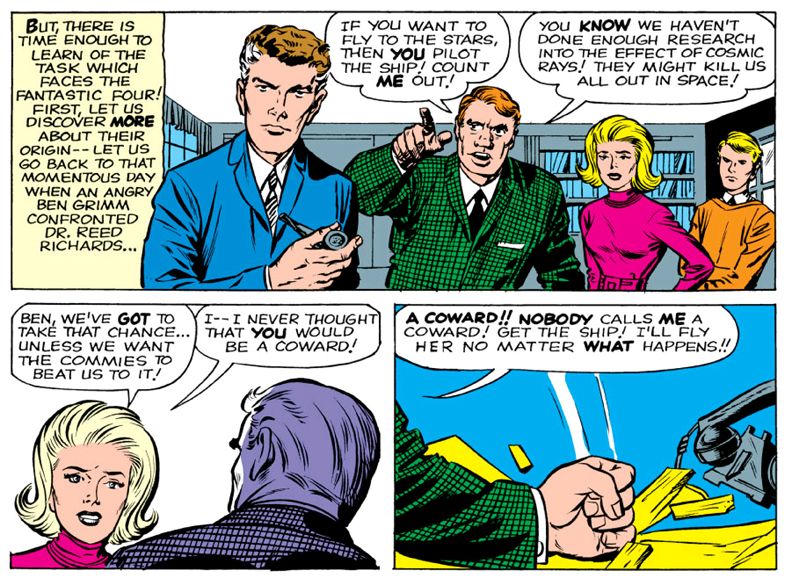
I'm guessing Reed Richards has at least one doctorate.  Probably several.  He's a genius, highly though of by the United States government.  But for some reason this miracle mind, this all-American Einstein, this pipe-smoking prodigy, decided to take his girlfriend and her kid brother on a rocket joy-ride.  That alone would be enough for the Fed to revoke all his security clearances and toss him in a metal box six by eight feet, surrounded by concrete and stone.  While his real-life brainiac counterparts at NASA occasionally evinced "go-fever" and a kind of engineer-mind tunnel vision that led to disasters and deaths, it's hard to reconcile Richards's genius with the kind of recklessness involved in subjecting himself and his loved ones to cosmic rays and crashing America's most advanced spacecraft.

Think about it one more time.  Reed Richards took his civilian girlfriend and a teenager with him on an unauthorized flight of an experimental rocket, even after the more cautious (but not cautious enough) test pilot Benjamin Grimm warned him the ship wasn't adequately shielded against radiation.  And that was the least of the reasons why this was a terrible idea.  This isn't "we've gotta beat those Reds into space" derring-do.  This is "wearing diapers and driving across the country to shoot someone" multi-layered criminal insanity.

What was he thinking?  Certainly, the lack of shielding represents a calculated risk for Richards and Grimm in their attempt to give the U.S. a Space Race victory.  But to involve outsiders, one of whom Richards is involved in a romantic relationship with, gives one pause.  J. Robert Oppenheimer (perhaps an inspiration for Richards) similarly allowed his personal life to intrude on his national security obligations.  But while Oppenheimer married a former member of the Communist Party and carried on a secret affair with someone who wrote for the Western Worker, a Communist newspaper, he didn't strap either of them to the atomic bomb at Trinity.  But his involvement with radical causes led the government to revoke his security clearances in the early 1950s.  Richards's deed is arguably worse and he doesn't receive so much as a slap on the wrist.

Reckless endangerment.  The failure of this flight could have set the United States back decades in the exploration of space.  The 1967 Apollo 1 fire, for example, caused a twenty-month delay at a crucial time during our moon landing program.  The loss of space shuttles Challenger and Columbia both halted American space flights.  After the 1986 Challenger explosion, NASA grounded their shuttles for three years.  After the 2003 Columbia re-entry disaster, crewed spaceflight via shuttle didn't resume for more than two.  Imagine, then, the catastrophic results of Richards's rash, idiotic act.

The man should be under the jail.  Well, actually, he shouldn't have even survived the crash.  But the bulk of Fantastic Four #1 (November 1961) post-accident should have consisted of Reed Richards on trial as the traitor of the decade. Julius and Ethel Rosenberg?  Bah!  Pikers!  The Cambridge Five?  Rank amateurs by comparison.  Richards's alma mater should have demanded he return his degrees, Grimm and Sue Storm should have been jailed as accomplices (the government could have granted them immunity or at least reduced sentences in return for testimony, however).  A life sentence for ex-Dr. Richards.

Instead, Richards is one lucky devil.  He gets rewarded with neat powers (unlike Grimm, who turns into an embittered monstrosity), Sue thinks nothing of the risks he put her and brother Johnny through and everything is just peachy.

Power Records does Beneath the Planet of the Apes


Enjoy the shouty goodness of this Power Records (PR 20, originally released in 1974) adaptation of the 1970 film classic Beneath the Planet of the Apes where the action "comes alive" as you read!!  The story adaptation art and design are credited to Arvid Knudsen and Associates, but that art has the unmistakable look of one of those amazing artists from the Philippines like Alfredo Alcala, Nestor Redondo or someone closely emulating their style.  In other words-- gorgeous!

Thursday, February 14, 2013

Old comics on Comixology

Living in Japan, I don't have easy access to the latest American comics.  Japanese comics, yeah.  I can walk over to Lawson and buy tons of those.  But for American comics, I have to go all the way to Tokyo to visit Blister.  Fortunately, I don't buy a lot of new monthlies.  I do, however, buy lots of hardcovers of things like Nexus, Creepy, Eerie and softcovers of things like Swamp Thing, New Mutants, Uncanny X-Men and the like.  For those, I go through Amazon.jp.  Very fast and it's fun to get boxes even if I know what's in them.  The delivery guy and I have a great relationship, too.

In fact, the last time I ordered something from Amazon.jp, he recognized my name and brought it to the wrong apartment-- my old place, which is right across the street from my new place.  He thought he was doing me a snappy favor.  Poor guy was very apologetic once we got things straightened out.

Anyway, the point is, if you live in Japan, unless you happen to be in a location convenient to Blister, digital comics are your best bet for keeping up with the American sequential world.  Comixology carries almost everything.  I've been feeding my Walking Dead habit there, for example.  It's not perfect.  You don't actually own the comics even though you pay the same amount someone would if he or she went to a physical store and bought a physical copy there.  You're paying $1.99, $2.99, $3.99 or more for simply a license to read the comic on your computer (via Comixology's reader, which has its own positives and negatives), or on your iPhone (which is pretty cool if you're waiting for a doctor or a bus).  I won't kid you and say that concept doesn't suck.  If I pay for something, I want to own it outright, without limitations.

Well, I suppose I could order print copies online from other sources, but then I'd have to wait two weeks or more to read what you can read on the same day it hits the shelves.  Like I said, I live in Japan.  These are just little things I've weighed and my conclusion is Comixology is the way for me to go.  Or Dark Horse Digital, which is similar but exclusive to Dark Horse comics.  These are the ways I buy my comics.

Still, I love to read the old stuff more than the new stuff...  Well, Comixology can help you out there, too.  DC and Marvel are constantly adding their back catalog to Comixology.  It seems they focus a lot on back issues related to events in current titles so they can bundle them all together in special sales events meant to increase interest in their current product, but they're bulking up some of the ancient books I like to talk about here.

Let's see--  just recently I bought a bunch of the universe-spawning Stan Lee/Jack Kirby Fantastic Four, the complete first volume of Swamp Thing (twenty-four issues featuring Len Wein, Bernie Wrightson and Nestor Redondo, among others), the first two years or so of the Alan Moore version, the first seven issues of New Mutants plus the original Marvel Graphic Novel (a bargain at $3.99), some 1960s-vintage Teen Titans, two issues of the first volume of X-Men drawn by Jim Steranko, some Neal Adams Batman, John Byrne's Next Men, plus a lot of random stuff I can't remember right now because I'm at work and not at home where I can read my comics.  Many of these I own in collected editions and the like, but now I have a nice collection of really sweet old comics I can talk about here.

So expect a lot of Swamp Thing, New Mutants and Teen Titans coming your way.  And a lot of Jack Kirby.  Which I will analyze, deconstruct, poke affectionate fun at and generally mess around with.

You know, same crap as I always do here.  Only shinier.