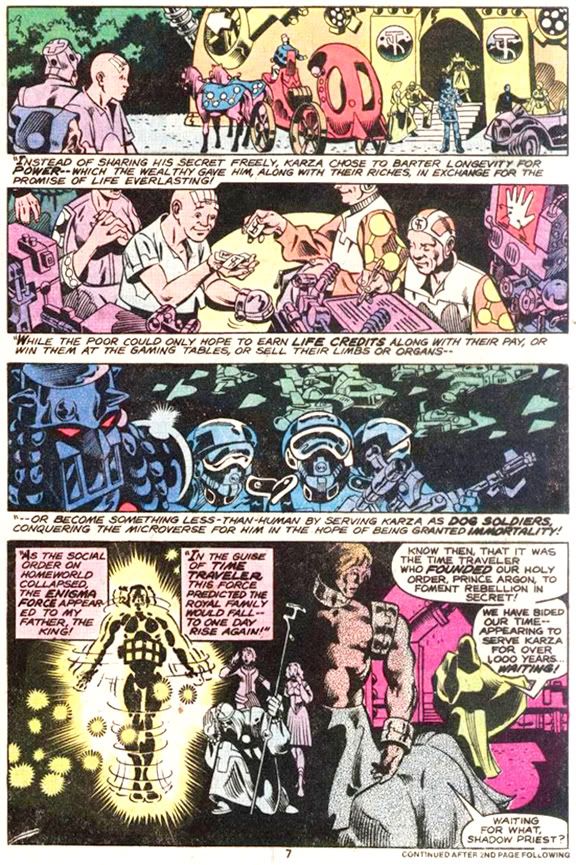
I'm kind of on an Art Saaf kick lately. When I was a kid or a punk teen, I wouldn't have appreciated his work, because I was into people who rendered the heck out of everything, or put a lot of flash on the page. Sure, I had taste-- I was into Joe Kubert, Gene Colan and Al Williamson, after all. But as I've matured, I've come to love these journeyman old dudes who may not have blown readers away, but could draw anything the writer asked for. Despite Mark Evanier's opinion that "No one drew the female figure in action better than Artie Saaf," Saaf's art is most definitely not spectacular; he wasn't a Neal Adams, a Nestor Redondo, a Jose Luis Garcia-Lopez, or a Nick Cardy. He was a guy who started working when comics were young and put in his time at the drawing board doing everything from capes to war to romance. It's just solid, believable work with well-rendered anatomy and storytelling clarity of a kind mainstream-- superhero-- comics have largely abandoned.
There's not a line present that isn't justified, zero visual noise. The vehicles might be faked and the space costumes a bit on the goofy side, but it's got a warmth and appeal to it a lot of today's superficial, super-slick digitally-finished art doesn't with all its photo-real bells and whistles. Saaf's art has become timelessly retro in a way I'm not sure our current crop of superhero scribblers ever will. But that's for tomorrow's nostalgics to decide.
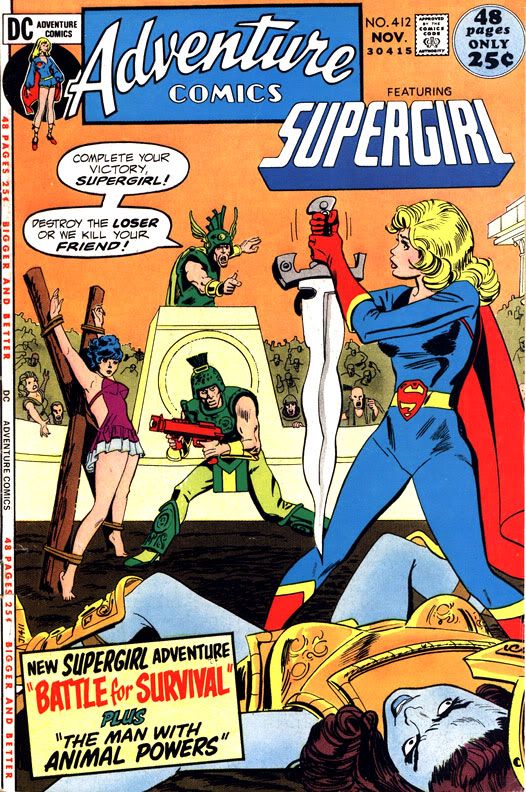
Adventure #412 features Supergirl starring in "The Battle for Survival," with Saaf's pencils inked by Bob Oksner-- who contributed the dramatic and somewhat suggestive cover. It came out in 1971and features a cheerful, positive-minded Supergirl living in San Francisco. As Linda Danvers, Supergirl works for a TV station where her immediate superior, Geoff, is a red-haired guy with the ultra-hip sartorial style and mustache of a low-rent Ron Burgundy-- and who gently sexually harasses her at every opportunity. Supergirl shrugs it off as "corny" humor. I suppose you can't expect more from a guy who wears a polka-dotted ascot.
The story, written by John Albano, is nutty in its conception. Someone disguised as Supergirl is committing crimes, and it turns out it's all a mad scheme to find out if Supergirl really is all she's cracked up to be. This is important, because there's a planet with one of the stupidest ways yet conceived of choosing a ruler-- single combat between champions chosen by the various political contenders.
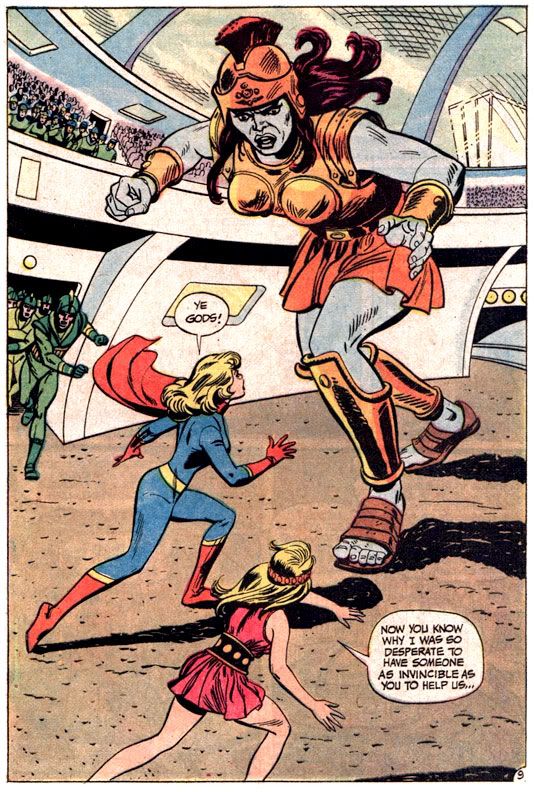
So Glynix, who wants to keep her throne, comes to Earth and causes all sorts of trouble to test Supergirl and blackmail her into fighting as her champion against a blue-skinned giant in orange armor. Why Glynix-- who claims to be in a great hurry-- couldn't have simply asked Supergirl to help her rather than waste a lot of time wreaking havoc isn't addressed. I imagine it has a lot to do with the necessity for DC comics of that era to have a story hook of some kind, and a lot of action. A reasonable request just wouldn't cut it.
And we wouldn't get to see Saaf's drawings of Supergirl snuffing explosive capsules with her hands. Whether or not Saaf was the best at depicting women in action is debatable, but he certainly makes a case for himself here. Even the opening splash page with ordinary human being Nasthalthia Luthor (I have to love her because she's only doing this job for her own evil purposes but she works hard at it; there's a character we're going to have to talk about later) tells us this is an artist well within his comfort zone drawing the female body moving, turning, running. Punching space giants and single-handedly defeating armies armed with laser rifles, which are two wonderful things Supergirl does later, before flying all the way back to Earth under her own power, then declaring to herself, "Home at last! And am I bushed!" There aren't any Escher Girls here.
Glynix and her people can make capsule explosives powerful enough to flatten cities and laser cannons, but still resort to fighting with the knives they wear on their belts. And the main villain has a pointy goatee and a sun symbol on his tunic, both of which seem to be de rigueur for would-be space tyrants.
As you can see, Supergirl wears a modest bodysuit throughout. Glynix, disguised as Supergirl, wears a 1960s Mod minidress, but the real thing goes about covered completely from neck to feet, her Super-logo reduced to a mere belt buckle. It's a boring costume. The one she's wearing in her latest title is more visually appealing. It's not perfect-- I'm not sold on the wrap collar, red diaper-panel or the knee cut-outs in her thigh-high boots, but at least she's not flying around looking like a Britney Spears clone anymore.
The only thing I'm not too keen on is the feminine version of Superman's spit curl Saaf sticks Supergirl with. The rest of her hair is in a kind of contemporary flip (kind of like Mary Tyler Moore's at the time, which is fitting given Supergirl's civilian job), but the bangs curl around like a cream horn, making it look like she's wearing a pastry for a toupee.
Monday, September 19, 2011
Saturday, September 17, 2011
Thirty Years of Hopey Glass, Super Punk Badass!
With a new issue of the Harvey Award-winning series Love and Rockets: New Stories poised to hit the streets, it's time to look at some of Hopey Glass's moments of punk badassery. I had to limit myself to the first twenty or so issues of Love and Rockets, volume one. Otherwise, this blog post would be almost as long as the series itself. With a career dating way back in 1981 with Los Bros Hernandez's first self-published comic, Hopey's done too many memorable things. Things that make you laugh, things that make your dog smile and your grandpa blush. She's such an amazing character, practically any scene she's in becomes a medium-altering moment in comic book history.
Okay, I'm exaggerating a little. Hopey's probably only the third or fourth most important character in American comics. And it only took twenty-six years for Fantagraphics to publish a book with her name in the title. But this poses a question-- just how did Jaime Hernandez pack so much awesome into such a teensy-tiny character? I don't think we'll ever know. Perhaps she sprang from some real-life source, some proto-Hopey raising punk hell, throwing bottles, spray-painting walls, blowing the boys and girls away with her spiked hair and mean eyebrows. Perhaps it's a mystery best left unsolved. However, I do know I would never cross Hopey no matter how petite she may be.
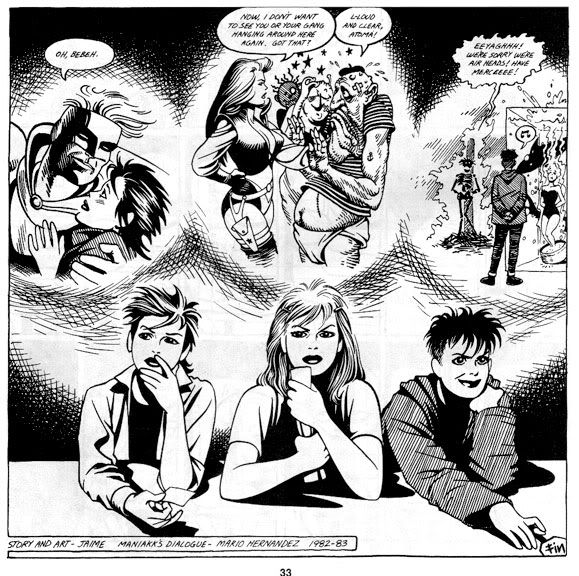
1) Hopey's gleefully violent imagination (Love and Rockets #3). When Maggie reluctantly tells a group of doubters about her brief career as a superhero's sidekick, Hopey takes a little mental revenge.
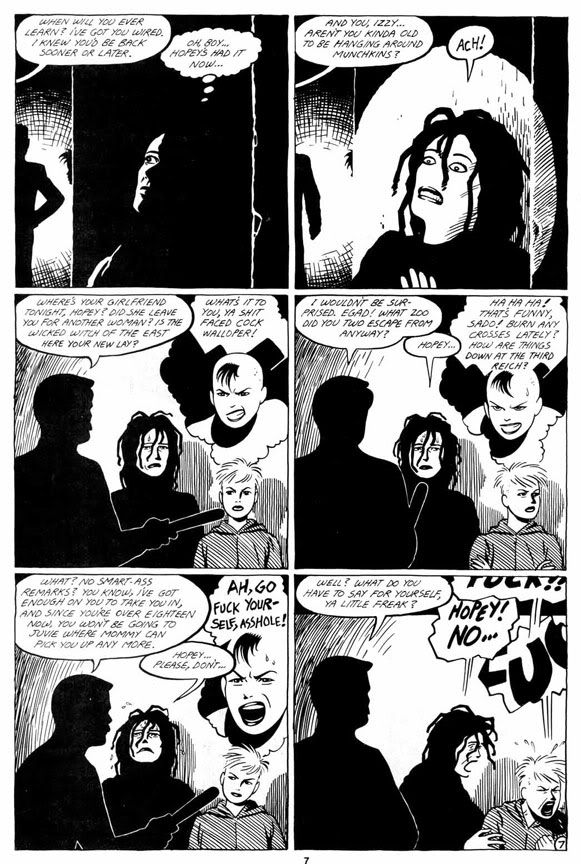
2) Hopey fights the law (LR #5). An untagged wall drives Hopey to distraction and depression. With the encouragement of her friends Maggie and Izzy, she sets out to do something about it, only to have her moment of triumph interrupted by Officer Sado, her personal nemesis-cop. She ends up doing something about that, too. Sado later made sergeant, no doubt due to his Javertian pursuit of La Hopita.
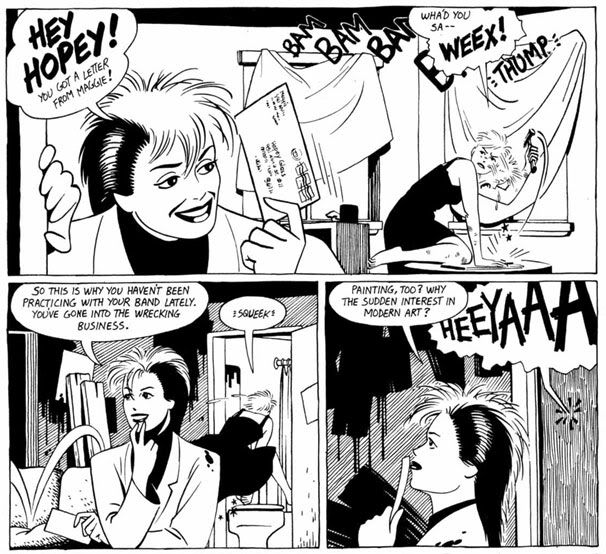
3) Hopey hits her finger with a hammer (LR #7). With Maggie away repairing spaceships, Hopey decides to go all Bob Villa and fix up their dumpy habitat. Too bad she's not as skilled with tools as she is with spraycans of paint.
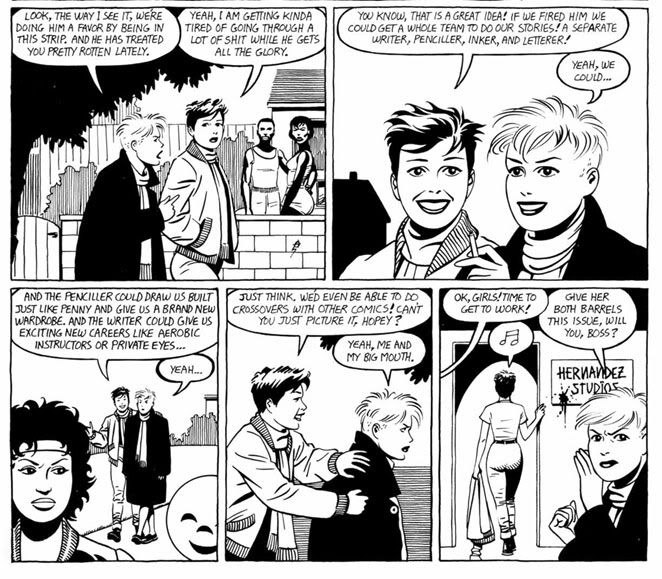
4) Hopey breaks the fourth wall (LR #10). Hopey loves Maggie, but she's not one to suffer fools gladly, even fools she's sleeping with. She has a request for the guy who created the two of them.
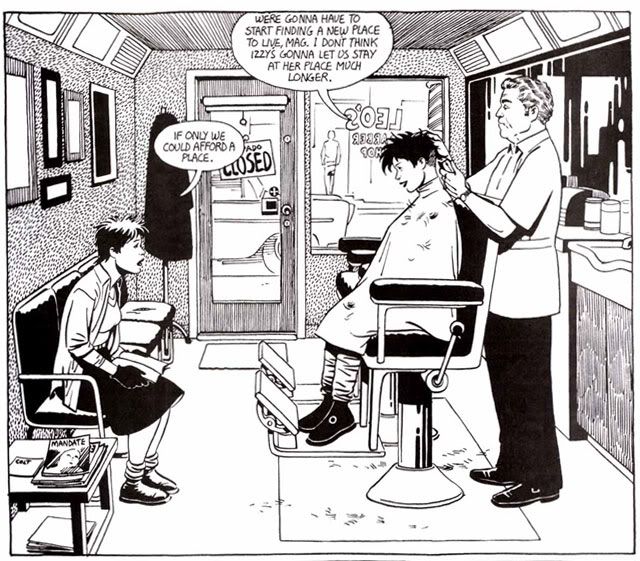
5) Hopey gets a haircut at an old school barber shop (LR #13). Where else would Hopey get her hair cut? This is one of my favorite comic book panels of all time. I love how Hernandez has Hopey's toes barely touching the barber chair's foot rest base-plate. When I was a kid, I got my hair cut in a similar place, with photos of gunfighters like Doc Holliday, Wyatt Earp and Billy the Kid on the wall. Ironically, my barber's ex-wife blew him away with a shotgun. This drawing brings back memories of that so vivid and detailed, I can almost smell the baby powder and rubbing alcohol and feel the goosebumps I'd break out in when the barber buzzed the back of my neck with the electric shaver.
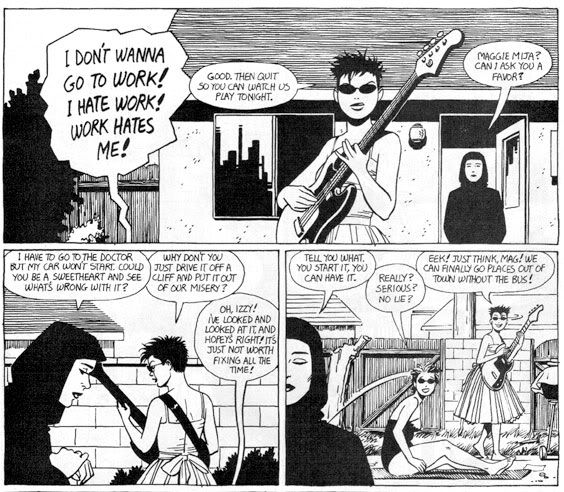
6) Hopey wears a vintage-like dress while practicing bass in the backyard (LR #14). She practices? Even a vicious little punk chick like Hopey wants to feel like a princess every once in a while. I love the way her butch hair and in-your-face personality clash with her demure girly-girl dress. Notice also her bare feet.
7) Hopey helps Izzy ruin Daffy's day (LR #15). Poor Daffy. I love her. She's really just a sweet kid with a head full of mixed-up ideas that a bit too conventional and suburban for Hopey's tastes. Looking like the long-lost sisters of Morticia Addams, Hopey and Izzy arrive on the beach pop the balloon made up of Daffy's romantic notions.
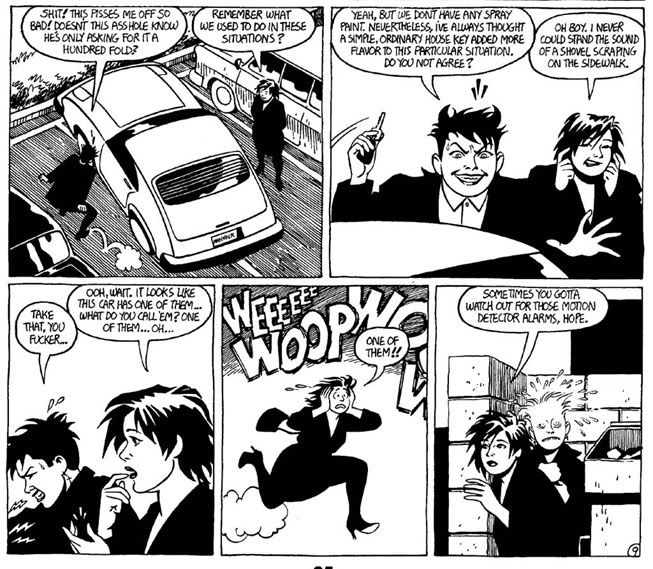
8) Hopey practices street justice (LR #18). Jaime Hernandez shows some of his humor comics influence in the second panel of this sequence where Hopey does what many of us have dreamed of doing. Take that, you rich jerk!
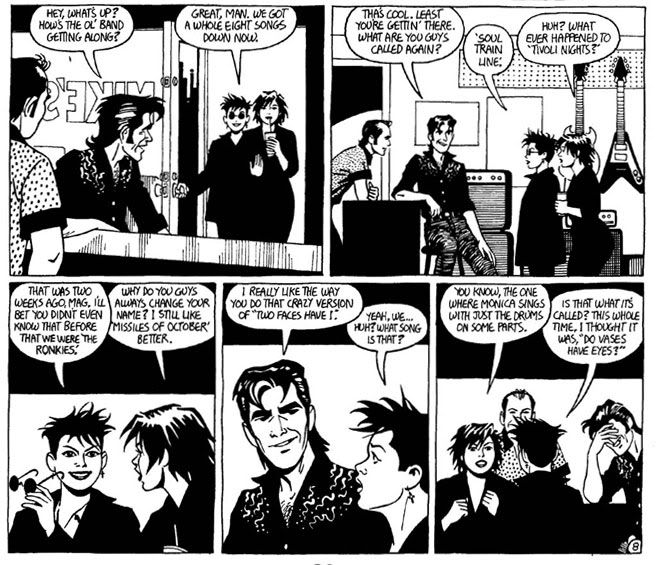
9) Hopey's famous near-homophony (LR #18). Or mondegreen, if you like. Hopey rarely gives strangers a straight answer, but even she's stumped when it comes to the names of the songs her band performs. She still hasn't lived this one down.
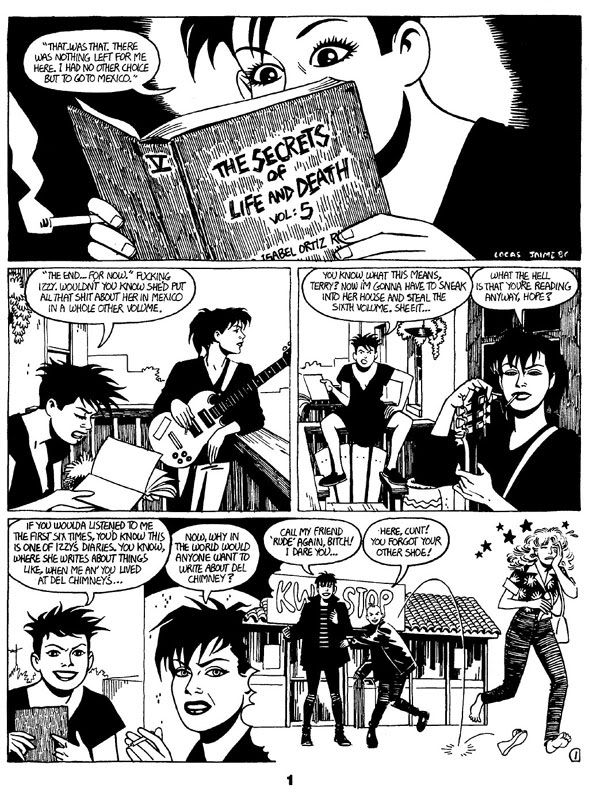
10) Hopey steals and reads Izzy's diary while Terry reminisces about beating up the hated Julie Wree (LR #19). During a break from band practice, Hopey obsesses over Izzy's diary. Terry Downe, her former lover-- and the person most interested in actually becoming a musician in the group-- takes a moment to flash back to to the good ol' days, when Hopey was hers-all-hers and they terrorized Julie Wree on a regular basis. Man, all these years later and they still hate Julie Wree!
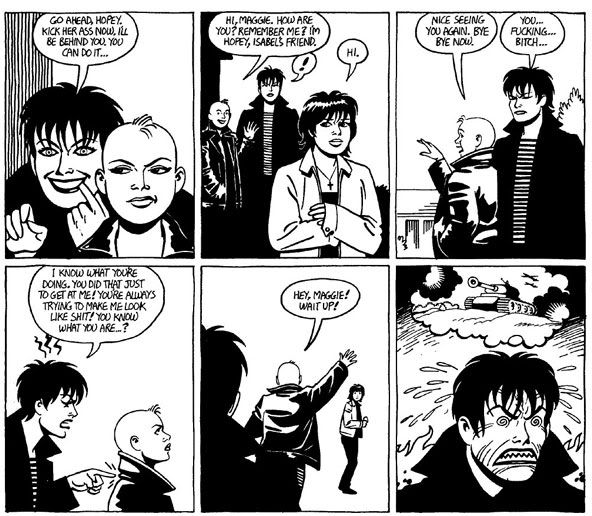
11) Hopey stabs Terry in the back (LR #19). Terry has a lot of bad memories about her brief relationship with Hopey. She learns the hard way you can never get too comfortable with Hopey because she always has her own agenda. Just when you think you're on the same side, she chooses another team. Why? We often learn Maggie's motivations, but Hopey's remain an enigma. That's just Hopey being Hopey.
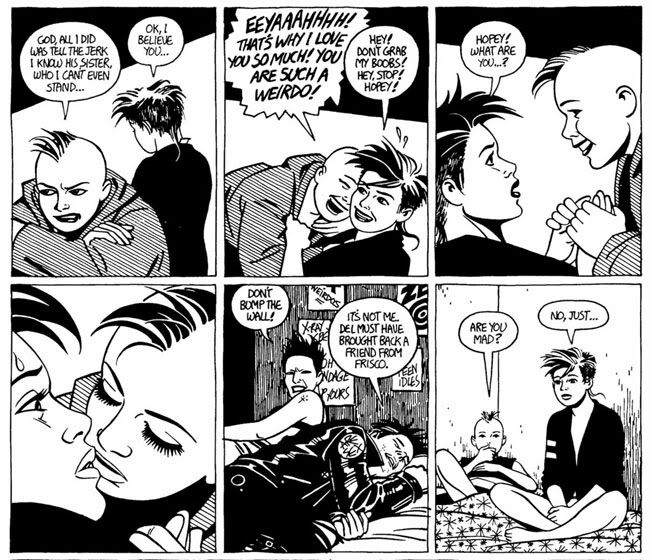
12) Hopey makes the first move on Maggie (LR #20). While they've both been with plenty of others in the decades since-- Hopey has a miscarriage as the result of a wild three-way and Maggie gets married and divorced-- one of the ongoing plot threads in the various "Locas" stories has always been their on-again/off-again love affair. Strangely enough, it's always seemed to be more off than on. Hernandez brought them together, then created long storylines that split them apart. Delicious torture for the characters (including Daffy, who's as obsessed with the Maggie-Hopey pairing as many of the series' readers) and the fans. Who knows what was really going on in Hopey's mind right here, but this is a flashback scene to their early days, showing how it started.
Thursday, September 15, 2011
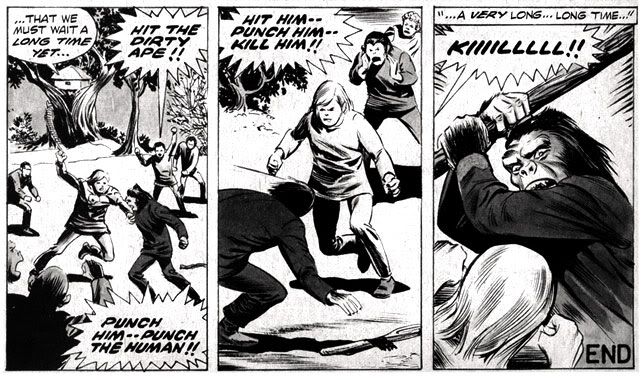
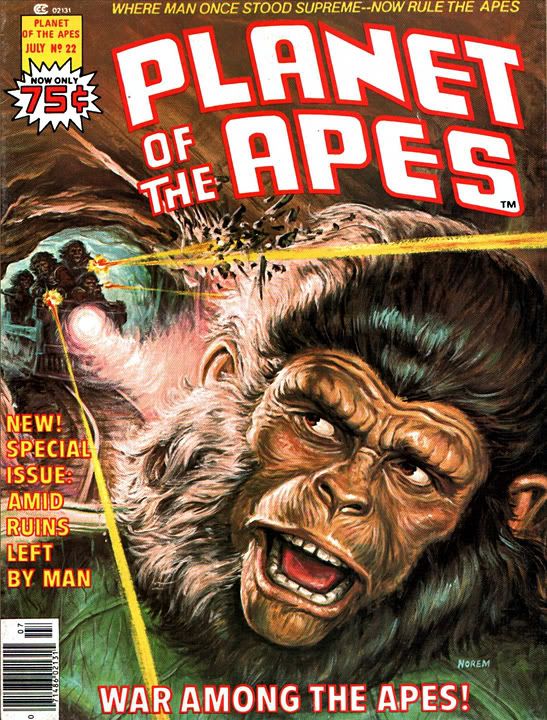
What About the Future?: The Lost Issue of Marvel's Planet of the Apes Magazine
Does it ever bother you that the story "Terror on the Planet of the Apes," serialized in Marvel's Planet of the Apes magazine, ends on a cliffhanger? Sure, it's not quite of the same order as that maddening final episode of Twin Peaks, but it's unfinished business nevertheless. I probably spend a lot more time bemoaning the lack of a third season for David Lynch's weird show than I do an ending to Doug Moench's even weirder comic book saga, but I'd never turn down either.
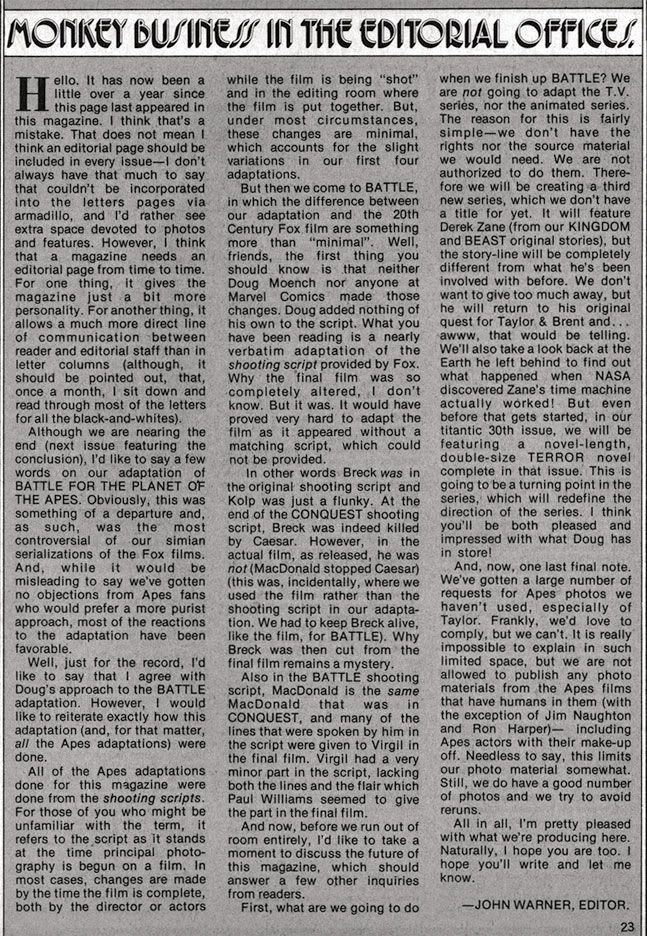
What's tantalizing about Apes is how in #27, editor John Warner promised a "novel-length, double sized TERROR novel," set to appear in the never-published thirtieth issue of the magazine. It would have sparked a "[redefined] the direction" of a narrative that already had too many of them.
Directions, that is. "Terror" is the picaresque story of Jason, the loin-cloth wearing, fiery-tempered human and Alexander, his long-suffering chimpanzee friend. Yes, Jason and Alexander. They're on the run from gorilla Brutus, the ironically-titled "peace officer," an ambitious gorilla who uses his respected office as a cover for recruiting other gorillas into his violent ape supremacist movement. Brutus stops at nothing, not even the murder of his own wife, which he pins on Jason. The human-ape buddies flee into the Forbidden Zone, but not without a lot of fist waving and angry emotional showboating on Jason's part.
Actually, let me just take a moment here and say for the record Jason is one of the most annoying and unlikable protagonists ever to grace a Marvel title. Really, I can't imagine why Alexander puts up with him. Jason is just that much a jerk. Self-pitying and largely unforgiving, too.
The two fugitives have all kinds of increasingly psychedelic adventures as they encounter cultures all too coincidentally similar to different historical epochs-- gnarly old frontier types in buckskins and with names like Gunpowder Julius (an ape) and Steely Dan (a human); the Assimians, who appear to have spent quite a bit of time studying James Fenimore Cooper's Leatherstocking Tales; apes of the far north in horned helmets who love wild feasts in their warm meadhalls and go raiding in longboats. Along the way, Jason and Alexander make friends with a techno-hippie who calls himself Lightsmith, after the flashlight he wields and Maleguena, who becomes Jason's lover even though even she can't stand his arrogant posturing. But her previous boyfriend was a jealous chimp, so I guess on the Planet of the Apes, this is considered trading up.
And don't forget the mush-faced drones led by giant floating brains, the googly-eyed aliens and their pet flying monkey-demons inside mountains and a vast ecosystem of mutated beasts-- like the former horses that now resemble maiasaura. They add zest!
The story climaxes as Brutus attempts to invade Ape City with his rogue ape army supplemented by the Gorilloids-- bionic apes made by yet another group of human mutants, the Makers. This leads to an epic battle sequence where practically every character in the story shows up to scream and run around shooting guns at each other. Jason reduces Brutus to a prisoner in chains, but finds it's a bitter victory because he will never know the joys of wearing pants. Meanwhile, some dumb kid ape has gotten himself turned into a nearly mindless cyborg by the Makers-- they plan to attack as well-- and comes strolling up in the battle's aftermath.
And that's all we ever get of "Terror." From gorgeous but occasionally rushed-looking art by Mike Ploog, to serviceable work by Herb Trimpe, Moench's story is the comic book equivalent of ghost riding the whip. And then falling off the hood, landing on one's head and entering a coma from which one never awakens. The final issue of Planet of the Apes, #29, consists largely of an installment of the "Future History Chronicles," which features talking apes but otherwise has only the merest connection to the movies that spawned the magazine, and there is no #30.
So we never get to see the Makers attack, or find out what happens to cyber-ape-kid. My guess is this vaporous thirtieth issue would have wrapped all of this up and future storylines would have explained how Gunpowder Julius, the viking apes and the Assimians all came to adopt such specific, anachronistic lifestyles in just a few short years after the collapse of modern civilization. Then more of "Future History Chronicles." According to Warner, Marvel had no plans to adapt the two Apes TV properties, the live action show and the animated one. But he did hint at a third series starring Derek Zane, hero of the magazine's lamest-- yet, oddly enough, more closely-tied to movie continuity-- stories about a guy who invents a time machine and then has a lot of Mark Twain-inspired adventures among apes who've patterned their society after Camelot, complete with jousting knights and a Robin Hood.
But after that? Who knows? Let's ask the Lawgiver if the day will ever come when we Apes-fans will get to read more thrilling tales of jerky Jason and agreeable Alexander:
I'm afraid, my children...
Labels:
Doug Moench,
Herb Trimpe,
Marvel,
Mike Ploog,
planet of the apes,
vintage comics
Monday, September 12, 2011
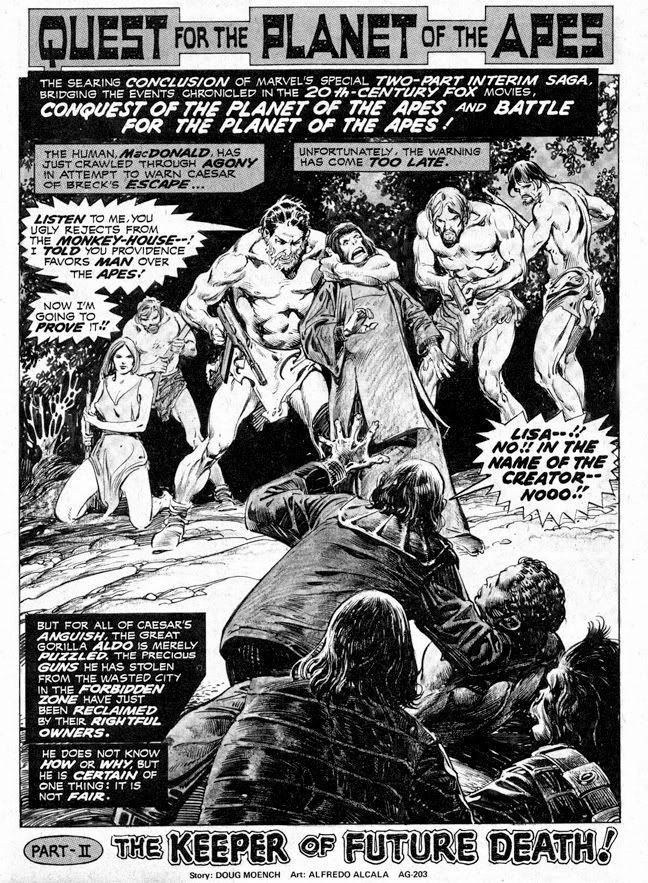
Ape-Quest '11: "Quest for the Planet of the Apes" Edition, Part 2!
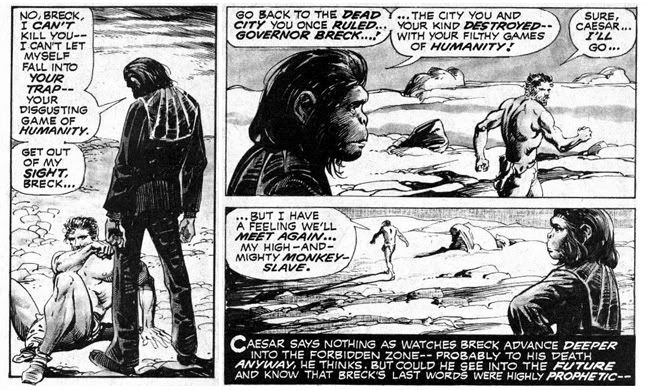
What's Breck so angry about? Well, he used to be ruler of a mighty state, but thanks to Caesar the super-smart boss of all the talking apes, he's now a bearded bum in a soiled loincloth. Just about anyone else in Breck's reduced position would look back on his life and think, "Maybe running a repressive regime that enslaved anthropomorphized apes wasn't the best career move," but the ex-governor isn't like most people-- refusing to recognize his own culpability for his fall from power, he places sole blame on Caesar and wants revenge!
Rico Rival has been replaced by my favorite Apes artist-- one of my favorite artists, period-- Alfredo Alcala. Alcala's art here isn't as ornate as his work on the black & white Beneath the Planet of the Apes adaptation, a series highpoint. It's a little simpler, the gray tones a bit flatter. It's still quite lovely, with a slightly comical quality, especially in the apes' expressions.
Even after two years of constant study, I haven't figured out why the humans are in Tarzan rags. In the movie Battle for the Planet of the Apes, which this story immediately precedes, they just wore regular clothes. It would be thousands of years into the future before the humans started making like the extras in a Hammer Studios prehistoric romp-- my favorite is Prehistoric Women because it has the amazing Martine Beswick in it as the evil high priestess of a decadent tribe-- in Apes film continuity. Another thing I don't understand is why the woman on the far left felt it necessary to kneel. Other than to fit into the scene without Breck's jagged speech bubbles covering her face.
This page has an excellent feeling of depth, though. The apes are almost silhouetted in the foreground, Breck and his gang occupy the well-lit middle ground, then there's a suggestion of foliage behind them.
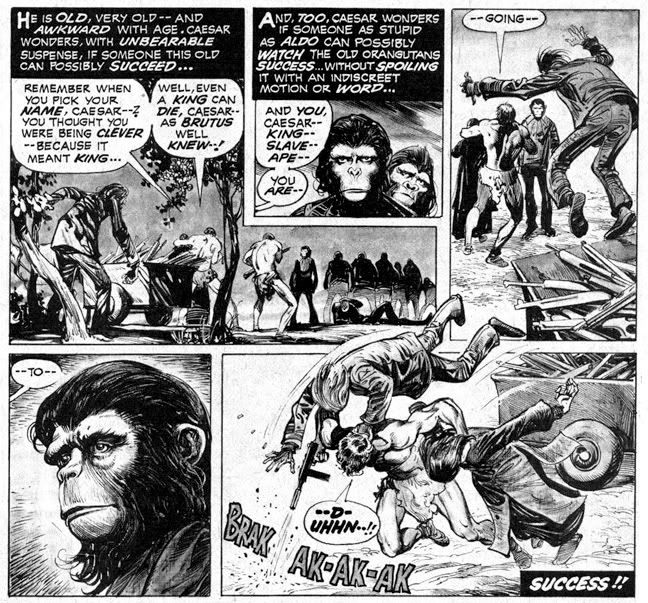
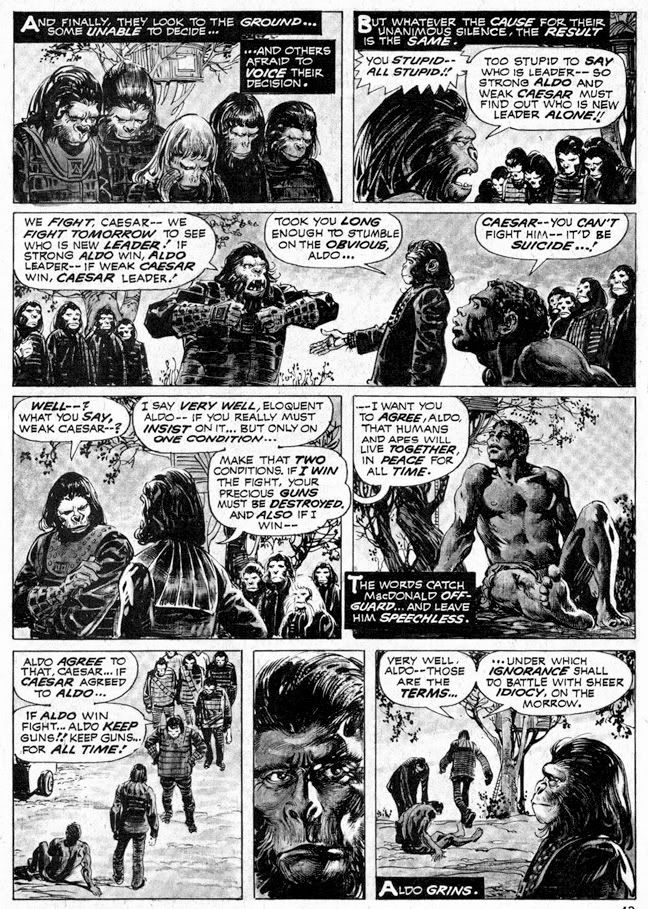
Instead of just shooting Caesar and being done with the whole ordeal, Breck has to voice all his grievances while Caesar and Aldo squirm uncomfortably. It allows an old orangutan time to climb up on a wagon full of guns-- ever-generous Aldo brought them back from the ruined city in the Forbidden Zone to share with all his pals-- and jump on Breck. This sequence occupies approximately 12 days of story-time.
Then comes the big fight!
Yeah, it's pretty much a re-write of Battle. My memories of that movie are confused with those of the David Gerrold prose adaptation. The novel is infinitely superior to the movie, which is common with film versions of literary works but rarely seems to work in the opposite direction.
But in this case, Gerrold worked from a shooting script that was written for a significantly higher-budget movie than the one that eventually reached the screen. If I'm remembering correctly, Aldo holds his gorilla cavalry out of the big third act fight after a disastrous headlong charge into the humans' automatic weapons, then has his horse-apes chase down and slaughter the fleeing and demoralized survivors after their defeat by the other apes led by Caesar.
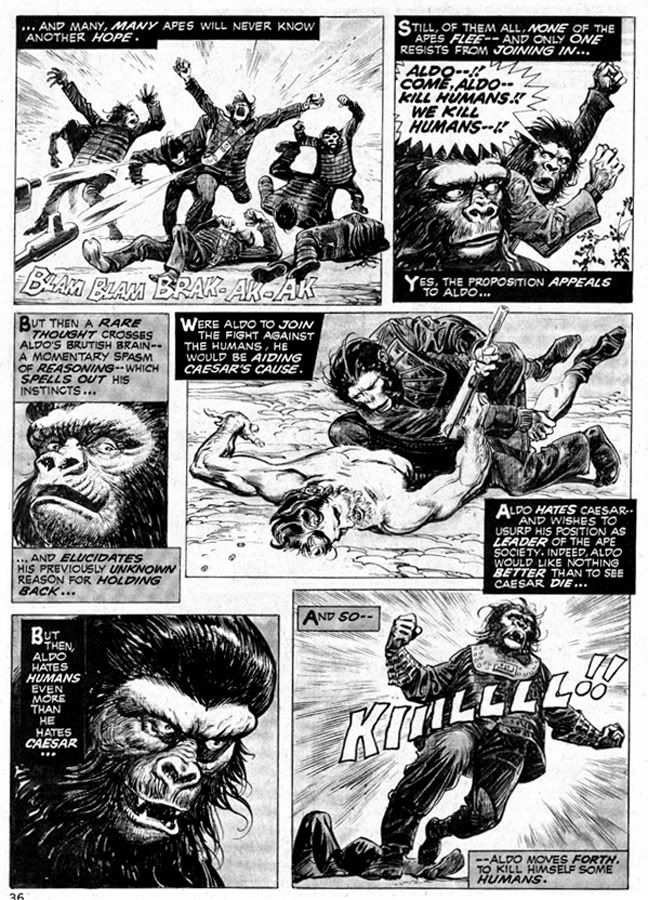
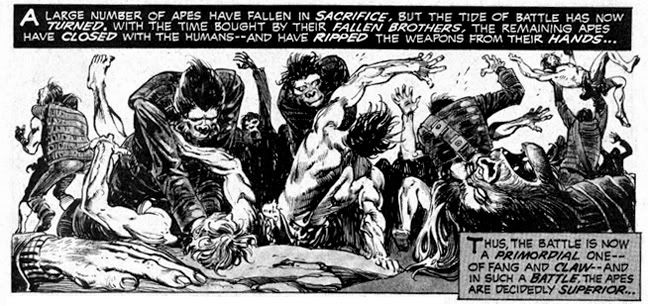
I believe that sequence never made it as far as the filming stage, which is too bad; the movie could have used a little more epic scope a "Charge of the Ape Brigade" would have lent it-- mutants to the left of them, mutants to the right, mutants in front of them, volley'd and thunder'd. You get the idea. Here, Aldo just can't decide. Let the hated Breck kill the hated Caesar or kill the hated humans? Eventually, he decides to do both. Which is good for us, because we get to see his gorilla soldiers do this:
And then Aldo himself do this:
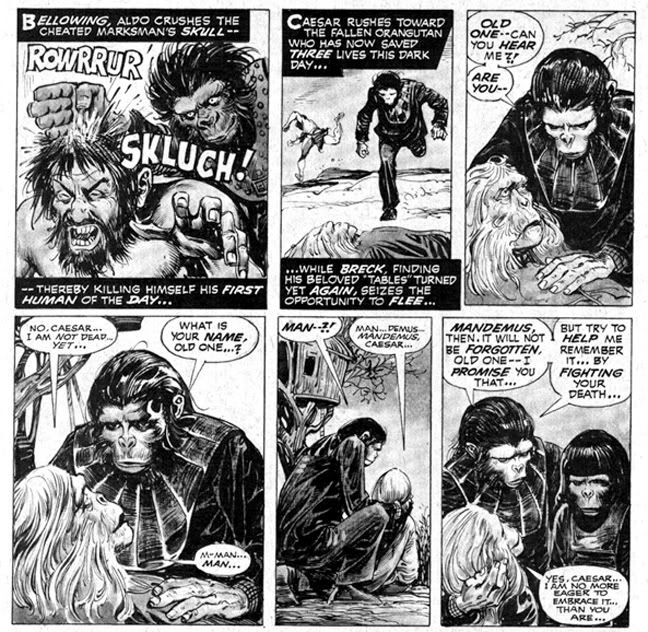
"Skluch!" Wow, these old Marvel magazines have the sickest sound effects, don't they? Take that, you filthy, gun-wielding counter-culture artifact! "Skluch" is the perfect "gorilla general karate chop to the skull" onomatopoeia, isn't it? Unless it's supposed to be, "Rowrrur!" and Aldo's actually sawing into the hippie's brain. But that hardly seems likely.
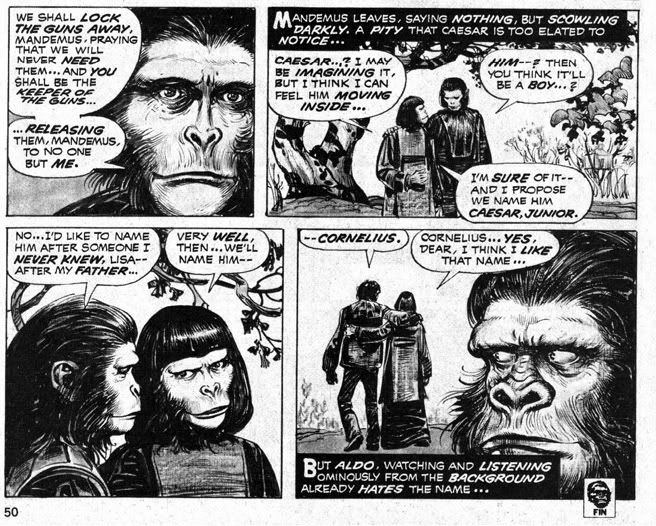
Oh yeah, that old orangutan turns out to be Mandemus, played by Lew Ayres in Battle. Mandemus guards the Ape City arsenal in the movie, and his appearance here seems to contradict a bit of dialogue in the film. Do you remember a scene where genius ape Virgil describes Mandemus as his former teacher? I seem to, but I'm still not sure I trust my memories. In this story, he's already an elderly kook. Well, maybe he is a teacher and we just don't get to see his classroom. But does it seem likely as familiar with Virgil as Caesar is later, he wouldn't know the primary teacher of the ape school in this story?
Am I confusing my sources again?
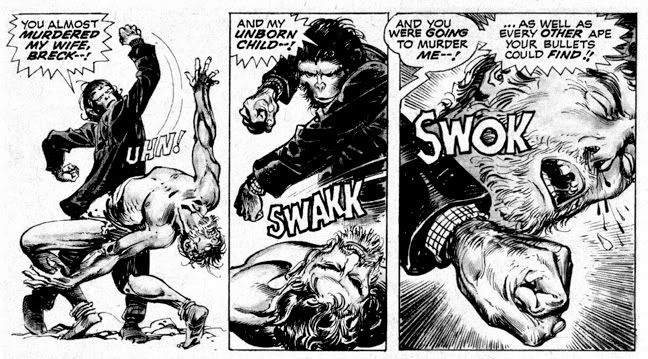
Not to be outdone by his more savage rival, Caesar engages the nearly-naked Breck in some mano-a-mano fisticuffs using the Marquess of Queensberry rules. Caesar is a civilized ape, but he throws a wicked right uppercut. BALD BULL! UPPERCUT! UPPERCUT! Sorry, that's the only punch I ever knew how to throw when I played that old video game.
Finally, his feelings deeply hurt (he's a sensitive man), Breck sniffles a little, then storms off, vowing never to invite Caesar to his birthday party. Which would be held in the bowels of a city devastated by nuclear war, the kind of thing that sort of cuts down on the festive atmosphere. And then, pumped up on adrenaline, Caesar goes and does something kind of stupid.
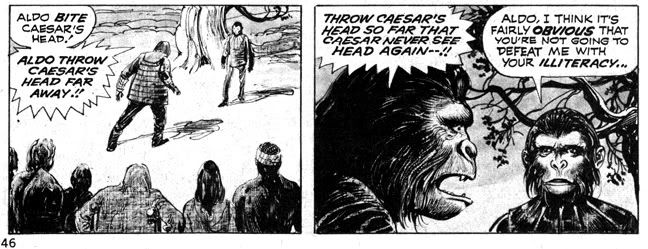
The next day, the two adversaries face off and toss arch bon mots at each other. Caesar uses his wit like a rapier; Aldo uses his like a big wooden mallet. He kind of reminds me of Animal Mother from Stanley Kubrick's Full Metal Jacket here: "Well, I've got a joke for you. I'm going to tear you a new asshole." Animal Mother and Aldo, brothers in subtlety. Might I suggest Adam Baldwin for this part in the remake? I mean, not taking anything away from Claude Akins's fierce portrayal, but he's no longer alive.
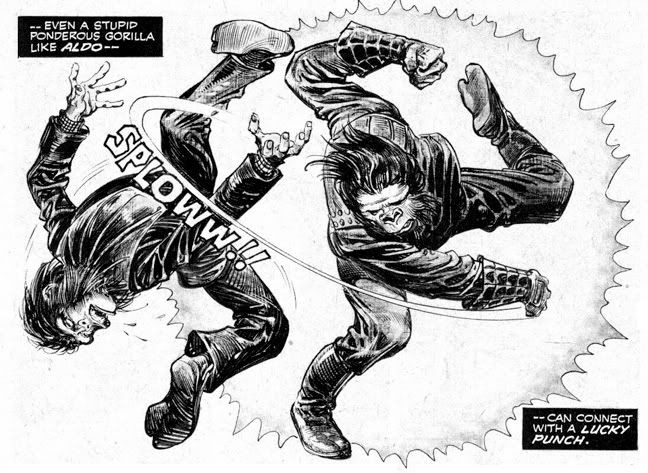
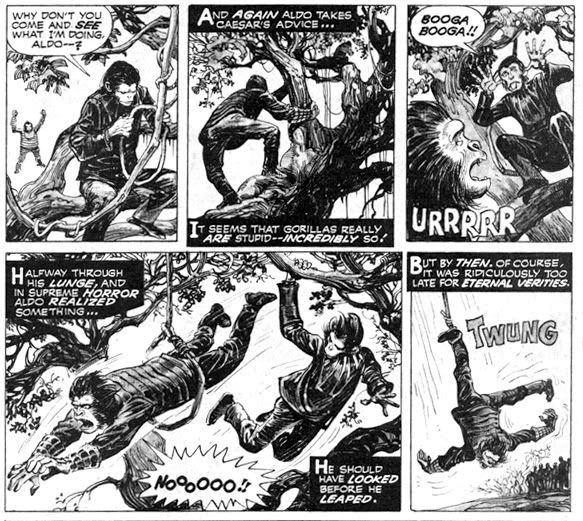
Now it's Caesar's turn to see how it feels! Check out the body language Alcala gives his battlin' apes here. Aldo just hit Caesar so hard, his unborn son Cornelius felt it! He hit Caesar so hard, the shelf containing all the Mego Planet of the Apes action figures collapsed at K-Marts across the land! There were plastic figures recalled all over the place at Christmas time that year because they came out with lop-sided faces and dark marks over their eyes. He hit Caesar so hard, Roddy McDowall had to sit down for a few minutes while filming an episode of Rod Serling's Night Gallery. Which makes the punch all the more impressive, because McDowall guest-starred on that show about seven years before Marvel published "Quest!"
It's pretty much the final sequence of Battle, with Aldo taking to a tree. Only in this one, the outcome is a bit different.
Ah, slapstick! Cue the circus music. Perhaps "Sabre Dance" as Aldo struggles and spins beneath the swaying limbs of the big oak tree. All's well that ends well, right? No, this is Planet of the Apes. Not only do things never end well, thanks to the circular nature of the series' narrative, they never end at all.
Oh, that irrepressible scamp Aldo! You know there's going to be all kinds of delicious trouble ahead!
While it may lack in originality as far as plot points go, "Quest for the Planet of the Apes" more than makes it up to us in sheer fun. I wish Marvel had done a few more stories within the movie series continuity-- not that I don't dig all the weird-o stuff they did do-- but more than anything, I really wish someone would get on the ball and reprint all of Doug Moench's insanely brilliant Apes work. Dark Horse... Dark Horse... come in, Dark Horse!
Labels:
Aldo,
Alfredo Alcala,
Caesar,
Doug Moench,
good art,
Martine Beswick,
Marvel,
planet of the apes,
vintage comics
Tuesday, September 6, 2011
The International Museum of Obscure Comic Book Characters, Exhibit 2: Johnny Carpetbag
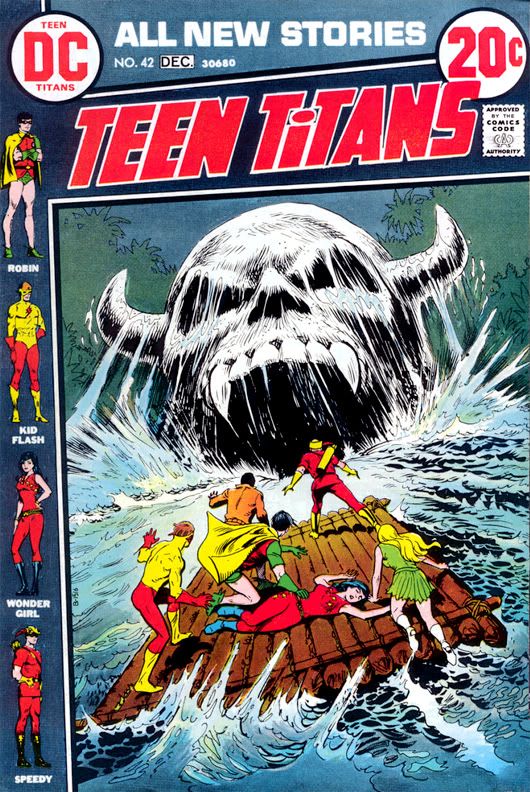
I'm surprised some hot-shot writer hasn't revived Johnny and turned into something horrifying. Johnny Carpetbag would make the perfect villain for some 12-issue mega-crossover where he powers up to appropriately bad-assian levels then stalks the grown-up Teen Titans, kills whichever one editorial deems unnecessary to Time-Warner's bottom line yet important enough to have impact on nostalgia hounds and hardcore geeks, then dies himself in some horrifically violent way at the hands of some character usually not known for doing such things, which somehow reboots the entire DC universe and launches a comic starring an "updated" version of said character. Lots of gore, too. A comic book is nothing without evisceration depicted in all its scarlet glory. If there's anything Teen Titans #42 lacks, it's evisceration.
Of course, this completely hypothetical yet oh-so-dreamy narrative would be accompanied by interviews with the creative team where they explain why Johnny Carpetbag was never used up to his full potential and then pat each other on the back for sullying what was once a pleasantly bizarre little comic and, by extension, every comic its characters ever appeared in before or after.
While we're waiting for the return of the new and improved Johnny Carpetbag, we can still enjoy the Teen Titans in "Slaves of the Emperor Bug." It's a simple story, with an insanely random plot.
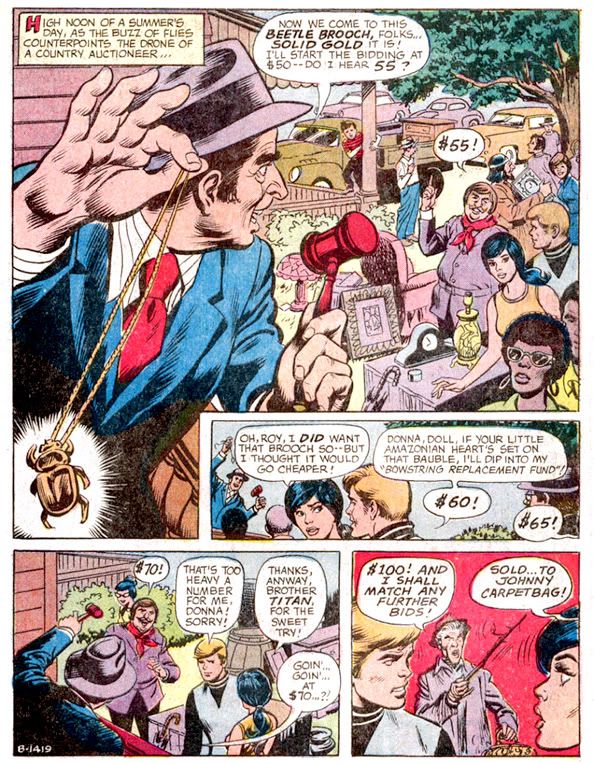
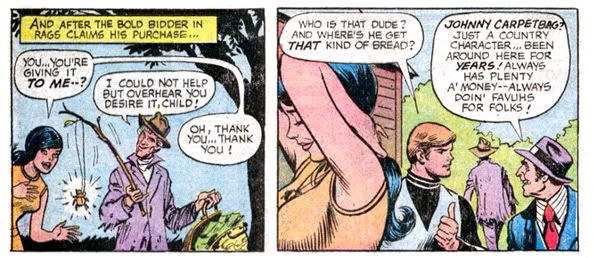
Ah. The opening sequence, tranquil and with just a hint of blossoming young romance. It lulls us into thinking the rest of the book will be sane. Wonder Girl and Speedy (pre-heroin addiction) bid on a beetle-shaped brooch. What's really cool is how Speedy refers to Wonder Girl's "little Amazonian heart." What a smooth operator. Her heart will play a major role in the story. Her metaphorical one. Don't you imagine it gets pretty old for Wonder Girl to always have the male Titans condescending to her like that? Especially when her "little Amazonian strength" could have Speedy shaped into a human pretzel if she so desired?
Notice how the auctioneer instantly recognizes Johnny Carpetbag. Not just because he's holding the object he took his name from, but apparently the guy's a sort of local character and held in fairly high regard by the citizens of whatever small town this is.
And why not? They think he's a righteous dude. For a dirty hobo. Who has an unlimited income. Maybe he's Howard Hughes in disguise, Wonder Girl! Give him a ride to Las Vegas and see if he puts you in his will!
The golden beetle brooch soon shows its magical powers-- it tells Wonder Girl and her less gullible friend Lilith it once was a mighty warrior king and needs to return to the Yucatan so it can regain its former glory. This leads to the entire team heading down to Central America where they run into all sorts of trouble in the jungle. Here's where things get ever so slightly... um... far-fetched.
Kid Flash almost loses a leg to a hungry caiman, Wonder Girl fights a jaguar then sees a fish swallow her beloved brooch. When a hungry eagle snatches up the fish, Wonder Girl gives chase only to run afoul of a poisonous snake. The eagle flies directly overhead while the Titans are looking for Wonder Girl, and Speedy shoots the fish out of its talons. Non-powered but quick-thinking Titan Mal cuts open the fish and finds not Wonder Girl but the beetle brooch inside. What luck!
In Lilith's hands it leads the gang to the dying Wonder Girl and Robin injects her with all the anti-venom he can find in his little first aid kit. That first aid kit really comes in handy on this trip, so I recommend when you take a magical golden beetle brooch into some swamp or jungle you take one as well.
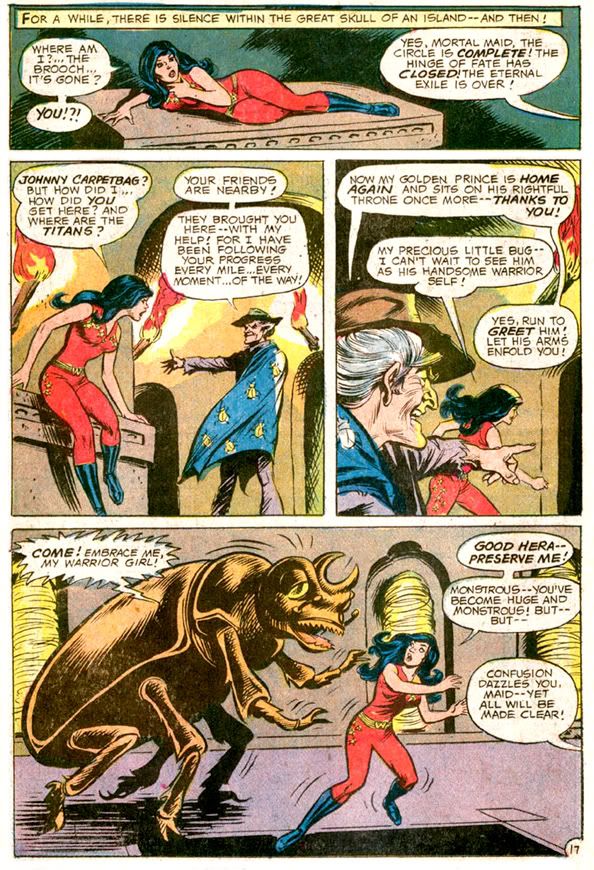
Reunited, the bold super-teens enter a skull-shaped island or temple or palace. And here our pal Johnny Carpetbag makes his second appearance.
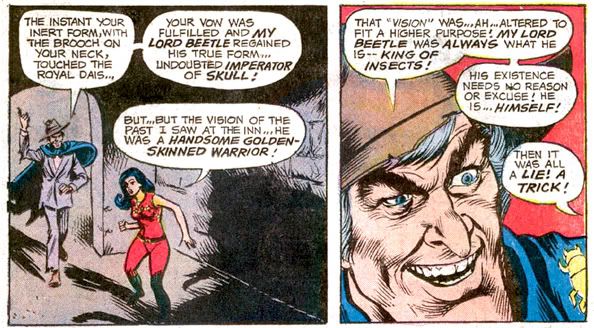
What's this? He's not the nice guy he first appeared to be? And Wonder Girl's golden warrior is actually a giant rhinoceros beetle? His name is Lord Beetle, and his love for her is still true, even if he plans to devour her friends. It's at this point Wonder Girl begins to suspect she just may have been had. Gesturing grandly, still smelling of what we can only assume is the accumulated sweat and urine from dozens of years sleeping on steaming sewer gratings and in abandoned automobiles, Johnny Carpetbag explains everything.
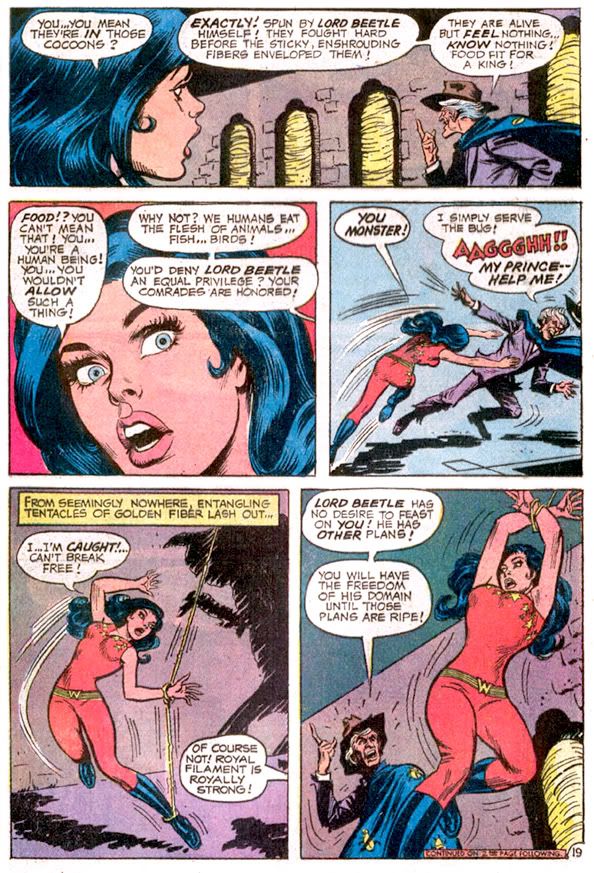
I really like Wonder Girl. She's endlessly vivacious and physically strong beyond reason, but not the smartest person in the room. In any room, including rooms filled with circus clowns or even the cadavers of circus clowns. Ever so slowly, she comes to the realization she may have screwed up. In fairness, none of the Teen Titans are exactly what you might call "geniuses." I'm not sure any of them exhibit even merely average intelligence. That's why it's so entertaining when Wonder Girl and Johnny Carpetbag start to debate the morality of a carnivorous diet.
As if he's spent many a late night contemplating this exact discussion with Wonder Girl, Carpetbag offers the what I consider the most compelling pro-meat argument-- we're all animals and most animals eat other animals. This includes as apex predator giant talking insects with magic powers eating intellectually-challenged teens with super powers. Or vice versa. One devours the other in the great circle of life. Wonder Girl, on the other hand, employs a kind of moral relativity and draws the line at the consumption of people, but thinks nothing of resorting to violence to drive home her point.
I'm sorry to say vegans and vegetarians are not represented in this debate, but I'm sure they could come up with plenty of reasons why both Wonder Girl and Johnny Carpetbag should embrace cruelty-free alternatives.
Bondage fetishists no doubt also enjoyed this issue, or at least two panels from it. And here's where the icky "other plans" line of dialogue falls. Care exercise your imaginations and come up with a few ideas of what these "other plans" might be? Unless they involve sending Wonder Girl back to the United States rather than long white gowns with veils of lace, I don't.
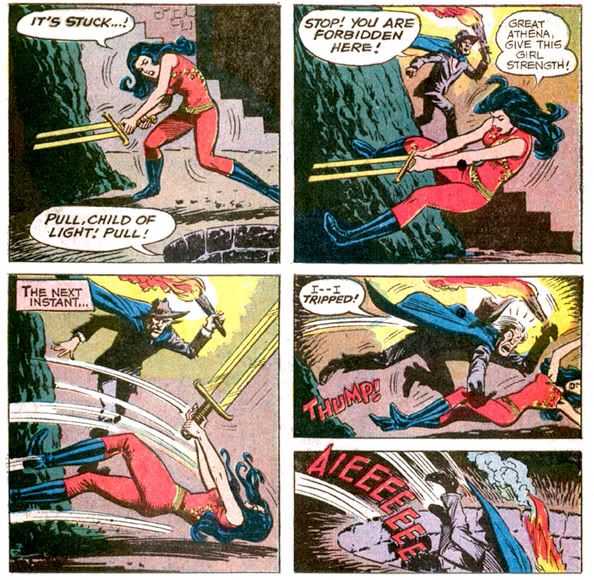
After tying up Wonder Girl with "royal filament" (from his royal butt spinneret... mercifully not shown), Lord Beetle lets her go to wander his temple alone. But soon enough Wonder Girl plays to her strengths-- not thinking or debating. No, she doesn't care for those. Dancing and general hedonism are more her bag. Okay, while in other stories, Wonder Girl often gives into her more fun-loving impulses, doing the frug, the mashed potato, the monkey, the Watusi or the Madison won't help her in this situation, so instead-- egged on by a talking skeletal salamander lying in pit-- she grabs a golden double-bladed sword and pulls with all her Amazonian might.
And so ends the life of Johnny Carpetbag. Not with a bang or a whimper, but an "I-- I tripped!" and an "AIEEEEEEE!" Because when push comes to shove, or trip, if you're dumb enough to work for a giant insect, you're probably dumb enough to destroy yourself accidentally. Even poor, dim-witted Wonder Girl knows better!
Labels:
Art Saaf,
Bob Haney,
DC Comics,
Johnny Carpetbag,
Nick Cardy,
Teen Titans,
vintage comics,
Wonder Girl
Monday, September 5, 2011
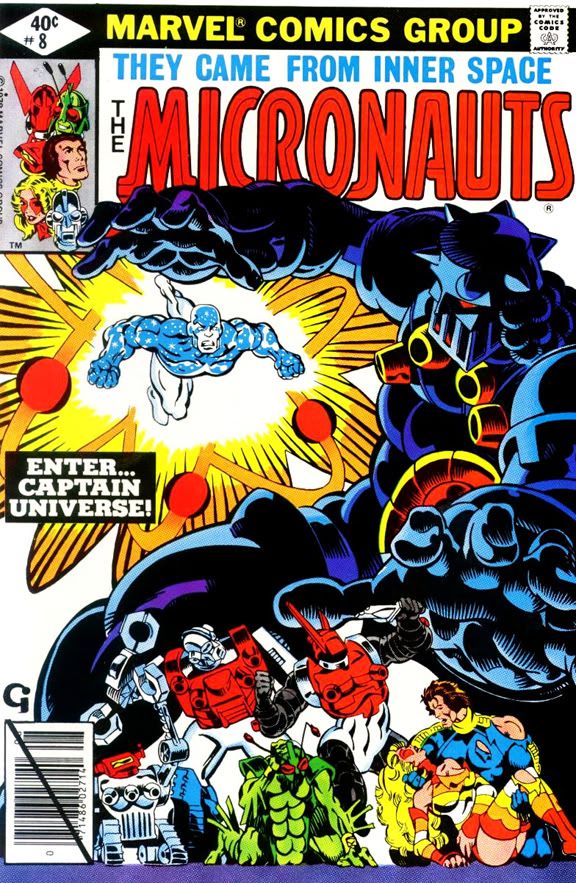
Micronauts #8: What do you get the comic book that has everything?
News to me! But I've long known McLeod as one of the ace inkers. Many of his recent posts have been of his tonal work over Michael Golden's breakdowns for the Howard the Duck black and white magazine. A Michael Golden breakdown features all the little details of his full pencils, only mostly in outline form. There's a leafy tree in one panel Golden has rendered as simply the exterior holding line and he's taken the time to outline practically every individual leaf. Historically accurate models of WWII airplanes hang from the ceiling in another panel, which also features caricatures of several of Golden's friends. McLeod, working in ink, markers and airbrush, later added all the shadows and blacks, rounding out the figures and giving the pages depth and atmosphere through the addition of rich gray tones-- it's almost as if he's painted the finished artwork. Two masters. Comic book art seldom gets any better than Michael Golden with Bob McLeod finishes.
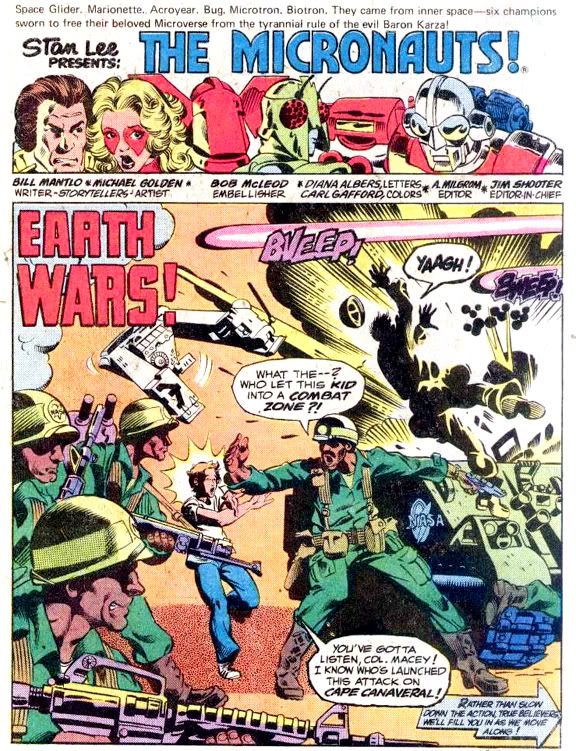
I asked McLeod if he'd ever inked Golden's color work. He said yes, he inked page 1 and 22 of The 'Nam #7, working from Golden's breakdowns again. What about Golden's full pencils? Check out Micronauts #8, the comic that has everything you could possibly want in an action-adventure book.
When they produced it way back in the 1970s, Golden and writer Bill Mantlo were just about to wrap up a space opera epic. As the issue begins, villain Baron Karza has emerged from the "Prometheus Pit" in a secret NASA laboratory and is wreaking havoc. Back in the subatomic reality known as the Microverse, Prince Argon (the guy with a horse's ass-- literally) decides to don some sacred white armor and lead the rebellion against Karza. And while this is happening, a retired astronaut who's fallen into the Prometheus Pit meets up with mystical magical Time Traveller and turns into the superhero Captain Universe-- "The Hero That Could Be You!"*
Last Friday, McLeod posted a page from this issue and talked about it, with Joe Rubinstein and Larry Hama adding their perspectives. As McLeod recalls, Rubinstein inked the first few issues of Micronauts, but McLeod replaced him because the editors didn't particularly like Golden's artwork because it "looked 'weak'" and the book wasn't selling as well as they wanted. They were after Golden to draw it more like Jack Kirby.
According to McLeod, Rubinstein would have done been truer to the original pencils, which were bolder and featured more blacks this go around. That's interesting enough, but it gets better!
Hama then explains it wasn't so much the editors themselves as it was their response to pressure from the fans, a group he characterizes as "solidly anti-Golden at the time." It may seem strange to comic book art aficionados today-- when Golden is recognized as a major influence on top talents and favorites like Art Adams and Jim Lee-- but apparently his stuff didn't go over with the readers in the 1970s. That the book wasn't selling very well helps prove Hama's point, although that may have also been due to its being based on a toy line and its awkward relationship to the superhero monthlies dominating sales. Continuity! How do Bug and Spider-Man relate to each other? What does Acroyear feel about anti-mutant hysteria? That's important stuff to some people!
Hama further points out that Al Milgrom, editor of Micronauts at the time, actually championed Golden's work to the higher ups. McLeod concurs, saying he didn't feel the art was something Milgrom would complain about. Hama also recalls DC stalwarts Murray Boltinoff and Julie Schwarz initially rejecting Golden's art, with himself and Al Milgrom giving him his first jobs there. Hindsight being what it is, this is practically inconceivable, huh? Thankfully, there were people like Hama and Milgrom around.
Despite fan objections and editorial demands, Micronauts #8 is quite the artistic tour de force. I'd say Golden achieved a bolder, more dynamic look without sacrificing his characteristic eye for teensy-tiny detail, and McLeod inked with a sympathetic line that didn't overwhelm.
Milgrom took over inks on Micronauts starting with #9, and he did ink with a bolder, simpler line. Hama maintains the fans felt Golden's work was "too cartoony," but Milgrom's inks look cartoonier than either Rubinstein's or McLeod's. I'm not sure how telling the inkers to make the art look more like Jack Kirby would have alleviated that particular complaint, either. Especially considering how Kirby himself was no longer in fashion with the fans at the time and subject to a certain amount of disrespect at the Marvel offices during this period as well. At least that's how I've always heard it told.
I wonder if sales improved. They must have been acceptable, since the book continued for several more years. In retrospect, Golden was the perfect choice for this book, much more appropriate for its milieu than Howard Chaykin, who took over pencils with #13. And as fine an inker as Milgrom is, he and Chaykin don't mesh very well. The art appears clumsy and rushed compared even to the work Golden and Milgrom produced in the previous issue. Chaykin really needs to ink himself. Why did Marvel keep plugging him into these space opera type books? It's not that he can't handle science fiction or action-- check out American Flagg. It's just this type of spaceship-and-heavy-equipment storytelling and Marvel-style inking never did him justice. His perfect fit would have been Marvel's The Further Adventures of Indiana Jones, but that's a post for another day. This one's already ridiculously rambling and prolix enough!
As the title continued, it began to suffer from repetitive storytelling. Karza comes back from the dead, reconquers his domain, invades the Earth, has his butt kicked. Repeatedly. And the Microverse-- being an entire universe unto itself-- would seem to offer a limitless backdrop for any number of original plots, but because it's in the back pocket of the Marvel universe, the Micronauts fight Doctor Doom, Plant Man and Molecule Man while teaming up with the Fantastic Four and Ant-Man. Eventually, they join forces with the X-Men while Karza and Kitty Pryde switch bodies. That's where I break with most fandom-- I would have preferred Marvel's Dracula not fight Brother Voodoo or vampirize Storm, for example. Luke Skywalker didn't have to team-up with Nick Fury and Dum Dum Dugan; why should Commander Rann? Don't get me wrong-- quite a few of these individual stories are a lot of fun to read, but they're standard comic book fare without the grandeur of title's first dozen issues.
Throughout, Golden-esque artists like Pat Broderick and Jackson Guice-- kind of ironic, huh?-- maintain a high level of gloss and gleam. Despite the the deja vu-inducing plots, Mantlo continues to develop his cast-- especially the lead, Rann, who starts to feel his age, grows a beard and loses his hand. But there's a sense they'd told the tale and then succumbed to the inherent weaknesses of open-ended serialized storytelling.
While I was reading this, one of the best ideas I've ever had suddenly came to me. Sit down. You really need to be sitting before I share it with you. Comfortable? Good. Imagine this: Chris Claremont scripting a New Mutants flashback issue featuring the original team with Michael Golden and Bob McLeod providing the art!
Oh baby!
*Restrictions may apply. Offer not valid in every state. Marvel and When Comic Books Rule the Earth do not mean to imply you actually could be Captain Universe and make no claims-- legal or otherwise-- that are to be considered binding contracts.
Thursday, September 1, 2011
The Henry Cavill-Zack Snyder Superman Suit
Well, there they are, at last. Some clearer-- though not better-- photos of Henry Cavill cavorting in character as Superman, the first and greatest superhero of them all. I haven't checked out everyone else's opinions on the Superman suit for the upcoming Man of Steel movie because I don't want mine diluted or influenced in any way. Here we go!
I don't hate it. In fact, I like it better than the one Superman's going to be sporting in the funnybooks from now on. But I can't really say I'm in love with it, either.
The photo from the MTV Splash Page site where Cavill is walking towards a couple of other actors portraying what I assume are villains makes him look fairly ridiculous, probably because crew members are standing around him in civilian duds and the scene appears to be staged in a strip mall parking lot where one of the stores is being renovated. Not very heroic or godlike. Just a dude in a rubber suit, possibly going to grab a pack of smokes out of his Ford Fiesta while entertaining at a children's party in a Chuck E. Cheese.
Then there's the capeless one, the one where Cavill is air-punching. It affords a better look at some of the suit's detailing. The little markings around his hips. What are they supposed to be? Kryptonian athletic wear branding? Kal-Adidas? K-Nike? I kind of like it without the cape, though. If you're going to change the traditional look, why not go all the way and really change it? I have the feeling he'll be wearing the cape for filming, though. No point in wearing it during blocking or all the other between-scenes stuff they have to do for huge movies. And small ones, as well.
These photos really don't do it justice. They look so crappy, so poorly light-balanced and composed, I might have taken them. We haven't seen the suit in motion, we haven't seen how Zack Snyder is going to frame these shots, or how they'll light them and we haven't seen how Cavill is going to carry himself as Superman. The body language and film photography will go a long way towards determining whether or not this suit helps Superman fly, or becomes his kryptonite necklace.
There you have it. The great traditionalist doesn't hate the new suit and suggests they could have taken it further. Surprised? I know I am. I'm going to be interested to read a few blogs about the suit now. It will be a while before I can catch up with you guys, though. The Snyder factor more than likely means I'll be giving this flick a miss in the theaters and catching it on cable a couple of years. And then I'll update you on whether or not this suit really works.
I have to leave you now. No hard feelings. We all have our little faults. Mine's in California. Oh, but before I go...
The Daily Mail site has some shots where someone-- possibly connected to these "MDCU" people-- has used a little Adobe Photoshop to add color and a badly rendered cape to these photos, plus the red pants. It amazes me how obsessed with Superman's red pants these sites are. Superman goes commando. Superman's underwear. Superman's Junk Protection (as if he needs any). What's wrong with these people? Why no love for the spit-curl? That's missing, too!
Labels:
costumes,
Henry Cavill,
superheroes,
Superman,
Zack Snyder
Subscribe to:
Posts (Atom)