Sunday, March 24, 2013

Dani Moonstar, the Early Years! A Look at How Moonstar Stole the Spotlight in the First Issues of The New Mutants

Arguably the greatest comic book character ever created, Dani Moonstar just made her debut as a team member in Fearless Defenders, having survived the cancellation of the most recent New Mutants series. It's not luck.  She demands to be in books.  Created by Chris Claremont and Bob McLeod, Dani Moonstar has been flying around the Marvel universe on her magical winged horse for more than thirty years now and no matter how they change her-- new powers, no powers-- she just keeps on doing her thing.  With sheer grit and determination, she elbows others aside and takes over entire narratives.  The other characters in Fearless Defenders had better watch out lest they find themselves mere sidekicks to Dani Moonstar.  It's been so from the very beginning, and I will prove it.  Mathematically.  Scientifically.  Magically.

Chris Claremont, script/Bob McLeod, art (Marvel Graphic Novel #4, October 1982)

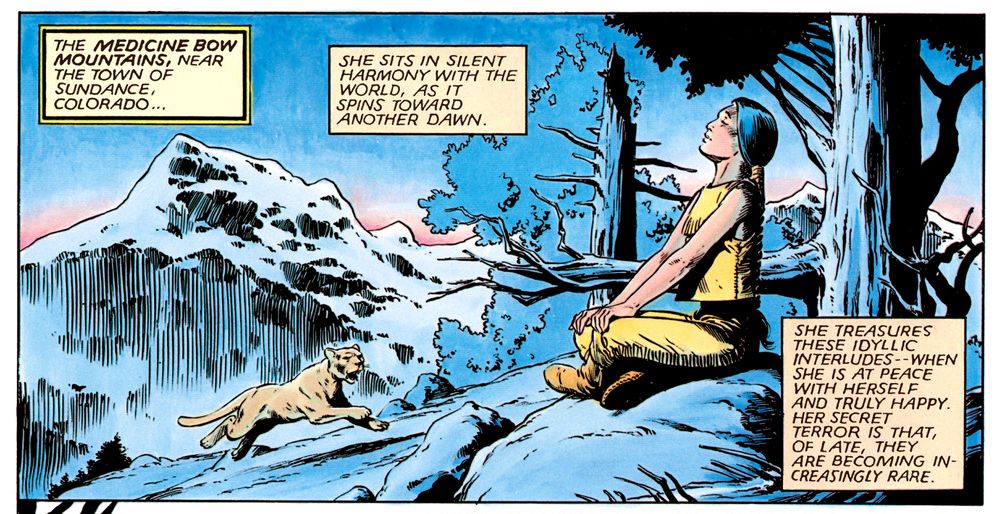
Our girl Dani debuted in Marvel Graphic Novel #4:  The New Mutants, way back in October of 1982, the fourth of the new... er... mutants in order of appearance, but first by far in order of kick-assness.  Her first moment in the book sees her chilling out on a mountainside after essentially reducing herself to a recluse because her mutant power of drawing out a person's worse fears has alienated her from her peers.  Yeah, as if Dani has peers.  A Native American of the Cheyenne people, pre-heroic Dani likes to sport some kind of deerskin outfit that's probably more comic book than real world, but with her black hair in braids, it's enough to visually imprint the idea of her cultural origins.  Chris Claremont's economical narrative captions serve only to emphasize what Bob McLeod's art has already made obvious, but in those days, at the height of his creative powers, Claremont excelled at adding depth and shading to characters that are essentially stereotypes, drawing in readers with his sympathetic take on their personalities.  Like with Dani.

In a graphic novel full of introductions and kind of crowded with incident and scene changes-- the locale shifts from Scotland to Brazil to the United States to Brazil again before returning to the good ol' US of A to wrap things up-- Dani's volcanic temper, rebelliousness and single-minded quest for vengeance set her apart from the other characters.  While Rahne is shy, Roberto kind of stiff, Sam dopey and X'ian a bit uptight, Dani emerges as the most well-defined and charismatic.
Chris Claremont, script/Bob McLeod and Mike Gustovich, art (The New Mutants #1, March 1983)

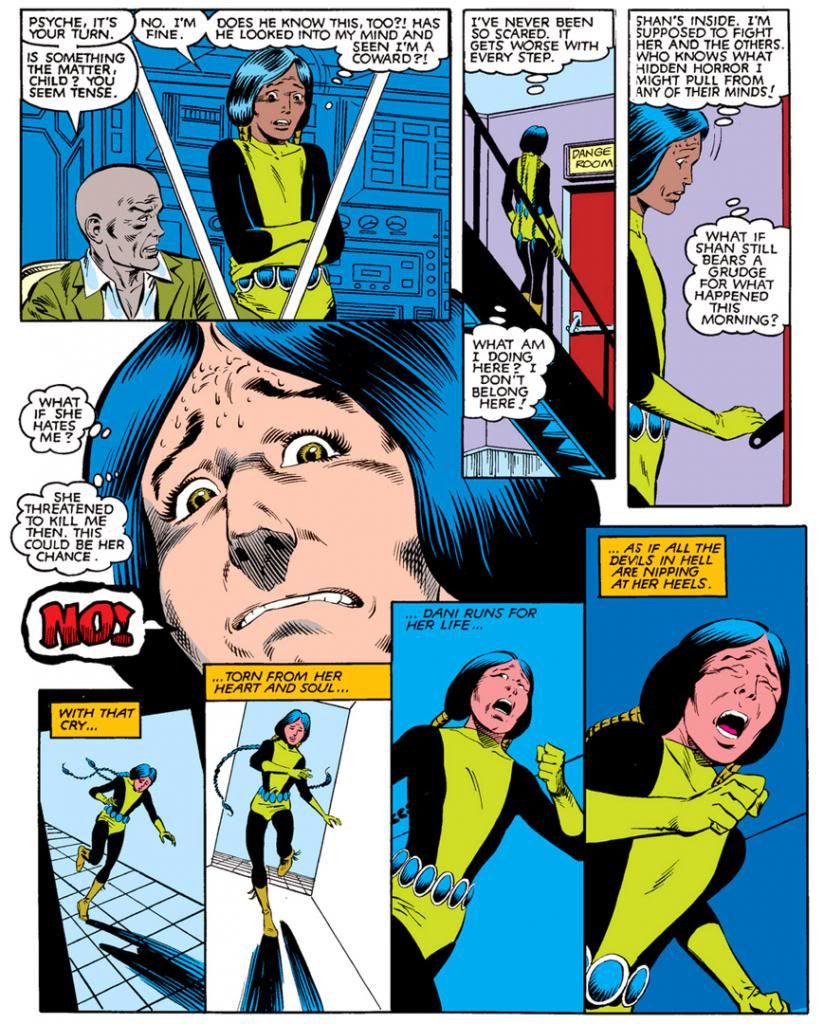
Claremont and McLeod must have known they were on to something, because Dani becomes the star almost immediately in The New Mutants monthly comic, repeatedly getting solo spotlight moments while the other kids are out at the mall or practicing their moves.  Look at it this way-- in the first three issues, she gets the central position on a cover, 12 and a half solo pages-- two of them title page splashes-- and fifteen story pages devoted either to her problems or actions in which she's the main participant in some way.

No one else comes close.  Roberto gets a nice double-page spread at one point.  Sam and Rahne get one solo page each.  Poor Xi'an gets zero, and her most dramatic story moments relate to something Dani did to her.  Out of sixty-six interior pages over one-third of them-- slightly more than one complete comic-- are Dani-centric.  When the story features the other kids, they're usually sublimating their individuality to the group dynamic.
Chris Claremont, script/Bob McLeod and Mike Gustovich, art (The New Mutants #2, April 1983)

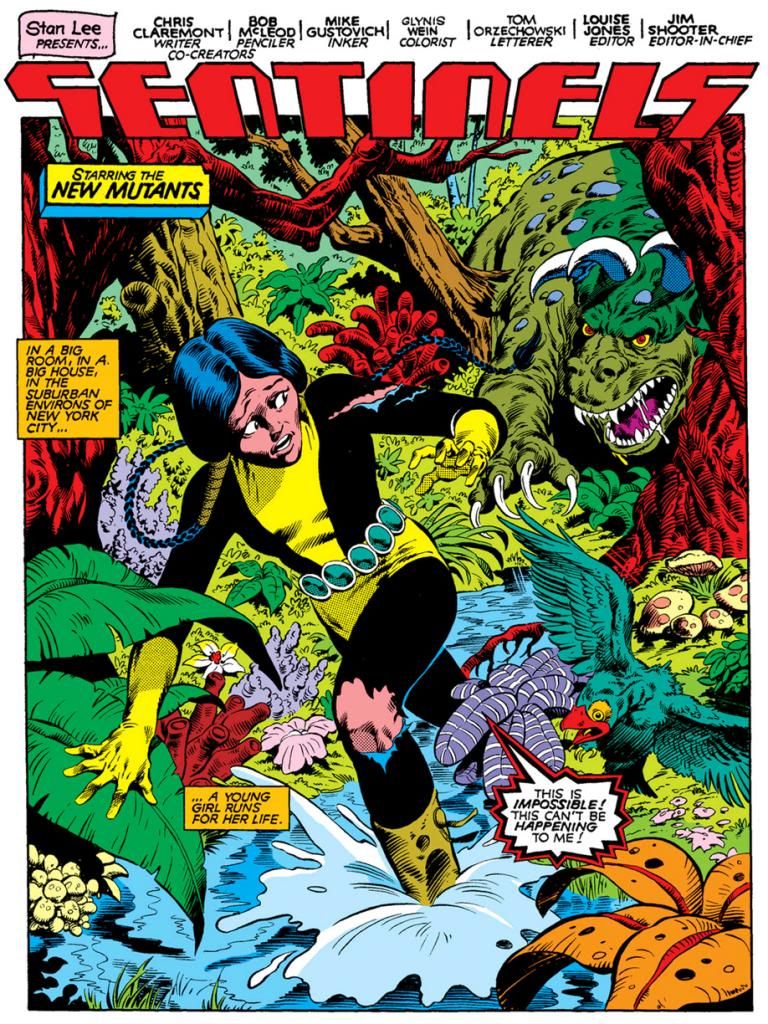
Not Dani.  She's all about the awesomeness of being Dani.  Humiliated by her cowardly failure to confront the Danger Room the first time in The New Mutants #1 (March 1983), she takes it on all by her lonesome and ends up stalked through a jungle landscape by a fabulous creature out of McLeod's imagination in #2 (April 1983).

One underappreciated aspect of McLeod's long comic book career is his ability to draw really cool jungle environments.  Look at all those strange fronds and bizarre polyps sprouting all over the place, plus that crazy bird in the foreground that seems as frightened of Dani as she is of that three-horned behemoth-- so powerful it can knock down fully-mature trees-- coming up behind her.  Run, Dani, run!

McLeod takes advantage of the Danger Room's holographic capabilities to go absolutely nuts with the forest primeval, which leads directly to one of Claremont's own specialties-- the development of the hints and intimations of a mysterious subplot into an action-and-dialogue packed main plot.  An unknown miscreant is manipulating Dani's emotions for some nefarious end.  And attempting to murder her.

Claremont tells us a great deal about Dani during this period, more so than of any of the other characters other than perhaps Xi'an (again, only because Dani draws out a lot of this info).  For example, not only is she full of self-reproachment for failing to live up to her own standards (she calls herself a coward), but she also tells Rahne about her parents' apparently supernatural death and that her father was Horse Clan and her mother was Eagle Clan.  While Claremont never elaborates on the meaning of these clan affilitions, Dani's parents play an important role in a later storyline that wraps up this aspect of her history.  By contrast, we haven't learned Rahne's parents' names at this point (I still don't know them!), and all we know about Sam's family is they're a bunch of Kentucky coal miners and he should be writing sad honky-tonk songs about them instead of wasting his time trying to learn how to change directions in mid-air while blasting fire out of his ass like a human rocket.
Chris Claremont, script/Bob McLeod and Mike Gustovich, art (The New Mutants #3, May 1983)

We also learn there's a chance Dani might be mentally ill.  This is a lot for readers to absorb about a single character in what's supposed to be an ensemble this early in a series, and it renders the book more or less Dani Moonstar and Her Amazing Friends!  Screw Sam, Rahne and the rest-- this is Dani's book and they're merely supporting players.

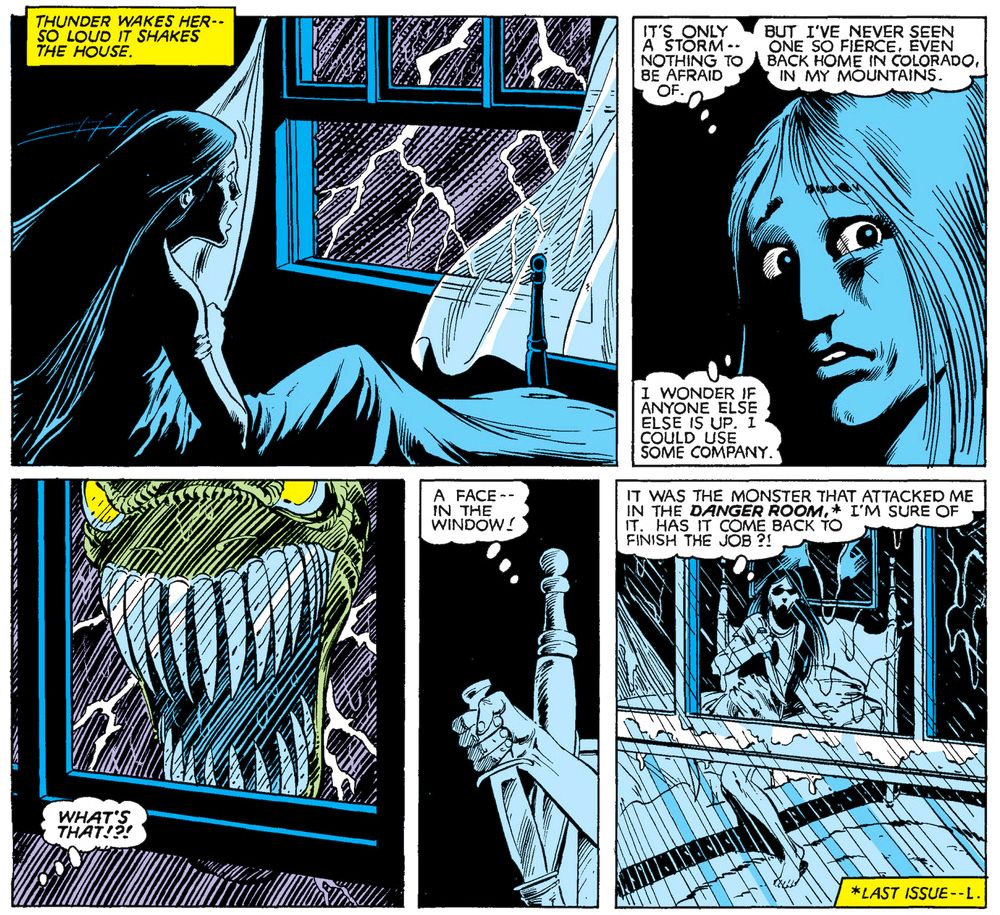
In The New Mutants #3 (May 1983), Dani gets another dramatic solo moment as she dreams of the demon bear that she believes killed her parents and the deaths of her new friends.  In the aftermath-- and while clutching a wicked-looking knife-- Dani overhears Professor X himself on the phone telling Moira McTaggart the incident represents a psychotic break, that's it's nothing more than paranoia, symptomatic of schizophrenia.  I think the proper medical term is "losing her shit."  She doesn't take it well.  I mean, what thirteen-year-old girl wants to be diagnosed as schizophrenic by a seemingly all-knowing authority figure?  Dani's young mind conflates having a mental health issue with being broken and unworthy, confirming her growing tendency towards self-loathing.  Her thoughts turn towards the suicidal.

Okay, stop and think about how genius this is.  At this point, having shown us all of Dani's fears-- that Xi'an wants to kill her, that her cowardice is out of character, that she's being persecuted by some strange dream-like figure, that her powers are somehow some manifestation of inner evil-- and having no reason to doubt the usually reliable Professor X, Claremont makes us doubt her sanity.  Just enough.  Claremont's obviously building to something here-- either the demonic creature is real or we're going to have a very dramatic storyline about a teen losing her hold on reality.
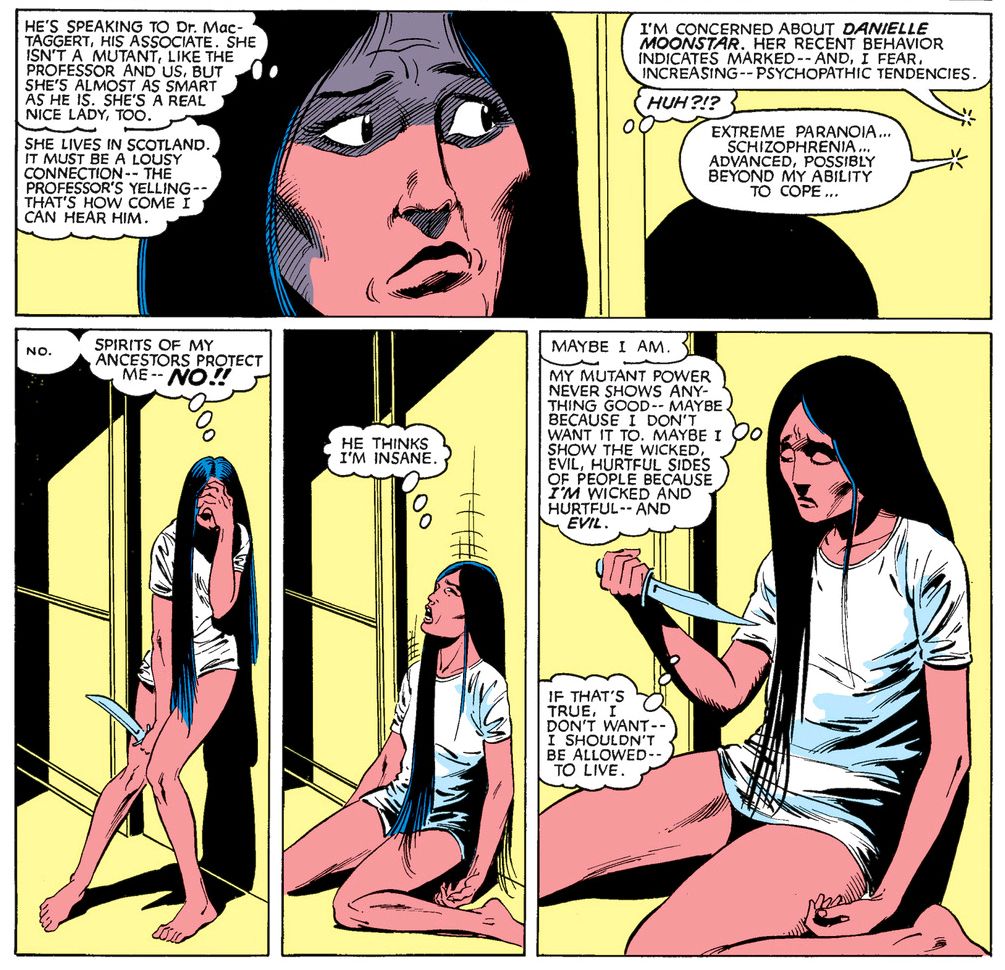
Chris Claremont, script/Bob McLeod and Mike Gustovich, art (The New Mutants #3, May 1983)

And McLeod reinforces very distinct possibility it's the latter by posing Dani-- her hair unkempt, wearing only a sleep shirt that's a signifier of dream-states and other levels of consciousness, or perhaps even a hospital gown one might wear at a mental health facility-- with the business end of her knife ominously towards her own heart.  Out of all the characters in this book, of course it's Dani who's the most at-risk.  A cliff-hanging end to issue #3, with the entire direction the series in the balance... and it's all about Dani Moonstar.

For now, let's leave young Dani slumped against Professor X's office door out of respect and come visit her again when she's feeling better...

Thursday, March 14, 2013

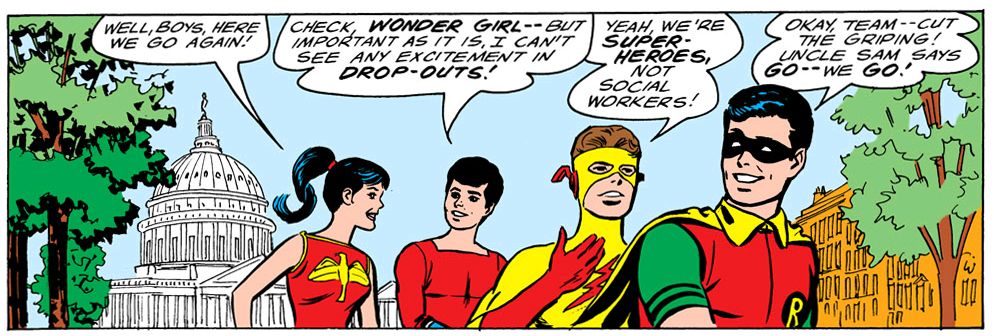
The Teen Titans versus the New Mutants-- reactions to authority in contrast


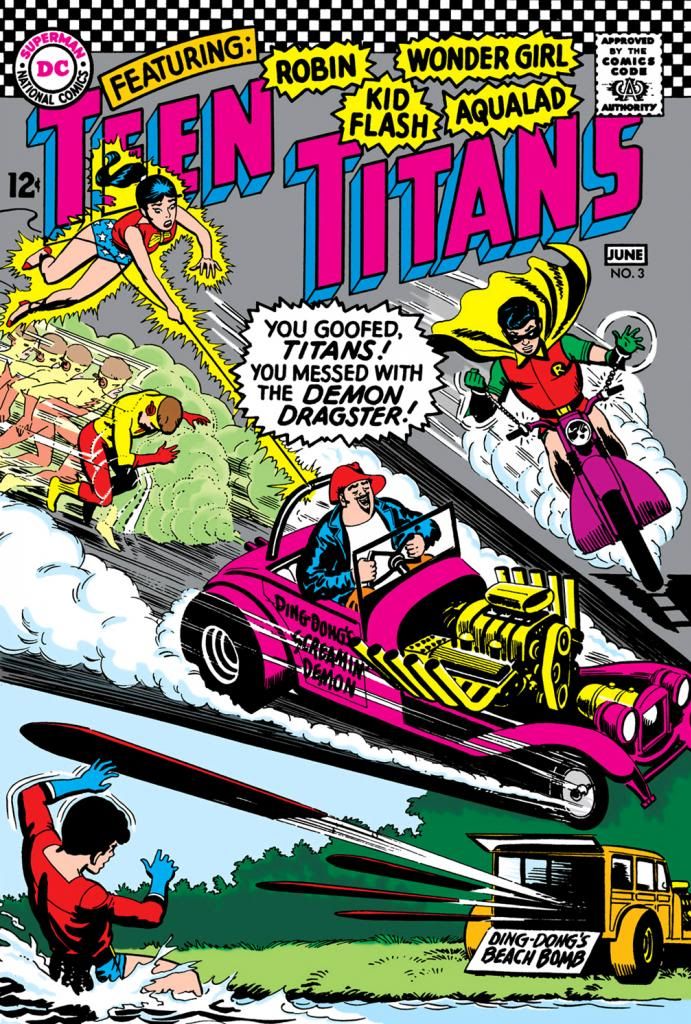
Bob Haney-script/Nick Cardy-art, Teen Titans #3 (May/June 1966)

Many years ago, before you and I were even born, the US government needed someone to help with school drop-outs.  So they turned to DC's premiere group of costumed teens (most of whom were sidekicks, wards or protégés of similarly-themed adult characters).  Calling Robin, Kid Flash, Aqualad and Wonder Girl to Washington, D.C., concerned officials charge them with journeying to the middle American heartland and confronting their age-peers.  "Stay in school," the Teen Titans preach, "the United States government wishes it!"

People had youth on the brain back in the 1960s.  While adults and kids have always had their differences, the post-WWII baby boom expanded what they used to call the "generation gap" to almost revolutionary levels.  It started in the 1950s, but intensified the following decade due to the continued pressures of an unpopular war, struggles for racial and gender equality, new forms of musical, artistic and self-expression, the Sexual Revolution and even the cynical media exploitation of this huge, new-- and relatively affluent-- demographic.  With even a cursory reading of history, we can, just as people did back in the 1960s, divide these opposing forces into the establishment and the anti-establishment.

When "The Revolt at Harrison High" in Teen Titans #3 -- with its heroes optimistically working for the establishment writer Bob Haney (himself a self-described socialist and pacifist) characterizes as largely benign-- hit the newsstands in the summer of 1966, the anti-war movement was already in full swing.  Young people had already burned draft cards, various groups had successfully staged several large scale anti-war rallies (Haney had participated in some by this time as well) and a number of veterans had attempted to return their medals to the White House.

The next year, 1967, witnessed the Summer of Love and the Beatles' psychedelic masterpiece Sgt. Pepper's Lonely Hearts Club Band.  Colorful Utopian dreams seemed within reach if the young simply turned their eyes to the sky in search of diamonds and tuned their sitars to the cosmic.

Then, in 1968, the world erupted, with the Tet Offensive rocking America's confidence in its military's ability to defeat a technologically-inferior foe, two major assassinations at home, racial violence, student violence, police violence in Chicago during the Democratic National Convention, a Soviet invasion of a liberalized Czechoslovakia, tyranny stamping its iron boot on the human face forever.  

Things fractured further.  That year, American International Pictures released Wild in the Streets, in which a 24-year-old rock star becomes president of the United States and throws people over 35 into concentration camps where they’re dosed with LSD.  Coming years would see more war protests, the watershed music festival Woodstock giving way to legendary bummer Altamont, the Tate-LaBianca Murders (via the demonic influence of Charles Manson-- the perfect hippie bugbear to chill the spines of parents everywhere), the invasion of Cambodia and the 1970 Kent State shootings—an event preceded by the Ohio governor angrily denouncing anti-war protesters on campus as a “militant, revolutionary group.”

Then came further betrayals.  The crushing loss of George McGovern in the 1972 election to Richard Nixon.  Watergate.  The energy crisis.  Recession.  Malaise.  Cities like New York suffering from collapsing infrastructure.  No wonder youth culture curdled into the nihilism and anarchy of punk rock on one hand and the mindless hedonism of disco on the other.

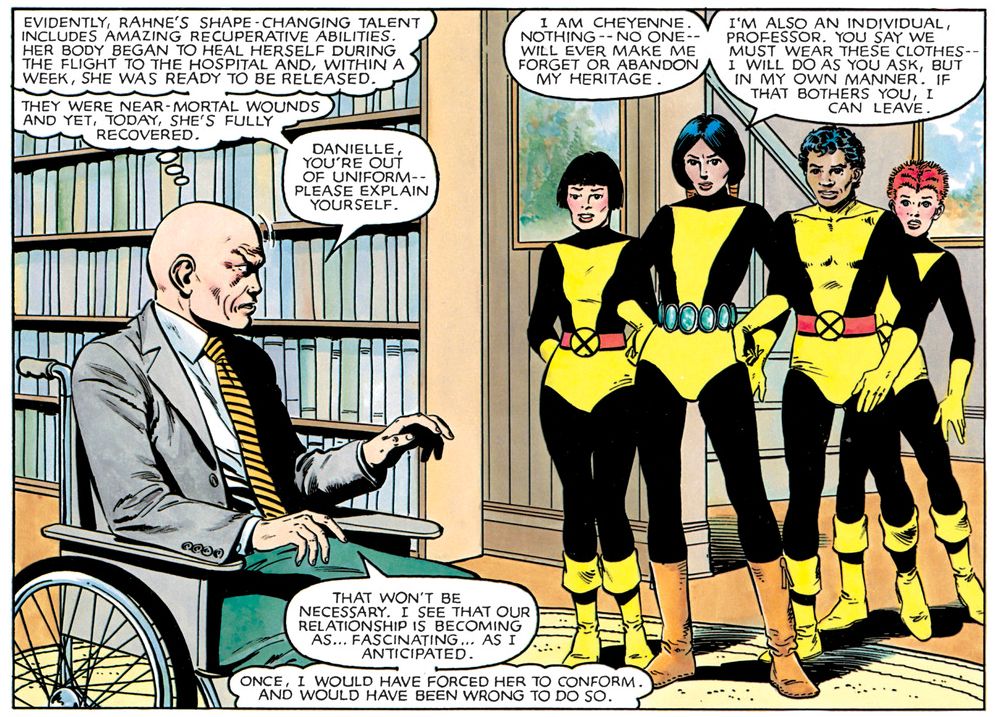
Chris Claremont-script/Bob McLeod-art, Marvel Graphic Novel #4 (October 1982)

Which might be why just a generation after the Titans marched proudly out of Washington filled with the evangelical furor and a hopeful message for high school drop-outs everywhere, Dani Moonstar of the New Mutants, Marvel’s premiere group for costumed young people (none of whom were sidekicks, wards or protégés of similarly-themed adult characters) responds with open rebelliousness to Professor X’s demand for uniformity among his pupils.  And also why the Professor himself decides not to quash her individualism.

Bob Haney-script/Nick Cardy-art, Teen Titans #3 (May/June 1966)

The two teams take different tactics when interacting with their peers, too.  In "Harrison High," the Titans act as establishment mouthpieces, which renders their attempts at talking frankly with their age-peers awkward and forced.  They fail because few people enjoy being talked down to, especially by others their own age.  This approach pays no dividends, as the Titans learn here.  Later they take a different tactic-- strangely enough, involving violence-- and find positive results.

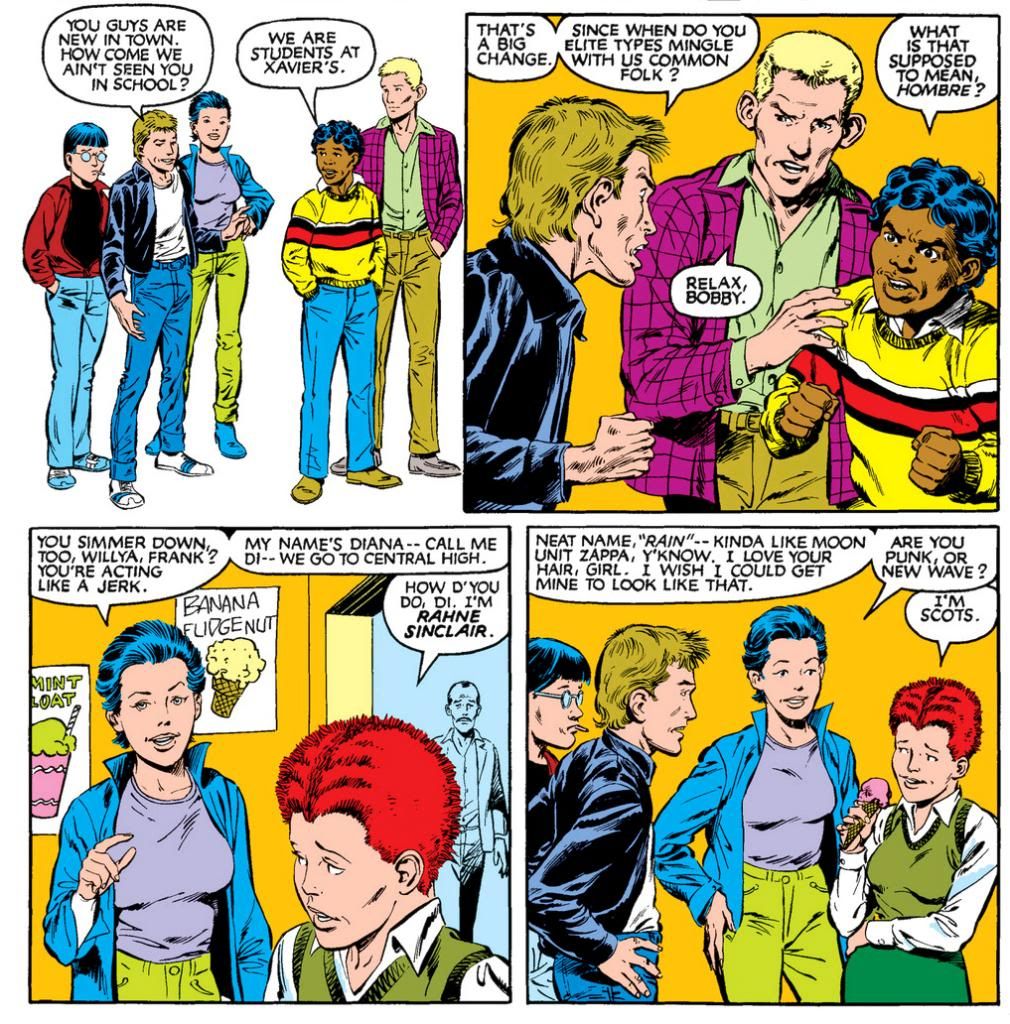
Chris Claremont-script/Bob McLeod, Mike Gustovich-art, New Mutants #2 (April 1983)

The New Mutants, on the other hand, have no ulterior motives-- certainly none that are government-directed-- and relate to people in their age demographic more or less as equals, so their interaction, while a bit contentious, is comfortingly naturalistic.  Within moments, the mutant students and the townies have forged the bonds of friendship despite their socio-economic, cultural and genetic differences.

But don't let me give you the idea the Titans didn't learn to swing.  It wasn't long before they got with their times and began questioning authority.  They'd drop their self-righteous pro-establishment stance and come into conflict with their mentors and the adult world at large.  That's an essay for another time.  But just think about this-- today Robin is a grandfather and Dani is my age and they're both just as confused and troubled by today’s kids as the grown-ups of yesteryear.

Monday, March 11, 2013

Free is the best price point!

Did you manage to score any of those free Marvel #1 comics?  Marvel offered 700 first issues through Comixology and apparently inspired demand so great Comixology's servers couldn't handle it.  While most of the offerings held little to no interest for me-- Marvel Ultimates, Marvel Zombies, Marvel Now, Avengers vs. X-Men and stuff like that-- I did find 84 comics both old and new I loaded into my digital shopping cart.  Then I couldn't complete the transaction because Comixology wouldn't let me sign in.

The shopping process went as usual.  Maybe a little more slowly, but not so much it taxed my patience.  Then the sign-in stage and nothing but a blank screen.  I left it for a while, watched a little Japanese television-- celebrities who graduated from the top universities here taking a kanji quiz while dressed in high school uniforms-- then came back to find that same blank screen.  I turned off my computer and picked up an actual book.  I'll try again tomorrow, I thought.

Now Marvel and Comixology have suspended the offer so I'm out in the cold.  I'm a little disappointed, but those are the breaks in this digital age.  Fortunately, I'd previously bought a few of the number ones offered-- New Mutants, Fantastic Four and some others from the good ol' days.  

But there were some oddball choices (for me) I was really looking forward to having in my Comixology library.  Wolverine and Jubilee, for example.  Young Avengers.  The first Joss Whedon Astonishing X-Men and the Giant-Size Astonishing X-Men with Kitty Pryde riding the giant space bullet into apparent oblivion.  Some updated Dracula story.  FF, a new Fantastic Four book with a different cast and Mike Allred art.  Not stuff I'd cover here where my focus is on comics from the last century, but things I wanted to read nevertheless.

Well, maybe they'll take the lessons learned from this event and do something similar in the future.  I still think Comixology is a wonderful site, especially for a person living overseas where it's difficult and expensive to come by print issues of various comics.  And, after all, free is my favorite price point.

Thursday, March 7, 2013

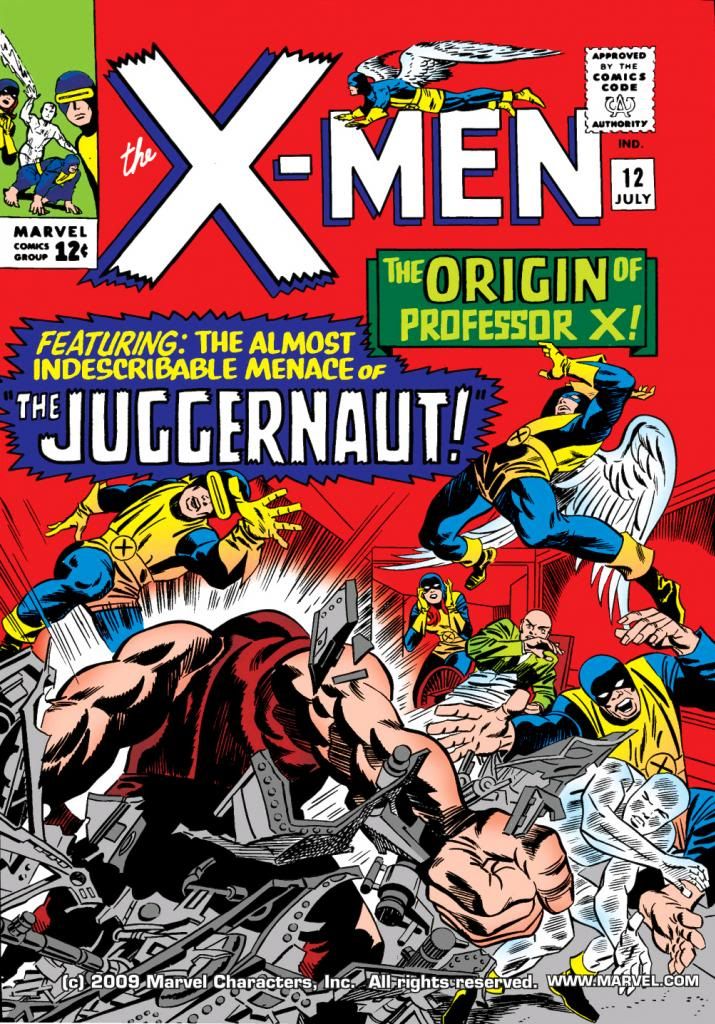
X-Men #12: Kirby and Toth, two great tastes that don't taste great together!


Jack Kirby and Alex Toth are tops of the pops as far as I’m concerned.  When I found out Alex Toth penciled X-Men #12 (July 1965), I had to track it down.  When I read he did this over Kirby layouts, I grew a little concerned.

You know, the two artists had almost diametrically opposed approaches to the page.  Toth practiced an elegant minimalism, with poses largely naturalistic.  Heavy black-spotting, cinematic.  Kirby drew in a more expressionistic way, his figures displaying emotions and actions at their most extreme.  Statue-like figures surrounded by crackling force fields and radiating forces, as if their struggles produce an energy that threatens to consume the paper they’re printed on.  

But then I thought, why not combine Toth and Kirby?  This kind of artistic dissonance can produce in collaboration an energy of its own, like unstable two radioactive molecules exchanging electrons and we get an artistic nuclear reaction producing a startling, never-before-thought-of beauty.  Or, in this case, X-Men #12, a comic book China syndrome.  A Three Mile Island in print.

Flash back to 1965.  Stan Lee, always on the hunt for artists (a number of DC regulars did Marvel jobs under assumed names back then), gave Alex Toth a call-- or mailed him a letter for all I know-- and offered him an issue of X-Men.  I'm no comic book historian, but I think Kirby was spread pretty thin at this point and dropping X-Men to concentrate on Marvel's better-selling titles.  But as to why Lee would offer this particular book to Toth in particular-- well, that's for people who know more about the inner workings at the House of Ideas.  Suffice it to say, Lee offered and Toth accepted.

So far, so good.  As so many other artists had to at Marvel, Toth went to work on pages previously laid out by Kirby, the creator of the Marvel house style.  Maybe this was meant to smooth the art transition for the readers.  Maybe Toth asked for this arrangement himself.  After all, he was used to working from full scripts, not from Stan Lee posing on his desk.  To make sure Toth's work became fully Marvel-ized, Lee then assigned inker Vince Colletta, a frequent Kirby collaborator, to...


"Fix" isn't quite the word for what Colletta did.  While Colletta certainly has his shortcomings-- a cursory Google search will come up with ample listings of them, especially in conjunction with his inks on Kirby-- nowhere are they more on display than in this ham-fisted job on top of Toth pencils.  Gone are the smooth, graceful lines of Toth and instead, we find crinkly, crabby scrawlings, wonky faces and malformed hands galore, plus trange interpretations of light and shadow that show Colletta wasn't quite sure of what Toth was getting at.  Toth was known for drawing handsome men and beautiful women.  Kirby drew them as powerhouses seemingly carved from stone or molded from steel.  The mutants on display in this book are the kind you find preserved in alcohol in dark closets in abandoned madhouses.


Joe Sinnott might have salvaged this job with his slick line, confident black-spotting and willingness actually to draw with ink and fix proportions, but it's pretty obvious Colletta just isn't up to the task.  Check this out:


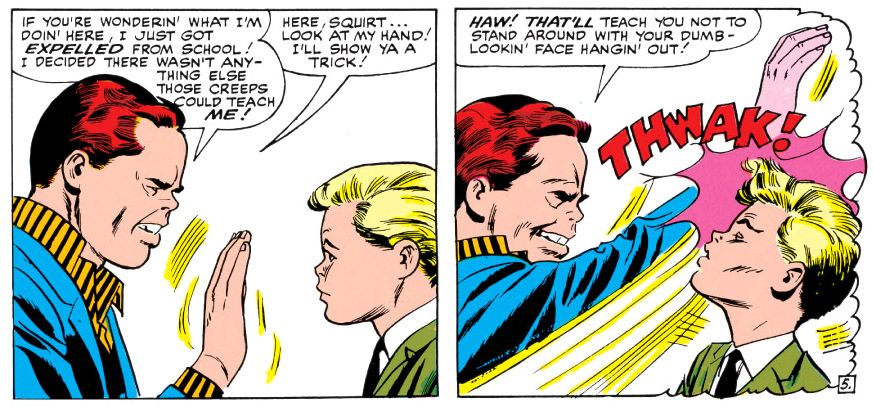
Lumpy Rutherford-- NOOOO!!!  This looks like the worst comic book adaptation of a secret Leave it to Beaver episode ever.  That red-haired jerk is Cain Marko, Charles Xavier's step-brother.  They don't get along, as you can see.  While Cain has a pert Toth-style nose, his hand looks like someone shoved sausages into a latex glove.  That's neither a Toth hand nor a Kirby hand-- it's a hand no one bothered to finish drawing.

In Colletta's defense, I really doubt Toth gave him all that much to work with.  They'd team together again at DC on Hot Wheels with much better results-- although Toth might dispute that if he were still around.  The difference there might have been Toth being more engaged with the material than he is here and unencumbered by another artist's layouts.

Anyway, a few panels in this book look very Tothian, as if he took his time to really shape the image, but for whatever reason, throughout most of this book Toth appears to have largely traced Kirby's figures without adapting them to his own naturalistic proportions and scale.  While he uses a lot of those parallel ray bursts that make the characters look as though they're exploding with strange energy-- but never seems to have reconciled the Kirby approach to these kind of abstracted effects with his own minimalism and Colletta spent about two seconds puzzling them out before slapping down the ink.  There's also a chance Toth might not have drawn any of these effects and Lee, dissatisfied with too much negative space in the panels, either added those lines himself or had someone in the art department do it.

Here's another unfinished hand:


Another problem is the color reconstruction is lousy.  This comic was never meant to be printed on slick, glossy paper with modern line-screens.  Despite a growing serious fandom and popularity on college campuses and with the heads, comics in the mid-60s were still disposable rags printed on the cheapest paper.  Lee, Kirby, Toth and Colletta all knew this.  This didn't necessarily mean they hacked it out without a care, although X-Men #12 seems to stink of that.  It just means they were under no illusions of creating something of lasting impact.  They weren't dreaming history here or anticipating bloggers deconstructing every aspect of every panel on one page out of the hundreds they touched that month.  They were working to support families or pay alimony and they knew, as professionals, how to get the most out of the shoddy materials they had to work with in the time allotted-- they didn't have the luxury of blowing deadlines like superstar artists of today do-- so the end result, there on the newsstand, would be attractive enough to tempt readers into spending their twelve cents.

People didn't preserve the original artwork-- they had paste-up jobs done on them with glue that soon yellowed or browned, people used old pages to clean brushes or tossed them in files and later shredded them when the company needed more space.  I've seen some pages from this job for sale online, but I doubt Marvel spent the money necessary for full access to them in order to start from scratch.  What's more likely is they scanned decent printed copies, then used Photoshop to eliminate as much of the colors and old-timey fat line-screens-- a process which also takes away the edges of the black areas and a lot of the fine line work.  And, in the case of Colletta, serving to make an already sketchy line quality even sketchier.  Re-colored then printed slickly, or blown up on Comixology (which is where I read this), all the original flaws become glaring and a lot of new ones show up as well.

In this case, there are pages where Cain Marko's face appears a bizarre pink as if he's suffering from extreme embarrassment or some kind of disfiguring rash.  Poor guy. No wonder he went mad with power when he found the Cyttorak Ruby.


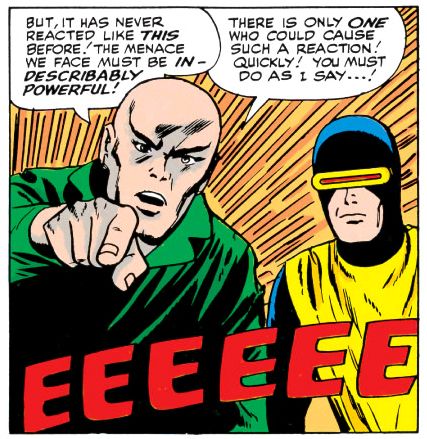
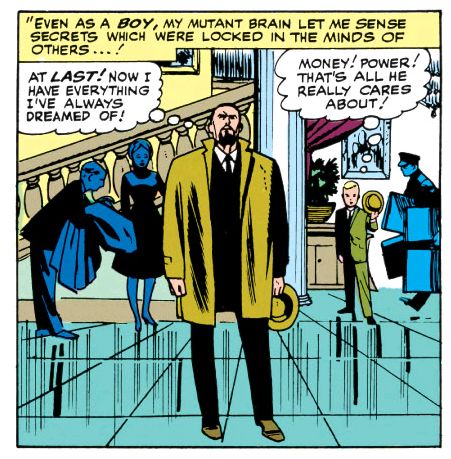
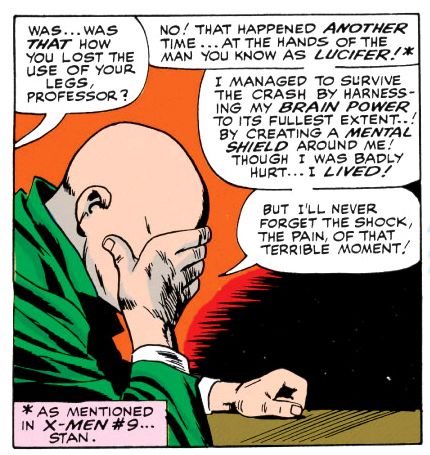
What I don't understand is why Toth took this job in the first place.  If Lee wasn't shy about expressing his artistic opinions, Toth was the original let 'em have it guy.  He must have looked at these layouts and thought, "Oh balls!"  Plus, Xavier's backstory is cliched and melodramatic (although these guys make a pretty good case for it even while pointing out Stan Lee's apparent difficulty with psychic terminology).  It's rather talky for a book so packed with characters, too.  And, as part one of two, it's all build-up and no climax.

Toth liked to draw airplanes and cars and he was aces on period pieces.  Portions of this story take place in flashback, but there's nothing setting it in any particular era visually, and just one sequence featuring a car that looks pretty contemporary to me, a mid-60s model in a scene that takes place sometime in the 1940s.  Toth preferred classic Errol Flynn-style swashbuckling heroism, but there's not a single sword-fight anywhere in this story.

My best guess is the Warren and DC jobs weren't coming frequently enough and publishers like Dell didn't pay high enough a page rate, so he gave Marvel a shot in hopes of picking up some much-needed money.   I don't know.  Who can fathom genius, especially one as mercurial as Alex Toth?

He must have had his reasons because here's Toth working over Kirby layouts.  It's not as if Toth never drew superheroes-- we have a classic Flash and Atom team-up from the year before which cuts X-Men #12 to shreds, a run on Black Canary and an often-reprinted Batman story, plus some other gems scattered throughout his bibiography.  This should have been one of those.


Anyway, if the lack of any other Toth Marvel work is any indication, Stan Lee wasn't too pleased with the outcome of his little science experiment.  Werner Roth would pencil part two, similarly working over Kirby lay-outs with happier results, as "Jay Gavin" before becoming the regular penciller under his own name.  Toth would go on to do sterling work in Warren's Blazing Combat, and for DC's horror and war titles in the 70s, but never again would he draw Marvel's heroes for comic books.  For TV, yeah.  A couple of years later, he did designs for Hanna-Barbera's Fantastic Four cartoon.  But we never got to see Toth's take on The Avengers or Doctor Strange.  I, for one, would have loved to have read a Toth Amazing Spider-Man or Daredevil.  I can't help but think if Lee had just trusted Toth to do his thing-- the way he seems to have let Gene Colan-- and come up with a plot playing to his strengths rather than trying to merge him with Kirby, we might have had a stand-out issue, an oddity nonetheless, but something really special.  Maybe it wouldn't have sold, though.  Whatever else you can say about Lee, the man knew how to move books.

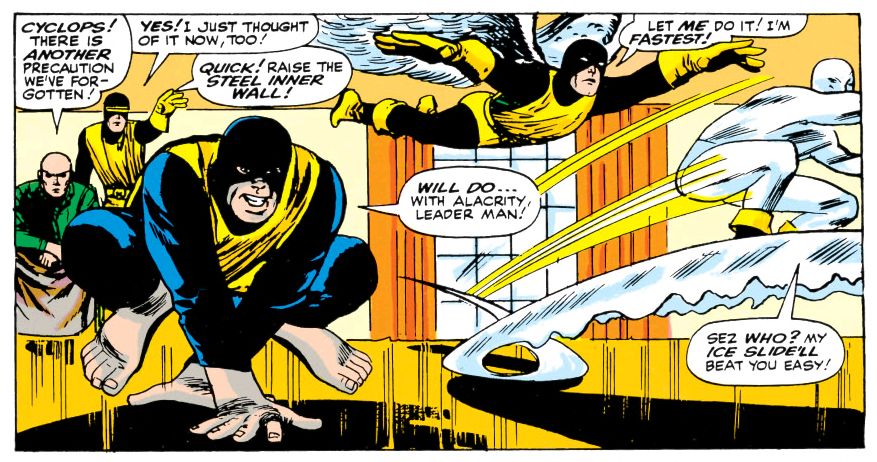
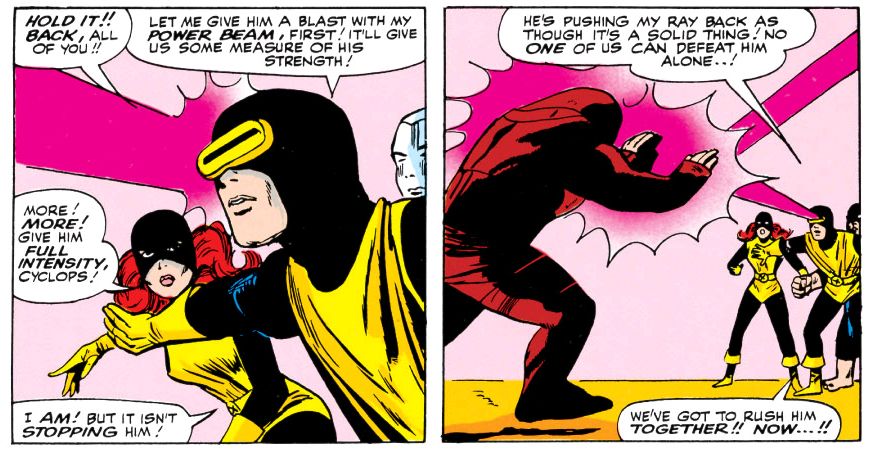
Now if someone can explain to me why Cyclops's famous ruby-red eye beam is magenta.

Wednesday, March 6, 2013

Do you realize how difficult it is to get New Mutants Classic volume 1?

That's right.  One of Marvel's best releases in the past few years has been their full-color New Mutants Classic reprint series.  I rank it up there with their Tomb of Dracula color reprints.  New Mutants Classic 1 features the debut of a cast of winning characters (many of whom still figure majorly in Marvel's X-narrative), some of Chris Claremont's finest writing, gorgeous Bob McLeod art and some solid work by Sal Buscema.  It starts with the entirety of Marvel Graphic Novel #4, then segues into the first issues of the New Mutants monthly in which Dani Moonstar quickly assumes the lead role with her rebellious attitude and melodramatic mental issues.  It also has a funky and clunky cross-over with Team America, based on a toy line by Ideal, in which Dani turns into Dark Rider.  This leads to the team tangling with Hydra and Dani being forced to wear a green backless catsuit.  Well, you really have to read it to believe it.

Anyway, the series itself marches on (volume seven, featuring issues #48-54 and Annual #3, came out in May 2012 and you can find #55-61 in X-Men: Fall of the Mutants volume 1, just released in February 2013), but it seems the first book is now either out of print or still in print in incredibly small runs, leading to scarcity.  Which is crazy.  For a book this good, Marvel needs to be banging the drum and distributing it free to schools.  It should be found in motel rooms across the United States along with Gideons Bibles and local phonebooks.  But they don't listen to me.  Whoever "they" are.  

Instead, you have to source it yourself from secondhand sellers and well-stocked comic book shops.  For now, you can find reasonably-priced used copies at Amazon.com or unreasonably-priced new copies (one seller has theirs priced at $900!).  Don't expect this to last.  

Because I'm a billionaire genius inventor/consulting detective, I could easily afford to pay vighBooks $84.20 for a pristine copy shipped here to my vast estate and land holdings in rural Japan.  It arrived yesterday so well-packed it took my robot staff hours to open the various envelopes.

So if you're a fan of Dani, Sam Guthrie, Xi'an Coy Manh and the rest, you really need to snap up a copy of this book so you can complete your collection before they completely vanish into the hands of wealthy and mysterious individuals such as myself.  You other option is to buy individual issues on Comixology.

This I have also done.

Tuesday, March 5, 2013

On Jerry Ordway...

I'm sure a lot of comic fans and professional comic book mouths (like me, only smarter and with connections) have already seized on Jerry Ordway's recent blog essay about being over fifty and under-employed in comics.  Shocking.  A talent of his stature.  The state of comics today.  Give this man work, DC.  All of that.  Which I happen to agree with.  Ordway is too damned talented and capable not to be drawing a book, especially when the company he's most associated with puts out 52 of the rascals every month.  Fifty-two comics and no room for Jerry Ordway?

Anyway, I don't want to use Ordway's essay as a starting point for slamming DC or their product.  I don't think he'd appreciate that, and as he wrote later, that's actually not what he was trying to express.  What I want to point out is the cast of professionals who showed up in the comments.  Gail Simone!  Chuck Dixon!  Jimmy Palmiotti!  Joe Rubinstein!  Mark Verheiden!  Michael Manley!  Graham Nolan!  Others!

The part that feels directed at me personally-- as a buyer of collected editions and archival hardcovers-- is where Ordway discusses how little he gets paid for those things.  That's very upsetting.  One reason I spend money on them is to support financially old school artists whose work I enjoy and the style of comic art and writing I love best.  I'm talking mostly superheroes.  That's not to say there isn't some good new caped stuff out there, but when I buy new comics these days they tend to be manga or small publisher books.  Not from the Big Two.  Their products I consume in the form of reprints.

It made me happy to buy a Showcase Presents in the hopes Nick Cardy, Denny O'Neil or Neal Adams got a cut.  Or a New Mutants Classic for the sake of Bob McLeod (another underemployed pro who seems to have gone out of style).  Now I'm not so sure.  If Jerry Ordway and his peers are getting a pittance for their work while the publishers reap the bulk of the profits-- and bear in mind they already turned these comics into profit years ago so this is just extra gravy (and don't forget the movies coming out this summer and next and next and next that borrow liberally from these old stories and coin hundreds of millions in more profits while the people who originally dreamed up these ideas get both jack and shit)-- then I'm not sure I'm spending my comic book dollars as wisely as I'd imagined.

I think revenue sharing needs to be revisited and greater parity achieved.  I'm not saying overturn the entire system, but a lot of these older pros don't have health insurance and 401K plans and the like.  If companies are turning their ideas into library editions on the basis that this work has some kind of intrinsic value beyond the merely monetary-- that it is important enough to be preserved for as long as the paper lasts as if it's something by Tacitus or Suetonius-- and if they're further basing "tentpole" event movies on these works and building billion-dollar multi-media franchises, then the people whose talent made it all possible in the first place deserve a little more for their efforts.  A somewhat greater share than they've been getting.

At the very least, they need the opportunity to do more work for these companies, if after all of that, this is where their hearts remain.  I mean, fifty-two books and most of them are being cancelled left and right anyway.  You could hardly do worse than to get someone like Jerry Ordway to draw for you again.  Actually, let me rephrase that-- you could hardly do better.  The guy's stuff still rocks.  I see a lot of good artists at work for DC right now, but few of them can touch Ordway.

Sunday, March 3, 2013

Teen Titans #3: And then they beat up "Big Daddy" Ed Roth on government orders

Why, Titans?  Why?  I love "Big Daddy" Ed Roth, but apparently the President's Commission on Education has a gripe with the creator of Rat Fink.  That son of a bitch Lyndon Johnson!  Oh... you mean it's really Ding-Dong Daddy Dowd and not Roth?  Well, that's okay then!

Anyway, "The Revolt at Harrison High," from Teen Titans #3 (June 1966), finds the Johnson administration trusting its anti-drop out initiative to a group of costumed kids who, if we measured IQ in houses, would have to climb up out of the basement to get to stupid.  The Teen Titans in this issue are ultra-establishment types who believe when Uncle Sam says "Jump!" you jump, right across the Pacific into Southeast Asia where, if you're lucky, you come back minus just your innocence or part of your leg.  Or in this case, to Harrison, USA, where statistically average teen David Robinson has dropped out of school and taken to spinning around town in a souped-up jalopy while working for Ding-Dong Daddy, who just happens to be a dead ringer for Ed Roth.

The Titans don't do much to prove me wrong about their intelligence in this issue.  As soon as Robin hears about David's employer, he has the team check out Ding-Dong Daddy's Hot Rod Hive, which is a pretty obvious move.  There Dowd-- a mountain of a man much like his real-world inspiration-- comes on way too strong with hip cat talk and his refusal to show anyone his secret room.  Once again, the barely-sentient Robin senses something amiss-- I mean, secret room!-- and sends Kid Flash vibrating through the steel door to find a group of teen-aged boys doing what teen-aged boys do best.

No, not that.  Are you kidding me?  They'd go blind!  Plus, that's more a hygiene issue and this is about societal ills.  What these out of sight groovesters are doing is equipping an ice cream cart with a machine gun to kill cops.  Robin knows this is all kinds of wrong, so he has the Titans beat a hasty yet nonchalant retreat so they can plan the next step.  After tangling with a trio of Ding-Dong Daddy's hot rods and losing, the Titans disguise themselves as some less-than-convincing motorcycle toughs so they can help Danny and his no-good pals fight an even worse scourge of wholesome American highways-- an honest-to-goodness motorcycle gang called the Scorchers.  The Scorchers wouldn't survive ten seconds in a rumble with the Hell's Angels.  I doubt they'd last much longer against the Black Widows.  Our favorite teens soon subdue the Scorchers and impress David and pals enough they help the heroes infiltrate the Hot Rod Hive where Wonder Girl-- her hair bleached blond-- entertains Ding-Dong Daddy by dancing away in his office and the boys fight some goons and a robotic gas pump.

You sleaze!  You're more than twice her age! (Bob Haney, script/Nick Cardy, art, Teen Titans #3)

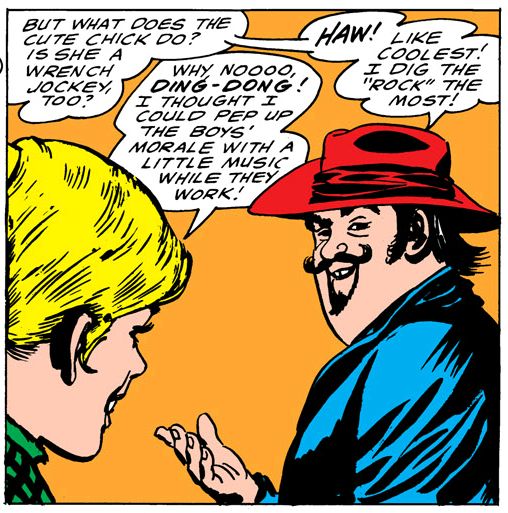
There's even a nasty little double-entendre a few moments earlier when Ding-Dong Daddy asks, "But what does the cute chick do?  Is she a wrench jockey, too?"  This sets up a scene where Wonder Girl leads Ding-Dong Daddy by the arm to his office-- both figures largely silhouetted in a sinisterly suggestive way-- to "keep him occupied" (Robin's phrase, not mine).  Once in the office, our bold young Amazon gyrates away while Ding-Dong Daddy, obviously middle-aged, leers at her and declares, "Haw!  I like it, babe!"  But the creep soon gets his as Wonder Girl takes him down herself and everyone agrees to return to school.  Two years later, David Robinson gets his draft notice and it's off to Cu Chi with the 25th Infantry Division.  But that's a Titans tale for another time!

Of course, there are few things less cool than middle-aged men trying desperately to capture the youth zeitgeist, but paradoxically, there are also few things cooler.  Stan Lee somehow managed to do it with ease by using a lot of WW II-era GI slang ("Hang tough!" and "Face front!" come to mind), but DC never quite got with it despite their best efforts.  Bob Haney lays on the teen-talk pretty thick throughout this issue, which dates it (along with its super square, pro-establishment naivete, which no doubt dated it even in 1966), but it's that very product-of-its-time quality that makes these early Teen Titans issues such fun.  Like, baby, I dig Teen Titans the most!  And that includes the pop-art checkerboard design on the cover.

That and the use of a Roth stand-in as the villain.  Which, my friends, is inspired.  The only thing that could have been better would have been a Bob Dylan-esque folk singer pushing pot to Robinson and pals.  Okay, Haney never would have gotten that one past the Comics Code.  Roth and his hot rod culture were pretty popular around this time-- DC comics frequently included ads for toys based on his designs-- and he was such a colorful figure in his own right.  Plus, using a Roth avatar gives Nick Cardy the chance to go absolutely nuts with crazy custom car designs- one has bank-robbing mechanical tentacles, even-- and whacky motorcycle gang outfits.

Come to think of it, if Ding-Dong Daddy hadn't been a villain, he would have made the perfect protagonist for his own title.  That is, if you took away his pervy "barely legal" predilections.  Of course, it would have flopped like a lot of DC's youth-pandering efforts did later in the 60s and early 70s when they got ever more desperate to stem the Marvel tide and capture some of those Baby Boomer bucks, but then we'd have more Ding-Dong Daddy material to talk about and there's nothing wrong with that.

It's just too bad they couldn't have worked in some version of Rat Fink as Dowd's side-kick in place of some unfortunately generic thugs-- so dull I initially mistook one for David, who sports a white tee and jeans throughout.  Yawn!-- who beat up Robin.

These early Titans issues are nothing if not socially conscious, as well.  Which is fitting considering the book's young cast and the tumultuous times in which these books first appeared.  Even though it's handled less subtly than in one of those classroom films we used to watch in PE on rainy days during junior high, Haney and Cardy don't let their preachy anti-drop out message get in the way of a lot of frantic action, with the dread Batman in his Batmobile getting his ass handed to him by Ding-Dong Daddy's technologically superior automotive stylings, Robin handcuffed to a "hot Honda" (a phrase which tickled Haney so much he uses it again later in the book), which nearly speeds him to his death, Kid Flash running in place to save a school bus full of teens and Aqualad falling prey to a car that shoots flying surfboards.  They just awkwardly toss the message into the dialogue and let the story continue on its rambunctious way.

We're having fun, but I can't shake the feeling Haney really hoped he might reach a few at-risk kids with this comic and do some real-world good.  That kind of kind heartedness counts a lot with me, especially looking back from a vantage point where so many of today's books seem simply negative for negativity's sake, crass, the results of lowest-common-denominator thought, or cynical attempts to exploit headlines for controversy.  Haney probably wrote this with an eye on the headlines as well, but his mission wasn't simply to profit from them.  Instead, I get the idea he hoped to find some constructive way for silly superheroes to have a positive impact on their readership, rather than just confirm them in their downbeat pessimism.

Realistically, this comic probably did little if anything to convince readers to stay in school or trust the Johnson administration.  On the other hand, it must have sent more than a few of them in search of CARtoons magazine.