Tuesday, October 9, 2012

October is Spookey Month: "Hellboy," yet another Halloween reading recommendation

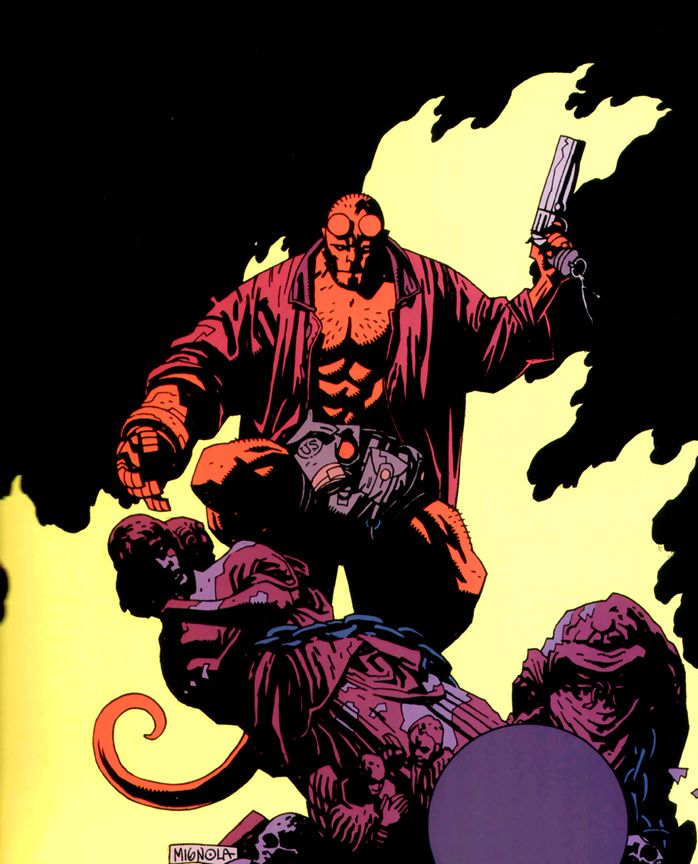
Mike Mignola (1994)
Can you believe Mike Mignola's Hellboy has been around for almost 20 years?  Dark Horse published the debut of four-issue miniseries Hellboy:  Seed of Destruction way back in March, 1994.  In this modest little monster-fighting story artist-creator Mike Mignola and scripter John Byrne introduced us to one Hellboy, the burly half-demon with sawed-off horns and a blue collar approach to the supernatural.  Gruff and something of a smart-ass, Hellboy would just wade in and punch the terror right out of whatever monster, ghost or alien turned up while his buddies at the BPRD (Bureau of Paranormal Research and Defense, the government agency Hellboy works for and housed by) would handle the brain work and clean up afterwards.

After two decades and so many miniseries and titles it can be hard to know where to start with Hellboy.  It doesn't help matters Mignola's chronology jumped around depending on whatever inspired him to write and draw a particular story.  In one book, Hellboy could be in Ireland in 1959 or 1961, then show up in Japan in 1967 for the next, then guest star in an issue of The Goon telling the story about Japan.  Or something like that.  Working it out this way, Mignola and his later collaborators have built a massive narrative spanning decades, continents and even the galaxy, with characters dying and other joining, menaces burbling up from the background, others springing full-blown into the foreground plot.

From his earliest days fighting un-frozen Nazis and their spiritual leader Rasputin-- yes, the historical Rasputin, the one Prince Felix Yusupov, Grand Duke Dmitri Pavlovich and some concerned friends poisoned, shot, beat and drowned in 1916-- to various creatures from European myth, with an underpinning of H.P. Lovecraft, Hellboy now inhabits a sharply defined world with all kinds of incidents and epics.  So how do you jump into this world?

Sorry, I'm not much help there.  I'm not a continuity junkie or obsessed with minutia.  All I ask is whatever story I'm reading to be internally consistent.  And I tend to prefer Mignola's moody, sometimes peculiarly random one-offs with Hellboy himself to the longer apocalyptic tales generally starring the BPRD cast (althought these are good, too).  That's why I say, "Don't worry about a reading order with Hellboy."  My advice is just buy the Seed of Destruction collection and start there.  Move on to whatever story catches your fancy.

In short, you must do as you see fit.

For me, Hellboy pushes a number of buttons.  Let's examine four of them in detail.  Mignola's art is the first.  I love bold, heavily stylized art, the kind where you say, "Now there's a nice drawing, just the essentials" rather than take in something that looks like it was traced from a still frame out of a movie, or a swimsuit magazine.  Mignola's work has become more essentialist and geometrical over time and that's my bag.

The second is my love of the weird and fantastic.  Since earliest childhood, I've read books about cryptid animals, UFOs, alternate dimensions, the Bermuda Triangle, ghosts, urban legends and the like.  I've always loved stories where teams of people investigate the unknown and come to grief, from Kolchak to Venkman, Stantz, Spengler and Zeddmore to Mulder and Scully to Hellboy and company.  I'm a friend to them all.

Folklore and myth make the third.  Mignola draws heavily on European traditions and Lovecraft, but he has broken with this on a few memorable occasions.  Two are team-ups with horror art legend Richard Corben-- Makoma, informed by African folktales and The Crooked Man, set in the Appalachian Mountains of the good ol' U.S. of A.  Both are lovely and strange.  How can anyone not read these?

And the fourth is a specific story.  As an ex-pat living in Japan, "Heads," set in Kyoto, is a lot of fun in a very personal way.  Mignola claims in his introduction to the story not to know a whole lot about Japan.  Yeah, but his art, as influenced by Alphonse Mucha, who himself drew on Japanese ukiyo-e and their extremely linear forms as it is by European woodcuts, Jack Kirby or P. Craig Russell, makes him particularly apt for this kind of material.  I wish Hellboy would revisit Japan sometime in the near future.  If Mignola or any of his collaborators need some first hand experience and reference-- or just want to hang out while doing a research trip-- well, now, I know just the blogger to volunteer his services!

Saturday, October 6, 2012

October is Spookey Month: "Uzumaki," another Halloween reading recommendation!

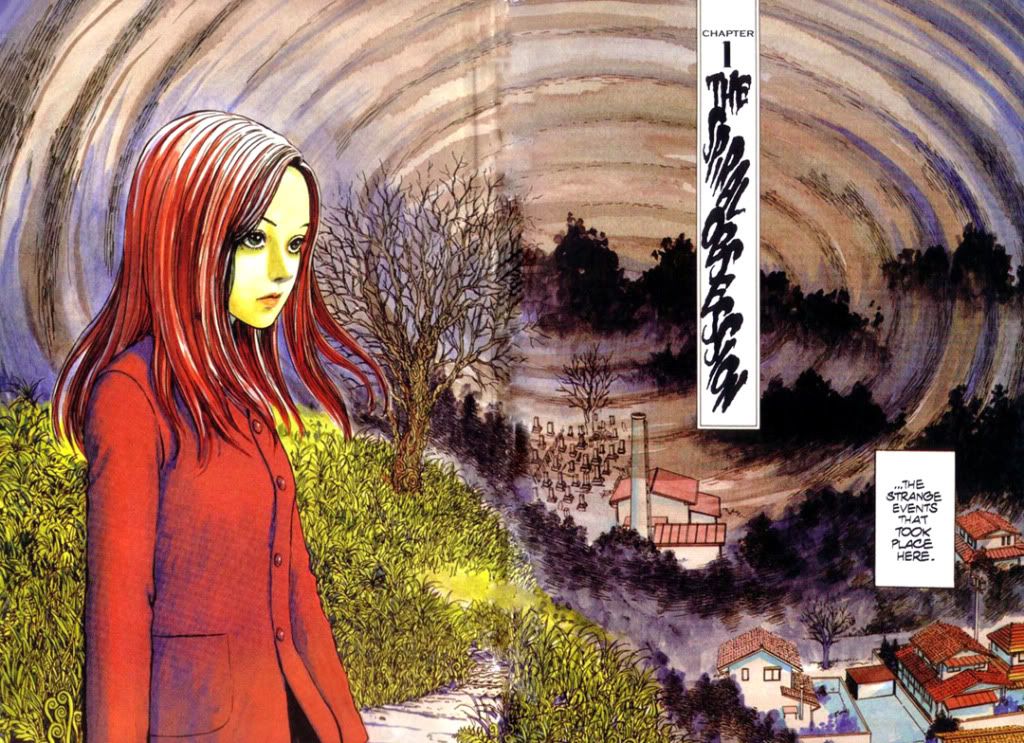
Junji Ito, Uzumaki (1998-9)
I don’t know why Junji Ito hasn’t caught on with manga fans in the Americas.  Both Viz Media and Dark Horse Comics have released very nice books collecting Ito’s work, but they don’t seem to have made much of an impact there as far as comics culture goes.  I think he should be mentioned in the same breath as Mike Mignola, but he seems largely a cultish figure, and somewhat elusive.  Dark Horse has two Museum of Terror volumes (the third seems to be out of print) and Viz offers Uzumaki, of course.  Gyo is worth a read, although I didn't particularly care for it.  It's about dead fish and a killer odor, neither of which inspires much interest in me.  But Museum features Ito's most well-known creation-- Tomie, the beautiful, unkillable school girl-- and inspired a hit-and-miss movie series that seems never to to die completely, just like Tomie herself.  Uzumaki also became a film, a severely truncated version with a hugely disappointing ending and played largely for laughs.  A great deal of Ito's more recent short stories and other tales-- many of which are absolutely brilliant-- haven't been made available in English other than through "scanlations."

What is Ito like in his every day life?  Probably just another hard-working mangaka.  A regular kind of guy who puts in long hours at the drawing table.  After all, before he began his comics career and started creating chills and thrills, he was a dental technician.  But in his stories, the man reveals a seriously twisted genius.  His characters inhabit a universe ruled by dream logic, by malicious forces acting either arbitrarily or for capricious reasons beyond our human understanding.  Whatever it is, it's a dark, pitiless place with little hope for escape or redemption.  Ito's work is true horror and the man doesn't really have any peers, because no one working in the genre can touch him.  

While I was an imaginative little kid who often spent sleepless nights after reading even the mildest of DC ghost stories, as an adult I’m pretty hard-boiled when it comes to printed horror.  Uzumaki, Ito’s masterpiece, gave me a serious case of the creeps.  It made my stomach churn.  Even today, years after I initially read Uzumaki, moments from the story recur in my mind, like childhood nightmares recalled time and again in broad daylight, in the most unexpected of places.  Writing this, I suddenly feel it faintly in my nervous system, on my skin, as if it Ito himself tattooed itself there, indelible.  As the old idiom goes, it's as if someone walked on my grave.

Kirie Goshima is a normal high school girl, another of Ito’s fragile, doll-like female protagonists.  She lives in Kurozu-cho ("Black Vinegar Town"), a seaside town like many here in Japan.  Sea for one border, mountains for another.  Kurozu-cho is a little cut off from the rest of Japan thanks to geography, and it has a mysterious past.  Little by little—a whirlwind here, a guy obsessed with swirling his miso soup there—Kirie discovers to her growing horror an ever-pervasive influence by the spiral.  No ghosts, no monsters, just a simple shape curving in on itself.  Kirie‘s boyfriend Shuichi has already noticed things not quite normal and is coming unraveled.  Kind of like a thread from a blanket that curls in your fingers as you try to pluck it.

And with that simple set-up, life for the two luckless teens increasingly spirals out of control.  Ito tells the story in vignettes, from Kirie’s point of view; Shuichi has introduced the girl into a world where literally anything can be perverted by the pernicious influence of the spiral.  After a couple of early chapters, each of which tends to follow a formula of developing a premise, developing it, then delivering a disgusting punchline, you begin to anticipate what the spiral will do next.  The results still shock.

Like diseased mushrooms, events grow inexorably out of each other and transformations and mutations abound.  As the spriral closes in, Kurozu-cho darkens to a place where a girl with a crescent-shaped scar on her forehead becomes a monstrous entity, a boy obsessed with pop-up surprise scares becomes a ruined jack-in-the-box figure and even the joy of birth becomes the stuff of nightmares.  The signal transformation involves a particularly slow-moving classmate of Kirie’s.  His physical and mental changes are off-putting enough by themselves, but just when you think you’ve reached the point where you can somewhat live with the memories (or at least resume your normal diet), they maddeningly recur to other characters until the situation escalates to what is arguably cannibalism—or something for which we’ll have to invent a completely new word for gastronomic crimes against humanity.  Kirie pursues these rapidly proliferating horrors towards their twisted center, where the story takes on Lovecraftian proportions and escape may prove impossible.

These are stories to read in the daytime.  If you can find them, that is.  But be warned—Ito does not flinch from reshaping his characters to suit the spiral’s whims and a lot of the imagery is extremely disturbing.  Not for tender psyches or weak constitutions.  Oh, and don't eat escargot before you read it.

Friday, October 5, 2012

October is Spookey Month: "Tomb of Dracula," a Halloween reading suggestion


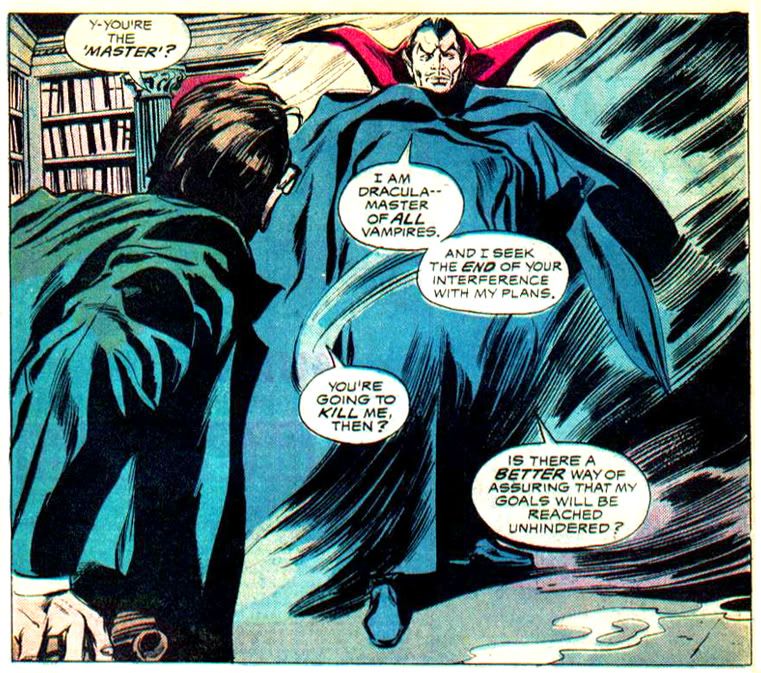
Marv Wolfman, Gene Colan, Tom Palmer, Tomb of Dracula #31 (April 1975)

 Your perfect Halloween reading is Marvel’s Tomb of Dracula by Marv Wolfman and Gene Colan.  I’m a Halloween traditionalist.  As far its denizens go, I tend to avoid all slashers other than Michael Myers (or is he more of a stabber?) and stick with the classics—werewolves, ghosts, mummies, witches and vampires.  And vampires don’t come any better than the main man himself, Vlad Dracula.  Forget those Varneys, Ruthvens, Yorbas, Mamuwaldes and all those other pretenders to the throne.  Barlow?  A clown.

But when you want the true Lord of the Undead, there’s no other choice for choosy consumers.  You want Dracula.  He’s packed with vitamins, stays crunchy in milk and has a taste that can’t be beat.  Kids and moms agree-- the wholesome goodnesss of Dracula is part of your complete breakfast.  And Wolfman’s purple prose funny book serial is the third finest Dracula tale after Bram Stoker’s novel and the Hammer Films series starring the greatest of the screen Dracs, Christopher Lee.

It’s got gothic elements and touches of Robert Bloch and Richard Matheson, and occasionally Sax Rohmer by way of Ian Fleming.  Disembodied Communist brains?  If the series unfortunately takes place in the Marvel universe at large—Johnny Storm, the Kree Empire and vampires have no business co-existing, sorry (although we might make a case in favor of a Fin Fang Foom crossover)—Wolfman wisely and largely keeps the colorful longjohns crowd at bay,  beyond a brief visit by Brother Voodoo and a tete-a-tete with earth’s Sorcerer Supreme Dr. Strange.  Chris Claremont’s tales in the Giant-Size issues tend to draw on H.P. Lovecraft as well.  They’re okay, not really Claremont’s finest—the man mastered mutants, not vampires—but then again, he didn’t have the benefit of Gene Colan handling the art.

Colan made his horror bones—so to speak—drawing some memorable ink-washed Creepy tales for Warren, but he made his mark at Marvel pencilling Daredevil and Captain America.  Tomb of Dracula, however, is the man’s masterpiece.  Tomb was an assignment he sought, and he was right to do so.  While his superhero work showcases his ability to depict bodies in motion, Tomb proves him a master at distorting them through foreshortening.  Constrained from showing gore by the Comics Code, and due to the talky nature of a lot of scenes-- vampire hunting requires planning while sitting around coffee tables-- Colan would choose the most difficult angles, then stretch page design to its outer limits by framing them with panels of odd shape, or going for collage-like effects.  But always under control, always moving the reader's eyes across the page in a way that makes sense and lends to a clean reading experience.  Actually, reading a Colan Dracula page is like reading a movie.  

His chiascuro style—heavy on shadows and mood—finds its ideal match in the sinuous ink line of Tom Palmer.  Through Palmer's finishes, Colan’s art coalesces further into the kind of dark beauty that also prints well on the cheap newsprint comics companies used in those days.  When you find them in black and white in an Essential Tomb of Dracula or one of the slick collections in full color, you see just how endlessly attractive and rewarding of close study these pages truly are.  

Palmer interprets Colan's shaded modeling with parallel feathering and cross-hatching to create a feeling of form, depth of field, added clarity and emphasis.  At times he seems less an inker than an extension of Colan’s artistic consciousness.  There are other pencil-ink teams where the partners’ sensibilities mesh so well.  Neal Adams and Dick Giordano, George Perez and Romeo Tanghal, Jack Kirby and Mike Royer, John Byrne and Terry Austin, Steve Rude and Gary Martin.  But Colan and Palmer made Tomb of Dracula Marvel’s most consistently gorgeous book of the 1970s.

Wolfman takes a novelistic approach to his cast of characters, especially lead Frank Drake.  When we first meet Drake in Tomb #1 (April 1972), he's a cjaded, shallow rich boy who's squandered his fortune.  Only Castle Dracula remains, but betrayal by a close friend leads to Dracula's resurrection and sets the series in motion.  Drake is at times selfish, mule-headed, morose and self-reproaching.  When he moves to embrace outright heroism, he does so in about as jerky a way a person could, alienating his friends.  The quest to stop Dracula changes him over the course of his adventures.  The same can be said of  Rachel van Helsing, whose character transformation finds stark symbolism in facial scars she eventually acquires, marring forever her icy blonde beauty.

Like many open-ended narratives, Tomb seems content to spin its stories out, changing direction abruptly, introducing new characters like shlubby Harold H. Harold, the hacky writer, and Blade, the half-vampire vampire hunter who proved popular enough to inspire a Wesley Snipes-starring movie franchise and a syndicated TV series, then following them down twisting story paths until things conclude rather abruptly in Tomb # 70 (August 1979)-- which was supposed to be a three-issue arc, but ended up mutilated into a double-sized single issue thanks to a Jim Shooter decision.  The stitched-together seams show badly, but the series ends up having a strange Victorian serialized novel feel, which is appropriate for vampires.

Dracula himself would go on to appear ever more ridiculously in issues of The Uncanny X-Men and ---, a kind of supernatural Dr. Doom, every new iteration watering down Wolfman's indelible characterization of a proud, misanthropic anti-hero until Drac becomes just another super-villain in the Mighty Marvel manner.  He even fights Apocalypse at one point.  Sheesh.  But during the run of his own title, Wolfman, Colan and Palmer found majesty in a character who suffers from being overly familiar to the point he's inspired parody and mockery.  Besides Dracula himself, obviously Blade is still kicking around.  I'm not sure what's up with Frank Drake, although he resurfaced in 1991 for a four-issue Epic miniseries also called Tomb of Dracula, where we find him trying to put the past behind, only to have the infamous vampire reappear.  Wolfman deliberately ignores all the Drac appearances in between, having the vampire lord reappear at precisely the same place he apparently perished in that last issue of Tomb.

I, for one, applaud that choice.

Which is why every October I find myself brushing away the cobwebs, creeping down the stone steps weeping condensation, the darkness breathing chill air like a dying man… and opening the tomb.  This Halloween, if you haven’t already, you should, too.

October is Spookey Month: Merry Marvel monster monologue!

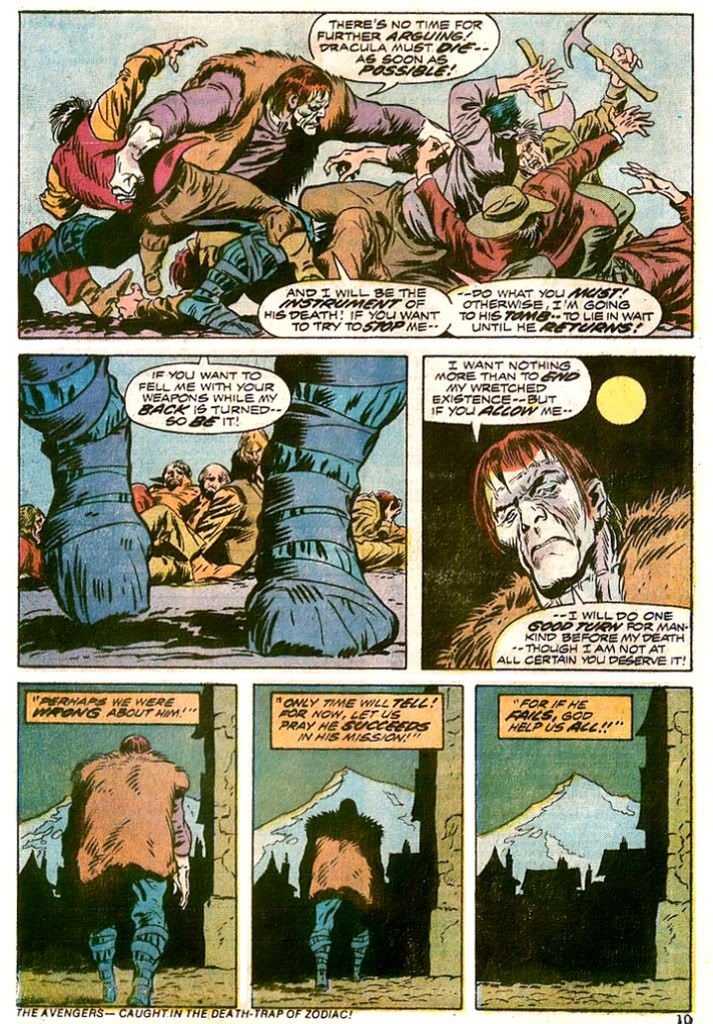
Gary Friedrich, John Buscema, John Verpoorten, The Frankenstein Monster #9 (March 1974)

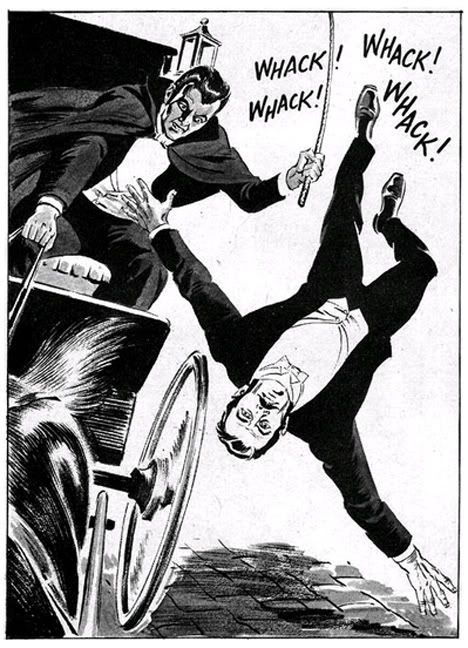
One of the great things about Marvel back in the day was no matter how busy their characters were fighting multiple enemies, thanks to the intense aerobics training Stan Lee put them through as part of their contractual obligation to the company, they always had wind enough to explain their basic motivations.  Or, in the case of Frankenstein's Monster here, to protest not having enough time to do so, while doing so.

I really don't see how this sequence makes Frankenstein's Monster (although this characterization is closer to Mary Shelley's original than the more well-known Boris Karloff movie version) all that different from the Incredible Hulk or the Silver Surfer or any of those yahoos.  Yeah, Monster is more eloquent than the Jade Giant, but I'm sure they could commiserate over beers:  "I don't have time to explain myself to you idiots despite my amazing ability to multi-task."

Thursday, October 4, 2012

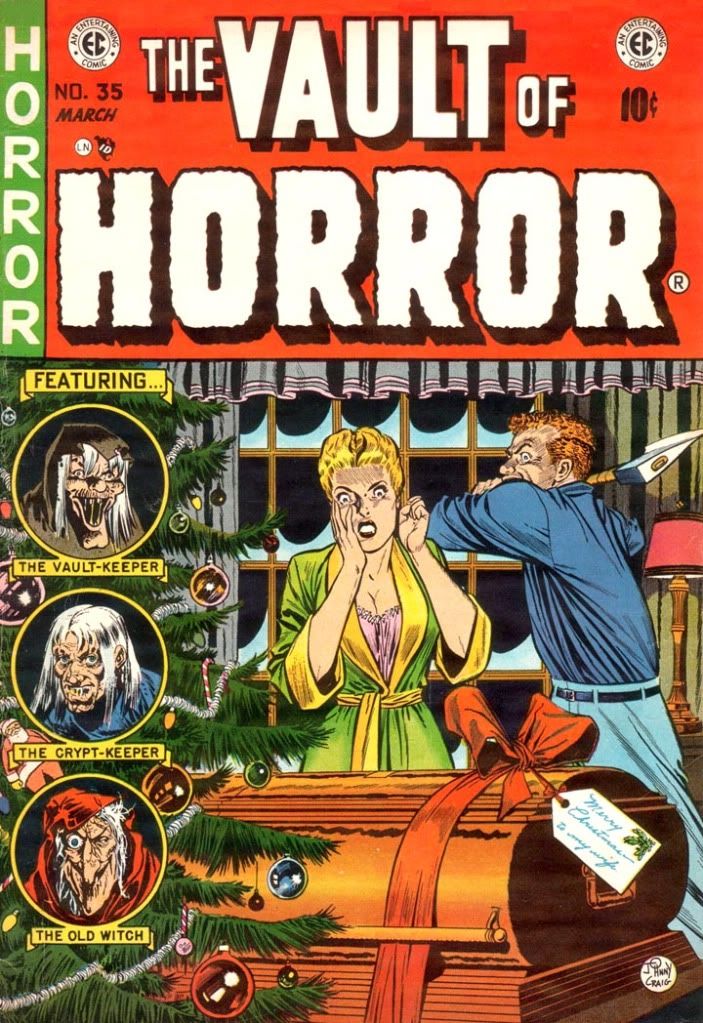
October is Spookey Month: Johnny Craig's "... And All Through the House..."

A few weeks ago we took a hard-hitting look at the 1972 Amicus Productions horror anthology flick Tales from the Crypt, specifically the segment starring Joan Collins, "... And All Through the House...."  It's a piece for which I won several journalism awards and received an offer to pen the film re-adaptation of the Dell Comics adaptation of the classic Andy Griffith service comedy No Time for Sergeants, which itself was an adaption of a stage play drawn from a novel.  Unfortunately, my dedication to this blog forced me to turn down that guaranteed six-figure paycheck in favor of fulfilling a threat-- er--- promise I made to you, my loyal reader.

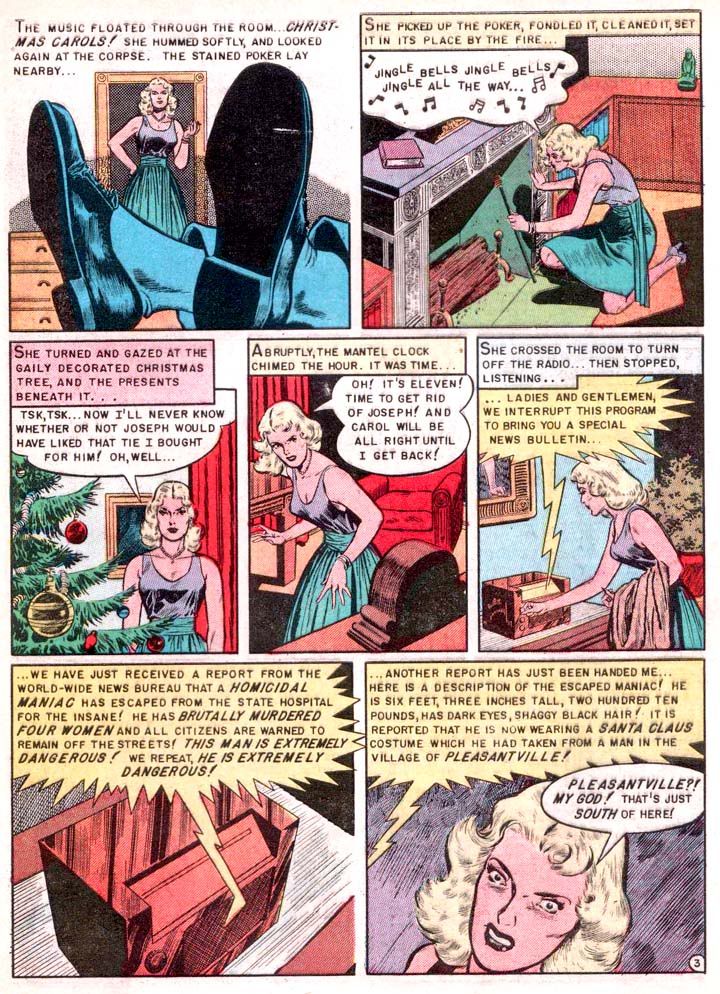
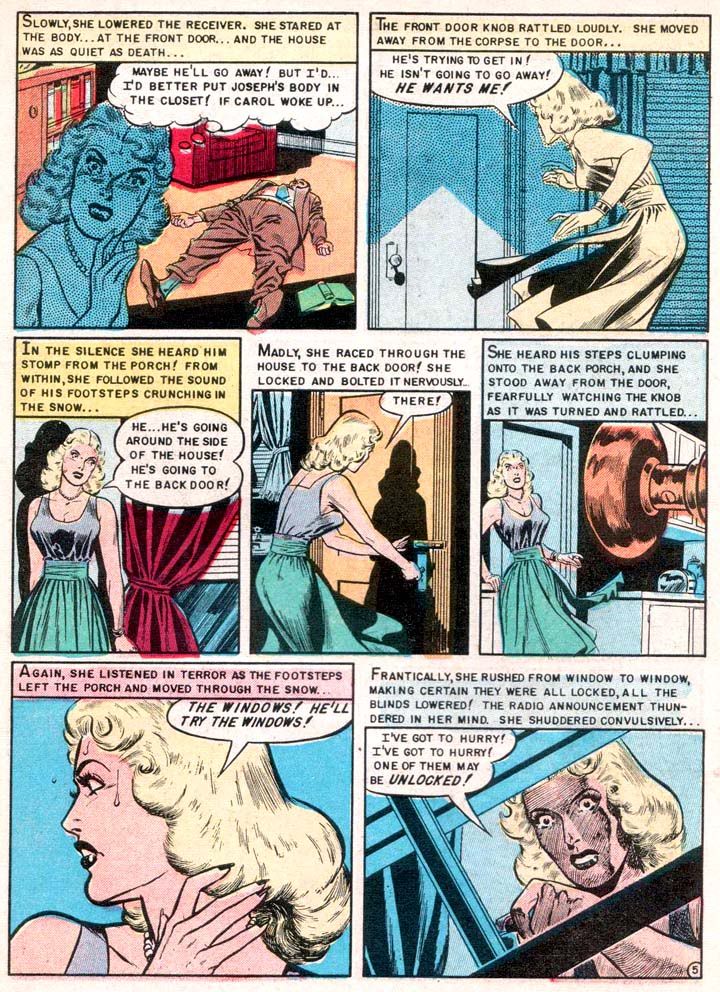
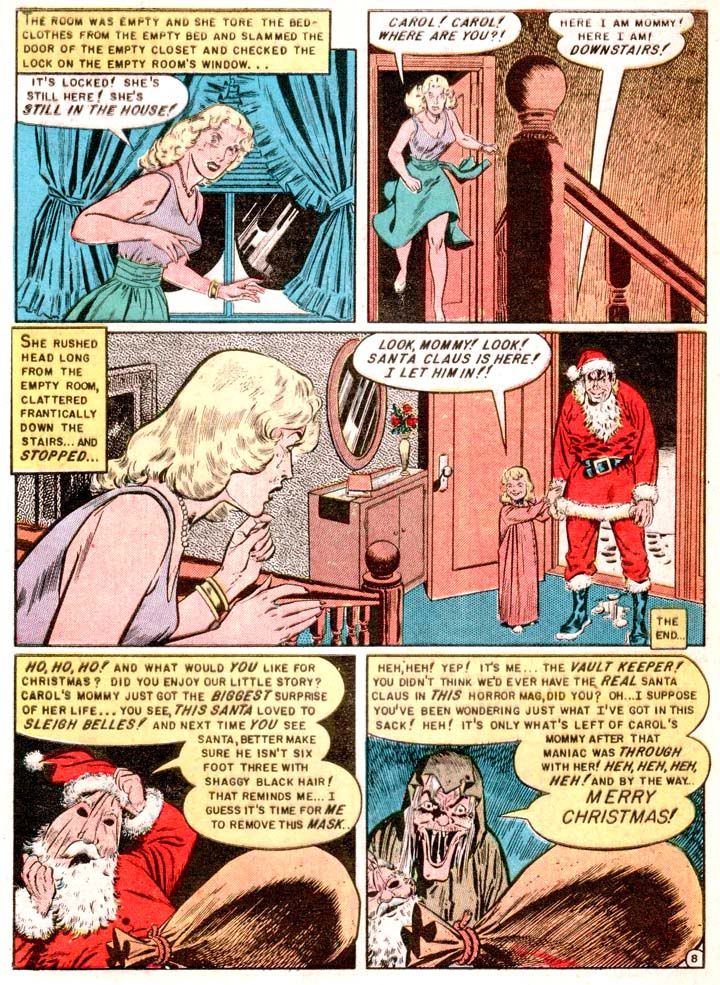
So to that end, let's revisit Johnny Craig's original story from The Vault of Horror #35 (EC Comics, March 1954).  And here... we... goooo!

The film's version is a very close adaptation (they even kept the daughter's name the same, and the dialogue in scenes with her is almost word-for-word from the comic), but the Craig's story is pretty taut and doesn't lend itself to a lot of padding.  Sure, a few differences crop up here and there.  For example, the comic story is red white and blue in its all-American look at Christmas-related murder.  The movie transplants the story to the UK, where it gains Collins, with Sir Ralph Richardson as the Crypt-Keeper.  In the comic, the protagonist is a blond, while Collins is famously a brunette, a quality that would serve her and her stunt double well on ABC's night time soap opera Dynasty during the infamous Krystle-Alexis fight.  In the movie, the Santa-suit wearing madman throttles the Collins character for a violent comeuppance.  It's a movie and movies rely on action. Otherwise, they might just as well be photographs.  And instead of photographs, drawings.  Which brings us right back to comic books again, where it's just as effective to have un-jolly old St. Nick simply stand there in the final panel.  The reader's imagination supplies the killing.  Or, if you're of a less sanguinary persuasion, the murmured discussion followed by a night of gentle love-making.

Since there's not a lot to say about the story I haven't already written about at great length while blathering on in my usual sub-moronic way about the film, here are some choice moments from the comic.  Get ready to enjoy a little bit of Johnny Craig-style holiday cheer...

Monday, October 1, 2012

The Secrets of Isis, October is Spookey Month Edition featuring Episode 6: "Lucky"

Randy Martin is crazy about his canine pal Lucky.  And why not?  Lucky loves Randy right back in that special unconditional way dogs do.  The pair show up at Larkspur High one afternoon to play fetch and bring good luck to Larkspur High's baseball... or softball... team (the episode doesn't quite make it clear, and either way, just last week it was the height of football season so something screwy's going on) and join the high school kids on the beach for a pre-game party.  Some of the guys from rival Central High show up and there's some good-natured trash talk back and forth, but things take a tragic turn when one of the guys tosses a ball for Lucky to fetch and the dog goes into the raging Pacific Ocean.  Randy tries to save his dog, Isis rescues them both, but it's too late for Lucky.  The dog was just too old and its heart couldn't take the strain.

Angry at the world for robbing him of his best friend, Randy seeks solace at a local dam just before a water pressure test.  When he drops Lucky's collar-- a melancholy keepsake-- onto some jagged rocks down in the spillway, the unhappy boy tries to retrieve it, only to catch his ankle.  Trapped with only a minute or two before thousands of gallons of water comes rushing his way.  It's Isis in a race against the raging flood for Randy's life!

Hold up a second.  Before we review the episode let's address this whole "getting your foot caught" business.  Something like this happens in almost every story.  Since the show eschews most superhero violence (Isis tosses some tires and levitates a car; that's about as intense as it gets), there aren't a lot of bad guys running around with ropes and chains to bind their victims so Isis can come to the rescue.  And a lot of times, the jeopardy the characters find themselves in-- chased by car thieves, menaced by a diseased bear, or simply about to be washed away by a torrential dam release-- would be fairly easy to escape but for an injury of some kind.  The show specifically targets its characters' ankles almost to a fetishistic extent.  It just never tires of the ol' ankle-in-the-rock gag.  In this case, Randy just falls behind a large rock and starts screaming bloody moider.

It would be comic, but actor John Doran turns out to be preternaturally skilled at conveying pain and fear.  For a moment I was convinced some hidden creature had ripped his foot completely off.  Couple that with the recent loss of his dog and some all-too-believable angry crying scenes, and you've got one poor little guy having a crappy day.

"Lucky" is a strong episode, one that tackles the ultimate issue:  Death.  Nothing is so serious as death, and as a subject, death encompasses all others.  You can imagine quite a few young viewers knew the confusion and pain accompanying the loss of a beloved pet or even a family member.  Parents often struggle with how to tell their children about death and come up with a lot of confusing euphemisms, which generally just confuse the kids.  Most kid-vid offerings stay well away from this subject.

Not Isis.  Rather than sidestep it or cop out, Isis confronts death in a straightfoward, honest way.  When a tearful Randy asks Isis why Lucky had to die, she simply tells him, "It was time."

"Couldn't you save him?" Randy asks.

"No," she replies.

Isis explains no one has that power.  It's a hard-hitting moment, and leads to a short speech on the cycle of life compassionately delivered by Joanna Cameron.  It's her finest moment of the series so far, especially when you consider she delivers this monologue while wearing faux Egyptian jewelry and a skimpy minidress outfit to portray a superhero.

This scene also gives the show a chance to introduce a new Isis power-- the gem she wears on her forehead can project images into a person's mind.  It's nice to visualize the episode's lesson, and all it takes is a simple superimposition trick.  Isis ties Lucky's death to everyone's, but also makes the case that death is necessary so life can continue-- we are born, we grow, we grow old, we die and we return to the earth to nourish a new cycle of growth.  This is nature's way and no superhero, even one endowed with the powers of the earth, sky and water, can alter this simple fact.

Another well played scene features Cutler and Pang.  Thomas takes the call from the vet, her expression changes and everyone knows it's the worst possible news without her having to tell them.  At first I wanted to chalk it up to the script trying to soft-sell the moment-- and given the workings of network standards and practices, there may have been a deal by which Isis could use the word "death" only a certain number of times in the episode-- but fine performances all around make underplaying the scene the best choice.  I can't help but compare this to what's largely considered the worst of Star Trek, "Spock's Brain," where the pivotal moment goes for broke and devolves into high camp, or the now infamous "Walker says I have AIDS" moment from Walker, Texas Ranger.  There's a right way and a wrong way to break news and guess who gets it right.

Working from an especially strong script by Ann Udell, director Hollingsworth Morse (an old-school pro who helmed episodes of practically every TV show from the 1950s to the 1980s, the Arthur Digby Sellers of Isis) elicits some very effective performances from regulars and guest stars alike.  Most importantly from Doran, who carries the show and brings a believability to his role the bereaved dog owner.  He could easily have proven obnoxious during the scenes where he's crying and lashing out bitterly at the Central High guy who tossed the fatal ball, but instead he's pitch-perfect.  Roles dried up for the guy as they tend to do for kid actors, but not long after this job he portrayed Our Gang legend (and future Perry White impersonator) Jackie Cooper in the TV movie Rainbow, opposite Broadway's first Annie, a badly-miscast Andrea McArdle as Judy Garland, directed by none other than Cooper himself.  That's a pretty strong endorsement.

You know, when Cooper was a lad they used to make him cry on cue by threatening to kill his dog.  Just thought I'd throw that out there.

I really enjoy any scene with Rick Mason.  Cutler opens the episode with both Doran and Lucky, breaking W.C. Fields's famous maxim about working with children and dogs.  It's subtly expository as we learn about Randy's big brother (a Larkspur alumnus and well-known to Mason and Thomas) and the bond between boy and canine, but mostly it's just fun.  Plus, for an added bonus we find out Rick Mason had a dog of his own as a boy, but didn't have Randy's knack for training.  Cutler has a hilarious bit of business when Randy talks him into tossing the ball to Lucky and the teacher tries to get out of it, can't, then does it awkwardly.  The guy's trying, he really is and you get a sense his heart is in the right place, but he isn't lying-- Rick Mason probably just isn't that great with animals.  The show relies on Cutler to bring a light touch to various scenes and it's just so darn hard not to like the guy and his character.

And look at that awesome black and white checked sport coat.

But once again, the ever-reliable Pang as Cindy Lee has some of the funniest moments in what's generally a heavy-duty episode.  While Randy discusses the importance of chemistry to would-be veterinarians with Ms. Thomas, Cindy tries to lure Lucky for a race.  What is it with Cindy and racing?  Bikes, dogs, UFOs.  There's nothing that kid won't challenge to a contest of speed.  Lucky is too old and too obedient to give in, though, and Thomas informs Cindy he's a "one man dog."  Cindy then introduces the lucky charm/baseball story element and she and Randy end up sharing a soul shake over Larkspur's chances against Central High.  That's right--  Cindy Lee does a soul shake.

Later, during what passes for a crowd scene on the Isis budget, she spots some dudes walking up the beach.  "It's the guys from Central High!" she shouts with probably more enthusiasm than the moment warrants.  But that's Cindy Lee all over.  She's the show's incarnation of niceness.  She happily waves at these rivals and it turns out they're not there to cause trouble.  A lesser show would have featured these Central High guys as villains; on Isis, they're portrayed as genuinely nice guys who show up to have some good natured fun.  They even give Randy a new dog at the end of the episode-- although Central High spokesperson Glen takes some of the saccharine edge off by insisting Central will cream Larkspur anyway.

I may have mentioned this before, but Joanna Cameron was amazingly fit during her time as Isis.  Her miniskirt costume is practically chaste compared to what your modern-day women supers wear, but it displays her toned arms and legs to great effect.  I also want to point out that Joanna Pang as Cindy Lee looks simply amazing in her short culottes/mini-dress outfit on the beach.  It's easy to see why Glen and his Central High buddies "just happened" to be strolling along the beach that day.

Now that we're on the topic of death and dying, reading E.B. White's Charlotte's Web would be a good follow-up to any viewing of "Lucky."  And a viewing of 1982's Peabody-award winning The Electric Grandmother TV movie, too.  You know, the adaptation of Ray Bradbury's I Sing the Body Electric with Maureen Stapleton as the robotic grandmother who helps a family deal with loss, especially Agatha-Agamemnon.  Death and humanity's varied reactions to it are themes running through a lot of Bradbury's work.  From the Dust Returned deals with this explicitly, as does his 1972 fantasy novel The Halloween Tree.  We can relate this book back to Isis because in The Halloween Tree, Bradbury makes a special effort to show how Egyptian mythology influenced our Halloween revels.  We celebrate mortality in all things autumnal, dark and strange.  Or, in Isis's case, sunshine-infused spring days with Cindy Lee asking a dog for a foot race.

Safety note:  When Isis gingerly makes her way over the loose rocks in the spillway, she appears to have changed from her usual high-heeled boots into some sensible flats. Yet when she and Randy make it to safety, she's once again in those high heels!