I don't write a great deal about Hellboy, because I tend to think of it and its related titles as "new" comics. That's how fresh it is. But the first issue came out way back in March, 1994, which is well within the timeframe for this particular nostalgia-leaning blog. And I'm a big fan of the property and a lot of the people who've worked on it, creator Mike Mignola foremost among them. Man, I dig that cat's art and the weird pacing and tone of his writing.
Mignola is the reason I picked up a Hellboy book in the first place-- and it was the Seed of Destruction collection. At the time, I really didn't care what the story was about or the characters in it. I just wanted to look at Mignola's drawings.
Mignola first entered my particular radar through his work on the Topps comic book adaptation of Francis Ford Coppola's overwrought vampire flick Bram Stoker's Dracula. I picked it up out of curiosity because I'd enjoyed the movie in a campy kind of way and I've always appreciated a Dracula story, any Dracula story. I didn't realize I was actually about to encounter a new artist with whose work I'd become obsessed in the way I had with people like Jack Kirby, Joe Kubert, Al Williamson, Alex Toth and Mark Schultz over the years. The comic book, written by Roy Thomas and drawn by Mignola and inker John Nyberg, blew the movie away, not the least reason being you don't have to deal with the hammy acting and outrageously bad accents when you read it. Hooked on Mignola from that point, I started copying his art and looking for his other comics. But I went about it in a kind of leisurely fashion, because I didn't buy Seed of Destruction until probably around 1999 or 2000...
And wow, oh wow, when I finally got around to it, I found it was full of stuff that fired up the endorphin-receptors in my brain for a full-on rush of pleasure and good feelings. And from then on, I had to buy every single Hellboy and Hellboy-related comic book I could get my hands on. Nowadays there are so many to choose from, too. The cast has grown over the years and there are spin-offs and off-shoots and even "other world" type, out-of-continuity stories. Two movies, a cartoon. Toys. Other people are involved in the writing and drawing of Hellboy and his friends, but it's still Mignola's world. He has the knack of choosing the best and most appropriate collaborators, too. There are stories I've enjoyed more than others, but I can't think of one that's a real misfire or mistake. Twenty years of quality entertainment.
I think this is the ideal model for how to handle comic book characters, creators and publications. Kudos to Dark Horse for letting Mignola run with this and not trying to screw it up and put their imprint on it the way some other companies might have. When you think of what could have happened to Hellboy if Mignola had been more successful pitching it to a certain other company before landing at Dark Horse... YIKES.
I should have blown up this blog with a major Hellboy write-up back in March, and I should definitely write more about the 1990s-era Hellboy books here. And post some art from them because it's so damned cool to look at.

Showing posts with label Dracula. Show all posts
Showing posts with label Dracula. Show all posts
Monday, May 12, 2014


Tuesday, October 15, 2013
October is Spookey Month: Tomb of Dracula #7 introduces Edith Harker

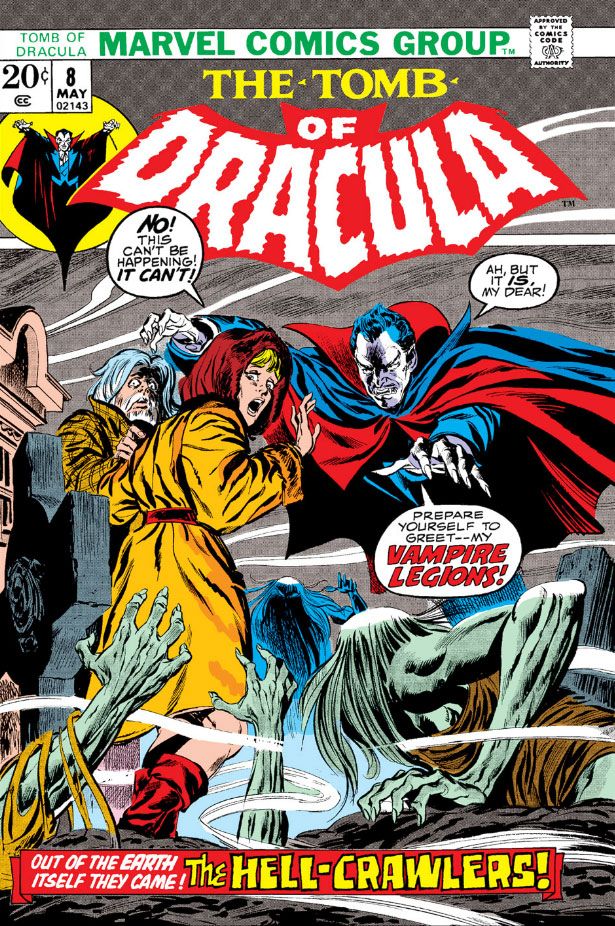
Let's look at the cover before we get into the story. Doesn't Dracula have a fun sense of humor here? This is some clever copy and it hooks me immediately. The drawing is by Larry Lieber, Stan Lee's little brother. It gives readers a fairly accurate depiction of the story inside. It's not nearly as dynamic as some of the series' Gil Kane covers, but Kane was one of those "gold standard" cover artists and it's not really fair to compare anyone to him. And yet I just did, didn't I? What I like about Lieber's cover, however, is he makes Dracula look a lot like Hammer Studios' own Christopher Lee, the finest of all screen Draculas (and tallest). I'm going to assume Lieber agrees with me and that in itself is more than enough to recommend this cover. I'm in favor of Gene Colan's "casting" of Jack Palance as powerhouse, intensely masculine Dracula inside the pages, but the more sinisterly refined Lee played Dracula for a longer period and emerged with dignity intact despite some increasingly silly material like Dracula, A.D. 1972 and Satanic Rites of Dracula, both of which provide prototypes for Tomb of Dracula. You know, Dracula in the modern age, tooling around London and swingin' hippies and mods and all that. So Lee is also very appropriate. Anyway, the cover does its job competently if not spectacularly, but it's still fun. The issue preceding this one had a Neal Adams cover, by the way!
Take a deep breath, because here... we... go...
In this issue, Rachel van Helsing introduces her pal Frank Drake to the Harkers and they form a vampire-fighting association the likes of which the world had never seen. Well, not really. It's a group similar to the one Bram Stoker came up with in his original novel, the one that started this whole Dracula business. I've always liked vampire-fighting groups, and Tomb of Dracula's is far and away my favorite because everyone is a bit edgy and damaged. While Marv Wolfman's core cast coalesces, their enemy, the famed count himself, self-styled Lord of the Undead, is busy making new friends of his own. Because Tomb of Dracula #7 has a lot more going for it than just the first appearance of Edith Harker and her dad. It also has one of Dracula's most sinister plans-- hypnotizing a bunch of kids into killers. Kids, killers. They both start with the letter k, and lemme tell you, there are some kids out there who would just as soon slit your throat as look at you even without a vampire master giving them hypnotic orders. Slit your throat, then enjoy delicious Honeycombs cereal as a part of any complete breakfast.
Dracula's logic for this is while Harker and company would stop at nothing to kill vampires, they're not about to murder children, not even to save their own lives. Turns out he's right.
This set-up reminds me of Village of the Damned, that truly disquieting film where time stops in a quaint village and nine months later a cadre of identical blonde babies arrive. They grow up into sinister children who delight in murder via telepathy and wearing blonde wigs. It's also reminiscent of those Simon-Kirby kid gangs of yore. The killer Boy Commandos in Tomb don't wear wigs and they don't engage in any witty repartee, but they do sport some eerie glowing eyes as they silently and relentlessly pursue our heroes. They do such a good job of it, the story stretches into Tomb of Dracula #8 (April 1973), which has a John Buscema cover.
Getting back to Edith. Since we've already covered Edith's final moments, let's take a look at her first.

I'm going to assume she works at the chemist (that's "pharmacy" or "drugstore" to us colonials) Colan draws her leaving. Gosh, it sure is cold. I hope she gets home all right...

Oops! No such luck. Yes, she is the book's jeopardy queen. Still, a bash in the face is better than a bite on the neck when you're dealing with the undead, and it's Edith Harker's good luck to have come face-to-face with the boss of them all and come away with only a bruise. Dracula seems kind of a quitter here, though, doesn't he? Edith's wearing one measly little cross. Where is Dracula's amazing hypnotic gaze to make her take it off so he can feed on her? It takes him about two seconds to enthrall those kids.
Speaking of which, here they are:

It looks as though someone at Marvel did a really clumsy art touch-up on Dracula's head in the fourth panel. The face is Colan/Palmer, but the wonky perspective on the forehead (the widow's peak is turned a few degrees from where it should be both vertically and horizontally and there's no foreshortening despite the slightly low-angle view of Dracula's head) and the hair texture look completely alien. Why? Maybe the page passed through the inking and lettering stages with the top balloon coming out too large and covering too much of Dracula. The editor decided we needed more of Dracula's head in there, which meant reducing the balloon and getting someone on staff to touch up the missing areas. Just speculating about a hypothesis, but it also looks as if someone mistook Dracula's left hand for one of the background trees and colored it brown as a result.
 Here's one of the most disturbing aspects of vampire lore-- the corruption of innocence. Stoker used this is a major theme in his novel, and Wolfman picks up on it. In Stoker's book, Dracula's first victim is the virginal Lucy Westenra, the ideal of proper young womanhood in the Victorian Age. By the time Dracula is through with her, she's feeding on babies in a parody of nurturing motherhood. Wolfman's Dracula will stop at nothing in his quest for power or whatever he holds as his ultimate goal and a bunch of boys become his weapons. They're very effective, surprisingly so. They chase Frank and company right out into the night and trap them in an old-fashioned car and there's not a thing anyone can do about it.
In fact, the hypno-kids do such a fine job of taking Dracula's enemies out of the fight, he finally has a little leisure time on his hands. The next issue (nicely inked by Ernie Chan-- credited as Chua thanks to a bureaucratic screw-up on his immigration documents) sees Dracula using this free time to recruit some even more sinister allies, a lot of moldy vampires. I think he should have stuck with kids. Imagine Dracula getting himself on TV, perhaps taking one of those horror movie host jobs, or showing up at a station where they do one locally and beaming his powers across a wider area, ensnaring hundreds, perhaps thousands, of children and turning them against the adults. Kind of like Halloween 3, but without that Silver Shamrock rhyme to get into your mind and stay. And stay. AND STAY.
And here's where it turns out I owe Edith Harker something of an apology. She first appears as a typical damsel in distress, and goes out that way as well. But she gets to come to the rescue herself at least once before Dracula and dear old dad put an end to her once and for all.
And here she is:

You go, Edith! Sorry they didn't get your hair color right in this, your shining moment.
Friday, October 11, 2013
October is Spookey Month: Tomb of Dracula #12 teaches us most accidents happen at home
Those are all fine series, and I've enjoyed each of them. But Tomb is just something else entirely. Tomb is like wow times wowee for a little "wowee-wow-wow." Tomb took an exhausted public domain property-- good ol' Count Dracula, star of dozens of movies, TV shows and comic books in one form or another-- and gave it a compelling, new un-life. Writer Marv Wolfman's melodramatic prose perfectly matches Gene Colan's shadowy visuals, the two elements working in tandem like peanut butter and chocolate in a Reese's. When Marvel finally teamed Colan with inker Tom Palmer, the two produced what I will argue was consistently the most breathtakingly beautiful color monthly of the entire decade.

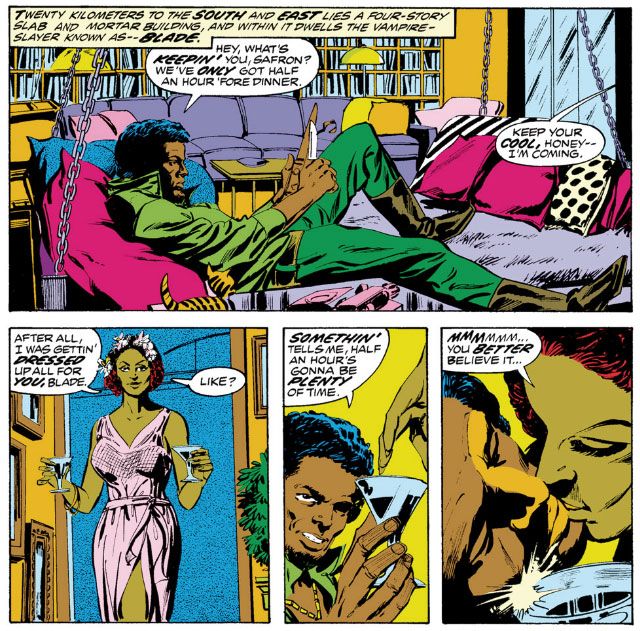
Operating on the fringes of the Marvel universe, Tomb functions as a sequel and expansion of Bram Stoker's novel. In fact, lead good guy Frank Drake is a descendant of Dracula himself, his last name an Americanized version of the original. Quincy Harker comes right out of the original book, the first born child of Jonathan and Mina (nee Murray) Harker, conceived and born after the novel's main events and named after one of Dracula's victims, the Harkers' courageous American cowboy friend Quincy Morris. Wolfman casts Harker in the Dr. Van Helsing role. More troubled than his Stokerian prototype, Harker rides around in a weaponized wheelchair the likes of which James Bond's pal Q would envy, and he uses it to save himself and others several times throughout the stories. His hardboiled protégé (and later, Drake's lover), Rachel van Helsing, is the grand-daughter of the Stoker character. Both Taj Nital, devoted companion to Rachel, and-- most significantly-- Blade, the ultra-cool, Blaxploitation-style member of the group, are wholly original. At least I don't remember Stoker having watched Shaft, Super Fly or Hammer, but he could very well have despite having died about 60 years before the birth of the film genre.
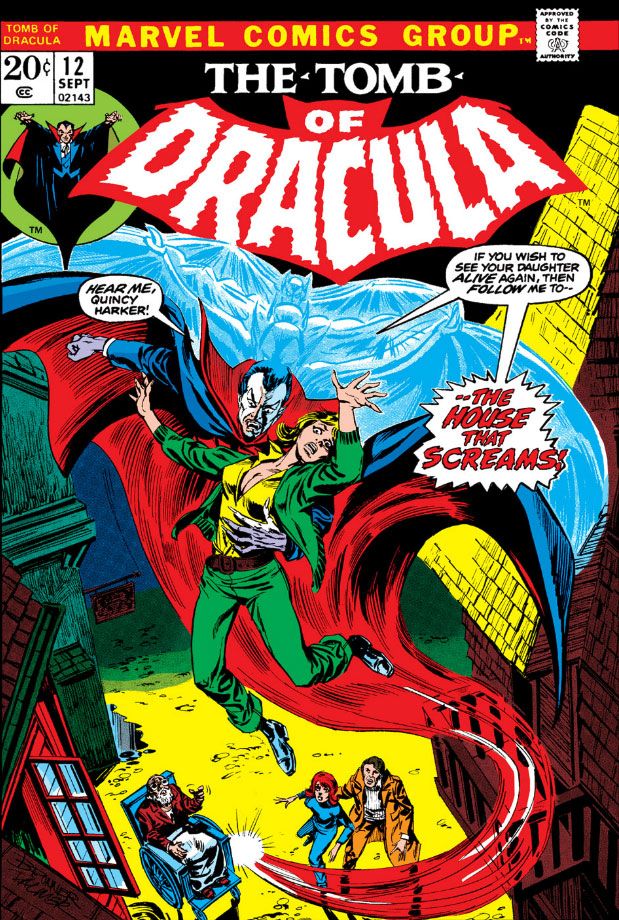
Every October, I turn to Tomb of Dracula and it helps put me in that spooky, haunted Halloween mood. It has its funky idiosyncrasies-- too many scenes where Rachel, Frank and Blade confront Dracula and all they do is trade arch insults and a whole lotta plots where Dracula almost dies, only to escape at the last moment. After all, how many times can our vamp-slaying crew almost destroy Dracula before they start to seem completely incompetent to the point they lose our sympathies and incur our scorn, like that bumbling Gilligan? Tomb of Dracula ends rather abruptly with issue #70 before it has a chance to devolve into self-parody, but even when things turn silly as they occasionally do, the overall atmosphere remains one of effectively updated gothic horror, and there are still plenty of genuinely creepy moments to restore our faith. Which finally brings us to tonight's topic, Tomb of Dracula #12 (September 1973) and a little story we like to call "Night of the Screaming House." Because that's what Marv Wolfman named it.
Oh, on the Frank Brunner-illustrated cover, Dracula calls it the "House that Screams," but you should never believe anything the king of the vampires tells you. He has his own agenda and will lie when it suits him.
Okay, forget Dracula before... er... remembering him again. Because Wolfman and Colan throw us right into the action with the main characters locked in a ferocious show-down with none other than Dracula, who has caught himself a delicious dinner, but can't catch a moment to eat in peace. It's not a holdover from a cliffhanger ending to the previous issue (in which Dracula fought some motorcycle guys who aren't quite as menacing as the Sons of Anarchy bunch, although they do their best). It's more like, "Open the book, here we are!"
Unfortunately one of them, Harker's daughter Edith, is ill-equipped for the life of a fearless vampire hunter. Edith Harker was simply born to find herself in jeopardy. Wolfman and Colan introduce her to the series that way in Tomb #7 (March 1973), and in "Screaming House" (as its friends call it; the rest of you must refer to it in full, with an honorific of your choice), she really finds herself in a mess, the likes of which no heart-felt talk with Sheriff Andy Taylor, Mrs. Garret or Mr. Belvedere can solve. After a lot of posturing on both sides and some ineffectual hand-to-hand, Dracula spirits Edith away to a shabby old house so he can toy with his adversaries rather than just kill them outright.
With his mastery of vertigo-inducing camera angles, Colan expertly depicts the abduction, which is quite alarming as Dracula transforms only partially into his bat-form. This emphasizes his otherworldly aspects by making him a grotesque hybrid creature, plus it gives him enough strength to carry Edith through the air. He needs those membranous arm-wings to do two things at once.
And the titular screaming house is foe unto itself. It's full of rotten floorboards that give way at inopportune times and Dracula's hidden away traps of his own, like the black widow cages he slips around the corner beneath Frank Drake's feet at one point. The good guys split up to cover more ground and render themselves even less effective against Dracula and it all comes to a tragic conclusion.
While the story itself is pretty straightforward, at least compared to later issues (which would feature adversaries such as a Communist Chinese brain in an aquarium, Dracula's hated vampire daughter, a faceless dead man and, later, his own weirdo son, an angelic/demonic pretty boy calling himself Janus) it has some important character development.
Once he plunges his cast into Dracula's fun house, Wolfman depicts Drake as scared almost out of his wits to the point of stuttering as he speaks. And yet the guy still pushes on alone. While Drake is in a state of transition from callow rich jerk to bumbling vampire avenger to intrepid daredevil hero, it helps reinforce the danger Dracula personifies. Remember, when you go against a vampire it's not just your life that's in hazard; it's your very soul. And with Dracula the series anti-hero, there's always the chance over-familiarity with the character and his motivations will weaken his menace and turn him into just another ineffective Marvel villain fond of soliloquys in the dark. This is especially true if the characters in the book come to view him as ho-hum.
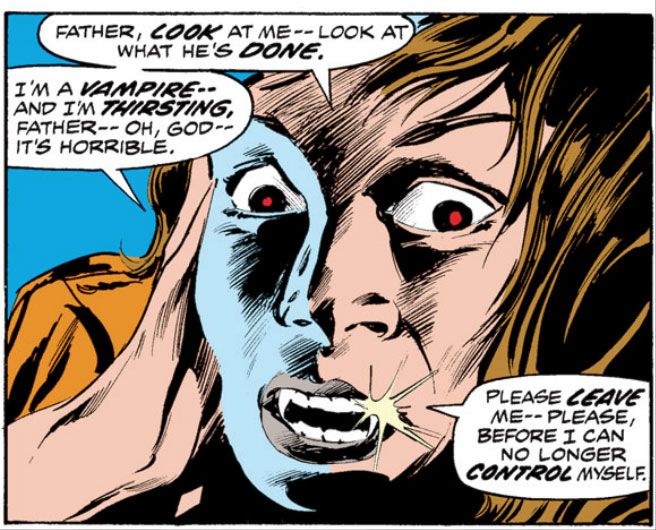
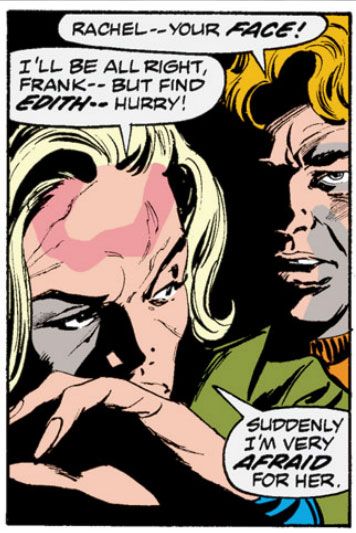
Another important character point is the scarring of Rachel's face. Bats, released by Dracula, attack the group and Rachel gets a makeover. These scars become part of her character and eventually symbolize the hardening of her spirit. So important are these scars, when Wolfman and Colan resurrect Rachel years later in their Tomb of Dracula miniseries, it's through a kind of possession that involves a brand-new character tearing at her own face until she resembles Rachel and loses her own identity.
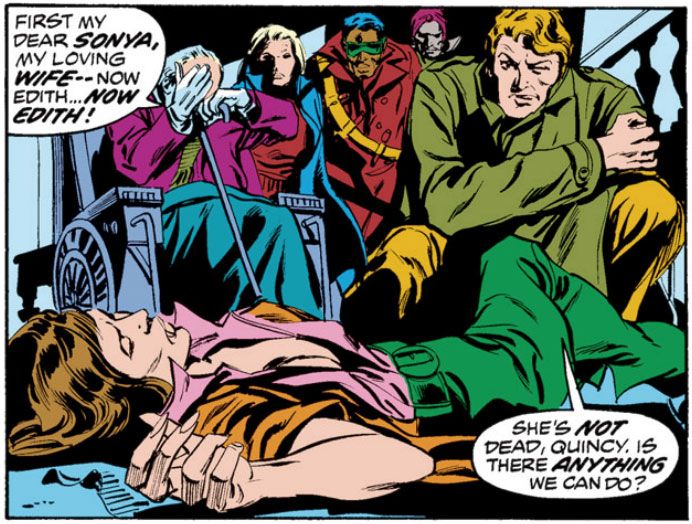
The final and most poignant element is Edith's fate and the matter-of-fact way Quincy deals with it. While Frank reacts with very human but misguided compassion and hopefulness, Quincy Harker knows from experience there is only one thing to do. Wolfman could easily cop out at this point and offer a last-minute reprieve in the form of some never-before-heard-of cure, but no. Instead, he sacrifices a character to the betterment of the story. It's a moment reminiscent of the scene from Stephen King's 1976 novel 'Salem's Lot where protagonist Ben Mears is forced to drive a stake through Susan Norton's (his vampirized girlfriend) heart. King changes viewpoint characters throughout his story, spending a great deal of time and care making readers empathize with Susan by allowing them to see events from her perspective. Her loss in the narrative gains impact because we think of her loss as tragic unto itself rather than merely something that incites Ben's actions towards the climax.
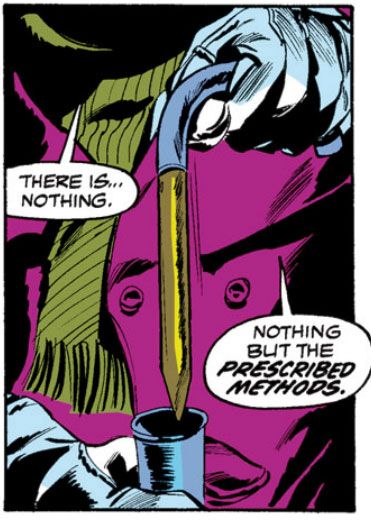
Wolfman hasn't had enough time to do as much for Edith. Because her fictional career ends so abruptly, she remains something of a punching bag of a character. And yet, Harker's coldly pragmatic method of dealing with her is chilling. This is what separates a true horror story from an adventure that uses horror trappings. Horror forces characters into painful choices, the loss of sanity, of limbs, of life, of loved ones.
Saturday, October 13, 2012
October is Spookey Month: "The Coffin of Dracula"

For Warren's Creepy magazine, Archie Goodwin and Reed Crandall created a two-part sequel centering on one Lord Varney (his name borrowed from one of Dracula's vampire antecedents) and his stupid misadventures with Dracula's coffin. Not that the story is stupid. It's not exactly a classic-- although Warren thought highly enough of it to reprint it in one of their best-of issues-- but Varney's the idiot here. What kind of fool buys Dracula's coffin and climbs into it? It's a bonehead move by an arrogant jackass and actually one of the most bizarre ways I've yet seen of contracting the dread disease we know as gingivitis. I mean, vampirism.
Seriously, if you must become a vampire, have the common decency to drink the blood of one of the undead. Get your own coffin. Sharing coffins isn't sanitary, anyway. And it's not true vampirism. It's more like possession at first. Varney can't even get that right. Man, I hate this Varney guy!
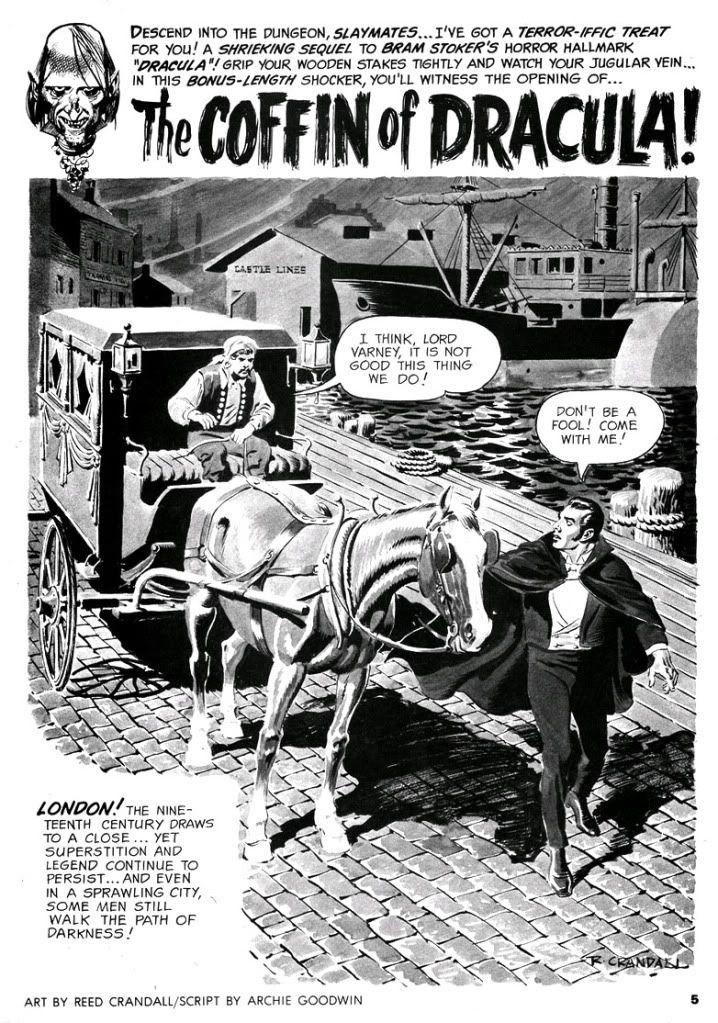
Part one clawed its way out of the crypt in time to anchor Creepy #8 (April 196), while part two coalesced from swirling ash in #9 (June 1966). Both segments are gorgeously illustrated by Crandall at the height of his artistic powers, "Coffin" plays like an overly abridged adaptation of the Stoker original, with Dracula more a presence than a character. Dopey, delusional Varney kidnaps Mina, Jonathan, van Helsing and Dr. Steward pursue him back to Whitby, one of the central settings in the novel and where Dracula began his reign of terror by vamping virginal young aristocrat Lucy Westenra. The heroes hope to kill a vampire left over from the novel and prevent Varney from truly becoming one of them. After that, they plan to save Mina. The plan doesn't sit too well with Harker, but he's too dim to argue with van Helsing's logic.
There's some decent violence and fully-rendered vampire-staking (tastefully sans outright gore), but Varney is a vamp-come-lately, a pale imitation of the great one and lacks charisma. Once fully vampirized, he doesn't even have any dialogue. Ultimately, gorgeous art or not, the story is mainly mild fun for fans of books like Alan Moore's League of Extraordinary Gentlemen, itself an extension of Dracula through the character Mina. If you finished Dracula and hoped for more story, then here's your chance and you don't have to know 19th and 20th century literary references and pop culture to fully appreciate it.
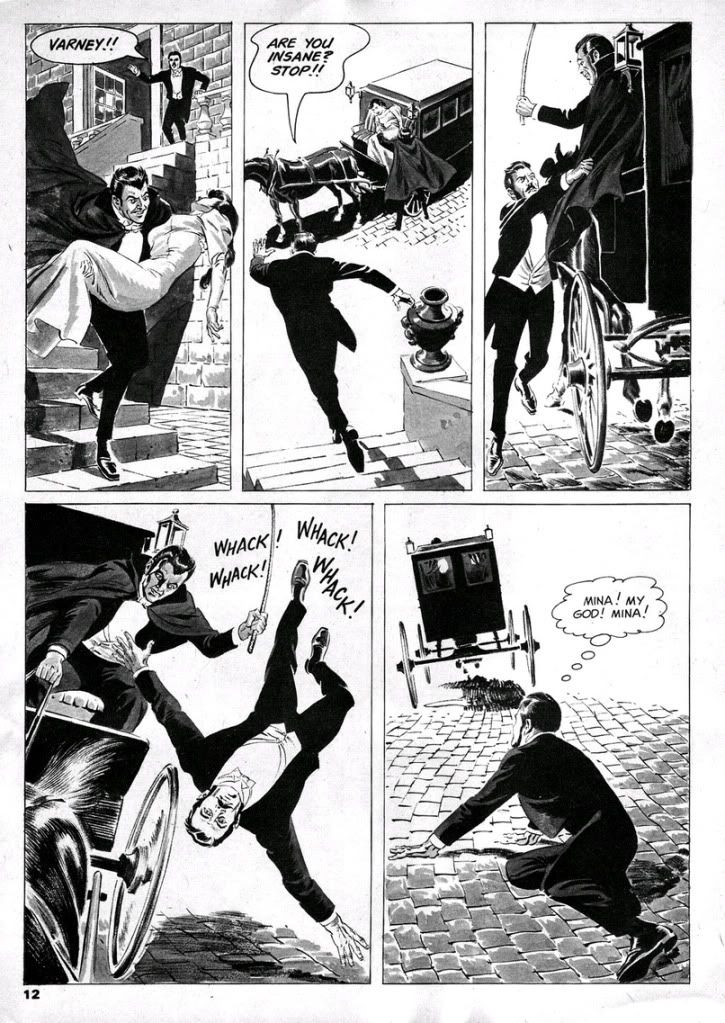
At least Moore picked up on the nascent feminist aspects of Mina, given that ultimate compliment by van Helsing in the book of having a "man's brain." The novel's Mina is a schoolteacher with a strong empiricist bias before she encounters the supernatural. Moore really ran with the notion and made her a lot steelier than Stoker's Mina, but Goodwin goes the opposite route and reduces Mina to your standard damsel in distress, kind of a dishrag. She barely has any dialogue, and none at all in the second part where we only see her unconscious before we follow Harker as he pursues Varney.
Well, Stoker puts Mina in jeopardy and in need of rescuing by men as well, but she does get in a few shots of her own, and because it's an epistolary novel, she at least had the privilege of speaking for herself. Goodwin shifts his focus exclusively to those menfolk, here rendered as a a dull crew of stick-up-their-asses types. When Varney kidnaps Mina, she disappears for the bulk of the story, which diminishes her plight. Goodwin does a wonderful job of recreating Abraham van Helsing's stilted Continental dialogue, though. Van Helsing is like a Dutch Yoda. "Friend Jonathan," indeed.
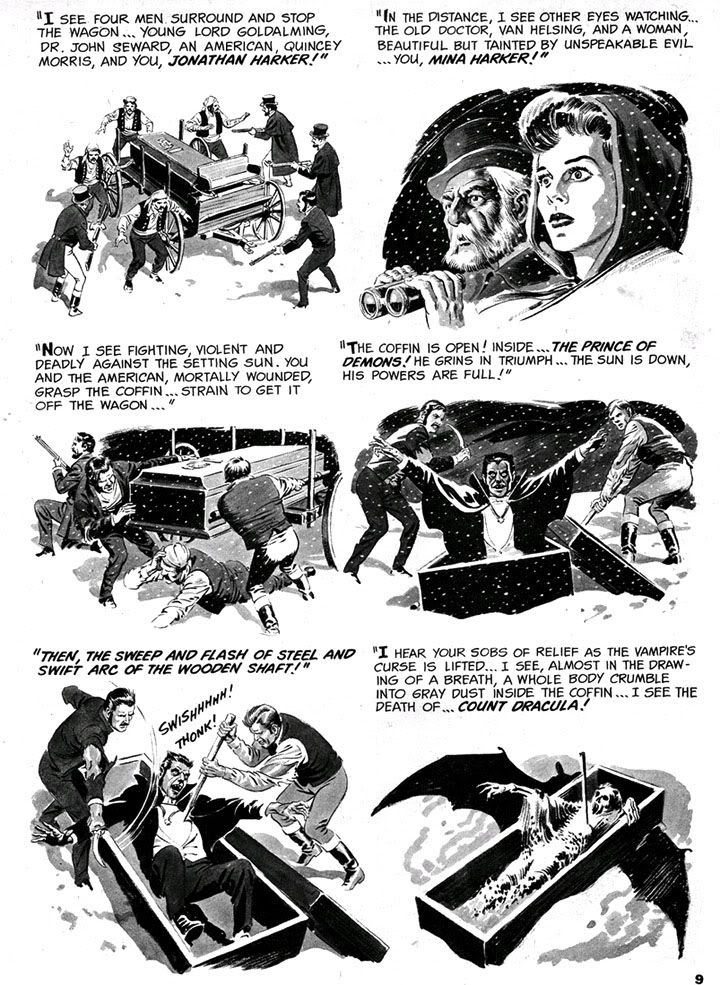
My favorite page is the collage-like recapitulation of Dracula's climax. I wish Goodwin and Crandall had done a full-fledged adaption of Stoker rather than this rehash, pretty as it is.
Poor Reed Crandall. While I immediately loved what I saw when I encountered his color jobs for EC in those early 1990s Gladstone reprints (I sorely miss those), his black and white art in the Creepy archives books from Dark Horse is a revelation. I can only describe it as beautiful, like those illustrated plates you encounter in ancient, heavy tomes from the darker corners of a library collection. Finely proportioned and posed figures, beautiful contour lines and modeling, depth of field, absolute control and mastery of individual panels and the page as a whole. And yet he seems to have been in competition with Wally Wood for "most tragic former EC great." Alcohol dependency and failing eyesight robbed him of his talent and sent his output into a shockingly steep decline in quality, so much so his last few jobs seem more the work of a talented amateur trying to do a Crandall impression. Reading them is like viewing a slow motion film of a ship sinking with a man still visible on the deck. On the other hand, he did leave behind an impressive body of work, especially in these early issues of Creepy.
And now it's time for one of my all-time favorite videos starring Spookey:
Friday, October 5, 2012
October is Spookey Month: "Tomb of Dracula," a Halloween reading suggestion
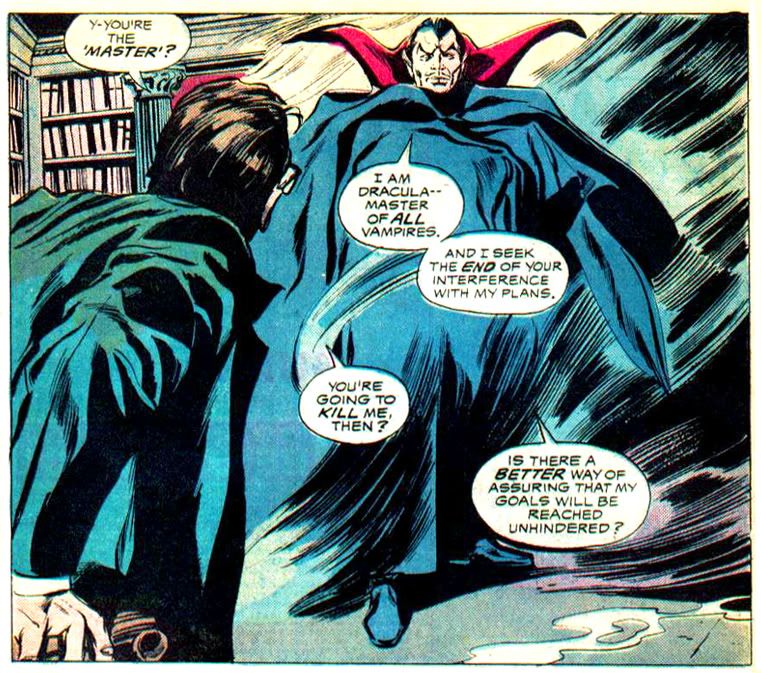 |
| Marv Wolfman, Gene Colan, Tom Palmer, Tomb of Dracula #31 (April 1975) |
Your perfect Halloween reading is Marvel’s Tomb of Dracula by Marv Wolfman and Gene Colan. I’m a Halloween traditionalist. As far its denizens go, I tend to avoid all slashers other than Michael Myers (or is he more of a stabber?) and stick with the classics—werewolves, ghosts, mummies, witches and vampires. And vampires don’t come any better than the main man himself, Vlad Dracula. Forget those Varneys, Ruthvens, Yorbas, Mamuwaldes and all those other pretenders to the throne. Barlow? A clown.
But when you want the true Lord of the
Undead, there’s no other choice for choosy consumers. You want Dracula. He’s packed with vitamins, stays crunchy in
milk and has a taste that can’t be beat.
Kids and moms agree-- the wholesome goodnesss of Dracula is part
of your complete breakfast. And Wolfman’s
purple prose funny book serial is the third finest Dracula tale after Bram
Stoker’s novel and the Hammer Films series starring the greatest of the screen
Dracs, Christopher Lee.
It’s got gothic elements and touches of
Robert Bloch and Richard Matheson, and occasionally Sax Rohmer by way of Ian
Fleming. Disembodied Communist
brains? If the series unfortunately
takes place in the Marvel universe at large—Johnny Storm, the Kree Empire and vampires have no
business co-existing, sorry (although we might make a case in favor of a Fin Fang Foom crossover)—Wolfman wisely and largely keeps the colorful
longjohns crowd at bay, beyond a brief
visit by Brother Voodoo and a tete-a-tete with earth’s Sorcerer Supreme Dr.
Strange. Chris Claremont’s tales in the
Giant-Size issues tend to draw on H.P. Lovecraft as well. They’re okay, not really Claremont’s finest—the
man mastered mutants, not vampires—but then again, he didn’t have the benefit
of Gene Colan handling the art.
Colan made his horror bones—so to speak—drawing
some memorable ink-washed Creepy tales for Warren, but he made his mark at
Marvel pencilling Daredevil and Captain America.
Tomb of Dracula, however, is the man’s masterpiece. Tomb was an assignment he sought, and he was
right to do so. While his superhero work showcases his ability to depict bodies in motion, Tomb proves him a master at distorting them through foreshortening. Constrained from showing gore by the Comics Code, and due to the talky nature of a lot of scenes-- vampire hunting requires planning while sitting around coffee tables-- Colan would choose the most difficult angles, then stretch page design to its outer limits by framing them with panels of odd shape, or going for collage-like effects. But always under control, always moving the reader's eyes across the page in a way that makes sense and lends to a clean reading experience. Actually, reading a Colan Dracula page is like reading a movie.
His chiascuro style—heavy on shadows and mood—finds its ideal match in the sinuous ink line of Tom Palmer. Through Palmer's finishes, Colan’s art coalesces further into the kind of dark beauty that also prints well on the cheap newsprint comics companies used in those days. When you find them in black and white in an Essential Tomb of Dracula or one of the slick collections in full color, you see just how endlessly attractive and rewarding of close study these pages truly are.
Palmer interprets Colan's shaded modeling with parallel feathering and cross-hatching to create a feeling of form, depth of field, added clarity and emphasis. At times he seems less an inker than an
extension of Colan’s artistic consciousness.
There are other pencil-ink teams where the partners’ sensibilities mesh
so well. Neal Adams and Dick Giordano, George
Perez and Romeo Tanghal, Jack Kirby and Mike Royer, John Byrne and Terry
Austin, Steve Rude and Gary Martin. But
Colan and Palmer made Tomb of Dracula Marvel’s most consistently gorgeous book
of the 1970s.
Wolfman takes a novelistic approach to his cast of characters, especially lead Frank Drake. When we first meet Drake in Tomb #1 (April 1972), he's a cjaded, shallow rich boy who's squandered his fortune. Only Castle Dracula remains, but betrayal by a close friend leads to Dracula's resurrection and sets the series in motion. Drake is at times selfish, mule-headed, morose and self-reproaching. When he moves to embrace outright heroism, he does so in about as jerky a way a person could, alienating his friends. The quest to stop Dracula changes him over the course of his adventures. The same can be said of Rachel van Helsing, whose character transformation finds stark symbolism in facial scars she eventually acquires, marring forever her icy blonde beauty.
Like many open-ended narratives, Tomb seems content to spin its stories out, changing direction abruptly, introducing new characters like shlubby Harold H. Harold, the hacky writer, and Blade, the half-vampire vampire hunter who proved popular enough to inspire a Wesley Snipes-starring movie franchise and a syndicated TV series, then following them down twisting story paths until things conclude rather abruptly in Tomb # 70 (August 1979)-- which was supposed to be a three-issue arc, but ended up mutilated into a double-sized single issue thanks to a Jim Shooter decision. The stitched-together seams show badly, but the series ends up having a strange Victorian serialized novel feel, which is appropriate for vampires.
Like many open-ended narratives, Tomb seems content to spin its stories out, changing direction abruptly, introducing new characters like shlubby Harold H. Harold, the hacky writer, and Blade, the half-vampire vampire hunter who proved popular enough to inspire a Wesley Snipes-starring movie franchise and a syndicated TV series, then following them down twisting story paths until things conclude rather abruptly in Tomb # 70 (August 1979)-- which was supposed to be a three-issue arc, but ended up mutilated into a double-sized single issue thanks to a Jim Shooter decision. The stitched-together seams show badly, but the series ends up having a strange Victorian serialized novel feel, which is appropriate for vampires.
Dracula himself would go on to appear ever more ridiculously in issues of The Uncanny X-Men and ---, a kind of supernatural Dr. Doom, every new iteration watering down Wolfman's indelible characterization of a proud, misanthropic anti-hero until Drac becomes just another super-villain in the Mighty Marvel manner. He even fights Apocalypse at one point. Sheesh. But during the run of his own title, Wolfman, Colan and Palmer found majesty in a character who suffers from being overly familiar to the point he's inspired parody and mockery. Besides Dracula himself, obviously Blade is still kicking around. I'm not sure what's up with Frank Drake, although he resurfaced in 1991 for a four-issue Epic miniseries also called Tomb of Dracula, where we find him trying to put the past behind, only to have the infamous vampire reappear. Wolfman deliberately ignores all the Drac appearances in between, having the vampire lord reappear at precisely the same place he apparently perished in that last issue of Tomb.
I, for one, applaud that choice.
Which is why every October I find myself
brushing away the cobwebs, creeping down the stone steps weeping condensation,
the darkness breathing chill air like a dying man… and opening the tomb. This Halloween, if you haven’t already, you
should, too.
Monday, October 3, 2011
Dracula: Marvel's Merriest Misanthrope (2nd Annual Spookey Month)
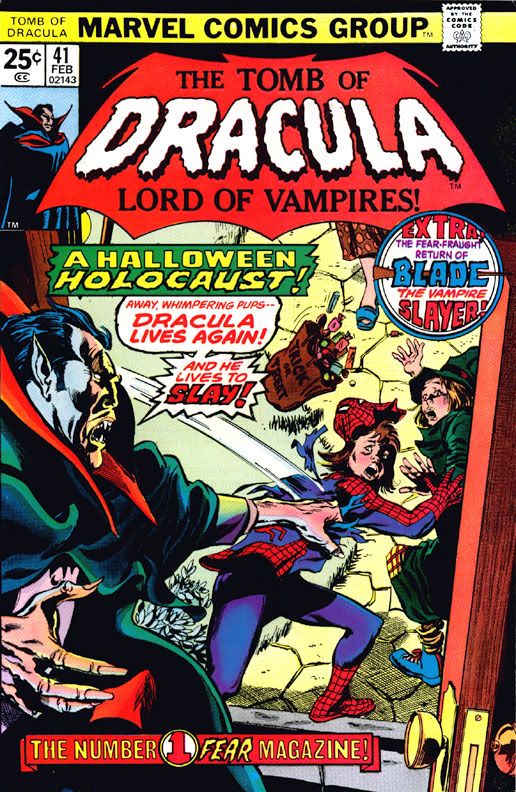 My favorite Marvel monster by far is Dracula, Lord of Vampires. Not because of his redeeming qualities; he doesn't have any. Dracula is far too hateful to identify with, or to like as a person. Every so often, writer Marv Wolfman attempted to establish a little sympathy for Dracula.
Dracula loses his powers, he eviscerates himself in his blog, he drinks too much and cries at a sad clown movie. Then you remember he also murdered his wife, alienated his daughter and son, drove a young woman to suicide through emotional abuse, bullies anyone he perceives as weaker than himself-- nearly everyone-- and murders without remorse in order to feed his vampiric blood-thirst. And that's in between long monologues where he tells you how great he used to be when he was alive, and how awesome he is even now that he's dead. But he does exude charisma as star of his own comic. He's sickly fascinating, like the snake that kills you or a YouTube video of a car crash. You can't take your eyes off him, even while you deplore his very existence.
In Bram Stoker's novel, Dracula is the antagonist and what we learn of him comes second-hand from various diaries and letters; for Marvel's Tomb of Dracula series, Wolfman cleverly reversed the formula and Marvel ended up with a comic that exhaustively examined the sociopathic tendencies of its lead character, a completely reprehensible killer whose egotism buries the needle on the ego-ometer, easily topping 10,000 kilo-Trumps. Imagine a Fantastic Four where they not only fight Dr. Doom every single issue, but the writers seem more interested in him than in the good guys.
At least Victor von Doom has a kind of tragic nobility resulting from his being more misguided than actively evil. Despite his protests to the contrary, Dracula's nobility drizzled away with his blood the moment he died, only to have a kind of nihilism replace it. But just like Dr. Doom as infamously written by Brian Michael Bendis, Dracula loves to put people down. Let's look at some of Dracula's insults, shall we? And then we'll cleanse ourselves through the healing power of music.
Dracula's hate is universal, but there is no one among the masses he hates more than Frank Drake, his descendent. Drake's very existence is an insult to Dracula, so he repays the poor schlub at every opportunity. It starts as early as Tomb of Dracula #1 (1972).
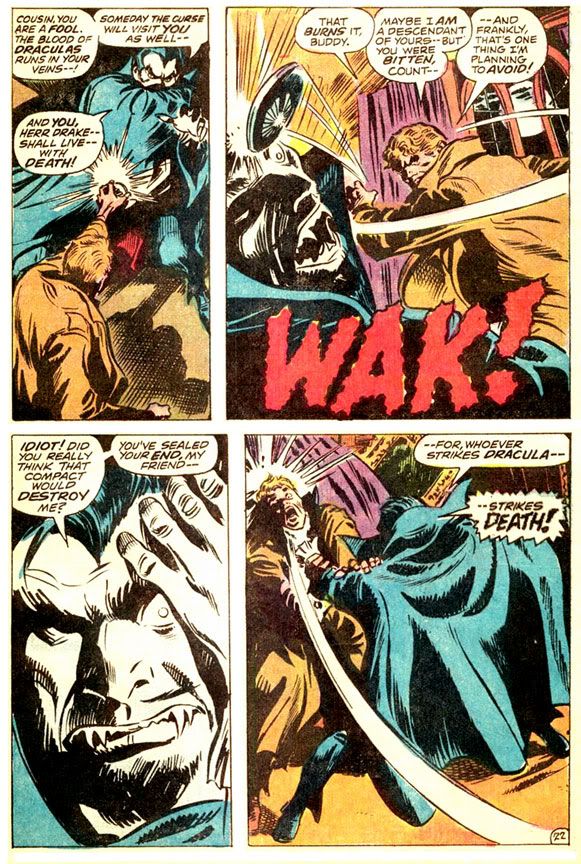
Dracula relies heavily on old favorites such as "fool" and "idiot." "Scum" seems to be his favorite epithet, though. All through the series, it's "scum this" and "scum that." While he's not shy about expressing his displeasure with humanity, he's also something of a culinary critic, a skill he displays in #9 (1973).

It's amazing a guy who died hundreds of years before the invention of indoor plumbing knows enough to dump stew into a sink. On the other hand, depending on how greasy or oily it was, that might not have been the best idea. What am I saying? Of course Dracula would want to clog your pipes!
Occasionally, Dracula gets a little more clever with his insults. After charming a group of hoity-toity ship passengers, he suddenly shows his true colors in this scene from #10 (1973).
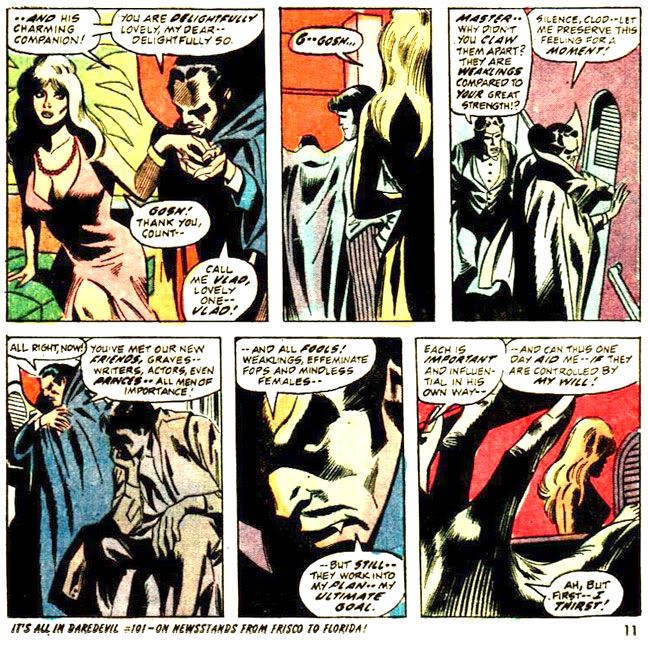
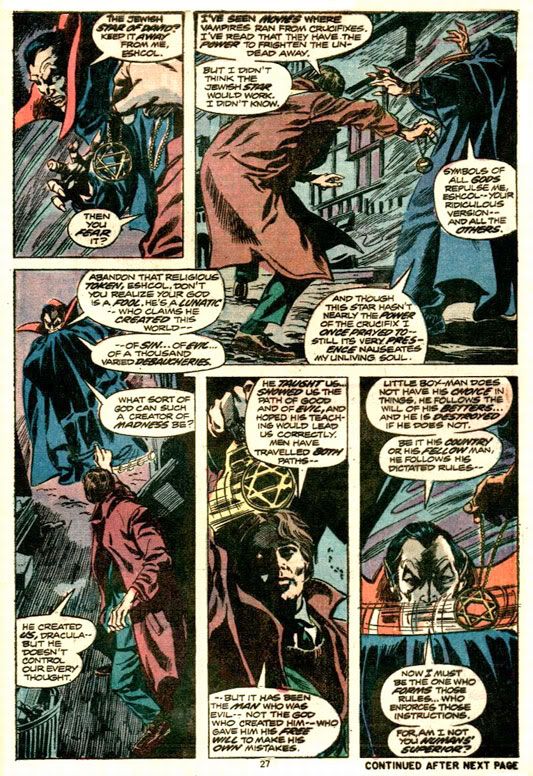
Well, he does call them fools before working a bit more baroque than usual. If you want a torrent of angry verbiage from Dracula, few topics get him worked up like religion. As a foul undead creature aligned with Satan, Dracula-- as you might imagine-- isn't too keen on God, as we see in this tender, sensitive moment from #27 (1974).
Even after months of hanging out among us mortals, he's not shy about expressing his dislike for people. In #29 (1975), he really lets his feelings show.

Comparing us to vegetables is kind of odd, since Dracula is a hardcore carnivore who love nothing better than reducing all of humanity to docile food stock. Dracula never orders salads in restaurants. He's also not content to decry food, deities and people. In #60 (1977), we also learn that Dracula has it in for inanimate objects.

Yes, even chairs aren't safe from Dracula's wrath. But given his towering ego, Dracula must reserve praise for himself, right? He has to be a narcissist-- the kind of guy who would gaze lovingly into a mirror and practice his various smiles, if he still had a reflection. Yeah, I thought so too, until I read #66 (1978).
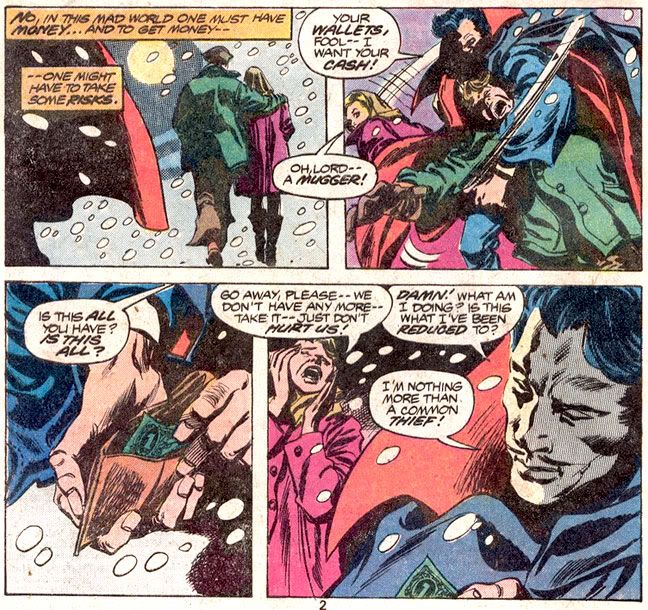
Well, this is after he's had a huge argument with none other than Satan (later determined to be lame-o wannabe Mephisto, which is a major cop-out on Marvel's part), who removed Dracula's powers and reverted him to mortality but left him with his snazzy cape. Later, however, we learn there are few things Dracula despises more than his fellow vampires. Check out this heartwarming moment from #70 (1979).
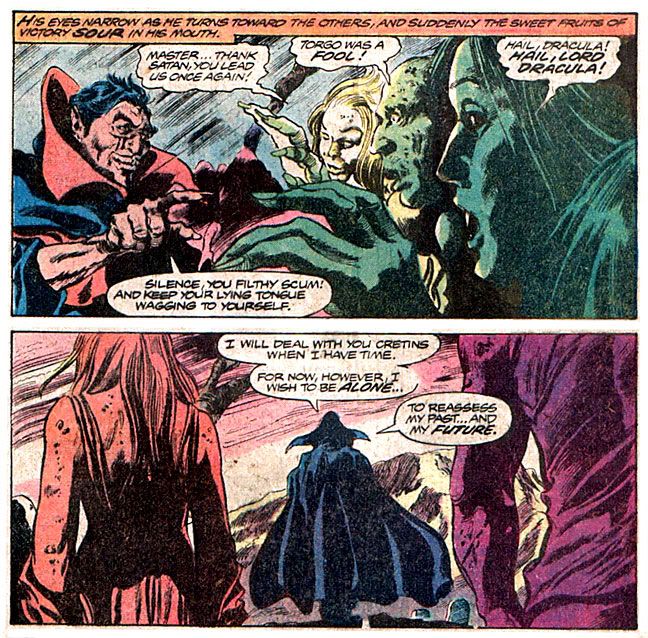
Tomb of Dracula #70 was a double-sized issue abruptly ending with his death, and so Dracula disappeared from the Marvel universe for a year or two. Like his Hammer Studios counterpart, the comic book vampire kept returning from each seemingly final destruction. While Wolfman and company wisely kept Dracula's involvement with Marvel's costumed heroes to a minimum-- with genre-appropriate appearances from Brother Voodoo, Dr. Strange and Werewolf by Night-- other writers would try to fold the character into the mainstream superhero continuity. This resulted in incredibly silly moments such as Dracula trying to vampirize Storm of the X-Men.
Possibly sensing the ridiculous nature of such tales, the powers-that-be at Marvel had Dr. Strange eliminate all vampires via something called the Montesi Formula. No more vampires. Just mutants and spider-people, please, and metallic guys who fly around on surfboards. But Dracula was and remains too good a public domain villain not to use even if you're just going to have him battle super-people in their colorful underwear and/or BDSM outfits. In 1991, Wolfman and original series artist Gene Colan teamed up with inker Al Williamson for Tomb of Dracula: Day of Blood! Night of Redemption! which sees Dracula returning from the grave and ignoring all that X-Men nonsense between the final issue of his own series and the first of the new.
And he's no happier with humanity, although he has learned to express himself with a bit more eloquence. Gone are the generic references to "scum" and "cretins," replaced by a more definitive explanation of Dracula's misanthropy.
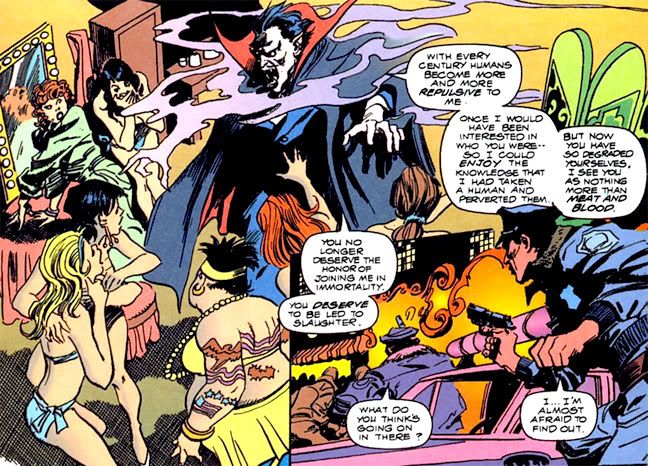
Well, that's what Dracula gets for hanging out in a seedy strip club. Of course you're going to learn cynicism when you choose only to see the worst society has to offer. Dracula responds by tearing off a security guard's face-- Colan and Williamson make it look like a rubber Halloween mask trailing red streamers-- then slaughtering the club's dancers. See those cops in the last panel? They come upon a crime scene so horrifying it affects even their jaded sensibilities. One of them vomits. But what about the hoi-poloi? I'm sure Dracula, having been ruler of Transylvania in his younger days, would find the upper crust more suitable company.
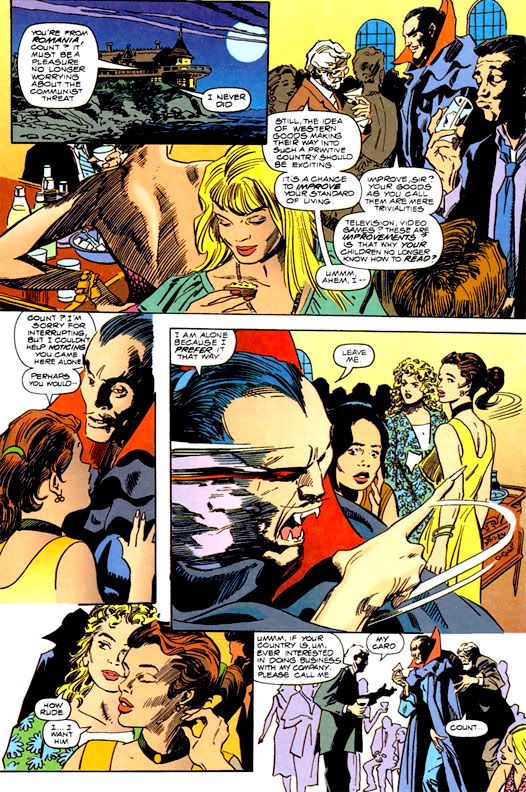
Guess not. Once again, he doesn't just offer a tongue lashing. When one young woman makes a pass at him, Dracula responds by casually murdering her and throwing her body off an ocean-side cliff where she goes SPLAT! on the rocks below.
One of the worst things you can do is try to use Dracula for your own means, even if it helps him in the short term. Here he mocks Dr. Smirnoff, a college professor whose dalliance with the supernatural has resulted in his torso becoming transparent. Smirnoff wants Dracula to turn him into a vampire so he can avoid a Lovecraftian doom, but Dracula prefers to string him along and humiliate him at every opportunity.
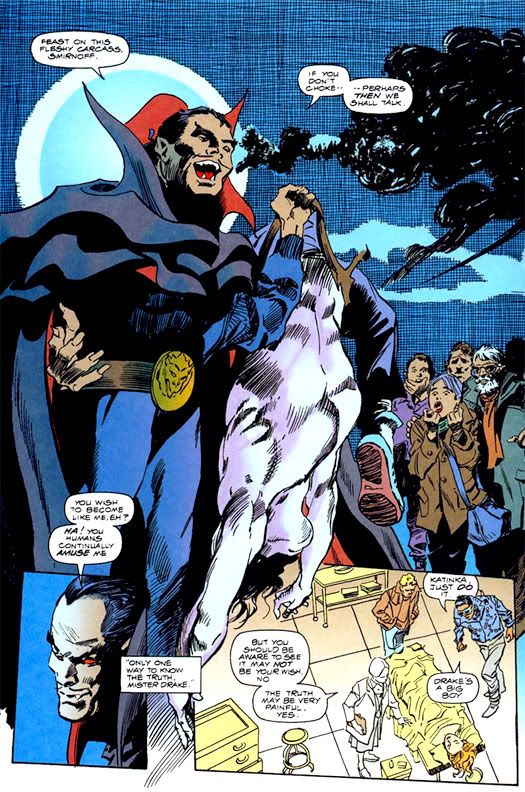
I'm not sure when Dracula gave up his suit and tie for this pro wrestler's attire, but he's apparently won the Intercontinental Tag-Team Championship, if I'm recognizing that belt buckle. Later, Dracula adds injury to insult when he pokes out Smirnoff's eyes and rips off his head.

At least Dracula's finally learned to loosen up and enjoy himself. Let's do the same! Once again, it's Hamamatsu's completely awesome Spookey!
Subscribe to:
Posts (Atom)