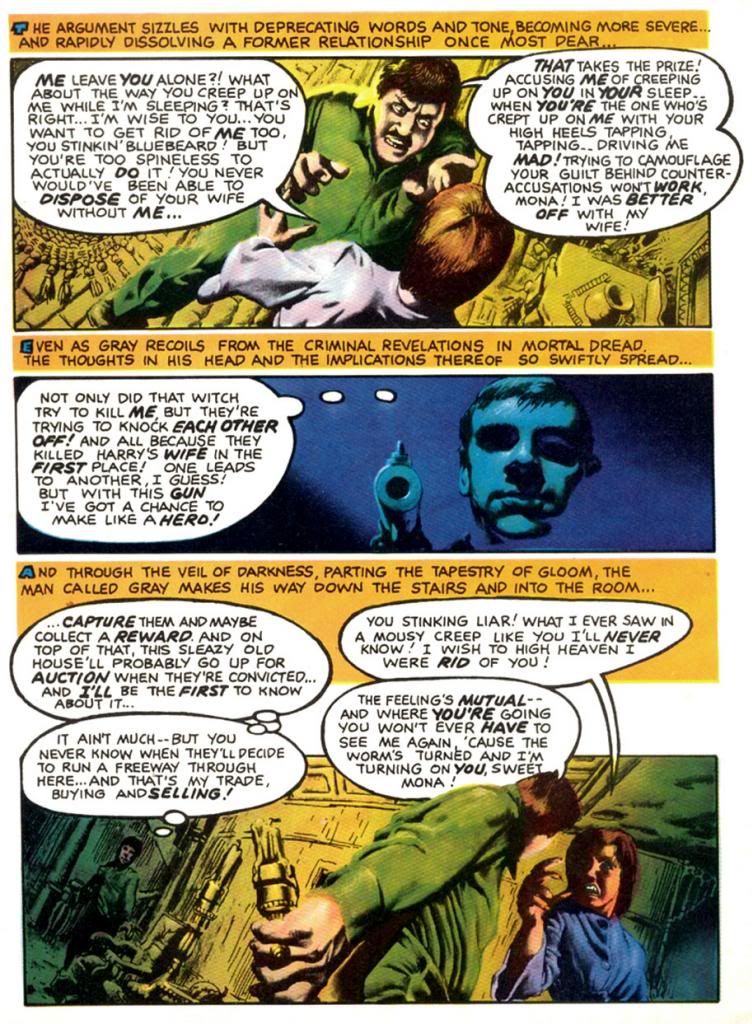
The original Star Trek series sometimes combined science fiction with straight up horror, maybe softened a bit by a little dialogue about an "energy source" that creates whatever magic Kirk, Spock and the rest come up against. But the idea was still using the old cliches to fill fifty minutes worth of story without being so obvious about it. The very first episode to air, "The Man Trap" (September 8, 1966), featured a "salt vampire" that was pretty much just a version of a regular vampire story dressed up a little for a futuristic setting. The crew met a witch in "Catspaw," written by Psycho author and H.P. Lovecraft protege Robert Bloch. It ran just in time for Halloween (October 27, 1967, to be exact) and came complete with a black cat and a gothic castle. And let's not forget "Wolf in the Fold" (December 22 the same year), also written by Bloch. That's the one where we find out Jack the Ripper was possessed by some kind of immortal, incorporeal entity that feeds on fear. When it gets into the ship's computer and starts screaming "RED JACK! RED JACK!" over the intercom, Trek for the first time managed to scare me silly. Even reading the James Blish short story adaptation of that particular episode frequently gave me the willies, the heebiejeebies, the whimwhams or small pox.
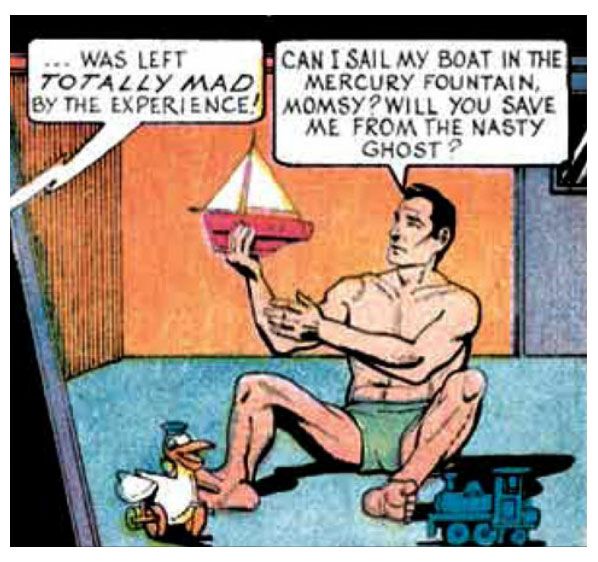
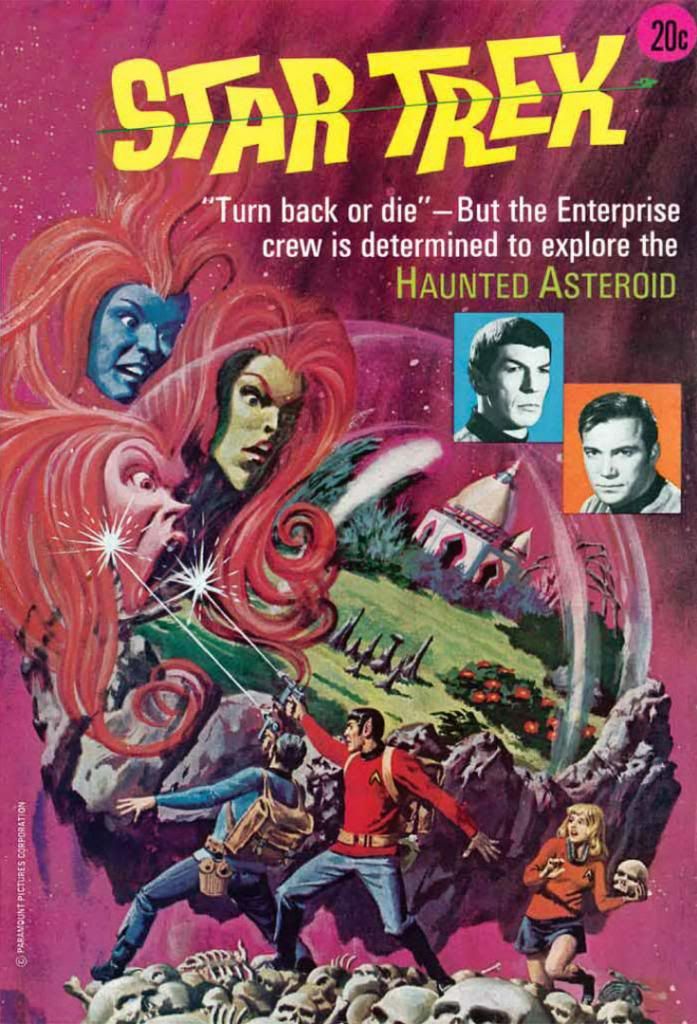
The Gold Key Star Trek comic adds ghosts to the mix in #19 (July 1973) , where (according to Comixology at least) writer Len Wein-- of all new, all different X-Men and Swamp Thing fame-- presents our daring space explorers with a supposedly haunted asteroid where something fearful dwells. How fearful? So fearful that after encountering it, this poor guy reverts to childhood and has to wear diapers for the rest of his life:
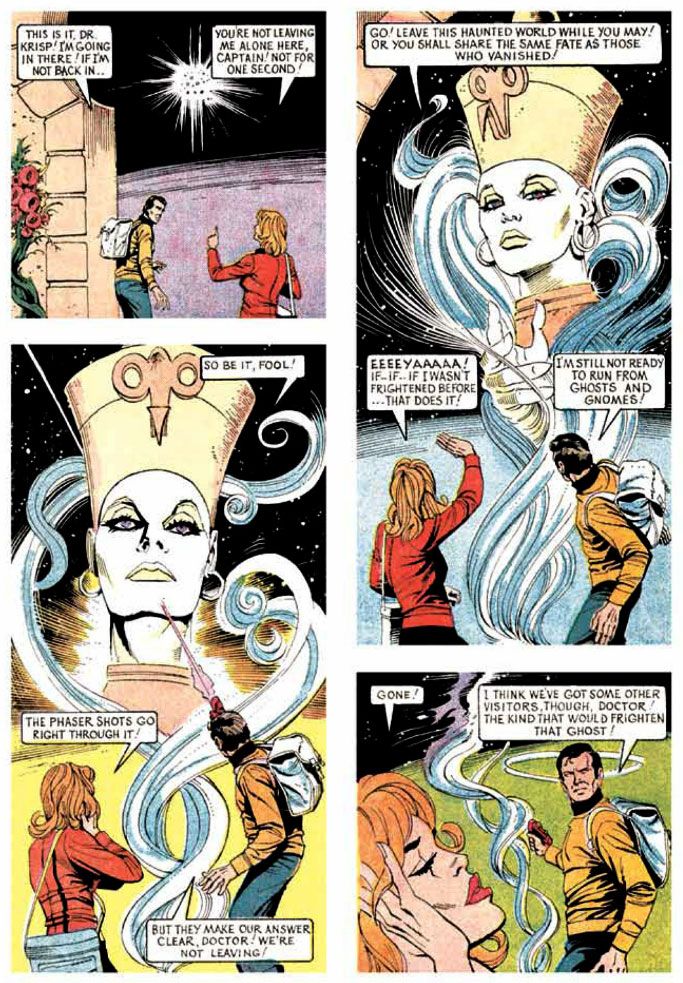
Because Starfleet favors the empirical over the metaphysical, the Enterprise warps to the asteroid for an investigation. Kirk's old Academy pal Jay Nordyke goes down and comes back with selective amnesia. Hypnotic regression reveals he's erased from his memory a horrifying encounter with a ghost. At least he can still function as an adult. Kirk, Spock, Sulu and some others beam down to check things out and gamble they're mentally tough enough to stay grown ups and in control of their bowels no matter what they face.
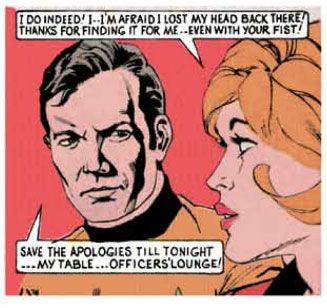
Aiding the ghostbusting is Dr. Krisp (first name Cookie) who, despite wearing a smart black skirt, proves a bit shaky in the field. She and Kirk get down... to business (get your mind out of the gutter, please) and solve the mystery. It turns out it's more science than supernatural, a variation on the old Scooby Doo, Where Are You? ploy of someone pretending to be a ghost to frighten people away when we all know that would only attract hordes of macho jackasses with night vision video cameras and heat signature detectors and a whole lot of pseudo-scientific bullshit to run around shouting at the walls for SyFy.
By borrowing heavily from the story of the Taj Mahal, Wein does a sweet job of setting up and then explaining the mystery. There are some characteristically goofy moments because it's Gold Key, like hardened space travelers trained in scientific observation screaming "zombies" when what they're looking at is patently something else with which they should be very familiar given the Federation's technology. And I love Alberto Giolitti's off-model artwork. He sometimes all too obviously uses photo reference for some portrait-style panels, but most of the time it just seems like he had only the vaguest idea about the property he was working on. As a result, a few things have been lost in translation, but a lot of charm has been gained. Giolitti's art has its own Giolittian flavor, kind of fusion cuisine, some Trek, a side of Flash Gordon, a liberal dollop of European comics. In the end, it proves a deliciously satisfying yet wild stew of different ingredients. The exterior of the mausoleum looks Mughal, the interior gothic, the costumes strictly Ancient Egyptian. At the same time, that's not too far from what the show itself used to do, where the set and costume designers seemed to lean on whatever was available in the prop and wardrobe departments at Desilu.
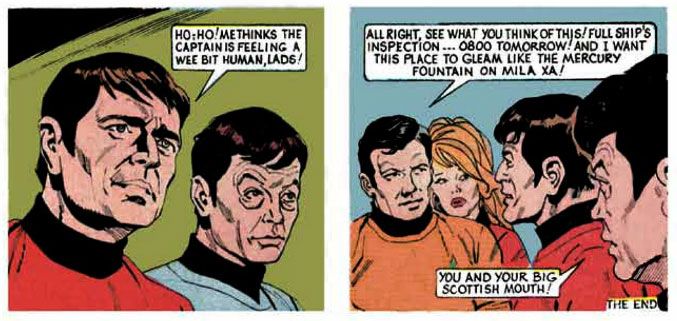
The ultimate solution is a surprise, but it fits the evidence and it's also made of stuff that's very familiar to Trek fans, so we'll accept it. Or not. That is to say, I'm fine with it but you'll have to make up your own mind. This sets up a more traditional Star Trek dilemma where the crew now knows exactly what it's up against but still has to figure out how to escape an overwhelming power. It helps that Sulu reveals himself to be a champion gymnast and Scotty a champion weightlifter. I've always considered myself a solid Trekker, but I can't for the life of me remember either man possessing those skill sets. I know Sulu is an expert fencer and botanist, and that Scotty can drink anyone under the table be it Klingon or godlike evolutionarily advanced super-being. Neither of those apply here.
And what is it Kirk is good at, better than any other man?
Being a hard ass.
Sunday, October 13, 2013
Friday, October 11, 2013
October is Spookey Month: And now a Spookey video!
As you know, Spookey is from my adopted hometown here in Japan and inspired this annual month-long Halloween celebration They're a lot better than my overwrought prose, right?
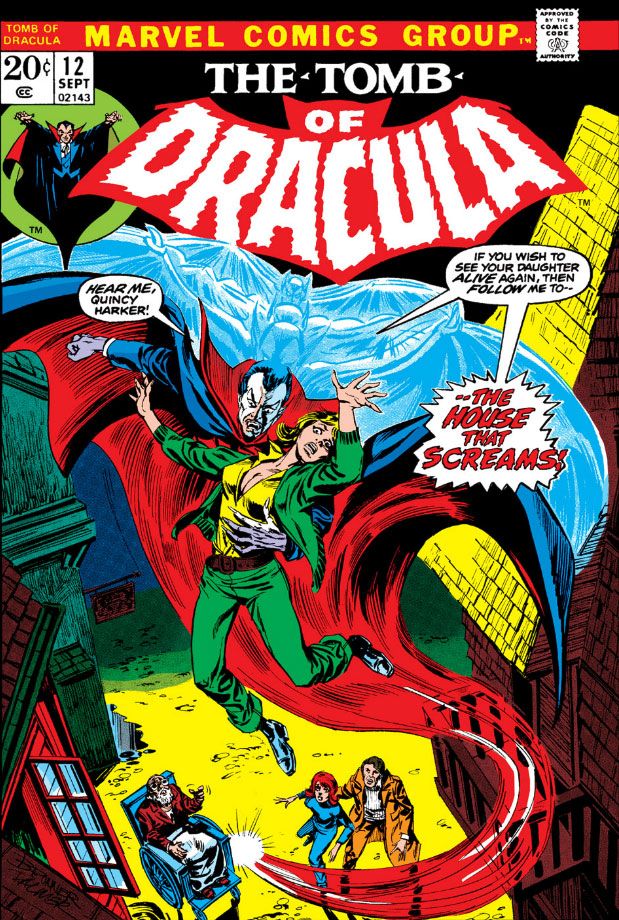
October is Spookey Month: Tomb of Dracula #12 teaches us most accidents happen at home
Is it controversial to say Tomb of Dracula was Marvel's best comic of the 1970s? It has some strong competition from Conan the Barbarian where Barry Windsor-Smith displayed exponential artistic growth; from X-Men/The Uncanny X-Men with Chris Claremont, Dave Cockrum and then John Byrne creating a mythos that won all those Eagle Awards and underpins the entire Marvel universe to this day; and from Howard the Duck where Steve Gerber and artists like Frank Brunner, Val Mayerik and Gene Colan inspired Marvel's first movie adaptation (an infamously lousy one, but still a big budget, George Lucas-produced film released to theaters in the belief it would be a big hit).
Those are all fine series, and I've enjoyed each of them. But Tomb is just something else entirely. Tomb is like wow times wowee for a little "wowee-wow-wow." Tomb took an exhausted public domain property-- good ol' Count Dracula, star of dozens of movies, TV shows and comic books in one form or another-- and gave it a compelling, new un-life. Writer Marv Wolfman's melodramatic prose perfectly matches Gene Colan's shadowy visuals, the two elements working in tandem like peanut butter and chocolate in a Reese's. When Marvel finally teamed Colan with inker Tom Palmer, the two produced what I will argue was consistently the most breathtakingly beautiful color monthly of the entire decade.
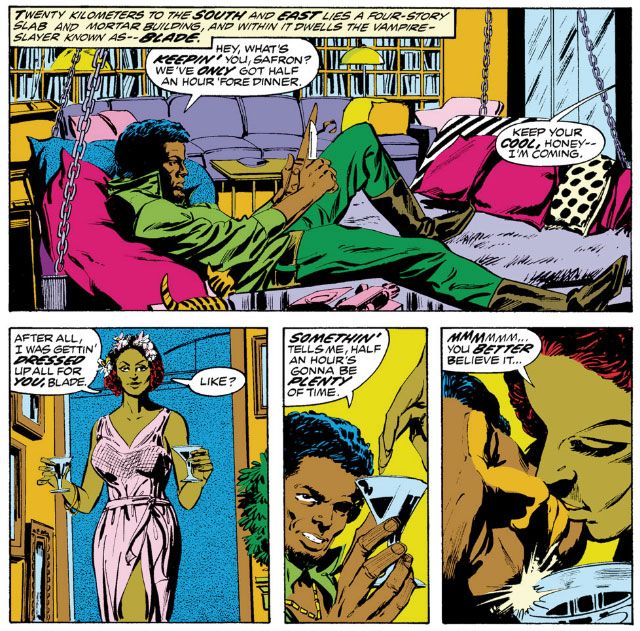
Operating on the fringes of the Marvel universe, Tomb functions as a sequel and expansion of Bram Stoker's novel. In fact, lead good guy Frank Drake is a descendant of Dracula himself, his last name an Americanized version of the original. Quincy Harker comes right out of the original book, the first born child of Jonathan and Mina (nee Murray) Harker, conceived and born after the novel's main events and named after one of Dracula's victims, the Harkers' courageous American cowboy friend Quincy Morris. Wolfman casts Harker in the Dr. Van Helsing role. More troubled than his Stokerian prototype, Harker rides around in a weaponized wheelchair the likes of which James Bond's pal Q would envy, and he uses it to save himself and others several times throughout the stories. His hardboiled protégé (and later, Drake's lover), Rachel van Helsing, is the grand-daughter of the Stoker character. Both Taj Nital, devoted companion to Rachel, and-- most significantly-- Blade, the ultra-cool, Blaxploitation-style member of the group, are wholly original. At least I don't remember Stoker having watched Shaft, Super Fly or Hammer, but he could very well have despite having died about 60 years before the birth of the film genre.
Every October, I turn to Tomb of Dracula and it helps put me in that spooky, haunted Halloween mood. It has its funky idiosyncrasies-- too many scenes where Rachel, Frank and Blade confront Dracula and all they do is trade arch insults and a whole lotta plots where Dracula almost dies, only to escape at the last moment. After all, how many times can our vamp-slaying crew almost destroy Dracula before they start to seem completely incompetent to the point they lose our sympathies and incur our scorn, like that bumbling Gilligan? Tomb of Dracula ends rather abruptly with issue #70 before it has a chance to devolve into self-parody, but even when things turn silly as they occasionally do, the overall atmosphere remains one of effectively updated gothic horror, and there are still plenty of genuinely creepy moments to restore our faith. Which finally brings us to tonight's topic, Tomb of Dracula #12 (September 1973) and a little story we like to call "Night of the Screaming House." Because that's what Marv Wolfman named it.
Oh, on the Frank Brunner-illustrated cover, Dracula calls it the "House that Screams," but you should never believe anything the king of the vampires tells you. He has his own agenda and will lie when it suits him.
Okay, forget Dracula before... er... remembering him again. Because Wolfman and Colan throw us right into the action with the main characters locked in a ferocious show-down with none other than Dracula, who has caught himself a delicious dinner, but can't catch a moment to eat in peace. It's not a holdover from a cliffhanger ending to the previous issue (in which Dracula fought some motorcycle guys who aren't quite as menacing as the Sons of Anarchy bunch, although they do their best). It's more like, "Open the book, here we are!"
Unfortunately one of them, Harker's daughter Edith, is ill-equipped for the life of a fearless vampire hunter. Edith Harker was simply born to find herself in jeopardy. Wolfman and Colan introduce her to the series that way in Tomb #7 (March 1973), and in "Screaming House" (as its friends call it; the rest of you must refer to it in full, with an honorific of your choice), she really finds herself in a mess, the likes of which no heart-felt talk with Sheriff Andy Taylor, Mrs. Garret or Mr. Belvedere can solve. After a lot of posturing on both sides and some ineffectual hand-to-hand, Dracula spirits Edith away to a shabby old house so he can toy with his adversaries rather than just kill them outright.
With his mastery of vertigo-inducing camera angles, Colan expertly depicts the abduction, which is quite alarming as Dracula transforms only partially into his bat-form. This emphasizes his otherworldly aspects by making him a grotesque hybrid creature, plus it gives him enough strength to carry Edith through the air. He needs those membranous arm-wings to do two things at once.
And the titular screaming house is foe unto itself. It's full of rotten floorboards that give way at inopportune times and Dracula's hidden away traps of his own, like the black widow cages he slips around the corner beneath Frank Drake's feet at one point. The good guys split up to cover more ground and render themselves even less effective against Dracula and it all comes to a tragic conclusion.
While the story itself is pretty straightforward, at least compared to later issues (which would feature adversaries such as a Communist Chinese brain in an aquarium, Dracula's hated vampire daughter, a faceless dead man and, later, his own weirdo son, an angelic/demonic pretty boy calling himself Janus) it has some important character development.
Once he plunges his cast into Dracula's fun house, Wolfman depicts Drake as scared almost out of his wits to the point of stuttering as he speaks. And yet the guy still pushes on alone. While Drake is in a state of transition from callow rich jerk to bumbling vampire avenger to intrepid daredevil hero, it helps reinforce the danger Dracula personifies. Remember, when you go against a vampire it's not just your life that's in hazard; it's your very soul. And with Dracula the series anti-hero, there's always the chance over-familiarity with the character and his motivations will weaken his menace and turn him into just another ineffective Marvel villain fond of soliloquys in the dark. This is especially true if the characters in the book come to view him as ho-hum.
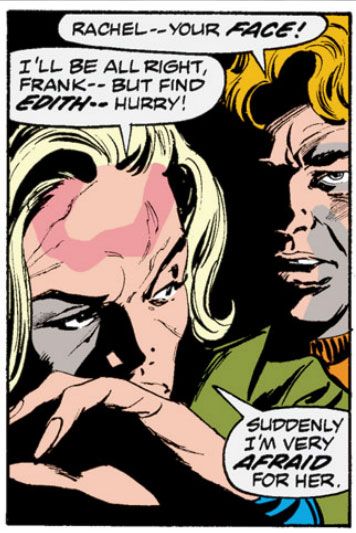
Another important character point is the scarring of Rachel's face. Bats, released by Dracula, attack the group and Rachel gets a makeover. These scars become part of her character and eventually symbolize the hardening of her spirit. So important are these scars, when Wolfman and Colan resurrect Rachel years later in their Tomb of Dracula miniseries, it's through a kind of possession that involves a brand-new character tearing at her own face until she resembles Rachel and loses her own identity.
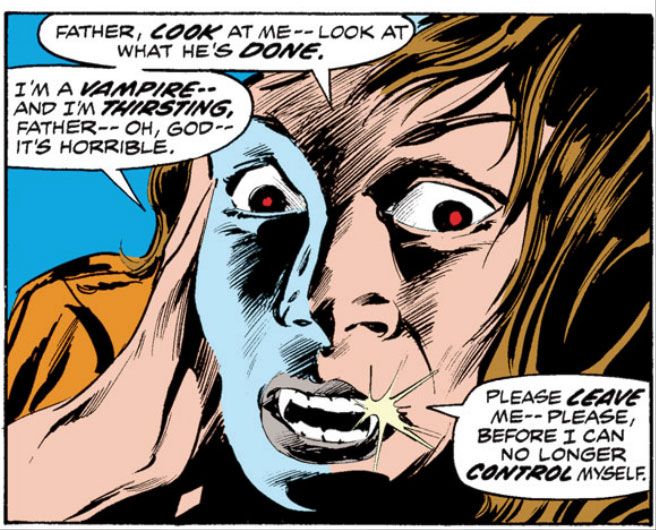
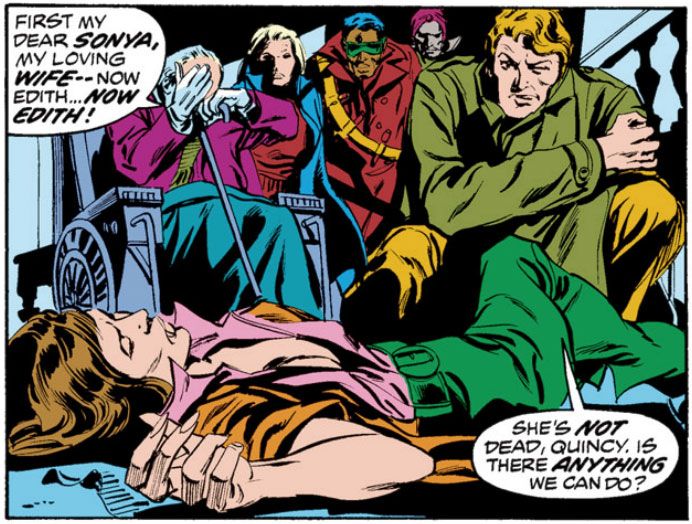
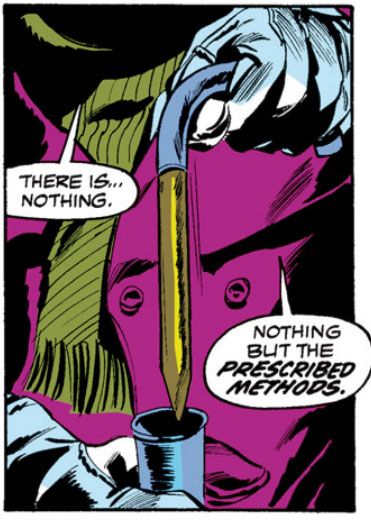
The final and most poignant element is Edith's fate and the matter-of-fact way Quincy deals with it. While Frank reacts with very human but misguided compassion and hopefulness, Quincy Harker knows from experience there is only one thing to do. Wolfman could easily cop out at this point and offer a last-minute reprieve in the form of some never-before-heard-of cure, but no. Instead, he sacrifices a character to the betterment of the story. It's a moment reminiscent of the scene from Stephen King's 1976 novel 'Salem's Lot where protagonist Ben Mears is forced to drive a stake through Susan Norton's (his vampirized girlfriend) heart. King changes viewpoint characters throughout his story, spending a great deal of time and care making readers empathize with Susan by allowing them to see events from her perspective. Her loss in the narrative gains impact because we think of her loss as tragic unto itself rather than merely something that incites Ben's actions towards the climax.
Wolfman hasn't had enough time to do as much for Edith. Because her fictional career ends so abruptly, she remains something of a punching bag of a character. And yet, Harker's coldly pragmatic method of dealing with her is chilling. This is what separates a true horror story from an adventure that uses horror trappings. Horror forces characters into painful choices, the loss of sanity, of limbs, of life, of loved ones.
Wednesday, October 9, 2013
October is Spookey Month: Uncanny X-Men #143 in which Kitty Pryde recreates the movie "Alien" just for kicks
Remember the N'Garai, the H.P. Lovecraft-inspired smoke demons led by that big, energy-draining jerk Kierrok? One September afternoon and/or evening, they gave the X-Men a lot of trouble until Storm blew their stone cairn apart with a lightning bolt and sent them back to whatever hell-space they crawled out of. Flash forward a few years and intro Kitty Pryde to the book.
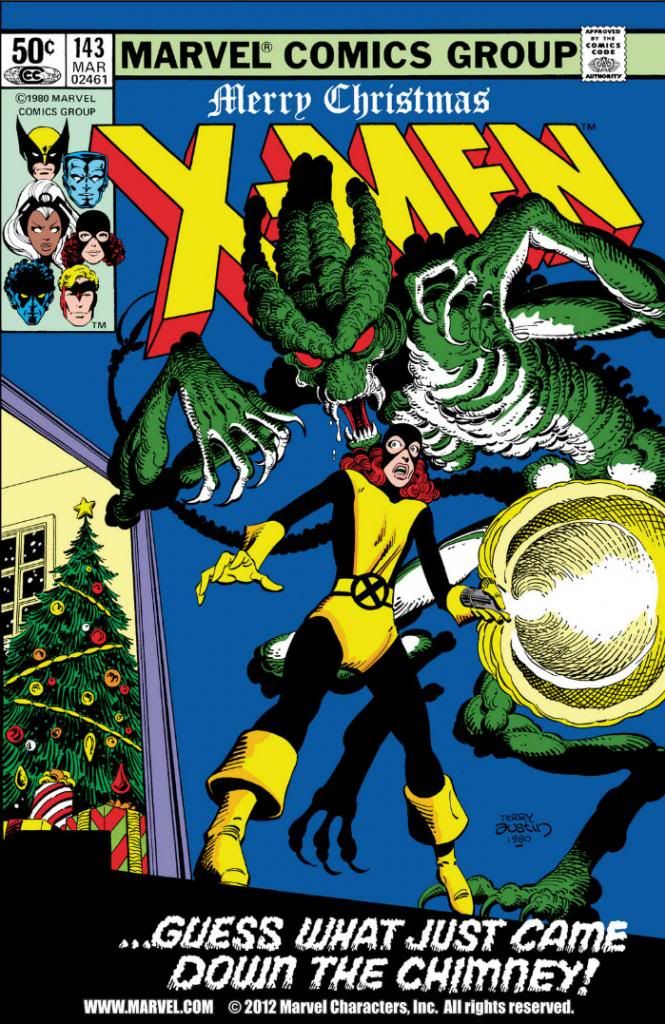
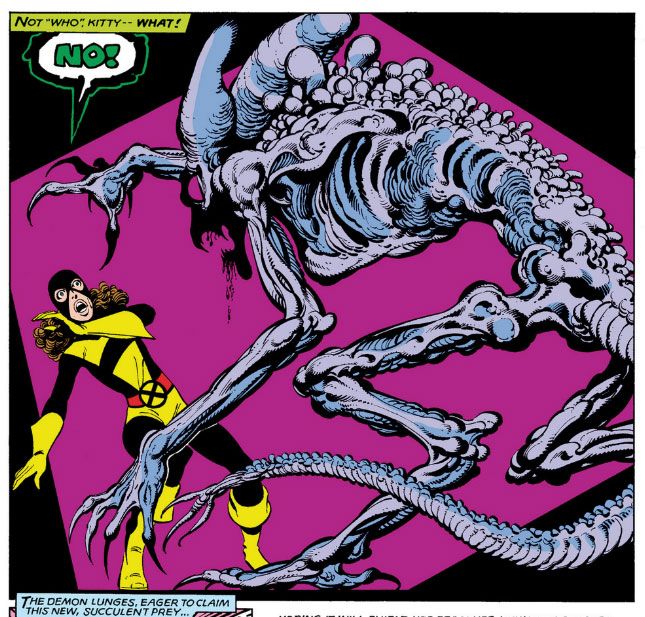
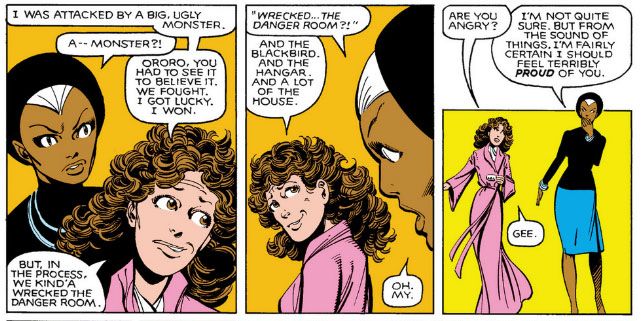
One Christmas Eve the rest of the gang leave her home alone, just like in that fun holiday movie about being left home alone. The title escapes me. Oh yeah-- It's a Wonderful Life. Unknown to everyone but Chris Claremont and John Byrne (those scamps!), it turns the portal to the N'Garai dimension is still slightly ajar. One of them, or a close relative, pops out, having visited Swiss surrealist H.R. Giger for a makeover sometime during the intervening years. The first thing the new, Alien-style N'Garai does is shred an unfortunate couple out poaching a small Christmas tree for their apartment. Then the poor, lost little demon, as lonely and in need of companionship as Kitty, goes looking for a friend. After all, it's no fun to be by yourself during the holidays. Kitty knows this, because this is the first Chanukah she's spent away from home herself. Unfortunately, thanks to various cultural differences, things don't go the way the demon planned. Kitty is less than appreciative of its presence, they don't get along, there's a misunderstanding, a fight and a blast from a white-hot jet engine.
This story, called simply, "Demon," ran in Uncanny X-Men #143 (March 1981) a pretty minor work compared to the galaxy-spanning drama that made up the
recently-concluded "Dark Phoenix Saga," and it lacks the influence of
"Days of Future Past," which took up the previous two issues It's kind of the
Claremont-Byrne team's last little laugh before the team split, and from its title to its monster and most of its plot, it's openly cribbed from Ridley Scott's sci-fi/horror masterpiece. You know, White Squall. Claremont
must have enjoyed using Scott as much as he did H.P. Lovecraft in the prequel to this issue; he'd later re-homage Alien with his Brood creatures,a kind of otherworldly insect species with a
life-cycle that resembles a toned-down version of the Giger creature's.
I don't know if Byrne tried again. He seemed to content himself with
mining Marvel's own history for ideas when he moved over to Fantastic
Four as writer and artist. And tossing in a little Twilight Zone or
Invasion of the Body Snatchers for good measure-- remember that issue
with the town that drank the cow-Skrull milk and turned into evil
shapeshifters? That one was disquieting in a way this one can't quite match.
The monster itself tries its best, but falls a little short because neither Claremont nor Byrne seem particularly interested in it. Their main concern is putting Kitty through her paces and making readers adore her.
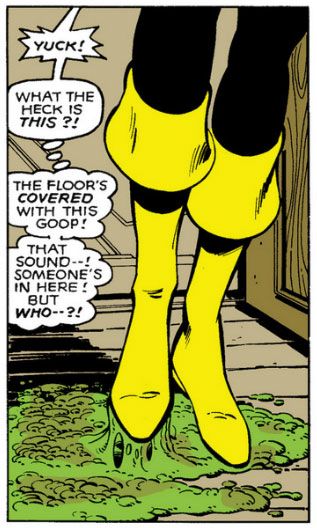
Let's examine our N'Garai for a moment. In X-Men #96, the story makes the point these smaller demons consist of smoke, and Dave Cockrum makes them more bug-eyed. Storm is even able to wave one of them away with her hand. They do, however, sometimes use long spears or lances with which they can stab someone and inflict pain and perhaps drain away life force like Kierrok does with his very presence. Claremont is almost out of pages with no time to explain it fully, and Storm herself only says something about pain and possible death if she's stabbed again. In this issue, the lone N'Garai is definitely made up of solid matter of some kind, albeit demonic, and it uses its claws and teeth on the young marrieds before eating their bodies and their souls. It also leaves Alien slime wherever it goes and crashes through walls. Essentially, it's an unauthorized guest appearance by the movie monster without any of the icky bio-mechanical sexual reproduction connotations.
Confined within the pages of a single issue and the limits of what the Comics Code would approve, the poor beastie doesn't really get to cut loose and terrify us. The chase it inspires is chaotic but not as frightening as it needs to be. Byrne smudges Kity's face and draws some sweat droplets on her brow and Claremont has her tell us through a thought balloon she's scared but "coping," but she comes across as a bit too unflappable throughout most of the comic.
Sigourney Weaver's redoubtable Lt. Ellen Ripley-- for whom Kitty acts as a stand-in and occasionally physically resembles here-- is self-possessed throughout the majority of the film, but frazzles during her frantic escape attempt. Then she just about loses her shit when she discovers she's accidentally taken the alien with her in her little life pod before she pulls herself together. Weaver's iconic performance helps, as she's able to convey both Ripley's palpable fear and her agency simultaneously. This crucial element is missing in Uncanny X-Men #143, despite the tear in Kitty's eye in one close-up. Also, we haven't really seen the demon do a whole lot beyond kill two people-- both taken by surprise and, as civilians, without even Kitty's ghostly phasing powers-- and a room full of plants.
The story comes close to its full Alien-esque horror potential when the creature jumps out at Kitty and slashes through her, causing her pain and the temporary loss of feeling in one arm even though she's in her incorporeal "phase state," and in the hyper-kinetic Danger Room sequence as well, but there's no real feeling Kitty's in serious jeopardy. After all, this entire issue is more or less a love letter to her, so we seriously doubt from the get-go Claremont and Byrne plan to kill off this kid so soon after the start of her comic book career.
So what we're left with is more a puzzle situation, and the interest is in watching how courageous and clever Kitty solves it. Which, I suppose, makes it kind of akin to one of those Quinn Martin detective shows. Barnaby Jones or something. We see the criminal commit the crime right at the outset and instead of a whodunnit, we get a how-solve-it.
Speaking of how Kitty solves things-- well, if you've seen Alien, you know how it all ends. Byrne even borrows heavily from the film's visuals to show it, a kind of acknowledgement of just how baldly he and Claremont are riffing on Scott. To set it up, there's a neat bit of foreshadowing right at the start when we see Professor X teaching Kitty how to start the Blackbird. I find it really fun to see a young hero's education in process, and who would have thought the day's lesson would pay dividends so quickly? This premise-- how superheroes learn to be superheroes within a school setting-- is a lot more interesting to me than the demon/Alien stuff. It's a precursor to The New Mutants and it's almost as if we're watching Claremont inspire himself along those lines, with the genesis of that series appearing right here on these pages.
The weirdly saccharine denouement also foreshadows Claremonts of future past when the team returns to the mansion only to find a tired but otherwise unshaken Kitty sipping hot cocoa in front of the fireplace. That's right-- she has barely escaped death or even worse at the demon's claws, has no way of knowing if this was a one-time event or the harbinger of a full-scale monster invasion, isn't expecting anyone home for hours... and Claremont has her drowsily lounging about in her robe, as if nothing at all out of the ordinary had happened.
Okay, so Kitty's much tougher than I'd ever imagined, and she's recently returned from the future where she watched everyone die, but don't you think almost being killed by a demon warrants some kind of emotional response beyond the slight embarrassment one gets from denting the family car? And even if Kitty is too cool to worry, you'd think the older superheroes who almost died fighting Kierrok and supposedly have years of combat experience would do some kind of reconnaissance or go into a defensive posture on the chance there are more demons or enemies lurking around. They don't even spend much time trying to debrief Kitty. Storm just gives her the concerned mom act. After all the mayhem, it turns out nothing more is at stake here than in any given episode of Facts of Life.
This comes dangerously close to making the whole "spunky teen girl joins the team" aspect insufferable. I guess my tolerance for this stuff was a lot higher when I was Kitty's age. The New Mutants, which came out a mere year or two later, would consist almost entirely of this kind of tonal dissonance, and I ate it up. And still do, but then my outright hero worship-love for Dani Moonstar has always overshadowed my liking of Kitty Pryde. As it is here, everyone's muted reaction further undermines any peril Kitty might have been in earlier in the story and reveals a Claremont a little too in love with his cast. While it's nice to show Kitty as a teen character able to pull herself together and save herself (a trait she's going to need when the team rockets into space or faces down Dracula himself later on), if you're going to take your superhero story the sitcom route, a better, more appropriate gag for the ending would have been the team coming back to find a pumped up Kitty toting around a baseball bat or that M16 rifle Moira MacTaggert used on Kierrok when these demons first appeared.
And one more thing, gosh darn it-- it's really too bad this wasn't set at Halloween.
One Christmas Eve the rest of the gang leave her home alone, just like in that fun holiday movie about being left home alone. The title escapes me. Oh yeah-- It's a Wonderful Life. Unknown to everyone but Chris Claremont and John Byrne (those scamps!), it turns the portal to the N'Garai dimension is still slightly ajar. One of them, or a close relative, pops out, having visited Swiss surrealist H.R. Giger for a makeover sometime during the intervening years. The first thing the new, Alien-style N'Garai does is shred an unfortunate couple out poaching a small Christmas tree for their apartment. Then the poor, lost little demon, as lonely and in need of companionship as Kitty, goes looking for a friend. After all, it's no fun to be by yourself during the holidays. Kitty knows this, because this is the first Chanukah she's spent away from home herself. Unfortunately, thanks to various cultural differences, things don't go the way the demon planned. Kitty is less than appreciative of its presence, they don't get along, there's a misunderstanding, a fight and a blast from a white-hot jet engine.
The monster itself tries its best, but falls a little short because neither Claremont nor Byrne seem particularly interested in it. Their main concern is putting Kitty through her paces and making readers adore her.
Let's examine our N'Garai for a moment. In X-Men #96, the story makes the point these smaller demons consist of smoke, and Dave Cockrum makes them more bug-eyed. Storm is even able to wave one of them away with her hand. They do, however, sometimes use long spears or lances with which they can stab someone and inflict pain and perhaps drain away life force like Kierrok does with his very presence. Claremont is almost out of pages with no time to explain it fully, and Storm herself only says something about pain and possible death if she's stabbed again. In this issue, the lone N'Garai is definitely made up of solid matter of some kind, albeit demonic, and it uses its claws and teeth on the young marrieds before eating their bodies and their souls. It also leaves Alien slime wherever it goes and crashes through walls. Essentially, it's an unauthorized guest appearance by the movie monster without any of the icky bio-mechanical sexual reproduction connotations.
Confined within the pages of a single issue and the limits of what the Comics Code would approve, the poor beastie doesn't really get to cut loose and terrify us. The chase it inspires is chaotic but not as frightening as it needs to be. Byrne smudges Kity's face and draws some sweat droplets on her brow and Claremont has her tell us through a thought balloon she's scared but "coping," but she comes across as a bit too unflappable throughout most of the comic.
Sigourney Weaver's redoubtable Lt. Ellen Ripley-- for whom Kitty acts as a stand-in and occasionally physically resembles here-- is self-possessed throughout the majority of the film, but frazzles during her frantic escape attempt. Then she just about loses her shit when she discovers she's accidentally taken the alien with her in her little life pod before she pulls herself together. Weaver's iconic performance helps, as she's able to convey both Ripley's palpable fear and her agency simultaneously. This crucial element is missing in Uncanny X-Men #143, despite the tear in Kitty's eye in one close-up. Also, we haven't really seen the demon do a whole lot beyond kill two people-- both taken by surprise and, as civilians, without even Kitty's ghostly phasing powers-- and a room full of plants.
The story comes close to its full Alien-esque horror potential when the creature jumps out at Kitty and slashes through her, causing her pain and the temporary loss of feeling in one arm even though she's in her incorporeal "phase state," and in the hyper-kinetic Danger Room sequence as well, but there's no real feeling Kitty's in serious jeopardy. After all, this entire issue is more or less a love letter to her, so we seriously doubt from the get-go Claremont and Byrne plan to kill off this kid so soon after the start of her comic book career.
So what we're left with is more a puzzle situation, and the interest is in watching how courageous and clever Kitty solves it. Which, I suppose, makes it kind of akin to one of those Quinn Martin detective shows. Barnaby Jones or something. We see the criminal commit the crime right at the outset and instead of a whodunnit, we get a how-solve-it.
Speaking of how Kitty solves things-- well, if you've seen Alien, you know how it all ends. Byrne even borrows heavily from the film's visuals to show it, a kind of acknowledgement of just how baldly he and Claremont are riffing on Scott. To set it up, there's a neat bit of foreshadowing right at the start when we see Professor X teaching Kitty how to start the Blackbird. I find it really fun to see a young hero's education in process, and who would have thought the day's lesson would pay dividends so quickly? This premise-- how superheroes learn to be superheroes within a school setting-- is a lot more interesting to me than the demon/Alien stuff. It's a precursor to The New Mutants and it's almost as if we're watching Claremont inspire himself along those lines, with the genesis of that series appearing right here on these pages.
The weirdly saccharine denouement also foreshadows Claremonts of future past when the team returns to the mansion only to find a tired but otherwise unshaken Kitty sipping hot cocoa in front of the fireplace. That's right-- she has barely escaped death or even worse at the demon's claws, has no way of knowing if this was a one-time event or the harbinger of a full-scale monster invasion, isn't expecting anyone home for hours... and Claremont has her drowsily lounging about in her robe, as if nothing at all out of the ordinary had happened.
Okay, so Kitty's much tougher than I'd ever imagined, and she's recently returned from the future where she watched everyone die, but don't you think almost being killed by a demon warrants some kind of emotional response beyond the slight embarrassment one gets from denting the family car? And even if Kitty is too cool to worry, you'd think the older superheroes who almost died fighting Kierrok and supposedly have years of combat experience would do some kind of reconnaissance or go into a defensive posture on the chance there are more demons or enemies lurking around. They don't even spend much time trying to debrief Kitty. Storm just gives her the concerned mom act. After all the mayhem, it turns out nothing more is at stake here than in any given episode of Facts of Life.
This comes dangerously close to making the whole "spunky teen girl joins the team" aspect insufferable. I guess my tolerance for this stuff was a lot higher when I was Kitty's age. The New Mutants, which came out a mere year or two later, would consist almost entirely of this kind of tonal dissonance, and I ate it up. And still do, but then my outright hero worship-love for Dani Moonstar has always overshadowed my liking of Kitty Pryde. As it is here, everyone's muted reaction further undermines any peril Kitty might have been in earlier in the story and reveals a Claremont a little too in love with his cast. While it's nice to show Kitty as a teen character able to pull herself together and save herself (a trait she's going to need when the team rockets into space or faces down Dracula himself later on), if you're going to take your superhero story the sitcom route, a better, more appropriate gag for the ending would have been the team coming back to find a pumped up Kitty toting around a baseball bat or that M16 rifle Moira MacTaggert used on Kierrok when these demons first appeared.
And one more thing, gosh darn it-- it's really too bad this wasn't set at Halloween.
Labels:
Alien,
Chris Claremont,
H.R. Giger,
Halloween,
John Byrne,
Kitty Pryde,
Marvel Comics,
N'Garai,
Ridley Scott,
Spookey,
vintage comics,
X-Men
Monday, October 7, 2013
October is Spookey Month: Uncle Creepy meets (and possibly eats) the NBC peacock... in color! (Part One)
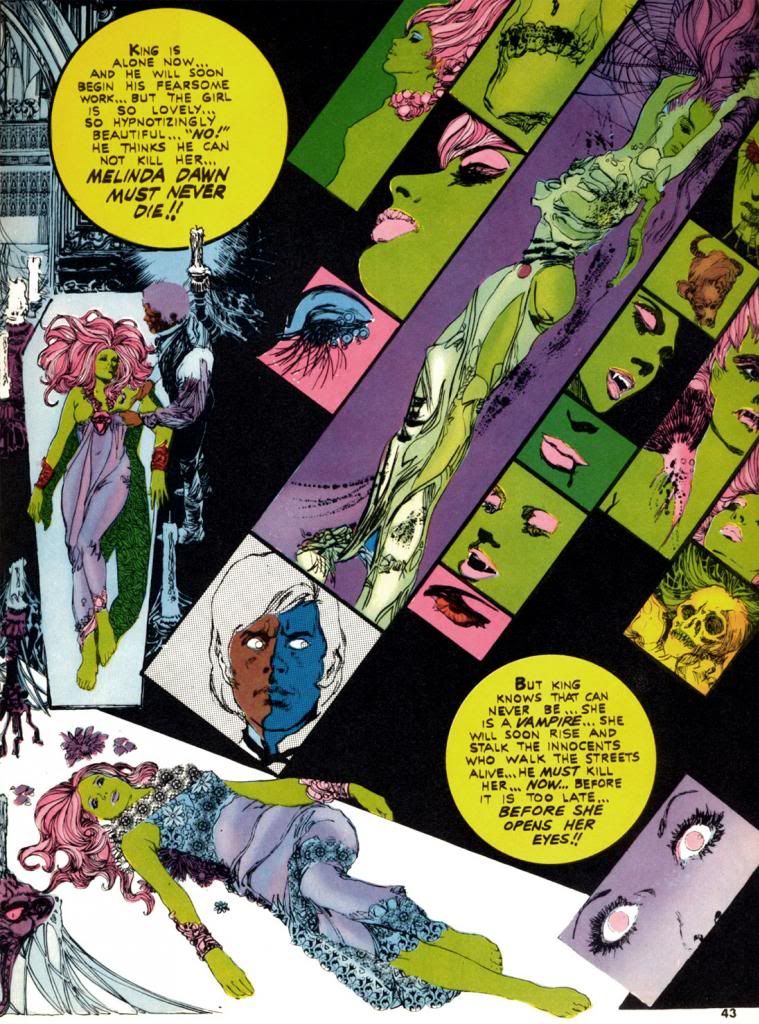
I don't know how or why this went down, but in 1973, when William DuBay went from art director to managing editor on Warren's Creepy magazine, he introduced full-color comics to its formerly black and white pages. Creepy had already featured spot color on the inside front and back covers, but this was to be the real four-color deal, trumpeted by house ad copy as "full spectrum" color.
Why end the streak of consecutive black and white issues? Maybe it had something to do with the company's big roll-out of Dracula, the "horror art magazine," which would feature color (and that's the extent of my Dracula knowledge). Or DuBay just wanted to freshen up the décor inside Creepy manor, the structure of which had already been under renovation by a group of highly-talented Spanish artists and our old friend Richard Corben. Or maybe he needed to goose sales in the face of competition from Marvel-- the House of Idea released six magazines that year, five of which were horror, a direct challenge to Warren-- and CarToons.
Whatever DuBay's reason (and in the interest of full disclosure, I actually don't even care why he did this; I just love these comics for simply existing in the first place), Esteban Maroto provides "Viyi," five pages of story and art in Creepy #51 (March 1973), DuBay's second issue as editor. Here, Maroto puts one of his Brigitte Bardot-like females on display, and she's a livid green. Amazingly, it suits her. Maroto also wrote the story, but for Creepy's purposes "Viyi" amounts to a glorified house ad for Dracula. We don't get the complete tale, just a couple of teaser pages telling us all about the new magazine. The colors in "Viyi" are more subjective than representational and suit Maroto's gorgeous, emotionally-charged linework. It certainly looks nothing like the monthly four-color superhero fare showing up on the spinner racks. It hardly resembles the Creepy we'd come to know and love. Perhaps that was the whole point.
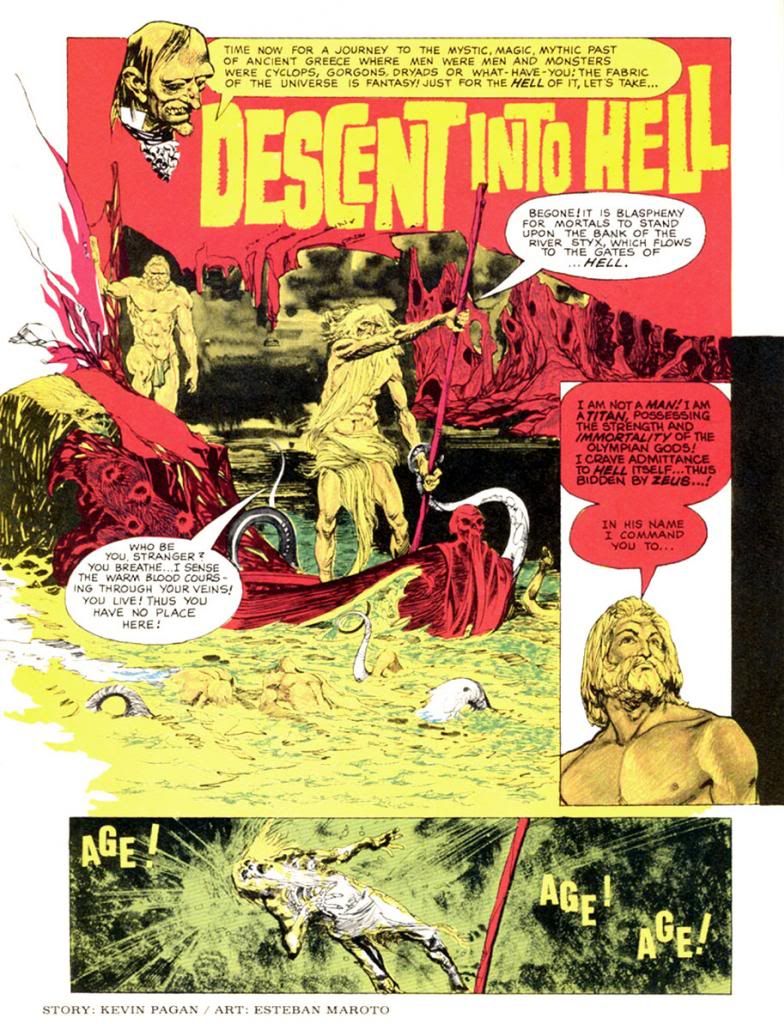
The next color story, "Descent Into Hell," again by Maroto, ran in Creepy #54 (July 1973), which also features Corben's infamous "Slipped Mickey Click-Flip." Only a black and white story as outrageous as that could hope to compete with Maroto's journey straight to hell in lurids red and yellows. And some blues. By then the company must have been jazzed about where this was headed because the cover copy fairly screams, "Now! Full Color Comics!" The next issue consists entirely of black and white reprints but does toss in a neat-o full color board game with movement squares made up of a number of the magazine's classic cover paintings. The credit for it reads, "Game conceived by: Bill DuBay."
I'm beginning to sense a pattern here...
Corben finally gets his chance to produce some color pages in Creepy #56 (October 1973), where we find his classic "Lycanklutz." A few issues before this a reader wrote in to complain that horror and comedy don't mix, but I beg to differ. Corben's story of a flea-plagued werewolf is not only beautifully drawn, it's absolutely hilarious. It's full of winking references to Universal Studios' Wolf Man movies and some anachronistic humor that anticipates The Princess Bride over a decade later. Corben's palette is more naturalistic than Maroto's. Modeled and painterly as opposed to flat and graphic. Very different looks, but both please me immensely.
Corben strikes again in #57 (November 1973), this time partnered with write Doug Moench for a story seemingly inspired by the title of Traffic's 1971 album, which zoomed to #7 on the Billboard pop chart. Do you think Moench owned a copy? Maybe? Whatever the title's source, "The Low Spark of High Heeled Noise" kind of strains to make its pun work, but ends up a grisly, effective murder in an old house tale. Corben's color palette is more idiosyncratic this time out as he experiments with complementary color schemes in the blue/violet-yellow/orange areas of our ever-helpful color wheel. I write "experiment," but I'm pretty sure the guy knew exactly what he was doing. I'm not too conversant on what was happening in color magazines around this time, but compared to the still-primitive color printing in typical monthlies this is incredibly sophisticated stuff from color choice to use of subtle gradations in tone. This wasn't possible in standard news-rack comics in 1973 and it shows Corben's mastery of color reproduction and effects.
Color takes a break until the Christmas-themed #59 (January 1974). This time DuBay himself writes for Corben and they come up with a holiday story split between two perspectives that come together for a tragic finale. It's both gruesome and sentimental, no small trick. In this story, Corben employs a restrained, naturalistic palette for a timeless look. Kind of like one of those Coca-Cola Santa paintings. Or Norman Rockwell suffering a psychotic episode. In #60 (February 1974), Corben teams with Steve Skeates for a story that seems somewhat inspired by the artist's own "Den." It's a disquieting tale of a squeamish kid who finds a magic rock, turns into some kind of space-barbarian ape on another planet, then comes to a rather pathetic end. Poor little guy. More relatively restrained colors on display here in the early going, with some sweet autumnal atmospherics on the first page giving way to otherworldly hues during the fantasy sequence.
In #61 (April 1974), Corben provides his own script again for another comedy-horror turn. This time, it's "Terror Tomb," with a character named Hardoff Bey and a clumsy mummy tripping the lunkheaded human cast to their doom. Corben's dispensing of these dopes that way provides a nice chuckle amongst the more nihilistic horrors of the surrounding stories. If I have one complaint about the guy's work, it's every so often there's a panel so packed with dialogue the balloon obscures most of a face, squeezing the art into a tiny corner.
You may be starting to notice a theme here as Richard Corben really makes the most of the opportunities DuBay provides for him, as we'll see in part two of this epic, rambling and altogether pointless overview. My favorite of the whole bunch is coming up!
Sunday, October 6, 2013
October is Spookey Month: Uncanny X-Men #96 in which the X-Men meet H.P. Lovecraft or a version thereof...
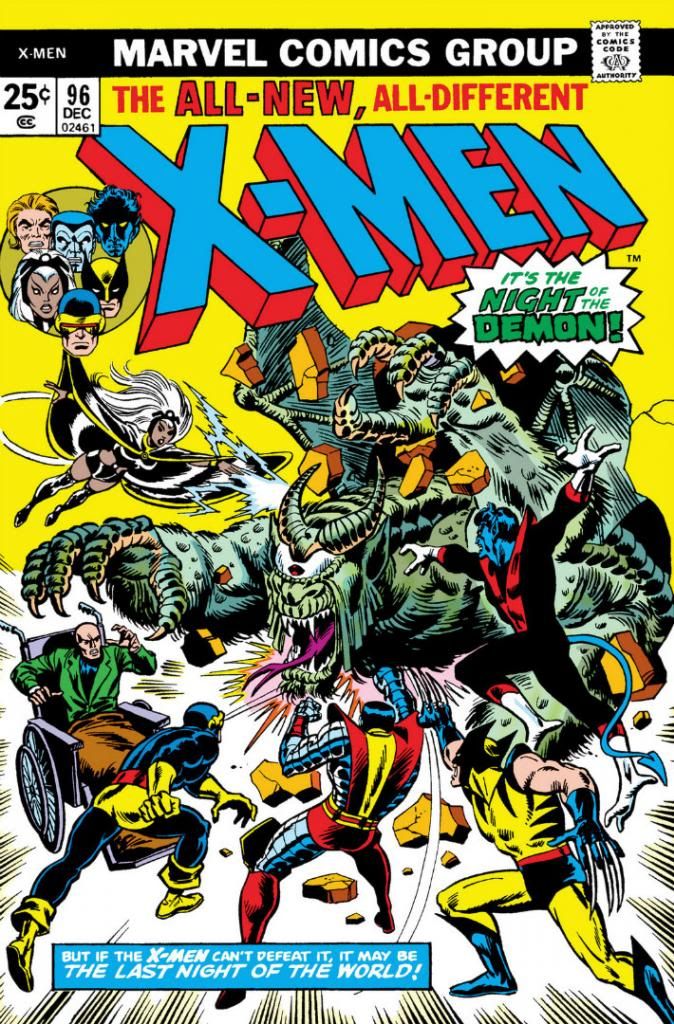
What is your favorite Halloween fright creature? Is it the ever-popular vampire? The werewolf? The ghost? The demon? How about the demon who's a riff on H.P. Lovecraft's whole "Old Ones" mythology? I can't even pretend to understand Marvel's cosmology or theology, but if we're to believe "Night of the Demon" from X-Men #96 (December 1976), we are dealing with a universe where Lovecraftian analogues co-exist with gods and demi gods from just about every religion past and present alongside science both ordinary and extraordinary.
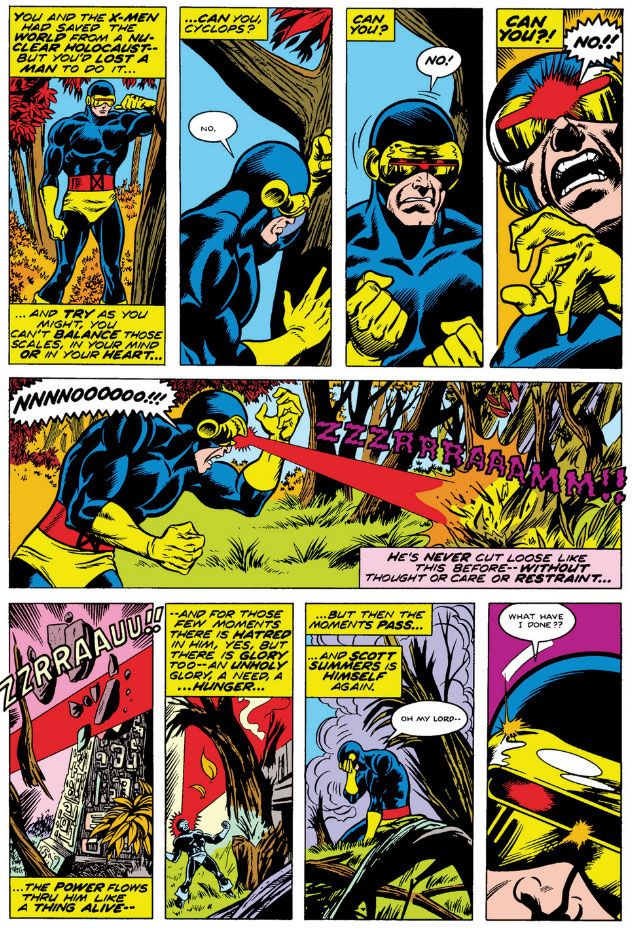
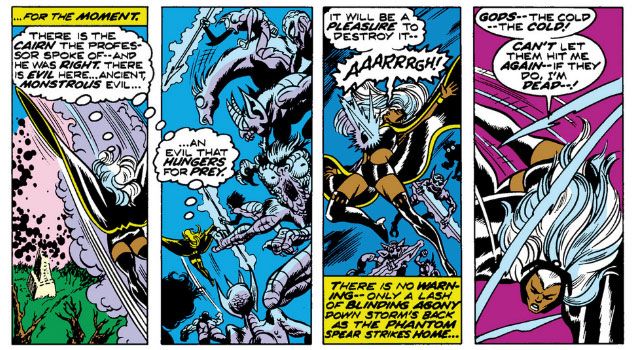
Our story opens on a lovely fall day with text-heavy narrative captions floating in the air. This is a seasonal tradition in upstate New York, from what I understand. They do help Chris Claremont establish mood, and the first couple of pages are all about mood. Guilty over his role in teammate Thunderbird's death in the previous issue, Cyclops broods alone in the woods near the X-Mansion. The setting proves aptly symbolic: the recently deceased Thunderbird and the crunchy leaves combine to produce not a winter but an autumn in Cyclops' soul. Also, it's September, which is close enough to Halloween for our purposes. Penciller Dave Cockrum and inker Sam Grainger conjure up a tasty forest setting, aided by a crackerjack coloring job by Phil Rachelson. You can almost hear the wind through those crisp red and orange leaves and feel the dry air. Then Claremont taunts poor Cyclops so much, the man loses control of his optic blasts. Cyclops accidentally decapitates an ancient obelisk-shaped cairn with indecipherable hieroglyphics carved on its sides.
This suave move-- I'm wondering how far Cyclops' eye-blasts travel before their energy or force dissipates enough to be harmless to anyone unlucky enough to be caught by one of his indiscriminate outbursts-- frees a demon from a type called "N'Garai" (Claremont was always fond of apostrophes in his monster/demon/alien species names).
The cairn itself is kind of an oddball element. Sure, Claremont has to introduce this issue's enemy somehow. It's just hard to suspend disbelief such a spectacular artifact would be undiscovered so close to the X-Mansion. There must be county roads or even an interstate or something similar running nearby, too. Plus, this thing is supposed to be thousands of years old. You can't tell me a hunter, hiker, birdwatcher or Cub Scout pack hasn't stumbled across it before now, with a horde of archaeologists following soon after. And to have Cyclops blast it open at random stretches belief to the breaking point, even for a book where we have a blue-furred teleporter running around. But it's in the story, and we all know the gang at Marvel was simply working from reports submitted by the actual superheroes they published comics about, so it must have happened in exactly this way.
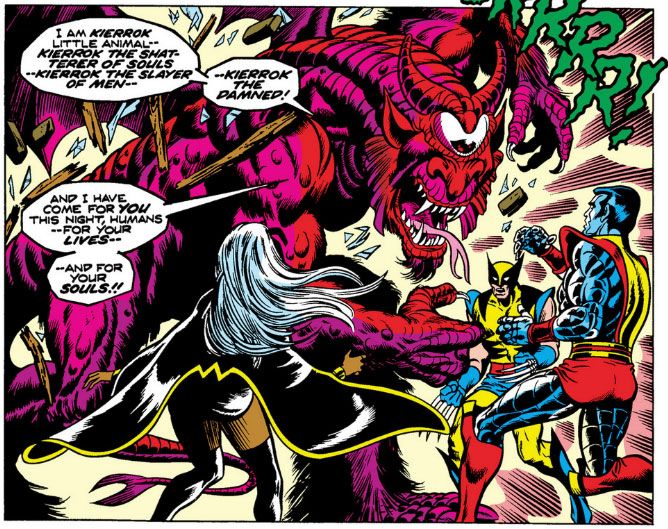
The boss N'Garai is a bat-winged, shaggy, one-eyed dude named Kierrok, and he burst through the mansion's wall like the Kool-Aid Man on a PCP rampage. As a bit of side trivia, his name is an in-joke because he's portrayed by none other than William Shatner himself in a spectacular costume of someone's design.
Someone? I can't say who gets credit as creature-creator here. Marie Severin and Sal Buscema drew the rather hectic cover instead of Cockrum, and no one has ever told me why. I read in Comic Book Artist magazine many years ago how Stan Lee used to demand all monstrous enemies be humanoid in appearance to the point where he had Severin re-pencil a dog-like beastie originally drawn by Neal Adams, even if it meant the stupid thing was too big even to stand upright thanks the confines of the page layout. There may have been a similar situation here, with editorial deciding not to use Cockrum's original design because it didn't fit the Marvel anthro-centric standard. As you can see, there's also a slight continuity mistake thanks to the cover/interior art duties split. On the cover, Kierrok is mean and green and pretty far between, but in the story he's kind of reddish or magenta.
Whoever designed him and whatever his color, inside the book Cockrum makes damned sure this nutty Kierrok creature can not only stand on a couple of muscular legs, but also flail about. Kierrok tosses the heroes around like a big brother lumbering into a little kids' pretend wrestling match. He also drains their powers and makes Wolverine frown as if he's an offended Sunday School teacher out of some Mark Twain book. Tom Sawyer, perhaps. What I love about Kierrok isn't so much that he gives the X-Men all sorts of trouble, but the way he insists in perfect English he's not likely to suffer defeat. He's like a three-way cross between the Mugatu from Shatner's cult-fave series Star Trek, one of those body-suit Muppets and an enraged pro wrestler in an after-match interview.
As far as I can tell, this is where Claremont starts making his reputation for writing strong women (mostly justified, with caveats extensively covered elsewhere), because Storm comes into her own in this issue. While the X-Men first attempt to deal with Kierrok one at a time-- which really makes their team training exercises seem useless or Cyclops even a worse leader than he thinks he is-- it takes Storm to shut the magic gateway between our world and wherever it is the N'Garai come from. While Storm braves the demon hordes alone and also fights off a flashback to her childhood, the male X-Men apparently huddle around Professor X and pray for salvation.
Oh yeah, dig those crazy demons. They look like something out of Disney's "Night on Bald Mountain" Fantasia sequence. Cockrum keeps the mayhem contained within some tight, narrow panels that emphasize Storm's ever-growing claustrophobia.
We all know Wally Wood and Gil Kane influenced Cockrum's art. Well, there's one panel that I swear looks like Cockrum and Grainger channel a little Kane. Maybe it's Cockrum's choice of camera angles and Storm's clutching hand, both of which are very Gil Kane-like, or the way Grainger inks the demon's scaly texture and Storm's face. On the other hand, the rest of the drawing elements seem less like Kane, like the double lines on Storm's knuckles and the hatching on the demon's bicep and under Storm's arm. If Cockrum had chosen a full-figure pose for Storm and the cairn below her in the background, we could blow this image up into a pretty cool cover for this issue.
At this point-- because we only have about a page left before the comic ends-- Storm shrugs off the smoke demons and puts the finishing touch on the events courtesy of a huge lightning bolt. And so concludes an action-packed one-off that falls one Innsmouth denizen shy of being a full-blown "Cthulhu Mythos" tale.
Claremont and Bill Mantlo share plot credit here, so it's difficult to know who came up with all these events. The overall characterization and quick flashback to Storm's childhood scream Claremont, but the way Kierrok lumbers into the story without any foreshadowing or much of a set-up is generic comic book stuff that could be by anybody. I don't know if Mantlo had a Lovecraft fixation-- I can't find much evidence of it in his Micronauts work-- but if you've read Giant Size Dracula #2 (September 1974), you've already encountered Claremont's appropriation of Lovecraftian elements. That story pits our favorite vampire against a cult led by an Elder God-worshipping demon or warlock or warlock-demon named... wait for it... Y'Garon.
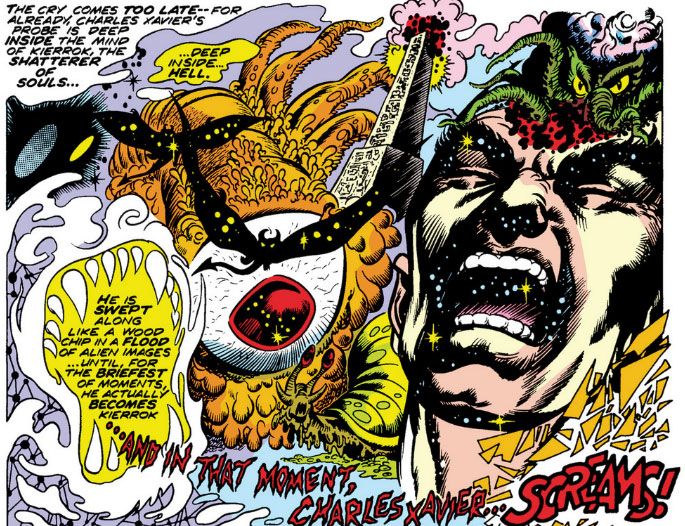
This isn't a criticism by any means. After all, just about everyone working in creepy genre fiction, film or art cribs from Lovecraft at some point. Robert E. Howard, Robert Bloch, Stephen King, H.R. Giger, Sam Raimi, Mike Mignola (who does it best, as far as I'm concerned), Frank Sinatra (remember his his hit song, "Fly Me to Yuggoth?"), Tony Bennett, Alan Alda. I've read Lovecraft's stories dozens of times and enjoy them, but to paraphrase Kurt Vonnegut, "If only he could write!" Claremont's writing might have some cloying tendencies at times (especially in his post-John Byrne Uncanny X-Men era), but even at his wordiest he's never as awkward as Lovecraft and his rhythms and modern vernacular are much more appealing. Mix the two writers together and you get Professor X doing a mindmeld and falling straight into the Necronomicon.
Yep. Ph'nglui mglw'nafh Cthulhu R'lyeh wgah'nagl fhtagn! Eyeballs, tentacles, winged creatures that fly through the void between planets, geometries unknown on earth. That's Lovecraft all over, but "... and in that moment, Charles Xavier... screams!" is pure Chris Claremont.
We're not through with the N'Garai by any means. They make a reappearance a few years later in a story that borrows even more heavily from a more contemporaneous horror source, this time a little movie called Alien. We'll discuss that in our next installment.
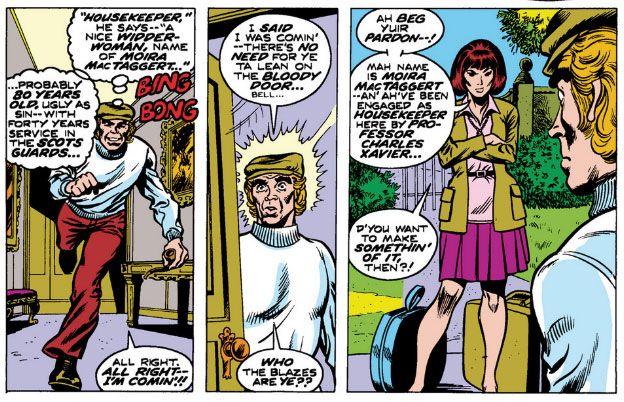
Now I'll share with you my favorite part of this comic. It has to do with yet another of those strong women, for this is also the issue that introduces Professor X associate Moira MacTaggert, who will play an increasingly important role in stories to come.
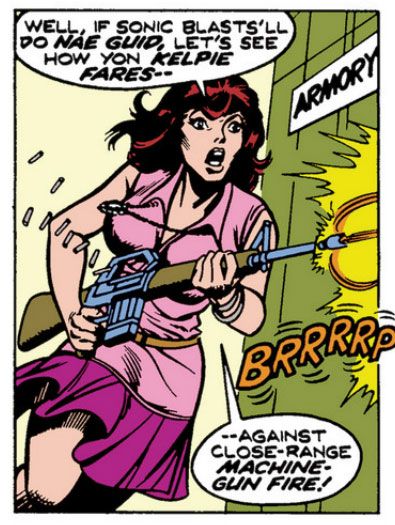
That's some advanced Irish-Scottish stereotype-speak, Marvel-style! All that's lacking is an argument about whether or not leprechauns eat haggis. She may not have powers, but does Dr. MacTaggart have the toughness to hang with the X-Men? Check this out:
She does what none of those highly-trained military dudes at our Valhalla Mountain NORAD command could manage in X-Men #94, firing from the hip, no less! And all at once we have an exciting addition to the cast and we know never to mess with her.
Tuesday, October 1, 2013
October is Spookey Month... again!
And that means horror, horror and more horror here at When Comic Books Ruled the Earth. Also, I might write something about horror comics. First up is what I plan as a multi-part look at Creepy's color comics. That means some Esteban Maroto, a bit of Bernie Wrightson and a whole lotta Richard Corben. Corben practically owned the color pages in Creepy. Then, for a change of pace, we're going to take a look at Sugar and Spike's Halloween-themed covers. I love Halloween-themed covers in general and Sugar and Spike's in specific, even though I have to admit I've read exactly one Sugar and Spike story in my life and it had nothing to do with Halloween.
About Spookey-- they're an all-girl "bubblegum-garage-power-pop-punk" trio from my hometown here in Japan. A few years back, I wanted to do a Halloween-themed month of my own across all my blogs and they seemed like the perfect hook. Their music is upbeat and energetic, and they even did a Halloween-themed live performance, which is immortalized on YouTube and linked here numerous times. I think of October as the most fun of months and Halloween as the most fun of holidays, so linking the whole thing to the most fun of local bands seemed like the most fun thing to do. It's been a while since Spookey put out any new music, but you should check them out anyway. Do a Google search. If you can find their last CD release, by all means buy it.
Subscribe to:
Posts (Atom)