Saturday, November 9, 2013

Fantastic Four Annual #3: Stan and Jack can't catch a break

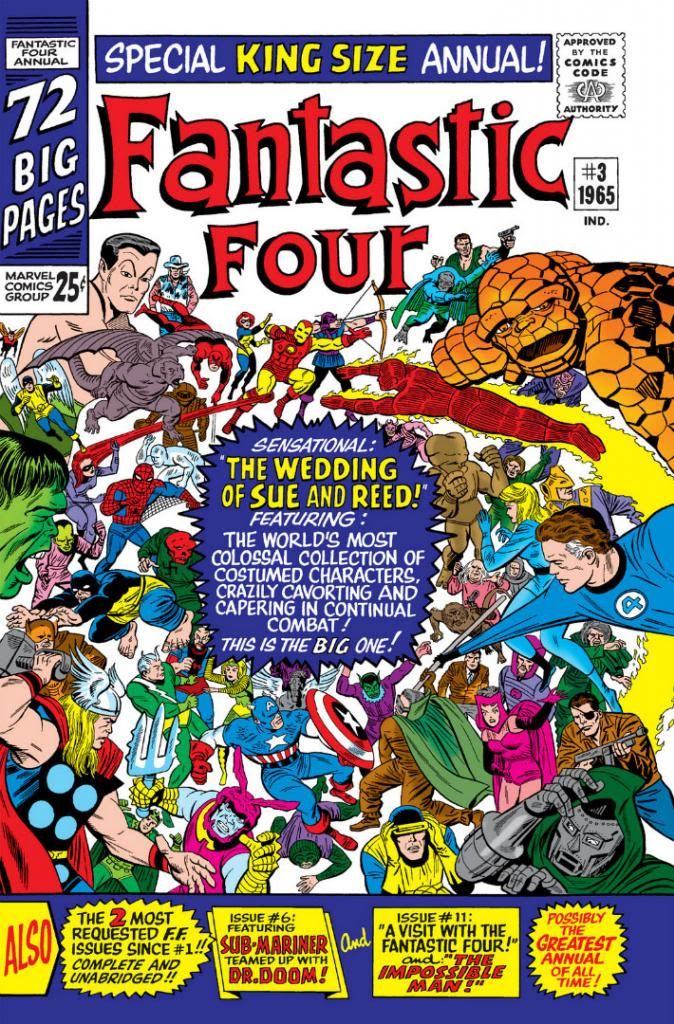
I've always felt ambivalent about annuals.  The best are the ones where the regular creatives use the extra room to tell an epic story that's either too large an idea for an ordinary issue or else climaxes a storyline, or someone you've wanted to see handle the characters shows up to write or draw the book.  The worst are when some ill-suited guest team butts in with crap that's essentially filler or else it's simply part of a storyline from some other book.  Back in the 1960s, the gang at Marvel really knew how to put together an annual, although Fantastic Four Annual #3 (October 1965) consists of a regular-length story and some "most requested" reprints.  It's just the main story is nothing less than the long-awaited wedding of Reed Richards and Sue Storm.

And lemme tell ya, brothers and sisters, everyone who is everyone shows up and it is fun, fun, fun from panel one!  Captain America, Thor, Iron Man, Spider-Man, Daredevil, Dr. Strange and all the X-Men, plus Patsy and Hedy, (at least rumor has it) Millie the Model and possibly Irving Forbush headline a stellar guest list, with Nick Fury and SHIELD providing security.  The only problem is, with such a major event there are bound to be crashers.  The Puppet Master, the Red Ghost and his apes, Mole Man and the Super-Skrull all cause problems, because Dr. Doom himself has some kind of crazy emotion ray controlling their minds.

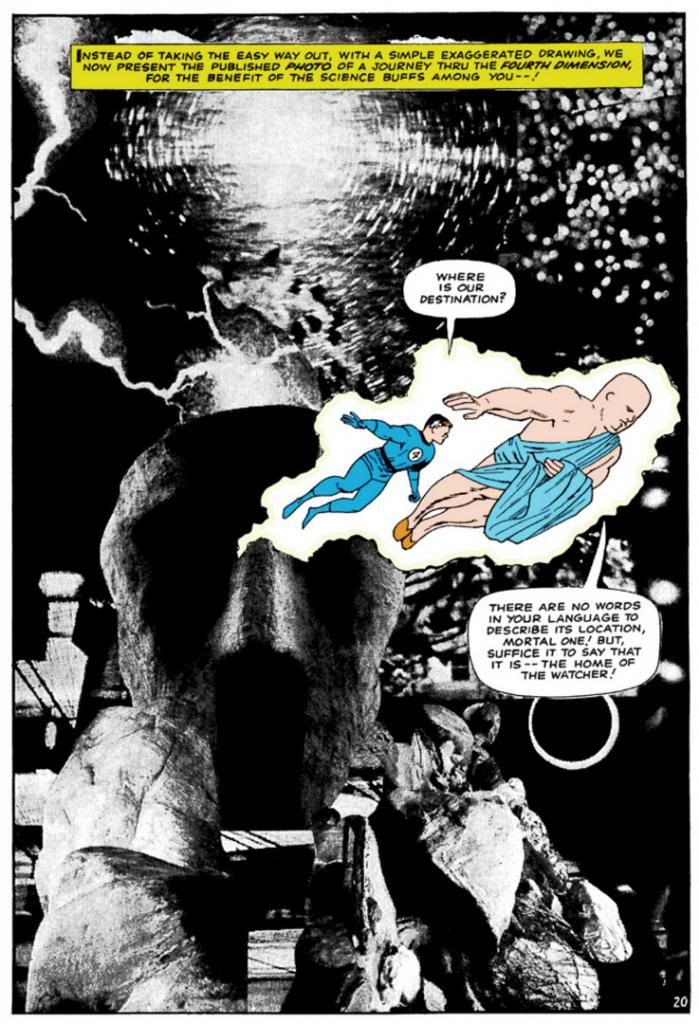
The heroes prove capable of handling the initial wave, but more and more villains attack so we get the like of the Mandarin and Hydra plus a lot of other clowns whose names escape me barging in and smashing up the place (kind of like Owen Wilson's mescaline-addled Eli Cash in The Royal Tenenbaums only without the death of a single Buckley), giving Fury a raging headache.  When Attuma and his Atlantean armies emerge from the harbor (Doom meant to call Namor, but the King himself was on some deeper quest according to Stan Lee's little editor's note; he also tells us why the Hulk isn't there) and Richards puzzles out what's behind it all, even the Watcher has to take a hand.  He takes Richards on a dazzling yet possibly superfluous trip through the "fourth dimension" (isn't that time?) to retrieve a device that beams all the baddies backwards in time to a moment where they would forget the whole thing happened.

Kirby uses one of his patented collages to depict the dimensional trip and we have to take a moment to gaze upon its wonders.


And here's that aforementioned device in action.
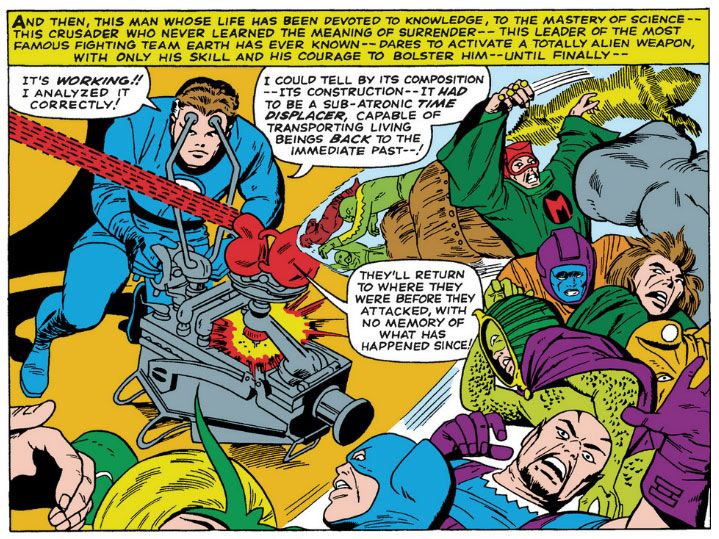

My god, Reed Richards is so smart, he could tell just by looking at it what it is and what it's used for!  I'm looking at it and all I can think is maybe I could use it to project transparencies onto some kind of fabric screen or perhaps even the wall itself as a visual aid for one of my classes.

This panel sums up the whole of the rather jangled plot, which is almost entirely given over to fight scenes, as you can imagine.  Kirby's on fire with some incredibly energetic poses as he presents practically an encyclopedia of Marvel's contemporaneous characters and we get a lot of villainous monologues and heroic wise-cracks from Lee.  Vince Colletta's inks are typically scratchy and rushed-looking, but I also recognize the herculean task faced by the art team here in working with this many characters on deadline.  They're serviceable finishes and a few odd figures and faces actually have a becoming elegance (others look kinda haphazardly slapped together), but certainly this book would have looked slicker with Chic Stone doing the honors, or Joe Sinnott.  Then again, Reed and Sue might have had to delay their ceremony another year or two waiting for this issue.

Another thing to consider is we're looking at restored art here.  I'm not sure what process Marvel puts their back catalog through to produce these color reprints, but I doubt they used the original inked pages or old separations (if any of that still exists).  I'm guessing they cleaned up some stats or decent-quality printed books as best they could,  retouched things here and there but said, "Eh, good enough" at the loss of finer lines after the digital coloring.  And these lines look like they were thin enough to begin with.

On with the wedding!  Here comes the--

Stop the music!  Stop the music!  Hold the sub-atronic time displacer!  What's this?  Two more wedding crashers?
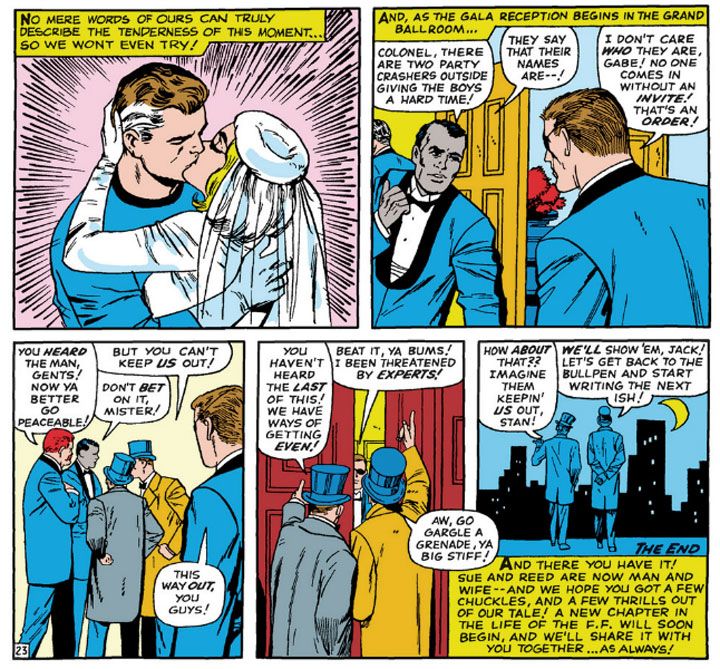

In the immortal words of a certain bashful, blue-eyed boy, "Wotta revoltin' development!"

Monday, November 4, 2013

Nick Cardy 1920-2013

I'm really into Nick Cardy's art.  He's one of those "I wish I drew like him" guys.  He turned pro as a teen, served in WWII, came home to the US and went back to drawing.  I haven't read any of his Aquaman books, but his Teen Titans work has made that one of my all-time favorite books and propelled him into the top tier of my comic art pantheon.  It's a joy to look at Cardy's Titans, either in color on Comixology or in B&W in one of the two Showcase Presents volumes.

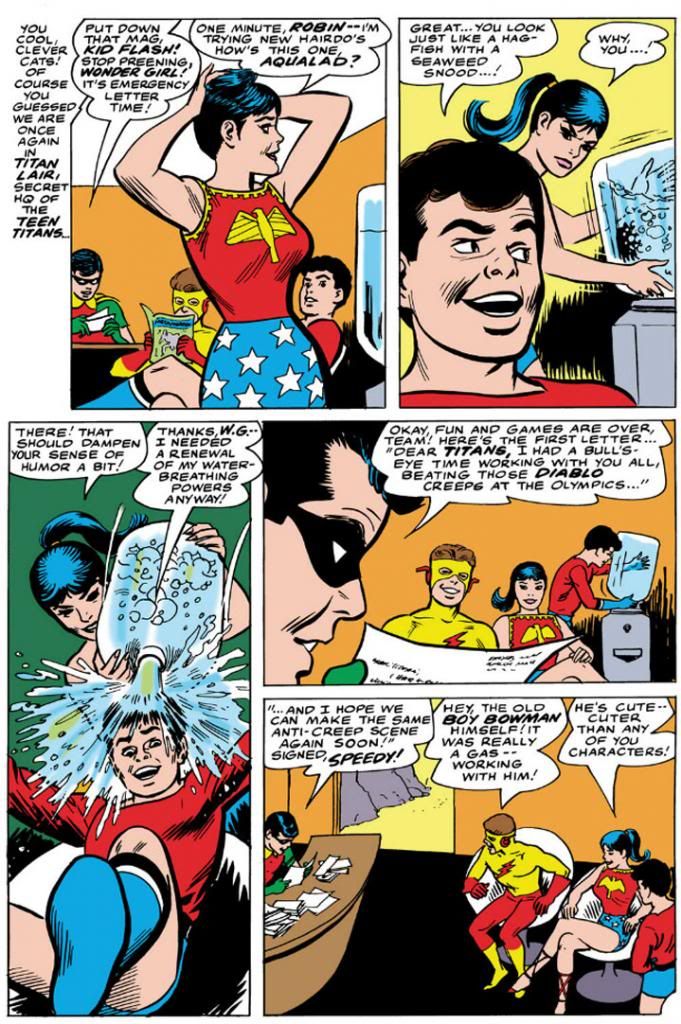
Cardy could draw anything.  Giant conquistador statues walking around, jalopies, hot rods, "Big Daddy" Ed Roth, the Tokyo Olympics, go-go dancers, teenaged cavepeople, outer space, you name it.  His Teen Titans issues are just full of that elusive element we call "appeal."  There's something bright and optimistic about it and if you spend an afternoon immersed in Cardy's Teen Titans art (and digging on Bob Haney's wild and woolly socially-aware plots), it will lift your mood.

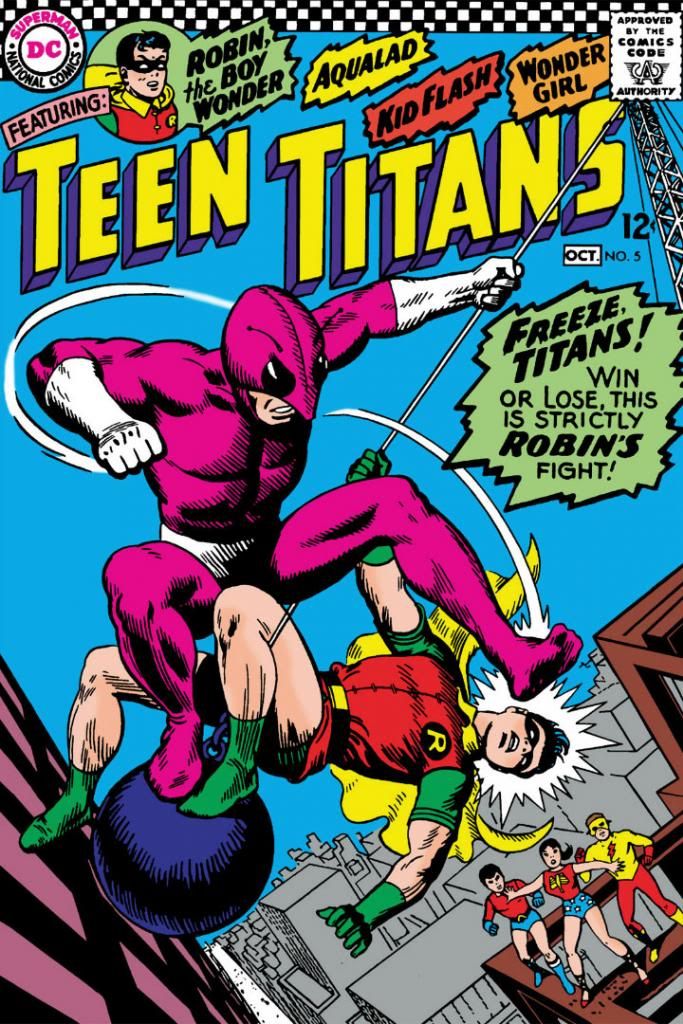
Cardy excelled at facial expressions (there's a lot of Norman Rockwell in his work at times), bodies in motion and this characteristic style of ink feathering that's loose sometimes to the point of being curvilinear zig-zags that follow the exterior contour lines at times and at others are parallel to them (see this the cover to Teen Titans #5 right here), or diagonal to them or almost perpendicular.  However Cardy did it, these touches create a distinct sense of roundness-- as if the curved surfaces of a body are falling away into shadow-- that's unique to Cardy's work.  Sometimes he'd do just a series of diagonal single hatch mark lines, but I've never seen anyone else do the zig-zag thing as successfully as Cardy.  Whenever I see that, I'm pretty sure I'm looking at Nick Cardy art, self-inked or on someone else's pencils.  Sometimes tight, sometimes loose, always beautiful.

And then there are all those covers.  What a sense of drama and design!  And masterful control of eye movement.  Teen Titans #5 (October 1966, by the way), the two foreground figures swing at you on that wrecking ball thanks to the sweet tilting action and then you go from the logo to the Ant's head, then follow the arc of movement down his leg to Robin's face, which points us as the background element of his teammates as they watch in dismay.  Robin's going to die!  An entire story in one image.  No wonder he moved on to doing movie ad work.

Nick Cardy drew the sunniest, sassiest Wonder Girl, too.

Teen Titans #5 (October 1966), Writer: Bob Haney/Pencils and Inks: Nick Cardy

Anyway, thanks for making comics a lot more fun, Nick Cardy.  You will be missed.

Friday, November 1, 2013

When Comic Books Ruled the Earth News!

Hello, loyal reader.  We've had a lot of fun looking at horror comics and superhero comics sort of peripherally related to Halloween, but I'm exhausted from all this blogging stuff.  Not only that, I'm blogging about comics more than I'm reading comics, which means I've got a huge backlog of books to read.  Oh, and there's this whole marriage thing and my actual day job.  And my own art to create.  So I'm cutting back on posts here.  There may be entire months where you won't hear so much as a peep.

PEEP!

Yeah, I know, what will the Russian porn spam sites link to from now on, and where will the robot advertisers go to annoy me with their fake "This blog contains good information/I will read it often/  Now here are some leather jackets for sale in Hong Kong" comments?  Don't worry.  I'm sure they'll all land on their feet.

What does this mean to you, the reader of this blog?  Well, not a whole lot.  I'm going to try to post something of interest or value once a week, unless I'm really inspired and energized by a topic to run off a whole bunch of posts.  Don't really count on that, though.  I want to get back to relaxing and enjoying comics so I generate the enthusiasm necessary for writing about them.  There's Gary Chapin's spectacular second part to his musical-themed overview of Jack Kirby's Fourth World still to come, and believe me, you want to read that!

Please stick around for Gary's essay and some fun stuff about Jack Kirby, Dani Moonstar, Lonnie Loomis, the Micronauts and the Teen Titans to come!  Just not all at once.  At least not until next year's Spookey Month!

October is Spookey Month: Swamp Thing fights male and female werewolves!

To end our month-long celebration of Halloween, horror comics and all-girl Japanese pop punkers Spookey, here are a couple of stories where Swamp Thing fights that old school monster favorite, the werewolf.  Male and female varieties.

The first one, Swamp Thing #4 (May 1973) is by Len Wein and  Bernie Wrightson.  They lean on the familiar Universal Studios style, setting their tale in the Scottish moors and within a creepy old mansion.  Their werewolf is the tragically cursed son of some very worried parents.  They're in luck when Matt Cable and Abby Arcane crashland their plane close to their ancestral home, but definitely unlucky in that Swamp Thing is also on board.  This means their plans to use Cable's blood to cure their boy of his lycanthropy (and give it to Cable; but isn't this what any concerned parents would do for their child?) is doomed from the start.

While the werewolf on the cover looks more like a satyr to me, inside the comic itself Wrightson uses heavy black silhouetting for its first appearance, which gives his beastie a very Frazetta-ian touch, almost amorphous in the night fog.  It's very reminiscent in its first appearance of Frank Frazetta's aptly-titled "Werewolf!" from Creepy #1 (1964).  Kind of impressionistic.  Shoot, why am I telling you all this when I can just shut my fool mouth and show you?  Here:


There is nothing not to like about this comic and its classical approach. 

But what a difference a decade makes!   We hear a lot of talk about the "curse of the werewolf," and writer Alan Moore and his merry art crew of Steve Bissette and John Totleben set out to explore what this means both literally and metaphorically-- because there's also this other monthly thing sometimes referred to as a curse.

In Swamp Thing #40 (September 1985), Brit Moore unspools an episode in "American Gothic," an extended story arc where Swamp Thing battles traditional horror creatures suffused darker elements of the United States' national narrative-- the unintended consequences of progress, the preponderance of gun violence, the genocide of Native Americans and the lingering effects of slavery and the Civil War.  This time, perennial fan favorite character John Constantine pits Swamp Thing against something more personal-- the perpetual state of war between the genders, specifically the daily battles waged by a typically American suburban couple.

As with the Len Wein-Bernie Wrightson werewolf tale, "The Curse" is very concerned with blood.  It's just Moore is interested in a deeper exploration of this sanguine symbolism.  Our werewolf this time is a modern woman so empathetic to the anger and resentment felt by long-ago Pennamaquot tribeswomen sequestered in a special lodge (she and her husband live in a house built on the site) while they menstruate she turns into a massive wolf creature and goes on a rampage.  Male privilege has finally loosed a beast, and after a brief fight, Swamp Thing comes to as much of an understanding of the woman's plight as a male-gendered plant elemental can.

Tragically, our tragic werewolf is a stand-in for all of womankind, so she learns there's another aspect to this blood curse-- women are bound by it to men and vice versa.  As a result, she cannot bring herself to kill her husband (even though she contemptuously notes he's "soiled himself" from fear).  Giving in completely to her primal, savage anger, she crashes through the front window of a pornography shop where a customer has just asked the cashier to show him something he euphemistically refers to as more "unusual."  Perhaps as a matter of tastefulness, we aren't permitted to see the resulting carnage.  In the end, Swamp Thing cannot offer succor and the werewolf impales herself on the knives in a supermarket display, ironically labeled, "Here's good news for housewives!"  The supermarket setting itself represents the sterilizing effect consumerism has on our lives and its place in the continuing subjugation of female power, having been referenced satirically in the same vein by Ira Levin's 1972 novel The Stepford Wives and its 1975 film adaptation.


And with our tale of two lycanthropes, we bring this year's Spookey Month to a close!

Wednesday, October 30, 2013

October is Spookey Month: The Joker versus the Scarecrow!

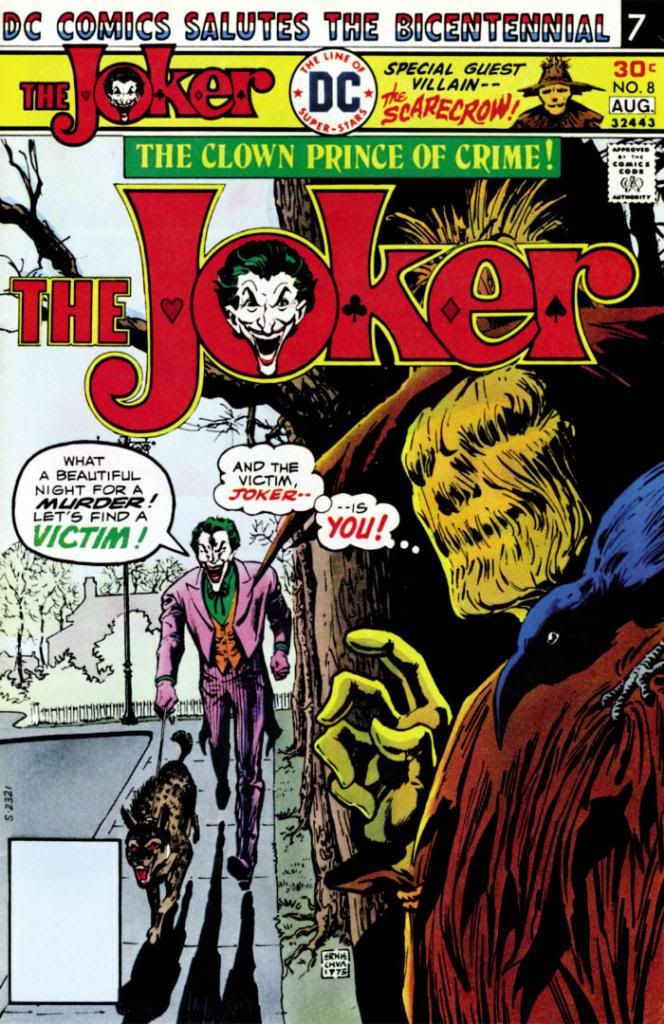
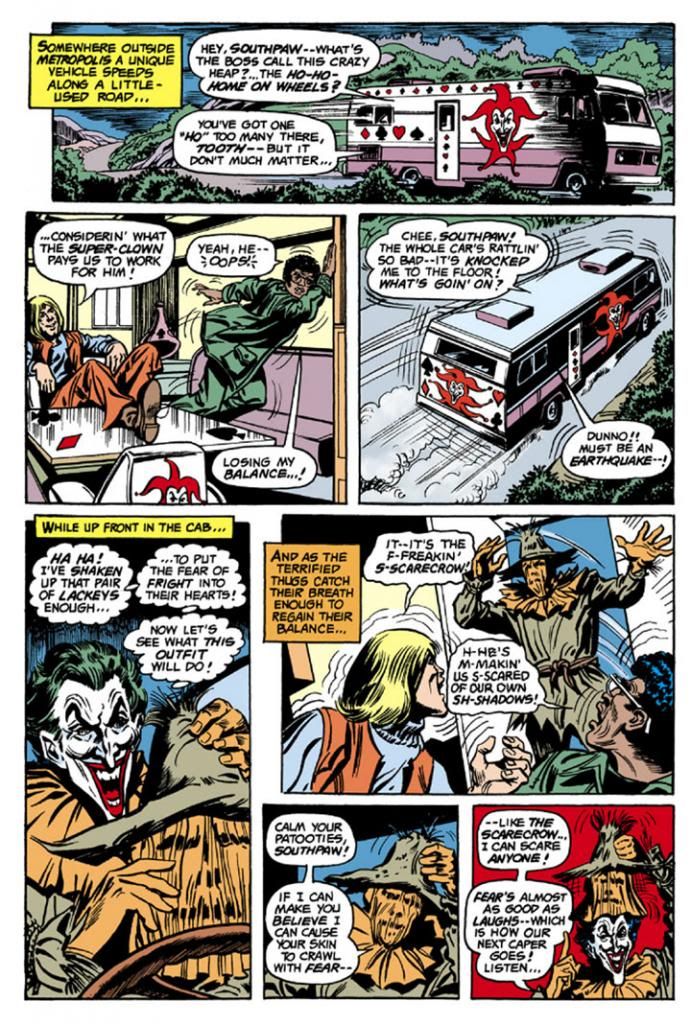
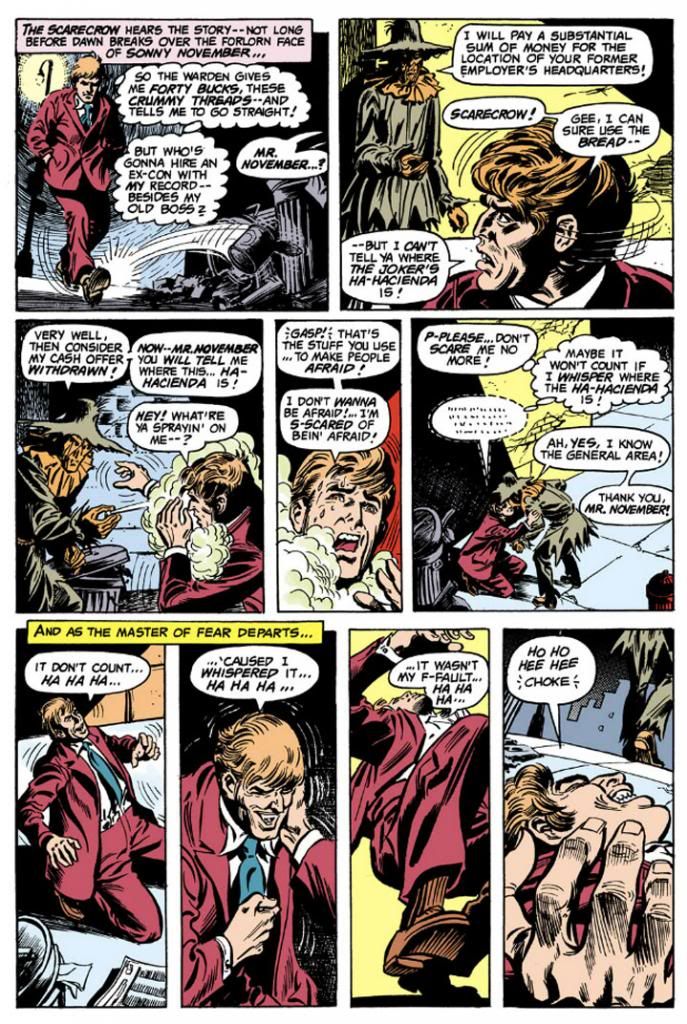
If there's a DC super-villain made for Halloween, it must be the Scarecrow.  He likes to scare people, people like to be scared on Halloween.  The Joker #8 (August 1976) pits him against our titular anti-hero over a batch of new-fangled fear gas developed by those happy-go-lucky chemical warfare specialists down at S.T.A.R. Laboratories.  What's startling about this book is despite its sunnily appealing Irv Novick-Tex Blaisdell art, there's a body count.  I'm simply fascinated by this dichotomy, which gives the book a mood of joyful nihilism.  Innocent people die, and so does a not-so-innocent.  The Joker himself says it best right there on the cover, "What a beautiful night for a murder.  Let's find a victim!"

While we're looking at it, that's a nice Ernie Chan cover.  Once again, Chan had to sign it "Chua," thanks to some kind of bureaucratic goof involving his work visa.  Whoever colored it didn't quite capture the essence of night, though.  No matter.  The lurking Scarecrow provides a lot of menace that's missing in the cheerful story itself.  I mean despite all the killing.

And now a special message to you, the reader!

Dear Reader,

How have you been?  Did you have a nice summer?

Okay, let's discuss something perhaps you can help me with.  This story brings up something that's troubled me for a long time.  I just can't imagine why your average, ordinary, work-a-day criminal would ever join the Joker's gang. 


Being a Joker henchperson has such a high fatality rate.  One touch you can almost count on in any Joker story is when the writer decides to present the Joker's bona fides as a dangerous lunatic by having him off a henchman.  This time writer Eliot S. Maggin floats the clever idea the Joker instills a post-hypnotic killing suggestion in all his employees.  If any of his gang rats him out, that person laughs himself or herself to death.  Good deal for the Joker, but a terrible burden for his lackeys.

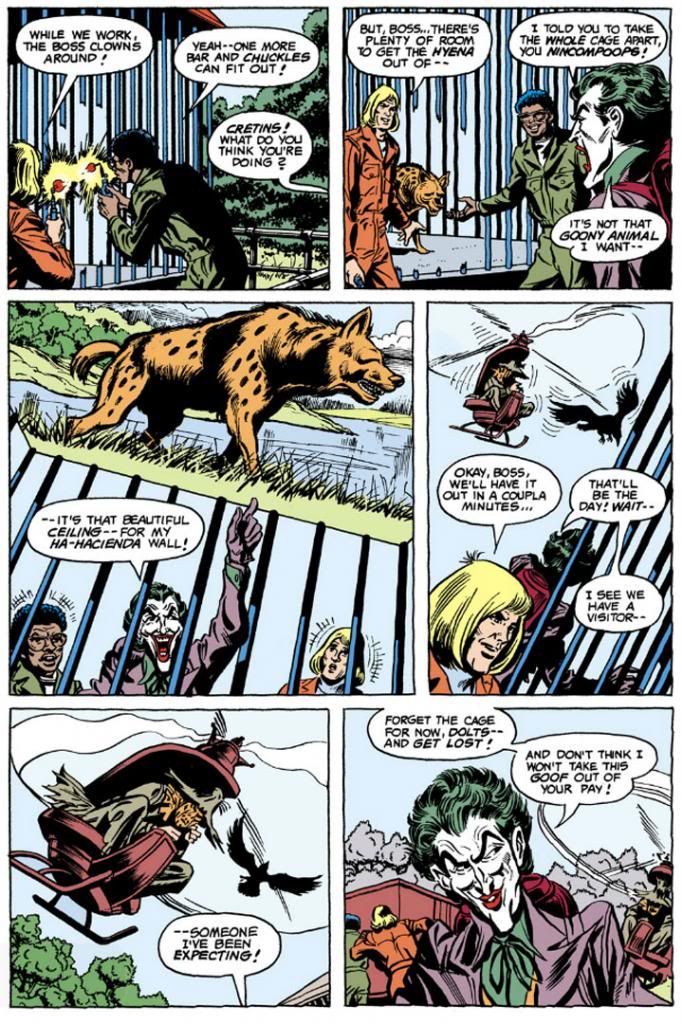
While there's no riskier occupation in the DC universe than Joker henchperson, there is virtually no reward in it.  Most of us grow up with the idea of risk versus reward.  The greater the risk, the greater the expected reward.  What's the reward for members of a Joker gang?  Even if the Joker decides to steal, say, a solid gold statue of famous clown Emmett Kelly, he's not doing it to melt the metal down and sell it off and split the profit equitably, or even to remove it from the market in hopes of increasing the value of his own stockpile (although a single statue would hardly do that) as when Auric Goldfinger colluded with communist China to irradiate the United States' gold reserves at Fort Knox.  The Joker operates whimsically.  He steals that statue because Emmett Kelly appeals to him in some personal way and he just wants to look at it.  In this story, the Joker takes the fear gas so he can use it to steal the ceiling out of a hyena cage because the painting on it would make a pretty decoration for his "Ha-Hacienda," a kind of Winnebago of crime he and his gang drive around in.  


Yet the Joker never seems to lack for lackeys, does he?  It's easy to understand why the Joker would appeal to anarchists, weirdos, cultists and anti-social types.  Even Charles Manson has fans.  But as far as I know, no writer has attempted to explain the attraction of working for the Joker to the Rockos and Leftys out there in Gotham City and Metropolis.  The blue-collar professionals-- safe-crackers, strong-arms, grifters, B&E boys (and girls) and car-thieves-- with families to feed. 

Here's where you come in, loyal reader.  Has any DC writer addressed this in a story?  I know Alan Moore had the Joker employ carnival freaks in Killing Joke-- which makes a lot of sense-- but never explained their motivation for taking part in his spree.  Every other Joker story I can think of features more conventional criminal types.  What's their attraction to the Joker?  I can only conclude lawbreakers in the DC universe must be even bigger idiots than real-world criminals.

Thanking you in advance!

Sincerely,
A Dope

Oh yeah!  I forgot all about the Scarecrow!


He flies into the comic in a teensy-tiny helicopter with his knees jutting skyward as if he's Disney's Ichabod Crane (a partial inspiration, I believe) on his horse at the end of the classic The Legend of Sleepy Hollow segment from their 1949 package film The Adventures of Ichabod and Mr. Toad.  He and the Joker engage in a duel right there in the zoo, and Scarecrow makes a complete ass of himself.  Oh well, to hell with him.  Here's Der Bingle singing about the Headless Horseman...


Here's Thurl Ravenscroft doing the same...


Happy Halloween, everyone!

Tuesday, October 29, 2013

October is Spookey Month: Jack Kirby pits Jimmy Olsen and his pal, Superman, against a vampire. The winner? Anyone who reads it!

Jack Kirby drew comics in just about every genre.  Which is a pretty conservative way of putting it when you consider he actually invented or co-invented some of them.  As a Kirby fanatic, I wanted to link him to my annual Halloween celebration here, and rather than talk about Spirit World (Kirby does the paranormal) or some of his straight-up horror work (you can find it scattered about in various reprints, Archives, Essentials and Showcases and IDW's Haunted Horror), I have decided to once again explore his early-70s DC years.  We love those book here.

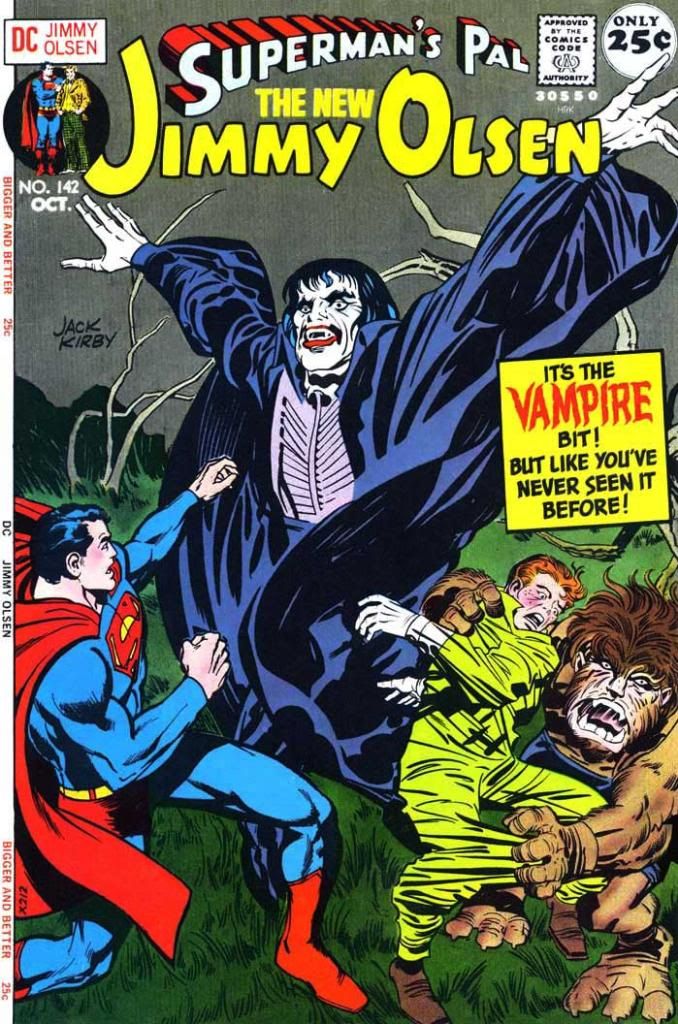
In Superman's Pal Jimmy Olsen #142 and #143 (October-November 1971), Kirby gives the then-corny vampire routine a science-fiction/superhero twist.  Nowadays we have scary vampires again, and romantic, sparkling vampires and vampires that fight werewolves with Matrix-style kung-fu, but when Kirby wrote this story, movie vampires were pretty much still tuxedo-wearing noblemen and the occasional lesbian baroness in a Victorian-style negligee.  Comics in particular had worn out the theme, despite years of a Comics Code ban on vampires.  Once EC had modern-day vampires put taps in their victims' necks and Warren saw an old school county-style vampire take a spaceship to a planet of perpetual night, the concept had been stretched past recognition, like Dick Tracy's face imprinted on Silly Putty (I used to love distorting that guy). The only things left were parody and deconstruction.  Kirby's story tends towards the latter, although the self-aware cover copy hints at the former.

That's as close to tongue-in-cheek as this story gets.  The rest of it is as sincere as Linus' pumpkin patch in It's the Great Pumpkin, Charlie Brown.  Kirby expends a lot of energy here trying to make readers buy this concept and he's not playing around or being cutesy.


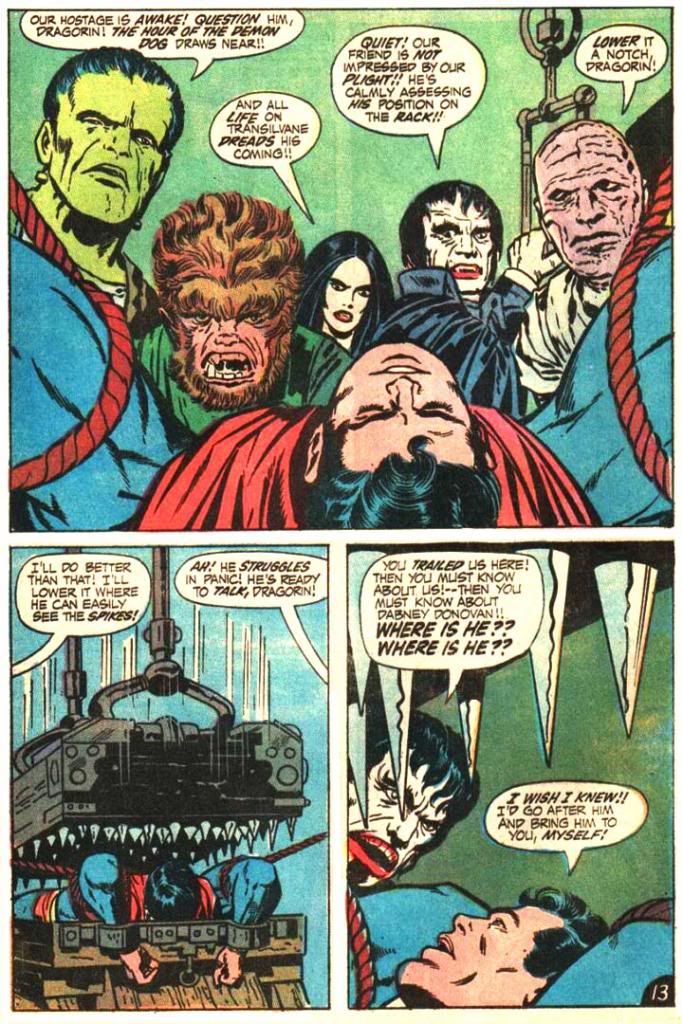
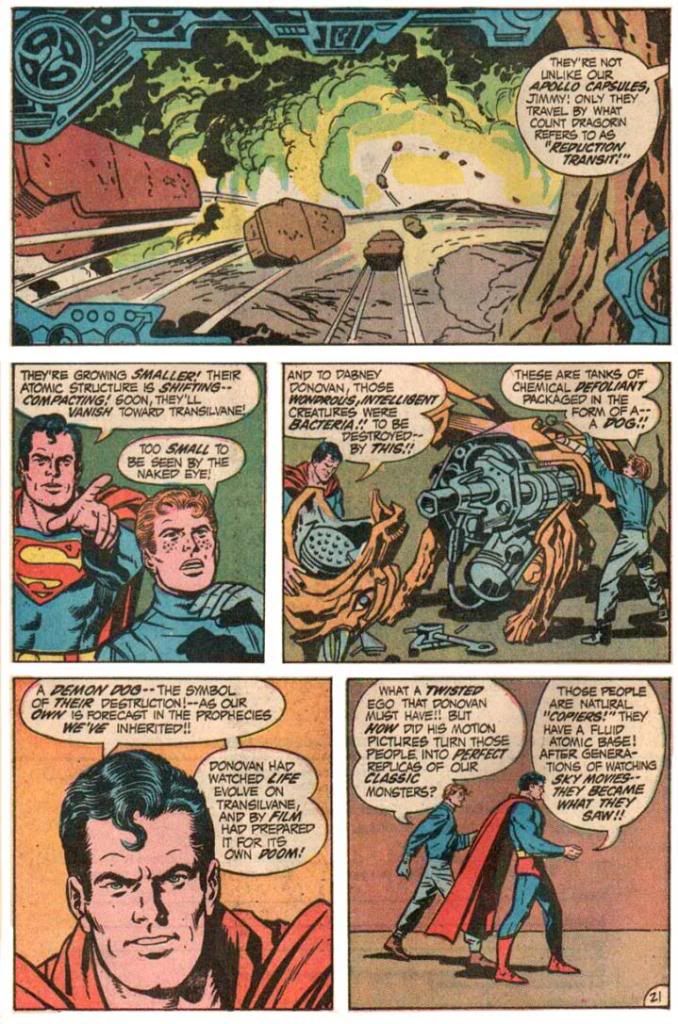
Count Dragorin, the man from Transilvane, does everything you've come to expect from a vampire, up to and including having a werewolf as a best friend.  Kirby wastes no time kickstarting the plot as Dragorin and his beastly companion slip into the city one night and put the bite on a sleeping receptionist by the name of Laura Conway.  Kirby's updated answer to the age-old vampiric transformation scene is to have Dragorin accomplish this via some kind of twin yellow power emanations from his eyes.  They leave the tradition double bite mark on the receptionist's neck and "change her body chemistry."  Within a couple of pages we have Clark Kent and Jimmy Olsen fighting Dragorin for Laura Conway's soul-- or at least her free will-- right there in broad daylight inside the GBS (Galaxy Broadcasting System) offices.  Dragorin is after a former NASA scientist named Dabney Donovan, and Conway was once Donovan's personal secretary.  Intercut with this is a subplot with the Newsboy Legion trying to escape from the Cadmus Project (they're not prisoners; their fathers work there and they're just up to their usual independent-minded mischief), so these are some really busy issues.


When Superman and Jimmy Olsen track down the scientist's lab (beneath a mausoleum in the pleasantly-named Bloodmoor Cemetery), they find they're not dealing only with a vampire and werewolf couple.  There are all kinds of familiar creatures.  So what does Kirby do to explain these Space Age vampires, werewolves and the like within the science fiction setting?  Well, it turns out Dragorin and company are microscopic aliens from an artificial planet.  That floats inside a room that looks like a creepy castle set where James Whale would have put Boris Karloff through his paces, or Todd Browning would have put Bela Lugosi through his.  And if that wasn't enough, the aliens on that world have developed a society based on old horror movies as well thanks to the bizarre experiments of Dr. Donovan, who must be a real piece of work himself.

For some reason known but to himself (and, I think, NASA), Donovan didn't just make a world.  He also chose those horror movies from his vast personal collection of films and projected them into its clouds.  The sentient life there turns out to have remarkable adaptive and imitative properties, kind of like those gangster guys and the Nazis the Star Trek crew dealt with on their old TV show.  Some of the people there turned into vampires, some into Frankenstein's monsters and others into mummies and werewolves.  They travel from their planet to ours by riding inside coffins that grow or shrink depending on which way they're transiting.


Kirby doesn't really bother to explain Donovan's scientific motivation.  After all, what could he have hoped to gain from such an experiment?  Certainly if he had published his results, the idea that we as a species could create an entire miniature world full of intelligent, evolving life, would result in a philosophical or even a religious sea change.  But Donovan seems to have added these rather baroque flourishes for his own personal enjoyment, and then to destroy via a robotic dog filled with a chemical defoliant.


The horror and science fiction aspects create a dissonance that's fun but, like Frankenstein's monster, reveal some of the stitching Jack Kirby did to make the story work.  Because Kirby's trying to assemble this creature in a way that gives it life and makes sense, some of the details are a bit too on-the-nose-- the space coffins compared to the Apollo re-entry process, for example-- while others remain shadowy, as if they're inexplicable.  Why did Donovan use old horror movies in the first place?  And we not only never meet the nutty scientist who did this, but he never receives a comeuppance for what amounts to attempted genocide.

I love that after all this oversized craziness-- even if it's also about miniature creatures as well-- Kirby chooses to end it on a minor note, with two pals sitting down together to watch Oklahoma!  It's just so human.  They're not even nonplussed about letting Donovan get away scot free, or having encountered human-created sentient life that could potentially affect life on earth in horrific ways, like some kind of virus escaping from a weapons lab. 

But maybe Superman is completely aware of this and downplaying it for Jimmy's sake as he renders the Transilvanians harmless in his own inimitable way.  From what I've read, writers and artists later extended the Transilvane concept and finally had Donovan make a story appearance as a full-blown villain, but a true sequel to this story would have Dragorin and friends transformed into good-natured cowboys and farm girls, and singing about a surrey with a fringe on top.

Oh, and be sure to note the Superman figure on the cover to #142.  Neal Adams re-touch.  And check out all the Al Plastino faces in the interior art.  Occasionally some Kirby comes through, but I really wish DC hadn't felt the need to do this.

Saturday, October 26, 2013

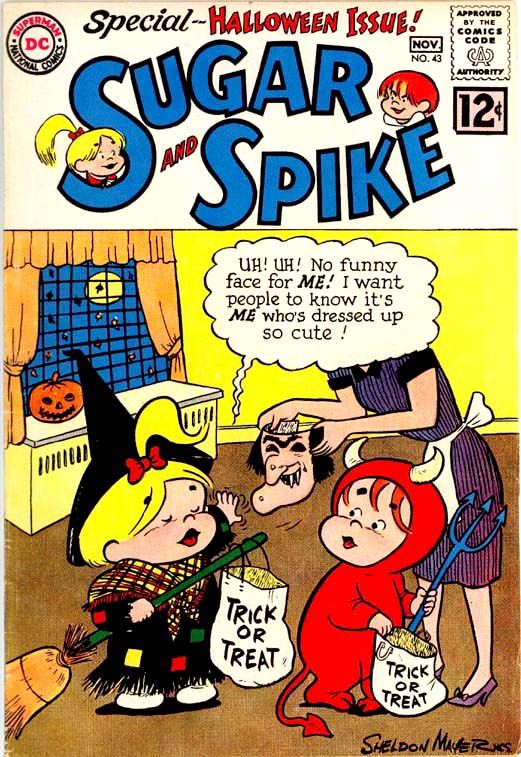
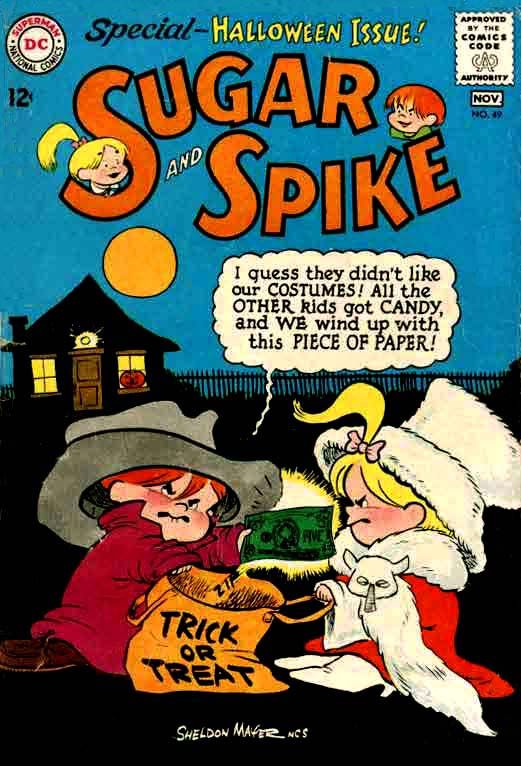
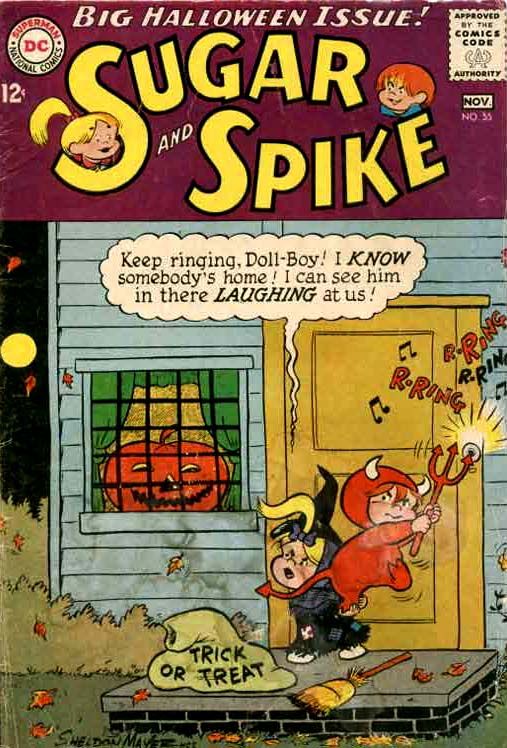
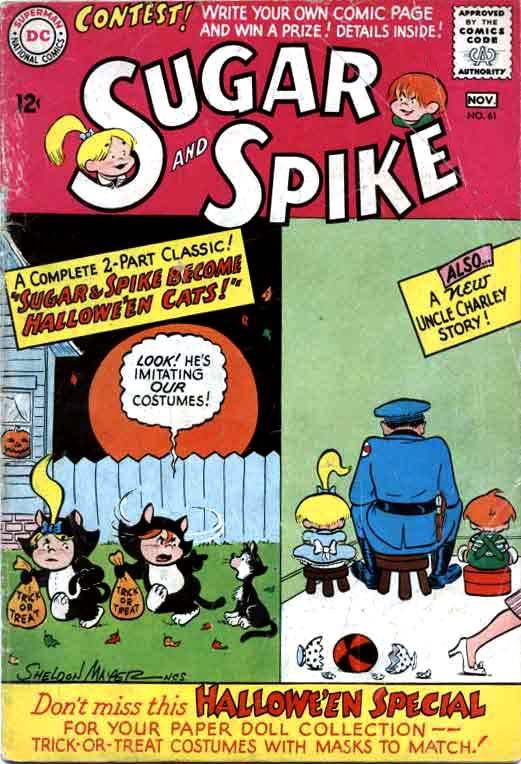
October is Still Spookey Month: Sugar and Spike's Halloween-themed covers!

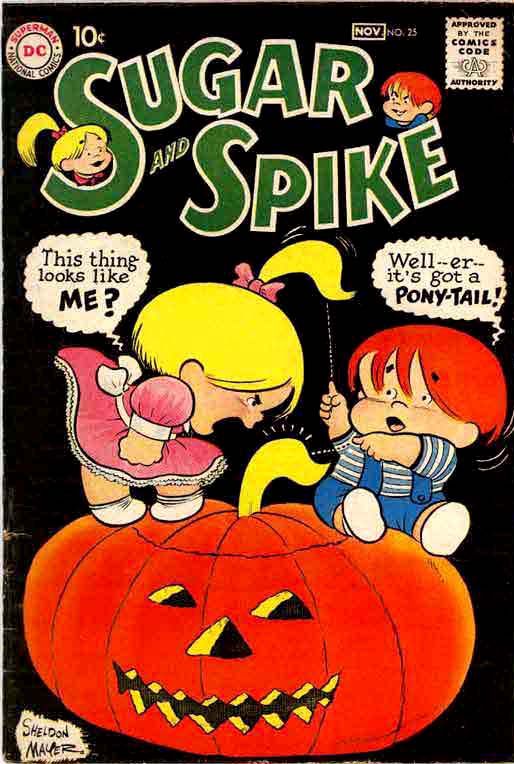
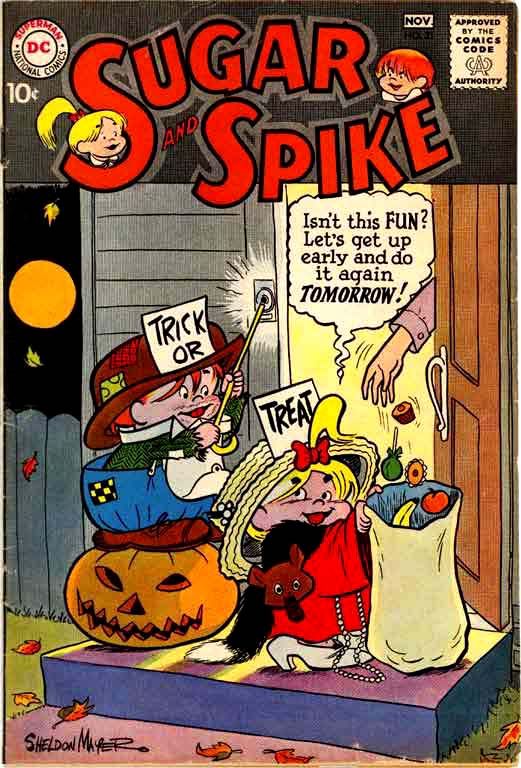
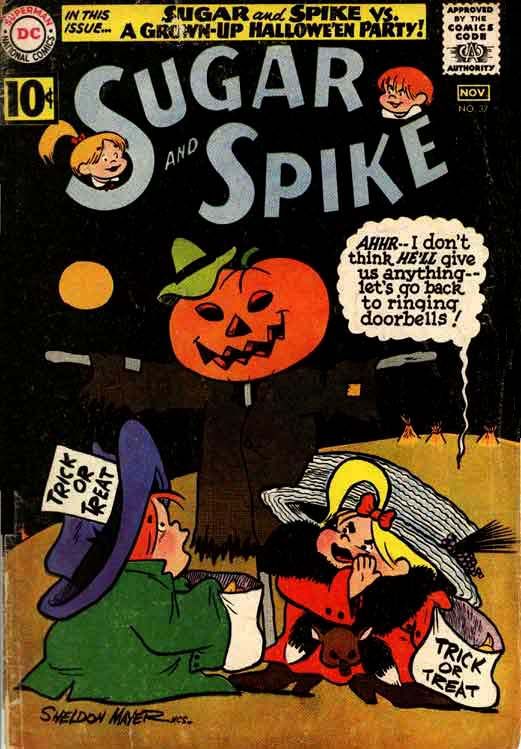
These are pure joy.  I really don't have anything to say about any particular cover in this collection, so we'll let Sheldon Mayer's work speak for itself and fill you with the spooky, fun Halloween spirit.

Sugar and Spike #25 (Oct.-Nov. 1959)


Sugar and Spike #31 (Oct.-Nov. 1960)

Sugar and Spike #37 (Oct.-Nov. 1961)

Sugar and Spike #43 (Oct.-Nov. 1962)

Sugar and Spike #49 (Oct.-Nov. 1963)

Sugar and Spike #55 (Oct.-Nov. 1964)

Sugar and Spike #61 (Oct.-Nov. 1965)

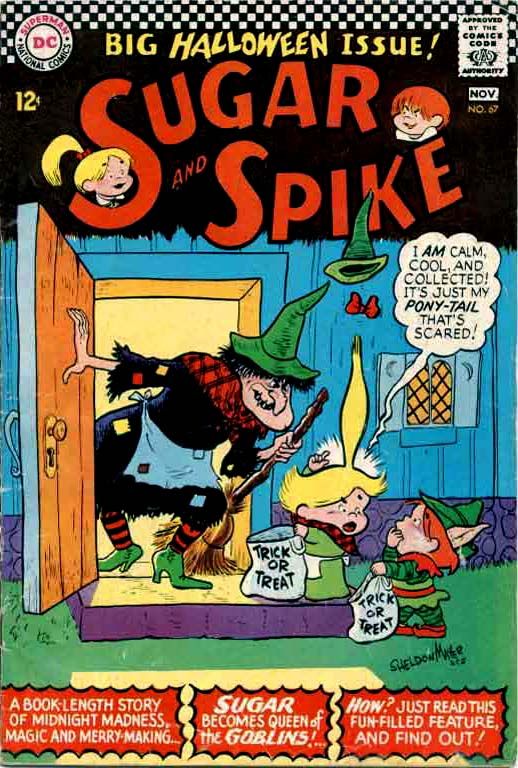
Sugar and Spike #67 (Oct.-Nov. 1966)

There!  I'm ready to go trick or treating and it's only October 27th.  I've only read one or two Sugar and Spike stories, but the Comic Book Artist #11 (January 2001) flip side devoted to Mayer and his kids made me a believer.  I wish DC and Comixology would make this entire series available so I could put up some better scans instead of ones I had to scour the web to find and then clean up a little for you.  I did as good a job as time (little) and money (zero) would allow and it's our good fortune Sugar and Spike fans put them out there for all of us to enjoy.

And now you also enjoy my favorite Spookey video!