Sunday, May 29, 2011

MIcronauts: Perfect summer comic book reading

Summer is upon us and that means school's out, big-budget/small-brained blockbusters dominate the nation's movie screens, there's nothing on TV but reality shows and dramas too lame to make the regular season and people are putting down their hefty copies of James Joyce's Ulysses and picking up lighter reading fare. My suggestion?

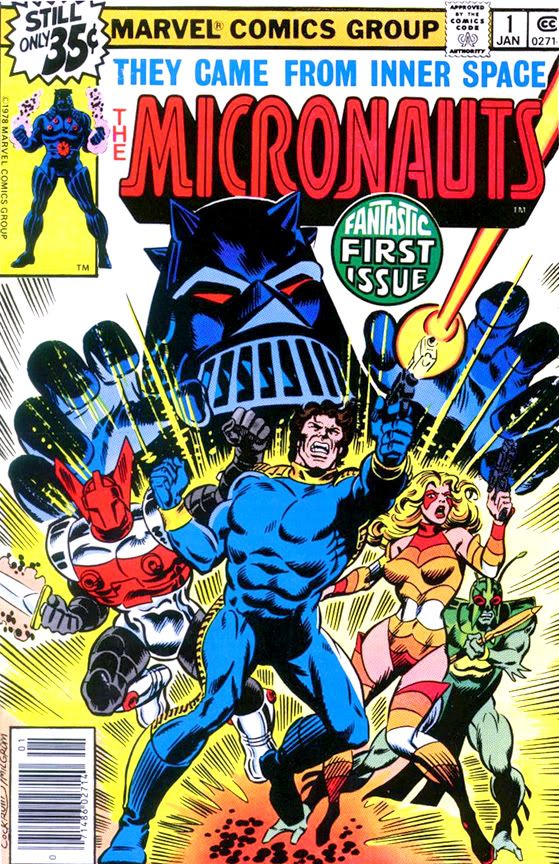
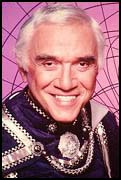
Marvel's Micronauts series. It's kind of like the Star Wars comic that never was, only there was a Star Wars comic that was also kind of like Micronauts. Actually, the first Star Wars artist Howard Chaykin later illustrated a few issues of Micronauts, which is a neat overlapping of similar summer fun fare. While Bill Mantlo filled the Arthur Digby Sellers role and wrote the bulk of the series (all 59 issues of the first volume), superstar artist Michael Golden illustrated the first 12 issues and its classic storyline, a dimension-spanning epic featuring a hero with a connection to a mysterious cosmic force, a couple of plucky robots, a spunky space princess and their rebellion against a black-armored mastermind and his Nazi-like army. Which reminds me of something or other. Battlestar Galactica?

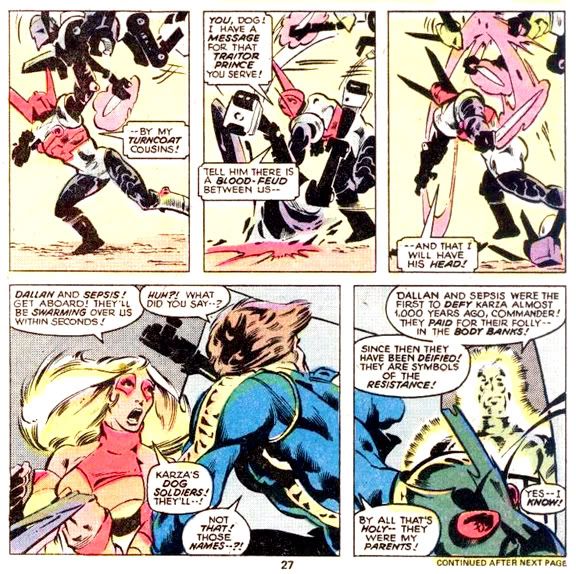
In the first issue, Commander Rann, a bold explorer, returns to his home planet after centuries in deep space only to find himself something of a legend and his parents-- the former king and queen-- worshiped as gods. And their science adviser Baron Karza ruling the place with an iron fist. Sensing a threat to his regime, Karza has Rann imprisoned. This proves to be a mistake, because it isn't long before Rann makes friends with the stoic warrior Acroyear, his comedic relief insectoid buddy Bug and Princess Mari, sister of the deposed Prince Argon. Together, they become a team of freedom fighters. But first they have to escape Karza's dungeons.

Script by Bill Mantlo, art by Michael Golden and Josef Rubinstein: Welcome home, Commander Rann!

Mantlo quickly sketches his world and its central conflict, filling his story with action sequences and little snippets of characterization. Princess Mari is so spirited she has to be convinced by her self-sacrificing brother to flee and fight another day, Rann conquers his initial confusion and takes charge of his own destiny, Bug cracks jokes and Acroyear provides muscle. And it's all gloriously illustrated by Golden and inker Josef Rubenstein. Taking as his inspiration a line of Japanese toys imported by the Mego company, Mantlo grafts on a few elements of Flash Gordon, the first Star Wars movie (there wasn't a second in those days) and Jack Kirby's Fourth World. Golden has always excelled at this kind of material-- armored warriors, sci-fi weaponry ever so slightly exaggerated from real-world examples, starships and fire-fights.

Hot Acroyear-on-Acroyear action! Notice how Golden makes the character Acroyear look "real," but the anonymous enemy version looks like one of the Mego toys, complete with metal joints!

Mantlo's script really turns him loose. I remember looking at issue #2 and being completely enthralled with Golden's artwork. The way he seemed to draw every nut and bolt on the robots and the starships, the lighting effects that reminded me so much of the movies-- rather than the fairly flat figures I'd been used to from coloring books and Super Friends cartoons.

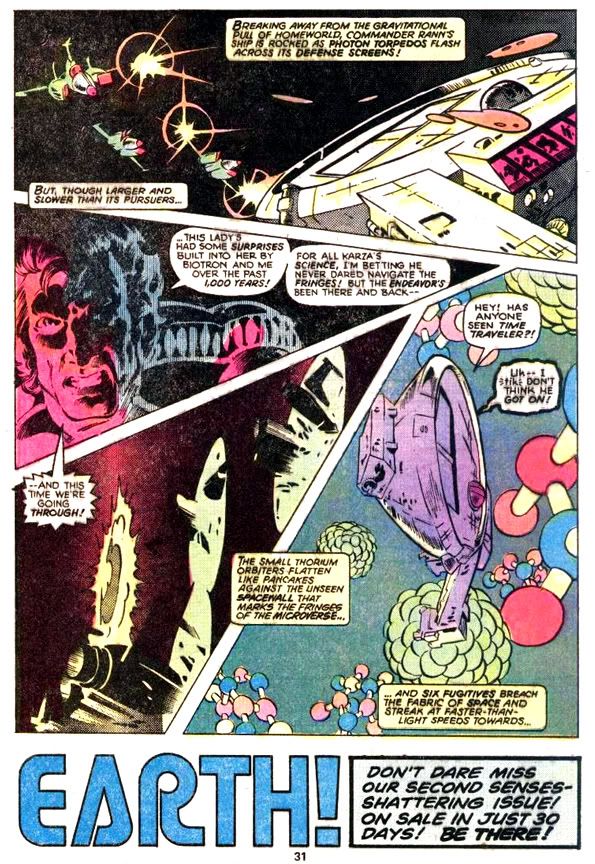
Where else would they go? How else are they going to meet the ever lovin' blue-eyed Thing?

And, of course, the Micronauts end up on earth, where they're exactly the same size as the action figures my friends and I were so crazy about that year. Yeah, my best friend owned practically every Micronauts toy, no matter how complex or expensive. He never particularly cared for the comic book, but I was hooked, at least initially. The only problem was, it was so difficult to find. I never saw #1, didn't find another issue until #4 (introducing my favorite 'Naut, the valiant guerrilla leader Slug), managed to get #5 (the Micronauts invade NASA) and #6 (they fight Man-Thing in a swamp) and then nothing until #12 (the post-climactic battle between estranged brothers Acroyear and Shaitan, a traitor). And yet thanks to Mantlo's ability briefly recapitulate the action from previous issues, I never felt lost or left behind.

If the series had ended there, it would've been the first maxi-series, I suppose. Or a pioneering graphic novel. But it was popular and financially lucrative enough to continue. So Golden handed off the interior art chores to Chaykin-- something I didn't discover for months. I honestly thought the story was over. Imagine my surprise when I found Micronauts #17 (guest-starring the Fantastic Four) and #18 at a convenience store in Florida. Same awesome Golden covers, but with Chaykin story art inked by Al Milgrom that, frankly, left me appalled. Later I came to appreciate and admire Chaykin when he inked himself, but I dropped the title in dismay for a while. It wasn't until I came across #20 with pencils by Pat Broderick and inks by Armando Gil that I became a re-confirmed Micronauts fan and stuck with the book through all the repetitive Karza returns-- how many times can this guy take over Argon's mind and re-conquer over the Microverse?-- and laborious trips back and forth through time and space, Nick Fury and Timothy Aloysius Cadwallader "Dum Dum" Dugan and the X-Men showing up, visits to increasingly familiar locales like the same NASA laboratory they'd already escaped from. Gil Kane provided some memorable covers but had his distinctive look on the pages inside all but obliterated by some heavy-handed Dan Bulanadi inks; hey, I just told you I like Pat Broderick's stuff, but I don't think Gil Kane's art needs to look anything like it. There were still plenty of fun moments, but Mantlo really seemed to be writing stories in circles. Maybe that's what Marvel wanted-- those amazing first twelve issues repeated endlessly.

Well, that's hindsight. At the time, that's what I wanted too! That and more Slug.

I recently found #3 and #4 in practically mint condition at my local comic book shop, and re-reading those I can feel those summer breezes and see the cool morning grass still wet with dew. It's like being 10 years old again, only now I no longer have my lush, androgynous 70s hair and I fart more frequently. If you can find the first 12, you really need to buy them and read them this summer. They're a lot better than that John Grisham book with the wrinkled spine and the cookie crumbs flattened against some of the pages you're going to find in the magazine basket in your beach condo and probably no more expensive than that braindead 3D robot movie that's going to leave your ears ringing and your head pounding from lost IQ points.

Steve Rude wants to return to comics and work for DC, DC is less than enchanted with this idea

Steve Rude has decided to make his return to comics. That's right. According to his latest "Daily Diatribe," Rude's less than happy with the current state of superhero storytelling and feels he can improve things by making a direct contribution. Plus, there's a certain economic necessity. Whatever the reasons, the Dude thought it over, discussed it with his wife and decided to contact the company that most appealed to him, to see if he could do something "high profile" with certain characters.

That company would be DC Comics. The characters-- in order of preference-- are Supergirl, Superman, Big Barda and her Female Furies and OMAC. Rude contacted an editor, got no response. Talked to some executives and another editor. One response. Rude characterizes it as a "polite turn down." I can't imagine why DC would turn down an artist of Steve Rude's caliber. Maybe his proposals didn't fit with their ongoing plans or business model. Maybe his kind of traditional technique-heavy aesthetic is too far out of fashion with the "edgy" crowd-- if the books I bought this past week are any indication, the fans seem to like scratchy-looking artwork. Markets change. I do know he was hoping to do some work on another Wednesday Comics series, but that hasn't panned out so far either. I just think it's sad the Dude-- of all artists-- didn't get so much as a peep of interest from DC about working on characters he seems born to draw.

Here's what I offered: Just a thought-- this past week, I picked up IDW's new The Rocketeer book with art by Mike Allred, John Cassaday and Mike Kaluta. Unfortunately, it's a 4-issue mini so I'm guessing all the art and stories are already in the can. The Dude would've rocked on that. But they must have some upcoming projects where the Dude can make a big splash. Maybe not as big as on Superman or Supergirl-- and a Big Barda story would be too perfect-- but they do seem to be a company that's putting out some intriguing books with some artists Rude's kind of simpatico with as far as aesthetics go.

In another comment I mentioned Dark Horse, but I'm not sure they're in a financial position to do anything with Rude. Plus, he's been there before and the Nexus books he and Mike Baron did for them in the 1990s were more a critical than a sales success. Maybe Dark Horse is more comfortable with the Nexus archives books these days. After all, they've put out a ton of Rude's classic sequential work in that series. Still-- Steve Rude on a Star Wars book? A Hellboy one-shot with Mike Mignola? The new Creepy book (if it's still being published)?

So there you have it. I'm holding out hope some editor at Dark Horse, IDW or even Image-- which seem to be companies that let creators do what they do best without a whole lot of multimedia corporate narrative flak and bother-- will give Rude a call and see what happens. Of course, if he's determined his return to comics is contingent only on his being able to work for DC on these particular characters and no one else, then my suggestions are useless. But if he's just fishing to see what's biting, then someone has to make this happen. The guy is a legend, for the love of Kirby!

Friday, May 27, 2011

Today's lesson: Buying comics is an expensive habit!

Yeah. I'm thinking about giving up comics and taking up cocaine again. Just kidding. I've never used cocaine. As far as you know. But today was payday, so I went to JJ's Comics & Cards, my local comic book store, looking specifically for comics featuring Cassandra Cain in her new costumed identity of Blackbat. Which means-- choke!-- I bought a few DC Bat-books! I even bought some I wasn't sure she was in just to make certain I didn't miss even a fleeting glimpse or hint!

But I spent close to 40 bucks. They had stuff there I didn't even know I wanted until I saw it on the shelves. Here's what I ended up buying:

Batman: Gates of Gotham #1: Cass in civilian clothes, towards the end of the issue, just as promised. The way artist Kyle Higgins draws Cass-- her anatomy, her clothing, her body language-- and the way writer Scott Snyder handles her mode of speech do nothing to define her as anything more than just another generic superhero person, which lead to something of an anti-climax. Here's hoping a closer reading proves me wrong.

Batman Incorporated #5: No discernible traces of Cass in civvies or otherwise, but lots of Batwoman. I like Yanick Paquette's art with these Michel Lacombe inks. Solid figurework, nice facial expressions.

Batman Incorporated #6: Chris Burnham's art combines the thin, scribbly lines of Frank Quitely with the deranged facial expressions of Ito Junji. I'm not sure I like Bruce Wayne looking kind of crazed, but there's Cass as Blackbat more than making up for it with a nearly silent action sequence. Leave it to Grant Morrison to give us Cass doing what she does best-- whomping on people and leaving no room for discussion. Liking the pointy little mask and cape, can't tell much else about her costume.

Conan: Road of Kings #5: I passed on King Conan to pick this up. No Cass whatsoever, just Conan in his warrior prime as written by Roy Thomas. Which reminds me-- I need to turn to the back for "The Adventures of Two-Gun Bob," the biographical Robert E. Howard strip by Jim & Ruthe Keegan. It's always excellent. Cass's appearance in this book cancelled due to licensing difficulties between Dark Horse, Time-Warner and Conan Properties International. Too bad. Thomas's take on her would have been interesting, to say the least.

Hellboy: Being Human: Mike Mignola script, Richard Corben art, complete story in one issue. Of course I bought this! No Cass appearance, Cass not referenced in dialogue.

John Byrne's Next Men #6: The return of one of my favorite-- yet somehow frustrating-- titles from years past. Byrne's telling a convoluted time travel mystery but the story feels somehow beefy. I get that same full-belled satisfaction from reading it I used to get from comics, rather than the sense I've eaten a single cookie a lot the flimsy, underwritten books give me these days. Not saying Next Men is gourmet fare so far, but it does hit the spot. Will I be able to keep it down? Cass appears briefly disguised as a Union soldier. Sure, the figure's tiny and consists of just a couple of ink swirls, but I'd recognize her anywhere.

New Mutants #25: "New Direction!" huh? How about A direction? This is a book I've stuck with because I like Dani and Xi'an so much, but it's been nothing but fragments of crossover stories, frequently with the New Mutants team barely appearing on the pages of their own book. And it got off to such a decent start before being consumed by the needs of modern epic storytelling. I'm not quite ready to give up on it yet, but if this book is just going to be a bump on the ass of the greater X-franchise with no stories to tell of its own, then I'll be bailing soon. Very soon. Rumors of Cass taking over as team leader in this issue prove unfounded.

Red Robin #23: Another false alarm. No Cass.

The Rocketeer Adventures #1: The lead story is all about Cass and explains how she came to choose "Blackbat" as her new super-name. Yeah. I didn't make that up. It's... really... I bought "cover 8," the Dave Stevens variant. I also hate multiple covers. But this one is a beauty. And inside there are stories by Mike Allred, John Cassaday and Kurt Busiek. Busiek's just happens to be illustrated by Michael Kaluta. Are there really people who have to collect each and every variant cover of a single issue? Do those kinds of stunts really help publishers? Or do readers just choose their favorite one and go with that? If it's the latter, I'm all for it because it's kind of interactive. If it's the former-- YUCK. But what a gorgeous book! John CASSaday, but no Cass Cain.

X23 #10: I've always hated this X23 character. Well, not the character, just the concept. To me, you need one Wolverine, one Batman, one Superman, one Wonder Woman, one Spider-Man. Not clones and extras. Which may sound strange coming from someone who bought a bunch of comics based on the erroneous assumption a former Batgirl would be in each and every one of them. And I've always been indifferent towards Jubilee. Then a funny thing happened. One day the comic store had nothing I particularly wanted so I picked up the first issue of the Wolverine and Jubilee miniseries. Jubilee as a vampire? DOUBLE YUCK. DOUBLE SURPRISE! It turned out to be a pretty compelling story, quite well-written by Kathryn Immonen and nicely drawn by Phil Noto. It made me care about Jubilee for the first time. So when I saw a comic featuring vampire Jubilee fighting X23 with art by Sana Takeda? I felt perfectly willing to climb off my high horse and--

Cassandra Cain is back in action!

I'm happy with all these purchases, and I'd openly shill for JJ's Comics & Cards because of the royal treatment the owners have always given me-- and they're just so nice-- but these books cost me around 36 dollars. Actually, if I want to keep up my comic book reading habit, I'm probably going to have to give up a lot of other little things. Like electricity, clothing and food. Or I may have to resolve once again to stick only to collections, trades and archives, and then only very selectively.

But there's that Cass factor. Yes, there is.

Thursday, May 26, 2011

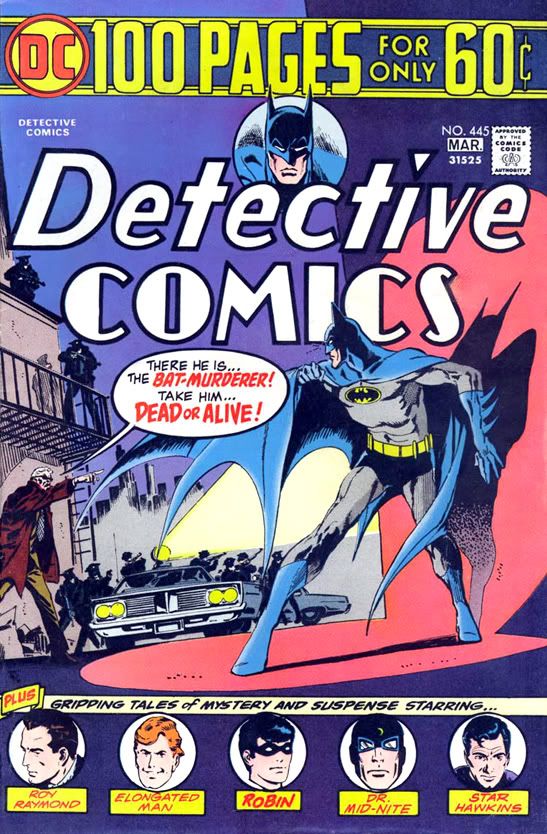
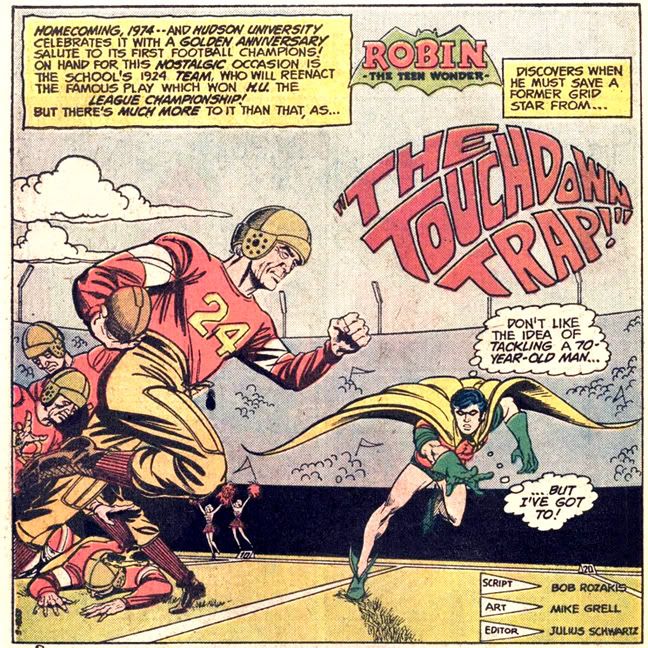
"The Touchdown Trap" from Detective Comics #445: Remember that time Robin tackled an old man and made him cough up the football?

You may be too young to remember the days before genetically engineered super-comics grew on cybertrees in all the colors of the rainbow, but when I was your age they were made of paper. In 1975, DC's Detective Comics consisted of 100 pages for 60 cents (I know! Imagine paying more than a quarter for anything less than 600 holographic pages!), and starred such iconic characters as Roy Raymond (subject of 1995's Oscar winner for Best Picture), Marty Moran (Headline Hunter) and Star Hawkins (in 1986, an act of Congress replaced Labor Day with a new holiday in Star's honor), plus those almost forgotten failures Batman and Robin, whose brief literary careers went nowhere-- aside from being occasionally unearthed and derided by nostalgia bloggers looking for obscure pop culture artifacts upon which to exercise their snide humor.

Yet at one point, this so-called Batman was a popular enough character to command the cover spot for a few issues of Detective Comics. Then again, people living in those days also loved Irwin Allen's disaster movies and belted jumpsuits. There's no accounting for taste, or so they tell me. What do I know? I'm just a clone. From the future!

1974's Robin is quite a bit different from today's version, the wretched little asshole Damian Wayne. This Robin is the original one, Dick Grayson, better known now as... well, Robin, because I doubt most people outside of comics have ever heard of Nightwing, or of Grayson's stint as Batman. I also seriously doubt they even know the name Dick Grayson. It just doesn't stick in the mind like Bruce Wayne, Clark Kent, Roy Raymond, or Marty Moran (Headline Hunter).

Here we have young Robin as a college student at Hudson University, which sounds as though it should be located in upstate New York. And perhaps it is, because Robin and his university pals frequently pop over to Rutland, Vermont, for the annual Halloween parade. Almost once a year, in fact.

I'm not sure what kind of school Hudson University is. Ivy League? Big 10? One of the Seven Sisters? All "The Touchdown Trap" tells us is it's the 50th anniversary of the school's first football championship. Ah yes, Hudson University. It's coming back to me now, the legendary Hudson University football dynasty, when the school won 5 consecutive national championships.

But that was decades after the storied 1924 season, during which their offensive attack was spearheaded by Heisman Trophy winner, "Hurricane" Hurley. As our story begins, the school has invited back the offensive squad of that storied team to recreate the play that won them the league championship (the entire defensive team having died in the interim).

The Hudson University Beavers play their home games before an appreciative crowd
of lumpy mashed potatoes turning gray with age.


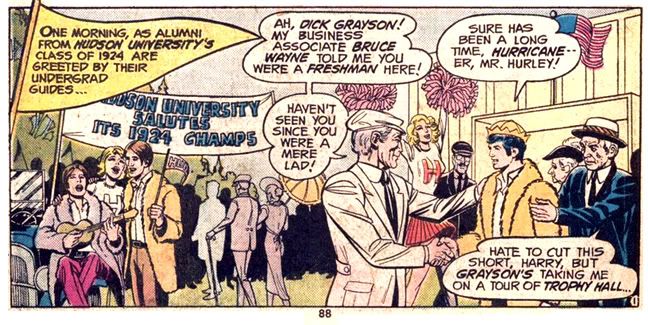
No student is more excited to see these aged gridiron warriors than our boy Dick. Hurley is an old family friend, and Dick is so thrilled to see him again, he's beaten up Jughead Jones of Riverdale and stolen his crown-like hat, then killed and skinned a goat and donned its still bloody pelt, steaming in the crisp autumn air. Hudson University, where goats are plentiful on campus and students gather around ukele-playing audioanimatronic figures to sing hymns to the coming socialist utopia.

When 23-skidoo met far freakin' out.

This is some nice dialogue. There's not the least bit of awkwardness in the way scripter Bob Rozakis has Hurricane Hurley reference his relationship to Bruce Wayne while addressing Dick by his full name and scholastic status. It's so natural and unforced, in fact, a lone cheerleader celebrates its soulful smoothness by soundlessly leaping into the air and shaking her pink pompoms. As good as his word, Dick takes straw-hat wearing Mr. Benson on a tour of the school's trophy hall. Benson's so impatient to see the trophys, he doesn't even want to drop of his bag. Or change his adult undergarments, which must be soaked after the long drive up from Gotham City. The man loves sports mementos and dampness in his personal area is not about to stop him from having fun. And it's a good thing, because as soon as Dick and Benson reach the hall, they find some fun-loving students engaged in a Hudson University tradition.

This guy entered the fight wielding a sliver of balsa wood, or a canvas stretcher stolen from some poor art student's locker.

Which is wearing white gimp masks and matching disco costumes to smash the award-laden glass displays. Careful! Those shards of glass might cut and the all the sports-related puns will stick to your shoes and make them smell something awful! Dick changes to Robin and beats up the disco kids, just as the campus cops show up. They're as timely and effective as most campus cops.

For a second I thought I was dead. But, when I heard all the noise, I knew they were cops. Only cops talk that way. If they'd been wiseguys, I wouldn't have heard a thing. I would've been dead.

"Okay, Robin... ...What the fudge is goin' on here?!" Only he didn't say "fudge." He said the "f-dash-dash-dash" word. Seems one of the "jocks" received a letter full of money with orders to smash up the trophy hall. Never one to question letters full of money, he and his friends immediately went out and spent their entire windfall on masks and matching leather jackets, then proceeded to wreak havoc. Now they're broke and in jail, but at least everyone knows they're together! A matching set. And that's what really counts. Togetherness. And Benson himself carves the roast-- actually, what Benson does is recover the game-winning football.

While Robin's trying to figure all this out, we cut to the stadium's locker room where the head coach from the 1924 squad is showing his team game film from their championship effort. Let's think about this for a moment.

The old guys behind "Coach" are all smiling because, in his senility, he forgot to wear pants. Sports teams are notorious for their cruel, mocking humor.

The former players are all in their late 60s or early 70s. Their coach was probably in his 30s or 40s when they won the championship. Which means this guy is pushing 80 or perhaps even as much as 100 years old! Look at him! Time has left him a withered, toothless wreck of a man, and deposited a gigantic carbuncle on his chin. Yet he proudly wears a dirty old crewneck t-shirt upon the collar of which he's crudely lettered the word "COACH" in red marker. A younger man would have bought a nice sweatshirt with stitched lettering, or at least used iron-ons. But not this walking mummy. Look how high those letters are. This might be because artist Mike Grell didn't trust the readers to fill in the parts of the letters the bottom of the panel cut off, but that's not it. What happened is exactly as I've described it. It's in Rozakis's original script. Writers include little details like that in their scripts even though we'll probably never read them because it helps the artists figure out the characters they're drawing.

We get to see how the winning play went down. Hurley, the quarterback, took the snap from center, then turned to hand off to fullback Benson. With the pocket collapsing around him, he decided to keep the ball. The cameraman somehow managed to get a sweet close-up of that moment, so clear you can see the shock and disappointment on Benson's face when Hurley snatched the ball away from him. Then it's 90 yards down the field and he... could... go... Okay, yeah, we already know Hurley scored the winning touchdown.

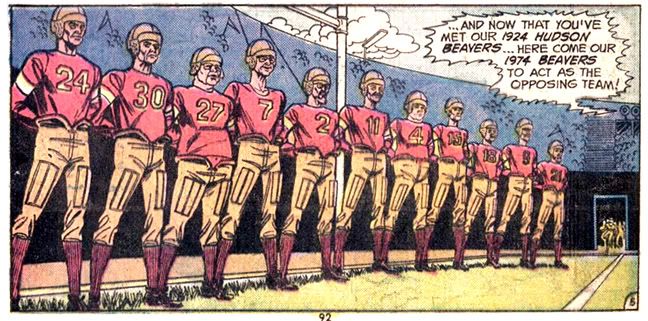
A few minutes after the old coach passes away, the players take the field, wearing their original 1924 uniforms complete with leather helmets. Luckily, they've stayed in shape all those years and everything fits perfectly.

Behind the men: a wall made of natural stone. Granite, I believe. With little flags poked into it to mark specimens of particular interest to rock hounds.

The plan is to use the original game ball for the recreation, but someone has destroyed Hudson University's most precious sports artifact. Robin learns of this from none other than a time lost Burt Reynolds as he appeared in his starring role as police officer Nick McKenna in the 1993 cinematic masterwork Cop and a Half.

Robin never had a strong grasp of meteorological phenomenon. That's why he failed so many science classes.

At which point Robin deduces the reason for all the disco-style vandalism-- a distraction while someone switched footballs. And being a superb detective trained from childhood by the master himself, Batman, Robin also knows there was only one person in position to handle the old switch-a-roo. Hurley's in danger and there's not a moment to lose! After a trip to the concession stand for a large, icy Pepsi and one of those delicious Hudson University stadium chili dogs, then an interminable wait in the line an open urinal (millions in alumni donations for luxury skyboxes and a Jumbotron scoreboard, zero for restroom facilities), Robin leaps over the retaining wall and hurls himself down the field.

He takes Hurley down with a fine open-field tackle, snapping the man's brittle tibias and fibulae as though they were merely dried twigs, old wood, dead these many winters. The substitute ball contains a time bomb, as evidenced by the muffled ticking coming from within.

"I don't care what kind of hero this moldy old chump used to be, ain't nobody crosses the goal line on Robin's field!"

I'm left wondering why someone would use a timebomb in this situation. Wouldn't some kind of remote triggering device work much better? If you're a ball-handling offensive player on a football team-- a quarterback or fullback, for example-- chances are you're going to be near the football at some point during a play. Especially if your participation is a major component of said play. Granted this is merely a recreation, but the timing on these things isn't always precise. There are delays. These are old men; they don't move as quickly as they used to. Using a timed explosive is taking a major risk. But I don't know. I have a superstition about standing too close to explosions, so I may not be the most objective person to judge.

Unfortunate timing led to the demise of all the doves released during the pre-game ceremony.

Forget all that! Not only is he a textbook tackler, but marvel at the height Robin gets with that punt! Lord have mercy! Imagine the hang time he'd have had if the ball hadn't contained a timebomb! Why isn't the current Hudson University coach trying to recruit this guy? "You can even wear the mask, kid, but we need you on special teams!"

I've been poking fun at "The Touchdown Trap," but it's really an effective eight-page story, with a concise, direct plot. Rozakis probably came up with it over lunch, ran it by editor Julius Schwartz and tapped it out on an IBM Selectric II at the DC offices in less than an hour, one of many he'd write that afternoon. Grell doesn't seem to have labored over the art-- and he obviously skimped on the stadium crowd shots. Lumpy gravy? Week-old grits? But you know what? That's fine. Rozakis and Grell weren't trying to produce a masterpiece. They were just trying to tell an entertaining Robin mystery to fill a slot in the magazine. Stripped of flash, efficient, not a wasted moment, no loose ends, just enough character development to propel the narrative to its conclusion.

Written today, "The Touchdown Trap" would attempt some gross-out thrills with a few gruesome murders. Also, it would consist of a four-issue prologue mini-series, then twelve issues running across most of DC's monthlies for an entire summer, and finally, a couple of epilogue stand-alone issues and a new on-going series starring the daughter of the original Roy Raymond, also named for some reason Roy Raymond. The real culprit behind it all-- manipulating Benson and Hurley for his own nefarious ends-- would be an insane Star Hawkins with help from a brain-damaged, drug-addicted Marty Moran (Headline Hunter). And as a parting gift, Robin would also learn Hurley had molested Benson's daughter and consequently come away a Boy Wonder disillusioned with hero-worship. A few months later, and we'd all get to buy the hardcover annotated version with an introduction by some best-selling author of horror novels or techno-thrillers sold by the pound at airports, re-mastered art on super-slick glossy paper and self-congratulatory commentary from the creators. Two more years and there'd be the direct-to-DVD animated adaptation. Then the new Roy Raymond title would be cancelled, she'd show up from time to time badly mischaracterized in various Batman-related books and finally, be raped and murdered as a minor plot element in yet another multi-title crossover event.

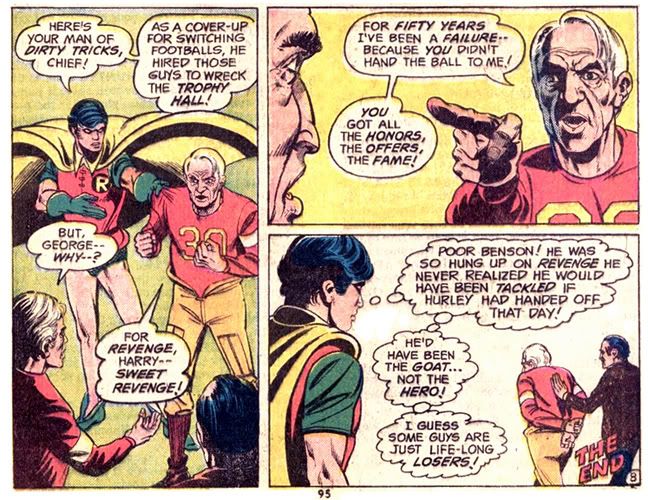
A relic of a simpler, brighter time, Rozakis's plot would've worked beautifully as a segment of Super Friends or an episode of The New Scooby Doo Movies guest-starring the Dynamic Duo, or the Caped Crusaders. Or Sonny and Cher. All that's missing is an unmasking. We have to settle for an unhelmeting. Actually, we don't even get that much. Poor Benson. Fifty years nursing a grudge and this is the best revenge he can come up with? Like Robin notes, "I guess some guys are just life-long losers!" Luckily for Benson, he won't have long to stay in prison. Because he's so old, he's bound to die there in a month or two! Freddie, Velma, Daphne, Shaggy, Scooby, Batman and Robin all laugh heartily and...

Roll credits.

Tuesday, May 24, 2011

Happy Birthday Carmine Infantino!

Carmine Infantino turns 86 today. One of the all-time greats, Infantino helped launch the Silver Age of comics with his work on a more sci-fi based Flash with Robert Kanigher at DC, but eventually drew for both Marvel and Warren as well. He's one of those guys it'd be easier to list the characters he didn't draw during his career. Wolverine. The end. Heck, Infantino probably drew Wolverine. I'm just clowning around here.

But I'm being very serious when I say that it's great to know Infantino's still around, and these days I'm really enjoying his work on the Marvel Star Wars series as reprinted by Dark Horse in their Star Wars Omnibus books. I also think his re-designed costume for the Flash is one of the most visually appealing costumes worn by any superhero. It's bold, bright, simple and conveys exactly what the character is all about-- he's fast as lightning.

For Kamandi -- With Love and Squalor

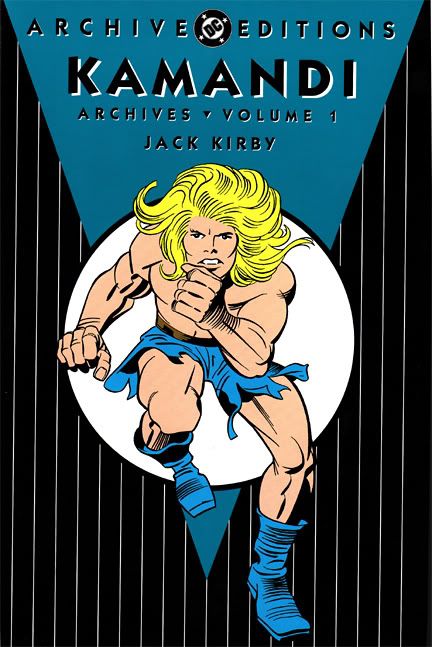
What do you get when you’re DC publisher Carmine Infantino and you float the idea that Jack Kirby should rip off Planet of the Apes? Not a Planet of the Apes rip-off, that’s for sure. If Infantino expected Kirby to content himself with mere talking simians, he was sorely mistaken. And yet that’s pretty much how it happened, and how approximately 65 million years later, we lucky fools ended up with this slick and weighty DC Archives edition of Kamandi.

Or, as I like to call it, Kamandi: The Last Boy on Earth, because that’s the series’ title and I’m clever that way.

Chapter One: The Last Boy on Earth!

Kamandi is a futuristic, roughneck young hippie in a time where barbers have gone extinct, but cut-off denim and motorcycle boots are all the fashion rage. He’s the Charlton Heston surrogate for this madhouse world where not only do gorillas talk and ride horses, but lions and tigers tool around on three-wheelers and radioactive scientists float overhead in helium balloons.

Because it’s Kirby, Kamandi can scarcely contain itself. While he was always possessed of a febrile creativity, as soon as Kirby hit DC, his imagination went into some sort of turbocharged overdrive. His Fourth World stories are over stuffed with incident and new characters, and Kamandi features a similar breathlessly paced narrative. Reading a DC-era Kirby comic like reading ten stories in one.

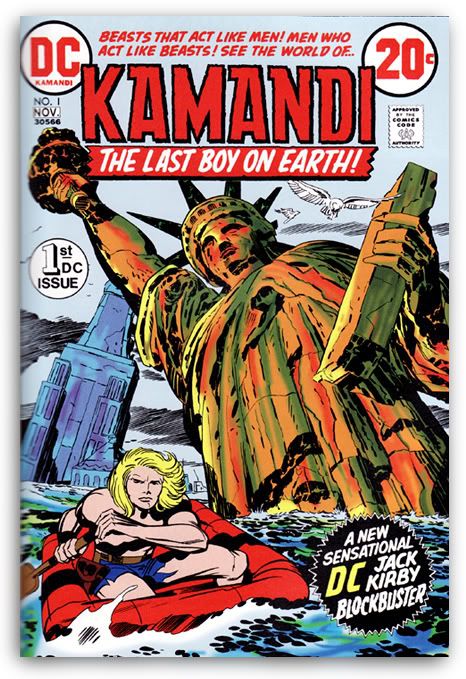
Kirby himself was busy then, too. I believe he was simultaneously producing Jimmy Olsen, Orion, Mr. Miracle and Forever People, spackling his living room wall in preparation for repainting it and mediating the Paris Peace Talks between the United States and the Democratic Republic of Vietnam (DRVN). And just as he saved our world in reality, Kirby destroys it in the pages of Kamandi. It's the post-apocalypse with a new status quo of underground bunker-dwelling and scavenging for food. Kirby destroys that almost as soon as he introduces it, too. When we first meet Kamandi, he's rafting through a flooded New York with a Statue of Liberty as majestically ruined as the one in the Apes film series, its obvious antecedent. Kirby leads with a splash page followed by a double-page spread no less!

DC... next time you destroy
the Statue of Liberty in a story,
do it the Kirby way.

Six pages in and Kamandi’s guardian/mentor is dead (he barely gets any dialogue), Kamandi’s battling a talking wolf who foolishly beckons, “Here! Give me that gun! --- Come on ---! I won’t hurt’cha!” and then Jolly Jack decides he needs to do something to pick up the pace before reader ennui sets in.

The second sees Kamandi’s new-found radioactive buddy Ben reminding him “Don’t forget Ben Boxer, boy! I’m not like the other humans you’ve seen!” As if Kamandi or the readers could forget- Ben Boxer is a man who has to wear an astronaut suit in order not to kill everyone around him with deadly radiation. Oh, and he turns into steel then deals out ass-whuppin’s. Just like the X-Men's Colossus, only not Russian. And a couple of years earlier.

Then we get yet another double page spread, this time of anthropomorphic rats looting the wreckage of the George Washington Bridge.

Kirby's gorillas are cooler than
the ones from 20th Century Fox.
Just keep Timothy Burton away
from them.

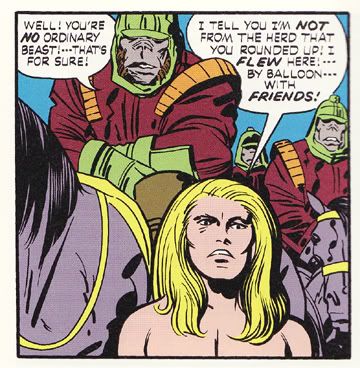
It’s not until #3 that the Planet of the Apes similarities fully emerge as roughneck gorillas (are there any other kind?) in green hunting caps and purple jumpsuits capture Kamandi. The cover blurbs come backing more hyperbolic bombast than a decade’s worth of today’s comics:

Welcome to a buried Las Vegas! Once a playground for men – now, a sinister hunting ground for gorillas!

So the apocalypse didn’t change much. And then this:

Complete in this issue! “The Thing That Grew on the Moon!”

A thing! And it grew… on the moon! As if the loincloth-sporting gorilla on the cover wasn’t enticement enough. Comics today could use more of this kind of cover copy-- at once hucksterish and tongue-in-cheek, and instantly appealing.

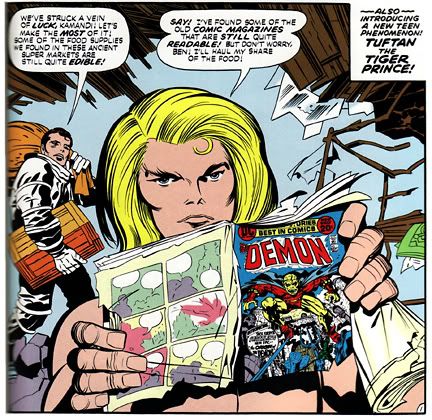
Who says this isn't the Age of
Kirby Self-Promotion? Kirby
works in a little plug for another
of his comics. "Quite readable,"
Kamandi? Quite readable indeed!

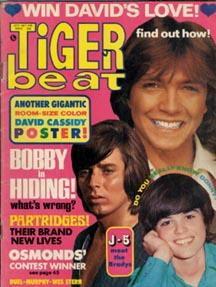
I think Kirby may have had bigger plans for Tuftan, the Tiger Prince. He comes on the scene in #4, heralded by a splash page text box labeling him a “new teen phenomenon.” I’m not sure if Kirby means Tuftan is a teenager (and more to the point, a tiger), or that he hopes Tuftan catches on with 70s teens the way David Cassidy and his half-brother Sean did, or Kristy McNichol, or skateboarding, or discotheques or feathered hair. After all, the kids loved Tiger Beat magazine; how could they not love Tiger Prince?

In the post-apocalyptic future,
half-naked neo-hippies will frolic
with headband and loincloth wearing
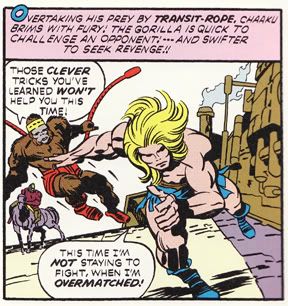
gorillas on transit ropes!

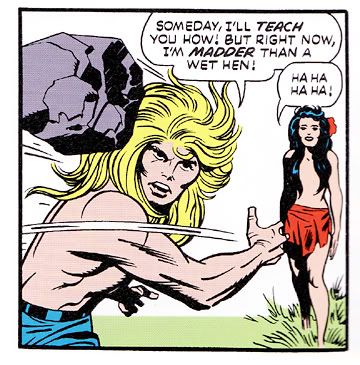
Kamandi and Tuftan get caught between the warring tiger and gorilla armies, and Kamandi gains a talking human girlfriend named Flower… who shamelessly goes around shirtless! Which is only fair, since Kamandi also flaunts bare-chestedness. Flower’s hair gives her some Lady Godiva-style modesty but Kirby’s notion of upper-body nudity is amazingly egalitarian.

In Kirby's future anyone may go
topless without shame! Viva la difference!

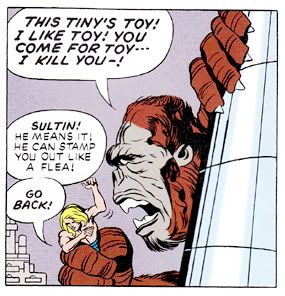
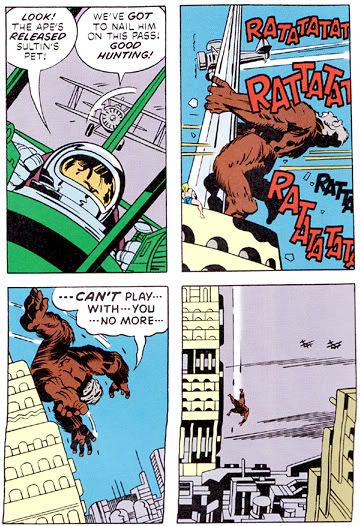
Almost as soon as Kirby establishes the romance between Kamandi and Flower and hints at the eventual reestablishment of some sort of humancentric society, tragedy strikes our young lovers. Kirby examines its aftermath in Kamandi #7, with a chapter intriguingly titled “The United States of Lions." Surprisingly, it has little if anything to do with unions, states and only tangentially features lions. Beginning with a funeral and ending with a skyscraper battle, it's actually Kirby’s parody of King Kong, substituting a massive gorilla; Kong’s equal in stature but superior in conversational skill.

And that’s just a quick overview of the first seven issues! I’m too exhausted to tell you all the details about the last three in this book, in which we visit “Tracking Site,” battle the savage flying bats and the freakish, sinister homunculus who dwells there, intent on unleashing a world-ending bacterium for some obscure reason Kirby can barely take time to explain to us in the breathless rush of his futuristic narrative.

Chapter Two: The Waiting Secret!!

If you haven't guessed by now, Kirby goes pretty far afield, given the series’ original mandate. And while Kirby wasn’t above rehashing classic movie plots he never failed to add twists the original wouldn’t dare. Imagine how insane Beneath the Planet of the Apes would’ve been if, instead of skinless mutants, the gorilla army had encountered talking lions on three-wheelers.

While suffering from an over-reliance on capture, escape and evasion plotting (it becomes repetitive), Kamandi is a sterling example of Kirby’s off-the-wall and unrestrained storytelling, honed over decades of professional work. While he may not have been as interested in the book as he was in his New Gods, the fact remains the man just could not half-ass things even if he tried.

Who else would engineer an entire future Earth, populate it with talking animals of nearly every species, continually hint at a central mystery that unravels intermittently throughout the adventures and introduce brand new characters practically on a page-by-page basis?

From reading these, I can’t help but see Kirby as a mostly intuitive storyteller. Certainly the man was a sponge, soaking in bits of science, legend and myth, and good old Hollywood movies; all of this he'd combine and alter to suit his story needs. Mike Evanier's recollections give me the impression Kirby would frequently come up with a particular direction for a story... then produce something almost totally counter to his original intent. Creating on the fly, always bubbling over with ideas. With that in mind, I don’t see an overall plan here, just incidents piled on incidents.

Groovy incidents. With the intent to entertain the bejeezus out of anyone who buys Kamandi.

And while Kirby may never have written the Great American Novel, it’s probably no accident Kamandi’s adventures take place in the western regions of the former United States. As soon as he departs his underground bunker near New York, Kamandi becomes the classic American pilgrim, sojourning in locales near Las Vegas, Yellowstone Park, even ranging as far as South America in a tip of the hat to Butch Cassidy and his partner in crime, the Sundance Kid.

From James Fenimore Cooper to Mark Twain and Brett Hart, to the relatively more recent Jack Kerouac and Thomas Berger plus many others, American novels frequently explore western migration as related to rugged individualism, which Kamandi certainly personifies. In fact, this is probably the most important defining traits of what we characterize as American literature, at least in the 19th century, and much of the 20th.

The west is the quintessential setting for American literature, with Kamandi the descendant of Huckleberry Finn by way of Col. George Taylor. And like Huck, and Berger’s Jack Crabb, Kamandi rebels against unjust societal expectations, cannot tolerate a life in either literal or figurative captivity. He must remain in motion, forever restless, the personification of our nation in its youth. Unable to relate to most surviving humans, Kamandi remains apart from each culture he encounters. Kirby reinforces this by repeatedly separating Kamandi from Ben Boxer's scientists and having Kamandi assert his human identity and equality to his animal overlords who insist on treating him condescendingly as either a pet, a mascot or an enemy.

As science fiction, technological themes abound in Kamandi, but these are traditionally conflated with western ones in more mainstream American literature as well. While Cooper might bog down the narrative of his 1823 novel The Pioneers to describe a stove in almost Luciferian terms, Kirby, the once and future king of his four-color milieu, creates bizarre flying vehicles and war machines with a gestural whim, yet never slackens the story's pace.

The series has a strange dichotomy-- for humans, advanced technology is of the past, and there’s a nostalgia for what humanity has lost, but along with it, an implied criticism of the queasy, mindless consumerism and complacency that led to this outcome in Kirby’s use of imagery featuring the detritus of a lost civilization: familiar shopping mall signage and weathered sculptures of American presidents (even significantly including one of Richard M. Nixon, never a Kirby favorite) whose identities have been lost to history.

Still, in order to reclaim mastery over the world, which Kamandi sees as a human birthright, he must solve these archaeological mysteries. To this end, Ben Boxer and his scientific comrades are forever seeking the lost “Apollo Project” in an effort to understand this disordered reality.

And while technology is used to destroy (being a Kirby action-fest, violence and weapons-based imagery predominate), there’s also a hopeful quality. If one can defeat the barbarian bat-creatures and the horrific human-created bacterium that can kill all life… one might at the very least, as in "The United States of Lions," find a peaceful place where one might belong.

If, that is, Kamandi can overcome his temper and tendency towards violence. Then again, to Kirby these were also human qualities. To create and destroy, our recurring pattern, even among animals with anthropomorphic qualities. Kamandi lives in a world ruled by violence, both casual and institutionalized- rowdy fistfights, warfare and gladitorial games coexist. Kirby might remind us these, too, are human inventions.

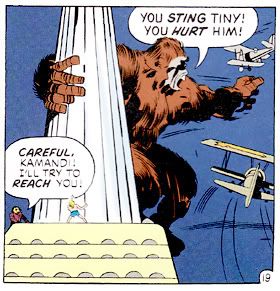
Kirby does Kong. Get Peter
Jackson on the phone! We need
an epic Kamandi movie!

Franklin Schaffner never thought
to put his apes in biplanes, but it
would've been cool if he did. These
are actually lions. Lions in biplanes,
attacking a giant, talking ape who
calls himself Tiny. God, we need
another Jack Kirby.

Chapter Three: The Monster Fetish!

We’re lucky enough of the art exists for DC to gather it all into this hefty and cleanly-designed hardcover. We can enjoy its prime Kirbyness, where his stylistic flourishes, unhindered by the slick ink work from Joe Sinnott at Marvel and the scratchy, unfinished line of Vince Colletta at DC, erupt. Kirby's use of splashes backed by innovative gutter-crossing double spreads on pages 2 and 3 gives the stories a wide-screen feel, opening up the scope and dazzling the reader with Cineramic imagery like a ruined Nevada town, preserved for animal archaeologists by the dry desert air, an Ozymandian image at once humorous and melancholy.

Sic semper Tiny! "Can't play---
with --- you --- no more." He's not
even angry at the lions who killed him.
Isn't that the saddest comic panel ever?

In the Kamandi Archives reprint, the blacks are crisp, the colors smooth. The reconstruction is akin to looking at a restored print of a Cecil B. DeMille epic. These stories were originally printed on grey-toned newsprint which almost immediately began to yellow. And they featured line screens that were practically planet-sized compared to today’s. Now we can see the art on glossy white, with screens so fine they allow the color fields to appear as smooth, flat areas. While this takes away some of the immediacy and ephemeral quality of the originals, it allows us to study the line work unobscured by cheap paper and indifferent printing.

This is especially educational because Mike Royer’s inks always bring out the Kirbyness of Jack Kirby’s pencils. From interviews I’ve read with Royer in the Jack Kirby Collector (a product of the wonderfully nice people at TwoMorrows), it seems his intent was always to preserve the pencils as much as possible. I love this approach, because the attraction of a Kirby comic is its uniqueness. He’s oft-imitated, but no one has ever fully captured the intangibles of the true Kirby.

The most others can do is provide the bombast and overkill, without the humane qualities. Kirby strikes me as having a genuine love for people, be they the shirtless, blonde hippie kid type or the kind hidden in an animal’s fur and sinew.

Monday, May 23, 2011

Prinprin Monogatari!


I'd been looking for this for months. When I lived in Japan, I'd occasionally find this airing in the mornings or early afternoons on Cartoon Network. It's a puppet/marionette show called Prinprin Monogatari (or Purinpurin Monogatari). It originally aired on NHK in the early 1980s and has a gentle Mr. Rogers' Neighborhood feel. All I know about it beyond that is the characters would sometimes ride around in a Jeep.